Eraldo Rezende Fernandes
∗ Instituto Federal de Goi´asC´ıcero Nogueira dos Santos
∗∗ Brazilian Research LabIBM Research
Ruy Luiz Milidi ´u
† PUC-RioWe describe a structure learning system for unrestricted coreference resolution that explores two key modeling techniques: latent coreference trees and automatic entropy-guided feature induction. The latent tree modeling makes the learning problem computationally feasible be-cause it incorporates a meaningful hidden structure. Additionally, using an automatic feature induction method, we can efficiently build enhanced nonlinear models using linear model learn-ing algorithms. We present empirical results that highlight the contribution of each modellearn-ing technique used in the proposed system. Empirical evaluation is performed on the multilingual unrestricted coreference CoNLL-2012 Shared Task data sets, which comprise three languages: Arabic, Chinese, and English. We apply the same system to all languages, except for minor adaptations to some language-dependent features such as nested mentions and specific static pronoun lists. A previous version of this system was submitted to the CoNLL-2012 Shared Task closed track, achieving an official score of58.69, the best among the competitors. The unique enhancement added to the current system version is the inclusion of candidate arcs linking nested mentions for the Chinese language. By including such arcs, the score increases by almost 4.5 points for that language. The current system shows a score of60.15, which corresponds to a
3.5%error reduction, and is the best performing system for each of the three languages.
1. Introduction
Mentions are textual references to real-world entities or events. In a given document, mentions that refer to the same entity are calledcoreferring mentionsand form a men-tion cluster. Coreference resolumen-tion is the task of identifying the menmen-tion clusters in a document and has been a core research topic in natural language processing. It has wide applications in question answering, machine translation, automatic summarization, and information extraction. Coreference resolution systems have been evaluated for
∗E-mail:[email protected]. This work was developed when the first author was at PUC-Rio.
∗∗E-mail:[email protected].
†E-mail:[email protected].
Submission received: 5 February 2013; revised submission received: 22 December 2013; accepted for publication: 5 January 2014.
several decades, beginning with MUC-6 (Sundheim and Grishman 1995). Following those evaluation efforts, the CoNLL-2011 Shared Task (Pradhan et al. 2011) has been dedicated to the modeling of unrestricted coreference resolution for English text. The CoNLL-2012 Shared Task (Pradhan et al. 2012) extends the task to a multilingual scope, considering three languages: Arabic, Chinese, and English.
A singleton is a mention cluster containing exactly one mention. The unrestricted coreference resolution task consists of identifying the non-singleton mention clusters in a document. This task is usually split into three subtasks: mention detection, mention clustering, and singleton elimination. In Figure 1, we present an illustrative example. First, ten mentions are detected and shown in bold. They are sequentially tagged with the numbers 1, 2,. . ., 10. Next, four mention clusters are identified by tagging each men-tion with one of the tagsa,b,c,dto indicate its cluster, wherea={1, 2, 8, 9},b={3, 7},
c={4, 5, 6},d={10}are the four mention clusters. Finally, clusters that contain only one mention are ignored, such as the one with Iran as its unique mention. In this example, we ignore some noun phrases in the mention detection subtask to simplify the illustration.
The final subtask is trivial, given the solution of the previous one. For the first subtask, several specific heuristics have been proposed, enabling the construction of high-recall mention detectors. The second subtask is harder, as it requires a complex output. Most of the current effort toward solving the coreference resolution task is focused on the mention clustering subtask.
Here, we propose an approach to unrestricted coreference resolution that is based on two key modeling techniques: latent coreference trees and entropy-guided feature induction. Our approach is based on a graph whose nodes are the mentions in the given document. The arcs of this graph link mention pairs that are coreferent candidates. The resulting structure predictor has similar steps for training and testing.
Predictor training can be summarized as follows:
1. Mention Detection– where we build a graph node for each mention by adapting a predictor proposed by dos Santos and Carvalho (2011);
2. Candidate Pair Generation– where we add a directed arc for each candidate coreferent mention pair by adapting the sieves proposed by Lee et al. (2013);
1.Mention Detection
North Korea1openedits2doors to theU.S.3today, welcomingSecretary of State Madeleine Albright4.She5 saysher6visit is a good start. TheU.S.7remains concerned aboutNorth Korea’s8missile development program andits9exports of missiles toIran10.
2.Mention Clustering
North Koreaaopeneditsadoors to theU.S.btoday, welcomingSecretary of State Madeleine Albrightc.Shecsays
hercvisit is a good start. TheU.S.bremains concerned aboutNorth Korea’samissile development program and
itsaexports of missiles toIrand.
3.Singleton Elimination
North Koreaaopeneditsadoors to theU.S.btoday, welcomingSecretary of State Madeleine Albrightc.Shecsays
hercvisit is a good start. TheU.S.bremains concerned aboutNorth Korea’samissile development program and itsaexports of missiles to Iran.
Figure 1
3. Basic Feature Setting– where we set basic features that indicate whether an arc is likely to be connecting a coreferent pair by adapting the features used by dos Santos and Carvalho (2011);
4. Context Feature Induction– where we conjoin basic features to generate complex features with high discriminating power by means of the entropy-guided feature induction method proposed by Fernandes and Milidi ´u (2012) and Milidi ´u, dos Santos, and Duarte (2008); and
5. Coreference Tree Learning– where we learn how to extract the trees that connect coreferent mentions in the graph of mentions by applying a large margin latent perceptron structure learning algorithm.
To provide features with high predicting power to our model, we useentropy-guided feature induction. Using this mechanism, we automatically generate several feature templates that capture coreference-specific local context knowledge. Furthermore, this feature induction mechanism extends the structured perceptron framework by providing an efficient general method to build strong nonlinear classifiers.
Predictor testing uses the same first three steps as in predictor training, followed by three further steps:
4. Context Feature Setting– where we set the values of the additional induced features selected at training;
5. Coreference Tree Prediction– where we apply the Chu-Liu-Edmonds algorithm to solve an optimal branching problem to find the maximum score coreference trees; and
6. Coreference Cluster Extraction– where we extract the clusters of coreferring mentions from the coreference trees.
For the Coreference Tree Prediction step, we solve an optimal branching problem to find the maximum score coreference trees. This process is efficiently performed by the Chu-Liu-Edmonds algorithm (Chu and Liu 1965; Edmonds 1967). A tree score is simply the sum of its arc scores, which are given by a weighted sum of the arc features. The feature weights are learned during training in the Coreference Tree Learning step, which is based on the structured perceptron algorithm. Because coreference trees are not given in the training data, we assume that these structures arelatentand use the latent structured perceptron (Sun et al. 2009; Yu and Joachims 2009) as the learning algorithm. In fact, we use a large margin extension of this algorithm (Fernandes and Brefeld 2011). The Coreference Cluster Extraction step is trivial by construction because its input is a set of coreference trees. Each coreference tree corresponds to a cluster of coreferring mentions.
Due to the different application set-ups for coreference resolution as a subtask, multiple metrics have been proposed for evaluating coreference performance. No single metric is clearly superior to the others. We follow the CoNLL-2012 Shared Task evalua-tion scheme, adopting the unweighted average of the MUC, B3, and CEAFemetrics. We
also use the multilingual data sets provided in the CoNLL-2012 Shared Task to assess our system. The official ranking for this task is given by the mean of the system scores on three languages: Arabic, Chinese, and English.
when creating candidate mentions. Therefore, it does not resolve coreferences involving events. We participated in the CoNLL-2012 Shared Task with a previous version of our system (Fernandes, dos Santos, and Milidi ´u 2012). The system submitted to this task achieved scores of 54.22, 58.49, and 63.37 on the Arabic, Chinese, and English test sets, respectively. Its official score is thus 58.69, which is the best among the competitors. Later, we extended this system by including candidate arcs linkingnestedmentions for the Chinese language. This version shows an official score of 60.15, corresponding to a 1.46 point absolute improvement or a 3.5% error reduction. As far as we know, this is currently the best performing system on the CoNLL-2012 Shared Task Arabic, Chinese, and English test sets.
The remainder of this article is organized as follows. In Section 2, we review related work. In Section 3, we detail our approach to the mention detection subtask. In Section 4, we describe coreference trees, a key element in solving the mention clustering subtask in our system. We also examine the coreference tree prediction problem. In Section 5, we detail the entropy-guided feature induction method and its application to coreference resolution. In Section 6, we describe the large margin latent structured perceptron that we use to learn the coreference trees. In Section 7, we present our experimental setting. The experimental findings are provided in Section 8. Finally, in Section 9, we present our concluding remarks.
2. Related Work
Over the last two decades, many different machine learning–based approaches to co-reference resolution have been proposed. Most of them use supervised learning and divide the task into two phases: the detection of potential mentions and the linking of mentions to form coreference chains, that is, mention clustering. In Ng (2010), the author presents a detailed review of supervised approaches to coreference resolution.
Many works that report results for the MUC-6 corpus (Sundheim and Grishman 1995) and the Automated Content Extraction (ACE) corpus (Doddington et al. 2004) use gold mention boundaries and, hence, do not address the mention detection task (Culotta, Wick, and Mccallum 2007; Finkel and Manning 2008; Poon and Domingos 2008; Haghighi and Klein 2009). Most of the works that perform mention detection use a set of heuristics. The common approach consists of extracting all noun phrases from the parse tree and considering them to be candidate mentions (Soon, Ng, and Lim 2001; dos Santos and Carvalho 2011; Haghighi and Klein 2010; Stoyanov et al. 2010; Chang et al. 2011; Bansal and Klein 2012; Lee et al. 2013; Sapena, Padr ´o, and Turmo 2013). A few works approach the mention detection task by training classifiers (Bengtson and Roth 2008; Yuan et al. 2012). For the CoNLL data sets, training mention detectors is not a suitable approach because singleton mentions are not annotated in this corpus. Systems trained and tested with these data sets frequently privilege mention recall over precision (Chang et al. 2011; Lee et al. 2011; Sapena, Padr ´o, and Turmo 2011). Therefore, these systems usually extract noun phrases that are not identified in the parse tree. This strategy increases consistency with the corpus annotation (Chang et al. 2011; Sapena, Padr ´o, and Turmo 2011; Bj ¨orkelund and Farkas 2012; Lee et al. 2013). The system proposed in this work uses a rule-based approach to mention detection, which is similar to previous work with the CoNLL data sets (dos Santos and Carvalho 2011).
Poesio 2012). In this strategy, a preprocessing step is used to generate pairs of candidate coreferring mentions. In the training phase, it is necessary to generate positive and negative examples of coreferring pairs. For this purpose, the approach proposed by Soon, Ng, and Lim (2001) is normally used. For instance, in the CoNLL 2011 Shared Task (Pradhan et al. 2011), 11 of the 18 machine learning–based participant systems used Soon, Ng, and Lim’s approach or a variation of it. In the classification phase, each candidate pair of mentions is classified as coreferring or not, using the classifier learned from the annotated corpus. When using the mention-pair approach, a linking step is necessary to remove inconsistencies that would result from the pairwise classifications and to construct a partition on the set of mentions. An aggressive strategy for this last step consists of merging each mention with all preceding mentions that are classified as coreferent with it (McCarthy and Lehnert 1995; dos Santos and Carvalho 2011). More sophisticated strategies, such as inference methods, have also been proposed (Bengtson and Roth 2008; Chang et al. 2011). One of the main disadvantages of the mention-pair classification approach is the lack of global information. Moreover, the lack of information on the clusters already formed can lead to contradictory links.
Methods have been proposed to overcome the limitations of mention-pair classifica-tion. Entity-mention models address the lack of information about the clusters already formed by seeking to classify whether a mention is coreferent with a preceding cluster (Luo et al. 2004; McCallum and Wellner 2005; Culotta, Wick, and Mccallum 2007; Yang et al. 2008). While entity-mention models have the advantage of allowing the creation of cluster-level features, they fail to identify the most probable candidate antecedent, just as the mention-pair classification approach does. Ranking models address this issue by directly comparing different candidate antecedents for the mention part of the training criterion (Yang et al. 2003; Yang, Su, and Tan 2008; Denis and Baldridge 2008). However, ranking models are unable to exploit cluster-level features. An approach that combines the advantages of entity-mention and ranking models was proposed by Rahman and Ng (2009). Their method, the cluster-ranking model, ranks preceding clusters rather than candidate antecedents, thereby enabling the use of cluster-level features.
Global inference methods that combine classification and clustering in one step have also been proposed. Cai and Strube (2010), Cai, Mujdricza-Maydt, and Strube (2011) and Sapena, Padr ´o, and Turmo (2013) present systems that implement global de-cision via hypergraph partitioning. Whereas Cai and Strube (2010) and Cai, Mujdricza-Maydt, and Strube (2011) use a spectral clustering algorithm to perform hypergraph partitioning, Sapena, Padr ´o, and Turmo (2013) use relaxation labeling for the resolution process. There are also approaches that perform global inference using integer linear programming to enforce consistency on the extracted coreference chains (Denis and Baldridge 2007; Klenner 2007; Finkel and Manning 2008).
nor cataphoric relation. Mention 1 is an antecedent of mention 2; mention 8 is an antecedent of mention 9; and mentions 1 and 8 are obviously coreferent. Hence, these two pronouns can be predicted as coreferent only by transitionbetween other direct references. By using trees, the natural hierarchy of coreference dependencies is better modeled.
The model proposed by Yu and Joachims (2009) is highly related to ours because it is also based on latent trees. However, they useundirectedtrees to represent clusters, whereas we use directed trees. This difference is most likely not very significant, but we think that most coreference dependencies are directed relations. Using the example from Figure 1 again, we can see that mention 2 is a reference to mention 1 and not the other way around. By using directed trees, we model coreference dependencies, such as the dependencies between nouns and pronouns referring to the same entity. Other differences between Yu and Joachims (2009) and our work are that they do not use an artificial root node and, moreover, that their empirical evaluation is based on the MUC-6 task (Sundheim and Grishman 1995), whereas ours is based on the CoNLL-2012 Shared Task. The CoNLL-CoNLL-2012 Shared Task considers multilingual unrestricted coreference resolution. It defines a more general task than the one proposed by the MUC-6, as the annotated mentions in OntoNotes cover entities and events not limited to noun phrases or a limited set of entity types (Pradhan et al. 2011).
One key contribution of our work is the application of entropy-guided feature induction to coreference resolution, which we experimentally demonstrate as highly effective. There are someon-linemethods (della Pietra, della Pietra, and Lafferty 1997; McCallum 2003) that perform feature induction within the learning algorithm. These methods choose among candidate features by evaluating their impact on performance along with the learning process. Our method isoff-line. In this case, feature induction is performed by an efficient procedure before the training step. Off-line methods have two main advantages over on-line ones: (i) they are usually faster, as inducing features dur-ing traindur-ing requires substantially more learndur-ing iterations; and (ii) there is not a need to modify the learning algorithm, so we can use it as is. The proposed method extends the automatic template generation strategy proposed in Entropy-Guided Transformation Learning (dos Santos and Milidi ´u 2009) to structure learning. This strategy has been previously applied to the English unrestricted coreference resolution task (dos Santos and Carvalho 2011). However, this previous work is based on a completely different task modeling and a different learning algorithm.
3. Mention Detection
The first subtask in coreference resolution, mention detection, is formally solved by an auxiliary predictorAgiven by
m mm=A(ddd)
wheremmmis the list of detected mentions in the given documentddd. Singleton mentions are not annotated in the CoNLL-2012 data sets. Hence, a specific noun phrase may be annotated as a mention in one document but not in another document due to the absence of coreferring mentions in the latter. Therefore, machine learning–based mention detectors are difficult to build in this case.
Carvalho 2011). For a given documentddd, this predictor generates a listmmmof candidate mentions by including the following items:
1. noun phrases from the provided parse tree;
2. pronouns, even when they appear inside larger noun phrases;
3. named entities in the categories Person (PERSON), Organization (ORG), and Geo-Political Entity (GPE), even when they appear inside larger noun phrases;
4. and possessive marks, to better align with the CoNLL-2012 annotated mentions.
If a mention is not detected in this step, our system is not able to resolve references to that mention. Toward this goal, we define a set of rules that rely mainly on the use of parse tree information and that privilege recall over precision. Note that rules 2, 3, and 4 have the effect of expanding the set of extracted noun phrases, thereby aligning the set of detected mentions more fully with the CoNLL-2012 annotated mentions. Note also that all but the fourth rule are language independent. The fourth rule is used for the English language only. This set of rules can be further improved by including rules that contain language-specific knowledge. For instance, Lee et al. (2013) use rules to remove occurrences of pleonastic it, as in It is possible that and
It seems that.
The CoNLL-2012 Shared Task data sets also include coreferring mentions of events. However, the current version of our system does not consider verbs when creating candidate mentions and therefore does not resolve coreferences involving events.
4. Mention Clustering
In the mention clustering subtask, we must find a structure predictorFthat assigns to its inputxxxa high-quality mention clustering ˆyyygiven by
ˆ
yyy=F(xxx)
wherexxx=(ddd,mmm), withddda new unlabeled document andmmmits corresponding mention set.
In machine learning–based predictors, we learnFfrom a training setD={(xxx,yyy)}of correct input–output pairs. More specifically, the structured perceptron algorithm learns the weight vectorwwwof a parameterized predictor given by
ˆ
yyy=F(xxx;www)=arg max
yyy∈Y(xxx)s(xxx,yyy;www),
whereY(xxx) is the set of feasible outputs forxxx, that is, all clusterings over the detected mentions mmm in xxx, and s is a www-parameterized scoring function over the clusterings. The prediction ˆyyyis the solution of an optimization problem and is called theprediction problem. The objective function of this problem is given bys, and it scores the candidate clusterings for the given document.
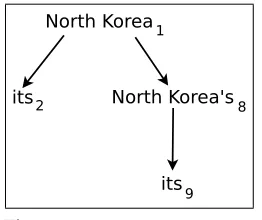
represent strong coreference relations between mentions. To illustrate this concept, we use the labeled document in Figure 1. In Figure 2, we present a plausible coreference tree for the{1, 2, 8, 9}mention cluster.
We are not concerned about the semantics underlying coreference trees because they are simply auxiliary structures for the clustering task. Nevertheless, we have two arguments to justify the application of these structures. First, the concept is linguisti-cally plausible because there is a dependency relation between coreferring mentions. Based on the aforementioned example, it may be observed that mention 8 (North Ko-rea’s) is indeed more likely to be associated with mention 1 (North Korea) than with mention 2 (its), even considering that, in the text, mention 8 is closer to mention 2 than to mention 1. Hence, the coreference trees should capture this dependency structure. Second, the concept is algorithmically plausible because most hierarchical clustering methods incrementally link an unclustered mention to a previous cluster. This operation can be viewed as adding a directed arc from the mention to its clos-est cluster member. We use a data set to learn a scoring function that captures the strength of the coreference relation between two mentions. This scoring function on the arcs guides the construction of the coreference trees with the largest aggregate scores.
This modeling approach is closely related to the one proposed by Yu and Joachims (2009). However, Yu and Joachims use undirected spanning trees instead of directed ones. We think that directed trees are more appropriate for use in coreference resolution to represent dependencies between mentions. Recalling the example from Figure 2, it is clear that mention 2 (its) is a reference to mention 1 (North Korea), not the other way around. Hence, there is indeed a direction related to the dependency between a pair of coreferring mentions.
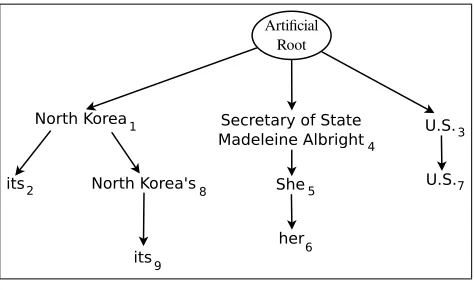
For a whole document comprising certain coreferring clusters, we have a forest of coreference trees, one tree for each cluster. Hence, for the sake of simplicity, we link the root node of every coreference tree to anartificialroot node, obtaining thedocument tree. In Figure 3, we depict a document tree for the current example.
Finally, it is important to remark that from a document tree, one can easily generate a mention clustering as follows:
1. remove the artificial root node and all its outgoing arcs, splitting the document tree into a forest;
2. from each tree in the resulting forest, output its node set as a mention cluster.
North Korea
its North Korea's
its 1
2 8
[image:8.486.47.178.531.641.2]9
Figure 2
Artificial Root
Secretary of State Madeleine Albright
She
her North Korea
its North Korea's
its
1
2 8
9
4
5
6
U.S.
U.S.
3
[image:9.486.54.291.62.207.2]7
Figure 3
Document tree with artificial root node and its three coreference subtrees.
Hence, coreference trees provide a powerful auxiliary structure for solving the mention clustering subtask. Formally, we decompose the original predictor into two predictors, as follows:
F(xxx)≡Fy(Fh(xxx))
where Fy(hhh) is the straightforward two-step procedure described here to generate a
mention clustering from a document treehhh, andFh(xxx) is thedocument tree predictor, which
is defined as
ˆ
hˆ
hhˆ=Fh(xxx)=arg max
h∈H(xxx)hwww,ΦΦΦ(xxx,hhh)i
withH(xxx) defined as the set of feasible document trees for the mentions inxxxandΦΦΦ(xxx,hhh) as the joint feature vector representation ofxxxand document treehhh.
The document tree predictorFh(xxx) finds a maximum scoring rooted tree over the
feasible document trees for mentions inxxx. A tree score is given by a linear function over its features. To understand how this predictor works, we must define the setH(xxx) of feasible document trees, the feature vectorΦΦΦ(xxx,hhh), and the algorithm that solves the arg max combinatorial problem.
The trees in H(xxx) are subgraphs of the directed graph G(xxx), which is called the
candidate pairs graph. Therefore, we must describe how to build the nodes and the directed arcs of this graph. The inputxxx=(ddd,mmm) provides mmm, the list of mentions in documentddd. For each mention inmmm, a node is created in G(xxx). Thus, an arc in G(xxx) connects a pair of mentions inxxx. Ideally, we would consider the complete graph for each document. However, because the number of mentions may be large and because most mention pairs are not coreferent, we filter the arcs simply by using sieves from the method proposed by Lee et al. (2013) for English coreference resolution. To further reduce the total number of arcs, we only consider forward arcs, which means that a directed arc (i,j) from mentionito mentionjis only included inG(xxx) ifiappears before
the correct clusteryyycan be disconnected inG(xxx). In such a case, the correct prediction of
yyyis impossible. However, such cases are rare, given that the recall of the used sieves is approximately 90%. To completeG(xxx), we add anartificial root nodeand connect it to each mention inxxx. These extra arcs are theartificial arcs, and under the current setting, they also point to the first mention in a cluster. Hence, we can learn how to use them to control the number of mention clusters.
The next predictor ingredient to be defined is the feature vectorΦΦΦ(xxx,hhh). This vector is linearly decomposed as
Φ Φ
Φ(xxx,hhh)=X e∈hhh
Φ Φ Φ(xxx,e)
where e=(i,j) is a directed arc in hhh linking mention i to mention j, and ΦΦΦ(xxx,e)=
(φ1(xxx,e),. . .,φM(xxx,e)) is a feature vector that describese. Each of these features helps to identify whetheriandjare coreferent or not. To define these features, we utilize the entropy-guided feature induction method described in the next section.
Our coreference resolution approach is similar to previous structure learning ap-proaches for dependency parsing (McDonald, Crammer, and Pereira 2005; Fernandes and Milidi ´u 2012). Thus, the arg max combinatorial problem reduces to a maximum branching problem, which can be efficiently solved using the Chu-Liu-Edmonds algo-rithm (Chu and Liu 1965; Edmonds 1967).
5. Entropy-Guided Feature Induction
The CoNLL-2012 Shared Task data sets include features that are either naturally present in documents, such as words, or automatically generated by external systems, such as POS tags and named entities information. We call this information provided by the data sets basic features. At the same time, most structure learning algorithms are based on linear models, as such algorithms have strong theoretical guarantees regarding their prediction performance and, moreover, are computationally efficient. However, linear models using basic features alone do not capture enough information to effectively represent coreference dependencies. Conjoining basic features to derive new features is a common way to introduce nonlinear contextual patterns into linear models.
The entropy-guided feature induction (EFI) method automatically derives a set of basic feature conjunctions, which we callfeature templates. These templates are later used to generate thederived features, which comprise the input feature vectorsΦΦΦ(xxx,e) used in the structured modeling described in the previous sections.
EFI conjoins the basic features that are useful to predict whether the mentions linked by an arc are coreferring. To solve this auxiliary binary classification problem, we derive a new set of data sets from the original one. Using all arcs in each of the candidate pair graphs, we obtain thearc data set D={(ΨΨΨ(e),c(e))}, comprising the arc basic feature vectorsΨΨΨ(e) along with their binary classificationc(e). In Table 1, we depict an example of such a data set for the document in Figure 1. This example includes the following features: i-head is the head word of mention i; i-pos is the head POS tag of mention i; j-headis the head word of mention j; j-pos is the head POS tag of mentionj;sameNEindicates whether both mentions have the same named entity type; anddistis the number of mentions in the document text that occur between mentions
Table 1
Arc data set with some arcs from the document in Figure 1.
e ΨΨΨ(e)
c(e)
i j i-head i-pos j-head j-pos sameNE dist
1 2 Korea Noun its Pronoun N 0 1
1 3 Korea Noun U.S. Noun Y 1 0
2 4 its Pronoun Secretary Noun N 1 0
1 9 Korea Noun its Pronoun N 7 1
The EFI method automatically generates feature templates for a structure learning problem by conjoining basic features that are highly discriminative. This method is based on the conditional entropy of arc labelc(e) given the basic featuresΨΨΨ(e).
The first step of the proposed method is to train a decision tree on the arc data set. The decision variable indicates whether the arc links two coreferring mentions. We use the arcs of all training examples; that is, for each training document, we generate an example for each candidate arc. Thus, the learned decision tree (DT) predicts whether the mentions linked by an arc are coreferring. In Figure 4, we present a decision tree learned from an arc data set. Eachinternal node in the DT corresponds to a feature; eachleafnode has a label value (0 or 1, in the binary case); and each arc is labeled with a value of the source node feature. Note that in this sample DT, we suppress several possible feature values to simplify the presentation.
The most popular decision tree learning algorithms use the Gain Ratio to select the most informative feature (Quinlan 1992; Su and Zhang 2006). The Gain Ratio is simply a normalized version of the information gain measure. Hence, these algorithms provide a quick way to obtain entropy-guided feature selection. We propose a new automatic feature generation method for structure learning algorithms. The key idea is to use decision tree induction to conjoin the basic features. One of the most frequently used algorithms for DT induction is C4.5 (Quinlan 1992). We use Quinlan’s C4.5 system to obtain the required entropy-guided selected features.
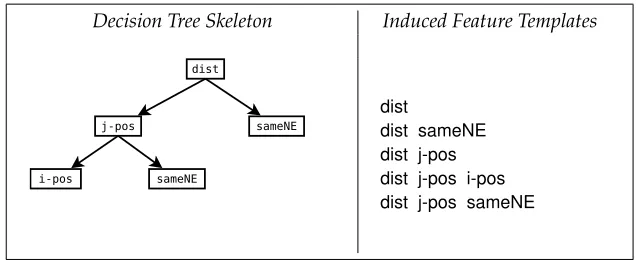
Our method uses a very simple scheme to extract feature templates. We consider all partial paths starting at the root node. For each path, a template is created by conjoining all of its node features. Because we aim to generate featuretemplates—conjunctions of basic features that do not include feature values—we ignore the feature values and the decision variable values in the DT. Thus, we do not use arc labels or leaf nodes. Figure 5 illustrates our method. The tree in the left side of this figure is the skeleton obtained from the decision tree in Figure 4 by discarding the aforementioned pieces of information.
dist
j-pos sameNE
i-pos sameNE
Noun Verb
1 0 1 0
1 0
Y
Y
N
N Noun Verb
[image:11.486.54.214.532.655.2]1 2
Decision Tree Skeleton Induced Feature Templates
dist
j-pos sameNE
i-pos sameNE
dist
[image:12.486.81.399.62.196.2]dist sameNE dist j-pos dist j-pos i-pos dist j-pos sameNE
Figure 5
Feature template induction from a decision tree.
Its nodes are basic features with high discriminative power. The generated templates are listed on the right side of the figure. In other words, we create a template with the features in each path from the root node to every other internal node in the given decision tree. Additionally, we eliminate duplicate templates.
Because C4.5 greedily chooses the feature with the highest information ratio at each step, our method generates feature templates with high discriminative power based on entropy. This method can provide a very large number of templates. Hence, to limit the maximum template length, we use C4.5 pruned trees and limit the maximum template length when traversing the DT. This parameter is clearly task-dependent and must be calibrated by cross-validation or on a development set.
Finally, we utilize the generated templates to induce thebinarycontextual features that occur in the structured data set D. For each template, we generate many binary features. These derived features comprise the structured model feature vectorsΦΦΦ(xxx,e)=
(φ1(xxx,e),. . .,φM(xxx,e)). For instance, one of the derived features for the template dist j-pos sameNEis given by
φm(xxx,e)=
(
1 ifdist=2andj-pos=NounandsameNE=N, 0 otherwise.
Note that this feature captures a context that is not used by the DT in Figure 4. Indeed, we eliminate the DT feature values when generating the templates and then instantiate these templates based on every context that occurs in a training example.
Thus, the derived feature vectorΦΦΦ(xxx,e) is a binary vector whose 1-valued positions indicate the derived features that areactivein arce. These active derived features depend on the values of the basic featuresΨΨΨ(e). The number of derived featuresMis very large because several combinations of basic feature values arise for each template. However, the number of active derived features in a specific arc is much smaller. In fact, for each arc, there is one active derived feature for each template; all others are set to zero.
6. Large Margin Latent Tree Learning
In our learning set-up for the mention clustering subtask, we are given a training set
D={(xxx,yyy)}, where each example consists of a mention set xxx and its corresponding mention clusteringyyy. Beforehand, we also generate the candidate pairs graphG(xxx) for each example, as described in Section 4. The generation of these graphs for the CoNLL-2012 data sets is detailed in Section 7.2. Observe that document trees are not given inD. Thus, we assume that these structures arelatentand use the latent structured perceptron algorithm (Sun et al. 2009; Yu and Joachims 2009; Fernandes and Brefeld 2011) to train our models.
First, we predict the constrained document tree˜hhh˜˜ for the training instance (xxx,yyy), using a specialization of the document tree predictor, the constrained tree predictor
Fh(xxx,yyy). This predictor finds a maximum scoring document tree forxxxthat follows the
correct clusteringyyy. Therefore, its search is constrained to a subsetH(xxx,yyy) contained in
H(xxx).
The constrained tree predictor is given by
˜
h˜
h˜h=Fh(xxx,yyy)=arg max
h∈H(xxx,yyy)hwwwt,ΦΦΦ(xxx,hhh)i
wherewwwt comprises the model parameters in the t-th training iteration. The trees in H(xxx,yyy) are subgraphs of theconstrainedcandidate pairs graphG(xxx,yyy), which is obtained by removing intercluster arcs regarding the correct clusteringyyyfrom the candidate pairs graph G(xxx). Regarding the artificial arcs, for each cluster inyyy, G(xxx,yyy) includes only one arc that connects the artificial node to the first mention of the cluster. Hence, the constrained document tree can only include arcs between mentions that lie in the same cluster plus one arc from the artificial root node to each cluster. We use the constrained document tree ˜hh˜h˜as the ground truth in the current perceptron iteration.
It is worth noting that, as we heuristically filter arcs out ofG(xxx), a correct cluster can be disconnected inG(xxx,yyy). In this situation, the prediction of a completely correct clustering is impossible; that is,Fy(Fh(xxx,yyy))6=yyy for any model parameters. However,
such cases are rare, given that the recall of the used sieves is approximately 90%. More-over, the essential arcs are missing in bothG(xxx) andG(xxx,yyy), and thus the constrained document tree ˜hh˜˜h, which is used as the ground truth, corresponds to the best possible clustering given the candidate arcs.
Next, we predict the document tree ˆhhhˆˆ for the training instance (xxx,yyy), using alarge marginversion of the document tree predictor. This modified predictor uses a large margin trick (Tsochantaridis et al. 2005; Fernandes and Milidi ´u 2012) that embeds a loss function into the prediction problem. As is usual in such methods, the large margin training improves the quality of the learned model. In Section 8, we present experimen-tal evidence of this behavior. The large margin predictor for a training example (xxx,yyy) is given by
ˆ
hˆhhˆ =arg max
hhh∈H(xxx)
hwwwt,ΦΦΦ(xxx,hhh)i+C·`r(hhh, ˜h˜hh˜)
where`r is a non-negative loss function that measures how much a document treehhh
differs from the constrained document tree ˜h˜hh˜, which is the ground truth for the current iteration. The loss function measures the impurity in the predicted document tree, and
that simply counts how many arcs are different in a given treehhhcompared to the current iteration ground truth ˜hh˜˜h, that is,
`r(hhh, ˜hh˜h˜)= X j=1,...,N
111[hhh(j)6=˜h˜hh˜(j)]·(1+r·111[hhh(j)=0])
where 111[q]is equal to 1 if predicateqis true and 0 otherwise;hhh(j) indicates the parent of
mentionjin treehhh; andris theroot loss valuethat scales the loss value for artificial arcs. This large margin trick is only applied during training because its purpose is to learn a model that separates the ground truth tree from any alternative tree by a distance proportional to the loss of the alternative tree. The greater the loss`r(hhh, ˜hhh˜˜) of a candidate treehhh, the smaller its score hwwwt,ΦΦΦ(xxx,hhh)i must be to avoid model updates during the
current iteration.
Observe that to find ˜hhh˜˜and ˆhhhˆˆ, we use the Chu-Liu-Edmonds algorithm with different arc sets and, due to the loss function, different arc costs. Nevertheless, the optimization algorithm is identical in both cases because the loss function can be factored along arcs. Thus, in the large margin predictor, we simply add the loss function values to the original arc weights. Then, we use the Chu-Liu-Edmonds algorithm to predict the optimum tree on the graph with modified arc weights. Different loss functions can be used in the large margin predictor. However, if the loss function does not factor along arcs, the prediction problem will be different, and, consequently, another optimization algorithm will be required. For instance, to use the CoNLL metrics as loss functions may be practically infeasible. These metrics are based on very strong, global dependencies along the output structure, and the resulting optimization problem will thus be much harder. Our simple loss function relies on the latent trees to be effective and computa-tionally efficient.
The model update is determined by the difference between the constrained docu-ment tree ˜hhh˜˜and the document tree ˆhhˆˆhpredicted by the large margin prediction algorithm, that is,
wwwt+1←wwwt+ ΦΦΦ(xxx, ˜hhh˜˜)−ΦΦΦ(xxx, ˆhhˆˆh)
In Figure 6, we depict the proposed averaged large margin latent structured per-ceptron algorithm for the mention clustering subtask. Similar to its univariate counter-part (Rosenblatt 1957), the averaged large margin latent structured perceptron is an
w ww0←000 t←0
whileno convergence for each(xxx,yyy)∈ D
˜ h˜
h˜h←arg maxh∈H(xxx,yyy)hwwwt,ΦΦΦ(xxx,hhh)i
ˆ hˆ
hˆh←arg maxh∈H(xxx)hwwwt,ΦΦΦ(xxx,hhh)i+C·`r(hhh, ˜h˜hh˜)
w
wwt+1←wwwt+ ΦΦΦ(xxx, ˜hh˜h˜)−ΦΦΦ(xxx, ˆhhhˆˆ)
t←t+1 w
ww←1
t
[image:14.486.49.288.524.639.2]Pt i=1wwwi
Figure 6
on-line algorithm that iterates through the training set. For each training instance, it uses the given input and the current model estimate to perform three major steps: (i) a constrained document tree prediction ˜h˜hh˜, which we call the iteration ground truth; (ii) an output prediction ˆhˆhhˆ; and (iii) a model update based on the difference between the predicted output features and the current iteration ground truth features. We use the
averagedstructured perceptron, as suggested by Collins (2002), because it provides a more robust model.
The latent structured perceptron algorithm learns to predict document trees that assist in the target task, which is clustering. Thereafter, for the prediction of an unseen documentxxx, the document tree predictorFh(xxx) is applied using the learned modelwww.
It finds the maximum scoring document tree ˆhhhˆˆ ∈H(xxx) over the given candidate pairs graph by applying the Chu-Liu-Edmonds algorithm. Its output, in turn, is fed toFy(ˆhhhˆˆ)
to finally give the predicted clusters.
7. Empirical Evaluation Setting
We evaluate our system using the data sets from the CoNLL-2012 Shared Task. In this section, we first briefly describe these data sets. Next, we detail the system settings adopted in the experiments for different steps of our system, including candidate pair generation, basic feature setting, and entropy-guided feature induction. We also describe the minor adaptations that are necessary for each language. Finally, we present the evaluation metrics used to assess our system.
7.1 Data Sets
The CoNLL-2012 Shared Task is dedicated to the modeling of unrestricted coreference resolution in three languages: Arabic, Chinese, and English. Its data sets are provided by the OntoNotes project (Weischedel et al. 2011). In addition to coreference information, the shared task data sets contain various annotation layers, namely, part-of-speech (POS) tags, syntactic parses, word senses, named entities (NE), and semantic roles (SRL). The task consists of the automatic identification of coreferring mentions of entities and events given the predicted information on other layers.
The data set for each language comprises three subsets: training, development, and test. We report our system performances on the development and test sets. The development results are obtained using systems that have been trained only on the training sets. However, the test set results are obtained by training on a larger data set that is obtained by concatenating the training and development sets. During training, we use the gold standard input features, which produce better performing models than do those trained on the automatic values. We believe that the use of gold values during training avoids the additional noise introduced by automatic features. However, during evaluation, we always use the automatic values provided in the data sets.
7.2 Candidate Pair Generation
easily identified as unnecessary or even incorrect. Thus, we filter the mention pairs that are less likely to be coreferent out of the candidate pairs graph.
We choose the candidate arcs by simply adapting the sieves method proposed by Lee et al. (2013) to English coreference resolution. Lee et al. propose a list of handcrafted rules that are sequentially applied to mention pairs to iteratively merge mentions into entity clusters. These rules are termed sieves because they filter the correct mention pairs. In Lee et al.’s system, sieves are ordered from higher to lower precision. However, in our filtering strategy, precision is not a concern, and the application order is not important. The objective here is to build a small set of candidate arcs that show good recall. Additionally, we do not want sieves that are strongly language dependent, as our target is multilingual coreference resolution. Hence, we select the most general of Lee et al.’s sieves. The resulting sieves can also be directly applied to the Arabic and Chinese data sets provided in the CoNLL-2012 Shared Task. Therefore, given a mention pair (i,j), whereiappears beforejin the text, we create a directed arce=(i,j) ifat least oneof the following conditions holds:
1. Distance– the number of mentions betweeniandjis not greater than a given threshold.
2. Named Entity Alias–iandjare named entities of the same kind, plus: (a) Person– the head word of one mention is part of the other mention,
such asObamaandBarack Obama.
(b) Organization– the head word of one mention is contained in the other, or one is an acronym of the other.
3. Head Word Match– the head word ofimatches the head word ofj. 4. Shallow Discourse– shallow discourse attributes match for both mentions.
This sieve comprises a set of rules proposed by Lee et al. (2013) based on mention and speaker attributes that are available in the data set. Basically, the number and gender of speakers and mentions must follow a small set of patterns. For instance, two first-person pronouns assigned to the same speaker is a match.
5. Pronouns–jis a pronoun, andihas the same gender, number, speaker, and animacy asj, using the number and gender data from Bergsma and Lin (2006).
6. Pronouns and NE–jis a pronoun, andiis a compatible pronoun or named entity.
Sieves 2–6 are adapted from Lee et al. (2013). Most of these sieves are relaxed versions of the ones proposed by Lee et al. (2013). Sieve 1 is introduced by us to raise recall while avoiding strongly language-dependent sieves.
7.3 Basic Feature Setting
been adapted from previously proposed features (Ng and Cardie 2002; Sapena, Padr ´o, and Turmo 2010; dos Santos and Carvalho 2011).
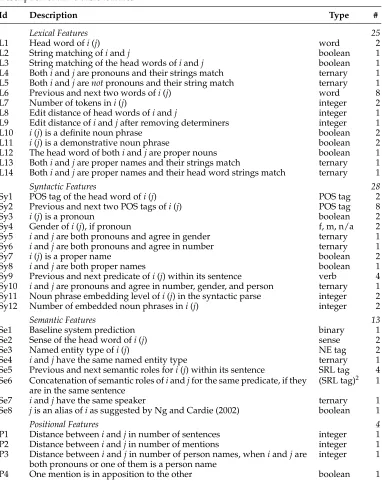
[image:17.486.55.437.180.672.2]In Table 2, we describe the set of basic features used in our system. TheIdcolumn identifies each feature. TheTypecolumn indicates the value type of each feature, for example, Boolean (yes, no) or ternary (yes, no,not applicable). The # column indicates how many basic features correspond to each description.
Table 2
Description of all 70 basic features.
Id Description Type #
Lexical Features 25
L1 Head word ofi(j) word 2
L2 String matching ofiandj boolean 1
L3 String matching of the head words ofiandj boolean 1
L4 Bothiandjare pronouns and their strings match ternary 1 L5 Bothiandjarenotpronouns and their string match ternary 1
L6 Previous and next two words ofi(j) word 8
L7 Number of tokens ini(j) integer 2
L8 Edit distance of head words ofiandj integer 1
L9 Edit distance ofiandjafter removing determiners integer 1
L10 i(j) is a definite noun phrase boolean 2
L11 i(j) is a demonstrative noun phrase boolean 2
L12 The head word of bothiandjare proper nouns boolean 1
L13 Bothiandjare proper names and their strings match ternary 1 L14 Bothiandjare proper names and their head word strings match ternary 1
Syntactic Features 28
Sy1 POS tag of the head word ofi(j) POS tag 2
Sy2 Previous and next two POS tags ofi(j) POS tag 8
Sy3 i(j) is a pronoun boolean 2
Sy4 Gender ofi(j), if pronoun f, m, n/a 2
Sy5 iandjare both pronouns and agree in gender ternary 1
Sy6 iandjare both pronouns and agree in number ternary 1
Sy7 i(j) is a proper name boolean 2
Sy8 iandjare both proper names boolean 1
Sy9 Previous and next predicate ofi(j) within its sentence verb 4 Sy10 iandjare pronouns and agree in number, gender, and person ternary 1 Sy11 Noun phrase embedding level ofi(j) in the syntactic parse integer 2
Sy12 Number of embedded noun phrases ini(j) integer 2
Semantic Features 13
Se1 Baseline system prediction binary 1
Se2 Sense of the head word ofi(j) sense 2
Se3 Named entity type ofi(j) NE tag 2
Se4 iandjhave the same named entity type ternary 1
Se5 Previous and next semantic roles fori(j) within its sentence SRL tag 4 Se6 Concatenation of semantic roles ofiandjfor the same predicate, if they
are in the same sentence
(SRL tag)2 1
Se7 iandjhave the same speaker ternary 1
Se8 jis an alias ofias suggested by Ng and Cardie (2002) boolean 1
Positional Features 4
P1 Distance betweeniandjin number of sentences integer 1
P2 Distance betweeniandjin number of mentions integer 1
P3 Distance betweeniandjin number of person names, wheniandjare both pronouns or one of them is a person name
integer 1
Although our feature set does not include negative features such as Ng and Cardie’s (2002) binding constraints and maximal NP, this type of feature can be used in our system. An arc that activates one or more negative features is highly unlikely to be in the solution. In other words, if a mention pair has the valueyesfor one or more negative features, the two mentions are unlikely to be coreferent. When using negative features, the structured perceptron will most likely learn negative weights for these features. Consequently, arcs that activate negative features have a lower chance of inclusion in the solution because these arcs tend to decrease the coreference tree weight.
7.4 Language Specifics
Our system can be easily adapted to different languages given the basic features. In our experiments, only minor changes are needed to train and apply the system to three different languages. The adaptations are due to (i) the lack of input features for some languages; (ii) the different POS tagsets across data sets; and (iii) the creation of static lists of language-specific pronouns. The necessary adaptations are restricted to only two preprocessing steps: basic features and coreference arcs generation.
Some input features available in the English data set are not available in the Arabic or Chinese data sets. The Arabic data set does not contain named entity, semantic role labeling, and speaker annotations. Therefore, for Arabic, we do not derive the following basic features: Sy9, Se3, Se4, Se5, Se6, Se7, and P3. For Chinese, information related to named entities is not provided. Thus, we do not derive the following basic features: Se3, Se4, and P3. Additionally, the Chinese data set uses a different POS tagset. Hence, some mappings are used during the basic feature derivation stage.
The lack of input features for Arabic and Chinese also impact the sieve-based candidate pair generation step. For Chinese, we do not use Sieve 5, and, for Arabic, we only use Sieves 1, 3, and 6. Sieve 6 is not used for the English data set because it is a specialization of Sieve 5. The first sieve threshold is 4 for Arabic and Chinese and 8 for English. These values have been chosen to optimize recall in the development sets and simultaneously fit the training data sets in memory.
In the arc generation and basic feature derivation steps, our system uses static lists of language-specific pronouns. In our experiments, we use the POS tagging information and the gold entity clusters to automatically extract these pronoun lists from the training data.
Our system submitted to the CoNLL-2012 Shared Task ignores arcs linkingnested
mentions. Although such mentions are never coreferent in Arabic or English, the Chi-nese data sets include many nested coreferring mentions. Hence, in the latest version of our system, we include such arcs for the Chinese language.
7.5 EFI
Using EFI, we can automatically generate feature templates without human effort, which allows us to easily experiment with different template sets. In our experiments, we use 70 basic features and apply EFI to generate feature templates from them. Only 58 basic features appear at least once in the template set of any of the three languages. In decreasing frequency order, the ten most frequent basic features in the templates are Se1, L13, L3, L1j, Se7, Sy3j, L1i, Se4, Sy12i, and Sy3i. These features appear closest
are not used when training with the structured perceptron algorithm. Note that features Sy4 and Sy7jcarry some information that is already present in other features, such as
Sy10 and L12, respectively. Features Sy9, Se5, and Se6 are all derived from the SRL basic features. Therefore, when following our template generation strategy, SRL information contributes little to the coreference resolution task.
In our first experiments, for each language, we create a template set by applying EFI to the training corpus of that language. However, merging different template sets usually produces better results, even when merging template sets of different lan-guages. For instance, for the Chinese and Arabic languages, merging their templates sets with a template set generated for the English language produces an improvement of approximately 2% on the MUC F-score. We believe this behavior to be due to the greedy nature of the decision tree induction algorithm used in EFI and the variation in annotation quality and size of the different data sets. It is quite likely that the automatically generated feature templates are not optimal.
In our final English language system, we use a set of 196 templates obtained by merging the output of two independent EFI executions. These two runs are based on two different training data sets comprising (a) the mention pairs produced by Sieves 2– 5; and (b) the mention pairs produced by all sieves. For Chinese and Arabic, the template sets automatically generated using the corresponding training data sets are merged with template set (a) generated for the English language. The final set for Chinese comprises 197 templates, and the final set for Arabic comprises 223 templates.
Note that the number of templates generated by EFI depends on the number of basic features, the size of the training set, and the settings of the decision tree algorithm. The number of feature templates has a direct impact on memory use, as increasing the number of templates increases the number of binary contextual features instantiated. Hence, our main restriction when automatically creating and merging feature template sets is memory. Using the template sets previously mentioned, we are able to train our English system, which corresponds to the largest data set, using approximately 48 GB RAM. For the Arabic and Chinese systems, less than 20 GB RAM is used during training.
7.6 Evaluation Metrics
Evaluating coreference systems is a difficult task. The main issue is that coreference information is highly faceted, and the value of each facet varies substantially from one application to another. Thus, when reporting and comparing coreference system performances, it is very difficult to defineonemetric that fits all purposes. Therefore, we follow the methodology proposed in the CoNLL-2012 Shared Task to assess our systems, as it combines three of the most popular metrics. The metrics used are the link-based MUC metric (Vilain et al. 1995), the mention-link-based B3metric (Bagga and Baldwin 1998), and the entity-based CEAFe metric (Luo 2005). All these metrics are based on
precision and recall measures, which are combined to produce an F-score value. The mean F-score of these three metrics gives a unique score for each language. Additionally, when appropriate, the official CoNLL-2012 Shared Task score is reported, which is the average of the F-scores for all languages. We denote this metric as theCoNLL score.
Another important aspect of coreference evaluation is mention matching. Some methodologies, such as the ones used in the MUC and ACE evaluations, consider approximate matching of mention spans. However, the CoNLL-2012 Shared Task eval-uation considers only exact span matching.
to keep our results comparable with most of the results reported in the literature. It is important to note that, in early 2014, a committee of researchers revised some of the evaluation metrics and released a new version of these scripts.1Although this revision changes the absolute scores, the ranking of the top performing systems, including ours, remain the same.
8. Empirical Results
In this section, we present nine sets of empirical findings on the CoNLL-2012 Shared Task data sets. In Section 8.1, we demonstrate our system’s overall quality and compare it with state-of-the-art systems. In Section 8.2, we assess the mention detection step. Sec-tion 8.3 details the results of the candidate pair generaSec-tion step. In SecSec-tion 8.4, we assess EFI, showing that this method significantly improves the resulting system performance. In Section 8.5, we present experimental evidence that latent trees improve the prediction performance of our system compared to simple static structures. In Section 8.6, we show that the root loss value also significantly improves our system performances. Section 8.7 presents results that show the contribution of the large margin trick. In Section 8.8, we show that by enhancing our Chinese modeling with nested mentions, we achieve state-of-the-art performance for this language. Finally, in Section 8.9, we present a detailed analysis of the different types of errors in our system output.
In the reported experiments, we use a computer with a 2.4-GHz quad-core pro-cessor and 48 GB RAM. We report the processing times for the English data sets. For the other languages, these times are proportionally lower. First, regarding training, the feature induction procedure takes 27.4 minutes; loading the training data set and gener-ating features from the learned templates take 7.5 minutes; and the training algorithm takes 57.5 minutes. The test procedure on the development set takes 6 seconds to load the data set, 45 seconds to load the model and to generate features from templates, and 30 seconds to predict the output structures for all documents. Most of these procedures could be further optimized in terms of both execution time and memory use.
Regarding the size of the learned models, the Arabic model has approximately 8.1 million parameters; the Chinese model has approximately 9.7 million parameters; and the English model has approximately 15.5 million parameters.
8.1 State-of-the-Art Systems
In Table 3, we present the per-language CoNLL scores of the best performing systems on the CoNLL-2012 Closed Track Shared Task test sets. The first row of this table corresponds to the last version of our system, and the second row corresponds to our official entry in the CoNLL-2012 Shared Task. The difference between these two versions is the inclusion of candidate arcs linkingnestedmentions for the Chinese language. By including such arcs, the score increases by almost 4.5 points for that language. The last two rows of this table correspond to the competitors that are ranked second (Bj ¨orkelund and Farkas 2012) and third (Chen and Ng 2012) in the shared task. Our system obtains the best score for each language.
From Table 3, it can be further observed that the best scores on Chinese and English are similar. However, the performances on the Arabic language are much lower. Given the smaller size of the Arabic training corpus, this reduction is expected.
Table 3
State-of-the-art systems for multilingual unrestricted coreference resolution in the CoNLL-2012 Shared Task data sets. Performances on the test sets for Arabic (AR), Chinese (CH), English (EN), and the official shared task score.
Reference AR CH EN CoNLL Score
This work 54.22 62.87 63.37 60.15
Fernandes, dos Santos, and Milidi ´u (2012) 54.22 58.49 63.37 58.69 Bj ¨orkelund and Farkas (2012) 53.55 59.97 61.24 58.25
Chen and Ng (2012) 47.13 62.24 59.69 56.35
The detailed performances of the best available systems for the Arabic CoNLL-2012 Shared Task test set are presented in Table 4, where we report the recall (R), precision (P), and F-score (F) for the three metrics considered in the CoNLL-2012 Shared Task. Additionally, in the final column of this table, we present the mean F-score over the three metrics, which gives a unique per-language score. In these results, we see that the runner-up system outperforms our system by approximately 1.4 points on both the MUC and B3 F-scores. However, our system outperforms theirs on CEAF
e by almost
5 points. In the end, our system achieves a mean score that is 0.67 point higher than Bj ¨orkelund and Farkas’ system. The third-ranked system (Uryupina, Moschitti, and Poesio 2012) scores much lower, being competitive only on the B3 metric, in which it achieves a substantially higher recall.
The detailed results of the best performing systems for the Chinese language are presented in Table 5. For this language, our system is competitive on all metrics and particularly on MUC, where our system outperforms all competitors by more than 2.5 points of F-score. Note that this result is achieved by considering the nested mentions.
[image:21.486.52.436.481.557.2]In Table 6, we present the detailed performances of the state-of-the-art systems for the English language. Our system outperforms all others by more than 2 points on the mean score. Moreover, it achieves the best F-scores on the three metrics used, being
Table 4
Detailed performance of state-of-the-art systems on theArabicCoNLL-2012 Shared Task test set.
System MUC B3 CEAFe Mean
R P F R P F R P F
This work 43.63 49.69 46.46 62.70 72.19 67.11 52.49 46.09 49.08 54.22
[image:21.486.53.436.593.662.2]Bj ¨orkelund and Farkas (2012) 43.90 52.51 47.82 62.89 75.32 68.54 48.45 40.80 44.30 53.55 Uryupina et al. (2012) 41.33 41.66 41.49 65.77 69.23 67.46 42.43 42.13 42.28 50.41
Table 5
Detailed performance of state-of-the-art systems on theChineseCoNLL-2012 Shared Task test set.
System MUC B3 CEAFe Mean
R P F R P F R P F
This work 59.20 71.52 64.78 67.17 80.55 73.25 57.46 45.20 50.59 62.87
Table 6
Detailed performance of state-of-the-art systems on theEnglishCoNLL-2012 Shared Task test set.
System MUC B3 CEAFe Mean
R P F R P F R P F
This work 65.83 75.91 70.51 65.79 77.69 71.24 55.00 43.17 48.37 63.37
Martschat et al. (2012) 65.21 68.83 66.97 66.50 74.69 70.36 48.64 44.72 46.60 61.31 Bj ¨orkelund and Farkas (2012) 65.23 70.10 67.58 65.90 75.24 70.26 48.60 43.42 45.87 61.24
outperformed only by Martschat et al.’s system on the B3 recall and CEAFe precision
values. These achievements are sound, especially considering the large research effort applied to the English language.
8.2 Mention Detection
The first step of our coreference resolution system is mention detection, where we seek to detect all possible mentions in the given document. In this preliminary step, recall is much more important than precision because missing mentions correspond to unre-coverable errors for the subsequent steps. Moreover, in the CoNLL-2012 unrestricted coreference resolution task, singleton mention clusters are treated as precision errors. Thus, the performance of our mention detector must be checked only on the set of non-singleton mentions.
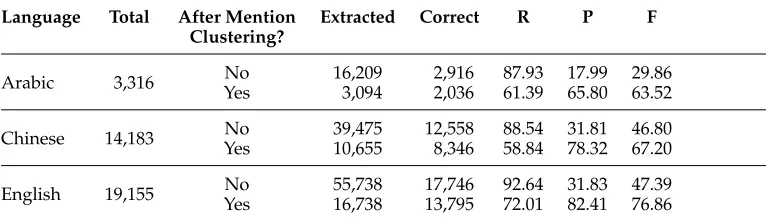
[image:22.486.49.432.552.663.2]In our system, we remove singleton mentions only after the mention clustering step. Hence, for each model, we assess mention detection twice: before and after the men-tion clustering step. The first evaluamen-tion is performed immediately after the menmen-tion detection step but before the mention clustering step, when our system has neither identified nor excluded singleton mentions. The second evaluation is performed on the final output of our system, when clusters comprising only one mention have been deleted. In Table 7, we present these performances on the development sets of the three languages. TheTotalcolumn indicates how many mentions are annotated in the gold standard data set, which comprises non-singletons only. TheExtractedcolumn indicates the number of mentions detected by our system, and theCorrectcolumn indicates how many of them are correct. The columns R, P, and F correspond, respectively, to the recall, precision, and F-score of mentions. As in the CoNLL-2012 Shared Task, a mention is considered correct only when its exact span has been detected.
Table 7
Mention detection performances on the development sets before and after mention clustering.
Language Total After Mention Extracted Correct R P F Clustering?
Arabic 3,316 YesNo 16,2093,094 2,9162,036 87.9361.39 17.9965.80 29.8663.52
Chinese 14,183 YesNo 39,47510,655 12,5588,346 88.5458.84 31.8178.32 46.8067.20
English 19,155 No 55,738 17,746 92.64 31.83 47.39
In Table 7, we can observe that before mention clustering, the precision is very low for all languages: our system extracts many singleton mentions because it privileges recall over precision. Conversely, it correctly detects approximately 90% of the non-singleton mentions for all languages. After the mention clustering step, the mention detection precision increases because many correctly identified singletons are excluded. Of course, some non-singleton mentions are wrongly identified as singletons in the mention clustering step, and there is a consequent drop in recall.
8.3 Candidate Pair Generation
The candidate pair generation step is responsible for creating the candidate pairs graph
G(xxx) given the set of detected mentions. Our approach to this subtask is based on the sieves proposed by Lee et al. (2013). The purpose of using sieves in this step is twofold. First, when generatingG(xxx), we want to include only the arcs that link mentions that are likely to be coreferent to avoid dealing with a dense graph in the subsequent steps, which involve arc feature generation and solving maximum branching problems on
G(xxx). Second, we do not want to generate too many precision errors for the subsequent steps by linking mentions that are not likely to be coreferent. Conversely, the sieves can-not be too restrictive, or they would miss too many intracluster arcs and put coreferent mentions in different connected components. If two coreferent nodesm1andm2belong
to different connected components inG(xxx), the coreference tree predictor is unable to generate a tree onG(xxx) containing the coreferent nodesm1andm2. Therefore, there is a
trade-off between the restrictiveness of the sieves and the coreference resolution recall. In this subsection, we evaluate the MUC recall of the candidate arcs in G(xxx), which corresponds to the upper bound for our coreference resolution system when this graph is given as input to the tree predictor.
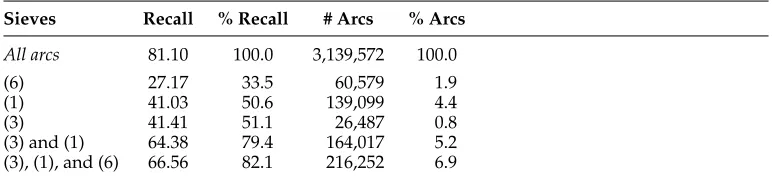
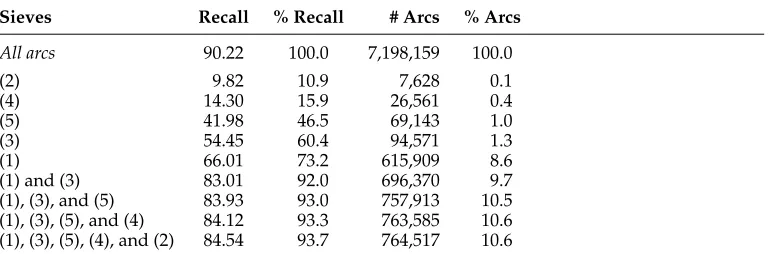
[image:23.486.52.438.573.663.2]In Tables 8, 9, and 10, we report the impact of different combinations of sieves on the MUC recall of the candidate arcs for the Arabic, Chinese, and English development sets, respectively. These results help us to understand the contribution of each sieve and the overlap among them. It is important to note that, for each document in the development set, one distinct candidate pairs graph is generated. Hence, in Tables 8– 10, we show an overall assessment of the graphs generated for all documents in the respective development sets. The first row of each table corresponds to the case where all graphs contain all possible candidate pairs, which means filtering no arcs out. The recall errors in this case are due to missing mentions, which means that these errors occur in the mention detection step. In addition to recall, for each sieve set configuration, we report the recall percentage (% Recall), which gives the percentage of the maximum recall (first row) achieved by the configuration. The tables also present the number of
Table 8
Performances of the Arabic sieves on the development set.
Sieves Recall % Recall # Arcs % Arcs
All arcs 81.10 100.0 3,139,572 100.0
(6) 27.17 33.5 60,579 1.9
(1) 41.03 50.6 139,099 4.4
(3) 41.41 51.1 26,487 0.8
(3) and (1) 64.38 79.4 164,017 5.2
Table 9
Performances of the Chinese sieves on the development set.
Sieves Recall % Recall # Arcs % Arcs
All arcs 84.14 100.0 6,193,390 100.0
(4) 7.45 8.9 4,596 0.1
(2) 18.78 22.3 17,964 0.3
(6) 20.78 24.7 50,432 0.8
(1) 41.62 49.5 260,590 4.2
(3) 65.86 78.3 83,523 1.3
(3) and (1) 75.85 90.1 335,447 5.4
(3), (1), and (6) 77.32 91.9 373,820 6.0
[image:24.486.50.439.278.405.2](3), (1), (6), and (2) 77.57 92.2 377,751 6.1 (3), (1), (6), (2), and (4) 77.58 92.2 377,851 6.1
Table 10
Performances of the English sieves on the development set.
Sieves Recall % Recall # Arcs % Arcs
All arcs 90.22 100.0 7,198,159 100.0
(2) 9.82 10.9 7,628 0.1
(4) 14.30 15.9 26,561 0.4
(5) 41.98 46.5 69,143 1.0
(3) 54.45 60.4 94,571 1.3
(1) 66.01 73.2 615,909 8.6
(1) and (3) 83.01 92.0 696,370 9.7
(1), (3), and (5) 83.93 93.0 757,913 10.5 (1), (3), (5), and (4) 84.12 93.3 763,585 10.6 (1), (3), (5), (4), and (2) 84.54 93.7 764,517 10.6
generated candidate arcs and the percentage of arcs in relation to the maximum number of arcs. Note that for the Chinese language, using only 6.1% of the possible arcs, we achieve 92.2% of the maximum recall. For the English language, we achieve 93.7% of the maximum recall using only 10.6% of the possible arcs. These results demonstrate that our sieve sets for these two languages achieve a good trade-off between the restric-tiveness of sieves and the coreference resolution recall. For the Arabic language, there is still considerable room for improvement in the aforementioned trade-off.
8.4 EFI
We use entropy-guided feature induction to automatically generate nonlinear features by conjoining the 70 basic features. In this section, we compare our EFI-based system with systems trained using basic features alone. It is important to note that these 70 basic features include several complex features. Some of these features are even conjunctions of simpler basic features, and others provide complex task dependent information, such as head words and agreement on number and gender. These 70 basic features were manually generated by domain experts and encode valuable coreference information.