Application of Evolutionary Programming Method
to Solve a Hydro Thermal System Problem
S. Prabakaran1
1
Associate Professor, Dept. of EEE., Sri Chandrasekharendra Saraswathi Viswa Mahavidhyalaya Kanchipuram, Tamil Nadu, India
Abstract: This paper proposes a Evolutionary Programming (EP) and Tabu Search (TS) methods to solve hydro thermal system consisting of 3 thermal and 1 hydro unit. The results obtained by TS method and EP algorithm heve been compared. The convergence and the reliability characteristics of the proposed algorithms are graphically analyzed. From the results obtained it is proved that the both algorithms is capable of solving highly nonlinear problems.
Keywords: Evolutionary Programming, Tabu Search, hydro thermal scheduling prohibited operating zones.
I. INTRODUCTION
Optimization is an art of obtaining optimum result under given circumstances. In the design, construction and maintenance of any engineering system, engineers have to take many technological and managerial decisions at several stages. The ultimate goal of all such decisions is either to maximize the desired benefit or to minimize the effort or time required which ultimately optimizes the solution of the problem undertaken by taking into account the various constraints. Optimization, the best way of doing things, is obviously of great interest in the practical world of engineering. In recent years, for power system management, many important decisions are made by describing the system under study as precisely and quantitatively as possible, selecting some measures of system effectiveness, and then seeking the state of the system which gives the most desirable solution to the criteria. Modern electric power systems built with nonlinear characteristics are highly interconnected with wide geographical distribution. This demands the optimization of a complex objective function under few practical constraints. Hence power system network optimization involves maximization or minimization of objective function under certain constraints. The electric power is the critical infrastructure on which the socio-economic development of the country depends. The growth of the economy and its global competitiveness hinges on the availability of reliable and quality power at competitive rates. The demand of power in India is enormous and is growing steadily. The vast Indian power market, today offers one of the highest growth opportunities for private developers.. Our country ranks sixth in the world in total energy consumption and needs to accelerate the development of the sector to meet its growth aspirations. The country, though rich in coal and abundantly endowed with renewable energy in the form of solar, wind, hydro and bio-energy has very small hydrocarbon reserves (0.4% of the world’s reserve). India, like many other developing countries, is a net importer of energy, more than 25 percent of primary energy needs being met through imports mainly in the form of crude oil and natural gas .The distribution of primary commercial energy resources in India is quite skewed. 70 percent of the total hydro potential is located in the Northern and Northeastern regions, whereas the Eastern region accounts for nearly 70 percent of the total coal reserves in the country. The Southern region, which has only 6 percent of the total coal reserves and 10 percent of the total hydro potential, has most of the lignite deposits occurring in the country.
II. OBJECTIVE
The main objective of this paper is to apply evolutionary programming (EP) to solve hydrothermal scheduling problem to get an optimal solution in comparably shorter time and minimization of the thermal power generation cost. Due to the zero incremental cost of hydro generating units, the hydrothermal scheduling problem is aimed to minimize the system thermal cost, while making use of the availability of hydropower as much as possible.
III. HYDRO THERMAL SCHEDULING (HTS):
In a hydrothermal power system (HPS), the available water resources for electrical generation are represented by the inflows to the hydroelectric power plants (HPPs) and the water
Optimization is the art of obtaining optimum result under given circumstances. In design, construction and maintenance of any engineering system, Engineers have to take many technological and managerial decisions at several stages. The ultimate goal of all such decisions is to either maximize the desired benefit or to minimize the effort or the cost required.
The main goal of the optimal operation planning of an HPS is to determine an operation
strategy for each power plant. This strategy has to minimize the expected value of the operative cost along the planning horizon and assures that the energy market will be supplied according to reliability rates. The operation cost includes costs from the operation of the thermal units, purchase of energy from neighboring systems and penalties for failure in the load supply. In hydro-dominated HPSs, optimal operation planning is concerned with the possible replacement of the generation from thermal units by generation from hydro units. This concern is due to the almost null operative cost of hydroelectric power plants.
IV. OVERVIEW OF EVOLUTIONARY ALGORITHMS
During the last thirty years there has been a growing interest in problem solving systems based on principles of evolution and hereditary. Evolution is certainly the unifying principle of modern biology. However, there are several opinions as to “what is being evolved?” Genetic algorithm models are driven by the perspective that “evolution is a process that operates on chromosomes rather than on the living beings they encode”. In contrast, Evolutionary algorithms (Evolutionary programming and Evolution strategy) endorse the claim that “evolution is change in the adaptation and in the diversity of population of organisms”. Evolutionary computation is the standard term that encompasses all these biologically motivated techniques. The emergence of massively parallel computers made these algorithms of practical interest. The best-known algorithms in this class include Genetic algorithms (GAs), Evolution strategy (ES), Evolutionary programming (EP), Genetic programming (GP), Simulated annealing (SA) and Tabu search (TS).
A. Evolutionary Programming (Ep)
Evolutionary programming, originally conceived by Lawrence J. Fogel in 1960, is a stochastic optimization strategy similar to Genetic algorithms, but instead places emphasize on the behavioral linkage between parents and their offspring, rather than seeking to emulate specific genetic operators as observed in nature. Evolutionary programming is similar to Evolution strategies, although the two approaches developed independently. Like both ES and GAs, EP is a useful method of optimization when other techniques such as gradient descent or direct, analytical discovery are not possible. Combinatorial and real-valued function optimization in which the optimization surface or fitness landscape is “rugged”, processing many locally optimal solution, are well suited for evolutionary programming. D.B. Fogel has given a detailed explanation about the Evolutionary programming and demonstrated it with suitable illustrations. H.T Yang et al have used the EP method for solving economic load dispatch with non-smooth fuel cost functions. L.L. Lai et al have demonstrated the effectiveness of EP by applying it for the reactive power planning with network contingencies. K.A. Juste et al have solved the unit commitment problem by the EP method. There are two important ways in which EP differs from GAs.
1) There is no constraint on the representation in EP. The typical GA approach involves encoding the problem solutions as
string of representative tokens, the genome. In EP, the representation follows from the problem. A neural network can be represented in the same manner as it is implemented because the mutation operation does not demand a linear encoding.
2) The mutation operation simply changes the aspects of solution according to a statistical distribution which weights minor
variations in the behavior of the offspring as highly probable and substantial. Further, the severity of mutations is often reduced as the global optimum is approached. There is a certain tautology here: if the global optimum is not already known, how can the spread of the mutation operation be damped as the solutions approach it? Several techniques have been proposed and implemented which address this difficulty, the most widely studied being the “Meta-evolutionary” technique in which the variance of the mutation distribution is subject to mutation by a fixed variance mutation operator and evolves along with the solution.
V. HYDRO THERMAL SCHEDULING
scheduling methods that accommodate generation diversity and line flow limitations and concurrently can produce accurate scheduling results.
In a hydrothermal power system (HPS), the available water resources for electrical generation are represented by the inflows to the hydroelectric power plants (HPPs) and the water stored in their reservoirs. Thus, the available resources at each stage of the operation planning horizon depend on the previous use of the water, which establishes a dynamic relationship among the operation decisions taken along the whole horizon. The main issue in energetic operation planning is: what is the most appropriate way to manage the water resources in the present without compromising their availability in the future.
The main goal of the optimal operation planning of an HPS is to determine an operation Strategy for each power plant. This strategy has to minimize the expected value of the operative cost along the planning horizon and assures that the energy market will be supplied according to reliability rates. The operation cost includes costs from the operation of the thermal units, purchase of energy from neighboring systems and penalties for failure in the load supply. In hydro-dominated HPSs, optimal operation planning is concerned with the possible replacement of the generation from thermal units by generation from hydro units. This concern is due to the almost null operative cost of hydroelectric power plants. Due to the planning complexity and the different aspects that this problem has to address, it may require a chain of models to be solved.
To solve the hydrothermal scheduling problem, several methods have been applied. Some of these methods are nonlinear programming, maximum principle, dynamic programming, network flow algorithms, progressive optimality algorithm, heuristics, expert systems, artificial neural network, genetic algorithms and evolutionary programming. All the above methods (except DP and evolutionary algorithms) will give optimum results at an affordable time when system cost equations are smooth and monotonically increasing function of generation. But if the cost functions are not so then these methods will give only local optimal results. Among the existing methods, DP appears to be the most popular. However, a major disadvantage of the DP method is that the computational and dimension requirements grow drastically with increasing system size. Evolutionary algorithms include genetic algorithms (GAs), evolutionary programming (EP), evolutionary strategy (ES) and genetic programming (GP). Among the above algorithms, the evolutionary programming are having number of advantages over conventional optimization techniques . They have attractive features such as: the simplicity of the algorithm, the ability to handle all types of constraints and less computational time. In the proposed algorithm, an evolutionary programming will direct the search towards the optimal solution area. Then a local search method will fine-tune the search to reach the global optimal solution.
VI. PROBLEM FORMULATION
The hydrothermal scheduling problem involves the optimization of a problem with a non-linear objective function, with a mixture of linear, non-linear and dynamic network flow constraint . Due to the zero incremental cost of hydro generating units, the hydrothermal scheduling problem is aimed to minimize the system thermal cost, while making use of the availability of hydropower as much as possible. The objective function and associated constraints of the hydrothermal scheduling problem are formulated as follows.
A. Objective Function
The objective function of the hydrothermal scheduling problem is the minimization of the thermal power generation cost . T n
fCTk = Σ Σ FCi(Psi (t)) (1)
t=1 i=1
1) Power balance equation
n m
Dt = Σ Psi (t) + Σ PHj (t) − PL (2)
i=1 j=1
The hydro generation PHj (t) is a function of water discharge rate and storage volume.
2) Thermal generation capacity
Psimin ≤ Psi (t) ≤ Psimax (3)
3) Hydro generation capacity
PHjmin ≤ PHj (t) ≤ PHjmax (4)
Vj (t+1) = Vj (t) + qj (t−m) + sj (t−m) − qj (t) − sj (t) + rj (t) (5)
Where m is the water delay time between reservoir j and its upstream 1 at interval t.
5) Initial and final reservoir storage
Vj (0) = V0 ; Vj (T) = VT (6)
6) Reservoir storage
Vjmin ≤ Vj (t) ≤ Vjmax (7)
7) Water discharge rate
qjmin ≤ qj (t) ≤ qjmax (8)
8) Total water discharge
T
qjtot = Σ qi (t) (9)
t=1
B. Prohibited operating zones (poz)
A thermal or hydro generating unit may have a prohibited operating zone, depending on the physical limitations of the power plant components like generator shaft etc. At certain power output, vibrations occur in the components and when the frequency of vibration equals the natural frequency, resonance occurs and it may damage the components. Those power outputs at which this phenomenon occurs are called Prohibited Operating Zones. Hence the thermal and hydro units should not be operated in the specific prohibited operating zone. For a Prohibited Operating Zone (POZ), the unit can operate only above or below the zone. In this project, POZ has been taken as an additional constraint.
VII.PROPOSED EVOLUTIONARY PROGRAMMING ALGORITHM
Evolutionary programming (EPs) has become increasingly popular in recent years in science and engineering disciplines. Evolutionary programming is a search technique based on the evolution of biological systems. The search starts with random generation of initial population or initial set of solutions. Using cross-over and mutation procedures new generations are obtained. The characteristics of initial set of solutions improve in terms of costs from generation to generation. In this paper, a evolutionary programming is proposed to solve the hydrothermal scheduling problem.
VIII. EP IMPLEMENTATION IN THE PROPOSED ALGORITHM:
The evolutionary programming (EP) is essentially a search algorithm based on the mechanism of natural selection and natural genetics. It combines solution evaluation with randomized, structured exchange of information between solutions to obtain global optimality. EP is a robust approach because no restrictions on the solutions to obtain global optimality. EP is a robust approach because no restrictions on the solution space are made during the search process, The power of this algorithm comes from its ability to exploit historical information structures from previous solution guesses in an attempt to increase performance of future solution
structures. Let Qk = [ Ps1, Ps2, .... Psi, .... , Psn, q1, q2, …., qj, …., qm ]T be a trial matrix designating the kth individual of a population
to be evolved where Psi = [ Psi (1), Psi (2), …., Psi (t)….., Psi (T) ] The element Psi (t) is the power output of the ith thermal unit during interval t. The range of the elements Psi (t) should satisfy the thermal generation capacity constraints in equation (3.3) . Assuming the spillage in equation (3.5) to be zero for simplicity. We have the hydraulic continuity constraints.
T T
Vj (T) − Vj(0) = Σ qi (t) − qi (t − m) − Σ rj (t) (10)
t=1 t=1
Where m is the water delay time between reservoir j and its upstream i at interval t. To meet exactly the restrictions on the initial and final reservoir storage in equation (6), a hydro plant qj (d) in the dependent interval d is arbitrarily selected from among the interval t = 1,….., T. qj (d) then calculated by
T T
qj (d) = Vj (T) − Vj(0) − Σ qi (t) + qi (t − m) + Σ rj (t) (11) t=1
t=1
Also to meet exactly the power balance constraint in equation (3.2), a dependent thermal generation unit Psd (t) is arbitrarily selected from among the committed n units for t = 1,…, T. For hydro generation PHj (t), for j = 1,…., m and t = 1,…., T, the dependent thermal generation Psd (t) can then be calculated using the following equation
n m
Psd (t) = Dt + PL − Σ Psi (t) − Σ PHj (t) (12)
i=1 j=1
In the proposed algorithm based hydrothermal scheduling, the dependent variables in equations (4.2) and (4.3) are used to satisfy the constraints in equations (3.7) and (3.2) so that every randomly generated individual of a population will be a feasible solution. The initial parent trial matrix Qk, k=1, 2,…., np is generated randomly in which the output of thermal units will satisfy their generation limits and the hydro unit’s water discharge will be within the allowable water discharge rate.
There are two important EP operators which are commonly used are as follows :
1) Reproduction or Selection
2) Mutation
.
IX. ALGORITHMIC STEPS OF PROPOSED ALGORITHM:
The main aim of EP simulation is to provide a feasible solution in the population pool of each generation and achieve the objective of minimization through these feasible solutions in further evolutions
Step 1: Initial population is randomly initialized with total population of 20 chromosomes. Steam Power is chosen as the particle. Step 2: Convert the initial population from binary to decimal.
Step 3: Find the sum of the total cost functions and calculate the probability of occurrence of each solution. Step 4: Find the cumulative probability for each solution.
Step 5: Initialize the roulette wheel with values assigned randomly between 0 and 1.
Step 6: Check for the solutions which are with cumulative probabilities less than the value in the roulette wheel. Step 7: Randomly initialize the mutation matrix.
Step 8: Randomly initialize the value for the mutation probability.
Step 9: Check for the solutions which are with mutation probability less than the randomly assigned value of mutation probability and find the value of the position of the bit.
Step 10: Perform mutation for the bits at the position found out. Step 11: Convert the population from binary to decimal. Step 12: Find the total fuel cost for the solutions.
Step 13: Find out the optimal solution amongst the available solutions.
Step 14: Find the hydro power by subtracting the steam power from the load demand for the dependent intervals.
Step 15: Calculate the reservoir volume for the dependent time interval by the hydro power calculated in the previous step. Step 16: Calculate the discharge rate from the hydro power.
Step 17: Calculate the hydro power for the independent interval from the volume obtained by subtracting the target volume from the volume left out in the previous interval.
Step 18: Calculate the Steam power for the last interval from the hydro power calculated in the previous step. Step 19: Calculate the discharge rate for the last interval.
Step 20: Check whether all the constraints are satisfied. If not re-initialize the population and repeat from step 1. Step 21: Repeat the steps 1 to 20 till maximum iterations is reached.
Step 22: Store the best solutions from each iteration and chose the optimal solution amongst the best solutions.
X. EXAMPLE PROBLEM AND SIMULATION RESULTS
In this paper, a hydro thermal test system consisting of 3 thermal and 1 hydro generating units is considered The fuel cost function in dollars per hour of the equivalent thermal plants is as follows:
f (PS1) = 0.01 PS12 + 0.1 PS1 + 100 ; 50MW≤ PS ≤ 200MW
f (PS2) = 0.02PS22 + 0.1 PS2 + 120 ; 40 MW≤ PS ≤ 170
The hydro power generation relationship to water discharge is denoted as,
q = 0.05 (PH − 1000)2 + 12 (PH − 1000) + 5300 ; 1000MW ≤ PH ≤ 1100MW
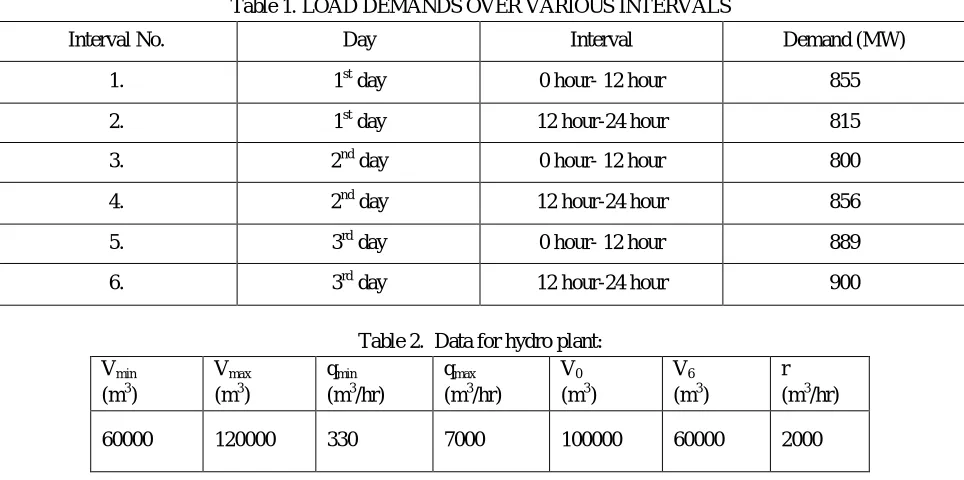
Table 1. LOAD DEMANDS OVER VARIOUS INTERVALS
Interval No. Day Interval Demand (MW)
1. 1st day 0 hour- 12 hour 855
2. 1st day 12 hour-24 hour 815
3. 2nd day 0 hour- 12 hour 800
4. 2nd day 12 hour-24 hour 856
5. 3rd day 0 hour- 12 hour 889
[image:6.612.63.550.109.345.2]6. 3rd day 12 hour-24 hour 900
Table 2. Data for hydro plant: Vmin
(m3)
Vmax (m3)
qmin (m3/hr)
qmax (m3/hr)
V0 (m3)
V6 (m3)
r (m3/hr)
60000 120000 330 7000 100000 60000 2000
The proposed EP algorithm is applied to the hydro thermal system with 3 thermal units and 1 hydro unit to demonstrate the validity of the method for larger systems as well. All the programs were developed using MATLAB 6.0 and the test case was simulated in 20 independent trials on Core 2 Duo processor computer @ 2.53 GHz and 2 GB RAM using EP algorithm.
Table 3. Parameters chosen for implementation
PARAMETERS CHOSEN VALUE
Population Size 20
Mutation Probability 0.01
Spillage 0
Maximum Iterations( itermax) 100
Table 4. ts Results
The following are the results obtained by applying only tabu search for the system consisting of 3 thermal units and 1 hydro unit. The steam powers, hydro powers, rate of discharge, volume of the reservoir and total cost are displayed.
Table 5. EP Method Results
Interval
Steam power of plant1, Ps1 (MW)
Steam power of plant2, Ps2 (MW)
Steam power of plant 3, Ps3 (MW)
Hydro power Ph
(MW)
Volume of
reservoir
(v)m3
Total cost ($)
1 132 117 128 478 92,998
77,300
2 172 75 172 396 84,530
3 192 130 177 301 80,953
4 155 176 81 544 83,041
5 108 119 115 547 70,637
[image:6.612.144.468.412.527.2] [image:6.612.52.560.592.718.2]The following are the results obtained in the initial run and the final run by applying the Proposed EP method for the larger system consisting of 3 thermal units and 1 hydro unit. The steam powers, hydro powers, rate of discharge, volume of the reservoir and total cost are displayed
Table 6. Initial Run Results:
Interval
Steam Power1 Ps1
(MW)
Steam Power2 Ps2
(MW)
Steam Power3 Ps3
(MW)
Hydro Power (MW) Ph
Volume of Reservoir, v
(m3)
Rate of Discharge, q
(m3/hr)
Total Fuel cost
($)
1. 132.3106 163.1373 156.4706 323.6735 1,00,720 1.9387
78,994
2. 109.0196 86.6667 87.0588 464.0196 1,01,460 2.6362
3. 104.3137 87.4510 162.3529 441.1765 93,820 2.5226
4. 140.00 81.5686 164.3137 492.4706 87,550 2.7776
5. 81.9608 92.1569 105.0980 585.8627 78,220 3.2417
6. 100.3922 158.8235 208.4150 641.5198 60,000 3.5184
Table 7. Final Run Results:
Interval
Steam Power1 Ps1
(MW)
Steam Power2 Ps2
(MW)
Steam Power3 Ps3
(MW)
Hydro Power Ph
(MW)
Volume of Reservoir, v
(m3)
Rate of Discharge, q
(m3/hr)
Total Fuel cost
($)
1. 171.3 93.3 116.6 423.6 94,924 1.6354
75,565
2. 112.5 124.3 158.8 419.3 89,699 2.3645
3. 109.4 98.4 163.1 429 84,731 2.2865
4. 98.4 80 128.6 549 79,185 2.4533
5. 85.8 92.9 92.9 617.2 66,486 2.9826
6. 143.9 119.2 192 444.7 60,000 3.2069
Table 8. Comparison of Results
Sl. No Optimization Method Generation Cost ($)
1 Tabu Search Method 77300
2 Evolutionary programming (EP) 75565
XI. CONCLUSIONS
The performance of the proposed algorithm for solving the Hydro Thermal Scheduling problem has been demonstrated by taking a larger hydro thermal system consisting of 3 thermal and 1 hydro units.
A. EP algorithm is capable of determining near global optimal solution or global optimal solution for the non-linear and
B. Evolutionary programming has the capability of searching the global optimal solution by fine tuning the search process. So this avoids the entrapment of the solution at local minima.
C. In the proposed algorithm, EP has the ability to identify the high performance region of the solution space at quick execution
time.
D. The example problem 2 has been solved by the proposed algorithm and the solution obtained.
REFERENCES
[1] Kennedy and R. Ekrhart, "Particle swarm optimization",Proceedings of lEEE lnternational Conference on Neural Nerworkr (lCNN95). Vol. IV, pp. 1942-1948, Perth. Australia. 1995
[2] Hydro Thermal Scheduling using Particle Swarm Optimization”,Chandrasekar Samudi, Gautham P. Das, Piyush C. Ojha, Sreeni.T.S, member, IEEE, Sushil Cherian, member, IEEE Kalki Communication Technologies Ltd., Bangalore
[3] “Integrating Genetic Algorithms And Tabu Search For Short Term Hydro Thermal Scheduling Problem”,M.Sudhakaran, Non-member,Dr.S.Mary Raja Slochanal, Member
[4] “Particle Swarm Optimization: Basic Concepts, Variants and Applications in Power Systems “ by Yamille del Valle, Student Member, IEEE, Ganesh Kumar Venayagamoorthy, Senior Member, IEEE,Salman Mohagheghi, Student Member, IEEE, Jean-Carlos Hernandez, Student Member, IEEE, and Ronald G. Harley, Fellow, IEEE
[5] Carneiro, A.A.F.M.; Leite, P.T.; Silva Filho, D.; Carvalho, A.C.P.L.F., “Genetic algorithms applied to hydrothermal system scheduling”, Power System Technology, 1998. Proceedings. POWERCON apos;98. 1998 International Conference on Volume 1, Issue, 18-21 Aug 1998 Page(s):547 - 551 vol.1
[6] A J Wood and B F Woolenberg, “Power Generation Operation and Control”, John Wiley and Sons, 1984
[7] M. A. Abido, “Optimal power flow using particle swarm optimization,” Int. J. Elect. Power Energy Syst., vol. 24, no. 7, pp. 563–571, 2002
[8] BeasleyY D,Ralph R. M.and David R.B. “ An Overview of Genetic Algorithms: Part 2, Research Topics”, University Computiong, 15(4) 170-181, 1993 [9] D.S.Suman, C. Nallasivan Joseph Henry, and S.Ravichandran, “A Novel Approach for Short-Term Hydrothermal Scheduling Using Hybrid Technique”, IEEE
Power India Conference, 10-12 April 200
[10] M Sudhakaran, S Mary Raja Slochanal and S Jeya Devi, “An Evolutionary Computing Technique to Combined Heat and Power Economic Dispatch”, selected for publishing in Journal of the Institution of Engineers (India), Pt EL.
[11] Y. Shi and R. Eberhart, “A Modified Particle Swarm Optimizer,” Proceedings of IEEE Int. Conference on Evolutionary Computation, May 1998, pp. 69-73 [12] Davis, L., Ed. (1991). “Handbook of Genetic Algorithms”. Van Nostrand Reinhold, New York,NY
[13] Goldberg, D., “Genetic Algorithms in Search, Optimization and Machine Learning”, Addison-Wesley, Reading, MA,1989, pp. 1-25 [14] Austin, S., "An Introduction to Genetic Algorithms," AI Expert, Vol. 5, March 1990,pp. 48-53
[15] R. C. Eberhart and Y. Shi, “Comparison between Genetic Algorithms and Particle Swarm Optimization,” Proceedings of IEEE Int. Conference on Evolutionary Computation, May 1998, pp.611–616
[16] ] Yuhui shi and Russel Eberhart, “Empirical Study of Particle Swarm Optimization”, IEEE Conference, 199 [17] Kennedy, J. and Eberhart, R., “Swarm Intelligence”, Academic Press, 1st ed., San Diego, CA, 2001
[18] Venter, G. and Sobieski, J., “Particle Swarm Optimization,” AIAA 2002-1235, 43rd AIAA/ASME/ASCE/ AHS/ASC Structures, Structural Dynamics, and Materials Conference, Denver, CO., April 2002
[19] Nidul Sinha, Chakrabarti.R, and Chattopadhyay.P.K, “Fast Evolutionary Computing Techniques for Short-Term Hydrothermal Scheduling”, IEEE Transactions on Power Systems, Vol.18, No.1, February 2003, pp. 214-220
[20] T Ohishi, S Soares and M F H Carvalho, “A Short Term Hydrothermal Scheduling Approach for Dominantly Hydro Plants”, IEEE Transactions on Power systems, Vol-6, No 2, May 1991, P-637
[21] M V Rakic and Z M Markovic, “Short Term Operation and Power Exchange Planning of Hydro-Thermal Power Systems”, IEEE Transactions on Power systems, Vol-9, No 1, Feb 1994, P-359
[22] P Huang Chen and H C Chang, “Genetic Aided Scheduling of Hydraulically coupled Plants in Hydrothermal Coordination”, IEEE Transactions on Power systems, Vol-11, No 2, May 1996, P-975
[23] P C Yang, H T Yang and C L Huang, “Scheduling Short Term Hydrothermal Generation using Evolutionary Programming Techniques”, IEE proceedings, Power Generation, transmission & Distribution, Vol-143, No 4, July 1996,P-371