570
©IJRASET: All Rights are Reserved
Parametric Study on Effect of Wind Load on Tall
Building with and Without Infill Wall by
Considering Equivalent Diagonal Strut
Bhumik R. Gajjar1, Prof. R. A. Jhumarwala2, Prof. N. B. Umravia3 1, 2, 3
Applied Mechanics Department,Government Engineering College, Dahod
Abstract: Designs of tall buildings for wind loads are mainly dependent upon standard wind codes which are very limited as, considering surrounding buildings arrangement is very complicated. Wind loading codes are developed from different wind tunnel tests of isolated buildings for different topography conditions and wind environments. When the interference effects (IF) of neighbouring buildings are considered, the wind tunnel tests must require and interference factor should be find out. Neighbouring structure influences the wind induced forces on a building by increasing or decreasing the forces. Researchers investigated interference effects from neighbouring buildings on the wind induced along wind, across wind and torsional behaviour of tall building. Study of wind interference effect on tall building due to surrounding structure by using Computational Fluid Dynamics (CFD) and responses of the structure have been studied by changes of axial force, bending moment and displacements with respect to height. The masonry infill walls influence greatly the response of the RC structures under lateral loading due to their contribution to strength and stiffness. In this study, the equivalent diagonal strut model is considered. The basic parameter of this strut is its equivalent width.
Keywords: Tall building, wind interference effect, interference factor, Computational Fluid Dynamics, infill wall, equivalent diagonal strut.
I. INTRODUCTION
Nowadays, the trends for construction of tall buildings are rapidly increased due to growth of population day by day, lack of land, and increase in land prices in metropolitan cities. The development of advanced equipment and materials such as high strength concrete and steel and improvement in structure analysis and design has made construction of tall building more feasible. Design of tall building is mainly design for lateral load like earthquake and specially wind loads hence estimation of wind load for tall building is significant.
Wind load plays an important role while designing tall building. Earlier, symmetric plan shape buildings were used but due to development of technologies in civil and architectural field, asymmetric plan of buildings can be possible like ‘T’ and ‘Y’ shape. Present tallest building of world ‘Burj Khalifa’ which is a ‘Y’ shapes building. There are several codes along with Indian code on wind loads [IS 875 (Part-3) 2015, ASCE: 7-02-2002, BS: 63699-1995, AS/NZS: 1170.2-2002, EN: 1991-1-4-2005]. But these codes give standard pressure and force mainly for isolated buildings.
However, tall building is rarely shown isolated in urban areas. The existing of surrounding buildings affects the wind pattern flow around the buildings. Neighbouring buildings may increase or decrease the wind loads on principal buildings. Hence it is very significant to conduct wind tunnel tests on the models of building together for accurate calculations of wind loads. The main parameters of the interference effects on principal building are size and shape of the buildings, wind direction, velocity of wind, types of terrain, location of interfering buildings.
A. Interference Effects
571
©IJRASET: All Rights are Reserved
The existing neighbouring building may increase or decrease the wind loads on a principal building, depending mainly on several parameters like geometrical, structural and wind parameters, including size, section shape, relative position of these buildings, wind velocity, number of the adjacent buildings, upstream terrain conditions etc.
The ratio of the value of a typical response parameter for a structure due to interference by the corresponding value of the isolated is called Interference Factor.
Nowadays, mostly reinforced concrete buildings are constructed with masonry infill walls. Masonry infill walls are used only for privacy point of view and often used to fill the voids between the vertical and horizontal resisting elements of the building frames with considering that these masonry infill walls will not resist any kind of load either axial or lateral. Hence, generally it is not considered for both strength and stiffness in the analysis of the frame.
Moreover, non-availability of realistic and simple analytical models of infill becomes another obstruction for its consideration in analysis. The masonry infill walls influence greatly the response of the RC structures under lateral loading due to their contribution to strength and stiffness. Here, several approaches for different types of modelling the infill walls discussed in the literature. In this study, the equivalent diagonal strut model is considered. The basic parameter of this strut is its equivalent width.
II. LITERATURE REVIEW
This chapter includes the content available in various codes and standards and recent research paperss. Wind Codes discussed here are Indian, British, European, Australian codes [IS: 875 (Part-3) 1987, BS: 63699-1995, AS/NZS: 1170.2-2002, ASCE: 7-02-2002, EN: 1991-1-4-2005].
1) ANINA SARKIC GLUMAC et al. (2018) evaluated the wind tunnel test on the flow above the roof of a high rise building surrounded by four similar high rise building. The main idea was to obtain detailed representation of the flow characteristics with respect to the urban wind energy harvesting above high-rise buildings by joining the results of velocity and pressure measurements. Therefore, the presented results looked into the wind flow characteristics in terms of flow pattern, turbulence intensity, accelerated wind velocity and skew angle. Flat roof geometry was used in current investigation and the flow above it was considered for four different wind angles: 0°, 15°, 30°, and 45°. To analyse the influence of the neighbouring buildings on the flow above the principle one, the flow pattern above the principal building was compared with the case of the flow above an isolated (single) high-rise building. Results showed that there is a significant effect of the upstream building on the wind characteristics of the principle one. However, 45° wind direction is the most preferable wind direction, due to a large number of suitable locations over the roof top positioned as well at different heights.
2) WONSUL KIM et al. (2017) evaluated the variations of local wind forces along height levels of a tall building due to an adjacent tall building with various height and breadth ratios through huge wind tunnel experiments. It deals with the characteristics of local wind forces including root mean square local wind force coefficients, non-dimensional power spectra, and root coherences along height levels of a tall building with an adjacent tall building in critical locations. It is shown that
increases of over 20% in interference factors ( , , and ) for maximum mean and root mean square base
overturning moment coefficients in along- and across-wind directions occur when the adjacent building is close to the principal building. Higher and wider adjacent buildings can cause not only higher mean wind loads but also higher dynamic wind loads in along- and across-wind directions, but the critical locations of an adjacent building with various height and breadth ratios are somewhat different. However, most critical locations of an adjacent building for wind-induced wind loads are within the region (X/B, Y/B) = (1.5, 0 - 1.5).
3) SANTOSH GURJUR et al. (2017) studied interference effect between two building through numerical simulation using ANSYS CFX. Total drag force and interference factors for the principal building is calculated in the presence of interfering building having height ratio of 0.5, 0.75,1, 1.25, and 1.5. The results show that the upstream interfering buildings cause certain shielding effect by decreasing the mean wind load on the downstream principal building. However, an amplification effect is also observed for certain location of the interfering building on upstream side. For buildings of the same cross-section, the interference factor (IF) decreases with the increase of the height of interfering building, indicating increase in the shielding effects. However, the shielding effect on principal building is found to be significant when the heights of interfering buildings range from 0.75 to 1.5 of the height of the principal building. The along-wind force of the downstream principal building reduced to zero when the upstream interference building of height ratio more than one was two to three times the building breadth away from the principal building.
572
©IJRASET: All Rights are Reserved
loads on tall buildings. The changes in urban topology are found to have different impacts on structural and non-structural elements from wind hazard perspective. Based on the study cases, mean wind pressures are reduced while fluctuations in these pressures are increased as the urban environment becomes denser. The effect of increased pressure fluctuations particularly on some cladding elements, is viewed as a higher wind risk due to damage accumulation. From the main wind force resisting system perspective, both mean and fluctuating base moments reduce by 50% and 20%, respectively, with the increase in surrounding height consequently reducing the peak moments. Examining the urban development in Financial District, Toronto shows the consistency in the observations from the generic case when compared to the realistic case. However, a pressure increase due to channelling has been observed in few cases. Therefore, the developed CFD approach can be applied on a case by case basis to assess these varying wind risks on buildings in the future. These approaches are expected to be useful for mechanics based loss models and community level wind performance assessments where the performance of neighbourhoods in addition to individual buildings and their components can be modelled and quantified.
5) BOWEM KIM et al. (2016) carried out wind tunnel test to investigate the interference effects between twin super-tall buildings with aerodynamic modifications. The contour plots of interference factors are presented to quantitatively assess the interference effects on global aerodynamic loads, wind-induced response and local surface pressure coefficients. The results show that the dynamic wind loads and responses are greatly increased in critical tandem and staggered arrangements of the twin towers and the minimum peak negative pressure coefficients are approximately 30% larger than those without interference. This study provides useful results for identifying the potential problematic arrangements of twin super-tall buildings and to further the understanding of the underlying mechanisms of the aerodynamic interference.
6) RAVINDER AHLAWAT et al. (2015) carried out wind tunnel tests on ‘T’ plan shape buildings to evaluate the wind loads and wind pressure distribution for isolated case and interference case in different wind angles. In isolated case, the author has taken 5 wind angles i.e. 0°, 45°, 90°, 135° and 180° for ‘T’ shape and in interference case, 3 conditions i.e. spacing = 0, 50 and 100 mm for 0° and 180° angles are considered. According to his results, Wind flow pattern is greatly affected by the presence of other buildings and it depends on the direction of wind, spacing between the buildings and the geometric shape of the buildings, Base shear on the building gets reduced due to shielding and it increases as the spacing increases and at the edges and corners of walls, suction due to wind can increase hugely due to interfering building.
7) X.F. Yu et al. (2015) carried out Interference effects on wind pressure distributions between two high- rise buildings are systematically through a series of wind tunnel tests with various configurations in tandem, oblique, and parallel arrangements were studied in detail by applying the synchronous pressure measurement technique. Configurations included six kinds of
breadth ratios ( = ) and four kinds of height ratios ( = ). The
characteristics of wind pressure distribution were further investigated in the most unfavourable parallel arrangements. Results showed that the mean pressure was of ten beneficial because of shielding, whereas the peak pressure of the lateral facade adjacent to the interfering building was mainly amplified. With increased and , the corresponding shielding and
amplification effects became more remarkable. When < 1 in tandem arrangement, the local mean and peak pressures on the
lateral façade increased by 56% and 53%, respectively, because of the three-dimensional flow effects. The channelling effect in
parallel arrangement should be given sufficient attention for the observed maximum interference factors ( ,) of the mean
and peak pressures reach up to 2.6 and 1.91, respectively. Finally, high precision regression equations were proposed to present
the relationship between the maximum block interference factor ( ,) and building spacing in parallel arrangement
8) WONSUL KIM et al. (2015) evaluated a series of wind tunnel test of typical tall building models using pressure measurement techniques for wind induced interference effects of overall wind loads and local wind loads on two buildings. He studied five types of adjacent building models were considered with height ratios ( = 0.5, 0.7,1,1.5 and 2) and wind directions were considered from 0° to 355° in 5° steps. Aerodynamic interference effects on base moments and local wind forces along nine
height levels of the principal building are presented and discussed. As a result, interference effects ( and ) on
573
©IJRASET: All Rights are Reserved
9) GAONKAR et al. (2014) studied the effect of proximity on the wind loads. The author considered number of interference setups for force study and recorded base forces for different spacing and compared the results with isolated building. After doing experimental study, the author analyzed the building in STAAD Pro software for 12 cases of wind loading. All models are rectangular in plan and are of same height with a scale ratio of 1:200. According to his results, Wind flow is affected due to proximity of other structure and the space which get affected depends mainly on external geometry of building. Overall base shear gets reduce and as the spacing increases, effect of proximity reduces which leads to increase in base shear. Pattern of loading on some faces of building changes due to proximity effect. High magnitude of twisting moment is observed even in symmetrical building. According to analytical study, base shear in the direction perpendicular to longer edge and shorter edge of building shows decrease and increase respectively as compared to isolated case.
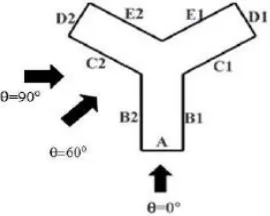
10) CHAKRABORTY et al (2014) studied the pressure developed on faces of Y shape building using experimental and numerical methods. Authors used wind tunnel for experiment and CFD simulation for numerical study for wind angles 0° and 60°.
Numerical models used are k-ε and SST model. Flow pattern around the model has also been studied. Model plan and names of
different faces are shown in Fig. 2.3. From this study, authors found that, Identical pressure distribution are observed on symmetrical faces for 0° and 60°, 90° wind angles due to symmetry in flow pattern. Overall accuracy of k-ε model is better but
[image:4.612.230.365.294.402.2]SST model predicts pressure in high turbulence zone with higher degree of accuracy. And for 90° wind angle, critical pressure is observed on faces B1, D1, E1 and E2. For 600 wind angle, critical pressure is observed on faces B2, C2 and D2.
Figure 1: Plan of Y shape model with names of faces used
11) PANDEY et al. (2013) carried out the study to evaluate pressure and force coefficients on models in isolated case and models arranged in different patterns for calculating interference effects. Apart from wind tunnel experiments, the author has also done response analysis using STAAD Pro software. The author found that, Interference effects reduce when spacing between instrumented and interfering building increases beyond 750mm. Base moment and base shear increases with increase in number of interfering buildings. Also they are maximum when buildings are arranged in staggered manner. There is no effect of interference on torsional moment at the base of the building.
12) JIGNESH A. AMIN et al. (2011) studied that the mean interference effects between two rectangular buildings located in close proximity in a geometrical configuration of ‘L’ and ‘T’ plan shape is studied through wind tunnel test on 1:300 scale rigid models. The mean surface pressure distributions on all the walls of two buildings located in close proximity as well as in an isolated position are measured over an extended range of wind directions. The mean responses of pair of buildings namely, block-1 and block-2 subjected to interference effects are evaluated using experimentally obtained wind loads and, subsequently compared it, with the responses of a similar building in an isolated position. Result showed that effectiveness of upstream building location and wind orientation in changing the mean wind pressure distributions and responses of upstream and downstream building are also assessed. At wind incidence angle of 0°, presence of upstream block-1 reduces the mean along-wind displacement of block-2 of ‘L’ and ‘T’ shape arrangements up to 25% and 71% respectively as compared to that of corresponding block in an isolated position. However, the presence of upstream block-1 increases the maximum mean torque on block-2 of ‘L’ and ‘T’ shape arrangement up to 28%, and up to 88% respectively as compared to maximum mean torque developed on a similar block in an isolated position.
574
©IJRASET: All Rights are Reserved
comparison, it was found that infill cause two primary alterations to the original moment-frame system, namely stiffening/ strengthening effect and deformation concentration effect. Among theinfilled frames analyzed, the systems with relatively stiff and strong infill have shownbetter seismic performance as compared to bare frame.
14) BARTOLOMEO PANTO et al. (2017) carried out nonlinear seismic behaviour of infilled frame structures (IFS), considering the contribution of the infill as an equivalent diagonal strut element. An alternative plane macro-element approach for the seismic assessment of IFS is proposed, validated and applied to a benchmark prototype building. As a benchmark investigation, a multi-storey plane frame prototype, for which the results of pseudo-dynamic tests are available, is investigated and compared to the results obtained by using a commonly adopted single-strut model/ the nonlinear behaviour of a multi-storey prototype infilled frame has been investigated under pushover analysis. The results highlight that the standard European procedure for the assessment of reinforced concrete structures, in which the influence of the infill masonry walls is neglected, could significantly influence the results, producing either unsafe or conservative results, compared with an explicit of the non-structural elements. The better performance of the plane macro element can be justified by its geometrical consistency together with its capability to simulate the highly nonlinear interaction between the masonry infill and the surrounding beams and columns through nonlinear interfaces rather than elements that share forces by means of two diagonally opposite nodes.
15) DANIELE PERRONE et al. (2017) investigated the influence of infill panels on the seismic behaviour of RC infilled frames by means of nonlinear static analysis. Three geometric configurations have been considered. Bare frae, full infilled configuration without opening and fully infilled configuration with the percentage of openings introduced in the infill panels are respectively equal to 20, 40 and 60%. The models and the analysis have been carried out by means of SAP2000. The results show that the masonry infill significantly affects the elastic period of the analysed frames, that decreases by increasing the Young modulus of infill. In particular, the elastic period of infilled frames compared to the period of bare frames decreases between 41% and 67% for different values of both heights of the frames and Young modulus of infill. And the introduction of the openings causes an intermediate behaviour between the full infilled and the bare frame configurations.
16) OVIDIU BOLEA et al. (2016) studied the state of the art regarding the behaviour and modelling of the masonry infill. Furthermore, the influence of masonry on global response of reinforced concrete frames is analyzed by using dynamic nonlinear analyses for several structures in the Bucharest area. A single strut nonlinear cyclic model was used for masonry panels to simulate the response of infilled RC frames. Initially, a comparison of the model characteristics with experimental data was made which showed a relatively good accuracy of the model. It should be noted that using a single-strut model, the analysis was carried out only at global level ignoring the adverse local effects that the infill panels may cause due to their interaction with the surrounding RC frame. The results obtained in the present work obviously demonstrate that the presence of masonry infill changes the dynamics characteristics of the RC building and contribute to increase structural resistance against seismic action.
17) K. H. ABDELKAREEM et al. (2013) carried out a general review of several expressions proposed by researchers to calculate this equivalent width. In the analysis involving analytical models for infilled frames in a single-storey, single bay reinforced concrete frame, the single-strut model was found to be predicting the global behaviour of the system with reasonable accuracy. In conclusion, the single-strut model is better to be used in analysis regarding the general behaviour of infilled frames, because it can be accepted as correct and due to its simplicity. The comparative study of different expressions shows that the Paulay and Priestley equation is the most suitable choice for calculating the diagonal equivalent strut width, due to its simplicity and because it gives an approximate average value among those studied.
18) FADI OUDAH et al. (2014) evaluated the seismic performance of masonry infilled moderately ductile moment resisting RC frames using the capacity spectrum method. The nonlinear analysis was conducted on three building configurations; bare, fully-infilled, and partially-infilled frames. The masonry infill walls were modelled using the equivalent diagonal compression strut method. The width of the diagonal compression strut was calculated using three models. It was found that the inclusion of the masonry infill walls increases the strength and the stiffness significantly. Fully infilled buildings experience a sudden drop in capacity upon the formation of the first few plastic hinges in the compression strut while partially infilled buildings exhibit a yielding plateau similar to that of the bare frame but with higher stiffness. Also the earthquake ductility demand in the fully infilled walls is higher than that at the maximum base shear. Therefore, the structure is not capable of withstanding the induced earthquake motion. The earthquake ductility demand in the partially infilled buildings is lower than that at the maximum base shear. Therefore, the structure is expected to withstand the earthquake excitation.
575
©IJRASET: All Rights are Reserved
it shows that infill panels increase the stiffness of the structure and also it shows that, deflection is very large in case of bare frame as compare to that of infill frame with opening. If the effect of infill wall is considered, then the deflection has reduced drastically. And also deflection is more at last storey because earthquake force acting on it more effectively.
20) G. UVA et al. (2012) analysed a frame for performing nonlinear static analyses aimed at investigating some significant aspects about the modelling of the infill. In particular, it is faced the sensitivity analysis about specific parameters involved in the definition of the equivalent strut models: the width of the strut; the constitutive Force–Displacement law of the panel; the number of struts adopted to simulate the panel. The analyses have shown that, for the same geometry and mechanical properties of the frame-panel system, the infill panels simulated with wide struts are characterized by a greater strength peak, but are
penalised by a brittle behaviour, whereas lower values of favour a ductile behaviour. Because of the interaction between
the RC columns and the infill panel, was investigated. The nonlinear static analysis of the reference frame was thence performed by using 2-struts models for the infill. By comparing these results with the analyses previously performed with a single strut model, the influence of the local infill–frame interaction at the nodes on the overall structural response is clearly evident, and is shown by a significant reduction of the peak strength.
III.CONCLUSIONS
After the study of literatures, we concluded that wind plays an important role in designing of a tall building. Wind force with incidence angle is influenced the behaviour of tall building. Wind flow pattern is greatly affected by the presence of other buildings and it depends on the direction of wind, spacing between the buildings and the geometric shape of the buildings. The existing adjacent buildings may either side by side or tandem position. Which may either decrease or increase the wind loads on a building. For safety purpose building over 200 m, dynamic approach would become dominant, and wind tunnel test is required for most of the cases.
The fully infilled wall gives better resistance of lateral load than bare frames or partially infill walls due to their contribution to strength and stiffness. Frames with infill have more strength and rigidity in comparison to the bare frames and their ignorance has become the cause of failure of many of the multi-storeyed buildings. Paulay and Priestley equation is the most suitable choice for calculating the diagonal equivalent strut width, due to its simplicity and because it gives an approximate average value among different equations from authors. Single strut model gives better response in the analysis of global behaviour of initial stiffness and load carrying capacity due to its conservative results and simplicity.
REFERENCES
[1] “Fundamental of Tall Building”, Design and Analysis of Tall and Complex Structures, Elsevier, chapter-2, 2018.
[2] IS:875-Part-3 (1987). Code of practice for design loads (other than earthquake loads) for buildings and structures- Wind Loads. [3] Paulay, T. and Priestley, M.J.N., “Seismic Design of Reinforced Concrete and Masonry Buildings”,Wiley, New York, 1992.
[4] Anina Sarkic Glumac, Hassan Hemida, and Rudiger Hoffer, “Wind energy potential above a high-rise building influenced by neighboring buildings: An experimental investigation”, Journal of Wind Engineering & Industrial Aerodynamics. 2018,175 ,32–42
[5] Wonsul Kim and Yukio Tamura, “Interference effects of an adjacent tall building with various sizes on local wind forces acting on a tall building”, Advances in Structural Engineering. 2017, 1–13.
[6] Santosh Gurjar and Jignesh. A. Amin, “Numerical simulation of Wind induced mean interference between two tall buildings”, Journal of Materials and Engineering Structures. 2017, 4, 181–192.
[7] Ahmed Elshaer and Anant Gairola, “Variations in wind load on tall buildings due to urban development”, Sustainable Cities and Society.2017
[8] Bowen Yan and Qiu-Sheng Li, “Wind tunnel study of interference effects between twin super-tall buildings with aerodynamic modifications”, Journal of Wind Engineering and Industrial Aerodynamics. 2016, 156, 129–145.
[9] Ravinder Ahlawat and Ashok K. Ahuja, “Wind Loads on ‘T’ Plan Shape Tall Buildings”, Journal of Academia and Industrial Research. 2015, 4.
[10] X.F.Yu and Z.N.Xie, “ Interference effects on wind pressure distribution between two high-rise buildings”, Journal of Wind Engineering and Industrial Aerodynamics. 2015, 142, 188–197.
[11] Wonsul Kim, Yukio Tamura, and Akihito Yoshida, “Interference effects on aerodynamic wind forces between two buildings”, Journal of Wind Engineering and Industrial Aerodynamics. 2015, 147, 186-201.
[12] Gaonkar, A. S, M.Tech Thesis, “Effect of proximity on wind loads on rectangular plan tall buildings”, Indian Institute of Technology Roorkee, 2014. [13] Chakraborty, S., Dalui, S. K., Mukherjee, S. and Ahuja, A. K., “Wind induced pressure on ‘Y’ plan shape tall building”. Wind and Structures.2014, 19,
523-540.
[14] Pandey, S.C, M.Tech. Thesis, “Influence of proximity on the response of tall buildings under wind loads”, Indian Institute of Technology Roorkee, 2013. [15] Jignesh A. Amin, “Wind-Induced Mean Interference Effects Between Two Closed Spaced Buildings”, KSCE Journal of Civil Engineering. 2012, 16. [16] Matrin Suthasit, and Pennung Warnitchai, “Seismic Performance of US-Code Conforming RC Moment Frames Constructed with Regularly Distributed
Masonry Infill”, Journal of Earthquake Engineering. 2018.
576
©IJRASET: All Rights are Reserved
[18] Daniele Perrone, Marianovella Leone, and Maria Antonietta Aiello, “Non-linear behaviour of masonry infilled RC frames: Influence of masonry mechanical properties”, Engineering Structures. 2017, 150, 875–891.
[19] Ovidiu Bolea, “The Seismic Behaviour of Reinforced Concrete Frame Structures with Infill Masonry in The Bucharest Area”, Energy Procedia. 2016, 85, 60 – 76.
[20] K. H. Abdelkareem, F. K. Abdel Sayed, M. H. Ahmed, and N. AL-Mekhlafy, “Equivalent strut width for modelling R.C. infilled frames”, Journal of Engineering Sciences. 2013, 41.
[21] Fadi Oudah, and Raafat El-Hacha, “seismic evaluation of RC moment resisting frames with masonry infill walls”, 8th International Conference AMCM, 2014 [22] Nikhil Agrawal, P.B Kulkarni, and Pooja Raut, “Analysis of Masonry Infilled R.C. Frame with & without Opening Including Soft Storey by using Equivalent
Diagonal Strut Method”, International Journal of Scientific and Research Publications. 2013, 3, 1–8.