Abstract—In modern societies there is an increasing concern regarding the environmental impact of automotives. This and additional strict legislation in vehicle production are driving automotive manufacturers to develop lighter and, thus, less fuel consuming vehicles. This goal is further related to quality issues in current production lines and in the final product itself, especially when safety issues are concerned. Customers’ protection during crash is a major demand which motivates automotive manufacturers to improve production processes which can satisfy the highly demanding market. Simultaneously, the introduction of new manufacturing techniques is strongly correlated with additional costs, which should be analyzed and quantified, in order to prove the sustainability of such processes for automotive production.
This paper considers adhesive bonding for joining attachments (i.e. roof, hood, windshield components) on painted automotive shell surfaces as a potential technique in volume production. Production issues pertinent to the automotive industry are discussed in conjunction with a consideration of the physical properties of the adhesive joints studied. In order to introduce such type of adhesive joining process in current production lines, different process chain scenarios are proposed depending on the paint type in order to achieve the required strength of connection, especially during crash loads. Production costs are gathered and a proposed cost analysis is presented and explained for evaluating the suggested process chain scenarios in order to identify cost intensive procedures.
Index Terms— adhesive bonding, automotive body-in-white, cost analysis, painting process, production line
I. BACKGROUND AND MOTIVATION
he principle adoption of functionally integrated components and modules in automobile construction, without which light automobile construction today would be greatly limited, is necessary in the completion of the exterior of automotive body shells [1], [2]. The most appropriate
Manuscript received March 3, 2012; revised April 4, 2012. This work was supported the Research Promotion Foundation (RPF), PO BOX 23422, CY-1683 Nicosia, Nicosia, Cyprus.
L. Papadakis is with the Department of Mechanical Engineering, Frederick University, Nicosia, Cyprus (phone: +35722345159 ext. 115; fax: +3572243823; e-mail: [email protected]).
V. Vassiliou is with the Frederick Research Center (FRC) (e-mail: [email protected]).
M. Menicou is with the Department of Mechanical Engineering, Frederick University (e-mail: [email protected]).
M. Schiel is with the Institute for Joining and Welding (ifs), Technische Universität Braunschweig, Germany (e-mail: [email protected])
K. Dilger is with the Institute for Joining and Welding (ifs), Technische Universität Braunschweig, Germany (e-mail: [email protected])
way to attach components and modules to painted car shells is through an appropriate low-temperature joining process with a similar finishing paint as the auto body. An assembly of the external components before the application of a finishing paint is, in the majority of cases, not possible because the affiliated oven-curing process cannot be withstood by the components and inhibits the functional integration of the painting process [3].
As a result of exacting specifications for the above application area, the best suitable joining technology is adhesive bonding. The industry standard adhesive bonding on finish painted surfaces nowadays provides the required strength only partially with respect to automobile structure strength and crash safety. An exception is the bonded wind screen of some automobiles. Here extensive test to prove the structural characteristics of the bonded parts with used colours have to be carried out. In order to find solutions to this problem, it is relevant to know the properties of the finish paint from its composition, which depends on the specific compounds and the “process history” of the paint. It is known that through various oven-times and temperature settings, the paint can fluctuate in adhesive strength from “structural rigidity” to “not-adhesive”, but these properties can only be measurable retroactively [4]. Additionally, an important issue which impacts the adhesive joint is the strength of the paint itself depending on its compositions, i.e. metallic or non-metallic.
A measurement technique for the adhesive bond system, and consequently for the adoption of functionally integrated components and essential paint characteristics, is not currently available. Furthermore, the interrelationship between process history and composition of the paint and its adhesive capability were only lately able to be understood [5].
The goal of this paper is to provide an understanding of how the total adhesive bond system including substrates, electro-coating, primer, paint layers and 2-component polyurethane adhesive (2C-PU) influences the adhesive strength on attachments. A deeper look into how accessories can be attached with an adhesive agent so as to provide the necessary joint strength and crash safety will also be undertaken. Furthermore, the results provided from this study will enable the discovery of optimized high-demand bonds.
Finally, in order to introduce such type of adhesive joining process in current production lines, different process chain scenarios are proposed depending on the paint type in
Adhesive Bonding on Painted Car Bodies in
Automotive Production Lines: Alternatives and
Cost Analysis
Loucas Papadakis, Vassos Vassiliou, Michalis Menicou, Manuel Schiel, Klaus Dilger
order to achieve the required strength of connection, especially during crash loads. Appropriate process sequences are suggested, with which the preparation of coated surfaces, the treatment of painted surfaces and the application of an adhesive coat can all be incorporated in the production. Hereby, production costs are gathered and a proposed cost analysis is presented and explained for the suggested process chain scenarios in order to identify cost intensive procedures and secure their long-term sustainability in automotive production.
II. STATE OF THE ART
A. Organic coated sheets
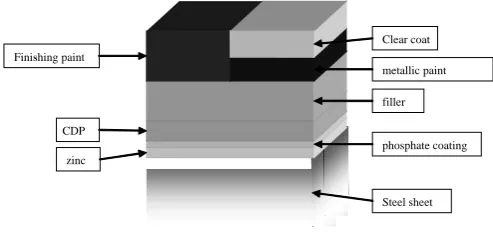
In the field of vehicle manufacturing today, there are various methods used in the painting process, all of which not only vary among the various manufacturers, but also vary internally among factories of individual manufacturers [6]. A cathode electrophoretic coating is used first as a primer coat. In the following step of the process, a water-based filler, or a functional coat, is applied to the surface. Before a water-based color and/or effect lacquer is used, the paint from the underlying layer is hardened in the same manner as the electrophoretic coat. This next coat is then applied in a uniform color evenly over the surface electrostatically. After the electrostatic paint coat, an “effect lacquer” may be applied using a wet-on-wet, pneumatic coating process, with which the effect of the metallic pigments will be more visible and can be easily repaired in the future if necessary. After an intermediate drying process, in which water is removed, a wet-on-wet application of the 2C clear lacquer and its hardening in the finishing coat dryer follows. Fig. 1 illustrates the layer configuration of the system substrate-coating-paint as utilized by automobile manufactures.
Finishing paint
-filler
CDP
zinc
Steel sheet metallic paint Clear coat
[image:2.595.45.292.509.626.2]phosphate coating
Fig. 1. Layer configuration of automotive substrate-coating-paint system
The release of information about other painting procedures (i.e. the hardening of material through ultra violet-radiation) allows a greater bandwidth of the various methods to be made available [7]. Current research of paint layering procedures after the stresses involved in an automobile crash are only relevant to respective stone chipping resistance of the paint [8]. There are numerous additional investigations in the area of the improvement of adhesive strength between metal and polymer surfaces [9]–[11].
The performance of paint layering under the stresses of high speed travel was, until now, only investigated from the perspective of stone impact resistance. These investigations allowed carrying out a direct interrelation between stone impact resistance and the bond strength and elasticity of the paint [12]. Furthermore, the large influence of interlacing temperatures and interlacing times on the bond strength and elasticity of paint coats were investigated. Other authors investigated the stone impact resistance of paint on plastic, specifically how aesthetic paints in automobile construction are being used [8]. These investigations have discovered that paint damage in contrast to metallic substrates is almost exclusively dependent upon plastic. For higher impact resistance of paint, the existence of a glass transition made a difference in low temperature tests.
B. Joining of coats of sheet steel
The joining of painted metal through the use of an adhesive agent is used widely in industrial fabrication. Already by 1999, the adhesion of completely painted aluminum panels on the side quadrants of Light Rail Vehicles (LRV) was made possible through developed process technology [13].
Different possibilities in the area of joining surface coated steel materials were demonstrated in the literature [14]. The fact that the adhesive medium applied to the coated steelwork adhered to the surface but did not compromise the strength or adhere to the substrate displays the research worthiness of this work.
Formation and adhesion through hybrid bonding techniques were used for the integration of new materials in a transportation structure [15]. On this topic of synergy, the completion and the properties of the emerging connections under quasi-static, dynamic and impulsive strain are admonished. Through this work, the possibilities that the use of dissimilar materials, the isolation of the joining partners and the avoidance of seam corrosion are elucidated. Finally, the “patchwork blank” technology as an alternative to the currently-used “tailored banks,” in which the cutting process could be reduced and a higher flexibility could be obtained through the adhesion of various sheets of material offers certain advantages [16].
C. Crash behavior of Steel Sheeting
There are numerous research studies on the topic of the behavior of steel sheeting during a crash. Various steel components were investigated in terms of their different tensile strengths [17]. Moreover, the dependency between tensile strengths and temperature in regards to the steel sheets the automobile industry adopted (dual-phase steel, trip-steel and bake-hardening steel) was also investigated [18]. The tensile strength differences between the various steel types above are quite pronounced.
III. MECHANICAL ANALYSIS OF BOND SYSTEM PROPERTIES
In order to identify the potential of the application of adhesive boning on lacquered automotive shells different bond system configurations were analyzed in terms of their mechanical failure. Following bond systems joined with a 2C-polyurethan adhesive were investigated in terms of their mechanical properties by means of (a) lap-joint tensile-shear tests and (b) butt-joint tension tests:
(i) plain steel sheets
(ii) electro-coated steel sheets (iii) primed sheets
(iv) lacquered sheets with
o white non-metallic color and o silver metallic color.
A. Lap-joint tensile-shear tests
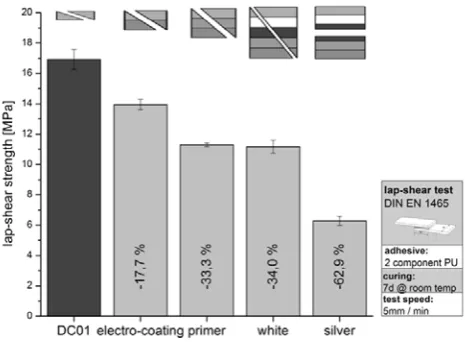
[image:3.595.307.543.237.404.2]The lap-joint tensile-shear tests were performed after DIN EN 1465 for the above five bond system configurations stated above. The location and type of failure for each adhesive bond configuration in case of tensile-shear overlap tests with a sheet thickness of 0.8 mm as well as the respective lap-shear strengths are illustrated in Fig. 2.
Fig. 2. Failure mechanisms of the adhesive bond system joined by 2C-PU on (i) plain steel sheets, (ii) electro-coated steel sheets, (iii) primed sheets, and (iv) white and (v) silver painted sheets after tensile-shear tests
The experiments show that the connection fails in the first four bond system configurations through all the involved layers with a clear reduction of the bond strength up to 34% [20]. In case (iv) of the lacquered surface with white non-metallic color the mechanical failure is observed within the whole adhesive bond connection including the electro-coat, the primer and the white paint, the varnish and the adhesive. In case (i) of blasted metal sheet probes the connection between adhesive and metal surface proves the highest strength representing the lap-shear strength of 2C-PU of 17 MPa. Blasted steel probes were used for the performance of the experiments instead of metal sheet probes with a smooth surface, which would cause a very early failure of the adhesion zone. Finally in case of the adhesive bonding on painted silver metallic surface (v) the weakest link in the bond system proved to be the silver paint layer, since the
failure occurs solely here. The bond system with silver paint indicates an even higher reduction of strength in the paint cohesive zone reaching even almost the half of the lap-shear strength of the bond on white non-metallic paint [20].
B. Butt-joint tension tests
[image:3.595.51.284.363.534.2]The butt-joint tests were performed after ISO 11003-2 again for the three bond system configurations: adhesive bond with a 2C-PU on (i) plain steel sheets and on lacquered sheets with (ii) white non-metallic color and (iii) silver metallic color. The location and type of failure for each adhesive bond configuration in case of but-joint tension tests with cylindrical probes as well as the respective maximum tensile stresses are illustrated in Fig. 3.
Fig. 3. Failure mechanisms of the adhesive bond system joined by 2C-PU on (i) plain steel sheets and (ii) white and (iii) silver painted sheets after butt-joint tension tests
The performed tests prove that the adhesive bonds fail within the adhesive-varnish-paint system in case (ii) of white paint, which indicates an almost equal tensile strength of the white non-metallic paint compared to the 2C-polyurethan adhesive in case (i). Evidence of this is the only slight decrease of the total bond tensile strength of 8%. In the contrary in case of butt-joint tension with silver metallic paint the bond failure is located entirely within the silver paint layer. This signifies that the silver paint is the weakest link in such kind of bond systems. This conclusion is also supported by the considerable decrease of 40% of the bond tensile strength in case of the silver paint bond [20].
Fig. 4. Stress-deformation curves during butt-joint tensile tests for different adhesive bond system configurations
TABLEI
EXPERIMENTAL BUTT-JOINT RESULTS OF MECHANICAL PROPERTIES FOR DIFFERENT ADHESIVE BOND SYSTEM TYPES Mechanical
properties of bonds
Epoxy on plain
steel
2C-PU on plain
steel
2C-PU on white
paint
2C-PU on silver
paint
Young’s Modulus E [MPa]
3500 3000 2900 2750
Tensiale yield strength σY
[MPa]
35 25 22 -
Max. tensile strength σmax
[MPa]
45 30 28 16
IV. CURRENT SITUATION IN AUTOMOTIVE BODY
PRODUCTION AND PROPOSAL OF PROCESS ALTERNATIVES
A. Current situation
The classic process chain in automotive production includes three major areas: the body shell work or body-in-white, the painting process and the final assembly. The body shell work is subdivided into the component manufacture, e.g. through deep forming, extrude molding, casting etc., the mechanical or thermal joining, i.e. laser or spot welding, and the application of structural adhesive bonding for integrating single components and assemblies into an integrated body shell [21]. In turn, the painting process encompasses various applications as electro-coating (EC), hardening of EC and structural adhesives, primer and top color coating. Finally, during the final assembly mainly mechanical joining of attachments and bonding of non-structural parts occur.
B. Process chain alternatives
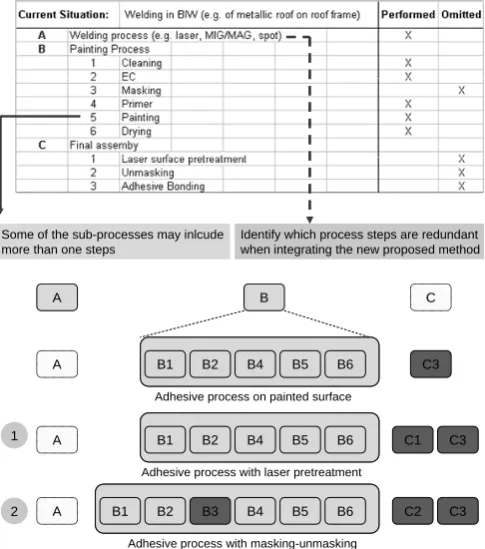
First attempts in the automotive industry in Europe to increase the adhesive bond quality and strength during the final assembly phase prerequisites a masking of the surfaces to be adhered with a corresponding unmasking operation prior and after the color painting process respectively. The masking will be placed on the EC-layer. A further alternative proposal involves the pre-treatment of already painted body surfaces by means of laser process for the paint removal prior to adhesive bonding. This alternative solution aims to increase the strength of the bond system
since the adhesion will occur solely on the electro-coat (cp. Fig. 2). During such process application it is important to ensure the EC-layer consistency so as to avoid corrosion. Last adhesive bonding on painted automotive surfaces could be a cost-effective alternative in the existing production lines. However, this variation proves uncertainties due to the slight decrease of the bond strength, especially for metallic (silver) paints, as shown in Fig. 2.
For the purposes of this contribution the following three alternative scenarios were identified for which a cost analysis will be conducted:
(i) laser surface pre-treatment, i.e. paint removal, prior to final assembly,
(ii) masking and unmasking process steps during the painting process after electro-coating and color painting respectively.
(iii) adhesive bonding on painted surfaces with non-metallic paint, i.e. white, for which higher bond strength are achieved.
The proposed alternatives are visualized in Fig. 5. Here the main process sequences are listed with the option to integrate the suggested alternatives in order to achieve the required bond quality and strength for different product variants, i.e. metallic or non metallic paint, panoramic roof etc.
Some of the sub-processes may inlcude more than one steps
Identify which process steps are redundant when integrating the new proposed method
A B
A
C
B1 B2 B4 B5 B6
B1 B2 B4 B5 B6
Adhesive process on painted surface
A
Adhesive process with laser pretreatment
C1 C3
C3
B1 B2 B4 B5 B6
B1 B2 B4 B5 B6
A B1 B2B2 B3B3 B4B4 B5B5 B6B6 C2 C3
Adhesive process with masking-unmasking
[image:4.595.307.550.395.670.2]2 1
Fig. 5. Current situation and determination of alternative process chain scenarios
V. SCENARIO AND COST ANALYSIS
production in respect to the adhesive joining. As discussed in the aforementioned sections IIIA and IIIB adhesive joining on silver paint yielded high reduction of strength a result clearly illustrated in Fig. 2 and Fig. 3.
That said, the identified alternative production scenarios for achieving higher standards, are decomposed into their activities and the impact the latter have on costs is examined. The methodological framework followed is that of engineering economic analysis.
A. Engineering Economic Analysis
Engineering economics or alternative the engineering economy, as its name states, is an area at which economics and engineering are combined. Essentially, one could say that is the use of fundamental economics techniques applied to engineering projects and subsequently to engineering investment decisions. Sullivan et al [22] reports that engineering economy involves the systematic evaluation of the economic merits of proposed solutions to engineering problems, and this is exactly what is being carried out here.
The analysis starts by identifying the cost groups that will be affected. Since the proposed alternative scenarios require major changes it is clear that all cost groups will be affected. In particular, the (a) direct labor; (b) raw material; (c) tooling; (d) utilities; (e) maintenance; (f) manufacturing overheads; and finally (g) depreciation, are in some degree affected by each proposed scenario. Note that each cost group has a number of inherent variables that determine the level of influence, for example the cost per kWh and the electricity consumption, in the case of utilities costs. Obviously, the inherent variables are of two types, the quantitative and the monetary type. The first describes the quantities needed whereas the second the cost per quantity. Consequently, these inherent variables must also be identified, some of which have.
Following the identification of the affected cost groups and of their inherent influencing variables, quantifying the impact comes next. Impact has essentially two attributes, magnitude and direction. The former refers to absolute or relative monetary effects on each cost group while the latter refers to the direction of those effects, i.e. positive or negative. Note that since all proposed scenarios suggest supplementary activities within the production process and not replacements of existing ones, the impact’s direction is clearly negative.
In addition to the above, various key operational variables have being or are to be quantified. These include, (i) overall production rate; (ii) new process(es)’ cycle time (broken down into setup-processing-post time); (iii) working days; (iv) shift(s) duration; (v) new machinery throughput, etc. Finally, for the cost analysis to be carried out successfully financial variables are also required to be quantified. Those of paramount importance are (a) investment, which includes possible salvage value of machinery and installation cost; (b) tax rate; (c) interest rate, (d) inflation rate; (e) investment horizon; and finally (f) capital structure i.e. the percentage of equity funds versus loaned funds for financing each scenario. A detail list of the aforementioned is given in Table II.
TABLEII COST GROUPS AND VARIABLES Cost Groups
Direct Labor Employees, Wages Raw Material Type, Quantity, Price
Utilities Cost, Consumption
Maintenance Cost of in-house Vs outsource Tooling Cost Man. Overheads As % of Investment Depreciation Horizon (Years), Method
Financial Variables
Investment Price
Salvage Value Price
Installation costs As %
Tax rate As %
Interest rate As %
Inflation rate As %
Investment horizon Years
Capital Structure Equity % and Loan %
Operational Variables
Production rate Units per day
Cycle time Setup, Processing and Post processing time
Working days Days per year
Shift Number of shift(s), duration
Machinery throughput Units per day
The final step of the cost analysis is to evaluate each proposed scenario based on an appropriate criterion. In this case the cost per unit (referring to automobile part) is chosen. Cost per unit defines the additional economic burden the company must carry in order to adopt a specific production scenario. Its magnitude encloses all operational changes each scenario is requiring and works as simple but yet effective comparison criterion for the scenarios.
B. Risk Analysis
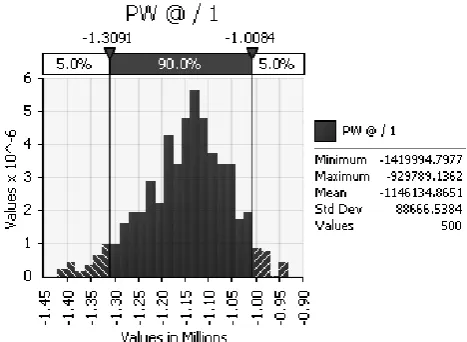
[image:5.595.310.544.509.680.2]Quantifying some of the aforementioned cost groups and variables is certain to lead to the inclusion of a range of values instead of deterministic ones. Therefore, Monte Carlo Simulation (MCS) can be utilized which would yield more representative results in the form of stochastic outputs.
Fig. 6. Indicative density function diagram
for every variable of the objective function, a possible scenario is formed that leads to a certain outcome for the objective function. The synthesis of all iterations, which is the completion of a single cycle described above, gives an efficient number of scenarios.
Consequently, the cost per unit criterion will be portrayed out of the respectively large number of results and presented as a density function diagram that could attribute in a reliable manner its needed distribution. This will show in parallel the possibility of occurrence for each value and marking out extreme or probable results [22] making it, thus, a quantitative risk analysis (refer to Fig. 6).
VI. CONCLUSIONS AND OUTLOOK
In this paper the state-of-the-art of adhesive bonding mechanisms on different coating configurations is introduced. Hereby, the bond strength is investigated in respect of the coat layer composition and the weakness of bond systems on metallic paint was indentified. Based on the experimental conclusions and the available means, alternative process chain scenarios were proposed with the aim to overcome the disadvantages identified during adhesive bonding of attachments on painted surfaces in automotive final assembly lines. In order to quantify the costs of the suggested scenarios a proposed cost analysis is presented including all relevant cost groups and variables. The proposed cost analysis can aid to justify the viability of the modern manufacturing process in respect of their additional costs vs. the improved product quality.
ACKNOWLEDGMENT
The presented investigations and results were accomplished in the context of the collaborative project CrabLacs, which is financed within the 8th Joint CORNET Call for Trans-national Collective Research Project Proposals by the German Federation of Industrial Research Associations (AiF) and the Research Promotion foundation (RPF) of Cyprus.
REFERENCES
[1] J. Daniels, “Design implications of adhesive bonding in car body construction,” Int. J. on Adhesion and Adhesives, vol. 4, no. 1, pp. 5–8, Jan. 1984.
[2] T.A. Barnes, I.R. Pashby, “Joining techniques for aluminium spaceframes used in automobiles, Part II - adhesive bonding and mechanical fasteners,” J. of Materials Processing Technology, vol. 99, pp. 72–79, 2000.
[3] M.F.B. M Fathil, “Painting process improvement for automotive industry,” University Malaysia Pahang, Nov. 2008.
[4] A. Kessel, K. Dilger, “Kleben auf Lack. Einfluss der Lacktrocknung auf die Hafteigenschaften,” J. für Oberflaechentechnik, vol. 46, no. 9, pp. 56–59, 2006.
[5] A. Kessel, “Lackautohäsion in kraftübertragenden Klebverbindungen im Automobilbau,” Dissertation Techn. Univ. Braunschweig, Shaker, Aachen 2009.
[6] G. Woelfel, “BMW Werk Leipzig setzt neue Maßstäbe in der Auto-mobillackierung,” Die Oberflaechen-Zeitung, Germany, 2005 [7] M. Hilt, “Perspektiven der UV-Strahlungstrocknung von Klarlacken,”
Metalloberflaeche, vol. 54, no. 11, pp. 43–45, 2000.
[8] R. Nothhelfer-Richer, G. Kunz, C.D. Eisenbach, “Stone chip resistance of coatings on plastic substrates,” Stuttgarter Kunststoff Kolloquium, vol. 19, Stuttgart, pp. 1–6, 2005.
[9] W. Scholz, “Improving substrate wetting with coating additives,“ Adhesive and Finishing Symp., vol. 28, Munich, 2003.
[10] W. Kleber, “Elektrostatische Oberflächenbeschichtung, Teil 4: Technologische Anforderungen an die Anlagentechnik,” Metalloberflaeche, vol. 54, pp. 48–51, 2000.
[11] M. Mechtel, M. Melchiors, “2-K-Wasserklarlack für die Automobil-Lackierung,” J. für Oberflaechentechnik, 2003.
[12] R. Somborn, “Lackwunden durch Steinschläge. Unzureichende Stein schlagbeständigkeit,” Farbe und Lack, vol. 113, no. 1, pp. 50–52, 2007.
[13] G. Schmatz, “Verkleben von fertiglackierten Aluminiumpaneelen im Seitenwandbereich von LRV (light rail vehicle) aus prozess-technischer Sicht,” Praxis-Forum, Arbeitskreis Automobil, Vienna, 1999.
[14] W. Fluegge, “Fügen von oberflächenbeschichteten Stahlwerkstoffen,” Conference Report: DVS-Report, Salzgitter, 2004.
[15] G. Meschut, H. Friedrich, “Zukünftige Fügekonzepte für Automobil-strukturen in Mischbauweise,” Conference Report: Dresdner Leichtbausymposium, 2003.
[16] K. Lamprecht, M. Geiger, “Experimental and numerical investigation of the formability of laser welded patchwork blanks,” Conference Report: Advanced Materials Research, 2005.
[17] M. Borsutzki, D. Matthissen, T.W. Schaumann, H.J. Sieg, “Modern methods of material characterization during the development of new steels for automotive application,” Conference Report: SCT, Inter. Conf. on Steels in Cars and Trucks, 2005.
[18] W. Bleck, A. Frehn, P. Larour, G. Steinbeck, “Untersuchungen zur Ermittlung der Dehnratenabhängigkeit von modernen Karosserie-stählen,” Materialwissenschaft und Werkstofftechnik, vol. 35, no. 8, pp. 505–513, 2004.
[19] O. Hahn, J.R. Kurzok, M. Oeter, M. Brede, O. Hesebeck, K. Dilge, G. Schmid, “Untersuchungen zum Crashverhalten geklebter und hybridgefügter Stahlblechverbindungen,” Forschung für die Praxis, Paderborn, 2002.
[20] M. Schiel, E. Hanssen, M. Frauenhofer, K. Dilger, “Determination of mechanical properties of adhesive joints on painted substrates,” in Int. Conf. on Structural Adhesive Bonding, Porto, July 7–8, 2011. [21] L. Papadakis, “Simulation of the Structural Effects of Welded Frame
Assemblies in Manufacturing Process Chains,” Dissertation, Techn. Univ. Muenchen, 2008.
[22] G.W. Sullivan, M.E. Wicks, C.P. Kowlling, Engineering Economy. 14th ed. New Jersey: Pearson Education, 2009.