F R O M CONCEPTS TO EVENTS: A PROGRESSIVE PROCESS FOR
MULTIMEDIA CONTENT ANALYSIS
Z H I G A N G M A
Advisor: Prof. Dr. Nicu Sebe
Department of Information Engineering and Computer Science
University of Trento
C O N T E N T S
1 I N T R O D U C T I O N 7
2 W E B I M A G E A N N O TAT I O N V I A S U B S PA C E-S PA R S I T Y C O L L A B O R AT E D F E A
-T U R E S E L E C -T I O N 11
2.1 Introduction . . . 11
2.2 Related Work . . . 13
2.2.1 Shared Feature Subspace Uncovering . . . 13
2.2.2 Feature Selection . . . 14
2.2.3 Automatic Image Annotation . . . 14
2.3 The Proposed Framework . . . 15
2.3.1 Problem Formulation . . . 15
2.3.2 Solution . . . 16
2.4 Experiments . . . 20
2.4.1 Compared Methods . . . 20
2.4.2 Image Databases . . . 20
2.4.3 Experiment Setup . . . 21
2.4.4 Performance on Image Annotation . . . 21
2.4.5 Influence of Feature Type . . . 23
2.4.6 Influence of Selected Features . . . 23
2.4.7 Parameter Sensitivity Study . . . 24
2.4.8 Convergence Study . . . 25
2.5 Conclusion . . . 25
3 D I S C R I M I N AT I N G J O I N T F E AT U R E A N A LY S I S F O R M U LT I M E D I A D ATA U N -D E R S TA N -D I N G 27 3.1 Introduction . . . 27
3.2 Related Work . . . 29
3.2.1 Feature Selection . . . 29
3.2.2 Semi-supervised Learning . . . 30
3.3 Methodology . . . 30
3.3.1 Problem Formulation . . . 30
3.3.2 Solution . . . 32
3.3.3 Algorithm . . . 33
3.4 Experiments . . . 34
3.4.1 Compared Algorithms . . . 34
3.4.2 Experimental Data Sets . . . 35
3.4.3 Experimental Setup . . . 36
3.4.4 Multimedia Understanding Performance . . . 36
3.4.5 Comparison with Other Semi-supervised Feature Selection Methods . . . . 40
3.4.6 Influence of the Unlabeled Data . . . 41
3.4.7 Parameter Sensitivity Study . . . 42
3.4.8 Convergence Study . . . 42
3.5 Conclusion . . . 43
Contents
4.2 Related Work . . . 46
4.2.1 Multimedia Low-level Feature Representation . . . 47
4.2.2 Learning to Refine Multimedia Representation . . . 47
4.2.3 Concepts-based Representation . . . 47
4.3 The Proposed Algorithm . . . 48
4.3.1 Learning An Intermediate Representation . . . 48
4.3.2 Solution . . . 51
4.3.3 Nonlinear SAIR . . . 51
4.4 Experiments . . . 52
4.4.1 Datasets . . . 52
4.4.2 Setup . . . 53
4.4.3 MED Results . . . 53
4.4.4 Performance w.r.t. Fewer Concepts . . . 54
4.4.5 Using More Negative Examples . . . 55
4.4.6 Parameter Sensitivity . . . 55
4.4.7 Convergence . . . 55
4.4.8 Nonlinear SAIR vs Linear SAIR . . . 55
4.5 Conclusion . . . 56
5 K N O W L E D G E A D A P TAT I O N W I T H PA RT I A L LY S H A R E D F E AT U R E S U S I N G F E W E X E M P L A R S 59 5.1 Introduction . . . 59
5.2 Related Work . . . 62
5.2.1 Video Event Detection . . . 62
5.2.2 Knowledge Adaptation for Multimedia Analysis . . . 63
5.3 Framework Overview . . . 64
5.4 Concepts Adaptation assisted Event Detection . . . 64
5.5 Optimizing the Event Detector . . . 67
5.6 Experiments . . . 69
5.6.1 Datasets . . . 69
5.6.2 Comparison Algorithms . . . 70
5.6.3 MED Results . . . 71
5.6.4 Influence of Knowledge Adaptation . . . 71
5.6.5 Using Fewer Concepts . . . 76
5.6.6 Do Negative Examples Help? . . . 76
5.6.7 Parameter Sensitivity Study . . . 77
5.6.8 Convergence Study . . . 78
5.7 Complementary Experiment on Multi-Class Classification . . . 78
5.8 Conclusion . . . 79
6 C O N C L U S I O N 81
P U B L I C AT I O N S
This thesis consists of the following publications:
• Chapter 2:
-Z. Ma, F. Nie, Y. Yang, J. Uijlings and N. Sebe: “Web Image Annotation via Subspace-Sparsity Collaborated Feature Selection". IEEE Transactions on Multimedia, 14(4): 1021-1030, 2012.
• Chapter 3:
-Z. Ma, F. Nie, Y. Yang, J. Uijlings, N. Sebe and A. G. Hauptmann: “Discriminating Joint Feature Analysis for Multimedia Content Understanding". IEEE Transactions on Multimedia, 14(6): 1662-1672, 2012.
Idea previously appeared in:
-Z. Ma, Y. Yang, F. Nie, J. Uijlings and N. Sebe: “Exploiting the Entire Feature Space with Sparsity for Automatic Image Annotation". In Proceedings of the ACM International
Confer-ence on Multimedia, pages 283-292, 2011.
• Chapter 4:
-Z. Ma, Y. Yang, N. Sebe, K. Zheng, A. G. Hauptmann: “Multimedia Event Detection Us-ing A Classifier-Specific Intermediate Representation". IEEE Transactions on Multimedia, 15(7):1628-1637, 2013.
Idea previously appeared in:
-Z. Ma, Y. Yang, A. G. Hauptmann and N. Sebe: “Classifier-specific Intermediate Repre-sentation for Multimedia Tasks". In Proceedings of the ACM International Conference on
Multimedia Retrieval, 2012.
• Chapter 5:
-Z. Ma, Y. Yang, N. Sebe and A. G. Hauptmann: “Knowledge Adaptation with Partially Shared Features for Event Detection Using Few Exemplars". Pending minor revision in IEEE
Transactions on Pattern Analysis and Machine Intelligence, 2013.
Idea previously appeared in:
-Z. Ma, Y. Yang, Y. Cai, N. Sebe and A. G. Hauptmann: “Knowledge Adaptation for Ad Hoc Multimedia Event Detection with Few Exemplars". In Proceedings of the ACM International
Conference on Multimedia, pages 469-478, 2012.
The following are the papers published during the course of the Ph.D but not included in this thesis:
• S. Wang, Z. Ma, Y. Yang, X. Li, C. Pang and A. G. Hauptmann: “Semi-supervised Multiple Feature Analysis for Action Recognition". IEEE Transactions on Multimedia, 2014.
Contents
• Z. Ma, Y. Yang, Z. Xu, N. Sebe, A. G. Hauptmann: “We Are Not Equally Negative:
Fine-grained Labeling for Multimedia Event Detection". In Proceedings of the ACM International
Conference on Multimedia, pages 293-302, 2013.
• Y. Yan, Z. Xu, G. Liu, Z. Ma and N. Sebe: “GLocal Structural Feature Selection with Sparsity for Multimedia Data Understanding". In Proceedings of the ACM International Conference
on Multimedia, pages 537-540, 2013.
• Z. Ma, Y. Yang, F. Nie and N. Sebe: “Thinking of Images as What They Are: Compound
Matrix Regression for Image Classification". In International Joint Conferences on Artificial
Intelligence, 2013.
• Z. Ma, Y. Yang, Z. Xu, S. Yan, N. Sebe and A. G. Hauptmann: “Complex Event Detection
via Multi-source Video Attributes". In IEEE Conference on Computer Vision and Pattern
Recognition, pages 2627-2633, 2013.
• Y. Yang, Z. Ma, N. Sebe and A. G. Hauptmann: “Feature Selection for Multimedia Anal-ysis by Sharing Information among Multiple Tasks". IEEE Transactions on Multimedia, 15(3):661-669, 2013.
• Y. Yang, J. Song, Z. Huang, Z. Ma, N. Sebe and A. G. Hauptmann: “Multi-Feature Fusion via Hierarchical Regression for Multimedia Analysis". IEEE Transactions on Multimedia, 15(3):572-581, 2013.
• Y. Han, Z. Xu, Z. Ma and Z. Huang: “Image Classification with Manifold Learning for Out-of-sample Data". Signal Processing, 93(8):2169-2177, 2013.
• H. Zhang, Y. Liu, Z. Ma: “Fusing Inherent and External Knowledge with Nonlinear Learning for Cross-media Retrieval". Neurocomputing, 119:10-16, 2013.
• Y. Yang, Y. Yang, Z. Huang, J. Liu and Z. Ma: “Robust Cross-Media Transfer for Visual Event Detection". In Proceedings of the ACM International Conference on Multimedia, pages 1045-1048, 2012.
• S. Wang, Y. Yang, Z. Ma, X. Li, C. Pang and A. G. Hauptmann: “Action Recognition by Exploring the Data Distribution and Feature Correlation". In IEEE Conference on Computer
Vision and Pattern Recognition, pages 1370-1377, 2012.
• Y. Yang, H. T. Shen, Z. Ma, Z. Huang and X. Zhou: “L21-Norm Regularized Discriminative Feature Selection for Unsupervised Learning". In International Joint Conferences on
1
I N T R O D U C T I O N
How do we memorize moments of our life? We take pictures to capture the beauty of nature, happy smiles of our beloved people or the prosperity of the cities that we build. We record videos to mem-orize our daily life in a more vivid way. Be it a birthday party or a wedding ceremony. Videos can perfectly capture each joyful and romantic moment. We also like to share those digitalized mem-ories with our family and friends even when we are not close by since internet makes us always connected. Online portals like Flickr and Youtube and social network like Facebook and Instagram are flourishing all the time. These comprise just a part of the multimedia data nowadays, not to men-tion the tremendous number of other news, documentary and surveillance resources. The abundant images and videos serve as a huge information pool that can be utilized for our daily life. For the exploitation of them per se, effective indexing techniques are highly desired [19].
Images and videos depict semantic contents in different degrees of richness. Generally speaking, people tend to record static concepts such as objects, scenes or moments of human activities. Videos, in contrast, are used to record dynamic events that are more complicated than static concepts. For example, we can capture a flower with an image but a wedding ceremony needs a long lasting video. Therefore, images and videos consist of the main multimedia data and it is important to develop effective analyzing techniques for both of them. In this thesis we address the problem of image and video understanding and specifically, we tackle the problem with machine learning techniques. The generic framework of thesis is displayed in Figure 1 which shows that the primary techniques harnessed in our work are comprised of feature selection, semi-supervised learning, intermediate representation learning and knowledge adaptation.
We begin from image analysis as static concepts are the components of complicated video events. So what is the basis of image analysis? It is probably the feature representation of an image. In the literature, many different types of feature have been proposed to capture the semantic information of images. Impressive progress on image analysis has been witnessed based on these feature repre-sentations. However, it is inevitable that the feature representation has certain amount of noise and redundancy. Consequently, the following questions are raised up:
• Is it possible to get a more compact representation? Would the analyzing accuracy be im-proved as a result?
We work on these issues in Chapter 2, which was published by IEEE Transactions on Multimedi-a [52]. TechnicMultimedi-ally, feMultimedi-ature selection is utilized to select Multimedi-a compMultimedi-act subset from the originMultimedi-al feMultimedi-ature sets and a novel sparse model formulates our algorithm, which corresponds to the Module 1 in Figure 1. Another benefit of feature selection is that the dimension of the feature representation is reduced, thus leading to the improvement of computational efficiency.
I N T R O D U C T I O N
feature extraction
Multimedia Data
Module 1
Noisy & Redundant Representation?
Feature
Selection
Module 2
Module 3
Module 4
Few Labels? Complicated
Events?
Complicated Events & Few
Labels?
Semi-supervised
Learning
Classifier-specific Intermediate Representation
Knowledge
Adaptation
Auxiliary Multimedia Data
Figure 1: The illustration of our approach for multimedia content analysis.
Though images and videos on the Web are usually associated with tags (labels), they are subjective and sometimes noisy. As for image and video understanding we need to learn models with labeled training data, noisy and incorrect labels would potentially lead to incompetent analyzing models. Hence, the following question comes up:
• Is there any way to attain reasonable analyzing performance with only few labeled images and videos are available?
Searching for a possible answer, we propose a semi-supervised feature analyzing framework for image and video understanding in Chapter 3, which was published by IEEE Transactions on Multi-media [53]. This work corresponds to the Module 2 in Figure 1. Semi-supervised learning is known to be able to handling the paucity of precise labels by exploiting both labeled and unlabeled data. Our approach is based on semi-supervised learning and simultaneously considers eliminating fea-ture noise and redundancy. Through extensive experiments on image and video classification, we validate that properly utilizing unlabeled data does contribute to the performance boost.
Following the work on videos with simple activities and human actions in Chapter 3, we move on to understanding more complicated videos that depict a multimedia event such as landing a
fish. A multimedia event is a higher level semantic abstraction of video sequences than a concept
I N T R O D U C T I O N
challenge is that different video sequences of a particular event may have huge variations. Despite its arduousness, we propose to work on multimedia event analysis as it is more closely related to user interest. We base our research on the multimedia event detection task that has been drawing increasing attention recently. Detection task is more challenging than the widely studied annotation task. Multimedia annotation, also known as recognition, aims to associate a datum with one or multiple semantic labels (tags). Detection identifies the occurrence of a class of interest in a large pool of data. In contrast with annotation for which both the training and testing data are from a fixed number of classes, the training and testing data in detection can be from an infinite number of classes. Hence, multimedia event detection has posed a great research challenge. As multimedia event builds upon several basic elements of objects, scenes and human actions we may refer to an approach suggested by previous work that uses semantic concept representation obtained from concept detectors for event videos [28] [25]. Yet this approach requires the training of many concept detectors in advance, which is tedious and the video understanding performance heavily depends on the accuracy of those concept detectors. As a result, we think about the following question:
• Can we skip the explicit concept detection process but learn an intermediate representation using available multimedia archives related to various concepts for complicated events?
Probing for a positive answer, we propose to learning an intermediate representation coupled with the classifier learning for multimedia event detection in Chapter 4, which was published by IEEE Transactions on Multimedia [56]. Our method corresponds to the Module 3 in Figure 1. Since the intermediate representation learning is bounded to the classifier learning, both of them attain mutual benefit, thus resulting in an optimized event detector that carries more informative cues from the intermediate representation.
We have witnessed encouraging results in Chapter 4 by leveraging the idea that a multimedia event consists of several relevant concepts of objects, scenes and actions. The progress motivates us to further investigate improving multimedia event detection in this direction. Particularly, we tackle a similar problem in line with the second problem addressed in this thesis:
• How can we guarantee reasonable multimedia event detection accuracy when only few posi-tive exemplars are provided?
Note that we expect a solution tailored for multimedia event detection and Chapter 4 has shed a light upon us that other concepts-based multimedia data can be useful. Hence, rather than semi-supervised learning, we approach the problem by a novel knowledge adaptation algorithm in Chapter 5, the extension of our ACM MM paper [54]. We propose to adapt the knowledge from concept level to assist in event detection. Specifically, we use the available video corpora with annotated concepts as our auxiliary resource and event detection is performed on the target videos. Our approach has another desirable property that it is able to adapt knowledge from the source to the target even if the features of them are partially different, but overlapping. Avoiding the requirement that the two domains are consistent in feature types is desirable as data collection platforms change or augment their capabilities and we should be able to respond to this with little or no effort.
2
W E B I M A G E A N N O TAT I O N V I A S U B S PA C E - S PA R S I T Y C O L L A B O R AT E D F E AT U R E S E L E C T I O N1
The number of web images has been explosively growing due to the development of network and storage technology. These images make up a large amount of current multimedia data and are closely related to our daily life. To efficiently browse, retrieve and organize the web images, numerous approaches have been proposed. Since the semantic concepts of the images can be indicated by label information, automatic image annotation becomes one effective technique for image management tasks. Most existing annotation methods use image features that are often noisy and redundant. Hence, feature selection can be exploited for a more precise and compact representation of the images, thus improving the annotation performance. In this chapter, we propose a novel feature selection method and apply it to automatic image annotation. There are two appealing properties of our method. First, it can jointly select the most relevant features from all the data points by using a sparsity-based model. Second, it can uncover the shared subspace of original features, which is beneficial for multi-label learning. To solve the objective function of our method, we propose an efficient iterative algorithm. Extensive experiments are performed on large image databases that are collected from the web. The experimental results together with the theoretical analysis have validated the effectiveness of our method for feature selection, thus demonstrating its feasibility of being applied to web image annotation.
2.1 I N T R O D U C T I O N
As digital cameras become very common gadgets in our daily life, we have witnessed an explosive growth of digital images. On the other hand, the popularity of many social networks such as Face-book and Flickr helps boost the sharing of these personal images on the web. In fact, digital images now take up a very large proportion of multimedia contents in the network and are utilized inten-sively with different purposes. However, it is not straightforward to effectively organize and access these web images because we are facing an overwhelmingly large amount of them. Aiming to man-age the imman-ages efficiently, automatic imman-age annotation has been proposed as an important technique in multimedia analysis. The key idea for image annotation is to correlate keywords or detailed text descriptions with images to facilitate image indexing, retrieval, organization and management.
The sheer amount of web images itself provides us free and rich image repository for research. Researchers have been developing many automatic image annotation methods by leveraging the web scale databases such as Flickr which consist of a large number of user-generated images anno-tated with user-defined tags [80]. Appearance-based annotation, which is one popular approach, is generally realized through two processes, namely searching and mining. Similar images of the unan-notated images are first found out from the web scale databases through the searching process and then the mining process extracts annotation from the textual information of these retrieved similar images. Research work using this approach has demonstrated promising performance for automatic
W E B I M A G E A N N O TAT I O N V I A S U B S PA C E-S PA R S I T Y C O L L A B O R AT E D F E AT U R E S E L E C T I O N
image annotation [86] [69]. Appearance-based image annotation has its effectiveness, but a major problem is that it can be negatively affected when user-generated tags do not reflect the concepts precisely. Learning-based automatic annotation is another effective approach and has gained much research interest. This approach is dependent on certain amount of available annotated images as the training data to learn classifiers for image annotation. Many algorithms have been rendered using learning-based approach these years with varying degrees of success for multimedia semantic anal-ysis [48] [98] [111] [55] [94]. Therefore, this chapter focuses on exploiting learning based methods for image annotation.
Images are normally represented by multiple features, which can be quite different from each other [99]. As it is inevitable to bring in irrelevant and/or redundant information in the feature representation, feature selection can be used to preprocess the data to facilitate subsequent image annotation task [89]. Hence, it is of great value to propose effective feature selection methods. Existing feature selection algorithms are achieved by different means. For instance, classical feature selection algorithms such as Fisher Score [22] compute the weights of different features, rank them accordingly and then select features one by one. These classical algorithms generally evaluate the importance of each feature individually and neglect the useful information of the correlation between different features. To overcome the disadvantage of selecting features individually, researchers have proposed another approach which selects features jointly across all data points by taking into account the relationship of different features [89] [62]. These methods have shown promising performance in different applications. In this chapter we propose a feature selection technique which builds upon the latest mathematical advances in sparse, joint feature selection and apply this to automatic image annotation.
Image annotation is basically a classification problem. However, most web images are multi-labeled, that is to say, an image can reflect several semantic concepts. This intrinsic characteristic of web images makes it a complicated problem to classify them. A simple way to annotate multi-label images is to transform the problem to a couple of binary classification problems for each concept respectively. Though it is easy to implement, this approach neglects the correlation between different concept labels which is potentially useful. Therefore, many recent works [32] have proposed to exploit the shared subspace learning for multi-label tasks by incorporating the relational information of concept labels into multi-label learning. Inspired by their success, we apply shared subspace learning to the problem of feature selection.
To summarize, we combine the latest advances in joint, sparse feature selection with multi-label learning to create a novel feature selection technique which uncovers a feature subspace that is shared among classes. We name our method Sub-Feature Uncovering with Sparsity and demonstrate its effectiveness for automatic web image annotation. The main contributions of our work are:
• Our method leverages the prominent joint feature selection with sparsity, which can select the most discriminative features by exploiting the whole feature space.
• Our method considers the correlation between different concept labels to facilitate the feature selection.
• We conduct several experiments on large scale databases collected from the web. The re-sults demonstrate the effectiveness of utilizing sparse feature selection and label correlation simultaneously.
2.2 R E L AT E D W O R K
2.2 R E L AT E D W O R K
Our work is geared towards better image annotation performance by exploiting effective feature selection. In this section, we briefly review the three related topics of our work, i.e., shared feature subspace uncovering, feature selection and automatic image annotation.
2.2.1 Shared Feature Subspace Uncovering
Letxbe a datum represented by a feature vector. The general goal of supervised learning is to predict for the inputxan outputy. To achieve this objective, learning algorithms usually use training data
{(xi,yi)}in=1to learn a prediction functionfthat can correlatexwithy. A common approach to
obtainfis to minimize the following regularized empirical error:
min f
n X
i=1
loss(f(xi),yi) +µΩ(f), (2.1)
whereloss(·)is the loss function andµΩ(f)is the regularization withµas its parameter.
It is reasonable to assume that multi-label images share certain common attributes. For example, a picture related to “parade", “people" and “street" share the component “people" with another picture related to “party", “people." Intuitively, we can leverage such label correlations for image annotation. In multi-label learning problems, Ando et al. assume that there is a shared subspace for the original feature space [7]. The concepts of an image are predicted by its vector representation in the original feature space together with the embedding in the shared subspace, which can be generalized as the following demonstration:
f(x) =vTx+pTQTx, (2.2)
wherevandpare the weight vectors andQis a common subspace shared by all the features. Suppose the images are related tocconcepts in multi-label learning and there aremt training
data{xi}mti=1belonging to thet-th concept labeled as{yi} mt
i=1. Then (2.1) can be redefined as:
min
ft,Q c
X
t=1
1 mt
mt
X
i=1
loss(ft(xi),yi) +µΩ(ft)
!
s.t. QTQ=I
(2.3)
Note that the constraintQTQ=Iin (2.3) is imposed to make the problem tractable.
By incorporating the shared feature subspace uncovering of (2.2) into (2.3), we get:
min
{vt,pt},Q c
X
t=1
1 mt
mt
X
i=1
loss(vt+Qpt)Txi,yi
+µΩ({vt,pt})
!
s.t. QTQ=I
(2.4)
W E B I M A G E A N N O TAT I O N V I A S U B S PA C E-S PA R S I T Y C O L L A B O R AT E D F E AT U R E S E L E C T I O N
2.2.2 Feature Selection
Feature selection is widely adopted in many multimedia analysis applications. Its principle is to select the most discriminating features from the original ones while simultaneously eliminate the noise, thus resulting in better performance in practice. Another advantage of feature selection lies in its attribute that it reduces the dimensionality of the original data, which in turn reduces the computational cost of the classification.
According to the availability of label information, feature selection algorithms can be classified into two groups: supervised and unsupervised. Unsupervised feature selection [40] [87] [12] is used when there is no label information. An effective way of unsupervised feature selection is to use the manifold structure of the whole feature set to select the most meaningful features [12].
In contrast, supervised feature selection is preferable when there is available label information that can be leveraged by using the correlation between features and labels. In the literature, plen-ty of supervised feature selection methods have been proposed. For example, Fisher Score [22] and ReliefF [36] are traditional supervised feature selection methods and are exploited widely in multimedia analysis. However, traditional feature selection usually neglects the correlation among different features [12]. Therefore, another approach has been developed recently, namely sparsity-based feature selection [37] [62] which can exploit the feature correlation. This approach is built upon the comprehension that many real world data can be sparsely represented, thus rendering the possibility of searching the sparse representation of the data to realize feature selection. Thel2,1
-norm regularization is known to be an effective model for sparse feature selection [107] and has drawn increasing attention [62] [95].
Thel2,1-norm of an arbitrary matrixW∈Rd×cis defined as:
kWk2,1= d X
i=1
r
Xc j=1W
2
ij (2.5)
In [62] and [95],l2,1-norm is leveraged to conduct feature selection jointly across the entire
fea-ture space with promising performance. Their works demonstrate that thel2,1-norm ofWmakes W sparse, meaning that some of its rows shrink to zero. Consequently,W can be viewed as the combination coefficients for the most discriminative features. Feature selection is then realized by
W where only the features associated with the non-zero rows inW are selected. Sparsity-based feature selection is efficient as it can select discriminative features jointly across all data points. However, few works have incorporated sparsity-based feature selection and shared feature subspace uncovering into one joint framework.
2.2.3 Automatic Image Annotation
Image annotation can be viewed as a classification task. It aims to correlate concept labels with spe-cific images by classifying images to different classes. The ultimate goal is that the predicted labels via annotation algorithms can precisely reflect the real semantic contents of images. Nonetheless, the web image resources are countless so it is infeasible to annotate all of them manually. Hence, automatic image annotation becomes an essential tool for handling web scale images for retrieval, index and other management tasks.
2.3 T H E P R O P O S E D F R A M E W O R K
selection model to select discriminative features that are closely related to image concepts for image annotation [55].
Thanks to the continuous effort made by researchers, we have witnessed great advance in automat-ic annotation for web images. However, the performance of automatautomat-ic image annotation is yet to be satisfactory, thus requiring more research work in this domain. Inspired by the recent advanced tech-niques of feature selection and shared feature subspace uncovering, we propose a novel framework to extract the most discriminating features to boost the image annotation performance.
2.3 T H E P R O P O S E D F R A M E W O R K
In this section, we first illustrate the formulation of our Sub-Feature Uncovering with Sparsity (S-FUS) framework. Then a detailed approach is rendered to solve the objective problem.
2.3.1 Problem Formulation
Our method roots from the shared feature subspace uncovering as given by (2.4).
Denote the training data matrix asX= [x1,x2, ...,xn]wherexi ∈ Rd(1 6 i 6n)is thei-th
datum andnis the total number of the training data. LetY = [y1,y2, ...,yn]T ∈{0,1}n×cbe the
label matrix. cstands for the class number andyi ∈ Rc(1 6 i 6n)is the label vector withc
classes. DenoteV = [v1,v2, ...,vc] ∈Rd×candP= [p1,p2, ...,pc] ∈ Rsd×c wheresdis the
dimension of the shared subspace. We can then present (2.4) in a more compact way as:
min
V,P,Qloss
(V+QP)TX,Y+µΩ(V,P)
s.t. QTQ=I
(2.6)
By definingW=V+QPwhereW∈Rd×c
, the above function equivalently becomes:
min
W,V,P,Qloss
WTX,Y+µΩ(V,P)
s.t. QTQ=I
(2.7)
It can be seen from the above function that by applying a different loss function and regularization, we can realize shared feature subspace uncovering in different ways. The least square loss has been
widely used in research which can be illustrated asXTW−Y2
Fwherek·kFdenotes the Frobenius
norm of a matrix. By utilizing the least square loss, Ji et al. [32] have proposed to achieve shared subspace learning in the following way:
min
W,P,Q
XTW−Y 2
F+αkWk 2
F+βkW−QPk2F
s.t. QTQ=I
(2.8)
W E B I M A G E A N N O TAT I O N V I A S U B S PA C E-S PA R S I T Y C O L L A B O R AT E D F E AT U R E S E L E C T I O N
We therefore propose the following objective function as our foundation to realize feature selec-tion:
arg min
W,P,Q
XTW−Y
2,1+αkWk2,1+βkW−QPk 2 F
s.t. QTQ=I
(2.9)
The loss function in our objective, that is to say,XTW−Y2,1is robust to outliers as indicated in [62]. At the same time,kWk2,1in the regularization term guarantees thatWis sparse to achieve feature selection across all data points [95] [62].
2.3.2 Solution
As can be seen in (2.9), our problem involves thel2,1-norm which is non-smooth and cannot be
solved in a closed form. As a result, we propose to solve it as follows.
By denotingXTW−Y= [z1, ...,zn]TandW= [w1, ...,wd]T, the objective in (2.9) is equivalent
to:
arg min
W,P,QT r
(XTW−Y)TD˜(XTW−Y)+αT r
WTDW
+βkW−QPk2F
s.t. QTQ=I,
(2.10)
whereD˜ andDare two matrices with their diagonal elementsD˜ii= 2kz1ik 2
andDii= 2kw1ik 2
respectively.
Note that for any arbitrary matrixA,kAk2F=T r ATA
. Thus, (2.10) becomes:
arg min
W,P,QT r
(XTW−Y)TD˜(XTW−Y)+αT rWTDW
+βT r(W−QP)T(W−QP)
s.t. QTQ=I,
(2.11)
By setting the derivative of (2.11) w.r.tPto zero, we have:
β(2QTQP−2QTW) =0 ⇒ P=QTW (2.12)
SubstitutingPin (2.11) with (2.12) we have:
argmin
W,QT r
(XTW−Y)TD˜(XTW−Y)+αT rWTDW
+βT r
(W−QQTW)T(W−QQTW)
⇒argmin
W,QT r
(XTW−Y)TD˜(XTW−Y)+αT rWTDW
+βT rWT(I−QQT)(I−QQT)W
s.t. QTQ=I
(2.13)
Since(I−QQT)(I−QQT) = (I−QQT), the problem becomes:
argmin
W,QT r
(XTW−Y)TD˜(XTW−Y)+T rWT(αD+βI−βQQT)W
s.t. QTQ=I
2.3 T H E P R O P O S E D F R A M E W O R K
By setting the derivative of (2.14) w.r.tWto zero, we get:
2XDX˜ TW−2XDY˜ +2(αD+βI−βQQT)W=0
⇒ (XDX˜ T +αD+βI−βQQT)W=XDY˜
⇒ W= (M−βQQT)−1XDY˜
⇒ W=N−1XDY˜ ,
(2.15)
whereM=XDX˜ T+αD+βI,N= (M−βQQT)−1andN=NT.
Note that (2.14) can be rewritten as:
argmin
W,QT r
WTXDX˜ TW−2T rWTXDY˜ +T rYTDY˜
+T rWT(αD+βI−βQQT)W
⇒argmin
W,QT r
WT(XDX˜ T+αD+βI−βQQT)W
−2T r
WTXDY˜
+T rYTDY˜
⇒argmin
W,QT r
WT(M−βQQT)W−2T rWTXDY˜ +T rYTDY˜
⇒argmin
W,QT r
WTNW−2T rWTXDY˜ +T rYTDY˜
s.t. QTQ=I
(2.16)
By incorporating theWobtained with (2.15) into the above function, we have:
argmin
Q T r
YTDX˜ TN−1NN−1XDY˜
−2T r
YTDX˜ TN−1XDY˜
+T r
YTDY˜
⇒argmin
Q T r
YTDY˜ −T rYTDX˜ TN−1XDY˜
s.t. QTQ=I
(2.17)
The above problem is equivalent to the following one:
argmax
Q T r
YTDX˜ TN−1XDY˜
s.t. QTQ=I
(2.18)
According to Sherman-Woodbury-Morrison formula, N−1 = (M−βQQT)−1 = M−1+
βM−1Q(I−βQTM−1Q)−1
QTM−1. Thus, (2.18) becomes:
argmax
Q T r
YTDX˜ TM−1XDY˜ +βYTDX˜ TQ(I−βQTM−1Q)−1QTM−1XDY˜
s.t. QTQ=I
(2.19)
which is equivalent to:
argmax
Q T r
YTDX˜ TM−1Q(I−βQTM−1Q)−1QTM−1XDY˜
⇒argmax
Q T r
YTDX˜ TM−1Q(QTQ−βQTM−1Q)−1QTM−1XDY˜
⇒argmax
Q T r
YTDX˜ TM−1Q[QT(I−βM−1)Q]−1QTM−1XDY˜
s.t. QTQ=I
W E B I M A G E A N N O TAT I O N V I A S U B S PA C E-S PA R S I T Y C O L L A B O R AT E D F E AT U R E S E L E C T I O N
Algorithm 1: The algorithm for solving the SFUS objective function. Input:
The training dataX∈Rd×n
; The training data labelsY∈Rn×c
; Parametersαandβ.
Output:
OptimizedW∈Rd×c .
1: Sett=0and initializeW0∈Rd×c
randomly;
2: repeat
Compute[z1t, ...,znt]T =XTWt−Y;
Compute the diagonal matrixD˜tas:D˜t=
1 2kz1
tk2 ...
1 2kzn
tk2
;
Compute the diagonal matrixDtas:Dt=
1 2kw1
tk2 ...
1 2kwd
tk2
;
ComputeMt=XD˜tXT +αDt+βI;
ComputeAt=I−βM−t1;
ComputeBt=M−t1XD˜tYYTD˜tXTM−t1;
ObtainQtby the eigen-decomposition ofA−t1Bt;
UpdateWt+1according to (2.15); t=t+1.
until Convergence;
3: ReturnW.
As for any arbitrary matricesA,BandC,T r(ABC) =T r(BCA), the above function becomes:
argmax
Q T r
[QT(I−βM−1)Q]−1QTM−1XDYY˜ TDX˜ TM−1Q
⇒argmax
Q T r
(QTAQ)−1QTBQ
s.t. QTQ=I,
(2.21)
whereA=I−βM−1andB=M−1XDYY˜ TDX˜ TM−1.
Equation (2.21) can be easily solved by the eigen-decomposition ofA−1B. However, as the
solv-ing ofQrequires the input ofD˜ andDwhich are related toW, it is still not straightforward to getQ
andW. To solve this problem, we propose an iterative approach demonstrated in Algorithm 1. The complexity of the proposed algorithm is briefly discussed as follows. The complexity of calculating the inverse of a few matrices isO(d3). To obtainQ, we need to conduct eigen-decomposition of
A−1B, which is alsoO(d3)in complexity.
The proposed iterative approach in Algorithm 1 can be verified to converge to the optimalWby the following theorem.
Theorem 1 The objective function value shown in (2.9) monotonically decreases in each iteration
until convergence using the iterative approach in Algorithm 1.
Proof. According to Algorithm 1, it can be inferred from (2.11) that:
Wt+1=argminT r
(XTW−Y)TD˜(XTW−Y)+αT rWTDW+βkW−QPk2F
2.3 T H E P R O P O S E D F R A M E W O R K
Therefore, we have
T r(XTWt+1−Y)TD˜t(XTWt+1−Y)
+αT rWtT+1DtWt+1
+βkWt+1−Qt+1Pt+1k2F
6T r(XTWt−Y)TD˜t(XTWt−Y)
+αT rWtTDtWt
+βkWt−QtPtk2F
⇒
n
X
i=1
xT
iWt+1−yi
22 2xTiWt−yi
2 +α d X
i=1
wit+122
2wit2 +βkWt+1−Qt+1Pt+1k
2 F
6
n
X
i=1
xTiWt−yi
22 2xTiWt−yi
2 +α d X
i=1
wit22
2wit2+βkWt−QtPtk
2 F
⇒
n
X
i=1
xTiWt+1−yi
2− n X
i=1
xTiWt+1−yi
2+ n X
i=1
xTiWt+1−yi
2
2
2xTiWt−yi
2 +α d X
i=1
wit+1
2−α d
X
i=1
wit+1
2+α d
X
i=1
wit+122
2wi t
2
+βkWt+1−Qt+1Pt+1k2F
6
n
X
i=1
xTiWt−yi
2−
n
X
i=1
xTiWt−yi
2+
n
X
i=1
xTiWt−yi
2
2
2xT
iWt−yi
2 +α d X
i=1
wit
2−α d
X
i=1
wit
2+α d
X
i=1
wi t 2 2
2wi t
2
+βkWt−QtPtk2F
⇒
n
X
i=1
xTiWt+1−yi
2+α d
X
i=1
wit+1
2+βkWt+1−Qt+1Pt+1k 2 F
−(
n
X
i=1
xTiWt+1−yi
2− n X
i=1
xTiWt+1−yi
2
2
2xTiWt−yi
2
) −α(
d
X
i=1
wit+1
2− d
X
i=1
wit+122
2wit2 )
6
n
X
i=1
xTiWt−yi
2+α d
X
i=1
wit
2+βkWt−QtPtk 2 F
−(
n
X
i=1
xTiWt−yi
2− n X
i=1
xT
iWt−yi
2
2
2xT iWt−yi
2
) −α(
d
X
i=1
wit
2− d X
i=1
wi t 2 2
2wi t
2
)
It has been shown in [62] [95] that for any non-zero vectorsvit|r i=1:
X
i
vit+1
2− X i vit+122
2vi t 2 6X i vit
2− X i vit
2
2
2vi t
2
whereris an arbitrary number. Thus, we can easily get the following inequality:
n
X
i=1
xTiWt+1−yi
2+α d
X
i=1
wit+1
2+βkWt+1−Qt+1Pt+1k 2 F
6
n
X
i=1
xTiWt−yi
2+α d
X
i=1
wit
2+βkWt−QtPtk 2 F
⇒XTWt+1−Y
2,1+αkWt+1k2,1+βkWt+1−Qt+1Pt+1k 2 F
6
XTWt−Y
2,1+αkWtk2,1+βkWt−QtPtk 2 F
W E B I M A G E A N N O TAT I O N V I A S U B S PA C E-S PA R S I T Y C O L L A B O R AT E D F E AT U R E S E L E C T I O N
2.4 E X P E R I M E N T S
To validate the efficacy of our method when applied to automatic image annotation, we conduct several experiments particularly on image databases that are collected from the web image resources.
2.4.1 Compared Methods
We compare our method with one baseline and several feature selection algorithms on automatic image annotation to understand how our method progresses towards better annotation performance. The compared methods are enumerated as follows.
• Using all features (All-Fea): our baseline. It means that we use the original data without feature selection for annotation.
• Fisher Score (F-score) [22]: a classical method. It selects the most discriminative features by evaluating the importance of each feature individually.
• Sparse Multinomial Logistic Regression via Bayesian L1 Regularisation (SBMLR) [15]: a sparsity based state of the art method. It realizes sparse feature selection by using a Laplace prior.
• Spectral feature selection (SPEC) [106]: a state of the art method using spectral regression. It selects features one by one by leveraging the work of spectral graph theory. The supervised implementation is used in our experiments for fair comparison.
• Group Lasso with Logistic Regression (GLRR) [89]: a recently proposed method based on a sparse model. It utilizes group lasso extended with logistic regression to select both sparse and discriminative groups of homogeneous features.
• Feature Selection via Joint l2,1-Norms Minimization (FSNM) [62]: a latest sparse feature
selection algorithm. It employs jointl2,1-norm minimization on both loss function and
regu-larization for joint feature selection.
As our framework is expanded upon regularized least square regression, we use it as the classifier for all the compared approaches.
2.4.2 Image Databases
Web images cover almost all the concepts people are interested in, thus justifying their advantage to be used as research corpus for automatic image annotation. For the sake of the study on multimedia analysis, researchers have also managed to collect and process the web images to create good image databases for experimental purpose.
2.4 E X P E R I M E N T S
Table 1: Performance comparison (±Standard Deviation) on MSRA-MM 2.0 when10×cimages
work as training data.
MAP MicroAUC MacroAUC
All-Fea 0.062±0.001 0.840±0.001 0.655±0.006 F-score [22] 0.060±0.002 0.861±0.005 0.655±0.003 SBMLR [15] 0.056±0.002 0.869±0.003 0.643±0.006 SPEC [106] 0.058±0.001 0.852±0.002 0.650±0.004 FSNM [62] 0.061±0.002 0.875±0.002 0.658±0.006 GLRR [89] 0.060±0.001 0.846±0.001 0.653±0.005
SFUS 0.063±0.001 0.878±0.002 0.662±0.005
this database in our experiments as well. Nonetheless, 59,653 images within NUS-WIDE are unla-beled, we therefore have removed them and used the remaining 209,347 labeled images related to 81 concepts as experimental corpus.
Considering the computational efficiency, we combine three feature types, i.e., Color Correlo-gram, Edge Direction Histogram and Wavelet Texture provided by the authors to represent the im-ages of the two databases. As a consequence, the corresponding feature dimensions for MSRA-MM 2.0 and NUS-WIDE are 347 and 345 respectively [43] [17].
2.4.3 Experiment Setup
The procedure of our experiments can be generalized as follows. We first randomly generate a training set comprised ofm×c images for each database similarly to the experimental setting in [16]. The remaining images are used as testing sets. To understand the performance variation
w.r.t the number of training data, we setmas 10 and 20 respectively and report the corresponding results. We generate the training and testing sets for 5 times and report the average results for fair comparison with other methods.
Note that our objective function in (2.9) involves two parametersαandβ. We tune both of them from{10−3,10−2,10−1,1,10,102,103}and report the best results. The number of the selected features ranges from{100,150,200,250,300}and we use the corresponding feature subset to repre-sent the images. Then the regularized least square regression is applied as the classifier for image annotation.
To evaluate the annotation performance, we use three evaluation metrics, i.e., Mean Average Precision (MAP), MicroAUC and MacroAUC which are all widely used for multi-label classification tasks [65] [89] [85] [26].
2.4.4 Performance on Image Annotation
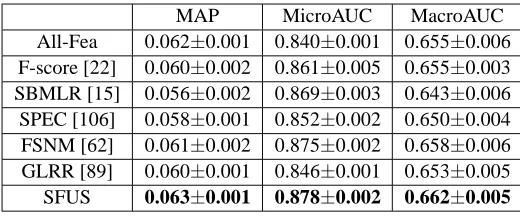
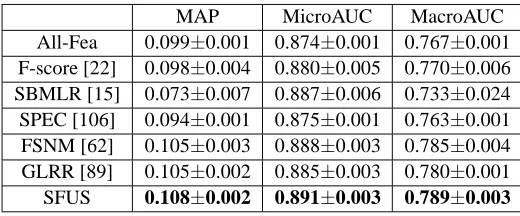
Table 1 to Table 4 show the annotation results when using10×cand20×ctraining data. The results in bold indicate the best performance using the corresponding evaluation metric. According to the annotation results, we observe that our method demonstrates consistently superior performance on both databases.
W E B I M A G E A N N O TAT I O N V I A S U B S PA C E-S PA R S I T Y C O L L A B O R AT E D F E AT U R E S E L E C T I O N
Table 2: Performance comparison (±Standard Deviation) on NUS-WIDE when10×cimages work
as training data.
MAP MicroAUC MacroAUC
All-Fea 0.081±0.002 0.842±0.003 0.726±0.003 F-score [22] 0.080±0.002 0.851±0.003 0.728±0.004 SBMLR [15] 0.072±0.008 0.871±0.005 0.718±0.028 SPEC [106] 0.078±0.002 0.847±0.003 0.722±0.003 FSNM [62] 0.092±0.001 0.869±0.002 0.753±0.002 GLRR [89] 0.082±0.002 0.853±0.002 0.732±0.003
SFUS 0.094±0.003 0.877±0.002 0.756±0.003
Table 3: Performance comparison (±Standard Deviation) on MSRA-MM 2.0 when20×cimages
work as training data.
MAP MicroAUC MacroAUC
All-Fea 0.067±0.004 0.859±0.011 0.676±0.013 F-score [22] 0.066±0.002 0.876±0.004 0.680±0.004 SBMLR [15] 0.059±0.001 0.883±0.004 0.666±0.004 SPEC [106] 0.066±0.001 0.868±0.001 0.679±0.002 FSNM [62] 0.068±0.001 0.887±0.002 0.687±0.002 GLRR [89] 0.067±0.001 0.866±0.002 0.680±0.002
SFUS 0.070±0.001 0.888±0.002 0.690±0.002
Table 4: Performance comparison (±Standard Deviation) on NUS-WIDE when20×cimages work
as training data.
MAP MicroAUC MacroAUC
All-Fea 0.099±0.001 0.874±0.001 0.767±0.001 F-score [22] 0.098±0.004 0.880±0.005 0.770±0.006 SBMLR [15] 0.073±0.007 0.887±0.006 0.733±0.024 SPEC [106] 0.094±0.001 0.875±0.001 0.763±0.001 FSNM [62] 0.105±0.003 0.888±0.003 0.785±0.004 GLRR [89] 0.105±0.002 0.885±0.003 0.780±0.001
2.4 E X P E R I M E N T S
Table 5: Performance comparison (±Standard Deviation) using Color Correlogram & Wavelet Tex-ture on MSRA-MM 2.0 when10×ctraining data are labeled.
MAP MicroAUC MacroAUC
All-Fea 0.059±0.001 0.848±0.002 0.652±0.006 F-score [22] 0.059±0.001 0.861±0.006 0.651±0.003 SBMLR [15] 0.053±0.003 0.874±0.004 0.636±0.006 SPEC [106] 0.058±0.001 0.854±0.003 0.648±0.004 FSNM [62] 0.059±0.001 0.872±0.002 0.655±0.005 GLRR [89] 0.060±0.001 0.858±0.002 0.652±0.004
SFUS 0.061±0.001 0.883±0.002 0.659±0.005
selection methods. Using10×ctraining data, SFUS outperforms the second best feature selection method by about 2.6% and it is better than other feature selection algorithms for both data sets; using
20×ctraining data, SFUS is better than the second best feature selection method by about 1.6% and 3% on MSRA-MM 2.0 and NUS-WIDE respectively and it demonstrates good advantage over other algorithms. Hence, we conclude that our algorithm is a good feature selection mechanism for web image annotation.
The good performance of SFUS for image annotation can be attributed to the appealing property that it can select features jointly across the whole feature space while simultaneously considering the correlation of multiple labels by exploring the shared feature subspace. The incorporation of the sparse model and shared subspace uncovering facilitates the feature selection by finding the most discriminative features, which can be used subsequently in annotation process.
2.4.5 Influence of Feature Type
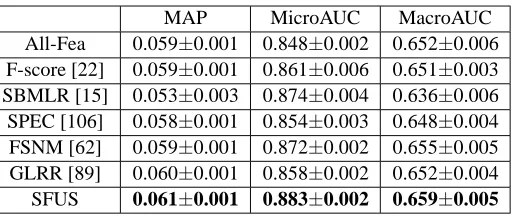
To evaluate the effectiveness of our method, we use a different original feature set, i.e., only Color Correlogram and Wavelet Texture are combined to represent the images and we present the cor-responding annotation results. The experiment is conducted on the MSRA-MM dataset with the results shown in Table 5.
It can be seen that our method still outperforms other feature selection algorithms when the images are represented by color histogram and wavelet texture. The results demonstrate that our algorithm is robust for the variance of the original feature set.
2.4.6 Influence of Selected Features
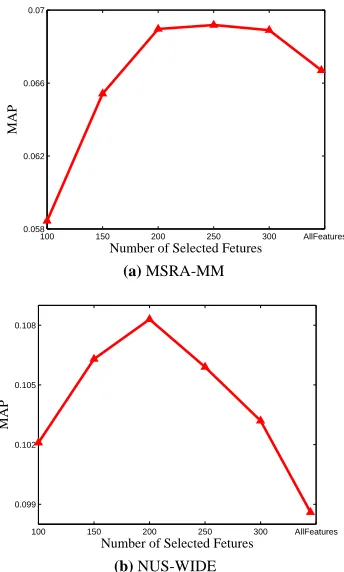
As feature selection is aimed at both accuracy and computational efficiency, we perform an exper-iment to study how the number of selected features can affect the annotation performance using
20×ctraining data. This experiment can present us the general trade-off between performance and computational efficiency for the two image databases.
W E B I M A G E A N N O TAT I O N V I A S U B S PA C E-S PA R S I T Y C O L L A B O R AT E D F E AT U R E S E L E C T I O N
100 150 200 250 300 AllFeatures
0.058 0.062 0.066 0.07
Number of Selected Fetures
MAP
(a) MSRA-MM
100 150 200 250 300 AllFeatures
0.099 0.102 0.105 0.108
Number of Selected Fetures
MAP
(b) NUS-WIDE
Figure 2: Performance variation w.r.t to the number of selected features using our feature selection
algorithm.
200 features to using 300 features for MSRA-MM 2.0 while drops for NUS-WIDE. The different variance shown on the two datasets are supposed to be related to the properties of the datasets. 5) After all the features are selected, in other words, without feature selection, MAP is lower than selecting 200 features for MSRA-MM 2.0 and 100 features for NUS-WIDE. We conclude that, as MAP improves on both databases, our method reduces noise.
2.4.7 Parameter Sensitivity Study
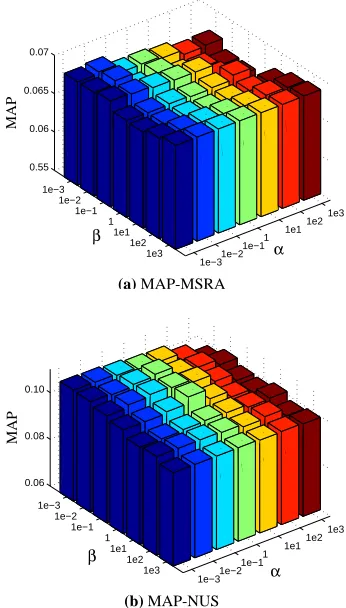
Our method involves two regularization parameters, which are denoted asαandβin (2.9). To learn how they affect the feature selection and consequently the performance on image annotation, we conduct an experiment on the parameter sensitivity. Following the above experiment, we use20×c
training data for image annotation. MAP is used here to reflect the performance variation.
Figure 3 demonstrates the MAP variation w.r.tαandβon the two databases. From Figure 3 we notice that the annotation performance changes corresponding to different combinations ofαandβ. The impact of different values of the regularization parameters is supposed to be related to the trait of the database. On our experimental datasets, better results are generally obtained whenαandβ
2.5 C O N C L U S I O N
1e−31e−2 1e−11
1e11e2 1e3 1e−3
1e−2 1e−1
1 1e1
1e2 1e3 0.55
0.06 0.065 0.07
α β
MAP
(a) MAP-MSRA
1e−31e−2 1e−11
1e11e2 1e3 1e−3
1e−2 1e−1
1 1e1
1e2 1e3 0.06
0.08 0.10
α β
MAP
(b) MAP-NUS
Figure 3: Performance variation w.r.tαandβwhen we fix the number of selected features at 200
for annotation. The figure shows different annotation results when using different values ofαandβ. With this setting, we get the best results whenα=β=10−2for MSRA-MM 2.0 and whenα=1
andβ=10−2for NUS-WIDE.
2.4.8 Convergence Study
As mentioned before, the proposed iterative approach monotonically decreases the objective func-tion value in (2.9) until convergence. We conduct an experiment to validate our claim and to under-stand how the iterative approach works. Following the above experiments, we use20×ctraining data in this experiment. The two parametersαandβare both fixed at 1 as that is the median value of the range from which the parameters are tuned. Figure 4 shows the convergence curves of our algorithm according to the objective function value in (2.9). It can be observed that the objective function value converges quickly. We also calculate the convergence time which is 17.6 and 10.9 seconds for MSRA-MM 2.0 and NUS-WIDE respectively on a personal PC with Intel Core 2 Quad 2.83GHz CPU. The convergence experiment demonstrates the efficiency of our algorithm.
2.5 C O N C L U S I O N
proper-W E B I M A G E A N N O TAT I O N V I A S U B S PA C E-S PA R S I T Y C O L L A B O R AT E D F E AT U R E S E L E C T I O N
5 10 15 20
3360 3370 3380 3390 3400 3410 3420 3430
Iteration Number
Objective Function Value
(a) MSRA-MM
2 4 6 8 10 12 14 16
2540 2560 2580 2600 2620 2640 2660 2680
Iteration Number
Objective Function Value
(b) NUS-WIDE
Figure 4: Convergence curves of the objective function value in (2.9) using Algorithm 1. The figure
shows that the objective function value monotonically decreases until convergence by applying the proposed algorithm.
ties. First, our method jointly selects the most discriminative features across the entire feature space. Additionally, our method considers the correlation between different labels, which has proved to be an effective way in multi-label learning tasks.
3
D I S C R I M I N AT I N G J O I N T F E AT U R E A N A LY S I S F O R M U LT I M E D I A D ATA U N D E R S TA N D I N G1
In this chapter, we propose a novel semi-supervised feature analyzing framework for multimedia data understanding and apply it to three different applications: image annotation, video concept de-tection and 3D motion data analysis. Our method is built upon two advancements of the state of the art: (1)l2,1-norm regularized feature selection which can jointly select the most relevant
fea-tures from all the data points. This feature selection approach was shown to be robust and efficient in literature as it considers the correlation between different features jointly when conducting fea-ture selection; (2) manifold learning which analyzes the feafea-ture space by exploiting both labeled and unlabeled data. It is a widely used technique to extend many algorithms to semi-supervised scenarios for its capability of leveraging the manifold structure of multimedia data. The proposed method is able to learn a classifier for different applications by selecting the discriminating features closely related to the semantic concepts. The objective function of our method is non-smooth and difficult to solve, so we design an efficient iterative algorithm with fast convergence, thus making it applicable to practical applications. Extensive experiments on image annotation, video concept detection and 3D motion data analysis are performed on different real-world data sets to demonstrate the effectiveness of our algorithm.
3.1 I N T R O D U C T I O N
The explosive increase of multimedia data, i.e., text, image and video has brought the challenge of how to effectively index, retrieve and organize these resources. A common approach is to analyze the semantic concepts of multimedia data and to correlate concept labels with them for management tasks. Within the realm of multimedia data understanding, image and video concept understanding have obtained increasing research interest as both of them become prevalent with the popularity of the social web sites such as Flickr and YouTube. To effectively index, retrieve and manage these mul-timedia resources, it is necessary and beneficial to study concept analyzing techniques. Mulmul-timedia data are usually represented by different types of features. Previous works have shown that feature selection is able to reduce irrelevant and/or redundant information in the feature representation, thus facilitating subsequent analyzing tasks such as image annotation [89] [88].
Existing feature selection algorithms are achieved by different means. For instance, classical feature selection algorithms such as Fisher Score [22] compute the weights of different features and then select features one by one. These classical algorithms generally evaluate the importance of each feature individually but neglect the useful information of the correlation between different features.
1 Z. MA, F. NIE, Y. YANG, J. UIJLINGS, N. SEBE AND A. G. HAUPTMANN: “DISCRIMINATING JOINT FEATURE ANALYSIS FOR MULTIMEDIA CONTENT UNDERSTANDING". IEEE TRANSACTIONS ON MULTIMEDIA, 14(6): 1662-1672, 2012. IDEA PREVIOUSLY APPEARED IN: Z. MA, Y. YANG, F. NIE, J. UIJLINGS AND N. SEBE: “EX-PLOITING THE ENTIRE FEATURE SPACE WITH SPARSITY FOR AUTOMATIC IMAGE ANNOTATION". IN
D I S C R I M I N AT I N G J O I N T F E AT U R E A N A LY S I S F O R M U LT I M E D I A D ATA U N D E R S TA N D I N G
! " # $ "%& "' $ () $* +$,
-. / ' 0%. / '
1 2345 67 85 94 :;5<< 57;=9 56 >45 7;=2;?
;5 7 6@234<AB4 19 2CD
:;5<<4D2:4 5 67 85 9
=9 56 >4 <AB 82C6 ?57 64
<AB4<623
=9 56 ?4 ?;57 64 ;57 9 35 B E?;C1?C;59F>5?C;>E>9 >1?72637 ?GE=5;<7 ?B
H II I
J K
L M
N
O P QRSTU RSVR WXRY
ZQ[\X W] [\U R^[V_ ` $, a# $'
H II I ` $, a# $ ' E=5;<>b2 >c c7 1 7 >6 ?<
D2:4567 859
U R^[V d eY_X_][Y W[ fQR XYXYghR]RU R^[V_
iS R Q_ [d e[jjXWX[Y]_ ` $, k # $"%
l m n
op q
r s
t o uuo
n v wxy z w { wxy zw{
wy|}{wx~
~
wy|} |
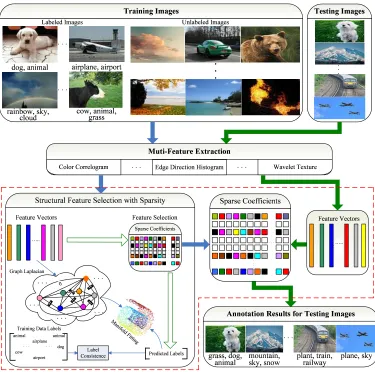
Figure 5: The general process of our method for image annotation. The red frame indicates the core
part of our algorithm which analyzes the feature space for practical applications.
Another problem is that they only use labeled training samples for feature selection, which have an excessive cost in human labor. Semi-supervised learning has shown to be an effective tool for saving labeling cost by using both labeled and unlabeled data. Motivated by this fact, semi-supervised feature selection has also been proposed. For example, in [105], Zhao et al. have presented an algorithm based on the spectral graph theory but similarly to Fisher Score [22], their method selects features one by one. To overcome the disadvantage of selecting features individually, a plethora of state of the art approaches such as [89] [88] [62] have been proposed to extract features jointly across all data points. Nonetheless, [89] [88] [62] implement their methods in a supervised way.
Our semi-supervised feature selection method combines the strengths of joint feature selection [62] [89] [107] and semi-supervised learning [63] [75]. It utilizes both labeled and unlabeled data to select features while simultaneously consider the correlation between them. We name the proposed method Structural Feature Selection with Sparsity (SFSS).
3.2 R E L AT E D W O R K
as it has to decide which classes an image may belong to. Annotation is realized by exploiting the correspondence between visual features and semantic concepts of the images. Video concept detec-tion is another important tool for multimedia resource management. Similarly to image annotadetec-tion, it aims to assign different concept labels to videos. We additionally apply SFSS to human action analysis from 3D motion data.
Taking image annotation as an example, we illustrate the general analyzing process of our method in Figure 5. All the training and testing images are first represented by different types of features, followed by the graph Laplacian construction. Then sparse feature selection and label prediction are conducted simultaneously by satisfying both label consistence with the training data labels and manifold fitting on the data structure. The obtained sparse coefficients can be applied to the feature vectors for selection and be directly leveraged for classification.
The main contributions are as follows:
• We combine the recent advances of feature selection and semi-supervised learning into a sin-gle framework.
• The advantage of manifold learning, which is known to be effective in exploring relationship among multimedia data, is incorporated into our framework.
• We apply our method to different applications for which we show promising performance. Our method is especially competitive when few labeled samples are available.
• A fast iterative algorithm is proposed to solve our objective function.
3.2 R E L AT E D W O R K
In this section, we briefly review the research on feature selection and semi-supervised learning.
3.2.1 Feature Selection
Feature selection is an effective tool in multimedia data understanding by selecting discriminating features and reducing the noise from the original data, resulting in more efficient and accurate mul-timedia analysis results.
In literature, there are many different feature selection algorithms. Some classical feature selec-tion methods such as Fisher Score [22] evaluate the relevance of a feature according to the label distribution of the data. Although these classical methods have good performance when used in different applications, they have two major drawbacks. First, a lot of human labor is consumed as they require all the training data to be labeled to exploit the correlation between features and labels for feature selection. Second, their computational cost is high as they evaluate features one by one.
To progress beyond these classical methods, researchers have proposed sparsity-based feature selection to extract features jointly [107] [62] [95] [52], i.e., each feature either has small scores or large scores over all data points, thus facilitating feature selection. Among various methods using this approach,l2,1-norm regularization based algorithms have gained increasing interest for
the sparsity, joint selection way and the ability to exploit the pairwise correlation among groups of features. For example, Zhao et al. use spectral regression withl2,1-norm constraint to select
features jointly and effectively remove redundant features in [107]. Nie et al. exploit jointl2,1-norm
minimization on both loss function and regularization for feature selection in [62]. Feature selection using l2,1 models has shown its prominent performance. Therefore we propose to leverage it in
our feature selection framework. However, the state of the art usingl2,1 models mostly conducts
D I S C R I M I N AT I N G J O I N T F E AT U R E A N A LY S I S F O R M U LT I M E D I A D ATA U N D E R S TA N D I N G
we design our l2,1-norm based feature selection in a semi-supervised way which can utilize both
labeled data and unlabeled data.
3.2.2 Semi-supervised Learning
Semi-supervised learning is widely used in many applications with the appealing feature that it can use both labeled and unlabeled data [109]. The benefit of utilizing semi-supervised learning is that we can save human labor cost for labeling a large amount of data because it can exploit unlabeled data to learn the data structure. Thus, the human labeling cost and accuracy are both considered which gives semi-supervised learning a great potential to boost the learning performance when properly designed [18].
Among the different methods, graph Laplacian based semi-supervised learning has gained most research interest. Yang et al. have proposed a semi-supervised approach for cross media retrieval in [96]. In [63], Nie et al. have proposed a Flexible Manifold Embedding framework built upon graph Laplacian and demonstrated its advantage for dimensionality reduction over other state of the art semi-supervised algorithms. In [94], a new semi-supervised algorithm based on a robust Laplacian matrix is proposed for relevance feedback. Semi-supervised learning has proved to be able to bring in promising performance by leveraging the whole data distribution for multimedia data understanding in these previous works [96] [63] [94].
3.3 M E T H O D O L O G Y
In this section, we illustrate the detailed approach of our algorithm.
3.3.1 Problem Formulation
We aim to select features that are mostly related to the concepts of the training data. Suppose that
X ∈ Rd×n
indicate the training data,Y ∈ Rn×c
are the labels accordingly. dis the dimension of the original feature,nis the number of the training data, andcis the number of concepts. We propose to use a projection matrixWto correlate XwithY for feature selection. As Wis used to select features from the original feature space and it is expected to be related to the semantic concepts,Wis ad×cmatrix. The problem is subsequently to design an objective function to obtain
Wfor feature selection. In our method, we propose to exploit thel2,1-norm based sparse feature
selection due to its efficacy shown in recent works. Thel2,1-norm based methods select features
by exploiting the correlations between different features and select them jointly [107] [62] [95] [52]. The boosted feature selection performance can consequently facilitate other applications.l2,1-norm
based algorithms can be generalized as the following objective function:
min
W loss(W) +γkWk2,1, (3.1)
whereWis a projection matrix used for feature selection andloss(W)is the loss function. γis a regularization parameter. The definition ofkWk2,1is:
kWk2,1= d X
i=1
r
Xc
j=1W 2
ij. (3.2)
The regularization termkWk2,1in the above function makes the optimalWsparse, according to