Doctoral Thesis
University of Trento
School of Social Sciences
Doctoral School in Economics and Management
Game Experiments with
Communication
A dissertation submitted to the Doctoral School in Economics and Management in partial fulfillment of the requirements for the Doctoral degree (Ph.D.) in
Economics and Management
Andrew Musau
Advisor
Prof. Luigi Mittone University of Trento
Doctoral committee
Prof. Luca Corazzini University of Messina
Prof. Jochen Jungeilges University of Agder
Acknowledgements
I consider myself extremely blessed to have worked with a talented group of individuals over the past few years as a graduate student in Trento. First and foremost, I am grateful to my advisor, Luigi Mittone, who has given me a great level of freedom in working on the dissertation. His guidance, patience, and good humor have been invaluable in providing me with an ideal environment for doing research. I thank Matteo Ploner for his helpful suggestions at CEEL seminars over the years, and for introducing me to the research methodology in experimental economics. Marco Tecilla wrote the software for all experiments that I run as part of the dissertation, and Dominique Cappelletti and the rest of the team at CEEL have welcomed me and made me feel as part of the family. For this, I am extremely grateful.
Contents
List of Figures 11
List of Tables 13
1 A survey of game experiments with communication 21
1.1 Implementation of game experiments in economics . . . 26
1.2 Dictator and ultimatum games . . . 28
1.2.1 Dictator, ultimatum and other bargaining game exper-iments with communication . . . 32
1.2.2 Other relevant dictator and bargaining game experi-ments without verbal communication . . . 46
1.3 Trust games . . . 55
1.4 Other games . . . 64
1.5 Conclusion . . . 75
2.2 Method . . . 86
2.2.1 Experimental Design . . . 86
2.2.2 Behavioral Predictions . . . 88
2.2.3 Participants and Procedures . . . 91
2.3 Results . . . 93
2.3.1 Descriptive Statistics . . . 93
2.3.2 Regression Analysis . . . 97
2.3.3 Analysis of the informational content of messages . . . 101
2.4 Conclusion . . . 107
2.5 Appendix . . . 109
2.5.1 Instructions (Translation from Italian) . . . 109
2.5.2 Categorization procedure . . . 113
3 Communication, sequentiality and strategic power: A pris-oners’ dilemma experiment 119 3.1 Introduction . . . 119
3.2 Method . . . 126
3.2.1 Experimental design . . . 126
3.2.2 Behavioral predictions . . . 129
3.2.3 Experimental procedures . . . 134
3.3 Results . . . 135
3.3.1 Descriptive statistics . . . 135
3.4 Discussion . . . 148 3.5 Appendix . . . 152 3.5.1 Instructions (Translation from Italian) . . . 152
List of Figures
1.1 The ultimatum game . . . 29
1.2 Money maximizing model: One-to-one correspondence assump-tion . . . 31
1.3 A version of Kreps’ trust game . . . 56
1.4 The investment game . . . 57
1.5 Payoff matrix of the battle of the sexes . . . 66
1.6 Prisoners’ Dilemma . . . 68
1.7 A zero-sum game . . . 69
2.1 Choices of X (average at the individual level) . . . 94
2.2 Conditional choices of Y (comparison across treatments) . . . 95
2.3 Communication breakdown by content . . . 103
2.4 Fairness-oriented vs. Non-fairness-oriented content . . . 106
2.5 Stata Output . . . 116
3.2 Choices of X participants (average at individual level for in-vestment game). Figures within boxes represent mean values. 136 3.3 Choices of Y participants in the investment game (average
at the individual level). Figures within boxes represent mean values. . . 138 3.4 Average payoffs of X and Y participants across treatments in
the prisoners’ dilemma. Figures within boxes represent ECU amounts. . . 140 3.5 Average payoffs of X and Y participants across treatments
List of Tables
2.1 Ultimatum game with strategy method: Y’s decision task . . . 87 2.2 Choices of X (Random Effects: linear and probit) . . . 98 2.3 Analysis of Responder Choices (GLLAMM: logit) . . . 100
3.1 Investment game with strategy method: Y’s decision task . . . 127 3.2 Communication and Reciprocity (Random-intercept logit) . . 144 3.3 Communication and Cooperation (Random-intercept logit) . . 145 3.4 Communication and profitability of trust (random-intercept
Introduction
Neoclassical economic theory is characterized by complex models of super rationality. Aumann (1997) summarizes five main objections to such models:
• From casual empirical observation (or introspection), it is apparent that most economic agents are not maximizers (i.e., they do not consider the entire choice set and pick the maximal element from it).
• Maximization problems are complex, and even if one were willing, one would in practice not be able to carry them out.
• Conclusions from rational analysis, in some cases, seem unreasonable even on the basis of introspection.
• Laboratory experiments show that people fail to conform to some of the basic assumptions of rational decision theory.
• Laboratory experiments indicate that the conclusions of rational anal-ysis sometimes fail to adhere to “reality”.
part of the growth in popularity of behavioral and experimental economics is its endeavor not only at identifying anomalies in neoclassical models, but also introducing psychological realism into these models.1 Specifically, be-havioral and experimental economics has proposed and tested a variety of formulations (such as reciprocity and inequality aversion), that capture the social nature of preferences.
One important element in this research field is determining how commu-nication affects behavior, taking into account that individuals are not merely self-interested, but also value outcomes that accrue to other individuals. In the utility maximization framework, communication is on the most part pre-dicted not to influence outcomes, since agents primarily pursue their private interests. For example, in the trust game (Kreps, 1990), if the second mover promises to honor trust conditional on the first mover offering trust, then the first mover would not find the second mover’s promise to be credible since keeping such a promise entails sacrificing some material payoff for the second mover. Yet, if we stop at this prediction, we learn nothing about the real world where communication plays a crucial role in maintaining the functioning of the economic system. The present thesis therefore aims to identify the incremental effect of communication on behavior of participants in game experiments, taking into account social preferences, structures of games, and underlying power hierarchies in a given game. It would be
incor-1For both general and specific discussions on whether models in economics and
rect, however, to imply that the level of importance given to communication started with the rise to prominence of behavioral economics. Therefore, be-fore summarizing our contribution in the thesis, we briefly summarize the role that information has played in economics, because a primary role of communication is to convey information.
copies of the same information. In game theory, the role of information is also central. Non-cooperative games, for example, are analyzed in terms of what information players possess, and are subdivided into perfect informa-tion games and imperfect informainforma-tion games. The economic literature on perfect information games is vast, encompassing the areas of signaling and screening.
Chapter 2 is based on the working paper “Anticipated communication in the ultimatum game”, with Mario Capizzani (IESE Business School), Luigi Mittone (University of Trento, Department of Economics and Man-agement), and Antonino Vaccaro (IESE Business School). The paper in-vestigates whether strategic considerations crowd out anticipatory effects of communication in an ultimatum game. Previous studies in the dictator game show that anticipated verbal feedback induces altruistic behavior. When an allocator donates an amount of money to a recipient, and the recipient sends an anonymous written message after learning of the amount, donations are higher in relation to the standard (no-communication) condition. However, in the extended environment of the ultimatum game, in determining what proportion of endowment to offer, the proposer is not only concerned about her pro-social behavior, but must factor in the possibility of her offer being rejected by the responder. Such strategic considerations have been shown to matter, and in a study examining the effect of anonymity on social distance, it is observed that reducing social distance significantly increases donations in the dictator game, whereas in the ultimatum game, there is no significant effect on offers. We show that anticipated communication effects still persist in the presence of two-sided communication in the ultimatum game.
Chapter 1
A survey of game experiments
with communication
behavioral aspects of the results. The introduction begins by first defin-ing communication and discussdefin-ing issues that may arise if the experimenter wishes to study its effect in an experiment.
The Merriam-Webster dictionary defines communication as “the act or process of using words, sounds, signs, or behaviors to express or exchange in-formation or to express ideas, thoughts, feelings, etc., to someone else.” This definition implies that communication can be split into verbal communication and nonverbal communication. The first category may be further subdivided into oral communication (where spoken words are used e.g., face-to-face con-versations, telephone concon-versations, voice over internet, radio, video) and written communication (where written words are used e.g., letters, reports, memos, faxes, emails, sms).1 Non verbal communication on the other hand
involves the sending or receiving of wordless messages (or any form of com-munication other than oral or written), including, sign language (gestures), body language, facial expression, tone of voice, posture, etc.
What emerges from the above definition is the broad nature of communi-cation, and how implementing it in a laboratory setting may be problematic in some instances. A key feature of laboratory experiments is that they enable the investigator to achieve a controlled variation of a variable of inter-est whilst keeping other (background) conditions fixed. The assumption is that an experiment that is well designed and executed exemplifies a situation where statistical relationships between variables represent underlying causal
relations (Guala, 2005). Communication in an experiment, thus, is what is referred to as a “structural variable” (Camerer, 2003, p. 75). A structural variable changes the structure of the underlying game (typically by adding a move in the extensive-form representation of the game) as contrasted to a descriptive variable that simply changes the way strategies are described.
To illustrate how communication may result in false cause-and-effect in-ference in a game experiment setting, we consider an example where the investigator wants to study the effect of communication on how much the first mover allocates to the second mover in an dictator game.2 However,
before the allocation is done, the second mover is given the opportunity to talk face-to-face with the first-mover. In this instance, there may be non-pecuniary influences on the first-mover’s preferences that the experimenter introduces by allowing face-to-face communication. Suppose that the partic-ipants in this experiment, as in most studies, attend the same college and are able to identify each other once they meet face-to-face. As Camerer (2003, p. 37) observes,
If the subjects know the identity of the person they are bargain-ing with, their knowledge may influence what they do for many reasons. They may like how the person looks and want to make them happy, or fear retribution or embarrassment if they make a stingy offer and see the person after the experiment.
2For the reader unfamiliar with the dictator game, the structure is presented in the
Therefore, the amount the first-mover allocates to the second-mover may take into account future encounters between the two-parties outside the lab-oratory. In such an instance, what may be influencing observed behavior may not be so much what is said between the first-mover and the second-mover and its result (i.e. the effect of communication), but the effect of identification.
Other potential false inference issues that may arise if the experimenter chooses face communication relate to the various levels of face-to-face communication. If visual identification alone results in a non-significant difference in contributions relative to when participants talk to each other face-to-face, then the effect is not as a result of the content of the mes-sages that are exchanged. An experimental design which does not include a visual-identification-only treatment may erroneously attribute the effect of observed behavior partly on the content of the messages, when in fact this is not the case. Finally, it is noted that nonverbal responses at times con-tradict verbal communication and hence affect the effectiveness of messages. A famous example is the first televised US presidential debate between the then Sen. John F. Kennedy and vice president Richard Nixon. Don Hewitt, who produced and directed the debate observed that
(CBS News , October 3, 2012).
The medium of communication may influence perception, in this case the message-content having a dominant effect over radio than over television. How the experiment is designed to take into account these particular factors is therefore important in ensuring that the experimenter achieves a controlled variation of communication. An easy way out is to focus on written com-munication and maintain anonymity between experimental participants, yet this does not fully represent real-world environments where behavioral fac-tors such as trust are important, e.g., in buyer-seller encounters, which in a large number of cases are face-to-face.
1.1
Implementation of game experiments in
economics
In a typical game experiment in economics, participants, usually students pursuing a program of study at the college where the experimental labora-tory is located, are randomly recruited from a pool of interested participants who previously indicated their intent to take part in such experiments. In a number of cases, the recruitment process may impose some restrictions with respect to some attribute, e.g., maintaining a female to male gender ratio of at least 4 : 6. Laboratories often utilize in-house recruitment and selec-tion procedures, but increasingly, open source recruitment softwares such as ORSEE (Greiner, 2004) are employed to aid in the organization and man-agement of the process.
knowledge of the structure of the game, embodied in the common knowledge of rationality assumption (Aumann, 1976). The instructions therefore serve to familiarize participants with the environment of the game, and this is re-inforced by the experimenter reading these instructions aloud at the start of an experimental session.
each experimental session. The most common matching protocol implements no-repeat matching (the so-called “stranger design”)3.
1.2
Dictator and ultimatum games
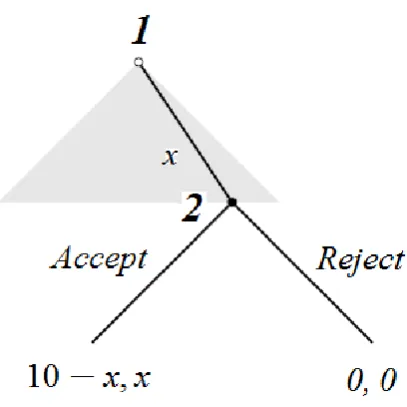
The most widely studied of the experimental games, the ultimatum game, takes a very simple form. The first-mover (henceforth proposer) is asked to divide a fixed endowment, usually a sum of money, between herself and the second-mover (henceforth responder). The responder can either accept or reject the offer. Fig. 1.1 provides an extensive form representation of the game. The endowment is set equal to 10 and the amount that the proposer offers to the responder is denoted x, where x ∈ [0,10]. The continuum of possible offers is represented by the shaded region in the figure. If the responder accepts the proposer’s offer, then he gets a payoff of x, and the proposer gets 10−x. If the responder rejects the offer, then both players get a zero payoff.
The dictator game on the other hand can be viewed as an ultimatum game where the responder’s option to reject an offer is removed. In effect, the game is a one-player decision task where only the proposer has a substantive
3The strictest form of the stranger design is termed “perfect stranger” design where a
Figure 1.1: The ultimatum game
role.4 Nevertheless, it is useful in identifying whether proposers’ offers in the
ultimatum game stem from purely altruistic preferences or are a result of the fear of rejection by responders.
Before reviewing the literature on behavior in ultimatum and dictator games with communication, we briefly summarize findings for these games without communication. For comparative purposes, it is useful to first con-sider what outcome predictions an analysis of these games would yield ap-plying standard game theory. Selten’s (?) notion of backward induction provides a simple method to analyze the ultimatum game in Fig. 1.1.
How-4Strictly speaking, the dictator game does not constitute a proper game in the pure
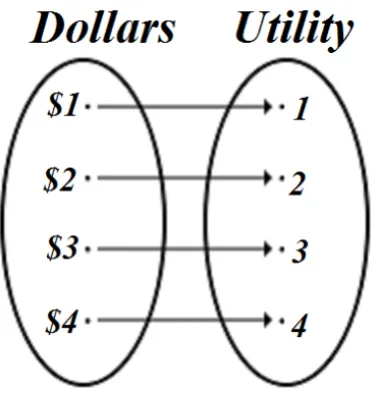
ever, before one can apply the concept in search of the subgame perfect equilibrium (SPE), assumptions regarding players’ preferences are needed. Standard game theory assumes that players maximize expected utility in games. Therefore, players have well defined preferences over outcomes, and these preferences are represented by utility functions defined over outcomes. They choose strategies that earn them the highest expected payoff consider-ing the strategies of all other players in the game. What considerations enter a particular player’s utility function in practice may not be fully enumerated, and standard game theory does not offer a guide as to what these considera-tions are.5 Under standard theory, payoffs are exogenous and valued equally by all players in the game. In experiments which use money, a simple solution is to assume a one-to-one correspondence between utility and money. Figure 1.2 illustrates this assumption. Assume that the set of payoffs for each par-ticipant in an experiment involves four dollar amounts {$1, $2, $3, $4} as represented in the figure. The assumption is that these amounts correspond to the utility set {1, 2, 3, 4}where the following preference ordering holds:
u(4)≻u(3)≻u(2) ≻u(1) . Thus, each player strictly prefers a higher dollar amount relative to a lower dollar amount, is self-interested, and maximizes monetary payoffs (since money corresponds to utility). We will refer to this model as the money-maximizing model.
5Attempts to explicitly explore considerations that enter into players’ utility functions
Figure 1.2: Money maximizing model: One-to-one correspondence assumption
which of the two options to choose. Tossing a coin yields an expected payoff of 12($0) + 12($10) = $5 for the proposer. Could the proposer do better? Absolutely. She could offer $x = ϵ (the smallest currency unit available) which the responder will immediately accept because $ϵ > 0. The proposer gets $(10−ϵ) (e.g., $9.75 if ϵ = $0.25). Offers x > ϵ yield a lower payoff for the proposer. In expected payoffs terms, the outcome (10−ϵ, ϵ) yields the highest expected payoff for the proposer who would determine this using the backward induction process. She would subsequently use her first-mover advantage in the ultimatum game to achieve this allocation. In the dictator game, the money-maximizing model predicts that the proposer would keep the entire endowment since offers ofx >0 reduce the proposer’s payoff.
Camerer (2003) compiles statistics from a large number of studies of ulti-matum games and observes, contrary to predictions of the money-maximizing model, modal and median offers are mostly within 40–50 percent of the stakes on offer, and mean offers are 30–40 percent. In addition, there are very few offers of less than 10 percent, and of above 50 percent.
1.2.1
Dictator, ultimatum and other bargaining game
experiments with communication
treatments. Thus, in the anonymous treatments, responders fill in a reporting card, completing the sentence, “I requestU S$...”. The card is then forwarded to the proposer by a courier, and the proposer at no time knows the identity of the responder she is paired with. In the face-to-face treatment, the respon-der fills in the same reporting card, but delivers it himself to the proposer with the appropriate participant number. No other form of communication is allowed. In total, the experiment includes four treatments: anonymous-and-no-request, anonymous-and-request, to-and-anonymous-and-no-request, and face-to-face-and-request. Rankin finds that mean requested amount by respon-ders is higher under anonymous interaction relative to face-to-face interaction ($ 15.60 compared to $ 13.85 ). However, there is no significant difference in mean offers when requests are made anonymously or face-to-face ($ 7.90 and $ 8.10 respectively). Significantly, face-to-face interaction in the absence of a request results in the highest mean offer across all four conditions ($11.70) whereas the standard dictator game protocol of anonymous interaction and no request results in the lowest mean offer (only $1.89).
mes-sage from a third party (a previous responder) before the allocation decision, and this is common knowledge. Mohlin and Johannesson find that written messages from responders to proposers increase the proportion of proposers who donate some amount of money relative to no-communication from 42 percent to 58 percent, whereas average donations increase from 12.73 percent to 22.13 percent respectively. When communication is from third parties to proposers, there is also an increase in the proportion of proposers who do-nate some amount of money relative to no-communication from 42 percent to 53 percent, and average donations increase from 12.73 percent to 18.18 percent. Therefore, Mohlin and Johannesson suggest that it is not the “re-lationship effect” of communication that is relevant in raising donations but the impersonal content of the communication.
accom-panied by a written reply message to the responder; “Explain then Ask” – where the proposer first sends a written message along with a “non-binding allocation” to the responder who then responds with a written message and a numerical request, and then finally the proposer makes her decision. The base treatment is the standard protocol with no communication.
Andersen et al. find that the average allocation with no communication is $1.53 which is significantly lower than in all communication treatments except “Explain” where the mean allocation is just $0.65. Mean allocation rates are highest in the treatments where there is two-way communication i.e. “Ask then Explain” and “Explain then Ask” (over $ 2.50 in both treat-ments), and over $2.25 in the “Ask” treatment. They analyze the content of responders’ communication and find that the model message is a request for the equal split of the endowment. Notably, in treatments where the responder has a voice (all 3 communication treatments except “Explain”), the mean al-location and proportion of equal split offers is significantly higher than in the treatments where the responder can not speak (baseline no-communication and “Explain”). Andersenet al. thus conclude that asking is powerful. How-ever, there is a caveat to this result: Andersen et al. observe that asking for more than the equal split typically results in nothing in return. They con-clude that communication has a significant influence on altruistic behavior, and this appears to mainly work by increasing empathy.
“commu-nication”. In the anonymity condition, participants play the dictator game under standard procedure. The mutual identification condition entails par-ticipants visually identifying each other but there is no verbal communication between them, whereas in the communication condition, participants inter-act face-to-face with verbal communication allowed. Proposers are given envelopes containing an endowment of CHF. 13 and decide how much to al-locate to responders. Bohnet and Frey find that there is an increase in the proportion of endowment allocated to the responder from 26 percent under no-communication to 50 percent under mutual identification. The propor-tion allocated under communicapropor-tion is 48 percent, which is higher than the proportion under no communication but not significantly different to the proportion under mutual identification. Therefore, they conclude that silent identification (and not face-to-face communication per se) is sufficient to raise contribution rates in dictator games. In particular, Bohnet and Frey note that identification strengthens social or cultural propensities for fairness and decreases social distance, thereby allowing emergence of empathy for the counterpart.
Croson et al. (2003) modify the standard ultimatum game to allow re-sponders to receive an outside option in case of rejection.6 They consider a two-sided imperfect information setting: known or unknown amounts to be
6An outside option in the ultimatum game can be seen as potentially having two effects:
divided (endowments), and known or unknown amounts of the outside op-tions. Participants play the same role with the same partner initially for two rounds, and then a further two rounds, and responders are allowed to send a written message to proposers prior to the proposers making an offer. In turn, proposers have the option to reply (in writing) to the responders’ mes-sages in conjunction with their offers. The design allows lies about private information to be uncovered and to be punished. In some treatments, the size of either the outside option, the initial endowment, or both are revealed to proposers and responders after the second round. Croson et al. find that about half of the responder’s communication includes a threat to reject an offer across all four rounds of the experiment, and both responders’ and pro-posers’ messages include a lie, averagely about slightly less than 20 percent of the time in the first two rounds (before revelation of private information) and about 10 percent of the time in the final two rounds.
Responders in the experiment threaten to reject small offers about 50 percent of the time, and despite the threats, proposers make smaller offers (relative to what is requested) in 30 percent of the cases.7 Crosonet al. clas-sify short-run effects of communication and long-run effects. In the short-run, responder’s lies about their outside options significantly increase the offers
7In game theory, a player who makes a threat that he cannot stand up to is referred to
as making anincredible threat. For example, in the ultimatum game in Fig. 1.1, assuming that the monetary values represent utilities, if the responder threatens to reject an offer
that they receive (relative to no-communication) whereas responder’s threats increase offers only marginally but significantly reduce the probability of ac-ceptance. Proposers’ lies on the other hand result in significantly lower offers and no change in the probability of acceptance. In the long run, responder revealed lies result in smaller but not significantly different offers relative to no-communication in the proceeding rounds (i.e. round 3 and 4), whereas proposer revealed lies result in significantly larger offers and a significantly higher likelihood of rejection of the amounts offered. A possible reason that Croson et al. attribute to the lack of an observed effect as it relates to re-sponder lies is the small size of outside options relative to the possible gains from trade (i.e. the relative unimportance of the lies as it relates to their effect on overall dollar payoffs in the game).
They thus can discuss the bargaining game or anything else. Roth finds that “social” communication results in the same level of cooperation (measured in terms of agreement frequencies) as “game related communication” in bar-gaining games. Overall, communication results in higher rates of cooperation relative to no communication with agreement frequencies of over 90 percent in both communication treatments compared to only 67 percent under no communication. However, Roth further notes that the presence of game-related communication although not resulting in significantly different rates of cooperation compared to social communication may have affected the dis-tribution of offers in the bargaining game. He finds that the percentage of equal-split offers are significantly higher under game-related communication relative to both social communication and no communication, but due to a small sample size, the relevance of this result is unknown.
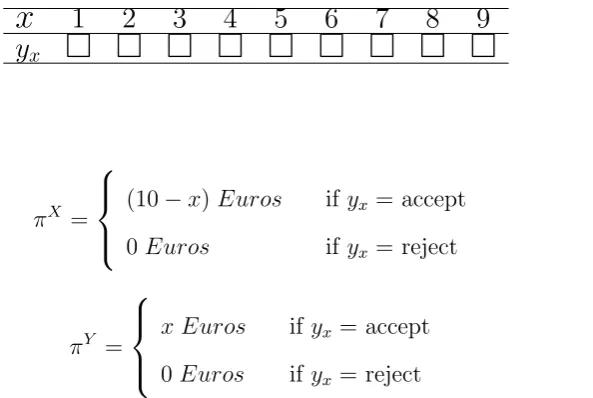
pro-poser endowment is 90 experimental currency units (ECU) and the strategy method is employed to elicit the full vector of the responder. Therefore, the proposer chooses one of 17 possible divisions of the 90 ECU, and for each division, without knowing the actual choice of the proposer, the responder has to indicate whether he accepts or rejects the division.
Zultan finds that communication results in significantly higher offers than no communication, with no significant difference between offers in the re-stricted condition and the unrere-stricted condition (over half of offers are at the 50:50 split in both the restricted and unrestricted conditions compared to only 9 percent under no communication). The result qualitatively mirrors proposer behavior in Roth’s experiment. However, he finds that responders behave significantly less cooperatively in the unrestricted condition compared to both under restricted communication and no communication. The mean acceptance threshold, defined as the smallest proportion of the endowment that a responder is prepared to accept, is 32.2 percent in the unrestricted condition, which is significantly higher than in both the restricted condition and under no communication (23.8 percent and 20.6 percent, respectively). Zultan thus concludes that pre-play communication effects may be the out-come of strategic and social-affective processes, or an interaction of both. Strategic (game-related) communication affects the way in which the play-ers consider social norms, whereas social (non game-related) communication induces cooperative behavior through other-regarding preferences.
requests from responders in the ultimatum game. His two experimental con-ditions include “request” – where responders can request a specific amount of the endowment by filling a reporting card, completing the sentence, “I request $...”, and “no request” – which entails the standard ultimatum game procedure without communication. Both treatments maintain anonymity be-tween participants. The endowment to proposers is equal to $ 30. Proposers record their donations on recording cards, completing the sentence “My offer is $...”, and these are forwarded to responders who decide on whether to accept or reject the offers. Rankin finds that offers and rejection rates in the no request condition are consistent with past results from ultimatum games. Averagely, proposers contribute $ 12.67 or 42 percent of their endowment, and 24 percent of offers are rejected by responders. In the request condition, the mean offer is $ 10.09 or 33.6 percent of the endowment, significantly lower than in the no request condition, and 35 percent of offers are rejected. He concludes that requests adversely affect average offers in the ultimatum game.
a preference for another Nash equilibrium in a different subgame). Punish-ment arises since the second-mover has a chance to choose the strategy that yields a lower payoff for both players if the first-mover chooses her preferred subgame (as opposed to the subgame that favors the second-mover).8 Con-currently, second movers can reward first movers for choosing the subgame preferred by the former (through choosing the efficient-equal split outcome), although this again entails second-movers sacrificing some of their material payoffs. Only the first-movers preferred equilibrium is subgame perfect.
Two pre-play communication treatments are implemented in the experi-ment: written (email) communication and face-to-face (via a video link) com-munication, alongside the base no-communication treatment. In the written communication treatment (as well as no communication), anonymity between participants is maintained. Further, Brosig et al. consider games with dif-ferent efficiencies of punishment. They find that in the absence of commu-nication, first-movers overwhelmingly choose the subgame perfect strategy, over two thirds of the time across all punishment efficiency conditions. Un-der face-to-face communication, there is a reversal: first-movers play their preferred subgame perfect strategy in only 13 out of 106 games (less than an eighth of the time), and second movers exploit first movers by not choos-ing the efficient equal-split outcome only in 4 out of 93 cases (less than 5 percent of the time). In the anonymous written communication treatments,
8Therefore, this feature of the sequential-bargaining game is similar to ultimatum
first-movers play their preferred subgame perfect strategy less than a quarter of the time, and the results generally mirror those under face-to-face commu-nication (although the rates are higher in the face-to-face condition). Brosig
et al. note that if reputation drove the results in the face-to-face condition, then behavior in the anonymous written communication treatment should not be different from behavior under no-communication. Since the results overwhelmingly reject this conclusion, they rule out reputation effects as a significant driver of the communication effect.
via a video link but without any audio channel, and “audio-visual,” where the proposer can see both responders but can only hear one of them speak. The baseline is the standard dictator game protocol with no communication. Greineret al. find that donations are on average 8 percent higher in the visual treatment compared to no-communication, whereas they are 14 percent and 28 percent higher for the non-talking and talking responder, respectively, in the audio-visual treatment. Thus, the findings replicate the result that mere visual exposure does not greatly affect social giving. In addition, Greiner
et al. speculate that guilt aversion may have driven increased giving in the audio-visual treatment, noting that video messages may serve as a channel to influence the proposer’s beliefs about the responder’s expectation, thereby in-fluencing contributions. Proposers’ discrimination (differences in allocations between the responder pair) on the other hand significantly increases with the addition of the visual channel, thus providing evidence that proposers respond to the communication, even if they do not generally become more generous towards responders.
face-face communication. In the former, players send written messages to each other (through a courier) for a 13 minute duration before submitting a bid. In the latter, players are allowed to talk to each other face-to-face, and com-munication is unrestricted, after which they return to separate rooms and submit a final bid. Valley et al. find that communication generally enhances the efficiency of trade. In the communication treatments, only one third of participants truthfully reveal their true values and about the same proportion actively lie about their value. Therefore, Valley et al.’s analysis shows that efficiency does not emerge from mutual truth telling (mutual revelation of values) but through a different mechanism: specifically, communication aids bargainers to coordinate on a single price that is common (one-price equilib-rium), and this occurs approximately 40 percent of the time under written communication and approximately 70 percent of the time under face-to-face communication.
This is not the case when communication is face-to-face, where bargaining is more efficient relative to no communication both when the potential gains from trade are large and when they are small. This increased efficiency is achieved through high levels of coordination coupled with low rates of decep-tion when parties interact face-to-face.
1.2.2
Other relevant dictator and bargaining game
ex-periments without verbal communication
some experiments that have attempted to isolate and investigate the former effect.
as the driving force in decreasing social distance and increasing contributions in the dictator game.
Bolton and Zwick (1995) test two hypotheses of why results in the ul-timatum game experiments divert from the perfect equilibrium prediction. The first, labeled “anonymity hypothesis,” posits that participants’ money maximizing objective is distorted by the act of experimental observation. The second, termed “punishment hypothesis,” contends that participants are willing to punish those who treat them “unfairly” independent of any experimenter influence. Due to what Bolton and Zwick refer to as cost and time considerations, they run a modification of the standard ultimatum game where proposers can choose either an equal allocation of a $ 4 endowment at any period, represented by the payoff vector (2,2), or they can choose an un-equal allocation of the same amount at experimental periodt, represented by the payoff vectorht= (ht,1, ht,2), whereht,1 is the proposer’s share of the
en-dowment attandht,2is the responder’s share attsatisfyinght,1+ht,2 = 4 and
ht,1 > ht,2 >0. The experiment is run under several alternative values ofht,
e.g., (2.20,1.80), (2.60,1.40), (3,1), etc. If the responder accepts at a period
t, then the chosen allocation is implemented, either (2,2) or (ht,1, ht,2). If the
Bolton and Zwick find that across the last 5 periods of the game, the results from condition (i) qualitatively mirror those of standard ultimatum game experiments, for example, 50 percent of offers are equilibrium offers, 20 percent of offers are rejected by responders, and equal-divisions are never rejected. In condition (ii) where anonymity is present, 66 percent of offers are equilibrium offers, and 20 percent of offers are rejected by responders, so perfect equilibrium outcomes rise to 46 percent relative to 30 percent in condition (i). The difference is significant, but Bolton and Zwick note that the anonymity hypothesis explains only a small fraction of non-equilibrium play (about 23 percent). Finally, in condition (iii), all offers are equilibrium offers in the final 5 periods despite the fact that participant-experimenter anonymity is absent. Bolton and Zwick thus conclude that anonymity is relatively unimportant in explaining non-equilibrium play in the ultimatum game, and observe that the punishment hypothesis explains the majority of deviation.
modal allocation is $ 5 in both picture treatments relative to $ 2 in the pictureless treatment. However, mean amounts do not vary much between treatments resulting from the high concentration of $ 0 contributions, with the lowest amount of $1.19 being contributed in the pictureless treatment compared to $1.96 when the responder’s photo is shown, and $1.71 when the proposer’s photo is shown. He concludes that contrary to Bolton and Zwick (1995)’s conclusion, anonymity is an important consideration in determining how much is contributed in the dictator game (altruism) since more than half of proposers keep everything under double blind conditions. However, for those proposers who do choose to contribute some positive amount, the modal division is an even split in the picture treatments similar to what is observed in face-to-face experiments.
Hoffman et al. (1994) conduct double blind dictator game experiments where the experimenter cannot identify the proposer. In their ”contest en-titlement” treatment, participants answer current events questions, and the top ranked participants who score highest in this quiz “earn” the right to be proposers in the game.9 Additionally, participants earn $0.25 extra for each
9To motivate this property rights treatment, Hoffman et al. note that in bargaining
correct answer.10 The ”random entitlement” treatment entails the standard
procedure of randomly assigning participants into the position of proposer and responder. Proposers are endowed with $ 10. Hoffman et al. find that the contest entitlement significantly lowers the distribution of donations in the dictator game relative to random entitlement. In the contest entitle-ment treatentitle-ment and when the experientitle-menter can identify proposers, about 40 percent of proposers offer $ 0 compared to 20 percent under random entitle-ment. 80 percent of proposers offer $ 2 or lower under contest entitlement, whereas about 20 percent of proposers allocate half of the endowment to responders under random entitlement. When the experimenter cannot iden-tify proposers (double-blind treatments), Hoffman et al. observe by far the largest incidence of self-regarding contributions. For example, in one of the double blind treatments, over two-thirds of proposers donate $ 0 and 84 per-cent donate $1 or less. The significantly smaller offers are observed in both random entitlement and contest entitlement treatments.
Eckel and Grossman (1996) run a dictator experiment where the respon-der in one treatment is an anonymous individual, whereas in a separate treatment, the responder is an established charity. Proposers are asked to allocate a $ 10 amount, and behavior in the two treatments is compared. They find that 30 out of 48 participants (62.5 percent) keep the entire
en-10There is evidence that participants regard the role of proposer as more valuable than
dowment, and the mean donation is 10.6 percent of the endowment when the responder is an anonymous individual. However, when the responder is an identified registered charity, only 27.1 percent of participants keep the entire endowment and the mean donation is 31 percent of the endowment. Eckel and Grossman note that when the responder is agreed to be “deserving,” donations increase significantly and thus they conclude that participants are rational in the sense that they incorporate fairness into their decisions.
name treatment. They conclude that the absence of a significant effect on the offers across treatments in the ultimatum game suggests that strategic considerations crowd out altruistic impulses.
individuals), identification by age, name, and picture results in a significantly higher WTC relative to both unidentified and identified by age only. Kogut and Ritov conclude that the effect of identification in the dictator game may be largely restricted to single responders, and that identification of the single responder is more effective the more vivid the representation.11
1.3
Trust games
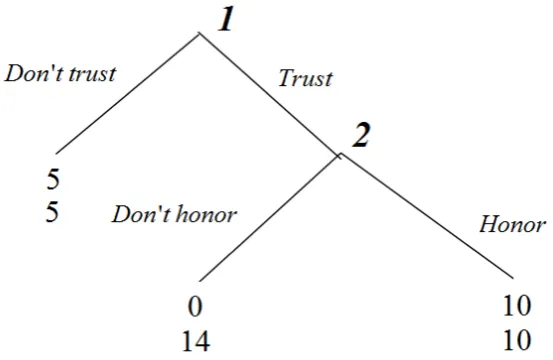
Trust is another important dimension of social preferences and it has in-evitably attracted a number of experiments with communication. However, as we did in the previous section, we will first summarize findings of trust games without communication and then assess how the behavior of players changes once communication is added into the mix. Earlier trust experi-ments employed versions of Kreps’ (1990) trust game such as exhibited in Fig. 1.3. In this game, the first-mover (henceforth trustor) can choose one of two actions: “trust” or “don’t trust”. If the trustor chooses not to trust the second-mover (henceforth trustee), then both players get a payoff of five. If the trustor chooses to trust the trustee, then the payoffs depend on the ac-tion taken by the trustee. The trustee (she) can choose to honor the trustor’s trust in which case each player gets a payoff of 10, or she may choose not to honor the trustor’s trust. If this happens, then the trustor gets a zero payoff and the trustee gets a payoff of 14. The trust game in Fig. 1.3
cap-11Kogut and Ritov (2005b) is a related paper that considers the singularity effect in
tures an essential element of trust in the sense that the trustor (he) will choose the action “trust” only if he strongly believes that the trustee will honor trust. Before analyzing the predicted outcome of the game using the money-maximizing model described in the previous section, we identify a de-fect inherent in Kreps’ trust game and introduce a game which has become the standard behavioral measure of trust among experimental economists.
Figure 1.3: A version of Kreps’ trust game
trustee honoring trust. Being an expected utility maximizer, he will compare his outside payoff of 5 (payoff under the action “don’t trust”) to 0.4(10) + 0.6(0) =4 in which case he still decides not to trust. Notice that all beliefs with p < 0.5 automatically result in the trustee choosing the “don’t trust” action – implying zero trust even though the trustor does weakly trust the trustee. The opposite argument can be advanced for beliefs with p > 0.5, where it might seem that the trustor fully trusts the trustee in cases where
p∈(0.5,1), e.g., p= 0.7, even though the trustors’ beliefs entail an element of mistrust.
Recognizing the fact that Kreps’ trust game does not allow for the iden-tification of intermediate trust preferences, Berg et al. (1995) suggested the investment game exhibited in Fig. 1.4. In this game, the trustor has the choice to send some part, none, or all of the initial endowment (set equal to 10 in Fig. 1.4). The amount that the trustor sends is denoted x where
x ∈ [0,10]. The continuum of possible trustor offers is represented by the shaded upper part of Fig. 1.4. Before the amount sent by the trustor reaches the trustee, it is multiplied by an efficiency factor ofm >1 (usually m is set equal to 3). Therefore, the trustee receives mx. The trustee (usually) has an initial endowment equal to that of the trustor, and she decides how much of her total wealth (endowment + mx) to send back to the trustor (trustee’s endowment is set equal to 10 in Fig. 3.3). The amount sent back to the trustor is denoted y where y ∈ [0,10 +mx]. The continuum of possible y
amounts is represented by the shaded lower part of Fig. 1.4. It should be noted that the trustee’s choice ofy is a function of x in the sense y(x).
chooses not to reciprocate, the trustor still remains with part of the endow-ment not sent, and not a devastating zero payoff as is the case in Kreps’ trust game. Additionally, the investment game also allows for the measurement of the strength of the trustee’s trustworthiness. For every dollar invested by the trustor, it is possible to determine what proportion the trustee reciprocates, and higher proportions reflect higher levels of trustworthiness.
will sendx= 0 in the investment game. The trustee in the investment game will also send y = 0 (since the game does not end even if the trustor sends
x= 0). Therefore, the SPEs in Kreps’ trust game and the investment game are given by (don’t send,∅), and (send x= 0,send y= 0), respectively.
Trust game experiments with communication
Charness and Dufwenberg (2006) modify the trust game (Fig. 1.3) by intro-ducing a probability p = 16 that the trustor gets a zero payoff if the trustee chooses to honor trust.12 In a communication treatment, the trustee is
al-lowed to send a written message to the trustor, and trust behavior in this treatment is compared to that in the base treatment where no communi-cation occurs. Charness and Dufwenberg find that a majority of trustees’ communication includes statements of intent (promises), and observe that the proportion of trustors who choose to trust their counterparts increases from 56 percent in the absence of communication to 74 percent when com-munication is allowed. Overall, there is an increase in the action profile in which the trustor offers trust and the trustee honors trust from 20 percent in the no communication treatment to 40 percent in the communication treat-ment. In a separate communication treatment where trustors send a written message to trustees prior to the start of play, there is no significant effect on
12This modification may be seen as representing hidden action in a principal-agent
behavior.
The special contribution of Charness and Dufwenberg is to figure out why communication from trustees to trustors significantly enhances trust and co-operative behavior (trustworthiness), resulting in greater efficiency and not the other way round. Their design allows them to measure the beliefs of par-ticipants, and they find that communication potentially influences motivation and behavior by influencing beliefs about beliefs. Specifically, since a major-ity of trustees’ communication includes promises, Charness and Dufwenberg find evidence consistent with trustees striving to live up to the expectations of trustors’ (induced by their promises) in order to avoid guilt, a hypothesis they refer to as “guilt aversion”.
behavior.13 Vanberg’s experimental design allows him to directly test these
two explanations. Using essentially the same experimental setup as Char-ness and Dufwenberg, he achieves this by first matching trustors and trustees and allowing the trustees to send messages to trustors, and subsequently re-matching half of the trustees with different trustors before the trustees make any move. Trustors do not know at any time that trustees have been re-matched so their first-order beliefs depend on whether a promise had been made to them. Rematched trustees on the other hand know of the switch and are shown the messages that were sent to their new counterparts by a differ-ent trustee. Most of these messages contain promises, and in principle, the second-order beliefs of the re-matched trustees should be affected by these promises. Vanberg finds strong evidence in favor of the commitment-based explanations observing that an individual’s own promise significantly affects her behavior towards the person whom the promise is made. In terms of the expectations-based account, Vanberg finds that promises do induce changes in second order beliefs, but these changes do not have any significant effect on behavior. The general result of Charness and Dufwenberg on the effect of communication on cooperative behavior is replicated in this experiment.
Goeree and Zhang (2014) introduce competition into Charness and
Dufwen-13Therefore, if I know that individual “X” had been promised something (either by
berg’s design by including treatments where the trustor can select one of two trustees prior to playing the trust game. To induce competition in the de-sign, they offer a higher outside option for the trustee who is selected but not hired relative to the trustee who is not selected (a payoff of 10 relative to a payoff of 5). Goeree and Zhang replicate Charness and Dufwenberg’s result that one way communication from trustees to trustors enhances coop-erative behavior (the proportion of efficient outcomes rises from 30.1 percent under no-communication to 64.4 percent with communication). However, they find that the introduction of competition significantly lowers efficiency in the presence of communication, observing a higher proportion of efficient outcomes under no communication and with competition (53.5 percent) com-pared to under communication and with competition (37.5 percent). Their additional result that competition raises efficiency in the absence of commu-nication leads them to conclude that commucommu-nication and competition act as substitutes.
information about themselves but are not allowed to discuss strategies in the investment game (similar to Roth’s restricted treatment). In the sec-ond csec-ondition(“impersonal-communication”), participants discuss facts but no personal information is shared (similar to the manipulation in Daweset al.
(1977)). Buchan et al. find that personal communication results in signifi-cantly higher amounts sent and returned in the investment game (or higher levels of trust and trustworthiness) relative to impersonal communication. Therefore, they speculate that what may be relevant in enhancing cooper-ation, for example as observed in Roth’s experiment, may not merely be non-strategic communication but personal communication, through either reducing social-distance between communicating parties, increasing group identity, or promoting other regarding concerns.
1.4
Other games
a public pot. The tokens are multiplied by a factor greater than one but less than N (N representing the total number of players), and this “public good” payoff is evenly divided among players. Each player keeps the part of the initial endowment that they did not contribute.14 Under a linear voluntary contribution mechanism, the payoff to player j is thus given by
πj =p(z−cj) +
α
Nγ whereγ =
N
∑
i=1
ci.
where z represents the total number of tokens, p is the private value of tokens,cj is the number of tokens that playerj contributes, Nα is the marginal
gain from contributing a token. The marginal per capita return (MPCR) of the public good is simply the marginal rate of substitution between the public and private good
MPCR = −
∂πj ∂γ ∂πj ∂ci = α pN
A social dilemma arises when N1 <MPCR<1, and the money maximiz-ing model predicts that player j will contributecj = 0.
Coordination games are games with multiple pure strategy Nash equi-libria where players can choose either the same or corresponding strategies. They represent abstractions of coordination problems, a classical example
be-14A public good game is therefore just anN-person Prisoners’ Dilemma (PD) where
ing the “battle of the sexes” – where one player (husband) prefers to watch a game of football, and the other player (wife) prefers to attend an opera concert, but both would rather attend the same event together than sepa-rate events apart. Fig. 1.5 exhibits the payoff matrix of the battle of the sexes game where the wife is the row player and the husband is the column player. Notice that the game is represented in normal form (payoff matrix) because unlike the ultimatum game and trust game which are sequential-moves games, coordination games are simultaneous-sequential-moves games.15
Figure 1.5: Payoff matrix of the battle of the sexes
The two pure strategy Nash equilibria outcomes of the battle of the sexes game are (opera, opera) and (football, football). The husband prefers the latter equilibrium but would rather be in the (opera, opera) equilibrium
15Strategically, what is important in the classification of simultaneous-moves versus
relative to coordination failure. Similarly, the wife prefers the (opera, opera) equilibrium but would rather be in the (football, football) equilibrium relative to coordination failure. There is a mixed-strategy Nash equilibrium in which the husband mixes his strategies opera and football with weights (13,23), and the wife mixes her strategies opera and football with weights (2
3, 1
3). To see
Figure 1.6: Prisoners’ Dilemma
The Prisoners’ Dilemma, the most famous game in game theory, has also attracted a great deal of interest among experimental economists. In this game, both the row player and the column player can choose between two actions: cooperate or defect. If both players choose cooperate, then each obtains a payoff of C ∈ R, and if both choose defect, then each obtains a payoff of D ∈ R. If a player chooses defect, then she obtains a payoff of
participants play this game in the laboratory, where the payoffs in the matrix represent some multiple of real monetary amounts. A famous result, referred to as the folk theorem, shows that the outcome (cooperate, cooperate) can emerge as a subgame perfect equilibrium in an infinitely repeated version of the stage game (or where the number of repetitions is unknown by play-ers). We derive conditions under which (cooperate, cooperate) emerges as a subgame perfect equilibrium under the assumption that players use an ex-ponential discount function (the standard case), and in cases where players use non-exponential discounting (Musau, 2014a).
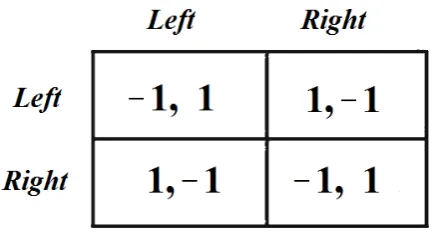
Figure 1.7: A zero-sum game
the game is Pareto optimal. Consider the game in Fig. 1.7 which we will refer to as the “shoot-out” game. In this game, the row player (henceforth striker) will attempt to score a goal from the penalty spot against the column player (henceforth goalkeeper). The striker has two strategies: he can either kick the ball to the left or to the right. The goalkeeper has also two strategies: he can either dive to the left or to the right. If the striker kicks to the left and the goal keeper dives to the left, then the spot kick is saved and the striker gets a payoff of −1 whereas the goal keeper gets a payoff of 1. However, if the striker kicks to the left and the goal keeper dives to the right, the striker scores and gets a payoff of 1 whereas the goalkeeper gets a payoff of
−1. Thus, if both players pick the same action, this favors the goalkeeper whereas different actions favor the striker. Notice that the payoffs in each cell sum up to zero. In zero-sum games, there may be no pure strategy Nash equilibria as in our shoot-out game. However, there is a mixed strategy Nash equilibrium in which both the striker and goalkeeper mix their strategies “left” and “right” with weights (12,12). This can be easily computed using the procedure described previously. Experiments involving zero-sum games investigate whether participants follow minimax decision rules when playing these games.16
16The minimax theorem asserts that in a 2-player zero-sum game, there exists a mixed
Other game experiments with communication
Brosig et al. (2003) study the effect of communication media on coopera-tion in standard public goods games. They manipulate two factors: verbal communication and anonymous interaction. Thus, their seven treatments include combinations of these factors, for example, no-communication (i.e. no verbal communication and anonymous interaction), visual identification with no communication (i.e. no verbal communication but non anonymous interaction), anonymous communication (verbal communication but anony-mous interaction), face-to-face communication (verbal communication and non anonymous interaction). Brosiget al. find that the lowest contributions result under both no communication and under visual identification with no communication with cooperation rates of less than 50 percent. When verbal communication is introduced but the interaction is non-anonymous, there is a significant rise in contributions with cooperation rates of between 50 and 60 percent. The highest contributions are observed when there is face-to-face communication with cooperation rates in excess of 90 percent. Brosig
et al. conclude that various forms of nonverbal communication such as facial expression, and body language as well as the tone of voice play a significant part in accounting for the observed communication effects.
“NC” treatment involves 10 periods with no communication. The “C/NC” treatment involves an initial 10 periods with communication followed by 10 periods without communication whereas the “NC/C” treatment involves 10 periods without communication followed by 10 periods with communication. In the communication periods, participants are allowed to discuss face-to-face for four minutes about anything, except that they cannot reveal private information about their endowments and cannot arrange side payments or issue threats. Thereafter, they return to their terminals and privately make their contribution decisions. Isaac and Walker find that communication sig-nificantly increases mean contributions at levels well above 60 percent in the communication periods compared to well below 50 percent in the base-line NC treatment. However, they observe that contributions decbase-line very slowly in the last half of the C/NC treatment (i.e. periods where there is no communication), and they also increase slowly in the last half of the NC/C treatment (periods where there is communication), suggesting that there is a reinforcing effect, i.e., a history of free-riding tends to discourage cooperation and a history of cooperation tends to discourage free-riding.
communicate with the other 3 group members in writing. Each participant is endowed with a sum of 25 ECU at the start of each period. Koukoumelis et al. find that the mean contribution per participant is significantly higher in the communication treatments (<20 ECU) compared to the no communication treatment (12.27 ECU). Thus, they conclude that in contrast to the usual explanation that communication enhances cooperation through mutual ex-change of promises, one-way communication significantly raises contributions and lowers their variability. In cases where communication occurs only once, contribution levels persist in later periods, and the effectiveness of one-way communication is robust to the absence of strategic concerns.
Bohnet and Frey (1999a) implement the same three treatments described previously in the Prisoners’ Dilemma (PD). They find that the outcome (Co-operate, Cooperate) emerges 12 percent of the time in the anonymity con-dition compared to 23 percent under mutual identification, and 78 percent under communication. Unlike the dictator game where cooperation rates were not significantly different between mutual identification and communi-cation, their results show that face-to-face verbal communication is powerful in enhancing cooperation in the PD.
region of the U.S. (i.e. participants engage in “fact-related” communication). As in Roth’s experiment, participants cannot discuss strategies in the game. Daweset al. find that fact-related communication results in the same levels of cooperation as no-communication in social-dilemma games.
A very brief summary on coordination games with communication
equi-librium that always exists in a cheap talk game is the so called “babbling” equilibrium where cheap talk does not convey any useful information.17
Studies that have looked at the form of communication and outcomes in coordination games have yielded contrasting results. Ellingsen and ¨Ostling show that two-sided communication in general results in increased coordina-tion on equilibrium outcomes and better payoffs than does one-sided commu-nication in symmetric 2×2 games. However, in two-player common interests games, they observe both one-sided and two-sided communication always fa-cilitate coordination on the best equilibrium outcome if players make at least two thinking steps. The duration of communication has also been observed to be important. Aumann and Hart (2003) show long cheap talk (or long conversations) convey substantive information that cannot be conveyed by a single message, and this expands the set of outcomes thus affecting the equilibria preferred by players. Experimental results that support a number of these theoretical predictions are covered in Crawford (1998).
1.5
Conclusion
This chapter has reviewed a substantial body of literature on the effect of communication in game experiments in economics. Previous findings have shown that behavior in game experiments does not conform to predictions
17A babble is a continuous, murmuring sound that is mostly incomprehensible. Thus,
of the purely selfish money maximizing model. Subsequent research has advanced from simply focusing on departures from the standard model to looking at the incremental effect of structural variables such as communica-tion on observed behavior. Generally, results show that communicacommunica-tion has a positive effect on increasing donations in dictator games, increasing rates of cooperation in bargaining games, trust games, and public goods games, and increasing coordination rates in coordination games when the interests of players are closely aligned. The general result masks a lot of detail in its simplicity, and it is tempting to conclude that communication has a unidi-rectional effect on behavior. In reality, as the experiments that have been reviewed show, there are a number of varied and at times conflicting effects of communication, some of which need further experimentation in order to disentangle.
to face-to-face communication, then this renders an analysis of the infor-mational content of messages in the communication treatments redundant. Therefore, it would be interesting to see a replication of the results by Roth and Zultan including a visual-identification only treatment.
The vast majority of ultimatum game and trust game studies reviewed have emphasized the role of strategic communication in achieving higher levels of cooperation compared to the standard no communication condition. For example, Charness and Dufwenberg emphasize the effect of first movers’ promises to cooperate in the trust game, and Andreoni and Rao focus on the power of asking by recipients in the dictator game. Apart from a few studies such as Roth (1995), the role of non-strategic communication has not been analyzed to the same level as strategic communication. Therefore, more studies that look at the impact of non-strategic communication are needed, so that one can evaluate a general communication effect as opposed to simply a strategic communication effect.
as Andreoni and Rao find, the recipient is reduced to asking for a portion of the endowment, or in less kind terms, begging. To the best of our knowl-edge, no communication study has explored these power dynamics that are present in sequential move games, and how they affect the ensuing commu-nication. Given that economic actors have different levels of strategic power, for example in buyer-seller bargaining, exploring how power dynamics affect communication and cooperation is an important element in understanding individual behavior.
Chapter 2
Anticipated communication in
the ultimatum game
with Marco Capizzani, Luigi Mittone, and Antonino Vaccaro
2.1
Introduction
(below the 50:50 split), and this is expressed in terms of expressions of dis-approval, and even at times foul language. For Ellingsen and Johannesson, individuals are motivated by concerns for pride and blame, whereas Xiao and Houser argue that allocators in the dictator game have a preference for avoiding written expression of disapproval, or negative emotions.
One suspects that such motivations persist in similar decision problems where individuals are required to make allocation decisions. However, in the extended environment of the ultimatum game, in determining what propor-tion of endowment to offer, the proposer is not only concerned about her pro-social behavior, but must factor in the possibility of her offer being re-jected by the responder. Previous studies have shown that such strategic considerations have a significant effect on allocation decisions. Charness and Gneezy (2008), for example, compare how anonymity and social distance af-fect behavior in dictator- and ultimatum-games, and find contrasting effects. In the dictator game, reducing social distance significantly increases dona-tions, whereas in the ultimatum game, there is no significant effect on offers. Thus, for them, it appears that strategic considerations crowd out impulses toward generosity or charity.
knowing the actual choice of the proposer, has to indicate for each possible offer whether s