Nutritional compositions of various potato noodles:
Comparative analysis
Xu Fen
1,2,
Hu Honghai
1,2,
Dai Xiaofeng
1,2,
Liu Qiannan
1,2,
Huang Yanjie
1,2,
Zhang Hong
1,2*(1. Institute of Food Science and Technology, Chinese Academy of Agricultural Sciences/Comprehensive Key Laboratory of Agro-products Processing, Ministry of Agriculture, Beijing 100193, China; 2. College of Staple Food Technology,
Institute of Food Science and Technology, Chinese Academy of Agricultural Sciences, Harbin 151900, China)
Abstract: In this study, three kinds of noodles, wheat, Shepody potato and Atlantic potato noodles, were produced with blended powder consisting of wheat flour and certain amounts of various potato flours. In order to investigate the effects of potato flour on the nutritional characteristics of noodles, the nutrient compositions of four types of noodles were analyzed: fresh noodle, dried noodle, fresh noodle after boiling, and dried noodle after boiling. Results showed that the contents of protein, crude fiber, total ash, reducing sugar, vitamin B1, vitamin B2, vitamin B3, vitamin C, most mineral elements, dietary fiber, and amino acids in potato noodles were higher than those in wheat noodles. Furthermore, drying and boiling could decrease the contents of vitamin B1, vitamin B3, and mineral elements in noodles, but the nutrient contents in potato noodles remained higher than those in wheat noodles. The comprehensive nutritional values of noodles were evaluated using the index of nutritional quality, the results showed that the nutritional value of Shepody potato noodles was the highest, followed by that of Atlantic potato noodles and then wheat noodles.
Keywords: potato, noodles, nutritional composition, nutritional value
DOI: 10.3965/j.ijabe.20171001.2287
Citation: Xu F, Hu H H, Dai X F, Liu Q N, Huang Y J, Zhang H. Nutritional compositions of various potato noodles: Comparative analysis. Int J Agric & Biol Eng, 2017; 10(1): 218–225.
1 Introduction
Potato (Solanum tuberosum L.) is the largest
non-cereal food crop worldwide and ranked as the
Received date: 2015-12-15 Accepted date: 2016-12-12
Biographies: Xu Fen, Master, research interests: potato noodle processing science and technology, Email: [email protected];
Hu Honghai, PhD, Associate Professor, research interests: potato processing science and technology, Email: [email protected];
Dai Xiaofeng, PhD, Professor, research interests: agro-products processing science and technology; Liu Qiannan, Master, research interests: food processing and mechanical engineering, Email: [email protected]; Huang Yanjie, Master, research interests: potato staple food processing technology, Email: milier.19881106 @163.com.
*Corresponding author:Zhang Hong, PhD, Professor, research interests: traditional food processing and equipment technology research. Mailing address: Institute of Food Science and Technology, CAAS, No. 1 Nongda South Rd., Haidian District, Beijing, 100193, China. Tel: +86-10-62811401, Fax: +86-10- 62893899, Email: [email protected].
world’s fourth most important food crop after rice, wheat, and maize. In both developed and developing countries, potato is an economically important staple crop and plays
an important role in human diet[1,2]. Potatoes can grow
with stable yields under unfavorable conditions such as
barren land and harsh climates[3]. Given that the
competition for water resources is increasingly intense, potato is an ideal crop in water-deprived areas because of its water-use efficiency. Moreover, potato cultivation can produce a larger amount of dry matter and protein per
hectare than other cereal crops[4]. Potato gains
significance not only because of its high yield and
commercial values but also its nutritional values[5].
Potato is recognized as an excellent source of carbohydrates, high-quality proteins, dietary fiber,
vitamins, and minerals[6]. In addition to these basic
January, 2017 Xu F, et al. Nutritional compositions of various potato noodles: Comparative analysis Vol. 10 No.1 219
compounds, with health-promoting properties[7-9].
Recently, several studies highlighted the high quality of
protein in potatoes[10,11]. Potato protein is considered as
high quality because of its reasonable amino acid composition. Moreover, potato protein contains high amount of lysine, which is often lacking in other vegetables and crops.
China is the largest potato producer worldwide in
terms of either volume or area[12]. However, majority of
potatoes are consumed as fresh vegetables for cuisine, and the industrial processing rate is much lower than the global average. Potato products in China are mainly prepared in forms of starch, modified starch, potato flour, fried chips and French fries. Thus, research and development for nutritional potato stable food suitable for the dietary habits of Chinese residents are of great significance.
The consumption of noodles as daily staple food is one of the most distinguished oriental traditions in
China[13]. With the improvement of people’s living
standards, the demand for nutritional food also increases. Potato is rich in essential nutrients; hence, adding certain proportion of potato flour into wheat flour to make noodles is expected to enhance the nutritional value of traditional noodles. In recent years, many researchers in China have attempted to develop a new kind of traditional staple food called potato noodles to satisfy people’s
nutritional requirement[14]. However, the nutritional
differences between potato noodles and wheat noodles remain still unclear. To increase consumer awareness regarding the nutritional value of potato noodles, the nutritional components and their changes during processing of potato and wheat noodles should be investigated.
2 Materials and methods
2.1 Materials
Wheat flour was purchased from Yi Jia Yi Natural Wheat Flour Co., Ltd. (Henan, China), containing 8.26% moisture, 7.73% protein, 73.14% starch and 3.71% ash. Potato flour was made from two varieties of potato which were kindly provided by Dingbian Science and Technology Bureau of Shaanxi Province. Atlantic
potato flour contains 7.33% moisture, 8.94% protein, 68.11% starch and 4.45% ash. Shepody potato flour contains 7.26% moisture, 7.68% protein, 70.31% starch and 4.84% ash. Wheat protein flour was purchased from Tian Long Wheat Flour Co., Ltd. (Henan, China), containing 7.22% moisture, 89.34% protein, 9.82% starch and 0.82% ash. Salt was purchased from Merry Mart (Beijing, China). Protein, fat, moisture and ash contents were determined via AOAC official methods (Association of Analytical Chemists, 2000). Starch content was determined using a total starch assay kit (Megazyme, K-TSTA 04/2009).
2.1.1 Potato flour preparation
The Atlantic and Shepody potatoes were thoroughly washed and cut in half. Clean potatoes were placed in a steamer for 30 min at a constant temperature of 105°C. After steaming, the potatoes were peeled and mashed. The mashed potatoes were then spread on trays in an oven and dried at a constant temperature of 65°C. These dried potatoes were further ground into flour by using a superfine pulverizer and sieved through a 100 mesh sieve. 2.1.2 Potato noodle preparation
Two potato noodles, namely, Atlantic potato noodle and Shepody potato noodle were processed with blended flour consisting of 61% wheat flour, 35% potato flour (Atlantic and Shepody potato flour respectively), and 4% wheat protein flour. As there is no gluten in potato flour, the addition of the potato flour in wheat flour formed a relatively low degree of gluten network. Thus it was difficult to make noodles when added with 35% potato flour. In order to improve the quality of potato noodles, 4% wheat protein was added in the raw material flour. The control sample was prepared using wheat flour only, namely, wheat noodle. Using a multifunctional mixer (KM005, Kenwood, England), 250 g of raw material flour was mixed with 5 g salt dissolved in certain amounts purified water in advance. And the amount of water was determined by the different water contents in raw material flour to assure that the water content in all dough samples achieved 35.8%.
noodle-making machine (JMTD-168/140, Dongfu, China) with a roller gap of 4 mm. The dough sheet was folded and turned 90° before the next sheeting. The folding, turning, and sheeting procedures were repeated 10 times before resting the dough sheets for another 30 min. Subsequently, the dough sheets were rolled until the thickness reached 1 mm. The expanded dough sheets were cut into 7 mm width strands to make fresh noodles. And approximately half of each kind of fresh noodle samples was subsequently dried in an artificial climate box (LT-ACC300, LEAD-TECH, China) to make dried noodles. In order to investigate the effect of boiling on nutrition of noodles, the fresh and dried noodles were cooked in boiling water for 3 min and 5 min respectively. The noodles after boiling and fresh noodles were dried through a pilot-scale vacuum freeze dryer (GenesisTM SQ, Virtis, America) respectively. All dried noodles were further ground into smaller flour by using a superfine pulverizer (Q-500B, Bingdu, China) and sieved
through a 150 μm mesh sieve. The nutrient composition
of these three kinds of noodles (wheat, Shepody potato and Atlantic potato noodles) was analyzed in four states (fresh noodle, dried noodle, fresh noodle after boiling, and dried noodle after boiling).
Previous experimental results confirmed potato noodles added with 35% potato flour showed no significant difference with wheat noodles in terms of edible qualities including cooking loss, tensile resistance, hardness, cohesiveness and chewiness.
2.2 Basic nutrients
Moisture, ash, crude fat, and crude protein contents were determined by Association of Official Analytical Chemists (AOAC) standard methods. Starch content was determined using a Total Starch Assay Kit (K-TSTA, Megazyme, Ireland).
2.3 Reducing and total sugars
The contents of reducing and total sugars were measured by 3,5-dinitrosalicylic acid (DNS) method after
extraction[15]. Glucose solution was used as analytical
standard at 1 mg/mL, and the calibration curve was established at the glucose content range of 0-1.2 mg. Aliquots of each standard solution (0.5 mL and 1 mL) with equal amount of distilled water were placed in a test
tube and added with 1.5 mL of the DNS reagent. Subsequently, each test tube was shaken evenly and transferred to a boiling water bath for 5 min. After cooling, each sample was diluted to 10 mL with distilled water. The absorbance was determined using a spectrophotometer at 540 nm. The contents of reducing and total sugars were calculated in accordance with the calibration curve.
2.4 Vitamins
Vitamin B1, vitamin B2 and vitamin B3 contents were
determined using the methods outlined by Tuncel et al.[16]
The vitamin C content was determined using the methods
outlined by Mazurek and Jamroz[17].
2.5 Mineral elements
Samples were digested in 100 mL triangular flasks
with 20-30 mL of HNO3 until the digests was cleared.
Approximately 1-2 mL of perchloric acid was added and evaporated until the white smoke disappeared. Small
amount of HNO3 was added again, and the samples were
moved to an electric heating plate to evaporate the
excess HNO3. Finally, the samples were diluted with
deionized water to 25 mL. Blank digestions were performed in a similar manner. Mineral contents were measured by inductively coupled plasma atomic emission spectroscopy (iCAP Q, Thermo Fisher Scientific, America).
2.6 Dietary fiber
The contents of total dietary fiber (TDF), soluble dietary fiber (SDF), and insoluble dietary fiber (IDF) were determined by the enzymatic–gravimetric procedure approved by the AOAC Official Method 991.43
described by previous scholars[18,19]. Samples were
introduced into 400 mL tall-form beakers and suspended into MES/TRIS buffer. Subsequently, the samples were subjected to enzyme hydrolysis in the sequence of
heat-stable α-amylase at 95°C, protease at 60°C, and
January, 2017 Xu F, et al. Nutritional compositions of various potato noodles: Comparative analysis Vol. 10 No.1 221
2.7 Amino acids
The amino acid contents in the noodles were determined by an amino acid analyzer (L-8900, Hitachi, Tokyo, Japan). Samples were hydrolyzed by 6 mol/L HCL at 110°C for 24 h. Filter the samples after hydrolyzing and dilute them to 50 mL with deionized water. Then volatilize the solvent and dissolute samples
with dilute HCL before determination[20].
2.8 Index of nutritional quality (INQ)
A method utilizing INQ was proposed to
quantitatively assess the nutritional quality of food[21-23].
The determination of INQ is based on a relative nutrient density, which is the ratio of a food’s nutrient contribution to its calorie contribution, thereby enabling the evaluation of the specific nutrient contribution of that food to a diet. By using the Chinese Dietary Reference Intakes (Chinese DRIs) as a standard, INQ can be calculated as follows:
INQ=(amount of nutrient per 100 g/Chinese DRIs of that nutrient)/(calories in 100 g/energy reference intake)
For males and females within the age range of 18-50 years old, the energy and nutrient reference intakes, including protein, vitamins and minerals, were quoted from the Chinese DRIs. An INQ of 1 for a nutrient is a
significant goal for a total daily dietary allowance[23].
When the INQ of a specific nutrient in a food is higher than 1, it indicates a relatively higher nutrient intake than calorie intake, and the nutritional value of this nutrient is high. When the INQ is lower than 1, the nutrient intake is below the energy intake, and the nutritional value of
this nutrient is relatively low. 2.9 Statistical analysis
The data reported are averages of triplicate observations and expressed as mean ± standard error. ANOVA followed by Tukey’s test with 0.05 significance level was used to evaluate the differences among sample means. ANOVA was conducted with SPASS 18.0 (SPSS Inc., Chicago, USA).
3 Results and discussion
3.1 Basic nutrient analysis
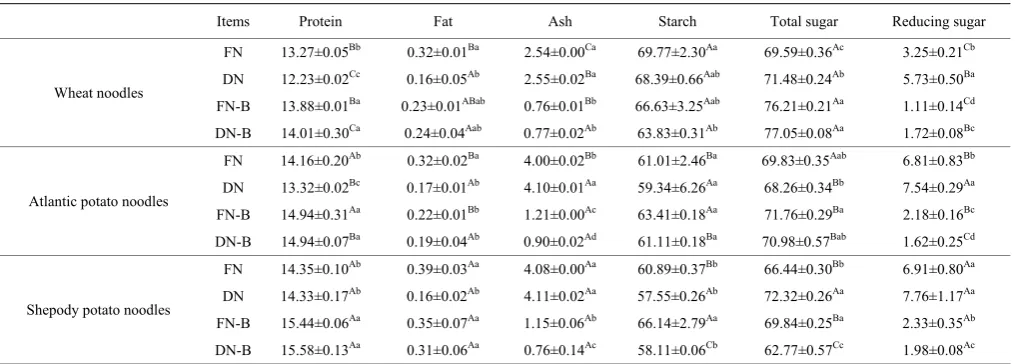
The basic nutrients of wheat noodles, Atlantic potato noodles and Shepody potato noodles in four states (fresh, dried, fresh after boiling, and dried after boiling) were analyzed; these nutrients include protein, fat, ash, starch, total sugar, and reducing sugar. As shown in Table 1, the protein and ash contents in potato noodles were higher than those in wheat noodles, whereas the fat content presented no significant difference. Moreover, the protein and ash contents in Shepody potato noodles were higher than those in Atlantic potato noodles. The higher ash content is probably caused by higher mineral element contents in potato noodles. Table 1 also shows that the content of reducing sugar in potato noodles was higher than that in wheat noodles, whereas the starch and total sugar contents were significantly lower. After boiling, the reducing sugar content decreased, and no obvious difference was observed in starch and total sugar contents. The boiling process did not cause a significant loss of basic nutrients.
Table 1 General nutrient compositions in different kinds of noodles (g/100 g of dry matter)
Items Protein Fat Ash Starch Total sugar Reducing sugar
Wheat noodles
FN 13.27±0.05Bb 0.32±0.01Ba 2.54±0.00Ca 69.77±2.30Aa 69.59±0.36Ac 3.25±0.21Cb
DN 12.23±0.02Cc 0.16±0.05Ab 2.55±0.02Ba 68.39±0.66Aab 71.48±0.24Ab 5.73±0.50Ba
FN-B 13.88±0.01Ba 0.23±0.01ABab 0.76±0.01Bb 66.63±3.25Aab 76.21±0.21Aa 1.11±0.14Cd
DN-B 14.01±0.30Ca 0.24±0.04Aab 0.77±0.02Ab 63.83±0.31Ab 77.05±0.08Aa 1.72±0.08Bc
Atlantic potato noodles
FN 14.16±0.20Ab 0.32±0.02Ba 4.00±0.02Bb 61.01±2.46Ba 69.83±0.35Aab 6.81±0.83Bb
DN 13.32±0.02Bc 0.17±0.01Ab 4.10±0.01Aa 59.34±6.26Aa 68.26±0.34Bb 7.54±0.29Aa
FN-B 14.94±0.31Aa 0.22±0.01Bb 1.21±0.00Ac 63.41±0.18Aa 71.76±0.29Ba 2.18±0.16Bc
DN-B 14.94±0.07Ba 0.19±0.04Ab 0.90±0.02Ad 61.11±0.18Ba 70.98±0.57Bab 1.62±0.25Cd
Shepody potato noodles
FN 14.35±0.10Ab 0.39±0.03Aa 4.08±0.00Aa 60.89±0.37Bb 66.44±0.30Bb 6.91±0.80Aa
DN 14.33±0.17Ab 0.16±0.02Ab 4.11±0.02Aa 57.55±0.26Ab 72.32±0.26Aa 7.76±1.17Aa
FN-B 15.44±0.06Aa 0.35±0.07Aa 1.15±0.06Ab 66.14±2.79Aa 69.84±0.25Ba 2.33±0.35Ab
DN-B 15.58±0.13Aa 0.31±0.06Aa 0.76±0.14Ac 58.11±0.06Cb 62.77±0.57Cc 1.98±0.08Ac
Note: FN: Fresh noodles; DN: Dried noodles; FN-B: Fresh noodles after boiling; DN-B: Dried noodles after boiling. Data are means ± SD. a, b, c, d represent the
3.2 Vitamin analysis
As shown in Table 2, the VB1, VB3 and VC contents
in Shepody potato noodles were the highest followed by
those in Atlantic potato and wheat noodles. The VB2
content in potato noodles was higher than that in wheat
noodles at fresh state. After the boiling process, the VB2
and VB3 contents decreased significantly, and the changes
of VB2 and VC were not significant. Similar phenomenon
was observed during the drying process as the contents of vitamins decreased. These results indicated that boiling and drying processes could decrease the vitamin contents.
Table 2 Vitamin contents in different kinds of noodles (mg/100 g of dry matter)
Items VB1 VB2 VB3 VC
Wheat noodles
FN 0.21±0.01Ca 0.12±0.00Cb 0.97±0.00Ca 38.19±0.14Cc
DN 0.16±0.00Cb 0.14±0.00Aa 1.10±0.03Ca 37.36±0.05Cd
FN-B 0.10±0.01Cc 0.12±0.01Ab 0.74±0.00Cb 38.78±0.07Cb
DN-B 0.10±0.00Cc 0.12±0.01Ab 0.98±0.04Ca 45.92±0.16Ca
Atlantic Potato noodles
FN 0.24±0.01Ba 0.15±0.00Ba 2.26±0.02Ba 53.23±0.01Bd
DN 0.21±0.01Bb 0.14±0.01Ab 1.92±0.00Bb 65.49±0.06Aa
FN-B 0.16±0.00Bc 0.12±0.01Ac 1.62±0.01Bc 58.01±0.07Bc
DN-B 0.14±0.01Bd 0.10±0.00Ad 1.40±0.05Bd 63.14±0.03Ab
Shepody potato noodles
FN 0.30±0.01Aa 0.18±0.01Aa 2.70±0.05Aa 64.49±1.20Aa
DN 0.26±0.00Ab 0.11±0.00Bb 3.03±0.09Aa 54.53±0.31Bb
FN-B 0.22±0.01Ac 0.12±0.00Ab 2.07±0.02Ab 63.91±0.01Aa
DN-B 0.21±0.01Ad 0.12±0.01Ab 1.83±0.01Ac 49.01±0.69Bc
Note: FN: Fresh noodles; DN: Dried noodles; FN-B: Fresh noodles after boiling; DN-B: Dried noodles after boiling. Data are means ± SD. a, b, c, d represent the
significant difference between different states of the same varieties (p<0.05); A, B, C represent the significant difference between different varieties of the same
states.
This finding confirmed that potato noodles contain more vitamins, and long-term consumption of potato noodles could increase people’s vitamin intake. Moreover, Shepody potato noodles performed better than Atlantic potato noodles.
3.3 Mineral analysis
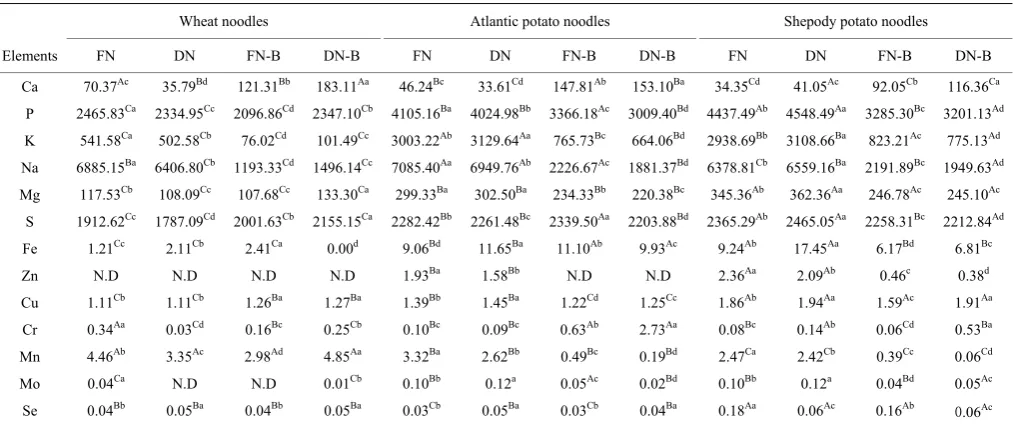
As essential nutrients, minerals significantly influence human health. The contents of Ca, P, K, Na, Mg, S, Fe, Zn, Cu, Cr, Mn, Mo and Se were analyzed in this study. Table 3 shows that most mineral elements in potato noodles were higher than those in wheat noodles. The P, K and Mg contents in potato noodles were 1.3-2, 5.4-10.8, and 1.7-3.4 times higher than those in wheat noodles, respectively. This phenomenon indicated that potato noodles could be a good food source of P, K and Mg. Previous research indicated that potato is recognized as a good source of minerals, such as potassium, phosphorous,
and magnesium[6]. Potato noodles also contain high
amounts of microelements (Table 3). The Fe content in potato noodles was 2.6-8.3 times higher than that in wheat noodles. In Shepody potato noodles, the Se content was 5 times higher than that in wheat noodles. Zn and Mo were also detected in potato noodles but were rather limited in wheat noodles. The content of most mineral elements in noodles decreased after boiling. However, these mineral elements remained higher in potato noodles than in wheat noodles.
Table 3 Mineral element contents in different kinds of noodles (mg/100 g of dry matter)
Wheat noodles Atlantic potato noodles Shepody potato noodles
Elements FN DN FN-B DN-B FN DN FN-B DN-B FN DN FN-B DN-B
Ca 70.37Ac 35.79Bd 121.31Bb 183.11Aa 46.24Bc 33.61Cd 147.81Ab 153.10Ba 34.35Cd 41.05Ac 92.05Cb 116.36Ca
P 2465.83Ca 2334.95Cc 2096.86Cd 2347.10Cb 4105.16Ba 4024.98Bb 3366.18Ac 3009.40Bd 4437.49Ab 4548.49Aa 3285.30Bc 3201.13Ad
K 541.58Ca 502.58Cb 76.02Cd 101.49Cc 3003.22Ab 3129.64Aa 765.73Bc 664.06Bd 2938.69Bb 3108.66Ba 823.21Ac 775.13Ad
Na 6885.15Ba 6406.80Cb 1193.33Cd 1496.14Cc 7085.40Aa 6949.76Ab 2226.67Ac 1881.37Bd 6378.81Cb 6559.16Ba 2191.89Bc 1949.63Ad
Mg 117.53Cb 108.09Cc 107.68Cc 133.30Ca 299.33Ba 302.50Ba 234.33Bb 220.38Bc 345.36Ab 362.36Aa 246.78Ac 245.10Ac
S 1912.62Cc 1787.09Cd 2001.63Cb 2155.15Ca 2282.42Bb 2261.48Bc 2339.50Aa 2203.88Bd 2365.29Ab 2465.05Aa 2258.31Bc 2212.84Ad
Fe 1.21Cc 2.11Cb 2.41Ca 0.00d 9.06Bd 11.65Ba 11.10Ab 9.93Ac 9.24Ab 17.45Aa 6.17Bd 6.81Bc
Zn N.D N.D N.D N.D 1.93Ba 1.58Bb N.D N.D 2.36Aa 2.09Ab 0.46c 0.38d
Cu 1.11Cb 1.11Cb 1.26Ba 1.27Ba 1.39Bb 1.45Ba 1.22Cd 1.25Cc 1.86Ab 1.94Aa 1.59Ac 1.91Aa
Cr 0.34Aa 0.03Cd 0.16Bc 0.25Cb 0.10Bc 0.09Bc 0.63Ab 2.73Aa 0.08Bc 0.14Ab 0.06Cd 0.53Ba
Mn 4.46Ab 3.35Ac 2.98Ad 4.85Aa 3.32Ba 2.62Bb 0.49Bc 0.19Bd 2.47Ca 2.42Cb 0.39Cc 0.06Cd
Mo 0.04Ca N.D N.D 0.01Cb 0.10Bb 0.12a 0.05Ac 0.02Bd 0.10Bb 0.12a 0.04Bd 0.05Ac
Se 0.04Bb 0.05Ba 0.04Bb 0.05Ba 0.03Cb 0.05Ba 0.03Cb 0.04Ba 0.18Aa 0.06Ac 0.16Ab
0.06Ac
Note: FN: Fresh noodles; DN: Dried noodles; FN-B: Fresh noodles after boiling; DN-B: Dried noodles after boiling; N.D: Not detected. Data are means ± SD. a, b, c, d
represent the significant difference between different states of the same varieties (p<0.05); A, B, C represent the significant difference between different varieties of the
January, 2017 Xu F, et al. Nutritional compositions of various potato noodles: Comparative analysis Vol. 10 No.1 223
3.4 Dietary fiber analysis
Table 4 shows the TDF, SDF, and IDF contents in noodles. The results indicated that the TDF and IDF contents in potato noodles were significantly higher than those in wheat noodles, whereas the SDF content was much lower. Moreover, the TDF and IDF contents in noodles increased after boiling, mainly because of the dissolution of some water-soluble substances in noodles during boiling. Dietary fiber intake is associated with a number of health benefits, such as prevention or reduction of bowel disorders, benefit in body weight management, and decreased risks of coronary heart
Table 4 Dietary fiber contents in different kinds of noodles (mg/100 g of dry matter)
Items Total dietary
fiber
Soluble dietary fiber
Insoluble dietary fiber
Wheat noodles
DN 2.39±0.01Ba 1.1±0.02Aa 1.27±0.02Cb
DN-B 2.03±0.01Cb 0.47±0.01Ab 1.56±0.01Ca
Atlantic potato noodles
DN 2.10±0.02Cb 0.46±0.02Ba 1.64±0.02Bb
DN-B 3.45±0.02Aa 0.21±0.02Bb 3.24±0.02Aa
Shepody potato noodles
DN 3.11±0.02Aa 0.47±0.02Ba 2.64±0.02Ab
DN-B 3.21±0.03Ba 0.15±0.02Cb 3.06±0.02Ba
Note: DN: Dried noodles; DN-B: Dried noodles after boiling. Data are means ± SD. a, b, c, d represent the significant difference between different states of the
same varieties (p<0.05); A, B, C represent the significant difference between
different varieties of the same states.
disease and type 2 diabetes[24-26]. Dietary fiber can also
reduce the risk of hyperlipidemia, hypercholesterolemia, and hyperglycemia by modulating food ingestion,
digestion, absorption, and metabolism[27,28]. Thus,
potato noodle intake is more beneficial to human health than wheat noodle intake because the dietary fiber content of the former is higher.
3.5 Amino acid content
Table 5 reports the amino acid contents in different kinds of noodles. The glutamic acid content was the highest, followed by proline in both wheat and potato noodles. The results in Table 5 also indicated that the essential amino acid (EAA) and total amino acid (TAA) contents in both Atlantic potato and Shepody potato noodles were higher than those in wheat noodles. Compared with Atlantic potato noodles, the EAA and TAA contents in Shepody potato noodles were higher. Most amino acids in potato noodles, such as threonine, valine, isoleucine, leucine, lysine, aspartic acid and tyrosine, were higher than those in wheat noodles. As tryptophan was destroyed in the process of acid hydrolysis pretreatment, no tryptophan was detected. The changing trend of amino acids in noodles was consistent with protein contents.
Table 5 Amino acid contents in different kinds of noodles (mg/100 g of dry matter)
Wheat noodles Atlantic potato noodles Shepody potato noodles
AA FN DN FN-B DN-B FN DN FN-B DN-B FN DN FN-B DN-B
3.6 INQ values
The INQ is suggested as a method to describe the
comprehensive nutritional value of food[22]. For each
kind of noodles analyzed in this study, an INQ was
calculated for VB1, VB2, VC, Ca, P, K, Na, Mg, Fe, Zn,
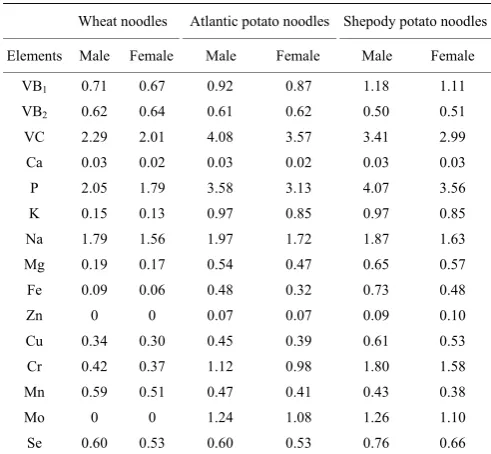
Cu, Gr, Mn, Mo, and Se (Table 6). The results showed that most of the INQ values of potato noodles were higher than those of wheat noodles, indicating a higher nutritional value of potato noodles. When the INQ value of a nutrient is higher than 1.00, this means that the food item is a good source of that particular nutrient. According to the results in Table 6, potato noodles were
good sources of vitamin B1, vitamin C, P, Na, Gr and Mo.
Furthermore, Mo was not detected in wheat noodles, whereas its INQ values in potato noodles reached 1.00. The results revealed that potato noodles can satisfy people’s requirements of some nutritional elements, which are often insufficient in wheat noodles. Potato noodles are good sources of vitamins and minerals, and Shepody potato noodles are better than Atlantic potato noodles.
Table 6 INQ value in different kinds of noodles Wheat noodles Atlantic potato noodles Shepody potato noodles
Elements Male Female Male Female Male Female
VB1 0.71 0.67 0.92 0.87 1.18 1.11
VB2 0.62 0.64 0.61 0.62 0.50 0.51
VC 2.29 2.01 4.08 3.57 3.41 2.99
Ca 0.03 0.02 0.03 0.02 0.03 0.03
P 2.05 1.79 3.58 3.13 4.07 3.56
K 0.15 0.13 0.97 0.85 0.97 0.85
Na 1.79 1.56 1.97 1.72 1.87 1.63
Mg 0.19 0.17 0.54 0.47 0.65 0.57
Fe 0.09 0.06 0.48 0.32 0.73 0.48
Zn 0 0 0.07 0.07 0.09 0.10
Cu 0.34 0.30 0.45 0.39 0.61 0.53
Cr 0.42 0.37 1.12 0.98 1.80 1.58
Mn 0.59 0.51 0.47 0.41 0.43 0.38
Mo 0 0 1.24 1.08 1.26 1.10
Se 0.60 0.53 0.60 0.53 0.76 0.66
4 Conclusions
This study demonstrated that the addition of potato flour could effectively enhance the nutritional value of traditional noodles. Compared with wheat noodles, potato noodles contained higher contents of general nutrients. The contents of protein, ash and reducing
sugar in Shepody potato fresh noodles were 14.35%, 4.08% and 6.91% (in dry matter), respectively; these values were all higher than those in Atlantic potato fresh noodles. The vitamin contents in noodles were also determined in this study. The results showed that the
contents of VB1, VB2, VB3 and VC were 0.3, 0.18, 2.70
and 64.49 mg/100 g dry matter, respectively, in Shepody potato fresh noodles, which were also higher than those in fresh wheat and Atlantic potato noodles. The boiling
process could decrease the VB1 and VB3 contents. Most
mineral elements in potato noodles were higher than those in wheat noodles. The TDF and IDF contents in potato noodles were significantly higher than those in wheat noodles, whereas the SDF content was much lower. The amino acid determination showed that the EAA and TAA contents in potato noodles were higher than those in wheat noodles. The INQ was calculated to evaluate the comprehensive nutritional differences between potato and wheat noodles, results showed that the INQ values of potato noodles were higher than wheat noodles. This research indicated that the nutritional value of noodles can be enhanced by adding potato flour into wheat flour.
Acknowledgements
The authors acknowledge the financial support from the National Natural Science Foundation of China (Grant No: 31601507) and the Public Welfare Industry (Agriculture) Scientific Research Projects of China (Grant No: 201503001-2).
[References]
[1] Arun K B, Chandran J, Dhanya R, Krishna P, Jayamurthy P, Nisha P. A comparative evaluation of antioxidant and antidiabetic potential of peel from young and matured potato. Food Bioscience, 2015; 9(4): 36–46.
[2] Ezekiel R, Singh N, Sharma S, Kaur A. Beneficial phytochemicals in potato - a review. Food Research International, 2013; 50(2): 487–496.
[3] Lutaladio N, Castaldi L. Potato: The hidden treasure. Journal of Food Composition and Analysis, 2009; 22(6): 491–493.
January, 2017 Xu F, et al. Nutritional compositions of various potato noodles: Comparative analysis Vol. 10 No.1 225 [5] Wang H, Xiao L, Tong J, Liu F. Foliar application of
chlorocholine chloride improves leaf mineral nutrition, antioxidant enzyme activity, and tuber yield of potato (Solanum tuberosum L.). Scientia Horticulturae, 2010; 125(3): 521–523.
[6] Kita A, Bąkowska-Barczak A, Hamouz K, Kułakowska K, Lisińska G. The effect of frying on anthocyanin stability and antioxidant activity of crisps from red- and purple-fleshed potatoes (Solanum tuberosum L.). Journal of Food Composition and Analysis, 2013; 32(2): 169–175. [7] Singh J, Kaur L, Moughan P J. Importance of chemistry,
technology and nutrition in potato processing. Food Chemistry, 2012; 133(4): 1091.
[8] Tian J, Chen J, Lv F, Chen S, Chen J, Liu D, et al. Domestic cooking methods affect the phytochemical composition and antioxidant activity of purple-fleshed potatoes. Food Chemistry, 2016; 197: 1264–1270.
[9] Tierno R, Hornero-Méndez D, Gallardo-Guerrero L, López-Pardo R, Galarreta J I R D. Effect of boiling on the total phenolic, anthocyanin and carotenoid concentrations of potato tubers from selected cultivars and introgressed breeding lines from native potato species. Journal of Food Composition and Analysis, 2015; 41: 58–65.
[10] Bártová V, Bárta J, Brabcová A, Zdráhal Z, Horáčková V. Amino acid composition and nutritional value of four cultivated South American potato species. Journal of Food Composition and Analysis, 2015; 40: 78–85.
[11] Waglay A, Karboune S, Alli I. Potato protein isolates: recovery and characterization of their properties. Food Chemistry, 2014; 142: 373–382.
[12] Li S, Duan Y, Guo T, Zhang P, He P, Johnston A, Shcherbakov A. Potassium management in potato production in Northwest region of China. Field Crops Research, 2015; 174: 48–54.
[13] Fu B X. Asian noodles: History, classification, raw materials, and processing. Food Research International, 2008; 41(9): 888–902.
[14] Xu F, Hu H H, Zhang C J, Huang F, Zhang X, Liu Q N, et al. Effects of different types of proteins on the eating quality of potato noodles. Modern Food Science and Technology, 2015; 31(12): 269–276. (in Chinese)
[15] Silveira M H, Aguiar R S, Siika-aho M, Ramos L P. Assessment of the enzymatic hydrolysis profile of cellulosic substrates based on reducing sugar release. Bioresource Technology, 2014; 151: 392–396.
[16] Tuncel N B, Yılmaz N, Kocabıyık H, Uygur A. The effect of infrared stabilized rice bran substitution on B vitamins, minerals and phytic acid content of pan breads: Part II. Journal of Cereal Science, 2014; 59(2): 162–166.
[17] Mazurek A, Jamroz J. Precision of dehydroascorbic acid quantitation with the use of the subtraction method-validation of HPLC-DAD method for determination of total vitamin C in food. Food Chemistry, 2015; 173: 543–550.
[18] Curiel J A, Coda R, Centomani I, Summo C, Gobbetti M, Rizzello C G. Exploitation of the nutritional and functional characteristics of traditional Italian legumes: The potential of sourdough fermentation. International Journal of Food Microbiology, 2015; 196: 51–61.
[19] Vujić L, Vitali Čepo D, Vedrina Dragojević I. Impact of dietetic tea biscuit formulation on starch digestibility and selected nutritional and sensory characteristics. LWT-Food Science and Technology, 2015; 62(1): 647–653.
[20] Zhou Y, Wang H, Cui L, Zhou X, Tang W, Song X. Evolution of nutrient ingredients in tartary buckwheat seeds during germination. Food Chemistry, 2015; 186: 244–248. [21] Sun H, Mu T, Xi L, Zhang M, Chen J. Sweet potato
(Ipomoea batatas L.) leaves as nutritional and functional foods. Food Chemistry, 2014; 156: 380–389.
[22] Tseng R Y L, Sullivan M A, Downes N J. A proposed method for the nutritional rating of foods. Journal of Nutrition Education, 1986; 18(2): 67–74.
[23] Wittwer A J, Sorenson A W, Wyse B W, Gaurth Hansen R. Nutrient density—Evaluation of nutritional attributes of foods. Journal of Nutrition Education, 1977; 9(1): 26–30. [24] Brownlee I A. The physiological roles of dietary fibre.
Food Hydrocolloids, 2011; 25(2): 238–250.
[25] Kendall C W C, Esfahani A, Jenkins D J A.. The link between dietary fibre and human health. Food Hydrocolloids, 2010; 24(1): 42–48.
[26] Mudgil D, Barak S. Composition, properties and health benefits of indigestible carbohydrate polymers as dietary fiber: A review. International Journal of Biological Macromolecules, 2013; 61: 1–6.
[27] Dahl W J, Stewart M L. Position of the academy of nutrition and dietetics: Health implications of dietary fiber. J Acad Nutr Diet, 2015; 115(11): 1861-1870.