1
ELECTROPHYSIOLOGICAL
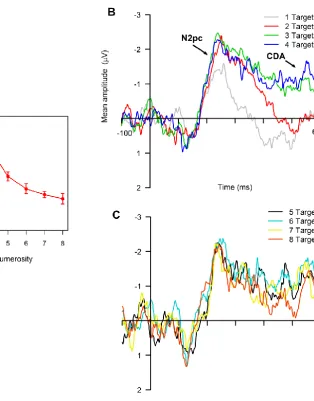
CORRELATES OF MULTIPLE
OBJECT PROCESSING
PhD student: Silvia Pagano
Advisor: Veronica Mazza
Doctoral School in Cognitive and Brain Sciences XXV Cycle
3
Table of contents
Abstract ... 7
Chapter 1 ... 9
1.1 Experimental paradigms for the study of multiple object processing ... 11
1.1.1 Reviewing paradigm ... 11
1.1.2 Multiple object tracking ... 14
1.1.3 Enumeration tasks ... 16
1.2 Theories of multiple object processing ... 20
1.2.1 The FINSTs theory ... 21
1.2.2 The object-file theory ... 25
1.2.3 The neural object-file theory ... 27
1.3 Electrophysiological correlates of multiple object processing ... 29
1.3.1 N2pc ... 29
1.3.2 CDA ... 32
1.4 Rationale of the present thesis ... 34
Chapter 2 ... 37
2.1 Experiment 1... 37
2.1.1 Methods ... 43
2.1.1.1 Participants ... 43
2.1.1.2 Stimuli and procedure ... 43
2.1.1.3 EEG recording and data analysis ... 44
2.1.2 Results ... 47
2.1.2.1 Behavioral results ... 47
2.1.2.1.1 RTs ... 47
2.1.2.1.2 Accuracy ... 48
2.1.2.2 ERP results ... 49
2.1.2.2.1 N1 ... 49
2.1.2.2.2 P2p ... 50
2.1.2.2.3 N2pc ... 51
2.1.2.2.4 CDA ... 51
2.1.2.3 Group analysis ... 51
2.1.2.4 Correlational analyses ... 54
2.1.3 Discussion ... 56
2.2 Experiment 2... 58
2.2.1 Participants ... 59
4
2.2.3 EEG recordings and analysis ... 60
2.2.4 Results ... 61
2.2.5 Discussion ... 63
2.3 General Discussion ... 64
Chapter 3 ... 71
3.1 Experiment 3... 71
3.2 General Methods ... 77
3.2.1 Participants ... 77
3.2.2 Stimuli and procedure ... 77
3.2.3 EEG recording and data analysis ... 78
3.3 Results ... 80
3.3.1 Behavioral results ... 80
3.3.2 ERP results ... 81
3.3.2.1 N1 ... 81
3.3.2.2 N2pc ... 83
3.2.2.3 Control analysis ... 85
3.3 Discussion ... 85
Chapter 4 ... 91
4.1 Experiment 4... 91
4.2 Methods ... 94
4.2.1 Participants ... 94
4.2.2 Stimuli and procedure ... 94
4.2.3 EEG recordings and data analysis ... 96
4.3 Results ... 97
4.4 Discussion ... 99
Chapter 5 ... 101
5.1 Experiment 5a: Masking shapes ... 106
5.1.2 Participants ... 107
5.1.3 Stimuli and Procedure ... 107
5.1.4 Results and discussion ... 108
5.2 Experiment 5b: Masking colors ... 109
5.2.1 Participants ... 109
5.2.2 Stimuli and Procedure ... 110
5.2.3 Results and discussion ... 110
5.3 Experiment 5c: The final paradigm ... 111
5.3.1 Participants ... 112
5.3.2 Stimuli and Procedure ... 112
5
5.4 Experiment 6: Electrophysiological correlates of multiple object processing
in the absence of awareness ... 114
5.4.1 Participants ... 114
5.4.2 Stimuli and procedure ... 114
5.4.4 EEG recordings and analysis ... 115
5.4.5 Results ... 116
5.4.5.1 Accuracy ... 116
5.4.5.2 ERP components ... 117
5.4.5.2.1 N2pc ... 117
.4.5.2.2 CDA ... 117
5.4.5.3 Analysis of error trials ... 118
5.4.5.3.1 N2pc ... 119
5.4.5.3.2 CDA ... 119
5.4.6 Discussion ... 120
5.5 Experiment 7... 121
5.5.1 Participants ... 121
5.5.2 Stimuli and procedure ... 122
5.5.3 Results and Discussion ... 122
5.6 General discussion ... 123
Chapter 6 ... 127
References ... 135
7
Abstract
Several daily activities like walking in a crowded street depend on our ability to
process multiple objects simultaneously. According to some theories this ability relies
on at least two stages or mechanisms related respectively to visual attention and visual
working memory. The early stage of multiple object processing – individuation – is a
function of attention that allows the visual system to represent multiple objects
simultaneously by selecting a limited number of locations and binding them to basic
visual features. A second later stage related to visual working memory encodes in
greater detail the indexed objects leading to their full representation. In the present
thesis I investigated the functioning of multiple object processing in a set of behavioral
and electrophysiological studies focusing on the modulation of two component of the
event-related potentials - N2pc and CDA – which have been associated respectively to
individuation and visual working memory. In all the experiments of the present thesis I
established that both N2pc and CDA were modulated by the number of relevant items
during the execution of an enumeration task. I exploited this effect in each Chapter of
the present thesis to investigate different aspects of multiple object processing.
In particular, in the first and second experiment (Chapter 2) I assessed the existence
of a capacity limit in simultaneous processing as predicted by theories of individuation.
In Chapter 3 I investigated the role of distracting information in simultaneous
individuation. In Chapter 4 I focused on whether high-level features (such as semantic
information) are incorporated in the representations produced at the stage of
individuation. Finally in Chapter 5 I assessed the role of awareness in multiple object
8
The results provided new information on the way early individuation and late WM
stages interact for successful object perception, as well as on their functional
9
Chapter 1
General introduction
Several daily activities, like driving a car or walking in a crowded street, depend
closely on our ability to analyze potentially relevant objects simultaneously. Although
the visual input is a continuous stream of complex information, we are able to parse it
and construct coherent representations of small portions of it, focusing on the relevant
objects. Several theories of object recognition have proposed that multiple object
processing can be divided in at least two stages: an early individuation stage of analysis
and a late stage of processing mediated by visual working memory related mechanisms
(Kahneman, Treisman, & Gibbs, 1992; Xu & Chun, 2009).
The early stage of multiple object processing – individuation– (Kahneman,
Treisman, & Gibbs, 1992; Pylyshyn, 1989) is a function of attention that allows the
visual system to represent multiple objects simultaneously by selecting a limited
number of locations and binding them to basic visual features (Cavanagh & Alvarez,
2005; Cavanagh & He, 2011). Theories of individuation indicate that this early stage of
processing cannot represent more than four or five items simultaneously (Kahneman et
al., 1992; Pylyshyn, 1989; Trick & Pylyshyn, 1993). The representations produced
10
crucial, like multiple object tracking (Chesney & Haladjian, 2011; Scholl & Pylyshyn,
1999) or visual enumeration (Trick & Pylyshyn, 1994a). When the task at hand requires
a more detailed representation of the objects, like for instance during a memory task,
the representations produced during individuation are not informative enough. For this
reason, more features of the individuated objects need to be added and/or elaborated
more deeply in order to have a complete representation, ultimately leading to the full
object identification. This late stage of multiple object processing is likely mediated by
mechanisms related to visual working memory (Xu, 2007).
The functioning of multiple object processing has been described by two main
theories, which are based on empirical observations and behavioral evidence. Recent
research has additionally tried to investigate the brain activations associated with
multiple object processing. For instance, Xu and Chun (2009) have recently proposed
that two specific portions of the intraparietal sulcus are respectively implicated in the
individuation of multiple objects and in the detailed encoding procedures on the
individuated objects. This and other evidence (Xu, 2007; 2009) concurred in the
formulation of a neural model of multiple object processing based on functional
Magnetic Resonance Imaging (fMRI) results. However, given the poor temporal
resolution of fMRI, the time course of the processing stages underlying multiple object
processing has received little investigation. Electroencephalographic (EEG) measures
represent one of the best neuroimaging techniques to unravel this aspect, but so far only
a few studies (Drew, Horowitz, Wolfe, & Vogel, 2011; Drew & Vogel, 2008; Mazza &
Caramazza, 2011) have focused on the electrophysiological measurements of multiple
CHAPTER 1
11
investigate the temporal dynamics of the various stages implicated in the analysis of the
multiple objects.
In the present chapter I will review some basic behavioral paradigms used so far
to investigate multiple object processing. Next, I will describe the main theories that
have tried to bring together the contributions of the behavioral and fMRI studies to
explain the functioning of multiple object processing. Finally, I will discuss the existing
EEG studies and findings on the involvement of two specific electrophysiological
responses associated with multiple object processing.
1.1 Experimental paradigms for the study of multiple object processing
Multiple object processing and its underlying stages are crucial for the
implementation of several activities. As a consequence, there is a variety of
experimental paradigms that have been employed so far to study this topic. In this
section I will describe three of them: the object reviewing paradigm, the multiple
object tracking (MOT) paradigm and the visual enumeration task. These paradigms
have given a substantial contribution to the formulation of the theories discussed in the
next section.
1.1.1 Reviewing paradigm
Kahneman, Treisman and Gibbs (1992) used the so-called reviewing paradigm
12
pertain to the same object. This paradigm is at the basis of the object-file theory, one of
the most relevant theories on multiple object processing. This theory is centered on the
idea that, when looking at a scene, we need to construct representations of the displayed
objects in order to recognize them as the same individuals when they change position or
size on the retina. To test this idea, Kahneman, Treisman and Gibbs (1992) presented
observers with a display with some predefined positions.
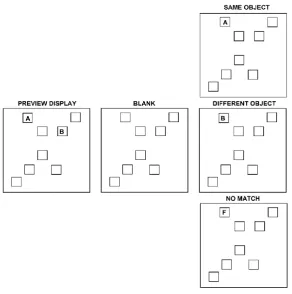
Figure 1.1 Schematic representation of the reviewing paradigm
Example of a preview display with letter A as target. The three possible test displays are
CHAPTER 1
13
In the so-called preview display, two or more (up to eight) of these positions
were filled with letters. After a blank, a target display was presented in which one letter
appeared in one of the previewed positions. The letter could be the same one as in the
preview display (same object condition), a different one chosen from the letter set of the
preview display (different object condition), or a completely novel letter (no match
condition). Participants’ task was to name the target letter as fast as possible (see figure
1.1). The results showed that participants were fastest in naming the letter when the
same object was displayed in the position corresponding to the previewed one. In
addition, participants were faster in the different object condition with respect to the
no-match condition. Interestingly, these effects disappeared when participants saw preview
displays with more than four letters. This occurred both with static and moving stimuli.
Although this task required to focus on a single object, the results by Kahneman
et al. (1992) are interesting for the study of multiple object processing as well. Indeed,
they showed that the specific advantage for an object displayed in a previewed position
disappears when more than four objects are originally presented. This result indicates
that there is a limit in the number of objects that can be processed simultaneously, and
that this limit is at approximately four objects. Interestingly, a similar limit has been
found in other tasks requiring processing of multiple objects, such as visual
enumeration (Kaufman, Lord, Reese, & Volkmann, 1949; Trick & Pylyshyn, 1994a)
and visual working memory (Cowan, 2001; Luck & Vogel, 1997). This suggests the
14
1.1.2 Multiple object tracking
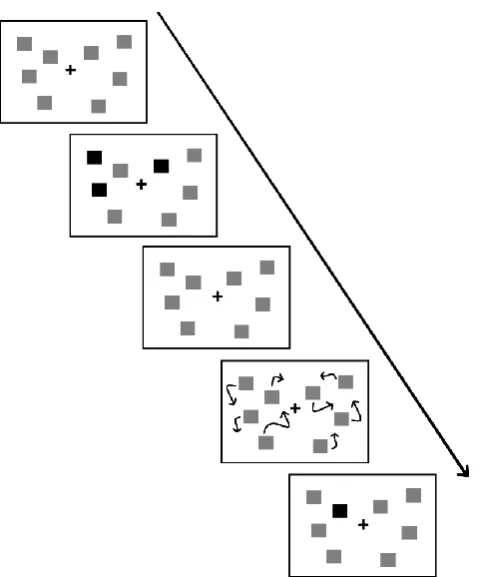
Multiple object tracking (MOT) is a task proposed by Pylyshyn & Storm (1998)
that requires to actively track multiple moving targets. In a classical MOT experiment
participants are presented with a display of targets and distractors. After an interval, all
the objects displayed become identical and they start moving independently from one
another. At the end of the trial participants are asked to recognize the target objects
(e.g., by clicking on each of them or by indicating whether or not a highlighted item is a
target; see figure 1.2).
Figure 1.2 Schematic representation of a MOT task
CHAPTER 1
15
The MOT task offers a good tool to investigate multiple object processing in
dynamic contexts in which there is a continuous update of the spatial information, like
in real-life situations. Some of the classical results about MOT fit well with the idea that
multiple object processing is a mechanism based on individuation. First, several studies
indicated that there is a limit in the number of targets than can be successfully tracked
and that such limit is at around four or five targets (Alvarez & Cavanagh, 2005; Storm
& Pylyshyn, 1988), in line with the assumptions of individuation theories. Second,
successful tracking can be dissociated from the detailed encoding of the targets features
(Pylyshyn, 2004), thus suggesting that individuation, rather than working-memory
related operations, is the perceptual stage mainly involved in tracking of moving
objects. More recent studies have shown that MOT capacity can vary by splitting
attention among the two visual hemifields (Alvarez & Cavanagh, 2005), modifying
objects spacing (Franconeri, Jonathan, & Scimeca, 2010) objects velocity (Alvarez &
Franconeri, 2007) or targets and distractors saliency (Bettencourt & Somers, 2009),
leading to a debate on whether or not there is a fixed capacity limit in MOT task.
Recent accounts explain these contrasting findings by proposing that there is a fixed
number of attentional foci that can be used to track multiple objects and that these
channels are flexible in the number of features they can encode or select (Cavanagh &
16
1.1.3 Enumeration tasks
The processing of multiple objects is intrinsically related to visual enumeration.
During enumeration our visual system needs to tag and keep separate several objects in
order to count them once and only once, and to finally retrieve the numerosity of a set.
For this reason visual enumeration is one of the simplest, yet more effective, paradigms
to study multiple object processing. This is a well-known paradigm in which a variety
of features can be easily changed to assess different aspects of multiple object
processing. Moreover, decades of studies on enumeration (e.g. Jensen, Reese, & Reese,
1950; Kaufman et al., 1949) have produced a large corpus of data to be used as a basis
for the investigation of several issues. For these reasons, I chose to use this paradigm
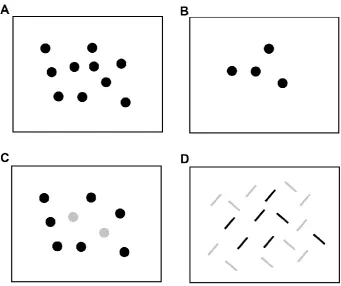
for exploring the questions addressed in the present thesis. Typically, in this paradigm a
display with a variable number of objects is shown and participants are required to
report the numerosity of the items displayed (e.g. Mandler & Shebo, 1982; Trick &
Pylyshyn, 1993; 1994b; see figure 1.3).
Studies on visual enumeration usually report a dissociation between a fast and
relatively free type of enumeration, called “subitizing”, and a slower and
error-prone one, known as counting (Kaufman et al., 1949). Interestingly, subitizing involves
the range between one and four-five items, whereas counting is the term that refers to
the precise enumeration of larger quantities. In the literature the dissociation between
subitizing and counting has been interpreted as evidence of the functioning of two
different enumeration processes (Mandler & Shebo, 1982; Trick, 2008; Trick &
CHAPTER 1
17
Figure 1.3 Example of different enumeration tasks
The top line shows enumeration displays without distractors representing a typical condition in which counting (A) or subitizing (B) are observed. The bottom line represent enumeration displays of targets among distractors in a “pop-out” (C) and in a feature conjunction (D) condition (modified figures from Trick & Pylyshyn, 1993).
If the number of displayed objects is within the subitizing range, a fast indexing
system is supposed to be at work, tagging multiple objects and then retrieving their
numerosity (Trick & Pylyshyn, 1993). If the number of displayed objects is in the
counting range the indexing process must be reiterated over the whole set, keeping track
of the objects already indexed, thus consuming more time and leading to more errors.
Another account (e.g. Mandler & Shebo, 1982) explained the dichotomy between
18
simple shapes or pattern (like the ones in a dice) that are easily recognizable and thus
enumerated fast and with no errors. In line with this account, some studies (Logan &
Zbrodoff, 2003; Mandler & Shebo, 1982) showed that if several dots are arranged in a
recognizable pattern they are enumerated as fast and as accurately as small quantities.
While the idea of the dichotomy between subitizing and counting has dominated
in the literature for a long period, some studies have recently challenged this
hypothesis, considering the existence of a double enumeration mechanism too
redundant (Cordes, Gelman, Gallistel, & Whalen, 2001; Railo, Koivisto, Revonsuo, &
Hannula, 2008; Vetter, Butterworth, & Bahrami, 2008; Whalen, Gallistel, & Gelman,
1999). These studies propose the existence of a single enumeration mechanism whose
precision varies with the number of to-be-enumerated items. The precision of this
mechanism is extremely high for small numerosities, leading to a fast and error-less
performance. For large numerosities, the precision of this mechanism decreases as a
function of object numerosity, thus causing more errors during enumeration (see
Whalen et al., 1999). In general, precision refers to the fact that there is a limit in the
amount of resources available to process multiple objects. Thus, if the number of
objects is small, all resources available can be used to fully process those objects,
leading to their precise representation. On the other hand, when the number of objects is
large, resources are not enough to fully process the whole group of items, leading to a
more coarse representation. This idea is supported by a growing number of studies
showing that subitizing disappears when the amount of resources available is reduced
(for example, by adding a secondary task, see Vetter et al., 2008; by manipulating
CHAPTER 1
19
Olivers & Watson, 2008; Poiese, Spalek, & Di Lollo, 2008; or during inattentional
blindness, see Railo et al., 2008).
Yet, there is a vast corpus of behavioral and imaging data showing a consistent
discrepancy in the way small (1-4) versus large numerosities are enumerated (Dehaene
& Cohen, 1994; Dehaene, Piazza, Pinel, & Cohen, 2003; Logan & Zbrodoff, 2003;
Sathian et al., 1999). The apparent discrepancy between these two theoretical positions
can be reconciled by hypothesizing that the phenomenon of subitizing is not due to a
capacity limit specific for enumeration but rather to a limit in a more general perceptual
mechanism, such as individuation. This hypothesis is based on the fact that a limit of
four items in processing capacity have been found in a variety of tasks that rely on the
ability to simultaneously elaborate multiple objects, such as multiple object tracking
(Storm & Pylyshyn, 1988), memory tasks (Cowan, 2001) and reviewing paradigm
(Kahneman et al., 1992). If enumeration depends on individuation, than the capacity
limit of this latter mechanism can easily explain the phenomenon of subitizing. Recent
behavioral findings (Chesney & Haladjian, 2011; Piazza, Fumarola, Chinello, &
Melcher, 2011), as well as some imaging studies (Sathian et al., 1999; Vetter,
Butterworth, & Bahrami, 2011) have indeed confirmed this idea by showing that the
capacity limit of the individuation stage is the best predictor of subitizing performances.
However electrophysiological studies about the specific role of individuation
supporting this idea are still few (see Ester, Drew, Klee, Vogel, & Awh, 2012; Hyde &
Spelke, 2009; Mazza & Caramazza, 2011).
A final remark about visual enumeration studies concerns the use of distracting
information. In everyday life, relevant objects are always surrounded by other
20
irrelevant objects. In an experimental setting, this situation can be mimicked by
presenting distractors together with the targets. Although visual enumeration has been
thoroughly investigated, so far only a few studies have used distractors, thus leaving out
the important aspect of target selection during enumeration. The majority of the studies
have investigated subitizing and visual enumeration using target items displayed in
isolation (Kaufman et al., 1949; Mandler & Shebo, 1982; Trick & Pylyshyn, 1994b).
The few behavioral (e.g. Trick & Pylyshyn, 1993) and electrophysiological (Nan,
Knösche, & Luo, 2006) studies with cluttered scenes seem to suggest that distractors
can change the way targets are enumerated. However, it is still unclear whether and
how the presence of distractors affects the functioning of the various stages of
processing involved in multiple object enumeration.
Overall, the reviewing paradigm, MOT and visual enumeration show that there
is a common limit in the processing of multiple objects. Whether this limit can be
attributed to the capacity limit of early individuation mechanisms (versus late stages of
processing) is still a matter of debate, although some behavioral studies indicate that
this may indeed be the case (Chesney & Haladjian, 2011; Piazza et al., 2011). This
issue will be addressed in Chapter 2. In addition, the role of distracting information
during multiple target processing is still unclear. This issue will be examined in Chapter
3.
1.2 Theories of multiple object processing
Multiple object processing has been studied so far using two different
perspectives that focused on spatial indexes (FINST theory) and on feature-to-location
binding (object-file theory). In the next section I will describe both theories highlighting
CHAPTER 1
21
multiple object processing based on recent neuroimaging studies that tries to summarize
both the FINST and object-file approaches.
1.2.1 The FINSTs theory
Pylyshyn’s theory of Fingers of Instantiation (FINST) was introduced to frame
findings coming from different research fields, like attentional selection and
enumeration, into a general theory of vision. In order to achieve this, FINST theory introduces the concept of “indexing” as a core process that is able to apprehend
simultaneously a limited number of objects. According to Pylyshyn’s idea, visual
processing of multiple objects includes three stages. The first stage is preattentive and
allows the visual system to index in parallel all the features and discontinuities in a
scene, in order to create a feature map. The second stage requires attention and is
spatially serial. Here the objects displayed can be processed only one at the time,
without the possibility of being elaborated simultaneously. During this stage multiple
features are integrated into a complete object representation. Although this second stage
can produce detailed object representations, it cannot process multiple objects
simultaneously. How can a set of targets, defined by a set of features, be successfully
processed?
Pylyshyn hypothesized the existence of a third mechanism dedicated to this
purpose. This intermediate process, represented by the so-called FINSTs, allows for the
binding of features and locations, resulting in the simultaneous tagging of a set of
objects (Pylyshyn, 1989; Trick & Pylyshyn, 1993, 1994a). FINSTs are pointers that
22
FINSTs are limited in number (1-4), the overall indexing mechanism is therefore
limited in capacity. Moreover, FINSTs stick to the indexed objects tracking them as
they move even when the objects are occluded (Scholl & Pylyshyn, 1999). One of the
distinctive features of FINSTs is that they operate preattentively. This means that they
can only index objects on the basis of preattentive features (i.e. those feature that have
been registered in the first stage of visual processing) and not on the basis of
conjunctions of features (see figure 1.4). The ultimate goal of FINSTs is to isolate multiple objects simultaneously in order to “distinguish between different tokens of the
same type, for example a given black dot from all other black dots” (Trick & Pylyshyn,
1993).
By hypothesizing that there is a fixed limit in the number of available FINSTs,
this proposal explains why the limit of visual enumeration and of successful tracking is
set at four items. In addition, as FINSTs stick to the objects when they move, it is also
CHAPTER 1
23
Figure 1.4 Schematic representation of the FINST model
24
First, FINSTs are thought to operate in a preattentive manner. Trick and
Pylyshyn (1993; 1994) based this idea on the fact that visual enumeration is highly
influenced by the kind of features defining the to-be-enumerated targets. For instance,
when targets are defined solely on the basis of one feature there is evidence of
subitizing; conversely, when the targets are defined by a conjunction of features,
enumeration of small quantities becomes slow and error-prone (Trick & Pylyshyn
1993). On the assumption that unique features can be detected preattentively (e.g.
Treisman & Gelade, 1980), they reasoned that when a “pop-out” feature (such as color)
defines the target(s), FINSTs can easily select up to four objects simultaneously. In
contrast, when a feature conjunction defines the target(s), the slow attentional
mechanism must intervene, searching for each of the targets and adding them one by
one.
However, the preattentive view of subitizing has been recently challenged by
several studies, indicating that attention is needed even when we have to enumerate or
track small quantities (Burr, Turi, & Anobile, 2010; Egeth et al., 2008; Olivers &
Watson, 2008; Railo et al., 2008; Vetter et al., 2008). Using different attentional load
conditions during enumeration, some of these studies hypothesize that if FINSTs
operate in parallel and without attention, they should index multiple targets even under
conditions of high attentional load (Burr et al., 2010; Vetter et al., 2008). Interestingly,
these studies found that when attention is deployed to a demanding secondary task,
enumeration of small numerosities becomes slower and error prone. Taken together,
these studies challenge the idea that individuation is preattentive and support the view
that individuation is instead a key function of attention (Alvarez & Cavanagh, 2005;
CHAPTER 1
25
Second, it is not entirely clear which type of feature FINSTs can tag and the
nature of the representations that are subsequently generated. In fact, features, feature
clusters or objects can be indexed but it is not clearly defined whether or under what
circumstances one should be privileged over the others. Related to this, the nature of the
content of a FINST during visual enumeration still remains unclear.
Finally, FINST theory does not describe whether awareness is required during
simultaneous individuation. So far, only few studies investigated this topic using
behavioral paradigms (Bahrami et al., 2010; Koechlin, Naccache, Block, & Dehaene,
1999). Both studies showed that a group of masked dots can prime the response to
another group of dots, provided that they share the same numerosity. Although these
studies imply that multiple object processing can operate in the absence of awareness,
there are currently no studies that have directly manipulated target awareness during
visual enumeration. This topic will be addressed in Chapter 5.
To summarize, the FINST theory offers a relatively good model of multiple
object processing. However the assumption of pre-attentive processing needs to be
revised and the exact nature of the representations produced during the individuation
stage remains to be clarified. This has partially been accomplished by the object-file
theory that will be described in the next section.
1.2.2 The object-file theory
The object-file theory (Kahneman et al., 1992) proposes that individuation
occurs through entities called “object-files”. According to the object-file theory, when
26
an object is encountered, the corresponding object-file is set up at that location, and
then filled in with the featural information regarding that particular object as long as it
is present in the visual field. The opening of an object file and the initial feature binding
corresponds to the individuation stage. It is important to note that when all the object’s
features are bound to the object-file, a complete representation of the object is available
for comparison with the representations stored in memory. Differently from the FINST
proposal, the object-file theory assigns an important role to attention. Attention controls
the object-file resolution and the level at which the object-file are set up (i.e., whether
they concern the whole object or only its parts). As in Pylyhsyn’s theory, object-files
are also limited in number and only about four objects can be represented
simultaneously. This idea derives from the fact that the previewing effects in the
reviewing paradigm are reduced or disappear when the objects initially displayed are
more than four or five (see section 1.1.1).
However, this theory remains unclear about the kind of features that are needed
to initially set up an object-file. Kahneman, Treisman and Gibbs suggest that the
simplest visual features are initially used, and that only later more complex features are
added. However they do not describe when the switch from simple to complex should
occur in time. Finally, as the FINST theory, the object-file theory does not specify the
role of awareness in the setting up and filling in of object-files. Although some studies
suggest that awareness is not crucial during these operations (Bahrami et al., 2010;
Koechlin et al., 1999), further research is needed to address the question more
CHAPTER 1
27
1.2.3 The neural object-file theory
The FINST ( Pylyshyn, 1989) and object-file (Kahneman et al., 1992) theories
have been the first systematic models of multiple object processing. Recent advances in
cognitive neuroscience have made it possible to to test the classic cognitive models with
neuroimaging techniques, in order to assess the brain dynamics associated with multiple
object processing. This has brought to several new studies on multiple object processing
using fMRI. These recent studies have discovered a network in parietal and occipital
extrastriate areas of the brain that is active when multiple objects are selected and
encoded (Xu, 2007, 2009). This new corpus of results has promoted the development of
a new theoretical framework that tries to merge the contribution of behavioral studies
on multiple object processing on one hand, and the findings of neuroimaging studies on
individuation and visual working memory on the other hand.
In their “neural object-file” theory, Xu and Chun (2009) propose that our
cognitive system selects and encodes multiple objects by means of two stages whose
activity is mainly based in the parietal lobe. The first stage - individuation- is a
capacity-limited mechanism through which we select object locations and set up the
corresponding object files. At this stage, object-files contain only simple visual features
of the objects, such as color or shape. During the second stage –identification- more
complex features are added to the object-files by means of procedures that rely on
working memory. This in turn leads to a complete representation of the individuated
objects. Identification has a variable capacity depending on the complexity of the
objects encoded and, according to the theory, this can vary from one to four items. On
the basis of fMRI findings (Xu & Chun, 2006; Xu, 2009), individuation takes place in
28
(Xu, 2009). For instance, in an fMRI study by Xu (2009) participants were asked to
observe either one object, four identical or four different objects. After a delay, they
judged whether a probe object was present in the previous display. Interestingly, the
inferior IPS was more active when both four identical and four different objects were
displayed, while the superior IPS was maximally active only when four different
objects were shown. This study suggests that different portions of IPS are selectively
involved in individuation and identification of multiple targets, respectively.
The neural object-file theory is different from FINST in several aspects. First, according to this theory, the results of the individuation stage represent a sort of
“proto-objects”, namely not simply indexes but actual object representations. In addition, this
proposal highlights the central role of attention for individuation for two reasons. First,
because the neural object-file theory acknowledges the results of several recent studies
(for a review see Cavanagh & Alvarez, 2005) showing that attention can be deployed
simultaneously to multiple focal parts of a scene, thus suggesting that attention can have
a role in the processing of multiple objects. Second, the spatial proximity and partially overlapping of the brain structures traditionally associated with “selective attention”
(for a review see Behrmann, Geng, & Shomstein, 2004) with the areas activated during
individuation, suggest that these two mechanism are tightly linked.
Finally, the neural-object file theory argues that only during identification we
become aware of the object identities. Differently from the other theories of multiple
object processing, this is the first theory that makes specific assumptions on the role of
CHAPTER 1
29
1.3 Electrophysiological correlates of multiple object processing
Although the neural object-file theory complements previous behavioral theories
by providing important hints on the neural structures associated with multiple object
processing, it is entirely based on fMRI studies. Thus, it cannot provide the fine-grained
information on the temporal brain dynamics associated with the various processing
stages involved in the analysis of multiple objects. The electrophysiological measures
would be perfectly suitable to this extent given their high temporal resolution.
Previous Event-Related Potential (ERP) studies on visual search with single
target presentations (Mazza, Turatto, & Caramazza, 2009a; Mazza, Turatto, Umiltà, &
Eimer, 2007) have indicated that two temporally distinct neural activations- the N2pc
and the CDA- are tightly correlated, respectively, with the object individuation
mechanism and with the maintenance of the individuated object for subsequent
cognitive operations required for computing more detailed representations of the
objects. In the subsequent paragraphs I will review the main findings on these two
components, highlighting the links to multiple object processing.
1.3.1 N2pc
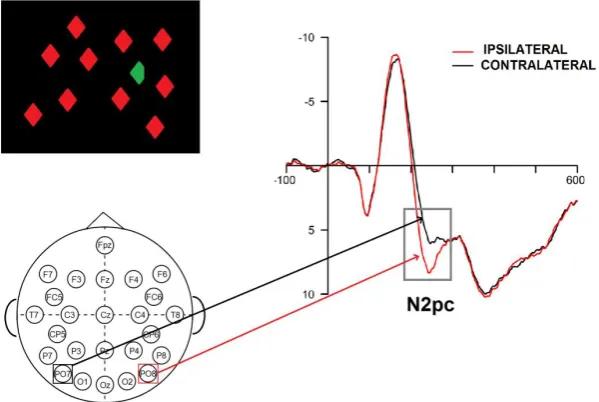
N2pc (N200 posterior contralateral) is a lateralized negative component of the
ERPs that arises at approximately 200 ms post-stimulus onset (Eimer, 1996; Luck &
Hillyard, 1994) when the relevant information (i.e., a target element) is displayed in one
visual hemifield. More precisely, the N2pc is defined as a difference in the activity of
the two hemispheres, with the posterior electrodes contralateral to the target side more
30
Typically, the N2pc has been measured during visual search tasks and it has
been associated with attentional selection/individuation processes. The first studies on
N2pc showed that this component is visible when a target presented with distractors
must be either detected or localized (Luck, Girelli, McDermott, & Ford, 1997; Luck &
Hillyard, 1994). Given that N2pc occurred only in the presence of distractors, the first
accounts proposed that N2pc reflected a mechanism of distractor suppression during
attentional selection (Luck et al., 1997). This account was based on the fact that N2pc
disappeared when distractors are eliminated, or when they carry information relevant
for the task (Luck & Hillyard, 1994). Moreover, N2pc typically increases when the
number of distractor increases (Luck et al., 1997), leading to the idea that this
component represents a mechanism suppressing irrelevant information.
Figure 1.5 N2pc as elicited by a target detection task
CHAPTER 1
31
However, subsequent studies (Eimer, 1996) showed that N2pc appeared also
when one target was displayed together with a single distractor in the opposite
hemifield. In this context there is a reduced need for suppression of irrelevant
information; yet, the N2pc was still visible. Together with other evidence (e.g., Hickey,
McDonald, & Theeuwes, 2006; Mazza, Turatto, Caramazza, 2009a; 2009b) this
suggests that N2pc may reflect target enhancement rather than distractor suppression (for an “intermediate” proposal that the N2pc may reflect a summation of
distractor-related and target-distractor-related activities, see Hickey, Di Lollo, & McDonald, 2009).
Given that the N2pc has been associated with attentional functions, and on the
assumption that attention is intrinsically related to individuation, this component is an
ideal candidate for testing the role of individuation in multiple object processing.
However, the majority of studies on the N2pc (Eimer, 1996; Hickey et al., 2006; Luck
& Hillyard, 1994; Mazza et al., 2009; Mazza, Turatto, Umiltà, & Eimer, 2007) have
used single target presentations. Thus, the temporal dynamics of multiple object
individuation have remained largely unexplored.
Two recent studies have shown that N2pc amplitudes are modulated by the
number of targets to be processed (Drew & Vogel, 2008; Mazza & Caramazza, 2011).
In the study by Drew and Vogel (2008) participants performed an MOT task with a
variable number of targets (up to five). Results showed that the amplitude of this
component was modulated by the number of tracked targets, increasing as the number
of targets increased. N2pc amplitudes also reached an asymptote between 3 and 5
tracked elements, indicating a capacity limit similar to the one proposed by models of
individuation. The findings of Drew and Vogel (2008) on N2pc were extended by a
32
and Caramazza asked participants to count the number of uniquely colored targets
displayed among distractors. Similar to Drew and Vogel (2008), they found that N2pc
amplitude was modulated by target numerosity, increasing as the number of targets
increased.
Taken together, these two studies provided evidence that individuation, as
reflected by N2pc, has an active role in multiple object processing. However, Mazza
and Caramazza (2011) used a relatively small range of target numerosities (i.e., 1-3),
thus leaving unexplored whether individuation during visual enumeration is limited in
its ability to process objects simultaneously. A study addressing this issue is presented
in Chapter 2 of the present thesis.
1.3.2 CDA
CDA (Contralateral Delay Activity, also known as SPCN, Sustained Posterior
Contralateral Negativity) is a lateralized and sustained component arising at around 400
ms post stimulus onset (Jolicoeur, Brisson, & Robitaille, 2008; Vogel & Machizawa,
2004). Like N2pc, CDA represents a difference in the activity of the two posterior sites
of the hemispheres with respect to target side, with the contralateral sites being more
CHAPTER 1
33
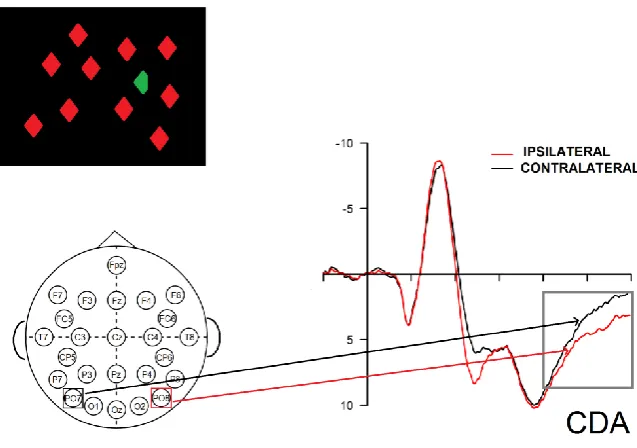
Figure 1.6 CDA as elicited by a target discrimination task
Schematic representation of an EEG setting eliciting CDA using a single target. Participants have to discriminate which side of the uniquely colored target is cut. Activity in the posterior electrode contralateral to target side (PO7) is more negative than correspondent activity the ipsilateral site (PO8) in the N2pc and CDA (400-600 ms) time windows.
Different from N2pc, CDA has been first shown in tasks requiring multiple
object processing (Vogel & Machizawa, 2004). In their study, Vogel and Machizawa
(2004) asked participants to memorize half display (left or right with respect to a
fixation point) with a variable number (1 to 10) of colored squares. After a delay in
time, a new display was shown and it was asked to indicate whether it was identical or
not to the one previously displayed. Vogel and Machizawa found a difference in the
34
corresponding to the delay. Crucially, this activity was modulated by the number of
squares to be memorized and reached a plateau at approximately four elements. This
study interprets the CDA as reflecting nueral activity linked to the encoding and
maintenance of multiple objects in visual working memory. However the task proposed
by Vogel and Machizawa required an explicit memory encoding of the items.
The two studies described above (Drew & Vogel, 2008; Mazza & Caramazza,
2011) showed that CDA modulations are visible also during MOT and visual
enumeration. The study by Drew and Vogel (2008) found that CDA was elicited by the
MOT task during the tracking period, suggesting that CDA represents a mechanism that
encodes and maintain multiple objects simultaneously. Interestingly, in this study CDA
was also modulated by the number of objects to be tracked, increasing in amplitude as
the number of targets increased. A similar finding was shown by Mazza and Caramazza
(2011). In their study CDA was elicited during visual enumeration and increased as the
number of to-be-enumerated targets increased. However, when participants were simply
asked to detect the presence of at least one target, no CDA was visible at all. These
findings provide further support to the idea that CDA represents the second stage of
multiple object processing, in which the individuated targets are encoded in greater
detail and maintained for further operations. These issues will be further discussed in
Chapter 2.
1.4 Rationale of the present thesis
In a series of five electrophysiological experiments and two behavioral studies,
CHAPTER 1
35
individuation mechanisms and late working-memory related procedures during multiple
target enumeration.
In Chapter 2 I will describe two ERP experiments aimed at establishing the
involvement of both early and late mechanisms in response to changes in the
numerosity of the target elements. As highlighted before, only two electrophysiological
studies have specifically focused on this issue (Drew & Vogel, 2008; Mazza &
Caramazza, 2011), showing that N2pc and, to some extent, CDA can track the number
of individuated items either in an enumeration task or in a MOT task. However, as far
as enumeration is concerned, previous experiments used only a small number of items
without exploring one of the defining features of multiple object processing, namely its
limit in capacity. In Chapter 2 I will present a first experiment (Experiment 1) in which
the number of to-be-processed items was increased up to seven items in order to
observe whether N2pc and CDA amplitudes showed modulations compatible with the
predictions of theories of multiple object analysis. In Experiment 2 I will use a more
continuous and extended range of numerosities to further test whether N2pc and CDA
are directly involved in enumeration.
In Chapter 3 I will focus on the role of distracting information during
individuation. As discussed previously (see section 1.1.3) the presence of distracting
information characterizes most of the real life situations in which the relevant objects
must be selected from the irrelevant ones. Some research has shown that indeed the
presence of distractors can influence the way targets are enumerated (Nan et al., 2006;
Trick & Pylyshyn, 1993). By manipulating the presence of distractors in the target
36
relevant elements can be distinguished from the computation of the general (target and
distractor) numerosity of objects.
In Chapter 4 I will present an experiment that investigated the role of semantic
information during simultaneous target individuation. As previously discussed, little is
known about the exact contents of the representations produced during individuation.
While some studies on MOT showed that we can successfully track multiple objects
without encoding all their features (Annan & Pylyshyn, 2006), so far there are no
exhaustive investigations on whether high-level features (such as semantic information)
are incorporated in the representations produced at the stage of individuation. Thus, by
means of a number-Stroop paradigm in Experiment 4 I asked whether semantic
information is encoded during individuation, as reflected by N2pc.
Finally, as I have already discussed (see section 1.2), theories of individuation
did not make specific assumptions on the role of awareness during multiple object
processing. This is an interesting question that so far has received little investigation.
Some behavioral studies indirectly suggested that individuation can operated in the
absence of awareness (see Bahrami et al., 2010). Consistently, some studies using
single target presentations indicated that N2pc is elicited even when awareness is
reduced (Prime, Pluchino, Eimer, Dell’Acqua, & Jolicœur, 2011; Woodman & Luck,
2003), but so far no investigation has been made using multiple targets. In Chapter 5 I
will present an EEG experiment (together with two behavioral studies) that investigated
37
Chapter 2
The role of individuation during
multiple object processing
2.1 Experiment 1
Computation of quantities is essential in daily life and, as some studies suggest,
it is necessary to develop symbolic representations of numbers (e.g., Carey & Xu, 2001;
Feigenson & Carey, 2005; Leslie, Xu, Tremoulet, & Scholl, 1998; Piazza & Izard,
2009). A topic that is still debated in the literature is whether visual enumeration relies
on a single mechanism that covers both small and large quantities (Cordes, Gelman,
Gallistel, & Whalen, 2001; Whalen, Gallistel, & Gelman, 1999) or whether small
quantities are (at least initially) processed through a more general individuation
38
short-term memory tasks (Hyde & Wood, 2011; Piazza et al., 2011; Trick & Pylyshyn,
1993, 1994a).
The individuation mechanism relies on the ability to distinguish an object from
the others and is assumed to operate relatively early and simultaneously on a small set
of objects (approximately four), leading to a fairly accurate representation of their
properties (Hyde & Wood, 2011; Piazza et al., 2011; Trick & Pylyshyn, 1993, 1994a).
While the earlier proposals argued that individuation operates separately from attention
(Pylyshyn, 1989; Trick & Pylyshyn, 1993; see also Doran & Hoffman, 2010), recent
research has suggested that simultaneous indexing of relevant items is tightly related to
attention, being indeed one of its key functions (Alvarez & Cavanagh, 2005; Burr, Turi,
& Anobile, 2010; Cavanagh & He, 2011; Olivers & Watson, 2008; Vetter, Butterworth,
& Bahrami, 2008; Xu & Chun, 2009). Thus, according to this view enumeration of
small quantities depends on a capacity-limited ability of the visual attention system to
individuate simultaneously approximately four items.
How does the individuation mechanism operate and how is its operation related to
visual enumeration of small quantities? Some models of object analysis assume that
individuation is a multifaceted process that is decomposable into various
subcomponents each dedicated to a different aspect of object processing. For instance,
the object file theory (Kahneman et al., 1992), as well as other models (Pylyshyn, 1989;
Pylyshyn, 2001), argues that the earliest encoding of objects is based on spatio-temporal
aspects alone. Subsequently, these object files are filled with feature information
resulting in an approximate representation of the objects. The latter subcomponent may
take place through binding of specific features to their respective locations (Mazza &
CHAPTER 2
39
As far as enumeration of small quantities is concerned, previous studies (Trick,
2008; Trick & Pylyshyn, 1994) have suggested that it relies on the first component of
individuation, the one that initially opens a small set of indexes on the basis of the
spatio-temporal information of the objects. However, it is unclear whether additional
subcomponents of individuation, such as feature-to-location binding, also have a role in
visual enumeration. For instance, feature-to-location indexing may be particularly
important when quantities need to be extracted from a complex scene, namely when
distractors are presented together with the targets. In such situations, binding may be
crucial in order to select and distinguish the relevant from the non-relevant objects. In
line with this observation, recent studies on multiple object tracking suggest that the
presence of distractors may change the way multiple targets are individuated (e.g., see
Doran & Hoffman, 2010).
However, in the majority of the studies on visual enumeration (e.g., Mandler &
Shebo, 1982; Piazza et al., 2011; Trick, 2008; Trick & Pylyshyn, 1994b) the elements
to be enumerated were presented in isolation, thus leaving unexplored how enumeration
occurs when the number of elements to be counted does not coincide with the overall
number of elements presented. In addition, most of the previous evidence is based on
behavioral measures, which represent the final product of effects potentially taking
place at several stages of processing. Therefore, it is unclear whether the advantage in
processing small quantities can be really attributed to a relatively early stage, such as
the one represented by individuation and its subcomponents, or whether later stages are
mainly involved in enumeration of small quantities. To address these aspects, in
Experiment 1 I investigated how multiple object individuation is accomplished during
visual enumeration of targets presented in cluttered scenes. I adopted an Event-Related
40
activity, is well-suited to isolate the effects taking place at different stages of stimulus
processing.
Previous ERP research on number-related tasks (Dehaene, 1996; Hyde &
Spelke, 2009; Hyde & Wood, 2011; Libertus, Woldorff, & Brannon, 2007; Nan et al.,
2006; Szucs & Csépe, 2004; Temple & Posner, 1998) has used numerical distance
paradigms to infer the cognitive operations related to symbolic number processing. The
most consistent result from these studies is a modulation of the brain activity at
posterior sites at approximately 200 ms (P2p component) as a function of the distance
between a specific symbolic or non-symbolic numerosity and a predefined number or
numerical distance in adaptation paradigms (Hyde & Spelke, 2009). Interestingly, some
studies (e.g., Hyde & Spelke, 2009; Libertus et al., 2007) additionally found an earlier
modulation (N1 range, 140-200 ms) related to the absolute cardinality of the object sets.
However, the tasks used by previous studies (e.g., parity judgment, passive viewing)
required only an implicit quantification and not an explicit enumeration of the object
sets. In addition, the sets of elements were always presented in isolation, thus leaving
unexplored how relevant quantities are extracted in a complex scene (i.e., when the
relevant object sets are presented among distractors). The only exception is the study of
Nan et al. (2006), which showed that the N1 increase is related to the overall number of
elements presented in the visual display, regardless of whether these are targets or
distractors.
Given my interest in individuation of targets when these are presented with
irrelevant objects, in the present study I used an explicit enumeration task of target
elements presented among distractors. My main focus in terms of ERPs was on the
N2pc component (N2 posterior contralateral- arising at approximately 200 ms), a
CHAPTER 2
41
hemifield together with distractors (Eimer, 1996; Luck & Hillyard, 1994). The fact that
the N2pc is elicited in the presence of distractors and in a wide range of tasks used to
study attention makes this ERP response an ideal tool to investigate how targets are
individuated in complex scenes.
The N2pc has typically been interpreted as the neural correlate of attention
selection in the visual field, either through distractor suppression (see Luck, Girelli,
McDermott, & Ford, 1997) or through target enhancement (see Eimer, 1996; Mazza,
Turatto, & Caramazza, 2009). The lateralized nature of the N2pc indicates that the
visual hemifield where the relevant stimulus occurs is processed differently from the
other hemifield, thus implying that (at least coarsely) the location of this object plays an
important role in the functioning of the mechanism reflected by this ERP response.
Interestingly, recent studies (e.g., Woodman, Arita, & Luck, 2009) have shown that the
N2pc is elicited only when a potentially relevant location is specifically marked by an
object (i.e., a set of features in a specific location), thus indicating that the mechanism
reflected by the N2pc is not exclusively based on location coding. This in turn suggests
that this ERP component reflects the working of a mechanism that integrates spatial and
non-spatial features and through which potential targets are indexed and distinguished
from distractors.
Although most of the studies on the N2pc have used single-target presentations,
recent research (Drew & Vogel, 2008; Mazza & Caramazza, 2011) has shown that the
N2pc is sensitive to target numerosity, making it a good candidate for investigating the
mechanisms involved in multiple target individuation. Drew and Vogel (2008) showed
that in a multiple object tracking task the N2pc amplitude is modulated by the number
of objects that are tracked, reaching a plateau at approximately four elements. While
42
a stage of multiple object individuation, the study did not address the role of this
process during explicit object enumeration. The study by Mazza and Camarazza (2011)
found that the N2pc amplitude is modulated by target numerosity during an
enumeration task, suggesting an important role of feature-to-location binding in
quantity computation. However that study manipulated a small range of target
numerosities (i.e., 0-3), leaving unexplored one of the defining features of the
individuation mechanism, namely its limit in simultaneous processing. The present
study filled this gap by using an enumeration task with an extended range of target
numerosities (i.e., 1, 3, 5 and 7). To further explore the involvement of the
feature-to-location binding stage of individuation (as reflected by the N2pc) in target enumeration
I assessed the relationship between the N2pc pattern and participants’ enumeration
efficiency as revealed by behavioral performance. On the basis of the foregoing, I
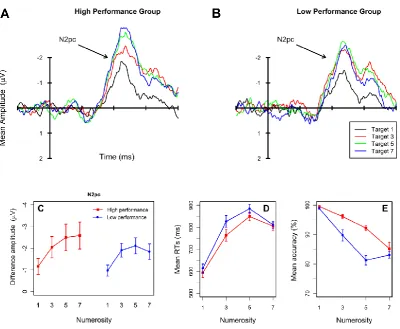
expected that the pattern of the N2pc activity would change not only as a function of target numerosity but also according to individuals’ enumeration performance.
Finally, some studies have underlined a close relationship among enumeration,
visual working memory (VWM) and individuation (e.g., Piazza et al., 2011; Whalen,
Gallistel & Gelman, 1999). More specifically a VWM buffer may be crucial in
maintaining active the individuated items during the process of mapping the set of
elements onto a specific numerical value. For this reason I additionally assessed another
lateralized component, the CDA (Contralateral Delayed Activity- also called SPCN,
Sustained Posterior Contralateral Negativity- arising at approximately 350-400 ms
post-stimulus). This is a sustained lateralized response elicited in memory tasks, as well as in other “attention” paradigms in which further elaboration of the relevant object(s) is
CHAPTER 2
43
has been proposed that CDA is related to cognitive operations involved in a more
detailed elaboration of the individuated objects (Jolicoeur, Sessa, Dell’Acqua, &
Robitaille, 2006; Kiss, Van Velzen, & Eimer, 2008; Mazza et al., 2007). Recent studies
have shown that the CDA is modulated by the numerosity of the items to be memorized
or tracked (Drew & Vogel, 2008; Ikkai, McCollough, & Vogel, 2010) making it a good
candidate for assessing the role of VWM in quantity computation.
2.1.1 Methods
2.1.1.1 Participants
Twenty-four healthy volunteers (15 female; aged 19–35) with normal or
corrected-to-normal vision participated in the study after providing informed consent. The study
was approved by the local ethics committee.
2.1.1.2 Stimuli and procedure
A total of 32 equiluminant green and red dots (8 cd/m²) were presented on a dark grey
background (6 cd/m²), equally distributed to the left and right side of the fixation cross
(Figure 2.1 A). The dots appeared within an invisible 10 (rows) x 8 (columns) grid
(10.7° × 5.4°). On each trial, one, three, five or seven dots (the targets) had a unique
color (either red or green) relative to the homogenously colored distractors, and
appeared with equal probability and in random order to the left or right of fixation, but
44
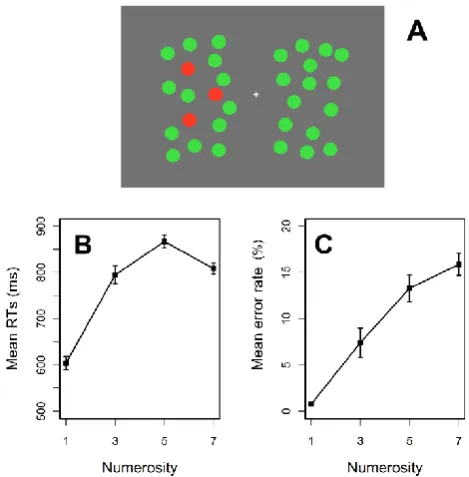
to fixation. The color of the target(s) and of the distractors was counterbalanced across participants. The display duration was 300 ms. Participants’ task was to report the
number of targets by pressing one of four vertically arranged keys on a keyboard with
their index or middle fingers of both hands. Response assignment was counterbalanced
across participants. Speed and accuracy were emphasized equally, and maximum time
for responding was 1500 ms. The inter-trial interval was 1500 ms. Participants
performed eight blocks of trials with 104 trials per block (26 one-target trials, 26
three-target trials, 26 five-three-target trials and 26 seven-three-target trials). One practice block was
delivered before the first block of the experimental session.
A problematic aspect when measuring lateralized ERP activity concerns the lateralized electrical artifacts created by the participant’s eye movements, especially in
tasks (such as the present one) that might increase the likelihood of systematic eye
movements towards the target(s) location. Thus, in addition to the standard off-line
procedures for removing eye movement artifacts (see below) we recorded eye
movements with a remote eye-tracking device and used these measurements as an
on-line feedback to the participants in order to minimize their tendency to make eye
movements. In each block, the device delivered a visual feedback to the participants
every five consecutive saccades.
2.1.1.3 EEG recording and data analysis
EEG was recorded from the scalp with 25 electrodes (including PO7 and PO8)
and a left earlobe electrode, with a right earlobe reference (bandpass filter: 0.01- 200
CHAPTER 2
45
left earlobe electrodes and filtered with a 40 Hz low-pass filter. Horizontal
electro-oculogram (HEOG) was recorded from two electrodes placed on the external canthi of both eyes. Impedance was kept below 5 KΩ for all electrodes. Trials with horizontal
eye movements (HEOG exceeding ± 30 µV), head movements, eye blinks or other
movement artifacts (any channel exceeding ± 80 µV) were discarded. The average
number of retained trials for each participant was 80%.
ERP averages for correct responses were computed relative to a time window
starting 100 ms before stimulus onset, separately for each target numerosity (one, three,
five, seven) and target side (left, right). Statistical analyses for the lateralized
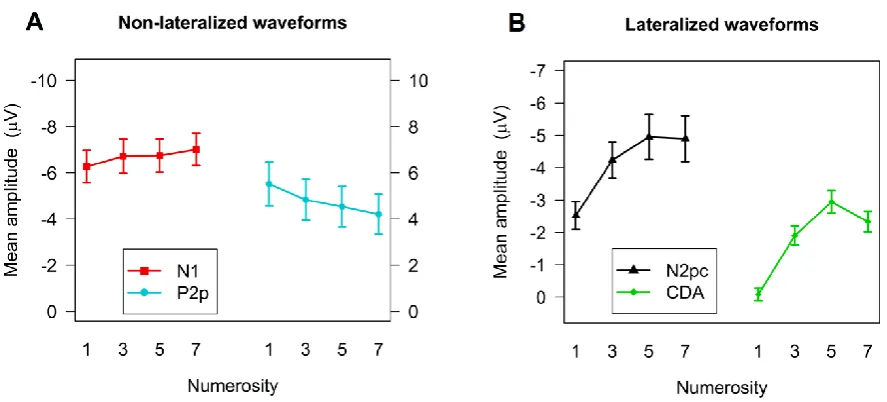
activations (N2pc and CDA) were carried out on mean difference amplitude values at
posterior electrode sites (PO7 and PO8) obtained by subtracting the activity at the
ipsilateral electrodes relative to the target side (e.g., PO8 for right targets) from that
recorded at the contralateral sites (e.g., PO7 for right targets), collapsed across target
side and for the following time windows: 206-286 ms (N2pc), and 400-800 ms (CDA).
The N2pc time range was defined as the 80 ms interval centered on the N2pc peak
amplitude calculated from the grand-average waveforms. To compare the present
results with previous research (e.g., Hyde & Spelke, 2009; Libertus et al., 2007), I also
analyzed the (non-lateralized) mean amplitude values for the following time windows:
139-199 ms (N1), and 175-250 ms (P2p). The N1 and P2p time range were defined as
in Hyde and Spelke (2009). These mean amplitude values (as well as behavioral data)
were submitted to a repeated measures ANOVA with numerosity (one, three, five,
seven) and ERP response (N1, P2p, N2pc, CDA, for ERP data only) as factors. When
appropriate, the Greenhouse–Geisser method for the violation of the sphericity