Models for economic evaluation of multi-purpose apple harvest platform
and software development
Zhao Zhang
1, Zhaohua Zhang
2, Xinmiao Wang
3, Hu Liu
4*, Yuanjie Wang
5, Weijie Wang
6(1. Department of Agricultural and Biological Engineering, Pennsylvania State University, State College, PA 16803, USA; 2. College of Economics and Management, Shandong Agricultural University, Tai’an 271018, Shandong, China;
3. School of Food Science & Biotechnology, Zhejiang Gongshang University, Hangzhou 310018, China; 4. Northwest Institute of Eco-Environment and Resources, Chinese Academy of Sciences, Lanzhou 730000, China;
5. Agricultural Information Institute, Chinese Academy of Agricultural Sciences, Beijing 100081, China; 6. State Grade Dezhou Power Supply Company, Dezhou 253000, Shandong, China)
Abstract: An increasing number of U.S. apple growers are now interested in using harvest platforms to increase harvest
productivity, expand labor pool, and alleviate tough working conditions. To maximize benefits, functions of thinning, pruning & training, and infield sorting have been or are to be incorporated into harvest platforms. Though growers are most concerned with economic benefits, few cost-benefit studies had been conducted on different platforms. In the meantime, economic analysis procedure is complex and each analysis is for one specific machine (not for general purposes). No software has been developed as a general and ready-to-use tool for growers and researchers for the platform economic analysis. In this study, platforms, both available on the marketplace and developed in lab as pilot trials, were reviewed. Costs and benefits models were then established, based on which multi-purpose apple harvest platform economic evaluation software (iMPAHP) was developed (capable of evaluating a wide variety of apple harvest platforms). A case study (machine cost of $100 000, accommodating 6 workers, processing apple incidence of 10% with 90% sort-out rate, and harvest, thinning, and pruning & training productivity increase by 40%, 50%, and 60%, respectively) based on iMPAHP demonstrated that infield sorting, harvest, thinning, and pruning and training accounted for 48.4%, 23.9%, 14.3%, and 13.4% of the total benefits, respectively. In the case that the platform was in all-four-purpose-application, the net present value (NPV) analysis of a 10-year investment showed a positive return of $60 547. However, without infield sorting function, the NPV resulted in a negative value, indicating a loss for the machine investment. Though incorporating the modular infield sorting system certainly increased the overall machine investment by $30 000, the benefits outweighed the costs.
Keywords: multi-purpose apple harvest platform, economic evaluation, infield sorting, pruning, thinning, training
DOI: 10.25165/j.ijabe.20191201.4360
Citation: Zhang Z, Zhang Z H, Wang X M, Liu H, Wang Y J, Wang W J. Models for economic evaluation of multi-purpose
apple harvest platform and software development. Int J Agric & Biol Eng, 2019; 12(1): 74–83.
1 Introduction
Apples rank the second most consumed fruit in the U.S., due to their health benefits, such as improving neurological health and lowering risks of diseases (e.g., diabetes and lung cancer)[1,2].
Because of their susceptibility to bruising and lack of suitable technologies[3-6], apples are still manually harvested by workers, who wear a bushel bucket to temporarily hold harvested apples[7]. After buckets are fully filled (approximately 19 kg), workers walk to a bin and then dump apples. The current harvest approach exposes workers to safety hazards, such as strains/sprains and
Received date: 2018-05-21 Accepted date: 2018-10-31
Biographies: Zhao Zhang, PhD, Research Assistant, research interests:
automated agricultural machinery systems and smart agriculture. Email: [email protected]; Zhaohua Zhang, PhD, Lecturer, research interests: health economics and public health. Email: [email protected]; Xinmiao Wang, PhD, Lecturer, Assistant Professor, research interests: food and biological engineering. Email: [email protected]; Yuanjie Wang, PhD, research interests: agricultural informatization and open access publishing. Email: wangyuanjie@ caas.cn; Weijie Wang, Master, Electronics Engineer, research interest: automation in power supply. Email: [email protected].
*Corresponding author: Hu Liu, PhD, Associate Professor, research interest: ecohydrology and hydropedology. Northwest Institute of Eco-Environment and Resources, Chinese Academy of Sciences, 320 Donggang West Road, Lanzhou 730000, China. Tel: +86-931-496-7014; Email: [email protected].
ladders falls[8,9]. Since 1980s, harvest cost increased sharply as apple growers found it increasingly difficult to employ qualified labor[10-13]. Besides incurring occupational injuries, close dependence on seasonal workforce, decreasing availability of harvest workers and increasing labor cost put strains on the U.S. apple industry[14].
Mechanical apple harvest is a solution to decreasing its high dependence on workforce and lower harvest cost[15]. Based on different fruit removal methods, harvest technologies can be categorized into bulk (mass) and selective[16,17]. Apple harvesters based on the bulk approach were developed and tested, but not commercialized because of high machine cost and unsatisfactory performance on bruising prevention[18-20]. Harvest robots based on the selective method could recognize and detach apples successfully without causing bruises, but the low productivity and high expenditure hindered their commercialization[21-23]. Researchers therefore shifted focus on developing harvest-assist platforms[14,24]. To date, several fresh market apple harvest platforms have already been or will be soon to be commercially available. A low-cost harvest-assist platform taking advantage of gravity to convey apples was developed and tested, with market potential demonstrated[6,25,26]. Jones[27] reported DBR and
being picked when adopting harvest platforms, resulting in less apple-to-apple collisions[27]. Consequently, apples harvested with the platforms have a higher quality compared with those harvested using ladders and buckets (conventional approach). Apple harvest platforms are adopted quickly in recent years as they can: 1) increase worker’s productivity by eliminating time-wasting activities (e.g., moving and climbing up a ladder); 2) alleviate occupational injuries via preventing awkward activities (e.g., bending and dumping apples); and 3) expand labor pool by avoiding strength demanding activities (e.g., descending down a ladder while carrying a full bucket with apples)[28-30].
Pruning & training and green fruit thinning are low in productivity due to intensive use of ladders, as activities (e.g., ladder moving and descending a ladder) are not directly related to work. With the assistance of harvest platforms, however, work productivity could be improved significantly by eliminating time wasting activities (e.g., moving and climbing up a ladder) is saved[28,31]. Another recently developed technology is the modular apple infield sorting system, which could sort out low grade apples (processing and cull) from high quality ones (fresh market) and be incorporated into commercial harvest platforms without or with minor modifications[32-35]. Without infield sorting, low grade apples incur the same cost as fresh market ones during the postharvest handling (i.e., storage, grading and sorting). The low grade apples, however, are sold at a fraction of the price of fresh market ones. As a result, growers may see a negative earning from processing apples. Moreover, the infield sorting technology prevents defective apples from spreading rot and microbial diseases to high quality ones during postharvest storage[36]. The in-field sorting system has been developed[32,33], but not been popularly incorporated into platforms, as apple growers concerning more on the system' economic performance. Baugher et al.[28] indicated that platform multiple uses (i.e., harvesting, infield sorting, tree pruning & training, and fruit thinning) could maximize benefits to apple growers.
Development and commercialization of apple harvest platforms in the U.S. started several years ago, and research was mainly focused on designing and optimizing machines and lowering apple bruising incidence. A few researchers conducted cost-benefit analysis on different harvest platforms[26,35,37,38], but these studies only focused on specific function of the platform, and none of the studies considered all four functions of pruning & training, thinning, harvest, and infield sorting. Furthermore, existing studies do not allow an adjustable setting of the parameters. For example, Zhang and Heinemann[26] evaluated a harvest
platform economically with a fixed productivity increase of 25% and a preset machine price of $30 000, but any changes in parameters of productivity improvement and machine price will lead to the repetition of the entire complicated calculation procedure.
The objectives of this research are therefore to: (1) review currently available multi-purpose apple harvest platforms (MPAHP); (2) develop economic analysis models for MPAHP, based on which then to develop a parameter setting adjustable software program (iMPAHP); and (3) apply the iMPAHP to a case study.
2 Review of multi-purpose apple harvest platforms
There are mainly two types of harvest platforms: one requires the use of buckets to temporarily hold apples, and the other uses conveyors or vacuum for apple transportation from the picker to the
bin. Platforms improve labor productivity in harvest, pruning & training, and thinning by eliminating use of ladders – the time spent on moving/climbing up/descending ladders, which is not directly related to apple picking, is saved. When working on platforms requiring use of buckets, the productivity is further improved due to significantly decreased distance between workers and bins; while working on platforms with conveyors, the productivity is even further increased because workers are not involved with apple transportation. Ladder falls, as the most concerned safety issue in orchard work (e.g., harvest, pruning & training, and thinning), are also fully prevented by adopting platforms[9]. The apple infield sorting technology[32-35], which could sort low grade apples from high quality ones as a modular system, can be incorporated into commercial harvest platforms without or with minor modifications. Mainstream apple harvest platforms on the U.S. marketplace include DBR vacuum harvester, Pluk-O-Trak harvest platform, Huron harvest-assist machine, and Automated Ag harvest-assist system. Researchers at USDA/ARS are developing and testing an apple harvest and infield sorting machine with a goal of commercialization[34,35,39,40].
DBR vacuum harvester (Phil Brown Welding Corp., Conklin, MI, USA) can accommodate a harvest crew of 4-6 workers[41] (Figure 1). They stand on the platform, pick and place apples into vacuum tubes, which transport fruit to the bin automatically. The reported machine price was $110 000, and productivities on harvest, pruning & training, and thinning could be increased by 30%, 50%, and 50%, respectively[28,42].
Figure 1 DBR vacuum apple harvester[41]
Pluk-O-Trak harvest platform (Machinefabriek, Horst, The Netherlands) uses conveyor belts to transport apples to the bin[43]. A harvest crew of 4-6 workers, standing on the platform or on the ground, pick then place apples onto the conveyor belts, which deliver fruit to the bin automatically. This harvest platform sells at around $90 000 and is able to increase productivities on harvest, pruning & training, and thinning by 30%, 20%, and 20%, respectively[28,42].
Huron harvest-assist machine (also named Wafler-Cornell), not as radical as the DBR and Pluk-O-Trak harvesters in using innovative technologies for apple transportation, still requires workers to wear buckets[44,45]. Workers pick various heights of
apples on the tree by standing on different elevations of the platform or on the ground, and when the bucket is full, they walk to the bins and dump apples (Figure 3b). Figure 3a shows workers pruning trees by standing on the platform. This $40 000 platform could improve productivities on harvest, pruning & training, and thinning by 40%, 40%, and 40%, respectively[28,42].
a. Pruning
b. Harvest
Figure 3 Huron harvest-assist platform used for pruning and harvest[44,45]
Automated Ag harvest-assist system (also called Bandit Xpress) (Figure 4) has a similar concept with the Huron system on using buckets to temporarily hold apples[46,47]. Each worker standing on the platform is attached to a vertical bar mounted at the machine center via a string, preventing them from falling off the platform. The machine, at the price of about $50 000, could improve productivities on harvest, pruning & training, and thinning by 35%, 35%, and 35%, respectively[48].
a. Harvest b. Fruit thinning
Figure 4 Automated Ag harvest system used for harvest and fruit thinning[46,47]
USDA/ARS researchers initially developed a modular system to separate processing apples from fresh market ones, based on which an apple harvest and infield sorting machine was designed,
constructed and preliminarily tested[34,35]. Standing on the ground or platform, workers pick and place apples onto conveyors. While moving forward through innovative screw conveyors, apples are first graded into processing or fresh and then transported into corresponding bins. The machine, with an estimated price of $100 000, could improve productivities on harvest, pruning & training, and thinning by 50%, 50%, and 50%, respectively[38].
Figure 5 Apple harvest and in-field sorting prototype machine preliminarily tested in a commercial orchard in Michigan, during
the 2016 harvest season[39]
The infield sorting technology is developed as a modular system that can be readily incorporated into commercial platforms, and it is anticipated that this system would be incorporated into other harvest platforms in the foreseeable future[34,38]. Harvest
platforms are summarized in Table 1 in terms of price, maximal number of pickers, and productivity increase in harvest, pruning & training, and thinning. Despite the fact that harvest platforms could generate benefits via increasing labor productivity and sorting out low grade apples, a cost-benefit analysis is important – growers only accept platforms when their benefits outweigh costs.
Table 1 Harvest platforms summary[28,38,41-43,48]
Platform name Price/$
Maximal number of
pickers
Harvest PI[b]
Pruning & training PI
Thinning PI
DBR 110 000 6 30% 50% 50%
Pluk-O-Trak 90 000 6 30% 20% 20%
Huron 40 000 6 40% 40% 40%
Automated Ag 50 000 6 35% 35% 35%
USDA/ARS 100 000[a] 6 50% 50% 50%
Note: [a] Parameters are estimated; [b]PI=Productivity Increase.
3 Materials and methods
Harvest platforms of different designs benefit apple growers in similar ways as increasing labor productivities in harvest, thinning, pruning & training, and decreasing postharvest handling cost for low grade apples (if sorting function added). It is therefore possible to conduct platform economic evaluation by developing one general model, consisting of yearly costs and benefits. Yearly costs include ownership and operational cost[49]. The ownership
(or fixed) cost is not related with machine use; while the operational (or variable) cost is closely related to the amount of machine use. The yearly benefits generate from the savings in harvest, pruning & training, thinning, and low grade apple postharvest handling. Apple growers, based on their needs, could use partial or all the independent functions of the platform, and only those adopted functions could generate benefits in the cost-benefit analysis.
Gallardo et al.[50], Gallardo and Galinato[51] and Zhang et al.[35] as below: orchard yield ranging 20-50 Mt/hm2; harvest cost of $50/Mt; harvest labor cost of $20/h; pruning, training, and thinning labor cost of $12/h; pruning and training cost at $1050/hm2 (yield at 50 Mt/hm2) and $420/hm2 (yield at 20 Mt/hm2); hand thinning cost at $1330/hm2 (yield at 50 Mt/hm2) and $550/hm2 (yield at 20 Mt/hm2); each picker’s harvest productivity as about 0.7 apple/s using conventional harvest method; a platform accommodating a maximum harvest crew of 6 pickers. For a certain apple orchard, relationships are assumed as below: a linear relationship between pruning & training hours and harvest hours as Equation (1); a linear relationship between thinning hours and harvest hours as Equation (2); a linear relationship between pruning & training cost and harvest cost as Equation (3); and a linear relationship between thinning cost and harvest cost as Equation (4)[51].
Hp&t = HCEp&t×Hh (1)
where, Hp&t = hours for pruning & training; HCEp&t = hour
coefficient for pruning and training (0.625); Hh = hours for harvest.
Ht = HCEt×Hh (2)
where, Ht = hours for thinning; HCEt = hour coefficient for
thinning (0.8).
Cp&t = CCEp&t ×Ch (3)
where, Cp&t = cost for pruning & training ($/hm2); CCEp&t = cost
coefficient for pruning & training (0.4); Ch = cost for harvest.
Ct = CCEt ×Ch (4)
where, Ct = cost for thinning ($/hm
2
); CCEt = cost coefficient for
thinning (0.5).
Considering seasonal characteristics of apple orchard work (i.e., limited time window for harvest, pruning & training, and thinning), the machine could maximally work 40 d per season for harvest (400 h yearly with a 10 h/d working duration assumption)[32,35]. From Equations (1) and (2), the yearly machine maximum running hours for pruning & training and thinning is therefore 250 h and 320 h, respectively. Consequently, the calculated total annual working hours is 970 h with all four functions applied (infield sorting system functions simultaneously with harvest). However, if the platform is only used for one or two functions, annual working hour is determined by the operation hour of the specific functions. For example, if used only for harvest and thinning, the annual working hour is 720 h.
4 Model of yearly multi-purpose harvest platform
costs
4.1 Annual ownership cost
Annual ownership cost mainly consists of depreciation, interest, and others (taxes, housing, and insurance). A simple estimation of total annual ownership cost can be calculated by multiplying the platform purchase price by the ownership cost coefficient, with detailed calculation formulas given by the ASABE Standards[49] as below:
CA=PM×C0 (5)
0 2
1 1
2
V V
S S
C i K
L
(6)
where, CA=annual ownership cost; PM=new machine purchase
price ($40 000-$120 000); C0=ownership cost coefficient; L=
machine life (yr); Sv=salvage value factor at the end of the machine
life (year L); i=annual interest rate; K2=ownership cost factor,
including taxes, housing, and insurance.
After assuming machine life as 10 years following Edwards[52], machine salvage value factor, annual interest rate, and ownership
cost factor are estimated to be 10%, 7%, and 2%, respectively[32,38]. C0 is calculated as 0.1485, and then the annual ownership cost is
exclusively determined by the new machine purchase price (PM).
4.2 Annual operation cost
Annual operation cost consists of repair and maintenance, energy, and lubrication. Repair and maintenance cost is highly variable, and mainly related to routine maintenance, wear, tear, and possible accidents. To reduce the variability, the repair and maintenance cost is estimated using accumulated machine use hours[32,49,53]:
2 ( 1) 1000 RF tt rm M H C RF P
(7)
where, Crm = accumulated annual repair and maintenance cost;
RF1 = repair and maintenance factor one; RF2 = repair and maintenance factor two; Htt = machine annual total working hours.
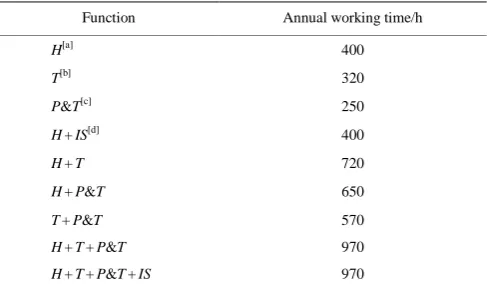
The values of RF1 and RF2 are assigned to be 0.3 and 1.6, respectively[32,49]. It is noted that the machine total working hours will not increase with the incorporation of the infield sorting system, which functions simultaneously with harvest. Platform annual working hours with different functions is shown in Table 2.
Table 2 Harvest platform annual working hours with different functions
Function Annual working time/h
H[a] 400
T[b] 320
P&T[c] 250
H+IS[d] 400
H+T 720
H+P&T 650
T+P&T 570
H+T+P&T 970
H+T+P&T+IS 970
Note: [a] Harvest; [b] thinning; [c] pruning & training; [d] infield sorting.
Energy cost is related to the engine power. Usually, an engine ranging from 21 kW to 35 kW is used for a harvest platform[35,54]. In this study, the engine is assumed to be 30 kW; the diesel price is assumed to be $0.7/L[55]. Based on ASABE Standards[49] and Edwards[52], the average gasoline consumption
(dollars/h) can be estimated with the following formula:
Qfuel=0.16×Ppto (8)
where, Qfuel = hourly energy cost (dollars/h); Ppto = maximum PTO
power.
Edwards[52] indicated that the total lubrication cost for farm machines averaged approximately 15% of energy cost. Consequently, the lubrication cost is as below:
Qlub=0.02×Ppto (9)
where, Qlub = hourly lubrication cost (dollars/h); Ppto = maximum
PTO power.
4.3 Model for yearly cost of the multi-purpose platform
Given that the yearly cost of multi-purpose platform is the sum of the costs of annual ownership (Equation (6)), repair and maintenance (Equation (7)), energy (Equation (8)), and lubrication (Equation (9)), the yearly cost model can be expressed as:
2 2 & 1 1 ( 1) 2 1000 V V
y M M
RF tt
e l pto tt
S S
C P i K RF P
L
H
CE P H
where, Cy=yearly total cost of the multi-purpose platform; Htt =
machine annual total working hours (0-970 h); CEe&l = coefficient
of energy and lubrication (0.18).
The platform, with a basic harvest aid function, does not need to add any extra components to be used for pruning & training and thinning, which means that the machine price will not increase. The price of the modular infield sorting system, however, is assumed to be $30 000, indicating the machine price would be $30000 higher when this function is adopted[32].
4.4 Model of multi-purpose platform yearly benefits
The multi-purpose platform could benefit apple growers in terms of harvest, in-field sorting, thinning, and pruning & training. For harvesting, thinning, and pruning & training, the benefits can be attributed to improved productivity, while for in-field sorting, the benefits can be attributed to savings on postharvest handling of processing apples.
4.5 Annual savings from apple harvest
Based on the summary shown in Table 1 and the literature review[14,28,30,42,56], the harvest platform is assumed to increase productivity from 10% to 60%. When the machine operates at its full capacity for harvest (400 h), the annual benefit is entirely determined by the extent to what the harvest productivity is improved. Cost savings on apple harvest by adopting the platform could be estimated from Equation (11):
CSh=Hh×CEcs×Pn×HPc×PIh (11)
where, CSh = cost savings on harvest; Hh=hoursfor harvest (400 h);
CEcs = coefficient for cost savings (28.8)[50,51]; Pn = picker number
(4-6 pickers); HPc = harvest productivity in conventional approach
(0.7 apples/s-picker); PIh = productivity increase on apple harvest
(10% to 60%).
4.6 Annual savings from apple infield sorting
Apple postharvest handling (i.e., storage/sorting/grading/ packing) accounts for 35% of the total production cost[57]. Harvested apples of mixed grades are hauled to warehouses for postharvest handling, incurring the same cost for processing and fresh market apples. Considering the low price of processing apples and high cost of postharvest handling, apple growers would even receive negative benefits when having a high percentage of low grade apples[58]. Based on personal communications with Riveridge Packing LLC in Sparta, Michigan and Elite Apple Co. LLC in Sparta, Michigan (Nov.23, 2016), the cost data shown in Table 3 are used in this study. Processing apples are kept in cold storage and do not go through sorting/grading/packaging processes; fresh market apples and mixed grade apples (processing mixed with fresh market) would be kept in controlled atmospheric storage and go through sorting/grading/packaging processes.
Table 3 Packinghouse costs for storing and sorting/grading/
packaging apples[32]
Packinghouse service Cost /$·Mt-1
CA storage* 80
Cold storage** 30
Sorting/grading/packaging 290
Note: * CA: Controlled atmospheric storage used for long-term storage; ** Cold storage: refrigerated storage for short-term storage of processing apples.
The sorting system could sort out 80%-95% of processing apples from the mixed grade apples. The mixed grade apples are charged at the rate of $370/Mt (controlled atmospheric storage plus sorting/grading/packaging); the processing apples, on the other hand, are charged at the rate of $30/Mt (just cold storage without sorting/grading/packing). For example, when 10 Mt of mixed
apples with 20% processing grade are transported into the warehouse, the postharvest handling fee is $3700. However, if processing apples are already 90% sorted out infield, the total postharvest handling fee is $3088, leading to a cost saving of $612. Cost savings on postharvest handling of processing apples by incorporating the infield sorting system could be estimated using Equation (12):
CSs=Hh×Pn×HEc×(1+PIh)×PAi×Rs×CEis (12)
where, CSs=cost savings by apple in-field sorting system; PAi=
processing apple incidence (0 to 20%); Rs=processing apple
sort-out ratio (80% to 95%); CEis=coefficient for cost savings of
infield sorting (185)[50,51].
4.7 Annual savings from thinning
Multi-purpose harvest platform improves thinning productivity through saving time spent on moving, climbing up and descending ladders. From Table 1 and the literature review[24,28,59-61], thinning productivity increased by adopting the platform ranges from 20% to 70%. Benefits on thinning could be estimated as:
CSt=Ht×PIt×CEt×Pn=HCEt×Hh×PIt×CEt×Pn (13)
where, CSt=cost savings on thinning; Ht=hours of harvest platform
used for thinning (320 h); PIt=productivity increase on thinning
(20% to 70%); CEt=coefficient for thinning (12).
4.8 Annual savings from pruning & training
Same as thinning, pruning & training productivity is also improved due to the avoidance of ladder use. From Table 1 and literature review[24,28], the productivity improvement on pruning & training ranges from 20% to 70%, with the cost savings calculated via Equation (14):
CSp&t=Hp&t×PIp&t×CEp&t×Pn=HCEp&t×Hh×PIp&t×CEp&t×Pn (14)
where, CSp&t=cost savings on pruning & training; Hp&t=hours
harvest platform used for pruning and training (250 h); PIp&t=
productivity increase on pruning and training (20% to 70%); CEp&t=coefficient for pruning and training (12).
4.9 Model of yearly multi-purpose platform benefits
Total yearly benefits generated by the multi-purpose platform consists of savings on harvest, infield sorting, thinning, and pruning & training:
Sy=Hh×CEcs×Pn×HEc×PIh+Hh×Pn×HEc×(1+PIh)×PAi×Rs×CEis+
HCEt×Hh×PIt×CEt×Pn+HCEp&t×Hh×PIp&t×CEp&t×Pn=Hh×Pn×
(CEcs×HEc×PIh+HEc×PAi×Rs×CEis+HEc×PAi×Rs×CEis×PIh+
HCEt×EIt×CEt+HCEp&t×PIp&t×CEp&t) (15)
where, Sy= total yearly savings by adopting the multi-purpose
harvest platform.
4.10 Net present value analysis
Net present value (NPV), calculated by subtracting the present value of cost from the present value of benefits, is a widely used measurement of the profitability of an investment. Determining the machine NPV helps apple growers with decision making on purchasing harvest platforms[37,62-66]. Apple growers anticipate the purchase of a harvest platform to lead to a positive NPV (profit) instead of a negative NPV (loss) throughout the machine life span. The harvest platform NPV could be calculated from Equation (16) (machine life of 10 years)[26,37].
9 1 2 10 10 2 (1 ) (
(1 ) 2 2
(1 )
) / (1 )
(1 )
( ) / (1 )
2 2
V M
M n n a V
n V M
M rm AMB
V V M rm
S P i i
NPV P R S
L i
S P
K P C i B
L i
i i
S S K P C i
where, NPV = net present value; Ra = annual revenue.
5 Development of software program (iMPAHP)
Taking both costs (Equation (10)) and benefits (Equation (15)) into account, a cost-benefit analysis model (Equation (17)) is introduced, based on which a software program is developed to economically assess a harvest platform. Tkinter (a standard GUI package) of Python 2.7 programming language is used to develop the software program (iMPAHP), including general introduction to the multi-purpose apple harvest platform and the economic evaluation.
2
2
&
& & &
1 1
( 1)
2
( 1000
)
V V
a M M
RF tt
e l pto tt h n cs c
h c i s is c i s is h
t t t p t p t p t
S S
ECO P i K RF P
L
H
CE P H H P CE HE
EI HE PA R CE HE PA R CE EI
HCE EI CE HCE EI CE
(17)
where, ECOa = overall annual economic analysis.
Basic parameters required for conducting economic analysis are listed in Table 4. Though recommended value range for each parameter is provided, users can assign any reasonable and valid values to parameters. For example, PIh (productivity increase on
harvest) would be 100%, if a newly developed platform could improve harvest productivity by 100%. Flowchart of the economic analysis is shown in Figure 6.
Table 4 Parameters needed to conduct harvest platform economic analysis using iMPAHP and recommended value
range
Parameters Recommended value range
PM: machine purchase price $40 000-$120 000
Pn: picker number 4-8
PIh: productivity increase on apple harvest 10%-60% PAi: processing apple incidence 0-20% Rs: processing apple sort out rate 80%-95% PIt: productivity increase on thinning 20%-70%
PIp&t: productivity increase on pruning and training 20%-70%
Figure 6 Flowchart of the platform economic analysis
6 A case study using iMPAHP
A specific case study of the multi-purpose harvest platform application is conducted using the iMPAHP. The value for each parameter is given in Table 5, and the machine maximum operating hours is 970 h (400 h for harvest and infield sorting, 250 h for pruning & training, and 320 h for thinning).
Table 5 Parameters of a case study using iMPAHP software program
Parameters Value
Machine purchase price $100 000*
Picker number 6
Processing apple incidence 10%
Processing apple sort out rate 90%
Productivity increase on harvest 40%
Productivity increase on thinning 50% Productivity increase on pruning and training 60% Note: * Including harvest platform ($70 000) and infield sorting system ($30 000)[32].
7 Results and discussion
7.1 iMPAHP software program
The iMPAHP includes a platform introduction section and an economic analysis section (Figure 7). The introduction provides general information about each function (harvest, thinning, pruning & training, and infield sorting); the other section assesses economic performance of the platform.
7.2 Multi-purpose apple harvest platform general introduction
Each function is introduced with a figure for visual comprehension. Figure 8 shows the harvest-assist function with a photo and detailed description. All other three functions are introduced in the same approach.
Figure 8 Harvest aid introduction of the multi-purpose platform
7.3 Multi-purpose apple harvest platform economic analysis
By inputting values of required parameters as listed in Table 5, the costs and benefits will be calculated and NPV analysis will be conducted (Figure 9). Results could be acquired by clicking the corresponding buttons (Figure 10).
Figure 9 Parameters input interface for multi-purpose harvest platform economic analysis
Figure 10 Economic analysis results: costs, benefits, and net present value
8 A case study via iMPAHP software program
Applying parameter values given in Table 5, costs, benefits, and NPV for this case study will be obtained automatically from
the iMPAHP.
8.1 Multi-purpose harvest platform annual costs
Figure 11 shows the detailed results when the machine only serves harvest purpose (400 h for annual use), with $70 000 purchase price. The total annual costs are $17 450, with repair and maintenance cost accounting for 28% ($4847). With infield sorting system incorporated and all four functions used (970 h for annual use), the machine price increases to $100 000 (extra $30 000 for infield sorting system), and the machine annual costs are estimated as $48 777 (Figure 12), with the repair and maintenance cost accounting for 59% ($28 573). Compared with only harvest use, the sharp increase in repair and maintenance cost (also energy and lubrication costs) is mainly due to the increased machine operating hours.
Figure 11 Multi-purpose harvest platform annual costs when only used for harvest (parameters shown in Table 5)
Figure 12 Multi-purpose harvest platform annual costs when used for harvest, infield sorting, pruning & training, and thinning
(parameters shown in Table 5)
8.2 Multi-purpose harvest platform annual benefits
When four functions used, infield sorting, harvest, pruning & training, and thinning contribute 48.4%, 23.9%, 13.4%, and 14.3% of the total benefits, respectively (Figure 13). Compared to harvest use only, multi-purpose applications of the platform generate more benefits to apple growers.
Figure 13 Multi-purpose harvest platform benefit ratio from individual function
(incurring more annual ownership and operation costs). Meanwhile, multi-purpose use brings more benefits to apple growers. Figure 14 shows machine costs, benefits, and net benefits of platforms with different functions. Though both costs and benefits increase with machine’s multiple applications, benefits increase way higher than costs and hence the net benefits increase with more functions applied (Figure 14). When the platform is used for harvest only, the overall annual net benefit is $1900; for harvest and thinning, it is $4100; for harvest, thinning, pruning & training, it is $5900; and for harvest, thinning, pruning & training, and infield sorting, it increases sharply to $38 000. Despite the fact that the infield sorting system increases machine prices and annual costs, the technology itself could bring significant benefits to apple growers (benefits outweigh costs).
Note: H stands for harvest; P & T stands for pruning and training; T stands for thinning; IS stands for infield sorting; Net benefit equaling to benefits subtract costs.
Figure 14 Multi-purpose harvest platform costs, benefits, and net benefits with different functions
8.3 Multi-purpose harvest platform net present value analysis
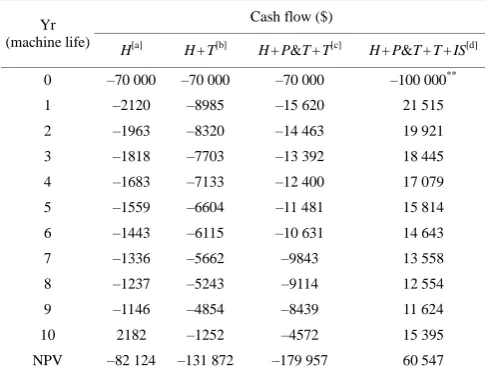
Despite the net benefit analysis provides information on the economic performance of the platform with difference functions, this method did not consider the time value of money. Hence, the net present value analysis (NPV), which incorporates time value, is employed and the case study analysis result is shown in Table 6. When the platform is used for harvest only, harvest and thinning, and harvest, pruning & training, and thinning, the NPV analysis
Table 6 Net present value (NPV) analysis for a case study*
Yr (machine life)
Cash flow ($)
H[a] H+T[b] H+P&T+T[c] H+P&T+T+IS[d]
0 –70 000 –70 000 –70 000 –100 000**
1 –2120 –8985 –15 620 21 515
2 –1963 –8320 –14 463 19 921
3 –1818 –7703 –13 392 18 445
4 –1683 –7133 –12 400 17 079
5 –1559 –6604 –11 481 15 814
6 –1443 –6115 –10 631 14 643
7 –1336 –5662 –9843 13 558
8 –1237 –5243 –9114 12 554
9 –1146 –4854 –8439 11 624
10 2182 –1252 –4572 15 395
NPV –82 124 –131 872 –179 957 60 547 Note: * This case study was conducted based on a $70 000 platform assumption; platform accommodating 6 pickers; processing apple incidence of 10%; apple sorting out rate 90%; harvest, thinning and pruning & training productivity increase as 40%, 50% and 60%, respectively; ** infield sorting system was assumed to be $30 000; [a] platform only used for harvest; [b] platform used for harvest and thinning; [c] platform used for harvest, pruning & training, and thinning; [d] platform used for harvest, thinning, pruning and training, and infield sorting.
results are all negative, indicating overall a loss for the investment in the machine. However, when the infield sorting system is added, the NPV analysis result is positive, suggesting an overall profit of machine investment. Therefore, to make the machine investment profitable, apple growers are suggested to incorporate the infield sorting system, and use all four functions of the machine.
9 Conclusions
A software package (iMPAHP) was developed for the economic evaluation of a multi-purpose apple harvest platform based on the developed cost and benefit models, after reviewing all current harvest platforms. iMPAHP has two sections of platform introduction and economic evaluation. Introduction section focuses on providing platform background knowledge while the other section aims at assessing the platform economically. With a case study using iMPAHP, it is concluded that both costs and benefits increase with more functions applied, but benefits increase way higher than the costs, indicating platform with multi-purposes will bring more net benefits. Of all the four functions in the case study, infield sorting, harvest, thinning, and pruning & training accounts for 48.4%, 23.9%, 14.3%, and 13.4% of the total benefits, respectively. Despite the fact that the machine price is increased by $30 000, incorporating the infield sorting system is profitable as demonstrated in the NPV analysis. Consequently, it is recommended for commercial platforms to add the modular infield sorting system. Results for the case study using the developed program is conservative as labor cost increases sharply year by year and more labor cost will be saved. Furthermore, insurance premium rate for workers will be lowered due to the elimination of ladder fall accidents.
Acknowledgement
This research was funded by the Youth Innovation Promotion Association of Chinese Academy of Sciences (1110000002) and the Key Project of Chinese Academy of Sciences (QYZDJ-SSW- DQC040).
[References]
[1] Boyer J, Liu R H. Apple phytochemicals and their health benefits. Nutr. J. 2004; 3(5):1–15.
[2] PBH. Produce for better health foundation. State of the plate, 2015 study on America’s consumption of fruit and vegetables. 2015. http://www.pbhfoundation.org/pdfs/about/res/pbh_res/State_of_the_Plate_20 15_WEB_Bookmarked.pdf. Accessed on [2018-05-31]
[3] LeFlufy M J. Harvest trials with a prototype apple harvester. J. Agric. Eng. Res., 1982; 27: 415–420.
[4] Peterson D L, Bennedsen B S. Isolating damage from mechanical harvesting of apples. Appl. Eng. in Agric., 2005; 21(1): 31–34.
[5] Luo R L, Lewis K M, Zhang Q, Wang S M. Assessment of bruise damage by vacuum apple harvester using an impact recording device. ASABE, Paper No: 121338094. St. Joseph, Mich.: ASABE, 2012.
[6] Zhang Z, Heinemann P H, Liu J, Schupp J R, Baugher T A. Development of mechanical apple harvesting technology – A review. Trans. ASABE., 2016; 59(5): 1149–1156.
[7] Freivalds A, Park S, Lee C, Earle-Richardson G, Mason C, May J J. Effect of belt/bucket interface in apple harvesting. Intl J. Ind. Ergonomics, 2006; 36(11): 1005–1010.
[8] Fulmer S, Punnett L, Slingerland D T, Earle-Richardson G. Ergonomic exposures in apple harvesting: preliminary observations. American J. Ind. Med. Supplement, 2002; 2: 3–9.
[9] Fathallah F A. Musculoskeletal disorders in labor-intensive agriculture. Appl. Ergonomics, 2010; 41: 738–743.
S, et al. A fresh fruit harvester for apples trained on horizontal trellises. J. Agric. Eng. Res., 1988; 41: 239–249.
[11] Martin P L, Mines R. Immigration reform and California agriculture. Cal. Agr., 1983.Jan.-Feb:14–15.
[12] Hansen M. Prepare now for labor shortages. Good Fruit Grower, 1999; 50(3): 41–42.
[13] Warner G. Tighter borders may be keeping out workers. Good Fruit Grower, 2003; 54(11): 10–11.
[14] Schupp J, Baugher T, Winzeler E, Schupp M, Messner W. Preliminary results with a vacuum assisted harvest system for apples. Fruit Notes, 2011; 6: 1–5
[15] Tong J, Zhang Q, Karkee M, Jiang H, Zhou J. Understanding the dynamics of hand picking patterns of fresh market apples. ASABE Paper No.141898024. St. Joseph, Mich. 2014.
[16] Peterson D L. Harvest mechanization progress and prospects for fresh market quality deciduous tree fruits. Hort. Tech., 2005; 15(1): 72–75. [17] DeKleine M E, Karkee M, Lewis K, Zhang Q. A fresh-market apple
harvesting technique. ASABE Paper No. 131619241. St. Joseph, Mich.: ASAE, 2013.
[18] Millier W F, Rehkugler G E, Pellerin R A, Throop J A, Bradley R B. Tree fruit harvester with insertable multilevel catching system. Trans. ASABE, 1973; 16(5): 844–850.
[19] Berlage A G, Langmo R D. Harvesting apples with straddle-frame trunk shaker. Trans. ASAE, 1974; 17(2): 230–232, 234.
[20] Peterson D L, Wolford S D. Fresh-market quality tree fruit harvester Part II: apples. Appl. Eng. in Agric. 2003; 19(5): 545–548.
[21] Baeten J, Donne K, Boedrij S, Beckers W, Claesen E. Autonomous fruit picking machine: a robotic apple harvester. Springer Tracks in Advanced Robotics, 2008; 42: 531–539.
[22] Bulanon D M, Kataoka T. Fruit detection system and an end effector for robotic harvesting of Fuji apples. Agric. Eng. Intl: CIGR Journal, 2010; 12(1): 203–210.
[23] Zhao D A, Lv J D, Ji W, Zhang Y, Chen Y. Design and control of an apple harvesting robot. Biosystems Eng., 2011; 110(2): 112–122.
[24] Robinson T, Hoying S, Sazo M M, DeMarree A, Dominguez L. A vision for apple orchard systems of the future. New York fruit Q., 2013; 21(3): 12–16.
[25] Zhang Z, Heinemann P H., Liu J, Schupp J R, Baugher T. A. Design, fabrication, and testing of a low-cost apple harvest-assist device. ASABE Paper No. 141839738. St. Joseph, MI: ASABE, 2014.
[26] Zhang Z, Heinemann P H. Economic analysis of a low-cost apple harvest-assist unit. HortTechnology, 2017; 27(2): 240–247
[27] Jones R. The state of mechanical apple harvesting. http://www.growingproduce.com/fruits/the-state-of-mechanical-apple-harvest ing/, 2015. Accessed on [2018-06-21]
[28] Baugher T, Schupp J, Lesser K. Harsh R M, Lewis K, Seavert C, et al. Mobile platforms increase orchard management efficiency and profitability. Acta Hort., 2009; 824: 361–364.
[29] Sparks B. The future is now for orchard technology. http://www.growingproduce.com/fruits/the-future-is-now-for-orchard-technol ogy/2/, 2013. Accessed on [2018-04-22]
[30] Zhang Z. Design, test, and improvement of a low-cost apple harvest-assist unit. PhD diss. State College, Pa.: Pennsylvania State University, Department of Agricultural and Biological Engineering, 2015.
[31] Galinato S P, Gallardo R K, Miles C A. 2013 cost estimation of establishing a cider apple orchard in Western Washington. 2014. https://research.libraries.wsu.edu/xmlui/bitstream/hm2ndle/2376/5149/FS141 E.pdf?sequence=2&isAllowed=y. Accessed on [2018-04-22]
[32] Mizushima A, Lu R. Cost benefits analysis of in-field presorting for the apple industry. Appl. Eng. in Agric., 2011; 27(1): 33–40.
[33] Mizushima A, Lu R. A low-cost color vision system for automatic estimation of apple fruit orientation and maximum equatorial diameter. Appl. Eng. in Agric., 2013; 56(3): 813–827.
[34] Lu R, Pothula A K, Vandyke M, Mizushima A, Zhang Z. System for sorting fruit. U.S. Patent 9,919,345. 2016.
[35] Zhang Z, Pothual A, Lu R. Economic analysis of a self-propelled apple harvest and in-field sorting machine for the apple industry. ASABE annual meeting. Paper No. 2456644, 2016.
[36] Peterson D, Wolford S D, Anger W C. Automated bin filling system. U.S. Patent No. 8,033,084 B1, 2011.
[37] Julian J W, Seavert C F. AgProfit™: a net present value and cash flow based decision aid for agriculture producers. Agric. Finance Rev., 2011; 71(3): 366–378.
[38] Zhang Z, Pothula A, Lu R. Economic evaluation of apple harvest and infield sorting technology. Trans. ASABE, 2017; 60(5): 1537–1550.
[39] Zhang Z, Pothula A, Lu R. Development of a new bin filler for apple harvesting and infield sorting with a review of existing technologies. ASABE Paper No. 1700662. St. Joseph, MI: ASABE, 2017.
[40] Zhang Z, Pothula A, Lu R. Development and preliminary evaluation of a new bin filler for apple harvesting and infield sorting machine. Trans. ASABE, 2017; 60(6): 1839–1849
[41] Phil Brown Welding. DBR vaccum apple harvester. Retrieved from: http://www.philbrownwelding.com/index.php/new-products, 2016. Accessed on [2018-05-21]
[42] Robinson T, Sazo M M. Recent advances of mechanization for the tall spindle orchard system in New York State – Part 2. NY Fruit Quarterly, 2013; 21(3): 3–7.
[43] Munckhof. Pluk-O-Trak apple harvester. http://www.munckhof.org/ Pluk-O-Trak_Senior, 2016. Accessed on [2018-05-21]
[44] Clark S. More apples, faster: harvester conceived by huron orchardists boosts productivity. 2015. http://www.fltimes.com/lifestyle/ more-apples-faster-harvester-conceived-by-huron-orchardists-boosts-producti vity/article7e1d8be2 -6de2-11e5-96c9-1b016b66fbb3.html. Accessed on [2018-05-21]
[45] Huronfruitsystems. Picking platform. 2015. http://www. huronfruitsystems.com/index_files/Page572.htm. Accessed on [2018-05-21] [46] Good fruit grower. Bandit Xpress harvest demonstration. 2013.
https://www.youtube.com/watch?v=oXvWydK2z9g. Accessed on [2018-05-21]
[47] Herrick C. How best to integrate man and machine. 2016. http://www.growingproduce.com/fruits/apples-pears/how-best-to-integrate-m an-and-machine/. Accessed on [2018-07-21]
[48] Wheat D. Harvest platform catches on. Apr. 23, 2014. http://www.capitalpress.com/Washington/20140423/hm2rvest-platform-catch es-on. Accessed on [2018-07-21]
[49] ASABE Standards. EP496.3: Agricultural machinery management. St. Joseph, MI: ASABE, 2011.
[50] Gallardo K, Taylor M, Hinman H. Cost estimates of establishing and producing Gala apples in Washington. Washington State University, 2009. [51] Gallardo R K, Galinato S. 2012 cost estimates of establishing, producing,
and packing red delicious apples in Washington. Washington State University, 2012.
[52] Edwards W. Estimating farm machinery cost. Iowa State University, extension and outreach. 2015. https://www.extension.iastate.edu/agdm/ crops/html/a3-29.html. Accessed on [2018-07-21]
[53] ASABE Standards. D497.7: Agricultural machinery management data. St. Joseph, MI.: ASABE, 2011.
[54] Brownie Quad. Self-propelled work platform. 2016. http://www.philbrownwelding.com/images/myPDFDocs/brownie%20quad% 2011-26-2013.pdf. Accessed on [2018-07-21]
[55] U.S. Energy Information. Gasoline and diesel fuel update. 2017. https://www.eia.gov/petroleum/gasdiesel/. Accessed on [2018-07-21] [56] Lehnert R. New apple harvester shows promise. Good Fruit Grower.
http://www.goodfruit.com/suck-em-up/. Accessed on [2018-07-21] [57] Wunderlich L, Klonsky K M, DeMoura R L. Sample cost to establish and
produce apples (Fuji Variety). Cost and Return Study Report AP‐IR‐07. Davis, Calif.: Agricultural & Resource Economics, University of California. 2007. http://cecentralsierra.ucanr.edu/files/60510.pdf. Accessed on [2018-07-21]
[58] Schtzko R T, Granatstein D. A brief look at the Washington apple industry: past and present. Project Report SES 04‐05. Pullman, Wash.: School of Economic Sciences College of Human and natural Resource Sciences, Washington State University, 2005. http://www.agribusiness- mgmt.wsu.edu/agbusresearch/ docs/SES04-05_BRIEF_LOOK_WAFTA.pdf. Accessed on [2018-07-21]
[59] Sazo M M, Marree A D, Robinson T. The platform factor - labor positioning machines producing good results for NY apple industry. New York Fruit Quarterly, 2010; 18(2): 5–10.
[61] Zhang Z, Heinemann P H, Liu J, Schupp J R, Baugher T A. Design and field test of a low-cost apple harvest-assist unit. Trans. ASABE, 2016; 59(5): 1149–1156.
[62] Kien Hwa. Sources of net present value gains in the acquisitions of corporate real estate. J. Corporate Real Estate, 2008; 10(2): 121–129. [63] Zhang Z, Heinemann P H, Liu J, Baugher T A., Schupp J R, Development of
mechancial apple harvesting technology – A review. Trans. ASABE, 2016; 59(5): 1165–1180.
[64] Zhang Z, Heinemann P H, Liu J, Schupp J R, Baugher T A. Brush mechanism for distributing apples in a low-cost apple harvest-assist unit. Appl. Eng. in Agric., 2017; 33(2): 195–201.
[65] Zhang Z, Pothula A, Lu R. A review of bin filling technologies for apple harvest and postharvest handling. Appl. Eng. in Agric. 2018; 34(4): 687-703 [66] Zhang Z, Pothula A, Lu R. Improvement and evaluation of an infield bin
![Figure 1 DBR vacuum apple harvester[41]](https://thumb-us.123doks.com/thumbv2/123dok_us/593068.2058551/2.595.317.545.652.776/figure-dbr-vacuum-apple-harvester.webp)
![Table 1 Harvest platforms summary[28,38,41-43,48]](https://thumb-us.123doks.com/thumbv2/123dok_us/593068.2058551/3.595.72.258.186.474/table-harvest-platforms-summary.webp)
![Table 3 Packinghouse costs for storing and sorting/grading/ packaging apples[32]](https://thumb-us.123doks.com/thumbv2/123dok_us/593068.2058551/5.595.43.287.639.698/table-packinghouse-costs-storing-sorting-grading-packaging-apples.webp)