Volume 37 Issue 2 Article 1
2010
Residual-Risk Model for Classifying Business Arrangements
Residual-Risk Model for Classifying Business Arrangements
Bradley T. Borden [email protected]
Follow this and additional works at: https://ir.law.fsu.edu/lr
Part of the Law Commons
Recommended Citation Recommended Citation
Bradley T. Borden, Residual-Risk Model for Classifying Business Arrangements, 37 Fla. St. U. L. Rev. (2010) .
https://ir.law.fsu.edu/lr/vol37/iss2/1
F
LORIDA
S
TATE
U
NIVERSITY
L
AW
R
EVIEW
R
ESIDUAL
-R
ISK
M
ODEL FOR
C
LASSIFYING
B
USINESS
A
RRANGEMENTS
Bradley T. Borden
V
OLUME
37
W
INTER
2010
N
UMBER
2
BRADLEYT. BORDEN*
ABSTRACT
Tax law classifies business arrangements as one of three general structures: (1) disregarded arrangements, (2) tax partnerships, or (3) tax corporations. Since the enactment of the income tax in 1913, tax law has struggled unsuccess-fully to develop an ideal model for classifying business arrangements. The cur-rent model’s sole virtue is its simplicity, derived from formalistic, elective attributes. Its greatest shortcoming may be that it disregards the reasons par-ties form business arrangements and the reasons they use economic items to re-duce rent-seeking behavior and agency costs. That disregard often allows busi-ness participants to choose their tax classification and minimize their taxes, which erodes the tax base and shifts tax burdens to others but does not alter the parties’ economic relationships. This Article rejects the current model and presents a classification model based on the economic theory of the firm. Eco-nomic theory aids classification in three respects. First, it helps explain why parties form business arrangements. Second, it views business arrangements as nexuses of contracts composed of various parties. This view helps identify the economic aspects of business arrangements and the economic rights of business participants, irrespective of legal form. Third, economic theory demonstrates that residual risk (the right to the residual assets of a business) measures the economic interests parties have in business arrangements. In particular, resi-dual risk helps distinguish between arrangements that can trace income from its source to the owner of the source, or from allocations to the beneficiaries of those allocations, and those that cannot. That knowledge clarifies the appro-priate tax regime for all arrangements and leads to the residual-risk model for classifying business arrangements.
I. INTRODUCTION ... 246
II. CURRENTCLASSIFICATION MODEL ... 252
A. Grant Theory and Corporate Resemblance ... 254
B. Elective Model and Private Ordering of Tax Liability... 262
C. Tax Partnership Versus Disregarded Arrangement ... 265
III. RESIDUALRISK ... 268
A. Unitary Residual Risk ... 271
B. Allocation-Dependent Residual Risk ... 273
C. Distribution-Dependent Residual Risk ... 275
D. Allocation-Distribution Symmetry ... 278
IV. RESIDUAL-RISK CLASSIFICATION MODEL ... 280
A. Case for Aggregate-Plus Taxation ... 282
B. Case for Entity Taxation ... 286
C. Classifying Arrangements Under the Residual-Risk Model ... 291
V. CONCLUSION ... 294
VI. APPENDIX OF TABLES ... 294
I. INTRODUCTION
Properly classifying business arrangements is essential to pre-serving the integrity of the income tax system. The income tax sys-tem uses various tax regimes, including partnership tax and corpo-rate tax, to tax business participants. The application of those tax re-gimes depends upon an arrangement’s classification as either a tax partnership or tax corporation. If the classification model does not properly match a business arrangement with a tax regime, members of the arrangement may receive the economic benefit from the ar-rangement without shouldering the corresponding tax burden. That result occurs when the classification model fails to consider the eco-nomic attributes of an arrangement. The current classification model fails to consider relevant economic aspects of business arrangements and undermines Congressional efforts to enact income tax laws that achieve specific tax policy objectives.1 Economic theory, on the other
1. Commentators generally agree on fundamental policy criteria such as equity, effi-ciency, simplicity, and administrability. See, e.g., Joseph M. Dodge, Taxes and Torts, 77 CORNELLL. REV. 143, 146–47 (1992) (analyzing the equity and efficiency of certain recove-ries for injurecove-ries); Edward J. McCaffery, A New Understanding of Tax, 103 MICH. L. REV. 807, 816, 829–30, 848–49 (2005) (evaluating transfer taxes using the principles of equity, efficiency, and simplicity); Joseph T. Sneed, The Criteria of Federal Income Tax Policy, 17 STAN. L. REV. 567, 568, 569–72, 586–90 (1965) (arguing that a tax system should, among other things, supply adequate revenue, impose equal taxes, and avoid impairment of the market-oriented economy (i.e., promote efficiency)). Commentators may not, however, agree on the best system to achieve such policies. For example, they may disagree on the concept of income—some commentators believe consumption is the best concept of income while others believe a broader definition is more important. See, e.g., William D. Andrews,
A Consumption-Type or Cash Flow Personal Income Tax, 87 HARV. L. REV. 1113, 1188 (1974) (arguing that a cash flow tax is the ideal income tax); Joseph Bankman & David A. Weisbach, The Superiority of an Ideal Consumption Tax Over an Ideal Income Tax, 58 STAN. L. REV. 1413, 1413 (2006) (arguing in favor of a consumption definition of income); Alan Gunn, The Case for an Income Tax, 46 U. CHI. L. REV. 370, 400 (1979) (arguing that
the income tax has worked well and that the cost of changing to another system would be too costly); Alvin Warren, Would a Consumption Tax Be Fairer Than an Income Tax?, 89 YALEL. J. 1081, 1082 (1980) (arguing that consumption tax unfairly excludes a significant
portion of wealth from the tax base); Alvin C. Warren, Jr., Fairness and a Consumption-Type or Cash Flow Personal Income Tax, 88 HARV. L. REV. 931, 931-32 (1975) (criticizing
hand, provides residual risk (the right to the residual assets of a business) as a method for measuring parties’ economic interests in business arrangements. As a measure of economic interest, residual risk should dictate the tax regime that applies to the various types of business arrangements, and it should order their classification. Two examples illustrate the deficiencies of the current classifica-tion model. First, the current model allows parties to alter the cha-racter of the arrangement’s income. The income tax system imposes a tax rate structure on income earned as compensation for services (which can be as high as thirty-five percent)2 and a separate rate
structure on gains from the sale of certain capital assets (which gen-erally will not exceed fifteen percent).3 Traditionally, employment
contracts memorialize service arrangements, and payments made to the service provider pursuant to such contracts should be compensa-tion for services. Parties may, however, create an economically equivalent arrangement using a limited liability company or limited partnership.4 The current model disregards an arrangement
memo-rialized by an employment contract, but it most likely treats the same arrangement as a tax partnership if memorialized by a part-nership or limited liability company agreement.5 That different
clas-sification may affect the character of income a service provider re-ports on a tax return. Income a partnership allocates to a service-providing partner could be long-term capital gains taxed at favorable rates, while amounts paid under an employment contract would be compensation taxed at higher rates.6 Thus, the current model allows
business participants to alter the character of income by changing the form, but not the substance of a transaction. That ability
that classifications should help preserve the general tax system by creating definitions that help ensure that tax items follow economic items.
2. See I.R.C. § 1(i)(2) (2006) (setting the maximum individual tax rate at thirty-five percent for tax years beginning in 2003).
3. See I.R.C. § 1(a)–(d) (2006) (imposing a tax on individuals and providing the gen-eral graduated rate structures for individual tax liability); I.R.C. § 1(h)(1)(C) (2006) (pro-viding preferential rates for adjusted net capital gain).
4. See Gregg D. Polsky, Private Equity Management Fee Conversions, 122 TAXNOTES
743, 746–52 (2009) (demonstrating that investment advisors use entity structures to convert the character of income without altering the economic aspects of an employment arrangement). 5. See David A. Weisbach, The Taxation of Carried Interests in Private Equity, 94 VA. L. REV. 715, 731–33 (2008) (concluding with thinly-constructed analysis that such ar-rangements are tax partnerships and the partners act in a partnership capacity). But see
Bradley T. Borden, Profits-Only Partnership Interests, 74 BROOK. L. REV. (forthcoming 2009), available at http://ssrn.com/abstract=1262493 (arguing that such arrangements should not be tax partnerships, or the service providers should be treated as nonpartners); Douglas L. Longhofer, The Lost Regulations: Section 707 and the Definition of Partner Ca-pacity 11 BUS. ENT. 16, 26-29 (2009) (suggesting that a more rigorous analysis is needed to
determine if service-providing partners act in partner capacity).
mines any income tax law and policy that supports the different tax rates.
Second, the current model allows business participants to skirt the assignment of income doctrine. The assignment of income doc-trine provides generally that a person who realizes an economic bene-fit must report the corresponding tax item on a tax return.7
Conse-quently, a person who receives compensation for providing services must report compensation income on a tax return.8 A person who
rea-lizes economic gain on the disposition of property must report a cor-responding tax gain.9 The current model allows parties to shift the
incidence of taxation by contributing property or services to an ar-rangement classified as a tax partnership or tax corporation.10 Thus,
the current model frustrates the assignment of income doctrine.11 The
shortcomings of the current model exist because the model developed independent of economic theory.
Section II of this Article traces the evolution of the current classi-fication model, revealing three significant points. First, the model undergoes significant changes every few decades.12 Second, the model
7. SeeBrant J. Hellwig, The Supreme Court’s Casual Use of the Assignment of In-come Doctrine, 2006 U. ILL. L. REV. 751, 765–81 (2006) (discussing the assignment of in-come doctrine generally but arguing that it should apply only to gratuitous assignments of income); Stanley S. Surrey, Assignments of Income and Related Devices: Choice of the Tax-able Person, 33 COLUM. L. REV. 791, 796–815 (1933) (discussing the application of the as-signment of income doctrine in various contexts).
8. See Lucas v. Earl, 281 U.S. 111, 114–15 (1930) (holding that a husband could not shift the tax liability of his compensation to his wife).
9. See Helvering v. Horst, 311 U.S. 112, 124–25 (1940) (holding that the person who owns property must recognize income from that property).
10. See Bradley T. Borden, Partnership Tax Allocations and the Internalization of Tax-Item Transactions, 59 S.C. L. REV. 297, 333–45 (2008) (demonstrating how partners may use the partnership allocation rules to separate the incidence of taxation from the economic items allocated to partners).
11. Another example is illustrative. If corporate marginal tax rates are lower than in-dividual marginal tax rates, inin-dividuals, particularly high-income inin-dividuals, may be able to shelter some income from higher tax rates by using a tax corporation for income-producing functions. See John W. Lee, A Populist Political Perspective of the Business Tax Entities Universe: “Hey the Stars Might Lie But the Numbers Never Do,” 78 TEX. L. REV.
885, 903–22 (2000) (discussing the use of entities taxed as corporations to shelter some in-come from higher taxes). Parties will also structure ownership arrangements as open te-nancies in common, which the IRS may not classify as tax partnerships, to obtain section 1031 nonrecognition. See generally Bradley T. Borden, Open Tenancies-in-Common, 39 SETONHALLL. REV. 387 (2009) (describing and analyzing a safe harbor provided by the
IRS for parties seeking to avoid tax partnership classification).
lags behind development of legal and economic theory, sometimes adopting concepts decades after they have lost relevance in other areas of the law.13 Third, the model lacks tax policy support. As the
current model passes its ten-year anniversary, commentators have begun recognizing chinks in its armor, calling for changes or further examination of the model.14 Furthermore, changing business
practic-es mandate periodic reviews of practic-established legal and tax rulpractic-es, and the current economic climate compels a review of the current model for classifying tax entities. Finally, developments in economic theory shed new light on the analysis of the classification model.
A review of the current model reveals that it is wanting in many respects. For instance, it relies upon legal formalities, labels, and elections to classify business arrangements, enabling business partic-ipants to privately influence the placement of the incidence of taxa-tion.15 For example, if partnership tax law allows untaxed
assign-ments of tax items,16 business people may elect tax partnership
clas-sification to exploit the allocation rules and use tax items as consid-eration.17 Additionally, if entity tax law does not concern itself with
Circuit decision in United States v. Kintner, 216 F.2d 418, 421-24 (9th Cir. 1954) led to the promulgation of the Kintner Regulations in 1960, which adopted a bright-line multi-factor test for determining whether an arrangement was a tax corporation. See infra text accom-panying notes 84–97. In 1977, Wyoming enacted the first limited liability company statute, and the IRS privately ruled in 1980 that such an entity could be a tax partnership, creat-ing a de facto classification election. See infra text accompanying notes 101–06. Finally, in 1997, Treasury created the current model by promulgating the check-the-box regulations, which formalized and simplified the classification election (abandoning theory for the sake of simplicity). See infra text accompanying notes 107–13. Thus, the important dates in the evolution of the classification model are 1909–11, 1913–18, 1934–35, 1954–60, 1977–80, and 1997. Significant changes, therefore, appear to occur every fifteen to twenty years, suggesting another major change may occur over the next three to seven years.
13. Corporate law’s concept of corporations evolved from the original grant/concession theory (accepted in the nineteenth century), which recognized that states granted corpora-tions the privilege of existence, to the entity theory, which recognized corporacorpora-tions as enti-ties separate from their owners (well established by the beginning of the twentieth cen-tury). See infra text accompanying notes 48–55, 56–60. The entity theory is now being eroded by the economic view of corporations as nexuses of contracts. See infra text accom-panying notes 142–45.
14. See,e.g., Steven A. Dean, Attractive Complexity: Tax Deregulation, the Check-the-Box Election, and the Future of Tax Simplification, 34 HOFSTRAL. REV. 405, 406, 457-58 (2005) (concluding that the current classification model adds attractive complexity to the tax system and results in tax deregulation); Heather M. Field, Checking in on “Check-the-Box,” 42 LOY. L.A. L. REV. 451 (2009) (suggesting that twelve years after the promulgation
of the check-the-box classification regulations, the time is ripe for reconsidering them). 15. This Article uses the term “incidence of taxation” to refer to the obligation to pay tax, or the statutory incidence of taxation. See HARVEYS. ROSEN& TEDGAYER, PUBLIC
FINANCE 304–29 (8th ed. 2008) (discussing tax shifting that occurs when the economic in-cidence of taxation differs from the statutory inin-cidence of taxation).
16. This Article uses the term “tax items” to describe items that factor into the com-putation of taxable income. They include items of income, gain, loss, deduction, and credit.
See I.R.C. § 704 (2006) (providing for the allocation of tax items).
the accurate allocation of tax items, parties may elect corporate form and shift the incidence of taxation.18 The review also demonstrates
that the current model fails to justify the various tax regimes. The model does not explain why entity tax is important or why tax law imposes a double tax on distributions from arrangements subject to entity taxation. The current model also fails to contemplate why tax law needs aggregate-plus taxation. Those failures make classification arbitrary and the application of the tax regimes inconsistent. Thus, the shortcomings of the current model threaten the integrity of the tax system.
This Article accepts as a premise of entity classification that clas-sifying business arrangements should help ensure that tax items fol-low economic items. That premise requires a person who realizes an economic benefit from providing services or owning property to report a corresponding tax item on a tax return. If tax items follow economic items, participants in business arrangements would not be able to al-ter the characal-ter of income, delay the recognition of income, or oth-erwise shift the tax burden using the classification rules. Such re-sults help promote the accurate placement of the tax burden, which in turn promotes both equity and efficiency—two linchpins of tax pol-icy.19 To ensure that tax items follow economic items, the
classifica-tion model should adopt a metric that accurately measures business participants’ economic interests.
Section III suggests that the economic concept of residual risk (rights to the residual assets of a business) is such a metric and demonstrates how it measures economic interests. Residual risk is an important component of the neoclassical theory of the firm, a theory that ignores the legal form of business arrangements and
18. For example, a person with property that has significant built-in gain (i.e., the value of the property exceeds the property’s tax basis) may contribute such property to an entity taxed as a corporation with at least one other member. If the corporation later sells the property and pays tax on the property, the noncontributing shareholder bears a portion of the incidence of tax on the built-in gain, which should have been borne solely by the con-tributing shareholder who held the property while the built-in gain accrued. See I.R.C. § 362(a) (2006) (providing that a corporation takes a shareholder’s basis in contributed prop-erty if the contribution is tax free). Partnership tax law recognizes this potentiality and helps ensure that the contributing partner bears the incidence of tax on the built-in gain to the extent reasonably possible. See I.R.C. § 704(c)(1)(B)(i) (2006); Treas. Reg. § 1.704-3(a)(1) (as amended in 2005).
views them as nexuses of contracts.20 That theory considers the rights
and obligations of management, bearers of residual risk, and other market participants.21 It also helps explain why parties form
ar-rangements and how they use economic items to influence behavior. Because tax law has traditionally drawn significantly from economic theory, its disregard of the economic theory of the firm in tax entity classification is unusual.22
This Article introduces three types of residual risk that help measure business participants’ economic interests: (1) unitary resi-dual risk, (2) allocation-dependent resiresi-dual risk, and (3) distribution-dependent risk. These various types of residual risk help classify business arrangements and determine the appropriate tax regime for each type of business arrangement. This Article demonstrates that members of arrangements with unitary residual risk can trace eco-nomic items such as income and loss directly from the resources they control. The tax regime that naturally fits such arrangements is ag-gregate taxation. Members of arrangements with allocation-dependent residual risk cannot trace economic items directly from controlled resources. They may, however, trace economic items from privately ordered allocations that have independent economic signi-ficance. Aggregate-plus taxation is the natural fit for such arrange-ments. Finally, members of arrangements with distribution-dependent residual risk cannot trace economic items directly from
20. See Michael C. Jensen & William H. Meckling, Theory of the Firm: Managerial Be-havior, Agency Costs and Ownership Structure, 3 J. FIN. ECON. 305, 311 (1976) (using the
term “firm” to refer to a “legal fiction which serves as a nexus for contracting relationships”). 21. See Harold Demsetz, The Structure of Ownership and the Theory of the Firm, 26 J. L. & ECON. 375, 377 (1983) (“The chief mission of neoclassical economics is to understand how the price system coordinates the use of resources, not to understand the inner work-ings of real firms.”); Oliver E. Williamson, Organization Form, Residual Claimants, and Corporate Control, 26 J. L. & ECON. 351, 357 (1983) (“The corporation, after all, is one member of a family of complex organizations, a common theory of which applies to all. Spe-cifically, the same principles of hierarchical decomposition apply to every member of the set.”). Legal scholars use economic principles to understand business law generally and to explain its developments and the evolution of legal forms of entities. See,e.g., FRANKH. EASTERBROOK & DANIEL R. FISCHEL, THE ECONOMIC STRUCTURE OF CORPORATE LAW
(1991) (explaining the structure of corporate law from an economic perspective); Henry Hansmann et al., Law and the Rise of the Firm, 119 HARV. L. REV. 1335 (2006) (providing a detailed analysis of the evolution of the various legal forms of business entities available to business owners today).
22. Much of the early scholarly work on taxation and income tax came from econo-mists. See, e.g., A.C. PIGOU, A STUDY IN PUBLIC FINANCE (1929); DAVID RICARDO, PRINCIPLES OF POLITICAL ECONOMY AND TAXATION (Prometheus Books 1996) (1911); EDWIN ROBERT ANDERSON SELIGMAN, THE INCOME TAX (1911); HENRY C. SIMONS,
PERSONALINCOMETAXATION: THEDEFINITION OF INCOME AS A PROBLEM OF FISCALPOLICY
controlled resources or from privately ordered allocations. Thus, such arrangements are the natural subject of entity taxation.
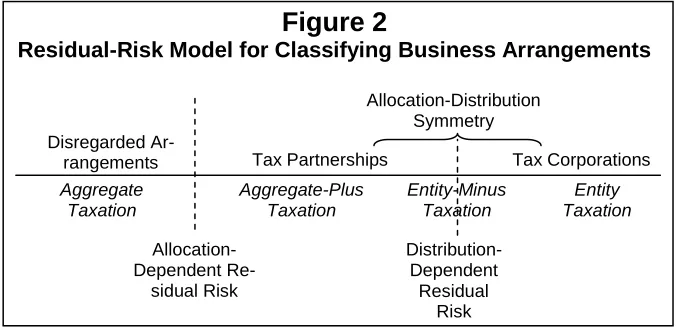
Section IV draws from the analysis of the different types of resi-dual risk and the matching tax regimes to create the resiresi-dual-risk model for classifying business arrangements. The residual-risk model adopts the nexus of contract view of business arrangements and moves away from legal forms and elective regimes. By focusing on the economic rights of business participants, the residual-risk model will help ensure that tax items follow economic items and help elimi-nate the private ordering of the incidence of taxation. Its reliance on economic principles helps reduce inaccuracies, inequity, and ineffi-ciency and helps the classification of business arrangements more closely mirror current economic theory.
II. CURRENT CLASSIFICATION MODEL
Tax law currently has three general tax regimes—aggregate taxa-tion, aggregate-plus taxataxa-tion, and entity taxation. The tax regimes are complex, but a few words describe each sufficiently to frame the discussion of how to classify business arrangements. Entity taxation recognizes entities separate from their members and imposes a tax at the entity level.23 Thus, arrangements subject to entity taxation
re-port income and pay an income tax.24 Entity taxation applies to tax
corporations. Aggregate taxation completely disregards a business arrangement and taxes each member of the arrangement separately on income from the arrangement’s property or services.25 Aggregate
taxation applies to disregarded arrangements. Aggregate-plus taxa-tion disregards arrangements to the extent possible, but it adds enti-ty tax components as needed to address the economic aspects and administrative needs of such arrangements.26 Arrangements subject
23. Under the current tax system, owners of tax corporations are subject to double taxation—tax at the entity level and tax on distributions. See I.R.C. § 11(a) (2006) (impos-ing a tax on corporations); I.R.C. § 301(c) (2006) (includ(impos-ing distributions and dividends in gross income). Entity taxation does not, however, require double taxation. See DEPT OF THE
TREASURY, REPORT OF THE DEPARTMENT OF THE TREASURY ON INTEGRATION OF THE
INDIVIDUAL AND CORPORATE TAXSYSTEMS: TAXINGBUSINESS INCOME ONCE (1992), availa-ble at http://www.ustreas.gov/offices/tax-policy/library/integration-paper/integration.pdf [hereinafter TREASURYREPORT]; Edward D. Kleinbard, Rehabilitating the Business Income Tax, 2007 TAXNOTESTODAY 114-42 (June 13, 2007) (recommending that corporate tax
system be modified to tax corporate income only once). This Article focuses on the policy reasons for entity tax and for the most part leaves the debate over double taxation for a dif-ferent venue. Nonetheless, to accurately place the incidence of taxation, the law may need to modify the rate structure of taxes on dividends or eliminate the tax.
24. See I.R.C. §11(a) (2006) (imposing a tax on corporations).
25. See, e.g., Hahn v. Comm’r, 22 T.C. 212, 214 (1954) (holding that members of a tenancy in common have income from the property equal to their ownership interests in the property).
26. See Bradley T. Borden, Aggregate-Plus Theory of Partnership Taxation, 43 GA. L. REV. (forthcoming 2009), available at http://ssrn.com/abstract_id=1121351 (describing the
to aggregate-plus taxation file information returns but do not pay tax.27 Instead, the members of such arrangements pay tax on their
al-locable share of the arrangement’s income.28 Aggregate-plus taxation
applies to tax partnerships. The current entity classification model also includes S corporations, which are qualified closely-held corpora-tions.29 Originally, such arrangements were subject to entity
taxa-tion, but Congress realized that S corporations should not pay an ent-ity tax because the entent-ity subjected closely-held corporations to a tax that did not apply to partnerships, which were generally closely held.30 Therefore, Congress removed certain components from entity
taxation to allow tax items to flow from the arrangement to the members, who pay taxes on such items.31 The removal of entity
com-ponents created entity-minus taxation.
Finally, the current classification model includes qualified tax partnerships. Qualified tax partnerships are arrangements that come within the definition of a tax partnership but elect out of partnership taxation.32 Such arrangements include investment partnerships and
joint-production partnerships.33 Even though qualified tax
partner-ships are not subject to partnership tax rules, other provisions of the tax law may recognize them as tax partnerships.34 Thus, they are not
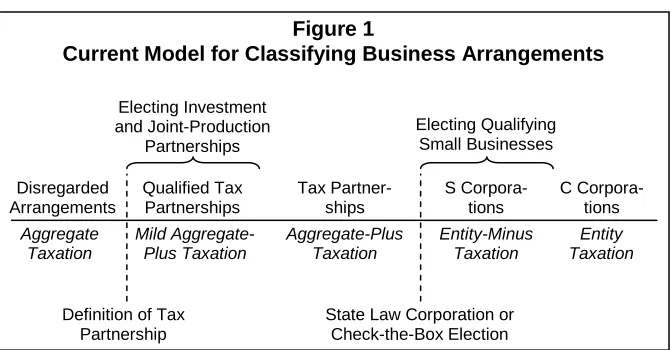
subject to pure aggregate taxation. Instead, they are subject to a mild form of aggregate-plus taxation. Figure 1 represents the current model for classifying business arrangements.35
27. See I.R.C. § 701 (2006) (providing that partnerships are not subject to tax); Treas. Reg. § 1.6031(a)-1(a) (as amended in 2005) (requiring partnerships to file returns). 28. See I.R.C. § 701 (2006) (providing that partners are liable in their individual ca-pacities for tax on income of a partnership).
29. See I.R.C. § 1361(a) (2006) (providing that an S corporation is an electing small business corporation); I.R.C. § 1361(b) (2006) (defining small business corporation to in-clude only closely held corporations).
30. See S. REP. NO. 85-1983, at 87 (1958) (providing that subchapter S benefits small corporations by removing the double tax).
31. See Jerald David August, Benefits and Burdens of Subchapter S in a Check-the-Box World, 4 FLA. TAXREV. 287, 322–30 (1999) (discussing the history of S corporations).
32. See generally I.R.C. § 761(a) (2006).
33. See I.R.C. § 761(a)(1) (2006) (providing an election for tax partnerships availed of for investment purposes); I.R.C. § 761(a)(2) (2006) (providing an election for certain tax partnerships availed of for joint production of services or property).
34. See Bryant v. Comm’r, 46 T.C. 848, 864 (1966) (“The partnership remains intact and other sections of the Code are applicable as if no exclusion existed.”).
35. A more complete model would also include arrangements such as real estate in-vestment trusts and foreign entities. For the sake of introducing the residual-risk model, this Article focuses only on those arrangements identified in Figure 1. Future work should consider the model that classifies other arrangements. See Bradley T. Borden, Policy and Theoretical Dimensions of Qualified Tax Partnerships, 56 U. KAN. L. REV. 317, 320 (2008)
Figure 1 depicts the current classification model as a continuum. Tax law moves from aggregate taxation by degrees to entity taxation. The arrangements move concurrently from disregarded to entity status. As Figure 1 depicts, the definition of tax partnership separates disregarded arrangements from tax partnerships. The line separating tax partner-ships from tax corporations (S corporations and C corporations36) is a
state law classification or a check-the-box election.37 Qualified tax
part-nerships and S corporations are subsets of tax partpart-nerships and tax cor-porations, respectively. The figure also depicts how the various tax re-gimes track the classification of business arrangements.
The following Section reveals the origin and evolution of the cur-rent model. The discussion demonstrates that tax law has lagged be-hind legal and economic theories and fails to match tax regimes with relevant economic and legal concepts of business arrangements.
A. Grant Theory and Corporate Resemblance
The origin and evolution of business arrangements sets the stage for discussing tax classifications. The natural form of business entity is the partnership, originating thousands of years ago.38 A typical
36. A C corporation is a tax entity subject to the entity tax provision in subchapter C of the Internal Revenue Code (Corporate Distributions and Adjustments). See 26 U.S.C. §§ 301-385 (2006).
37. The modern classification model actually includes within the definition of “tax corporation” other state-created and foreign entities. See Treas. Reg. § 301.7701-2(b) (as amended in 2008). To simplify the discussion, this Article uses “state law corporation” to refer to all of the arrangements listed in the definition.
38. See generally ABRAHAM L. UDOVITCH, PARTNERSHIP AND PROFIT IN MEDIEVAL
ISLAM (1970) (discussing medieval Islamic partnerships); Borden, supra note 26; Hans-mann et al., supra note 21, at 1356–61 (tracing partnerships to ancient Rome); Henry Fr. Lutz, Babylonian Partnerships, 4 J. ECON. & BUS. HIST. 555, 557–59 (1932) (tracing part-nerships to the first recorded private business enterprises in ancient Babylon during the Hammurabi period (2057 to 1758 B.C.)).
Disregarded Arrangements
C Corpora-tions Tax
Partner-ships Qualified Tax
Partnerships
S Corpora-tions
Aggregate Taxation
Mild Aggregate-Plus Taxation
Entity Taxation Entity-Minus
Taxation Aggregate-Plus
Taxation Figure 1
Current Model for Classifying Business Arrangements
Definition of Tax Partnership
State Law Corporation or Check-the-Box Election Electing Investment
and Joint-Production Partnerships
cient merchant partnership divided investment and management among the partners.39 Such arrangements were attractive because
investors, who exercised no control over the operations of the ar-rangement, were liable only to the extent of their invested capital.40
Managers, on the other hand, brought little if any capital to the ar-rangement but bore liability for losses incurred due to their mana-gerial shortcomings.41 Such arrangements usually lasted only a short
period—generally the duration of a single venture.42 The short
dura-tion and immediate settling of accounts provided liquidity for the in-vestor.43 The investor’s creditors could not disrupt the venture
be-cause the manager was often isolated from the creditors of the inves-tor, providing the arrangement with a weak form of entity shiel-ding.44 In a simple economy with relatively small ventures, such
un-sophisticated short-term arrangements were suitable. In other ar-rangements, the investors had the right to withdraw capital, recoup-ing their investments and any rightful returns on the investment.45
Such arrangements also provided liquidity to the investors.
The evolution of business made simple arrangements inadequate for large-scale ventures. The longer distances traveled meant that investors had to wait longer for ventures to complete prescribed ac-tivities. Frequent asset liquidations were cumbersome and ineffi-cient, and the right to withdraw would threaten the longevity and success of larger ventures.46 Financially and geographically larger
en-terprises needed greater sums of capital but also needed to provide investors with liquidity and limited liability.47 Tools that provided
limited liability, liquidity, and entity shielding in simpler arrange-ments in a simpler economy became insufficient. Without preferred features in place, the cost of capital would have become prohibitive. The law reacted to the economic needs of larger enterprises by
39. Hansmann et al., supra note 21, at 1360-61 (describing the Roman societas publi-canorum, which included investors who exercised control and those who lacked control), 1372–74 (describing the medieval Italian commenda, which “had two partners: a passive investor who provided capital, and a traveling trader (often the ship captain) who contri-buted labor and initiative”).
40. See Lutz, supra note 38, at 559. 41. See id.
42. See id. at 566.
43. See Hansmann et al., supra note 21, at 1376–77 (explaining that tradable interests were necessary for entities with perpetual existence to provide investors with liquidity). 44. See id. at 1368, 1372–73 (noting that the manager’s liability for shortfalls also dis-couraged distributions, providing another form of entity shielding). “[E]ntity shielding refers to rules that protect a firm’s assets from the personal creditors of its owners.” Id. at 1337. 45. See id. at 1388–91.
ing state-chartered, publicly traded joint stock companies as early as the fourteenth century.48
Joint stock companies granted investors the right to sell their in-terests in the company without the consent of other owners, satisfy-ing the investors’ need for liquidity.49 Investors in joint stock
compa-nies also enjoyed limited liability, and the law provided entity shiel-ding.50 Such features made the cost of capital affordable and
facili-tated the growth of private business enterprises. The state’s creation of early joint stock companies provided the company a monopoly to trade in a particular area, operate a particular asset, or perform some other specific function.51 The monopolies allowed businesses to
grow financially and geographically.
The monopolistic nature of joint stock companies carried over to early corporations chartered in the colonies and later in the United States.52 Through the early nineteenth century, states granted
corpo-rate monopolies for quasi-governmental functions, such as operating canals, building roads, and providing financial services.53 From the
grant of such monopolies emerged the “grant” or “concession” theory of corporations, which considered state law incorporation a grant or privilege for the pursuit of a public purpose.54 The grant theory
rec-ognized the corporation as an artificial being created by the state with powers strictly limited by its charter.55 Legislative bribery,
polit-ical favoritism, and monopoly eventually led to free incorporation, which made corporations universally available in the United States
48. Genoa appears to have created the first joint stock company as early as 1346. See
William Mitchell, Early Forms of Partnership, 3 SELECT ESSAYS IN ANGLO-AMERICAN
LEGALHIST. 183, 193 (1909). England, Holland, and France created joint stock companies in the seventeenth century. See id. at 193–94. Joint stock companies descended from char-tered trade gilds. See Samuel Williston, History of the Law of Business Corporations Before 1800, 2 HARV. L. REV. 105, 108–10 (1888).
49. See Hansmann et al., supra note 21, at 1376–77. 50. See id. at 1378.
51. See id.; Williston, supra note 48, at 111 (listing banks, trading companies, and mines as examples of early joint stock companies).
52. See Simeon Eben Baldwin, History of the Law of Private Corporations in the Colo-nies and States, 3 SELECTESSAYS IN ANGLO-AMERICAN LEGALHIST. 236, 243–55 (1909) (giving examples of early chartered corporations in the colonies and early United States and identifying early corporate statutes).
53. See Hansmann et al., supra note 21, at 1394 (“In the late eighteenth and early ni-neteenth centuries, state legislatures granted charters primarily to the same kinds of firms that Parliament had typically allowed to incorporate: those that built and ran canals, bridges, and turnpikes.”).
54. See Trs. of Dartmouth College v. Woodward, 17 U.S. 518, 637 (1819) (“They are deemed beneficial to the country; and this benefit constitutes the consideration, and, in most cases, the sole consideration of the grant.”); Morton J. Horwitz, Santa Clara Revi-sited: The Development of Corporate Theory, 88 W. VA. L. REV. 173, 181 (1985).
by the end of the eighteenth century.56 Such free incorporation
un-dermined the grant theory, and corporations became the preferred entity for large enterprises.57 Even though the rise of free
incorpora-tion weakened the grant theory, some commentators and law makers still considered incorporation a privilege into the twentieth century.58
The entity concept followed on the heels of the grant theory, and lawmakers and commentators developed a list of entity characteris-tics.59 Early twentieth century characteristics were: (1) free
transfera-bility of interests, (2) continuity of life, (3) limited liatransfera-bility, and (4) cen-tralized management.60 At the turn of the twentieth century,
partner-ships, in contrast to corporations, were not considered entities.61
In-stead, partnerships were considered aggregates of their members.62
The formalities of early corporate laws made the corporate form unavailable to smaller businesses.63 Thus, smaller businesses
gener-ally could not enjoy limited liability and strong entity shielding at the turn of the twentieth century.64 The use of partnerships and
corpora-tions during that period reveals an understanding that large busi-nesses (operated as corporations) needed entity shielding and limited liability to raise sufficient capital. The more intimate nature of a small business did not mandate those protections, so the partnership form sufficed for smaller arrangements.
In that environment, Congress enacted the Corporate Excise Tax of 1909, imposing a tax on the privilege of conducting business in corporate form.65 The limited scope of that act (it applied to
corpora-tions and joint stock companies or associacorpora-tions66) gave tax entity
56. See id. Free incorporation did not immediately eliminate monopolistic corporate grants, which existed through the early nineteenth century. See supra note 53.
57. See Horwitz, supra note 54, at 181.
58. See, e.g., Flint v. Stone Tracy Co., 220 U.S. 107, 141, 151–52 (1911) (recognizing that the corporate excise tax was a tax on the privilege of doing business in corporate or quasi-corporate form).
59. See Marjorie E. Kornhauser, Corporate Regulation and the Origins of the Corpo-rate Income Tax, 66 IND. L. J. 53, 58–59 (1990).
60. Id. at 61.
61. See Horwitz, supra note 54, at 182.
62. See UNIF. P’SHIPACT, Prefatory Note (1914), 6 U.L.A. 276 (2001). 63. See Hansmann et al., supra note 21, at 1395.
64. See id. at 1394–95; see also Kornhauser, supra note 59, at 55 (noting that the turn of the century also witnessed a transformation of capitalism from a system of owner-managed firms to large nonowner-owner-managed corporations); Richard Winchester, Corpora-tions That Weren’t: The Taxation of Firm Profits in Historical Perspective, 19 S. CAL.
INTERDISC. L.J. (forthcoming 2010) (describing particular aspects of the corporate tax in its earliest years in the United States).
65. See Revenue Act of 1909, ch. 6, § 38, 36 Stat. 11, 112 (requiring that a business “shall be subject to pay annually a special excise tax with respect to the carrying on or doing business by such corporation”) (emphasis added).
classification its modern significance.67 As interpreted by the
Su-preme Court, the corporate excise tax applied only to corporations and statutory joint stock companies organized under state law.68 That
original model for classifying tax entities was formalistic, depending on the manner in which the arrangement was formed.
The excise tax on corporations reflected the grant theory’s focus on the corporate privilege.69 The Supreme Court’s narrow reading of the
Act’s scope also reflects that view,70 even though substantive law’s
understanding of corporations had adopted the entity view several years earlier. This demonstrates that modern tax law’s original enti-ty classification model lagged behind the legal understanding of cor-porations. To the Supreme Court’s credit, however, an excise tax on the corporate privilege does have some policy appeal. Because the state grants the corporate privilege and provides a setting for corpo-rations to flourish, a tax on such privilege seems reasonable.71 With
that justification, the tax should only apply to state-law corporations, so the Supreme Court’s ruling was consistent with the policy justifi-cation for the tax.
Congress enacted the corporate excise tax out of concern that the Supreme Court might declare an income tax unconstitutional or be forced to overturn its earlier decision.72 The corporate excise tax was
also a stopgap to appease income tax proponents while lawmakers worked to amend the Constitution to grant Congress the power to tax income.73 Following the ratification of the Sixteenth Amendment in
1913, which gave Congress the power to tax income “from whatever
applied the statute to corporations, joint stock companies, and associations. See Treas. Reg. 31, T.D. 1571, 12 Treas. Dec. Int. Rev. 131 (1909). The Supreme Court appeared to agree that associations, as long as they were organized under state law, could be an independent con-cept. See Flint v. Stone Tracy Co., 220 U.S. 107, 141, 151–52 (1911) (identifying the tax as on the privilege of doing business in corporate or quasi-corporate form).
67. The first U.S. tax law to distinguish between corporations and other entities was the Revenue Act of 1894, which imposed an entity level income tax on corporations but not on partnerships. See Revenue Act of 1894, ch. 349, § 32, 28 Stat. 509, 556. The Supreme Court declared the act unconstitutional within a year of its enactment. See generally Pol-lock v. Farmers’ Loan & Trust Co., 157 U.S. 429, 586 (1895), modified by 158 U.S. 601 (1895). For a comprehensive review of the definition of “tax corporation up” to 1995, see generally Patrick E. Hobbs, Entity Classification: The One Hundred-Year Debate, 44 CATH. U. L. REV. 437 (1995).
68. See Eliot v. Freeman, 220 U.S. 178, 185–87 (1911) (placing emphasis on whether an entity is organized under a state’s statute).
69. See source cited supra note 65.
70. See Eliot, 220 U.S. at 185–87 (emphasizing organization under state law). 71. See Kornhauser, supra note 59, at 100 (quoting President Taft as supporting the tax on the “ ‘privilege of doing business as an artificial entity’ ”).
72. See Hobbs, supra note 67, at 454–55.
73. Kornhauser, supra note 59, at 93. Although commentators and lawmakers de-bated whether Pollock truly prevented the enactment of an income tax, enough doubt ex-isted to warrant the amendment to the Constitution in 1913. See ERIKM. JENSEN, THE
source derived, without apportionment,”74 Congress enacted a
corpo-rate income tax.75 That act specifically provided that partnerships
were not subject to income tax, but partners would pay tax on their respective shares of partnership income.76 The corporate income tax
applied only to “corporation[s], joint-stock compan[ies], or associa-tion[s] . . . no matter how created or organized . . . .”77 This language
eliminated the requirement that tax corporations be organized under a state statute and elevated legal substance over legal form. Some doubt lingered, however, about whether the definition included asso-ciations. Subsequent legislation clarified that the corporate tax ap-plied to associations.78 That modification required Treasury and
courts to define association.
Early on, Treasury adopted regulations defining associations to include certain state-law partnerships and business trusts.79 Later,
Treasury clarified the definition with regulations that listed entity characteristics: (1) profit-seeking activity, (2) continuity of existence, (3) centralization of management, (4) ability to hold property, (5) abil-ity to sue and be sued, and (6) limited liabilabil-ity.80 Shortly thereafter,
in 1935, the Supreme Court used the entity characteristics to hold that a trust resembling a corporation was a tax corporation.81 The
Court’s use of the entity characteristics became known as the corpo-rate resemblance test.82 Thus, more than thirty years after
substan-tive law adopted an entity view of corporations, tax law incorporated that view into its classification model.
74. U.S. CONST. amend. XVI.
75. See Revenue Act of 1913, ch. 16, § II.G.(a), 38 Stat. 114, 172. 76. Revenue Act of 1913, ch. 16, § II.D., 38 Stat. 114, 169.
77. Revenue Act of 1913, ch. 16, § II.G.(a), 38 Stat. 114, 172. That statute was not with-out its problems, however, respecting the definition of taxable entities. See Hobbs, supra note 67, at 463–66 (explaining that the statute left unresolved whether the phrase “however created or organized” applied to each of the listed terms or only to insurance companies). 78. See Revenue Act of 1918, ch. 18, § 1, 40 Stat. 1057, 1058 (defining tax corporation to include “associations, joint-stock companies, and insurance companies”).
79. The regulations provided that a trust would be an association for tax purposes if it engaged in business and the beneficiaries controlled the trustees’ activities. See Treas. Reg. 45, art. 1504, T.D. 3146, 23 Treas. Dec. Int. Rev. 591 (1921). Under the regulations, a part-nership was an association for tax purposes if its interests were freely transferable and some of the members were passive investors. See Treas. Reg. 45, art. 1503, T.D. 3146, 23 Treas. Dec. Int. Rev. 591–92 (1921). A limited partnership was an association for tax pur-poses if the partnership provided limited liability, freely transferable interests, and the right to sue in the name of the partnership. Treas. Reg. 45, art. 1506, T.D. 3146, 23 Treas. Dec. Int. Rev. 592 (1921).
80. Hobbs, supra note 67, at 476; see Treas. Reg. 86, art. 801-3 (1934) (describing cha-racteristics that cause a trust to be a tax corporation).
81. See Morrissey v. Comm’r, 296 U.S. 344, 359-60 (1935) (finding that the trust held title to property, had centralized management, continuity of existence, provided owners li-mited liability, and carried on a real estate development business).
The classification model’s use of the entity characteristics is a mystery from a tax policy perspective. The statute required a division between arrangements subject to the corporate tax and arrange-ments not subject to the corporate tax. An accurate division would require a clear policy position for entity taxation. Such a position was nonexistent.83 The lack of clear policy reasons for the corporate
in-come tax indicates that the courts and Treasury adopted the corpo-rate resemblance test merely to clarify ambiguous terms. The charac-teristics themselves did not define parties’ economic interests, but the law did not adequately express the economic interests the corpo-rate tax should cover.
In 1954, the corporate resemblance test cost the IRS a challenge of a taxpayer’s corporate classification.84 Treasury followed that defeat
by amending its regulations to include the characteristics and estab-lish that each characteristic has equal weight. Additionally, Treasury regulations were amended to provide that an arrangement must pos-sess more than half the characteristics to be a tax corporation.85 The
new regulations became known as the Kintner Regulations, taking the name of the case the IRS lost.86 The Kintner Regulations ended
any connection between the substantive law understanding of entity classification and tax law’s classification model. Substantive law rec-ognized entity characteristics but did not have a bright-line scorecard for classifying arrangements. Recall from above that the substantive law developed legal forms with entity characteristics to meet the de-mands of economic activity.87 Owners of capital and labor needed
ent-ity shielding, limited liabilent-ity, perpetual business forms, centralized management, and investor liquidity to successfully and efficiently conduct business in the expanding economy.88 Such characteristics
are attractive to members of smaller business arrangements and, as corporations became accessible to all forms of business, more small businesses incorporated.89 The business and economic needs for such
characteristics explain their existence, but the characteristics do not justify a model for classifying tax entities. Such characteristics may not affect the economic rights of the parties.
83. See infra text accompanying notes 90–96.
84. See United States v. Kintner, 216 F.2d 418, 420 (9th Cir. 1954) (holding that an unincorporated association to practice medicine and “endowed with the ‘attributes of a cor-poration’ ” by the members was a tax corporation).
85. See Treas. Reg. § 301.7701-2(a)(2), -2(a)(3) (1961) (listing the following slightly dif-ferent characteristics: (1) associates, (2) an objective to carry on business and divide the gains therefrom, (3) continuity of life, (4) centralization of management, (5) liability for corporate debts limited to corporate property, and (6) free transferability of interests). 86. Hobbs, supra note 67, at 485.
The Kintner Regulations’ lack of support may stem from the gen-eral lack of policy support for corporate income tax. None of the rea-sons espoused for enacting a corporate tax provide a satisfactory jus-tification for entity taxation and its boundaries.90 An examination of
just one convincing explanation reveals the general lack of tax policy justifications in this area. One explanation for the early corporate income tax is that Congress used it to obtain information from corporations that had grown significantly but remained unregu-lated.91 That explanation may very well describe the motivation for
the early corporate tax provisions, but subsequent securities regula-tion would have made the raregula-tionale obsolete.92 Furthermore, the
ra-tionale does not reflect sound tax policy. The use of tax law to regu-late business disguises Congress’s exercise of police power and di-verts the taxing authority from its primary purpose of raising reve-nue equitably and efficiently.
Over the decades, tax law has taxed corporate distributions at va-rying rates, which generally imposed a double tax on corporate in-come.93 Commentators have bemoaned the double tax and called for
its repeal;94 and proponents have generally been unable to offer a
sa-tisfactory policy explanation for its existence. One explanation is the lock-in theory, which provides generally that management prefers the tax on corporate distributions because it creates a disincentive for
90. For an in-depth critique of the various theories, see generally Field, supra note 14. One commentator argues in favor of the corporate income tax based largely on a variety of factors, including its progressive venture, ability to raise revenues efficiently, ability to prevent unlimited deferral, political acceptance, entrenchment in our current system, and the significant costs that would result from its repeal. SeeKim Brooks, Learning to Live with an Imperfect Tax: A Defence of the Corporate Tax, 36 U. BRIT. COLUM. L. REV. 621, 630–54 (2003). Those arguments, although compelling in the existing environment, do not support the original enactment of the corporate income tax. Other commentators have be-grudgingly agreed that antideferral justifies entity taxation. See,e.g., J. Clifton Fleming, Jr. & Robert J. Peroni, Reinvigorating Tax Expenditure Analysis and Its International Di-mension, 27 VA. TAXREV. 437, 503–06 (2008) (suggesting that the entity tax is a “crude, second-best anti-deferral device”).
91. See Kornhauser, supra note 59, at 113–33.
92. See Securities Act of 1933 § 5(a), 15 U.S.C. § 77e(a) (2006) (requiring registration of securities); Securities Act of 1933 § 7, 15 U.S.C. § 77g (2006) (describing the information required in a registration statement).
93. See generally Winchester, supra note 64.
94. See, e.g., TREASURYREPORTsupra note 23, at 1–12 (identifying the distortive nature
of a double-tax regime); Fred W. Peel, A Proposal for Eliminating Double Taxation of Corpo-rate Dividends, 39 TAXLAW. 1, 2–5 (1985) (recounting the objections to double taxation); Ka-therine Pratt, The Debt-Equity Distinction in a Second-Best World, 53 VAND. L. REV. 1055,
1098–1103 (2000) (recounting the equity and efficiency arguments against the corporate tax); George K. Yin, Corporate Tax Integration and the Search for the Pragmatic Ideal, 47 TAXL.
the owners to demand distributions.95 Although the lock-in theory
may explain the continued existence of the tax on dividends from a public choice perspective, it does not support a satisfactory tax policy argument. Management’s business preferences should not dictate the direction of tax law. Finally, the entity characteristics that make lock-in possible, in particular entity shielding, are available to many arrangements that are not taxed as corporations.96
With no satisfactory reason for the corporate tax and second tax on distributions, current corporate tax appears to be a product of tradition, surviving from the original 1909 act, and an extra source of revenue.97 Tax law appears to have merely adopted the substantive
law concept of entity and the entity characteristics to define tax corporation. With no policy direction supporting such adoption, how-ever, the law eventually became formalistic, abandoning any notion of policy support.
B. Elective Model and Private Ordering of Tax Liability
Despite their significant shortcomings, the Kintner Regulations became entrenched in the law. Tax planners began to obtain the clas-sification that provided business owners the most favorable tax treatment.98 Using the Kintner Regulations and skilled document
drafting, lawyers could create either a tax partnership or tax corpo-ration according to their clients’ tax preferences.99 Creating entity
characteristics through contract can, however, be cumbersome and add to the cost of business formation. To make characteristics more accessible to noncorporations, business people began lobbying state legislatures to create hybrid entities that would provide desired cha-racteristics but grant leeway to avoid some entity chacha-racteristics.100
The Wyoming legislature responded to those efforts, creating the first
95. See generally Jennifer Arlen & Deborah M. Weiss, A Political Theory of Corporate Taxation, 105 YALEL. J. 325, 359–62 (1995) (arguing that managers often do not support
the double tax, but they may if their interests diverge from shareholders and if they prefer retaining earnings within the corporation); Steven A. Bank, A Capital Lock-In Theory of the Corporate Income Tax, 94 GEO. L.J. 889 (2006) (presenting historical evidence that the corporate income tax and tax on distributions is intended to discourage capital distribu-tions from corporadistribu-tions).
96. See UNIF. P’SHIPACT §§ 502, 504 (1997), 6 U.L.A. 156, 156, 160 (2001) (limiting a
creditor’s claim from a partner’s judgment to that partner’s transferable interest in the partnership). But see UNIF. P’SHIP ACT § 801(1) (1997) (providing that the withdrawal of a partner in an at-will partnership will dissolve the partnership, eliminating the lock-in ef-fect). The limited use of at-will partnerships suggests that the lock-in effect is fairly preva-lent in businesses.
97. See generally Brooks, supra note 90, at 647–51. 98. See Field, supra note 14, at 75.
99. See Victor E. Fleischer, Note, “If it Looks Like a Duck”: Corporate Resemblance and Check-the-Box Elective Tax Classification, 96 COLUM. L. REV. 518, 527 (1996).
limited liability company in 1977.101 Limited liability companies
pro-vide their members limited liability and sufficient drafting flexibility so they can avoid unwanted entity characteristics and tax corpora-tion classificacorpora-tion. After Wyoming created the limited liability com-pany, the IRS blessed the classification of a properly structured li-mited liability company as a tax partnership.102 A subsequent 1988
ruling ignited an explosive growth of limited liability company acts.103
The spread of limited liability company popularity was the result of economic needs converging with tax wants. Business arrange-ments of all sizes needed some of the entity characteristics, but they also wanted the greatest possible flexibility in managing their tax af-fairs. State limited liability company acts and the 1988 IRS ruling al-lowed those two preferences to merge. Although an attractive combi-nation to business owners, the merger of economic needs and tax wants neglects tax policy.
By ruling that limited liability companies could be tax partner-ships, the IRS created a de facto elective regime for classifying tax entities. Such a classification model has serious policy deficiencies. First, an elective regime taxes similarly situated taxpayers different-ly. For example, two entities could possess all of the same corporate characteristics other than continuity of life and free transferability of interests (which are arguably immaterial from a tax policy perspec-tive), and tax law could treat them differently.104 Second, the elective
regime created administrative complexity as taxpayers had to spend more resources to obtain the desired tax treatment, and the IRS had to spend more resources to consider tax entity classification.105 Such
treatment favors the well-advised taxpayers and places a larger tax burden on the unrepresented taxpayer.106 Third, the de facto election
allows business owners to privately affect the placement of the inci-dence of taxation by modifying legal documents. As a result, the re-gime is not efficient.
Even though inequity and inefficiency are legitimate policy con-cerns, the regime itself focused on the significantly less substantial
101. See Wyoming Limited Liability Company Act, ch. 158, 1977 Wyo. Sess. Laws 537. 102. See I.R.S. Priv. Ltr. Rul. 81-06-082 (Nov. 18, 1980) (ruling that a limited liability company lacking continuity of life and free transferability of interests was a tax partnership). 103. Rev. Rul. 88-76, 1988-2 C.B. 360 (ruling that a Wyoming limited liability company could be a tax partnership); Susan Pace Hamill, The Limited Liability Company: A Cata-lyst Exposing the Corporate Integration Question, 95 MICH. L. REV. 393, 403–04 (1996) (identifying that all fifty states had limited liability company statutes by 1996).
104. See I.R.S. Priv. Ltr. Rul. 81-06-082 (Nov. 18, 1980).
105. See Dean, supra note 14, at 453–55 (describing the complexity that arises when the choice of entity classification intersects with other provisions of a complex income tax structure and distinguishes between well-advised taxpayers and others).
concern of administrative complexity. Commentators began advocat-ing a de jure elective model that would replace the de facto elective model in the Kintner Regulations.107 The rationale appeared to be
fairly straight forward: the current system was elective and complex, so a simple elective regime would be better.108 The promulgation of
the check-the-box regulations is evidence that Treasury embraced the simplicity argument.109 The check-the-box regulations provide that all
entities incorporated under state law are tax corporations, and all other multiple-member business entities are tax partnerships by de-fault.110 Tax partnerships and single-member business entities may,
however, elect to be tax corporations111—thus the appellation,
“check-the-box regulations.”
The check-the-box regulations simplified the elective classification model but exacerbated inequity and inefficiency.112 Under the
check-the-box regulations, tax law may treat two identical legal entities dif-ferently. For example, an electing partnership is a tax corporation while a non-electing partnership is a tax partnership, even though they are legally and economically identical. Tax policy does not sup-port sacrificing equity for simplicity, and commentators now criticize the elective classification model because it adds complexity to the tax system.113 Thus, the regulations arguably have no policy support.
107. See Field, supra note 14, at 27-29.
108. See Susan Pace Hamill, The Taxation of Domestic Limited Liability Companies and Limited Partnerships: A Case for Eliminating the Partnership Classification Regula-tions, 73 WASH. U. L.Q. 565, 600 (1995) (suggesting the check-the-box election would simpl-ify the classification process and recognizing that “the well advised have always been able to avoid the corporate tax by forming as a partnership or LLC that complies with the clas-sification regulations or a corporation that pays out its earnings in deductible items or elects Subchapter S”).
109. See Preamble to the Simplification of Entity Classification Rules, 61 Fed. Reg. 21,989 (1996) (proposed May 13, 1996) (“Treasury and the IRS believe that it is appropriate to replace the increasingly formalistic rules under the [Kintner Regulations] with a much simpler approach that generally is elective.”). Commentators and practitioners generally hailed the promulgations of the check-the-box regulations as a good thing. See, e.g., Michael L. Schler, Initial Thoughts on the Proposed ‘Check-the-Box’ Regulations, 71 TAXNOTES 1679, 1681 (June 17, 1996) (suggesting that the regulations were good because they made the tion easier for sophisticated taxpayers, enabled less-sophisticated taxpayers to make the elec-tion, and eliminated arbitrary rules). But see Aaron W. Brooks, Chuck the Box: Proposed Ent-ity Classification Regulations Bring Bad Policy, 70 TAXNOTES 1669, 1674–76 (Mar. 18, 1996) (arguing that the check-the-box regulations would produce inequities).
110. See Treas. Reg. § 301.7701-3(a) (as amended in 2006). “Business entity” is a term used in the check-the-box regulations to refer to any arrangement recognized as separate from its members. See Treas. Reg. § 301.7701-2(a) (as amended in 2007).
111. See Treas. Reg. § 301.7701-3(a) (as amended in 2006).
The continuing evolution of legal entities provides business own-ers significant leeway to privately order their tax affairs. From the relative statutory rigidity of the corporation to the almost unre-stricted flexibility of statutory business trusts and general partner-ships, business owners are able to choose the legal characteristics their entities will take.114 The check-the-box regulations allow
busi-ness owners to choose from an array of tax alternatives, regardless of business owners’ economic arrangements.115 Now, arrangements of
all sizes possess entity characteristics and can choose their favored tax classification.116 Tax law has, therefore, by and large turned
enti-ty classification over to business owners.117 The current entity
classi-fication model prioritizes simplicity above economic reality.
C. Tax Partnership Versus Disregarded Arrangement
An often overlooked classification issue is the difference between tax partnerships and disregarded arrangements, which include em-ployment, financing, leasing, and co-ownership arrangements.118
Business arrangements that are not tax corporations should general-ly be tax partnerships or disregarded arrangements.119 Unlike the
bright-line test that distinguishes tax partnerships from tax corpora-tions, the undeveloped and confusing definition of tax partnership distinguishes tax partnerships from disregarded arrangements.120 An
114. See Hansmann et al., supra note 21, at 1396–97 (describing the evolution of the law of business entities as a result of the tax entity classification rules and the most recent emergence of the statutory business trust, which grants entity shielding and limited liabil-ity but otherwise leaves the contractual arrangement to the owners).
115. Commentators have also criticized the check-the-box regulations for their short-comings with respect to non-U.S. entities. See, e.g., Joint Committee on Taxation, Options to Improve Tax Compliance and Reform Tax Expenditures, JCS-02-05 at 182–85 (Jan. 27, 2005); American Bar Association, Report of the Task Force on International Tax Reform, 59 TAXLAW. 649, 668-69 (2006). Tax entity classification requires significant attention. Un-fortunately, the length of this Article does not permit a consideration of the entity classifi-cation rules that apply to foreign entities.
116. See Treas. Reg. § 301.7701-3(a) (as amended in 2006) (providing an elective classifi-cation regime); Hansmann, et al., supra note 21, at 1394–99 (explaining that business partic-ipants have a significant variety of legal forms to choose from when forming an entity). 117. The only exception is for certain publicly traded arrangements, which the law treats as tax corporations. I.R.C. § 7704(a) (2006).
118. See Bradley T. Borden, The Federal Definition of Tax Partnership, 43 HOUS. L. REV. 925, 936–41 (2006).
119. Business arrangements also include real estate investment trusts and other types of tax arrangements. However, this Article confines its consideration to tax corporations, tax part-nerships, and disregarded arrangements, leaving other arrangements for future consideration. 120. See WILLIAMS. MCKEE, WILLIAMF. NELSON& ROBERTL. WHITMIRE, FEDERAL
TAXATION OF PARTNERSHIPS AND PARTNERS, ¶ 3.01 (3d ed. 2004) (“The most basic, and