Federal Communications Law
Federal Communications Law
Journal
Journal
Volume 63 Issue 2 Article 3
3-2011
The End-to-End Argument and Application Design: The Role of
The End-to-End Argument and Application Design: The Role of
Trust
Trust
David D. Clark
MIT Computer Science and Artificial Intelligence Laboratory
Marjory S. Blumenthal
Georgetown University
Follow this and additional works at: https://www.repository.law.indiana.edu/fclj
Part of the Communications Law Commons, Computer and Systems Architecture Commons, and the Internet Law Commons
Recommended Citation Recommended Citation
Clark, David D. and Blumenthal, Marjory S. (2011) "The End-to-End Argument and Application Design: The Role of Trust," Federal Communications Law Journal: Vol. 63 : Iss. 2 , Article 3.
Available at: https://www.repository.law.indiana.edu/fclj/vol63/iss2/3
The End-to-End Argument and
Application Design: The Role of Trust
David D. Clark*
Marjory S. Blumenthal**
I. INTRODUCTION ... ... 358
A. What Is an End Point? ... 359
II. RELIABILITY AND FUNCTION PLACEMENT ... ... 361
A. Application-Specific Semantics... ... 365
III. THE CENTRALITY OF TRUST.. ... 365
A. Multiple Stakeholders ... 366
David Clark is a senior research scientist at the MIT Computer Science and Artificial Intelligence Laboratory, where he has worked since receiving his Ph.D. there in
1973. Since the mid 70s, Dr. Clark has been leading the development of the Internet; from 1981-1989 he acted as Chief Protocol Architect in this development and chaired the Internet
Activities Board. His current research looks at redefinition of the architectural underpinnings of the Internet and the relation of technology and architecture to economic, societal, and policy considerations. Dr. Clark is past chairman of the Computer Science and Telecommunications Board of the National Academies, and he has contributed to a number of studies on the societal and policy impact of computer communications. Support for Dr. Clark's effort on this research was provided by the U.S. Office of Naval Research grant number N000 14-08-1-0898.
. Marjory S. Blumenthal is associate provost, Academic at Georgetown University.
Between July 1987 and August 2003, she served as founding Executive Director of the National Academies Computer Science and Telecommunications Board (CSTB; http://cstb.org). She is a member of the Advisory Board of the Pew Internet & American Life Project and the Center for Strategic and International Studies Commission on Cybersecurity; she is a fellow of the National Academy of Public Administration; she chairs the External Advisory Board of the Center for Embedded Networked Sensing at UCLA; and she is a RAND adjunct and an Office of Naval Research grantee. This work was supported
by a grant from the U.S. Office of Naval Research grant number N00014-09-1-0037.
FEDERAL COMMUNICATIONS LAW JOURNAL
B. "Good Guys" and "Bad Guys ... ... 369
IV. THE NEW END-TO-END ... ... 370
A. Trust Options for the Individual End Node... 371
B. Delegation ofFunction ... ... 373
C. Mandatory Delegation... 373
D. When End Users Do Not Trust Each Other... 375
V. THE ULTIMATE INSULT
...
... 379A. Can We Take Back the End Node? ... ... 379
VI. DESIGN FOR DELEGATION ... ... 380
VII. REINTERPRETING THE END-TO-END ARGUMENT .... ... 383
VIII. CONCLUSIONS... 388 I. INTRODUCTION
Applications are the raison d 'tre of the Internet. Without e-mail, the Web, social media, VoIP and so on, the Internet would be (literally) useless. This fact suggests that the structure of applications, as well as the structure of the Internet itself, should be a subject of study, both to technologists and those who are concerned with the embedding of the Internet in its larger context. However, the Internet, as the platform, may have received more attention and analysis than the applications that run on it.
The original end-to-end argument' was put forward in the early 1980s as a central design principle of the Internet, and it has remained relevant and powerful as a design principle, even as the Internet has evolved.2 However, as we will argue, it does not directly speak to the design of applications. The original end-to-end paper poses its argument in the context of a system with two parts, the communications subsystem and "the rest."3 That paper says: "In a system that includes communications, one usually draws a modular boundary around the communication subsystem and defines a firm interface between it and the rest of the system.' Speaking generally, what the end-to-end argument asserts is that application-specific functions should be moved up out of the communications subsystem and into "the rest" of the system. But the argument, as stated, does not offer advice about how "the rest" should be structured. That paper equates the "rest of the system" with the application, and the application with the end points. It says: "The function in question
1. J.H. Saltzer, D.P. Reed & D.D. Clark, End-to-End Arguments in System Design, 2 ACM TRANSACTIONS ON COMPUTER Sys. 277 (1984).
2. This may reflect path dependence-the Internet remains young enough that it should not be surprising to see a common set of underlying uses persist.
3. Saltzer et al., supra note 1, at 278. 4. Id.
[Vol. 63
THE END-TO-END ARGUMENT
can completely and correctly be implemented only with the knowledge and help of the application standing at the end points of the communication system. Therefore, providing that questioned function as a feature of the communication system itself is not possible."'
Applications and services on the Internet today do not just reside at the "end points"; they have become more complex, with intermediate servers and services provided by third parties interposed between the communicating end points. Some applications such as e-mail have exploited intermediate servers from their first design. E-mail is not delivered in one transfer from original sender to ultimate receiver. It is sent first to a server associated with the sender, then to a server associated with the receiver, and then finally to the receiver. By one interpretation, all of these intermediate agents seem totally at odds with the idea that function should be moved out of the network and off to the end points. In fact, the end-to-end argument, as described in the original paper, admits there are interpretations that are diametrically opposed. When we consider applications that are constructed using intermediate servers, we can view these servers in two ways. An Internet purist might say that the "communications subsystem" of the Internet is the set of connected routers; servers are not routers, but are connected to routers; as such, servers are outside the "communications subsystem." This reasoning is compatible with the end-to-end argument of placing servers anywhere in "the rest" of the system. On the other hand, these servers do not seem like "ends," and thus they seem to violate the idea of moving functions to the ends. These issues are prominent today, thanks to the emergence of cloud computing-which involves specific sorts of servers-and the tendency of some popular discourse to treat "the cloud" as a new incarnation of the Internet itself.6
The original end-to-end paper, because it uses a simple two-part model of the communications subsystem and "the rest," does not directly speak to the situation where "the rest" has structure. The purpose of this Article is to offer an interpretation of the end-to-end argument, drawing on the original motivation and reasoning, that is applicable to today's application design and today's more complex world of services and service providers.
A.
What Is an End Point?
Part of the definitional problem, of course, is to define the end point.
5. Id. (emphasis omitted).
6. See, e.g., Phil Dotree, Cloud Computing: The Most Important Technology of 2010, ASSOCIATED CONTENT FROM YAHOO! (Jan. 13, 2010), http://www.associatedcontent.com/article/2585171/cloudcomputingthe most-important.h
tml.
FEDERAL COMMUNICATIONS LAW JOURNAL
There is an intuitive model that is often adequate: if computer A is sending
a file to computer B (to use the example of "careful file transfer" from the
original paper
7), then A and B are end points. However, they are end points
in two ways that are subtly different. In the original example, the end points
are the literal source and destination of the data being sent across the
communications subsystem. They are also the end points in that they are
the prime movers in the activity-they are directly associated with the
principals that actually wanted to accomplish the action. Intermediate
nodes, whether at the packet level or application service level, seem to play
a supporting role, but they are not the instigators of the action, or the nodes
that wanted to see it accomplished.
The original paper provides a hint as to the importance of this
distinction. Using a telephone call as an example, it points out that the
ultimate end points are not the computers, but the humans they serve.
8As
an illustration of human-level end-to-end error recovery, one person might
say to another: "[E]xcuse me, someone dropped a glass. Would you please
say that again?"
9The humans are the prime movers in the activity, the
ultimate end points. The computers are just their agents in carrying out this
objective.
In the case of a phone call, the humans and the computers are
colocated. It makes no sense to talk about making a phone call unless the
person is next to the phone. So one can gloss over the question of where the
human principal is. But in the case of careful file transfer, the location of
the person or persons instigating the action and the location of the
computer end points may have nothing to do with each other. As an
example, there might be one person, in (say) St. Louis, trying to do a
careful file transfer from a computer in San Francisco to a computer in
Boston. Now, what and where are the end points?
The person in St. Louis might undertake a careful file transfer in three
stages. First, she might instruct the computer in San Francisco to compute a
strong checksum of the file (i.e., a measure of the bits it contains) and send
it to her in St. Louis. Then she might instruct the two computers to carry
out the transfer. Third, the person might instruct the computer in Boston to
compute the same strong checksum and send it to St. Louis, where she can
compare the two values to confirm that they are the same. In this case, the
computers in San Francisco and Boston are the end points of the transfer,
but they seem just to be agents (intermediaries) with respect to the person
in St. Louis. With respect to the instigation of the transfer, there seems to
be one principal (one end point) located in St. Louis.
7. Saltzer et al., supra note 1, at 278.
8. See id. at 284-85. 9. Id. at 285.
THE END-TO-END ARGUMENT
It might seem that this example serves to further confuse the story, rather than clarify it. But if we explore one step deeper, we can begin to find some clarity. The example above, building on the example in the original paper, referred to the overall activity as "careful file transfer." It is important to ask, why is that sequence of steps being careful? It is careful only in the context of an assumed failure mode-that is, loss or corruption of information during transfer. But why does the end user assume that the computation of the checksum will not fail? Why does the end user assume that the checksum returned by the computer is actually the checksum of the file, as opposed to some other value? Why does the end user assume that the file transferred today is the same as the file stored earlier? Why does the end user assume that the file will still be there at all? A prudent end user would be careful about these concerns as well. Perhaps the file was copied to Boston because the computer in San Francisco is crash prone or vulnerable to malicious attack. Perhaps this move was part of a larger pattern of "being careful." Perhaps, in a different part of the story, the end user in St. Louis has the computer in San Francisco compute the strong checksum on multiple days and compares them to see if they have changed.
All of these actions would represent "being careful" in the context of some
set of assumed failures.
But if there is no part of the system that is reliable, being careful is either extremely complex and costly, or essentially impossible. For example, the end user cannot protect against all forms of failure or malice using the comparison of strong checksums, because it may not be possible to detect if one of the computers deliberately corrupts the file but returns the checksum of the correct version. Ultimately, being careful has to involve building up a process out of component actions, some of which have to be trustworthy and trusted.
II. RELIABILITY AND
FUNCTION PLACEMENT
The example of careful file transfer in the original paper can help us to explore the relevance of the end-to-end argument to today's world. It points to the need to define what it means to be careful in a more general sense. Being careful implies making a considered and defensible judgment about which parts of the system are reliable and which parts are failure prone or open to malicious attack-being careful today implies a degree of risk management. Using careful design implies constructing a set of checks and recovery modes that can compensate for the unreliable parts. The end user in St. Louis, moving a file from San Francisco to Boston, presumably has decided to place some level of trust in those two computers. She has also designed the pattern of information movement and storage to make the overall outcome reliable, based on the assumed level of reliability and trust
FEDERAL COMMUNICATIONS LAW JOURNAL
of the component parts, including the computers and the communications subsystem that connect them. The trust assumptions are made by the end user (who is, at one level, the end point), and the computers are trusted agents that act on behalf of the end user.
Why does the above view of "being careful" motivate us, in the
context of the original end-to-end argument, to move functions out of the communications subsystem and into the end nodes? The original paper lists several reasons:
* In some respects, it is technically very hard to make a communications subsystem fully reliable. In a system with statistical sharing, for example, there is a probability of packet loss. Such imperfections are technical consequences of rational technical design.
* Adding mechanisms to the communications subsystem adds to its complexity, and complexity seems to make systems less reliable, as well as more costly.'0
* The communications system may not be fully trustworthy. The original paper recognizes this issue-it talks about the peril of having the communications subsystem do encryption on behalf of the end node: "[I]f the data transmission system performs encryption and decryption, it must be trusted to securely manage the required encryption keys.""
* The providers of the communications subsystem may not be motivated to provide service with the level of reliability the end user desires and can depend on.12
There is an explicit assumption in the original paper that the communications subsystem is unreliable.'3 This assumption is justified (both then and now) for the reasons listed above. But there is an implicit assumption that the end node is reliable and trustworthy. The example of "careful file transfer" in the original paper 4 assumes that the end node can compute a checksum reliably and perform other actions designed to compensate for the unreliability of the communications. It also assumes, implicitly, that the two ends trust each other. One end wants to send the file to the other, and the other wants to receive it. Presumably, the interests of
10. Technical advances and a more mature understanding of the system, as well as a
desire to add new features, have led to increasing complexity of the communications substrate of the Internet. It is an interesting question as to whether that has reduced the overall reliability of the Internet, but this Article does not focus on issues of this sort of complexity.
11. Saltzer et al., supra note 1, at 282 (emphasis added).
12. Id. at 287. 13. See generally id.
14. See id. at 278-82.
THE END-TO-END ARGUMENT
the two ends are aligned in this respect. But let us challenge these assumptions and see what happens.
What if the two ends do not trust each other? This situation is common today. People receive e-mail but worry that it is spam or contains a virus. They are willing to receive it (because it is worth the risk), but they do not trust the sender. Now what does it mean to be careful? This is a real-world situation, so we can see what the real-real-world answer is. People deploy spain filters, virus checkers, and so on. And where is that done? Sometimes it is done at the receiving end point of the mail transfer, and sometimes it is done "in the middle," at one of the mail relay points. Is this a violation of the end-to-end argument?
* As a practical matter, performing these functions at an intermediate point makes sense, because, assuming that the end user trusts the intermediary, it may be more reliable and more convenient.
* The operator of the end node (the end user) may not want to go to the effort of providing the service with the desired level of reliability.
* By performing the function at an intermediate point, the service may have access to more information; for example, a mail filter may be better able to detect spain if it can compare mail going to many recipients.
* By performing the function at an intermediate point, the end user can avoid the cost and overhead of at least temporarily storing and then transferring unwelcome traffic across the communications subsystem to the ultimate end point.
* The end node might have a vulnerability that would allow a virus to attack it before a virus checker on that machine could detect it. Doing the check at an intermediate point can protect the end node from a vulnerability the end user cannot rectify. * Pre-positioning information at an intermediate point can make
the subsequent delivery more responsive as well as more reliable. Replicated intermediate points can specifically improve reliability.
What we see is that function is migrating to the point where it can be done most reliably and efficiently. In some cases, this migration is "naturally" toward the ultimate end points (because of "natural" limits to the reliability of the communications subsystem), but in other cases function may migrate away from the end point to a service point somewhere else in the network.
When we look at the design of applications, we can see different approaches to structure based on different views of those functions that are
FEDERAL COMMUNICATIONS LAW JOURNAL
reliable and trustworthy and those that are not. Here are two examples. "Careless" mail transfer. E-mail, an early application for the Internet, has no end-to-end assurance of delivery or data integrity.15 The mail is sent via a series of servers, any of which might lose the mail. Yet there is no end-to-end confirmation. E-mail seems almost an "anti-careful" file transfer, in contrast to the first example of the original paper. What was the reasoning that made the original design for Internet e-mail come out that way? The original motivation for designing e-mail systems to use forwarding servers was that the sender and the receiver might not be connected to the Internet at the same time, and if the transfer had to be done in one step, it might never succeed. Using an intermediate server is an obvious solution. But for this approach to work with reasonable overall reliability, the servers that relay mail have to be built to a very high standard of availability, reliability, and trustworthy operation. And indeed, each stage of the mail transfer is expected to be "very careful." Given this level of attention to reliability of the intermediate nodes, no end-to-end confirmation was considered necessary. So the overall reliability is built out of a cascade of these steps, rather than an end-to-end confirmation. E-mail is not "careless"; it is just based on a different set of assumptions about which parts of the system are reliable.16
What happens if this assumption of reliable delivery is violated? Here is a story passed on by someone who spent two years as a volunteer in Africa, where she was forced to use an e-mail server that often crashed or otherwise lost mail.'7 The end users created a manual reliability mechanism, which was to put sequence numbers in the subject line of each piece of e-mail, and send human-to-human acknowledgements of the sequence numbers by return e-mail. In other words, they added an end-to-end confirmation to deal with the unreliable servers.'8
Content distribution. Today, much Web content is not delivered to the ultimate recipient directly from the Web server belonging to the original creator, but via a content delivery network (CDN)-a collection of
15. Later enhancements to Internet e-mail have provided the option of end-to-end
integrity and authenticity checks, often using digital signatures. See, e.g., Understanding
Digital Signatures, U.S. COMPUTER EMERGENCY READINESS TEAM, http://www.us-cert.gov/cas/tips/STO4-018.html (last visited Feb. 20, 2011). These checks are seldom used today, perhaps because they do not address delivery assurance, something for which tools are lacking. Return-receipt features are used sometimes, but can be ignored by recipients, thereby undermining their value.
16. The same logic can be seen in the recent development of delay- or
disruption-tolerant networking; different circumstances give rise to different assumptions about which parts of a system are reliable. See, e.g., Home, DELAY TOLERANT NETWORKING REs. GROUP,
http://www.dtnrg.org/wiki (last visited Feb. 20, 2011).
17. Interview with Libby Levison in Cambridge, Mass. (2001).
18. Id.
THE END-TO-END ARGUMENT
servers that cache the content and deliver it on demand. This, like e-mail, has no end-to-end confirmation of correct delivery. Is this design being careful? Is it trustworthy? Commercial CDNs such as Akamai9 depend on their reputation as a reliable and trustworthy provider. There are no features built into the web standards that assure that they are reliable; there is only the discipline of the competitive marketplace. If they were not reliable and trustworthy, they would go out of business. So they build highly reliable systems, the content creators trust them, and the result is a more efficient overall system.
A. Application-Specific Semantics
There is another aspect to the end-to-end argument, which is that different applications have different semantics-different definitions of what it means to be "reliable" or "correct." In the context of network data transfers, for example, some applications may define "correct" operation as perfect delivery of every byte as sent, while another application may define "correct" as delivery within some time limit, with as few errors and omissions as possible. Putting some mechanism to enhance reliability into the communications subsystem runs the risk of adding a mechanism that does not meet the needs of the application. However, when we look at the placement of application-level function inside "the rest," this argument has less relevance. Wherever application-level components are placed, they can be designed so that they are aware of the application-level semantics. This line of reasoning has been used to argue explicitly for the placement of application-aware components throughout the network, because these components can then be aware of both local conditions in the network and
20 application-level requirements.
III. THE CENTRALITY OF TRUST
The previous discussion has used the words "reliable" and "trustworthy" in loose equivalence. However, the distinction is very important. Reliability is a technical concept, and relates to the correct operation of a component or system under specific circumstances. The concept of trust is a broader concept. A component may not be trustworthy
19. See AKAMAI, http://www.akamai.com (last visited Feb. 20, 2011).
20. See, e.g., Samrat Bhattacharjee et al., Commentary, Commentaries on "Active Networking and End-to-End Arguments, " IEEE NETWORK, May/June 1998, at 66-67. Similar reasoning has also informed planning for the so-called Next Generation Networks
by the International Telecommunications Union, where desires by some to support priority
access and such applications as telephony have focused attention on in-network mechanisms. See, e.g., ITU-T Study Group 13 - Future Networks Including Mobile and NGN, INT'L TELECOMM. UNION, http://www.itu.int/ITU-T/studygroups/ coml3/questions.html (last visited Feb. 20, 2011).
FEDERAL COMMUNICATIONS LAW JOURNAL
even though it is technically reliable, because it is operated by an agent with interests and motivations that are not aligned with the end user-the principal who wants to undertake the action. Early experience with public cloud services, including social media, illustrate this concern.2
1 Trust or trustworthiness thus includes some of the issues associated with security, and security is recognized as something that can and often should be
addressed at multiple points in a system.2 2
A.
Multiple Stakeholders
Why would one agent or server be more trustworthy than another? In
many applications today, different parts of the application belong to different actors. An ISP may provide a mail server, a third party may provide a web cache or a component of what is displayed on a web page, or a peer system may provide a music-sharing server. The difference in the degree of trustworthiness relates to the motivation and roles of the different actors, and their external influences, which range from economic incentiveS23 to legal requirements or constraints.
In many cases, the interests of the different actors are nominally aligned, notwithstanding differences in status or role. End users want to send and receive mail, and ISPs attract customers by providing this service, so both the end user and the ISP want the same thing to happen. The ISP may not want to perform the function exactly as the end user would prefer, and this misalignment is either tolerated or corrected via economic means (competition to provide the service) or through the technical design of the protocol, which allows the trusted elements at each end to compensate for and recover from the failures of the other agents. Recent controversy over privacy on Facebook, a provider of social media services, reflects conflicting incentives facing service providers, who seek to attract and retain both users and advertisers (which want access to users).24
21. One of the Authors has been examining the potential for the cloud to be a platform
for malice from either providers or other users. See, e.g., Marjory S. Blumenthal, Is Security
Lost in the Clouds?, CONFERENCE ON COMMUNICATION, INFORMATION AND INTERNET POLICY
(2011), http://www.tprcweb.com/images/stories/2010%20papers/Blumenthal_
TPRC2010.pdf.
22. For example, two mutually trusting end nodes can use encryption to preserve integrity and prevent unwanted disclosure, but preventing attacks that flood the network or disrupt availability by harming network control mechanisms can only be accomplished inside the network.
23. See Jonathan Anderson & Frank Stajano, Not That Kind of Friend: Misleading Divergences Between Online Social Networks and Real- World Social Protocols (Extended
Abstract) (forthcoming in Springer LNCS),
http://www.cl.cam.ac.uk/-jra4O/publications/2009-SPW-misleading-divergences.pdf (discussing economic incentive weakness) (last visited Feb. 20, 2011).
24. See, e.g., Emily Steel & Geoffrey A. Fowler, Facebook in Privacy Breach, WALL
ST. J., Oct. 18, 2010, at Al, available at
[Vol. 63
THE END-TO-END ARGUMENT
But sometimes, there are actors in the system with motivations that are adverse, rather than aligned. Music lovers of a certain disposition choose to share copyrighted material; the rights-holders try to prevent this. Some end users may prefer to have private conversations; law enforcement (and, in some countries, other governmental elements) wants the ability to intercept conversations.
To understand this situation, one must do an analysis from the perspective of all the actors. Each actor, from its own perspective, has the same ambition about reliable and trustworthy execution of its requirements-but they have different requirements. Performing this analysis will reveal that sometimes one actor's end is another actor's middle, and sometimes the actors fight over the ends. From the perspective of trust, different actors will have different views about which servers and services they can trust, and in this respect, these different servers and
services represent different "ends" of the application.
Lawful intercept. Lawful intercept, or government-ordered "wiretapping," is usually conceived as being implemented in the "middle" of the network. One approach is to carry out lawful intercept within the communications subsystem (e.g., the routers of the Internet). This would imply finding a router (perhaps one very close to the end node) that the traffic of interest is likely to pass through. Another idea is to identify some service at a higher layer (an "application layer" service) that is involved in the communication, and implement the intercept there. In the e-mail system, the mail servers are a natural point of intercept. For instant messaging, the IM server would be the target.
In order for an interceptor (lawful or otherwise) to locate a node or server through which the content is flowing, it may be necessary (or at least helpful) if this actor can constrain the set of choices, both technical and commercial, that the end user can exploit. If, because of technical design or economic or policy reasons, the end node is forced to use a particular server that can be easily identified, this makes the intercept much easier to carry out. If the end user can be prevented from using encryption (an obvious "end-to-end" reliability enhancement from the perspective of the communicating end users), the effectiveness of the intercept improves. Accordingly, the legal authorities might try to limit the use of encryption, either by influencing the development of standards, legal restrictions, making encryption hard to use and understand, and so on.25
http://online.wsj.com/article/SB10001424052702304772804575558484075236968.html. 25. The Internet Engineering Task Force has addressed these concerns for over a decade, declining to accept the task of designing corresponding protocols. See Brian E. Carpenter & Fred Baker, IAB and IESG Statement on Cryptographic Technology and the
Internet, IETF RFC 1984 (rel. Aug. 1996), http://www.ietf.org/rfc/rfcl984.txt; Brian E.
Carpenter & Fred Baker, IETF Policy on Wiretapping, IETF RFC 2804 (rel. May 2000),
FEDERAL COMMUNICATIONS LAWJOURNAL
In several countries, as government sophistication about the Internet has grown, so, too, have efforts to monitor and control use, both of which can involve forms of interception. Attempts to visit certain websites, to search the web for certain words, to blog using certain words, to send e-mail to certain recipients, or to send e-e-mail using certain words have been affected by such government efforts. Even use of anonymizing services can be affected if it constitutes a pattern that can be recognized and constrained.26 The year 2010 saw a number of countries attempt to prevent use of BlackBerry communication because of its strong encryption, forcing adaptation by BlackBerry as it sought to balance demands from governments and from end users.27 In some of these countries, regulation of speech and other conduct serves to control Internet access and use, making it, from the perspective of many end users, less trustworthy regardless of
ISP or other service provider. An international perspective makes clear that
reliability is only one element of trustworthiness and that a well-functioning market is only one kind of force influencing a provider's behavior. Moreover, growth in intergovernmental discussion and cooperation in dealing with cybercrime, spam, and malware-notwithstanding different national stances about such individual rights as privacy and freedom of expression-suggests that pressures for systems to
inspect and filter will continue to grow.28
Music sharing. The copyright holders for music and other content have taken a more direct approach to achieving their rights-protection aims-they are taking the fight to the end points themselves. They do this in a number of ways. For example, they have tried introducing their own (untrustworthy, from the end user's point of view) end nodes into some peer-to-peer systems to disrupt the delivery of illicitly shared content, and they attempt to identify sources of that content and take nontechnical (e.g.,
http://www.ietf.org/rfc/rfc2804.txt.
26. See Julien Pain, Bloggers, the New Heralds of Free Expression, in HANDBOOK FOR
BLOGGERS AND CYBER-DISSIDENTS 5, 6 (Reporters Without Borders Sept. 2005),
http://www.rsf.org/IMG/pdf/handbook-bloggers-cyberdissidents-GB.pdf [hereinafter
HANDBOOK].
27. See, e.g., Margaret Coker et al., UA.E. Puts the Squeeze on BlackBerry, WALL ST.
J., Aug. 2, 2010, at Bl, available at
http://online.wsj.com/article/SB 10001424052748704702304575402493300698912.html?K EYWORDS=uae+puts+the+squeeze+on+blackberry; Bibhudatta Pradhan & Mark Lee,
India Seeks Permanent BlackBerry Solution from RIM, Pillai Says, BLOOMBERG
BUSINESSSWEEK (Sept. 16, 2010),
http://www.businessweek.com/news/2010-09-16/india-seeks-permanent-blackberry-solution-from-rim-pillai-says.html.
28. The U.S. is not immune: A defense contractor announced a product aimed at
monitoring social media use by client enterprise personnel in late 2010. See Raytheon
Unveils Cybersecurity Product, UNITED PRESS INT'L (Sept. 17, 2010), http://www.upi.com/BusinessNews/Security-Industry/2010/09/17/Raytheon-unveils-cybersecurity-product/UPI-15531284735793/.
THE END-TO-END ARGUMENT
legal) action against them.2 9 This is a classic example of end nodes that
communicate even though they have no mutual trust and adverse interests. The long-term strategy of the rights-holders is to influence the hardware manufacturers to build what they call "trusted systems," which prevent the end users from performing certain actions on data that the rights-holders deem unacceptable. The term for this may be "trusted system," but it begs the question of "trusted by whom?"
B.
"Good Guys" and "Bad Guys"
As we have noted in several places in this Article, while the original end-to-end paper used examples in which the two end points had a common interest in communicating, today more and more users who choose to communicate do not trust each other. Whether it is e-mail designed to defraud as in the case of phishing, a node in a peer-to-peer content distribution system that is designed to nab copyright violations, or a website that attempts to download malware or third-party tracking software onto an unsuspecting client, the Internet is full of examples where there is good reason for the ends of a communication not to trust each other.
In this context, the end-to-end argument is a two-edged sword. Since the end-to-end argument leads to a general-purpose network in which end users can run the application of their choice, without constraint from the network, it empowers both the "good guys" and the "bad guys." As the Internet seems to be increasingly overrun with bad guys, some security advocates deem the.end-to-end argument itself as too dangerous to tolerate, since it is an enabler for bad guys. Further, the proliferation of malware transmitted by e-mail and the web provides some with an argument against end-to-end encryption, on the grounds that it makes filtering such material
by service providers harder and therefore facilitates its circulation. On the
other hand, the Internet Engineering Task Force has emphasized the value of end-to-end security, taking what some might call a "good guy"-centric position that, because in part of rampant exploitation of compromised end systems, development and use of secure protocols by end systems is critical
30
for the Internet to serve the purpose of an international infrastructure.
29. Peer Media Technologies offers "noninvasive" techniques (such as posting of false
files and propagation of false signals) aimed at limiting illicit transfers of copyrighted materials on peer-to-peer networks. See PEER MEDIA TECH.,
http://www.peermediatech.com/services.html (last visited Feb. 20, 2011). A discussion of what have been called pollution and poisoning can be found in Nicolas Christin et al.,
Content Availability, Pollution and Poisoning in File Sharing Peer-to-Peer Networks, in EC '05 PROCEEDINGS OF THE 6TH ACM CONFERENCE ON ELECTRONIC COMMERCE, 68, 68, 75-77
(2005).
30. See Jeffrey Schiller, Strong Security Requirements for Internet Engineering Task Force Standard Protocols, IETF RFC 3365 (rel. Aug. 2002),
http://www.ietf.org/rfc/rfc3365.txt. Schiller's 2002 RFC reiterates and amplifies the
369
FEDERAL COMMUNICATIONS LA WJOURNAL
We will revisit this point at several points in this Article. However, our overall approach is to reframe the end-to-end argument in terms of trust (where trust exists, and between which parties), rather than in terms of physical location (e.g., an "end point"). In this approach, adding protection to keep the bad guys from harming the good guys is consistent with (and integral to) the end-to-end argument, rather than being at odds with it.
IV.
THE NEW END-TO-END
The discussion of what it means to be careful provides a framework for proposing a reformulation of the end-to-end argument for today's context: we can replace the end-to-end argument with a "trust-to-trust argument." The original paper said: "The function in question can completely and correctly be implemented only with the knowledge and help of the application standing at the endpoints of the communication system."3 The generalization would be to say: The function in question can completely and correctly be implemented only with the knowledge and help of the application standing at a point where it can be trusted to do its job in a reliable and trustworthy fashion. Trust, in this context, should be
determined by the ultimate end points-the principals that use the application to fulfill their purposes. Because the locus of trust is naturally at the ends, where the various principals are found, "trust-to-trust" is preferable to "end-to-end" from the point of view of the principals, because it more directly invites the important question of "trusted by whom?" That question, in turn, relates to questions that implicate application design, notably "who gets to choose which service is used?" or "which parts of an application are in which service modules?" Answers to these questions illuminate who controls what aspects of an application.
To reconstruct the end-to-end argument in the context of trust, we proceed in two steps. We first look at the range of options that each participant in the communication can take, based on their individual choices about trust, and then we look at the range of options that arise jointly, depending on the degree to which the various communicants trust each other. Trust-to-trust acknowledges that, unlike when the original paper was written, there is more reason for one end to question the trustworthiness of another and therefore more reason to seek something beyond simple end-to-end communication. As we noted in our earlier paper, the population of end users has become more diverse, and this raises questions for the end-to-end argument. 32
"Danvers Doctrine" agreed to in 1995. Id. at 3.
31. Saltzer et al., supra note 1, at 278 (emphasis omitted).
32. Marjory S. Blumenthal & David D. Clark, Rethinking the Design of the Internet: The End-to-End Arguments vs. The Brave New World, I ACM TRANSACTIONS ON INTERNET
THE END-TO-END ARGUMENT
A.
Trust Options for the Individual End Node
Each end user, to the extent the option is available, must make decisions about where services should be positioned so that they can be performed in a trustworthy manner. They can be positioned on a computer that is directly associated with the end user (the classic "end node" of the original paper), or they can be delegated to a service provider elsewhere in the network. A marketplace of providers and subscribers gives the end user control over which provider is selected to perform the service. Given choice, users can be expected to select services and service providers that they deem trustworthy. Only if the principals at the edge of the network, where they connect to it, are constrained from making choices about what agents to use, and are thus constrained to depend on agents that are not trustworthy, is this natural pattern of edge-determined trust broken. The above anecdote about problematic e-mail in Africa illustrates this point.33 First, of course, the mail relay was unreliable. But second, the end users had no reasonable alternative but to use the mail relay of their ISP-they could not choose to move to another one, for reasons of ISP policy and pricing. There was thus no market incentive to motivate the provider to be reliable or trustworthy. This story also shows how end users may respond to untrustworthy agents by adding a new layer that they believe they can trust, in that case by trusting each other to use sequence numbers properly.
There are many reasons why the end user might be constrained in some way from making a choice to select trustworthy services and forced to use a service, whether or not she trusts it. An ISP can try to force its customers to use its own e-mail servers (most end users today depend on the DNS servers of the ISP, which influence where traffic is directed, without even thinking about whether it is wise to do so); and some ISPs try to force the end user to use an ISP-provided web proxy. Certain applications may be designed so there are few (or no) choices available to the prospective users as to the provider of the service. For example, a dominant social media service provider, such as Facebook, defines both hidden and visible aspects of its service; the user has no view into and no control over the hidden aspects. More generally, there are countries where all local agents may not be trustworthy, for reasons other than their use of inadequate or unreliable technology. For example, government interception may diminish the trustworthiness of all services available locally.34 And in
TECHNOLOGY 70, 74 (2001).
33. See supra note 18 and accompanying text.
34. The OpenNet Initiative tracks such government-based interception. See OPENNET INITIATIVE, http://opennet.net/ (last visited Feb. 20, 2011). China now requires cell phone users to register for new accounts with their names to facilitate monitoring of the increasingly mobile Internet. See Loretta Chao, China Starts Asking New Cellphone Users
for ID, WALL ST. J., Sept. 1, 2010, available at
FEDERAL COMMUNICATIONS LAW JOURNAL
developed, as well as developing countries, there is a growing number of reasons, including private sector monitoring for commercial purposes and selective blocking and filtering of communication, for end users to question the trustworthiness of available agents in at least some regards.
Constraint also comes from the operating system (and the browser) of the end user's computer. As we will discuss, the end user is more or less forced today to use one of a very small set of operating systems (and browsers). Whether or not the end user trusts those operating systems, convenience drives end users to use them. The power of convenience as a driver is manifest in the rapid growth in use of smartphones and other mobile devices, which support mobile Internet use.
In most of the examples we have listed of this sort, and in most countries today, the provider of the service has some motivation to provide services in a reasonably reliable and trustworthy manner. There are enough checks and balances in the system (through market or legal/regulatory mechanisms) to discipline a provider. But the match of expectations is often not perfect, as illustrated by the surge in concerns about privacy motivated by social media and other public cloud applications, and the end user is often forced into various sorts of compromises.
One of the most problematic situations is where a user is constrained to use an ISP that is not trustworthy. The ISP may indeed forward traffic correctly, but may monitor or log it. In this case, users with sufficient skills and knowledge invoke services (such as encryption) that disguise what is being sent. In other cases, the ISP may block the sending of certain traffic, or to certain destinations. Here, sophisticated users may invoke some sort of "higher-level" forwarding service, so that the ultimate destination of the communication is not visible to the ISP. Some dissidents in censorship-prone regimes resort to third parties in different countries to get their messages out on their behalf, perhaps without attribution." Tools such as onion routing36 can be used to disguise both the content and the destination of a transmission; it essentially overlays the routing algorithm of the ISP with a separate routing scheme carried out by (presumably) more trustworthy nodes.
http://online.wsj.com/article/SB10001424052748704791004575465190777886192.html?K EYWORDS=china+requires+id+cellphone+customers.
35. See Nart Villeneuve, Technical Ways to Get Round Censorship, in HANDBOOK,
supra note 26, at 63, 75. The U.S. government has funded the development of software for
this purpose. See, e.g., Freegate, DYNAMIC INTERNET TECH., http://www.dit-inc.us/freegate (last visited Feb. 20, 2011).
36. For a description of onion routing, see TOR PROJECT: ANONYMITY ONLINE,
http://www.torproject.org (last visited Feb. 20, 2011).
[Vol. 63
THE END-TO-END ARGUMENT
B. Delegation ofFunction
E-mail and content distribution as described above, as well as the example of checking for viruses and spam, illustrate what we might call delegation of function to a trusted agent. The content producers trust the
CDN, and they delegate the delivery function to it. In most cases, end users
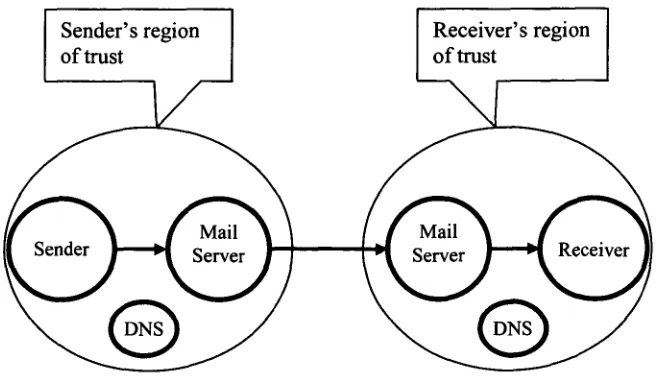
trust their mail agents (in contrast to the story about the African service), and they delegate the transfer of mail to these services. We could draw a circle around each end point and the servers (including supporting services such as the DNS) the user has chosen to trust, and (at the application layer) we could call this an application end point.
Figure 1 illustrates how the e-mail system might be drawn. To get between parts of this "higher-level" end point it will be necessary to make use of the lower-layer communications subsystem, and there will be reliability mechanisms designed and used at that level. At this lower level, the end-to-end argument will apply as each part of the service communicates with the other parts. At a higher level, there is a different interpretation of the end-to-end argument, as one application end point talks to the other application end point.
Sender's region Receiver's region
of trust of trust
Mail Mail
Sender Server Server Receiver
Figure 1: Regions of trust in email forwarding system
C
Mandatory Delegation
In the real world, there are many circumstances where an individual user does not have control over which services and servers to use. Perhaps the most obvious example is the context of employment, where individual
FEDERAL COMMUNICATIONS LAW JOURNAL
employees are constrained by corporate policy to use their computers in
certain ways, to use only certain servers (e.g., their corporate e-mail or
instant message servers), and so on. The fact that the user is forced to use
these services does not automatically make them untrustworthy. Some
employees may be entirely comfortable with the way their employers
operate their IT infrastructure; others may have fears about surveillance,
logging, or other practices. But whatever judgment the employee makes
about the trust to place in his or her circumstances, he or she has no
realistic control over the situation (although alternative platforms and
applications may be chosen for personal use).
There is a useful analog between this situation and a duality that
arises in the security community. Certain security controls are cataloged as
"discretionary access controls," or DACs, and "mandatory access controls,"
or MACs." MACs originated from the need to enforce rules for the proper
handling of classified information, and access decisions were taken away
from the individual- at his computer and given to a system security
administrator, who would impose access controls based on corporate or
institutional security policies. Because the individual user had no control
over these mechanisms, they were called mandatory, which is a word that
signals that somebody other than the end user has the discretion to control
them.
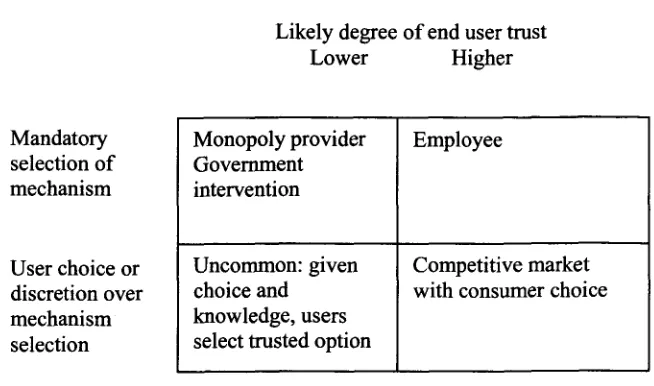
One way to capture the range of situations that apply to the individual
end user is illustrated in Figure 2.
37. See, e.g., SYs. SEC. STUDY COMM. ET AL., COMPUTERS AT RISK: SAFE COMPUTING IN THE INFORMATION AGE 251 (1991).
38. See id.
39. An illustrative example of such a control in the network context is an intrusion
detection system. Such systems look at incoming and outgoing traffic to attempt to detect patterns that suggest an ongoing attack. They can benefit from seeing the traffic to and from many nodes, not just one. They are often installed by network managers (so they are mandatory from the perspective of the end user), and they are generally viewed as benign.
THE END-TO-END ARGUMENT
Likely degree of end user trust
Lower Higher
Mandatory selection of mechanism
User choice or discretion over mechanism selection
Figure 2: Range of options for choice and trust
D.
When End Users Do Not Trust Each Other
In the analysis above, we defined "trust end points" by drawing circles around end points and the various trusted services to which they have chosen to delegate functions. But once we have drawn these circles, an important question remains-do the different trust end points trust each other?
For most of the examples in the original paper, the answer is yes. In the example of careful file transfer, the two end points are collaborating to make the transfer reliable. But as we hinted above (using the example of viruses), we often communicate with other end points that are not trustworthy and/or that we do not choose to trust. How do we deal with this situation?
One class of response is to try to devise and deploy defenses inside each circle of trust that are robust enough that the other end point cannot inflict any material damage. We deploy virus checkers, spam filters, and so on, and then we cautiously try to exchange e-mail.
But the other class of response is to invoke the services of a mutually trusted third party to remove some of the risk of the interaction. I do not trust you, you do not trust me, but we both trust this other party- perhaps that other party can help us interact. The real world is full of examples of this sort-trusted institutions of all sorts are what make contemporary, economically developed society function, from banks to contract law and courts to credit card companies and various sorts of negotiators. In the real world, when two parties view each other with suspicion, they seldom try to
Monopoly provider Employee Government
intervention
Uncommon: given Competitive market choice and with consumer choice knowledge, users
select trusted option
FEDERAL COMMUNICATIONS LAW JOURNAL
resolve the problem on their own.
And we see more and more the emergence of online analogs. For
example, credit card companies, because they can verify the identity of all
parties and because they protect against fraudulent actions, act to add trust
so that transactions can be completed between untrusting end users and
merchants. Providers of digital certificates assist in the authentication of
communicants that may not trust each other. And today, a variety of
projects aim to provide identity-management services in ways that suggest
new categories of third-party actors facilitating trust.
40By providing
assurance-supporting services such as identity management and insurance
against specific risks, such third parties permit untrusting parties to decide
to take the risk of interacting. More directly, many applications are
designed so that services developed and operated by the designer of the
application are interposed between the end users. When two end users
communicate using popular instant messaging applications today, they do
not directly connect across the communications subsystem. Instead, the IM
communications are relayed through an IM server run by the service itself.
This service enhances many aspects of the overall function. For example,
the centralized management of identities provides level of confidence to the
users about the identities.. Second, the service provides isolation between
the end users. Since end users do not communicate directly, they need not
reveal low-level information such as IP addresses to each other, which
prevents them from attacking each other directly across the
communications subsystem.
Similarly, eBay, interposed between buyer and seller, provides a
neutral meeting ground (more specifically, a neutral place where markets
can be made). eBay also illustrates the role of reputation in assessing
trustworthiness: eBay is a third party that facilitates communication about
reputation and implied trustworthiness. This is one way that identity can be
invoked for trust.
For some applications, for example multi-player games, it is fairly
obvious that much of the implementation of the game resides on servers
.rather than on the end nodes of the players. This structure arises both
because there is a great deal of shared information (about the game and its
state of play) among the players that must be coordinated, and also because
,the players must be kept from cheating. The players certainly want to
communicate, but they just as certainly do not trust each other.
Here is a partial list of functions that a trusted third party might
40. See, e.g., HIGGINS: OPEN SOURCE IDENTITY FRAMEWORK, http://www.eclipse.org/higgins/ (last visited Feb. 20, 2011); SHIBBOLETH,
http://shibboleth.intemet2.edu/ (last visited Feb. 20, 2011) (explaining the single sign-on approach); OPENID, http://openid.net/ (last visited Feb. 20, 2011).
THE END-TO-END ARGUMENT
perform:
* Manage identity, in many ways * Facilitate appraisal of reputation
* Provide robust authentication (prevent identity theft, prevent fraud)
* Control the release of attributes (limit what one party can see about others, e.g., IP addresses)
* Preserve anonymity (extreme form of controlled release-sender wants to hide all aspects of his identity from receiver) * Protect end users from each other
* Prevent attacks
* Regulate and filter content * Prevent cheating (e.g., in games)
* Provide mutual assurance and guarantees (escrow, fraud insurance, nonrepudiation)
Sometimes the third party software is directly interposed in the communication path between the end nodes, as with instant messaging, games, eBay, and the like. In other cases, the third party is not literally in the communication path between the two untrusting users but is invoked by one or both of those parties to augment the trustworthy nature of the overall transaction. It is tempting to try to analyze the implications of trusted third parties for the end-to-end argument by looking to see if the third party is literally in the path of communication. If we allow ourselves to fall back to a lower-level view of end-to-end, looking at the role of the communications subsystem, models where the third party is "off to the side" (invoked by one of the end nodes) might seem more "end-to-end." But we would argue that this lower-level detail is irrelevant in an analysis of trust, which is the basis for our higher-level model. If two parties decide to involve a trusted third party, then that party is in the middle of the "path of trust," regardless of whether that party is in the middle of the packet flow. We should not be concerned with how the packets flow, but instead look at which aspects of the trust depend on our mutual dependence on that third party, and which aspects we can determine for ourselves.
The choice as to whether to invoke a third party to enhance trust in a particular application is usually not up to the individual user. It will usually be embedded into the design of the specific application at hand; in other words, the designer of the application has control over the patterns of communication and thus the "architecture of trust." Whether or not a buyer and a seller on eBay have reason to trust each other, they must interact in the context of the marketplace defined by eBay. This fact begs the obvious question as to whether it is any more reasonable for end users to trust the third-party service provider than to trust each other. One way to try to
FEDERAL COMMUNICATIONS LAW JOURNAL [
answer this question would be by analogy to the original end-to-end argument, where one might argue that it is better for the end nodes to solve what problems they can by themselves, because involving a third party can only add to the complexity, and perhaps to the lack of certainty about trust.4
' An issue for the design and operation of such third parties, as recently publicized identity-theft cases illustrate, is to avoid having them
emerge as a bigger, let alone just another, source of vulnerability. To some observers who are concerned about the loss of personal control, the use of certain kinds of remotely provided services (services "in the cloud") is a major source of risk.42 But the outcome of the analysis, in this case as in the original paper, is not a dogmatic stricture but a preference to be validated
by the facts of the situation. And this construction by analogy may be
nonsense. While there are specific reasons to assume that the communications system will be unreliable, there is no similar reason to assume that third-party services are intrinsically unreliable. The decision will be based on a trust assessment, as well as considerations of convenience and utility. So perhaps at this level there should not be a preference for end-to-end patterns of communication, but a preference for the use of third-party services and multiway patterns of communication-that is the kind of thinking communication-that has contributed to growth in demand for cloud services.
In the marketplace of the 2000s, a number of developments shift activities away from end nodes. "Service oriented architecture" (SOA) is a buzzphrase for accessing a variety of applications and data over a network. It is linked to a model in which end users, within some enterprises, access what they need from servers as they need it, rather than investing in capabilities at their individual end nodes. It is also a concept fundamental to social media and various public cloud applications. For example, Google's move to provide office-productivity capabilities aims to motivate end users, as individuals and as members of enterprises, to use capabilities hosted on its servers rather than at the end nodes (or servers controlled by the enterprise). This mode of operation, combined with a style of operating the end node in which no new software or functions can be downloaded or installed, tries to accomplish stable operation through delegation and outsourcing.
41. This is a big question for cloud computing, at least for the public cloud services. See Blumenthal, supra note 21.
42. See, e.g., Richard Stallman, What Does That Server Really Serve?, Bos. REv. (Mar. 18, 2010), http://bostonreview.net/BR35.2/stallman.php (revised version available at http://www.gnu.org/philosophy/who-does-that-server-really-serve.htm).
43. Stay Connected and Be More Productive, GOOGLE APPS,
http://www.google.com/apps/ (last visited Feb. 20, 2011).