33
THE APPLICATION OF ENVIRONMENTAL
MANAGEMENT SYSTEM (EMS)
PRINCIPLES TO WATERSHEDS
Jack J. Schramm
Kenneth Rubin
Hagler Bailly Services, Inc.
B A C K GR O U N D: E V O LU T IO N O F
ENVIRONM ENTAL M ANAGEM ENT SYSTEM
There is a worldwid e mo vem ent tod ay to systematize environmental management. It has roots in the attempts by the industrialized world to co me to grips in a management sense with the vexing environmental crises confronted by society over the last thirty years.
In the 90's, voluntary systems for environmental management virtually exploded into view. The global economy had w itnessed increa sing reliance on global standards in a variety of key industries, including teleco mmunicatio ns, electronics, computers, information man agem ent, bank ing, shipp ing, airline operations, and maritime opera tions. The trend was reflected in the G e n e v a - b a s e d I n t e r n a t i o n a l O r g a n i z a t i o n f o r S t a n d ar d i za t io n ( I S O ) , w h e r e e n v i r o n m e n t a l representatives from 100 countries agreed on the eleme nts of a n E nv iro nm en ta l M anagement System (EMS) and promulgated the ISO 1400 1 EM S Standard (as part of the ISO 14000 Series) in September 1996.
W hile the term s of the stan dard are d irected to the ge neric “orga nizatio n,” it actually grew out of the creation in 1990 of the B usiness C harter fo r Sustainable Develop men t, an organization of 50 business leaders. The standard was intended to crea te tools and systems to improve corp orate environmental performance and safeguard companies against negative impacts on trade and comm erce. The standard does not prescribe substantive environmental performance requ ireme nts from an organiza tion, bu t, rather, a set of sound environmental management proce dures.
The standard had immediate implications for the global supp ly chain. Not a regulatory requirement, ISO 14001
instead is beco ming an ad vanc ed fo rm o f econ omic incentive. M any co mpa nies see it in their ec ono mic self-interest to adopt a conforming EM S as a passport to the international marketplace.
The standa rd refle cts a compilation of sound management
processes that, toge ther, ma y be constituted into a
management framework or become an organizin g princ iple for a variety of orga nizatio ns, includ ing thos e in the pu blic sector. The premise of ISO 14001 is that, if a n E M S is pro perly established and main tained, “continual impr ovemen t” in environmental p erform ance will inevitably result and the system ’s objectives and ta rgets will be m et.
Th is paper argues that the application of EMS principles to the development and/or the protection of a watershed can similarly help both the public and priva te secto rs to achieve their go als. M ore particularly, they include the efficient integratio n of wa ter qua ntity and w ater q uality, environmental as well as human health protection, industrial grow th, and the systematic management of water and related land resourc es.
SUGGESTED COMPOSITION OF AN
INTEGRATED M ULTI-MEDIA WATER SHED EM S
The followin g man agem ent prin ciples a re co mmon to all EM Ss:
• A policy that articulates a com mitme nt to a sp ecific level of environmental performance;
• A planning process and strategy to meet the com mitme nt;
• An organized institutional structure to execute the strategy;
• Implementation programs and support tools to meet objec tives;
• Comm unications and training programs; and
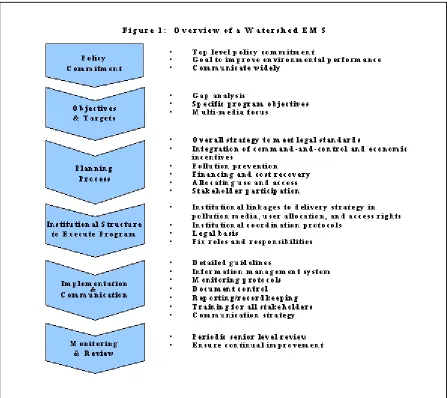
• Mea surement and review proce ss to monitor p rogress. Figure 1 presents an adaptation of the ISO 14001 management tools to a watershed setting. This adaption spec ially recognizes the institutional and programm atic dimensions of the watershed EMS, especially in the developing world. The institutional dimension, like the ISO standard, addresses the question of whether a set of institutional linkages and sp ecific proce dure s is in place to man age the watersh ed; an d, if so, ho w effective they are as mana gem ent too ls; and, if no t, what institutio nal linkages and procedures need to be created. The
progra mm atic dimension, generally uncharacteristic of the
35 APPLICATIONS OF THE INTEGRATED EMS DESIGN
In the context of a watershed EMS, the terms “integrated” and “multi-media” have special importance. An “integrated” EMS combines government intervention tools, such as regulatory/enforcement programs, with market-based incentives, including resource and pollution pricing, to attain environme ntal goals at least cost to
socie ty. A “multi-media” E M S app lies these tools across
all environmental med ia (air, wa ter, land ) to avo id transfers from one medium to another. So structured, an integrated, multi-media EM S assures that resources are allocated to users based on full information and internalization of all allocation costs, including concerns for both quantities of resources consumed and the quality of those resou rces.
EMSs have been implemented at m any levels to solve a wide range of enviro nmental ma nageme nt challenges. Single industrial locations have developed E M Ss to manage their environmental perfo rman ce in water, air, and solid waste. Cities have developed E MS s to improve the efficiency and effectiveness of their environmental programs or to engage multiple stakeholders in an equitable program of continuous environm enta l
impr ovemen t. Regional EM Ss have also been successfully applied within large industrial or trade zo nes.
Following are two project examples of the application by Hagler Ba illy of seve ral of the forego ing prin ciples. The first, as reflected in Exhibit 1, is the special purpo se district of Laguna La ke D evelo pme nt Auth ority (LLDA ), which oversees the development of, and regulation of discharges into, the Laguna de B ay, the largest fresh water lake in Asia. The lake shore is hom e to countless industries, and LLDA was specially created to manage the development and water pollution control of this unique multiple-use watershed whose uses were threatened b y a lack of effective management, enforcement, and incentives. Hag ler B ailly design ed an d imp lemented a program that integrate d tech nical, institutio nal, financial, incentive, legal, and da ta manage ment eleme nts. This was done through extensive stakeholder meetings, and was followed, in the implementation phase, with an effective training regimen of LLDA staff. After only the first year of operation, there was a dramatic decrease in BOD contamina tion, and th e hop e of up grad ing the w ater q uality classificatio n of the lak e in the futur e. Th is mod el is espe cially relevant for the management of a regional watershed.
Exhibit 1: Philippines Special Purpose District
EM S Elements Com ponents
Policy Commitment < Program supp orted by Philippines Department of Natural Resources and LLD A manag eme nt.
Objectives and Targets < Reduce BOD loadings in Laguna de Bay, the largest freshwater lake in Asia.
< If successful, expand re ach of the pro gram to o ther param eters. Planning < Fee system designed to focus on BOD initially, but expandable to other
param eters.
< Actio n plan formu lated o utlining the procedural do cum ents nec essary, a budget, and an implementation timeline.
< Extensive stakeh older dialo gues.
Institutional Structure < Institutional development plan to support the administrative needs of the progra m (fee assessme nt, permits, billing, collection, appeals p rocess, enforcement, fund management).
Implementation and Communication
< Drafted authorizing legislation and operational guidelines for a permit and monitoring p rogram s.
< Capacity building program.
< BO D levels reduced 78% in first year of operation.
M onitoring and Review < Go vernm ent is de velop ing plans to ap ply the E M S natio nally.
The second project, as reflected in Exhibit 2, addressed the groundwater problems of an industrial city in Egypt called the 10th of Ramadan. With twenty percent of its drinking water pumped from nearby deep wells, the Municipal Authority, at our suggestion, found evidence of heavy metals and other contamination in well samples. Unlined oxidation ponds, capturing liquid industrial wastes from 800 industrie s, were secretiv ely sluiced to the fields of itinerant farmers to water their cr ops and th eir livestock. W ith extens ive stake hold er inpu t, Hagler Ba illy
designed a multi-m edia to tally integrate d progra m that combined comm and and market-base d instruments. Borrowing liberally from other management d isciplines, such as pollution prevention and the ISO 140 00 stand ards, the program, currently awaiting implementation funding from USA ID, features detailed implementing guidelines for both government officials and industry managers, and has been heralded as the most significant environmental program in the Gore-Mubarak Partnership. It is expected to be im plem ented over time in more than 20 industrial cities in E gypt.
Exhibit 2: Egyp tian Industrial City
EM S Elements Com ponents
Policy Commitment < Pressure to comply with new regulatory requirements (Law 4).
< Agreement on EMS memorialized in Memorandum of Agreement (MOA) by Ministries and City’s Board of Trustees (representing industrial investors). Objectives and Targets < Red uction of wastewa ter discharges.
< Elimination of promiscuous dumping of solid waste. Planning < Multi-media coverage: air, water, waste.
< Integration of a co mman d system and econo mic incentives.
< Provisions for licensing, monitoring, EIA.
< Po llution ch arge sys tem as a central man agem ent too l.
< Environmental fund: revenues expected to cover administrative costs and subsid ize env ironm ental inve stmen ts by indu stry.
< Data management system to store and retrieve compliance-related data. Institutional Structure < Institutional linkages defined and roles and responsibilities fixed. Implementation and
Communication
< Extensive ad vocacy d ialogues.
< De tailed gu ideline s for bo th gov ernm ent and industry.
< Implementation at top of Egypt’s environmental agenda.
< USAID technical assistance for implementation in late 1999. M onitoring and Review < Governm ent to monitor implementation.
< Other indu strial cities want this.
APPLICATION OF EM S PRINCIPLES TO WATERSHEDS
Other applications of the EMS approach are possible, including mor e geo graphically expansive watersheds that acco mmoda te a wide variety of uses. Common problems in watersh ed m anag eme nt includ e a lack of: autho rity,
incentives. A n E M S approach offers distinct advantages over more traditional watershed planning and management approaches with power to deliver measurable, sustainab le results in:
37 • capturing value-added in the benefits stream and using
cash flows to o ffer financia l incentives linked to behavioral change; and
• decentralizing the ma nage men t structure design , with consensus-based rules of particip ation a nd ro les for governm ent and priva te entities.
One approach to addressing watershed management problems is to implement three pilot EM S structures aimed at different environmental problems in different locations. Pilots will address at least the following critical problems in water resources management (known in ISO 14001 EM S parlance as “objectives and targets”):
• Increasing the efficiency of water u se, esp ecially in the agricultural and industrial sectors;
• Imp roving the quality of wastewater in the municipal and industrial sectors to supp ort reuse op portunities; and
• Attracting private-sector participation in water resou rces m anag eme nt.
Each EMS pilot could be des igned to ad dress spec ific water resources problems within a well-defined watershed. The process of designing each EMS pilot will en gage all stakeholders within the w atershe d, whic h, in turn, helps ensure broad acceptance of problems to be solved, resulting resource management activities, potential changes in resource pricing, and new roles and responsibilities for ma nage men t. Typically, a watershed-level EM S results in decentralized institutional roles and local actions that cannot be achieved through centralized approaches. Th e EM S fram ewo rk is designed to crea te eco nom ic incentives for industry, agriculture, and local governm ents to participate in and execute management actions that cannot be achieved through more traditional regulatory mea ns.
Each pilot EM S might require the preparation of six pro ducts that would fit a pp ro pria te ly w ith in th e E M S organizing principles related to planning, support, and impleme ntation strategies:
• Respo nse Model - A simulation model of water
resources/water quality responses to changes in management activities attributable to the EMS;
• Da ta M ana gem ent T ools - Database and/or other data
management tools to store, re trieve, an d ma nipula te ambient environmental, water use, and discharge data, plus related data elements specific to the EMS and needed to track and report on environmental outcomes and progress;
• Financial Mana gem en t M ech an ism s - Systems,
institutions, and/o r pro cesses that create or manage the flow of funds from and to stakeholders as conditions of participation in the EMS;
• Government Guidelines - A set of detailed instructions
that specify exact roles an d resp onsib ilities for all central and local government entities that must ex ecute portions of th e E M S during the implementation phase;
• Industry Guidelines - A set of d etailed instructions
that specify exactly what private sector participa nts must d o to ex ec ute re le va nt p ortio ns o f th e E M S during the implementation phase; and
• Mem orandum of Understanding - A legal document
signed by the cooperating national and local government entities that commits each to carry o ut its respo nsibilities as specified in the Government
Guidelines.
It is likely that the design phase will take 1 8 mo nths to complete, and another 12 to 18 mo nths should be allowed for imple men tation. T his allows sufficient time to monitor and measure results, and abstract from each pilot app rop riate lessons for purposes of modification of the design or application to other watersheds within the subject jurisdiction.
AUTHORS
Jack J. Schramm, with Hagler Bailly since 1989 and curre ntly senior coun sel for en vironmen tal man agem ent, leads the firm’s internation al pra ctice in institutio nal and program strengthening. He ha s formulated laws and regulations, and developed multi-media integrated programs and strengthened the institutions that administer them in 17 c ountries throu ghou t the wo rld. A former senior administrator with the U.S. Environmental Protection Agency, Mr. Schramm holds degrees in politics and philosophy from Colgate University and in law from
Kenn eth I. Ru bin is Chief Executive Officer of Hagler Ba illy Services, Inc ., having joined the firm in 19 97 as a result of Hagler Bailly’s acquisition of Apogee R esearch, Inc., a pub lic works consulting firm that he co -found ed in 1986 and served as President and C EO . Dr. R ubin serves on H agler B ailly’s Exec utive and Ma nage men t