Universities CoUnCilon Water resoUrCes JoUrnalof Contemporary Water researCh & edUCation
issUe 136, pages 68-79, JUne 2007
Assessing the Science-Based Information
Needs of Stakeholders: A Case Study
on Acid Rain Research and Policy
Kathryn Hunt
1,
Jeffrey S. Kahl,
2,3Jonathan Rubin
1,4and Deirdre M. Mageean
1,51,4Margaret Chase Smith Policy Center, University of Maine, Orono; 2Senator George J. Mitchell Center for
Environmental and Watershed Research, University of Maine, Orono; 3 Center for the Environment, Plymouth
State University, Plymouth; 4Department of Resource Economic and Policy, University of Maine, Orono; 5Chancellor’s Office, East Carolina University, Greenville
T
here is an increasingly recognized need for research teams experienced in scienceand policy to collect and examine scientific data, and use this information appropriately for the development of social and economic policy. One of the first Federal research programs to require this team approach was the joint NSF/EPA Water and Watersheds program in the mid-1990s. The Water and Watersheds RFP contained the now famous Venn diagram showing the desired intersection of three circles representing social science, physical science, and biological science which successful PIs had to address.
The University of Maine Water and Watersheds project team included ecosystem scientists that had been researching acidic deposition (hereafter “acid rain”) for more than 20 years (Church 1999, Norton et al. 1999, Kahl et al. 2002), and social scientists who evaluated the information needs of stakeholders. This paper will evaluate the effectiveness of a stakeholder assessment at the local level concerning the relevance of findings from an ongoing acid rain researchprogram.
Policy-Relevance of Acid Rain Research
The 1990 Clean Air Act Amendments set target reductions, beginning in 1995, for acid precursor emissions from industrial sources as a means of reducing the acidity in deposition. The intended effect of the reductions in precipitation acidity was
to decrease the
acidity of poorly buffered waters
and thereby improve their biological condition.
In setting policy for acidic deposition, policymakers faced the difficult challenge of dealing with an environmental issue that has rather subtle effects, takes decades to unfold, and may require years to reach a consensus about what “recovery” entails (Stoddard et al. 1999, Kahl et al. 2004).
Although acidic deposition is the ultimate non-point source pollutant because it falls on the entire landscape, only a small percentage of surface waters were ‘acidified’ (e.g., Landers et al. 1988). As a result, the choices for future policy depend on awareness of the scientific consensus about the magnitude of the resource at risk for a given region or resource (Church 1999). Differences in environmental sensitivity and capacity also require decision support tools capable of capturing regional variation. The significance of this impact is demonstrated by Lawler et al. (2005) who adapted the Tracking and Analysis Framework model of biotic, economic, and health effects of acid deposition for Maine’s high elevation lakes, as part of this Water and Watersheds grant.
Our tasks in the Water and Watershed grant were
twofold:
Scientific information acquisition to address
the status, trends, and relationships involved in the ecosystem response to acidic deposition.
Scientific information utilization to provide the findings of this research in a format that facilitated their use by policy-makers.
The second task was designed to link the
scientific and technical aspects of the research to the practical needs of decision makers and
1.
resource managers. To ascertain the needs of stakeholders, we conducted in-depth interviews with commercial foresters, government agency staff, and environmental advocates in Maine. The findings suggested that different strategies of research dissemination were appropriate to support the environmental decision-making of the different stakeholder groups involved. However, in practice, the demand for scientific information about acid rain was determined to be low by the target audiences: state agencies, environmental non governmental organizations (NGOs), and the forest products industry. Local NGOs and industry have other, more local, priorities compared to the national policy-scale issue of acid rain, and the
state regulatory agency was more concerned with direct emission inventories and control than with
ecosystem response and recovery.
We began with the following questions: How is the issue of acid rain, with all of its current uncertainties, being addressed by local stakeholders? To what extent are concerns about acid rain reflected in the environmental decision-making of local stakeholders? How can the current science promote meaningful interactions with local stakeholders in order to improve the use of acid
rain research in environmental decision-making?
Objectives
In this paper, we present the results of our stakeholder assessment. We link our findings to current theoretical models of research use. We discuss the broader implications of our findings with respect to improving the use of scientific information in environmental decision-making.
Methodology
In concept, assessing the needs of local stakeholders seems relatively straightforward; however, in reality, it can be difficult to identify who represents a stakeholder. The public comprises numerous groups and our first challenge was to identify the stakeholders.
Accordingly, we adopted a snowball sampling technique to identify the local stakeholders involved. Snowball sampling is a technique of building up a list or sample of a special population by using an initial set of members as informants (Kish 1965). We took advantage of the informal
linkages already in existence between the scientists and local stakeholders. We identified additional stakeholders by asking each respondent to recommend additional contacts and by using our knowledge of the state’s environmental community. Our final sample included individuals from state government, individuals affiliated with non-government environmental organizations, and individuals who work for timber companies with holdings in Maine.
We sought answers to the following broad questions:
How is the research analysis of acid rain linked to the values and interests of various stakeholder groups?
What do stakeholders perceive they need with respect to information about acid rain research
to enhance their environmental
decision-making – better facts, better understanding of ecological mechanisms, or of the human behaviors that cause acid rain?
Are the areas of greatest scientific uncertainty also those areas where the value of improved
knowledge is highest?
How are the risks, benefits, and costs of acid rain perceived by different stakeholder groups?
The contextual nature of these questions led us to adopt a qualitative approach to implementing the assessment. In general, qualitative methods of research have been shown to lead to better understanding, and perhaps even better theorizing, about larger phenomena of interest (Fontana
and Frey 1994, Stake 1994). In this case, we not
only sought answers to our questions but also an understanding of how the stakeholders’ needs for information related to different models of research
use.
We conducted twenty in-depth interviews each lasting from thirty minutes to three hours. The variation in length reflects the open nature of the interviews conducted. We used each question as a general prompt in the discussion. The respondents were encouraged to follow the direction of
their thoughts even when, in a strict sense, they
represented a digression from the interview protocol. Our later interviews included more
1.
2.
3.
targeted questions to fill in information gaps and to cross-check previous findings. Such modifications in protocol are standard in qualitative research designs where initial questions are often refined in order to maximize the research effort (Morse,
1994).
Results
Scientific Context for Acid Rain
Title IV of the 1990 Clean Air Act Amendments (CAAA) set target reductions for sulfur and nitrogen emissions from industrial sources as a means of reducing the acidity in deposition. One of the intended effects of the reductions was to decrease the acidity of low alkalinity waters, largely in the northeast (Figure 1), thereby improving their biological condition. The measures of expected “recovery” in biological condition include decreased acidity, sulfate, and toxic dissolved aluminum concentrations (e.g., Kahl et al. 2004).
Anthropogenic acidity in atmospheric deposition. NOx and SOx from the combustion of fossil fuels react with water in the atmosphere to produce “acid rain,” a dilute solution of nitric and sulfuric acids. This acidity (and the acid anions sulfate and nitrate) may travel hundreds of miles before being deposited on the landscape. The northern and eastern U.S. receives precipitation with mean
pH that ranges from 4.3 in Pennsylvania and New York, to 4.8 in Maine and the Upper Midwest. The acidity (hydrogen ion concentration) in precipitation in the eastern U.S. is at least twice as high as in pre-industrial times. In the northeast, sulfate in precipitation has declined significantly for at least 30 years (Lynch et al. 2000). Nitrate
concentrations have declined slightly in the
Northeast.
Acid-base status of surface waters. The 1984-1986 EPA National Surface Water Survey (NSWS) estimated the number of acidic waters at 4.2 percent of lakes and 2.7 percent of stream segments in acid-sensitive regions of the North and East (Landers et
al. 1988). “Acidic” waters are defined as having acid neutralizing capacity (ANC) less than zero (i.e., no acid buffering capacity in the water), corresponding to a pH of about 5.2. The regions include lakes in the Adirondacks, central and northern New England, and the upper Midwest. Sensitive regions with small streams are found in the mid-Atlantic region, including the northern and central Appalachian Plateau and the Ridge and Valley and Blue Ridge provinces. Surface
waters in most other regions are not sensitive to
the impacts of acidification due to the nature of the
local geology.
Stoddard et al. (2003) provide the most recent EPA assessment of response and recovery from
acidification. All regions showed significant declines in sulfate concentrations in surface waters, consistent with the decline in sulfate in precipitation. Nitrate concentrations decreased in regions with the high ambient nitrate concentration, but were relatively unchanged in regions with low concentrations. Dissolved Organic Carbon (DOC) increased in each region, potentially contributing natural organic acidity to offset the recovery from decreased acidity and sulfate in deposition.
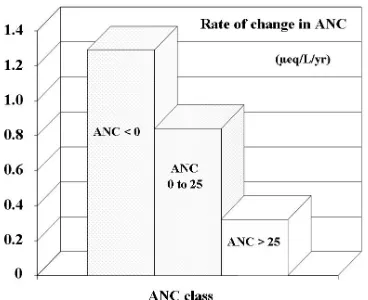
Has the number of acidic waters changed? Modest increases in ANC have reduced the number of acidic lakes and stream segments in some regions. There are currently 150 Adirondack lakes with ANC less than 0, or 8.1 percent of the population, compared to 13 percent (240 lakes) in the early 1990s. In the Upper Midwest, an estimated 80 of 250 lakes that were acidic in mid-1980s are no longer acidic. Appalachian TIME surveys of streams in the northern Plateau region estimated that 5,014 km of streams (ca. 12 percent) were acidic in 1993-94. Stoddard et al. (2003) estimated that 3,393 km of streams, or 7.9 percent, remain acidic in this region at the present time. In these three regions, approximately one-third of formerly acidic surface waters are no longer acidic, although still with very low ANC. Additionally, the lowest pH acidic lakes recovered the most in the 1990s (Figure 2), reflecting the ability of acidic
systems to recover.
Expectations for recovery. An important consideration for measuring the success of the CAAA is to have appropriate expectations for the
magnitude of potential recovery. Lakes inferred as having been measurably acidified by atmospheric deposition were already marginally acidic, typically with pH less than 6, before anthropogenic atmospheric pollution began more than 100 years ago. Therefore, full recovery of most acidic lakes will not yield neutral pH, and should not be expected to do so (Kahl et al. 2004). Indeed, the Acid Neutralizing Capacity (ANC) of lakes with ANC greater than 25 increased by less than 10% in the 1990s, suggesting that only the lowest pH should be expected to experience major increases in pH or ANC (i.e., recovery) in the future.
Theoretical Framework: Models of
Research Use
Increasingly, scientists are concerned about making the results of their research more relevant to policymakers and other users of scientific information (Regens 1984, 1993, Skolnikoff 1999, Kasemir et al. 2000). However, the process of conveying scientific information to such users often results in mutual disappointment and frustration. Scientists can become frustrated when the results of
their research are ignored or not weighted as heavily
as other factors in decision-making processes. Similarly, the users of scientific information – stakeholders – often express disappointment when scientists are unable to provide advice that lessens the range of risks or uncertainties inherent in the science (Kazancigil 1998). What is lacking in such exchanges is an understanding of the various
ways in which research is used in decision-making
fora. At least six different models help to explain how research is used by stakeholders (Weiss 1986, 1991, Auriat 1998):
The knowledge-driven model derives primarily from the natural sciences. It presumes that basic research discloses opportunities of relevance to public use; applied research and development then follow and, finally, an application is put forward for public use. This application may be in the form of a physical product or may be in the form of a policy solution or best management practice. In any case, the model
1.
assumes that stakeholders’ research use is
determined primarily by their interaction with the end product.
In contrast, the problem-solving model
suggests that the results of specific studies are used directly by stakeholders. In this case, a problem exists and a decision must be made. Yet there is an information gap that is preventing the stakeholders from identifying a desired solution. Applied research is able to fill this gap, and when the gap is filled, a
decision is made. This is the most common
concept of how research is used.
The interactive model assumes that stakeholders
seek information not only from scientists but also from a variety of other sources, including practitioners, politicians, interest groups, and friends. The process of research use follows a disorderly pattern and consists of back-and-forth interconnections among many parties. There is a collective effort to make sense of the problem, and the results of scientific research comprise only one piece of a complicated puzzle.
In political arenas, research is often used to support a predetermined position. This is called
the political model. Many scientists consider this form of research use to be improper. However, it is distortion or misinterpretation
of research findings that is inappropriate; otherwise it is normal for policy-makers to use information that fits their preferred policy position. “To the extent that the research, accurately interpreted, supports the position of one group, it gives the advocates of that position confidence, reduces their uncertainties, and provides them with an edge in the continuing debate” (Weiss 1986).
In still other cases, the use of research has little relation to its substance. The tactical model of
research use suggests that it is not the content
of the research that is important but simply the sheer fact that research is being done. Here, support for a particular research project may be a tactic for gaining organizational prestige (via an affiliation with highly-reputed scientists), or may be a way of deflecting demands for
2.
3.
4.
5.
action.
The enlightenment model is perhaps the most common method by which research results
are used. This model suggests that neither
the research findings from a particular study, nor even the results of a series of studies, are used directly by stakeholders. Rather, what permeates the consciousness of stakeholders over time are the general concepts and theoretical perspectives engendered by
the science. With this model there is no
assumption that stakeholders seek specific research conclusions. However, when research diffuses by such indirect means, both valid as well as invalid generalizations result. Hence, through this model research results are subject to oversimplification and distortion.
Together these six models suggest that the process of determining how best to interact with stakeholders involves more than simply recasting research results into user-friendly formats. Rather, meaningful stakeholder interactions are determined by factors such as the values and goals of both stakeholders and scientists, the political environment of stakeholders, and the value placed on the scientific information by stakeholders, which may differ substantially across groups. Furthermore, the differences across these models suggest that the mechanisms for achieving meaningful stakeholder interactions may vary greatly across groups and over time.
Stakeholder Interviews
Our sample of stakeholders reflected three distinct stakeholder groups:
private timber companies with holdings in Maine,
state government, and
non-government environmental organizations. We began our assessment with an assumption that interest in acid rain research by local stakeholders would be consistent with the problem-solving model – that the stakeholders would need infor-mation that we could provide. In other words, we expected that local stakeholders would be able to identify knowledge gaps relevant to current problems facing their organization, and that future research objectives within the acid rain research 6.
1.
group could encompass these specific needs. As our results indicate, our findings were not consistent with these initial expectations.
Commercial forestry interviews.
The majority of our interviews were with individuals who work for, or with, Maine’s timber companies. Our emphasis on this group reflects the fact that in Maine commercial foresters are the largest single group potentially affected by possible negative impacts to natural resources from acid rain, and the policies designed to mitigate its effects. The southern one-third of Maine is comprised of small privately-owned woodlots, and the northern two-thirds was owned at the time of the study by multinational paper companies with headquarters outside of the state. The bulk of our interviews were conducted with stakeholders from these larger companies although we also reached out to stakeholders from trade organizations representing Maine’s small woodlot owners.Our first surprise in interviewing stakeholders from this group related to their level of interest in acid rain. We had expected this group would express a high degree of concern about the current and future effects of acid rain on forest soils and forest productivity. Instead, those whom we interviewed ranked the issue of acid rain as one of low concern. When we pushed them to explain this unexpected response, they pointed out that acid rain represented an uncertain threat that may or may not manifest itself at some point in the future. To paraphrase one interviewee: Acid rain is a “topic of wondering” for us. We’re not doing anything strategic about it; however, we want to be “in the know” in a casual sort of way. We’re looking for some comfort that things aren’t going
to change very much. On the other hand, we want
enough information to be able to capitalize on broad changes in the environment. For example, what should we do about the northern spread of white pine? How best can we determine allowable growth and yields given the youth of Maine’s forests today? When is the spruce budworm going to return? In terms of potentially threats like acid rain and global climate change (e.g., Mitchell et al. 1996), we wonder whether our current silvicutural techniques are “all for naught,” but this wondering is one of low priority because of many other higher priorities.
Almost all of those we interviewed jumped back and forth between the issues of acid rain and global climate change. It appeared to us that both issues occupied a similar category in their minds, and that this category can be characterized by high scientific uncertainty, a long-term time horizon, with low urgency. There was also a shared perception among our respondents that the policy remedies to environmental hazards like acid rain and global warming may harm the paper companies today (because they are big energy users and producers), whereas any actual environmental impacts might affect the forest fifty-plus years in the future. To paraphrase one stakeholder: the priority issues for the forest industry are not environmental, biological, or ecological because these issues do not represent a clear and present danger to us. This is particularly true for the whole global warming debate; its polarization has made it much less of an
immediate concern. On the other hand, economic
realities and Maine’s political climate are big issues for us. Some companies are willing to pay top dollar for forest resources in Maine. Other companies are selling land or desire to get out of the state because the public policy climate is so unpredictable.
We pressed those we interviewed to tell us more about the political and economic issues occupying their attention at present. To varying degrees, each of the stakeholders we interviewed talked about the dual focus within their organizations
on environmental sustainability and political and
not yield high profit margins, so an uncertain
regulatory environment dominates current thinking
and planning, even though the industry’s product requires a very long-term (by industrial standards) management perspective.
The uncertain nature of Maine’s political climate is further confounded by the rapidity and scale of recent land-ownership changes. One forest industry consultant correctly pointed out that in the two years prior to the interview, more than 50 percent of Maine’s industrial forest land had changed ownership, which constitutes roughly 24 percent of state’s total forest acreage (Irland 1999). Apparently, not only has the rate of ownership change increased but the nature of forest stewardship has also changed. Today, the majority of Maine’s commercial forests are owned by holding companies and real estate investment trusts, which differs from the past one hundred years where companies tended to own both the land and the mills. As one stakeholder observed, the obligate relationship between labor and industry has been severed. So, for example, when the next spruce budworm outbreak occurs, a holding company can write off its losses more easily than a company that also has to worry about losses in mill productivity. In short, while foresters in Maine may be personally concerned about the health of the forest, a similar level of concern may not exist among the managers and shareholders of these more globally-based holding companies.
Given these findings, it was not surprising to learn that the forest industry stakeholders we interviewed had only a casual (or perhaps even polite) interest in current acid rain research. Without exception, they indicated a preference for learning about the latest
science on environmental issues such as acid rain
through an occasional, informational presentation. As one respondent indicated: We like to hear from researchers as long as they’re good public speakers who don’t get caught up in scientific jargon.
Our respondents further suggested that any information about the effects of acid rain or climate change will have the greatest impact on forest management practices if environmental trends are linked to economic impacts. For example, they would want to know how varying levels of acid deposition or temperature change affect yield or long-term sustainability. In addition, they indicated
that knowledge about what may happen in the future should be coupled with strategies for capitalizing
on, orameliorating, the problem.
These findings are consistent with two models of
research use. First, they are consistent with the knowledge-driven model. It was clear that the
stakeholders’ desire to use actual research findings was minimal. Rather, they expressed a value for the end product or final conclusion about forest management that might develop as a result of the science passing through several evolutionary stages (basic research to applied research and development to application). This preferred mode of using research results was particularly evident in their suggestion that practical information, such as strategies for capitalizing on or ameliorating the problem, should accompany any information about what may happen in the future.
Second, these findings are consistent with the
enlightenment model. This model assumes that
stakeholders are not seeking specific research
conclusions. Rather their research use evolves
from a diffuse process over time, whereby general scientific concepts slowly become incorporated into accepted management practices. In this regard, it seems entirely appropriate to conclude
that the scientists should continue with their
long-standing practice of making available to the public general information about acid rain. In the past, such information has been disseminated in local conferences, in smaller fora focused on local acidification issues, through presentations given on request, and in news media coverage.
Our interviews suggest that these venues are not
only valued by forest industry stakeholders but consistent with their preferences for research
usage.
State government. The second group of stakeholders we interviewed was from state government. Here, our interviews were confined to the science team’s most logical state-based policy partner, the Bureau of Air Quality in the Maine Department of Environmental Protection. The Bureau ranks acid rain as one of its top priorities. Indeed, the Bureau’s director anticipates that he personally will become involved in pushing for a more holistic approach to thenext amendments of the federal Clean Air Act. While we had anticipated
surprised to learn the full reason for their interest, which was as much strategic as it was scientific.
Like most government agencies, the Bureau maintains a delicate balance between taking a position for or against particular pieces of legislation and being a conveyor of scientific and technical information to the public. Serving as an advocate in political fora weakens the Bureau’s credibility as an objective and neutral source of information. The Bureau staff we interviewed talked as much about their desire for a closer relationship with the University of Maine as they did their interest in acid rain in general. It was readily apparent that they viewed acid rain research as a vehicle for establishing closer ties with the University, in part because DEP had been influential in initiating one of the core research projects of the group in the 1980s, the high elevation lake monitoring program that is still in existence today (e.g., Kahl and Scott 1988). They perceived a closer alliance with the scientists would increase their credibility with
stakeholders.
Those we interviewed were most interested in the
linkages between the biogeochemical indicators of acidification and recovery and the socioeconomic or human impacts of acid rain. Their research interests were specific in this regard, and they were willing and able to utilize research findings directly.
They asked us to consider adding an integrated
modeling component to the current science and stated, furthermore, that they would like to serve as research partners in such an effort.
These findings, although limited to one state
government agency, are consistent with two models
of research use. First, the Bureau’s strategic interest reflects the tactical model of research use. Within this framework, the specific research results are less important than the sheer fact that research is being conducted by highly-reputed scientists from the state’s major research university. In short, the Bureau’s credibility with its public stakeholders is enhanced by affiliation. Second, their views are consistent with the problem-solving model. The Bureau has identified an information gap and perceives, rightly or wrongly, that filling this gap will lead to better environmental decision-making
at the state as well as regional level.
Non-governmental environmental organizations.
Our third set of interviews was conducted with stakeholders from non-government environmental organizations. We were surprised that even among this group, the issue of acid rain ranked relatively low compared to other environmental issues. Again, the issue was that acid rain was national, but their missions are generally local. If asked publicly about acid rain each of those we interviewed indicated that their organization would issue a statement of philosophy consistent with the idea that actions should be taken to prevent further acid rain damage to Maine’s forests and watersheds. However, they also indicated that their organizations currently were not devoting substantial resources to the issue. Indeed, the 1998 Maine Environmental Priorities Report funded by EPA failed to even mention acid rain in its priorities for environmental action in Maine, perhaps because of the success of the research team at studying the issue and reporting results in peer review literature, newsletters, and state conferences.
Over the next year, his organization intends to conduct some modeling of the impacts of nitrogen and sulfur deposition on air quality and, in the future, it may attempt to convene stakeholders across New England. However, the director also indicated that he felt it was much too early to bring stakeholders together. The uncertainty and political divisiveness of the issue was still too high.
In general, the results of our interviews with this group were consistent with the interactive model of research usage. The interactive model assumes that stakeholders seek information from a wide variety of spheres, and that the results of scientific research are just one of those spheres. Similar to the forest-industry stakeholders we interviewed, their interest in acid rain appeared to be heavily influenced by assessment of the state’s political landscape. However, unlike the forest-industry stake-holders we interviewed, their methods for gaining information fit more closely with the interactive model. They expressed a willingness and ability to directly utilize research results. However, they viewed such findings as only one, non-authoritative input into their decision-making about whether and how to take action.
Discussion
We began our assessment of local stakeholders by posing the following questions: How is the issue of acid rain, with all of its current uncertainties, being addressed by local stakeholders? To what extent are concerns about acid rain reflected in the environmental decision-making of local
stakeholders, and how can the acid rain research
team promote meaningful interactions with local stakeholders in order to improve the use of acid
rain research in environmental decision-making?
Although our results cannot be generalized in the statistical sense, we believe the themes that emerged from our interviews have helped us to answer these questions. We found that efforts to enhance the interaction between researchers and stakeholders must be guided by three considerations:
the needs and values of stakeholders,
the political climate in which they operate,
and
knowledge of the ways in which scientific information is assimilated into their
decision-making. 1.
2.
3.
The differences we observed suggest such considerations vary across groups, and that different models of research use are therefore appropriate. This finding has implications for how interdisciplinary teams of scientists should proceed.
Indeed, the final question that might be asked of any stakeholder analysis is how will the results be used. Given limited resources, both information providers and users will face a choice of where and how to focus. In this regard, Toman (1998) suggests that any decision about how and where to direct attention ought to be guided by an assessment of
where increased knowledge will have the greatest
potential impact on decisions.
The results from our interviews with forest-industry stakeholders imply that informal mechanisms of information transmission, such as those employed by the research team over the years, are not only valued but highly consistent with their preferred models of research use. On the other hand, both the government and
non-government stakeholders we interviewed
expressed a willingness and ability to use scientific information directly. Both expressed a need for more information relating biogeochemical data to economic and human impacts, although each indicated that such information would factor differently into their environmental
decision-making.
To help address the information needs identified by these local stakeholders, the team also adopted an integrated modeling approach. Specifically, we adapted the Tracking and Analysis Framework (TAF) model, first developed by the USEPA for modeling acid rain effects in the Adirondack region of New York (Argonne National Laboratory 1996), to reflect Maine data. While a full description of this work is the topic of another paper (Lawler et al. 2005), salient to this discussion is the fact that use of TAF presents an opportunity to improve the
ways in which acid rain research is used in local environmental decision-making.
Finally, our results imply that interdisciplinary teams can play an important role in furthering the use of scientific information in environmental
decision-making. This role can include stakeholder
assessments such as the one presented here, or
modeling that is underway at present. While the current trend is toward global environmental assessment processes, our assessment was carried out at the local level. We urge both social and natural scientists to not overlook the meaningful opportunities for collaboration and stakeholder interaction that may exist in their backyards.
Conclusions
Our Water and Watersheds team was
cutting-edge in the long-term science of acidic deposition, but most local stakeholders were not engaged from the start in identifying a facet of the problem that mattered to them. In addition, the issue of acidic deposition is a long-term problem with a long-term (and national scale) solution, resolvable neither at the local level, nor within the corporate quarterly or annual report cycle. Therefore, while our project was a success in terms of publications, student theses, and continuation of long-term data, many opportunities remain for engaging local policy makers. We suggest the lack of engagement of local
and regional stakeholders was due to the national
nature of acidic deposition control compared to their local focus. Indeed, our science has been directly and specifically designed in partnership with EPA to address a policy need – the assessment of the Clean Air Act and amendments. EPA staff were not interviewed in this project because the team is already actively engaging EPA. We believe that the results for this paper would have been very different if we had engaged EPA staff directly as part of this grant.
The geographic territory and time frame of our stakeholders was part of the problem – they didn’t have a direct need for our scale of information in time nor space. Unlike EPA which was formulating national policy of decadal timeframes using our data, the forest products industry was responding to the needs of shareholders who were reading quarterly reports. Although the forest products industry could have been considering leaching of nutrients by acid rain on a decadal time frame,
in reality they were not concerned with this time
frame.
These results indicate that the efforts to enhance the interactions between stakeholders and scientists must be guided by three considerations that relate to the culture of the stakeholders: 1) the needs and
values of the stakeholders, 2) the political climate in which they operate, and 3) an understanding of how they assimilate information into their decision-making. These factors vary across groups, and thus different models are needed to disseminate information for different cultures. Given limited resources, it is therefore essential to choose where and how to focus efforts to disseminate information and engage stakeholders. For example, the forest products industry stakeholders were satisfied with the present level of communication with scientists, in part because their short-range outlook based on corporate quarterly reporting was not concerned with long-term potential impacts from acidic deposition.
Information from this project was directly used in the 2003 EPA assessment of the 1990 Clean Air Act Amendments (Stoddard et al. 2003, Kahl et al. 2004) to ascertain trends in ecological response and to determine the effectiveness of the Clean Air Act Amendments in influencing these trends. Therefore, this research had direct influence on future federal policy and legislation as Congress prepares to debate the re-authorization of the Clean Air Act Amendments. However, the physical scientists on the team engaged EPA to relate the research to policy. The social scientists were not involved in the information exchange with EPA.
Author Bios and Contact information
Kathryn hunt is a research associate at the Margaret Chase Smith Policy Center at the University of Maine and has served as Editor of Maine Policy Review since 1997. As a senior member of the Center’s research staff, Ms. Hunt directs projects that address local, statewide and regional community and economic development issues. She is sought frequently as a facilitator, and often serves as a broker in bringing the intellectual and physical assets of the University to bear on community decision making and problem solving. Ms. Hunt holds graduate degrees in Resource Economics and Policy and Counselor Education from the University of Maine. Author for correspondence, contact: kathryn.hunt@
umit.maine.edu.
to that, he was the founding director of the George J. Mitchell Center for Environmental and Watershed Research at the University of Maine, where he was the lead PI on the EPA/NSF joint Water and Watersheds program project that funded the work in this paper. He has a Ph.D. in Watershed Geochemistry from the University of Maine. [email protected].
Jonathan ruBin, Ph.D. is an Associate Professor
in the Margaret Chase Smith Policy Center and Department of Resource Economics & Policy at the University of Maine. Rubin’s research focuses on using economic mechanisms (tradable credits, taxes, information programs) to assist with the attainment of environmental goals. Recent publications investigate the potential economic and environmental impacts from trading greenhouse emissions, vehicle fuel efficiency
credits trading and integrated economic and ecological
modeling. Phone: (207) 581-1528.
deirdre M. MaGeean, Ph.D.
Chancellor’s Office, East Carolina University, Greensville. [email protected].
References
Argonne National Laboratory. 1996. Tracking and Analysis Framework Model Documentation and Users Guide, ANL/DIS/TM-36.
Auriat, N. 1998. Social policy and social enquiry: Reopening debate. International Social Science Journal 156: 275-287.
Church, M. R. 1999. The Bear Brook Watershed Manipulation Project: Watershed science in a policy perspective. Environmental Monitoring and Assessment 55: 1-5.
Fontana, A. and J. H. Frey. 1994. Interviewing: The art of science. In Norman K. Denzin & Yvonna S. Lincoln (eds.) Handbook of Qualitative Research.
Sage Publications Inc.: Thousands Oaks, CA. Irland, L. 2000. Maine forests: A century of change,
1900-2000, and elements of policy change for a new
century. Maine Policy Review 9(1): 66-77.
Kahl, J. S., J. Rubin, I. Fernandez, S. Norton, L. Rustad, J. Lawlor, D. Mageean, J. Cosby, and P. Ludwig, 2002. Linking watershed-scale indicators of changes in atmospheric deposition to regional response patterns. Final report, EPA/NSF Water and Watersheds program. 36 p., plus attachments. Kahl, J. S., J. Stoddard, R. Haeuber, S. Paulsen, R.
Birnbaum, F. Deviney, D. DeWalle, C. Driscoll, A. Herlihy, J. Kellogg, P. Murdoch, K. Roy, W. Sharpe, S. Urquhart, R. Webb, and K. Webster, 2004. Response of surface water chemistry to changes in acidic deposition: implications for future amendments to Clean Air Act. Environmental Science and Technology, Feature Article 38: 484A-490A.
Kahl, J. S. and M. Scott. 1988. The aquatic chemistry of Maine’s high elevation lakes: results from the HELM project. Lake and Reservoir Management 4: 33-40. Kasemir, B., D. Schible, S. Stoll, and C. C. Jaeger.
2000. Involving the public in climate and energy
decisions. Environment 42(3): 32-42.
Kazancigil, A. Governance and science: Market-like modes of managing society and producing
knowledge. International Social Science Journal
155: 69-79.
Kish, L. 1965. Survey Sampling. John Wiley & Sons Inc.: New York, NY.
Landers, D. H., W. S. Overton, R. A. Linthurst, and D. F. Brakke, 1988. Eastern Lake Survey: regional estimates of lake chemistry. Environmental Science and Technology 22:128.
Lawler, J., J. Rubin, B. J. Cosby, I. Fernandez, J. S. Kahl, S. Norton, 2005. Predicting recovery from acidic deposition: Applying a modified TAF (Tracking Analysis Framework) Model to Maine High Elevation Lakes, Water Air Soil Pollution 164: 383-389.
Lynch, J., V. Bowersox, and J. Grimm. 2000. Acid rain reduced in the eastern United States. Environmental Science and Technology 34: 940-949.
Mitchell, M. J., C. T. Driscoll, J. S. Kahl, G. E. Likens, P. S. Murdoch, and L. Pardo. 1996. Climatic control of nitrate loss from forested watersheds in the northeastern United States. Environmental Science and Technology 30: 2609-2612.
Morse, J. M. 1994. Designing funded qualitative research. In Norman K. Denzin & Yvonna S. Lincoln (eds.) Handbook of Qualitative Research.
Sage Publications Inc.: Thousand Oaks, CA.
Environmental Monitoring and Assessment 55:7-51. Regens, J. L. 1993. Acid deposition. In M.F. Uman
(ed.), Keeping Pace with Science and Engineering.
National Academy Press: Washington, DC.
Regens, J. L. 1984. Acid rain: Does science dictate policy or policy dictate science? In T. D. Crocker (ed.), Economic Perspectives on Acid Deposition Control. Butterworth Publishers: Boston, MA. Skolnikoff, E. B. 1999. The role of science in policy: The
climate change debate in the United States. Environment
41(5):16-20,42-45.
Stake, R. E. 1994. Case studies. In Norman K. Denzin & Yvonna S. Lincoln (eds.) Handbook of Qualitative Research. Sage Publications Inc.: Thousand Oaks, CA.
Stoddard, J. L., and 22 others. 1999. Recovery of lakes and streams from acidification: Regional trends in North America and Europe. Nature, 401:575-578. Stoddard, J., J. S. Kahl, F. Deviney, D. DeWalle, C.
Driscoll, A. Herlihy, J. Kellogg, P. Murdoch, J. Webb, and K. Webster, 2003. Response of surface water chemistry to the Clean Air Act Amendments of 1990. EPA/620/R-03/001, U.S. Environmental Protection Agency, Washington, DC. 78 pp.
Toman, M. A. 1998. Connecting scientific research agendas to social needs: Some reflections. In Elisabeth A. Graffy (ed.), Water Resources Update —Decisionmaking Under Uncertainty: The Nexus Between Science and Policy, Issue 113, The
Universities Council on Water Resources.
Weiss, C. H. 1986. The many meanings of research utilization. In M. Bulmer (ed.), Social Science and Social Policy. Allen & Unwin: London.