The purpose of this paper is to study the differential and complementary role played by the theory of planned behavior (TPB) variables and by participants’ emotions when recalling and describing previous experiences of such risk behavior in the prediction of the intention to repeat a risk behavior in the immediate future. We chose the behavior of occasional excessive drinking, a risk behavior characterized by evoking attitudinal ambivalence and eliciting mixed emotions, joy and sadness. The results show that emotional ambivalence is not equivalent to attitudinal ambivalence (whose indexes include that of the affective component), and that this emotional information is relevant for predicting the intention to repeat the risk behavior in the near future, enhancing the prediction of the TPB model.
Keywords: attitudinal ambivalence, emotional ambivalence, mixed emotions, risk behavior
En este trabajo estudiamos el papel diferencial y complementario que juegan las emociones sentidas cuando se recuerda y describe una experiencia personal pasada en la conducta de riesgo junto con las variables clásicas de la teoría de la conducta planificada en la predicción de la intención de repetir dicha conducta de riesgo en un futuro cercano. Hemos elegido la conducta de beber puntualmente alcohol en exceso, una conducta caracterizada por evocar actitudes ambivalentes y emociones mixtas (alegría y tristeza). Los resultados muestran que la ambivalencia emocional no es equivalente a la ambivalencia actitudinal (cuyos índices incluyen la ambivalencia del componente afectivo de las actitudes), y que esta información emocional es un factor relevante para predecir mejor la intención de repetir la conducta de riesgo en el futuro cercano.
Palabras clave: ambivalencia actitudinal, ambivalencia emocional, emociones mixtas, conducta de riesgo
Emotional Ambivalence in Risk Behaviors:
The Case of Occasional Excessive Use of Alcohol
Amparo Caballero, Pilar Carrera, Dolores Muñoz and Flor Sánchez
Universidad Autónoma de Madrid
This research was supported by grant SEJ2005-06307/PSIC (MEC).
We thank Luis Oceja for his comments on an early version of this article, David Weston for his help in the preparation of the English version, and Marta Gacitúa and Teresa González for their help in the collection of data.
Correspondence should be addressed to: Amparo Caballero, Departamento de Psicología Social y Metodología, Facultad de Psicología, c/ Ivan Pavlov, 6, Cantoblanco, 28049 Madrid. Universidad Autónoma de Madrid. Spain. E-mail: [email protected]
Our aim in this study is to analyze the complementary role in the prediction of the intention to repeat a given risk behavior played by the theory of planned behavior (TPB; Ajzen, 1988, 1991) variables and by participants’ mixed emotions when they recall and describe their personal experience of that risk behavior. We report our results on the behavior of occasional (not habitual) heavy drinking. This is not a study on the problem of alcohol dependence, but rather deals with its excessive use occasionally (a behavior commonly observed in young people over the weekend). We did not impose an objective criterion for “excess of alcohol,” opting instead for a personal and subjective norm, that of our participants’ perception, so as to comprise all the individual features and differences. We would like to emphasize that our participants are not alcoholic: they drink excessive alcohol in very specific situations (e.g., some parties, or some weekends), but not daily. The choice of this behavior is explained by both its social and theoretical importance. In Spain, alcohol is still a “social drug” used in a ritual fashion at many everyday events (e.g., toasting at celebrations), and which has considerable social and economic consequences for public health. Thus, Becoña (2000) pointed out, based on the data from a 1998 survey of Spanish schoolchildren aged 14 to 18, that alcohol was the most widely consumed drug: over 80% of young people had consumed it in the last year, with a mean age at first consumption of 13.6 years. In a recent study, it was found that 67% of adolescents aged 14 to 16 drank alcohol, mainly on weekends and at parties (Caballero et al., 2004).
Our choice of this behavior is also important from a theoretical point of view, given that consumption of alcohol is associated with high levels of attitudinal ambivalence (Conner & Sparks, 2002), and this moderator clearly reduces the associations between attitude and intention-behavior (Cooke & Sheeran, 2004). Attitudinal ambivalence reduces both the temporal stability of the attitude (Conner, Sherlock, & Orbell, 1998) and its influence on behavioral intention and on the behavior itself (Conner, Sparks, Povey, James, & Shepherd, 1998). Drinking is clearly a behavior about which it is difficult to make predictions solely from attitudinal models such as that of the TPB, and further work in the field is necessary to try to overcome this shortcoming. The study presented here attempts to make a contribution in this direction, by considering participants’ emotional experience when they recall and describe a situation in which they have performed this behavior. Our aim is to add information about “emotional ambivalence” as measured by self-report items referring to two emotions (joy-sadness) with opposing valences and arousal level. We choose these diametrically opposite emotions because they represent the best example of mixed emotion (e.g., Larsen, McGraw & Cacioppo, 2001; Russell & Carroll, 1999), and they will allow us to compare more clearly attitudinal and emotional ambivalence. We also focus on the role of these specific
emotions (joy and sadness), because in our previous studies they were the emotions most frequently and clearly associated with several risk behaviors (see Carrera, Caballero, Sánchez, & Blanco, 2005; Sánchez, Caballero, Carrera, Blanco, & Pizarro, 2001). In this paper, we shall not (as we did elsewhere) explore whether these two emotions are felt simultaneously or sequentially, or the consequences of these patterns for ambivalence and behavior (see Carrera & Oceja, 2007).
The influence between affect and cognition seems to be clearly bidirectional (see Forgas, 2001). Along this line, authors such as Giner-Sorolla (1999) or Ajzen and Fishbein (2000) have argued for a differentiation of the concepts of attitude and affect, and we also stress the difference between the affective component of attitudes and the emotions experienced in relation to the object of an attitude.
We are aware that the affective component of attitude focuses on the evaluative implications of all types of affective experiences, including (but not exclusively) emotions elicited by attitude objects (Haddock & Zanna, 1998; 1999). In risk behaviors such as that studied here, the emotional reactions experienced when performing the behavior or when recalling it may be of great importance in relation to the decision whether or not to repeat it, and we believe that this information is not sufficiently covered in the items generally used for measuring the affective component of attitude (e.g., “What are your feelings
about…”). Such items usually inquire about the association
between the behavior or object analyzed and the affective dimension. However, this association does not mean that the subject has experienced these emotions on performing the behavior, or that he or she experiences them during recall. Indeed, in the opinion of some authors, participants may respond to attitudinal scales considering only the semantic relationships, in the sense that people who judge something positively associate positive feelings with it (see Robinson & Clore, 2002). People may associate emotions with behaviors even though they have no direct experience of them (e.g., I associate disgust with eating
sushi, but I have never tried it, so I have never felt disgust eating sushi). As Robinson and Clore pointed out,
emotions are momentary experiences, but people possess beliefs about their emotions, and the two things do not always coincide.
(Caballero, Carrera, Sánchez, Muñoz, & Blanco, 2003; Carrera et al., 2005; Sánchez, et al., 2001). It is extremely difficult to obtain data on the real emotions felt, and therefore, in the present study, we decided to use an intermediate procedure between experiential knowledge and
memory, asking participants to describe a real situation in
which they had carried out the risk behavior and to report the emotions evoked by that memory now (mentally
re-enacting a past situation). In this line, our aim here is to
make progress regarding consideration of the re-enacted emotional experience as a predictor variable. Our second goal in this study will be to test whether emotional ambivalence, as calculated from specific emotional experiences, is equivalent to attitudinal affective ambivalence as measured from affective attitudinal scales. Both goals relate to the exploration of the hypothesized lack of absolute equivalence between emotional experience and attitudinal measures.
Method
Participants, Measures, and Procedure
Participants were 100 students (89% women and 11% men) nearing the end of their degree courses at the Universidad Autónoma de Madrid, with a mean age of 22.9 years. One participant did not finish the questionnaire, and was therefore ruled out of the analysis. All had experience in the risk behavior studied (i.e., “occasional excessive alcohol consumption”), measured subjectively, according to their own experience. We did not filter the sample according to actual amount of alcohol drunk; rather, our criterion was their subjective consideration that they had drunk too much. We designed a questionnaire, guaranteeing anonymity, in order to gather the following information:
1. Personal data: age, sex.
2. Frequency of occasional excessive alcohol consumption, rated on a 7-point scale ranging from 1 (never) to 7 (very
frequently), and how long ago it last happened (days,
weeks, months, or years ago).
3. Participants’ attitude towards the behavior under study, measured with an item referring to general attitude (Do
you think the behavior of occasional excessive drinking is…?) and two further items dealing with different
components of attitude: the cognitive component (When
you think about the behavior of excessive drinking, to what extent are the thoughts that come to mind…?) and
the affective component (When you think about the
behavior of excessive drinking, to what extent are your feelings .…?). In all three cases, two scales are used: positive and negative, both rated on 7-point scales ranging
from 1 (not at all) to 7 (very much).
4. Direct measure of ambivalent thoughts (“I feel confused,”
“I have doubts”) and ambivalent feelings (“I feel a
bitter-sweet sensation,” “I feel a mixture of emotions”)
evoked in participants by the behavior in question, rated on a 7-point scale ranging from 1 (not at all) to 7 (very
much).
5. Perceived control of the behavior, rated on a 7-point scale ranging from 1 (very low) to 7 (very high). 6. Subjective norm, measured by two items: friends’ (peers’)
judgment of the behavior—positive and negative, both rated on 7-point scales ranging from 1 (not at all) to 7 (very much)—and participants’ agreement with that judgment, rated on a 7-point scale ranging from 1 (very
low) to 7 (very high).
7. The emotions currently felt by participants, at the time of completing the questionnaire, on recalling and describing the experience in which they drank most excessively; this was measured using two emotional categories (joy and sadness). Intensity of this emotional experience was measured with a strictly unipolar scale in which participants had to answer the question I feel
this emotion, with “yes” or “no;” if the answer was
affirmative, the next question was how intense was that
emotion? This was rated on a 7-point scale ranging from
1 (not at all) to 7 (very intensely). They were free to indicate none, one, or two emotions.
In order to facilitate the induction of emotions, participants were asked to describe in detail what they drank and how much, where they were, with whom, what happened, and how long ago. As mentioned, the perception of “excessive” in relation to alcohol consumption was subjective: We preferred not to impose any objective criterion, leaving it to the participant to judge.
8. Finally, we asked about their intention to repeat the risk behavior in the coming weeks, on a 7-point scale ranging from 1 (not at all) to 7 (very strong).
Results
calculated Cronbach’s alpha for these dimensions, which was found to be significant (.83). We averaged the two items (negative and recoded positive dimension) into one scale, which also showed a negative evaluation, but less so than in the case of personal attitude (M = 4.5, SD = 1.6). Contrast of means for related samples between general attitude index and perception of peers’ judgment was significant, t(98) = 28.5, p < .001. Mean level of agreement with peers’ opinions was moderately high (M = 4.7, SD = 1.8). Subjective norm was calculated as the product of the mean of negative and recoded positive judgment of peers’ behavior and participants’ agreement with that judgment (M = 22.9, SD =14.4). Perceived control over the behavior showed very high levels of such perception (M = 5.8, SD = 1.2).
With the aim of measuring attitudinal ambivalence, we used various indicators, some direct and others indirect, employing in the latter case one of the most frequently used formulas for calculating ambivalence in the field of attitudes, that of Thompson, Zanna, and Griffin (1995):
Ambivalence = [(positive information + negative information)/2] – positive information-negative information. This index is applied to both attitudinal and emotional information, in the latter case, considering the emotions of opposing valences experienced and described by the participants (joy-sadness). Given that the scales employed have seven points, this ambivalence index ranges from –2 to 7.
Ambivalence Indexes
As regards indirect general attitudinal ambivalence, we applied the same ambivalence index to participants’ judgments of the studied behavior, through the positive and negative items, obtaining a low general attitudinal ambivalence (M = -0.75, SD = 1.5).
In order to measure indirect cognitive attitudinal
ambivalence we applied the same index to the thoughts that
participants associated with the behavior, through the positive and negative items, obtaining a moderate-low level of indirect cognitive ambivalence (M = 0.10, SD = 2.0).
Likewise, in order to obtain the level of indirect affective
attitudinal ambivalence, we applied the same index to
participants’ feelings associated with the behavior, through the positive and negative items, obtaining a moderate-low level of indirect affective ambivalence (M = 0.22, SD = 1.9). Given our interest in examining closely the emotional experience of those who practice this risk behavior, we included in the questionnaire, as described above, other, more direct measures of the emotions experienced now, on recalling a personal instance of the behavior. We were thus also able to apply Thompson, Zanna, and Griffin’s (1995) ambivalence index, taking the emotional experience reported by participants at present when recalling the time they consumed most alcohol: the emotion of joy as an indicator
of positive dimension, and sadness as an indicator of negative dimension, obtaining in “emotional ambivalence” a mean of .29 (SD = 1.24). Emotional ambivalence was higher than general attitudinal ambivalence, t(98) = 5.10,
p < .001.
Because mixed emotions are rather scarce (see Carrera & Oceja, 2007; Russell & Carroll, 1999), we only obtained 22 participants who reported joy and sadness at the same time, obtaining an “emotional ambivalence” mean of 1.6 (SD = 1.3, N = 22). In this sub-sample, emotional ambivalence was also higher than general attitudinal ambivalence, t(21) = 3.9, p < .001.
The questionnaire also included direct items for
measuring the attitudinal ambivalence of both the cognitive
and affective components. Participants obtained moderate values on these items: confused (M = 2.75, SD = 1.7), doubts (M = 2.76, SD = 1.7), bitter-sweet (M = 3.44, SD = 1.7), a mixture of emotions (M = 3.87, SD = 1.9).
Attitudinal Ambivalence and Emotional Ambivalence
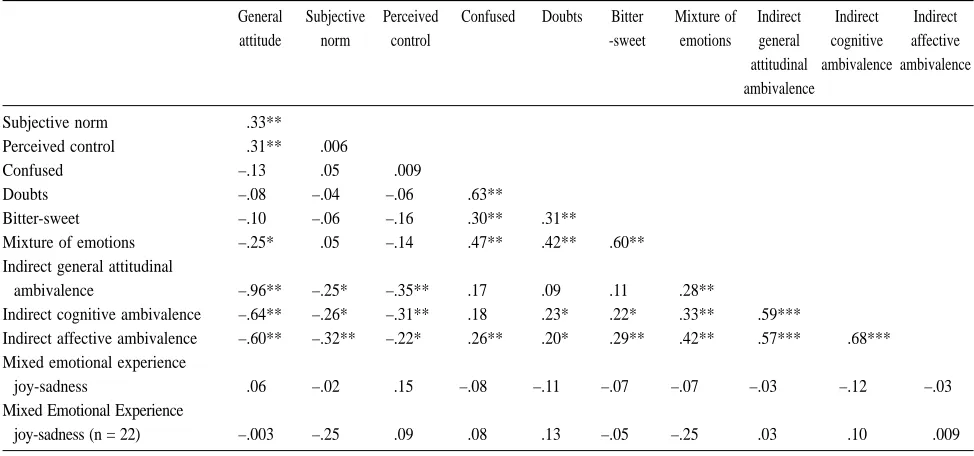
One of the goals of our study was to explore the relationship between the affective component and the emotions felt at the time of recalling the risk behavior. We therefore calculated the correlation between the indexes of general attitudinal ambivalence, indirect cognitive ambivalence, indirect affective ambivalence, and emotional ambivalence. The relationships between all measured variables are shown in Table 1.
Prediction of Intention to Repeat the Risk Behavior
in the Future
Influence of TPB variables on prediction of intention to repeat excessive drinking behavior. Having carried out these
descriptive analyses on the TPB variables and emotions associated with the risk behavior under study (excessive drinking), we set out to examine the role played by these variables in prediction of the intention to repeat the risk behavior. If we found emotions to be relevant for improving the prediction of intentions, in future research, we would explore the role of emotional experience as moderator in the attitude-intention relationship. For this purpose, we carried out a set of regression analyses with standardized scores for controlling factor variability level. Results on participants’ intention to repeat the behavior in the immediate future were low (M = 1.94, SD = 1.35), despite the fact that all participants had experience of the behavior.
We first performed a regression analysis incorporating the classic TPB variables. We included general attitude towards the behavior (averaged between negative and recoded positive dimensions), perceived control, and subjective social norm (calculated as the product of the mean of negative and recoded positive judgment of the behavior attributed to peers and participants’ agreement with that judgment), all in standardized scores. According to this model, F(3, 76) = 3.11, p < .05, the TPB variables explained 7% of intention to repeat the risk behavior, and perceived control was the most relevant variable in that prediction (β = –.22, p < .05).
TPB + attitudinal ambivalence. We performed another
regression analysis, adding to the standardized TPB variables those of indirect general, cognitive, and affective attitudinal ambivalence. Attitudinal ambivalence indexes did not produce a significant change in the prediction of intention to repeat the risk behavior.
Likewise, adding the items of direct attitudinal ambivalence (cognitive and affective) to the standardized TPB variables did not lead to changes in level of explanation.
TPB + emotional ambivalence. When we added
emotional ambivalence to the TPB information (general attitude, perceived control, and subjective norm), considering the complete sample (including participants who reported only joy or sadness; when only one emotion is reported, emotional ambivalence is negative or very low, as the Thompson et al. Index shows), the regression analysis showed a significant improvement, from 7 to 14% (p < .01). The best predictors in the second model, F(4, 75) = 4.15, p < .01, were emotional ambivalence (β = –.27, p < .01) and perceived control (β= –.19, p = .08), with general attitude (β = –.19, p = .09) at the level of a trend. Following Trafimow’s (2004) suggestions, we used binomial effect size display (see Rosenthal & Rosnow, 1991) in order to reveal the real meaning of the change in R2. We calculated the change in percentage of successes from the first (R1= .33) to the second model (R2= .42). This analysis showed that the ∆R2of 7% implies, when corrected, an increase in the probability of success of 5%, a moderate improvement.
When we repeated the above regression analysis taking into account only those participants who reported joy and sadness at the same time, the sample was reduced to 22 Table 1
Correlations between all Measured Variables
General Subjective Perceived Confused Doubts Bitter Mixture of Indirect Indirect Indirect attitude norm control -sweet emotions general cognitive affective attitudinal ambivalence ambivalence ambivalence
Subjective norm .33**
Perceived control .31** .006
Confused –.13 .05 .009
Doubts –.08 –.04 –.06 .63**
Bitter-sweet –.10 –.06 –.16 .30** .31**
Mixture of emotions –.25* .05 –.14 .47** .42** .60** Indirect general attitudinal
ambivalence –.96** –.25* –.35** .17 .09 .11 .28**
Indirect cognitive ambivalence –.64** –.26* –.31** .18 .23* .22* .33** .59***
Indirect affective ambivalence –.60** –.32** –.22* .26** .20* .29** .42** .57*** .68*** Mixed emotional experience
joy-sadness .06 –.02 .15 –.08 –.11 –.07 –.07 –.03 –.12 –.03
Mixed Emotional Experience
joy-sadness (n = 22) –.003 –.25 .09 .08 .13 –.05 –.25 .03 .10 .009
participants. This regression analysis shows an improvement from the first model, F (3, 18) = .83, p > .05,—which explains 2%—to the second model, F (4, 17) = 2.7, p < .05,—which explains 24%—so that the improvement is significant (p < .01). The best predictor in the second model was emotional ambivalence (β= –.54, p < .01). We made the correction for attenuation due to unreliability of the measurements and then calculated the change in percentage of successes from the first (R1 = .34) to the second model (R2= .62). When ∆R2is conceptualized in terms of change in probability of success, the improvement is still moderate (12%). Of course, this sample is very small, but we feel it is relevant because mixed emotions are scarce. In any case, the results must be considered with caution.
In general, these results reveal the importance of perceived control as a variable to take into account in the explanation of excessive alcohol consumption in young people, in the sense that the less the perception of control in this behavior, the greater the intention to repeat the risk behavior in the immediate future, bearing in mind that our participants have experience in this risk behavior. Even more interesting is the fact that if we add emotional ambivalence to the TPB information, the change in prediction was from 7 to 14% of intention to repeat the risk behavior. When we correct the value of this improvement following Trafimow’s (2004) suggestions, the change in probability of success is 5%, a low but acceptable figure, as R1is moderate (.33). Also, this result suggests that the lesser the emotional ambivalence (i.e., the participant feels one emotion more strongly—probably joy—on recalling the behavior) and perceived control, the greater the intention to repeat the risk behavior in the near future.
Discussion
Research aimed at explaining and predicting human behavior has found in attitudes one of the most powerful variables for its prediction (TRA, Fishbein, & Ajzen, 1975; and TPB, Ajzen, 1988, 1991). In general, there appears to be a broad consensus on the identification of different components of attitude, basically: the cognitive component, usually measured through questions on the
thoughts and beliefs associated with the object of attitude,
the affective component, which generally refers to
emotions and feelings associated with the object, and the behavioral component, which refers to the practice of the behavior related to the object of attitude. Attitudes,
perceived control, and social norms (the components of TPB) provide an excellent basis for the prediction of human behavior on most occasions, especially when decisions are made in a highly rational way.
In our study, we examined the importance of these attitudinal components in the explanation and prediction of the intention to repeat a particular risk behavior:
occasional excessive drinking in young people.
Furthermore, we explored the extent to which the incorporation of the re-enacted emotional experience (i.e., the emotions actually felt now on recalling the risk behavior) improves prediction of this risk behavior, as we consider it important to make a very clear distinction between this emotional experience and the affective component of attitudes (see Giner-Sorolla, 1999). Previous studies have found considerable relevance of the relationship between intentional behavior and anticipated emotional experience (Hynie, MacDonald, & Marques, 2006; Parker, Manstead, & Stradling, 1995; Richard, de Vries, & van der Plig, 1998; Sheeran & Orbell, 1999); we have previously explored a similar relationship in relation to risk behaviors and recalled emotions (Caballero et al., 2003; Carrera et al., 2005). Our aim in the present work was to replicate and enlarge upon these results with other behaviors and to improve the measurements of emotions, using not anticipated or recalled emotions but rather emotions induced when participants recall and describe their risk episode. Furthermore, given that risk behavior is associated with positive and negative consequences, we explored the extent to which participants experienced ambivalent attitudes and emotional ambivalence on drinking excessively, and how this information improves prediction from the TPB model.
Our results show a low general attitudinal ambivalence, corresponding to the negative consideration of this behavior, whereas the levels of cognitive ambivalence and affective ambivalence were moderate, both when measured directly and when measured indirectly. Levels of emotional ambivalence were also moderate, but higher than those of cognitive and affective ambivalence.
With a view to exploring the relationships between the attitudinal components and the current emotional experience on recalling the behavior, we analyzed the correlations between the different indexes of attitudinal ambivalence and the emotional ambivalence index. We found high and positive correlations between all attitudinal indexes, whereas none of them correlated significantly with emotional ambivalence measured through joy and sadness. We should like to emphasize that the correlation between affective ambivalence and emotional ambivalence was clearly nonsignificant.
These results reaffirm our proposal for a differential and complementary consideration of the affective-evaluative component of attitude and the emotional experience itself, so that, although the specific emotions experienced may form part of the affective component of attitude, they are not necessarily equivalent to it. Secondly, considering the two types of information in an independent and complementary manner helps us to make more reliable predictions of the intention to repeat the behavior.
predictive power in the intention to repeat excessive drinking behavior, and that perceived control is the most important aspect in predicting this intention. We stress the fact that participants perceive this behavior as controllable, despite the fact that they have experience of repeating it and the intention to do so, although our results show that the lower the perceived control, the greater the intention to repeat. None of the attitudinal variables were seen to play a significant role in the prediction of alcohol consumption; as mentioned, only perceived control emerges with significant explanatory power.
When we finally included emotional ambivalence together with the TPB variables, we obtained an improvement in the probability of prediction of 5% (12% when N = 22). We should like to emphasize that simple emotions, individually, did not increase the percentage of explanation: what increased it was the emotional ambivalence between the two opposite emotions (mixed emotion of joy and sadness).
Despite the fact that the improvement was low (though significant), the results obtained provide a good starting point that permits us to confirm the relevance of incorporating such current emotional experience in the prediction of the risk behavior studied. We point out that these results are only a first step in exploring the role of current (not only remembered or anticipated) emotions in the prediction of behavior; moreover, we are aware that one of the most important limitations of this study is the low number of items for measuring attitude and emotion, so that the results must be considered as preliminary. It is therefore necessary to continue research in this line, improving the measures of attitudes and emotions; manipulating the emotions (e.g., emotion induction paradigm) and using path analysis. The improvement found in the level of explanation encourages us to continue research on the role of emotion in the prediction of risk behavior.
References
Ajzen, I. (1988). Attitudes, personality and behavior. Chicago: Dorsey.
Ajzen, I. (1991). The theory of planned behavior. Organizational Behavior and Human Decision Processes, 50, 179-211. Ajzen, I., & Fishbein, M. (2000). Attitudes and the attitude-behavior
relation: Reasoned and automatic processes. In W. Stroebe & M. Hewstone (Eds.), European Review of Social Psychology, 11, (pp. 1-33). Wiley.
Becoña, E. (2000). Los adolescentes y el consumo de drogas. Papeles del Psicólogo, 77, 25-32.
Caballero, A., Carrera, P., Sánchez, F., Muñoz, D., & Blanco, A. (2003). La experiencia emocional como predictor de los comportamientos de riesgo. Psicothema, 15, 427-432. Caballero, A., Carrera, P., Sánchez, F., Shih, P.C., Muñoz, D., Toro,
I., Fuente, I., & Muñoz, A. (2004). Conductas de riesgo en
adolescentes. Madrid: Concejalía de Juventud del Ayuntamiento de Tres Cantos.
Carrera. P., & Oceja, L. (2006, May). Emotional patterns involved in the simultaneous mixed emotional experience: Analogical Emocional Scale. Oral presentation in the second European Conference on Emotion. Louvain-La-Neuve, Belgium, May 18-20.
Carrera, P., & Oceja, L. (2007). Drawing mixed emotions: Sequential or simultaneous experiences. Cognition and Emotion, 21(2), 422-441.
Carrera, P., Caballero, A., Sánchez, F., & Blanco, A. (2005). Emociones mixtas y conductas de riesgo. Revista Latinoamericana de Psicología, 37, 119-130.
Chaiken, S., Pomerantz, E.M., & Giner-Sorolla, R. (1995). Structural consistency and attitude strength. In R.E. Petty & J.A. Krosnick (Eds.), Attitude strength: Antecedents and consequences (pp. 387-412). Mahwah, NJ: Erlbaum. Conner, M.T., & Sparks, P. (2002). Ambivalence and attitudes. In
W. Stroebe & M. Hewstone (Eds.), European Review of Social Psychology, 12 (pp. 37-70). Wiley.
Conner, M.T., Sherlock, K., & Orbell, S. (1998). Psychosocial determinants of ecstasy use in young people in the UK. British Journal of Health Psychology, 3, 295-317.
Conner, M.T, Sparks, P., Povey, R., James, R., & Shepherd, R. (1998). Interpretations of healthy and unhealthy eating, and implications for dietary change, Health Education Research, 13, 171-183.
Cooke, R., & Sheeran, P. (2004). Moderation of cognition-intention and cognition-behaviour relations: A meta-analysis of properties of variables from the theory of planned behaviour. British Journal of Social Psychology, 43, 159-186.
Fishbein, M., & Ajzen, I. (1975). Belief, attitude, intention, and behavior: An introduction to theory and research. Reading, MA: Addison-Wesley.
Forgas, J.P. (2001). Feeling and thinking. The role of affect in social cognition. Cambridge University Press.
Giner-Sorolla, R. (1999). Affect in attitude. Immediate and deliberative perspectives. In S. Chaiken & Y. Trope (Eds.). Dual process theories in social psychology (pp. 441-461). New York: Guilford.
Haddock, G., & Zanna, M. (1998). On the use of open-ended measures to assess attitudinal components. British Journal of Social Psychology, 37, 129-149.
Haddock, G., & Zanna, M.P. (1999). Cognition, affect, and the prediction of social attitudes. In W. Stroebe & M. Hewstone (Eds.), European Review of Social Psychology, 10 (pp. 75-99). Wiley.
Hynie, M., MacDonald, T.K., & Marques, S. (2006). Self-conscious emotions and self-regulation in the promotion of condom use. Personality and Social Psychology Bulletin, 32, 1072-1084. Larsen, J.T., McGraw, A.P., & Cacioppo, J.T. (2001). Can people
fell happy and sad at the same time? Journal of Personality and Social Psychology, 81, 684-696.
Richard, R., de Vries, N.K., & van der Plig, J. (1998). Anticipated regret and precautionary sexual behavior. Journal of Applied Social Psychology, 28, 1411-1428.
Robinson, M.D., & Clore, G.L. (2002). Belief and feeling: Evidence for an accessibility model of emotional self-report. Psychological Bulletin, 128, 934-960.
Rosenthal, R., & Rosnow, R.L. (1991). Essentials of behavioural research: Method and data analysis (2nd ed.). New York:
McGraw Hill.
Russell, J.A., & Carroll, J. M. (1999). On the bipolarity of positive and negative affect. Psychological Bulletin, 125, 3-30. Sheeran, P., & Orbell, (1999). Augmenting the theory of
planned behavior: Roles for anticipated regret and descriptive norms. Journal of Applied Social Psychology, 29, 2107-2142.
Sánchez, F., Caballero, A., Carrera, P., Blanco, A., & Pizarro, B. (2001). Sexual risk behaviour and emotional experience. International Review of Social Psychology, 14, 7-20.
Schimmack, U. (2001). Pleasure, displeasure, and mixed feelings: Are semantic opposites mutually exclusive? Cognition & Emotion, 15, 81-97.
Thompson, M.M., Zanna, M.P., & Griffin, D.W. (1995). Let’s not be indifferent about attitudinal ambivalence. In R.E. Petty & J.A. Krosnick (Eds), Attitude strength: Antecedent and consequences (pp. 361-386). Mahwah, NJ: Erlbaum. Trafimow, D. (2004). Problems with change in R2as applied to
theory of reasoned action research. British Journal of Social Psychology, 43, 515-530.
Trafimow, D., Sheeran, P., Lombardo, B., Finlay, K.A., Brown, J., & Armitage, C. (2004). Affective and cognitive control of persons and behaviours. British Journal of Social Psychology, 43, 207-224.