International Journal of Computer Techniques -– Volume 5 Issue 2, Mar – Apr 2018
Enhancement and Performance Analysis of VoIP
Algorithms in Wireless Networks
1
Maghrib Abidalreda Maky Alrammahi,
2Haider Abdul Hassan Hadi Al Kim
1Information Technology Research and Development Centre, University of Kufa, Najaf, Iraq
2
Department of Electronic and Communications Engineering, Faculty of Engineering, University of Kufa, Najaf, Iraq
---
************************
---Abstract:
Voice over Internet Protocol (VoIP) is currently one of the fastest spreading telephone technologies. In recent years, VoIP has been widely used in wired and wireless networks because of its compatibility with and adoption in IEEE 802.11 devices. This technology works in the second layer of data link layer, and thus, is compatible with the carrier-sense multiple access with collision avoidance protocol (CSMA/CA), which works in IEEE 802.11 networks. The operation of this protocol depends on various algorithms, including the distributed coordination function (DCF) algorithm. This algorithm is governed by the transmission of packets at any time without considering the priorities of other stations. A collision of packets may occur when transmitting simultaneously with the rest of the stations. Another algorithm is the enhanced distributed channel access (EDCA),
which sets a priority when sending packets between stations. Thus, if more than one station is transmitting simultaneously, then one of the stations will have higher priority and the remaining stations in the transmitter will have to wait depending on the order of priority. Consequently, collisions do not occur. In this regard, EDCA is better than DCF. The parameters of these
algorithms are modified to produce a new algorithm, called M_EDCA. The three algorithms are applied using a simulation program, i.e. OPNET. The final results are obtained, and the results of the new algorithm are compared with those of the existing algorithms. The best results are achieved using the new algorithm, and consequently, the best voice quality in transmission and reception, and the best performance and service in VoIP applications.
Keywords
—
Voice over Internet Protocol (VoIP), Contention Window (CW), Distributed Coordination Function(DCF), Enhanced Distributed Channel Access (EDCA), OPNET
---
************************
---1. INTRODUCTION
The introduction has been divided to the following parts:
1.1.Overview
Internet telephony is a modern technology that involves telephony over wireless networks. It is another name for communication via Internet protocols, e.g. Voice over Internet Protocol (VOIP), which allows the transmission of voice calls from one device to another over Internet networks. Internal networks also support various applications for audio and video communications. This technology can be utilised in government institutions, universities, companies and other organisations. Compared with traditional networks and telephones, Internet telephony has many advantages, including ease of installation, expansion capability, and flexibility in motion and mobility in movement. One important feature of this technology is that it supports video communication and voice messages. During the sending of packets over a network, the analogue signal from the user’s telephone is converted to a digital signal while being transmitted over the Internet. Numerous challenges are experienced during the transmission of packets over a network, including security
information or packet loss and network design or hardware incompatibility.
1.2.Problem Statement and Research Motivation
Internet networks offer a variety of applications that support voice communications, such as computer hardware, mobile phones and digital devices used in communication over a network. The time of these applications can be measured based on the quality of the text, audio and video, all of which share the delivery of applications over a specified period. Two important factors used in telephone service over the Internet are general interaction and sound quality. These factors considerably affect the quality and performance of a network through the application of VoIP. The aforementioned applications face numerous challenges when they are implemented in wireless networks compared with their implementation in wired networks. Some of these challenges are described as follows.
- Delay is the total time that occurs from the moment the sender sends the message to the moment the recipient receives the message. Three different cases of delays can occur. Firstly, delay packets occur when the sender compresses the data to be
International Journal of Computer Techniques -– Volume 5 Issue 2, Mar – Apr 2018
ISSN :2394-2231
http://www.ijctjournal.org
Page 75
sent. It also happens when the recipient decompresses the data to be sent. The second case is network delay, which occurs during transmission or queue waiting. The third case of delay happens during the spread of data. It results from the sender sends packets coming from a phone user. The signal is converted from analogue to digital and vice versa. The recipient also converts the signal from digital to analogue, thereby causing a delay due to the conversion of signal. - Delay in jitter is a condition that happens to packets during the process of sending and receiving messages. It occurs when the packet does not reach the recipient at the specified time. The delay in arrival is caused by several different paths that can be taken between the nodes and terminals before reaching the recipient.
- Loss of packets occurs when some packets get lost in the track. Total loss of packets happens due to congestion among beams in the network or the signal carrier, the malfunction of devices, the lack of storage capacity and the collision of beams during transport.
- Quality of service (QoS) depends on the overall performance and design of the network and devices used, speed of signals and evaluation of users.
2. OBJECTIVES OF RESEARCH
VoIP technology offers many benefits. One of these benefits is reducing the cost of calls given that calls are made over the Internet or through internal networks. Despite its many advantages, VoIP also suffers from problems. This study aims to find appropriate solutions for these problems. The specific objectives of this study are as follows:
1. To identify the underlying causes and factors that affect VoIP technology in wireless networks.
2. To re-evaluate the environment in which VoIP operates and to measure the sound quality of the recipient.
3. To develop a new algorithm or modify an old one in the second layer of the data link that deals with. medium access control (MAC)
4. To analyse, design and test the new algorithm and compare it with existing algorithms.
5. To obtain the results of all the algorithms through a simulation program.
To obtain the best results for the new algorithm compared with the existing algorithms and to achieve the aforementioned objectives, the new algorithm is a modified version of the old ones, particularly in terms of the size of the contention window (CW) on the MAC layer. Consequently, positive results are obtained during the transmission and reception of packets across networks, which reduce or solve most of the aforementioned problems, such as minimising delay in sending and receiving packets, jitter, and packet loss in the transmitter. Eventually, high-quality audio and video are obtained during connection.
3. REVIEW OF LITERATURE 3.1.Introduction
The main purpose of VoIP is to achieve fast and reliable connection for making calls. Occasionally, the reliability is low because of packet loss or collision over the network. Delay is experienced between sending and receiving packets and finally the status of overall system latency [1]. In other cases, however, the QoS of this technology is extremely high. Occasionally, QoS is low because of the design and installation of the network, packet loss and the failure to use a buffer. All the aforementioned challenges in VoIP are considered more important and sensitive compared with those of traditional phones [4]. Fundamental priorities are set for the VoIP technique for packets transmitted over a network for voice and signal. If these packets have a high priority, then they will perform better depending on the devices and algorithms used in their operation[3]. In wireless networks, packets, services and multimedia experience difficulties in terms of signal quality and noise as they move through the network. All these challenges are related to the required QoS. Moreover, the price of achieving the agreed best quality of service QoS is high because of the collision of packets [7]. Occasionally, a high load on a network leads to the collision and loss of packets, which constantly cause delays in the transmission of packets in audio, game and video applications [8]. The waiting states of packets in nodes differ from one node to another depending on the type of algorithm used. Notably, these algorithms adopt the carrier-sense multiple access with collision avoidance (CSMA/CA) technique. Each algorithm depends on a set of parameters and values that are in CW, and the waiting time of the node is called the back-off time. QoS is high and collision beams are reduced by modifying the CW in the algorithm to achieve the shortest back-off time.
3.2.Previous Works
showed that a change in the size of the competition window in the distributed coordination function (DCF) algorithm improved the performance of the server side by using the Markov series model. Moreover, re-evaluation after modification and the comparison of the new results with the previous findings obtain good outcomes because of the small size of the measurement window and the reduced number of lost packets [4]. Taifour modified an algorithm, called the neighbourhood backup algorithm (NBA), which operates in wireless networks. NBA was modified between periods to return between each node with adjacent nodes. It does not change the size of the competition window for some nodes and determines the minimum size of CW in some nodes[16]. An algorithm called double increment double decrement (DIDD) was also modified. DIDD operates on a multiplier size CW after each operation is sent by a node. The result was successful and the crash rate of packets was reduced by half [17]. Another algorithm known as binary negative exponential back off (BNEB) increases and decreases CW size. The failure of the transmitter and the collision result increase with the size of CW; in case of successful transmission, the size of the transmitter is reduced by half and good test results are obtained [23].
4. METHODOLOGY
On the basis of previous works, we can conclude that a change in CW size plays a significant and effective role in improving the performance and operation of a network. Therefore, we use the change in CW size, which is an important function, to help reduce packet loss, proliferation and collision. In the processes of transmission and reception over a network, this change in size depends on the size of the network used and its impact on it. Challenges exist in a network with regard to management charts to maintain the size of the measurement window that is used in the algorithm by allocating precedence to the channels. The applications for adopting priority in its operation are applied to the enhanced distributed channel access (EDCA) algorithm to obtain an improved algorithm called M_EDCA. Notably, fixed-size algorithms cannot be used in different networks with the used data rates. Thus, algorithms that use fixed sizes for competition windows will be restricted and will exhibit several problems, depending on their task to increase window size. Hence, the use of the new algorithm will address the aforementioned reasons and problems. Ultimately, this principle will help improve the performance for sensitive applications in different networks and the best-quality sound and image will be obtained in the VoIP technique. However, a large window should not be used in complex networks with many nodes.
In this section, we implement the designed model on the WLAN of a small enterprise by considering the application area and the possibility of changing network size. We use the simulation program OPNET Modeller 14.5 in this simulation because it includes a set of functions and procedures that support the algorithms used in VoIP. Moreover, this program is easy to use [8]. It exhibits modern graphical interfaces that facilitate the use of the researcher, applies simulations to
develop prototype networks and provides a high possibility of establishing libraries of complete and comprehensive protocols that are used in networks for audio and video transmission and the capability to build the structure of a network. Lastly, the final results are presented in the form of charts and statistics
.
4.1.Design and Implementation
In this section, we implement the designed model on the WLAN of a small enterprise by considering the application area and the possibility of changing network size. We use the simulation program OPNET Modeller 14.5 in this simulation because it includes a set of functions and procedures that support the algorithms used in VoIP. Moreover, this program is easy to use [8]. It exhibits modern graphical interfaces that facilitate the use of the researcher, applies simulations to develop prototype networks and provides a high possibility of establishing libraries of complete and comprehensive protocols that are used in networks for audio and video transmission and the capability to build the structure of a network. Lastly, the final results are presented in the form of charts and statistics.
Fig1. Architecture Network in OPNET Simulation
International Journal of Computer Techniques -– Volume 5 Issue 2, Mar – Apr 2018
ISSN :2394-2231
http://www.ijctjournal.org
Page 77
final results are obtained and displayed on the screen in the form of charts or statistics [9]. Through simulations, different scenarios are used and the best performance for sound quality service is selected. These scenarios involve four cases with a different number of nodes (10, 30, 50 and 70) and three different algorithms (DCF, EDCA and M_EDCA) are applied. The results show different situations and present varying performance among the algorithms. Finally, the performance that achieves the best audio and video quality is selected.
4.2.Proposed M_EDCA Algorithm
In this section, we will propose the schema and definition of several variables to improve the basic EDCA algorithm, and therefore, change its specification and operation to obtain the M_EDCA algorithm, which considers a size change of CW instead of constant values in access categories (AC) in addition to the capability of the channel access in AC for the values in CW. Different results will be obtained for this technique when used under high and low load conditions and increasing CW size. The size of the competition window is changed using the back-off algorithm, which depends on MAC in its operation and the endurance capability in the network. Every network has specific requirements to deal with increased CW; therefore, the EDCA algorithm depends on the load movement and CW when making appropriate decisions. The new algorithm will also depend on the same requirements to further improve the performance of a network by reducing the probability of packet collision. Firstly, the collision rate (CWc) will be calculated using CW size and traffic condition (low or high). Each station is symbolised by S, and the initially specified CW for the station (CWs) is calculated based on two cases. The first case is the calculation of the minimum CW size, which is denoted as CW min[s]. The second case is the calculation of the maximum CW size, which is denoted as CW max[s]. Notably, the values of CWc are twice the minimum size of CW for each AC. If the value of CW[s] is less than or equal to the value of CWc, then the channel is in the position of carrying low traffic. By contrast, if CW[s] is more than CWc, then the channel will be in the case of carrying high traffic movement because CWc=2*CW min[s]. Conversion occurs between the multiplier and the linear scheme to modify CW, called CWch, which is equal to half the maximum size of CW (CW max[s]) and calculated using the following equation: CWch=CW max[s]/2. Each value has a set of requirements to calculate the related QoS and the size of CW should be changed because the high priority of the values should be increased. Therefore, an increase in speed in transmission and reception during traffic movement is achieved. Two cases require an increase and decrease in CW size during the movement of traffic. The first case requires reducing CW size during light traffic, whereas the second situation requires increasing CW size during heavy traffic, which is the required CW for the multiplier and then followed twice by linear additions. At the bottom of the commands, which are specific to the traffic mode for the two cases (light and heavy for voice and video), are the commands for increasing and decreasing CW size.
Light traffic for Voice and Video : If (CW[s]<=CWc)
CW[s] = min(CW[s]+1, CWmax[s]); Light traffic for better effort: If (CW[s]<=CWc)
CW[s] = min(CW[s]*1.5, CWmax[s]); Heavy traffic for Voice and Video : If (CW[s]>CWc)
If (CW[s]<=CWch)
CW[s] = min(CW[s]*1.5, CWch); else
CW[s] = min(CW[s]+1, CWmax[s]); Heavy traffic for better effort: If (CW[s]>CWc)
CW[s] = min(CW[s]*1.5,CWmax[s]);
Increasing of Contention Window For voice and video traffic: Case of low load
If (CW[s]<=CWc) //low load If(s>=2) //For voice and video traffic CW[s] = min(CW[s]+1, CWmax[s]); Case of high load
if (CW[s]>CWc) //high load If(s>=2) //For voice and video traffic If (CW[s]<=CWch) //within threshold CW[s] = min(CW[s]*1.5, CWch); else
CW[s] = min(CW[s]+1, CWmax[s]);
Increasing of Contention Window For best effort traffic: Case of low load
If (CW[s]<=CWc)
if (s>=0 and s<2) //For background and best effort traffic CW[s] = min(CW[s]*1.5, CWmax[s]);
Case of high load if (CW[s]>CWc)
if (s>=0 and s<2) //For background and best effort traffic CW[s] = min(CW[s]*1.5, CWmax[s]);
Decreasing of Contention Window For voice and video traffic: Case of low load
If (CW[s]<=CWc) //low load If(s>=2) //For voice and video traffic CW[s] = min(CW[s]-1, CWmin[s]); Case of high load
if (CW[s]>CWc) //high load If(s>2) //For voice and video traffic If (CW[s]<=CWch) //within threshold CW[s] = min(CW[s]-1, CWmin[s]); Else
CW[s] = max(CW[s]*0.5, CWch);
Decreasing of Contention Window For best effort traffic: Case of low load
If (CW[s]<=CWc)
if (s>=0 and s<2) //For background and best effort traffic CW[s] = max(CW[s]*0.5, CWmin[s]);
Case of high load if (CW[s]>CWc)
if (s>=0 and s<2) //For background and best effort traffic CW[s] = max(CW[s]*0.5, CWmin[s]);
During this stage, the results are verified through successful practical implementation on the model and by using a set of values and components. These values and components are the parameters that produce the results and help facilitate the completion of a task compared with the final schemas. Th experiment helps complete the model of the current algorithm (i.e. M_EDCA) based on the previous model applied simulations. Many scenarios are possible based on the implementation of the three algorithms. These scenarios include the specifications of the hardware, software and types of programming languages used on the algorithms. Moreover, a set data for the input and output is divided into experimental groups to obtain different results for multiple
requirements for the values and parameters of the simulation program used in the basic performance scenarios are listed in Table 1.1.
Tools Requirements Numbers of Nodes 10, 30, 50, 70 Range of Network 250 m × 250 m
Data Rate 54 Mbps Simulation Time 500 s
Support of Application VoIP, FTP, HTTP, Email Network Scale Office
Technology Type 802.11g Technologies WLAN Table.1: Network Simulation Requirements
All the tests, studies and results are conducted using the simulation program OPNET modeller, which was previously described as passing through four stages: processing and fixing the data problem, designing the model, constructing the model and performing simulations and presenting the results [9]. The codes for the simulations are written in C and C++. Different testing parameters are used for the scenarios to confirm the validity of the old results with the new results using the relative analysis of old values. On the basis of the new values, four network sizes are selected, depending on the number of nodes used in the web design (i.e. 10, 30, 50 and 70) to simulate different network sizes (e.g. small, medium and large). These scenarios are simulated individually using the three algorithms (DCF, EDCA and M_EDCA).
final results are obtained. Three basic scenarios (i.e.
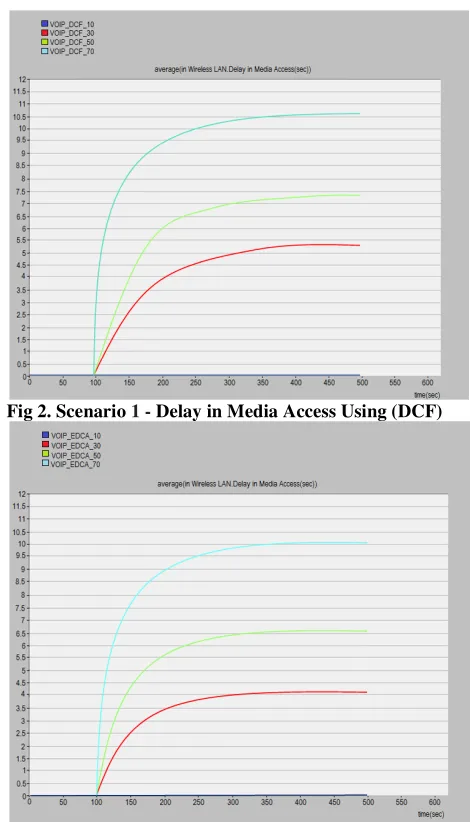
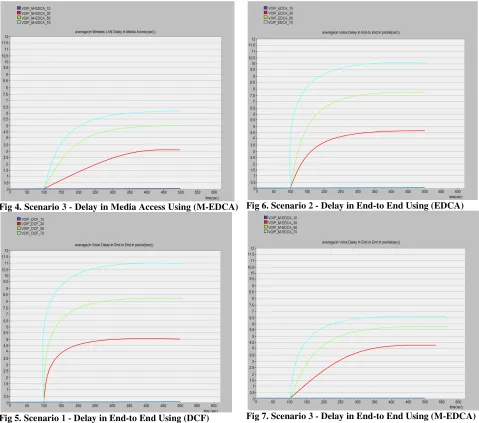
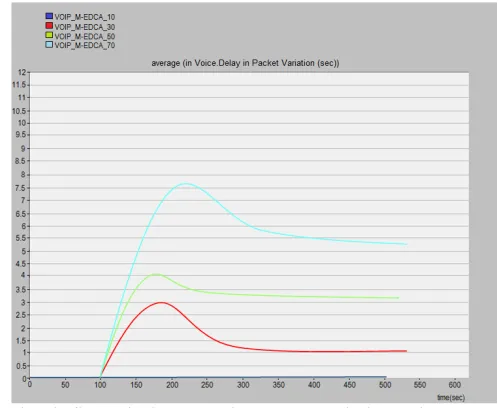
algorithms) are implemented in the simulations, and three cases are used to measure the delay in the algorithms. The first case is the test delay in Media Access, the second case is the test delay in end-to end transmission and the third case is the test delay in packet variation.
During this stage, the results are verified through successful practical implementation on the model and by using a set of and components are the parameters that produce the results and help facilitate the of a task compared with the final schemas. The experiment helps complete the model of the current algorithm (i.e. M_EDCA) based on the previous model applied to the simulations. Many scenarios are possible based on the ms. These scenarios include the specifications of the hardware, software and types used on the algorithms. Moreover, a set data for the input and output is divided into experimental multiple scenarios. The
and parameters of the simulation basic performance scenarios are listed in
Requirements 10, 30, 50, 70 250 m × 250 m
54 Mbps 500 s
VoIP, FTP, HTTP, Email Office
802.11g WLAN
Network Simulation Requirements All the tests, studies and results are conducted using the
er, which was previously described as passing through four stages: processing and fixing the data problem, designing the model, constructing the model and performing simulations and presenting the results mulations are written in C and C++. Different testing parameters are used for the scenarios to confirm the validity of the old results with the new results On the basis of the selected, depending on the number of nodes used in the web design (i.e. 10, 30, 50 and 70) to simulate different network sizes (e.g. small, medium and large). These scenarios are simulated individually using EDCA). Lastly, the
Three basic scenarios (i.e. ) are implemented in the simulations, and three cases are used to measure the delay in the algorithms. The first , the second case is the to end transmission and the third case is the
Fig 2. Scenario 1 - Delay in Media Access
Fig 3. Scenario 2 - Delay in Media Access
in Media Access Using (DCF)
International Journal of Computer Techniques
ISSN :2394-2231
Fig 4. Scenario 3 - Delay in Media Access Using
Fig 5. Scenario 1 - Delay in End-to End Using
International Journal of Computer Techniques -– Volume 5 Issue 2, Mar – Apr 2018
http://www.ijctjournal.org
Using (M-EDCA)
Using (DCF)
Fig 6. Scenario 2 - Delay in End-to End
Fig 7. Scenario 3 - Delay in End-to End
Apr 2018
Page 79
to End Using (EDCA)
Fig 8. Scenario 1 - Delay in Packet Variation
Fig 9. Scenario 2 - Delay in Packet Variation
Delay in Packet Variation Using (DCF)
elay in Packet Variation Using (EDCA)
Fig 10. Scenario 3 - Delay in Packet Variation EDCA)
Through the final results of the diagram we will create tables depending on the previous scenarios
Nodes 10 30 DCE 0.008 5.382 EDCA 0.006 4.162 M-EDCA 0.001 3.162
Table.2: Delay in Media Access (sec) for (DCF, EDCA, M EDCA)
Nodes 10 30 DCE 0.058 5.041 EDCA 0.054 4.682 M-EDCA 0.051 4.380
Table.3 : Delay in End-to End (sec) for (DCF, EDCA, M EDCA)
Nodes 10 30 DCE 1.903 3.031 EDCA 1.512 3.062 M-EDCA 1.246 3.034
Table .4 : Delay in Packet Variation (sec) for (DCF, EDCA, M-EDCA)
From the results presented in the precedi to 10) and tables (Table 2, 3, and 4), the
achieves the lowest average values among the three algorithms for all network sizes. Therefore, this algorithm is considered the best choice for VoIP applications in voice transmission over a network.
6. CONCLUSIONS
In recent years, the VoIP technique has become
communication technology; however, the use of VoIP faces numerous challenges. Firstly, this technology suffers from transmission quality (audio and video) a
The problem worsens in wireless networks, such as IEEE
Delay in Packet Variation Using
(M-Through the final results of the diagram we will create tables
50 70 7.468 10.687 6.138 10.131 5.078 6.257
: Delay in Media Access (sec) for (DCF, EDCA,
M-50 70 8.301 11.001 7.781 10.134 5.411 6.598
o End (sec) for (DCF, EDCA,
M-50 70 7.192 11.533 5.914 11.773 4.101 7.681
Delay in Packet Variation (sec) for (DCF, EDCA,
From the results presented in the preceding figures (Figures 2 , the M_EDCA algorithm achieves the lowest average values among the three algorithms for all network sizes. Therefore, this algorithm is considered the best choice for VoIP applications in voice
International Journal of Computer Techniques -– Volume 5 Issue 2, Mar – Apr 2018
ISSN :2394-2231
http://www.ijctjournal.org
Page 81
801.11. CSMA/CA reduces the collision of packets during transmission and reception over a network. For WLANs, which deal with MAC, algorithms that can reduce collisions include DCF and EDCA. DCF decreases the size of CW to the minimum value after each successful sending operation. In case of a failed transmission, the size of CW can be multiplied and other algorithms, such as EDCA, can provide better QoS compared with DCF. It depends on the priority in the transmission between the nodes and in turn they depend on the minimum and maximum size of CW dependence on AC through the transmission. Through the final evaluation of these algorithms and relative to the performance of VoIP, the size of the network should be verified. Network size can be determined based on the number of nodes used in the network and through tests conducted in the simulation program. The network used in this study was designed with four cases (10, 30, 50 and 70 nodes) and three network sizes (small, medium and large). From the experimental results presented in the previous section, the DCF and EDCA algorithms suffer from poor QoS and packet loss when the number of nodes reaches 50 and 70 and when the size of the network is either medium or large. However, good results and better performance are achieved, particularly in large networks, after the modification and development of the new algorithm (i.e. M_EDCA). Such improvement is realised by changing CW size in the new algorithm. The size of CW depends on the size of networks. Finally, the results indicate the superior performance of M_EDCA over DCF and EDCA.
7. FUTURE WORKS
1. A study on the speed of rotation between nodes, which affects the performance of audio applications on the new algorithm (M_EDCA). The results of speed for a variety of cases will be obtained, compared and improved to achieve the best results.
2. A study on the new algorithm and measurement value of throughput. Jitter will be tested and data decrease will be calculated. The obtained results will be compared with the results of other algorithms, and the final results will be evaluated.
3. The signals transmitted through wireless networks suffer from problems, such as refraction, signal weakness and noise, which play significant roles in evaluating the performance of voice transmission. In particular, these issues affect the values used in algorithms. These problems should be studied and solutions should be found to improve VoIP performance and reduce system damage.
REFERNCES
[1] Kim J, Niyaz Q, Javaid AY. Performance Evaluation of VoIP Broadcasting over LTE for Varying Speeds and Distances of Mobile Nodes. IEEE International Symposium on Broadband Multimedia Systems and Broadcasting. 2014; p. 1-5. Crossref .
[2] Li FF. Speech Intelligibility of VOIP to PSTN Interworking-A Key Index For the QoS. Printed and Published by the IEE (The institute of Electrical Engineers). 2004; p. 104-08.
[3] AlAlawi, K. and H. Al-Aqrabi, Quality of service evaluation of VoIP over wireless networks, In 8th IEEE GCC Conference and Exhibition (GCCCE) 2015, February.
[4] Cho, J.W. and Y. Jiang . Fundamentals of the Back off Process in 802.11: Dichotomy of the Aggregation, IEEE Transactions on Information Theory2015.
[5] Despaux, F. Modelling and evaluation of the end to end delay in WSN , Doctoral dissertation, Université de Lorraine, France 2015.
[6] Pan Y, Chung J, Zhang Z. Analysis of Performance of VoIP Over various scenarios OPNET 14.0, Final Report Group 11, SFU, Spring. 2012; p. 1-29.
[7] Milind U, Nemade, Satish K, Shah. Performance Comparison of Single Channel Speech Enhancement Techniques for Personal Communication, International Journal of Innovative Research in Computer and Communication Engineering. 2013 March; 1(1):1-4.
[8] Jannu K, Deekonda R. OPNET simulation of voice over MPLS with Considering Traffic Engineering. Blekinge Institue of Technology. 2010; 15.
[9] Das, Saurav, Sharafat, Reza A, Parulkar, Guru, et al. MPLS with a simple OPEN control plane. Optical Fiber Communication Conference and Exposition (OFC/ NFOEC), the National Fiber Optic Engineers Conference, 2011. p. 1–3. Crossref.
[10] Akinsipe O, Goodarzi F, Li M. Comparison of IP, MPLS and MPLS RSVP-TE Networks using OPNET. International Journal of Computer Applications. 2012; 58(2). Crossref. [11] O Flaithearta, P. Optimizing the QoS of VoIP applications over
WiFi through use of synchronized time, Doctoral dissertation, College of Engineering and Informatics, National University of Ireland Galway, 2015, Ireland.
[12] Kumar, Sushil, and Anil Kumar Verma. Position based routing protocols in VANET: A survey. Wireless Personal Communications , 2015.
[13] Sllame AM, Aljafari M. Performance Evaluation of Multimedia over IP/MPLS Networks. International Journal of Computer Theory and Engineering. 2015.
[14] Gangrade, K., P. Patidar and A. Tiwari. Performance Evaluation of IEEE 802.11 MAC DCF Using Various Schemes Towards-Throughput, Delay and Reliability, International Journal of Advanced Research in Computer and Communication Engineering, 2013.
[15] Faghihi E, Sadeghi ME, Behdadfar M. QoS Parameters Analysis in VoIP Network Using Adaptive Quality Improvement. IRAN: Tehran: Amirkabir University of Technology. 2015; p. 1-14.
[16] Ray M, Chandra M, Patil BP. Speech Coding Techniques for VoIP Applications: A Technical Review. World Applied Sciences Journal. 2015.
[17] RT, Sunitha BP. Speech Signal Coding for VOIP Applications Using Wavelet Packet Transform. International Journal of Science, Engineering and Technology Research (IJSETR). 2015, January.
[18] Dubey A. Quality of Service (QoS) in Wireless Network and NS-3, VOIP Simulation Environment, International Journal of Soft Computing and Engineering (IJSCE). 2012 , November. [19] Xia JB, Li MH, Wan LJ. Research on MPLS VPN networking
application based on OPNET. International Symposium on Information Science and Engineering, ISISE’08. 2008, April. [20] Wijnands IJ, Minei I, Kompella K, Thomas B. Label
Distribution Protocol Extensions for Point-to-Multipoint and Multipoint-to-Multipoint Label Switched Paths (No. RFC 6388). 2011.
[22] Mondal A, Huang C, Li J, Jain M, Kuzmanovic A. A Case for WiFi Relay: Improving VoIP Quality for WiFi Users. 2010; p. 1.
[23] Sifuzzaman M, Islam MR, Ali MZ. Application of Wavelet Transform and its Advantages Compared to Fourier Transform, Journal of Physical Sciences. 2009.
[24] Kazemitabar H, Ahmed S, Nisar K, Said AB, Hasbullah HB. A Comprehensive review on VOIP over Wireless LAN networks, Computer Science Letters. www.csl.issres.net. 2010, September.
[25] Tang J, Cheng Y. Quick Detection of Stealthy SIP Flooding Attacks in VOIP Networks. Japan: Kyoto: Proceedings of IEEE International Conference on Communication. June; 2011; p. 1-5. Crossref
[26] Rekik S, Guerchi D, Selouani SA, Hamam H. Speech steganography using wavelet and Fourier Transforms.
EURASIP Journal on Audio, Speech, and Music Processing. A Springer Open Journal. 2012.
[27] Srinivasan P, Jamieson LH. High Quality Audio Compression using an Adaptive Wavelet Packet decomposition and Psychoacoustic Modelling. IEEE Transactions on Signal Processing. 1998 April, Crossref
[28] Hilton ML, Ogden RT. Data Analysis Wavelet Threshold Selection in Two Dimensional Signal De-noising. IEEE Transaction on Pattern Analysis and Machine Learning. 1999. [29] Wook S, Cheol Y, Youn D. Speech Quality Measures for
VOIP using Wavelet based Bark Coherence Function, Eurospeech Scandinavia. 2001; p. 9-22.
[30] Ding L, Rafik A, Goubran. Speech Quality Prediction in VOIP Using the Extended E-Model. 2003; p. 1-4.