ISSN 2319-7625 (Online)
(An International Research Journal), www.chemistry-journal.org
High Field Ionic Conduction in Anodic Oxide Films on
Tantalum in Aqueous Acetic Acid Medium
B. R. Deshwal1 and Neha Kundu2
1
Department of Chemistry,
A. I. J. H. M. College, Rohtak, Haryana, INDIA.
2
Department of Chemistry, DCRUST, Sonipat, Haryana, INDIA.
(Received on: May 3, 2015)
ABSTRACT
The studies on the anodic growth of film on tantalum were carried out at various current densities (2.5, 5.0, 10.0 and 15.0 mAcm-2) in presence of 0.1N solutions of acetic acid (prepared in 1:1v/v of Ethanol + water) at four different temperatures (288.15, 298.15, 308.15 and 318.15K). The constants A and B of Guntherschulze and Betz empirical equation have been determined. The value of A varied with temperature but the value of B was found independent of temperature, which implies the non-dependence of Tafel slope on temperature. Dignam’s quadratic variation of field strength with ionic current density was examined critically. The zero field activation energy (
φ
), dimensionless quantity (C), zero field activation dipole (µ*), net activation energy W(E) and More function parameter (w*) of Dignam model were evaluated. The effects of temperature and current density on various parameters of Dignam model have been discussed. An appreciable contribution of the quadratic term elucidates that single-barrier theories of ionic conduction do not explain the data satisfactorily.Keywords: Anodic oxidation, Tantalum, Tafel slope, Dignam model,
Guntherschulze-Betz equation.
1. INTRODUCTION
182
the presence of two interfaces, i.e. metal/oxide and oxide/solution at which transfer process must occur. Anodic oxide films can be formed on valve metals by any of three methods (i) galvanostatically (ii) potentiostatically and (iii) by a sequence of constant current and constant voltage.
Anodic oxidation of valve metal plate in an acidic aqueous solution is a widely accepted technique for preparing oxide films with high bonding strength and has become an important process for improving the surface chemistry of metal in areas such as corrosion science and semi-conductor technology1. The high dielectric constant2 and high breakdown potential make these anodic oxide films particularly useful in the industrial chemical processes3 related to electronic devices, batteries, thin film transistors, corrosion protection films, fuel cells, thin film devices, nuclear technology4, rectifiers and in capacitor technology5 as dielectric, marine engineering6 and insulating materials. Ta2O5 thin films offer
a six-fold increase in dielectric constant compared to conventional dielectrics, so they can be used in the fabrication of a reliable high-density memory devices. These thin films are useful in themselves as protective and decorative coatings over the metal substrate.
The kinetics of growth of films on valve metals for a long time have been interpreted in terms of high field ionic conduction equation i = A exp(BE), where i is current density, E is the electric field strength in the film and A and B are positive temperature dependent constants. This relation is also known as Guntherschulze-Betz equation7. Various other models have been proposed to explain the growth kinetics but divergent views have been expressed by different workers8-24. According to Cabrera and Mott8, the Tafel slope should be proportional to temperature. However, Young13 found that the Tafel slope to be independent of temperature. Young13 and Dignam11 took into account the quadratic variation of field with ionic current density to explain the field and temperature dependence of Tafel slope. It appears that the exact behavior of Tafel slope with temperature needs thorough probing. The perusal of literature reveals that the results obtained by different workers are at variance.
In the present study, steady state kinetics for anodic growth of film on tantalum in different media at a wide range of temperatures and current densities has been investigated. The behavior of Tafel slope and critical assessment of various ionic conduction theories with special reference to Dignam's approach has been made.
2. MATERIALS AND METHODS
The anodic growth of oxide film on valve metal is very sensitive to the method of surface preparation of sample and hence to obtain reproducible results, many precautions are necessary to be taken during the preparation of specimen’s surface. The following procedure was used in the present study.
2.1 Technique for the preparation of surface of specimen for anodic polarization
specimen were abraded with 600 grit emery paper to make the surface smooth. The specimens were cleaned with acetone to remove the greasy particles, dipped in KOH melt to clean the surface and washed with doubly distilled water. The chemical polishing was done by dipping sample in freshly prepared etching mixture of 98% H2SO4, 70% HNO3 and 48%
HF (5:2:2 v/v) for 3-5 s and then washed with distilled water. The specimens were placed in boiling water for 10 minutes so as to remove any impurity left sticking to the surface. Finally, the sample was dried in a current of hot air. The entire process was repeated just before the use of the sample. The above process removed all the scratches and foreign materials and left a smooth surface. This technique of surface preparation has been found to give a constant rate of film growth in the process of anodization of specimens under constant current density conditions.
2.2 Working area of the specimen
Working area of the specimen was defined by making a thick anodic oxide film (say 250V) on tag in 0.1N citric acid at room temperature. Some oxide layer was always formed on the square portion of specimen surface due to creeping of electrolyte during the formation of film on tag. This extra layer formed was removed by dipping square portion of the sample in KOH melt up to required depth only. The square portion was washed, chemically polished and placed in boiling water as described earlier. In this way, no anodization on tag took place during anodic oxidation of electrode and working area was exactly 2cm2.
2.3 Experimental set up for anodic polarization
Tantalum specimens prepared by above mentioned procedure were placed in a pyrex glass cells of diameter 8cm and height 15cm. The specimen was placed in the centre of circular Pt wire mesh which acts as a cathode during anodic oxide film formation. The cell was immersed in a constant temperature thermostat which controlled the temperature up to ±0.05K.
2.4 Procedure for anodic growth of oxide film on tantalum
184
2.5 Determination of thickness of oxide film
The thickness of Ta film was determined using Faraday's Law as follows:
d = MQ/10ρFA (1)
where M is gram molecular weight of Ta2O5 film, Q is amount of charge passed, ρ is the
density of oxide film, F is Faraday's constant and A is area of the specimen. The density of Ta2O5 was taken to be 7.93 gcm
-3
as reported by Young [16]. The value of factor M/10ρFA for Ta2O5 films was found to be 2.88664×10
-7
C-1m. Using the calculated thickness of the film and the corresponding voltage of formation, the field strength (E = V/d) was calculated at any given current density.
3. RESULTS AND DISCUSSION
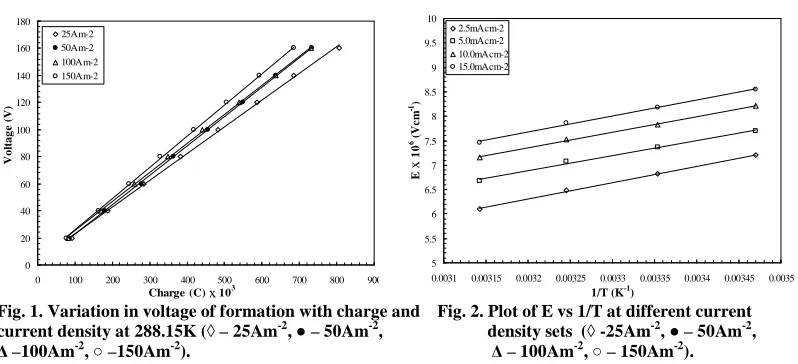
Data for anodic oxidation of Tantalum in acetic acid at various temperatures and current densities have been presented in Table 1. The variation of voltage of formation versus charge at 288.15K and at different current densities in 0.1N acetic acid is presented in Fig. 1.
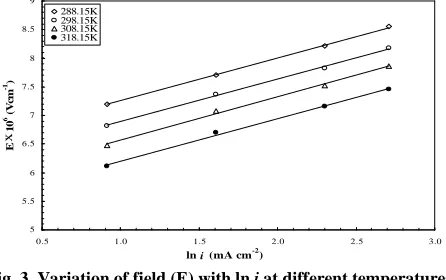
Fig. 1. Variation in voltage of formation with charge and Fig. 2. Plot of E vs 1/T at different current current density at 288.15K (◊ – 25Am-2, ● – 50Am-2, density sets (◊ -25Am-2, ● – 50Am-2,
∆ –100Am-2, ○ –150Am-2). ∆ – 100Am-2, ○ – 150Am-2).
The rate of growth of oxide film at different current densities and temperatures was found uniform up to 160V in acetic acid. During the growth, color of the film changed at various voltages from purple, fuchsia, turquoise, green and cobalt blue. At the breakdown voltage25 the color was dark grey and the surface was rough; this may be due to some local crystallization of Ta2O5
26
.
It was observed that the thickness of the oxide layer governs the color perceived. Thin film interference is responsible for the color. The oxide is transparent and has a high refractive index. Light waves bounce off the oxide, but some go through and reflect off the metal below, reappearing at the surface after a time delay that depends on the thickness of
0 20 40 60 80 100 120 140 160 180
0 100 200 300 400 500 600 700 800 900
Charge (C) x 103
V
o
lt
a
g
e
(
V
)
25Am-2 50Am-2 100Am-2 150Am-2
5 5.5 6 6.5 7 7.5 8 8.5 9 9.5 10
0.0031 0.00315 0.0032 0.00325 0.0033 0.00335 0.0034 0.00345 0.0035
1/T (K-1)
E
x
1
0
6 (
V
c
m
-1)
the oxide layer. Those two sets of wave either interfere with or reinforce each other, creating the color to be visible17. The oxide film itself is resistant to the passage of current and grows to a certain thickness and then stops. The linear behavior in voltage versus current plots as shown in Fig. 1 up to 160V shows that the field strength within film is constant and is almost independent of film thickness.
Plots of field strength E against reciprocal of absolute temperature (Fig. 2) at different current densities is again linear and parallel and have slope ∂E/∂(1/T). This graph showed that at the same current density, with the rise of temperature, the value of field strength E decreased. A slight scattering of points may be due to the uncertainties involved in the measurements of temperature, current density and pre-history of the film.
The data presented in Table 1 has been analyzed by considering various theories for ionic conduction. Applying the Guntherschulze and Betz empirical equation, constants A and B were calculated by using the method of least squares and tabulated in Table 3. The validity of this equation was verified at various current densities and for different aqueous electrolytes. The value of A varies with temperature but there is not much significant variation in the values of B, indicating the value of B to be independent of temperature. This implies the non-dependence of Tafel slope on temperature. The value of A and B, however, vary with the nature of the aqueous electrolyte.
According to the single barrier theory of Cabrera and Mott8 for ionic growth, E is given by:
bq q v N i bq kT E
s s
φ
+
= ln (2)
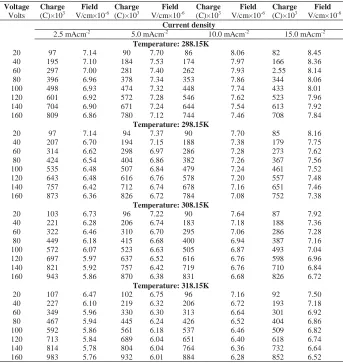
where all the terms have their usual significance8. According to this theory, the Tafel slope (∂E/∂ln i) should be directly proportional to absolute temperature. Tafel slope values obtained from the graph between E and ln i (as shown in Fig. 3) at different temperatures are constant, thus the applicability of this theory was ruled out.
Fig. 3. Variation of field (E) with ln i at different temperatures (◊ – 288.15K, ○ – 298.15K, ∆ – 308.15K, ● – 318.15K).
Dignam11 attempted to explain the field and temperature dependence of Tafel slopes for steady state anodic oxidation of valve metals by considering a simple model, according to
5 5.5 6 6.5 7 7.5 8 8.5 9
0.5 1.0 1.5 2.0 2.5 3.0
ln i (mA cm-2)
E
x 1
0
6 (
V
cm
-1)
186
which the field independent component of potential energy function for displacement of a mobile charged species was assumed to resemble a Morse function. According to this model, steady state data for anodic oxidation for these metals were represented by three empirical constants; the exponential factor, the activation energy and Morse function distance parameter. According to him at high fields, the relation between current density and field strength was given by11:
− − − = kT C E E i i o )) / ( 1 ( { exp * *
µ
φ
µ
φ
(3)where io is the primary current density,
φ
is the zero field activation energy, C is adimensionless quantity and µ* is the zero field activation dipole. Parameters µ*,
φ
and C are not independent constants but are related through the form of potential energy function. Eq. (3) may be written as: − − − = 2 1 * ln 4 4 1 1
2 io
i C kT C C E φ µ
φ (4)
Also,
( )
2 1 ln 4 4 1 ln 1 * 2 − − − = = ∂ ∂ o o i i C kT C i i kT S T E φµ (5)
if ∂S/∂ln i = 0, that is, Tafel slope being temperature independent, we have from Eq. (5)
+ = o i i kT
C 4 2 ln
φ
(6)The reciprocal of Tafel slope, is given by
− = ∂ ∂ = φ µ µ β C E kT E
i * *
2 1 ln
(7)
Various parameters of Dignam's equation can be solved using above equation as follows:
1 2 1 1 1 4 − + + = S TE
C (8)
β µ kT S TE + = 1
* (9)
1 * 1 2 1 − + = TE S C E φ
µ (10)
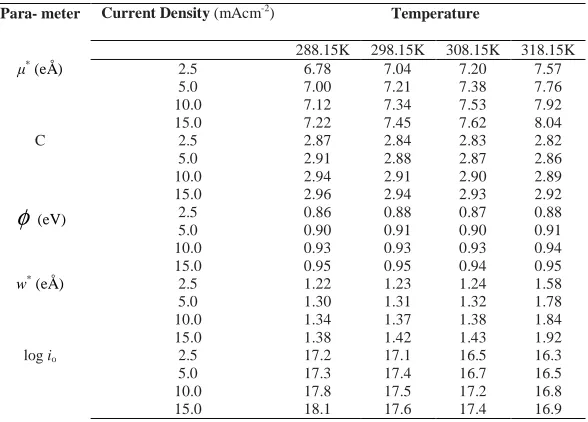
The values of zero field charge-activation distance product (µ*) are found to increase with temperature as well as the current density. Temperature has negligible effect on the magnitude of quadratic parameter (C) and zero field activation energy (
φ
) but they depend slightly on nature of aqueous electrolyte. The quantities C andφ
both increase slightly with current density. The dependence of µ* andφ
with the current density were not observed by Dignam due to non-availability of steady state data for a wide range of temperature and current density.The equation of ionic conduction can also be written as13:
(
)
− − − − = kT E w E w E w i i o ) 2 ( ) 2 ln( 1 exp * * *φ
φ
φ
(11)where w* is the Morse function parameter and has the same dimensions as µ* and is given by
1 2 1 2 1 * 2 * − + =
φ
µ
φ
E C E w (12)The values of w* are calculated using the values of E, µ*, C and
φ
are found to depend on temperature and current density.The values of the net activation energy W(E) were calculated as follows:
− − =
φ
µ
µ
φ
C E E E W * * 1 )( (13)
The values of W(E) are found to be 2.37 for acetic acid. The values of W(E) were found to be temperature and current density independent. The quantity µ*E/C
φ
measures the extent of the contribution of the quadratic term over the entire range of data and was found to be 11-13%.From Eq. (3) and (13)
− = kT E W i i o ) (
exp (14)
The values of log io were calculated using Eq. (14). The values are found to be temperature
dependent and not independent as assumed by Dignam. The values of io were found to
change with the current density. It appears that increase in temperature causes increase in activation distance product (µ*). This explains the increase of w* with temperature. As
φ
andW(E) are the activation energies, therefore they are not affected by temperature. The increase
in value of µ* and w* with current density may be due to mobile ions. The parameters io and C have no dimensions, hence they are not affected by temperature and current density. In the
188
is a variation of Morse function parameters with temperature and current density, thus a single barrier theory is not strictly applicable to our data. There might be the possibility of the existence of space charge in such films.
Table 1. Formation of anodic oxide film on tantalum in 0.1N acetic acid at various temperatures and current densities.
Voltage Charge Field Charge Field Charge Field Charge Field
Volts (C)×103 V/cm×10-6 (C)×103 V/cm×10-6 (C)×103 V/cm×10-6 (C)×103 V/cm×10-6
Current density
2.5 mAcm-2 5.0 mAcm-2 10.0 mAcm-2 15.0 mAcm-2
Temperature: 288.15K
20 97 7.14 90 7.70 86 8.06 82 8.45
40 195 7.10 184 7.53 174 7.97 166 8.36
60 297 7.00 281 7.40 262 7.93 2.55 8.14
80 396 6.96 378 7.34 353 7.86 344 8.06
100 498 6.93 474 7.32 448 7.74 433 8.01
120 601 6.92 572 7.28 546 7.62 523 7.96
140 704 6.90 671 7.24 644 7.54 613 7.92
160 809 6.86 780 7.12 744 7.46 708 7.84
Temperature: 298.15K
20 97 7.14 94 7.37 90 7.70 85 8.16
40 207 6.70 194 7.15 188 7.38 179 7.75
60 314 6.62 298 6.97 286 7.28 273 7.62
80 424 6.54 404 6.86 382 7.26 367 7.56
100 535 6.48 507 6.84 479 7.24 461 7.52
120 643 6.48 616 6.76 578 7.20 557 7.48
140 757 6.42 712 6.74 678 7.16 651 7.46
160 873 6.36 826 6.72 784 7.08 752 7.38
Temperature: 308.15K
20 103 6.73 96 7.22 90 7.64 87 7.92
40 221 6.28 206 6.74 183 7.18 188 7.36
60 322 6.46 310 6.70 295 7.06 286 7.28
80 449 6.18 415 6.68 400 6.94 387 7.16
100 572 6.07 523 6.63 505 6.87 493 7.04
120 697 5.97 637 6.52 616 6.76 598 6.96
140 821 5.92 757 6.42 719 6.76 710 6.84
160 943 5.86 870 6.38 831 6.68 826 6.72
Temperature: 318.15K
20 107 6.47 102 6.75 96 7.16 92 7.50
40 227 6.10 219 6.32 206 6.72 193 7.18
60 349 5.96 330 6.30 313 6.64 301 6.92
80 467 5.94 445 6.24 426 6.52 404 6.86
100 592 5.86 561 6.18 537 6.46 509 6.82
120 713 5.84 689 6.04 651 6.40 618 6.74
140 814 5.78 804 6.04 764 6.36 732 6.64
160 983 5.76 932 6.01 884 6.28 852 6.52
Table 2. Mean fields at different current densities and temperatures in 01.N Acetic Acid
Current Density (mA cm–2) Field (E) at various temperatures × 106 Vcm-1
288.15K 298.15K 308.15K 318.15K
2.5 6.92 6.50 6.12 5.80
5.0 7.25 6.92 6.56 6.20
10.0 7.52 7.25 6.90 6.56
Table 3. Parameters A and B of Guntherschulze and Betz equation at different temperatures
Temperature (K) A (Acm-2) B (cmV-1)
288.15 1.0×10⁻⁸ 1.778×10⁻⁶
298.15 2.0×10⁻⁸ 1.798×10⁻⁶
308.15 4.0×10⁻⁸ 1.798×10⁻⁶
318.15 6.9×10⁻⁸ 1.808×10⁻⁶
Table 4. Various parameters calculated from the Dignam's ionic conduction equations at different temperatures.
Para- meter Current Density (mAcm-2) Temperature
288.15K 298.15K 308.15K 318.15K
µ* (eÅ) 2.5 6.78 7.04 7.20 7.57
5.0 7.00 7.21 7.38 7.76
10.0 7.12 7.34 7.53 7.92
15.0 7.22 7.45 7.62 8.04
C 2.5 2.87 2.84 2.83 2.82
5.0 2.91 2.88 2.87 2.86
10.0 2.94 2.91 2.90 2.89
15.0 2.96 2.94 2.93 2.92
φ
(eV) 2.5 0.86 0.88 0.87 0.885.0 0.90 0.91 0.90 0.91
10.0 0.93 0.93 0.93 0.94
15.0 0.95 0.95 0.94 0.95
w* (eÅ) 2.5 1.22 1.23 1.24 1.58
5.0 1.30 1.31 1.32 1.78
10.0 1.34 1.37 1.38 1.84
15.0 1.38 1.42 1.43 1.92
log io 2.5 17.2 17.1 16.5 16.3
5.0 17.3 17.4 16.7 16.5
10.0 17.8 17.5 17.2 16.8
15.0 18.1 17.6 17.4 16.9
4. CONCLUSIONS
In brief, high field ionic conduction in anodic oxide film on tantalum has been examined at various current densities and temperatures in presence of 0.1N acetic acid. The constants A and B of Guntherschulze and Betz empirical equation have been determined. The value of B was found independent of temperature, which implies the non-dependence of Tafel slope on temperature. Various parameters of Dignam model i.e. zero field activation energy (
φ
), dimensionless quantity (C), zero field activation dipole (µ*), net activation energy W(E) and More function parameter (w*) have been evaluated and the effects of temperature and current density on these parameters have been discussed.5. ACKNOWLEDGEMENT
190
REFERENCES
1. EI-Mahdy, G.A., Thin Solid films, Vol. 307, p. 141 (1997).
2. Kamada, K., Mukai, M., and Matsumoto, Y., Electrochim. Acta, Vol. 49, p. 321 (2004).
3. Smallwood, R.E., Use of Refractory Metals in Chemical Process Industries: In
Refractory Metals and their Industrial Application. ASTM, Philadelphia, PA, p.106
(1984).
4. Frost, B.R.T., Nuclear Fuels Elements: Design, Fabrication and Performance. Pergamon Press, Oxford, (1982).
5. Sikula, J., Hlavka, J., Sedlakova, V., and Grmela, L., AVX Corporation, (2003).
6. Geld, I., Cathodic Protection Anode with Sections Replaceable under Water, US Pat., 3 718, 570, (1973).
7. Guntherschulze, A., and Betz, H., Z. Phys., Vol. 92, p. 367 (1934).
8. Cabrera, N., and Mott, N.F., Rep. Prog. Phys., Vol. 12, p. 163 (1948).
9. Diggle, W.J., Anodic Oxide and Oxide Films, Marcel Dekker, Inc., New York, Vol. I, p. 92 (1972).
10. Dewald, J.F., J. Electrochem. Soc., Vol. 102, p. 1 (1955).
11. Dignam, M.J., J. Electrochem. Soc., Vol. 126, p. 2188 (1979).
12. Nigam, R.K., Singh, K.C., and Maken, S., Thin Solid Films, Vol. 155, p. 115 (1987).
13. Young, L., Anodic Oxide Films. Academic Press, New York, (1961).
14. Kalra, K.C., Katyal, P., and Singh, K.C., Thin Solid Films, Vol. 177, p. 35 (1989).
15. Kalra, K.C., Singh, K.C., and Singh, M., Thin Solid Films, Vol. 239, p. 99 (1994).
16. Young, L., Proc. Roy. Soc. London A, Vol. 244, p. 41 (1958).
17. Zurer, P.S., C & EN's Washington, (2003).
18. Alsabet, M., Gorden, M., and Jerkiewicz, G., J. Electroanal. Chem., Vol. 589, p. 120 (2006).
19. Vijh, A.K., Electrochim. Acta, Vol. 17, p. 91 (1972).
20. Hukovic, M.M., and Grubac, Z., J. Electroanal. Chem., Vol. 556, p. 167 (2003).
21. Poznyak, S.K., Talapin, D.V., and Kulak, A.I., J. Electroanal. Chem., Vol. 579, p. 299 (2005).
22. Mogoda, A.S., El-Taib Heakal, F., and Ghoneim, A.A., Thin Solid Films, Vol. 219, p. 146 (1992).
23. Kotz, R., Schnyder, B., and Barbero, C., Thin Solid Films, Vol. 233, p. 63 (1993).
24. Heidelberg, A., Rozenkranz, C., Schultze, J.W., Schapers, T., and Staikov, G., Surface
Science, Vol. 597, p. 173 (2005).
25. Ikonopisov, S., Electrochim. Acta, Vol. 22, p. 1077 (1997).