Research Journal
Volume 11, Issue 2, June 2017, pages 23–27
DOI: 10.12913/22998624/67672 Research Article
HYBRID LAYER TYPE CR/LPC
Konrad Dybowski1, Paulina Kowalczyk1 , Bartłomiej Januszewicz1, Damian Batory1
1 Institute of Materials Science & Engineering, Technical University of Lodz, 1/15 Stefanowskiego Street,
90-924 Lodz, Poland, e-mail: [email protected]
ABSTRACT
Application of metal coatings and the carburized layer are widely known and read-ily used for various elements, depending on the application. Metal coatings based on chromium are used in order to increase resistance to wear, corrosion and erosion. The
coatings applied by different methods have a significant drawback - they are not well related with the substratum, so there is a risk of cracking or flaking. Any discrepan
-cies and flaws disqualify such a way as to protect the surface. Carburizing processes
will be carried out, primarily in order to increase the hardness of the surface layer while maintaining a ductile core of the object. It is likely that the combination of these treatments will provide to increase the hardness of the material. The behavior of the proper order to create hybrid layer ensures the continuity of the resulting layer and its good connection with the steel. The paper presents a hybrid layer consisting of the
deposited chrome and PVD in the next stage of low pressure carburizing. Conducted process allows chromium diffusion into the material, the enrichment of the steel and
to ensure the continuity of the layer.
Keywords: hybrid layer, thermo-chemical treatment, metallization, diffusion.
INTRODUCTION
The formation of the hybrid layer is
per-formed using a combination of different surface
treatment processes. It is possible, for exam-ple, to create a layer consisting of carbides of various metals by a combination of metalliza-tion and carburizametalliza-tion process. In this type of
hybrid treatment processes PVD or CVD, and
electrochemical methods are employed to ap-ply a given element / elements to the surface
of the workpiece. The applied element diffuses
the thermo-chemical treatment, which can be, for example, carburizing [4÷10, 12, 14, 15].
Combining metallization with thermo-chemical
processes allows the formation of a continuous
film of carbide, providing a good grip with the
metal substrate. This type of hybrid layer may cause an increase in anti-wear properties and corrosion resistance of the workpiece [14, 15]. At present literature reports about the use of
combined treatments to produce anti-corrosion layers using carburizing process, after coating the steel with nickel and cobalt [12] and also uses of anti-wear, for example, by formation of chromium carbide on steel [11]. For increasing chromium carbide coatings, it is noted that in case of crystalline layers achieves higher
hard-ness and a lower friction coefficient compared
with amorphous coatings [3]. Preparation of hy-brid layer may also dispense with the method TRD (thermal reactive deposition) using a di-rectly applied coating of an intermetallic phase
set, or a chemical compound [1]. Creating hy
-brid layers achieve the specified performance
in surface area and good adhesion and continu-ity produced between the casing and the core of the work material. The combination of sev-eral surface treatments allows for an increase in mechanical properties, but also depends on the type of input element, which may increase the other physico-chemical properties.
The article presents a new way of forming a hybrid layer, the method of combining RF-PVD
with low pressure carburizing (LPC). The hybrid
layer was made by that method, which is a com-bination of chromium with the carburization of the iron substrate. The conducted process allows
a diffusion of chromium into the processed mate -rial, forming the basis of the intermetallic phases and continuity produced layer. The article pres-ents metallographic layers made of hybrid, and
X-ray diffraction was performed to determine the
construction phase. Studies were also made on
carbon concentration profile in the surface layer to specify effect of metallization on the carbon diffusion and distribution of chromium concen -tration in the layer, for determining gradient and
the diffusion depth of the element.
RESEARCH SUBJECT
A sample of Armco iron, with dimensions of 12mm x Ø16mm, was applied with a chromium coating by physical vapor deposition PVD-RF. Be-fore coating, the surface of the sample was
digest-ed in argon plasma high-frequency discharge at a
pressure of 2 Pa, auto-polarization potential -800V during 10 minutes. The process of applying a
chro-mium coating was carried out using a pulsed DC magnetron sputtering cathodes Cr (Kurt Lesker) at
a pressure of 0.5 Pa, 500 W power and potential of 50V in 116 minutes. The thickness of the coating was 1.0 µm. The sample with a chromium coating were place in a vacuum furnace. The sample was overlaid with a chromium coating then placed in
a vacuum furnace. In the first stage, the working
chamber of the furnace was evacuated to a pres-sure of 10 Pa and then heated to a temperature of
1050°C. At this temperature the sample was an -nealed during 60 minutes. At this time, the furnace chamber, at the same temperature dispensed gases: ethylene, acetylene and hydrogen in the volume ra-tio 2: 2: 1 at a pressure of 300-800 Pa (pulsara-tion)
[13]. Carburizing process consisted of alternating segments of diffusion and saturation of 4/10, 2/17,
2/34, 2/31 minutes respectively. After carburizing the samples were pre-cooled to a temperature of
860 ° C, soaked for 20 minutes at this temperature and quenched in a gas (nitrogen) at a pressure of
1.2 MPa to ambient temperature. The treated
sam-ple was examined in diffraction spectrometric and
metallographic tests. The method used for obtain-ing the hybrid layer is described in a patent [2].
RESULTS
To determine the construction of the obtained
hybrid layer metallographic, diffraction and a quantitative depth profile of chromium and car -bon was performed.
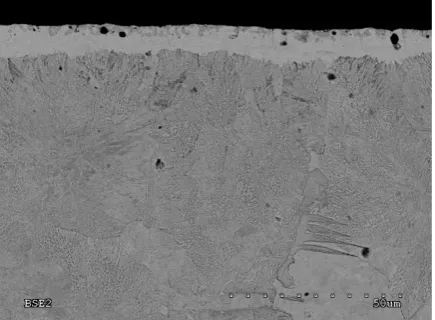
Metallographic examination revealed the
presence of a continuous layer of different mor -phology (Figure 1). It is visible from the surface of white layer having a thickness of about 10 to
15 μm, passing into the pearlitic structure, and
then ferritic-pearlitic to the ferrite substrate. Samples were also tested by small angle X-ray
diffraction. Diffraction was carried out using X-ray diffractometer equipped with ancopper an
-ode. The sample was scanned at 2Θ configura -tion, starting from an angle of 20.5 degrees and
ending at 85 degrees in steps of 0.1°. Counting
time t = 10s. The results are provided in Figure 2. The results showed the presence in the outer
layer of two types of chromium carbide Cr2C and Cr7C3.
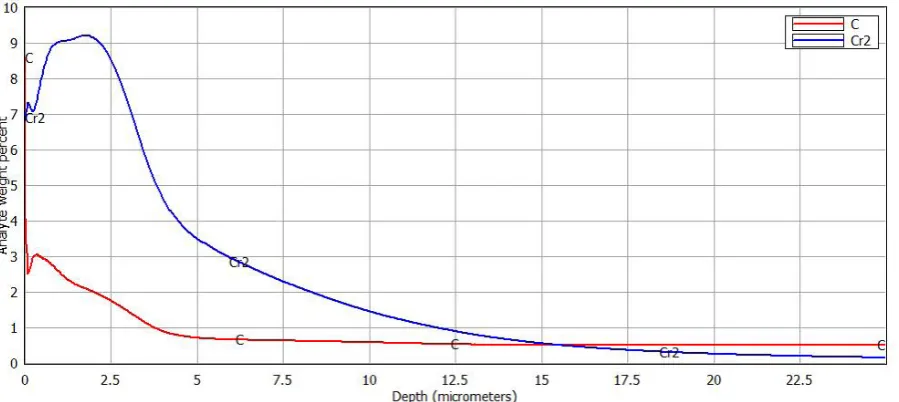
In order to determine the depth of diffusion of chromium, quantitative depth profile of the
chromium layer was carried out in a test sample. For the research glow discharge optical emission
spectrometer (GDOES) was used equipped with software for creating distribution profiles of ele -ments in the surface layer. The program allows to
perform the profile to a depth of 100 µm. Figure
3 shows the results of analysis of the contents of chromium and carbon from the surface of the sample. Maximum concentration of chromium at
the surface is about 9% by weight, and the diffu -sion depth of approx. 23 microns, and about 3% carbon by weight.
Fig. 1. The microstructure of the Armco surface after metallization and low – pressure carburizing process.
To determine the effect of chromium layer on the carbon diffusion in the carburizing con
-centration, the carbon profile was made in the
surface layer of the test material. The measure-ments were made using an glow discharge opti-cal emission spectrometer GDOES. Appointment
of carbon concentration profile was based on the
analyzes performed by volumetric carbon con-centration at a certain depth from the surface (the
depth of the crater after the firing was 2 μm). An -other layer of material were removed mechani-cally by grinding abrasive papers with corundum
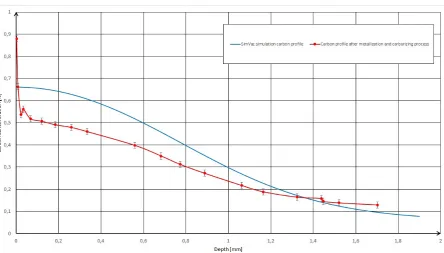
abrasive. Based on the survey (Fig. 4) a signifi -cant carbon content at the surface can be seen, which drops sharply to about 0.5% by weight and a gentle slope to a value of 0.1% wt. The total
thickness of the carburized layer made in the pro-cess is about 1.6 mm, while the carbon content criterion for 0.4% by weight and a thickness of
about 0.6 mm. The obtained carbon profile was
compared to that produced at Armco iron in the same process of carburizing without coating of
chromium. Comparing the two carbon profiles it
can be stated that in the case of a hybrid layer we observe the accumulation of carbon at the surface
to a depth of about 10 to 15μm, followed by a
mild decrease in the concentration of the content in the core. However, in the case of carburizing,
the result profile is characterized by a continuous
carbon concentration, gradually decreasing from the surface to the core, the thickness of this layer for criterion of 0.4% by weight is about 0.8%,
Fig. 2. Diffractogram of Armco after metallization and low-pressure carburizing process
while the total thickness of the carburized layer is approximately 1.8 mm.
The research proved that:
• Carrying out the process of carburizing pre -ceded by applying chromium coating allows a simultaneous enrichment of the element coat-ing and carbon;
• Continuing the process obtained from the sur -face layer consisting of a mixture of chromium
carbides Cr7C3 and Cr2C and carburized layer;
• Laying chromium before carburizing process
reduces its amount diffused into the carbon
steel, which accumulates on the surface of the resulting chromium carbides.
CONCLUSIONS
The study shows that it is possible to produce a hybrid layer, through a combination of metalliza-tion and low pressure carburizing processes. As a result of the process continuous layer of chromium carbide carburized layer on the substrate was ob-tained and it is consistent with the treated surface of iron core. Thus formed layer is characterized
by a limited diffusion of carbon in comparison to the layer obtained by conventional carburization because it is partly used to form carbides. Such
layers may have a significantly higher anti-wear
attributes than the same carburized layers because of the produced intermetallic phases. These layers
bring together benefits of wear resistant coatings
and carburizing layers, while providing a very good cohesion of the treated substrate.
Acknowledgments
The research was carried out under the grant for statutory activities of the Institute of
Materi-als Science TUL 2016 verification study for the
modernization of its own testing procedures SUB No. 501-11-7-1-9175.
REFERENCES
1. Chen F. S., Lee P. Y. and Yeh M. C.: Thermal reac -tive deposition coating of chromium carbide on die
steel in a fluidized bed furnace. Materials Chemis -try and Physics, 53, 1998, 19–27.
2. Dybowski K., Kowalczyk P., Atraszkiewicz R. and Ja -nuszewicz B.: Patent Application No. P. 416797, 2016. 3. Esteve J., Romero J., Gómez M. and Lousa A.: Cathodic chromium carbide coatings for molding die applications. Surface and Coating Technology,
188–189, (2004), 506–510.
4. Gawroński Z., Malasiński A. and Sawicki J.: Elim -ination of galvanic copper plating process used in hardening of conventionally carburized gear Fig. 4. Carbon profiles obtained as a result of metallization and vacuum carburizing of Armco and SimVac
wheels. International Journal of Automotive Tech -nology, 11 (1), 2010, 127-131.
5. Gawroński Z., Sawicki J.: Technological surface
layer selection for small module pitches of gear wheels working under cyclic contact loads. Mate-rials Science Forum, 513, 2006, 69-74.
6. Gold M., Zeigler D. D., Harth G. H., Tanzosh J. M., LaCount D., Kung S. C. and Mohn W. R.: United
State Patent No.: 6503340, 2003.
7. Kessler O. H., Hoffmann F.T. and Mayr P.: Com -binations of coating and heat treating processes: establishing a system for combined processes and
examples. Surface and Coating Technology, 108
(1), 1998, 211-216.
8. Kessler O.: Combination of coating and heat treat -ment processes, Surface and Coating Technology,
201, 2006, 4046–4051.
9. Kula P, Kaczmarek Ł, Dybowski K, Pietrasik R and Krasowski M.: Activation of carbon deposit
in the process of vacuum carburizing with prelimi-nary nitriding. Vacuum, 87, 2013, 26-29.
10. Kula P., Pietrasik R., Dybowski K., Paweta S.
and Wolowiec E.: Properties of surface layers processed by a new, high-temperature vacuum carburizing technology with prenitriding -
PreN-itLPC®. Advanced Materials Research, 401 (6),
2012, 452-453.
11. Kula P., Olejnik J., Heilman P.: European Patent
No.: EP1558780, 2007, United States Patent No.: US 7513958, 2009.
12. Ramqvist, L. H., Grinder N. O., Sporrong M., Eng -hang P.: United State Patent No. 4013487, 1997. 13. San S.: A study on kinetics of CrxC-coated
high-chromium steel by thermo-reactive diffusion tech
-nique, Vacuum, 79, 2005, 63-70.
14. Sawicki J., Górecki M., Kaczmarek Ł., Gawroński Z., Dybowski K., Pietrasik R., Pawlak W.: Increas -ing The Durability Of Pressure Dies By Modern
Surface Treatment Methods. Chiang Mai Journal
of Science, 40 (5), 2013, 886-897.
15. Wierzchon T.: Structure and properties of mul-ticomponent and composite layers produced by combined surface engineering methods, Surface