R E V I E W
Open Access
Animal models of enterovirus 71 infection:
applications and limitations
Ya-Fang Wang
1,2and Chun-Keung Yu
1,3,4*Abstract
Human enterovirus 71 (EV71) has emerged as a neuroinvasive virus that is responsible for several outbreaks in the Asia-Pacific region over the past 15 years. Appropriate animal models are needed to understand EV71 neuropathogenesis better and to facilitate the development of effective vaccines and drugs. Non-human primate models have been used to characterize and evaluate the neurovirulence of EV71 after the early outbreaks in late 1990s. However, these models were not suitable for assessing the neurovirulence level of the virus and were associated with ethical and economic difficulties in terms of broad application. Several strategies have been applied to develop mouse models of EV71 infection, including strategies that employ virus adaption and immunodeficient hosts. Although these mouse models do not closely mimic human disease, they have been applied to determine the pathogenesis of and treatment and prevention of the disease. EV71 receptor-transgenic mouse models have recently been developed and have significantly advanced our understanding of the biological features of the virus and the host-parasite interactions. Overall, each of these models has advantages and disadvantages, and these models are differentially suited for studies of EV71 pathogenesis and/or the pre-clinical testing of antiviral drugs and vaccines. In this paper, we review the characteristics, applications and limitation of these EV71 animal models, including non-human primate and mouse models.
Keywords:Enterovirus 71, Animal models, Pathogenesis
Review
Introduction
Since the effective control of poliovirus, enterovirus 71 (EV71) has been regarded as the most important neuro-tropic enterovirus. EV71 belongs to the species Human enterovirus A of the genusEnterovirus within the family Picornaviridaeand is the major pathogen of hand-foot-mouth disease (HFMD). EV71 was first described in 1974 after it was isolated from patients in California and from then on, EV71 infection has been reported in at least 12 small and large outbreaks throughout the world [1-4]. Two subsequent outbreaks occurred in Malaysia and Taiwan in the late 1990s, and these outbreaks mainly affected young children and were characteristically associ-ated with severe neurological complications and high rates
of fatality [3,5]. Since then, the Asia-Pacific region, in-cluding Taiwan, Malaysia, Vietnam, Singapore, Japan and China, has experienced more frequent large-scale EV71-associated HFMD epidemics.
EV71 infection is generally mild and self-limited, but occasionally such infection leads to central nervous sys-tem (CNS) infections that include aseptic meningitis, brainstem encephalitis and acute flaccid paralysis [6,7]. Fatal EV71 cases develop and progress rapidly and are typically associated with neural complications, pulmon-ary edema and function collapse, which make clinical management challenging [8,9]. The precise mechanisms of EV71-mediate disease, particularly the neuropatho-genesis, are still not fully understood because suitable and relevant animal models have not been established.
Similar to poliovirus, EV71 has a limited host range; humans are the only known natural host. Early studies showed that the members ofPicornaviridaedisplay distinct pathogenicities in newborn mice for which neither polio-virus nor echopolio-virus are pathogenic; coxsackie A polio-viruses were found to cause generalized myositis, and coxsackie B
* Correspondence:[email protected]
1Center of Infectious Disease and Signaling Research, Collage of Medicine,
National Cheng Kung University, Tainan, Taiwan
3Department of Microbiology and Immunology, Collage of Medicine,
National Cheng Kung University, No. 1, University Road, Tainan 70101, Taiwan
Full list of author information is available at the end of the article
viruses were found to induce myocarditis [10,11]. Soon after the discovery of EV71, experimental EV71 infections were reported in neonatal mice [12,13] and cynomolgus monkeys [14]. However, EV71 experimental infection models were not established until the severe outbreaks in the Asia-Pacific region around the late 1990s [6,15].
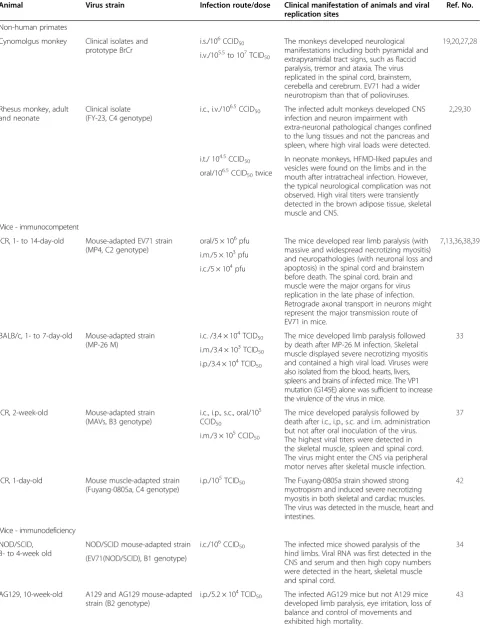
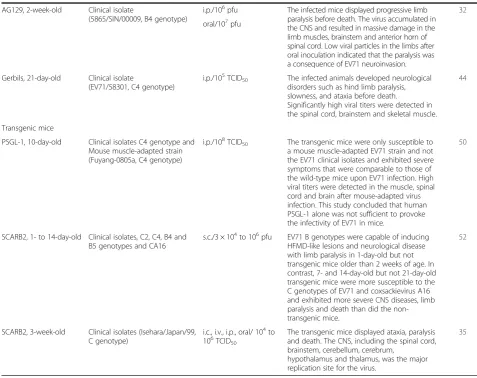
Experimental models of EV71 infection, including mur-ine and non-human primate models, have been developed as alternative means to determine the pathogenesis of and treatments and preventions for the diseases caused by this virus. Indeed, works based on these models have advanced our knowledge of EV71 infection and disease, and most importantly, have accelerated the development of EV71 vaccines. In this review, we discuss these animal models and emphasize their applications and limitations (summa-rized in Table 1).
Clinical features of EV71 infection in humans
Like other types of enteroviral infections, EV71 infection may cause persistent fever, diarrhea, rashes, aseptic men-ingitis and encephalitis, usually without life-threatening manifestations [3,16]. The majority of infected children have asymptomatic and self-limiting infections. Mild cases are characterized by upper respiratory tract infection and cutaneous diseases such as HFMD and herpangina. The illness is characterized by 3–4 days of fever and the devel-opment of a vesicular enanthem on the hands, feet and buttocks and herpangina that involves popular lesions on the mucosa of the anterior pillars of Fauces [7]. However, potentially life-threatening neurological and systemic complications, such as brain stem encephalitis, acute flaccid paralysis, autonomic nervous system dysregula-tion and pulmonary edema, are of the greatest clinical and public concern [3,17-20].
Animal models used for the study of EV71 tropism and pathogenesis
a. Non-human primate models
Early studies showed that non-human primates, includ-ing cynomolgus, rhesus and green monkeys, are suscep-tible to EV71 infection [12,14,21]. Non-human primate models have been used to evaluate and characterize the neurovirulence of EV71 since the outbreaks of the late 1990s. Similar to the neurological manifestations in humans, cynomolgus monkeys display both pyramidal tract signs (flaccid paralysis) and extrapyramidal tract signs (including tremor and ataxia) with a broad viral antigen distribution that involves the spinal cord, brain-stem, cerebellar cortex, dentate nuclei and cerebrum following intraspinal and intravenous inoculation of EV71 [22,23]. The neuropathological features are highly consistent with those observed in humans with severe EV71 encephalitis at autopsy [5,18,24-26], which is indi-cative of the similarity of the susceptibilities of human
and cynomolgus monkey CNS tissues to EV71. EV71 ex-hibits a wider neurotropism than does poliovirus in cyno-molgus monkeys, and wild-type strains, including those isolated from patients with fatal encephalitis or hand, foot, and mouth disease (HFMD), exhibit no marked differ-ences with respect to neurovirulence after infection; thus, this monkey species may not be suitable for assessing the neurovirulence level of the virus [22,23]. Additionally, the clinical manifestations in cynomolgus monkeys are not correlated with those in patients. The monkeys do not manifest cutaneous lesions or develop pulmonary edema, although they have brainstem lesions [22,23]. Pulmonary edema has been reported to be frequently associated with fatal EV71 infection in children and is considered to be re-lated to the damage to the brainstem [4,5,27,28].
Cynomolgus monkeys have been used to identify the molecular determinants of EV71. EV71 mutant strains derived from the prototype BrCr strain, which contains mutations in the 5′ non-translated region (NTR), 3D polymerase and 3′NTR, exhibit attenuated neuroviru-lence with a limited viral spread in the CNSs of mon-keys [29]. Furthermore, this attenuated EV71 strain may be an effective vaccine as it is able to induce a broad spectrum of neutralizing antibody responses against differ-ent genotypes of EV71 [30].
Table 1 Enterovirus 71 animal models for pathogenesis studies
Animal Virus strain Infection route/dose Clinical manifestation of animals and viral replication sites
Ref. No.
Non-human primates
Cynomolgus monkey Clinical isolates and prototype BrCr
i.s./106CCID50 The monkeys developed neurological manifestations including both pyramidal and extrapyramidal tract signs, such as flaccid paralysis, tremor and ataxia. The virus replicated in the spinal cord, brainstem, cerebella and cerebrum. EV71 had a wider neurotropism than that of polioviruses.
19,20,27,28
i.v./105.5to 107TCID50
Rhesus monkey, adult and neonate
Clinical isolate (FY-23, C4 genotype)
i.c., i.v./106.5CCID50 The infected adult monkeys developed CNS infection and neuron impairment with extra-neuronal pathological changes confined to the lung tissues and not the pancreas and spleen, where high viral loads were detected.
2,29,30
i.t./ 104.5CCID50 In neonate monkeys, HFMD-liked papules and vesicles were found on the limbs and in the mouth after intratracheal infection. However, the typical neurological complication was not observed. High viral titers were transiently detected in the brown adipose tissue, skeletal muscle and CNS.
oral/106.5CCID50twice
Mice - immunocompetent
ICR, 1- to 14-day-old Mouse-adapted EV71 strain (MP4, C2 genotype)
oral/5 × 106pfu The mice developed rear limb paralysis (with massive and widespread necrotizing myositis) and neuropathologies (with neuronal loss and apoptosis) in the spinal cord and brainstem before death. The spinal cord, brain and muscle were the major organs for virus replication in the late phase of infection. Retrograde axonal transport in neurons might represent the major transmission route of EV71 in mice.
7,13,36,38,39
i.m./5 × 103pfu
i.c./5 × 104pfu
BALB/c, 1- to 7-day-old Mouse-adapted strain (MP-26 M)
i.c. /3.4 × 104TCID50 The mice developed limb paralysis followed by death after MP-26 M infection. Skeletal muscle displayed severe necrotizing myositis and contained a high viral load. Viruses were also isolated from the blood, hearts, livers, spleens and brains of infected mice. The VP1 mutation (G145E) alone was sufficient to increase the virulence of the virus in mice.
33
i.m./3.4 × 103TCID50
i.p./3.4 × 104TCID50
ICR, 2-week-old Mouse-adapted strain
(MAVs, B3 genotype)
i.c., i.p., s.c., oral/105 CCID50
The mice developed paralysis followed by death after i.c., i.p., s.c. and i.m. administration but not after oral inoculation of the virus. The highest viral titers were detected in the skeletal muscle, spleen and spinal cord. The virus might enter the CNS via peripheral motor nerves after skeletal muscle infection.
37
i.m./3 × 105CCID50
ICR, 1-day-old Mouse muscle-adapted strain
(Fuyang-0805a, C4 genotype)
i.p./105TCID50 The Fuyang-0805a strain showed strong myotropism and induced severe necrotizing myositis in both skeletal and cardiac muscles. The virus was detected in the muscle, heart and intestines.
42
Mice - immunodeficiency
NOD/SCID, 3- to 4-week old
NOD/SCID mouse-adapted strain i.c./106CCID50 The infected mice showed paralysis of the hind limbs. Viral RNA was first detected in the CNS and serum and then high copy numbers were detected in the heart, skeletal muscle and spinal cord.
34
(EV71(NOD/SCID), B1 genotype)
AG129, 10-week-old A129 and AG129 mouse-adapted strain (B2 genotype)
i.p./5.2 × 104TCID50 The infected AG129 mice but not A129 mice developed limb paralysis, eye irritation, loss of balance and control of movements and exhibited high mortality.
Hand, foot, and mouth disease-like papules and vesi-cles are formed on the limbs and in the mouths of 1- to 1.5-month-old neonatal rhesus monkeys after EV71 in-fection through the intratracheal route [9]. Both the brown adipose tissue and skeletal muscle of the infected monkeys contain large amounts of virus, which suggests that these tissues are the primary target sites of viral replication. Similar to that observed in adult rhesus monkeys, the major inflammatory response is found in the tracheas and lungs of the neonates. In contrast to the cynomolgus monkeys, the typical neurological com-plications, including flaccid paralysis and ataxia, are not observed in the neonates, although both the medulla oblongata and thalamus contain very high virus titers and display neuropathological lesions. Additionally, the monkeys do not display the clinical symptoms (i.e., ser-ious encephalomyelitis and respiratory failure) that are frequently present in severe human cases. Neonatal rhesus monkeys seem to be a relevant model for EV71-induced HFMD. Subsequent studies have shown that this neonatal
monkey model was feasible for evaluating the efficacy of an inactivated EV71 vaccine [32].
b. Mouse models
b.1. Mouse-adaptation models In agreement with early studies [12,13], we confirmed that neonatal mice are sus-ceptible to an EV71 clinical isolate (EV71/Tainan/4643/98, GenBank accession number AF304458) [33]. In the course of the development of a mouse model for EV71, we real-ized that the mice exhibited an age-dependent susceptibil-ity to EV71 infection. Mice older than 14 days of age were resistant to infection with EV71 clinical isolates regardless of the inoculation route. Specifically, neither symptoms nor mortality were observed in the 3- to 6-week-old BALB/c, C3H/HeN or ICR mice after inoculation with the EV7/4643 strain (4.7 × 10⁹pfu/ml; via through intracra-nial, intravenous, intraperitoneal, or oral routes; Y. F. Wang and C. K. Yu, unpublished observation). This age-dependent susceptibility to EV71 has been subsequently confirmed in numerous mouse models [34-37].
Table 1 Enterovirus 71 animal models for pathogenesis studies(Continued)
AG129, 2-week-old Clinical isolate
(5865/SIN/00009, B4 genotype)
i.p./106pfu The infected mice displayed progressive limb paralysis before death. The virus accumulated in the CNS and resulted in massive damage in the limb muscles, brainstem and anterior horn of spinal cord. Low viral particles in the limbs after oral inoculation indicated that the paralysis was a consequence of EV71 neuroinvasion.
32
oral/107pfu
Gerbils, 21-day-old Clinical isolate
(EV71/58301, C4 genotype)
i.p./105TCID50 The infected animals developed neurological disorders such as hind limb paralysis, slowness, and ataxia before death.
Significantly high viral titers were detected in the spinal cord, brainstem and skeletal muscle.
44
Transgenic mice
PSGL-1, 10-day-old Clinical isolates C4 genotype and Mouse muscle-adapted strain (Fuyang-0805a, C4 genotype)
i.p./108TCID50 The transgenic mice were only susceptible to a mouse muscle-adapted EV71 strain and not the EV71 clinical isolates and exhibited severe symptoms that were comparable to those of the wild-type mice upon EV71 infection. High viral titers were detected in the muscle, spinal cord and brain after mouse-adapted virus infection. This study concluded that human PSGL-1 alone was not sufficient to provoke the infectivity of EV71 in mice.
50
SCARB2, 1- to 14-day-old Clinical isolates, C2, C4, B4 and B5 genotypes and CA16
s.c./3 × 104to 106pfu EV71 B genotypes were capable of inducing HFMD-like lesions and neurological disease with limb paralysis in 1-day-old but not transgenic mice older than 2 weeks of age. In contrast, 7- and 14-day-old but not 21-day-old transgenic mice were more susceptible to the C genotypes of EV71 and coxsackievirus A16 and exhibited more severe CNS diseases, limb paralysis and death than did the non-transgenic mice.
52
SCARB2, 3-week-old Clinical isolates (Isehara/Japan/99, C genotype)
i.c., i.v., i.p., oral/ 104to 106TCID50
The transgenic mice displayed ataxia, paralysis and death. The CNS, including the spinal cord, brainstem, cerebellum, cerebrum,
hypothalamus and thalamus, was the major replication site for the virus.
35
To increase the virulence of EV71 in mice and to de-velop an oral infection model that is suitable for the study of the pathogenesis of this disease and for vaccine devel-opment, particularly live attenuated vaccines, we gener-ated a mouse–adapted EV71 strain, i.e., EV71/MP4, after four serial passages of the parental strain EV71/4643 in mice. Strain MP4 (5 × 10⁶PFU/mouse) was capable of or-ally infecting 7-day-old mice and resulted in rear limb par-alysis (with massive and widespread necrotizing myositis) and neuropathology (with neuronal loss and apoptosis) in the spinal cord and brainstem prior to the death of the in-fected mice [6,15]. Subsequent study [38] and our unpub-lished observations demonstrated that the mouse-adapted EV71/MP4 strain displayed strong neurotropism and was capable of consistently infecting and producing diseases that included brain infection, flaccid paralysis, pulmonary dysfunction and death in mice up to 14 days of age follow-ing intraperitoneal, intramuscular, intracranial, or oral inoculation. Furthermore, by observing the lag time of the disease progression between the distal and proximal viral inoculations via the use of colchicine, a fast axonal transport inhibitor, we demonstrated that retrograde axonal transport in neuron cells, but not hematogenous transport, might be the major transmission route of EV71 in mice [38]. This assumption has been supported by other studies that have used both mice [34,39] and rhesus monkeys [9].
This mouse-adapted EV71 model also allowed us to dis-cover that type I interferon is an essential innate defense mechanism that controls EV71 infection in mice [40] and that EV71 per se inhibited the type I IFN system via the 3C protease while provoking a proinflammatory cytokine response [41].
The mouse-adaption approach has been extensively adopted by other investigators to develop infectious models. Chuaet al.[35] selected a mouse-adapted strain, i.e., MP-26 M, after six passages of a cell-adapted clinical isolate (CHO-adapted EV71-26 M) in newborn BALB/c mice via intracranial inoculation. After intramuscular, in-tracerebral or intraperitoneal challenge of the EV71/MP-26 M, both 1- and 7-day-old BALB/c mice developed limb paralysis with high tissue viral loads in the skeletal muscle. Interestingly, this study again demonstrated that the VP1 mutation (G145E) alone was sufficient to increase the virulence of this virus in mice. Our related studies re-vealed that the substitution of three of the nucleotides of EV71/MP4 in the 5′-NTR (C158U), VP1 (G145E), and VP2 (K149M) regions were responsible for the increased viral infectivity in vitro and the mouse virulence [6,42,43]. These results agree with those of Arita et al. [36] and Chuaet al.[35].
Similarly, Ong et al.[39] observed that EV71 could in-duce encephalomyelitis in 2-week-old but not 4-week-old ICR mice after inoculation with a mouse-adapted strain
that was isolated from 1-day-old mice after serial passage of the virus in the brain tissue. The mouse-adapted EV71 strain was capable of infecting mice through both oral and parenteral routes and was capable of entering the CNS via peripheral motor nerves.
Wang et al. [44] isolated a mouse muscle-adapted EV71 strain named Fuyang-0805a after four passages of the parental EV71 strain in skeletal muscle. The Fuyang-0805a strain exhibited strong myotropism and induced severe necrotizing myositis in both skeletal and cardiac muscles and induced intestinitis in 1-day-old ICR mice after intraperitoneal infection. There were many muta-tions in the genome of the muscle-adapted virus, includ-ing VP1 (E145Q), which had previously been reported by Chuaet al.[35] and Huanget al.[43].
Aritaet al. [36] took another approach to generating mouse-adapted EV71 strains in adult immunodeficient mice, which theoretically involved less selective pressure on the virus. The EV71(NOD/SCID) strain was isolated after three passages of the parental virus in the brains of 3-week-old NOD/SCID mice and caused paralysis in 3- to 4-week-old NOD/SCID mice. The adapted virus con-tained a single amino acid substitution in the VP1 region of EV71 (G145E) that was found to be essential for the mouse-adapted phenotype in NOD/SCID mice. Likewise, Caineet al.[45] generated mouse-adapted EV71 strains in adult immunodeficient A129 (α/βIFN receptor deficient) and AG129 (bothα/βandγIFN receptor deficient) mice. The resulting virus was highly lethal to 10-week-old AG129 mice and exhibited 100% lethality; the animals de-veloped clinical symptoms that included limb paralysis, eye irritation and loss of balance before death. It would be worthwhile to know whether this adapted virus also ac-quired increased virulence for immunocompetent mice.
To overcome the bias of the natural tropism of mouse-adapted/muscle-adapted strains, Khonget al.[34] success-fully infected 2-week-old AG129 mice with a non-mouse adapted EV71 strain (a clinical isolate termed 5865/SIN/ 00009). In these immunodeficient mice, the virus ex-hibited strong neurotropism and induced neurological manifestations after intraperitoneal and oral routes of inoculation. Basically, this model exhibited features that closely resemble those of the murine models that had pre-viously been reported, including clinical manifestations, tissue tropism, and histopathological changes. Collectively, the defect of the IFN system may debilitate the application of this model for the study of disease mechanisms, as alpha IFN is an essential innate defense mechanism for control-ling EV71 in mice [40], and defects in beta IFN signacontrol-ling (type II IFN) may alter the EV71-induced immunopatho-genesis observed in immunocompetent hosts [41].
The infected animals developed neurological disorders and histopathological abnormalities that were similar to those that have been reported in the mouse models.
b.2. Transgenic mouse models Viral receptors deter-mine the host ranges and tissue-specific tropisms of en-terovirus [47]. Two human receptors for EV71 were identified in 2009: the human P-selectin glycoprotein ligand-1 (PSGL-1, CD162) [48], and the human scavenger receptor class B, member 2 (SCARB2) [49]. PSGL-1 is a sialomucin membrane protein that is expressed exclu-sively by myeloid and lymphoid white blood cells and platelets and has a major role in the early stages of inflam-mation. SCARB2 is also known as lysosomal integral membrane protein II or CD36b-like-2. SCARB2 is local-ized mainly to lysosomes and is widely expressed in many human tissues and cell types. Additionally, sialyated gly-cans [50] and annexin II [51] have also been reported to be candidate receptors for EV71. Given the success of poliovirus receptor transgenic mice in studies of poliovirus pathogenesis and vaccine efficacy, transgenic mice ex-pressing EV71 receptors have been actively developed.
Liuet al.[52] established a transgenic mouse line that expresses the human PSGL-1 gene. However, these ani-mals are only susceptible to a mouse muscle-adapted EV71 strain and not to EV71 clinical isolates, and these animals exhibited severe symptoms that are comparable to those of wild-type mice upon EV71 infection. Given that PSGL-1 is expressed by the dendritic cells in lymph nodes and macrophages in the intestinal mucosa [53], which are the primary sites of EV71 replication, it has been speculated that human PSGL-1 might act as a cofac-tor in the early stage of EV71 infection and that human PSGL-1 alone is not sufficient to provoke the infectivity of EV71 in mice. Indeed, clinical isolates have consistently exhibited low binding affinities for PSGL-1.
Lin et al.[54] described a human SCARB2 transgenic mouse line in which the molecule is expressed ubiqui-tously. In these human SCRB2 transgenic mice, EV71 B genotypes are associated with HFMD-like lesions (i.e., visible hair loss and scurf ) and neurological disease that include limb paralysis in 1-day-old mice but not in mice older than 2 weeks of age. In contrast, 7- and 14-day-old but not 21-day-old human SCARB2 transgenic mice are more susceptible to the C genotypes of EV71 and coxsack-ievirus A16, which are more likely to produce severe CNS diseases, limb paralysis and death in these mice compared to non-transgenic mice. Overall, the human SCARB2 transgenic mice have features that are similar to those of the wild-type mouse models that have previously been re-ported, including age-dependent susceptibility (only until 2 weeks of age), primarily viral replication sites in the muscle and CNS and pathological changes.
Fujiiet al.[37] generated transgenic mice that express the human SCARB2 with an expression profile that is similar to that of humans (i.e., CNS neurons, lung pneu-mocytes, hepatocytes and intestinal epithelium). The human SCARB2 transgenic mice older than 6 weeks of age are susceptible to infection by EV71 clinical isolates and coxsackievirus A16, which use SCARB2 as a recep-tor after intracranial, intravenous, intraperitoneal, and intra-gastric inoculations. The mice display EV71 neuro-tropism, neuropathology and clinical features (i.e., ataxia, paralysis and death) that are similar to those displayed by humans, monkeys and wild-type mice. The non-neuronal tissues do not contain EV71 antigens or exhibit patho-logical changes, such as pulmonary edema and cutane-ous lesions. However, EV71 antigens and cutanecutane-ous lesions have been noted in 1-day-old transgenic mice after infection.
Pulmonary edema and the subsequent rapid onset of cardiopulmonary failure are hallmarks of EV71-induced mortality [55]. Unfortunately, none of the mouse models, either the transgenic or non-transgenic models, exhibit pulmonary edema, although CNS neuropathology, mus-cular lesions, paralysis and death occur consistently fol-lowing neuroinvasion. The absence of pulmonary edema limits the applicability of these murine models to the study of the disease mechanism of EV71.
Several reasons may explain why pulmonary edema is absent in EV71-infected mice. First, EV71-infected mice display a cytokine profile that is distinct from that of hu-man patients, and the huhu-man cytokine profile may be es-sential for the formation of pulmonary edemas [56]. Second, the nucleus tractus solitarii (NTS), an area known to contribute to the development of pulmonary edema in rats following injury [57,58], is not the CNS target of EV71 infection in mice. Third, over-activation of the sym-pathetic nervous system may be required for the develop-ment of classic pulmonary edema symptoms, which may be absent in the mouse models [59].
Animal models for testing vaccines and therapeutics a. Vaccines
Although they are not the natural hosts for human EV71, both mice and rhesus monkeys have demonstrated the same immunogenicity (in terms of neutralization of antibody titers and specific CD8+T cell responses) elicited by EV71 vaccine candidates [61]. Furthermore, it is tech-nically feasible to assess the efficiency of inactivated vac-cines in both animal species using distinct indicators, i.e., survival rates (mice), pathology (monkeys) and tissue viral loads (monkeys).
Given the age-dependent susceptibility to EV71 of la-boratory mice, the EV71 vaccine candidates have primarily been tested using maternal immunization in which the dams are immunized before or during pregnancy, and the newborn pups receive lethal challenges after delivery. The efficacy of a formalin-inactivated whole-virus vac-cine was first demonstrated in this setting as it pro-longed the survival of pups after EV71 lethal challenge [33]. Subsequently, this strategy had been applied to the testing of other vaccine formulations [70-72].
Using an oral infection model, for the first time, we proved the concept that live vaccines are feasible for pro-tection against EV71 [73]. In our hands, oral infection (intra-gastric challenge with mouse-adapted EV71 strains) only worked in mice that were 7 days old or younger. Des-pite this short time frame for immunization, we were able to demonstrate that 1-day-old mice were tolerant of an avirulent EV71 strain and mounted both systemic and mucosal antibody responses with neutralizing activities. More importantly, live EV71 active immunization at 1 day of age reduced the mortality of the mice following lethal challenge at 7 days of age. The same strategy had been ap-plied to the testing of the efficacy of other live and inacti-vated EV71 vaccine candidates [54] and to examination of the therapeutic potential of a neutralizing antibody based on neonatal human SCARB2 transgenic mice [74].
Our related study showed that whole body exposures to EV71 viral suspension are an effective and less stressful alternative for inducing the lethal infection of newborn mice via the oral route [75]. In laboratory mice, fecal-oral transmission of EV71 between infected and non-infected littermates occurs after close contact [6,15]. Systemic in-fection of neonate rhesus monkeys has also been noted following intranasal inoculation with stool specimens from EV71-infected monkeys [9].
Non-human primates have also been used to test the immunogenicity and immunoprotection of potential EV71 vaccine candidates [32,61,68]. Macaque monkeys develop both specific humoral and cellular immune responses to both an inactivated EV71 vaccine and an EV71 virus-like particle (VLP) vaccine [68]. However, challenge experi-ments have not been performed to evaluate the efficacies of these vaccine candidates. Chenet al.[32] reported that neonatal (1.5-month-old) rhesus monkeys that are intra-muscularly immunized with a formalin-inactivated,
alum-based EV71 vaccine exhibit repressed viral-induced in-flammatory reactions in the CNS and reduced IL-6, IFN-γ, and TNF-α production. Adult rhesus monkeys that are immunized with the inactivated vaccine also exhibit good humoral and cellular immune responses and re-duced pathologies and tissue viral loads upon live virus challenge [61].
Antibody-related reactions, i.e., antibody-dependent en-hanced infection [76,77] and antibody-mediated cytotox-icity [78], may represent a safety concern for vaccine development. Ch’nget al.[78] demonstrated that the ab-sence of EV71-neutralizing antibodies in the cerebrospinal fluid of vaccine-immunized and EV71-challenged mon-keys, which implies that antibody-mediated responses might not be an issue, at least in monkeys.
b. Therapeutics
EV71 mouse models had been employed to test the anti-EV71 activities of drugs that were originally developed against human rhinoviruses and polioviruses, including pleconaril [79,80], ribavirin [34,79,81] and rupintrivir [82]. The efficacies of interferon-α [40,83] and interfer-ing RNAs (siRNAs) [84] in inhibitinterfer-ing viral replication have also been examined in this setting. Generally, these anti-viral interventions exhibit certain protective or thera-peutic effects when given either before or after EV71 in-fection that include reductions in morality and tissue virus loads and the alleviation of lesions. As susceptibility to EV71 is age dependent, only neonatal mice can be effect-ively infected. Thus, if an adult model were available, in-creasing the dosage and the number of treatments would improve the efficacy of the antiviral drugs.
Lactoferrin is a glycoprotein that is present in external secretions of mammals, such as breast milk, tears, saliva and mucous secretion [85]. Studies have demonstrated that lactoferrin can inhibit EV71 infection by blocking the absorption or receptor-mediated binding of the virus to the target cells [86,87]. Chen et al. [88] generated a transgenic mouse that expressed the porcine lactoferrin in milk. Interestingly, four-day-old lectoferrin transgenic mice are resistant to EV71 lethal challenge. This finding raises the possibility of developing transgenic cows or goats for the mass production of lactoferrin-enriched milks and provides an evidence base that encourages breast-feeding in humans.
Conclusion
diversity of EV71 infections in different monkey species in terms of tissue tropisms, primary viral replication sites and disease manifestations. In general, the non-human primate models are suitable for studying the course of EV71 systemic infection. Indeed, these studies using monkey models have advanced our knowledge of the transmission modes and routes, clinical manifesta-tions, pathologies, viral distribumanifesta-tions, and immune re-sponses related to EV71 infection, and these factors are impossible to directly observe in human patients. Add-itionally, monkeys seem to be better suited than mice for evaluating the immunogenicity of EV71 vaccine can-didates and are feasible for use in vaccine challenge tests that use indicators other than those used in the mouse models.
It is still unknown whether monkey EV71 neuroviru-lence tests will be valuable as quantitative and sensitive methods for detecting neurovirulent variants in live atten-uated vaccine products because all of the EV71 genotypes and genogroups that have been tested are neuroviru-lent to cynomolgus monkeys. Furthermore, monkey systems would most likely be replaced by EV71 receptor-transgenic mice model when such models become available.
No adult mouse model with full validity has been estab-lished so far. Although adaptation would increase the mouse virulence of the EV71 clinical isolates, the mouse-adapted viruses themselves are unable to infect immuno-competent mice beyond weanling age. Although older immunodeficient mice (i.e., young adults) are susceptible to the adapted viruses derived from immunodeficient hosts, pulmonary edema has never been observed. More-over, the strong myotropism of the mouse-adapted virus would definitely alter the role of virus-related neuropath-ology in the disease mechanism. Despite these shortcom-ings, neonatal mouse models with mouse-adapted viruses have contributed significantly to the study of EV71 in-fection [38] and vaccine development [89]. More effort should be applied to creating adult mouse models with non-mouse adapted strains. These types of model will provide better systems with longer age time frames for the induction of the disease and/or immunization.
Human PSGL-1 transgenic mice are far from practical. PSGL-1 is not expressed in neurons, which are the cellular target of EV71; thus, these transgenic mice only acquiring a transient infection of the gastrointestinal tract. Young adult human SCARB2 transgenic mice (up to 6 weeks of age) seem to be more vulnerable to the virus; however, EV71-infected mice do not express the complete set of human symptoms nor do they exhibit a disease mechan-ism that is similar to the underlying cause of the human disease. In theory, the identification of all of the human EV71 receptors and co-receptors and the generation of transgenic mice that express all of these receptors are
crucial to EV71 research and vaccine development. The transgenic system represents a promising approach to cre-ate relevant models of EV71.
The increased size and frequency of EV71 outbreaks that have occurred over the past 16 years in the Asia-Pacific region have caused serious public health concerns. Fortunately, an inactivated EV71 vaccine has already undergone a phase III clinical trial in China [90]. Although an effective vaccine is expected in the near future, many questions regarding the nature and host response of the virus must be resolved, as these factors may compromise the safety of the vaccine. These issues include viral evolu-tion and recombinaevolu-tion [91,92] and antibody-mediated re-actions [76-78]. Appropriate animal models with full validity are indispensable for answering these questions and providing a better system for vaccine and drug development.
Competing interests
The authors declare that they have no competing interests.
Authors’contributions
YFW wrote the manuscript; CKY critically revised the manuscript. Both authors have read and approved the final manuscript.
Author details
1Center of Infectious Disease and Signaling Research, Collage of Medicine,
National Cheng Kung University, Tainan, Taiwan.2National Institute of Infectious Diseases and Vaccinology, National Health Research Institutes, Zhunan, Taiwan.3Department of Microbiology and Immunology, Collage of Medicine, National Cheng Kung University, No. 1, University Road, Tainan 70101, Taiwan.4National Laboratory Animal Center, National Applied Research Laboratories, Taipei, Taiwan.
Received: 31 December 2013 Accepted: 11 April 2014 Published: 17 April 2014
References
1. Stanway G, Brown F, Christian P, Hovi T, Hyypia T, King AMQ, Knowles NJ, Lemon SM, Minor PD, Pallansch MA, Palmenberg AC, Skern T:Family Picornaviridae.InVirus Taxonomy Eighth Report of the International Committee on Taxonomy of Viruses.Edited by Fauquet CM, Mayo MA, Maniloff J, Desselberger U, Ball LA. San Diego: Elsevier Academic Press; 2005:757–778.
2. Schmidt NJ, Lennette EH, Ho HH:An apparently new enterovirus isolated from patients with disease of the central nervous system.J Infect Dis1974, 129:304–309.
3. Ho M, Chen ER, Hsu KH, Twu SJ, Chen KT, Tsai SF, Wang JR, Shih SR:An epidemic of enterovirus 71 infection in Taiwan. Taiwan Enterovirus Epidemic Working Group.N Engl J Med1999,341:929–935. 4. Landry ML, Fonseca SN, Cohen S, Bogue CW:Fatal enterovirus type 71
infection: rapid detection and diagnostic pitfalls.Pediatr Infect Dis J1995, 14:1095–1100.
5. Chan LG, Parashar UD, Lye MS, Ong FG, Zaki SR, Alexander JP, Ho KK, Han LL, Pallansch MA, Suleiman AB, Jegathesan M, Anderson LJ:Deaths of children during an outbreak of hand, foot, and mouth disease in sarawak, malaysia: clinical and pathological characteristics of the disease. For the Outbreak Study Group.Clin Infect Dis2000,31:678–683.
6. Wang YF, Chou CT, Lei HY, Liu CC, Wang SM, Yan JJ, Su IJ, Wang JR, Yeh TM, Chen SH, Yu CK:A mouse-adapted enterovirus 71 strain causes neurological disease in mice after oral infection.J Virol2004,78:7916–7924. 7. McMinn PC:An overview of the evolution of enterovirus 71 and its
clinical and public health significance.FEMS Microbiol Rev2002,26:91–107. 8. Lin MT, Wang JK, Lu FL, Wu ET, Yeh SJ, Lee WL, Wu JM, Wu MH:Heart rate
9. Liu L, Zhao H, Zhang Y, Wang J, Che Y, Dong C, Zhang X, Na R, Shi H, Jiang L, Wang L, Xie Z, Cui P, Xiong X, Liao Y, Zhao S, Gao J, Tang D, Li Q:Neonatal rhesus monkey is a potential animal model for studying pathogenesis of EV71 infection.Virology2011,412:91–100.
10. Hsiung GD:Chapter 14: Picornaviridae.InHsiung’s Diagnostic Virology.4th edition. Edited by Hsiung GD, Fong CKY, Landry ML. Yale University Press: New Haven; 1994:119–140.
11. Melnick JL:The discovery of the enteroviruses and the classification of poliovirus among them.Biologicals1993,21:305–309.
12. Chumakov M, Voroshilova M, Shindarov L, Lavrova I, Gracheva L, Koroleva G, Vasilenko S, Brodvarova I, Nikolova M, Gyurova S, Gacheva M, Mitov G, Ninov N, Tsylka E, Robinson I, Frolova M, Bashkirtsev V, Martiyanova L, Rodin V: Enterovirus 71 isolated from cases of epidemic poliomyelitis-like disease in Bulgaria.Arch Virol1979,60:329–340.
13. Zheng ZM, Zhang JH, Zhu WP, He PJ:Isolation of enterovirus type 71 from the vesicle fluid of an adult patient with hand-foot-mouth disease in China.Virol Sin1989,4:375–382.
14. Hashimoto I, Hagiwara A, Kodama H:Neurovirulence in cynomolgus monkeys of enterovirus 71 isolated from a patient with hand, foot and mouth disease.Arch Virol1978,56:257–261.
15. Chen YC, Yu CK, Wang YF, Liu CC, Su IJ, Lei HY:A murine oral enterovirus 71 infection model with central nervous system involvement.J Gen Virol2004, 85:69–77.
16. Wang SM, Lei HY, Yu CK, Wang JR, Su IJ, Liu CC:Acute chemokine response in the blood and cerebrospinal fluid of children with enterovirus 71-associated brainstem encephalitis.J Infect Dis2008,198:1002–1006. 17. Wang SM, Lei HY, Liu CC:Cytokine immunopathogenesis of enterovirus
71 brain stem encephalitis.Clin Dev Immunol2012,2012:876241. 18. Wang SM, Liu CC, Tseng HW, Wang JR, Huang CC, Chen YJ, Yang YJ, Lin SJ,
Yeh TF:Clinical spectrum of enterovirus 71 infection in children in southern Taiwan, with an emphasis on neurological complications.
Clin Infect Dis1999,29:184–190.
19. Huang CC, Liu CC, Chang YC, Chen CY, Wang ST, Yeh TF:Neurologic complications in children with enterovirus 71 infection.N Engl J Med1999, 341:936–942.
20. Lin TY, Chang LY, Hsia SH, Huang YC, Chiu CH, Hsueh C, Shih SR, Liu CC, Wu MH: The 1998 enterovirus 71 outbreak in Taiwan: pathogenesis and management.
Clin Infect Dis2002,34(Suppl 2):S52–S57.
21. Hashimoto I, Hagiwara A:Pathogenicity of a poliomyelitis-like disease in monkeys infected orally with enterovirus 71: a model for human infection.
Neuropathol Appl Neurobiol1982,8:149–156.
22. Nagata N, Shimizu H, Ami Y, Tano Y, Harashima A, Suzaki Y, Sato Y, Miyamura T, Sata T, Iwasaki T:Pyramidal and extrapyramidal involvement in experimental infection of cynomolgus monkeys with enterovirus 71.J Med Virol2002, 67:207–216.
23. Nagata N, Iwasaki T, Ami Y, Tano Y, Harashima A, Suzaki Y, Sato Y, Hasegawa H, Sata T, Miyamura T, Shimizu H:Differential localization of neurons susceptible to enterovirus 71 and poliovirus type 1 in the central nervous system of cynomolgus monkeys after intravenous inoculation.J Gen Virol2004, 85:2981–2989.
24. Lum LC, Wong KT, Lam SK, Chua KB, Goh AY:Neurogenic pulmonary oedema and enterovirus 71 encephalomyelitis.Lancet1998,352:1391. 25. Wong KT, Lum LC, Lam SK:Enterovirus 71 infection and neurologic
complications.N Engl J Med2000,342:356–358.
26. Shieh WJ, Jung SM, Hsueh C, Kuo TT, Mounts A, Parashar U, Yang CF, Guarner J, Ksiazek TG, Dawson J, Goldsmith C, Chang GJ, Oberste SM, Pallansch MA, Anderson LJ, Zaki SR:Pathologic studies of fatal cases in outbreak of hand, foot, and mouth disease, Taiwan.Emerg Infect Dis2001,7:146–148. 27. Chang LY, Lin TY, Hsu KH, Huang YC, Lin KL, Hsueh C, Shih SR, Ning HC,
Hwang MS, Wang HS, Lee CY:Clinical features and risk factors of pulmonary oedema after enterovirus-71-related hand, foot, and mouth disease.Lancet1999,354:1682–1686.
28. Ho M:Enterovirus 71: the virus, its infections and outbreaks.J Microbiol Immunol Infect2000,33:205–216.
29. Arita M, Shimizu H, Nagata N, Ami Y, Suzaki Y, Sata T, Iwasaki T, Miyamura T: Temperature-sensitive mutants of enterovirus 71 show attenuation in cynomolgus monkeys.J Gen Virol2005,86:1391–1401.
30. Arita M, Nagata N, Iwata N, Ami Y, Suzaki Y, Mizuta K, Iwasaki T, Sata T, Wakita T, Shimizu H:An attenuated strain of enterovirus 71 belonging to genotype a showed a broad spectrum of antigenicity with attenuated neurovirulence in cynomolgus monkeys.J Virol2007,81:9386–9395.
31. Zhang Y, Cui W, Liu L, Wang J, Zhao H, Liao Y, Na R, Dong C, Wang L, Xie Z, Gao J, Cui P, Zhang X, Li Q:Pathogenesis study of enterovirus 71 infection in rhesus monkeys.Lab Invest2011,91:1337–1350.
32. Chen H, Zhang Y, Yang E, Liu L, Che Y, Wang J, Zhao H, Tang D, Dong C, Yang L, Shen D, Wang X, Liao Y, Wang L, Na R, Liang Y, Li Q:The effect of enterovirus 71 immunization on neuropathogenesis and protein expression profiles in the thalamus of infected rhesus neonates.
Virology2012,432:417–426.
33. Yu CK, Chen CC, Chen CL, Wang JR, Liu CC, Yan JJ, Su IJ:Neutralizing antibody provided protection against enterovirus type 71 lethal challenge in neonatal mice.J Biomed Sci2000,7:523–528.
34. Khong WX, Yan B, Yeo H, Tan EL, Lee JJ, Ng JK, Chow VT, Alonso S:A non-mouse-adapted enterovirus 71 (EV71) strain exhibits neurotropism, causing neurological manifestations in a novel mouse model of EV71 infection.J Virol2012,86:2121–2131.
35. Chua BH, Phuektes P, Sanders SA, Nicholls PK, McMinn PC:The molecular basis of mouse adaptation by human enterovirus 71.J Gen Virol2008, 89:1622–1632.
36. Arita M, Ami Y, Wakita T, Shimizu H:Cooperative effect of the attenuation determinants derived from poliovirus sabin 1 strain is essential for attenuation of enterovirus 71 in the NOD/SCID mouse infection model.
J Virol2008,82:1787–1797.
37. Fujii K, Nagata N, Sato Y, Ong KC, Wong KT, Yamayoshi S, Shimanuki M, Shitara H, Taya C, Koike S:Transgenic mouse model for the study of enterovirus 71 neuropathogenesis.Proc Natl Acad Sci U S A2013, 110:14753–14758.
38. Chen CS, Yao YC, Lin SC, Lee YP, Wang YF, Wang JR, Liu CC, Lei HY, Yu CK: Retrograde axonal transport: a major transmission route of enterovirus 71 in mice.J Virol2007,81:8996–9003.
39. Ong KC, Badmanathan M, Devi S, Leong KL, Cardosa MJ, Wong KT: Pathologic characterization of a murine model of human enterovirus 71 encephalomyelitis.J Neuropathol Exp Neurol2008,67:532–542. 40. Liu ML, Lee YP, Wang YF, Lei HY, Liu CC, Wang SM, Su IJ, Wang JR, Yeh TM,
Chen SH, Yu CK:Type I interferons protect mice against enterovirus 71 infection.J Gen Virol2005,86:3263–3269.
41. Lee YP, Wang YF, Wang JR, Huang SW, Yu CK:Enterovirus 71 blocks selectively type I interferon production through the 3C viral protein in mice.J Med Virol2012,84:1779–1789.
42. Yeh MT, Wang SW, Yu CK, Lin KH, Lei HY, Su IJ, Wang JR:A single nucleotide in stem loop II of 5′-untranslated region contributes to virulence of enterovirus 71 in mice.PLoS One2011,6:e27082. 43. Huang SW, Wang YF, Yu CK, Su IJ, Wang JR:Mutations in VP2 and VP1
capsid proteins increase infectivity and mouse lethality of enterovirus 71 by virus binding and RNA accumulation enhancement.Virology2012, 422:132–143.
44. Wang W, Duo J, Liu J, Ma C, Zhang L, Wei Q, Qin C:A mouse muscle-adapted enterovirus 71 strain with increased virulence in mice.Microbes Infect2011, 13:862–870.
45. Caine EA, Partidos CD, Santangelo JD, Osorio JE:Adaptation of enterovirus 71 to adult interferon deficient mice.PLoS One2013, 8:e59501.
46. Yao PP, Qian L, Xia Y, Xu F, Yang ZN, Xie RH, Li X, Liang WF, Huang XX, Zhu ZY, Zhu HP:Enterovirus 71-induced neurological disorders in young gerbils. Meriones unguiculatus: development and application of a neurological disease model.PLoS One2012,7:e51996.
47. JM B:Receptors. InThe Picornavirus.Edited by Ehrenfeld E, Domingo E, Roos RP. Washington, DC: ASM Press; 2010:73–86.
48. Nishimura Y, Shimojima M, Tano Y, Miyamura T, Wakita T, Shimizu H: Human P-selectin glycoprotein ligand-1 is a functional receptor for enterovirus 71.Nat Med2009,15:794–797.
49. Yamayoshi S, Yamashita Y, Li J, Hanagata N, Minowa T, Takemura T, Koike S: Scavenger receptor B2 is a cellular receptor for enterovirus 71.Nat Med
2009,15:798–801.
50. Yang B, Chuang H, Yang KD:Sialylated glycans as receptor and inhibitor of enterovirus 71 infection to DLD-1 intestinal cells.Virol J2009,6:141. 51. Yang SL, Chou YT, Wu CN, Ho MS:Annexin II binds to capsid protein VP1
of enterovirus 71 and enhances viral infectivity.J Virol2011, 85:11809–11820.
53. Laszik Z, Jansen PJ, Cummings RD, Tedder TF, McEver RP, Moore KL:P-selectin glycoprotein ligand-1 is broadly expressed in cells of myeloid, lymphoid, and dendritic lineage and in some nonhematopoietic cells.Blood1996, 88:3010–3021.
54. Lin YW, Yu SL, Shao HY, Lin HY, Liu CC, Hsiao KN, Chitra E, Tsou YL, Chang HW, Sia C, Chong P, Chow YH:Human SCARB2 transgenic mice as an infectious animal model for enterovirus 71.PLoS One2013,8:e57591.
55. Liu CC, Tseng HW, Wang SM, Wang JR, Su IJ:An outbreak of enterovirus 71 infection in Taiwan, 1998: epidemiologic and clinical manifestations.
J Clin Virol2000,17:23–30.
56. Wang SM, Lei HY, Su LY, Wu JM, Yu CK, Wang JR, Liu CC:Cerebrospinal fluid cytokines in enterovirus 71 brain stem encephalitis and echovirus meningitis infections of varying severity.Clin Microbiol Infect2007, 13:677–682.
57. Feng GG, Nishiwaki K, Kondo H, Shimada Y, Ishikawa N:Inhibition of fibrin-induced neurogenic pulmonary edema by previous unilateral left-vagotomy correlates with increased levels of brain nitric oxide synthase in the nucleus tractus solitarii of rats.Auton Neurosci2002, 102:1–7.
58. Talman WT, Perrone MH, Reis DJ:Acute hypertension after the local injection of kainic acid into the nucleus tractus solitarii of rats.
Circ Res1981,48:292–298.
59. Huang SW, Lee YP, Hung YT, Lin CH, Chuang JI, Lei HY, Su IJ, Yu CK: Exogenous interleukin-6, interleukin-13, and interferon-gamma provoke pulmonary abnormality with mild edema in enterovirus 71-infected mice.Respir Res2011,12:147.
60. Pliaka V, Kyriakopoulou Z, Markoulatos P:Risks associated with the use of live-attenuated vaccine poliovirus strains and the strategies for control and eradication of paralytic poliomyelitis.Expert Rev Vaccines2012, 11:609–628.
61. Dong C, Liu L, Zhao H, Wang J, Liao Y, Zhang X, Na R, Liang Y, Wang L, Li Q: Immunoprotection elicited by an enterovirus type 71 experimental inactivated vaccine in mice and rhesus monkeys.Vaccine2011, 29:6269–6275.
62. Chen CW, Lee YP, Wang YF, Yu CK:Formaldehyde-inactivated human enterovirus 71 vaccine is compatible for co-immunization with a commercial pentavalent vaccine.Vaccine2011,29:2772–2776. 63. Bek EJ, Hussain KM, Phuektes P, Kok CC, Gao Q, Cai F, Gao Z, McMinn PC:
Formalin-inactivated vaccine provokes cross-protective immunity in a mouse model of human enterovirus 71 infection.Vaccine2011, 29:4829–4838.
64. Ong KC, Devi S, Cardosa MJ, Wong KT:Formaldehyde-inactivated whole-virus vaccine protects a murine model of enterovirus 71 encephalomyelitis against disease.J Virol2010,84:661–665.
65. Wang M, Jiang S, Wang Y:Recombinant VP1 protein expressed in Pichia pastoris induces protective immune responses against EV71 in mice.
Biochem Biophys Res Commun2013,430:387–393.
66. Ch’ng WC, Saw WT, Yusoff K, Shafee N:Immunogenicity of a truncated enterovirus 71 VP1 protein fused to a Newcastle disease virus nucleocapsid protein fragment in mice.Acta Virol2011,55:227–233. 67. Premanand B, Prabakaran M, Kiener TK, Kwang J:Recombinant baculovirus
associated with bilosomes as an oral vaccine candidate against HEV71 infection in mice.PLoS One2013,8:e55536.
68. Lin YL, Yu CI, Hu YC, Tsai TJ, Kuo YC, Chi WK, Lin AN, Chiang BL:Enterovirus type 71 neutralizing antibodies in the serum of macaque monkeys immunized with EV71 virus-like particles.Vaccine2012,30:1305–1312. 69. Tung WS, Bakar SA, Sekawi Z, Rosli R:DNA vaccine constructs against
enterovirus 71 elicit immune response in mice.Genet Vaccines Ther2007,5:6. 70. Wu CN, Lin YC, Fann C, Liao NS, Shih SR, Ho MS:Protection against lethal
enterovirus 71 infection in newborn mice by passive immunization with subunit VP1 vaccines and inactivated virus.Vaccine2001,20:895–904. 71. Liu JN, Wang W, Duo JY, Hao Y, Ma CM, Li WB, Lin SZ, Gao XZ, Liu XL, Xu YF,
Xu WB, Qin C, Zhang LF:Combined peptides of human enterovirus 71 protect against virus infection in mice.Vaccine2010,28:7444–7451. 72. Chiu CH, Chu C, He CC, Lin TY:Protection of neonatal mice from lethal
enterovirus 71 infection by maternal immunization with attenuated Salmonella enterica serovar Typhimurium expressing VP1 of enterovirus 71.Microbes Infect2006,8:1671–1678.
73. Wu TC, Wang YF, Lee YP, Wang JR, Liu CC, Wang SM, Lei HY, Su IJ, Yu CK: Immunity to avirulent enterovirus 71 and coxsackie A16 virus protects against enterovirus 71 infection in mice.J Virol2007,81:10310–10315.
74. Chang HW, Lin YW, Ho HM, Lin MH, Liu CC, Shao HY, Chong P, Sia C, Chow YH: Protective efficacy of VP1-specific neutralizing antibody associated with a reduction of viral load and pro-inflammatory cytokines in human SCARB2-transgenic mice.PLoS One2013,8:e69858.
75. Wong TW, Huang HJ, Wang YF, Lee YP, Huang CC, Yu CK:Methylene blue-mediated photodynamic inactivation as a novel disinfectant of enterovirus 71.J Antimicrob Chemother2010,65:2176–2182. 76. Han JF, Cao RY, Deng YQ, Tian X, Jiang T, Qin ED, Qin CF:Antibody
dependent enhancement infection of enterovirus 71 in vitro and in vivo.
Virol J2011,8:106.
77. Chen IC, Wang SM, Yu CK, Liu CC:Subneutralizing antibodies to enterovirus 71 induce antibody-dependent enhancement of infection in newborn mice.Med Microbiol Immunol2013,202:259–265.
78. Ch’ng WC, Stanbridge EJ, Ong KC, Wong KT, Yusoff K, Shafee N:Partial protection against enterovirus 71 (EV71) infection in a mouse model immunized with recombinant Newcastle disease virus capsids displaying the EV71 VP1 fragment.J Med Virol2011,83:1783–1791.
79. Rotbart HA, Webster AD:Treatment of potentially life-threatening enterovirus infections with pleconaril.Clin Infect Dis2001,32:228–235.
80. Zhang G, Zhou F, Gu B, Ding C, Feng D, Xie F, Wang J, Zhang C, Cao Q, Deng Y, Hu W, Yao K:In vitro and in vivo evaluation of ribavirin and pleconaril antiviral activity against enterovirus 71 infection.Arch Virol2012, 157(4):669–679.
81. Li ZH, Li CM, Ling P, Shen FH, Chen SH, Liu CC, Yu CK, Chen SH:Ribavirin reduces mortality in enterovirus 71-infected mice by decreasing viral replication.J Infect Dis2008,197:854–857.
82. Zhang X, Song Z, Qin B, Chen L, Hu Y, Yuan Z:Rupintrivir is a promising candidate for treating severe cases of enterovirus-71 infection: evaluation of antiviral efficacy in a murine infection model.
Antiviral Res2013,97:264–269.
83. Hung HC, Wang HC, Shih SR, Teng IF, Tseng CP, Hsu JT:Synergistic inhibition of enterovirus 71 replication by interferon and rupintrivir.
J Infect Dis2011,203:1784–1790.
84. Tan EL, Tan TM, Tak Kwong Chow V, Poh CL:Inhibition of enterovirus 71 in virus-infected mice by RNA interference.Mol Ther2007,15:1931–1938. 85. Brock JH:The physiology of lactoferrin.Biochem Cell Biol2002,80:1–6. 86. Lin TY, Chu C, Chiu CH:Lactoferrin inhibits enterovirus 71 infection of
human embryonal rhabdomyosarcoma cells in vitro.J Infect Dis2002, 186:1161–1164.
87. Weng TY, Chen LC, Shyu HW, Chen SH, Wang JR, Yu CK, Lei HY, Yeh TM: Lactoferrin inhibits enterovirus 71 infection by binding to VP1 protein and host cells.Antiviral Res2005,67:31–37.
88. Chen HL, Wang LC, Chang CH, Yen CC, Cheng WT, Wu SC, Hung CM, Kuo MF, Chen CM:Recombinant porcine lactoferrin expressed in the milk of transgenic mice protects neonatal mice from a lethal challenge with enterovirus type 71.Vaccine2008,26:891–898.
89. McMinn PC:Recent advances in the molecular epidemiology and control of human enterovirus 71 infection.Curr Opin Virol2012,2:199–205. 90. Zhu FC, Meng FY, Li JX, Li XL, Mao QY, Tao H, Zhang YT, Yao X, Chu K, Chen QH,
Hu YM, Wu X, Liu P, Zhu LY, Gao F, Jin H, Chen YJ, Dong YY, Liang YC, Shi NM, Ge HM, Liu L, Chen SG, Ai X, Zhang ZY, Ji YG, Luo FJ, Chen XQ, Zhang Y, Zhu LW, Liang ZL, Shen XL:Efficacy, safety, and immunology of an inactivated alum-adjuvant enterovirus 71 vaccine in children in China: a multicentre, randomised, double-blind, placebo-controlled, phase 3 trial.
Lancet2013,381:2024–2032.
91. Huang SW, Hsu YW, Smith DJ, Kiang D, Tsai HP, Lin KH, Wang SM, Liu CC, Su IJ, Wang JR:Reemergence of enterovirus 71 in 2008 in taiwan: dynamics of genetic and antigenic evolution from 1998 to 2008.J Clin Microbiol2009,47:3653–3662.
92. McWilliam Leitch EC, Cabrerizo M, Cardosa J, Harvala H, Ivanova OE, Koike S, Kroes AC, Lukashev A, Perera D, Roivainen M, Susi P, Trallero G, Evans DJ, Simmonds P:The association of recombination events in the founding and emergence of subgenogroup evolutionary lineages of human enterovirus 71.J Virol2012,86:2676–2685.
doi:10.1186/1423-0127-21-31
Cite this article as:Wang and Yu:Animal models of enterovirus 71