
Geosci. Model Dev., 7, 867–881, 2014 www.geosci-model-dev.net/7/867/2014/ doi:10.5194/gmd-7-867-2014
© Author(s) 2014. CC Attribution 3.0 License.
Geoscientific
Model Development
Open Access
Modeling dissolved organic carbon in temperate forest soils:
TRIPLEX-DOC model development and validation
H. Wu1,2, C. Peng2,3, T. R. Moore4, D. Hua2,5, C. Li6, Q. Zhu3,2, M. Peichl7, M. A. Arain8, and Z. Guo1
1Key Laboratory of Cenozoic Geology and Environment, Institute of Geology and Geophysics, Chinese Academy of Science,
P.O. Box 9825, Beijing 100029, China
2Department of Biology Sciences, Institute of Environment Sciences, University of Quebec at Montreal, C.P. 8888, Succ.
Centre-Ville, Montreal H3C 3P8, Canada
3Laboratory for Ecological Forecasting and Global Change, College of Forestry, Northwest A & F University, Yangling,
Shaanxi 712100, China
4Department of Geography and Global Environmental and Climate Change Centre, McGill University, Montreal,
H3A 0B9, Canada
5Center for Climate Research, University of Wisconsin-Madison, Madison, WI 53706, USA
6Institute for the study of Earth, Ocean and Space, University of New Hampshire, Durham, NH 03824, USA 7Department of Forest Ecology and Management, Swedish University of Agricultural Sciences, Umeå, Sweden 8School of Geography and Earth Sciences and McMaster Centre for Climate Change, McMaster University, Hamilton,
Ontario L8S 4K1, Canada
Correspondence to: H. Wu ([email protected]) or C. Peng ([email protected])
Received: 13 April 2013 – Published in Geosci. Model Dev. Discuss.: 28 June 2013 Revised: 6 January 2014 – Accepted: 1 April 2014 – Published: 14 May 2014
Abstract. Even though dissolved organic carbon (DOC) is the most active carbon (C) cycling in soil organic carbon (SOC) pools, it receives little attention from the global C budget. DOC fluxes are critical to aquatic ecosystem inputs and contribute to the C balance of terrestrial ecosystems, but few ecosystem models have attempted to integrate DOC dy-namics into terrestrial C cycling. This study introduces a new process-based model, TRIPLEX-DOC, that is capable of es-timating DOC dynamics in forest soils by incorporating both ecological drivers and biogeochemical processes. TRIPLEX-DOC was developed from Forest-DNDC, a biogeochemical model simulating C and nitrogen (N) dynamics, coupled with a new DOC process module that predicts metabolic trans-formations, sorption/desorption, and DOC leaching in forest soils. The model was validated against field observations of DOC concentrations and fluxes at white pine forest stands located in southern Ontario, Canada. The model was able to simulate seasonal dynamics of DOC concentrations and the magnitudes observed within different soil layers, as well as DOC leaching in the age sequence of these forests. Addition-ally, TRIPLEX-DOC estimated the effect of forest harvesting
on DOC leaching, with a significant increase following har-vesting, illustrating that land use change is of critical impor-tance in regulating DOC leaching in temperate forests as an important source of C input to aquatic ecosystems.
1 Introduction
Recent climatic change projections have led to a great deal of attention being paid to carbon (C) cycling patterns and controls, particularly those factors that determine whether an ecosystem, from catchment to regional scales, is a net source or sink of atmospheric carbon dioxide (CO2)(e.g.,
Jenerette and Lal, 2005; Chapin III et al., 2006; Cole et al., 2007; Buffam et al., 2011). Northern ecosystems have been identified as being especially important for CO2
from terrestrial ecosystems and the resultant degassing of in-organic C in lakes and streams (Sobek et al., 2003; Roehm et al., 2009; Humborg et al., 2010; Kosten et al., 2010; Butman and Raymond, 2011; Trolle et al., 2012; Lapierre and del Giorgio, 2012). Only a handful of studies have attempted to comprehensively integrate terrestrial watershed C balances with their aquatic components. As a result, net ecosystem exchanges (NEE) of temperate terrestrial ecosystems are typ-ically investigated without taking into account C runoff to aquatic ecosystems and the resultant C loss. Therefore, an in-tegrative approach to examine C budgets for both terrestrial and aquatic ecosystems will help us to understand and esti-mate net C balances on both catchment and regional scales (Grimm et al., 2003; Jenerette and Lal, 2005; Chapin III et al., 2006; Cole et al., 2007; Buffam et al., 2011).
Understanding the interactive dynamics between terres-trial and aquatic ecosystems has been hampered by uncer-tainties. Processing dissolved organic carbon (DOC) is one such uncertainty (Hanson et al., 2004; Chapin III et al., 2006; Cole et al., 2007; Buffam et al., 2011). DOC plays a key role in the transport of soil nutrients (Qualls et al., 1991; Kaiser et al., 2001; Kaiser and Kalbitz, 2012), leaching from the forest litter layer into mineral soil and then discharged into streams and lakes. Globally, terrestrial ecosystem DOC export to oceans was estimated at approximately 0.17 to 0.36 Pg C yr−1 (Aitkenhead and McDowell, 2000; Harrison et al., 2005; Dai et al., 2012). Although DOC exports to wa-ter bodies are small relative to other wa-terrestrial C fluxes (Neff and Asner, 2001; Cole et al., 2007), they are nonetheless critical to C biogeochemical cycling and budgets in aquatic ecosystems (del Giorgio et al., 1999; Hanson et al., 2004; McCallister and del Giorgio, 2008).
Disturbances in the forested watershed or catchments re-sulting from forest management activities can alter biogeo-chemical processes in soils by changing species composi-tion, soil characteristics, soil moisture and soil temperature regimes, soil microbial activity, and water flux, thereby po-tentially causing extensive alterations to occur to soil DOC dynamics (Kreutzweiser et al., 2008). Little attention has been paid to the question of how DOC concentrations, fluxes, and chemistry vary with land use and forest management practices.
In the past decade, considerable progress has been made in modeling approaches used to estimate DOC flux, such as im-provements in soil and watershed C dynamics (Boyer et al., 1996; Currie and Aber, 1997; Band et al., 2001; Raymond and Saiers, 2010; Xu et al., 2012). Models have used a va-riety of physical and chemical watershed properties to pre-dict DOC concentration or export, either regionally or glob-ally, based on empirical relationships between DOC and wa-tershed attributes. Examples are basin size and slope (Clair et al., 1994; Clair and Ehrman, 1996), soil characteristics (Nelson et al., 1993; Hope et al., 1997; Aitkenhead et al., 1999; Aitkenhead and McDowell, 2000), and land cover type (Eckhardt and Moore, 1990; Dillon and Molot, 1997;
Aitkenhead et al., 1999). However, these empirical models often contain numerous environmental variables, some of which may be qualitative in nature, making it impossible to apply to conditions of climate change and human activity over long time spans. To overcome the shortcomings of em-pirical models, simplistic, process-based mechanistic models that couple hydrological, biological, and geochemical pro-cesses have been developed to predict DOC dynamics (Band et al., 2001; Xu et al., 2012).
A handful of more complex process-based soil DOC mod-els have recently been developed. Neff and Asner (2001), for example, proposed a model related to DOC transport for ter-restrial ecosystems, involving rates of production of DOC by vegetation and organic soil compounds, soil profile transport, mineral soil horizon adsorption, and the eventual export from a system. Michalzik et al. (2003) relied on14C data to deter-mine the age of soil organic matter. Lumsdon et al. (2005) simulated changing organic matter solubility as a function of competitive cation adsorption and hydrophobicity in a single soil horizon. Although these DOC models reasonably simu-late soil DOC dynamics, they are currently incapable of in-vestigating the potential impacts of land use change on the fate of DOC, such as forest management practices.
The broad aim in this study is to develop a general and quantitative approach at the landscape scale to simulate changes in soil DOC concentration and flux resulting pri-marily from successional changes in forest type, productiv-ity, aboveground biomass, litterfall, and forest floor biomass accumulation through stand development. The specific ob-jectives are (a) to introduce the development of TRIPLEX-DOC, a new DOC process-based model was used in con-junction with the forest soil C model to simulate seasonal and annual DOC concentration and flux patterns from precipita-tion to subsoil seepage, and (b) to assess land use impacts on dynamics and temporal changes in DOC soil leaching.
2 Model description and methods
DOC concentrations and fluxes were assigned for a vertical profile for a given forest ecosystem as follows (see Fig. 1): in-put through precipitation and throughfall; forest floor biolog-ical production and leaching; subsequent transfer to soil A, B, and C layers, including physical sorption/desorption pro-cesses; and the eventual export from a given forest ecosys-tem.
Figure 1 provides an overall structure and framework of TRIPLEX-DOC, which includes forest growth, soil carbon, hydrological and thermal conditions, and DOC dynamics simulation. This model is primarily based on Forest-DNDC (Li et al., 2000), a process-based biogeochemical model that simulates C and N dynamics and trace gas emissions in up-land forest ecosystems.
H. Wu et al.: TRIPLEX-DOC model development and validation 869
43
841
842
843
Figure 1: Modular structure of TRIPLEX-DOC. The model is composed of four
844
submodels that predict forest growth, soil hydrologic and thermal conditions, C
845
decomposition, and DOC dynamics. The simulations of forest growth, soil carbon,
846
hydrological and thermal conditions were adopted from the Forest-DNDC model, the
847
DOC dynamics simulation is the newly redesigned submodel.
848
849
850
851
852
Fig. 1. Modular structure of TRIPLEX-DOC. The model is composed of four submodels that predict forest growth, soil hydrologic and
thermal conditions, C decomposition, and DOC dynamics. The simulations of forest growth, soil carbon, and hydrological and thermal conditions were adopted from the Forest-DNDC model; the DOC dynamics simulation is the newly redesigned submodel.
physiology model developed to predict forest photosynthe-sis, respiration, organic C production and allocation, and lit-ter production. This submodel is driven by solar radiation, temperature, and water and N availability, and transfers litter production, water and N demands, and root respiration data to the soil climate submodel or the decomposition submodel. Soil C is divided into three organic matter pools (Li et al., 2000): residues (primary plant residues), microbial biomass, and humads. Each pool has both a labile and resistant compo-nent (Fig. 1). Soil organic matter (SOM) content is related to litter quantity and quality. The forest growth submodel pre-dicts litter production and the litter C / N ratio. After litterfall, the decomposition submodel allocates fresh litter to the very labile, labile, and resistant litter pools based on the litter C / N ratio, then quantifies the decomposition of organic matter re-sulting in DOC substrate concentrations, ammonium (NH+4), nitrate (NO−3), and CO2, based on decay rates (kvalues) that
are dependent on organic matter quality and soil environmen-tal conditions (e.g., soil temperature, soil moisture, and clay content in soil).
The soil climate submodel converts daily climate data into soil temperature and moisture profiles and is used to calcu-late soil oxygen availability within the forest soil profile. The hydrological submodel (Li et al., 2000) simulates soil wa-ter flux. The soil profile is divided into layers exhibiting dif-ferent characteristics (e.g., organic soils and mineral soils). This submodel takes into account water input (e.g., precipi-tation, surface inflow, snow and ice melt), output (evapora-tion and transpira(evapora-tion), runoff, and water transfer within the
unsaturated zone (infiltration, gravity drainage, and matrix redistribution).
Forest-DNDC has previously been used to successfully predict trace gas emissions in regional studies (Kesik et al., 2005; Kiese et al., 2005) and effects of forest management practices on soil environmental factors (Sun et al., 2006; Dai et al., 2012). Additionally, the model is currently param-eterized for 12 forest ecosystem tree species/genera: pine, spruce, hemlock, fir, hardwoods, oak, birch, beech, slash pine, larch, cypress, and evergreen oak (Li et al., 2000). It is particularly useful when investigating DOC dynamics for different forest types at a landscape level.
44 853
854
855
Figure 2: Comparison of annual mean DOC concentrations in different soil layers
856
between Forest-DNDC simulations (Li et al., 2000) and field measurements in a 15
857
year-old temperate pine forest in southern Ontario.
858
859
860
861
862
863
Fig. 2. Comparison of annual mean DOC concentrations in
differ-ent soil layers between Forest-DNDC simulations (Li et al., 2000) and field measurements in a 15-year-old temperate pine forest in southern Ontario.
contributions of throughfall, DOC consumption, and DOC sorption/desorption was integrated into Forest-DNDC. The new model is named as TRIPLEX-DOC, which is more suit-able for predicting forest soil DOC metabolic transforma-tions, sorption/desorption, and leaching in changing environ-mental conditions.
Soil C pools and decomposition processes, forest growth, and hydrological dynamics have been well documented and are described in detail in the DNDC (Li et al., 1992), PnET (Aber and Federer, 1992), and Forest-DNDC models (Li et al., 2000). However, the scope of this study was only to de-scribe DOC processes and the newly redesigned TRIPLEX-DOC, including DOC production and consumption as well as sorption/desorption.
2.1 DOC production and consumption submodel
The biological production and consumption of DOC play an important role in the regulation of soil DOC flux. DOC pro-duction via throughfall was calculated as follows:
DOCInterception=Ri× [DOC], (1)
where DOCInterception is DOC production via throughfall;
DOC is the concentration in throughfall; and Ri is
inter-ception, a highly simplified function based on the leaf area index (LAI) by Rutter et al. (1971). The other production processes of DOC by microorganisms associated with litter C, root exudates, and humified organic matter were adopted from Forest-DNDC (Li et al., 2000).
The major factors affecting DOC biodegradation and the size of these pools included its molecular size, chemical com-position (e.g., quantities of carbohydrates, lignin, etc.), po-larity, and acidity, as well as the chemical characteristics of the solution itself, such as pH, nutrient content, and oxy-gen and metal concentrations (Marschner and Kalbitz, 2003). Because the estimates of decomposition rates are difficult to model by a simple approach considering all the above-mentioned factors, numerous studies have focused on DOC fractions that decompose over a range of time spans (Dahm, 1981; Zsolnay and Steindl, 1991; Qualls and Haines, 1992; Jandl and Sollins, 1997; Yano et al., 1998; Kalbitz et al., 2003). Two kinetically distinct pools of biodegradable DOC have been recognized as fast and slow, and a double expo-nential equation for two distinct DOC pools with different mineralization rate constants fitted well to the measured data (Qualls and Haines, 1992; Kalbitz et al., 2003; Kiikkila et al., 2006; McDowell et al., 2006).
DOCremain(%)=(100−b)×10−k1t+b×10−k2t, (2)
wheret is time (units of day); 100−bandbare the initial percentages of rapidly and slowly decaying components, re-spectively; and k1 andk2 are the rate constants of the two
components determined from a range of litters and soils in Canadian forests (Turgeon, 2008).
2.2 DOC sorption/desorption submodel
Sorption and desorption are two key processes related to soil DOC stabilization and production. Because DOC con-tinuously moves in and out of solutions in soil, the initial mass (IM) isotherm best represents DOC sorption reactions (Nodvin et al., 1986; Kaiser et al., 1996). This is described by the following linear isotherm:
RE=mXi−b, (3)
where RE is the amount of DOC released into or removed from a solution,mis the dimensionless regression parame-ter,Xiis the initial concentration of DOC (mg g soil−1), and
b is the intercept (mg DOC released per gram of soil when Xi=0). Functionally,mandb can be viewed as measures
of the tendency of soil to adsorb and release DOC. This lin-ear sorption isotherm model is the most widely used by re-searchers and successfully describes the dissolved organic matter (DOM) sorption phenomena in soil horizons with low sorption capacity or cases that occur within a narrow concen-tration range (Vandenbruwane et al., 2007).
H. Wu et al.: TRIPLEX-DOC model development and validation 871
developed by Moore et al. (1992): mo=0.451+0.02 log(Fecbd)+0.032
p Alox
+0.064 log(OC), (4)
bo=0.145+0.103 log(OC)−0.055 p
Alox
−0.045 log(Fecbd), (5)
where OC, Alox, and Fecbddenote the contents (in mass %)
of organic C, oxalate extractable aluminum, and dithionite– citrate–bicarbonate extractable iron; soil properties of Alox
and Fecbdwere established from Canadian soils (Kothawala
et al., 2009). Parametersmandbare given as a fraction and in units of g kg−1, respectively.
Hydrologic conditions influence the leaching and appar-ent reactivity of DOC. Within soils, factors such as hydraulic conductivity and bypass flow capacity affect the concentra-tion and flux of inorganic elements in a soluconcentra-tion (Prendergast, 1995), and it is likely that DOC behaves in a similar manner (Radulivich et al., 1992). Weigand and Totsche (1998) have provided strong evidence that water flow rates through soil layers affect the fate of DOC. A recent analysis of stream discharge and DOM measurements from 30 forested water-sheds in the eastern United States revealed the importance of hydrologic events in regulating the transport of DOC to downstream ecosystems (Raymond and Saiers, 2010).
Sorption affinity m is reduced by a modifier (Hm) that scales with the rate of movement of a solution through soil:
m=mo−Hm. (6)
This parameterization denotes a kinetic aspect of sorption re-action and a maximum flow rate induced variation inmof 20 % for soils with a 100 % clay content:
Hm=mo×0.2× v
vs
×
% Clay 100
, (7)
wherev is the actual pore water velocity andvs is the pore
water velocity in saturated conditions (a soil-specific param-eter). These parameters were established from Forest-DNDC (Li et al., 2000). The equation scales with clay content be-cause the rate of sorption does not appear to be affected by hydrologic flux rates in sandy soils (Weigand and Totsche, 1998).
In contrast to sorption flux, desorption flux appears to be driven by concentration gradients that increase with solution flow (Weigand and Tosche, 1998). Thus,b is increased and calculated as follows:
b=bo+Hb, (8)
Hb=bo×0.2× v
vs
×
% Clay 100
. (9)
45
864
865
866
Figure 3: Observed versus predicted C densities in foliage (green), wood (blue),
867
forest floor (dark yellow), soil (orange), and the summed total (black) in an
868
age-sequence of temperate pine forests in southern Ontario.
869
870
871
872
873
874
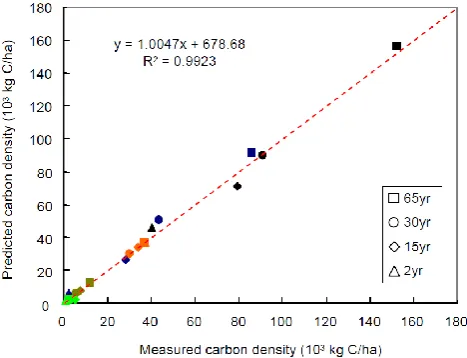
Fig. 3. Observed versus predicted C densities in foliage (green),
wood (blue), forest floor (dark yellow), soil (orange), and the summed total (black) in an age sequence of temperate pine forests in southern Ontario.
As it is with the down-regulating Hm modifier, Hb scales with flow velocity and clay content; however, in contrast to how flow affectsm,bis incremented by Hb, establishing a flow-dependent desorption coefficient.
The above DOC submodel was incorporated into Forest-DNDC to simulate DOC flux in temperate forest soils. The program of DOC submodel was developed using the C++ language as used in the Forest-DNDC. The Forest-DNDC model is available at http://www.dndc.sr.unh.edu, and its pro-gram code is not changed in this study. For simulations, the soil profile (1.0 m) was divided into horizontal layers with a typical thickness of 4 cm. Each layer was assumed to have uniform properties (e.g., temperature, moisture, substrate and microbe concentrations, etc.), and all decomposition calcula-tions were carried out layer by layer. The model was run in a daily time step.
3 Model input and validation data
TRIPLEX-DOC inputs and file format are same as Forest-DNDC model, including daily climate data (maximum and minimum temperature, and precipitation), soil properties (soil type, soil texture, and pH), and forest characteristics and management (forest type, stand age, and percentage of trees removed or harvested).
Table 1. Soil and stand characteristics of an age sequence of temperate pine forests in southern Ontario.
Characteristics 65 years old 30 years old 15 years old 2 years old
Location 42.7098◦N, 80.3574◦W 42.7068◦N, 80.3483◦W 42.7742◦N, 80.4588◦W 42.6609◦N, 80.5595◦W
Dominant tree White pine White pine White pine White pine
species (Pinus strobes) (Pinus strobes) (Pinus strobes) (Pinus strobes)
Major understory Quercus vultina, Quercus vultina Quercus vultina none
vegetation species Abies balsamifera, Prunus serotina
Max. LAI (m2m−2) 8.0 5.9 12.8 1.0
Mean tree height (m) 22 12 9 1
Mean tree diameter 35 16 16 2.5 (tree base)
at DBH (cm)
Stem density 429 1492 1242 1683
(trees ha−1)
Aboveground tree 8416 4488 3236 22
biomass (g C m−2)
Forest floor 1211 545 745 83
(g C m−2)
Forest floor 2.5 2.0 3.0 0.5
thickness (cm)
Tree roots 1920 923 502 5
(> 2 mm)
Litterfall 340–400 220–290 440–520 no data
throughout 2004–2005 (g C m−2year−1)
Soil type Brunisolic Brunisolic Gleyed Brunisolic Brunisolic
Luvisol Luvisol Luvisol Luvisol
Soil texture Fine sandy Fine sandy Fine sandy loam Fine sandy
Soil pH 5.5 5.5 6.2 7.4
(upper 20 cm)
Soil C 3700 3000 3400 3700
(g C m−2)
Data from Peichl and Arain (2006) and Peichl et al. (2007).
Peichl et al., 2010). It consists of four eastern white pine (Pi-nus strobus L.) forests that were planted in 2002 (2 years old), 1989 (15 years old), 1974 (30 years old), and 1939 (65 years old), respectively. All four stands are located within a 20 km radius of each other. The average altitude of the sites is 220 m, the 30-year mean annual temperature is 7.8◦C, and annual precipitation is 1010 mm, of which 438 mm falls from May to September (Environment Canada norms from 1971 to 2000 taken at Delhi, Ontario). Mean annual snowfall is 133 cm, the mean annual frost-free period is 160 days, and the mean growing season length is approximately 212 days (Presant and Acton, 1984). Turkey Point sites are situated on lacustrine sandy plains with Brunisolic Luvisol and Gleyed Brunisolic Luvisol sandy soils (about 98 % sand, 1 % silt, 1 % clay) that are well drained and have low-to-moderate water holding capacity. Meteorological and soil temperature and soil moisture (at several depths at two locations at each site) data were collected at all four age-sequence sites using automatic weather stations. Further site and instrumentation
details are given in Table 1 and Peichl and Arain (2006) and Peichl et al. (2010).
DOC data used in our study were collected at monthly in-tervals from the end of May to the end of November 2004 and at biweekly intervals from early April to November 2005 and from April to mid-May 2006. Throughfall DOC was col-lected in plastic buckets equipped with a 10 cm radius funnel with necks fitted with glass wool. Leachates from beneath the forest floor and the organic-rich Ah horizon were sampled us-ing zero-tension lysimeters. Porous cup suction lysimeters at 25, 50, and 100 cm depth were used to sample mineral soils. A detailed description of DOC measurements is given in Pe-ichl et al. (2007).
H. Wu et al.: TRIPLEX-DOC model development and validation 873
46
875
876
877
Figure 4: Time series of measured daily DOC concentrations versus simulated
878
values in litter layer and Ah soils layer in an age-sequence of temperate pine forests
879
in southern Ontario.
880
881
882
883
884
885
Fig. 4. Time series of measured daily DOC concentrations versus simulated values in litter layer and Ah soils layer in an age sequence of
temperate pine forests in southern Ontario.
4 Model validation
4.1 Carbon density at different forest ages
The model was run along a series of different forest ages, applying default forest parameter settings of pine (Li et al., 2000) for temperate forest growth. Figure 3 shows simu-lation results for 2-, 15-, 30-, and 65-year-old white pine stands compared to observed C density in foliage, wood, for-est floor, and soil. Values approximate to 1 : 1, indicating that the forest growth submodel performed well and therefore has the potential to predict temperate pine forest growth for dif-ferent stand ages.
4.2 DOC concentrations and leaching in different soil layers
Temporal variation in soil water DOC concentrations and fluxes were simulated and the model was able to capture rea-sonably well the temporal variations (maximum in summer and minimum in winter) in DOC concentrations in the for-est floor or litter layer compared to observations at the 65-and 30-year-old forests (Fig. 4). However, model simulations yielded less temporal variation in DOC concentrations than observed in summer for a 15-year-old forest stand. Model simulations showed good agreement with field observations of DOC in the Ah layer with respect to seasonality and mag-nitude for the 65- and 15-year-old forest stands but yielded lower DOC concentrations in summer than observed in the 30-year-old forest stand (Fig. 4).
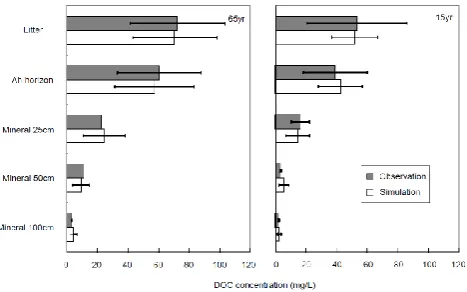
Model simulations showed that DOC concentrations throughout a 1-year period clearly decreased from the litter layer, to the A horizon and the B mineral horizon, reasonably consistent with observations for both the 65- and 15-year-old forest stands for which data had been previously measured (Fig. 5).
Simulated DOC leaching from forests of 2-, 15-, 30-, and 65-year-old stands (Fig. 6) showed a deceasing trend with increasing stand age, in good agreement with field observa-tions throughout the age-sequence investigation. Overall per-formance indicated that the model was able to capture the pri-mary mechanisms responsible for the variability and dynam-ics in observed DOC concentrations and leaching in these white pine forest soils.
4.3 Sensitivity analysis
47 886
887
Figure 5: Measured versus simulated annual mean DOC concentrations in soils in 888
65 and 15 year-old temperate pine forests in southern Ontario. Error bars denote 889
standard deviations. 890
891
892
893
894
895
896
897
898
Fig. 5. Measured versus simulated annual mean DOC
concentra-tions in soils in 65- and 15-year-old temperate pine forests in south-ern Ontario. Error bars denote standard deviations.
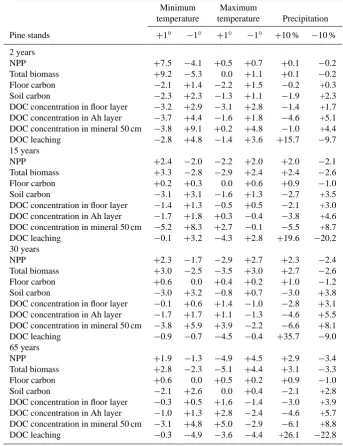
the basic behavior of the new model. The DOC concentra-tion sensitivity to sorpconcentra-tion (m) and desorption (b) param-eters was tested by a simple halving and doubling in val-ues (four experiments each for the forest floor layer and Ah layer) for each as the range limits (Fig. 7). The sensitivity for other model drivers was addressed by varying one factor and keeping all others constant, applying a 1◦increase/decrease in daily maximum and minimum temperature, and a 10 % increase/decrease in precipitation to baseline scenarios (Ta-ble 2).
Figure 7 shows the DOC concentration sensitivity experi-ments to variation in sorption (m) and desorption (b) using the Taylor diagram (Taylor, 2001). The correlation coeffi-cients were used to quantify the similarity between simulated and observed DOC patterns. The normalized standard devi-ation (SD) and the centered root-mean-square (rms) differ-ence were used to measure the temporal variability and in-ternal model error of the models, respectively. The position of each letter appearing on the plot quantified how closely that model-simulated DOC concentration patterns matched the observations, and thus the more distance of SD and rms difference between the observational data (dashed arc, refer-ence) and the simulations indicated more sensitivity for the m/bvariations. The sensitivity results showed that the corre-lations with observations were about 0.6; the increase (1–3 and 2–3 in Fig. 7) and decrease (1–2 and 2–2) sorption pa-rameter (m) had greater effect on DOC concentrations in dif-ferent soil layers than the variation (1–5 and 2–5 for increase, 1–4 and 2–4 for decrease) of desorption parameter (b), sug-gesting the response of DOC concentration to sorption was more significant than the response to desorption in temperate forest soils.
As expected, NPP and total biomass for all forests ages re-sponded positively to increases in both daily minimum tem-perature and precipitation (Table 2). A 1◦ increase in min-imum temperature resulted in the increases of 1.9 to 7.5 % and 2.8 to 9.2 % in NPP and total biomass, respectively, with
48
899
900
Figure 6: Comparison between measured and simulated annual DOC leaching in an
901
age-sequence of temperate pine forests in southern Ontario. Error bars denote
902
standard deviations.
903
904
905
906
907
908
909
910
911
912
Fig. 6. Comparison between measured and simulated annual DOC
leaching in an age sequence of temperate pine forests in southern Ontario. Error bars denote standard deviations.
more response for the young forests. The responses of NPP and total biomass to a 10 % increase in precipitation were less pronounced (only 0.1 to 3.1 % increase). On the other hand, the NPP and total biomass responded negatively to increases in the maximum temperature. The model predictions of pos-itive soil carbon responses with decreasing temperature and precipitation were also observed (Table 2).
The annual mean DOC concentrations in the forest floor layer, Ah layer, and in mineral soil responded negatively to changes in the minimum temperature and precipitation. However, this relationship was reversed to changes in the maximum temperature (except the 2-year-old forest). The DOC leaching responded positively to the increase of precip-itation for all four forest ages. The response of DOC leaching to precipitation change (−22.8 to 35.7 %) was more signifi-cant than the response to temperature (−4.5 to 4.8 %).
5 Discussion
5.1 Comparison to previous models
The aim of this study was to introduce TRIPLEX-DOC, a newly redesigned process-based model developed to investi-gate soil DOC processes. It incorporates many of the best features of existing C processing models, including DOC production and decomposition, sorption/desorption into soil solids, and transport by water percolation. It extends Forest-DNDC in predicting C cycles by including detailed model representations of soil DOC dynamics and leaching.
H. Wu et al.: TRIPLEX-DOC model development and validation 875
Table 2. Results of sensitivity of key variables to changes in climatic variables for different-aged temperate pine stands used in this study.
Minimum Maximum
temperature temperature Precipitation
Pine stands +1◦ −1◦ +1◦ −1◦ +10 % −10 %
2 years
NPP +7.5 −4.1 +0.5 +0.7 +0.1 −0.2
Total biomass +9.2 −5.3 0.0 +1.1 +0.1 −0.2
Floor carbon −2.1 +1.4 −2.2 +1.5 −0.2 +0.3
Soil carbon −2.3 +2.3 −1.3 +1.1 −1.9 +2.3
DOC concentration in floor layer −3.2 +2.9 −3.1 +2.8 −1.4 +1.7
DOC concentration in Ah layer −3.7 +4.4 −1.6 +1.8 −4.6 +5.1
DOC concentration in mineral 50 cm −3.8 +9.1 +0.2 +4.8 −1.0 +4.4
DOC leaching −2.8 +4.8 −1.4 +3.6 +15.7 −9.7
15 years
NPP +2.4 −2.0 −2.2 +2.0 +2.0 −2.1
Total biomass +3.3 −2.8 −2.9 +2.4 +2.4 −2.6
Floor carbon +0.2 +0.3 0.0 +0.6 +0.9 −1.0
Soil carbon −3.1 +3.1 −1.6 +1.3 −2.7 +3.5
DOC concentration in floor layer −1.4 +1.3 −0.5 +0.5 −2.1 +3.0
DOC concentration in Ah layer −1.7 +1.8 +0.3 −0.4 −3.8 +4.6
DOC concentration in mineral 50 cm −5.2 +8.3 +2.7 −0.1 −5.5 +8.7
DOC leaching −0.1 +3.2 −4.3 +2.8 +19.6 −20.2
30 years
NPP +2.3 −1.7 −2.9 +2.7 +2.3 −2.4
Total biomass +3.0 −2.5 −3.5 +3.0 +2.7 −2.6
Floor carbon +0.6 0.0 +0.4 +0.2 +1.0 −1.2
Soil carbon −3.0 +3.2 −0.8 +0.7 −3.0 +3.8
DOC concentration in floor layer −0.1 +0.6 +1.4 −1.0 −2.8 +3.1
DOC concentration in Ah layer −1.7 +1.7 +1.1 −1.3 −4.6 +5.5
DOC concentration in mineral 50 cm −3.8 +5.9 +3.9 −2.2 −6.6 +8.1
DOC leaching −0.9 −0.7 −4.5 −0.4 +35.7 −9.0
65 years
NPP +1.9 −1.3 −4.9 +4.5 +2.9 −3.4
Total biomass +2.8 −2.3 −5.1 +4.4 +3.1 −3.3
Floor carbon +0.6 0.0 +0.5 +0.2 +0.9 −1.0
Soil carbon −2.1 +2.6 0.0 +0.4 −2.1 +2.8
DOC concentration in floor layer −0.3 +0.5 +1.6 −1.4 −3.0 +3.9
DOC concentration in Ah layer −1.0 +1.3 +2.8 −2.4 −4.6 +5.7
DOC concentration in mineral 50 cm −3.1 +4.8 +5.0 −2.9 −6.1 +8.8
DOC leaching −0.3 −4.9 −3.6 −4.4 +26.1 −22.8
Values given represent percent of change compared to the baseline scenario.
different forest stand ages, soil C biogeochemistry, and hy-drological flow on DOC dynamics. TRIPLEX-DOC was val-idated using observed data, showing that the model can suc-cessfully simulate soil DOC concentrations and leaching for different aged forest stands.
The TRIPLEX-DOC modeled DOC production includes fresh litter, root exudates, and humified organic matter, all of which contribute substantial amounts of belowground DOC (Li et al., 1992; Guggenberger et al., 1994), whereas DOC was produced only from litter in the DocMod model (Currie and Aber, 1997) and only from humified organic matter in the DyDoc model (Michalzik et al., 2003). TRIPLEX-DOC shares similar features to the DOC model (Neff and Asner,
2001) in that both models generate DOC from both litter and soil organic matter. However, estimates from litter in the DOC model (Neff and Asner, 2001) are based on statistical relationships between DOC production and the ratio of lignin to N in incoming litter, whereas estimates from TRIPLEX-DOC are based on Forest-DNDC (Li et al., 2000), a process-based model. In this case, fresh litter is partitioned into very labile, labile, and resistant litter pools based on the input lit-ter C / N ratio, aflit-ter which each litlit-ter pool produces DOC based on its specific decomposition rate, temperature, and soil moisture.
876 H. Wu et al.: TRIPLEX-DOC model development and validation
49
914
915
916
Figure 7:
Sensitivity of DOC concentrations in soils to variation in sorption (m) and
917
desorption (b) parameters using Taylor diagram. 1-1 and 2-1 are standard simulation
918
in Ah layer and in litter layer, respectively. 1-2 and 2-2 are halving value of m in Ah
919
layer and in litter layer. 1-3 and 2-3 are doubling value of m in Ah layer and in litter
920
layer. 1-4 and 2-4 are halving value of b in Ah layer and in litter layer. 1-5 and 2-5
921
are doubling value of b in Ah layer and in litter layer, respectively.
922
923
924
925
926
927
Fig. 7. Sensitivity of DOC concentrations in soils to variation in
sorption (m) and desorption (b) parameters using a Taylor diagram. 1–1 and 2–1 are standard simulation in Ah layer and in litter layer, 1–2 and 2–2 are halving value ofmin Ah layer and in litter layer, 1–3 and 2–3 are doubling value ofmin Ah layer and in litter layer, 1–4 and 2–4 are halving value ofbin Ah layer and in litter layer, and 1–5 and 2–5 are doubling value ofbin Ah layer and in litter layer (all values respective of the mentioned layers).
and based on the two-component exponential decay model (Qualls and Haines, 1992; Kalbitz et al., 2003; Kiikkila et al., 2006; McDowell et al., 2006). In contrast, the DyDoc model (Michalzik et al., 2003) is composed of three humic fractions corresponding approximately to hydrophilic (Hum-1), hydrophobic acids (Hum-2), and humic acid and aged humin (Hum-3) for which metabolic transformations are de-scribed with first-order decay. The DOC model (Neff and Asner, 2001) only comprises a DOC pool, recycling into soil microbial biomass. Another difference between the mod-els is that DyDOC tracks 14C through a plant–soil–water system, thereby providing additional timescale information, but TRIPLEX-DOC confines itself to an overall daily DOC leaching flux.
5.2 Environmental controls on DOC production and transport
Knowledge of factors and processes that regulate DOC pro-duction and transport in forest soils is important for the prediction of soil C cycles under a varying climate. Pro-duction of DOC in the forest litter layer is thought to be primarily controlled by biological processes (e.g., decom-position of litter, humus, and root exudation), suggesting a high sensitivity to changes in soil temperature and moisture (Kalbitz et al., 2000). Simulations carried out for this study
showed a seasonal pattern, the highest DOC concentration occurring in summer in the litter layer and in the Ah layers (Fig. 4). These predications are consistent with results from field observations (Michalzik and Matzner, 1999; Solinger et al., 2001; Kaiser et al., 2002) and laboratory studies (Clark and Gilmour, 1983; Christ and David, 1996; Gödde et al., 1996; Moore et al., 2008), which documented a generally in-creasing DOC production with inin-creasing soil temperature and moisture. DOC concentrations are higher in the growing season than in non-growing seasons mainly because of the greater microbial activity in response to higher temperatures and moisture of the forest floor (Kalbitz et al., 2000; Yano et al., 2000; Kaiser et al., 2001).
Our results revealed a strong relationship between water flux and DOC flux in all soil layers, exhibiting linear relation-ships when summed to weekly fluxes (Fig. 8). These results are to be expected since DOC and water move in unison, but they imply that hydrologic flux rather than production mech-anisms are the limiting factors of DOC flux. Results were similar to the conclusions based on DOC model simulations (Neff and Asner, 2001) and confirmed by a plot-scale exper-iment carried out in the field (Tipping et al., 1999), reporting an increase in DOC flux with increasing amounts of water passing through the soil.
5.3 Impact of land use on DOC leachate
Understanding the effects of land use change on DOC con-centrations and export is imperative when attempting to pre-dict large-scale C dynamics and changes in landscape C bud-gets. Large areas have undergone land use change through forest regeneration and more recently through afforestation on marginal agricultural land, affecting ecosystem C dynam-ics (Quideau and Bockheim, 1997; Khomutova et al., 2000; Mattson et al., 2005). TRIPLEX-DOC successfully simu-lated increases in DOC concentrations in solutions obtained from the litter floor and Ah layer with the increasing age of forest stands (Fig. 4) accompanied with an increasing ac-cumulation of tree and forest floor biomass. Despite higher DOC concentrations found in soil solutions of older stands, results suggest that soil DOC leaching may be decreased by up to 4-fold for the 65-year-old stand (Fig. 6) compared to a recently established forest stand (2-year-old). This decrease in DOC leaching was mainly attributable to a decline in water loss due to increased water uptake by forest evapotranspira-tion, indicating the importance of hydrological controls on DOC processes.
H. Wu et al.: TRIPLEX-DOC model development and validation 877
50
928
929
930
Figure 8: Relationship between weekly soil DOC flux and water flux in litter layer
931
and mineral soil.
932
933
934
935
936
937
938
939
940
941
942
943
Fig. 8. Relationship between weekly soil DOC flux and water flux
in litter layer and mineral soil.
be attributable to the quantity of biomass (leaves, stem, and roots) left on the ground and soil, which is considered to be a primary source of increased DOC concentration and flux (Qualls, 2000; Piirainen et al., 2002). On the other hand, an increase in microbial activity could also be responsible for increased forest DOC concentrations and flux after forest harvesting. This is because temperature and moisture, crit-ical factors for microbial activity, generally increase after harvesting due to more open canopy and reduction in evap-otranspiration from the root zone (Londo et al., 1999) and may result in an increased production of DOC (Kalbitz et al., 2000; Kaiser et al., 2001; Neff and Asner, 2001). Water flux also contributes to the release of soil DOC (Kalbitz et al., 2000; Judd and Kling, 2002). It is important to note that forest canopy interception of precipitation and evapotranspi-ration would decrease after harvesting, increasing water flux to soils and thus resulting in an increase in soil DOC leach-ing.
6 Conclusion and future improvements
TRIPLEX-DOC is a useful tool when quantifying DOC con-centrations and leaching in temperate forest soils as well as in predicting how changes in land use may impact DOC. It is compatible with most ecosystem models related to soil C dynamics and forest growth, and provides an effective way to integrate forest management effects and DOC leaching in forest soils at an ecosystem level. Validation and sensitivity tests demonstrated that TRIPLEX-DOC is capable of simu-lating DOC processes for forest stands of different ages to a reasonable accuracy. The model provides an insight into the mechanisms that control soil DOC concentrations and export, and may be useful in scaling up DOC leaching from landscape to regional scales. Furthermore, this process-based model can be used to project DOC concentrations and leach-ing under future climate scenarios.
DOC simulation in this study includes the DOC produc-tion from throughfall. Although the intercepproduc-tion simulaproduc-tion (Rutter et al., 1971) represents the physically based process
51 944
945
946
947
948
949
Figure 9:
Sensitivity analysis on the effects of land use on annual DOC leaching
950before and after 50% forest harvesting
.
951
952
953
Fig. 9. Sensitivity analysis on the effects of land use on annual DOC
leaching before and after 50 % forest harvesting.
by a running water balance of rainfall input, storage, and out-put in the form of drainage and evaporation, the interception loss depends strongly on the timing and intensity of rainfall, the vegetation structure, and the meteorological conditions controlling evaporation during and after rainfall (Rutter et al., 1975; Dingman, 2002; Brutsaert, 2005). As the Rutter et al. (1971) model used in this study was only treated as a simplified process based on a single-layer vertical vegetation structure and a constant storage capacity, further improve-ments need to involve more-detailed interception processes in the future.
TRIPLEX-DOC recognizes the role of DOC consumption and sorption/desorption as two key mechanisms that regulate DOC concentrations and export rates. Although our simula-tions do not provide a more detailed validation of the DOC submodel for different forest types, results indicate that DOC consumption and sorption/desorption-based soil submodels can reasonably capture general patterns in DOC concentra-tion and flux rates related to soil depth, at least for temper-ate pine forests that we studied and where observed DOC flux data were available. Results also underscore the need for more detailed field experiment studies related to differ-ent types of forest ecosystems in major climatic regions and DOC sorption/desorption results from TRIPLEX-DOC are limited due to the model’s use of an equilibrium distribu-tion constant rather than using a time-dependent dynamical process (Qualls, 2000). This last point reflects the fact that TRIPLEX-DOC is in the early stage of model development as it pertains to DOC sorption/desorption and improvements could be made by incorporating more dynamic DOC sorp-tion/desorption processes in more realistic ways.
new model could be a useful tool in improving not only esti-mations of net C flux and greenhouse gas (GHG) emissions from forest soils on a regional scale but also DOC export from soils. As the DOC from terrestrial ecosystem is crit-ical to C budgets in the aquatic ecosystems, this estimate of DOC export will improve our understanding of the con-nectivity between terrestrial and aquatic C cycles, reducing the uncertainty in C fluxes of entire lake-watershed systems. DOC would take advantage of the TRIPLEX-GHG simulator (Peng et al., 2013) as well as important C loss pathways entering into aquatic ecosystems (TRIPLEX-Aquatic model) as described in an accompanying paper by Wu et al. (2013). Coupling the two efforts would be a strong contribution to understanding the processing and partitioning of organic C across both terrestrial and aquatic C cycles, re-sulting in a full regional integration between terrestrial and aquatic ecosystems.
Acknowledgements. This study was funded by the National Basic
Research Program of China (973 Program) (2010CB950204, 2013CB956602), the Canadian Foundation for Climate and Atmospheric Sciences (CFCAS), the National Natural Science Foundation of China (no. 41071055 and 41125011), the Bairen Programs of the Chinese Academy of Sciences, the Natural Sciences and Engineering Research Council of Canada (NSERC) Discovery Grant, and the Canada Research Chair Program. Measurements at the Turkey Point Flux Station were funded by the Discovery and Strategic Projects Program of (NSERC) and BIOCAP Canada. Additional support provided by the Canadian Foundation of Innovation (CFI), the Ontario Innovation Trust (OIT), McMaster University, and the Ontario Ministry of Natural Resources (OMNR) is also acknowledged in establishing the Turkey Point sites.
Edited by: A. Ridgwell
References
Aber, J. D. and Federer, C. A.: A generalized, lumped-parameter model of photosynthesis, evaporation and net primary production in temperate and boreal forest ecosystems, Oecologia, 92, 463– 474, 1992.
Aitkenhead, J. A. and McDowell, W. H.: Soil C:N ratio as a predic-tor of annual riverine DOC flux at local and global scales, Global Biogeochem. Cy., 14, 127–138, 2000.
Aitkenhead, J. A., Hope, D., and Billett, M. F.: The relationship between dissolved organic carbon in streamwater and soil or-ganic carbon pools at different spatial scales, Hydrol. Process., 13, 1289–1302, 1999.
Arain, M. A. and Restrepo-Coupe, N.: Net ecosystem production in a temperate pine plantation in southeastern Canada, Agr. Forest Meterol., 128, 223–241, 2005.
Band, L. E., Tague, C. L., Groffman, P., and Belt, K.: Forest ecosys-tem processes at the watershed scale: hydrological and ecologi-cal controls of nitrogen export, Hydrol. Process., 15, 2013–2028, 2001.
Boyer, E. W., Hornberger, G. M., Bencala, K. E., and McKnight, D.: Overview of a simple model describing variation of dissolved organic carbon in an upland catchment, Ecol. Modell., 86, 183– 188, 1996.
Brutsaert, W.: Hydrology. Cambridge University Press, New York, 605 pp., 2005.
Buffam, I., Monicag, T., Ankur, R. D., Paul, C. H., James, A. R., Noah, R. L., Emily, H. S., and Stephen, R. C.: Integrating aquatic and terrestrial components to construct a complete carbon budget for a north temperate lake district, Glob. Change Biol., 17, 1193– 1211, 2011.
Butman, D. and Raymond, P. A.: Significant efflux of carbon diox-ide from streams and rivers in the United States, Nat. Geosci., 4, 839–842, 2011.
Chapin III, F. S., Mcguire, A. D., Randerson, J., Pielkesr, R., Bal-docchi, D., Hobbie, S. E., Roulet, N., Eugster, W., Kasischke, E., Rastetter, E. B., Zimov, S. A., and Running, S. W.: Arctic and boreal ecosystems of western North America as components of the climate system, Glob. Change Biol., 6, 211–223, 2000. Chapin III, F. S., Woodwell, G. M., Randerson, J. T., Rastetter, E.
B., Lovett, G. M., Baldocchi, D. D., Clark, D. A., Harmon, M. E., Schimel, D. S., Valentini, R., Wirth, C., Aber, J. D., Cole, J. J., Goulden, M. L., Harden, J. W., Heimann, M., Howarth, R. W., Matson, P. A., McGuire, A. D., Melillo, J. M., Mooney, H. A., Neff, J. C., Houghton, R. A., Pace, M. L., Ryan, M. G., Run-ning, S. W., Sala, O. E., Schlesinger, W. H., and Schulze, E. D.: Reconciling carbon-cycle concepts, terminology, and methods, Ecosystem, 9, 1041–1050, 2006.
Christ, M. J. and David, M. B.: Temperature and moisture effects on the production of dissolved organic carbon in a spodosol, Soil Biol. Biochem., 28, 1191–1199, 1996.
Clair, T. A. and Ehrman, J. M.: Variations in discharge and dis-solved organic carbon and nitrogen export from terrestrial basins with changes in climate: A neural network approach, Limnol. Oceanogr., 41, 926–927, 1996.
Clair, T. A., Pollock, T. L., and Erhman, J. M.: Exports of carbon and nitrogen from river basins in Canada’s Atlantic provinces, Global Biogeochem. Cy., 8, 441–450, 1994.
Clark, M. D. and Gilmour, J. T.: The effect of temperature on de-composition at optimum and saturated soil water contents, Soil Sci. Soc. Am. J., 47, 927–929, 1983.
Cole, J. J., Prairie, Y. T., Caraco, N. F., McDowell, W. H., Tranvik, L. J., Striegl, R. G., Duarte, C. M., Kortelainen, P., Downing, J. A., Middelburg, J. J., and Melack, J.: Plumbing the global carbon cycle: integrating inland waters into the terrestrial carbon bud-get, Ecosystems, 10, 171–184, doi:10.1007/s10021-006-9013-8, 2007.
Currie, W. S. and Aber, J. D.: Modeling leaching as a decomposi-tion process in humid montane forests, Ecology, 78, 1844–1860, 1997.
Dahm, C. N.: Pathways and mechanisms for removal of dissolved organic carbon from leaf leachate in streams, Can J. Fish Aquat. Sci., 39, 68–76, 1981.
Dai, M. H., Yin, Z. Q., Feifei Meng, F. F., Qian Liu, Q., and Cai, W. J.: Spatial distribution of riverine DOC inputs to the ocean: an updated global synthesis, Curr. Opin. Een. Sust., 4, 170–178, 2012.
H. Wu et al.: TRIPLEX-DOC model development and validation 879
in CH4, CO2, and N2O fluxes in a forested wetland, Water Air Soil Poll., 223, 253–265, 2012.
del Giorgio, P. A., Cole, J. J., Caraco, N. F., and Peters, R. H.: Link-ing planktonic biomass and metabolism to net gas fluxes in north-ern temperate lakes, Ecology, 80, 1422–1431, 1999.
Dillon, P. J. and Molot, L. A.: Effect of landscape form on export of dissolved organic carbon, iron and phosphorous from forested stream catchments, Water Resour. Res., 33, 2591–2600, 1997. Dingman, S.: Physical Hydrology, Prentice Hall, Upper Saddle
River, 646 pp., 2002.
Dunn, A. L., Barford, C. C., Wofsy, S. C., Goulden, M. L., and Daube, B. C.: A long-term record of carbon exchange in a boreal black spruce forest: Means, responses to interannual variability, and decadal trends, Glob. Change Biol., 13, 577–590, 2007. Eckhardt, B. and Moore, T. R.: Controls on dissolved organic
car-bon concentrations in streams, southern Quebec, Can. J. Fish Aquat. Sci., 47, 1537–1544, 1990.
Gödde, M., David, M. B., Christ, M. J., Kaupenjohann, M., and Vance, G. F.: Carbon mobilization from the forest floor under red spruce in the northeastern USA, Soil Biol. Biochem., 28, 1181– 1189, 1996.
Grimm, N. B., Gergal, S. E., McDowell, W. H., Boyer, E. W., Dent, C. L., Groffman, P., Hart, S. C., Harvey, J., Johnston, C., May-orga, E., Mcclain, M. E., and Pinay, G.: Merging aquatic and terrestrial perspectives of nutrient biogeochemistry, Oecologia, 137, 485–501, 2003.
Guggenberger, G., Zech, W., and Schulten, H.: Formation and mo-bilization pathways of dissolved organic matter: evidence from chemical structural studies of organic matter fractions in acid for-est floor solutions, Org. Geochem., 21, 51–66, 1994.
Hanson, P. C., Pollard, A. I., Bade, D. L., Predick, K., Carpenter, S. R., and Foley, J. A.: A model of carbon evasion and sedimen-tation in temperate lakes, Glob. Change Biol., 10, 1285–1298, 2004.
Harrison, J. A., Caraco, N., and Seitzinger, S. P.: Global patterns and sources of dissolved organic matter export to the coastal zone: re-sults from a spatially explicit, global model, Glob. Biogeochem. Cy., 19, GB4S04, doi:10.1029/2005GB002480, 2005.
Hinton, M. J., Schiff, S. L., and English, M. C.: The significance of storms for the concentration and export of dissolved organic car-bon from two Precambrian Shield catchments, Biogeochemistry, 36, 67–88, 1997.
Hope, D., Billett, M. F., Milne, R., and Brown, T. A. W.: Exports of organic carbon in British rivers, Hydrol. Process., 11, 325–344, 1997.
Humborg, C., Morth, C. M., Sundbom, M., Borg, H., Blenckner, T., Giesler, R., and Ittekkot, V.: CO2supersaturation along the
aquatic conduit in Swedish watersheds as constrained by ter-restrial respiration, aquatic respiration and weathering, Glob. Change Biol., 16, 1966–1978, 2010.
Jandl, R. and Sollins, P.: Water-extractable soil carbon in relation to the belowground carbon cycle, Biol. Fert. Soils, 25, 196–201, 1997.
Jenerette, G. D. and Lal, R.: Hydrologic sources of carbon cycling uncertainty throughout the terrestrial-aquatic continuum, Glob. Change Biol., 11, 1873–1882, 2005.
Judd, K. E. and Kling, G. W.: Production and export of dissolved C in arctic tundra mesocosms: the roles of vegetation and water flow, Biogeochemistry, 60, 213–234, 2002.
Kaiser, K. and Kalbitz, K.: Cycling downwards-dissolved organic matter in soils, Soil Biol. Biochem., 52, 29–32, 2012.
Kaiser, K. and Zech, W.: Soil dissolved organic matter sorption as influenced by organic and sesquioxide coating and sorbed sul-fate, Soil Sci. Soc. Am. J., 62, 129–136, 1998.
Kaiser, K., Guggenberger, G., and Zech, W.: Sorption of DOM and DOM fractions to forest soils, Geoderma, 74, 281–303, 1996. Kaiser, K., Guggenberger, G., Haumaier, L., and Zech, W.: Seasonal
variations in the chemical composition of dissolved organic car-bon in organic forest floor layer leachates of old-growth Scots pine (Pinus sylvestris L.) and European beech (Fagus sylvatica L.) stands in northeastern Bavaria, Germany, Biogeochemistry, 55, 103–143, 2001.
Kaiser, K., Guggenberger, G., Haumaier, L., and Zech, W.: The composition of dissolved organic matter in forest soil solutions: changes induced by seasons and passage through the mineral soil, Org. Geochem., 33, 307–318, 2002.
Kalbitz, K., Solinger, S., Park, J. H., Michalzik, B., and Matzner, E.: Controls on the dynamics of dissolved organic matter in soils: a review, Soil Sci., 165, 277–304, 2000.
Kalbitz, K., Schmerwitz, J., Schwesig, O., and Matzner, E.: Biodegradation of soil derived dissolved organic matter as re-lated to its properties, Geoderma, 113, 273–291, 2003.
Kesik, M., Ambus, P., Baritz, R., Brüggemann, N., Butterbach-Bahl, Damm, K., Duyzer, M. J., Horváth, L., Kiese1, R., Kitzler, B., Leip, A., Li, C., Pihlatie, M., Pilegaard, K., Seufert, S., Simp-son, D., Skiba, U., Smiatek, G., Vesala, T., and Zechmeister-Boltenstern, S.: Inventories of N2O and NO emissions from Eu-ropean forest soils, Biogeosciences, 2, 353–375, 2005,
http://www.biogeosciences.net/2/353/2005/.
Khomutova, T. E., Richter, J., Shirshova, L. T., Tinz, S., and Rol-land, W.: Mobilization of DOC from sandy loamy soils under different land use (Lower Saxony, Germany), Plant Soil, 219, 13–19, 2000.
Kiese, R., Li, C., Hilbert, D. W., Papen, H., and Butterbach-Bahl, K.: Regional application of PnET-N-DNDC for estimating the N2O source strength of tropical rainforests in the Wet Tropics of
Australia, Glob. Change Biol., 11, 128-144, 2005.
Kiikkila, O., Kitunen, V., and Smolander, A.: Dissolved soil organic matter from surface organic horizons under birch and conifers: Degradation in relation to chemical characteristics, Soil Biol. Biochem., 38, 737–746, 2006.
Kosten, S., Roland, F., Marques, D., Van Nes, E. H., Mazzeo, N., Sternberg, L. D. L., Scheffer, M., and Cole, J. J.: Climate-dependent CO2emissions from lakes, Global Biogeochem. Cy.,
24, GB2007, doi:10.1029/2009GB003618, 2010.
Kothawala, D. N., Moore, T. R., and Hendershot, W. H.: Soil proper-ties controlling adsorption of dissolved organic carbon to mineral soils, Soil Sci. Soc. Am. J., 73, 1831–1842, 2009.
Kreutzweiser, D. P., Hazlett, P. W., and Gunnb, J. M.: Logging im-pacts on the biogeochemistry of boreal forest soils and nutrient export to aquatic systems: A review, Environ. Rev., 16, 157–179, 2008.
Lapierre, J. F. and del Giorgio, P. A.: Geographical and environmen-tal drivers of regional differences in the lakepCO2versus DOC
Li, C., Frolking, S., and Frolking, T. A.: A model of nitrous oxide evolution from soil driven by rainfall events, 1. Model structure and sensitivity, J. Geophys. Res., 97, 9759–9776, 1992. Li, C. S., Aber, J., Stange, F., Butterbach-Bah, K., and Papen, H.:
A process-oriented model of N2O and NO emissions from forest
soils: 1. Model development, J. Geophys. Res., 105, 4369–4384, 2000.
Londo, A. J., Messina, M. G., and Schoenholtz, S. H.: Forest har-vesting effects on soil temperature, moisture, and respiration in a bottomland hardwood forest, Soil Sci. Soc. Am. J., 63, 637–644, 1999.
Lumsdon, D. G., Stutter, M. I., Cooper, R. J., and Manson, J. R.: Model assessment of biogeochemical controls on dissolved or-ganic carbon partitioning in an acid oror-ganic soil, Environ. Sci. Technol., 39, 8057–8063, 2005.
Mattson, T., Kortelainen, P., and Räike, A.: Export of DOM from boreal catchments: impacts of land use cover and climate, Bio-geochemistry, 76, 373–394, 2005.
Marschner, B. and Kalbitz, K.: Controls of bioavailability and biodegradability of dissolved organic matter in soils, Geoderma, 113, 211–235, 2003.
McCallister, S. L. and del Giorgio, P. A.: Direct measurement of the
δ13C signature of carbon respired by bacteria in lakes: Linkages to potential carbon sources, ecosystem baseline metabolism, and CO2fluxes, Limnol. Oceanogr., 53, 1204–1216, 2008.
McDowell, W. H., Zsolnay, A., Aitkenhead-Peterson, J. A., Gre-gorich, E. G., Jones, D. L., Jödemann, D., Kalbitz, K., Marschner, B., and Schwesig, D.: A comparison of methods to determine the biodegradable dissolved organic matter (DOM) from different terrestrial sources, Soil Biol. Biochem., 38, 1933– 1942, 2006.
Michalzik, B. and Matzner, E.: Dynamics of dissolved organic ni-trogen and carbon in a Central European Norway spruce ecosys-tem, Eur. J. Soil Sci., 50, 579–590, 1999.
Michalzik, B., Kalbitz, K., Park, J. H., Solinger, S., and Matzner, E.: Fluxes and concentrations of dissolved organic carbon and nitrogen-a synthesis for temperate forests, Biogeochemistry, 52, 173–205, 2001.
Michalzik, B., Tipping, E., Mulder, J., Gallardo Lancho, J. F., Matzner, E., Bryant, C. L., Clarke, N., Lofts, S., and Vicente Esteban, M. A.: Modelling the production and transport of dis-solved organic carbon in forest soils, Biogeochemistry, 66, 241– 264, 2003.
Moore, T. R., de Souza, W., and Koprivnjak, J. F.: Controls on the sorption of dissolved organic carbon by soils, Soil Sci., 154, 120– 129, 1992.
Moore, T. R., Paré, D., and Boutin R.: Production of dissolved or-ganic carbon in Canadian forest soils, Ecosystems, 11, 740–751, 2008.
Neff, J. C. and Asner, G. P.: Dissolved organic carbon in terrestrial ecosystems: synthesis and a model, Ecosystems, 4, 29–48, 2001. Nelson, P. N., Baldock, J. A., and Oades, J. M.: Concentration and composition of dissolved organic carbon in streams in relation to catchment soil properties, Biogeochemistry, 19, 27–50, 1993. Nodvin, S. C., Driscoll, C. T., and Likens, G. E.: Simple partitioning
of anions and dissolved organic carbon in a forest soil, Soil Sci., 142, 27–35, 1986.
Peichl, M. and Arain, M.: Above- and belowground ecosystem biomass and carbon pools in an age-sequence of planted white pine forests, Agr. Forest Meteorol., 140, 51–63, 2006.
Peichl, M., Moore, T. R., Arain, M. A., Dalva, M., Brodkey, D., and McLaren, J.: Concentrations and fluxes of dissolved organic car-bon in an age-sequence of white pine forests in Southern Ontario, Canada, Biogeochemistry, 86, 1–17, 2007.
Peichl, M., Arain, M. A., and Brodeur, J. J.: Age effects and climatic controls on carbon fluxes in pine forests, Agr. Forest Meterol., 150, 1090–1101, 2010.
Peng, C. H., Zhu, Q., and Chen, H.: Integrating greenhouse gas emission processes into a dynamic global vegetation model: TRIPLEX-GHG model development and testing. In the proceed-ing of 4th NACP All-Investigators Meetproceed-ing, 64 pp., 4–7 Febru-ary, Albuquerque, NM, USA, 2013.
Piirainen, S., Finer, L., Mannerkoski, H., and Starr, M.: Effects of forest clear-cutting on the carbon and nitrogen fluxes through podzolic soil horizons, Plant Soil, 239, 301–311, 2002. Plamondon, A. P., Gonzalez, A., and Thomassin, Y.: Effects of
log-ging on water quality: Comparison between two Quebec sites, in: Proceedings of the Canadian Hydrological Symposium’82, Na-tional Research Council of Canada, Ottawa, Ont., 49–70, 1982. Prendergast, J. B.: Soil water bypass and solute transport under
irri-gated pasture, Soil Sci. Soc. Am. J., 59, 1531–1539, 1995. Presant, E. W. and Acton, C. J.: The soils of the regional
munic-ipality of Haldimand-Norfolk, Vol. 1, Report No. 57, Agricul-ture Canada, Ministry of AgriculAgricul-ture and Food, Guelph, Ontario, 100 pp., 1984.
Qualls, R. G.: Comparison of the behavior of soluble organic and inorganic nutrients in forest soils, Forest Ecol. Manage., 138, 29– 50, 2000.
Qualls, R. and Haines, B. L.: Biodegradability of dissolved organic matter in forest throughfall, soil solution, and stream water, Soil Sci. Soc. Am. J., 56, 578–586, 1992.
Qualls, R. G., Haines, B. L., and Swank, W. T.: Fluxes of dissolved organic nutrients and humic substances in a deciduous forest, Ecology, 72, 254–266, 1991.
Quideau, S. A. and Bockheim, J. G.: Biogeochemical cycling fol-lowing planting to red pine on a sandy prairie soil, J. Environ. Qual., 26, 1167–1175, 1997.
Radulovich, R., Sollins, P., Baveye, P., and Solorzano, E.: Bypass water flow through unsaturated microaggregated tropical soils, Soil Sci. Soc. Am. J., 56, 721–726, 1992.
Raymond, P. A. and Saiers, J. E.: Event controlled DOC export from forested watersheds, Biogeochemistry, 100, 197–209, 2010. Roehm, C. L., Prairie, Y. T., and del Giorgio, P. A.: The
pCO2 dynamics in lakes in the boreal region of
north-ern Quebec, Canada, Global Biogeochem. Cy., 23, GB3013, doi:10.1029/2008GB003297, 2009.
Rutter, A. J., Kershaw, K. A., Robins, P. C., and Morton, A. J.: A predictive model of rainfall interception in forest, I. Derivation of the model from observation in a plantation of Corsican pine, Agr. Meteorol., 9, 367–384, 1971.
H. Wu et al.: TRIPLEX-DOC model development and validation 881
Sobek, S., Algesten, G., Bergstrom, A. K., Jansson, M., and Tran-vik, L. J.: The catchment and climate regulation ofpCO2in
bo-real lakes, Glob. Change Biol., 9, 630–641, 2003.
Solinger, S., Kalbitz, K., and Matzner, E.: Controls on the dynamics of dissolved organic carbon and nitrogen in a Central European deciduous forest, Biogeochemistry, 55, 327–349, 2001. Startsev, N. A., McNabb, D. H., and Startsev, A. D.: Soil biological
activity in recent clearcut in west-central Alberta, Can. J. Soil Sci., 78, 69–76, 1998.
Sun, G., Li, C., Trettin, C., Lu, J., and McNulty, S. G.: Simulat-ing the biogeochemical cycles in cypress wetland-pine upland ecosystems at a landscape scale with the Wetland-DNDC Model, in: Proceedings of the International Conference on Hydrology and Management of Forested Wetlands, 8–12 April, New Bern, NC, 261–270, 2006.
Taylor, K. M.: Summarizing multiple aspects of model performance in a single diagram, J. Geophys. Res., 106, 7183–7192, 2001. Tipping, E., Woof, C., Rigg, E., Harrison, A. F., Inneson, P., Taylor,
K., Benham, D., Poskitt, J., Rowland, A. P., Bol, R., and Hark-ness, D. D.: Climatic influences on the leaching of dissolved or-ganic matter from upland UK moorland soils, investigated by a field manipulation experiment, Environ. Inter., 25, 83–95, 1999. Trolle, D., Staehr, P. A., Davidson, T. A., Bjerring, R., Lauridsen, T. L., Søndergaard, M., Jeppesen, E.: Seasonal dynamics of CO2
flux across the surface of shallow temperate lakes, Ecosystems, 15, 336–347, 2012.
Turgeon, J.: Production and biodegradation of dissolved carbon, ni-trogen and phosphorus from Canadian forest floors, Ph.D thesis, McGill University, Montréal, 2008.
Vandenbruwane, J., Neve, S. D., Qualls, R. G., Sleutel, S., and Hof-man, G.: Comparison of different isotherm models for dissolved organic carbon (DOC) and nitrogen (DON) sorption to mineral soil, Geoderma, 139, 144–153, 2007.
Weigand, H. and Totsche, K. U.: Flow and reactivity effects on dis-solved organic matter transport in soil columns, Soil Sci. Soc. Am. J., 62, 1268–1274, 1998.
Wu, H., Peng, C., Lucotte, M., Soumis, N., Gélinas, Y., Duchemin, É., Plouhinec, J.-B., Ouellet, A., and Guo, Z.: A coupled two-dimensional hydrodynamic and terrestrial input model to simu-late CO2diffusive emissions from lake systems, Geosci. Model
Dev. Discuss., 6, 3509–3556, doi:10.5194/gmdd-6-3509-2013, 2013.
Xu, N., Saiers, J. E., Wilson, H. F., and Raymond, P. A.: Simulating streamflow and dissolved organic matter export from a forested watershed, Water Resour. Res., 48, W05519, doi:10.1029/2011WR011423, 2012.
Yano, Y., McDowell, W. H., and Kinner, N. E.: Quantification of biodegradable dissolved organic carbon in soil solution with flow-through bioreactors, Soil Sci. Soc. Am. J., 62, 1556–1564, 1998.
Yano, Y., McDowell, W. H., and Aber, J. D.: Biodegradable dis-solved organic carbon in forest soil solution and effects of chronic nitrogen deposition, Soil Biol. Biochem., 32, 1743– 1751, 2000.






![多通道之多重音頻串流方法之研究(Multi-channel Source Clustering of Polyphonic Music) [In Chinese]](data:image/gif;base64,R0lGODlhAQABAIAAAP///wAAACH5BAEAAAAALAAAAAABAAEAAAICRAEAOw==)