A Model With Policy Network Approach for Entrepreneurship Policy Making
Fattah Sharifzadeh1 Atiyeh Sadat Haghi2 Mohammad Mirmohammadi3 Davood Hoseinpour4
Abstract:
One policy making issue that needs to be addressed more effectively through an intergovernmental and participatory approach is entrepreneurship policy. Entrepreneurship is an area where interdependencies are very high, and the establishment of collaborative relationships such as networks is vital. Therefore, a network approach in the entrepreneurial policy-making process, which leads to the involvement of key stakeholders and entrepreneurs, will lead to higher legitimacy and effectiveness of policies. The purpose of the research is to validate and design a suitable model for policy networks in the field of entrepreneurship. Qualitative data analysis was conducted through theme analysis; and the quantitative data through the structural equations. After designing the conceptual model, the research questionnaire with dimensions was distributed among 240 experts and managers of the Ministry of Cooperatives, Labor and Social Welfare.
Reliability of the questionnaire was verified using Cronbach's alpha and composite Reliability Coefficient (CR), and its validity was confirmed by Convergent Validity and Convergent Validity (AVE) methods. Finally, 24 components were identified in four branches of necessity, structural, behavioral and background. The findings show that, it is essential for the Ministry of Cooperatives, Labor and Social Welfare to focus on the role and importance of these entrepreneurs in order to develop the field of entrepreneurship, and to consider the network thinking in policy making as a substitute for hierarchical thinking.
Keywords: Public policy, Policy Making, Network Approach, Entrepreneurship, Model.
Introduction:
Economic development means growth, along with increased production, physical, human and social capacities. The goal of economic development
1 Professor, Department of Management, Allameh Tabataba'i University, Corresponding Author: Email: [email protected]
is to increase the wealth and welfare of the people of the community and create employment. The trend of economic development in advanced countries reflects the fact that the economy is affected by entrepreneurship, in which entrepreneurs play a central role in the development of the advanced economies (OECD 2010). In recent decades, governments have seriously encouraged entrepreneurship. Global markets play an effective role in the development of entrepreneurship in providing the conditions and facilities needed to start entrepreneurship (Lundström et al., 2017: 942). The attention of policy makers to the issue of entrepreneurship in Iran has a short life (slightly more than a decade). Obviously, in this short time, entrepreneurship development tools and policies are not as mature as possible and are limited. According to the Global Entrepreneurship Indicator (GEI), the Iranian Entrepreneurship Ecosystem is weak in 2018.
The general score of Iran's entrepreneurship in this index is only 26.8 and is among the 15 countries in the Middle East and North Africa region, (GEI, 2018), therefore, requires designing policies and implementing appropriate programs and paying close attention to entrepreneurship.
One of the major shortcomings of entrepreneurial policy-making is that although one of the main custodians is the Ministry of Cooperatives, Labor and Social Welfare, but there are various other governmental and nongovernmental institutions and institutions operating in this field throughout the country. (Monitoring and improving the Entrepreneurship System of Iran, 2016: 60). In spite of the fact that all of them are involved in some kind of administrative or operational processes of entrepreneurship, they are not interacting with each other due to their dependence on different organizations and authorities, and as a result, different policies and orientations are applied by the authorities. Lack of coherence and different orientations for actors in the field of entrepreneurship policy can be seen in the following related organizations (Monitoring and improving the Entrepreneurship System of Iran, 2016: 60).
Specialist and Free Economic Zone Organizations - Guilds organizations - Associations and NGOs – NGOs.
The above situation will result a kind of inconsistency between policies and decisions. In this way, almost every institution without any logical linkage will take different policies and orientations that result in parallel work or partial consideration of policies and plans for Develops entrepreneurship. As a result, a policy-making network that is able to set unit-oriented policies and targets, and lay the groundwork for business decision-making and policy-making, has not yet come into being.
On the other hand, most research in the country that deals with the category of entrepreneurial development has tried to provide a solution from the traditional perspective of hierarchical policy making, not a networks policy making. Accordingly, it is essential to take the necessary steps towards the establishment, and institutionalization of a network policy framework in the area of entrepreneurship, in line with the experience of other countries and in order to effectively address the current challenges in the field of entrepreneurship policy. Thus, the present research seeks to provide a native model of network policy for developing and facilitating entrepreneurship policy making. So the main question of this research is: What are the dimensions and determinants of the entrepreneurial network policy model?
Literature review
By expanding communication networks with the help of information and communication technology, the hierarchy of coordinators and supervisors is eliminated, and a huge transformation is being created in organizing organizations, including the creation of paperless organizations (Alwani, 1380: 281).
Since hierarchical structures and the market cannot provide proper guidance for the success of the organization on their own goals, the attention of stakeholders and their participation through network governance has been introduced as an appropriate and alternative method (Chaiton et al , 2002: 5).
network thinking, and government management must also learn how to manage these networks and consider itself an active element in networks (Alwani, 295: 1381). Frederickson (Frederickson, 1997: 84-5) has also suggested the need for a new approach to government agencies, which called for the "end to hierarchy" to be competing. Toda y's current trends in organizations also show that moving towards less hierarchical systems and more collaborative is happening. Studies conducted in conjunction with networks around the globe have focused on exploring the direct and non-interconnected interactions between network structures (structural vacuum and concentration of decisions) with social capital and network management that somehow function in policy networks Organizations are effective (Provan & Milward, 1995; Ahuja & Carly, 1999; Whitall, 2012). Other factors point to the need for change in policy-making structures and moving towards the network policy making extracted from the literature review can be seen in table 1.
Table 1: Factors Affecting the Need for Establishment of Policy Networks (Literature review)
Dimensions Excessive research literature on the subject of policy networks The Necessity
and Need to Use a Network Approach in an Entrepreneurship Policy Framework
-The weakness of the hierarchical policy-making system
-The degree of complexity, the interrelatedness of issues in the field (entrepreneurship) and the necessity of adopting systematic and inter-sectorial approaches.
•Dept. of Entrepreneurship Development, Ministry of Cooperatives, Labor and Social Welfare, 2016.
• Lack of coherence and different orientations for actors in the field of entrepreneurship policy can be seen in the following related organizations (Monitoring and Improving the Entrepreneurship System of Iran, 2016).
• Organizations join the network because networks allow them to cope with complex and complex issues (Chishlom, 1998). • The appearance of complex and interconnected subject areas highlights the need for change in traditional policy-making systems (Ke nis & Schneider, 1989) Effective responses to complex issues such as inequality, unemployment, discrimination, etc. require an intergovernmental approach in which the government, through collaboration with the third sector and civil society, develops appropriate policies (Walke r, 2000).
• Policymaking networks as a way to integrate and create unity among different actors, as well as a mechanism for addressing issues and problems that cannot be addressed by official tools and institutional arrangement. Have taken (Kenis & Raab, 2003, 3). • Policy networks are a successful model whose success is partly due to the increasing complexity of policy issues in contemporary modern societies (Kickert & Koppenja n, 1999). Networks are the only form of government capable of dealing adequately with the complexities of today's world (Milward & Raab, 2002).
-The degree of operational gaps in the existing policy framework
• Organizations seek to engage with other organizations in order to eliminate the gap in their resources and expertise (Mitchell & Singh, 1996).
(Limitation of the existing policy framework for financing,
knowledge and expertise require d for policy formulation, implementation and evaluation
- The degree of participation gap in the existing policy framework (the ability of the policy framework to engage non-state actors in the policy process)
- The importance of obtaining socio- political
constitution in the policy making process
• Living in a world in which there are many activists and influencers, and often the role of non-state actors has become more important, leads to an operational gap. (Reinicke et al., 1997)
• The operational gap occurs because policy makers and government agencies do
not have the information, knowledge, and tools needed to deal with highly complex policy areas (Reinicke et al., 1997)
• Networks involve various actors in the policy process, thus providing their critical skills and resources that are critical to their success (Reinicke et al., 1997)
By engaging in networks, governments can target the important goal of capturing specialized knowledge in the policy making process (Jordan & Richardson, 1983, 607-698)
• To legitimize activities, without active participation of actors and stakeholders, becomes more difficult day by day (Hazlehurst, 2001) • The emergence of a world in which there are many activists and influencers, and often the role of non-state actors has become more important and more controversial, leads to a gap in participation (Reinicke et al., 1997)
• The fragmentation of participation as a result of the inability to participate in the increasing number of non-state actors in the policy-making process (Reinicke et al, 1997)
By creating networks, stakeholders and executive agencies are involved in policy- making. Because of the number of relevant organizations, social acceptance becomes a policy (Kickert et al, 1997)
Network-based policy and networking
Since power in the future will be the power of knowledge and knowledge is increasingly distributed both within the organization and in society, hierarchical structures cannot guarantee the success of organizations to achieve their goals. Hence, the attention of different stakeholders and their participation through network governance has been introduced as an appropriate and alternative method (Chaiton et al., 2002: 5). However, Iran's policy-making system in the field of Entrepreneurship is more hierarchical approach and there have been many injuries from this perspective. It seems that the time has come for the change of approach.
of this lucrative industry. On the other hand, the need to use entrepreneurial policy-making networks at Iran’s Research Center of the Economic Research has also been mentioned. (Deputy Economic Research Committee of March 2013).
When we describe public policy, the term "policy" leads us to the concept of intertwined interests, inter-organizational relations, and governance (Yan, 2014, 122-126 and Rhodes, 2007, pp. 423-45). Policy networks are made up of actors that interact with one another to influence public policy (Sabatier, 1999: 118) and widely affect the dynamics of policy and its implications (Henry et al., 2011: 419). Conflict, cooperation, and power relationships are three important aspects of policy networks (Fischer, 2013: 6). In other words, networks play a key role in establishing collaboration between organizations in order to identify solutions to organizational problems and increase the degree of success of individuals and organizations in achieving goals. Yan, 2014: 122). In short, this concept refers to the way in which powerful people work in the labyrinth of public and private organizations and run a specific policy domain (such as entrepreneurship or training). Usually, bureaucrats, policy makers, professionals, and stakeholder groups discuss issues and problems with each other and provide solutions to deal with them. Over time, such relationships create networks of interconnections and equal expectations.
Policy making developed hand-in-hand with the emergence of what is often called interorganizational collaboration or network governance (Provan and Kenis 2008; Raab, Mannak, and Cambré 2013). If we acknowledge this complex and interdependent nature of today’s decision making and service delivery, a viable research strategy is to adopt a network approach in order to analyze power differentials. Policy networks are composed of actors and the relations among them. Actors’ attributes (such as their resources and expertise) and net- work configurations (i.e., specific realizations of a network) are jointly responsible for policy dynamics and outcomes (Henning 2009; (Ingold & Leifeld, 2018).
Three-branch model:
In the design of the main research model, a three-branch model was used. The reason for using this model is the possibility of proper categorization of the components of the entrepreneurial policy-making network. The model is an analytical tool that can be used to study and analyze many of the concepts and organizational phenomena in three areas of structure, content (behavior) and context (environment) (Dehghan et al., 2012). The relation between structural, behavioral and background factors is such that no phenomenon can be outside the interaction of these three branches. Indeed, the relationship between these three branches is an inextricable, inextricable, inseparable relationships. In other words, the three branches are not trivial in any way; they are trivial. The distinction between these three aspects is purely theoretical and in order to analyze phenomena (Mirzai Ahrandani and Sarlak, 2005)
Research Methodology
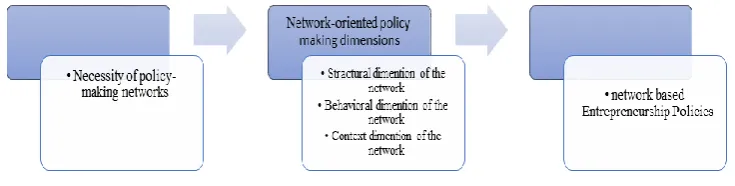
policy networks as inputs in the conceptual model of research was included (Figure 1).
Figure 1. Conceptual model
To validate the conceptual model of the research, experts and experts of the institutions and organizations associated with entrepreneurship in the Ministry of Co -operation, Labor and Social Welfare, estimated at 690 people, comprised the statistical community. Also, based on the Cochran formula, the final sample size of 240 individuals was calculated by stratified random sampling.
Number Research Design Cronbach Alpha CR AVE
1 Necessity of policy-making
networks 0.84 0.90
0.88
2 Behavioral dimension 0.84 0.91 0.90
3 Structural dimension 0.87 0.90 0.88
4 Content dimension 0.87 0.92 0.91
Research questions:
Main question: What are the dimensions and components of the entrepreneurial network policy model? Sub-questions:
1. What are the components of the necessity of using policy-making networks in the field of entrepreneurship?
2. What are the important components of the structural dimension of entrepreneurial policy making network?
3. What are the important components of the behavioral dimension of entrepreneurial policy network?
Findings:
As a result of the review of the theoretical foundations of the research, out of a total of 40 components in all four dimensions of the study, 12 components were identified in the need for network policy, of which 10 were identified as influential in networking policy in the field of entrepreneurship. In addition to three dimensions, structural, behavioral and background factors, a total of 28 components were identified. In order to enrich these components, semi-structured interviews were conducted with several experts. The result of these interviews was the extraction of five new components that were not considered during the review of theoretical foundations. Using the theme analysis method, as well as the idea of a three-branch model and a system model, 38
Components were categorized in the form of four main dimensions and, finally, the conceptual framework of the research was developed. After validating the conceptual model, by eliminating seven components, 31 components remained in the final model. In order to validate the initial model, the values of the standardized load factors of the components were calculated. Considering that the factor load factor, or the correlation coefficient between the observed and observed variables, is more suitable than 0.3, components of less than this value is eliminated (Table 2.).
Table 2. Validations of components using standardized load factor
Structure Dimensions Components Factor loading (S) The determina nts of establishin g a network model for entrepren eurship policy Necessity of policy-making networks
-Inappropriate coordination between organizations and institutions involved in - The weakness of the hierarchical policy framework
- The complexity, the interrelatedness and unpredictability of issues in the field (entrepreneurship), and the necessity of adopting and systemic approaches
- Capabilities and capabilities of the private sector (stakeholders and actors) in the policy process
- Need to increase performance and reduce costs in the policy process
- The need for coordination between stakeholders and actors in the field of policy - Need to adopt system-based and intersectional approaches in the field of policy
N9 N10 0.34 0.65 Behavioral dimension
- Trust between management and network members B1
- Policy-Participatory System Approach B2 - Motivational incentives to promote participation
- Understanding actors in the network of each other
- Understanding actors from the network - The degree of coherence and continuity of actors
- Common interests of actors
- The capacity of network to attract actors participation B1 B2 B3 B4 B5 B6 B7 B8 0.82 0.85 0.90 0.88 0.85 0.60 0.90 0.86 Structural dimension
- Degree of centralization
- The Importance of Controlling Mechanisms in Policy Making
- Network size (number of actors)
- Structural bridges (actors that interact with actors)
- The organizational status of the network actors (refers to the status and organization of the network interface outside the network) - Interdependence and intergenerational interests between actors in the network - How to divide tasks and Coordinate actors (Network Organization) S1 S2 S3 S4 S5 S6 S7 0.84 0.85 0.910.78 0.18 0.98 0.90 Content dimension
- The importance of non-state actors for state actors
- The existence of legal frameworks for the formation of networks
- Provision of Information and Communication Infrastructure
- Existence of values and culture encouraging cooperation
- Government Approach to Entrepreneurial Policy Networks (Tool / Interactive / Institutional)
- The government's look at entrepreneurship as a solution to the problem of unemployment - The role of stakeholder groups in entrepreneurship policy making
Tabel 3. The outputs of the Lisrel application showing a good fit of the model
Fit indicates NFI NNFI CFI GFI AGFI RMSEA
Model Indicators
0.854 0.92 0.96 0.94 0.98 0.90 0.00
Allowed Indicators
3 and less
0.9 and higher
0.9 and higher
0.9 and higher
0.9 and higher
0.9 and higher
Less than 0.08
Conclusion
While Iran's policy-making system in the field of entrepreneurship has been more hierarchical and has seen a lot of damage in this regard, it seems that the time has come for a change of approach. This is very important in the context of the Majlis Research Center on the need for the formation of an elite relative consensus (executive and intellectual) in shaping the entrepreneurial community and improving the business environment and the existence of a dedicated trustee to coordinate policies and programs on entrepreneurship in the country. , Is also reminded. (Vice -President of Economic Research, May 2013). The network approach in the process of entrepreneurial policy -making, which leads to the participation of the main stakeholders and entrepreneurship actors and the acquisition of the legitimacy required for the policies developed in this area, is one of the mechanisms that It is potentially effective in improving the policy process in the field of entrepreneurship. The purpose of the research is to design, validate and design a suitable model for networking in the field of entrepreneurship. Accordingly, the designed research model of the four main dimensions with internal topics indicates the necessity of a network-based entrepreneurial policy-making policy, the behavioral dimension of the entrepreneurial policy network, the structural dimension of the entrepreneurial policy network, the background dimension of the entrepreneurial policy network.
and their views are confronted with acceptance from the network members.
In the behavioral dimension of the Entrepreneurship Policy Network, the components were divided into two aspects of network management behavior and behavior of network actors. The governing style of the governing system of policy and incentive incentives to promote participation were the most important components in the behavior of the network administrator and in the behavior of the actors, the recognition of actors in the network from each other and the recognition of actors from the network were the most influential components. Other elements of behavior such as trust between network members, probable conflict between actors, non -verbal symbols and face-to-face interaction, the common purpose among the members in the field of the development of the country's entrepreneurship and cooperation, and the spirit of generous exchange of resources among network members, will affect network performance. . It is important to pay attention to these components because, for example, there is a conflict between some actors, the quality of relationships, and, ultimately, affect the performance of the network.
Regarding the background dimension of the Entrepreneurship Policy Network, the government's approach to Entrepreneurship (Instrument / Interactive / Institutional) (C5) Entrepreneurship Policy (C5) is more important than other components for respondents. The government can focus on one of the instrumental, interactive and institutional approaches to the Entrepreneurship Policy Network. An emphasis on each of these approaches has its own consequences and consequences. For example, if the government believes that it should have an initiative in the field of entrepreneurial policy, it will adopt a toolkit, and the Entrepreneurship Policy Network will serve as a platform for the achievement of the government's goals. . In this case, government representatives in the Entrepreneurship Policy Network will be considered as the main actors of the network. Among other substantive issues, the role of interest groups in entrepreneurship policy (C7) and the importance of non -state actors for government actors (C1) in the country's entrepreneurship sector were among the other key components as important respondents, because Directly or indirectly, the operation of the network overwhelms the network and affects the decisions of network actors.
in the field of entrepreneurship (N3), due to the high degree of participation gap in the policy system Existing N4 (N4), networking (N9) coordination among stakeholders and actors is hard to come by, and adopting policies with network and inter -enterprise approaches for entrepreneurship will not be achieved. In such a case, it can be predicted that the acquisition of social legitimacy in the policy process and the practical commitment of public sector institutions and organizations for the development of entrepreneurship will not be put into practice.
Hence, it is suggested to the government to take the initiative to start working on a tool approach and to take action on establishing an Entrepreneurial Policy Network that is the smallest member of the relevant state-owned entities in this network, and in the next steps with broadening the scope of the network and the membership of other public, private and public organizations will change the approach of interactivity or institutional approach.
References
1-Krätke, S. (2010). Regional knowledge networks: a network analysis approach to the interlinking of knowledge resources. European Urban and Regional Studies, 17(1), 83-97.
2- Resh, W., Siddiki, S., & McConnell, W. R. (2014). Does the network centrality of government actors matter? Examining the role of government organizations in aquaculture partnerships . Review of Policy Research, 31, 584–
3- Varone, F., Ingold, K., & Jourdain, C.(2016). Studying policy advocacy through social network analysis. European Political Science Review, 1– 15. doi:10.1057/eps.2016.16
4- Chaiton, A., Dibbits, T., Paquet, G., Roy, J., & Wilson, C.(2002) The Collaborative Challenges OF Regional Governance.
5- OECD (2010). Promoting entrepreneurship in South Eastern Europe: Policies and tools. Retrieved from http://www.oecd.org.
6- Lundström, A., Vikström, P., Fink, M., Meuleman, M., Głodek, P., Storey, D., & Kroksgård, A. (2014). Measuring the costs and coverage of SME and entrepreneurship policy: A pioneering study. Entrepreneurship Theory and Practice, 38(4), 941-957.
7-GEI (2018). https://thegedi.org/global-entrepreneurship-and-development-index/ Rhodes, R., Moran, M., & Goodin, R. (2006). Policy
network analysis. The Oxford Handbook of Public Policy (pp.423-45).
8- Yan, W., and G. Yin. 2014. “A Review of Policy Network Theory.”
The Journal of Yunnan Administration College 2: 122–126.
9- Harris, J. K., Leider, J. P., Carothers, B. J., Castrucci, B. C., & Hearne, S. (2016). Multisector Health Policy Networks in 15 Large US Cities.
Journal of Public Health Management and Practice, 22(6), 520–528.
http://doi.org/10.1097/PHH.0000000000000401
10- Leider, J. P., Castrucci, B. C., Harris, J. K., & Hearne, S. (2015). The Relationship of Policymaking and Networking Characteristics among Leaders of Large Urban Health Departments. International Journal of
Environmental Research and Public Health , 12(8), 9169–9180.
http://doi.org/10.3390/ijerph120809169
11- Fischer, M. (2013). Policy network structures, institutional context,
and policy change . Post- doctoral researcher, Swiss institute for aquatic
Understanding where we are and where we need to go. Journal of Public
Administration Research and Theory, 21(1), 157-173.
13- Sabatier, P. A., & Jenkins-Smith, H. C. (1999). The advocacy coalition
framework: An assessment. Theories of the policy process, Boulder, CO
Westview Press.
14- Henry, A. D., Lubell, M., & McCoy, M. (2011). Belief systems and social capital as drivers of policy network structure: The case of California regional planning. Journal of Public Administration Research and Theory, 21(3), 419-444.
15-Borg, R., Toikka, A., & Primmer, E. (2015). Social capital and governance: a social network analysis of forest biodiversity collaboration in Central Finland. Forest Policy and Economics, 50, 90-97.
16-Frederickson, H. G. 1997. The Spirit of Public Administration. San Francisco: Jossey-Bass.
17- Whitall, D. R. (2012, January). Sustaining communities of practice, place and culture through shared governance. In Leadership in Sustainable
Development Conference, Portland State University, OR, viewed (Vol.
18).
18-Lim, Seunghoo, Berry, Frances Stokes, Lee, Keon -Hyung, Barrilleaux, Charles J., Brower, Ralph S., Florida State University, College of Social Sciences and Public Policy, School of Public Administration and Policy (2015),. Three Essays on Policy Network Ties in the Dynamic Process of
Conflict Resolution, Retrieved from
http://purl.flvc.org/fsu/fd/FSU_2016SP_KWAK_fsu_0071E_13013
19- Kwak, C. -G. (2016). Understanding Network Change and Its Impact on Policy Performance : Policy Networks, EECBG Grants, Local Networks and "Green Development" in Florida. Retrieved from http://purl.flvc.org/fsu/fd/FSU_2016SP_KWAK_fsu_0071E_13013
20-Kim, K. (2016). How Do Public Policy Processes Influence Public Fiscal Choices Tax Politics and Policy Outcomes? Retrieved from http://purl.flvc.org/fsu/fd/FSU_FA2016_Kim_fsu_0071E_13599
21-Yi, H. (2012). Policy Networks, Environmental Impacts and Economic Consequences of Clean Energy in the U.S.: A National, State and Local Investigation. Retrieved from http://purl.flvc.org/fsu/fd/FSU_migr_etd-5291
and Adversarial Policy Networks in Decision Making and Implementation, (May), 1–18. http://doi.org/10.1093/jopart/muu043
23- Leider, J. P., Castrucci, B. C., Harris, J. K., & Hearne, S. (2015). The Relationship of Policymaking and Networking Characteristics among Leaders of Large Urban Health Departments. International Journal of
Environmental Research and Public Health, 12(8), 9169–9180.
http://doi.org/10.3390/ijerph120809169
24- Lundström, A., Vikström, P., Fink, M., Meuleman*, M., Głodek, P., Storey, D., & Kroksgård, A. (2017). Measuring the Costs and Coverage of SME and Entrepreneurship Policy: A Pioneering Study. Entrepreneurship
Theory and Practice, 38(4), 941–957. http://doi.org/10.1111/etap.12037
25- Chaiton, A., Dibbits, T., Paquet, G., Roy, J., & Wilson, C. (2002).
THE COLLABORATIVE CHALLENGES OF REGIONAL
GOVERNANCE: CIVIC ENTREPRENEURS AND NEW SOCIAL
TECHNOLOGIES. Alliances, cooperative ventures and the role of
government in the knowledge based economy: policy issues for Canada
and beyond, 111.
26- Alvani, Dr. Seyyed Mehdi, Decisions and Definition of Public Policy, Publication of the Soya, Third Edition, 1994.
27-Alvani, Dr. Seyyed Mahdi and Dr. Fateh Sharifzadeh, Policy Making Process, Allameh Tabataba'i University Press (RA), Fourth Edition, 2006. (Monitoring and Improving the Entrepreneurship System of Iran, 2016) Ministry of Cooperatives, Labor and Social Welfare, Entrepreneurship Development and Entrepreneurship Development Office, Autumn 2016 28- Ranaie Kardasholli, Habibollah, Management Quarterly Journal, Autumn 2006, Volume 1, Number 3; From page 1 to page 53, designing a feasibility model for creating policy networks in policy making systems: research in Agricultural Policy Research Policy
29-Sharifzadeh, Fattah, Kamli, Mohammad Javad, A Model for Networking Policymaking in Naja, Journal of Science and Research, Knowledge Enforcement, Year 10, Number 3 and 4, Autumn and Winter, 2008,
30-Peasant, R., Talebi, K. And Arabiun A., (2012) Development of Entrepreneurship in the Administrative System (State Status Survey). Tehran.
32- Heidar Ali Hooman, Structural Equation Modeling Using LisrelL Software, Organization for the Study and Compilation of Human Sciences Books of Universities, 1393
33- Adel Azar, Mansour Momeni, Statistics and its Application in Management, Organization of Study and Compilation of Human Sciences Books of Tehran University 2002
34- Raab, Jörg, Remco S. Mannak, and Bart Cambré. 2013. Combining structure, governance, and context: A configurational approach to network effective- ness [published online August 23, 2013]. Journal of Public Administration Research and Theory.