
University of New Orleans University of New Orleans
ScholarWorks@UNO
ScholarWorks@UNO
University of New Orleans Theses and
Dissertations Dissertations and Theses
5-20-2011
A Practical Method for Power Systems Transient Stability and
A Practical Method for Power Systems Transient Stability and
Security
Security
Hussain Hassan Al Marhoon University of New Orleans
Follow this and additional works at: https://scholarworks.uno.edu/td
Recommended Citation Recommended Citation
Al Marhoon, Hussain Hassan, "A Practical Method for Power Systems Transient Stability and Security" (2011). University of New Orleans Theses and Dissertations. 114.
https://scholarworks.uno.edu/td/114
This Thesis-Restricted is protected by copyright and/or related rights. It has been brought to you by
A Practical Method for Power Systems Transient Stability and Security
A Thesis
Submitted to Graduate Faculty of the University of New Orleans in partial fulfillment of the requirements for the degree of
Master of Science in
Engineering Electrical
By
Hussain Hassan Al Marhoon
B.S. University of New Orleans, 2008
© 2011
Hussain H. Al Marhoon
ACKNOWLEDGEMENT
This thesis would not have been possible without the guidance and help of several
individuals who in one way or another contributed and extended their valuable assistance in the
preparation and completion of this study.
First and foremost, I would like to express my utmost gratitude to my advisor, Professor
Parviz Rastgoufard for his valuable guidance and selfless support during these two years of my
Masters studies. His patience and unfailing encouragement have been the major contributing
factors in the completion of my thesis research.
I am heartfelt thankful to my parents, sister and brothers for their never ending love and
support.
Finally, I would like to thank all the professors and staff at the University of New Orleans
who contributed in providing quality education. I would also like to thank the Saudi Ministry of
TABLE OF CONTENTS
LIST OF TABLES ………. viii
LIST OF FIGURES ………... ix
ABSTRACT ……… x
Chapter 1 ………... 1
INTRODUCTION ………... 1
1.1 Overview ………... 1
1.1.1 Power System Stability Problems ………. 1
1.1.2 Forms of Power Instability ………... 2
1.1.3 Classification of Stability ……….. 2
1.1.4 Why Power System Stability ………... 4
1.2 Historical Review of Power System Stability Problems ………... 4
1.3 Scope and Simulation Tools ………... 7
Chapter 2 ………... 10
POWER SYSTEM STABILITY ……….. 10
2.1 Basic Concepts and Definitions ……….. 10
2.1.1 Rotor Angle Stability ………... 11
2.1.2 Small-Signal Stability ………... 16
2.1.3 Transient Stability ………. 18
2.2 Review of Existing Methods of Transient Stability Analysis ………... 19
2.2.1 Swing Equations ………... 20
2.2.2 Equal-Area Criterion ………. 21
2.2.3 Numerical Integration Methods ………... 23
2.2.4 Direct Methods Transient Stability Analysis ………... 24
2.3 Power System Models ……….. 25
2.3.1 Single-Machine Infinite-Bus ………... 26
2.3.1.1 Classical Model ………. 26
2.3.1.2 Detailed Model ………..27
2.3.2 Multi-Machine Infinite-Bus ……….. 29
2.3.2.1 Synchronous Reference Frame ………. 29
2.3.2.2 Center of Inertia Reference Frame ………... 30
2.4 Summary ………... 31
Chapter 3 ………... 32
TRANSIENT STABILITY USING NUMERICAL METHODS ……….. 32
3.1Overview ………... 32
3.2 Numerical Integration Methods ………. 32
3.2.1 Euler Method ………... 32
3.2.2.1 Second-Order R-K Method ………... 33
3.2.2.2 Forth-Order R-K Method ……….. 34
3.2.3 Implicit Integration Methods ………... 35
3.3 Simulation of Power System Dynamic Response ……….. 36
3.3.1 Overall System Equation ……….. 36
3.3.2 Solution of Overall System Equation Using Implicit Integration Methods ……….. 37
3.4 Summary ………... 38
Chapter 4 ………... 40
TRANSIENT STABILITY USING DIRECT METHODS ……… 40
4.1 Overview ………... 40
4.2 Lyapunov’s Method ………. 40
4.3 Transient Energy Function Formulation ……….. 41
4.3.1 Main Idea ……….. 41
4.3.2 Mathematical Development ……….. 42
4.3.3 Mathematical Development of TEF of Multi-machine Power Systems …………... 43
4.3.3.1 Synchronous Reference Frame ………. 43
4.3.3.2 Center of Inertia Reference Frame ………... 44
4.4 Multi-machine Transient Stability Measures Using TEF ……… 46
4.4.1 Individual Machine Energy Function for Synchronous Reference Frame ………... 46
4.4.2 Individual Machine Energy Function for COI Reference Frame ………. 48
4.4.3 Extended Equal Area Criterion ………. 50
4.4.4 Proposed Method ……….. 53
4.5 Summary ………... 54
Chapter 5 ………... 56
TEST SYSTEM ……….. 56
5.1 IEEE 39 Bus Test System ………... 56
5.1.1 Transmission Lines ………... 57
5.1.2 Transformers ………. 57
5.1.3 Generators ………. 58
5.1.4 Loads ………. 59
5.2 Summary ………...60
Chapter 6 ………... 61
SIMULATION AND RESULTS ……….. 61
6.1 Methodology ………. 61
6.1.1 Energy Comparison for Single Machine ………... 61
6.1.2 Determining Critical Clearing Time ………. 62
6.2 Power System Analysis Toolbox (PSAT) in MATLAB ………... 65
6.2.1 Overview ………... 65
6.2.2 Models and Algorithms for Numerical Simulation ……….. 67
6.2.2.1 Power System Model ………... 67
6.2.2.2 Power Flow ………... 67
6.3.1 Power Flow Results Using PSAT ………. 68
6.3.2 Numerical Simulation in PSAT ………... 68
6.3.3 Kron Reduction of Y-matrix ………. 71
6.3.4 Determination of Severely Disturbed Groups ….………..74
6.3.5 TEF for COI Reference Frame with Classical Model ……….. 75
6.3.6 TEF for Synchronous Reference Frame with Classical Model ………... 81
6.4 Summary ………... 83
Chapter 7 ………... 84
CONCLUDING REMARKS AND FUTURE WORK ………... 84
7.1 Concluding Remarks ………... 84
7.2 Future Work ………... 86
Appendix A ………. 87
A.1 Software Development ………...87
A.2 PSAT Built-in Functions ………... 88
A.3 Power Flow Report ………. 93
BIBLIOGRAPHY ……….. 98
LIST OF TABLES
5.1 Transmission Lines Data
5.2 Transformers Data
5.3 Generators’ Initial Load Flow
5.4 Generators Details
5.5 Loads Data
6.1 SDG Determination Illustration
6.2 Total Energy Comparison
6.3 EEAC Method
6.4 Proposed Method Simulation for COI Reference Frame
6.5 Average Simulation Time
6.6 Determining Critical Clearing Time Using the Proposed Method
6.7 Comparison of the four methods in determining tcr
6.8 Proposed Method Simulation for Synchronous Reference Frame
6.9 Average Simulation Time
A.2.1 Bus Data Format
A.2.2 Line Data Format
A.2.3 Transformer Data Format
A.2.4 Slack Generator Data Format
A.2.5 PV Generator Data Format
A.2.6 PQ Load Data Format
A.2.7 Fault Data Format
LIST OF FIGURES
1.1 Classification of power system stability
2.1 Single line diagram and equivalent circuit of a two-machine system
2.2 Phasor diagram of power transfer characteristic of a two-machine system
2.3 Power-angle characteristic of a two-machine system
2.4 Nature of small-disturbance response with constant field-voltage
2.5 Nature of small-disturbance response with excitation control
2.6 Rotor angle response to a transient disturbance
2.7 Simple SMIB system
2.8 Power-angle characteristic of the system in Fig. 2.7
2.9 A ball rolling on the inner surface of a bowl
2.10 Single-machine infinite-bus system
3.1 Euler’s method illustration
4.1 Potential energy plot
4.2 SMIB system
5.1 IEEE 39 Bus System
6.1 Flow chart of the proposed method applied to the IEEE 39 Bus system
6.2 Rotors’ speeds and angles relative to COI using forward Euler’s method plots
6.3 Rotors’ speeds and angles relative to COI using Trapezoidal rule plots
6.4 Obtained plots of generator 2 rotor’s angle and speed using forward Euler and Trapezoidal
rule
6.5 Rotors’ angles and speeds relative to synchronous reference frame plots using forward
ABSTRACT
Stability analysis methods may be categorized by two major stability analysis methods:
small-signal stability and transient stability analyses. Transient stability methods are further
categorized into two major categories: numerical methods based on numerical integration, and
direct methods.
The purpose of this thesis is to study and investigate transient stability analysis using a
combination of step-by-step and direct methods using Equal Area Criterion. The proposed
method is extended for transient stability analysis of multi machine power systems. The
proposed method calculates the potential and kinetic energies for all machines in a power system
and then compares the largest group of kinetic energies to the smallest groups of potential
energies. A decision based on the comparison can be made to determine stability of the power
system. The proposed method is used to simulate the IEEE 39 Bus system to verify its
effectiveness by comparison to the results obtained by pure numerical methods.
CHAPTER 1
INTRODUCTION
1.1
1.1
Overview:
Power systems generally consist of three stages: generation, transmission, and
distribution. In the first stage, generation, the electric power is generated mostly by using
synchronous generators. Then the voltage level is raised by transformers before the power is
transmitted in order to reduce the line currents which consequently reduce the power
transmission losses. After the transmission, the voltage is stepped down using transformers in
order to be distributed accordingly.
Power systems are designed to provide continuous power supply that maintains voltage
stability. However, due to undesired events, such as lightning, accidents or any other
unpredictable events, short circuits between the phase wires of the transmission lines or between
a phase wire and the ground which may occur is called a fault. Due to occurring of a fault, one or
more generators may be severely disturbed causing an imbalance between generation and
demand. If the fault persists and is not cleared in a pre-specified time frame, it may cause severe
damages to the equipments which in turn may lead to a power loss and power outage. Therefore,
protective equipments are installed to detect faults and clear/isolate faulted parts of the power
system as quickly as possible before the fault energy is propagated to the rest of the system.
1.1.1 Power System Stability Problem:
Power system stability is a very important aspect to supply continuous power. It is
equilibrium under normal operating conditions and to regain an acceptable state of equilibrium
after being subjected to a disturbance [1]. Instability of power system can occur in many
different situations depending on the system configuration and operating mode. One of the
stability problems is maintaining synchronous operation or synchronism especially that power
system rely on synchronous machines. This aspect is influenced by the dynamic of generator
rotor angles and power-angle relationships. Other instability problem that may be encountered is
voltage collapse that is mostly related to load behavior and not synchronous speed of generators.
1.1.2 Forms of Power Instability:
There are three different forms of power system instability: rotor angle instability,
voltage instability and voltage collapse, and mid-term and long-term instability. Rotor angle
stability is the ability of interconnected synchronous machines of a power system to remain in
synchronism. Voltage stability is the ability of a power system to maintain acceptable voltages at
all buses in the system under normal operating conditions and after being subjected to a
disturbance. For the voltage to be stable, the synchronous machines must run in synchronism.
The long-term and mid-term stability are relatively new to the literature on power system
stability [1]. Long-term stability is associated with the slower and longer-duration phenomena
that accompany large-scale system upsets and on the resulting large, and sustained mismatches
between generation and consumption of active and reactive power. In mid-term stability, the
focus is on synchronizing power oscillations between machines, including the effects of some of
the slower phenomena and possibly large voltage or frequency excursions [1].
1.1.3 Classification of Stability:
Figure 1.1 [1] provides a comprehensive categorization of power system stability. As
stability. Angle stability has two main subclasses: small-signal (steady-state) stability and
transient stability. A power system is considered to be steady-state stable if, after any small
disturbance, it reaches a steady state operating condition which is identical or close to the
pre-disturbance operating condition. A power system is transient stable for a large pre-disturbance or
sequence of disturbances if, following that disturbance(s) it reaches an acceptable steady-state
operating condition. Unlike steady-state stability which is a function only of the operating
condition, transient stability is more complicated since it is a function of both operating
condition and the disturbance [2]. Voltage stability also has two main subclasses:
large-disturbance voltage stability and small-large-disturbance voltage stability.
Figure 1.1: Classification of power system stability [1]
Power System Stability
Angle Stability Voltage Stability
Transient Stability
Mid-term Stability
Long-term Stability
Large Disturb. Stability
Small-signal Stability
Oscillatory Instability
Non-Oscillatory Instability
For transient stability, it is usually when the power system experiences a large
disturbance caused by an imbalance between the mechanical input and the electrical output
powers. In order to study this type of stability, the focus is only on the first swing periodic drift.
Therefore, only a fraction of a second is enough to observe the transients and several simulation
time seconds to study the system. As of the small-signal stability, it occurs when the system
lacks synchronizing torque or when an unstable control action occurs. This type of stability
requires a study of more than a minute to several hours.
1.1.4 Why Power System Stability:
Power system stability is a complex subject that has challenged power system engineers
for many years. Power systems operate closer and closer to their limits which makes the
instability problem to be more probable. With that given, it is very important to detect any
disturbance that may cause the instability. Instability may occur during steady-state; however, it
occurs more frequently following short-circuits which makes the time to clear a large disturbance
to be very short. That is, it is very crucial to determine whether the system will be transient stable
or will lose its synchronism. Therefore, transient stability analysis requires very fast computation
and decision making.
1.2
Historical Review of Power System Stability Problems:
Different forms of instability have emerged over the last century. The methods of power
system stability problems analysis were influenced by the development of computational tools,
stability theories, and power system control technologies. Therefore, it is very essential to
present a review of the history of the subject to better understand the methods used in industries
with regard of system stability and how these developments relate to the proposed practical
Power system stability is a complex problem that has challenged power system
engineers for many years. It was first recognized as an important problem in 1920s (Steinmetz,
1920; Evans and Bergvall, 1924; Wilkins 1926) [3]. The first field tests on the stability on a
practical power system were conducted in 1925 [4, 5]. The early stability problems were
associated with remote power plants feeding load centers over long transmission lines. With slow
exciters and non-continuously acting voltage regulators, power transfer capability was often
limited by steady-state as well as transient rotor angle instability due to insufficient
synchronizing torque [6].
In the early years, graphical methods such as, Equal Area Criterion (EAC) and power
circle diagrams were developed. These methods were successfully applied to early systems that
could be represented as two-machine systems. As the systems become larger, and
interconnection which was found to be economically better, the complexity of the systems grew
and therefore the stability problems became more complex, which voided the treatment of the
systems to be two-machine systems. A significant step towards the improvement of stability
calculations was the development in 1930 of the network analyzer which was capable of power
flow analysis of multi-machine power systems [1, 6]. A network analyzer is essentially a scaled
model of an AC power system with adjustable resistors, inductors and capacitors to represent the
transmission network and loads, voltage sources whose magnitude and angle are adjustable, and
meters to measure voltages, currents, and power anywhere in the network. However, system
dynamic still had to be solved by hand by solving the swing equations using step-by-step
numerical integration. During this period, classical models were used for the swing equations;
that is, by representing the generators by fixed transient reactances and a fixed power supply
In the early 1950s, electronic analog computers were used for analysis of special
problems requiring detailed modeling of the synchronous machine, excitation system, and speed
governor. Also, during that period, development of digital computers was seen, and specifically
about 1956, the first digital program for power system stability analysis was developed. In the
1960s, most of the power systems in the United States and Canada were joined as part of one of
two large interconnected systems, one in the east and the other in the west. In 1967, low capacity
HVDC ties were also established between the east and west systems. Nowadays, the power
systems in the United States and Canada form virtually one large system. This interconnection
between the two systems result in operating economy and increased reliability, though, it
increased the complexity of stability problems and increase the consequences of instability [1].
Until recently, most industry effort and interest has been concentrated on transient (rotor
angle) stability [1]. Powerful transient stability simulation programs have been developed that
are capable of modeling large complex systems using detailed models. In the early 1990s, the
focus was on small-signal stability which then led to the development of special study
techniques, such as modal analysis using eigenvalue techniques.
In the 1970s and 1980s, frequency stability problems were experienced following major
system upsets led to an investigation of the underlying causes of such problems and to the
development of long-term dynamic simulation programs to assist in their analysis. In 1983,
guidelines were developed for enhancing power plant response during major frequency
disturbance.
Nowadays, power systems are being operated under increasingly stressed condition due
to the prevailing trend to make the most of existing facilities. Increased competition, open
electric power systems which present greater challenges for secure system operation. This is
clear from the increasing number of major power-grid blackouts that have been experienced in
recent years such as, Northeast USA-Canada blackout of August 14, 2003. Planning and
operation of today’s power systems require a careful consideration of all forms of system
instability. Significant advances have been made in recent years in providing better tools and
techniques to analyze instability in power systems.
1.3
Scope and Simulation Tools:
It is very important for electric utilities to provide continuous power supply with minimal
interruption. In order to do that, it is essential to install protecting equipments such as, circuit
breakers and protective relays which protect the synchronous generators and transmission lines.
The purpose of this thesis is to find new ways to help in transient stability assessment for
multi-machine power systems during planning and operation (on-line assessment) phases. For this
purpose, direct methods are the most appropriate and the fastest methods to determine stability of
power systems. However, due to the complication of these methods when applied to larger
systems, variety of direct methods will be tested. Essentially, these methods are all based on
transient energy function (TEF) phenomena.
In this thesis, we propose a faster way to apply extended equal area criterion. The
proposed method requires three points: the stable equilibrium point (SEP) which is known from
the steady-state setup, rotor angles at the clearing time, and the estimate of unstable equilibrium
points (UEP). In traditional direct methods, the UEP is estimated by using only simulation results
up to the clearing time. However, in our proposed, we continue using simulation up to critical
clearing time, a longer simulation time than clearing time but much smaller than the simulation
system from the moment of a fault occurrence until the critical clearing of that fault using
numerical methods. Then, the results of the numerical integration are used to: first, determine the
unstable equilibrium points, then, calculate the potential and kinetic energies for each generator
on the system, and finally, determine whether the system is stable or unstable. When the
potential energy of each individual machine is found, the potential energies are sorted in
ascending order. Similarly, when the kinetic energy of each individual machine is found, the
kinetic energies are sorted in descending order. After calculating the potential and kinetic
energies of each machine in the system, the system is separated into two groups: the severely
disturbed group of machines, and the less disturbed machines. The severely disturbed group of
machines is determined using the accelerating power. Then, the group of the largest kinetic
energy is compared to the same number of group of smallest potential energy. If the largest
kinetic energy is smaller than the smallest potential energy, then the system is stable; otherwise,
the system is unstable. It is very challenging to find the unstable equilibrium point using the
post-fault system settings, but since the purpose of this thesis is stability assessment using energy
functions, previous methods will be implemented to calculate the UEP.
Additionally, this thesis provides comparison between the different direct methods with
the numerical methods and the proposed method results. In the comparison, simulation time is
captured for each method and the accuracy is compared with the numerical methods as a
benchmark.
The proposed method and the previous methods will be simulated and tested on the IEEE
39 Bus (New England) equivalent power system. This system has a total of 39 Buses of which 10
MATLAB is a numerical computing environment that can be used for transient stability
analysis using the Power System Analysis Toolbox (PSAT.) PSAT is a MATLAB toolbox for
static and dynamic analysis and control of electric power systems [10]. PSAT includes all the
required tools such as, power flow and time domain simulation, to simulate and analyze the
methods in this thesis.
In this thesis, first, a general discussion of power system stability and review of previous
methods are provided in chapter 2. Also, the general models of multi-machine power systems are
introduced in chapter 2. Then, in chapter 3, transient stability analysis using numerical methods
is discussed in detail. In chapter 4, transient energy function is introduced and different direct
methods in transient stability analysis are provided with their mathematical formulations and
criterion used to determine stability. Also, the proposed method is introduced and discussed in
chapter 4. In chapter 5, the IEEE 39 Bus power system is presented and its parameters are
tabulated. In chapter 6, some of the direct methods explained in chapter 4 are simulated on the
IEEE 39 Bus system and these methods are compared with the proposed method and the
numerical integration, which is used as a benchmark. Finally, some concluding remarks and
future work are presented in chapter 7. In the appendices, software developments of the functions
used in this thesis are briefly presented. In addition, the formatting of the various PSAT built-in
CHAPTER 2
POWER SYSTEM STABILITY
2.1
2.1
Basic Concepts and Definitions
Power system stability may be defined as that property of a power system that enables it
to remain in a state of operating equilibrium under normal operating conditions and to regain an
acceptable state of equilibrium after being subjected to a disturbance [1].
Instability of power system can occur in many different situations depending on the
system configuration and operating mode. Traditionally, the stability problem has been to
maintain synchronous operation or synchronism especially since power systems generation relies
on operation of synchronous machines. Necessary condition for satisfactory system operation is
that all synchronous machines operate in synchronism. This aspect is influenced by the dynamics
of the generator rotor angles and power-angle relationship.
In the stability assessment, the concern is the behavior of the power system when
subjected to transient disturbance. The disturbance may be small in the form of load changing
conditions, or large in the form of short-circuit on a transmission line or other large disturbances
such as, loss of large load or generator, or loss of tie-line between two subsystems. The system
response to a disturbance involves much of the equipment. For example, a short-circuit on a
critical element followed by its isolation by protective relays will cause variations in power
transfers, machine rotor speeds, and bus voltages; the voltage variations will actuate both
voltage and frequency will affect loads on the system in varying degrees depending on their
individual characteristics [1]. Many assumptions are usually made to simplify the problem and to
focus on factors influencing the specific type of stability problem.
To provide a framework for our proposed method, we briefly describe different form of
power system instability and associated concepts. Analysis of small idealized system will be
used to show each type of instability.
2.1.1 Rotor Angle Stability
Rotor angle stability is the ability of interconnected synchronous machines of a power
system to remain in synchronism [1]. The stability problem involves the study of the
electromechanical oscillations inherent in power systems. A fundamental factor in this problem
is how the outputs of synchronous machines vary with respect to their rotors oscillations. A brief
discussion of synchronous machines characteristics is helpful to develop the basic concepts of
stability.
A synchronous machine has two essential circuits: the field, which is on the rotor, and the
armature, which is on the stator. The field winding is supplied by direct current power while the
terminals of the armature provide the load power. The rotating magnetic field of the field
winding induces alternating voltages when the rotor is driven by a prime mover (turbine). The
frequency of the induced voltages depends on the speed of the rotor and the number of poles of
the machine. The frequency of the electrical voltage and the rotor mechanical speed are
synchronized (or in synchronism), at 60 Hz in USA, Canada and South America, and 50 Hz in
When two or more synchronous machines are interconnected, the stator voltages and
currents must have the same frequency and the rotor mechanical speed of each machine is
synchronized to this frequency.
To change the electrical torque (or power) output of the generator, the mechanical torque input is
changed to advance the rotor to a new position relative to the revolving magnetic field of the
stator.
Consider the system shown in Figure 2.1. It consists of two synchronous machines
connected by a transmission line having an inductive reactance XL but negligible resistance and
capacitance. Assume that machine 1 represents a generator feeding power to a synchronous
motor represented by machine 2.
Figure 2.1: Single line diagram and equivalent circuit of a two-machine system [1]
The power transfer from the generator to the motor is a function of the angular separation
δ between the rotors of the two machines. This angular separation is due to three components:
generator internal angle δG, angular difference between the terminal voltages of the generator
A phasor diagram identifying the relationships between generator and motor voltages is
shown in Figure 2.2. The power transferred from the generator with reactance of XG to the motor
with reactance of XM through a transmission line with reactance of XL is given by Equation 2.1.
sin
G M T
E E P
X δ
= (2.1)
where
T G L M
X =X +X +X
The corresponding power versus angle relationship is plotted in Figure 2.3. In the
equivalent model, an idealized model is used which makes the power varies as a sine of the
angle. However, with a more accurate machine models including the effects of automatic voltage
regulators, the variation in power with angle would deviate significantly from the sinusoidal
relationship, but the general form would be similar. As the angle is increased, the power transfer
increases up to a maximum. After a certain angle, normally 90˚, a further increase in angle
results in a decrease in power. When the angle is zero, no power is transferred.
Figure 2.3: Power-angle characteristic of a two-machine system [1]
From Figure 2.3, there are two points of interest: stable equilibrium point δ0
(SEP), and
the unstable equilibrium point δu (UEP). In the steady-state status, the system rests on the SEP where the mechanical power is equal to the electrical power. However, if the system swings to
the UEP, where the mechanical power is equal to the electrical power graphically, the
synchronous machine loses synchronism (unstable). Note that the system is assumed to be
lossless.
When there are more than two machines, their relative angular displacements affect the
interchange of power in a similar manner. However, limiting values of power transfers and
angular separation are a complex function of generation and load distribution.
Stability is a condition of equilibrium between opposing forces. The mechanism by
which interconnected synchronous machines maintain synchronism with one another is through
restoring forces, which act whenever there are forces tending to accelerate or decelerate one or
constant. However, if the system is perturbed, this equilibrium is disturbed resulting in
acceleration or deceleration of the rotors of the machines according to the laws of motion of a
rotating body [1]. If one generator runs faster than the other, the rotor angle of the faster machine
relative to the rotor angles of the slower machines will change and that particular machine may
lose synchronism causing disturbance to the other machines. As previously discussed, beyond a
certain limit, an increase in angular separation is accompanied by a decrease in power transfer;
this increases the separation further which leads to instability. For any given situation, the
stability of the system depends on whether or not the deviations in angular positions of the rotors
result in sufficient restoring torque.
Loss of synchronism can occur between one machine and the rest of the system or
between groups of machines. In this case, synchronism may be maintained within each group
after its separation from the others.
The change in electrical torque of a synchronous machine following a perturbation can be
resolved into two components:
e s D
T T δ T ω
∆ = ∆ + ∆ (2.2)
Where in Equation 2.2
s
T ∆δ is the component of torque change in phase with the rotor angle perturbation ∆δ
and is referred to as synchronizing torque component; Ts is the synchronizing torque
coefficient.
D
T ∆ω is the component of torque change in phase with the speed deviation ∆ωand is
Lack of sufficient synchronizing torque may result in instability through an aperiodic
drift in rotor angle. On the contrary, lack of sufficient damping torque results in oscillatory
instability.
Rotor angle stability phenomenon is categorized into two main categories: small-signal
stability, and transient stability.
2.1.2 Small-Signal Stability:
It is the ability of the power system to maintain synchronism under small disturbances.
These types of disturbances occur on the system because of small variation in loads and
generation. Instability that may result can be of two forms: (i) steady increase in rotor angle due
to lack of sufficient synchronizing torque, or (ii) rotor oscillations of increasing amplitude due to
lack of sufficient damping torque. The system response to small disturbance depends on: initial
operation, the transmission system strength, and the type of generator excitation controls used.
For a generator connected radially to a large power system, in the absence of automatic voltage
regulators (i.e. with constant field voltage) the instability is due to lack of sufficient
synchronizing torque. This result is shown in Figure 2.4. With continuously acting voltage
regulators, the small-signal stability is one of ensuring enough damping of system oscillations.
Figure 2.4: Nature of small-disturbance response with constant field voltage. Redrawn from [1]
Figure 2.5: Nature of small-disturbance response with excitation control. Redrawn from [1]
Nowadays, practical power system may experience small-signal instability due to
insufficient damping of oscillations. The stability of the following types of oscillations is of
concern:
Local modes or machine-system modes: these are associated with the swinging of units at a
Interarea modes: these are associated with the swinging of many machines in one part of the
system against machines in other parts.
Control modes: these are associated with generating units and other controls.
Torsional modes: these are associated with the turbine-governor shaft system rotational
components.
2.1.3 Transient Stability:
Transient stability is the ability of the power system to maintain synchronism when
subjected to sever transient disturbance. The response to this type of disturbance involves large
excursions of rotor angles and is influenced by nonlinear power-angle relationship. Stability
depends on the initial operating state of the system and the severity of the disturbance. The
system usually altered after the disturbance which may cause the system to operate in a different
steady-state status from that prior the disturbance.
Power systems are designed to be stable for a selected set of contingencies. The
contingencies usually considered are short-circuits of different types: ground,
phase-to-phase-to-ground, or three-phase. They are usually assumed to occur on the transmission lines,
but occasionally bus or transformer faults are also considered.
Figure 2.6 illustrates the behavior of a synchronous machine for stable and unstable
situations. In Case 1, the rotor angle increases to a maximum, then decreases and oscillates with
decreasing amplitude until it reaches a steady state. This case is considered transient stable. In
Case 2, the rotor angle continues to increase steadily until synchronism is lost. This type on
transient instability is referred to as first-swing instability. In Case 3, the system is stable in the
approached. This form of instability occurs when the postfault steady-state condition is itself is
small-signal unstable.
In transient stability studies, the study period of interest is usually limited to 3 to 5
seconds following the disturbance, although it may extend to about ten seconds for very large
systems with dominant interarea modes of oscillation.
Figure 2.6: Rotor angle response to a transient disturbance. Redrawn from [1]
2.2
Review of Existing Methods of Transient Stability Analysis:
As previously explained, transient stability is the ability of the power system to maintain
synchronism when subjected to a severe transient disturbance such as a fault on transmission
facilities, loss of generation, or loss of a large load. The system response to such disturbances
involves large excursions of generator rotor angles, power flows, bus voltages, and other system
certain bounds, the system maintains synchronism. If loss of synchronism occurs, the transient
instability will be evident within 2 to 3 seconds of the occurrence of the disturbance.
In this section, different methods of transient stability analysis are briefly introduced.
Since the focus of this thesis is transient stability analysis, small-signal stability analysis is not
explained in this section. Also, before introducing some of the methods, it is essential to
introduce the swing equation to represent the dynamic of a power system.
2.2.1 Swing Equation:
The swing equation describes the rotational dynamics of a synchronous machine and is
used in stability analysis to characterize that dynamic. During normal operation, the relative
position of the rotor axis and the resultant axis is fixed. During disturbance to the machine, the
rotor either accelerates or decelerates with respect to the synchronous rotating air gap MMF [7].
The swing equation describes this relation.
The swing equation of a power system is given as:
( )
0G M
Mδɺɺ+Dδɺ+P δ =P (2.3)
Where M ≜ H/πf0
H is the per unit inertial constant,
0 3
kinetic energy 3-phase apparent power
kinetic B
W H
S φ =
≜
3 0
2 / B
D≜ kω S φ
( )
G
P δ is the electrical power in p.u
0
M
P is the per unit mechanical power
δ is the relative angle of the electrical power
0
ω is the base electrical frequency in rad/sec
With the swing equation idea introduced, transient stability can be introduced in the
following sections.
2.2.2 Equal-Area Criterion
Consider a single-machine infinite-bus (SMIB) system of Figure 2.7. For the system
model considered in Figure 2.7, it is not necessary to formally solve the swing equation to
determine whether the rotor angle increases indefinitely or oscillates about an equilibrium
position. Assume that the system is a purely reactive, a constant Pm and constant voltage behind
transient reactance for the system in Figure 2.7.
Figure 2.7: Simple SMIB System [19]
Assume that a 3-phase fault appears in the system at t = 0 and it is cleared by opening
Figure 2.8: Power-Angle Characteristic of the System in Fig. 2.7 [19]
Let δ0 and δs be the pre-fault and post-fault operating or stable-equilibrium points, respectively, of the system. During the fault, the electrical output Pe of the generator reduces
drastically (almost to zero) but the mechanical power Pm remains almost constant. Thus the
generator accelerates and its angle δ increases. When the fault is cleared by disconnecting the
faulted line at time tc, the output power of the generator becomes greater than the mechanical
power and the generator decelerates to bring its speed to normal as shown in Figure 2.8. If the
system is stable, the generator will recover to its steady-state speed (or zero speed deviation) at
some peak angle δm. At δm,
Pe > Pm and the generator will continue to decelerate. The angle δ
decreases from δm
and reaches a minimum value below δs
before it starts to increase again. The
generator angle will oscillate around δs
and eventually it will settle down at δs
because of the
system damping. For a given clearing angle δc
, the peak angle δm
can be determined by equating
(
)
c
o
f
a m e
A P P d
δ
δ
δ
=
∫
− (2.4)(
)
m
c
p
d e m
A P P d
δ
δ
δ
=
∫
− (2.5)where
f e
P is the during-fault electrical power
p e
P is the post-fault electrical power
For a system to be transient stable, the maximum decelerating area is greater than the
accelerating area. That is, Ad > Aa. For a clearing time tc when Ad = Aa, we reach the maximum
clearing time referred to as the critical clearing time tcr.
2.2.3 Numerical Integration Methods:
The most commonly used method to solve the swing Equation 2.3 is the numerical
integration. The initial condition of the differential equation to be solved is the swing angle δ0
(SEP) of Figure 2.8.
Transient stability analysis is routinely performed in utility system planning. The industry
standard for transient stability usually requires the ability of the system to withstand sever
disturbances, including any “possible but improbable” three-phase fault close to a generator’s
Bus. The method used for analysis is time-domain numerical integration. The time-domain
numerical integration is not suitable for on-line security analysis due to the long CPU run times
for simulation. A typical time-domain numerical integration of 2 seconds takes more than 120
seconds depending on the step size of the integration. Larger step size that reduce time causes
There are different algorithms to perform numerical integration such as trapezoidal rule
and Euler integration. Mathematical derivation is illustrated in Chapter 3.
2.2.4 Direct Methods Transient Stability Analysis [1]:
The direct methods determine stability without explicitly solving the system differential
equations. This approach has received considerable attention since the early work of Magnusson
[8] and Aylett [9] who used transient energy function for stability assessment.
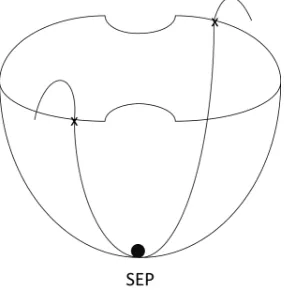
The transient energy approach can be described by considering a ball rolling on the inner
surface of a bowl generated by the equation describing the transient energy of the system as
depicted in Figure 2.9. The area inside the bowl represents the region of stability and the area
outside represents the region of instability. The rim of the bowl represents maximum elevation to
δs
, and hence, maximum potential energy for the traversed trajectory caused by the fault energy.
Figure 2.9: A ball rolling on the inner surface of a bowl
Initially, the ball is at rest at the bottom of the bowl, and this state is referred to as the
stable equilibrium point (SEP). When the bowl is perturbed, some kinetic energy is injected into
the ball causing it to move from its location at SEP in a particular direction. The ball will roll up
the inside surface of the bowl along a path determined by the direction of initial motion, and the
roll back and eventually settle down at the stable equilibrium point again. However, if the
injected kinetic energy is high enough to cause the ball to go over the rim, then the ball will enter
the region of instability and will not return to the SEP. The surface inside the bowl represents the
potential energy surface and the rim of the bowl represents the potential energy boundary
surface (PEBS.)
The application of transient energy function (TEF) method to power systems is
conceptually similar to that of a rolling ball in a bowl in the hyperspace (n-dimensional space).
Initially, the system is operating at steady-state equilibrium point. If a fault occurs, the
equilibrium is disturbed causing the synchronous machines to accelerate. The power system
gains kinetic energy and potential energy during the fault-on period causing the system to move
away from the SEP. After clearing the fault, the kinetic energy is converted to potential energy.
For a system to avoid instability, the system must be capable of absorbing the kinetic energy at a
time when the forces on the generators tend to bring them toward new equilibrium positions. For
a given post-disturbance network configuration, there is a maximum or critical amount of
transient energy that the system can absorb. For that reason, assessment of transient stability
requires the following:
a) Functions that adequately describe the transient energy responsible for separation
of one or more synchronous machines from the rest of the system.
b) An estimate of the critical energy required for the machine to lose synchronism.
Direct methods are suitable for on-line operation for dynamic security assessment
because it only requires simple mathematical operations unlike numerical methods which
involve solving differential equations numerically. Direct methods may require solving the
difficulties in applying direct methods to large power system. The mathematical formulation of
the direct methods will be illustrated in Chapter 4.
2.3
Power System Models
In order to analyze any power system, a mathematical model is used to represent the
system. It is very important to understand the various power system models before applying
them in this thesis. Therefore, several power system models are presented in this section. The
models that are presented in this section include: SMIB classical and detailed models, and
multi-machine classical model for both synchronous reference frame and center-of-inertia reference
frame.
2.3.1 Single-Machine Infinite-Bus System
2.3.1.1 Classical model [1]
Consider the single-machine infinite-bus (SMIB) system shown in Figure 2.10.
Figure 2.10: Single-machine infinite-bus system [1]
The generator is represented by the classical model, which ignores saliency of round
rotor, that is, for the purpose of transient stability, only the transient reactance Xd′ is considered
with the assumption that the direct and quadrature components are equal. Also, the speed
governor effects are neglected. The generator’s voltage is denoted by E’, and the infinite-bus
system experiences a disturbance, the magnitude of E’ remains constant at its pre-disturbance
value and δchanges as the generator rotor speed deviates from synchronous speed ω0.
The generator’s electrical power output is:
max sin sin s e T E E P P
X δ δ
′
= = (2.6)
where max s T E E P X ′ = (2.7)
The equation of motion or the swing equation may be written as:
2 max 2 0 2 sin m H d P P dt δ δ
ω = − (2.8)
where
Pm = mechanical power input, in pu
Pmax = maximum electrical power output, in pu
H = inertia constant, in MW.s/MVA
δ = rotor angle, in elec. rad
t = time, in s
2.3.1.2 Detailed Model [2]
In this model of synchronous machine, the field coil on the direct axis (d-axis) and
damper coil on the quadrature axis (q-axis) are considered. The machine differential equations
are:
(
)
1
q
q d d d fd do
dE
E X X i E
dt T ′ ′ ′ = − + − + ′ (2.9)
(
)
1 dd q q q
dE
E X X i
dt T
′
′ ′
= − − −
(
0)
B m m
d
S S
dt δ
ω
= − (2.11)
[
]
1 2
m
m m e
dS
T DS T
dt = H − − (2.12)
(
)
e q q d d q q d q
T =E i′ +E i′ + X −X ′ i i (2.13)
q d d a q q
E′ +X i′ −R i =v (2.14)
d q q a d d
E′ −X i′ −R i =v (2.15)
From Equations 2.14 and 2.15, id and iq can be solved as:
2
1 a d
q q q
q a
d a d q d d
R X
i E v
X R
i R X X E v
′ ′ − = ′ − ′ ′ ′ − +
(2.16)
where
Tm = the mechanical torque in the direction of rotation
Te = the electrical torque opposing the mechanical torque
do
T′ = d-axis open circuit transient time constant
qo
T′ = q-axis open circuit transient time constant
Sm = machine slip
Sm0 = initial machine slip (= 0 in steady-state)
B
ω = the electrical angular frequency
d
X = d-axis reactance
q
X = q-axis reactance
d
X ′, Xq′ = d-axis and q-axis transient reactance, respectively
d
E′,Eq′ = d- and q-axis generator’s voltage
d
i ,iq = d- and q-axis current
fd
E = control voltage
2.3.2 Multi-machine Infinite-Bus System
2.3.2.1Synchronous reference frame [11]
For this model, the motion of the generators can be represented by the set of differential
equations:
, 1, 2,...,
i i i i i ei i i
M D P P
i n ω ω δ ω + = − = = ɺ ɺ (2.17)
where, for machine i,
i
δ angle of voltage behind transient reactance, indicative of generator rotor position
i
ω rotor speed
i
M generator inertia constant
i
D damping coefficient
The expressions for Pi and Pei are given by:
(
)
(
)
2 1
sin cos
i mi i ii n
ei ij i j ij i j
i j i
P P E G
P C δ δ D δ δ
= ≠ = − = − + −
∑
(2.18) whereij i j ij ij i j ij
C E E B
D E E G
=
=
mi
P mechanical power input
Gii real part of the ith diagonal element of the network’s Y-matrix
Cij, Bij real and imaginary components of the ijth element of the network’s Y-matrix
2.3.2.2Center of Inertia (COI) Reference Frame [11]
The center of inertia model gives a good physical insight into the behavior of
synchronous generators. The equation of motion of the generators in the COI reference frame
can be represented by:
, 1,...,
i
i i i ei COI i i T
i i
M
M P P P D
M i n ω ω θ ω = − − − = = ɺɶ ɶ ɺ ɶ (2.19)
In Equation 2.19, the angle displacement θi and angular velocity ωɶi are defined as:
0 0
i i i i i
θ δ δ ω θ ω ω = − = ɺ = − ɶ (2.20) where 1 n T i i M M = =
∑
0 1 1 n i i i T M M δ δ = =∑
0 1 1 n i i i T M M ω ω = =∑
(
)
1 nCOI i ei i
P P P
= =
∑
−(
)
(
)
2 1 sin cosi mi i ii n
ei ij i j ij i j
i j i
P P E G
P C δ δ D δ δ
ij i j ij ij i j ij
C E E B
D E E G
=
=
mi
P mechanical power input
Ei magnitude of voltage behind transient reactance
Gii real part of the ith diagonal element of the network’s Y-matrix
Cij, Bij real and imaginary components of the ijth element of the network’s Y-matrix
δi and ωi as defined in Equation 2.17
The center of inertia model will be used later in this thesis.
2.4
Summary:
In this chapter, the basic concepts and definitions of stability in general are discussed.
Then, the discussion is focused on the rotor angle stability with its two main types: small-signal
stability, and transient stability. After that, a short review of the various methods to analyze
transient stability is illustrated which includes: numerical methods, and direct methods which are
based on equal area criterion. In addition, power system models are presented for both SMIB and
multi machine power systems.
In the next chapter, numerical methods are discussed in details. These methods include:
Euler method, Runge-Kutta second- and forth-order methods, and implicit integration method.
CHAPTER 3
TRANSIENT STABILITY USING NUMERICAL METHODS
3.1
3.1
Overview:
The differential equations to be solved in power system stability analysis are nonlinear
ordinary differential equation with known initial values and can be represented by:
(
,)
dt dt =
x
f x (3.1)
where x is the state vector of n dependent variables and t is the independent variable (time). The main goal of numerical integration techniques is to solve for x. In this chapter, different numerical integration methods are presented, and a way to simulate a power system with the
model in equation 3.1 is illustrated.
3.2
Numerical Integration Methods [1]:
In the following sections, the most commonly used techniques to perform numerical
integration are presented.
3.2.1 Euler Method
Consider the first-order differential equation:
(
,)
dxf x t
dt = (3.2)
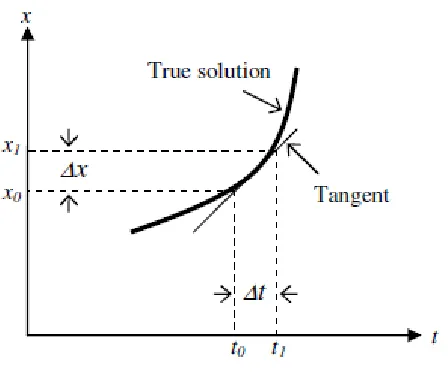
Figure 3.2: Euler’s method illustration
At x = x0, t = t0, the curve representing the true solution can be approximated by its
tangent having a slope
(
)
0
0, 0
x x
dx
f x t
dt = = (3.3)
Therefore, the value of x at t = t1 = t0 + ∆t is given by
0
1 0 0
x x
dx
x x x x t
dt =
= + ∆ = + ⋅ ∆ (3.4)
After using the Euler technique for determining x = x1 corresponding to t = t1, another
short time step ∆t can be taken and x2 corresponding to t2 = t1 + ∆t can be determined as follows:
1
2 1
x x
dx
x x t
dt =
= + ⋅ ∆ (3.5)
The method is also referred to as a first-order method because it considers the first
derivative in its Taylor series expanded version.
3.2.2 Runge-Kutta (R-K) Methods
3.2.2.1Second-order R-K Method
1 2 1 0 0
2
k k
x =x + ∆ =x x + + (3.6)
where
(
)
1 0, 0
k =f x t ∆t
(
)
2 0 1, 0
k =f x +k t + ∆ ∆t t
A general formula giving the value of x for the (n+1)st step is
1 2 1
2
n n
k k
x + =x + + (3.7)
where
(
)
1 n, n
k =f x t ∆t
(
)
2 n 1, n
k =f x +k t + ∆ ∆t t
The method is called second-order R-K because it is equivalent to considering up to the
second derivative terms of the Taylor series expansion.
3.2.2.2Forth-order R-K Method
The general formula giving the value of x for the (n+1)st step is
(
)
1 1 2 3 4
1
2 2
6
n n
x + =x + k + k + k +k (3.8)
where
(
)
1 n, n
k =f x t ∆t
1
2 ,
2 2
n n
k t
k =f x + t +∆ ∆t
2 3 , 2 2 n n k t
k =f x + t +∆ ∆t
The physical interpretation of the above solution is as follows:
k1 = (slope at the beginning of time step) ∆t
k2 = (first approximation to slope at mid step) ∆t
k3 = (second approximation to slope at mid step)∆t
k4 = (slope at the end of step) ∆t
∆x = 1/6(k1+2k2+2k3+k4)
The method is called forth-order R-K because it is equivalent to considering up to the
forth derivative terms of the Taylor series expansion.
3.2.3 Implicit Integration Methods
Consider the differential Equation 3.2. The solution for x at t = t1 = t0+∆t may be
expressed in integral form as
(
)
1
0
1 0 ,
t
t
x =x +
∫
f x τ dτ (3.9)Implicit integration methods use interpolation functions for the expression under the
integral. The most common implicit integration method is trapezoidal rule. The area under the
integral of Equation 3.9 is approximated by trapezoids.
The trapezoidal rule for Equation 3.9 is given by
(
)
(
)
1 0 0, 0 1, 1
2
t
x =x +∆ f x t +f x t (3.10)
A general formula giving the value of x at t = tn+1 is
(
)
(
)
1 , 1, 1
2
n n n n n n
t
x + =x +∆ f x t +f x + t + (3.11)
The trapezoidal rule is a second-order method and it is numerically A-stable, which
Implicit integration methods of higher order have been proposed in the literature on numerical
methods; however, they have not been widely used for power system applications especially that
they are more difficult to program and less numerically stable than the trapezoidal rule.
When numerical integration methods are used, the system’s equations have to be
arranged as first-order differential equations.
3.3
Simulation of Power System Dynamic Response
3.3.1 Overall System Equations
Equations for each of the generating units and other dynamic devices may be expressed
in the following form:
(
,)
d = d d d
xɺ f x V (3.12)
(
,)
d = d d d
I g x V (3.13)
where
xd = state vector of individual device
Id = R and I components of current injection from the device into the network
Vd = R and I components of bus voltage
Equations 3.12 and 3.13 can be represented using the general form comprising a set of
first-order differential equations of Equation 3.14 and a set of algebraic equations of Equation
3.15.
(
,)
=xɺ f x V (3.14)
(
,)
= NI x V Y V (3.15)
where
![Figure 1.1: Classification of power system stability [1]](https://thumb-us.123doks.com/thumbv2/123dok_us/8944029.1853397/14.612.72.502.323.648/figure-classification-power-stability.webp)
![Figure 2.2: Phasor diagram or power transfer characteristic of a two-machine system [1]](https://thumb-us.123doks.com/thumbv2/123dok_us/8944029.1853397/24.612.225.397.467.625/figure-phasor-diagram-power-transfer-characteristic-machine.webp)
![Figure 2.3: Power-angle characteristic of a two-machine system [1]](https://thumb-us.123doks.com/thumbv2/123dok_us/8944029.1853397/25.612.141.475.75.289/figure-power-angle-characteristic-machine.webp)
![Figure 2.4: Nature of small-disturbance response with constant field voltage. Redrawn from [1]](https://thumb-us.123doks.com/thumbv2/123dok_us/8944029.1853397/28.612.133.479.342.555/figure-nature-small-disturbance-response-constant-voltage-redrawn.webp)
![Figure 2.6: Rotor angle response to a transient disturbance. Redrawn from [1]](https://thumb-us.123doks.com/thumbv2/123dok_us/8944029.1853397/30.612.136.482.213.503/figure-rotor-angle-response-transient-disturbance-redrawn.webp)
![Figure 2.8: Power-Angle Characteristic of the System in Fig. 2.7 [19]](https://thumb-us.123doks.com/thumbv2/123dok_us/8944029.1853397/33.612.113.502.78.334/figure-power-angle-characteristic-fig.webp)
![Figure 2.10: Single-machine infinite-bus system [1]](https://thumb-us.123doks.com/thumbv2/123dok_us/8944029.1853397/37.612.147.466.419.530/figure-single-machine-infinite-bus-system.webp)
![Figure 5.1: IEEE 39 Bus System [21]](https://thumb-us.123doks.com/thumbv2/123dok_us/8944029.1853397/67.612.125.482.376.662/figure-ieee-bus-system.webp)
