DEMOGRAPHIC RESEARCH
VOLUME 29, ARTICLE 42, PAGES 1153-1186
PUBLISHED 6 DECEMBER 2013
http://www.demographic-research.org/Volumes/Vol29/42/ DOI: 10.4054/DemRes.2013.29.42
Research Article
Register-based estimates of parents’ coresidence
in Sweden, 1969-2007
Elizabeth Thomson
Helen Eriksson
© 2013 Elizabeth Thomson & Helen Eriksson.
This open-access work is published under the terms of the Creative Commons Attribution NonCommercial License 2.0 Germany, which permits use, reproduction & distribution in any medium for non-commercial purposes, provided the original author(s) and source are given credit.
1 Introduction 1154
2 Measuring parents’ coresidence 1155
3 The union context of childbearing and parents’ separation in Sweden
1158
4 Data and measurement 1159
5 Validation studies 1161
5.1 Register versus census estimates of parents’ coresidence 1161 5.2 Annual registration in relation to birth month 1164 5.3 Register- vs. survey-based estimates of union status at birth and
parents’ separation
1167
6 Trends in union status at birth and parents’ separation 1172
6.1 Union status at birth 1173
6.2 Parents’ separation after birth 1174
7 Conclusions and discussion 1176
8 Acknowledgements 1180
Register-based estimates of parents’ coresidence in Sweden,
1969-2007
Elizabeth Thomson1 Helen Eriksson2
Abstract
BACKGROUND
Many of the dramatic changes in family formation and dissolution observed in wealthy countries over the past 60 years are tracked through vital statistics or censuses. The signature change in family behavior — non-marital cohabitation — is not, however, registered in most settings.
OBJECTIVE
We evaluate the quality of new register-based estimates of parents‗ union status at birth and of separation during the childrearing years.
METHODS
Parents of a common child are identified through the Multi-Generation Register that links each child to each parent and therefore each parent to each other. The Total Population Register identifies the property at which each parent is registered at the end of each year. We use the five-year censuses 1960-1990 as one standard of comparison because the censuses identify the dwelling unit for each parent on the census date. RESULTS
Property-based estimates of parents‗ coresidence compare very well to census reports. Register-based estimates are virtually identical with those produced from the 1992 Swedish Fertility and Family Survey; differences between register estimates and those produced from the 1991 and 2000 Level of Living Survey can be explained by differences in measurement of marriage and cohabitation.
1 Stockholm University Demography Unit, Department of Sociology, Sweden. E-Mail: [email protected].
2
CONCLUSIONS
Estimates of parents‗ cohabitation based on annual, property-level registration are of sufficient quality for their use in substantive analyses of union status at birth and parents‗ separation in Sweden.
COMMENTS
Although register-based estimates of parents‗ coresidence at a child‗s birth or afterwards can be generated only for a select group of countries, their use can be fruitful for understanding more general processes of family change. Centralized administrative registers exist in many countries but have not been made fully available for research therefore losing much of the potential value.
1. Introduction
Many of the dramatic changes in family formation and dissolution observed in wealthy countries over the past 60 years are tracked through vital statistics or censuses. Births, marriages, and divorces are recorded and reported at the national and sometimes at the regional level (e.g., see http://epp.eurostat.ec.europa.eu/). Because birth records include the marital status of the mother, the proportion of births to unmarried women has become a key indicator of what is known as the Second Demographic Transition (e.g., Lesthaeghe and Neels 2002; Lesthaeghe and Neidert 2006). The signature change in family behavior, non-marital cohabitation, is not, however, a registered event in most settings. What we know about the emergence of cohabitation as an alternative to marriage, a context for childbearing, or a stable form of partnership is based almost entirely on sample surveys that collect retrospective life histories.
Measurement of cohabitation is particularly important for understanding the family lives of children. Almost all of the increase in non-marital childbearing has occurred in cohabitation (Bumpass and Lu 2002; Perelli-Harris et al. 2010; 2012) and the risk of parents‘ separation is hugely underestimated by parents‘ divorce (Jonsson and Gähler 1997; Raley and Wildsmith 2004). The increasing instability of children‘s families is a growing national and international concern (McLanahan 2004) and requires the regular collection of data that follow children over time (Manning and Bulanda 2007).
given the relatively small sizes of most national samples, especially where and when births to cohabiting couples are uncommon.
In some settings, it is possible to use administrative registers or censuses to estimate the event or state of non-marital cohabitation. Both sources of data have the advantage of covering the entire population, allowing for more precise estimates of cohabitation. Cohabitation is reported at the time it occurs, thus reducing recall error. Census reports may, however, also be subject to social desirability bias and to respondents‘ interpretations of census instructions. The accuracy of register data depends on incentives for individuals to provide timely and accurate information to authorities and on administrative procedures for recording the information. Registers can sometimes be linked over time to produce life histories from contemporaneous reports of life circumstances, i.e. life histories that are not subject to recall error.
In this paper, we evaluate new measures of parents‘ coresidence generated from Swedish population registers. We first compare the quality of an annual property-based measure to a dwelling-unit measure generated from national censuses and conclude that property-based registers provide quite accurate estimates of parents‘ coresidence in a child‘s birth year or afterward. We also document at the aggregate level considerable shifts in registered coresidence during the year before and the year in which a couple‘s first child is born. We find that the register-based estimates are similar to previous estimates based on retrospective life histories in sample surveys and that differences can be explained by the precision of dating events and method of allocating births to unions. Using the property-based estimates, we show that virtually all of the increase in non-marital births since the 1960s was comprised of births in cohabitation and that children‘s experience of parents‘ separation increased steadily to 1999 and then declined. In both cases, annual estimates for the entire population enable us to detect shifts in family behavior that may be associated with policy change.
2. Measuring parents’ coresidence
Heuveline, Timberlake, and Furstenberg 2003; see also Bumpass and Lu 2000). Information on the union status of births has been updated for a smaller number of countries using the more recent Generations and Gender Surveys (Perelli-Harris et al. 2010, 2012).
Estimates of births to cohabiting parents and the dissolution of cohabiting or marital unions are derived from retrospective histories by linking the child‘s birthdate to the parent‘s cohabitation and marriage dates. In general, birth histories are highly accurate in surveys, especially when provided by women (Klijzing and Cairns 2000; Rendall et al. 1999). The larger problem is the accuracy of union histories, especially for cohabitation.
The first source of error in reports of cohabitation is the definition. As Keilman (2006) points out, it was not until 1998 that the United Nations provided a common definition of cohabitation for censuses. But even the common definition contains ambiguities in the terms ―usual residence‖ and ―marriage-like relationship‖ (Keilman 2006: 460). Manning and Smock (2005) found that a common term used in household surveys and retrospective union histories – ―unmarried partner‖ – was not always understood as referring to a ―marriage-like relationship‖. In the 2007 U.S. Current Population Survey, follow-up questions using other terms identified an additional 18 percent of cohabiting couples and an additional 12 percent of children living with cohabiting parents (Kennedy and Fitch 2012). The distinction between cohabitation and marriage may also be influenced by one‘s definition of cohabitation. In the 1979 British General Household Survey, half of cohabiting women initially reported themselves as married; these women had more ―marriage-like‖ cohabitations in terms of duration, children, and employment (Brown and Kiernan 1981).
Another source of ambiguity is whether a romantic partner lives with the respondent (Knab and McLanahan 2007). Surveys and censuses usually instruct respondents to include in a household register those who ―permanently‖ live in the household even if they are temporarily living at another address. On the other hand, the Norwegian census of 1990 instructed householders to report persons in the household only if they were formally registered at the given address. Keilman and Brunborg (1995) estimate that 22 percent of cohabiting unions were missed because of this definition. Reports of household membership may be especially unreliable for persons who are in the process of moving in or moving out (Tourangeau et al. 1997; 2006; Martin 1999). Because cohabitation is a process rather than an event, at any given point in a relationship respondents may have different ideas about whether the couple does in fact live together.
2012). In retrospective reports, social desirability may lead respondents to report union dates that encompass a child‘s birth (Teitler, Reichman, and Koball 2006) or to omit births that occurred out of union or in a prior union (Klijzing and Cairns 2000; Rendall et al. 1999). Because social acceptance of cohabitation has increased in most wealthy countries (Thomson 2005), it is quite likely that some part of the apparent increase in cohabitation and in births to cohabiting parents is due to increased accuracy of reports.
The accuracy of cohabitation histories may also be influenced by recall (Keilman 2006). The fact that cohabitation does not occur all at once (Manning and Smock 2005) increases the difficulty of not only defining but also recalling the particular time of moving in. For the same reasons, separation or divorce may also be difficult to pinpoint and recall (Peters 1988). Hayford and Morgan (2008) found that short unions or those occurring long ago were less likely to be reported retrospectively. Hoem and Rennermalm (1985) reported a tendency for Swedish and Norwegian women to date the start of a cohabiting union at a year prior to the partners‘ marriage, suggesting that it was easy to recall a marriage celebrated with an anniversary each year, and then to backdate by one year for the period of cohabitation.
Recall of cohabitation timing should, however, be improved by the birth of a child to the cohabiting couple. Childbirth is an event high in the hierarchy of memory in part because children‘s birthdays are celebrated each year, and linking other life events to the birth of a child improves recall of those events (Auriat 1993; Belli, Shay, and Stafford 2001; Smith and Thomas 2003). On the other hand, as noted above, social desirability may produce underreporting of the less desirable contexts for children‘s births.
Where they exist, administrative data offer possibilities for contemporary and longitudinal estimates of births to and separation of cohabiting couples. Such data are maintained for an entire population and thus are not subject to sampling error. Because most events are registered when they occur, recall bias is not an issue. Once the two parents of a child are identified, cohabitation may be inferred from knowing the address of each parent (e.g., Cooper 1991; Statistics Sweden 2003).
percent of cohabiting couples are not registered at the same address (Slaastad et al. 2012; Statistics Sweden 1992). The process of registering residential moves may also introduce inaccuracies. Until 1998 in Sweden, residential moves were recorded as occurring when the report was received, rather than on the moving date reported by the resident (Statistics Sweden 2008). Thus, many couples who moved together at the end of the year were not registered in the same residence until the end of the following year.3
It is important to keep in mind, however, that the relatively high rate of error in residential registration for cohabiting couples may not apply to couples with common children. By the time a couple has children, they will have been together for a longer period of time, made a stronger commitment than a childless couple, and likely have pooled their resources in a common residence.
3. The union context of childbearing and parents’ separation in
Sweden
Sweden stands out as having the second (to Iceland) highest proportion of births occurring out of marriage (Thomson 2005). Furthermore, Sweden experienced the earliest steep increase in nonmarital childbearing. In 1960, around 10 percent of births occurred to unmarried women; by 1980, the percentage had increased to more than one third. According to retrospective survey estimates, the vast majority of unmarried mothers in these early cohorts had their children in a cohabiting union (Bernhardt and Hoem 1985; Hoem and Rennermalm 1985). Analyses of the Fertility and Family Surveys found that more than half of births around 1990 were out of marriage, but only 5 percent were to lone mothers (Andersson 2002a; Heuveline, Timberlake, and Furstenberg 2003). Kennedy and Thomson (2010) used a more generous definition of cohabitation at birth (up to 12 months after the birth), applied to the Swedish Level of Living Survey. They reported that all of the increase in non-marital births from the 1970s to the 1990s was comprised of births to cohabiting couples and that the percentage of births to lone mothers had remained unchanged at 3 percent. (See further details below.) Similar results are reported from retrospective surveys in other countries (Bumpass and Lu 2000; Kennedy and Bumpass 2008; Perelli-Harris et al. 2010; 2012).
Sweden has also been among the leaders in divorce (Sobotka and Toulemon 2008). Because cohabitations are less stable than marriages, the probability of union dissolution (divorce or separation) is higher in Sweden than in any country except the United States (Andersson 2002b). Analyses of the Swedish Fertility and Family Survey
showed that about 35 percent of Swedish children experience parents‘ separation by age 15 (Andersson 2002a; Heuveline et al. 2003). Furthermore, the probability of parents‘ separation is about twice as likely for children born in cohabitation as for children born in marriage. Kennedy and Thomson (2010) showed an increase in the likelihood of parents‘ separation or divorce from the 1970s to the 1990s and also documented similar differentials for children born in cohabitation versus marriage.
With a few exceptions (Prinz 2005; Statistics Sweden 2002), estimates of births to cohabiting couples and separation of cohabiting parents have been based on retrospective sample surveys. No estimates cover the entire period during which cohabitation and union dissolution dramatically increased. Non-response, recall and social desirability biases all work in the direction of underestimating the extent to which Swedish children are born out of union and/or experience their parents‘ separation. In this paper we evaluate the potential of administrative registers as a source of data on children‘s family lives.
4. Data and measurement
In order to generate estimates of separation among both married and cohabiting parents, we use Swedish register data on births, deaths, marriage, divorce, and registered residence.4 The population of children for our analyses includes persons born in Sweden 1954-2007: about 5.5 million persons. Statistics Sweden‘s Multi-Generation Register provides a link between each person and their parents if ever registered in Sweden (Statistics Sweden 2010). These links do not change once they are established (unless paternal status is changed by legal action), even if a parent dies or emigrates. Virtually all persons born in Sweden in 1932 or later can be linked to their parents. Through the parent-child link, it is possible to link both parents of the same child.
We excluded from analysis small numbers of persons with duplicate identification numbers or who were not linked to any parent.5 The largest exclusion was for adopted
4 We used Sweden in Time: Activities and Relationships (STAR), a collection of variables from population registers and censuses produced by Statistics Sweden. Virtually the entire Swedish population is included, i.e., anyone registered in Sweden in 1968 or later or in at least one of the censuses 1960-1990. The register variables are made available through remote access to projects developed at the Institute for Social Research (SOFI) at Stockholm University and the Stockholm University Demography Unit (SUDA). Further information is available from the authors on request.
children.6 Total exclusions due to duplicate identification numbers and missing information were less than 0.5% of the population born in Sweden 1954-2007.
To determine whether parents are living together, we turn to the Total Population Register. This annual register includes the unique number of the property at which each person is registered at the end of the calendar year, i.e., the last address reported to the tax authority.7 The property number is to date the lowest-level geographical identification in Swedish registers. It may represent a single-family dwelling, an apartment building or a complex of apartment buildings with as many as 1000 separate units.8 Because dwelling units are not separately identified, it is not possible to estimate cohabitation using the registers; each single person could be seen as cohabiting with several other single persons in a building or complex. Only when couples are already linked through a common child can one estimate coresidence using the property number. For couples with a common child, the primary source of error would be couples who live in different apartments in the same building or complex. The property measure may therefore be slightly biased toward coresidence.
When links are made between the child and both parents, we simply compare the property numbers at which the parents are registered at the end of each year. Parents with the same number are assumed to live together, those with different numbers to live apart. When only one parent is linked to the child, we assume that the parents did not live together at the child‘s birth; such cases constituted about 20 percent of all lone-mother births. In some cases, the child may have been born to a woman who became pregnant through donor insemination with unknown paternity.9 The vast majority of births for which a father is not identified, however, are to women living alone who do not report the biological father‘s identity to the authorities and perhaps not even to the man himself. Such men are highly unlikely to be living with the child‘s mother because the social welfare board conducts an inquiry on every child with a non-reported father.
6 Before 1991, no information is available in the register on the date of adoption. Thus, we could not determine if a child was born to a coresident or married couple and later adopted by a new parent or whether the child was born to a lone mother and adopted shortly after birth. By 1991 when date of adoption was included, adoptions of Swedish-born children were rare, while most adoptions were of foreign-born children (Statistics Sweden 2010).
7 Although the migration register provides information on the month and year of each registered move, it includes the residential locations only at the municipality, not the property level.
8 Denmark and Finland have had dwelling-unit identifiers in the annual population register since the late 1980s. Norway added dwelling-unit identifiers to annual registers in 2001. Sweden instituted a dwelling register in 2012. Only half of all registered properties in Sweden are single-family houses where everyone living at the property can be assumed to live in the same household.
The Total Population Register was also our source for parents‘ separation due to emigration. If a parent was in the population register in Year N but not in Year N+1, we assume that she/he has emigrated. Emigration was considered to constitute parents‘ separation unless both parents migrated in the same year; in that situation, the observations were censored. Finally, we used the Register of Deaths to determine whether and in which year a parent died, also a censoring event.
We used the Register of Civil Status Changes – marriage, divorce, widowhood – together with civil statuses recorded annually in the Total Population Register to determine whether a child‘s mother was married in the child‘s birth month. Changes of civil status are recorded from January 1968 onward, and civil status is also included in the annual population register, i.e., as of December each year, 1968 and onward. The husbands of married women are almost uniformly registered as the child‘s father, so we ignored register data on the father‘s marriages and divorces.
5. Validation studies
5.1 Register versus census estimates of parents’ coresidence
To estimate the reliability of the property-based measure of parents‘ coresidence, we compared it to measures based on each parent‘s dwelling unit recorded in the censuses of 1970, 1975, 1980, 1985, and 1990. After 1990, censuses were replaced by the annual population registers. Census data were collected by forms sent to the registered address of every individual over the age of 15. Forms were also sent to addresses identified by the building‘s owner (usually a cooperative in the case of multiple dwelling units) but for whom no person was registered at the address. The census forms included a pre-printed list of persons registered at the address and who would be 16 or older by the end of the census year. Instructions were to show on the submitted form all persons who lived ―permanently‖ in the dwelling unit on the specified date. Until 1990, householders were explicitly instructed to include anyone who was ―temporarily‖ living elsewhere because of, for example, studies, military service, or illness. In 1990, no mention was made of such persons, leaving more scope for those completing the forms to define who was a permanent resident.
November 1 (except for 1980, September 15) – while the population register refers to the person‘s address on December 31.
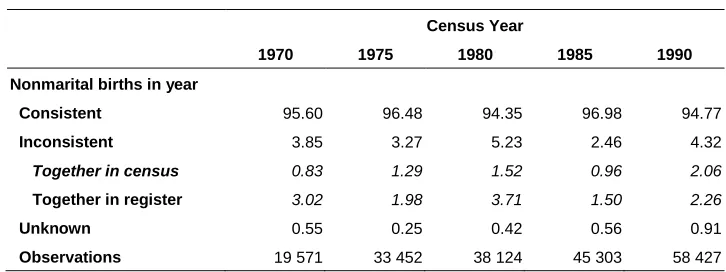
Table 1 shows the consistency between coresidence reported at the time of the census and coresidence estimated from the corresponding annual population register, separately for each census. As described above, when one parent was not found in a given data source (register or census), parents were classified as living apart; if neither parent was found in the source, coresidence was classified as unknown.
As shown in the first row, register (property) and census (dwelling unit) estimates of parents‘ coresidence are the same for about 99 percent of children under 16.10
Among families for which register and census information differs (second row), the distribution is about equal between those identified as together or apart in the register (rows 3 and 4). The discrepancies may be due to random or non-random errors in each data source, but they could also arise from moves into and moves out of a household between the census and the end of the year. The implication is that when Swedish parents separate, they almost always live at different properties.
We found a small percentage of children whose parents are both missing, either from the census or from the population register at the end of the year (rows labeled ―unknown‖). In almost all of these cases, parents were not found in either source of data and may have been living with the child outside of Sweden during the census year. In the very small number of other situations, parents could have emigrated together or returned together between the census and the end of the calendar year, or the census form was not completed.
The second set of comparisons is limited to parents of children born in a census year. The next-to-last row in the second panel shows that the proportion of children whose parents were neither registered nor reported in the census is much smaller than for all children. This result likely arises from the fact that parents have more opportunities to emigrate as children grow older, i.e., would both have missing information on residence for one or more years. The second and third rows of the panel show more discrepancies between the census and register in a child‘s birth year than in any given year for all children under 16. Furthermore, the register data are slightly more likely to indicate parents as together than are the census reports, something we did not see for all children. These results are consistent with the additional time to register a move together between the census date and the end of the year, and the very low likelihood of separation among new parents.
10
Table 1: Estimates of parents’ coresidence from register vs. census report (percentages of children)
Census Year
1970 1975 1980 1985 1990
All children < 16
Consistent 98.88 98.20 97.41 97.56 97.19
Inconsistent 0.49 0.59 1.16 0.79 1.49
Together in census 0.27 0.23 0.56 0.27 0.63 Together in register 0.22 0.36 0.60 0.52 0.86
Unknown 0.63 1.21 1.43 1.65 1.32
Observations 1 712 543 1 745 108 1 694 122 1 590 389 1 600 581
Children born in year
Consistent 98.77 98.56 97.17 98.28 96.98
Inconsistent 1.03 1.31 2.57 1.42 2.54
Together in census 0.32 0.53 0.78 0.57 1.23 Together in register 0.71 0.78 1.79 0.85 1.31
Unknown 0.20 0.13 0.26 0.30 0.48
Observations 107 730 102 215 96 218 97 688 123 653
Marital births in year
Consistent 99.47 99.56 99.05 99.41 98.98
Inconsistent 0.40 0.35 0.81 0.52 0.93
Together in census 0.21 0.15 0.29 0.24 0.48 Together in register 0.19 0.20 0.52 0.28 0.45
Unknown 0.13 0.09 0.14 0.07 0.09
Table 1: (Continued)
Census Year
1970 1975 1980 1985 1990
Nonmarital births in year
Consistent 95.60 96.48 94.35 96.98 94.77
Inconsistent 3.85 3.27 5.23 2.46 4.32
Together in census 0.83 1.29 1.52 0.96 2.06
Together in register 3.02 1.98 3.71 1.50 2.26
Unknown 0.55 0.25 0.42 0.56 0.91
Observations 19 571 33 452 38 124 45 303 58 427
Source: Swedish Multi-Generation Register 2007, Swedish Censuses and Swedish Total Population Register for corresponding years
Note: Swedish-born children, not adopted; percentages in italics sum to the percentage above
In the third and fourth panels, we compare census and register estimates for children born to a married mother and those whose mother was not married by the month of the child‘s birth. By comparing corresponding rows in each panel, we see that parents‘ residence is less likely to be unknown for marital than for non-marital births, but differences are small. Furthermore, almost all of the inconsistency between register and census measures arises from unmarried couples. The very small numbers of discrepant reports for married couples are equally distributed between the census vs. the register identifying the couple as living together in the birth year, while unmarried parents are much more likely to be registered at the same property at the end of the year than reported in the same dwelling on the census date. Again, this is consistent with real change because married couples will have lived together, on average, for a longer period of time and are less likely to be moving together in the short period between the census and the end of the year.
5.2 Annual registration in relation to birth month
children together or the woman is pregnant. We would therefore expect parents to be more likely to be reported at the same address the closer they come to a first child‘s birth. We further expect that the gradient will be stronger for those who are unmarried at the first child‘s birth than for those who are married. Those who marry before a first birth are likely to have lived together for a longer period of time, and therefore more likely to have given up any separate residence and registered together well before they contemplate parenthood. After the first birth, two opposing processes may be underway – further registrations of coresidence following the birth, but also separations generated by the stresses of parenthood. In both situations, the longer the period between birth and observation of coresidence, the greater the opportunity for couples to move together or separate. The net association between child‘s birth month and coresidence at the end of the year depends on the relative frequency of each process. When coresidence is measured very close to the birth, we might expect even greater error in registration as parents cope with demands of reorganizing a household for a newborn child. Again, we expect the timing issues to be of less relevance for first-time married parents.
Because parents‘ coresidence is reported only in December of each year, we use aggregate data to estimate the timing of coresidence in relation to the child‘s birth. We identified first births to both parents in Year Y and Year Y+1 and observed their coresidence at the end of year Y. This means that we observe parents‘ coresidence (or not) at 1-12 months before a first birth and at 0-11 months after a first birth. Keep in mind that these are aggregate data, not the same parents. Those observed on December 31 who had a birth the previous January could have been coresiding the entire year or have moved together sometime after the birth. Those who had a birth in the subsequent December might, but are not likely to, have separated before the birth. We produced such analyses for every census year using both register and census data, as well as for register data only in 1995, 2000 and 2005, with essentially the same results. We present, as an example, the patterns for parents‘ coresidence in December 1999, the cusp of the Millenium, in relation to their first births during 1999 or 2000.
Figure 1: Parents’ coresidence in December 1999 by year and month of first birth
Source: Swedish Multi-Generation Register 2007, Swedish Total Population Register for corresponding years, Swedish Register of Civil Changes 2007.
Note: Swedish-born children, not adopted.
To interpret the graph, we first consider couples having a first birth in December 1999, within 30 days of the observation of coresidence on December 31 (middle of the horizontal axis). More than 95 percent of married parents and about 85 percent of unmarried parents11 who had a child in December 1999 were registered at the same address at the end of the month. For those having births in 2000 (left-hand side), the proportion of couples co-registered in December 1999 declines quite steadily with the number of months between observation of coresidence and the birth. Among couples who would have a child in December 2000 (far left), only 65 percent of unmarried parents and 85 percent of married parents were coresiding at least a year before their first child was born. The pattern suggests a process of moving in together as children are planned and conceived. The slope is only slightly steeper for unmarried than for
married parents and may reflect differences in the total length of the relationships. In Sweden virtually all marriages are preceded by a period of cohabitation. Couples who marry before a first birth will have had more time to find a common residence and register together than unmarried parents.
Among couples who had a first birth in 1999 (right-hand side), the proportion coresiding at the end of that year does not vary much with the child‘s birth month for either unmarried or married couples. This is the pattern we would expect if most couples moved together at some time, even only a few months, before the birth. At this point, the difference in coresidence between married and unmarried couples reflects lone motherhood – the <10% of first-time parents who do not live together at all. We do, however, note a higher proportion of coresidence for parents whose children were born in February-October 1999 compared to those born in January, November, or December of the same year. The dip for January 1999 births could be the result of early separations following a first birth, i.e., a function of time between the birth and observation of coresidence (11 months). However, that would not explain the lower coresidence of couples having their first birth in November or December. We speculate instead that winter births are in fact more likely to occur to parents living apart because they are more likely to be unplanned (Cassell 2002).
On the basis of the census comparisons and the birth-month analyses, we conclude that the end-of-year registration at the same property provides a reasonable estimate of parents‘ union status at birth and also of any subsequent separations. This means that it is possible to obtain robust estimates of parents‘ coresidence across a 40 year period during which massive changes occurred in children‘s family circumstances.
5.3 Register- vs. survey-based estimates of union status at birth and parents’ separation
We next compare register-based estimates of parents‘ union status at birth and separation to those generated from retrospective birth and union histories in the 1992-93 Fertility and Family Survey (Andersson 2002a) and the 1991 and 2000 waves of the Level of Living Survey (Kennedy and Thomson 2010). The comparisons will, on the one hand, identify potential biases in survey estimates of marital births that can be assumed to be accurately recorded in registers. When it comes to distinguishing births in cohabitation from those to lone mothers, discrepancies may arise from biases in survey response or reporting or from having only annual observation of registered residence.
still married at the child‘s birth, we could know marital status only at the end of 1968. We therefore limited analyses of parents‘ union status at birth to children born in 1969 or later. In addition, because Statistics Sweden indicated that errors had not been corrected on parents‘ information for children born in 2007, we excluded children born in 2007 from this analysis.
Registered births were classified as marital if the mother was married in the month of the child‘s birth. We ignored data on the mother‘s coresidence with her husband. As shown above, a very small proportion of births – about 1.5 percent across all years, occurred to married parents who were not registered at the same address by the end of the birth year. Such couples may be en route to divorce or, more likely, registered at different addresses for other reasons. Births to unmarried mothers were classified as in cohabitation or not using the register-based indicator of parents‘ coresidence. We calculated the percent of births to married, cohabiting, or lone mothers across the same years as those used for the respective survey-based estimates.
The survey estimates were derived in slightly different ways that could produce differences between them and between each set of estimates and the register-based estimates. The Swedish Fertility and Family Survey was based on random samples of women born in 1949, 1954, 1959, 1964, and 1969 and men born in 1949, 1959, and 1964 with a response rate of 78 percent (Granström 1997). Only women‘s birth and union histories were used for estimates of parental coresidence (Andersson 2002a). Women‘s biological children born in Sweden within six years of the survey (roughly 1987-1992) are included. Mother‘s union status at the child‘s birth was determined by matching the birth month to the mother‘s exact months of cohabitation, marriage, or separation. If the sample is representative and union and birth histories contain only random errors, estimates of marital births should be the same from these data and the registers. If women with only marital births are more likely to respond or other women inaccurately report marriage dates to encompass children‘s births, the survey estimates of marital births will be higher than the register estimates. For non-marital births, the register data may overestimate births in cohabitation because couples moved together at some time after the child‘s birth but before the end of the birth year. Survey response and reporting biases are, however, in the same direction.12
The Level of Living Survey (LNU) is a panel survey with refreshed samples of new cohorts and new immigrants. Surveys were conducted in 1978, 1991, and 200013. Response rates varied from 91 percent in 1968 to 77 percent in 2000. Attrition is estimated at 10 percent for each wave (http://www.sofi.su.se/english/2.17851/research/
12 Swedish respondents to the World Values Survey, Wave 4, were the most disapproving of ―a woman having a child without wanting to live with a man‖ compared to other European countries, contrary to their generally very liberal opinions about other nontraditional family behaviors (authors‘ original analyses). Such views likely stem from the very high value placed on children‘s welfare and rights.
three-research-departments/lnu-level-of-living; Duncan, Joshi, and Mayer 2005). The 1991 survey was the first to gather complete union histories and these were updated for panel respondents in 2000; complete histories were gathered for new respondents in 2000. Estimates of parental coresidence are based on union and birth histories reported by Swedish-born women and men (Kennedy and Thomson 2010).
Because the LNU includes only the year, not the month, of marriages, parents who were married in the child‘s birth year were randomly assigned a marriage month according to the distribution of marriage months of the Swedish population in each year. This method would likely underestimate births in marriage as persons married in the year of a birth are more likely to marry before than after the birth (Baizán et al. 2004). The exclusion of births to foreign-born parents would also produce a slight downward bias in marital births and an upward bias in births either to lone mothers or to cohabiting couples. Thus, we expect the register-based estimates of marital births will be higher than those from the LNU and nonmarital births correspondingly lower.
Kennedy and Thomson (2010) also used a more liberal definition than Andersson (2002a) of cohabiting births, classifying children as born in a union if they were born within 9 months of the mother‘s separation or born more than 9 months after the end of a previous union but within 12 months of a subsequent union. Note that the register-based estimates also allow parents who have moved together after a birth to be classified as cohabiting – up to 12 months but on average only six, and in all cases the identity of the father is known and not inferred from cohabitation. Because the Kennedy-Thomson estimates are based on children born to male respondents as well as those born to female respondents, the proportion of lone-mother births is likely to be further biased downward to the extent that men underreport or do not know of births occurring out of a union (Rendall et al. 1999).
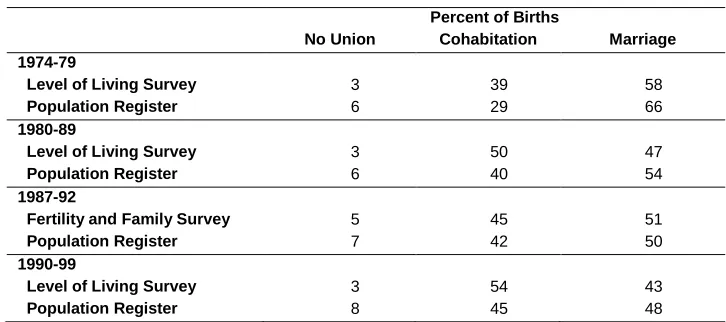
Turning to the proportion of births to lone mothers, Andersson‘s (2002a) estimates are only slightly lower than the register-based estimates. As the latter are biased slightly upward by matching coresidence up to 12 months and on average 6 months after the child‘s birth, and the former could be biased slightly downward by non-response and misreporting, the truth is likely in between. The Kennedy-Thomson estimates are much lower, and the difference is consistent with the more liberal allocation of births to unions in comparison with Andersson or the register estimates, the exclusion of foreign-born parents and the inclusion of births reported by men (who may underreport non-union births). If Kennedy and Thomson (2010) had applied the Andersson (2002a) allocation rules, some of the births in cohabitation would be shifted to lone motherhood. Together with possible misallocations due to marriage dates discussed above, we would end up with estimates for cohabiting births very close to the register-based estimates with remaining discrepancies consistent with the exclusion of foreign-born parents.
Table 2: Estimates of union status at birth: register versus survey reports
Percent of Births
No Union Cohabitation Marriage
1974-79
Level of Living Survey 3 39 58
Population Register 6 29 66
1980-89
Level of Living Survey 3 50 47
Population Register 6 40 54
1987-92
Fertility and Family Survey 5 45 51
Population Register 7 42 50
1990-99
Level of Living Survey 3 54 43
Population Register 8 45 48
Sources: Swedish Multi-Generation Register 2007, Swedish Total Population Register 1968-2007, Swedish Register of Civil Status Changes 2007, Andersson (2002a), Kennedy and Thomson (2010).
marriage but whose parents were not registered together at the end of the child‘s birth year. If married parents were more likely than unmarried parents to be registered at different addresses for reasons other than discord, our population at risk may be biased slightly toward unstable unions.
The survey estimates of parents‘ separation were based on the same samples as for union status at birth: Andersson‘s (2002a) estimates are based on women‘s histories and include foreign-born women but only their births in Sweden. the Kennedy-Thomson (2010) estimates are based on reports of native-born women and men. The varying definitions of cohabitation versus lone mother hood mean that the cohabiting unions included in the Kennedy-Thomson analysis may be on average less stable than the register-based unions that may in turn be less stable than the unions observed by Andersson where exact month of cohabitation was used to allocate births to couples rather than lone mothers.
In the register data, we observe parents‘ coresidence at the end of each year after the child is born up to the end of the child‘s 15th year. Age-specific rates of parents‘ separation are calculated from the end of year N to the end of year N+1 for children whose parents coreside at the end of year N. If one or both parents died, or both parents emigrated between N and N+1, the child is considered not to have experienced parents‘ separation, but is excluded from further observation. From the age-specific rates for a given calendar year, we construct a period life table or synthetic cohort to estimate the cumulative probability that a child would experience her parents‘ separation if the age-specific rates prevailed across her childhood. Because the register estimate of parents‘ coresidence is annual, our estimates refer to the nth year after the child‘s birth year rather than to the child‘s exact chronological age in years.
The estimation methods applied to the survey data differ in only minor respects and are not likely to be the source of any differences between them or in comparison to register-based estimates. Because all children are observed from birth in the survey data, however, the first parental separation is always observed. Andersson includes the rare event of parental death as a separation, while Kennedy and Thomson exclude children from observation after a parent‘s death.
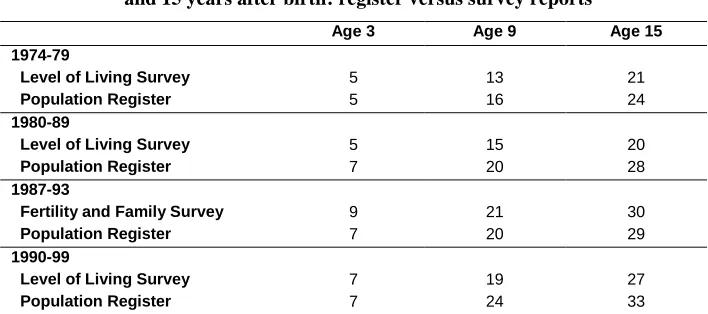
Table 3: Percent of children who will experience parents’ separation by 3, 9, and 15 years after birth: register versus survey reports
Age 3 Age 9 Age 15
1974-79
Level of Living Survey 5 13 21
Population Register 5 16 24
1980-89
Level of Living Survey 5 15 20
Population Register 7 20 28
1987-93
Fertility and Family Survey 9 21 30
Population Register 7 20 29
1990-99
Level of Living Survey 7 19 27
Population Register 7 24 33
Sources: Swedish Multi-Generation Register 2007, Swedish Register of Total Population 1968-2007, Swedish Register of Civil Status Changes 2007, Andersson (2002a), Kennedy and Thomson (2010).
In sum, register-based estimates of union status at birth and parents‘ separation are almost identical to those generated from the 1992 Fertility and Family Survey (Andersson 2002a) but differ considerably from the Level of Living Survey estimates for earlier and later periods (Kennedy and Thomson 2010). The lack of data on exact month of marriage and the method used to allocate marriage month is likely to have generated underestimates of marital births while attrition in the panel survey may be responsible for the greater union stability observed in these data than in the registers or the FFS. While register-based estimates are not error-free, they offer the advantage of covering the entire population and being updated on an annual basis.
6. Trends in union status at birth and parents’ separation
6.1 Union status at birth
Figure 2 shows the very familiar increase in non-marital births and corresponding decrease in marital births at the top. The estimates of all non-marital births combined are extremely close to those reported annually by Statistics Sweden.14 What is new here is the division of non-marital births into lone-mother and cohabiting births. Although small fluctuations are observed in births to lone mothers, virtually all of the increase in non-marital births was comprised of cohabiting births. Births to lone mothers accounted for less than 10 percent of all births for the entire period.
The register-based estimates allow us to identify very small shifts from year to year that cannot be detected in sample surveys. Note that estimates of births in cohabitation show a significant trend reversal in 1990. This is the year following the 1989 marriage ‗explosion‘ due to a pension reform in Sweden and its apparent spill-over effect on couples not affected by the reform (Hoem 1991). Many marriages that produced children in the next few years might have remained as cohabitations without the reform. By 1993, the long-term increase in cohabiting births was back on track and then leveled off. The figure also shows a steeper increase in births to cohabiting parents until 1974 when individual taxation was introduced and changes in family law made it easier to divorce, both policies reducing the cost of marriage.
The register-based estimates allow us to identify very small shifts from year to year that cannot be detected in sample surveys. Note that estimates of births in cohabitation show a significant trend reversal in 1990. This is the year following the 1989 marriage ‗explosion‘ due to a pension reform in Sweden and its apparent spill-over effect on couples not affected by the reform (Hoem 1991). Many marriages that produced children in the next few years might have remained as cohabitations without the reform. By 1993, the long-term increase in cohabiting births was back on track and then leveled off. The figure also shows a steeper increase in births to cohabiting parents until 1974 when individual taxation was introduced and changes in family law made it easier to divorce, both policies reducing the cost of marriage.
Figure 2: Percent of births by union status, Sweden 1969-2006
Source: Swedish Multi-Generation Register 2007, Swedish Total Population Register 1968-2007, Swedish Register of Civil Status Changes 2007.
Note: Swedish-born children, not adopted
6.2 Parents’ separation after birth
Figure 3: Percent of children born to cohabiting or married parents who will experience parents’ separation by 3, 6, 9 and 15 years after birth
Source: Swedish Multi-Generation Register 2007, Swedish Total Population Register 1968-2007
Note: Swedish-born children, not adopted
delay from 1987 to 1988 requires much more detailed analysis. The peak separation in 1998 may be due entirely to a shift in registration practice. In 1997 and before, moves late in the year were likely to have been registered as occurring in the following year. Thus, 1998 includes some separations that occurred in 1997 as well as all the separations in 1998.15 The fact that we observed the entire population also means that the decline in parents‘ separation risks since 1999 is real and not the result of random fluctuations and few observations. This is also the period when marriage and childbearing rates increased in Sweden (Ohlsson-Wijk 2011).
Because we can observe the parents‘ marital status at birth only for children born 1969 or later, our analysis of differentials in separation by parents‘ marital status at birth is truncated at 1984. This is the first year where we can observe age-specific separation for all ages up to 15 as well as the parents‘ marital status at child‘s birth. Figure 4 shows that, consistent with previous estimates from survey data, children born in cohabitation are more likely than children born in marriage to experience parents‘ separation. What we add to this body of knowledge is that differences were larger in the mid-1980s (about 16 percentage points) and declined steadily to about 9 percentage points in 2006-2007. This shift is likely due to a composition shift between married and cohabiting parents as it became more common to have children in cohabitation.
7. Conclusions and discussion
We have demonstrated that residential identification at the property level provides a good estimate of parents‘ coresidence in Sweden. We expect that the same outcome would be found for property-based registration in Denmark, Finland, Iceland, and Norway. Although each of these countries has moved to registration at the level of the dwelling unit, the study of parents‘ coresidence need not be limited to the more recent period when such data exist. The advantage our Nordic neighbors have is that they can directly investigate in later years how many, if any, cohabiting parents choose to live in different dwelling units in the same building or complex after separation. Such a choice, even if quite unusual, would be a potential indicator of the partners‘ commitment to co-parenting after separation.
Figure 4: Percent of children who will experience parents’ separation by the child’s 15th
year by parents’ marital status at birth
Source: Swedish Multi-Generation Register 2007, Swedish Total Population Register 1968-2007, Swedish Register of Civil Status Changes 2007
Note: Swedish-born children
Our results suggest that the Kennedy-Thomson estimates of births to lone mothers are too low, due to the allocation of births to unions in a mother‘s history. Andersson‘s (2002) decision to require that children be born in the exact month of cohabitation or later appears to be more accurate than the more liberal definition by Kennedy and Thomson (2010). In addition, it appears that better estimates of marital births would be produced by allocating births to marriage if they occurred in the same year. The problems with the Kennedy-Thomson estimates make clear that cohabitation and marriage should always be dated in months rather than years. Our analyses show that register estimates can be used with considerable confidence to produce ongoing updates of family change. On the other hand, where register data are not available, regular and frequent collection of birth, cohabitation, and marriage histories are reasonable substitutes.
birth. These results are consistent with findings from retrospective union and birth histories that the risk of coresidence (union formation) is many times higher during pregnancy and up to a year after the child‘s birth than prior to pregnancy (Baizán, Aassve, and Billari 2003; 2004). We suggest therefore that substantive analyses of parents‘ coresidence based on registered address at the end of the year should include controls for the birth month. It may also be desirable to consider parents‘ coresidence in the year after the birth. In analyses not shown here, we found that an additional two percent of first-time parents were shifted from the lone-mother to the cohabiting couple category if we considered coresidence in the year after birth. This would bring the register estimates of lone-mother births closer to those from the Fertility and Family Survey. Whether these parents were simply very late in registering a move or in fact lived together only after they had a child together cannot be determined from the register data.
The new time series from our analyses confirm earlier findings from retrospective surveys regarding the role of cohabitation in nonmarital childbearing in Sweden. Sweden‘s leading position in non-marital childbearing is accounted for entirely by childbearing in cohabitation. Childbearing without a partner has remained uncommon in Sweden for more than 40 years and if connected with earlier time-series on non-marital childbearing, for more than two centuries (Trost 1978).
Our analyses show further that the leveling of parents‘ divorce risks from the late 1970s to the 1990s did not reflect family stability in Sweden (Hoem 1997). The risk of parents‘ separation, including divorce, increased rather steadily through the 1990s and then slowly decreased. Register-based estimates of parents‘ separation have been consistently higher for children born to cohabiting than to married couples, as sample survey analyses have shown, but the new information is that the gap has narrowed as the proportion of births in cohabitation exceeded the proportion in marriage.
Register data on cohabiting parents in Sweden are also essential for contemporaneous comparisons with contexts where most childbearing occurs in marriage. That is, we need not make unrealistic comparisons between the select group of Swedish parents who are married and the vast majority of married parents in other contexts. Instead, we are able to consider all parental couples in studies of higher-order childbearing, separation, or division of breadwinning responsibility. Cohabitation may be a marker for less stable, less fruitful, or even more egalitarian unions, but if we focus on the content of all parental unions rather than on cohabitating parents per se, we can better understand the processes that lead couples in one direction or another in different countries.
The Nordic countries have been well ahead of the rest of the world in linking individual-level data from different administrative registers to produce path-breaking research on fertility, marriage, and divorce (e.g., Andersson et al. 2009; Gerster et al. 2007; Hoem 1997; Lappegård and Rønsen 2013; Ohlsson-Wijk 2011). 16 Other Nordic countries have had the advantage of dwelling registers to estimate cohabitation with or without children (Jalovaara and Miettinen 2013; Slaastad et al. 2012) and we hope that Sweden will be able to do so in the future. Although the best data cover only the past few decades, each country has earlier data from parish and other records that are or will eventually be digitized and available for longer-term studies of family change.
Centralized administrative registers exist in many other countries, though perhaps not with as much detailed information and without a common identifier to enable links between them at the individual level. Even where centralized registers would enable individual-level links over time, considerable technological and political work is required before they could be made available to the research community. By continuing to demonstrate the value of Swedish and other register data for studying family change, we hope to provide further stimulus for such work.
We do not, of course, argue that register data are necessarily preferred for studying family change or the social, economic, cultural and institutional contexts that generate different family behaviors. Register data are not available for many of the contexts we would wish to study and do not include information on many conditions and behaviors that are central to understanding family change and variation. Register data are, however, of great value for demographic research and are vastly underutilized. Governments make enormous investments in the collection and maintenance of administrative registers. Only when administrative data and clear documentation of registration procedures become more accessible to researchers will investments in register data produce their full potential return.
16
8. Acknowledgments
References
Andersson, G. (2002a). Children‘s experience of family disruption and family formation: Evidence from 16 FFS countries. Demographic Research 7: 344–364. doi:10.4054/DemRes.2002.7.7.
Andersson, G. (2002b). Dissolution of unions in Europe: A comparative overview. Zeitschrift für Bevölkerungswissenschaft 27: 493–504.
Andersson, G., Rønsen, M., Knudsen, L., Lappegård, T., Neyer, G., Skrede, K., Teschner, K., and Vikat, A. (2009). Cohort fertility patterns in the Nordic countries. Demographic Research 20: 313–352. doi:10.4054/DemRes.2009. 20.14.
Auriat, N. (1993). ―My wife knows best‖: A comparison of event dating accuracy between the wife, the husband, the couple, and the Belgium population register. Public Opinion Quarterly 57: 165–190. doi:10.1086/269364.
Baizán, P., Aassve, A., and Billari, F. (2003). Cohabitation, marriage, first birth: The interrelationship of family formation events in Spain. European Journal of Population 19: 147–169. doi:10.1023/A:1023343001627.
Baizán, P., Aassve, A., and Billari, F. (2004). The interrelations between cohabitation, marriage and first birth in Germany and Sweden. Population and Environment 25(6): 531–561. doi:10.1023/B:POEN.0000039064.65655.3b.
Belli., R.F., Shay, W.L., and Stafford, F.P. (2001). Event history calendars and question list surveys: A direct comparison of interviewing methods. The Public Opinion Quarterly 65(1): 45–74. doi:10.1086/320037.
Bernhardt, E. and Hoem, B. (1985). Cohabitation and social background: Trends observed for Swedish women born between 1936 and 1960. European Journal of Population 1(4): 375–395. doi:10.1007/BF01797149.
Brown, A., and Kiernan, K. (1981). Cohabitation in Great Britain: Evidence from the General Household Survey. Population Trends 25: 4–10.
Bumpass, L., and Lu, H.-H. (2000). Trends in cohabitation and implications for children‘s family contexts in the United States. Population Studies 54(1): 29–41. doi:10.1080/713779060.
Cassell, P.-G. (2002). Changing seasonality of births in Sweden 1900-1999. In: Carling, J. (ed.). Nordic Demography: Trends and Differentials. Scandinavian Population Studies 13. Oslo: Unipub forlag/Nordic Demographic Society: 97– 110.
Cooper, J. (1991). Births outside of marriage: recent trends and associated demographic and social changes. Population Trends 63: 8–18.
Duncan, G.J., Joshi, H., and Mayer, K.U. (2005). An evaluation of the Swedish Level of Living Survey (LNU). Vetenskapsrådets rapportserie. Rapport 2005:3. Stockholm: Vetenskapsrådet.
Ferrarini, T. and Duvander, A.-Z. (2010). Earner-carer model at the crossroads: Reforms and outcomes of Sweden‘s family policy in comparative perspective. International Journal of Health Services 40(3): 373–398. doi:10.2190/HS.40.3.a.
Gerster, M., Keiding, N., Knudsen, L.B., and Strandberg-Larsen, K. (2007). Education and second birth rates in Denmark, 1981–1994. Demographic Research 17: 181–202. doi:10.4054/DemRes.2007.17.8.
Granström, F. (1997). Fertility and Family Surveys in Countries of the ECE Region: Standard Country Report, Sweden. UNECE Economic Studies 10b. New York and Geneva: United Nations Economic Commission for Europe.
Groves, R.M. (1991). Measurement error across disciplines. In: Biemer, P.P., Groves, R.M., Lyberg, L.E., Mathiowetz, N.A., and Sudman, S. (eds). Measurement Errors in Surveys. New York: John Wiley & Sons: 1–28.
Hayford, S.R. and Morgan, P. (2008). The quality of retrospective data on cohabitation. Demography 45(1): 129–141. doi:10.1353/dem.2008.0005.
Heuveline, P., Timberlake, J.M., and Furstenberg, F.F., Jr. (2003). Shifting childrearing to single mothers: Results from 17 Western countries. Population and Development Review 29(1): 47–71. doi:10.1111/j.1728-4457.2003.00047.x.
Hoem, J.M. (1991). To marry, just in case...: the Swedish widow's-pension reform and the peak in marriages in December 1989. Acta Sociologica 34: 127–135. doi:10.1177/000169939103400205.
Hoem, J.M. (1997). Educational gradients in divorce risks in Sweden in recent decades. Population Studies 51: 19–27. doi:10.1080/0032472031000149696.
Jalovaara, M. and Miettinen, A. (2013). Does his paycheck also matter? The socio-economic resources of co-residential partners and entry into parenthood in Finland. Demographic Research 28: 881–916. doi:10.4054/DemRes.2013.28.31. Jonsson, J.O. and Gähler, M. (1997). Family dissolution, family reconstitution, and children's educational careers: Recent evidence for Sweden. Demography 34(2): 277–293. doi:10.2307/2061705.
Kennedy, S. and Thomson, E. (2010). Children‘s experiences of family disruption in Sweden: Differentials by parent education over three decades. Demographic Research 23: 479–508. doi:10.4054/DemRes.2010.23.17.
Keilman, N. (2006). Households and Families. In: Wunsch, G., Caselli, G., and Vallin, J. (eds.). Demography: Analysis and Synthesis. Amsterdam: Elsevier Academic Press: 457–476.
Keilman, N. and Brunborg, H. (1995). Household projections for Norway 1990–2020. Oslo: Statistics Norway.
Kennedy, S. and Bumpass, L. (2008). Cohabitation and children‘s living arrangements: New estimates from the United States. Demographic Research 19: 1663–1692. doi:10.4054/DemRes.2008.19.47.
Kennedy, S. and Fitch, C.A. (2012). Measuring cohabitation and family structure in the United States: Assessing the impact of new data from the Current Population Survey. Demography 49(4): 1479–1498. doi:10.1007/s13524-012-0126-8. Klijzing, E. and Cairns, H. (2000). On the quality of FFS event history data: Of critical
importance in life course research. Globalife Working Paper 13, University of Bielefeld, Germany.
Klijzing, E. and Corijn, M. (eds.). (2002). Dynamics of Fertility and Partnership in Europe: Insights and Lessons from Comparative Research. Geneva/New York: United Nations.
Knab, J.T. and McLanahan, S. (2007). Measuring cohabitation: Does how, when, and who you ask matter? In: Hofferth, S.L. and Casper, L.M. (eds.). Handbook of Measurement Issues in Family Research. Mahwah, NJ: Lawrence Erlbaum Associates: 19–33.
Lesthaeghe, R.J. and Neidert, L. (2006). The second demographic transition in the United States: Exception or textbook example? Population and Development Review 32(4): 669–698. doi:10.1111/j.1728-4457.2006.00146.x.
Lesthaeghe, R. and Neels, K. (2002). From the first to a second demographic transition: An interpretation of the spatial continuity of demographic innovation in France, Belgium and Switzerland. European Journal of Population 18: 325–360. doi:10.1023/A:1021125800070.
Manning, W.D. and Bulanda, R.E. (2007). Cohabitation and measurement of family trajectories. In Hofferth, S. L., and Casper, L. M. (eds.). Handbook of Measurement Issues in Family Research. Mahwah, NJ: Lawrence Erlbaum Associates: 199–219.
Manning, W.D. and Smock, P.J. (2005). Measuring and modeling cohabitation: New perspectives from qualitative data. Journal of Marriage and Family 67(4): 989–1002. doi:10.1111/j.1741-3737.2005.00189.x.
Martin, E. (1999). Who knows who lives here? Within-household disagreements as a source of survey coverage error. The Public Opinion Quarterly 63(2): 220–236. doi:10.1086/297712.
McLanahan, S. (2004). Diverging destinies: How children are faring under the Second Demographic Transition. Demography 41(4): 607–627. doi:10.1353/dem.2004.0033.
Ohlsson-Wijk, S. (2011). Sweden‘s marriage revival: An analysis of the new-millennium switch from long-term decline to increasing popularity. Population Studies 65(2): 183–200. doi:10.1080/00324728.2011.574724.
Perelli-Harris, B. and Sánchez Gassen, N. (2012). How similar are cohabitation and marriage? Legal approaches to cohabitation across Western Europe. Population and Development Review 38(3): 435–467. doi:10.1111/j.1728-4457.2012.00511.x.
Perelli-Harris, B., Kreyenfeld, M., Sigle-Rushton, W., Keizer, R., Lappegård, T., Jasilioniene, A., Berghammer, C., and Di Giulio, P. (2012). Changes in union status during the transition to parenthood in eleven European countries, 1970s to early 2000s. Population Studies 66(2): 167–182. doi:10.1080/00324728. 2012.673004.
Peters, H.E. (1988). Retrospective versus panel data in analyzing lifecycle events. The Journal of Human Resources 23(4): 488–513. doi:10.2307/145810.
Prinz, C. (1995). Cohabiting, Married, Single: Portraying, Analyzing, and Modeling New Living Arrangements in the Changing Societies of Europe. Aldershot, UK: Avebury
Raley, R.K. and Wildsmith, E. (2004). Cohabitation and children's family instability. Journal of Marriage and Family 66(1): 210–219. doi:10.1111/j.0022-2445.2004. 00014.x-i1.
Rendall, M.S., Clarke, L., Peters, H.E., Ranjit, N., and Verropoulou, G. (1999). Incomplete reporting of male fertility in the United States and Britain: A research note. Demography 36(1): 135–144. doi:10.2307/2648139.
Rendall, M., Joshi, H., Oh, J., and Verropoulou, G. (2001). Comparing the childrearing lifetimes of Britain‘s divorce-revolution men and women. European Journal of Population 17(4): 365–388. doi:10.1023/A:1012555916990.
Rendall, M.S., Ekert-Jaffé, O., Joshi, H., Lynch, K., and Mougin, R. (2009). Universal versus economically polarized change in age at first birth: A French-British comparison. Population and Development Review 35(1): 89–115. doi:10.1111/ j.1728-4457.2009.00262.x.
Sobotka, T. and Toulemon, L. (2008). Changing family and partnership behaviour: Common trends and persistent diversity across Europe. Demographic Research 19: 85–138. Special Collection 7: Childbearing Trends and Policies in Europe. Slaastad, T.I., Flekke, L., Hødahl, U.H., Lillegård, M., Rustad Thorsen, L., and Tuhus,
P. (2012). Sammenligning av utvalgsbasert och registerbasert samlivs statistikk [Comparison of survey- and register-based cohabitation statistics]. Statistics Norway Internal Document 10/2012, Oslo, Norway.