in the population sciences published by the Max Planck Institute for Demographic Research Konrad-Zuse Str. 1, D-18057 Rostock·GERMANY www.demographic-research.org
DEMOGRAPHIC RESEARCH
VOLUME 18, ARTICLE 6, PAGES 181-204
PUBLISHED 4 APRIL 2008
http://www.demographic-research.org/Volumes/Vol18/6/ DOI: 10.4054/DemRes.2008.18.6
Research Article
Women’s employment and union dissolution in
a changing socio-economic context in Russia
Magdalena Muszy ´nska
c
°2008 Muszy´nska.
1 Introduction 182
2 Background of the study 182
2.1 Theories concerning the effect of women’s employment on the desire
and the opportunity to dissolve a union 183 2.2 The Russian socio-economic context and its effect on the relationship
between women’s employment and risk of union dissolution 185
3 Data and methods 188
3.1 Data 188
3.2 Models 189
3.3 Variables 189
4 Results 194
4.1 The effect of employment and job characteristics 194
4.2 The effect of other characteristics 195
5 Summary 199
6 Acknowledgments 200
Women’s employment and union dissolution in a changing
socio-economic context in Russia
Magdalena Muszy ´nska1
Abstract
This study examines the effect of women’s employment on the risk of union disruption within the centrally planned economy and transition period in Russia. The empirical part is based on two retrospective surveys conducted in Russia in 2004/2005, covering the years 1967-2004. These are analyzed using hazard regression. The results show that within two periods (1967-1991 and 1992-2004) the risk of union dissolution was similar among women who worked and those who did not work. No differences were found between various employment groups during socialism. In the transition period, however, a variation in the risk of union dissolution among groups of working women existed. The biggest differences are related to company ownership type, with women who worked in private enterprises having the highest risk of union dissolution.
1Duke Population Research Institute & Population, Policy, and Aging Research Center, Terry Sanford
1. Introduction
The effect of women’s employment on union stability in Western economies has been discussed by many authors, yet few studies on this topic have been undertaken in the socialist or transition economies of Eastern Europe. Due to its historically high divorce rates (Council of Europe, 2004), Russia is an interesting country to study the relation-ship between those phenomena in two economically distinctive periods. Despite the high prevalence of divorce, its determinants in Russia are poorly understood. It has been stud-ied mostly on the macro level (Andreev and Scherbov, 1996; Avdeev and Monnier, 2000; Becker and Hemley, 1998; Darsky and Scherbov, 1995; Mazur, 1969; Scherbov and van Vianen, 2001, 2004). Studies on the individual level concentrated on the consequences rather than on the determinants of divorce (e.g. Festy et al., 2003; Prokofieva and Ter-skikh, 1998). So far, to our knowledge, no study has been conducted for Russia using individual level data to discuss women’s employment as a determinant of union dissolu-tion.
The advantage of studies based on Eastern Europe lies in a unique setting that cannot be achieved by any inter-country comparisons: rapid change in structural conditions in a relatively stable cultural context. First, in the last decade in Russia the situation in the labor market changed dramatically from one with a relatively homogenous level of earn-ings and guaranteed employment, to one characterized by high income disparities and unemployment. Second, with the economic changes, the purchasing power of the aver-age family income declined significantly, resulting in a decline in living conditions. The existence of these two distinct economic regimes in Russia gives an empirical possibility to study the influence of socio-economic context on the relationship between women’s involvement in paid work and union instability. In addition, the almost universal partici-pation of women in the labor market in Russia and their relatively low level of earnings, compared to Western economies, give rise to the question: Can the mechanism describing the effect of women’s employment on union instability that is characteristic for Western countries, be generalized to the Russian context?
2. Background of the study
Og-burn and Nimkoff (1955). The first group of theories concentrates on the effect of work on the quality of a union and the satisfaction derived by an individual from being in a union, whereas the second group concentrates on the fact that women’s independent in-come from employment could make it possible for women to leave unhappy relationships. In the second part of the section we question whether or not the relationship between women’s employment and union dissolution in socialist and transition Russian settings differs from Western experience. We focus on differences between the macro-settings, looking in particular at the level of earnings and job security.
2.1 Theories concerning the effect of women’s employment on the desire and the opportunity to dissolve a union
Women’s employment increases the desire to leave a union as it leads to the impairment of the marital interaction and increases opportunities to find a better partner in an enlarged marriage market. The impairment of the relationship of working women results, first of all, from lower union-specific investments (Becker, 1993; Becker et al., 1977; Lehrer, 2003; Sayer and Bianchi, 2000; South, 2001). As the union-specific investments would be worth less when the union dissolves, high investments reduce the desire to leave a union; working women invest less on average in union-specific capital than women who do not work (Becker, 1993; Becker et al., 1977). According to the household economic theory, a decrease in investment in household issues and tasks and childrearing among working women reduces a woman’s gain from being in a union and increases a woman’s propen-sity to dissolve it (Becker, 1993; Becker et al., 1977; Lehrer, 2003; Sayer and Bianchi, 2000; South, 2001). On the other hand, the lower investments in the union-specific capi-tal among working women could be also considered the result of strong market-oriented and low family-oriented preferences. According to Hakim (2000, 2003), the different in-vestment strategies of women (union-specific and market-related) result from their prefer-ences towards work or family. The author claims that those preferprefer-ences are formed early in a woman’s life and do not change significantly over the life-course.
Women who work also have a larger marriage market than women who do not work and hence more opportunities to find a better match than their current partner (South, 1985; South and Spitze, 1986). This effect of widening the marriage market for working women would positively influence the desire to dissolve a union.
Contrary to the previous arguments, women’s employment might have a stabilizing effect on a union, serving as a source of additional income to be invested in common assets (income effect). The common investments might decrease the desire to separate by increasing the utility of staying in the union (Greenstein, 1990). Higher disposable income in the household simply increases the quality of marital life (Sayer and Bianchi, 2000).
The second channel of influence of women’s employment on dissolution risk relates to the increased opportunities to dissolve an unsatisfactory union, through the indepen-dence effect. A woman who can afford to maintain a separate household would be less likely to stay in an unsatisfactory union than a woman who does not work and hence does not have a source of income independent of her husband (Becker, 1993; Lehrer, 2003; Sayer and Bianchi, 2000; South, 2001). In addition, women who anticipate a union dis-solution might invest more in job market related skills in order to become economically independent (Becker, 1993; Lehrer, 2003; Poortman, 2005).
risk of divorce than the low-earners, which suggests that the income effect of women’s work reduces the independence effect.
A woman’s level of pay and her absence from the home depend on the number of hours a woman works. High pay and high absence from home are the strongest among women who work full-time and among those involved in side jobs additional to their major employment, as opposed to women working part-time. Similarly, pay and home-absence levels depend upon a woman’s occupational status (Poortman and Kalmijn, 2002).
2.2 The Russian socio-economic context and its effect on the relationship between women’s employment and risk of union dissolution
In the theoretical investigations concerning the interrelation between economic cycle and divorce in Western democracies, the number of divorces is claimed to rise during periods of economic prosperity and decrease during recessions (South, 1985). During an eco-nomic downturn, this effect is related to a decrease in opportunities for working women to dissolve unsatisfactory unions as a result of having insufficient income to maintain a separate household. One could hypothesize, however, that in times of economic crisis, it is also difficult to "fulfill the financial obligations required to maintain satisfaction in marriage" (South, 1985, p.33) and furthermore, that investments into common assets are lower, resulting in a decrease in the protective effect of women’s income.
Similar to the effect of material conditions, the effect of economic conditions on in-timate relationships in the socialist and transition Russian settings would differ from the Western experience as a result of differences in the level of job security. A decrease in job security during recessions has a negative effect on the opportunities to leave an unsatis-factory union, as the higher risk of losing one’s job would decrease the level of perceived well-being and disposable income (Ruggles, 1997). On the other hand, it could be ex-pected that when the level of earnings is low and the risk of job dismissal is high, one would try to increase the number of hours worked. Additional to the increased absence effect, stress resulting from these adverse economic conditions causes tensions between the partners and results in the impairment of the relationship (Larson et al., 1994; White and Rogers, 2000; Fischer and Liefbroer, 2006).
based on the branch of industry (e.g. employees in defense and heavy industry had, on average, higher earnings), regional differences, and also job positions or responsibilities - those in managerial positions had higher wages (Gerber and Hout, 1998). Labor market segregation, with women concentrated in light industry and services, and in typical fe-male jobs and low-skilled jobs, resulted in women having lower earnings in comparison to men. As a result, despite the employment guarantee and the ideological principle of equal pay, the independence and income effects of women’s employment on union insta-bility were limited. In addition, resulting from the fact that unemployment did not exist and job security was high, contrary to the previous argument it could be hypothesized that women’s paid employment had only a limited effect on the impairment of marital inter-action. Additionally, the data show only a limited "absence effect" on union instability resulting from women’s employment; this was related to the fact that, despite hardly any part-time employment opportunities, the work day during socialism was relatively short in comparison to Western economies (Desa and Todd, 2000). To summarize, as a result of its limited effect on the desire and opportunities to dissolve a union, one could expect no significant effect of women’s employment on the risk of union dissolution during the period of centrally planned economy in Russia.
3. Data and methods
3.1 Data
The study is based on data derived from two retrospective surveys. The first survey, Gen-erations and Gender Survey (GGS), was conducted in Russia between June and August 2004. This survey is a part of the Gender and Generation Programme which conducts comparative individual-level surveys that integrate both prospective and retrospective ap-proaches. First, the questionnaire is comprised of detailed retrospective questions, in-cluding questions on nuptiality and fertility histories. Second, the form of the survey is prospective and the respondents were followed in a panel study over several waves. For a full description of the GGS Programme see Vikat, et al. (2007). The Russian GGS study was based on a multistage probability sample of dwelling units. The target sample size consisted of 11,000 dwelling units (for the description of the sample see, Kosolapov 2004). As a result, 4,223 men and 7,038 women between ages 18 and 79 were inter-viewed. The second survey,Education and Employment Survey (EES), was conducted in November 2005. In this survey respondents were asked detailed questions concern-ing their employment, educational, and migration histories. The sample consisted of the GGS survey respondents. The joined GGS and EES data sets constitute the first Russian longitudinal data with detailed nuptiality, childbearing, employment, and educational life-histories.
After combining the GGS and EES data files, we found 3074 women who had been in a union and who were respondents in both surveys. As the union formation and dis-solution patterns might differ between various ethnic groups, we studied only unions formed by women who were Russian, Belorussian, or Ukrainian and thereby excluded 255 women from our study. Data checking eliminated other women from the study, (some women had different years of birth in the two surveys or the date of union formation was misreported - meaning an age below 14 was reported for the woman at 1st union forma-tion), which limited the number of studied women to 2,803.
unions (with 497 dissolutions), 526 second unions (with 159 dissolutions) and 74 third unions (with 4 dissolutions).
3.2 Models
The event under study is union separation and not official divorce. The moment of union separation is considered to be the date the respondent reports the union ending. The reason for studying separation instead of a divorce is that for cohabiting unions there is no such event as official divorce. With the death of a partner, the observation is censored.
We model time since union formation to separation using hazard regression models (Blossfeld and Rohwer, 2002; Hoem, 1987, 1993, 2001). The baseline hazard of dissolu-tion, according to duration since union formadissolu-tion, is modeled as a linear spline. The time is measured in months.
Unions formed in the years 1967-1991, which were still together in January 1992, were right-censored at this date. These unions were also followed up in the second set of models (for the years 1992-2004) and left-truncated as they entered the population under risk.
As the aim of this study is to test whether women’s employment influences risk of union dissolution, information on the respondent’s employment status and selected char-acteristics of her job are entered into the model as a set of time-varying covariates. Several additional time-constant and time-varying variables, which refer to characteristics that are not employment characteristics, are introduced into the model. We control for selected characteristics for which there are significant compositional differences between women who work and those who do not work.
3.3 Variables
In this section, first, we present the variables created to describe women’s status in the labor market and selected characteristics of their jobs, and afterwards we present the ex-planatory variables.
3.3.1 Women’s employment
From detailed employment histories of women, several time-varying covariates were con-structed to describe their employment status.
week) and part-time (4-39 hours) employment spells. In the situation where the number of working hours was unknown, we created a separate level with unknown working hours. We also distinguished between different occupational groups. In constructing this variable, we made use of International Standard Classification of Occupations (ISCO-88). Below, in the brackets, we provide the reader with the ISCO-88 codes for major groups of occupations. We distinguished between: agricultural workers (farmer employers and own account farmers; in ISCO-88 coded as 6), manual workers (unqualified and qualified; 8, 9), lower white-collar (4,5,0) and higher-white collar occupations (1,2,3). In addition, in the group of upper-white collar occupations, we distinguished women who held white-collar jobs in typical female employment and distinguished them from other white-white-collar workers. We regarded women with professional backgrounds working in education (as teachers), in medicine, and in the social sciences as having typical female employment. We also included an additional level for data sets with missing information.
Finally, we distinguish among the different forms of company ownership (for com-panies where women worked): newly established private enterprise (new private), former state and privatized (including mixed property), state or municipal, and ’other’. In the lat-ter group (’other’) we included non-profit organizations, inlat-ternational organizations, re-gional offices of foreign companies, and employment by private persons and groups. An additional group was added consisting of those firms for which the type of company own-ership was not specified. This variable was created only for the period after the collapse of socialism. We did not include information concerning the type of company ownership in the centrally planned economy because women reported almost exclusively that they worked in the public sector.
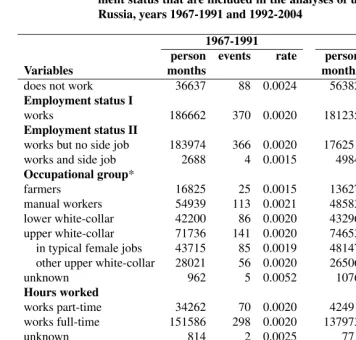
The distribution of exposures and events according to women’s status on the labor market as described above is presented in Table 1a.
3.3.2 Control variables
The characteristics that are often found to be predictors of union dissolution are educa-tional level, size of residential area (small to large village, town, city, etc.), the existence of children in the union, type of union, parents’ divorce age at union formation, union order and union duration.
Educational levelis claimed to have a stabilizing effect on union, as those better
In the variable describing educational status of the respondents we distinguish between women in education and those with the highest completed education out of the four levels (according to the International Standard Classification of Education): primary or lower secondary (up to 9 years in education), upper secondary, and tertiary. For 25% of the respondents, there was no information concerning involvement in education in the year they completed their 17th birthday. We assumed that the missing information is caused by the fact that they were not anymore in education at that moment and had completed 9 years of education or less which classifies them in the first level of the variable.
Thesize of the settlement areainfluences the risk of union dissolution, with those
living in urban areas, and in particular, in big cities, being more prone to separate than those living in rural areas. This effect results from there being a higher number of mar-riage alternatives to the current union, more liberal views and less social stigma of divorce and more employment opportunities in urban areas than in rural ones (Boyle et al., 2006; South and Spitze, 1986). We distinguish between large cities (regional centers), other towns, urban-type villages and other villages.
As far asthe effect of childrenon the risk of union dissolution, one can expect a neg-ative effect. Children constitute union-specific capital because of the selection effect into motherhood and the higher costs of maintaining two separate households in the presence of children. However, children from previous partnerships might have a negative effect on union stability as they might cause conflict within the marriage (Andersson, 1997; Becker, 1993; Becker et al., 1977; Lehrer, 2003; Waite and Lillard, 1991). To document motherhood status, two variables were constructed: motherhood status at the union for-mation and number of common children. In the first variable, we distinguish between women who were mothers at union formation and those who were not (women who were pregnant at union formation are included in the latter group).
Individuals whoseparents divorcedwould be expected to have a higher risk of union dissolution (Amato, 1996; Lehrer, 2003). Similarly, those in asecond and subsequent
unionas opposed to those in their first union (Becker et al., 1977; Hoem and Hoem, 1992;
Lehrer, 2003) would also have a higher risk. The effect of the type of a union on the risk of dissolution is discussed in the literature as a selection effect into direct marriage versus cohabitation (Axinn and Thornton, 1992; Hoem and Hoem, 1992; Lillard et al., 1995).
Being ofyoung age at union formationis expected to negatively influence the risk of dissolution due to the short time invested in the search for an optimal partner, emotional immaturity, as well as personal traits that make those who form a union at young age different from those who do so at later ages (Becker et al., 1977; Hoem and Hoem, 1992; Andersson, 1997). In addition, young age is usually associated with lower accumulation of human capital, from education or work experience, and as a result with lower level of earnings.
union-Table 1a: Descriptive statistics for the variables describing women’s employ-ment status that are included in the analyses of union dissolution in Russia, years 1967-1991 and 1992-2004
1967-1991 1992-2004
person events rate person events rate
Variables months months
does not work 36637 88 0.0024 56382 172 0.0031
Employment status I
works 186662 370 0.0020 181235 510 0.0028
Employment status II
works but no side job 183974 366 0.0020 176251 486 0.0028 works and side job 2688 4 0.0015 4984 24 0.0048
Occupational group*
farmers 16825 25 0.0015 13627 23 0.0017
manual workers 54939 113 0.0021 48583 137 0.0028 lower white-collar 42200 86 0.0020 43296 155 0.0036 upper white-collar 71736 141 0.0020 74653 193 0.0026 in typical female jobs 43715 85 0.0019 48147 119 0.0025 other upper white-collar 28021 56 0.0020 26506 74 0.0028
unknown 962 5 0.0052 1076 2 0.0019
Hours worked
works part-time 34262 70 0.0020 42491 99 0.0023 works full-time 151586 298 0.0020 137973 407 0.0029
unknown 814 2 0.0025 771 4 0.0052
Type of ownership
new private 14382 62 0.0043
other private 9672 40 0.0041
former state, privatized 21672 56 0.0026
state or municipal 132338 344 0.0026
unknown 3171 8 0.0025
TOTAL 223299 458 0.0021 237617 682 0.0029
*farmers = farm employers and own account farmers manual workers = manual workers skilled and unskilled lower white-collar = lower administrative or clerical employees
upper white-collar = managers and higher administrative or clerical employees
upper white-collar in female typical employment = teachers, working in medicine and social sciences
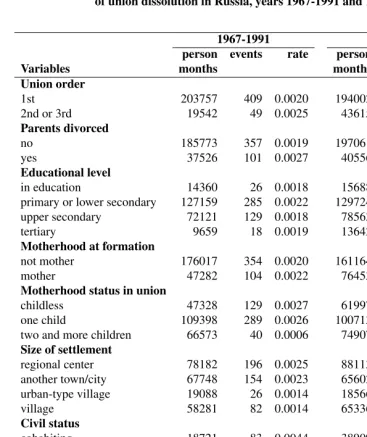
Table 1b: Descriptive statistics for the control variables included in the analyses of union dissolution in Russia, years 1967-1991 and 1992-2004
1967-1991 1992-2004
person events rate person events rate
Variables months months
Union order
1st 203757 409 0.0020 194002 497 0.0026
2nd or 3rd 19542 49 0.0025 43615 185 0.0042
Parents divorced
no 185773 357 0.0019 197061 517 0.0026
yes 37526 101 0.0027 40556 165 0.0041
Educational level
in education 14360 26 0.0018 15688 49 0.0031
primary or lower secondary 127159 285 0.0022 129724 398 0.0031 upper secondary 72121 129 0.0018 78563 195 0.0025
tertiary 9659 18 0.0019 13642 40 0.0029
Motherhood at formation
not mother 176017 354 0.0020 161164 449 0.0028
mother 47282 104 0.0022 76453 233 0.0030
Motherhood status in union
childless 47328 129 0.0027 61997 282 0.0045
one child 109398 289 0.0026 100713 297 0.0029
two and more children 66573 40 0.0006 74907 103 0.0014
Size of settlement
regional center 78182 196 0.0025 88113 353 0.0040 another town/city 67748 154 0.0023 65602 190 0.0029 urban-type village 19088 26 0.0014 18566 37 0.0020
village 58281 82 0.0014 65336 102 0.0016
Civil status
cohabiting 18721 83 0.0044 38909 237 0.0061
married after cohabitation 44487 102 0.0023 60307 184 0.0031 married directly 160091 273 0.0017 138401 261 0.0019
Age at formation
15-20 88678 216 0.0024 77512 246 0.0033
20-25 107754 174 0.0016 97253 220 0.0023
25-30 20644 49 0.0024 34653 104 0.0031
30+ 6223 19 0.0031 28199 112 0.0041
specific capital increases with union duration, and also because couples who are more prone to divorce would dissolve their unions faster (Becker, 1993; Becker et al., 1977; Sayer and Bianchi, 2000).
4. Results
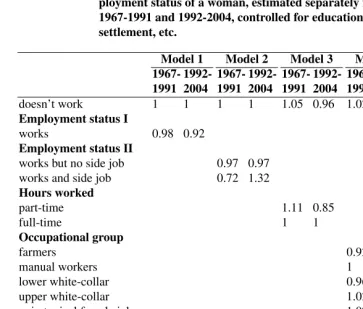
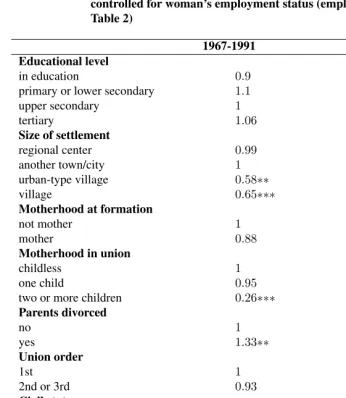
Table 2 presents selected results from our models which refer specifically to the effect of women’s employment on the risk of union dissolution. Only in Table 3 do we present the results we obtained for the effect of the variables describing women’s characteristics other than employment status.
4.1 The effect of employment and job characteristics
Both during the period of the centrally planned economy and after the collapse of the socialism, the risk of union dissolution was similar for both non-working and working women (no matter the number of hours worked). In both periods, the average income from a job was not sufficient to maintain a separate household and hence the indepen-dence effect of women’s employment was limited. These limited opportunities to leave an unsatisfactory union most probably dominated over the decreased income effect of women’s work. (Women’s decreased income would generally result in lower investment in common capital, and lower investment can destabilize a union.) In addition, we hy-pothesize that during socialism the short working hours allowed working women to fulfill their household duties, and hence the absence effect was relatively low.
Neither during socialism, nor in the transition period, were there significant differ-ences in the risk of union dissolution between women in different occupational groups.
The type of ownership of a company a woman worked for turned out to be an im-portant determinant of union stability after the collapse of socialism. The highest risk of union dissolution characterized women working in newly privatized companies or in ’other’ private enterprises. This group of women had, on average, greater opportuni-ties to leave a union as the earnings in newly established private and foreign companies were higher than in companies belonging to other categories of ownership (Lubyova and Sabirianova, 2001). In addition, one could expect that employment in a private company results in an increased desire to dissolve a union due to three factors: impairment of the relationship related to work-related stress, the absence effect, and lower union-specific investments. However, this interpretation might have some flaws. In Moscow, as shown by Vannoy et al. (1999), satisfaction with the current marriage was the highest among women in higher professional occupations and also positively correlated with a woman’s monthly income. If the results of Vannoy et al. (1999) are taken into theoretical con-sideration, the income effect could be discussed as having a dominant position over the absence effect.
4.2 The effect of other characteristics
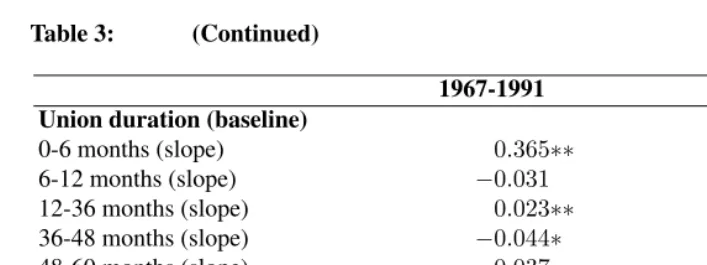
Similar to the results of empirical studies in Western economies, in Russia, the risk of union dissolution is the highest in the first months after the union formation and decreases with unionduration(Table 3).
In both periods the risk of dissolution was highest among those women who formed their unions at very young ages. However, there was no significant difference among the unions formed after the woman’s 20th birthday.
Educational leveldid not have a significant effect on the risk of union disruption in
(Ger-Table 2: Relative risks of union dissolution in Russia, according to the em-ployment status of a woman, estimated separately for the years 1967-1991 and 1992-2004, controlled for educational level, size of settlement, etc.
Model 1 Model 2 Model 3 Model 4 Model 5
1967- 1967- 1967- 1967- 1992-1991 2004 1992-1991 2004 1992-1991 2004 1992-1991 2004 2004
doesn’t work 1 1 1 1 1.05 0.96 1.02 1.03 1.08
Employment status I
works 0.98 0.92
Employment status II
works but no side job 0.97 0.97 works and side job 0.72 1.32
Hours worked
part-time 1.11 0.85
full-time 1 1
Occupational group
farmers 0.92 0.93
manual workers 1 1
lower white-collar 0.96 1.18
upper white-collar 1.02 1
in typical female jobs 1.09 1.02
other upper-white collar 1.00 1.15
Type of ownership
new private 1.41**
other private 1.58***
former state, privatized 1.05
state or municipal 1
*p <0.1, **p <0.05, ***p <0.01
Table 3: Relative risks of union dissolution in Russia (1967-1991, 1992-2004) by selected individual characteristics other than employment sta-tus and slope estimates of log-hazard for duration variable, after controlled for woman’s employment status (employment status I in Table 2)
1967-1991 1992-2004
Educational level
in education 0.9 1.11
primary or lower secondary 1.1 1.06
upper secondary 1 1
tertiary 1.06 1.24
Size of settlement
regional center 0.99 1.25∗∗
another town/city 1 1
urban-type village 0.58∗∗ 0.77
village 0.65∗∗∗ 0.59∗∗∗
Motherhood at formation
not mother 1 1
mother 0.88 0.80∗∗
Motherhood in union
childless 1 1
one child 0.95 0.88
two or more children 0.26∗∗∗ 0.45∗∗∗
Parents divorced
no 1 1
yes 1.33∗∗ 1.25∗∗
Union order
1st 1 1
2nd or 3rd 0.93 1.1
Civil status
cohabiting 2.08∗∗∗ 2.44∗∗∗
married after cohabitation 1.17 1.41∗∗∗
married directly 1 1
Age at formation (in years)
15-20 1 1
20-25 0.70∗∗∗ 0.67∗∗∗
25-30 0.74 0.77∗∗
Table 3: (Continued)
1967-1991 1992-2004
Union duration (baseline)
0-6 months (slope) 0.365∗∗ 0.560∗∗∗
6-12 months (slope) −0.031 −0.152∗∗∗
12-36 months (slope) 0.023∗∗ 0.025∗∗
36-48 months (slope) −0.044∗ 0
48-60 months (slope) 0.037 −0.007
60-72 months (slope) −0.031 −0.006
72+ months (slope) −0.002 0.007∗∗∗
Constant −7.893∗∗∗ −9.582∗∗∗
*p <0.1, **p <0.05, ***p <0.01
Source: author’s estimations based on Russian GGS and EES
ber and Hout, 1998). On the other hand, jobs in the big cities might be characterized by a higher level of job insecurity, which could lead to an increased desire to dissolve a union due to relationship impairment related to absence effect.
As far as the effect of childrenis concerned, we found a negative effect of the ex-istence of children on the risk of union dissolution, both before and after the collapse of socialism. The effect of the first child was insignificant when controlled for additional covariates, while the existence of a second child in the union significantly decreased the risk of dissolution. Contrary to what we expected, when we controlled for additional characteristics, being a mother already when the couple moved in together lowered the risk of dissolution. Following the theoretical background, the interpretation of this result is that common children stabilize the union (decreasing the desire to dissolve ties), and also that the presence of children in the household increases the costs of maintaining a separate household and hence decreases opportunities to leave an unsatisfactory union.
The effect of herparents’ divorceof a woman has a negative effect on union sta-bility. This effect is significant in both periods of analysis and remains significant when controlled for additional characteristics of the woman.
Similar to previous empirical studies, the risk of dissolution depends significantly on
thecivil status. Those who marry directly have the lowest risk of divorce, as compared
to those who marry after the period of pre-marital cohabitation or those who live together without being married.
is that direct marriage is much more common in first unions than in subsequent unions, and for those who marry directly, the risk of dissolution is lower. The effect of civil status turned out to be stronger that the effect of union order.
5. Summary
In this study, we examined the relationship between women’s employment and risk of union dissolution in two periods of distinct socio-economic conditions in Russia. The uniqueness of the socio-economic context in Russia provides an opportunity to test whether the existing theories can be applied to settings different from Western democracies. More-over, the dramatic shift in living and working conditions in Russia, together with relatively stable cultural settings, makes it possible to disregard cultural context and study how the different structural conditions influence the relationship between women’s employment and union stability.
In order to discuss the effect of economic conditions on the process under study, two sets of models were estimated separately: (a) for the years of centrally planned economy and (b) the transition period. We hypothesized that during socialism the effect of women’s employment on the risk of union dissolution was insignificant due to insufficient income to maintain a separate household and a limited absence effect among working women. Similarly, the relationship between women’s employment and union dissolution after the collapse of socialism was shaped by low opportunities to dissolve an unsatisfactory union. As a result, we expected that only those women who were in occupational groups with higher average salaries would have an elevated risk of union dissolution. Additional vari-ables were included and hypotheses concerning the effect of characteristics other than women’s employment on the risk of union dissolution were tested (e.g., educational level, size of settlement, motherhood status, etc.).
As we anticipated, in the centrally planned economy there were no significant differ-ences in the risk of union dissolution between women who worked and those who did not work. These differences were also absent in the transition period. The effect of selected characteristics of a woman’s job on the risk of union dissolution was, in the majority of the analyses, insignificant.
other reasons that pertain to relationship impairment. Women in private enterprises often worked long hours, and as a result, they experienced stress at the workplace (both long hours and stress are related to job insecurity), and are absent from the home. Additionally, women who are able to find and maintain a job in newly established private companies might have some personal characteristics that make them more prone to dissolve a union. The data sources on which this study was based allowed us only to approximate women’s income by the characteristics of a job. Information concerning the level of income earned by both partners could bring an additional insight into income-related determinants of union dissolution in Russia.
6. Acknowledgments
References
Amato, P. R. (1996). Explaining the intergenerational transmission of divorce.Journal of Marriage and the Family, 58:628–640.
Andersson, G. (1997). The impact of children on divorce risks of Swedish women. Eu-ropean Journal of Population, 13:109–145.
Andreev, E. and Scherbov, S. (1996). Demographic atlas of Russia. Unpublished manuscript.
Ashwin, S. and Bowers, E. (1997). Do Russian women want to work? In Buckley, M., editor,Post-Soviet Women: From the Baltic to Central Asia, pages 21–37. Cambridge: Cambridge University Press.
Avdeev, A. and Monnier, A. (2000). Marriage in Russia: A complex phenomenon poorly understood. Population: An English Selection, 12:7–50.
Axinn, W. G. and Thornton, A. (1992). The relationship between cohabitation and di-vorce: Selectivity or causal influence? Demography, 29:357–374.
Becker, C. M. and Hemley, D. D. (1998). Demographic change in the former Soviet Union during the transition period.World Development, 26:1957–1975.
Becker, G. S. (1993). A treatise on the family. Cambridge, Massachusetts: Harvard University Press.
Becker, G. S., Landes, E. M., and Michael, R. T. (1977). An economic analysis of marital instability.Journal of Political Economy, 85:1141–1187.
Blossfeld, H.-P. and Rohwer, G. (2002). Techniques of event history modeling: New approaches to causal analysis. Mahway, NJ: Lawrence Erlbaum Associates.
Boyle, P. J., Kulu, H., Cooke, T., Gayle, V., and Mulder, C. H. (2006). The effect of moving on union dissolution. MPIDR Working Paper WP 2.
Bridger, S. and Kay, R. (1996). Gender and generation in the new Russian labour mar-ket. In Pilkington, H., editor,Gender, generation and identity in contemporary Russia, pages 21–38. London: Routledge.
Bühler, C. (2004). Additional work, family agriculture, and the second birth in Russia at the beginning of the 1990s.Population Research and Policy Review, 23:259–289. Clarke, S. (1999).New forms of employment and household survival strategies in Russia.
Centre for Comparative Labour Studies, Warwick.
Council of Europe (2004). Recent demographic developments in Europe 2004. Technical report, Strasbourg: Council of Europe.
Darsky, L. and Scherbov, S. (1995). Marital status behaviour of women in the former Soviet Republics. European Journal of Population, 11:31–62.
Desa, P. and Todd, I. (2000). Work without wages: Russia’s nonpayment crisis. Cam-bridge, London, MIT Press.
Socio-logical Research, 38:79–90.
Festy, P., Kortchagina, I., Mouratcheva, O., and Prokofieva, L. (2003). Divorce and pro-fessional careers in Russia during the transition towards market economy. In Gar-cia, B., Anker, R., and Pinnelli, A., editors,Women in the labour market in changing economies: demographic issues, pages 104–129. Oxford: Oxford University Press. Fischer, T. and Liefbroer, A. (2006). For richer, for poorer: The impact of
macroeco-nomic conditions on union dissolution rates in the Netherlands 1972-1996. European Sociological Review, 22:519–532.
Foley, M. C. (1995). Labour market dynamics in Russia. Mimeo.
Gerber, T. P. and Hout, M. (1998). More shock than therapy: Market transition, employ-ment, and income in Russia, 1991-1995.American Journal of Sociology, 104:1–50. Greenstein, T. N. (1990). Marital disruption and the employment of married women.
Journal of Marriage and the Family, 52:657–676.
Greenstein, T. N. (1995). Gender ideology, marital disruption, and the employment of married women.Journal of Marriage and the Family, R82:31–42.
Hakim, C. (2000).Work-lifestyle choices in the 21st century: Preference theory. Oxford: Oxford University Press.
Hakim, C. (2003). A new approach to explaining fertility patterns: Preference theory. Population and Development Review, 29:349–374.
Hoem, B. and Hoem, J. M. (1992). The disruption of marital and non-marital unions in contemporary Sweden. In Trussell, J., Hankinson, R., and Tilton, J., editors, Demo-graphic applications of event history analysis, pages 61–93. Oxford: Clarendon Press. Hoem, J. M. (1987). Statistical analysis of a multiplicative model and its application to the standardization of vital rates: A review.International Statistical Review, 55:119–152. Hoem, J. M. (1993). Classical demographic methods of analysis and modern event-history
techniques: Introductory comments by the organiser of session 35 on event-history analysis in demography. InIUSSP 22nd General Conference, Montreal.
Hoem, J. M. (1997). Educational gradients in divorce risks in Sweden in recent decades. Population Studies, 51:19–27.
Hoem, J. M. (2001). Demographic analysis, a probabilistic approach to. In Smelser, N. J. and Baltes, P. B., editors,International encyclopedia of the social and behavioral sciences, volume 14, pages 3428–3432. Oxford: Elsevier.
Kosolapov, M. (2004). Preliminary report. Sample of the Russian Federation. Technical report, Moscow: Demoscope.
Larson, J. H., Wilson, S. M., and Beley, R. (1994). The impact of job insecurity on marital and family relationships.Family Relations, 43:138–143.
Lillard, L. A., Brien, M. J., and Waite, L. J. (1995). Premarital cohabitation and subse-quent marital dissolution: A matter of self-selection? Demography, 32:437–457. Lokshin, M. M. (2004). Household childcare choices and women’s work behaviour in
Russia.Journal of Human Resources, 39:1094–1115.
Lubyova, M. and Sabirianova, K. Z. (2001). Returns the human capital under economic transitions: The cases of Russia and Slovakia.Ekonomicky Casopis, 49:630–662. Martin, T. C. and Bumpass, L. L. (1989). Recent trends in marital disruption.
Demogra-phy, 26:37–51.
Mazur, D. P. (1969). Correlates of divorce in the U.S.S.R. Demography, 6:279–286. Mroz, T. A. and Popkin, B. M. (1995). Poverty and economic transition in the Russian
federation. Economic Development and Cultural Change, 44:1–31.
Ogburn, W. F. and Nimkoff, M. F. (1955).Technology and the changing family.Westport, CT: Greenwood Press.
Ogloblin, C. G. (1999). The gender earnings differential in the Russian transition econ-omy. Industrial and Labor Relations Reviewed, 52:602–627.
Ono, H. (1998). Husbands’ and wives’ resources and marital dissolution. Journal of Marriage and the Family, 60:674–689.
Oppenheimer, V. K. (1997). Women’s employment and the gain to marriage: The spe-cialization and trading model. Annual Review of Sociology, 23:431–453.
Pascall, G. and Lewis, J. (2004). Emerging gender regimes and policies for gender equal-ity in a wider Europe.Journal of Social Policy, 33:373–394.
Poortman, A.-R. (2005). Women’s work and divorce: A matter of anticipation? a research note. European Sociological Review, 21:301–309.
Poortman, A.-R. and Kalmijn, M. (2002). Women’s labour market position and divorce in the Netherlands: Evaluating economic interpretations of the work effect. European Journal of Population, 18:175–202.
Prokofieva, L. and Terskikh, L. (1998). Standards of living and family structure in a period of social transformation Russia in the 1990s. Population: An English Selection, 10:483–494.
Rose, R. and McAllister, I. (1996). Is money the measure of welfare in Russia? Review of Income and Wealth, 42:75–90.
Ross, H. L. and Sawhill, I. V. (1975). Time of tTransition. The growth of families headed by women.Washington, D.C.: The Urban Institute.
Ruggles, S. (1997). The rise of divorce and separation in the United States, 1880-1990. Demography, 34:455–466.
Sayer, L. C. and Bianchi, S. M. (2000). Women’s economic independence and the proba-bility of divorce. a review and reexamination. Journal of Family Issues, 21:906–943. Scherbov, S. and van Vianen, H. (2001). Marriage and fertility in Russia of women born
294.
Scherbov, S. and van Vianen, H. (2004). Marriage in Russia: A recon-struction. Demographic Research, 10(2):28–60. http://www.demographic-research.org/Volumes/Vol10/2/.
South, S. J. (1985). Economic conditions and the divorce rate: A time-series analysis of the postwar United States.Journal of Marriage and the Family, 47:31–41.
South, S. J. (2001). Time-dependent effects of wives’ employment on marital dissolution. American Sociological Review, 66:226–245.
South, S. J. and Spitze, G. (1986). Determinants of divorce over the marital life course. American Sociological Review, 51:583–590.
Spitze, G. (1988). Women’s employment and family relations: A review. Journal of Marriage and the Family, 50:595–618.
Vannoy, D., Rimashevskaya, N., Cubbins, L., Malysheva, M., Meshterkina, E., and Pisklakova, M. (1999).Marriages in Russia: Couples during the economic transition. Westport, Connecticut: Praeger.
Vikat, A., Speder, Z., Beets, G., Billari, F., Buhler, C., Desesquelles, A., Fokkema, T., Hoem, J. M., MacDonald, A., Neyer, G., Pailhe, A., Pinnelli, A., and Solaz, A. (2007). Generations and Gender Survey (GGS): Towards a better understanding of re-lationships and processes in the life course. Demographic Research, 17(14):389–440. http://www.demographic-research.org/Volumes/Vol17/14/.
Waite, L. J. and Lillard, L. A. (1991). Children and marital disruption. American Socio-logical Review, 96:930–953.