in the population sciences published by the Max Planck Institute for Demographic Research Konrad-Zuse Str. 1, D-18057 Rostock · GERMANY www.demographic-research.org
DEMOGRAPHIC RESEARCH
VOLUME 19, ARTICLE 47, PAGES 1663-1692
PUBLISHED 19 SEPTEMBER 2008
http://www.demographic-research.org/Volumes/Vol19/47/ DOI: 10.4054/DemRes.2008.19.47
Descriptive Finding
Cohabitation and children’s living
arrangements:
New estimates from the United States
Sheela Kennedy
Larry Bumpass
© 2008 Kennedy & Bumpass.
This open-access work is published under the terms of the Creative Commons Attribution NonCommercial License 2.0 Germany, which permits use, reproduction & distribution in any medium for non-commercial purposes, provided the original author(s) and source are given credit.
1 Introduction 1664
2 Background 1664
3 Data and methods 1666
3.1 Data 1666
3.2 Methods 1667
3.3 Sample composition and coverage 1668
4 Findings 1670
4.1 Women’s union formation 1670
4.2 Union transitions 1673
4.3 Children’s family contexts at birth 1675
4.4 Children’s family transitions 1680
4.4.1 Cohabitation 1680
4.4.2 Marriage following birth to an unmarried mother 1683 4.4.3 Children’s experience of disruption of family of birth 1684
5 Discussion 1686
6 Acknowledgements 1687
Cohabitation and children’s living arrangements:
New estimates from the United States
Sheela KennedyF 1
F
Larry BumpassF 2
0B
Abstract
This paper uses the 1995 and 2002 waves of the National Survey of Family Growth to examine recent trends in cohabitation in the United States. We find increases in both the prevalence and duration of unmarried cohabitation. Cohabitation continues to transform children’s family lives, as children are increasingly born to cohabiting mothers (18% during 1997-2001) or later experience their mother’s entry into a cohabiting union. Consequently, we estimate that two-fifths of all children spend some time in a cohabiting family by age 12. Because of substantial missing data in the 2002 NSFG, we are unable to produce new estimates of divorce or of children’s time in single-parent families. Nonetheless, our results point to the steady growth of cohabitation and to the evolving role of cohabitation in U.S. family life.
1 Minnesota Population Center, University of Minnesota. Email: [email protected].
1B
1. Introduction
By the early 1990s, cohabitation was well-established in U.S. family life. Once rare, cohabitation had become a normal part of adult union formation and was rapidly spreading to families with children (Bumpass and Lu 2000). By 1995, nearly two-fifths of all children could expect to experience maternal cohabitation during childhood (Bumpass and Lu 2000). Cohabitation has maintained this rapid pace of expansion through the present (Chandra, Martinez, Mosher, Abma, and Jones 2005; Fitch, Goeken, and Ruggles 2005; Mincieli, Manlove, McGarrett, Moore, and Ryan 2007; Schoen, Landale, and Daniels 2007).
As cohabitation continues to transform American families, existing statistics on the prevalence of cohabiting families have become outdated. In the current study, we use the 1995 and 2002 waves (Cycles V and VI) of the National Survey of Family Growth to replicate and update Bumpass and Lu’s 2000 article on trends in U.S. cohabitation. This paper, thus, increases our knowledge of the prevalence of U.S. cohabitation from the perspective of both adults and children. It examines the links between key family characteristics and cohabitation, and between cohabitation and subsequent marriage. Because of extensive missing data on marital separation dates in the 2002 NSFG, we can make only a limited exploration of whether the overall stability of children’s family lives has changed as cohabitation became further established in American family life; likewise, we are unable to update Bumpass and Lu's estimates of the time children spend in a single-mother family. Overall, our analyses demonstrate that cohabitation continues to grow unabated from the perspective of both adults and children.
2B
2. Background
Since the 1970s, the rise in cohabitation had dramatically changed the way Americans formed families. By 1995, cohabitation had become common: 45% of women aged 19-44 had ever lived with an unmarried partner (Bumpass and Lu 2000). A majority of women first forming partnerships cohabited instead of marrying directly; likewise, a majority of first marriages followed cohabitation. U.S. cohabiting unions formed in the early 1990s were typically transient, as cohabiting couples rapidly married or separated (Bumpass and Lu 2000). Always a short-lived state, cohabitation became less stable and less tied to marriage as it spread; just over half of all cohabiting couples married within 10 years (Bumpass and Lu 2000). Cohabitation has since expanded to half of all women ages 15-44 in 2002 (Chandra et al. 2005: Table 47).
cohabiting parents increased from 11% in 1990-94 to 18% by 2001, when cohabiting childbearing achieved parity with out-of-union childbearing (Bumpass and Lu 2000; Mincieli et al. 2007). More commonly, children experienced their mother’s cohabitation after birth, when she entered a new cohabiting relationship (Bumpass and Lu 2000). Combining all types of cohabiting families with children, about 35-40 percent of U.S. children were expected to live with their mother and a cohabiting partner in the early 1990s (Bumpass and Lu 2000; Heuveline and Timberlake 2004).
Despite spreading widely, cohabitation lacks a clearly defined and commonly understood position in the U.S. family system (Cherlin 2004; Manning and Smock 2005). Cohabitation can be a stage in the marriage process for some couples, a temporary alternative to marriage, or an alternative to being single for others (Smock 2000). In some instances, cohabiting childbearing may be jointly planned with marriage (Musick 2007; Wu and Musick Forthcoming). More commonly, cohabitation enables couples to enter into parenthood or to jointly parent children, without first overcoming barriers to marriage, including economic stability and relationship quality (Edin and Reed 2005; Smock, Manning, and Porter 2005). In doing so, cohabitation temporarily assumes traditional functions of marriage. Furthermore, the role that cohabitation plays in the family varies by education, income, and race and ethnicity. For instance, college-educated women are the least likely to ever-cohabit (Bumpass and Lu 2000), while Hispanic cohabitation is uniquely linked to reproduction (Landale and Oropesa 2007).F
3 F The rapid growth in cohabiting families with children has raised concerns over the potential consequences for child well-being. Children raised by a cohabiting parent appear to have poorer outcomes than the children of married parents, across a range of indicators, including academic performance, emotional problems and depression, and behavioral problems and delinquency (Brown 2004; Brown 2006; Dunifon and Kowaleski-Jones 2002; Hofferth 2006; Raley, Frisco, and Wildsmith 2005).
A number of factors make U.S. cohabiting unions potentially disadvantageous environments for raising children, including lower incomes, lower relationship quality, and higher dissolution rates than marriages (Cavanagh and Huston 2006; Graefe and Lichter 1999; Manning and Brown 2006; Manning, Smock, and Majumdar 2004; Osborne and McLanahan 2007; Raley and Wildsmith 2004). Many of these differences predate union formation, and thus reflect the disproportionate selection of couples with the least resources and the lowest expectations for relationship stability into cohabiting relationships and cohabiting parenthood (Kenney and McLanahan 2006; Lillard, Brien, and Waite 1995). Yet, cohabitation and marriage differ in fundamental ways that may have implications for child well-being, not least the enforceable public and legal
3 Smock (2000) provides a comprehensive overview of these differences. See also Lichter et al. (2006),
commitment required of married couples that makes marriages more difficult to dissolve (Nock 2005; Waite and Gallagher 2000).
Data limitations prevent us from directly addressing the question of whether children’s family lives have grown increasingly unstable as a consequence of rising cohabitation rates. By charting trends in the prevalence and stability of cohabitation, however, we will make a limited exploration of the implications of the continued increase in cohabitation for children's family contexts.
3B
3. Data and methods
8B
3.1 Data
We use data from the 1995 and 2002 cycles of the U.S. National Survey of Family Growth (NSFG). Interviews were conducted with 7,643 women ages 15-44 in 2002 and with 10,847 women in 1995. Both interview protocols include complete pregnancy and birth histories, as well as cohabitation and marriage histories. The 2002 NSFG is the most recent and comprehensive data source on U.S. families and allows us to study the recent cohabitation experiences of women and their children.
There is one very serious limitation of the 2002 NSFG: as a result of routing errors in the survey instrument, marriage dissolution data are missing for over one-third of all marriages that subsequently dissolved. Data are missing entirely for women whose husbands had children from a previous relationship and for over 90 percent of currently separated respondents. Black and Hispanic women and women who cohabited before marriage have particularly high rates of missing data. Time periods closer to 2002 have especially high rates of missing data because women who are currently separated were more likely to have dissolved their marriages recently.
Consequently, analyses which must incorporate dates of marital dissolution are very likely not defensible. Because separation dates are almost entirely missing for two distinct respondent groups, standard imputation techniques may be inappropriate. In addition, if trends in family formation and dissolution have changed over time, using imputed marital dissolution data may underestimate the magnitude of any recent changes. Because of these limitations, our analyses of children's family instability are exploratory and do not rely on the imputed dates of marital separation.
Despite these limitations, the NSFG remains the best data set available for studying recent trends in cohabitation from the perspective of women and children.F
4
4 Commonly used alternatives for studying cohabitation include the National Longitudinal Survey of Youth
9B
3.2 Methods
This paper follows the approach used in Bumpass and Lu (2000) to produce new estimates of the cohabitation experience of women and children and to describe children’s family structures at birth and later family transitions. We replicate their estimates from the 1995 survey, and update them using new data from 2002. Our approach will differ in some instances due to differences between the data sets, including missing data and smaller sample sizes. The 1995 estimates presented here are very similar but not always identical to those published by Bumpass and Lu (2000). All estimates are weighted, including regressions.
As noted above (see 3.1), we are reluctant to produce estimates that require information on the timing of marital dissolution. Specifically, because we do not know when a marriage ended with certainty, we cannot assign a separation to a particular period, nor can we calculate a child’s total exposure to the risk of marital dissolution. Consequently, estimates of the proportion of children who experience parental separation, of period trends in family instability, or of the duration of time a child born to a married mother spends in a single-parent household cannot be produced with confidence. Instead, we produce estimates of the proportion of children ever experiencing family dissolution by specific ages for recent birth cohorts. We restrict our estimates to children 10 years and younger in order to capture recent experiences (with little overlap between surveys) and to minimize the potential impact of age-censoring (discussed below).
A second analytic challenge results from the upper age limit of 44 imposed on the female sample. This age limit creates no problem for analyses of women’s current union status or past cohabitation experience, estimates that can be compared across surveys within age at interview groups. At periods distant from the survey, however, it becomes increasingly difficult to accurately represent family experiences, as older respondent ages are observed only in recent time periods. To the extent we use data from older children, or from periods further back in time, the data are progressively representative only of unusually young mothers, those who were most likely to have given birth outside of marriage.F
5
F For a more detailed discussion of age-censoring, see Rindfuss et al. (1982) and Bumpass and Lu (2000).
Following Bumpass and Lu, we address age-censoring by calculating period life tables for the 5-year periods prior to the each survey. Exposure begins at the beginning
cannot produce period estimates of women's cohabitation experience or children’s living arrangements at older child and teenage ages. The cross-sectional Study of Income and Program Participation (SIPP) provides recent divorce data but does not collect detailed cohabitation histories.
5 The mother of a 15-year old child in the 2002 NSFG could be at most 29 years old at the time of the child’s
of the period or at a child’s birth, if it occurs during the period. Exposure ends at the end of the period, at the time of the event, when a child turns 12 in the 5-year period, or a female respondent turns 40. Life table methodology follows the procedures described in Bumpass and Lu (2000), with one exception. Because of the smaller 2002 sample, the number of cases available to estimate children’s cohabitation experience at older ages was significantly reduced. In order to minimize the possibility of a small number of children influencing our overall estimates, we report estimates for children’s cohabitation experience only through age 12 instead of age 16. See Bumpass (1984) and Andersson and Philipov (2002) for further discussion of this methodology.
Finally, we should note that a child’s family history is constructed using mother’s partnership histories and information on each child’s birth. For the analysis of children’s cohabitation and living arrangements, we create an analysis file with children as the unit of analysis. Our estimation procedures make the simplifying assumption that each child resides with his or her mother throughout childhood. In doing so, we misrepresent the experience of children who live with their father or other relatives during childhood. Earlier studies have repeatedly demonstrated the robustness of this
procedure (Bumpass, Raley, and Sweet 1995; Bumpass and Sweet 1989; Raley and
Wildsmith 2001).
10B
3.3 Sample composition and coverage
Table 1 compares the background characteristics of the NSFG V and NSFG VI (female) samples—here, as elsewhere, the estimates are weighted (see 3.2). The period between the two surveys was one of rapid growth in the Hispanic population (Chapa and De La Rosa 2004), a population with unique family patterns (Landale and Oropesa 2007). Accordingly, the weighted proportion of Hispanics among NSFG respondents rose substantially, from 11 percent to 15 percent, while the proportion of non-Hispanic whites declined to 66 percent. By 2002, over half of Hispanic respondents were foreign-born. In addition, the coverage of Hispanic and foreign-born populations may have changed between NSFG cycles. The 1995 NSFG sample was drawn from the respondent pool of an existing survey, the 1993 National Health Interview Survey (Mosher 1998). Immigrants to the U.S. arriving after 1993 were not interviewed. In contrast, the 2002 NSFG includes immigrant women who arrived as recently as 2002 and Hispanic respondents were oversampled.F
6
F It is unclear what impact, if any, these coverage differences have on our estimates of Hispanic cohabitation and nonmarital fertility. We attempt to minimize the impact by distinguishing between foreign-born
6 Response rates for Hispanics were as high or higher than those of non-Hispanic whites in both surveys
and U.S.-born Hispanics. When possible, we compare our results with alternative sources, including vital statistics, in order to identify any potential discrepancies. Unfortunately, sample sizes do not allow us to analyze important national-origin differences in Hispanic family structure (Landale and Oropesa 2007).
Table 1: Background characteristics: US women ages 19-44 and mothers of recent births
Female Respondents Children born during the
periods
1995 2002 1990-94 1997-01
% % % %
Educational attainment
< High school 11.2 11.8 18.6 18.1
HS/GED 38.2 29.2 40.7 32.7
Some College 28.1 33.0 22.0 26.2
Col 4-yr grad 22.5 26.0 18.7 22.9
Race/ethnicity
Non-Hispanic White 71.5 65.7 65.6 60.4
Black 13.2 13.7 14.5 14.4
Hispanic 10.8 14.8 15.4 20.1
Other 4.4 5.8 4.4 5.1
Hispanic nativity
Foreign-born Hispanic 41.4 53.6 47.8 57.3
US-born Hispanic 58.6 46.4 52.2 42.7
Mother’s age at birth
< 20 years 12.3 10.9
20-24 20.3 20.2
25-29 35.7 32.5
30+ 31.7 36.4
n 9555 6459 3948 2753
The educational composition of the sample also changed substantially between the two surveys. The proportion of women with a high school degree or GED decreased from 38% to 29%, while the college-educated population increased. Although the proportion of the sample with less 12 years of schooling remained stable, at 11-12 percent, the proportion who were Hispanic increased to 42% by 2002, replacing non-Hispanic whites as the largest ethnic group within this education level.
are similar to the trends described above. In addition, teenage childbearing declined, accompanied by an increase in childbearing at older ages.
4B
4. Findings
11B
4.1 Women’s union formation
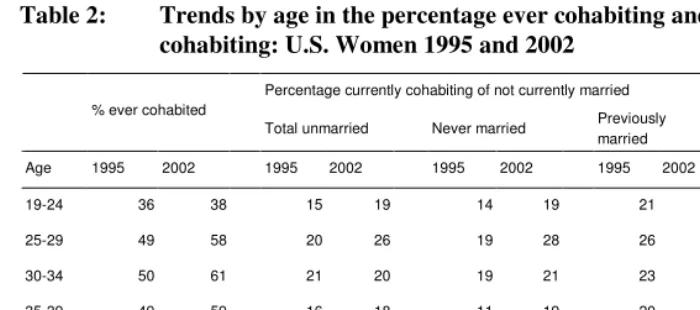
The continued rapid expansion of cohabitation is demonstrated in Figure 1 and Table 2 using two measures: women’s lifetime cohabitation experience and current cohabitation status. The percentage of women ages 19-44 who have ever cohabited increased substantially between 1995 and 2002, from 45 percent to 54 percent. Increases of nearly 10 percentage points are observed at all ages except the youngest, ages 19-24, where cohabitation experience increased only slightly.
Figure 1: Trends by age in the percentage ever cohabiting: U.S. Women 1995 and 2002
0 10 20 30 40 50 60 70
19-24 25-29 30-34 35-39 40-44 Total
Age at interview
P
er
cen
t
ever
-co
h
a
b
it
e
d
1995 2002
Current cohabitation also increased, from 17 to 19 percent among all unmarried women, and from 15 to 20 percent among married women. Increases for never-married women were particularly large in key premarital age groups (under age 30). In contrast, current cohabitation appeared to decline among previously married
respondents. Due to small sample sizes and missing data on marital separation, we are
premarital cohabitation increased between the two surveys for these previously married respondents.
Table 2: Trends by age in the percentage ever cohabiting and currently cohabiting: U.S. Women 1995 and 2002
Percentage currently cohabiting of not currently married % ever cohabited
Total unmarried Never married Previously married
% cohabiting, of current unions
Age 1995 2002 1995 2002 1995 2002 1995 2002 1995 2002
19-24 36 38 15 19 14 19 21 15 30 43
25-29 49 58 20 26 19 28 26 16 16 19
30-34 50 61 21 20 19 21 23 18 10 10
35-39 49 59 16 18 11 19 20 17 7 9
40-44 42 54 13 14 8 13 16 15 6 6
Total 45 54 17 19 15 20 20 16 12 15
n 9554 6440 4350 3494 2866 2562 1484 932 5908 3593
The final columns of Table 2 present the proportion of current unions (at the time of interview) that were cohabiting rather than married, and here we see a modest increase to 15 percent by 2002. The increase was very large among the youngest women (19-24): from 30 to 43 percent. This suggests that cohabitation continues to facilitate delays in marriage. In results not shown in a table, we find that the overall proportion ever in a union declined by only one percent between 1995 and 2002, while the proportion ever-married declined by 6 percent. As we would expect, this pattern is concentrated in the youngest age category where the proportion ever in a union was unchanged, but the proportion ever having married declined by 15 percent (from 28 to 24 percent).
experience appears to have increased most rapidly among foreign-born Hispanics, from one-third in 1995 to one-half of all respondents in 2002. It is hard to interpret this finding, however, because it is likely influenced by the higher proportion of recent immigrants among the foreign born in the 2002 survey (see 3.3).
Table 3: Percentage of women ages 19-44 who have ever cohabited and percentage change: 1995 and 2002
Percent ever cohabited
1995 2002 % change
Education
< High school 58 64 11
HS/GED 50 63 26
Some College 40 49 21
Col 4-yr grad 37 45 20
Race/ethnicity
Non-Hispanic White 47 54 16
Black 45 57 26
Hispanic 40 52 31
Hispanic nativity
Foreign-born Hispanic 33 49 49
US-born Hispanic 45 56 26
n (total sample) 9554 6440
Table 4: Percentage of first unions that were cohabitation, by marriage and union cohort, and percentage of women in the US aged 19-44 who cohabited before first marriage
First union cohort First marriage cohort
1990-94 1997-01 1990-94 1997-01
First union was cohabitation 60 68 -- --
Cohabited before first marriage 57 62
Cohab w/husband only -- -- 41 45
Cohab w/husband & others -- -- 12 13
Cohab w/others only -- -- 4 4
Direct marriage 40 32 43 38
n 1416 1282 1298 1011
12B
4.2 Union transitions
Previous studies have shown that cohabiting is a short-term state in the U.S. as consensual unions either rapidly dissolve or transition to formal marriage (Bumpass and Lu 2000; Bumpass and Sweet 1989; Lichter, Qian, and Mellott 2006). Updating earlier studies, we use multiple decrement life table techniques to examine the pathways out of women’s cohabiting unions during the 5-year periods prior to each NSFG wave (Bumpass and Lu 2000; Bumpass and Sweet 1989).
The results presented in Table 5 focus on first cohabiting unions, and analyze only those unions formed prior to first marriage.F
7 F
Based on the rates observed during the period 1997-2001, more than half of U.S. cohabiting couples (56%) will either marry or separate within the first two years following union formation. This represents a large increase in the duration of cohabitation over the early 1990s, where more than two-thirds married or separated within 24 months. The proportion of unions that would be expected to remain as unmarried cohabitation increased substantially at every duration. By the late 1990s, the observed survival rates suggest that nearly 70% of couples in cohabiting unions will continue to cohabit for at least one year, one-third of couples for at least three years, and one-fifth for four-years.
Table 5: Life table estimates of the outcomes of U.S. women’s first cohabiting unions, by duration
% cohabiting unions ending through
Duration % still cohabiting marriage dissolution
(Years) 1990-94 1997-01 1990-94 1997-01 1990-94 1997-01
1 56 68 24 19 20 13
2 32 44 40 32 29 24
3 19 30 47 40 34 30
4 13 22 50 45 37 34
5 10 14 52 49 38 37
Initially, the estimated percentage increases in intact cohabiting unions are accompanied by declines in the proportion of unions expected to result in marriage (5-8 percentage points at durations 1-4 years). By year 5, however, the survival rates in both time periods imply that about half of all cohabiting couples will have married. Thus, the initial decline in the proportion married appears to be largely the result of prolonged cohabitation and delayed marriage.
The lengthening of cohabitation occurred universally across race and ethnic groups (results not shown). Compositional changes also contributed to the overall increase, as the cohabiting unions of Hispanic women survive longer, on average, than unions formed by non-Hispanic white and Black women. Rates from the late 1990s suggest a median union survival of more than two years for Hispanic women compared to about one and a half years for non-Hispanic white women. This finding is consistent with research characterizing Hispanic cohabitation as a temporary substitute for marriage, and may reflect both higher cohabiting fertility rates and the longer duration of Hispanic cohabiting unions with children (Landale and Oropesa 2007; Manning 2004; Smock 2000; Wildsmith and Raley 2006). Note, however, that the large majority of Hispanic cohabiting unions still transition to marriage or dissolve within five years, and thus for most couples cohabitation is a temporary state.
weakened (Bumpass and Lu 2000). The meaning of these new trends is less clear. The prolonged duration of cohabitation may reflect longer engagements to marry as the social pressure to marry loosens and, perhaps, increased economic insecurity. Irrespective of marriage intentions, longer spells of cohabitation may also be associated with increasing fertility in cohabiting unions, and perhaps greater public acceptance of births to unmarried mothers. Whatever the specific reasons for these changes, the increase in unmarried couples living together and the longer duration of these arrangements may signal a shift in the meaning of cohabitation for some couples. The impact on the stability of marriages formed following cohabitation cannot be measured with these data because we cannot measure how long these unions ultimately lasted.
13B
4.3 Children’s family contexts at birth
Table 6: Mother's union status at birth, children born 1997-2001 and 1990-1994
Point estimatesa Bounds on imputed data, 1997-2001b
Assign to
marriage Assign to single
1990-94 1997-01 1997-01 1997-01
Marital birth 73 66 68 65
All nonmarital births 27 34 32 35
Single mother 16 16 14 17
Cohab mother 11 18 18 18
Total 3825 2678 2678 2678
aPoint estimates are calculated using imputed values for date of marital separation
bIn 2002, because of the large amount of missing marital separation dates, parent’s marital status at birth could not be determined
with certainty for 5% of children in 2002. Bounds were created by assuming 1) that all of these children were born to married parents, and 2) that all were born after the marriage dissolved.
As in the prior decade (Bumpass and Lu 2000), the growth in unmarried births was driven by a shift from married to cohabiting childbearing. By the period 1997-2001, half of all nonmarital births were to cohabiting parents. Two recent studies also find this: a Child Trends study that uses the Early Childhood Longitudinal Study’s 2001 birth cohort (Mincieli et al. 2007) and the Fragile Families study of children born between 1998 and 2000 in metropolitan areas (McLanahan et al. 2003; Teitler,
Reichman, and Koball 2006).F
8 F
By the late 1990s, 18 percent of children were born to cohabiting parents, a finding replicated by Child Trends (Mincieli et al. 2007).
The results just discussed and presented in the left-hand side panel of Table 6 are calculated using imputed values of parent marital status at birth when it could not be directly observed from union histories. As we noted in our discussion of the data, an unacceptably large number of respondents had missing values for marital dissolution dates. If a child was born after the start of one of the affected marriages, it was impossible to know definitively whether the birth occurred during the marriage. (138 births have missing data on marital status at birth during 1997-2001, compared to just 5 births during 1990-94). We can, however, evaluate the degree of uncertainty this
8 Note that our estimate of births to cohabiting couples in 1997-2001 (18%) is substantially larger than
introduces. We estimate the upper and lower bounds for the period 1997-2001 by identifying the 5 percent of births whose classification is affected and making two extreme assumptions about the circumstances at their birth: 1) all of these births occurred while their mother was still married; and 2) all occurred when she was no longer married.
The bounds resulting from these assumptions are shown in the right-hand panel of Table 6. Cohabiting births are unchanged. Our estimate of unmarried non-cohabiting births ranges from 14 to 17 percent, while the estimate for marital births ranges from 68 to 65 percent. Our overall conclusions are unchanged—nonmarital childbearing has increased between the two periods, and this change is mostly, if not entirely, the result of a shift from childbearing in marriage to childbearing in cohabitation.
Table 7 presents educational and race differences in children’s family structure at birth. The proportion of children born to unmarried parents continues to vary greatly by socioeconomic status and race and ethnicity. Educational differences, already large in 1990-94, persisted throughout the decade. Among children born in the late 1990s to mothers without high school degrees (an increasingly selective group), 61% were born to an unmarried mother, including one-third born to cohabiting parents.F
9
F For women
with a high school degree, married births fell to just 57% of all births by the late 1990s, while cohabiting childbearing grew to nearly one-quarter. Women who attended some college continued to give birth primarily within marriage, but cohabiting childbearing also increased noticeably, reaching 15%. Nonmarital childbearing changed only slightly for four-year college graduates, among whom it remains very low at 7% of all births. Despite the persistence of large educational differences, sizable increases in cohabiting childbearing are found for all women except the most highly educated.
Race and ethnic differences also remained substantial, but with two potentially significant trends. There was little net change in unmarried childbearing among both non-Hispanic whites and blacks (a 3 percent increase and decrease, respectively), with differences remaining very large (21 percent compared to 68 percent of all births). The slight increase in marital childbearing among African-Americans, to 32 percent, may signal an important departure from the long-term increases in nonmarital childbearing.F
10
F Also important, is that cohabiting births increased from 17 to 27 percent of all births to non-Hispanic blacks. Consequently, a majority of African-American children born in the late 1990s were born into a two-parent family.
9 Compositional changes may partly explain the overall increase; specifically the increasing proportion of
Hispanic women among women without a high school degree combined with increases in cohabiting childbearing among Hispanic women.
10 Vital statistics records a nearly identical decline: peaking at 71% in 1994 and falling to 69% by the late
Table 7: Percentage of births to unmarried mothers and cohabiting mothers, and proportion of unmarried births to cohabiting mothers: for U.S. children born to U.S. women under age 40, 1990-94 and 1997-2001
1990-1994
Births to unmarried mothers
Variable Total
unmarried Single Cohabiting Cohabiting/ unmarried n
Education
< High school 52 27 25 48 766
HS/GED 31 19 12 39 1552
Some College 19 12 7 37 854
Col 4-yr grad 5 4 1 19 653
Race/ethnicity
Non-Hispanic
White 18 9 9 50 2012
Black 71 54 17 24 929
Hispanic 32 15 17 54 765
Hispanic nativity
Foreign-born
Hispanic 24 10 13 56 367
US-born
Hispanic 39 19 20 52 398
Mother’s age at birth
< 20 years 67 47 21 31 411
20-24 42 22 20 47 804
25-29 20 11 8 43 1403
Table 7: (continued)
1997-2001
Births to unmarried mothers
Variable Total unmarried Single Cohabiting Cohabiting/ unmarried n
Education
< High school 61 29 32 53 550
HS/GED 43 20 23 53 887
Some College 29 14 15 52 709
Col 4-yr grad 7 4 3 38 532
Race/ethnicity
Non-Hispanic
White 21 10 12 55 1282
Black 68 41 27 40 556
Hispanic 46 18 29 62 723
Hispanic nativity
Foreign-born
Hispanic 40 14 26 66 401
US-born
Hispanic 55 23 32 58 318
Mother’s age at
birth
< 20 years 73 43 30 41 315
20-24 55 26 30 54 627
25-29 30 13 17 55 921
30+ 15 6 8 56 815
Although the largest changes appear to occur among Hispanic families, our estimates based on the NSFG overstate the trends observed in Vital Statistics for the same period. Taking all Hispanic women together, NSFG estimates of nonmarital childbearing increase from 32 percent in the early 1990s to 46 percent in the late 1990s (Table 7), and almost all of this increase appears to have occurred in cohabitation. In contrast, Ventura and Bachrach (2000) estimate that Hispanic nonmarital fertility increased from roughly 39 percent in 1992F
11
F to 42 percent by 1999, ultimately reaching
11 The earlier estimate of Hispanic nonmarital fertility in vital statistics is based on imputation in instances
46% in 2004 (Martin et al. 2006). Hence, while both foreign-born and U.S.-born Hispanic nonmarital fertility appear to be overestimated in the 2002 NSFG, the Vital Statistics series confirm that there is a substantial upwards trend in nonmarital childbearing among Hispanic women.
Finally, Table 7 presents estimates of births to unmarried mothers by mother’s age at birth. Strikingly, more than half of births to women under age 25 now occur to unmarried mothers. By 2002, a majority of unmarried mothers ages 20 and older reported cohabiting at the time of their child’s birth, and only unmarried teenage mothers gave birth predominantly without a partner. Regardless of mother's age, nonmarital childbearing increasingly occurred in coresidential unions.
14B
4.4 Children’s family transitions
15B
4.4.1 Cohabitation
Despite the increase in cohabiting births, children most commonly experienced mother's cohabitation during later family transitions, after birth to a single mother or the separation of birth parents. Table 8 presents life table estimates of the proportion of children expected to live with their mother and a cohabiting partner during the periods 1990-94 and 1997-2001, for children born to a single non-cohabiting mother and for those born to a married mother.
Overall, the proportion of these children expected to enter cohabiting families by age 12 increased from 21 percent to 25 percent based on rates observed in the early and late 1990s. For children born to single non-cohabiting mothers, the likelihood of cohabitation increased substantially, from 56 to 63 percent by age 12. Among children born to married mothers in both periods, about 15 percent are expected to enter a cohabiting family by age 12—after their mother’s marriage disrupts. Overall, if we combine these estimates with births to cohabiting parents, about 39 percent of children would be expected to experience any maternal cohabitation before age 12 based on rates during the late 1990s, compared to just 30 percent in the early 1990s.
Table 8: Proportion of children experiencing mother’s cohabitation and mother’s marriage.
Period life-table estimates, U.S. children ages 0-12
A. Mother’s cohabitation by age 12, children born to non-cohabiting mothers
Mother's marital status 1990-1994 1997-2001
Single or married 21 25
Single mother 56 63
Married mother 14 15
B. Mother’s marriage by age 12, children born to unmarried mothers
Mother's union status 1990-1994 1997-2001
Single or cohab 54 55
Single mother 46 45
Cohabiting mother 65 66
Because of the smaller 2002 NSFG sample, these estimates are limited to experience by age 12 (see 3.2).F
12
F With reasonable assumptions about the shape of the
hazard distributions, however, we can calculate the ratio of the proportion by 16 to the proportion by age 12 as estimated from the 1995 survey, and apply this to the age 12 estimates from the 2002 survey. The results of this procedure suggest that the proportion of children expected to ever experience a cohabiting family increased from 37 percent in 1990-1994 to 46 percent in 1997-2001. Almost half of the children in the United States can be expected to spend some time with a cohabiting mother.
To better understand transitions into cohabiting families, we estimate a pooled proportional hazard model for children born to non-cohabiting mothers who were at risk of cohabitation during the periods 1990-94 and 1997-2001. The multivariate results, with robust standard errors controlling for the clustering of children in families, are shown in Table 9. To illustrate the magnitude of any differences, we provide life table estimates of the proportion of children expected to transition into cohabiting families by age 12 for the period 1997-2001 for each variable included in the model (partnership status at birth, education, race, and mother’s age at birth). It is important to keep in mind that this column (Table 9, Column 4) and the matching life table estimates for marriage (Table 9, Column 8) are predicted values without controls for any other variables in the table.
12 Bumpass and Lu (2000) report estimates through age 16. We restrict estimates to age 12 because sample
Table 9: Relative risk of mother's cohabitation and mother's marriage for children by mother's characteristics. U.S. Children ages 0-12, period Cox model estimates and period life-table estimates of proportions, from 1990-94 and 1997-2001a
Cohabitation Marriage
Percentage Percentage
Hazard Parameter Standard cohabited Hazard Parameter Standard married
Ratio Estimateb Errorb 1997-2001c Ratio Estimateb Errorb 1997-2001c
Period
1990-1994 1.00 --- --- --- 1.00 --- --- ---
1997-2001 1.34 0.29 0.15 25 0.97 -0.03 0.09 55
Mother's union status at birth
Single 1.00 --- --- 63 1.00 --- --- 45
Cohabiting --- --- --- --- 1.90 0.64 0.08 66
Married 0.21 -1.54 0.13 15 --- --- --- ---
Mother's education
< High school 1.00 --- --- 31 1.00 --- --- 40
HS/GED 1.14 0.13 0.14 40 1.38 0.32 0.12 59
Some College 0.79 -0.23 0.18 20 1.65 0.50 0.13 60
Col 4-yr grad 0.40 -0.91 0.33 6 2.34 0.85 0.22 74
Race/ethnicity Non-Hispanic
White 1.00 --- --- 21 1.00 --- --- 67
Black 0.68 -0.38 0.12 45 0.44 -0.82 0.11 39
Hispanic 0.70 -0.36 0.16 27 0.66 -0.42 0.12 51
Mother's age at birth
< 20 years 1.00 --- --- 67 1.00 --- --- 56
20-24 0.68 -0.39 0.10 37 0.88 -0.13 0.08 57
25-29 0.35 -1.05 0.13 15 0.74 -0.31 0.11 51
30+ 0.32 -1.13 0.47 21 0.66 -0.42 0.17 53
a 1990-94 estimates are from the 1995 NSFG, 1997-2001 estimates are from the 2002 NSFG. b
All estimates are weighted; standard errors are robust (sandwich) estimates that adjust for the clustering of children in families. Models also control for a residual race/ethnicity category, which is not reported in the table.
Overall, cohabitation risks increased by one-third between the two periods once the other variables are taken into account (Column 1, Table 9). One contributing factor was declining marital childbearing, a trend that exposed a higher proportion (but not necessarily number) of children to the higher cohabitation rates of unmarried mothers.
In the simple life table estimates in column 4, we see a pronounced decline from high-school graduates to college graduates in the proportion of these children expected to experience cohabitation by age 12. However, controlling for background characteristics (column 1), only children of college graduates differ from the other educational categories, and their risk is 40% lower than the children of high school dropouts.
Controlling for mother’s marital status, education, and age at a child’s birth, non-Hispanic white children have the highest transition rates into cohabiting families (the risk is about a quarter lower among the others). In contrast, the unadjusted life table estimates show that black children are the most likely to enter cohabiting households. These seemingly contradictory findings, observed previously by Bumpass and Lu (2000), are the result of the high rates of out-of-union childbearing among African-American mothers, and the consequently higher risk of entering a cohabiting family. This was confirmed by eliminating the control for marital status from the hazard; the coefficient for African-American children became positive and significant in this model (not shown). Nearly half of non-Hispanic Black children born to single or married mothers are expected to experience maternal cohabitation by age 12 (column 4 of Table 9).
Mother’s age at birth is very strongly and negatively associated with children’s experience of maternal cohabitation; controlling for all other variables the risk decreases by about two-thirds if a mother is age 25 or older at birth. Among other factors, this may reflect the greater stability of the marriages formed by older women, less interest in having a husband or partner, or the reduced availability of suitable partners at older ages.
16B
4.4.2 Marriage following birth to an unmarried mother
Table 9 also presents multivariate hazard and unadjusted life table estimates predicting transitions into married families for children born to unmarried mothers. Overall, the risk of mother’s marriage for these children remained unchanged between the two periods, controlling for partnership status at birth, education, race, and mother’s age at birth. Our unadjusted life table estimates also showed little change in marriage risks.
births could expect their mother to marry by age 12 under the transition rates observed in the late 1990s (compared to 66 percent of cohabiting births).
The likelihood of marriage increases greatly with mother’s education—for instance, 74% of children of 4-year college graduates can expect their mother to marry, compared to 40% of the children of high school dropouts (and the differences are monotonic in the hazard model). About 40 percent of black children born to unmarried mothers will experience their mother’s marriage by age 12, compared to two-thirds of non-Hispanic white children, and half of Hispanic children. These differences persist in the hazard models even after controlling for cohabitation status at birth.
Finally, children born to younger mothers are significantly more likely to experience their mother’s marriage than children born to older mothers. The children of older mothers also experience less maternal cohabitation, so this may reflect the limited partnership markets available to older women. Since unmarried motherhood remains uncommon among women ages 25 and older (Table 7), low rates of marriage may also reflect the selectivity of older unmarried mothers.
17B
4.4.3 Children’s experience of disruption of family of birth
Bumpass and Lu (2000) used the 1995 NSFG to estimate the total time children would spend in each of three types of families: cohabiting parent, single parent, and married parent households. Unfortunately, this type of analysis is inappropriate with the 2002 data because of the extent of missing marital separation dates.
Figure 2: Percent of children experiencing parental separation by age at interview and parents marital status at birth
0 10 20 30 40 50 60 70
1 2 3 4 5 6 7 8 9
Child age (midpoint) at interview
P ro p o rt io n o f C h il d re n w it h S e p a ra te d o r D iv o rc e d P a re n ts
All Unions 1995 All Unions 2002 Married 1995 Married 2002 Cohab 1995 Cohab 2002
Notes: Only children born into a married or cohabiting union are included in these calculations. Child age is estimated as the mid-point of the ages used to calculate the parental dissolution proportion (e.g. children ages 0-23 months are used to calculate age 1; ages 6-41 are used to calculated age 2).
Overall dissolution rates changed little (see Figure 2). By approximate age 9, about 30% of children experienced the dissolution of their parents’ union in both time periods.F
13
F Figure 2 also shows results stratified by marital status at birth. In 2002, without accounting for selectivity, over 20% of marital births and over 50% of cohabiting births had experienced their parents’ separation by age 9. Although the trends between 1995 and 2002 suggest growing stability within each union type, the differences are not statistically different, and the small sample sizes make detection of differences unlikely for cohabitation. Thus, the overall trend in family dissolution is one of relative constancy.
13 Additional estimates including all children ever in union yielded similar results; fewer than one-third of
Although it is inappropriate to use the imputed 2002 NSFG data to produce point estimates of children’s family instability, the 1995 data can be used to understand the potential implications of increased cohabitation. Using the 1995 NSFG, we estimate that 32% of children—71% of children born to cohabiting parents and 26% of children born to married parents—could expect to experience parental separation by age 12 during the period 1990-1994.F
14
F Had union dissolution rates following marital and cohabiting births remained at 1995 levels, the proportion of children experiencing parental separation by age 12 would have increased by 4 percentage points. This estimate assumes that all of the new cohabiting parents in the late 1990s adopted the very high rates of union dissolution of the more select cohabiting parents in the early 1990s and that married parents maintained early 1990s rates of marital dissolution. If the stability of cohabiting parent families has improved with the increased prevalence of cohabiting childbearing, the impact would be smaller.
Although exploratory, the evidence suggests that the increase in cohabiting childbearing has resulted in at most a small increase the instability of children's birth families. This could reflect a reshuffling of families, as less stable couples increasingly giving birth in cohabitation rather than marriage; on its own, this process should not affect the overall population levels of family dissolution. Until new data become available, the true implications of increased cohabitation for children's family lives will remain in doubt.
5B
5. Discussion
As cohabitation continues to spread rapidly, cohabitation has become the prevailing way in which adult women enter unions and is fast becoming a normal context in which to bear and parent children. The majority of women of nearly all ages, educational, and race and ethnic backgrounds have some cohabitation experience. With this most recent expansion of cohabitation, the time spent cohabiting now lasts longer—on average, nearly two years—as couples postpone the transition to marriage.
Cohabitation continues to drive changes in structure of families with children. By the late 1990s, we estimate that nearly one-in-five births were to cohabiting couples, over half of all births to unmarried mothers. Children born to unmarried, non-cohabiting mothers also experienced an increased likelihood of ever living with their mother and a cohabiting partner. Our best estimate, based on rates in the late 1990s, is that almost half of the children in the United States can be expected to spend some time in a cohabiting family. It should be noted that the relevant trends have likely continued in
the ensuing 8 or so years. For example, the share of all births that were to unmarried mothers increased to 37 percent by 2005 from 33 percent in 2000 (Martin et al. 2007).
Cohabitation in the United States remains complex—both a part of the marriage process for some couples, and a temporary alternative to marriage for other couples. As cohabiting childbearing becomes more common, the characteristics of the people selecting into cohabiting parenthood—socioeconomic and demographic composition, relationship quality, the planning of births—may shift. As it does, the place of cohabiting families in the family system may change accordingly. Broader demographic shifts, the rapid growth in the Hispanic population and increasing educational attainment, may themselves have consequences for the overall characteristics of cohabiting unions. Ultimately, the implications of increased cohabitation for child well-being will depend on how closely these new cohabiting families resemble the families who entered cohabiting parenthood when it was unusual and highly selective.
6B
6. Acknowledgements
7B
Reference list
Andersson, G. (2002). Children's experience of family disruption and family formation: Evidence from 16 FFS countries." Demographic Research 7:343-364.
Andersson, G. and Philipov, D. (2002). Life-table representations of family dynamics in Sweden, Hungary, and 14 other FFS countries." Demographic Research 7:67-144.
Brown, S.L. (2004). Family structure and child well-being: The significance of parental
cohabitation. Journal of Marriage and Family 66(2):351-367.
Brown, S.L. (2006). Family structure transitions and adolescent well-being.
Demography 43(3):447-461.
Bumpass, L. and Lu, H.-H. (2000). Trends in cohabitation and implications for children's family contexts in the United States. Population Studies 54(1):29-41.
Bumpass, L.L. (1984). Children and marital disruption: A replication and update.
Demography 21(1):71-82.
Bumpass, L.L., Raley, R.K. and Sweet, J.A. (1995). The changing character of stepfamilies: Implications of cohabitation and nonmarital childbearing.
Demography 32(3):425-436.
Bumpass, L.L. and Sweet, J.A. (1989). National estimates of cohabitation. Demography
26(4):615-625.
Cavanagh, S.E. and Huston, A.C. (2006). Family instability and children's early problem behavior. Social Forces 85(1):551-581.
Chandra, A., Martinez, G.M., Mosher, W.D., Abma, J.C. and Jones, J. (2005). Fertility,
family planning, and reproductive health of U.S. women: Data from the 2002 National Survey of Family Growth. Hyattsville: National Center for Health Statistics: 160 pp. (Vital and health statistics: series 23; 25).
Chapa, J. and De La Rosa, B. (2004). Latino population growth, socioeconomic and demographic characteristics, and implications for educational attainment.
Education and Urban Society 36(2):130-149.
Dunifon, R. and Kowaleski-Jones, L. (2002). Who’s in the house? Race differences in
cohabitation, single parenthood, and child development. Child Development
73(4):1249-1264.
Edin, K. and Reed, J.M. (2005). Why don't they just get married? Barriers to marriage
among the disadvantaged. The Future of Children 15(2):117-137.
Fitch, C., Goeken, R., and Ruggles, S. (2005). The rise of cohabitation in the United States: New historical estimates. Minneapolis: Minnesota Population Center (MPC working paper series; 2005-03).
Graefe, D.R. and Lichter, D.T. (1999). Life course transitions of American children:
Parental cohabitation, marriage, and single motherhood. Demography
36(2):205-217.
Groves, R.M., Benson, G., Mosher, W.D., Rosenbaum, J., Granda, P., Axinn, W., Lepkowski, J. and Chandra, A. (2005). Plan and operation of Cycle 6 of the National Survey of Family Growth. Hyattsville: National Center for Health Statistics: 67 pp. (Vital and health statistics: series 1; 42).
Heuveline, P. and Timberlake, J.M. (2004). The role of cohabitation in family formation: The United States in comparative perspective. Journal of Marriage and Family 66(5):1214-1230.
Hofferth, S.L. (2006). Residential father family type and child well-being: Investment versus selection." Demography 43(1):53-77.
Kelly, J.E., Mosher, W.D., Duffer, A.P. and Kinsey, S.H. (1997). Plan and operation of
the 1995 National Survey of Family Growth. Hyattsville: National Center for Health Statistics: 96 pp. (Vital and health statistics: series 1; 36).
Kenney, C.T. and McLanahan, S.S. (2006). Why are cohabiting relationships more
violent than marriages? Demography 43(1):127-140.
Landale, N.S. and Oropesa, R.S. (2007). Hispanic families: Stability and change.
Annual Review of Sociology 33:381-405.
Lichter, D.T., Qian, Z. and Mellott, L. (2006). Marriage or dissolution? Union
transitions among poor cohabiting women. Demography 43(2):223-240.
Lillard, L.A., Brien, M.J. and Waite, L.J. (1995). Premarital cohabitation and
subsequent marital dissolution: A matter of self-selection? Demography
Manning, W.D. (2001). Childbearing in cohabiting unions: Racial and ethnic differences. Family Planning Perspectives 33(5):217-223.
Manning, W.D. (2004). Children and the stability of cohabiting couples. Journal of Marriage and Family 66(3):674-689.
Manning, W.D. and Brown, S. (2006). Children's economic well-being in married and
cohabiting parent families. Journal of Marriage and Family 68(2):345-362.
Manning, W.D. and Smock, P.J. (2005). Measuring and modeling cohabitation: New perspectives from qualitative data. Journal of Marriage and Family 67(4):989-1002.
Manning, W.D., Smock, P.J. and Majumdar, D. (2004). The relative stability of cohabiting and marital unions for children. Population Research and Policy Review 23(2):135-159.
Martin, J.A., Hamilton, B.E., Sutton, P.D., Ventura, S.J., Menacker, F. and Kirmeyer, S. (2006). Births: Final data for 2004. Hyattsville: National Center for Health Statistics: 102 pp. (National vital statistics reports; 55/1).
Martin, J.A., Hamilton, B.E., Sutton, P.D., Ventura, S.J., Menacker, F., Kirmeyer, S. and Munson, M.L. (2007). Births: Final data for 2005. Hyattsville: National Center for Health Statistics: 104 pp. (National vital statistics reports; 56/6).
Mathews, T.J. and Hamilton, B.E. (2002). Mean age of mother, 1970-2000. Hyattsville:
National Center for Health Statistics: 14 pp. (National vital statistics reports; 51/1).
McLanahan, S., Garfinkel, I., Reichman, N., Teitler, J., Carlson, M. and Audigier, C.N. (2003). The Fragile Families and Child Wellbeing Study: Baseline national report. (revised March 2003). Princeton: Princeton University, CRCW.
Mincieli, L., Manlove, J., McGarrett, M., Moore, K. and Ryan, S. (2007). The relationship context of births outside of marriage: The rise of cohabitation. 4 pp. Washington: Child Trends. (Child trends research brief; 2007-13)
Mosher, W.D. (1998). Design and operation of the 1995 National Survey of Family
Growth. Family Planning Perspectives 30(1):43-46.
Musick, K. (2007). Cohabitation, nonmarital childbearing, and the marriage process.
Demographic Research 16(9):249-286.
Osborne, C. and McLanahan, S. (2007). Partnership instability and child well-being.
Journal of Marriage and Family 69(4):1065-1083.
Raley, R.K., Frisco, M.L. and Wildsmith, E. (2005). Maternal cohabitation and educational success. Sociology of Education 78(2):144-164.
Raley, R.K. and Wildsmith, E. (2001). Cohabitation and children's family instability. Austin: University of Texas. (Population Research Center working paper; 01-02-06).
Raley, R.K. and Wildsmith, E. (2004). Cohabitation and children's family instability.
Journal of Marriage and Family 66(1):210-219.
Rindfuss, R.R., Palmore, J.A. and Bumpass, L.L. (1982). Selectivity and the analysis of birth intervals with survey data. Asian and Pacific Census Forum 8(3):5-6,8-10,15-6.
Schoen, R., Landale, N.S. and Daniels, K. (2007). Family transitions in young
adulthood. Demography 44(4):807-820.
Seltzer, J.A. (2004). Cohabitation in the United States and Britain: Demography, kinship, and the future." Journal of Marriage and Family 66(4):921-928.
Smock, P.J. (2000). Cohabitation in the United States: An appraisal of research themes, findings, and implications. Annual Review of Sociology 26:1-20.
Smock, P.J., Manning, W.D. and Porter, M. (2005). ‘‘Everything’s there except money’’: How money shapes decisions to marry among cohabitors. Journal of Marriage and Family 67(3):680-696.
Teitler, J.O., Reichman, N.E. and Koball, H. (2006). Contemporaneous versus retrospective reports of cohabitation in the Fragile Families Survey. Journal of Marriage and Family 68(2):469-477.
Ventura, S.J. and Bachrach, C.A. (2000). Nonmarital childbearing in the United States 1940-99. Hyattsville: National Center for Health Statistics: 39 pp. (National vital statistics reports; 48/16).
Waite, L.J. and Gallagher, M. (2000). The case for marriage: Why married people are
happier, healthier, and better off financially. New York: Doubleday.
Wildsmith, E. and Raley, R.K. (2006). Race-ethnic differences in nonmarital fertility: A
focus on Mexican American women. Journal of Marriage and Family
Wu, L.L. (2008). Cohort estimates of nonmarital fertility for U.S. women. Demography
45(1):193-207.
Wu, L.L., Bumpass, L.L. and Musick, K. (2001). Historical and life course trajectories of nonmarital childbearing. In: Wu, L. and Wolfe, B. (eds.). Out of wedlock. New York: Russell Sage: 3-48.