of peer-reviewed research and commentary in the population sciences published by the Max Planck Institute for Demographic Research Konrad-Zuse Str. 1, D-18057 Rostock · GERMANY www.demographic-research.org
DEMOGRAPHIC RESEARCH
VOLUME 23, ARTICLE 21, PAGES 587-614
PUBLISHED 14 SEPTEMBER 2010
http://www.demographic-research.org/Volumes/Vol22/21/ DOI: 10.4054/DemRes.2010.23.21
Research Article
Siblings and human capital:
A comparison between Italy and France
Giulia Ferrari
Gianpiero Dalla Zuanna
This publication is part of the proposed Special Collection “Social Mobility and Demographic Behaviour: A Long-Term Perspective”, organized by Guest Editors Cameron Campbell, Jan Van Bavel, and Martin Dribe.
© 2010 Giulia Ferrari & Gianpiero Dalla Zuanna.
This open-access work is published under the terms of the Creative Commons Attribution NonCommercial License 2.0 Germany, which permits use, reproduction & distribution in any medium for non-commercial purposes, provided the original author(s) and source are given credit.
1 Introduction 588
2 Background, hypotheses, and data 589
2.1 Background 589
2.2 Hypotheses 591
2.3 Data 592
3 Descriptive analysis: Method and variables 593
3.1 Method 593
3.2 Response variable 593
3.3 Covariates 594
4 Descriptive analysis: Results 597
4.1 Testing the first hypothesis: The dilution effect holds in both countries, but is stronger in Italy
597
4.2 Testing the second hypothesis: The dilution effect is weaker among French bourgeois families
599
4.3 Testing the third hypothesis: No differences by cohort 600 4.4 Testing the fourth hypothesis: It is better to be the first-born child 602
5 Toward a causal approach 603
6 Discussion and conclusion 608
7 Acknowledgements 609
References 610
Research Article
Siblings and human capital:
A comparison between Italy and France
Giulia Ferrari1
Gianpiero Dalla Zuanna2
Abstract
This paper investigates how family size affects children’s human capital, comparing Italy and France. We tested the dilution effect in these countries, starting with the assumption that the higher the number of siblings, the fewer parental resources are available for each child, and the lower the probability that each child will successfully pursue his/her educational career. We find a negative correlation between the number of siblings and human capital. However, when the analysis is developed with a causal approach, the strength of the dilution effect weakens in Italy and disappears in France.
1. Introduction
Studies of the determinants of educational attainment, occupation, and income usually consider the family background as a general effect. Meanwhile, fewer researchers have investigated family size as an independent effect. In this article, we focus our attention on a set of fundamental questions regarding social inequalities that may be linked to family background characteristics, especially family size. Based on the dilution effect theory, our assumption is that the higher the number of siblings, the lower the likelihood is that an individual will attain the highest levels of education (Blake 1980). Does growing up in large families affect people’s educational chances? If so, is the negative effect on educational attainment of belonging to a large family weakened among the more advantaged social classes? Has the negative effect of large family size on educational attainment changed over the course of the 20th century? Are there any
significant differences in the educational opportunities and life chances of first- and lastborns?
When families have large numbers of children, there is often a dilution of the resources available to each individual child. This research seeks to investigate whether, as a result of varying national family policies, the “dilution effect” differs between countries. In our analysis of this issue, we focus on Italy and France, two European countries where family policies and fertility choices are very different, but for which comparable data are available.
The main goal of this article is to describe the statistical association between siblings and human capital, after controlling for other variables (year at birth, social class, etc.). We note, however, that some unobserved factors may also influence both family size and children’s outcomes. Previous studies (see, for example, Angrist and Evans 1998) have argued that one possible source of unobserved heterogeneity is the preference among parents to have smaller families, with each child being of higher
quality. The level of “status anxiety” for children may drive both the family size and the education of each child (Dalla Zuanna 2007). Hence, the endogeneity issue should be taken into account when evaluating the true causal effect of family size on education. In the final section of this article, an instrumental variable approach will be applied, using the sibling sex composition as an exogenous determinant of family size variation (Conley and Glauber 2005). This approach – which was mainly chosen because of the specificity of the data source for Italy and France – is not completely satisfactory. Consequently, this part of the research should be viewed as merely a first step towards the formulation of a more exhaustive causal approach.
of interest examined in this paper are quite similar for the two countries, enabling us to compare different behaviors, as well as different policies.
The paper is organized as follows. The next section briefly summarizes the current state of the debate about these issues in the literature, and outlines the main hypotheses. Sections 3 and 4 are devoted to a descriptive analysis of the association between siblings and human capital, using simple cross-tabulations and logistic models. In Section 5, the causal analysis is introduced and developed. Finally, Section 6 summarizes the results and suggests directions for further research.
2. Background, hypotheses, and data
2.1 Background
The level of interest among researchers in the relationship between family size and the educational attainment of the children in the family has increased in recent decades. One pattern that has frequently been observed in the literature is that as the number of siblings increases, the educational achievement of the children in the family declines.
In addition to family size, another crucial characteristic of the siblings group— namely, birth order—should be taken into account. The literature presents conflicting empirical results of analyses of the impact of birth order on educational attainment, with different studies arguing that either firstborns and lastborns can benefit from their rank position. On the one hand, some authors conclude that firstborn children are advantaged with respect to their later born siblings because of their priority in obtaining parental time, energy, and attention. On the other hand, these benefits do not generally extend to economic resources. In fact, later born children are more likely than the firstborn to have older parents, who in turn are more likely to be in a better financial position to support their children. In addition, later born children could exploit their older siblings’ knowledge to obtain help in doing their homework, which could increase their probability of succeeding at school. Recognizing their disadvantageous position in the family hierarchy, later born children also develop alternative strategies of survival that often entail risk-taking and daring behaviour (Black, Devereux and Salvanes 2005). By contrast, other scholars (Gary-Bobo, Prieto, and Picard 2006) argue that a higher birth order confers no advantages, and that being a firstborn may even have a significant and negative impact on educational achievement. According to their findings, these negative effects remain even after controlling for the father’s occupational status.
As our paper primarily focuses on the association between sib-size and education, we do not take into account other characteristics of the sibship, e.g., age spacing between children or the sex composition of siblings. Today, families may vary more in the age spacing of children than in the number of siblings. Scholars generally agree that longer intervals allow parents to recover economic losses before the next child requires further investments. Regarding the gender composition of siblings, findings vary widely and often appear to be inconsistent. For example, the father’s occupation has been shown to have different effects for boys and girls, with some studies suggesting that fathers who are self-employed or in certain professions may encourage their sons—but not their daughters—to follow in their footsteps (Zarca 1995a,1995b).
level of the siblings, but they are not able to explain the relationship between educational achievement and family size that is net of intellectual development.
In recent decades, scholars have become increasingly interested in the question of whether the association between family size and children’s outcomes could represent a real causal influence (for a review, see Angrist, Lavy and Schlosser 2005). The observed relationship could be spurious because of the simultaneous determination of outcome and “treatment.” Specifically, a considerable source of unobserved heterogeneity might arise from the parents’ preference for having fewer children, but of higher quality. Couples who are very concerned about their children’s education would try to keep the family size small in order to allow each child to achieve a high level of education. Many other factors may also influence both educational achievement and family size, such as such where the family lives and whether they are recent immigrants. Unfortunately, our data do not provide enough information to allow us to take these factors into account.
2.2 Hypotheses
Having taken these research findings into consideration, our general hypothesis overlaps with Judith Blake’s: i.e., we assume that, as the number of siblings increases, the individual’s opportunities of achieving high levels of education decrease. The so-called dilution effect is a concept very close to that of the quantity-quality trade off (for a detailed discussion of the conflict between having another child and the desire to sustain the social mobility of child(ren) ever born, see, for example, Dalla Zuanna 2007). By means of our data, this general hypothesis will be tested using the following steps.
(1) The dilution effect is assumed to be more intense in Italy than in France
because the French instrument of “quotient familial” (a coefficient which operates by reducing the household’s income tax according to the number of children), and the more family-friendly policy orientation of this country, should provide financial incentives for increasing births, while, at the same time, indirectly decreasing the burden of educational expenses. We expect that, when following a causal approach, the dilution effect – assuming it is effective – should be stronger in Italy than in France.
(3) The dilution effect should weaken for the youngest cohorts, mainly for obtaining a secondary degree, as, over the last century, Italy and France have experienced a progressive expansion of participation in the school system. Consequently, a growing proportion of people have obtained a secondary school or a university qualification. Today, it has become “normal” for young people to earn a secondary degree, regardless of gender, family social class, and – presumably – family size.
(4) There could be differential advantages and drawbacks based on birth order in pursuing education. As previously stated, the literature provides mixed results regarding birth order, and does not seem to support the assumption that a specific position confers clear advantages. However, in this research project, the birth order is assumed to act negatively. In other words, following Zarca’s findings on intergenerational mobility, it is assumed that the first-born child is more likely to achieve top educational levels than the second-born child, who, in turn, has greater opportunities than the third-born child, and so on (Zarca 1995a, 1995b).
2.3 Data
Data for Italy come from the Indagine Multiscopo sulle famiglie: Famiglia e soggetti sociali (2003) (The Multipurpose Survey on the Family), a representative national survey conducted by the Italian National Statistics Institute (Istat) on a sample of about 24,000 Italian families and 50,000 individuals. Data for France have been taken from the Etude de l’Histoire Familiale (1999) (the Family History Survey), a representative national survey conducted by the French National Institute of Statistics and Economic Studies (Insee) and the French National Institute for Demographic Studies (INED) on a sample of 380,000 respondents. Despite the differences between the two surveys, a close correspondence has been maintained, allowing for strong comparability in terms of the topics and the time periods observed. The response rate was 18% for the Italian survey (personal communication with Lidia Gargiulo of Istat, E-mail: [email protected], see also Brancato et al. 2004) and 21% for the French survey (Barre and Vanderschelden 2004, page 7).
Additionally, both surveys include detailed information on individual education
3. Descriptive analysis: Method and variables
3.1 Method
Several logistic regression models have been employed to describe the impact of the number of siblings and birth order on the probability of achieving at least a secondary school (or university) qualification, controlling for other covariates. The dummy response variable juxtaposes high and low educational levels; “success” is defined as having completed secondary school or university.
3.2 Response variable
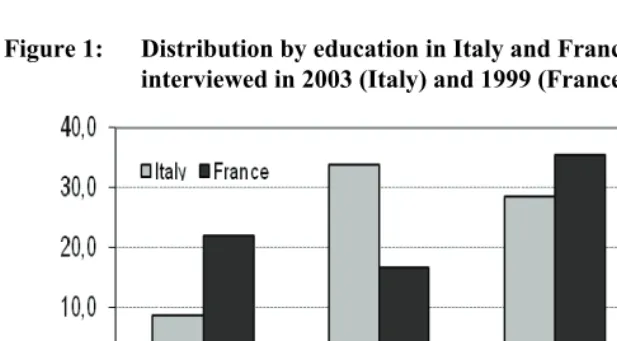
Figure 1: Distribution by education in Italy and France. People aged 18+ interviewed in 2003 (Italy) and 1999 (France)
3.3 Covariates
The main explanatory variable is the total number of brothers and sisters. The distribution of large and small families has changed considerably over the last century, towards a greater number of smaller families in the youngest cohort (table 1). The latter trend implies the “mandatory” inclusion of age classes when investigating the effect of number of siblings on education.
Table 1: Frequency distribution of family sizes according to age, Italy and France (%)
Ages Mean (all ages) 18-24 25-44 45-64 65 +
(cohorts) (ITA:1979-1985) (FRA: 1975-1981)
(ITA:1959-1978) (FRA: 1955-1974)
(ITA:1939-1958) (FRA: 1935-1954)
(ITA:1901-1938) (FRA: 1900-1934)
N. of siblings Italy France Italy France Italy France Italy France Italy France
Only Child 11.7 11.1 13.3 10.8 11.9 9.0 12.0 10.7 10.3 15.9
1 sibling 29.6 22.8 51.2 35.9 36.9 24.1 24.4 18.6 15.6 20.5
2 siblings 21.8 21.6 25.1 28.4 24.9 23.5 20.6 19.4 17.1 18.2
3 siblings 13.3 14.3 7.3 11.7 12.1 14.8 15.2 15.0 15.2 13.4
4 siblings 8.0 9.5 1.8 5.6 6.0 9.3 9.1 10.9 12.5 9.7
5 + 15.6 20.7 1.4 7.7 8.3 19.4 18.7 25.4 29.3 22.3
Total 100 100 100 100 100 100 100 100 100 100
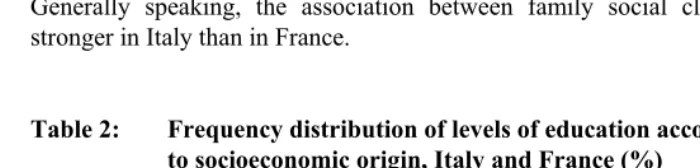
Parents’ occupation has been used as a proxy of socioeconomic conditions. The variable was created by combining the father’s and the mother’s jobs, with the most well-paid of the two used as an indicator of the general family situation. Occupations were grouped into four categories: (1) higher level occupations, (2) white collar, (3) employed, and (4) blue collar and unemployed. The decision to analyze the self-employed category separately is based on the widely observed phenomenon of intergenerational transmission in that particular category: i.e., there are reasons to believe that the sons of the self-employed are likely to follow in their parents’ footsteps (Zarca 1995a). We assume that the occupational status of a parent could indirectly affect the children’s educational careers, encouraging them, for example, to leave school earlier to join the family business, or to remain in the school system in order to acquire the knowledge required for a specific occupation. Table 2 shows the distribution by education for each parent’s socioeconomic category. In both countries, about two-thirds of the children of parents in the higher level occupations achieve at least a secondary school diploma. In Italy the same pattern holds for those whose parents are white collar workers, while in France only about the half of the children whose parents belong to this category earn at least a secondary school diploma. Generally speaking, the association between family social class and education is stronger in Italy than in France.
Table 2: Frequency distribution of levels of education according to socioeconomic origin, Italy and France (%)
Parents’ Job Higher Level White Collar Self-Employed Blue Collar Education Italy France Italy France Italy France Italy France
University Degree 27.6 52.7 21.1 27.4 6.2 19.6 3.8 8.8
Upper Secondary Diploma 44.8 21.1 52.3 20.1 27.4 19.2 25.0 11.0
Lower Secondary Diploma 16.8 20.7 18.9 38.0 26.5 36.9 32.5 39.1
Primary Diploma 10.8 5.5 7.7 14.5 39.9 24.3 38.7 41.1
Total 100 100 100 100 100 100 100 100
The birth order is another important variable related to the sibship composition, and it is strictly connected to the number of siblings. As we noted in the literature review, the role of birth order on child outcomes remains controversial, and it is thus worth taking into account. In this study, birth order will be included in interaction with family size, in order to investigate how children’s opportunities change based on whether they belong to different sub-groups.
The demographic characteristics age and gender are also included. Moreover, the year at birth has been centered to its median value to obtain more reliable estimates.
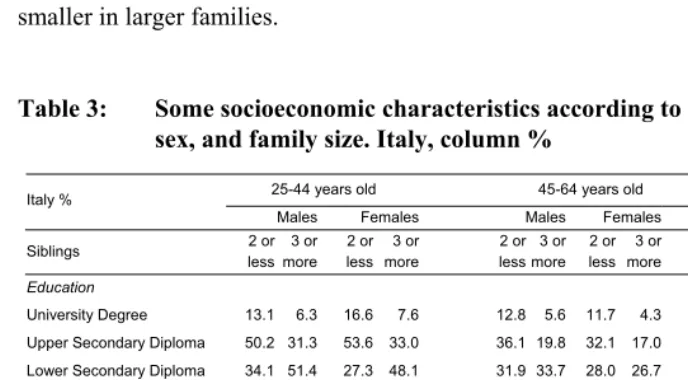
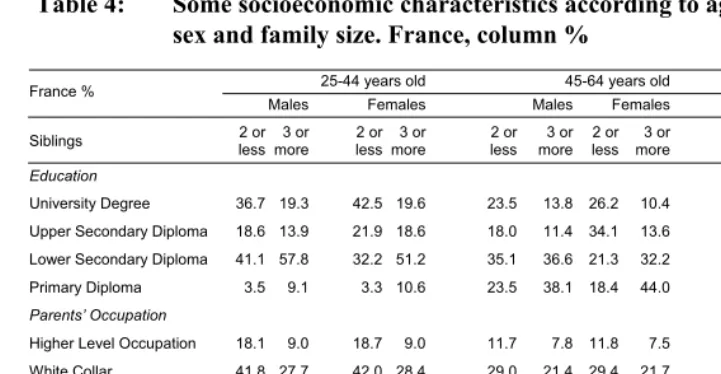
Tables 3 and 4 complete the data description. The frequency distribution of response variable has been summarized for particular sub-populations, and is split by age, gender, and family size (two or fewer siblings, and three or more siblings). The data displayed in these tables appear to support the dilution effect, as the proportion of people with university degrees or upper secondary diplomas is shown to be consistently smaller in larger families.
Table 3: Some socioeconomic characteristics according to age classes, sex, and family size. Italy, column %
25-44 years old 45-64 years old 65+ years old Italy %
Males Females Males Females Males Females Siblings 2 or
less 3 or more 2 or less 3 or more 2 or less 3 or more 2 or less 3 or more 2 or less 3 or more 2 or less 3 or more Education
University Degree 13.1 6.3 16.6 7.6 12.8 5.6 11.7 4.3 7.5 3.9 3.3 1.3 Upper Secondary Diploma 50.2 31.3 53.6 33.0 36.1 19.8 32.1 17.0 18.3 9.1 12.9 5.6 Lower Secondary Diploma 34.1 51.4 27.3 48.1 31.9 33.7 28.0 26.7 19.7 12.1 14.2 7.6 Primary Diploma 2.6 11.1 2.5 11.4 19.2 40.9 28.1 52.0 54.5 74.9 69.7 85.6
Parents’ Occupation
Higher Level Occupation 15.2 9.6 13.9 8.7 9.8 7.1 8.7 6.4 7.2 5.9 7.6 5.1 White Collar 21.0 11.8 23.4 13.2 13.6 7.9 15.8 8.3 9.7 4.6 8.9 5.6 Self-Employed 20.2 22.8 20.7 21.3 24.1 28.0 23.8 25.3 28.6 35.2 28.4 31.3 Blue Collar 43.6 55.8 42.1 56.8 52.6 75.1 51.8 60.0 54.5 54.3 55.1 58.0
Mother's Activity Status
Table 4: Some socioeconomic characteristics according to age classes, sex and family size. France, column %
25-44 years old 45-64 years old 65+ years old France %
Males Females Males Females Males Females Siblings 2 or
less 3 or more 2 or less 3 or more 2 or less 3 or more 2 or less 3 or more 2 or less 3 or more 2 or less 3 or more Education
University Degree 36.7 19.3 42.5 19.6 23.5 13.8 26.2 10.4 12.4 6.5 4.9 2.5 Upper Secondary Diploma 18.6 13.9 21.9 18.6 18.0 11.4 34.1 13.6 11.7 6.8 12.0 6.7 Lower Secondary Diploma 41.1 57.8 32.2 51.2 35.1 36.6 21.3 32.2 24.7 18.6 26.6 17.4 Primary Diploma 3.5 9.1 3.3 10.6 23.5 38.1 18.4 44.0 51.3 68.1 56.5 73.4
Parents’ Occupation
Higher Level Occupation 18.1 9.0 18.7 9.0 11.7 7.8 11.8 7.5 7.9 4.7 7.0 4.4 White Collar 41.8 27.7 42.0 28.4 29.0 21.4 29.4 21.7 22.6 14.3 21.1 15.2
Self-Employed 9.0 8.0 9.6 8.0 12.6 9.4 12.9 9.2 14.9 12.2 15.5 11.6 Blue Collar 31.2 55.4 29.7 54.6 46.7 61.3 45.9 61.5 54.7 68.9 55.4 68.8
Mother's Activity Status
Inactive 36.2 60.3 35.2 59.9 52.7 65.7 51.1 64.8 55.7 61.7 55.2 60.9 Active 63.8 39.7 64.8 40.2 47.3 34.3 48.9 35.2 44.3 38.3 44.8 39.1
4. Descriptive analysis: Results
This section presents the results of the logistic regression models, which test the four hypotheses outlined in Section 2. First, the relative risks of achieving university and secondary school qualifications will be presented without including any interaction, comparing France and Italy (Model 1). Second, the probability of reaching the two possible educational levels will be analyzed, including interactions with the parents’ occupation categories (Model 2) and age classes (Model 3). Finally, an interaction between the family size and birth order will be included in the basic model (Model 4).
4.1 Testing the first hypothesis: The dilution effect holds in both countries, but is stronger in Italy
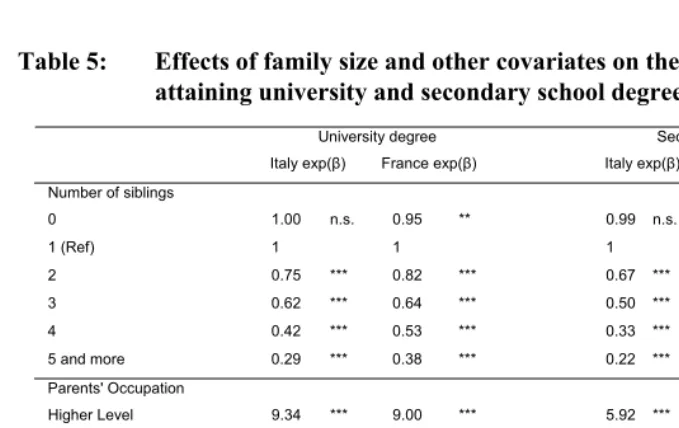
contrast, people who have two siblings or more are clearly penalized. Despite our initial assumptions, family size is shown to have a strong negative effect in France, although this effect is found to be weaker than in Italy. People who are from a disadvantaged socioeconomic background are shown to have lower chances of achieving high levels of education in France and in Italy. Furthermore, in line with our initial assumptions, the findings suggest that the mother’s activity status has a negative influence on the children’s education. Finally, our results indicate that sex differences, where they exist, are not very important in determining the opportunities of individuals.
Table 5: Effects of family size and other covariates on the probability of attaining university and secondary school degrees
University degree Secondary diploma
Italy exp(β) France exp(β) Italy exp(β) France exp(β) Number of siblings
0 1.00 n.s. 0.95 ** 0.99 n.s. 0.97 *
1 (Ref) 1 1 1 1
2 0.75 *** 0.82 *** 0.67 *** 0.78 *** 3 0.62 *** 0.64 *** 0.50 *** 0.61 *** 4 0.42 *** 0.53 *** 0.33 *** 0.50 *** 5 and more 0.29 *** 0.38 *** 0.22 *** 0.36 ***
Parents' Occupation
Higher Level 9.34 *** 9.00 *** 5.92 *** 9.17 *** White –Collar 5.59 *** 2.87 *** 4.63 *** 2.78 ***
Self-Employed 2.00 *** 2.55 *** 1.52 *** 2.55 *** Blue Collar (Ref) 1 1 1 1
Mother’s Activity Status
Active 0.90 ** 0.89 *** 0.84 n.s. 0.83 *** Sex
Males 1.00 n.s. 0.91 *** 0.99 *** 1.13 *** Age 0.99 *** 0.96 *** 0.96 *** 0.96 ***
4.2 Testing the second hypothesis: The dilution effect is weaker among French bourgeois families
Tables 6 and 7 show estimates obtained from Model 2. The probability of earning university and secondary school qualifications decreases significantly as the family size increases, but the decrease is slower in France for almost all the socioeconomic groups. Nonetheless, there is an interesting result among people who belong to large families in the top socioeconomic group: in France, among wealthier children who have five siblings or more, the probability of earning a university degree is reduced by “only” 40%, and the chances of earning a high school diploma are lowered by just one-half, with respect to the reference group. By contrast, in all the other categories in France, and also in Italy, the probability of achieving top qualifications is about 80% lower. Moreover, there are no significant differences between only children and people with one sibling, and this holds true for both countries, with the following exceptions: (1) French only children whose parents are in the blue collar category seem to be less likely to reach top levels than the reference group, and (2) French children whose parents are self-employed turn out to be more advantaged than the reference category.
Table 6: Effect of family size on educational outcomes by socioeconomic origin, Italy and France, university degrees
University Degree
Higher Level White Collar Self-Employed Blue Collar
Italy exp(β) France exp(β) Italy exp(β) France exp(β) Italy exp(β) France exp(β) Italy exp(β) France exp(β) Number of
siblings
0 1.01 n.s. 0.92 * 1.17 n.s. 0.97 n.s 0.97 n.s. 0.97 n.s. 0.87 n.s. 0.83 *** 1 (Ref) 1 1 1 1 1 1 1 1 2 0.80 * 0.97 n.s. 0.82 * 0.75 *** 0.77 ** 0.87 *** 0.70 *** 0.80 *** 3 0.70 ** 0.89 *** 0.83 n.s. 0.55 *** 0.62 *** 0.73 *** 0.44 *** 0.62 *** 4 0.50 *** 0.83 *** 0.50 *** 0.44 *** 0.36 *** 0.57 *** 0.39 *** 0.50 *** 5 and more 0.22 *** 0.59 *** 0.30 *** 0.33 *** 0.27 *** 0.47 *** 0.32 *** 0.36 *** Sex
Males 1.00 *** 0.92 *** 1.10 *** 1.07 *** 1.05 *** 0.79 *** 0.86 *** 1.00 *** Age 1.01 n.s. 0.98 *** 1.01 n.s. 0.97 *** 0.99 n.s. 0.97 *** 0.99 n.s. 0.95 n.s.
Table 7: Effect of family size on educational outcomes by socioeconomic origin, Italy and France, secondary school diploma
Secondary School Diploma
Higher Level White Collar Self-Employed Blue Collar
Italy exp(β) France exp(β) Italy exp(β) France exp(β) Italy exp(β) France exp(β) Italy exp(β) France exp(β) Number of
siblings
0 0.95 n.s. 0.96 n.s. 1.03 n.s. 1.02 n.s 1.01 n.s. 1.10 ** 0.98 n.s. 0.89 *** 1 (Ref) 1 1 1 1 1 1 1 1 2 0.73 *** 0.86 *** 0.76 *** 0.74 *** 0.70 *** 0.89 *** 0.63 *** 0.78 *** 3 0.55 *** 0.77 *** 0.60 *** 0.54 *** 0.53 *** 0.74 *** 0.46 *** 0.62 *** 4 0.31 *** 0.74 *** 0.36 *** 0.45 *** 0.38 *** 0.54 *** 0.32 *** 0.50 *** 5 and more 0.19 *** 0.50 *** 0.18 *** 0.32 *** 0.25 *** 0.44 *** 0.23 *** 0.37 *** Sex
Males 1.02 *** 1.01 *** 1.23 *** 1.18 *** 1.09 *** 0.99 *** 0.87 *** 1.17 *** Age 0.98 n.s. 0.98 n.s. 0.97 *** 0.97 *** 0.95 * 0.97 n.s. 0.96 *** 0.96 ***
n.s. p>0.10; * 0.05<p<0.10; ** 0.01<p<0.05; *** p<0.01
4.3 Testing the third hypothesis: No differences by cohort
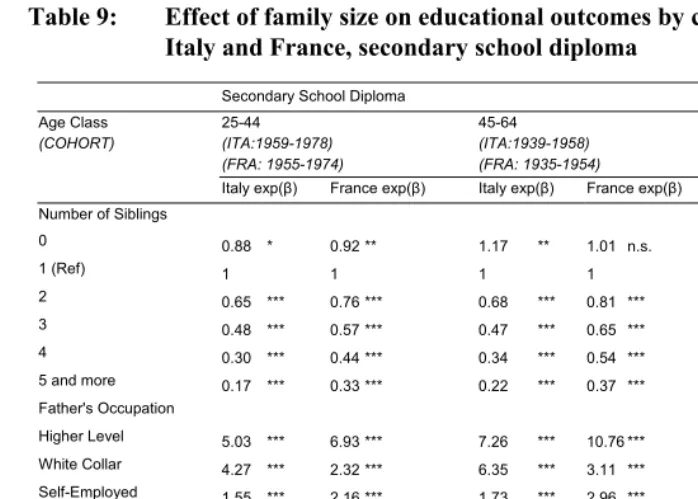
In Tables 8 and 9, the dilution effect by age is presented. In both countries, the impact of belonging to a large family is found to be negative throughout the 20th century,
despite tremendous changes in the educational systems and the diffusion of secondary education. This remains true for every level of education analyzed, even when we control for the parents’ occupation, the mother’s activity status, sex, and year of birth. As previously noted, however, the dilution effect is stronger in Italy than in France; this holds true for each cohort group considered. This stability is especially striking in light of other fundamental changes. For example, in cohort after cohort, the relative impact of the parents’ occupation becomes less and less important in determining children’s educational outcomes. Moreover, the impact of the mother’s occupation and sex have reversed over time: i.e., girls with working mothers born in the second half of the 20th
Table 8: Effect of family size on educational outcomes by age classes, Italy and France, university degree
University Degree Age Class
(COHORT)
25-44
(ITA:1959-1978) (FRA: 1955-1974)
45-64
(ITA:1939-1958) (FRA: 1935-1954)
65+
(ITA:1901-1938) (FRA: 1900-1934)
Italy exp(β) France exp(β) Italy exp(β) France exp(β) Italy exp(β) France exp(β) Number of Siblings 0 0.95 n.s. 0.94 ** 1.10 n.s. 0.98 n.s. 0.95 n.s. 1.08 n.s. 1 (Ref) 1 1 1 1 1 1 2 0.74 *** 0.79 *** 0.75 *** 0.87 *** 0.73 n.s. 0.87 *** 3 0.61 *** 0.60 *** 0.55 *** 0.71 *** 0.67 *** 0.78 *** 4 0.51 *** 0.46 *** 0.33 *** 0.63 *** 0.35 *** 0.65 *** 5 and more 0.20 *** 0.35 *** 0.30 *** 0.44 *** 0.37 *** 0.42 *** Father's Occupation Higher Level 8.20 *** 6.77 *** 10.27 *** 11.29 *** 15.88 *** 19.27 *** White Collar 5.04 *** 2.38 *** 6.51 *** 3.28 *** 6.52 *** 4.75 *** Self-Employed 2.16 *** 2.10 *** 1.93 *** 3.06 *** 1.77 ** 3.91 *** Blue Collar (Ref) 1 1 1 1 1 1 Mother’s Activity Status Active 1.09 n.s. 0.96 ** 0.76 *** 0.90 *** 0.69 ** 0.64 *** Sex
Males 1.33 *** 1.20 *** 0.84 *** 0.70 *** 0.35 *** 0.34 *** Age 1.02 *** 0.95 *** 0.96 *** 0.95 *** 0.98 * 0.99 **
Table 9: Effect of family size on educational outcomes by cohorts, Italy and France, secondary school diploma
Secondary School Diploma Age Class
(COHORT)
25-44
(ITA:1959-1978) (FRA: 1955-1974)
45-64
(ITA:1939-1958) (FRA: 1935-1954)
65+
(ITA:1901-1938) (FRA: 1900-1934)
Italy exp(β) France exp(β) Italy exp(β) France exp(β) Italy exp(β) France exp(β) Number of Siblings
0 0.88 * 0.92 ** 1.17 ** 1.01 n.s. 1.07 n.s. 1.16 *** 1 (Ref) 1 1 1 1 1 1 2 0.65 *** 0.76 *** 0.68 *** 0.81 *** 0.64 *** 0.83 *** 3 0.48 *** 0.57 *** 0.47 *** 0.65 *** 0.59 *** 0.71 *** 4 0.30 *** 0.44 *** 0.34 *** 0.54 *** 0.33 *** 0.61 *** 5 and more 0.17 *** 0.33 *** 0.22 *** 0.37 *** 0.27 *** 0.42 *** Father's Occupation
Higher Level 5.03 *** 6.93 *** 7.26 *** 10.76 *** 12.44 *** 16.94 *** White Collar 4.27 *** 2.32 *** 6.35 *** 3.11 *** 6.76 *** 4.19 *** Self-Employed 1.55 *** 2.16 *** 1.73 *** 2.96 *** 1.45 *** 3.61 *** Blue –Collar (Ref) 1 1 1 1 1 1 Mother’s Activity Status
Active 1.03 n.s. 0.96 ** 0.75 *** 0.85 *** 0.53 *** 0.54 *** Sex
Males 1.33 *** 1.41 *** 0.77 *** 0.92 *** 0.49 *** 0.63 *** Age 0.96 *** 0.96 *** 0.92 *** 0.95 *** 0.96 *** 0.99 ***
n.s. p>0.10; * 0.05<p<0.10; ** 0.01<p<0.05; *** p<0.01
4.4 Testing the fourth hypothesis: It is better to be the first-born child
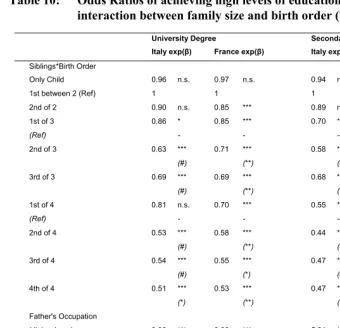
children, we found that only the lastborn is significantly disadvantaged in terms of education; in fact, our analysis shows that the middle-born in families of three and four children has a probability of obtaining a level of education not significantly different from that of the firstborn. The only exception concerns the probability that the lastborn within a three-sibling family will earn a university degree, which is found to be not significantly different from that of his or her older peers. Moreover, in France, the effect of birth order is found to be strong and regular, regardless of family size, for both levels of education: i.e., the firstborn is favored, the lastborn is penalized, and those in the middle are in an intermediate position.
5. Toward a causal approach
The models identified so far do not resolve the issue of causality. Indeed, the observed dilution effect could be biased due to unobserved heterogeneity. In particular, parental preferences regarding their children’s education could affect both the number of children they decide to have, and their children’s future education. In other words, couples who have a strong desire for “high quality” children would try to keep the family size small in order to ensure that each child receives the desired amount of material and non-material resources. By contrast, those parents who choose to have many children might be characterized as having less interest in their children’s education. Because a parental heterogeneous preference may exist, additional “adjustments” are needed in order to estimate correctly the effect of family size. But parental attitudes regarding their children’s educational future can be only one of several possible sources of heterogeneity: indeed, many other factors (e.g., where the family lives and whether they are recent immigrants) might also influence both the total number of children and their educational careers.
Table 10: Odds Ratios of achieving high levels of education, model with interaction between family size and birth order (a)
University Degree Secondary School Diploma
Italy exp(β) France exp(β) Italy exp(β) France exp(β)
Siblings*Birth Order
Only Child 0.96 n.s. 0.97 n.s. 0.94 n.s. 0.95 * 1st between 2 (Ref) 1 1 1 1 2nd of 2 0.90 n.s. 0.85 *** 0.89 n.s. 0.84 *** 1st of 3 0.86 * 0.85 *** 0.70 *** 0.81 ***
(Ref) - - - -
2nd of 3 0.63 *** 0.71 *** 0.58 *** 0.67 ***
(#) (**) (#) (***)
3rd of 3 0.69 *** 0.69 *** 0.68 *** 0.64 ***
(#) (**) (*) (***)
1st of 4 0.81 n.s. 0.70 *** 0.55 *** 0.67 ***
(Ref) - - - -
2nd of 4 0.53 *** 0.58 *** 0.44 *** 0.52 ***
(#) (**) (#) (***)
3rd of 4 0.54 *** 0.55 *** 0.47 *** 0.51 ***
(#) (*) (#) (***)
4th of 4 0.51 *** 0.53 *** 0.47 *** 0.49 ***
(*) (**) (*) (***)
Father's Occupation
Higher Level 9.38 *** 8.09 *** 5.91 *** 8.46 ***
White Collar 5.58 *** 2.80 *** 4.64 *** 2.77 ***
Self-Employed 2.06 *** 2.43 *** 1.50 *** 2.47 ***
Blue Collar (Ref) 1 1 1 1
Mother’s Activity Status
Active 0.93 n.s. 0.87 *** 0.87 *** 0.80 *** Sex Males 1.04 n.s. 0.96 *** 1.03 n.s. 1.18 ***
Age 0.99 *** 0.96 *** 0.96 *** 0.96 ***
n.s. / # p>0.10; * 0.05<p<0.10; ** 0.01<p<0.05; *** p<0.01
The data for both countries show that couples with two same-sex children (either two boys or two girls) are more likely to have a third child than those who already have two opposite-sex children. Specifically, the proportion of the former exceeds that of the latter by 7.8 percentage points for Italy, and by 8.2 percentage points for France (Table 11). Consequently, the first condition for being an instrumental variable is respected. The second condition also holds, as the parental preference for having children with different genders does not itself have any impact on the children’s educational attainment; its impact is solely related to the effect of increasing the family size.
Table 11: Proportion of families progressing from two to three offspring, according to the sex of the two oldest children
Italy (%) France (%)
(a) Two boys 41.4 54.3
(b) Two girls 43.2 49.7
Same-sex (average of a & b) 42.3 52.0
Mixed sex 34.5 43.8
It may be useful to explain in more detail the meaning of this statistical device for assessing the causal link between variable, following the approach of Agrist et al. (1996). If, for each individual i, is the observed educational outcome, is the observed “treatment” (i.e., belonging to a two- or three-child family), and is the instrument defined above, the model specification is the following:
i Di
i Z i i υ Y i i i i Z D D Y α α ε β β + ⋅ + = + ⋅ + = 1 0 * 1 0 ) 2 ( ) 1 ( 0 0 ≤ > ) 3 1 = * i D 0 1 * * i i D D if if (
In this model,β (i.e., the parameter relative to the treatment) is the causal effect of D on Y. In order to correctly identifyβ1,and thus to obtain an unbiased estimation of
size. This condition is verified empirically by looking at the coefficient of the first stage regression: for both Italian and French data,
α
1 turns out to be different from zero. (2)Any effect of Z on Y must be through an effect of Z on D. This means that, together with the absence of Z in Equation (1), Ziis uncorrelated with error terms εi andυi(orthogonal error process):
[
Zi⋅E εi
]
=0, E[
Zi⋅υi]
=0This instrument exploits the widely observed phenomenon of parental preferences for a mixed sibling sex composition. In particular, parents of same-sex siblings are significantly more likely to go on to have an additional child. Because the gender mix is almost randomly assigned, a dummy for whether the sex of the first two children matches provides a plausible instrument for representing further childbearing among women with at least two children (Angrist and Evans 1998). If the coefficients related to the family size change to positive after the instrument is included in the model, this means that the educational advantage of being reared in a small family is not related to the family size in itself, but rather to some other unobserved characteristics which distinguish these kinds of children from those who were reared in a bigger family.
Table 12: The effect of family size on obtaining university or secondary qualifications. Logit regression and 2SLS regression (causal analysis with Instrumental Variable IV).
A. with covariates
Italy France
Dependent
variable logit IV logit IV
University
Degree -0.30 *** -0.21 n.s. -0.21 *** 0.13 **
s.e. (0.0597) (0.2631) (0.0158) (0.0543)
Secondary
Diploma -0.40 *** 0.30 n.s. -0.26 *** 0.22 ***
s.e. (0.0376) (0.3750) (0.0136) (0.0567)
B. without covariates University
Degree -0.44 *** -0.30 n.s. -0.25 *** 0.27 ***
s.e. (0.0570) (0.2529) (0.0142) (0.0637)
Secondary
Diploma -0.56 *** 0.14 n.s. -0.29 *** 0.38 ***
s.e. (0.0338) (0.3841) (0.0119) (0.0684)
6. Discussion and conclusion
The descriptive analysis shows that, mainly in Italy, but also in France, being an only child or having only one sibling is associated with a greater probability of obtaining at least a high school qualification, even after controlling for the parents’ job, the mother’s working status, sex, and the year of birth. Our first hypothesis is confirmed (see Part 2). Moreover, the second hypothesis is partially confirmed: the dilution effect is found to be weaker for wealthy people, mainly in France. Meanwhile, the third hypothesis is not proved by the data, because the interaction with cohorts results in an unchanged pattern over the course of the 20th century. Finally, the birth order is shown to influence the
probability of achieving a higher level of education: in France, the effect of birth order is found to be stronger than in Italy, with the lastborn being more strongly penalized.
The main result of the descriptive analysis is important, as it shows that the probability of accumulating rich human capital correlates to family size, even after a number of covariates have been taken into account (mainly the social class and birth cohorts of the parents). Indeed, when the sex of the two eldest children (same vs. different) is used as an instrumental variable for family size in order to avoid the endogeneity associated with the latter, the effect of family size (two vs. three children) on education, while negative, is not found to be statistically significant in Italy; whereas in France, it is shown to become positive. Overall, our causal analysis is far from satisfactory. It examines only families with two or three children, and the instrumental variable is weak; i.e., its correlation with family size is moderate. While our results are in line with the findings of certain studies that use stronger instrumental variables in examining France (Merllié and Monso 2007) and a number of other countries (Angrist, Lavy, and Schlosser 2005); in other contexts, the effect of sib-size on children education has been shown to be “purely casual” (Jæger 2008). Thus, this avenue of research should be further pursued for both France and, especially, Italy, possibly by looking at other datasets, and/or by trying to find better instruments or other techniques for teasing out the “true” causality of these trends.
additional assistance in overcoming both the objective economic problems faced by their families, and the cultural opposition to education of their parents.
7. Acknowledgements
References
Angrist, J.D. and Evans, W.N. (1998). Children and their parents’ labor supply: Evidence from exogenous variation in family size. The American Economic Review 88(3): 450-477.
Angrist, J.D., Imbens, G.W., and Rubin, D.B. (1996). Identification of causal effects using instrumental variables. Journal of the American Statistical Association
91(434): 444-472. doi:10.2307/2291629.
Angrist, J.D., Lavy, V., and Schlosser, A. (2005). New evidence on the causal link between quantity and quality of children. Boston, MA, USA (MIT working paper).
Barre, C. and Vanderschelden, M. (2004). L’enquête «Étude de l’histoire familiale» de 1999: Résultats détaillés. Insee Résultats Société 33 August.
Black, S.E., Devereux, P.J., and Salvanes, K.G. (2005). The more the merrier? The effect of family size and birth order on children’s education. Quarterly Journal of Economics 120(2): 669-700. doi:10.1162/0033553053970179.
Blake, J. (1980). Family Size and Achievement. Berkeley: University of California Press. http://ark.cdlib.org/ark:/13030/ft6489p0rr/.
Brancato, G., Pellegrini, C., Simeoni, G., and Signore, M. (2004). Standardising, evaluating and documenting quality: The implementation of Istat information system for survey documentation – SIDI. Proceedings of the European Conference on Quality and Methodology in Official Statistics (Q2004). Mainz, May, 24-26.
Conley, D. and Glauber, R. (2005). Parental education investment and children’s academic risk: Estimates of the impact of sibship size and birth order from exogenous variation in fertility. (NBER working paper 11302).
Dalla Zuanna, G. (2007). Social mobility and fertility. Demographic Research 17(15): 441-464. doi:10.4054/DemRes.2007.17.15.
French National Statistical Institute (Insee). (2000). Courrier des statistiques. (93, March).
Italian National Statistical Institute (Istat). (2003). Famiglia. soggetti sociali e condizione dell’infanzia. La mobilità sociale. indagine multiscopo sulle famiglie, 1998. Collana Informazioni: Roma, Italy.
Jæger, M.M. (2008). Do large sibships really lead to lower educational attainment? New evidence from quasi-experimental variation in couples’ reproductive capacity. Acta Sociologica 51(3): 217-235. doi:10.1177/0001699308094167. Maurin, E. and Moschion, J. (2006). The social multiplier and labour market
participation of mothers. Bonn, Germany. (IZA Discussion Paper 2513).
Merllié, D. and Monso, O. (2007). La destinée sociale varie avec le nombre de frères et sœurs, INSEE, France, portrait social.
Steelman, L.C., Powell, B., Werum, R., and Carter, S. (2002). Reconsidering the effects of siblings configuration: Recent advances and challenges. Annual Review of Sociology 28(1): 243-269. doi:10.1146/annurev.soc.28.111301.093304.
Zarca, B. (1995a). L’héritage et la mobilité sociale au sein de la fratrie. I. L’héritage et la mobilité sociale différentielle des frères. Population (French Edition) 50(2): 331-356. doi:10.2307/1534192.
Appendix: Constructing the instrumental variable
The instrumental variable “same sex of the two eldest children” has been created as an indicator of whether the first two children of a family of two or three children were of the same sex.
The construction of the instrument is quite straightforward for families composed of two children. Indeed, there are eight (=2x2²) possible combinations of the compositions of siblings by sex and birth order; four for each birth order considered (Table A1). Specifically, the information on siblings is collected at the individual level, and, for each person, data are available on the number of brothers and sisters, as well as on the birth order. Moreover, since the individual who was interviewed can either be the first- or the second-born, two different cases are possible for each composition. When comparing, for example, Case 3_1st with Case 4_2nd, we find that the group is always
composed of a girl and a boy; but that, in Case 3, the information is available for the first-born girl, while in Case 4, the information is for the second-born boy.
Table A1: Possible sibling sex compositions and instrumental variable value among two-child families3
Case Firstborns
(1st) Z
Second-borns
(2nd) Z
1
GG 1 GG 1
2 BB 1 BB 1
3 GB 0 BG 0
4 BG 0 GB 0
Concerning the three-child families, the number of different combinations becomes 24 (3x2³), eight for each birth order (Table A2).
Table A2: Possible siblings sex compositions and instrumental variable value among three-child families4
Case Firstborns
(1st) Z
Second-borns
(2nd) Z
Third-borns
(3rd) Z
1 GGG 1 GGG 1 GGG 1
2 BBB 1 BBB 1 BBB 1
3 GBB 0 BGB 0 BBG 1
4 BGG 0 GBG 0 GGB 1
5 GBG 0 BGG 0 BGG 0
6 GGB 1 GGB 1 GBG 0
7 BGB 0 GBB 0 GBB 0
8 BBG 1 BBG 1 BGB 0
In this case, some combinations cannot be distinguished. When we look, for example, at Cases 5_1st and 6_1st, we find the situation is as follows. The reference
individual is a first-born girl who has a brother and a sister. Since the information on the birth order of the next children is missing, Case 5_1st—in which the girl has a brother immediately after her, and then a sister (i.e., the two oldest children are of mixed sex)—cannot be distinguished from Case 6_1st– in which the girl has first a sister, and then a brother (i.e., the two oldest children are of the same sex). The same problem arises when the observed individual is a first-born boy with one brother and one sister (7_1st and 8_1st), as well as when he/she is the second-born with a brother and
a sister (Cases 5/6/7/8_2nd). The situation is different when the third-born is observed:
even if the four cases are not completely identifiable, they all take the value zero with regards to the instrumental variable. Nonetheless, French data enable us to identify one of the three groups that are counted together, namely, the second-born group. Indeed, the French questionnaire does not ask the respondent directly for his/her birth order, but rather for the number of brothers or sisters born before him/her. Thus, if the individual is the second-born and he/she has one brother and one sister, it is possible to make a distinction between cases in which the instrument is zero or one (i.e., Cases 5, 6, 7, and 8 are all identifiable for the second-born).
However, this does not help us in distinguishing the “mixed” category among firstborns (Cases 5/6/7/8_1st), or in solving the problem for the Italian data. Thus, the
solution proposed here assumes the following.
As far as the Italian data are concerned, the distribution of each birth order among families with three children of the same sex can be assumed to be equal to the distribution of each birth order among families in which the first two children are of the same sex, and the third is different. In other words, the hypothesis is that the total number of GGGs (regardless of the birth order) equals the sum of GGBs (Cases 1_1st +
1_2nd + 1_3rd = 6_1st+ 6_2nd + 4_3rd). Since the three GGG cases are countable, it is
easy to obtain each GGG’s birth order proportion on the sum of the GGGs. Further, knowing the GGB_3rd number (Case 4_3rd), only two cases remain undefined. Thus, in
order to establish the proportion of the unknown GGB_1st and GGB_2nd, the
assumption that assigns the (known) proportion of GGG_1st to that (unknown) of
GGB_1st (and that of GGG_2nd to that of GGB_2nd) does not appear to pose too many
risks. The same holds true when boys are examined.
For the French dataset, the solution is even easier to find. Indeed, by maintaining the distinction between the frequency of same sex three-child families and the number of families in which the first two children are the same sex, the unknown cases collapse into one. In other words, assuming that 1_1st + 1_2nd + 1_3rd = 6_1st + 6_2nd + 4_3rd,
only Case 6_1st has to be estimated, and it can be simply derived from the algebraic