journal homepage: http://jac.ut.ac.ir
An improved algorithm to reconstruct a binary tree
from its inorder and postorder traversals
Niloofar Aghaieabiane
∗ 1, Henk Koppelaar
† 2and Peyman Nasehpour
‡ 31
Department of Engineering, School of Computer Science, New Jersey Institute of Technology, Newark, New Jersey, the USA.
2
Faculty of Electrical Engineering, Mathematics and Computer Science, Delft University of Technology, Delft, The Netherlands.
3
Golpayegan University of Technology, Department of Engineering Science, Golpayegan, Iran.
ABSTRACT ARTICLE INFO
It is well-known that, given inorder traversal along with
one of the preorder or postorder traversals of a binary tree,
the tree can be determined uniquely. Several algorithms
have been proposed to reconstruct a binary tree from its
in-order and prein-order traversals. There is one study to
recon-struct a binary tree from its inorder and postorder
traver-sals, and this algorithm takes running time of O n2. In this paper, we present InPos an improved algorithm to
reconstruct a binary tree from its inorder and postorder
traversals. The running time and space complexity of the
algorithm are an order ofθ nandθ nrespectively, which we prove to be optimal. The InPos algorithm not only
re-constructs the binary tree, but also it determines
Article history:
Received 15, July 2016
Received in revised form 10,
February 2017
Accepted 30 March 2017
Available online 01, June 2017
Keyword:Binary tree, Preorder traversal, Inorder traversal, Pos-torder traversal, Time complexity, Space complexity.
AMS subject Classification: 05C79.
∗
†
‡
Corresponding author: P. Nasehpour. Email:[email protected], [email protected]
Abstract continued
different types of the nodes in a binary tree; nodes with two children, nodes with one child,
and nodes with no child. At the end, the InPos returns a matrix-based structure to represent
the binary tree, and enabling access to any structural information of the reconstructed tree in
linear time with any given tree traversals.
1
Introduction
Binary trees [9,22] are fundamental structures in computer science (CS). Tree traversals are
therefore among one of the most important topics in CS [3]. In fact, many algorithms work on binary trees by using its traversals. We mentione a few examples here. The time complexity
of combinatorial Gray coding by a twisted tree and new tree traversal, has been abdicated
toO 1 time [24]. In [12], it has been shown thatk-pebble tree transducer, a kind of tree traversal, can be typechecked in (k+2)-fold exponential time for both ranked and unranked
tree. In [13], A method for semi-algorithmic verification of programs has been proposed that
manipulate balanced trees using a tree traversals.
In general, there are three binary tree traversals; inorder, preorder, and postorder. These binary
tree traversals are also termed tree walk in [9]. The inorder traversal first visits the value of
the root of a subtree between visiting the values of its left subtree and respectively visiting
those in its right subtree. Similarly, a preorder traversal visits the root before the values in
either subtree, and the postorder traversal prints the root after the values in its subtrees [9].
The problem of reconstructing a binary tree from its inorder preorder traversals, is first
pro-posed by Knuth [17]. This reconstruction is also used in program inversion [8]. Nowadays it
is common knowledge that given the inorder traversal of a binary tree, along with one of the
preorder or postorder traversals, one can identify and reconstruct the tree uniquely. Regarding
a binary treeTwithnnodes, several studies have been presented to rebuild a binary tree from
its inorder and preorder traversals as well as inorder postorder traversals. Primary studies
used the inorder-preorder sequence (i-p sequence for short), which is annunciated in [14] and also is called tree-permutation in [16]. These algorithms are based on two stages. In the first
stage the i-p sequence is built, and in the second stage the binary tree will be reconstructed
using the i-p sequence. We review here all the results from the literature to date.
Two algorithms were proposed by [4] to rebuild a binary tree from its inorder and preorder as well as inorder and postorder traversals. Both algorithms takeO n2time. Shortly thereafter [6, 7], presented two algorithms to reconstruct a binary tree from its inorder and preorder
traversals. In one of these two algorithms binary search [5] and in the other hashing tech-niques [18] are applied. The second algorithm has running time and space O nlogn and
O nrespectively. The first one has running time ofO nbut non-optimal space complexity. Solugh and Effe [23] also used this approach but with a slight twist; firstly, they applied the preorder traversal in the second stage of their algorithm. Moreover, instead of using the search
method aforementioned, they applied the recursive property of the i-p sequence. The running
time of the algorithm is linear.
and preorder traversals. The algorithm uses a stack of controlled pointers, and reconstructs
a binary tree using this stack and moving on the preorder and inorder traversals. Besides, a
certain combination of the two traversals were applied. The algorithm has time and space
complexity of an order of O n. Four algorithms were proposed in [2], to rebuild an or-der binary tree from its preoror-der traversal along with structural information, like inoror-der or
postorder traversals. Firstly, they proved that given preorder and postorder traversals of an
ordered binary tree, the tree will be reconstructed. Secondly, they showed that given preorder
traversal along with inorder traversal of a directed tree, the tree will be rebuilt. Thirdly, they
illustrated with only preorder traversal of a binary search tree, the tree will be reconstructed.
All these three algorithms take linear time and need an extra stack space which is
commensu-rate with the height of the reconstruction tree. Finally, they proposed an iterative algorithm to
reconstruct a directed tree from its preorder and postorder traversals in optimal space by using
empty pointers instead of a stack [2]. Cameron et al. [5] applied dual-order traversal [21],
the combination of inorder and preorder traversals, to obtain the i-p sequence. The time and
space complexity of their algorithm are in orders ofO nandO h, wherehis height of the tree respectively.
Recently, two studies [3,10] focus on an algorithm to rebuild a binary tree from its inorder
and preorder traversals. The earlier study [10] proposes an iterative algorithm which takes the O n and O nlogn for time and space respectively. In the later study [3] the authors ’prove’ that the algorithm proposed in [10] works correctly in most of the cases, however,
in some cases it returns a binary tree which is not correct. To address this problem, they use
some restrictions on the algorithm which take a constant time. Consequently, the modified
algorithm [3] takes the same time and space complexity as the original critisized algorithm
and is not better. In the best case time the algorithm takesO n, though.
In [11] an algorithm to reconstruct all binary trees from its preorder and reversal of preorder
is presented, which takes a linear time and space.
Here in this paper, we consider binary trees [9, 22] rather than ordered binary trees [2], such that the position of the nodes does matter; whether an internal node is either a left or
right child. We will present our novel algorithm InPos to reconstruct a binary tree from its
inorder and postorder traversals, which, as is well-known, enables to reconstruct the binary
uniquely. But InPos not only reconstructs the binary tree, it also determines different types
of each node: whether it has no child (which also is termed leaf of a binary tree), one child, or
is a node with two children. At the end InPos returns a matrix-based structure, such that any
structural information of the reconstructed binary tree can be gained in linear time by any
given tree traversals.
Insection 2, we give InPos and exemplify how this algorithm works. Insection 3, we present our results and insection 4we give our discussion in which we discuss the some of the
pre-sented algorithms with details. Finally, insection 5our conclusion is given. Although in this
paper we work on tree traversal sequences rather than the shape of the tree, in order to
ex-emplify our discussion in some cases we have depicted the shape of the tree or some parts of
2
Algorithm
In this section, we propose the InPos algorithm to reconstruct a binary tree from its inorder
and postorder traversals. Then, within an example we will show how the algorithm works.
For each type each node we classify it into one of three following categories.
i nodes with two children (two-child nodes), such that the node has exactly two children.
ii nodes with one child (one-child nodes), such that the node has exactly one child.
iii nodes with no child (no-child nodes), such that the node has no child, is a leaf.
2.1
Presenting the reconstruction algorithm
Here, we first give the general description of the InPos algorithm. Then, we explain the pseudo
code of it. Based on postorder traversal, we have the following properties.
Property 1. According to postorder traversal, the rightmost element of the postorder traversal is
always the root node.
Property 2. According to postorder traversal, the parent node is always placed after its child
(children).
On the other hand, the inorder and postorder traversals together share some features.
Consid-ering a node in postorder traversal, the left and right subtrees of the node can be determined
by inorder traversal.Theorem 1reflects this feature.
Theorem 1. If a nodexis in postorder traversal, then in the inorder traversal all the elements at
the left and at the right of ofxare in the left and right subtrees ofxrespectively.
Proof. For a given node, say x, according to inorder traversal, the left subtree of x will be visited, then the xelement, and finally its right subtree. Therefore, all the elements at the
left and at the right of thexin inorder traversal are placed in the left and right subtrees ofx
respectively.
Thus, regarding each node in postorder traversal, we can define the elements on its left and
right subtrees respectively, based on inorder traversal.
Nodes with one child whose only child is a leaf also share a feature in both traversals. In
fact, these two nodes will appear as two consecutives in both traversals, however, their orders
depend on the position of the child; either left or right.Theorem 2andTheorem 3show this
feature.
Theorem 2. A one-child node x has a leaf left child y if and only if y,xare two consecutive
. . .
z
x
y
(a)
. . .
z
y
y
(b)
. . .
z
x
w
y
(c)
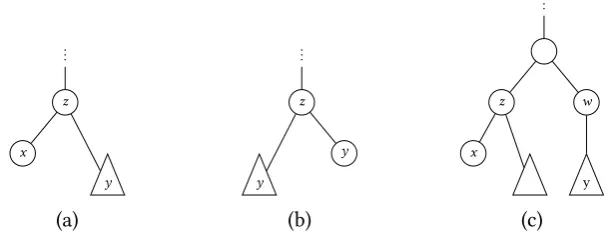
Figure 1: Parts of a binary tree considered in Theorem 1and Theorem 2. Subtrees which do
not contain any value means that those subtrees can be either empty or not. Vertical edges
show that those edges can be either left or right. (a) Part of a binary tree in which the node
yis in a right subtree of the nodez. (b) Part of a binary tree in which the nodeyis in a left subtree of the nodez. (c) Part of a binary tree in which the nodeyis placed in a subtree which
is not rooted at nodez.
Proof. (⇒): According to inorder traversal, since the node xdoes not have a right child and the node y is a leaf, the node y and then the nodex will be visited. Likewise, in postorder
traversal the nodeyand then the nodexare visited respectively.
(⇐): In contrary, letxis not a one-child node with the leaf left childy. We have the three following cases:
1. The nodexis leaf and the nodeyis placed elsewhere. Letzbe the parent ofx. Without
loss of generality, letxbe the left child of thez. We have the two following cases:
(a) The node y is placed in right subtree of the node z (Figure 1(a)). According to
postorder traversal, in general, we have . . . ,x,. . . ,y,. . . ,z,. . . . It is evident that the
nodeynever precedes the nodex, thus it is a contradiction.
(b) The nodeyis place in a one of a subtrees rooted from a node exceptz, sayw(
Fig-ure 1(c)). According to postorder traversal, in general, we have either . . . ,x,z,. . . ,y,. . . ,w,. . . or . . . ,y,. . . ,w,. . . ,x,z,. . . . It is evident that the nodeynever precedes the nodex, thus it
is a contradiction.
2. The node xis node with one child. Let its child bezwhich is a leaf. Without loss of
generality, letzis the left child of thexand the nodeyis placed elsewhere. According
to postorder traversal, in general, we have . . . ,z,x,. . . . It is evident that the nodexalways
immediately followed by the nodez. Thus, it is a contradiction. It should be noted that
in this case by the assumption, we just can consider that the nodezis a leaf.
3. The nodexis node with two childrenzandw such that the nodeszandware the left
and right children of thexrespectively. We have three following cases:
(a) The nodeyis placed in the on of the subtrees of the nodez. According to postorder
precedes the nodex, thus it is a contradiction.
(b) The nodeyis placed in the one of the subtrees of the node of the nodew. According
to postorder traversal, in general, we have, . . . ,z,. . . ,y,. . . ,w,x,. . . . The nodexalways
followed by the nodew, which is contradiction.
(c) The nodeyis neither in left and right subtrees of the node x, so it is placed
else-where. According to postorder traversal, in general, we have either
. . . ,y,. . . ,z,. . . ,w,x,. . . or . . . ,z,. . . ,w,x,. . . ,y,. . . . It is evident that the nodexis never
fol-lowed by the nodey, which is contradiction.
Therefore,xis a node with one childywhich is a leaf and the left child.
Theorem 3. A one-child nodexhas a leaf right childyif and only ifx,yandy,xtwo consecutive
elements in inorder and postorder traversals respectively.
Proof. (⇒): According to inorder traversal, since the nodexdoes not have a left child and the nodey is a leaf, in inorder traversal the node xand then the nodey will be visited. On the
other hand, in postorder traversal the nodeyand the nodexare visited respectively.
(⇐): In contrary, letxis not a one-child node with the leaf right childy. We have the three following cases:
1. The nodexis leaf and the nodeyis placed elsewhere. Letzbe the parent ofx. We have
the two following cases:
(a) Either the nodeyis placed in left subtree of the nodez(Figure 1(a)), which accord-ing to inorder traversal, in general, we have . . . ,y,. . . ,z,x,. . . or the nodey is place
right subtree of the nodez, which based on inorder traversal, in general, we have
. . . ,x,z,. . . ,y,. . . (Figure 1(b)). It is evident in both conditions the nodeynever pre-cedes the nodex, thus it is a contradiction.
(b) The nodeyis place in one of the subtree rooted from a node exceptz, saywand
the nodexis either the left or right child of the node z. According to postorder
traversal, in general, we have either . . . ,x,z,. . . ,y,. . . ,w,. . . or . . . ,y,. . . ,w,. . . ,x,z,. . . . It is
evident that nodezis always followed by the nodez, thus it is contradiction.
2. The node x is node with one child. Let its child be z and is a leaf. Without loss of
generality, letzis the right child of thex, and the nodeyis placed elsewhere. According
to postorder traversal, in general, we have . . . ,z,x,. . . . Since the nodezalways precedes
the nodex, it is a contradiction. It should be noted that in this case by the assumption,
we just can consider that the nodezis a leaf.
3. The nodexis node with two childrenzandw such that the nodeszandware the left
and right children of thexrespectively. We have three following cases:
(a) The nodeyis placed in the on of the subtrees of the nodez. According to postorder
traversal, in general we have . . . ,y,. . . ,z,. . . ,w,x, . . . . It is evident that the node w
a
b
e
j
c
f g
n
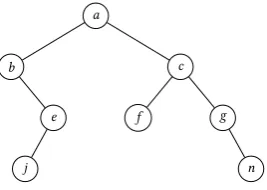
Figure 2: A binary tree. The inorder traversal is b,j,e,a,f,c,g,n, and the postorder traversal is
j,e,b,f,n,g,c,a
(b) The nodeyis placed in the one of the subtrees of the nodew. According to
pos-torder traversal, in general, we have, . . . ,z,. . . ,y,. . . ,w,x,. . . . The nodewalways
pre-cedes the nodex, which is contradiction.
(c) The nodeyis neither in left and right subtrees of the node x, so it is placed
else-where. According to postorder traversal, in general, we have either
. . . ,y,. . . ,z,. . . ,w,x,. . . or . . . ,z,. . . ,w,x,. . . ,y,. . . . It is evident that the nodewalways
pre-cedes the nodex, which is contradiction.
Therefore,xis a node with one childywhich is a right child.
The algorithm starts the reconstruction process by both postorder and inorder traversals
to-gether. It uses a stack and inorder traversal for control and postorder traversal to reconstruct
a binary tree from its inorder and postorder traversals. It moves on postorder from the last to
the first element, because of theProperty 1andProperty 2. In fact, it starts the reconstruction
process by considering the root node which is located at the end of the postorder traversal.
It then, first reconstructs the right subtree of the root and then its left subtree recursively,
since in postorder traversal based oneProperty 2the right child of a node is visited after its
left child. The algorithm, in each step considers a node from postorder traversal, say current
node. It then, determines whether the child of the current node have a right subtree or not
according toTheorem 1,Theorem 2, andTheorem 3. In fact, according to these theorems we
consider in the algorithm per iteration two consecutive elements in postorder traversal (for
more information see the InPos algorithm). On the other hand, since for the current node
all the elements in its left and right subtrees are placed before and after the current node in
inorder traversal, it moves on the inorder traversal from the last element to the right. If the
current node has a right child, it pushes the index child node of postorder traversal in the
stack. By pushing the index of the node, it can access the node without any searching during
the pop process. Thus, in the stack the index of the elements that have a right subtree will be
pushed. The algorithm pops up an element from the stack, when the right subtree of the
ele-ment at the top of the stack is already built, and its left subtree should be built. So the current
node will be changed to the element at the top of the stack. In effect, it is evident when the
current inorder traversal node is equal to the top of the stack, the right subtrees are already
a
c
a
c
g
a
c
g
n
a
c
f g
n
a
b c
f g
n
a
b
e
c
f g
n
a
b
e
j
c
f g
n
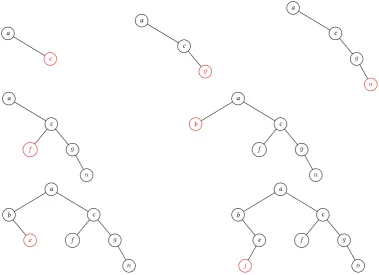
Figure 3: The process of the reconstruction of the binary tree depicted inFigure 2. The process
of the reconstruction is shown one by one. In each step the added node is colored red.
As a result, in this condition it pops up the element at the top of the stack and changes the
current node to the popped element. Thereafter, it initiates the attributes of the current node
as well as the parent index of the child, and continue this process for either the child node or
for the element popped up from the stack. Regarding a binary tree illustrated inFigure 2, the
process of reconstruction is depicted inFigure 3, one by one. As is seen in Figure 3the right subtree of each node firstly is rebuild, then the algorithm reconstructed the left subtrees, if
they existed.
2.2
InPos algorithm
Here, we give the pseudo code of the InPos algorithm using the pseudo code style defined in
[9]. The algorithm is implemented in the C# and MATLAB programming languages, and is
available upon request. In this algorithm, we letInandP osdenote to inorder and postorder traversals respectively. Two variablesLef tandRightshow whether the algorithm is working on a left or right subtree respectively. The variableCurrentN odealso shows the considered node in postorder traversal. Two functions, Push and Pop show the two operation on the
stack. The function Push(stack, x), inserts the elementxat the top of the stack. Similarly, the operation Pop, returns and then removes the element at the top of the stack.
In InPos we consider four attributes per node;parent,lef t,right, and type. The attributes
corresponding to the postorder traversal. The attribute type indicates the type of the node, which is either 0, 1, and 2. These numbers correspond respectively to no-child, one-child, and
two-child nodes. We note that there is difference between Lef t and lef tas well as Right andright, so that the variablesLef tandRightdepict that in which subtree the algorithm is working, whilelef tandrightare attributes that should be initiated during the reconstruction process.
Algorithm1in initial steps, makes the type value of each node equivalent to 0. Two variables
countpos and countin illustrate the indices of the considered nodes in inorder and postorder traversals respectively. As is said in advance, since the process of reconstruction starts with
the end of the two traversals, the initial value of thecountin is equal to the index of the last element in inorder traversal. The value of thecountposis at first equal to the last but two ele-ments of the postorder traversal, since it is known that the last element is the root node, and
during the reconstruction process the two postorder consecutives from the end to the first are
considered.
The algorithm, then firstly checks whether the last elements if the inorder and postorder
traversals are equal or not. By this comparison it recognizes that the root of the tree has a
right subtree or not. According toTheorem 1, it is obvious, if they are equal, then the root
does not have a right subtree, and so the algorithm should work on the left subtree of the root,
and in this condition it sets the variableLef tequal to 1. Otherwise, it pushes the root node into to the stack, since it has the right subtree (for more information see section 2.1Presenting the
reconstruction algorithm). As it was mentioned before, by two variablesLef tandRightthe algorithm identifies whether to work on either left or right subtree of a current node. At first,
the variableCurrentN odeis equal to the last element of postorder, as the algorithm starts the reconstruction process from the root of the tree. In each iteration of theforloop (line 12), the position of a node is recognized and based on this its corresponding attributes are initiated.
Thewhileloop (line 13), checks the element at the top of the stack whether it is equivalent to
the considered node in inorder traversals or not. If they are equal, the algorithm understands
that the right subtree of the considered node in postorder is already rebuilt and so it pops up
the element from top of the stack and initiates theCurrentN odeto this element, and sets the variableLef tequal to 1, since it has to work on the left subtree of theCurrentN odein pos-torder traversal. In fact, if a node is popped up from the stack, the algorithm recognizes that
the right subtrees are rebuilt and it should reconstruct the left subtree of the pushed nodes,
one by one. Here, it uses a loop, because some nodes in the stack may not have any left
sub-tree and then by the comparison in thewhile loop (line 13) it eliminates the nodes that are
pushed and do not have a left subtree. Therefore, after this loop, the CurrentN odeis such node that its right subtree is already rebuilt and it has a left subtree that the algorithm should
reconstruct. In the rest of the algorithm there are twoifconditions, such that each of them
along with theirelse parts initiate the corresponding attributes based on the position of the
Algorithm 1Reconstructing a binary tree from its inorder and postorder traversals.
InPos(In, P os) 1 stack.top = nil
2 CurrentN ode = P os[P os.length] 3 countin = In.length
4 fori = P os.lengthdownto1
5 P os[i].type = 0
6 if P os[P os.length]= = In[In.length] 7 Lef t = 1
8 Right = 0 9 elseLef t = 0
10 Right = 1
11 Push(stack, P os.length)
12 forcountpos = P os.length−2downto0
13 whileP os[stack.top]= =In[countin]andstack.top6=nil 14 CurrentN ode = stack.top
15 Pop(stack) 16 Lef t = 1 17 Right = 0
18 countin = countin−1
19 ifP os[countpos+ 1] 6=In[countin]
20 Push(stack, countpos+ 1) 21 if Lef t= =1
22 P os[CurrentN ode].lef t = Countpos+ 1 23 P os[countpos+ 1].parent = CurrentN ode
24 P os[CurrentN ode].type = P os[CurrentN ode].type+ 1 25 elseP os[CurrentN ode].right = Countpos+ 1
26 P os[countpos+ 1].parent = CurrentN ode
27 P os[CurrentN ode].type = P os[CurrentN ode].type+ 1 28 Lef t = 0
29 Right = 1 30 else if Lef t= =1
31 P os[CurrentN ode].lef t = Countpos+ 1 32 P os[countpos+ 1].parent = CurrentN ode
33 P os[CurrentN ode].type = P os[CurrentN ode].type+ 1 34 elseP os[CurrentN ode].right = Countpos+ 1
35 P os[countpos+ 1].parent = CurrentN ode
36 P os[CurrentN ode].type = P os[CurrentN ode].type+ 1 37 Lef t = 1
38 Right = 0
1 2 3 4 5 6 7 8
In b e j a f c g n
1 2 3 4 5 6 7 8
P os j e b f n g c a
1 2 3 4 5 6 7 8
parent / / / / / / / /
lef t / / / / / / / /
right / / / / / / / /
type 0 0 0 0 0 0 0 0
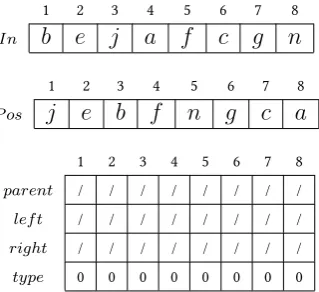
Figure 4: Initial step, consider four attributes per node associated with postorder traversal. all
the three attributes ofparent,lef t, andrightare equal to nil , and the value of the attribute
typeis equivalent to 0.
1 2 3 4 5 6 7 8
In b e j a f c g n
1 2 3 4 5 6 7 8
P os j e b f n g c a
1 2 3 4 5 6 7 8
parent / / / / / / 8 /
lef t / / / / / / / /
right / / / / / / / 7
type 0 0 0 0 0 0 0 1
Figure 5: First iteration of theforloop. The elementcis defined as right child of the element
a. The corresponding attributes are initiated.
2.3
Example of the InPos algorithm
Here we exemplify how our algorithm InPos works. Once again consider the inorder and
pos-torder traversals for the binary tree illustrated inFigure 2. Each figure shows one iteration of
theforloop. For convenience, in each figure the initiated attributes as well as their associated indices are colored red.
Figure 4shows the initial steps of the algorithm, in which all the attributes except the type are equal to nil, and the initial value of thetype for all the elements is 0. The index of the root (i.e. 8) is pushed into the stack.Figure 5 shows the first iteration of theforloop of the
algorithm. The index of the elementc(i.e. 7) is pushed into the stack. The right child of the
root node (i.e. a) is defined which is the elementc. The attributes right and type for the elementa, as well as the attributeparent for the elementcare initiated.Figure 6shows the second iteration of theforloop of the algorithm. The index of the elementsg(i.e. 6) is pushed
1 2 3 4 5 6 7 8
In b e j a f c g n
1 2 3 4 5 6 7 8
P os j e b f n g c a
1 2 3 4 5 6 7 8
parent / / / / / 7 8 /
lef t / / / / / / / /
right / / / / / / 6 7
type 0 0 0 0 0 0 1 1
Figure 6: Second iteration of theforloop. The elementgis defined as right child of the element
c. The corresponding attributes are initiated.
1 2 3 4 5 6 7 8
In b e j a f c g n
1 2 3 4 5 6 7 8
P os j e b f n g c a
1 2 3 4 5 6 7 8
parent / / / / 6 7 8 /
lef t / / / / / / / /
right / / / / / 5 6 7
type 0 0 0 0 0 1 1 1
Figure 7: Third iteration of theforloop. The elementnis defined as right child of the element
g. The corresponding attributes are initiated.
1 2 3 4 5 6 7 8
In b e j a f c g n
1 2 3 4 5 6 7 8
P os j e b f n g c a
1 2 3 4 5 6 7 8
parent / / / 7 6 7 8 /
lef t / / / / / / 4 /
right / / / / / 5 6 7
type 0 0 0 0 0 1 2 1
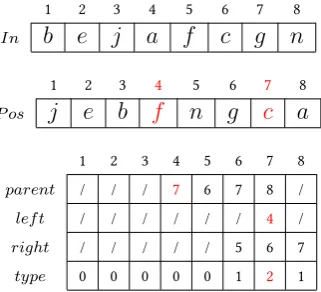
Figure 8: Next iteration of theforloop. The elementf is defined as left child of the element
1 2 3 4 5 6 7 8
In b e j a f c g n
1 2 3 4 5 6 7 8
P os j e b f n g c a
1 2 3 4 5 6 7 8
parent / / 8 7 6 7 8 /
lef t / / / / / / 4 3
right / / / / / 5 6 7
type 0 0 0 0 0 1 2 2
Figure 9: Next iteration of theforloop. The elementbis defined as left child of the elementa. The corresponding attributes are initiated.
1 2 3 4 5 6 7 8
In b e j a f c g n
1 2 3 4 5 6 7 8
P os j e b f n g c a
1 2 3 4 5 6 7 8
parent / 3 8 7 6 7 8 /
lef t / / / / / / 4 3
right / / 2 / / 5 6 7
type 0 0 1 0 0 1 2 2
Figure 10: Next iteration of theforloop. The elementeis defined as right child of the element
b. The corresponding attributes are initiated.
1 2 3 4 5 6 7 8
In b e j a f c g n
1 2 3 4 5 6 7 8
P os j e b f n g c a
1 2 3 4 5 6 7 8
parent 2 3 8 7 6 7 8 /
lef t / 1 / / / / 4 3
right / / 2 / / 5 6 7
type 0 1 1 0 0 1 2 2
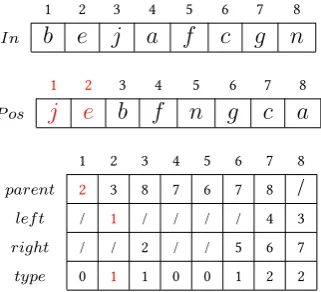
Figure 11: Next iteration of theforloop. The elementb is defined as left child of the element
The attributesrightandtypefor the elementc, as well as the attributeparentfor the element
gare initiated.Figure 7shows the third iteration of theforloop of the algorithm. No elements are pushed or popped up into or from the stack. The right child of theCurrentN ode(i.e. g) is defined which is the elementn. The attributesrightandtypefor the elementg, as well as the attributeparent for the elementn are initiated.Figure 8 shows the next iteration of the
forloop of the algorithm. The index of the elementsgandc(i.e. 6 and 7 ) are popped up from the stack in order. The left child of theCurrentN ode(i.e.c) is defined which is the elementf. The attributeslef tandtypefor the elementc, as well as the attributeparentfor the element
fare initiated. Figure 9shows the next iteration of theforloop of the algorithm. The index of the elementa(i.e. 8) is popped up from the stack, and then the index of the elementb(i.e.
3) is pushed into the stack. The left child of theCurrentN ode(i.e. a) is defined which is the elementb. The attributeslef tandtypefor the elementa, as well as the attributeparentfor the elementbare initiated.Figure 10shows the next iteration of theforloop of the algorithm. No
elements are popped up or pushed from or into the stack. The right child of theCurrentN ode (i.e. b) is defined which is the elemente. The attributesrightandtype for the elementb, as well as the attributeparentfor the elementeare initiated.Figure 11shows the next iteration of the forloop of the algorithm. No elements are popped or pushed from or into the stack.
The left child of the CurrentN ode(i.e. e) is defined which is the element j. The attributes
lef tandtypefor the elemente, as well as the attributeparentfor the elementjare initiated. In brief,Figure 4 troughFigure 11show the process of the reconstruction of the binary tree
illustrated inFigure 2from its inorder and postorder traversal by the algorithm InPos.
3
Results
In this section, we investigate time and space complexity of theAlgorithm 1. The number of the elements in either inorder or postorder traversal is equal to n, andT(n)as well as S(n) denote to time and space complexity respectively, We probe the complexity of each of them
separately.
3.1
Time complexity of InPos
Here, we look for the time complexity of the algorithm InPos. Except theforandwhileloops
in lines 4,12, and 13 other commands take constant time, so they can be discarded. Theforloop in line 10 takesθ n. Theforloop in line 12, runsn−2times, which is an order of theO n. Thewhileloop in line 13, repeats until its conditions do not hold. It compares the element at
the top of the stack with the element in inorder traversal using the variablecountin. On the other hand, as was said before, the index of the nodes that have a right subtree are pushed into
the stack. Therefore, the height of the stack is at most equal to the number of the nodes that
have right subtree. Shape of a binary tree withnnodes that has the maximum number of the
nodes with right subtrees is a right chain.Figure 12 shows an example of right chain binary
tree. In this case the inorder and postorder traversals are reverse of each other Theorem 4
a
b
c
d
Figure 12: A right chain binary tree. The inorder traversal isa,b,c,d, the postorder traversal is
d,c,b,a
.
Theorem 4. If a binary tree has shape of right chain, then the inorder and postorder traversals
are reverse of each other.
Proof. According to inorder traversal, since each node does not have any left subtree, at first the root will be visited and then its left child. Thus, nodes will be visited in term of their level
of the tree respectively. In other words, at first the root will be visited, then the node at the
level 2 and so on. Whereas, based on postorder traversal, since each node does not have any
left subtree, the right subtree will be visited first and then the root. Since each node in the
right subtree (except the leaf node) has a parent node, the parent is also placed in the right
subtree of its parent, these nodes will be visited from the leaf to root level by level.
If the binary tree is a right chain, the condition of thewhileloop, in line 13, never holds until
the last repeation of the for loop in line 13. Hence, the number of iterations of the while
loop can be discarded. The time complexity of the algorithm InPo depends on the number of
iterations of theforloops in line 4 and 12, which is
T(n) = θ n
+ O n
=θ n.
(1)
Thus, from Equation 1, the total time complexity of the algorithm InPos is θ n. In other words, algorithm InPos considers each node according to the type. It considers elements that
have two children twice, once for building their right subtrees, and once for their left subtrees.
Likewise, it considers the elements that have one child, only once, for building either their right
or left subtree, and the algorithm never considers the leaf node. That is to say, the variable
CurrentN odenever initiates for leaf nodes. Therefore, from this point of view the total time complexity of the algorithm is at mostθ 2nwhich isθ n.
3.2
Space complexity of InPos
Here, we investigate the space complexity of the algorithm InPos. Since the algorithm
re-gards four attribute per nodenthe matrix-based structure that it returns has four rows andn
M(n) = θ 4n
=θ n
.
(2)
From Equation 2, the space occupied by the returning matrix isθ n. On the other hand, in the InPos algorithm all commands take constant space except the dynamic space occupied
by the stack, and so they can be discarded. The space that the stack takes is at most equal
to the number of the nodes with one child, since only these nodes push into the stack. As
was discussed above, when the resulting binary tree has a right chain shape, all the one child
nodes push into the stack and the height of the stack would beθ nin this condition. In other situations it would be less, so the stack takes theO n. Hence, the total space complexity of the algorithm InPos is equal to the space occupied by the return matrix and the stack, which
is
S(n) =θ n+ O n
=θ n.
(3)
Therefore, fromEquation 3the total space complexity of the algorithm InPos is linear.
4
Discussion and future work
Here we discus our result incuding camparison to the previously mentioned studies. As we
proved in section 3, the algorithm InPos takes linear time and space, while the other study
that uses inorder and postorder traversals to reconstruct a binary tree, takes O n2. So, the algorithm InPos works much effectively. Furthermore, the time and space that this algorithm
takes are optimal according toTheorem 5andTheorem 6.
Theorem 5. The reconstruction of a binary tree from its traversals, takes at least θ n time,
wherenis the number of elements in either traversal.
Proof. In the reconstruction process of a binary tree from its traversals, since every node should be visited at least once, this process takes at least θ n, where n is the number of elements in either traversal.
Theorem 6. The reconstruction of a binary tree from its traversals, takes at least θ n space,
wherenis the number of elements in either traversal.
Algorithm Using Traversals Time Complexity Space Complexity
[4] inorder and preorder O n2 not mentioned
[4] inorder and postorder O n2 not mentioned
[6,7] inorder and preorder O nlogn O n
[6,7] inorder and preorder O n O n2
[20] inorder and preorder O n O n
[5] inorder and preorder O n O h
[10] inorder and preorder O n O nlogn
[3] inorder and preorder O n O nlogn
[11] preorder and reversed preorder O max(n,2m) O n
InPos inorder and postorder θ n θ n
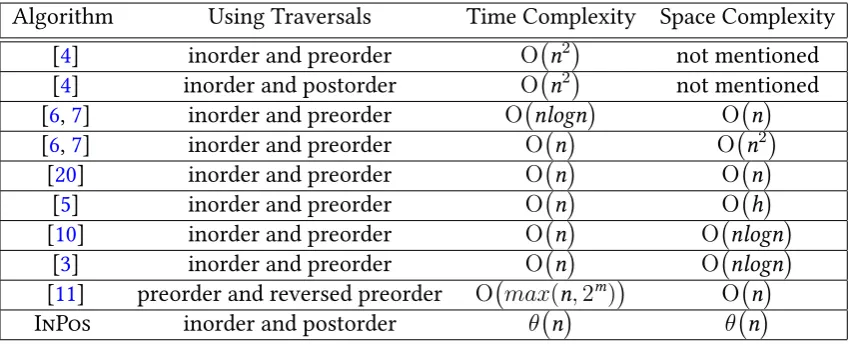
Table 1: Proposed algorithms to reconstruct a binary tree from its traversals. n, h, and m
respectively denote to number of elements in one of the traversal, height of the tree, and the
number of one-child nodes.
The algorithm InPos takes linear time and space which are optimal. As is seen from theTable 1,
across the presented algorithms to reconstruct a binary tree from its inorder and preorder
traversals, only the algorithm proposed by [20] has linear time and space complexity, which are optimal. The authors of the algorithm presented in [5] have claimed that their algorithm
takesO hspace wherehis the height of the reconstructed binary tree which may vary from
lognto n. This is seemingly optimal, since its maximum will be n. But not the height is at stake during the reconstruction process, the algorithm takes O n space, in the end, since every node should be stored ( Theorem 6), wheren is the number of the elements in one of
the traversals. However, these two algorithms were proposed to reconstruct a binary tree
only from its inorder and preorder traversals. Among the algorithms inTable 1, there is one
study focusing on both inorder and postorder traversals that takesO n2 time, but its space complexity is not mentioned . Here, our algorithm works more effective than it. In fact, our
algorithm works in optimal linear time and space. Besides, during the reconstruction of a
binary tree from its inorder and postorder traversals, it defines the type each tree. This will
make it more convenient to work up a reconstruction tree. For many reasons the type of a node
is important. The external nodes in both Huffman Coding [15] as well as decision trees [1,19]
represent the symbols and classes that can be found in linear time and space by this algorithm.
At the end, it returns a matrix-based structure accessible to any structural information of the
tree in linear time by any tree traversals, like BFS (Beardth-first search) or DFS (Depth-first
search) [9]. Although the most common representation of a binary tree is a linked list [9]
many programming languages, such as MATLAB, do not support it. Thus, the representation
of a binary tree with linked lists may not be embeddable in many cases, while because of
matrix-based structure of the binary tree beside the postorder traversal, can be used by many
programming languages, and one can access any structural information of the resulting tree
in linear time. It also does not bind the users only to some tree traversals. This representation
Furthermore, by applying bothTheorem 2,Theorem 3, andTheorem 7one can rebuilt a binary
tree from inorder and postorder traversals from a different view point.
Theorem 7. A two-child nodexhas a left childyand a right child z, such that bothyarezare
leaves if and only ify, x, zandy, z, xare in inorder and postorder traversals respectively. Proof. (⇒): According to inorder traversal, since the node yand z are a leaf, the node the nodesy,x,zwill be visited respectively. Based on postorder traversal, the nodesy,z,xwill be
visited respectively.
(⇐): On the contrary, letxis not a two-child node with the two leaf left childyand the leaf right childz. We have the following cases:
1. The nodexis leaf. Let its parent isw. Without loss of generality, we letxis the left child
of the nodew. We have the following cases:
(a) The nodesyandzare placed in right subtree of the nodew. According to postorder
traversal, in general, we have either . . . ,x,. . . ,y,. . . ,z,. . . ,w, . . . or . . . ,x,. . . ,z,. . . ,y,. . . ,w,
. . . . It is evident that the node x is always precedes the nodes y andz, which is
contradiction.
(b) The nodes y and z are in a subtree rooted from a node except w. According to
inorder traversal, in general, we have . . . ,x,w,. . . . It is evident the nodex always
precedes the nodew, thus it is contradiction.
2. The nodexis one child. Let its child isw. Without loss of generality, we let the nodew
be the left child of the nodex. We have the following cases:
(a) The both nodesyandzare placed in left subtree of the nodew. According to
in-order traversal, in general, we have either . . . ,y,. . . ,z,. . . ,w,x,. . . or . . . ,z,. . . ,y,. . . ,w,x,. . . .
It is evident that the nodewalways precedes the nodex, thus it is contradiction.
(b) The nodesyandzare places in right subtree of the nodew. According to inorder
traversal, in general, we have either . . . ,w,. . . ,y,. . . ,z,. . . ,x,. . . or
. . . ,w,. . . ,z,. . . ,y,. . . ,x,. . . . It is evident that the nodexis always followed by the nodes
yandz, thus it is contradiction.
(c) The nodesyandzare placed elsewhere in the tree rather than the subtrees of the
node w. According to inorder traversal, in general, we have one of the
follow-ing pattern; . . . ,y,. . . ,z,. . . ,w,. . . ,x,. . . or . . . ,z,. . . ,y,. . . ,w,. . . ,x,. . . or . . . ,y,. . . ,w,. . . ,x,. . . ,z
or . . . ,z,. . . ,w,. . . ,x,. . . ,y,. . . . It is evident that in none of the conditions the three
con-secutive elements ofx,y,znever happen, regardless of the gaps between sequences,
thus it is contradiction.
3. The nodexis a node with two childrenuandvsuch that the nodesuandvare the left
and right children of thexrespectively, and they are leaves. The nodes and are placed
elsewhere. According to postorder traversal, in general we have . . . ,u,v,x. It is evident
that the nodeualways precedes the nodexand the nodevalways followed by the node
Therefore, the two-child nodexhas a left childyand a right childz, such that bothyarezare leaves
Based onTheorem 2andTheorem 3the one-nodes child can be determined, and depending on its child position and considering two distinct notations which are not contained in the these
traversal values, these one-child with their only node can be merged into a new element with
new value containing either notions, as mentioned. Similarly, based onTheorem 7, two-child nodes can be defined. Then each two-child node with their children can be merges them into
new element regarding two new distinct notations from whom said forTheorem 2and
The-orem 3inorder to distinguish between parent, left child, and right child values. Therefore, by using the three theorem-Theorem 2,Theorem 3, andTheorem 7, for each node its position
in the reconstruction binary tree as well as their attributes-parent,lef tchild, andrightchild can be defined, and the binary tree can be reconstructed uniquely.
5
Conclusion
Binary trees [9,22] are essential structures in computer science [3]. Tree traversals are
there-fore are across the most paramount topics in CS. The process of reconstructing a binary tree
from its traversals first was described by Knuth [17] and later became its application
om-niscient. In Huffman Coding [15], for instance, inorder to increase the efficiency instead of
transmission of the complete tree, its traversals are sent either inorder and preorder or
in-order postin-order traversals, and the tree will be reconstructed in the receiver [3]. Now, it is
well-known, given inorder traversal along with preorder or postorder traversal of a binary
tree, the binary can be rebuilt uniquely. Many algorithms have been presented to reconstruct
a binary tree from inorder and preorder traversals, among them is the algorithm proposed
by [20]. It has optimal time and space complexity. However, there is one study [4] focusing
on reconstructing a binary tree from its inorder and postorder traversals, such that this takes
O n2 time. Here, was proposed InPos, an improved algorithm to reconstruct a binary tree from its inorder and postorder traversals. We proved that the algorithm takes optimal time and
space which both are linear. Finally InPos returns a matrix-based structure enabling use by
every programming language and all structural information of a binary tree can be accessed
by InPos in linear time and space by every tree traversal. What is more, during the
recon-struction process it determines the type of each node: with two children, with one child, or
with no child. So this algorithm also could be applied in linear time and space to optimize
de-cision trees in the applications to dede-cision support, machines learning and pattern recognition
References
[1] Alpaydin, E. Introduction to Machine Learning, 2nd ed. The MIT Press, 2010.
[2] Andersson, A., and Carlsson, S. Construction of a tree from its traversals in optimal
time and space. Information Processing Letters 34, 1 (1990), 21–25.
[3] Arora, N., Kaushik, P. K., and Kumar, S. Iterative method for recreating a binary tree
from its traversals.International Journal of Computer Applications 57, 11 (November 2012),
6–13.
[4] Burgdorff, H., Jajodia, S., Springsteel, F. N., and Zalcstein, Y. Alternative methods
for the reconstruction of trees from their traversals. BIT Numerical Mathematics 27, 2
(1987), 133–140.
[5] Cameron, R., Bhattacharya, B., and Merks, E. Efficient reconstruction of binary trees
from their traversals. Applied Mathematics Letters 2, 1 (1989), 79–82.
[6] Chen, G., Yu, M., and Liu, L. Nonrecursive algorithms for reconstructing a binary tree
from its traversals. In Computer Software and Applications Conference, 1988. COMPSAC
88. Proceedings., Twelfth International (1988), IEEE, pp. 490–492.
[7] Chen, G.-H., Yu, M., and Liu, L.-T. Two algorithms for constructing a binary tree from
its traversals. Information processing letters 28, 6 (1988), 297–299.
[8] Chen, W., and Udding, J. T. Program inversion: More than fun! Science of Computer
Programing 15, 1 (Nov. 1990), 1–13.
[9] Cormen, T. H., Leiserson, C. E., Rivest, R. L., and Stein, C. Introduction to Algorithms,
3rd ed. The MIT Press, 2009.
[10] Das, V. V. A new non-recursive algorithm for reconstructing a binary tree from its
traver-sals. In Advances in Recent Technologies in Communication and Computing (ARTCom),
2010 International Conference on(2010), IEEE, pp. 261–263.
[11] Deaconu, A. Optimal time and space complexity algorithm for reconstruction of all
binary trees from pre-order and post-order traversals. In7th conference on Operational
research Conference, 2005. Proceedings.(2006).
[12] Engelfriet, J. The time complexity of typechecking tree-walking tree transducers.Acta
Informatica 46, 2 (Mar. 2009), 139–154.
[13] Habermehl, P., Iosif, R., and Vojnar, T. Automata-based verification of programs with
tree updates. Acta Informatica 47, 1 (2010), 1–31.
[14] Hikita, T. Listing and counting subtrees of equal size of a binary tree. Information
[15] Huffman, D. A. A method for the construction of minimum-redundancy codes.
Proceed-ings of the IRE 40, 9 (1952), 1098–1101.
[16] Knott, G. D. A numbering system for binary trees. Communications of the ACM 20, 2
(1977), 113–115.
[17] Knuth, D. E. The Art of Computer Programming, Volume 1 (3rd Ed.): Fundamental
Algo-rithms. Addison Wesley Longman Publishing Co., Inc., 1997.
[18] Knuth, D. E.The Art of Computer Programming, Volume 3 (2nd Ed.): Sorting and Searching.
Addison Wesley Longman Publishing Co., Inc., 1998.
[19] Kuncheva, L. I. Combining Pattern Classifiers: Methods and Algorithms.
Wiley-Interscience, 2004.
[20] Mäkinen, E. Constructing a binary tree from its traversals. BIT Numerical Mathematics
29, 3 (1989), 572–575.
[21] Reingold, E. M., and Hansen, W. J. Data Structures in Pascal. Little, Brown & Co. Inc.,
1986.
[22] Skiena, S. S. The Algorithm Design Manual, 2nd ed. Springer Publ. Inc., 2008.
[23] Slough, W., and Efe, K. Efficient algorithms for tree reconstruction. BIT Numerical
Mathematics 29, 2 (1989), 361–363.
[24] Takaoka, T. O(1) time algorithms for combinatorial generation by tree traversal. The