RESEARCH ARTICLE
Designing and validation of an educational software to improve
writing skills of hearing-impaired students in primary schools
Azam Sharifi1*, Mahbube Arefi1, Kurosh Fathi Vajargah1, Ali Asghar Kakojoibari2
1- Department of Education, Faculty of Education and Psychology, Shahid Beheshti University, Tehran, Iran 2
- Department of Psychology, Payame Noor University, Tehran, Iran
Received: 1 Nov 2016, Revised: 4 Dec 2016, Accepted: 4 Dec 2016, Published: 15 Jan 2017
Abstract
Background and Aim: Hearing impairment affects educational skills of hearing-impaired students, but its negative impact is far more on reading and writing skills. This study was per-formed to design and validate an educational software to improve writing skills.
Methods: In this study, the mixed-methods app-roach was used. In the first step, the qualitative method was used to design the educational soft-ware, which was based on the main themes of the conceptual model of the writing skill curri-culum provided by Sharifi et al. (2016). After-wards, quantitative method was used to validate the software. In so doing, we enrolled 31 teach-ers working in hearing-impaired special primary schools.
Results: The results indicated that more than 50% of the participants approved the software in terms of objectives, content determination, appr-opriateness of time of teaching the content, app-ropriateness of the selected places related to the learning subject, diversity of techniques with regard to individual differences, variety of tech-niques to control organizational shortcomings, as well as appropriateness of the educational software for improving language skills, social
relationships, as well as educational achieve-ment in all the curricular areas.
Conclusion: Designing an educational software capable of considering all the influential aspects and components for writing skill improvement can improve writing skill of hearing-impaired students.
Keywords: Educational software; hearing-impaired; writing skills; validation
Introduction
Hearing is the basis of educational skills. When it comes to education, listening difficulties can greatly influence students. Hearing impairment, depending on its degree, has a significant imp-act on language development of hearing-impa-ired children, who as their peers, inherently have the ability to learn language rules and gra-mmar [1].
Hearing impairment affects educational skills of these students, but its negative impacts are far more on language skills such as reading and writing [2]. Writing creates the obtained experi-ences of listening, speaking, and reading inte-grated. One who writes should be able to exp-ress their thoughts using words and sentences [3]. They have numerous problems in written language production [4]. Since one of the ways of communication, especially in today’s world, is the use of written language, investigating the use of syntactic structures in the written
*
Corresponding author: Department of Education, Faculty of Education and Psychology, Shahid Beheshti University, Daneshjoo Blvd., Evin, Tehran,
language of hearing-impaired students with seri-ous language impairment has a remarkable sign-ificance [5]. In addition to vocabulary limit-ations, they have difficulty in organizing words in a sentence. One of the communication pro-blems that they encounter is the selection and organization of words in a sentence. The level of this problem is to the extent that in many cases students’ verbal message is incompre-hensible for the audience and full of ambiguities [6]. Writing weakness of hearing-impaired chil-dren is evident even in adulthood, such that the complexity of their writing in comparison with their normal hearing peers is very poor [7]. Borg et al. showed that all children with hearing impairment have delay in all aspects of phon-eme recognition, matching, rhyming, grammar test, and word expression. Additionally, they found a direct relationship between the degree of hearing loss and delay in these aspects [8]. Sharifi et al. conducted semi-structured inter-views in an exploratory study with an approach based on grounded theory; they included 39 experienced participants working in the field of hearing impairment in special schools. During their study, the main and sub-categories of the writing skill curriculum and their relationships were attained through open, axial, and selective coding. To generalize the findings of the quali-tative phase and validate the extracted model, a questionnaire was designed which was answ-ered by 231 teachers of the hearing-impaired special schools. The results approved their con-ceptual model of the writing skill curriculum in the primary schools of educational system in Iran [3].
Due to the writing weaknesses of hearing-impaired students in the aforementioned studies, this study aimed to design and validate an edu-cational software to improve their writing skills in the primary schools of educational system in Iran. This is the first attempt to develop a soft-ware to improve writing skill among these chil-dren.
Methods
In this study, the mixed-methods approach was used. In the first step, the qualitative method
was used for designing the software, which was designed using the main themes extracted from the conceptual model of the writing skills curri-culum of Sharifi et al. [3], the validity of which was approved. Their study indicated 8 main themes and 18 sub-themes (Fig. 1).
The titles of the steps of this educational software (totally 35 steps) were the same as grammar section headlines of the first to sixth grade Persian books used in primary schools of the educational system in Iran. Hearing-impaired students are different in terms of rehabilitation and psychological services [3], which influences their learning level. Thus, tea-chers’ actions, such as the way they adjust their activities based on individual differences of the students, methods they adopt with an eye on specific content, the way they assess or evaluate students, as well as type of interaction they have with students, are crucial in this process. There-fore, a diversity of techniques was included in this software for teachers. With this intention in mind, software design philosophy replaced the course book to enable teachers both overcome lots of restrictions with the help of the software and pay more attention to individual differences of the students.
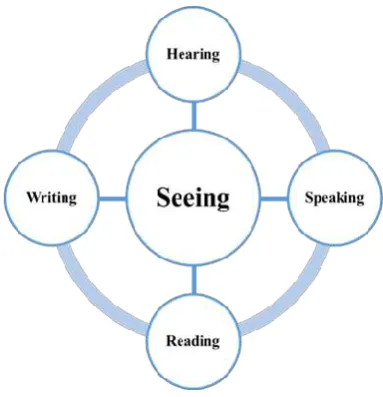
Hearing impairment affects language skills (list-ening, speaking, reading, and writing) of a per-son with hearing loss [9]. Improving all the four language skills, as well as visual skill were con-sidered in this software to overcome students’ individual differences and provide a learning context for all students, so that if a student with a profound hearing loss is not able to hear, his/her other language skills will be streng-thened in the teaching process.
this cycle will be repeated again. In another form of training, chains are linked to each other and do not operate separately. The student looks at an image, hears, tells, reads, and writes. The software is designed in such a way that training can vary according to the teachers’ opinion and recognition. For example, the student can only hear or read its written form without looking at the image, or s/he can hear and write without seeing the image.
The scoring method was considered in a way that the student can immediately receive the feedback for any correct answer; despite the psychological differences, learning enthusiasm is provided for the student through promoting motivation and curiosity, actually, the student
cannot go to another step unless s/he reaches mastery level in each written step. Families should help students to repeat and practice these learning materials at home, and the interaction between teacher and student and other staff, including rehabilitation staff, is emphasized. Learning to write some content or materials such as Persian grammar takes longer for the learner and no one can consider a set time for teaching different materials. In this software, some steps are divided into several parts to ass-ign an appropriate time for students to learn. Since the lack of organizational factors such as lack of supportive atmosphere and limited educational resources and facilities in schools are the restricting factors for the writing skill
Achieving optimal situation:
1. Major goal 2. Minor goals
Content determination:
1. Principles of content selection 2. Principles of content organization
Teacher's proceedings:
1. Teaching method 2. Evaluation 3. Teacher-student interaction
including individual and cooperative
Positive consequences:
1. Improvement of language skills 2. Academic achievement in all curricular areas 3. Advancement in social relationships
Place:
1. Appropriate environment as a resource of learning 2. Appropriate environment as the performance place
Individual
differences
between hearing-impaired students:
1. Rehabilitation differences 2. Psychological differences
Time of teaching:
1. Direct teaching during Persian 2. Indirect teaching during other lessons
Organizational factors:
1. Supportive atmosphere of the school
2. Educational facilities of the school
curriculum [3], to rule out these factors, the features and places relevant to the learning subject are displayed in a variety of images. Therefore, if the scientific camps and training facilities are not available due to organizational shortcomings, students, however, will be able to better link natural concepts to the images incl-uded in the software, which can facilitate deep learning. Thereafter, the quantitative method was performed. To validate the content of the software, 31 teachers participated in the survey, eight of whom were among the winners of the festival of superior teaching models. Further-more, 13 of the participants were those who contributed to the semi-structured interview section to identify influential dimensions of the curriculum model of writing skill in the study
conducted by Sharifi et al. [3], and 10 teachers were randomly selected from 10 available spe-cial schools of cities in Tehran Province, Iran. Table 1 presents the characteristics of the sele-cted teachers in the survey of the educational software. First, all the chosen teachers were informed of the general purpose of the software, and if they wanted to examine the educational software and answer the questions, they could receive the software package and the eight rela-ted questions. All the teachers expressed their willingness to cooperate and the researcher pre-sented the educational software and the ques-tions to all the selected teachers.
Each of the 31 evaluators examined the software based on an 8-item questionnaire rated using a 5-point Likert scale: strongly disagree (0), disagree (1), no idea (2), agree (3), and strongly agree (4). After the evaluation, the evaluators made recommendations about content of the package in terms of sound and colour of the images, which were applied in the final edition of the software.
Data analysis was performed using nonpara-metric test of binomial. Binomial test is used for a binary variable. This test was used to analyze the agreement or disagreement of teachers rega-rding the content of the educational software. Data analysis was conducted using SPSS 21.
Results
The degree to which the evaluators agreed on the characteristics of the educational software steps was examined through nonparametric test of binomial. Its results indicated that 87% of the evaluators agreed on the compatibility between Fig. 2. The cycle of language skills and
seeing skill
Table 1. Characteristics of the evaluators in the survey of educational software
Gender Work experience Education degree
Selected teachers Female Male Years≥20 Years<20 BA MA Ph. D.
The winners of the festival of superior teaching models in the country
7 1 6 2 2 4 2
Teachers participating in the qualitative research conducted by Sharifi et al. (2016)
11 2 9 4 2 10 1
Randomly selected 6 4 6 4 6 4 -
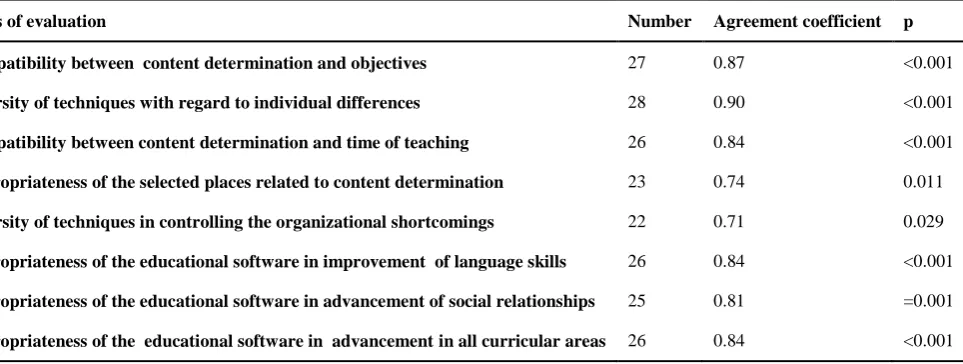
content and objectives. Furthermore, 90% of them agreed on diversity of techniques app-ropriate for individual differences, 84% on the compatibility between content and time of tea-ching, 74% upon appropriateness of the selected places for the content, 71% on diversity of tech-niques in overcoming the organizational short-comings, 84% upon appropriateness of the edu-cational software for improving language skills, 81% upon appropriateness of the educational software in promoting social relationships, and 84% upon appropriateness of the software in advancement in all the curricular areas. Agree-ment coefficient and significance level show that the software developed for the writing skill curriculum and its consequences have content validity (p<0.05; Table 2).
Discussion
The main and sub-themes of the conceptual model of the writing skill curriculum of hearing-impaired students were extracted from a study conducted by Sharifi et al. [3]. Results of that study were based on the content analysis of the interviews with the staff working in special schools such as rehabilitation personnel (i.e. speech therapists and audiologists), psycholo-gists of special children, educational super-visors, and teachers. People who are involved in the process of teaching can better identify the needs of hearing-impaired students [9]. This
educational software was inspired by the study of Sharifi et al. that was designed with a holistic view in terms of rehabilitation, educational, and psychological factors. This software is in line with the needs of hearing-impaired students, and it provides a context for the development of their writing skill [3].
The choice of a teaching method is one of the influencing factors in hearing-impaired stu-dents’ curriculum, and that a single approach cannot be applied for all students, but each stu-dent’s needs and abilities should be considered separately [10]. Marschark et al. proposed some useful factors, such as equal access to educa-tional opportunities, motivation, and diverse methods in teaching and learning, as well as effective communication, in overcoming weak-nesses of hearing-impaired students [9].
Simultaneously with the reinforcement of langu-age skills, our software motivates students to hear, expand their vocabulary to speak, become familiar with accurate reading, and learn the position of words, conjunctions, and other gra-mmatical rules. Furthermore, to be allowed to move to the next step, it encourages the students become more careful while writing with regards to grammatical rules. If a student, unlike the others, is unable to achieve the specified objec-tives at the particular time, s/he receives more time to achieve mastery in learning. The under-lying assumption of this learning method is that Table 2. Degree to which the evaluators agreed upon the characteristics of the educational software
Items of evaluation Number Agreement coefficient p
Compatibility between content determination and objectives 27 0.87 <0.001
Diversity of techniques with regard to individual differences 28 0.90 <0.001
Compatibility between content determination and time of teaching 26 0.84 <0.001
Appropriateness of the selected places related to content determination 23 0.74 0.011
Diversity of techniques in controlling the organizational shortcomings 22 0.71 0.029
Appropriateness of the educational software in improvement of language skills 26 0.84 <0.001
Appropriateness of the educational software in advancement of social relationships 25 0.81 =0.001
if the right conditions of training and sufficient time are taken into account, almost all learners can achieve educational objectives of a course or lesson [11].
This software emphasizes on learning for all students. As Hallahan and Kauffman point out, hearing-impaired students are not inherently unable to reach higher levels, but they need more training to be able to compensate for their hearing impairment [12].
This software can provide an opportunity for deep learning by presenting a variety of images related to the subject, so that the subject will not be forgotten. Fung et al. indicated that visual strategies are effective in learning among hearing-impaired students. Within the educa-tional framework, the implementation of this strategy should be considered [13]. Berge and Thomassen suggested that the type of teaching method is very important and that students bet-ter learn by providing visual input [14].
When students are asked to describe the expla-nations related to the image, more expressive interaction will be provided between teacher and student. On the other hand, students can better use their vocabulary by seeing the image. Teachers who encourage students to have more dialogue and interaction, in fact, let them think more; as a result, these students will become more proficient writers [15,16].
The software will have positive consequences as it can create a platform to strengthen language skills, and it promotes verbal interaction bet-ween teacher and student. Students who interact more with their teachers better learn to speak and act with more confidence in social relations [3]. Students who are more successful in written tests, achieve higher grades easier, while those with poor writing skills show little progress in higher grades [4].
All the teachers evaluating the inner content of the software agreed on the package as a tool for teaching writing skills. However, the statis-tical results showed that in controlling orga-nizational factors and selecting the places rela-ted to the learning subject, the coefficient is lower than other items, which confirms the fact that training a hearing-impaired student requires
teamwork [2]. With the absence of collaboration between administrators, rehabilitation perso-nnel, and teachers, proper educational facilities, as well as proper conditions for students to visit real places related to the learning subject, novel strategies should be employed in educational process. Nevertheless, these strategies cannot completely eliminate the negative impact of these shortcomings.
Conclusion
Given the evident weaknesses of hearing-impaired students in language skills, especially in writing skill, it is mandatory to emphasize on the need to improve writing skill, which is an essential language skill. Moreover, designing an educational software capable of taking into account all the influential aspects and compo-nents in developing writing skills can facilitate hearing-impaired students’ writing progress.
Acknowledgments
We would like to thank the respected teachers for cooperating with evaluation of the educa-tional software by providing precise answers to the questionnaire items. We are also immensely grateful to Seyyed Aref Hosseini Kia, a com-puter engineering student in Amirkabir Univer-sity of Technology (Polytechnic, Tehran, Iran), who contributed to the programming and imple-mentation of the educational software of writing skills for hearing-impaired students.
REFERENCES
1. Skarakis-Doyle E, Dempsey L. The detection and moni-toring of comprehension errors by preschool children with and without language impairment. J Speech Lang Hear Res. 2008;51(5):1227-43.
2. Kakojoibari AA, Sharifi A. The effect of hearing impair-ment on educational achieveimpair-ment of hearing-impaired students. Audiol. 2014;23(2):19-30. Persian.
3. Sharifi A, Arefi M, Fathi Vajargah K, Kakojoibari AA. Planning and validating a writing skill curriculum for hearing-impaired students in primary school system of Iran. Aud Vest Res. 2016;25(3):176-83.
4. Schley S, Albertini J. Assessing the writing of deaf coll-ege students: reevaluating a direct assessment of writing. J Deaf Stud Deaf Educ. 2005;10(1):96-105.
5. Barth AE, Tolar TD, Fletcher JM, Francis D. The effects of student and text characteristics on the oral reading fluency of middle-grade students. J Educ Psychol. 2014;106(1):162-80.
Philadelphia: Lippincott Williams & Wilkins; 2002. 7. Biser E, Rubel L, Toscano RM. Bending the rules:
when deaf writers leave college. Am Ann Deaf. 2007;152(4):361-73.
8. Borg E, Edquist G, Reinholdson AC, Risberg A, McAllister B. Speech and language development in a population of Swedish hearing-impaired pre-school children, a cross-sectional study. Int J Pediatr Otorhino-laryngol. 2007;71(7):1061-77.
9. Marschark M, Lang HG, Albertini JA. Educating deaf students: from research to practice. 1st ed. New York: Oxford University Press; 2002.
10. Sharifi A, Kakojoibari AA. The effect of educational level elevation on the mathematical skill in hearing-impaired students. Audiol. 2013:22(1):10-7. Persian. 11. Bloom BS. Learning for mastery. Instruction and
curri-culum. Regional education laboratory for the Carolinas and Virginia, topical papers and reprints, number 1. Evaluation Comment. 1968;1(2):n2.
12. Hallahan DP, Kauffman JM. Exceptional children: intro-duction to special education. 6th ed. Boston: Allyn &
Bacon; 1994.
13. Fung PC, Chow BW, McBride-Chang C. The impact of a dialogic reading program on deaf and hard-of-hearing kindergarten and early primary school-aged students in Hong Kong. J Deaf Stud Deaf Educ. 2005;10(1):82-95. 14. Berge SS, Thomassen G. Visual access in
interpreter-mediated learning situations for deaf and hard-of-hearing high school students where an artifact is in use. J Deaf Stud Deaf Educ. 2016;21(2):187-99.
15. Wolbers KA, Dostal HM, Graham S, Cihak D, Kilpatrick JR, Saulsburry R. The writing performance of elementary students receiving strategic and interactive writing instruction. J Deaf Stud Deaf Educ. 2015;20(4):385-98.
![Fig. 1. Conceptual model of writing skill curriculum for hearing impaired students in primary schools [3]](https://thumb-us.123doks.com/thumbv2/123dok_us/8947882.1857250/3.595.65.534.77.479/conceptual-writing-curriculum-hearing-impaired-students-primary-schools.webp)