Application of the new extended
(G
′/G)
-expansion method to find
exact solutions for nonlinear partial differential equation
Md. Nur Alam∗1
1,2,3Department of Mathematics,
Pabna University of Science and Technology, Bangladesh E-mail:[email protected]
Md. Mashiar Rahman
Department of Mathematics,
Begum Rokeya University, Rangpur, Bangladesh E-mail:[email protected]
Md. Rafiqul Islam2
E-mail:[email protected]
Harun-Or-Roshid3
E-mail:[email protected]
Abstract In recent years, numerous approaches have been utilized for finding the exact solu-tions to nonlinear partial differential equasolu-tions. One such method is known as the new extended (G′/G)-expansion method and was proposed by Roshid et al. In this
paper, we apply this method and achieve exact solutions to nonlinear partial differ-ential equations (NLPDEs), namely the Benjamin-Ono equation. It is establish that the method by Roshid et al. is a very well-organized method which can be used to find exact solutions of a large number of NLPDEs. equations.
Keywords. New extended (G′/G)-expansion method, the Benjamin-Ono equation, exact solutions.
2010 Mathematics Subject Classification. 35C07, 35C08, 35P99.
1. Introduction
NLPDEs play a significant role in different scientific and engineering fields, such as, fluid mechanics, propagation of shallow water waves, solid-state physics, plasma physics, plasma waves, biology, optical fibers, the heat flow and the wave propaga-tion phenomena, quantum mechanics etc. Nonlinear wave phenomena of diffusion, reaction, dispersion, dissipation, and convection are very important in nonlinear wave equations. The exact solutions of NLEEs play an important role in the study of nonlin-ear physical phenomena and one of the fundamental problems for this is to obtain their traveling wave solutions. In soliton theory, there are many methods and techniques to deal with the problem of solitary wave solutions for NLPDEs such as F-expansion method [1, 25, 39], tanh - sech method [19, 20, 30], Jacobi elliptic function method [12, 13, 18, 41], the collocation method [27, 28], new generalized (G′/G)-expansion
Received: 12 January 2015 ; Accepted: 12 October 2015. ∗Corresponding author.
method [3-6], the wave of translation method [24], the inverse scattering transform [2], the Adomian decomposition method [31], the Darboux transformation method [21], the Backlund transformation method [22], the homogeneous balance method [29, 33], the Sumudu transform method [9-11], the exp(−ϕ(η)) -expansion method [14, 15], (G′/G)-expansion method [32, 34, 35, 40], new (G′/G)-expansion method [7, 16], the
modified simple equation method [17, 36-38], the new extended (G′/G)-expansion
method [8, 26] and so on. The objective of this work is to show that the new extended (G′/G)-expansion method and the renowned the basic (G′/G)-expansion methods are
not alike. Further many new solutions are achieved via the offered the new extended (G′/G)-expansion method. This approach will play an imperative role in constructing
many exact traveling wave solutions for the Benjamin-Ono equation.
2. The Method
For given nonlinear evolution equations with independent variablesx, y, z and t,
we consider the following form
F(u, ut, ux, utt, uxx, uxt....) = 0. (2.1)
By using traveling wave transformation
u(x, y, z, t) =u(ξ), ξ=x+y+z−V t, (2.2)
where u is an unknown function depending on x, y, z, t and is a polynomial F in
u(ξ) = u(x, y, z, t) and its partial derivatives andV is a constant to be determined
later. The existing steps of method are as follows :
Step 1: Using the Eq.(2.2) in Eq.(2.1), we can convert Eq.(2.1) to an ordinary differential equation
Q(u,−V u′, u′, V2u′′, u′′,−V u′′....) = 0 (2.3)
Step 2: Assume the solutions of Eq.(2.3) can be expressed in the form
u(ξ) =
n
X
i=−n
{ ai(G′/G) i
[1 +λ(G′/G)]i
+bi(G′/G)i−1
s
σ[1 +(G′/G)
2
µ ]}, (2.4)
withG=G(ξ) satisfying the differential equation
G′′+µG= 0. (2.5)
In which the value ofσmust be±1,µ6= 0,ai, bi,(i=−n, ..., n) andλare constants
Step 3: Inserting Eq.(2.4) into Eq.(2.3) and making use of Eq.(2.5) and then
ex-tracting all terms of powers of (G′/G)j and (G′/G)jqσ[1 +(G′/G)2]
µ together with
each coefficient of them to zero yield a over-determined system of algebraic equations and then solving this system of algebraic equations forai, bi(i=−n, ..., n) andλ, V,
we obtain several sets of solutions.
Step 4: For the general solutions of Eq.(2.5), we have
µ <0,
G′
G =
√
−µ(Asinh(√−µξ)+Bcosh(√−µξ)
Acosh(√−µξ)+Bsinh(√−µξ)) =f1(ξ)
and whenµ >0,then
G′
G =
√µ(Acos(√µξ)−Bsin(√µξ)
Asin(√µξ)+Bcos(√µξ)) =f2(ξ), (2.6)
whereA, Bare arbitrary constants. At last, inserting the values ofai, bi(i=−n, ..., n),
λ, V and (2.6) into Eq.(2.4) and obtain required traveling wave solutions of Eq.(2.1).
3. Application of our Method
As an example of our method, Let us consider the Benjamin-Ono equation,
ut+Huxx+uux= 0, (3.1)
whereH is the Hilbert transform. The BO equation describes internal waves. It is a completely integrable equation that gives N-soliton solutions. We utilize the traveling wave variableu(ξ) =u(x, t), ξ=x−V t, Eq. (3.1) is carried to an ODE
−V u′+Hu′′+ 1/2(u2)′= 0. (3.2)
Eq. (3.2) is integrable, therefore, integrating with respect toξonce yields:
K−V u+Hu′+ 1/2u2= 0, (3.3)
whereK is an integration constant. By balancing the highest-order derivative term
u′ and nonlinear term u2 in Eq. (3.3) gives n = 1, thus, we have the solutions of
Eq.(3.1), according to Eq. (2.4) is
u(ξ) =a0+
a1(G′/G)
1 +λ(G′/G)+
a−1[1 +λ(G′/G)]
(G′/G)
+(b0(G′/G)−1+b1+b−1(G′/G)−2)
×pσ[1 + (G′/G)2/µ], (3.4)
whereG=G(ξ) satisfies Eq.(2.5). Substituting Eq.(3.4) and Eq.(2.5) into Eq.(3.3), collecting all terms with the like powers of (G′/G)jand (G′/G)jp
σ[1 + (G′/G)2/µ],
and setting them to zero, we obtain a over-determined system that consists of tweenty-five algebraic equations (we omitted these for convenience). Solving this over-determined system with the assist of Maple, we have the following results.
0, a1= 2Hλ2µ+ 2H, a0=const, b−1=b0=b1= 0.
Now whenµ >0, then using (2.6) and (3.4), we have
u(ξ) =a0+ (2Hµλ2+ 2H)[1+fλf2(ξ2)(ξ)], (3.5)
whereξ=x−(2Hλµ+a0)tand when µ <0, then using (2.6) and (3.4), we have
u(ξ) =a0+ (2Hµλ2+ 2H)[1+fλf1(ξ1)(ξ)], (3.6)
whereξ=x−(2Hλµ+a0)t
Case-2:K= 2H2µ2λ2−2a
0H2µλ+a20/2+2H2µ, V =−2Hµλ+a0, λ=const, a−1=
−2Hµ, a1= 0, a0=const, b−1=b0=b1= 0.
Now whenµ >0, then using (2.6) and (3.4), we have
u(ξ) =a0−2Hµ(1+fλf2(ξ2()ξ)), (3.7)
whereξ=x−(a0−2Hλµ)tand when µ <0, then using (2.6) and (3.4), we have
u(ξ) =a0−2Hµ(1+fλf1(ξ1()ξ)), (3.8)
whereξ=x−(a0−2Hλµ)t
Case-3: K=a2
0/2 + 8H2µ, V =a0, λ= 0, a−1=−2Hµ, a1= 2H, a0=const, b−1=
b0=b1= 0.
Now whenµ >0, then using (2.6) and (3.4), we have
u(ξ) =a0+ 2Hf2(ξ)−f22Hµ(ξ), (3.9)
whereξ=x−a0t and whenµ <0, then using (2.6) and (3.4), we have
u(ξ) =a0+ 2Hf1(ξ)−f21Hµ(ξ), (3.10)
whereξ=x−a0t
Case-4: K=12H2µ2λ2−a
0Hµλ+a20/2 +12H2µ, V =−Hµλ+a0, λ=const, a−1=
−Hµ, a1= 0, a0=const, b0=±Hµ
p
1/σ, b−1=b1= 0.
Now whenµ >0, then using (2.6) and (3.4), we have
u(ξ) =a0−µ(1+fλf2(ξ2)(ξ))±Hµ q
1 σ
1 f2(ξ)
q
σ[1 +(f2(ξ))2
µ ], (3.11)
whereξ=x−(a0−Hλµ)t and whenµ <0, then using (2.6) and (3.4), we have
u(ξ) =a0−µ(1+fλf1(ξ1)(ξ))±Hµ
q
1 σf11(ξ)
q
σ[1 +(f1(ξ))2
µ ], (3.12)
whereξ=x−(a0−Hλµ)t
Case-5: K = 12V2+1
2H2µ, V =const, λ= 0, a−1= 0, a0 =V, a1 =H, b0=b−1 =
0, b1=±Hµσ.
Now whenµ >0, then using (2.6) and (3.4), we have
u(ξ) =a0+Hµf2(ξ)±Hpµσf21(ξ) q
σ[1 +(f2(ξ))2
µ ], (3.13)
whereξ=x−V tand whenµ <0, then using (2.6) and (3.4), we have
u(ξ) =a0+Hµf1(ξ)±Hpµσf11(ξ)
q
σ[1 +(f1(ξ))2
whereξ=x−V t
Remark 3.1: Some of these solutions presented in this latter have been checked with Maple by putting them back into the original equations.
Remark 3.2: New extended (G′/G)-expansion method is simple but its results are
very cumbersome. The results of this method contain many arbitrary constants com-pare to the results of the other method. The performance of new extended (G′/G
)-expansion method is reliable, simple, direct, concise and gives more new exact solu-tions compared to the other method. This method allowed us to solve more compli-cated PDEs in the mathematical physics and engineering.
4. Discussions
The advantages and validity of the method over the basic (G′/G)-expansion method
have been discussed in the following:
Advantages: The crucial advantage of the new extended (G′/G)-expansion method
over the basic (G′/G)-expansion method is that the method provides more general
and large amount of new exact traveling wave solutions with several free parameters. The exact solutions have its great importance to expose the inner mechanism of the complex physical phenomena. Apart from the physical application, the close-form solutions of nonlinear evolution equations assist the numerical solvers to compare the accuracy of their results and help them in the stability analysis.
Validity: In Ref. [23] Neyrame et al. used the linear ordinary differential equa-tion as auxiliary equaequa-tion and traveling wave soluequa-tions presented in the formu(ξ) = Pm
i=0ai(G′/G)iwheream6= 0. It is notable to point out that some of our solutions are
coincided with already published results, if parameters taken particular values which authenticate our the solutions. Moreover, in Ref. [23] Neyrame et al. investigated the Benjamin-Ono equation to obtain exact solutions via the basic (G′/G)-expansion
method and achieved only three solutions (A. 1)-(A. 3) (see appendix). Moreover, ten solutions of the Benjamin-Ono equation are constructed by applying the new ex-tended (G′/G)-expansion method.
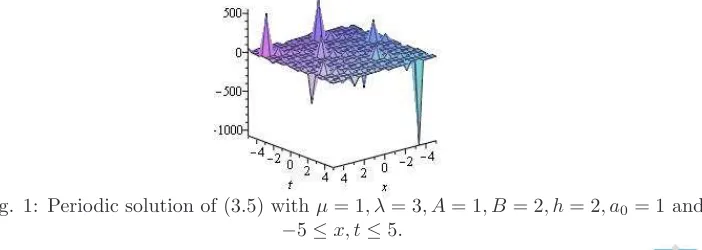
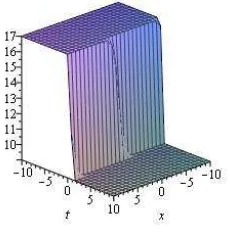
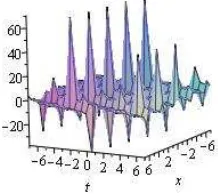
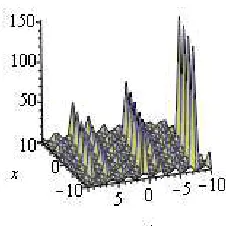
Graphical representations of the solutions: The graphical illustrations of the solutions are depicted in the figures 1 to 10 with the aid of commercial software Maple.
Fig. 2: Kink solution of (3.6) withµ=−1, λ= 3, A= 1, B= 2, h= 1, a0= 1 and −10≤x, t≤10.
Fig. 3: Periodic solutions of (3.7) with µ= 1, λ= 3, A= 1, B= 2, h= 2, a0= 1 and −3≤x, t≤3.
Fig. 5: Periodic solution of (3.9) withµ= 1, λ= 3, A= 1, B= 2, h= 2, a0= 1 and −10≤x, t≤10
Fig. 6: Modulas plot of Singular Kink of (3.10) with
µ=−1, λ= 3, A= 1, B= 2, h= 2, a0= 1 and −10≤x, t≤10.
Fig. 7: Modulas plot of periodic solution of (3.11) with
Fig. 8: Modulas plot of periodic solution of (3.12) with
µ=−1, λ= 3, A= 1, B= 2, h= 2, a0= 1 and −10≤x, t≤10.
Fig. 9: Periodic solution of (3.13) withµ= 1, λ= 3, A= 1, B= 2, h= 2, a0= 1 and −10≤x, t≤10.
5. Conclusions
The new extended (G′/G)-expansion method was applied effectively to solve one
solutions for this equation was formally obtained by using the new extended (G′/G
)-expansion method. Due to the excellent acting of the new extended (G′/G)-expansion
method, we feel that it is an influential scheme in handling a wide variety of NLPDEs.
Appendix: Neyrame et al. solutions [23]
Neyrame et al. [23] established exact solutions of the well-known the Benjamin-Ono equation by using the basic (G′/G)-expansion method which are as follows:
Whenλ2−4µ > 0, u
1 = 2h
p
λ2−4µ×(C1sinh(12
√ λ2
−4µ)ξ+C2cosh(12
√ λ2
−4µ)ξ C1cosh(12
√ λ2
−4µ)ξ+C2sinh(12
√ λ2
−4µ)ξ)− λ
2 +α0 (A.1)
where ξ =x−(hλ−α0)t and C1, C2 are arbitrary constants. When λ2−4µ < 0,
u2= 2h
p
4µ−λ2×(−C1sin( 1 2
√
4µ−λ2)ξ+C 2cos(
1 2
√ 4µ−λ2)ξ
C1cos(12
√ 4µ−λ2
)ξ+C2sin(12
√ 4µ−λ2
)ξ )− λ
2+α0 (A.2)
where ξ =x−(hλ−α0)t and C1, C2 are arbitrary constants. When λ2−4µ= 0,
u3= C12+hCC−22ξ (A.3)
whereξ=x−(hλ−α0)t andC1, C2 are arbitrary constants.
Acknowledgment
This section should come before the References and should be unnumbered. Fund-ing information may also be included here.
References
[1] M.A. Abdou, The extended F-expansion method and its application for a class of nonlinear
evolution equations, Chaos Solitons Fractals, 31 (2007) 95-104.
[2] M.J. Ablowitz and P. A. Clarkson,Soliton, nonlinear evolution equations and inverse scattering
method. Cambridge University Press, New York, 1991.
[3] M.N. Alam and M.A. Akbar, The new approach of generalized (G′/G)-Expansion
Method for nonlinear evolution equations , Ain Shams Engineering, (2014) 5, 595-603,
http://dx.doi.org/10.1016/j.asej.2013.12.008.
[4] M.N. Alam and M.A Akbar,Exact traveling wave solutions of the KP-BBM equation by using
the new approach of generalized(G′/G)-Expansion Method, SpringerPlus, 2: 617, 2013, DOI:
10.1186/2193-1801-2-617.
[5] M.N. Alam, M.A. Akbar and S.T. Mohyud-Din,General traveling wave solutions of the strain
wave equation in microstructured solids via the new approach of generalized(G′/G)-Expansion
method, Alexandria Engineering Journal, (2014) 53, 233-241.
[6] M.N. Alam, M.A. Akbar and M.F. Hoque, Exact traveling wave solutions of the (3+1)-dimensional mKdV-ZK equation and the (1+1)-(3+1)-dimensional compound KdVB equation using
new approach of the generalized(G′/G)-expansion method, Pramana-Journal of Physics, Vol.
83, No. 3 September 2014 pp. 317-329. DOI: 10.1007/s12043-014-0776-8.
[7] M.N. Alam and M.A. Akbar,A new(G′/G)-expansion method and its application to the Burgers
equation, Walailak Journal of Science and Technology, Vol. 11(8): 643-658, 2014.
[8] M.N. Alam, M.A. Akbar, K. Fetama and M.G. Hatez, Exact traveling wave solutions of the
(2+1)-dimensional modified Zakharov-Kuznetsov equation via new extended(G′/G)-expansion
method, Elixir Appl. Math. 73 (2014) 26267-26276.
[9] F.B.M. Belgacem, A.A. Karaballi, and S.L. Kalla, Analytical investigations of the Sumudu
transform and applications to integral production equations , Math. Prob. Eng., 2003 (3-4)
(2003) 103-118.
[11] F.B.M. Belgacem, and A.A. Karaballi,Sumudu transform Fundamental Properties
investiga-tions and applicainvestiga-tions, J. Appl. Mathe. Stochastic Analysis, 2006 (2006) Article 91083, 1-23.
[12] C.Q. Dai and J.F. Zhang,Jacobian elliptic function method for nonlinear differential difference
equations, Chaos Solutions Fractals, 27 (2006) 1042-1049.
[13] E. Fan , J. Zhang,Applications of the Jacobi elliptic function method to special-type nonlinear
equations, Phys. Lett. A 305 (2002) 383392.
[14] M.G. Hafez, M.N. Alam and M.A. Akbar,Traveling wave solutions for some important coupled
nonlinear physical models via the coupled Higgs equation and the Maccari system , Journal
of King Saud University-Science (2014), doi: http://dx.doi.org/10.1016/j.jksus.2014.09.001 (in press).
[15] M.G. Hafez, M.N. Alam and M.A. Akbar,Application of theexp(−Φ(η))-expansion method to
find exact solutions for the solitary wave equation in an unmagnatized dusty plasma , World
Applied Sciences Journal 32 (10): 2150-2155, 2014.
[16] M.G. Hafez, M.N. Alam and M.A. Akbar,Exact traveling wave solutions to the Klein-Gordon
equation using the novel(G′/G)-expansion method, Results in Physics 4 (2014) 177-184, DOI:
¡http://dx.doi.org/10.1016/j.rinp.2014.09.001¿.
[17] A.J.M . Jawad, M.D. Petkovic and A. Biswas,Modified simple equation method for nonlinear
evolution equations, Appl. Math. Comput. 217 (2010) 869-877.
[18] S. Liu, Z. Fu, S. Liu and Q. Zhao,Jacobi elliptic function expansion method and periodic wave
solutions of nonlinear wave equations, Phys. Lett. A 289 (2001) 69-74.
[19] W. Malfliet,Solitary wave solutions of nonlinear wave equation , Am. J. Phys. 60 (1992) 650-654.
[20] W. Malfliet and W. Hereman, The tanh method: Exact solutions of nonlinear evolution and
wave equations, Phys.Scr. 54 (1996) 563-568.
[21] V.B. Matveev and M. A. Salle,Darboux transformation and solitons, Springer, Berlin, 1991. [22] M.R. Miura,Backlund transformation, Springer, Berlin, 1978.
[23] A. Neyrame, A. Roozi, S.S .Hosseini, S.M. Shafiof,Exact travelling wave solutions for some
nonlinear partial differential equations, journal of King Saud University (Science), (2012), 22,
275-278.
[24] Y.J. Ren and H.Q. Zhang,A generalized F-expansion method to find abundant families of Jacobi
elliptic function solutions of the (2+1)-dimensional Nizhnik-Novikov-Veselov equation, Chaos
Solitons Fractals, 27 (2006) 959-979.
[25] J.S. Russell,Report on waves, in proceedings of the 14th Meeting of the British Association for
the Advancement of Science, 1844.
[26] H.O. Roshid, M.A. Akbar, M.N. Alam , M.F. Hoque and N. Rahman,New extended(G′/G)
-expansion method to solve nonlinear evolution equation: The (3+1)-dimensional
potential-YTSF equation, SpringerPlus 2014, 3:122 doi:10.1186/2193-1801-3-122.
[27] A.A. Saliman,Collocation solution of the Kortewegde Vries equation using septic splines, Int. J. Comput. Math. 81 (2004) 325-331.
[28] A.A. Soliman and M.H. Hussein,Collocation solution for RLW equation with septic spline , Appl. Math. Comput. 161 (2005) 623-636.
[29] A.M. Wazwaz, The tanh method for travelling wave solutions of nonlinear equations , Appl. Math. Comput., 154 (2004) 714-723.
[30] A. M. Wazwaz,Partial Differential equations: Method and Applications, Taylor and Francis, 2002.
[31] M. Wang,Solitary wave solutions for variant Boussinesq equations , Phys. Lett. A, 199: 169-172, 1995.
[32] M.L. Wang, J.L. Zhang, X.Z. Li,The(G′/G)-expansion method and travelling wave solutions
of nonlinear evolutions equations in mathematical physics, Phys. Lett. A 372 (2008) 417-423.
[33] E.M.E. Zayed, H.A. Zedan and K.A. Gepreel, On the solitary wave solutions for nonlinear
Hirota-Sasuma coupled KDV equations, Chaos, Solitons and Fract., 22: 285-303, 2004.
[34] E.M.E. Zayed and K.A. Gepreel,The(G′/G)expansion method for finding traveling wave
so-lutions of nonlinear partial differential equations in mathematical physics, J. Math. Phys. 50
[35] E.M.E. Zayed,The(G′/G)-expansion method and its applications to some nonlinear evolution
equations in mathematical physics, J. Appl. Math. Computing, 30 (2009) 89-103.
[36] E.M.E. Zayed and S.A. Hoda Ibrahim,Modified simple equation method and its applications for
some nonlinear evolution equations in mathematical physics, Int. J. Comput. Appl., 67 (2013)
39-44.
[37] E. M. E. Zayed and S. A. Hoda Ibrahim,Exact solutions of Kolmogorov-Petrovskii- Piskunov
equation using the modified simple equation method, Acta Math. Appl. Sinica, English Series,
30, No. 3, (2014).
[38] E.M.E. Zayed and S.A. Hoda Ibrahim, Exact solutions of nonlinear evolution equations in
mathematical physics using the modified simple equation method, Chin. Phys. Lett. 29 (2012)
060201-060204.
[39] J.L. Zhang, M.L. Wang, Y.M. Wang and Z.D. Fang,The improved F-expansion method and its
applications, Phys. Lett. A 350 (2006) 103-109.
[40] S. Zhang, J.L. Tong, W.Wang,A generalized(G′/G)-expansion method for the mKdv equation
with variable coefficients, Phys. Lett. A 372 (2008) 2254-2257.
[41] X.Q. Zhao, H.Y. Zhi and H.Q. Zhang,Improved Jacobi-function method with symbolic
compu-tation to construct new double-periodic solutions for the generalized Ito system, Chaos Solitons