Adaptive Fuzzy Output-Feedback Sliding Mode Control
for Switched Uncertain Nonlinear Systems with Input
Saturation
Chiang-Cheng Chiang*, Wei-Tse Kao
Department of Electrical Engineering, Tatung University, Taipei, Taiwan, Republic of China
Abstract
The paper deals with the problem of adaptive fuzzy output-feedback sliding mode control for switched uncertain nonlinear systems with input saturation. Based on sliding mode control technique, an adaptive fuzzy sliding mode controller is designed for switched uncertain nonlinear systems by using fuzzy logic systems to approximate the uncertain functions. By means of state variable filters, a state observer is constructed to solve the problem of unmeasured states of the system. Moreover, input saturation which is one of the most important input constraints usually occurs in many industrial control systems. The controller is designed by choosing a suitable Lyapunov function. Actually, it is verified that all the signals in the closed-loop system can not only guarantee uniformly ultimately bounded, but also achieve well performance. Finally, some computer simulation results of a practical example are illustrated to show the performance of the proposed approach.Keywords
Switched nonlinear systems, Lyapunov function, Sliding mode control, Input saturation, Fuzzy logic system1. Introduction
Recently, the control problem of switched uncertain nonlinear systems has attracted much attention [1], [2]. For non-strict feedback uncertain switched nonlinear systems, an adaptive fuzzy output-feedback stabilization control method has been already studied in [1]. The adaptive fuzzy control problem of nonlinear switched stochastic pure feedback systems has been discussed in Yin et al. [2]. Also, a lot of decentralized controller design methods for switched nonlinear systems have been investigated and various successful control applications have been developed. Meanwhile, many research results of strict feedback form systems or non-strict feedback form systems have been proposed [3], [4]. In [3], an adaptive fuzzy controller has been presented for a class of switched uncertain nonlinear systems with strict-feedback form. Liu et al. [4] focus on backstepping-based adaptive neural control for switched nonlinear systems in nonstrict-feedback form.
Input saturation often occurs in practical engineering, which is a source of limiting the system performance severely and even leads to the system instability. Recently,
* Corresponding author:
[email protected] (Chiang-Cheng Chiang) Published online at http://journal.sapub.org/ajis
Copyright©2019The Author(s).PublishedbyScientific&AcademicPublishing This work is licensed under the Creative Commons Attribution International License (CC BY). http://creativecommons.org/licenses/by/4.0/
the problem of input saturation has attracted much attention. Zhou et al. [5] presents an adaptive fuzzy control approach for a class of uncertain non-strict feedback systems with input saturation and output constraint. In [6], a fuzzy backstepping output tracking control approach was developed for a class of single-input-single-output (SISO) strict feedback nonlinear systems with unmeasured states and input saturation.
Sliding mode controller (SMC) is a powerful technique that has been successfully applied to control nonlinear systems with external disturbances and parameter variations. The SMC as ordinary design tools for control systems have been well accepted, and the major benefits of the SMC are the following: 1) its robustness against for a class of system uncertainties or perturbations; 2) a fast response and a good transient performance. Based on the aforementioned advantages, sliding mode control has been applied widely [7-9]. In [8], adaptive sliding mode approach was presented to handle disturbances of unknown bounds in nonlinear systems. Zhang et al. [9] proposed the sliding mode controller to tackle the trajectory tracking problems for discrete non-affine nonlinear systems with disturbance.
sliding mode controller to treat the problem for a class of multi-input multi-output unknown nonlinear time-delay systems with input saturation By means of two effective technical measures, more relaxed designs of discrete-time Takagi–Sugeno fuzzy-model-based observers was presented in [12]. The observer-based robust adaptive fuzzy control for MIMO nonlinear uncertain systems with delayed output has been discussed in [16]. Hwang et al. [17] presented an adaptive fuzzy hierarchical sliding-mode control for the trajectory tracking of uncertain under-actuated nonlinear dynamic systems.
In this paper, a fuzzy sliding mode control approach based on an observer is presented for a class of switched nonlinear systems with input saturation. Comparing with the existing results, the main features and contributions of this paper can be listed below.
(i) Based on the adaptive fuzzy control method, input saturation is considered in the design procedure, which is more common for application in practical engineering.
(ii) By sliding mode control technique design, an adaptive fuzzy sliding mode controller is designed for the system via using fuzzy logic systems to approximate uncertain functions, and the fuzzy state observer is employed to estimate the unavailable state for measurement.
(iii) Choosing an appropriate Lyapunov function, it is theoretically guaranteed that all the signals in the closed-loop system are uniformly ultimately bounded and obtain good system performance under our designed controller.
The remainder of this paper is organized as follows. Section II describes the problem formulation and preliminaries together with the definition of fuzzy logic systems (FLSs) are given. In Section III, adaptive fuzzy sliding mode controller and observer are designed for a class of switched uncertain nonlinear systems with input saturation and the stability analysis of the whole system is also verified by Lyapunov functional. Some computer simulation results of a practical example are indicated to show the performance of the proposed approach in Section IV. Finally, the conclusion is drawn in Section V.
2. Problem Statement and Preliminaries
2.1. System DescriptionConsider a class of switched uncertain nonlinear systems with input saturation in strict-feedback from [15]:
1 2 1, (t) 1 1, (t)
1 1, (t) 1 1, (t)
(t) n, (t) , (t)
1
( ) ( , )
( ) ( , )
( (t)) ( ) ( , )
n n n n n
n n
x x f x d t
x x f x d t
x sat u f d t
y x
σ σ
σ σ
σ σ σ
− − − −
= + +
= + +
= + +
=
x
x
x x
(1)
where xi =[ ,x x1 2,, ] ,xi T ∈ R ii =1,2,..., ( = ) n x xn is
the system state vector which is assumed to be unavailable for measurement, uσ(t) ∈R and y( )t ∈Rn are input and output of the system output, respectively. The function
(t) :[0, ) M {1,2,...,m}
σ ∞ → = , is a switching signal which is assumed to be a piecewise continuous (from the right) function of time. If σ
( )
t = k, then we say the k-th switched subsystem is active and the remaining switched subsystems are inactive. fi k i, ( ),(i 1,2,...,n,k M)x = ∈ are unknown smooth nonlinear functions,, ( , ),(i 1,2,...,n,
i k
d xt = k M)∈ are unknown external bound disturbances. sat(u (t))k denotes the nonlinear saturation characteristic.
Eq. (1) can be rewritten as
(t) (t) (t) (t)
1
[ ( ) ( , )] ( (t)) n
i i, i i, n
i f x d t sat u
y
σ σ σ σ
=
= + + +
=
∑
x A x B x B
Cx
(2) where
(t)
0 1 0 0
0 0 1 0
,
0 0 0 1
0 0 0 0
n n
R × for all Aσ A
= ∈ =
A
1
{
}
[0 0 1 0 0]T n , 1,2,3,...,
i
i R i n
×
= ∈ =
B
[
1 0 0]
R1×n= ∈
C
Assumption 1: 0< di k, ( , )xt ≤hi k, ( )x < ∞ , where , ( )
i k
h x are unknown functions.
In order to deal with the control constraints for convenience, the saturation function 𝑠𝑠𝑠𝑠𝑠𝑠(𝑢𝑢(𝑠𝑠)) can be rewritten as
𝑠𝑠𝑠𝑠𝑠𝑠(𝑢𝑢(𝑠𝑠)) = 𝜒𝜒(𝑢𝑢(𝑠𝑠)) ∙ 𝑢𝑢(𝑠𝑠) (3) where 𝜒𝜒(𝑢𝑢(𝑠𝑠)) be expressed as
𝜒𝜒(𝑢𝑢(𝑠𝑠)) = � 𝑢𝑢1 , if −𝑢𝑢𝑚𝑚/𝑢𝑢 , if 𝑢𝑢 > 𝑢𝑢𝑚𝑚 ≤ 𝑢𝑢 ≤ 𝑢𝑢𝑚𝑚 𝑚𝑚 −𝑢𝑢𝑚𝑚/𝑢𝑢, if −𝑢𝑢𝑚𝑚 > 𝑢𝑢
(4)
Control Objective: Design a controller for (1) such that the states of the system (t)x will converge asymptotically to a neighborhood of zero.
2.2. Description of Fuzzy Logic Systems
The fuzzy logic system performs a mapping from
n
U⊂R to V ⊂R. Let U U= 1× × Un where Ui ⊂R, 1,2, ,
( )
1 1 2 2
: IF is , and is , and and, is THEN is , for 1,2, , .
l l l l
n n
l
R x F x F x F
y G l= M
(5)
in which x=
[
x x1 2, , , xn]
T∈U and y V∈ ⊂R are the input and output of the fuzzy logic system, Fil and Gl are fuzzy sets in Ui and V , respectively. The fuzzifier maps acrisp point x=
[
x x1 2, , , xn]
T into a fuzzy set in U . The fuzzy inference engine performs a mapping from fuzzy sets in U to fuzzy sets inV , based upon the fuzzy IF-THEN rules in the fuzzy rule base and the compositional rule of inference. The defuzzifier maps a fuzzy set in V to a crisp point in V .The fuzzy systems with center-average defuzzifier, product inference and singleton fuzzifier are of the following form:
( ) T
y=θ ξ x (6) where T = θ1, ,θB
θ with each variable θl as the point at which the fuzzy membership function of Gl
achieves the maximum value and ξ x( ) [ ( ),...,= ξ1 x
T ( )] M
ξ x with each variable ξl( )x as the fuzzy basis function defined as
1
1 1
( ) ( )
( )
n
l i
i F
l i
M n
l i i Fi l
x
x µ ξ
µ
=
= =
=
∏
∑ ∏
x (7)
where l( )i Fi x
µ is the membership function of the fuzzy set.
3. Controller Design and Stability
Analysis
3.1. Observer Design
First, let the unknown nonlinear functions f xi,k i( ) can be approximated over a compact set Γ, by the fuzzy logic systems as follows:
ˆ ( | ˆ ) ˆT ( ) i,k i fi fi i
f x θ =θ ξ x (8)
i,k
ˆ ( |ˆ ˆT) ˆT ( )ˆ i hi hi i
h x θ =θ ξ x (9) where ( )ξ x is the fuzzy basis vector, ˆTf ˆhT
i and i
θ θ are the corresponding adjustable parameter vectors of each fuzzy logic systems.
Owing to the unavailable states of the system and the unavailable elements of the output error vector in many practical systems, the fuzzy logic systems (8) and (9) are not used to control nonlinear systems whose states are not obtained for measurement. Therefore, we must employ an
observer to estimate. Let ˆx be defined as the estimates of x. Then, we can obtain the following fuzzy logic systems as
i,k
ˆ ( |ˆ ˆ ) ˆ ( )ˆ ˆ ( |ˆ ˆ ) ˆ ( )ˆ
T T
i,k i fi fi i
T T
i hi hi i
f x x
h x x
θ θ ξ
θ θ ξ =
= (10) In order to estimate the state, the observer for system (2) can be chosen as follows:
, 1
ˆ ˆ
ˆ ˆ [ ( |ˆ ) ] ( (t)) (y y)ˆ ˆ ˆ
n
i i,k i fi i k n k k
i
f x θ v B sat u
=
= + + + + −
=
∑
x Ax B L
y Cx
(11) where,
1 1 1
1 2 1 ,
[ ]T n ,
k l,k l ,k ln ,k ln,k R vi k
× ×
−
= ∈ ∈
L R .
k
L is the observer gain matrix to guarantee the characteristic polynomial of A - L Ck to be Hurwitz. Let us define the estimation error vector as x x x= −ˆ andy = y - y ˆ, then by (2) and (11), we obtain
, 1
ˆ ˆ ˆ
( k ) n i i,k i[ ( ) i,k i( | fi)+ i,k( , ) i k]
i f x f x d t v
θ =
= − + −
=
∑
x A L C x B x
y Cx
-
(12) It is assumed that x,x θˆ, ˆf and θˆh belong to compact sets
ˆ ˆ
ˆ
, , and
x x θf θh
Ω Ω Ω Ω respectively, which is defined as
{
}
:Rn N
Ω =x x∈ x ≤ x< ∞ (13)
{
}
ˆ :ˆ Rn ˆ Nˆ
Ω =x x∈ x ≤ x < ∞ (14)
{
}
ˆf ˆf RM : ˆf Nf
Ωθ = θ ∈ θ ≤ < ∞ (15)
{
}
ˆh ˆh RM : ˆh Nh
Ωθ = θ ∈ θ ≤ < ∞ (16) where Nx,Nxˆ,Nf andNh are the designed parameters,
and M is the number of fuzzy inference rules. Let us define the optimal parameter vector θ*f and θh* as follows:
*
ˆ ˆ ˆ ˆ ˆ
arg min sup ( ) ( | )
fi ,k i i,k i fi
f f f x f x
θ θ
∈Ω ∈Γ
=
θ θ x i - (17)
*
,
ˆ ˆ ˆ ˆ ˆ
arg min sup ( ) ( | )
hi i k i i,k i hi
h h h x h x
θ θ
∈Ω ∈Γ
=
θ θ x - (18)
where θ*fi and θhi* are bounded in the suitable closed set ˆ
θf
Ω and Ωθhˆ , respectively.
The parameter estimation errors can be defined as * ˆ , for i 1,2,...,n
fi fi fi
* ˆ , for i 1,2,...,n hi hi hi
θ =θ −θ = (20) *
1 ,i k fi,k i( ) ( |x fˆi,k ixˆ fi), for i 1,2,...,n
ω = - θ = (21)
*
2 ,i k h xi,k i( ) h xˆi,k i( |ˆ hi), for i 1,2,...,n
ω = - θ = (22)
1,k =[ω11,k,ω12,k,...,ω1 ,n k]T
ω
2,k =[ω21,k,ω22,k,...,ω2 ,n k]T
ω
are the minimum approximation errors, which correspond to approximation errors obtained when optimal parameters are used.
Applying (19) and (21), we obtain
* *
1 ,
1 , ,
1
( )
ˆ ˆ
ˆ ˆ
[ ( ) ( | )
ˆ ( |ˆ ) ˆ ( |ˆ )+ ( , ) ]
ˆ
( ) [ (x ) ( , ) ]
k
n i i,k i i,k i fi
i i,k i fi i,k i fi i,k i k n
T
k i fi i i k i,k i k
i
f x f x
f x f x d t v
d t v
θ
θ θ
θ ξ ω
=
=
= −
+
+ − −
= − + + + −
=
∑
∑
x A L C x B
x
A L C x B x
y Cx
-
(23)
The output error dynamics of (23) can be expressed as follows:
1 , ,
ˆ
(s)[ T (x ) ( , ) ] , for i 1,2,3,...,n i fi i i k i,k i k
H θ ξ ω d t v
= + + − =
y x
(24) where
1
(s) (s ( )) , for i 1,2,3,...,n
i k i
H =C I A L C− − − B = (25) and s denotes the complex Laplace transform variable. As has been discussed, we could not obtain all elements of x, because not all states of the system are available for measurement. Hence, we could not obtain all elements of x. We will employ the state variable filters [14] to cope with this problem. First, we choose a stable filter ( )G s as the following form:
1 2
1 1
1
(s) n n
n G
S − g S − g −
=
+ + + (26) where gi >0 1,2,...,n 1i= − are coefficients of the Hurwitz polynomial.
(s) n 1 n-1 2 n-2 n-1
p =s + g s + g s + + g (27) Introducing (26) into (24), we can obtain the steady-state equation
1
1 ˆ 1 , ,
(s) H (s) {x } (s)[ (x ) ( , ) ] for i 1,2,3,...,n
T
i fi i i k i,k i k
G − =G θ ξ +ω +d t v−
=
x
(28) Define a set of state variable filters
(s) G(s)s ,i i
T = i=1,2,...,n-1
The corresponding filtered signals are defined as follows: 1
(s){x } , 1,2,...,n 1
fi i
x =T i= − (29) 1,kf =T0(s){ 1,k}
ω ω (30) 0(s){ }
f T
ξ = ξ (31) , 0(s){v },
i kf i k
v =T (32) and
, ( , t) T (s){0 , ( , t)}
i kf i k
d x = d x (33) Then, Eq. (23) can be rewritten as follows:
1 , ,
1
( )
ˆ
[ (x ) ( , ) ]
f k f
n T
i fi f i i kf i,kf i kf i
f
d t v
θ ξ ω
=
= −
+ + + −
=
∑
x A L C x
B x
y Cx
(34)
where
1 2 3
[ , , , , ]T n
f = x f x f x f xnf ∈R
x 1, 2,
n 1, n,
1 0 0
0 1 0
0 0 1
0 0 0
k k
n n k
k k l l
R l
l
×
− −
−
− = ∈
−
−
A L C
{
}
[
]
1 1
,
1 0 0
[0 0 1 0 0]T 1,2,3,...,
i
n i
n i R
R
n
×
×
=
= ∈ =
∈ B
C
Then, we define
ˆ
f f f
ω =ω −ω (35) and
ˆ
h h h
ω =ω −ω (36) where ˆωf and ˆωh are the estimated of ωf and ωh, respectively. The following assumptions are satisfied
1,kf ≤ωf
ω (37) 2,k ≤ωh
ω (38) Based on Lyapunov stable theorem, we can obtain the robust compensation term vi kf, and the parameter update laws as follows:
, 1 1 1
1 1 1
ˆ ˆ
ˆ ˆ ˆ
= + ( )
n n n
T T T
i k f i k f i k f
i kf n f n h n hi
T T T
f k i f k i f k i
i i i
i i i
v = ω = ω = h θ
= = =
+
∑
∑
∑
∑
∑
∑
B P x B P x B P x x x P B x P B x P B
(39)
ˆ (x )ˆ T fi f fi i i f k i
ˆ (x )ˆ T hi h hi i i f k i
θ =γ ξ x P B (41)
1 ˆf f Tf k n i
i
ω
ω γ
=
= x P
∑
B (42)
1 ˆh h Tf k n i
i
ω
ω γ
=
= x P
∑
B (43)
whereγfi,γhi,γωf and γωhare positive constants.
Remark 1: Without loss of generality, the adaptive laws used in this paper are assumed that the parameter vectors are within the constraint sets or on the boundaries of the constraint sets but moving toward the inside of the constraint sets. If the parameter vectors are on the boundaries of the constraint sets but moving toward the outside of the constraint sets, we have to use the projection algorithm to modify the adaptive laws such that the parameter vectors will remain inside of the constraint sets. Readers can refer to reference [13]. The proposed adaptive law (40)-(43) can be modified as the following form:
{
}
ˆ
ˆ
(x ) , if ( N ) or ( = N
ˆ and (x ) 0)
ˆ
(x ) , if ( = N
fi
T
f fi i i f k i f f
f f
T T
f k i f fi i T
f fi i i f k i f f P θ γ ξ ξ γ ξ < = ⋅ ≥
x P B θ θ x P B θ x P B θ
ˆ and Tf k i Tf fξi(x ) < 0) i ⋅
x P B θ
(44)
where P
{
γ ξf fi i(x )ˆi x PTf k}
is defined as{
}
2 ˆ (x ) ˆ ˆ ˆ ˆ= (x ) + (x )
ˆ
T f fi i i f k
T f f
T T
f fi i i f k i fi f k i fi i f
P γ ξ
γ ξ γ ξ
x P
θ θ x P B x P B
θ
(45)
{
}
ˆ
ˆ
(x ) , if ( N ) or ( = N
ˆ and (x ) 0)
ˆ
(x ) , if ( = N
hi
T
h hi i i f k i h h
h h
T T
f k i h hi i T
h hi i i f k i h h
P θ γ ξ ξ γ ξ < = ⋅ ≥
x P B θ
θ
x P B θ
x P B θ
ˆ
and Tf k i Th hξ i(x ) < 0) i ⋅
x P B θ
(46) where P
{
γ ξh hi i(x )ˆi x PTf k}
is defined as{
}
2 ˆ
(x ) =
ˆ ˆ
ˆ ˆ
(x ) + (x )
ˆ T
h hi i i f k
T
T T h h
h hi i i f k i h f k ii hi i h
P γ ξ
γ ξ γ ξ
x P
θ θ x P B x P B
θ
(47)
The main result of robust adaptive fuzzy observer scheme is summarized on the following theorem.
Theorem 1: Consider a class of switched uncertain nonlinear systems with input saturation in strict-feedback from (1). The robust adaptive fuzzy observer is defined by (11) with adaptation laws given by (40)-(43). For the given positive definite matrix Qk , if there exist symmetric
positive definite matrix P k such that the following Lyapunov equation
(A L C P− k )T k +P A L Ck( − k )= −Qk (48) is satisfied, then all the closed-loop signals are bound, and the estimation errors converge to a neighborhood of zero.
Proof. Consider the Lyapunov function candidate
1,
1
2 2
1
1[ 1
2
1 1 1 ]
n
T T
k f k f f fi i
f
i i
n T
f h
h hi i h
i i f h
V ω ω θ θ γ θ θ ω ω γ γ γ = = = + + + +
∑
∑
x P x
(49)
2 2,k 12 k
V = S
(50) By the time derivate of V1,k and the facts
ˆ ; ˆ ; ˆ ; ˆ
fi fi hi hi f f h h
θ = −θ θ = −θ ω = −ω ω = −ω we obtain
1,
1 1
1 , ,
1
1 [ ]
2
1 ˆ 1 ˆ 1 ˆ 1 ˆ
1 = [ ( - ) ( )) ] 2 ˆ + { [ ( ) ( , ) ]} T T
k f k f f k f
n n
T T
f f h h
f fi i h hi i
f h
i i i i f h
T T
f k k k k f
n
T T
f k i fi f i i kf i,kf i kf i
V
x d t v
ω ω θ θ θ θ ω ω ω ω γ γ γ γ θ ξ ω = = = = + − − − − + − + + −
∑
∑
∑
x P x x P x
x A L C P P A L C x
x P B x
1 1 1 1 , 1 1 , 1
1 ˆ 1 ˆ 1 ˆ 1 ˆ
1 ˆ = [ ( ) ]+ [ ( )] 2 [ ( , )] [ ] [ ]
n T n T
f f h h
f fi i h hi i
f h
i i i i f h
n
T T T
f k f f k i fi f i i
n n
T T
f k i i,kf f k i i kf
i i
n T
f k i i kf i x d t v ω ω θ θ θ θ ω ω ω ω γ γ γ γ θ ξ ω = = = = = = − − − − − + + − −
∑
∑
∑
∑
∑
∑
x Q x x P B
x P B x x P B
x P B
1 1 1 ˆ
1 ˆ 1 ˆ 1 ˆ
n T
f fi i f i i n
T
f f h h
h hi i h
i i ωf ωh
FromAssumption 1, it yields
1,
1
, 1 ,
1 1 , 1 1 1 1 ˆ = [ ( ) ]+ [ ( )] 2 [ ( )] [ ] 1 ˆ [ ]
1 ˆ 1 ˆ 1 ˆ
=
n
T T T
k f k f f k i fi f i
i
n n
T T
f k i i k f k i i k f
i i
n n
T T
f k i i kf f fi i f
i i i
n T
f f h h
h hi i h
i i f h
V x h v ω ω θ ξ ω θ θ γ θ θ ω ω ω ω γ γ γ = = = = = = ≤ − + + − − − − −
∑
∑
∑
∑
∑
∑
x Q x x P B
x P B x x P B
x P B
1 * , 1 *
1 , ,
1 1
1[ ( ) ]+ [ ( )]ˆ 2 ˆ ˆ ˆ ˆ ˆ ˆ [ ( )- ( | )+ ( | ) ˆ ˆ ˆ ˆ ˆ ˆ - ( | )+ ( | )] [ ] [ ] 1 n
T T T
f k f f k i fi f i i
n T
f k i i k i,k hi i,k hi i
i,k i hi i,k i hi
n n
T T
f k i i kf f k i i kf
i i
f i i
x
h h x h x
h x h x
v θ ξ θ θ θ θ ω γ = = = = = − + + − −
∑
∑
∑
∑
x Q x x P B
x P B x
x P B x P B
i i 1 1
1 1 1
ˆ ˆ ˆ ˆ
n n
T T
f f h h
f fi i h hi i h
i i ωf ωh
θ θ θ θ ω ω ω ω
γ γ γ
=
− − −
∑
∑
By employing (20) and (22), we can get
1, 1 2 , 1 1, , 1 1
1[ ( ) ]+ [ ( )]ˆ 2 ˆ ˆ ˆ ˆ [ ( )+ω + ( | )] [ ] [ ] n
T T T
k f k f f k i fi f i
i n
T T
f ki i hi i i k i,k i hi
n n
T T
k i kf f k i i kf f
i i
V x
x h x
v θ ξ θ ξ θ = = = = ≤ − + + −
∑
∑
∑
∑
x Q x x P B
x P B
x P B ω x P B
1 1
1 ˆ 1 ˆ 1 ˆ 1 ˆ
n n
T T
f f h h
f fi i h hi i
f h
i i i i ωf ωh
θ θ θ θ ω ω ω ω γ γ γ γ = = −
∑
−∑
− − 1 1 1 1 1 11 ˆ 1 ˆ
[ ( ) ]+ ( ) 2 1 ˆ ˆ ( ) 1 ˆ + ˆ [ n n
T T T T
f k f f k i fi f i f fi i f
i i i
n n
T T T
f k i hi i h hi i h
i i i
n T
k i h h h
f i h n T k i f i x x h ω θ ξ θ θ γ θ ξ θ θ γ ω ω ω γ = = = = = = ≤ − − + − − +
∑
∑
∑
∑
∑
∑
x Q x x P B
x P B
x P B
x P B
1 , 1 ˆ ˆ ( | )] 1 ˆ [ ] i,k i hi n
T
f k i f f f
i f
n T
f k i i kf i x v ω θ ω ω ω γ = = + − −
∑
∑
x P B
x P B
(51)
Using (40)-(43), we have
1,
1
1
,
1 1
1[ ( ) ]+ ( )ˆ 2 ˆ ˆ ˆ [ ( | )] ˆ + ( ) [ ] n T T
k f k f f k i h
i n
T
k i i,k i h
f i
i
n n
T T
f k i f f k i i kf
i i V h x v ω θ ω = = = = ≤ − + −
∑
∑
∑
∑
x Q x x P B
x P B
x P B x P B
(52)
Then employing the robust compensation term νi kf, (39), the above equation can be rewritten as
1,k 1 [ ( ) ]2 Tf k f
V ≤ − x Q x (53) Therefore, it can be concluded that V1,k ≤0 from (53), and the estimation errors of the closed-loop system converges asymptotically to a neighborhood of zero based on Lyapunov synthesis approach. This completes the proof. 3.2. Controller Design
Next, we design the observer-based incremental sliding mode controller. Define the sliding surfaces as follows:
1, 1ˆ 2, 2ˆ 3, 3ˆ 1, ˆ 1 ˆ
=c c c c
k k k k n k n n
S x + x + x + + − x − +x , (54)
where ci k, for i=1, 2,…, n-1, are positive constants. Differentiating Sk with respect to time, we have
1, 1 2, 2 3, 3 1, 1
, 1 , ,
1
, ,
ˆ ˆ ˆ ˆ ˆ
=c c c c
ˆ ˆ
ˆ ˆ ˆ
= [ (x ( | ) (y y)]
ˆ ˆ ˆ ˆ
[sat(u (t)) ( | ) (y y)]
k k k k n k n n
n
i k i i,k i fi i k i k i
k n,k n fn n k i k
S x x x x x
c f x v l
f x v l
θ θ − − + = + + + + + + + + − + + + + −
∑
(55)The following controller can be chosen as:
, 1 , ,
1
, ,
ˆ ˆ
ˆ ˆ ˆ
[ (x ( | ) (y y)]
ˆ ˆ ˆ ˆ
[ ( | ) (y y)] n
k i k i i,k i fi i k i k i
n,k n fn n k i k k
u c f x v l
f x v l KS
θ θ + = = − + + + − − + + − −
∑
(56) wherevi k, can be obtained by backward from vi kf, andKis a positive constant.
Theorem 2: Consider the switched uncertain nonlinear system (1). The proposed adaptive fuzzy sliding mode controller defined by (56) with adaptive laws (40)-(43) guarantees that all signals of the closed-loop system are bounded, and converge to a neighborhood of zero.
Proof: Consider the Lyapunov function candidate 2
2,k 12 k
V = S . Differentiating the and V2,k with respect to
2,
, 1 , ,
1
, ,
, 1 , ,
1
ˆ ˆ
ˆ ˆ ˆ
{ [ (x ( | ) (y y)]
ˆ ˆ ˆ ˆ
[sat( (t)) ( | ) (y y)]}
ˆ ˆ
ˆ ˆ ˆ
{ [ (x ( | ) (y y)]
ˆ [ ( (t)) (t)
k k k n
k i k i i,k i fi i k i k i
k n,k n fn n k i k
n
k i k i i,k i fi i k i k i
k k
V S S
S c f x v l
u f x v l
S c f x v l
u u
θ
θ
θ
χ
+ =
+ =
=
= + + + −
+ + + + −
= + + + −
+ +
∑
∑
, , ˆ
ˆ ˆ
( | ) (y y)]}
n,k n fn n k i k f x θ +v +l −
(57)
Since 0<χ( (t)) 1uk ≤ according to the density property of a real number [7].
2, , 1 , ,
1
, ,
ˆ ˆ
ˆ ˆ ˆ
{ [ (x ( | ) (y y)]
ˆ ˆ ˆ ˆ
[ (t) ( | ) (y y)]} n
k k i k i i,k i fi i k i k i
k n,k n fn n k i k
V S c f x v l
u f x v l
θ
θ + =
≤ + + + −
+ + + + −
∑
(58)
Then substituting equivalent control uk into (56), we have
2 2,k k
V ≤ −KS (59) Therefore, it can be concluded that V2,k ≤0 from (59), and the all signals of the closed-loop system converges asymptotically to a neighborhood of zero based on Lyapunov synpaper approach. This completes the proof.
4. An Example and Simulation Results
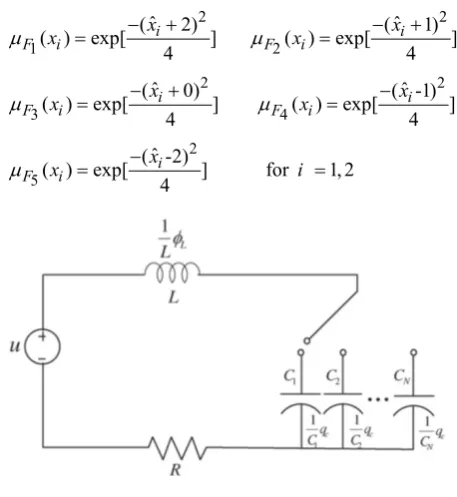
In this section, a series of simulation results of a switched RLC circuit [15] as depicted in Fig. 1, described by1 2 1, (t) 1 1, (t)
2 (t) 2, (t) 2, (t) 1
( ) ( , )
( (t)) ( ) ( , )
x x f x d t
x sat u f d t
y x
σ σ
σ σ σ
= + +
= + +
=
x
x x
(60)
where the nonlinear functions f1, (t) 1σ ( ) 0x = ,
2, (t) 1 2
(t) 1
( ) R
f x x
C L
σ
σ
= − −
x , and for each k, k = 1, . . . ,N,
(t)
Cσ denotes the k-th capacitor, x= [qc, ]ϕLT denotes the charge in the capacitor and the flux in the inductance, respectively, and sat(uσ(t)(t)) denotes the voltage. In the simulation, parameters of the RLC circuit are
1 2, 5, 1, 22
C = C = L = R= The disturbances are assumed to be d1, (t)σ ( , ) 0.1xt = ×x1(t) cos(t)× and
2, (t)( , )
d σ xt = 0.1×x2(t) cos(t)× for (t) = 1, 2σ .
In the implementation, five fuzzy sets are defined over interval [-2, 2] for x and x1 2 with labels F F F F1, , , , 2 3 4
5
and F and their membership functions are
2 2
1 2
ˆ ˆ
( 2) ( 1)
( ) exp[ ] ( ) exp[ ]
4 4
i i
F xi x F xi x
µ = − + µ = − +
2 2
3 4
ˆ ˆ
( 0) ( -1)
( ) exp[ ] ( ) exp[ ]
4 4
i i
F xi x F xi x
µ = − + µ = −
2 5
ˆ ( -2)
( ) exp[ ] for 1,2 4
i
F xi x i
µ = − =
Figure 1. The mass-spring-damper system
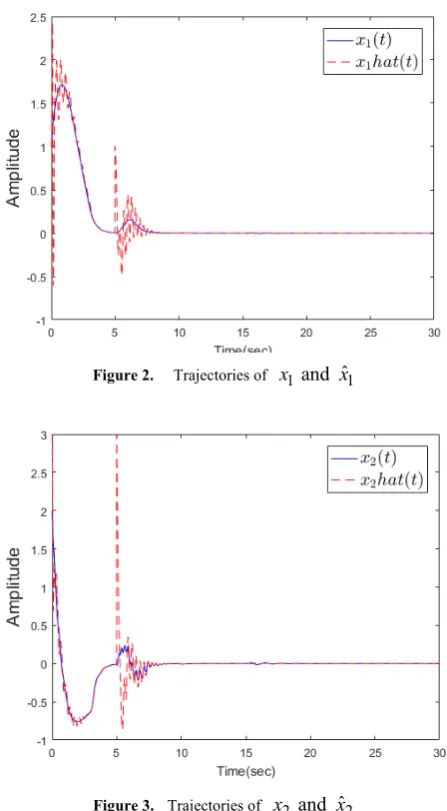
In this section, we apply the adaptive fuzzy robust observer-based sliding mode control approach in Section 3 to deal with the control problem. First, we select the observer gain as l1,1=2, 1, 4, 12l2,1= l1,2 = l2,2 = . The sample time is 0.01s. The sliding surfaces are selected as
1, 1ˆ ˆ2 =
k k
S c x x+ when k = 1, S c x x c1 1,1 1= ˆ +ˆ2 1,1, 2 = and when k = 2, S c x x c2 1,2 1= ˆ +ˆ2 1,2, 1 = . The initial values are chosen as
1,1 2,1 1,2 2,2
1,1 2,1 1,2 2,2
,1 ,2
1 1
,1 ,1
1 2
(0) 1, (0) 2, (0) 2, (0) 2, ˆ (0) 1, (0) 3, (0) 2.5, (0) 3,ˆ ˆ ˆ
(0) (0) [ 0.2,0.1, 0.2,0.3, 0.1],
(0) (0) [ 0.55, 0.55, 0.55, 0.55, 0.55], ˆ (0) 0, (ˆ
h h
f h
x x x x
x x x x
ω ω
= = = =
= = = =
= = − − −
= = − − − − −
=
θ θ
θ θ
f f
ˆ 0) 0, (0) 0= h =
The other parameters are selected as K =K =10, 1 2 γf,1= 1000, γωf,1=0.5, 10, 10, 0.5, γωh,1= γf,2 = γωf,2=
,2
h
ω
Figure 2. Trajectories of x1 and xˆ1
Figure 3. Trajectories of x2 and xˆ2
Figure 4. The estimation error of x1 and xˆ1
Figure 5. The estimation error of x2 and xˆ2
Figure 6. Phase plane plot of the system states x1 and x2
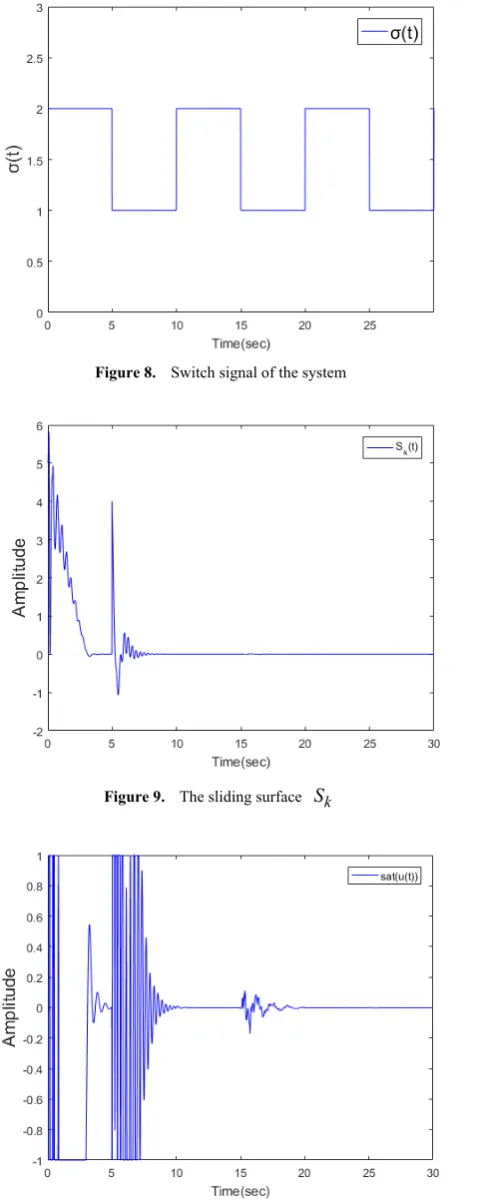
Figure 8. Switch signal of the system
Figure 9. The sliding surface Sk
Figure 10. Control signal with input saturation
Figure 11. Original control signal
5. Conclusions
An adaptive fuzzy observer-based sliding mode control approach has been proposed for a class of switched uncertain nonlinear systems with input saturation in strict-feedback form. A fuzzy state observer has been designed for estimating the unmeasured states with the help of FLS approximating the unknown functions. Based on the designed sliding mode controller, it can ensure the boundedness of the proposed sliding surfaces, which realizes the stability of system. By choosing an appropriate Lyapunov function, the proposed controller is designed to demonstrate that all the signals in the closed-loop system can not only guarantee uniformly ultimately bounded, but also achieve good performance. Finally, some computer simulation results of a practical example are illustrated to show the performance of the proposed control approach.
REFERENCES
[1] Y. Li and S. Tong, "Adaptive Fuzzy Output-Feedback Stabilization Control for a Class of Switched Nonstrict-Feedback Nonlinear Systems," IEEE Transactions on Cybernetics, vol. 47, no. 4, pp. 1007-1016, April 2017. [2] S. Yin, H. Yu, R. Shahnazi and A. Haghani, "Fuzzy Adaptive
Tracking Control of Constrained Nonlinear Switched Stochastic Pure-Feedback Systems," IEEE Transactions on Cybernetics, vol. 47, no. 3, pp. 579-588, March 2017. [3] S. Tong and Y. Li, "Adaptive Fuzzy Output Feedback
Control for Switched Nonlinear Systems With Unmodeled Dynamics," IEEE Transactions on Cybernetics, vol. 47, no. 2, pp. 295-305, Feb. 2017.
[5] Q. Zhou, L. Wang, C. Wu, H. Li and H. Du, "Adaptive Fuzzy Control for Nonstrict-Feedback Systems With Input Saturation and Output Constraint," IEEE Transactions on Systems, Man, and Cybernetics: Systems, vol. 47, no. 1, pp. 1-12, Jan. 2017.
[6] Y. Li, S. Tong and T. Li, "Composite Adaptive Fuzzy Output Feedback Control Design for Uncertain Nonlinear Strict-Feedback Systems With Input Saturation," IEEE Transactions on Cybernetics, vol. 45, no. 10, pp. 2299-2308, Oct. 2015.
[7] Z. Zhu, Y. Xia and M. Fu, "Adaptive Sliding Mode Control for Attitude Stabilization With Actuator Saturation," IEEE Transactions on Industrial Electronics, vol. 58, no. 10, pp. 4898-4907, Oct. 2011.
[8] T. R. Oliveira, J. P. V. S. Cunha and L. Hsu, "Adaptive sliding mode control for disturbances with unknown bounds," 2016 14th International Workshop on Variable Structure Systems (VSS), Nanjing, pp. 59-64, 2016.
[9] X. Zhang, W. Chen and B. Shen, "Direct adaptive fuzzy sliding mode control for a class of non-affine discrete nonlinear systems," 2015 12th International Conference on Fuzzy Systems and Knowledge Discovery (FSKD), Zhangjiajie, pp. 324-329, 2015.
[10] X. Zhao, H. Yang, W. Xia and X. Wang, "Adaptive Fuzzy Hierarchical Sliding-Mode Control for a Class of MIMO Nonlinear Time-Delay Systems With Input Saturation," IEEE Transactions on Fuzzy Systems, vol. 25, no. 5, pp. 1062-1077, Oct. 2017.
[11] H. Shen, F. Li, H. Yan, H. R. Karimi, and H.-K. Lam, “Finite-time eventtriggered H∞ control for T–S fuzzy
Markov jump systems," IEEE Transactions on Fuzzy Systems, to be published, doi: 10.1109/TFUZZ.2017.2788891, Jan. 2018.
[12] X. Xie, D. Yue, J. H. Park and H. Li, "Relaxed Fuzzy Observer Design of Discrete-Time Nonlinear Systems via Two Effective Technical Measures," IEEE Transactions on Fuzzy Systems,to be published,
doi: 10.1109/TFUZZ.2018.2791983, Jan. 2018.
[13] L. X. Wang, A course in fuzzy systems and control, Englewood Cliffs, NJ:Prentice-Hall, 1997.
[14] C. C. Kung and T. H. Chen, “Observer-based indirect adaptive fuzzy integral sliding mode control with state variable filters,” Fuzzy Sets and Syst., vol. 155, no.2, pp. 292–308, 2005.
[15] L. Long and J. Zhao, "Adaptive fuzzy output-feedback control for switched uncertain non-linear systems," IET Control Theory & Applications, vol. 10, no. 7, pp. 752-761, 2016.
[16] Chiang Cheng Chiang, "Observer-Based Robust Adaptive Fuzzy Control for MIMO Nonlinear Uncertain Systems with Delayed Output," Mathematical Problems in Engineering, vol. 2013, Article ID 215201, 12 pages, 2013. doi:10.1155/2013/215201.