Volume 6, Number 2, pp. 59–70. http://www.scpe.org c 2005 SWPS
TOLERATING STOP FAILURES IN DISTRIBUTED MAPLE
K ´AROLY B ´OSA† AND WOLFGANG SCHREINER†
Abstract. In previous work we have introduced some fault tolerance mechanisms to the parallel computer algebra system Distributed Maple such that a session may tolerate the failure of computing nodes and of connections between nodes without overall failure. In this paper, we extend this fault tolerance by some advanced mechanisms. The first one is the reconnection of a node after a connection failure such that a session does not deadlock. The second mechanism is the restarting of a node after a failure such that the session does not fail. The third mechanism is the change of the root node such that a session may tolerate also the failure of the root without overall failure.
Key words. distributed systems, fault tolerance, computer algebra.
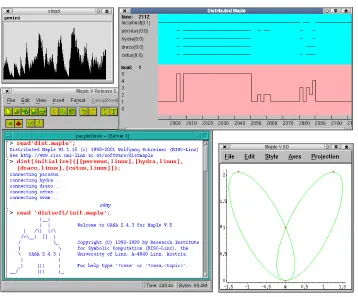
1. Introduction. Distributed Maple (see Figure 1.1) is a Java-based system for implementing parallel
programs in the computer algebra system Maple [26]. We have employed this system successfully for the parallelization of various methods and applications in algebraic geometry [28, 29]. The system is portable and has been used in numerous parallel and networked environments, e.g. clusters of Linux PCs and Unix workstations, a Sun HPC 6500 bus-based shared memory machine, an Origin 2000 NUMA multiprocessor, and heterogeneous combinations of these. Recently we have analyzed the system performance in these environments in large detail [27].
We have used the system to develop the parallel versions for various non-trivial applications from computer algebra and algebraic geometry, e.g. bivariate resultant computation, real root isolation, plotting of algebraic plane curves, plotting of surface to surface intersections and neighborhood analysis of algebraic curves. A com-prehensive survey on the system and its applications is given in [31].
Distributed Maple has evolved from our own experience in the development of parallel computer algebra environments and from learning from the work of other researchers. The programming interface of the sys-tem is based on a para-functional model as adopted by the PARSAC-2 syssys-tem [16] for computer algebra on a shared memory multiprocessor. The model was refined in PACLIB [11] on which a para-functional language was based [25].
The only mechanism originally available in Distributed Maple for dealing with faults was the watchdog mechanism for shutting down the system in case of failures. However, as we began to attack larger and larger problems, the meantime between session failures (less than a day) became a limiting factor in the applicability of the system.
There are numerous possibilities for faults that may cause a session failure: a machine becomes unreachable (usually a transient fault, i.e., the machine is rebooted or is temporarily disconnected), a process in the scheduling layer or in the computation layer crashes (a bug in the implementation of the Java Virtual Machine, of the Java Development Kit, of Maple, or of Distributed Maple itself) or the computation itself aborts unexpectedly (a bug in the application). While the last issue can be overcome and the Distributed Maple software itself is very stable, there certainly exist bugs in the lower software levels that are out of our control; machine/network/operating system faults may happen in any case.
We have therefore started to investigate how to introduce fault tolerance mechanisms that let the system deal with faults in such a way that the time spent in long running session is not wasted by an eventual failure. There exist various fundamental mechanisms to achieve fault tolerance in distributed systems [5, 13]:
(i) Byreplication we understand the duplication of resources or services on multiple servers such that, if a server fails, a request is handled by another one; because parallel programming systems are concerned about optimal use of resources, only few systems apply this approach [1, 2].
(ii) Most frequently, parallel programming environments pursue fault tolerance by checkpointing: they regularly save global snapshots of the session state on stable storage such that a failed session can be re-started from the last saved state (potentially migrating tasks to other machines); stable storage can be implemented by disks or by replicated copies in the memories of multiple machines [22, 24]. Some systems perform checkpointing
†Research Institute for Symbolic Computation (RISC-Linz), Johannes Kepler University, Linz, Austria,
Fig. 1.1.The User Interface of Distributed Maple
transparently to the application, often on top of PVM [7, 6, 10, 17, 15] or MPI [23]. Other systems rely on application support for checkpointing [4, 21].
(iii) Many metacomputing and message passing frameworks do not provide built-in fault tolerance at all. Rather they include failure detection and handling services that enable the user to deal with failures at the application-level. Examples of such systems are the Globus toolkit [32], the Harness environment [18], PVM [9] or FT-MPI [8].
All these approaches are relatively complex because they have to deal with general parallel computations; for special problems much simpler solutions exist [12]. However, also parallel programming models that are more abstract than message passing should allow to deal with fault tolerance in a simpler way. While this is not yet completely true for the coordination language Linda [3], the functional programming model provides this potential to a large degree [14].
All of the possibly fault cases mentioned above can be classified into the following failure types: Message
failures, Stop failures or Byzantine failures [19]. We do not deal with tolerating of Message failures and
Byzantine failures (our system currently is not able to handle corrupt messages and corrupt task executions), but in the functional parallel programming model, the handling of these two kinds of failure situations may happen similarly as in the message passing or any other general parallel programming model (there are no simpler solutions for these in the functional model). Furthermore, there exist already numerous general and effective algorithms for tolerating of these kinds of failures [19].
We focus on Stop failures and we assume in this paper that only such failures may occur (a part of the system can exhibitStopfailure simply by stopping somewhere in the middle of its execution). In more detail, we deal with the following error situations: the root of the tree of computation nodes crashes, some non-root node crashes, some Maple process fails, a connection between the root and another node breaks and a connection between two non-root nodes breaks. We say that a node crashes if the machine stops execution or reboots, or if the Distributed Maple process aborts.
a.) b.) user interface
root n
n’ n’’
2b) request<t,n’’> 2c) reply<t,r>
2d) result<t,r> ...
dist.maple
dist.Scheduler Maple user interface
dist.Scheduler
Maple dist.maple dist.Scheduler
Maple dist.maple
1c) task<t,d> 1b) task<t,d>
1d) result<t,r> 1e) result<t,r> 1a) task<t,d>
2a) wait<t>
Fig. 2.1.a.) System Modelb.) Execution Model
time scale of distributed computations (measured in hours at the moment) to many days as is required for realistic applications. Another requirement was that the implemented fault tolerance has to betransparent to the application.
Earlier, we introduced three fault tolerance mechanisms, by which some of the mentioned Stop failure problems were covered. The functional task model of Distributed Maple considerably simplified these develop-ments [30].
Now, we have extended these mechanisms to cover moreStop failures: first, a session may tolerate node failures (except root failure) and connection failures without loss of resources (e.g.: computed task results, Maple kernels or schedulers); second, we have introduced a mechanism to avoid a session failure, even if the root becomes unreachable for most of the non-root nodes. With these mechanisms, Distributed Maple is by far the most advanced system for computer algebra concerning reliability in distributed environments.
The remainder of this paper is organized as follows: Section 2 introduces the model of the system and its operation. Section 3 gives a short overview about the previously achieved fault tolerance mechanisms on which the following descriptions are based. Section 4 explains the reconnection and restarting mechanisms that we have introduced to reduce the loss of resources after node or connection failures. Section 5 extends this by a mechanism that allows the system to cope with root node failure without overall failure. Section 6 compares the fault tolerance features of Distributed Maple with a checkpointing mechanism developed for a particular parallel programming environment. Section 7 summarizes our results and outlines further development directions.
2. System and Execution Model. A Distributed Maple session comprises a set of nodes (machines,
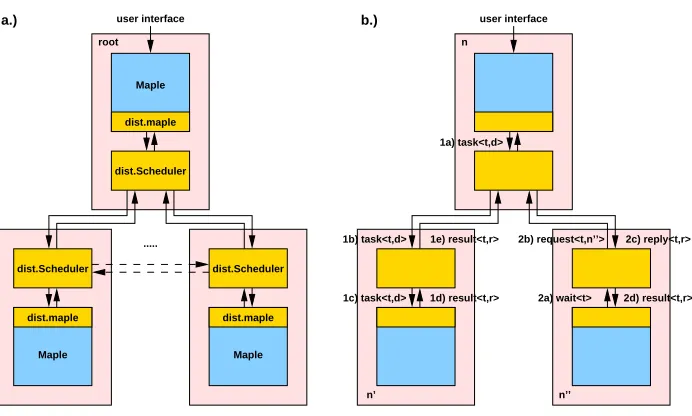
processors) each of which holds a pair of processes: a (e.g. Maple)kernelwhich performs the actual computation, and ascheduler (a Java Virtual Machine executing a Java program) which distributes and coordinates the tasks created by all kernels (see Figure 2.1a). The scheduler communicates, via pairs of sockets, with the kernel on the same node and, via sockets, with the schedulers on the other nodes. The communication protocol between the scheduler and the kernel is implemented bydist.maple interface. Theroot is that node from which the session was established by user interaction with the kernel. Initially, a single task is executing on the root kernel; this task may subsequently create new tasks which are distributed via the schedulers to other kernels and may in turn create new tasks.
The parallel programming model is basically functional (see Figure 2.1b): from the perspective of a sched-uler, a kernel may emit a number of messages task:<t, d> where t identifies the task and d describes it. The task needs to be forwarded to some idle kernel which eventually returns a message result:<t, r>
a.) b.)
Storage System
user interface
1) task<t,d> 2) task<t,d> 3) <t,d>
...
4) task<t,d> 9) <t,r>
5) task<t,d> 6) result<t,r>
7) result<t,r> 8) store<t,r>
Storage System
user interface
1) task<t,d> 2) task<t,d>
... 4) result<t,r>
5) result<t,r> 3) <r>
Fig. 3.1.a.) Logging a Resultb.) Restoring a Result
the result waited for or yet another task. A task identifier t encodes a pair <n, i> where n identifies the node on which the task was created and i is an index. The node n thus serves as the rendezvous point between node n’ computing the result of t and node n” requesting this result. When the sched-uler on n receives a task:<t, d> from its kernel, it thus allocates a result descriptor that will eventu-ally hold the result r; the task itself is scheduled for execution on some node n’. When a kernel on some node n” issues a wait:<t>, the scheduler on n” forwards a request:<t, n”> to n. If r is not yet avail-able on n, this request is queued in the result descriptor. When the kernel on n’ eventually returns the result:<t, r>, the scheduler onn’ forwards this message ton, which constructs areply:<t, r>and sends it ton”.
3. Formerly Achieved Fault Tolerance. The only mechanism originally available in Distributed Maple
for handling faults was a watchdog mechanism on every non-root node that regularly checked whether a message had been recently received from the root. If not, it sent apingmessage that had to be acknowledged. If no acknowledgement arrived from the root within a certain time bound, the node shut itself down.
We have extended this basic operation by three fault tolerance mechanisms. For the correct working of these mechanisms, we assume that the system has access to a reliable and stable storage system which never loses data. Communication is reliable, i.e. messages are never corrupted or duplicated (no Message failures) and they may be lost only inStopfailure situations. NoByzantine failures may occur.
Logging Results The logging mechanism can store a consistent state of a session and is able to recover this
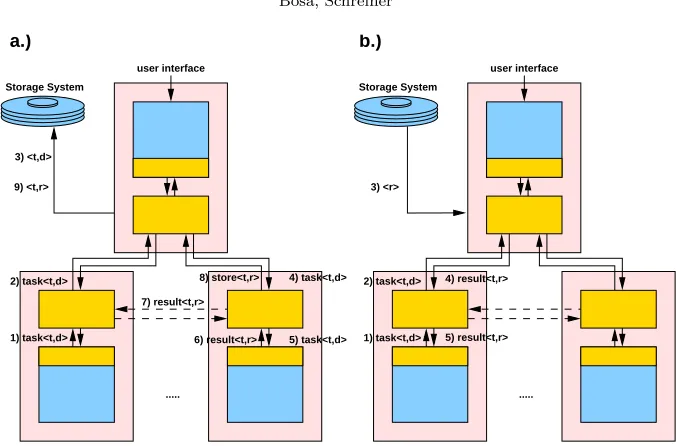
stored state after a failure [30]. This mechanism is based on the scheduling mechanism originally available in Distributed Maple, which allows the root to receive all task descriptions created by all nodes (see Figure 3.1a). Before the root schedules a task:<t, d>, it savesd. When a node sends a result:<t ,r>to some other node different from the root, it forwards a copy in astore:<t, r>to the root which saves it. When a session is restarted after a failure (see Figure 3.1b), the root may receive a task:<t’, d>. Ifd is already stored, the root checks whether there exists storedr for the received
d and it tries to restore thisr. The mechanism is able to recognize the corrupted files and it uses only the properly stored data in the recovery phase.
Tolerating Peer Connection Failures The connection between two non-root nodes is called peer connec-tion. Such connections are established on demand during the execuconnec-tion. The system is capable to cope with peer connection failures without overall failure. This mechanism is based on ”Tolerating Node Failures” mechanism, because it assumes that the system is able to continue normal operation, if a connection between root and another node fails. The principle is simple: if a non-root node cannot send a message to another such node, it sends this message to the root which forwards it to the final destination.
The effect of these mechanisms on the performance of the system has not been measured yet, but we do not expect it to be significant. For instance in the case of the ”Logging Results” mechanism, task descriptions and task results are saved by separate threads and thus do not hamper the normal flow of operation. These descriptions and results are also communicated in the basic operation model; their size is therefore bound by the performance of the communication system rather than by the extra overhead of the saving mechanism. Additionally, the ”Logging Results” mechanism introduces only one extra message type, the store:<t, r>
message, for saving of the task results to the storage system (task descriptions are saved when tasks are scheduled).
The overhead of the ”Tolerating Node Failure” and the ”Tolerating Peer Connection Failure” mechanisms is also not significant, because these mechanisms maintain only one small extra data structure on the root node and another one on each non-root node. They do not use additional messages during the normal operation.
4. Reducing the Loss of Resources afterStop Failures. In this section, we describe two quite simple
extensions of our basic fault tolerance mechanisms by which the system is able to reduce the loss of resources after some kind ofStop failures.
4.1. Reconnection after Connection Failure. We have extended the basic fault tolerance mechanisms
described in the previous section such that the root tries to recreate the connection to a disconnected node before it starts the migration of tasks in the ”Tolerating Node Failures” mechanism.
If a nodei observes that the root has become unreachable, it waits for a connection request from the root for a limited time period. If the request does not arrive, i shuts itself down. When a root observes node i
becomes unreachable, it tries to reconnect toi in the same way in which a node creates a peer connection to another node during normal execution. If it does not get back any reply, then it starts the ”Tolerating Node Failures” mechanism. Ifireceives a connection request from the root, it sends back a positive acknowledgement (independently whether it has already observed the connection failure or not). When the root gets this request, it informs all other nodes about the connection failure and the successful reconnection toi.
There is a main problem that all nodes (root and all others) now have to deal with: the management of those messages that were sent and might be lost. For solving this, the root can resend some task, result and wait messages to nodei, nodei can resend some task, result, store and wait messages to the root or some other nodes, and all other nodes can resend some result and wait messages via the root to nodei.
For resending the corresponding wait messages, every node can use a setWj which is used and maintained in Distributed Maple. Wj contains all wait messages sent toj; for a subsetWjr the answers with results have already arrived fromj. Afterj reconnected, each wait message inWj−Wjr has to be sent again.
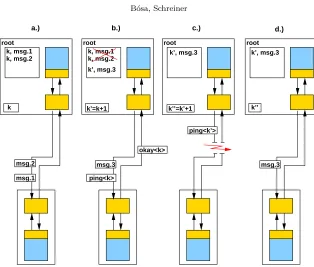
For resending the corresponding task, result, and store messages, every node maintains another set Mj, which contains all task, result and store messages sent to j (see Figure 4.1a). On the root, this set contains also those result messages which were sent by any other node toj through the root. For a subsetMa
j, acknowl-edgements have already arrived fromj (see Figure 4.1b). For acknowledging these messages, the system uses the modified ping message and its acknowledgement. Namely, if the number of non-acknowledged messages reaches a certain bound in Mj, a ping:<k> message is sent and the set Mj,k becomes Mj −Mja where k uniquely identifies thisping:<k>message (such a message is also sent in the original case, see Section 3). If an acknowledgement arrives with indexk, every element ofMj,kis added toMja. Afterj has been reconnected, each message inMj−Mja has to be sent again (see Figure 4.1c and d).
It may occur that some message arrives twice. This is not a problem, because the system tolerates redundant messages.
4.2. Restarting after Node Failure. We have implemented a quite simple extension of the ”Tolerating
root
k, k,
msg.1 msg.2 k,
k, msg.1 msg.2
k
msg.2
msg.1
root
k’=k+1
ping<k>
okay<k> root
k’’=k’+1
ping<k’> k’, msg.3
k’, msg.3
b.)
a.) c.) d.)
root k’, msg.3
k’’
msg.3 msg.3
Fig. 4.1. The resending method: a.) Sent messages are stored in a table.b.) If the acknowledgement message has arrived for the pingmessage, the corresponding messages are removed from the table. c.) The connection fails. The acknowledgement message for the ping does not arrive within a certain time bound.d.)After the reconnection, the messages in the table are resent.
gets a new identifier instead ofi, because all the results that have been stored on i earlier are provided by the root during the rest of the execution. The targets of the wait messages have to be determined uniquely from the node identifier contained in the task identifier.
By changing the identifier of the restarted node, we can guarantee that all other nodes interact to the newly started node. Namely, if nodei did not fail, just disconnected to the root, it may send some messages to some other nodes. But in this case, these nodes simply drop these messages (becauseiis declared dead by “Tolerating Node Failures” mechanism).i eventually aborts.
5. Tolerating Root Failure. This mechanism is based on all already mentioned fault tolerance
mecha-nisms (Logging Results, Tolerating Node Failure, Tolerating Peer Connection Failures and Reconnection after Connection Failure) except ”Restarting after Node Failure”. Therefore, the same assumptions are made as were described for the previous mechanisms: a reliable and stable storage system, reliable communication, no
Byzantine failures. There are two more important assumptions. First, the storage system is independent from the root and at least one non-root node has access to it. Second, the description of the main task which is performed by the root kernel is initially stored by this storage system.
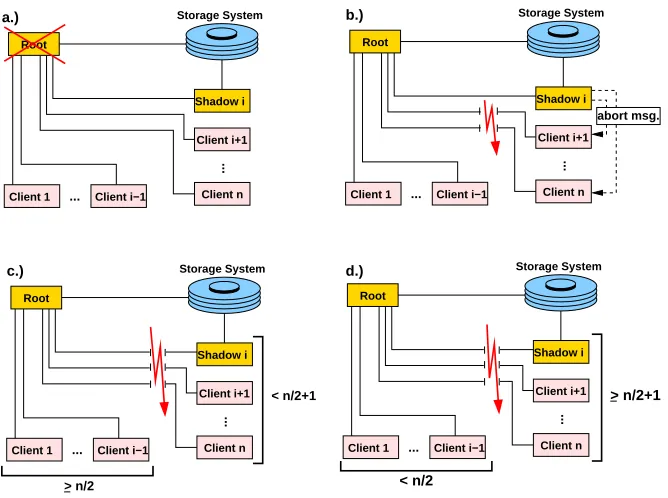
At no time during the execution of the system, there may exist more than one root. If the root becomes unreachable to another node, this means either the root crashed (see Figure 5.1a) or the connection between the root and the node broke (see Figure 5.1b, c and d). In the second case, the system has to be able to decide about the election of a new root. To guarantee this, the current root always has to be connected ton/2 nodes at least (see Figure 5.1c); a non-root node may become the root if and only if at leastn/2 non-root nodes (beyond itself) accept it as the root (see Figure 5.1d), wheren is the initial number of the non-root nodes.
It is possible to use the ”Restarting after Node Failure” mechanism together with this mechanism, but the additional restriction is needed: an unreachable node may be restarted if and only if the root has declared it dead (see Section 3) and more than n/2 nodes have acknowledged this declaration (the ”Tolerating Node Failures” mechanism warrants that every message from a dead node is dropped).
Root
Storage System
Shadow i
Client 1 ... Client i−1 Client n
Client i+1
...
Root
Storage System
Shadow i
Client 1 ... Client i−1 Client n
Client i+1
...
< n/2+1
< n/2
Root
Storage System
Shadow i
Client 1 ... Client i−1 Client n
Client i+1
...
Root
Storage System
Shadow i
Client 1 ... Client i−1 Client n
Client i+1
...
a.)
c.)
b.)
d.)
abort msg.
> n/2+1
> n/2
Fig. 5.1.a.) The root crashes.b.) The connections between the root and some non-shadow nodes break.c.) The network is split. The root is connected to at least n/2 pieces of non-root nodes.d.)The network is split. The shadow node is connected to at least n/2 pieces of non-root nodes.
5.1. Triggering the Root Election. If the root becomes unreachable to a non-shadow nodek and the
reconnection time expires,k sends a root lostmessage directly to the shadow node i. If nodei has become also unreachable,k aborts. Shadowi maintains a set Rof the identifiers of all nodes that cannot contact the root. Wheni receives theroot lostmessage fromk, it addsk toR. From the moment that the first node is added toR,i waits for a certain period of time. If during this period, no message arrives from the root,i starts the root election. However, if during this time a message from the root arrives (i.e. the root is not unreachable toi), the election is canceled (see Figure 5.1b). In this case,i waits until the root declaresk dead (which must eventually happen sincek cannot contact the root), and then it sends anabortmessage tok (which causesk
to abort, but the root will eventually restartk). Summarizing, root election is only started in the situations illustrated in Figure 5.1a, c and d.
5.2. Performing the Root Election. Shadow node i broadcasts a check root message to all live
nodes except those whose identifiers are in R. When a node l receives such a message, it sends back an acknowledgementmessage. Nodel also checks the root within a certain time bound. If the root is reachable tol, thenl sends back aroot connectedmessage to the shadow nodei. Otherwise, it sends back aroot lost message toi. Nodei waits for the acknowledgementmessages of thecheck rootbroadcast for a limited time period and counts them. If this sum plus the size of R is less than n/2 where n is the initial number of the non-root nodes, i aborts (see Figure 5.1c). Otherwise, it waits further for root lost and root connected messages and counts them, too. If it receives a root lostmessage, it adds the identifier of the sender to R
(if i observes that a node whose identifier is in R became unreachable,i deletes the corresponding identifier fromR). If the number of root lostmessages reaches the boundn/2,isends anew rootmessage to all other nodes. If this bound has not been reached, but aroot lostor aroot connectedmessage has been received from each acknowledged node that is reachable toi,i aborts.
Each node that has received thenew root message acceptsi as the new root even if the old root is still reachable to it. Summarizing, the shadow nodei becomes the new root only in cases represented in Figure 5.1a and d.
acknowledgementskwaits for and count them in aborts
kSTOP
aborts
kSTOP
R
for a limited time period new_root message from shadow waits for k sends root_connected check_root message to message to each
node that sent
k k Is new_root message arrived? aborts kSTOP
waits for root_lost k
in sum messages for a and root_connected
limited time period and counts them
root_lost messages are added to R Ids of senders of ack_sum
sum ==
root from the shadow_roots shadow := the next shadow
R >= n/2
new_root message to all connected
nodes k broadcasts
STOP k is the new
root aborts kSTOP unreachable to node k) START (root became
root from the shadow_roots shadow :=
the first shadow shadow == null shadow == k
check_root message
except those whoseto all nodes
broadcasts k yes no no yes yes no
ids are in R
Is reachable shadow to k? ack_sum + ack_sum < n / 2
sends root_lost k shadow message to STOP shadow new root is the yes no to Is shadow reachable k? no yes no yes no yes yes no
Fig. 5.2.The generalized root election method on node kwhere nis the initial number of the non root nodes.Ris a set which consists of the identifiers of those nodes that sent root lost message tok. |R|signs the size of R.
5.3. Initialization of the New Root. After the shadow root has become the root, it loads the main
task from the storage system and schedules it to its own kernel. Then it declares the old root and those nodes dead which did not acknowledge the receipt of the check root message (when the connected nodes receive this declaration, they resend those wait messages to the new root which might be lost, see Section 3). After a node has accepted anew root message, it resends all store and task messages to the new root which are not acknowledged by the old root (task messages are acknowledged by the root if and only if they have already been logged). It also sends the identifiers of those tasks in ascheduled tasks:<task identifiers>message to the new root which are under processing on this node. The new root keeps these pieces of information in the
scheduled tasks table as tuples of a node identifier and a task identifier (this table is the same which are already used by the root in the “Tolerating Node Failures” mechanism in Section 3).
5.4. Task Handling and Termination. If the new root receives a task:<t, d>message, the logging
mechanism tries to restore the result of the task from d. If it does not manage, it checks whether d may be already logged with a different identifier t’. If yes, it checks whether t’ occurs in the scheduled tasks table. Ift’ occurs in this table, the new root drops this message, because it is already under processing somewhere. Otherwise, it schedules this task to a node.
computing phase if the system fails during the
if the system fails during the check− pointing phase method the saving
in case of node failure
it is able to continue execution by the migration of the tasks (also if the root fails) previous checkpoint
only from the it can be restarted it can be restarted from the last checkpoint
a computing phase is
a checkpointing phase periodically interrupted by it is targeted to general parallel applications
P−GRADE checkpointing
centralized
transparency applicability architecture
transparent centralized
transparent
continuous
fault tolerance in Distributed Maple
recognize the corruption of
properly stored datum in a later session
it is able to
a file; thus it may reuse each
it is able to continue execution from the last checkpoint (except if the server fails)
it is restricted to parallel
on functional tasks programming models based
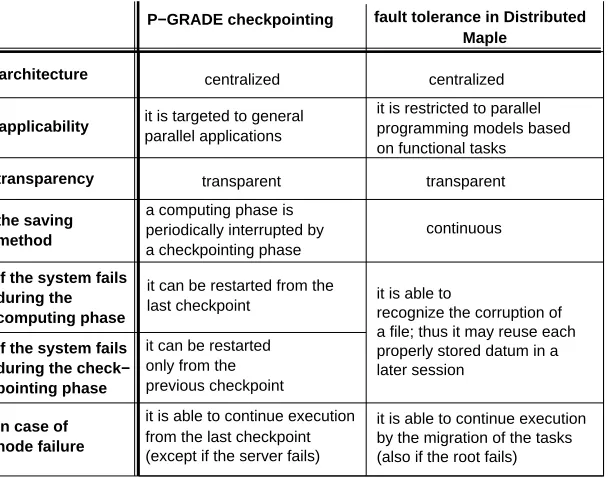
Fig. 6.1. Comparison of Fault Tolerance in Distributed Maple and P-GRADE Checkpointing
stored task results becomes equal to the number of stored task descriptors, the system terminates (the “Logging Results” mechanism warrants that the descriptor of a task is always stored before its own result and the result of its parent task). In a later session, the system is able to recover the result of the whole computation by the “Logging Results” mechanism.
5.5. Generalization of the Root Election. Above description uses only one shadow node. Now, we
generalize the mechanism such that we use a list of the shadow nodes. This list is calledshadow roots; all nodes receive it at the initialization of the session.
If the root is unreachable to a nodekand the reconnection time expires but the first node in theshadow roots
has become also unreachable,k sends aroot lostmessage to the first live node in this list (see Figure 5.2). If such a node does not exist,k aborts. Ifk has already sent aroot lostmessage to a node and somecheck root messages arrive from some other nodes, it replies with aroot connected messages. If k is the next shadow root, it broadcasts acheck root message as described in the previous section.
Finally, the number of the elements ofRon each shadow root decides the result of the root election. In the worst case, neither shadow node becomes the root and the whole system aborts.
6. Comparison with a Particular Checkpointing Mechanism. In order to put our work in context,
we are now going to compare the fault tolerance features of Distributed Maple with those of systems based on checkpointing mechanisms. As a concrete example, we take the P-GRADE environment into which such a mechanism has been recently integrated [15] (see Figure 6.1). P-GRADE is a parallel programming environment which supports the whole life-cycle of parallel program development [20]. A P-GRADE application is always centralized, where a server coordinates the start-up phase and the execution. The primary goal of the P-GRADE checkpointing mechanism was to make P-GRADE generated applications able to migrate among nodes within a cluster. Its secondary goal was to make periodic checkpoint for supporting fault tolerance.
system continues the normal operation
system continues the normal operation
system continues the normal operation
system continues the normal operation
the root and all shadow root nodes crash within a certain time bound less than half or half of non−root nodes crash within a certain time bound
deadlock
using fault tolerance
deadlock system aborts
deadlock
system aborts
deadlock deadlock
node
Stop failures
the root node crashes
system aborts without fault tolerance
between the root and non−root
crashes a
more than half of non−root nodes crash within a certain time bound
one or more connections
non−root nodes break one or more connections between non−root
one or more Maple processes fail nodes break
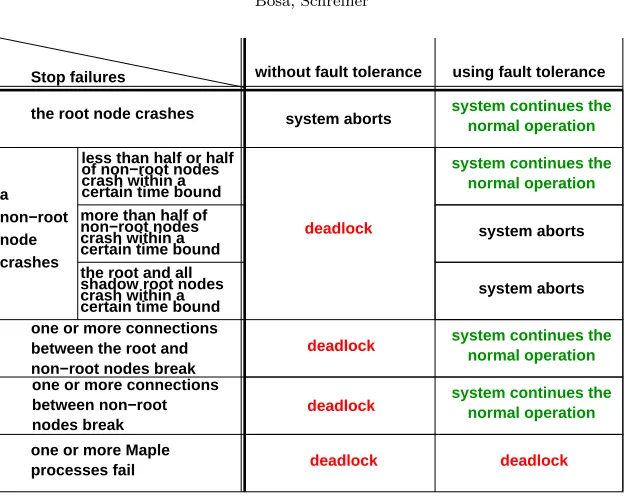
Fig. 7.1.Assessment of Distributed Maple Fault Tolerance
P-GRADE makes a checkpoint if and only if an external tool asks the server for the saving of a checkpoint. If the system fails during the computing phase, it can be restarted from the last checkpoint. If the system fails during the checkpointing phase, it cannot use any already saved information of this checkpoint and it can be restarted only from a previous checkpoint. The “Logging Results” mechanism saves every task descriptor and task result into separate files and it is able to recognize the corruption of a file; thus it may reuse each properly stored datum in a later session.
If a node fails (except for the server), the P-GRADE is able to recognize this and to continue execution automatically from the last checkpoint. In such a case, Distributed Maple is simply able to continue execution by the migration of the corresponding tasks (also if the root node fails). Distributed Maple regularly checks whether a failed node has rebooted again and in this case restarts the corresponding node process.
Summarizing, the most important advantage of the P-GRADE checkpointing mechanism is that it is made for general parallel applications. But its fault tolerance features are limited in that the main purpose was the dynamic migration of the processes among the node. The main disadvantage of the fault tolerant mechanisms in Distributed Maple that they are special mechanisms and they cannot be used for any parallel computing model. The advantages of our mechanisms are the following: the saving method is continuous; if the system fails in any time, the next session is able to use all properly saved intermediate task results; if any node or connection fails during the execution, the system is able to tolerate it and continue the normal operation without human intervention. Both systems are centralized, therefore the scalability of these systems is an open question.
7. Conclusion. We have implemented in Distributed Maple some fault tolerance mechanisms such that
we can guarantee the following: the system does not deadlock and continues normal operation, if any node crashes or some connection between any two nodes breaks; if the system fails after all, we can restart it and continue the computation from a saved state. The improvement of the system is demonstrated by Figure 7.1.
The system can still fail if more thann/2 non-root nodes fail, or if the root and all shadow nodes fail within a certain time bound (i.e., if there is not enough time for reconnection).
The system can also fail if neither the root nor one of the shadow nodes has connected at leastn/2 non-root nodes (this may happen if the network is split to more than two almost equal parts).
There remains only one kind of Stop failure situations which may let the system deadlock: if a kernel process fails. To solve this problem, we plan to introduce a new watching mechanism which scans the kernels and restarts them if necessary.
message passing programs. The runtime overhead imposed by the logging mechanism is very moderate; adding tolerance of node failures (in case of both root node and non-root node) on top does then not require much extra overhead.
In the testing phase of our fault tolerance mechanisms, we executed some long-running computations, whose solutions are required approximately 3 or 4 days. During these execution, we triggered several Stop
failure situations (both root and non-root failures) off. Our test experiences showed that the system is able to tolerate these kinds of failures and finish the computations.
One reason for this simplicity is the delegation of all logging activities to a single root node that also performs the task scheduling decisions; the model is therefore not scalable beyond a certain number of nodes. However, it is suitable for the system environments that we have used up to now (≤30 nodes); many parallel computer algebra applications do not scale well enough to profit from considerably more nodes.
Acknowledgments. Sponsored by Upper Austrian Government (Ph. D. scholarship) and SFB/FWF
project P1302.
REFERENCES
[1] David M. Arnow, DP: A Library for Building Portable, Reliable Distributed Applications. In 1995 USENIX Technical Conference, pages 235–247, New Orleans, Louisiana, January 16–20, 1995. USENIX.
[2] Ozalp Babaoglu, Lorenzo Alvisi, Alessandro Amoroso, Renzo Davoli, and Luigi Alberto Giachini¨ , Paralex: An
Environment for Parallel Programming in Distributed Systems. In1992 International Conference on Supercomputing, pages 187–187, Washington DC, July 19–24, 1992. ACM Press.
[3] David E. Bakken and Richard D. Schlichting,Supporting Fault-Tolerant Parallel Programming in Linda. IEEE Transac-tions on Parallel and Distributed Systems, 6(3):287–302, March 1995.
[4] Adam Beguelin, Erik Seligman, and Peter Stephan, Application Level Fault Tolerance in Heterogeneous Networks of Workstations.Journal of Parallel and Distributed Computing, 43(2):147–155, June 1997.
[5] Kenneth P. Birman,Building Secure and Reliable Network Applications. Manning, Greenwich, Connecticut, 1996
[6] Jeremy Casas, Dan Clark, Phil Galbiati, Ravi Konuru, Steve Otto, Robert Prouty, and Jonathan Walpole,
MIST: PVM with Transparent Migration and Checkpointing. InThird Annual PVM User’s Group Meeting, Pittsburgh, Pennsylvania, May 1995.
[7] A. Clematis and V. Gianuzzi, CPVM — Extending PVM for Consistent Checkpointing. In4th Euromicro Workshop on Parallel and Distributed Processing (PDP’96), pages 67-76, Braga, Portugal, January 24–26, 1996. IEEE CS Press. [8] G. E. Fagg and J. J. Dongarra,FT-MPI: Fault Tolerant MPI, Supporting Dynamic Applications in a Dynamic World. In
Recent Advances in Parallel Virtual Machine and Message Passing Interface, Proceedings of the 7th European PVM/MPI Users’ Group Meeting, volume 1908 ofLecture Notes in Computer Science, pages 346–353, Balatonf¨ured, Hungary, Septem-ber 10–13, 2000. Springer, Berlin.
[9] Al Geist, Adam Beguelin, Jack Dongarra, Weicheng Jiang, Robert Manchek and Vaidy Sunderam,PVM: Parallel Virtual Machine — A Users’ Guide and Tutorial For Networked Parallel Computing. MIT Press, Cambridge, Mas-sachusetts, 1994.
[10] V. Gianuzzi and F. Merani, Using PVM to Implement a Distributed Dependable Simulation System. In3rd Euromicro Workshop on Parallel and Distributed Processing (PDP’95), pages 529–535, San Remo, Italy, January 25–27, 1995. IEEE Computer Society Press.
[11] Hoon Homg, Andreas Neubacher, and Wolfgang Schreiner,The Design of the SACLIB/PACLIB Kernels.Journal of Symbolic Computation, 19:111–132, 1995.
[12] A. Iamnitchi and I. Foster,A Problem Specific Fault Tolerance Mechanism for Asynchronous, Distributed Systems. In29th International Conference on Parallel Processing (ICPP), Toronto, Canada, August 21–24, 2000. Ohio State University. [13] Pankaj Jalote,Fault-Tolerance in Distributed Systems. Prentice Hall, Englewood Cliffs, NJ, 1994.
[14] R. Jagannathan and E. A. Ashcroft,Fault Tolerance in Parallel Implementations of Functional Languages. In 21st Inter-national Symposium on Fault-Tolerant Computing, pages 256–263, Montreal, Canada, June 1991. IEEE CS Press. [15] J´ozsef Kov´acs, P´eter Kacsuk,Server Based Migration of Parallel Applications. In Distributed and Parallel Systems—
Cluster and Grid Computing, DAPSYS’2002, 4th Austrian Hungarian Workshop on Distributed and Parallel Systems, pages 30–37, Linz, Austria, September 29—October 02, 2002. Kluwer Academic Publishers,Boston.
[16] Wolfgang K¨uchlin, PARSAC-2: A Parallel SAC-2 based on Threads. In AAECC-8: 8th International Conference on Applied Algebra, Algebraic Algorithms, and Error-Correcting Codes, volume 50 of Lecture Notes in Computer Science, pages 341–353, Tokyo, Japan, August 1990. Springer, Berlin.
[17] Juan Leon, Allan L. Fisher, and Peter Alfons Steenkiste, Fail-safe PVM: a Portable Package for Distributed Pro-gramming with Transparent Recovery. Technical Report CMU-CS-93-124, School of Computer Science, Carnegie Mellon University, Pittsburgh, Pennsylvania, February 1993.
[18] M. Migliardi, V. Sunderam, A. Geist, and J. Dongarra,Dynamic Reconfiguration and Virtual Machine Management in the Harness Metacomputing System. InComputing in Object-Oriented Parallel Environments — Second International Symposium (ISCOPE 98), volume 1505 of Lecture Notes in Computer Science, pages 127–134, Santa Fe, New Mexico, December 8–11, 1998. Springer.
[21] Taesoon Park and Heon Y. Yeom,Application Controlled Checkpointing Coordination for Fault-Tolerant Distributed Com-puting Systems.Parallel Computing, 24(4):467–482, March 2000.
[22] James S. Plank, Youngbae Kim, and Jack Dongarra,Algorithm-Based Diskless Checkpointing for Fault Tolerant Ma-trix Operations. In25th International Symposium on Fault-Tolerant Computing, Pasadena, California, June 1995. IEEE Computer Society Press.
[23] Samuel H. Russ, Jonathan Robinson, Brian K. Flachs, and Bjorn Heckel,The Hector Distributed Run-Time Environ-ment.IEEE Transactions on Parallel and Distributed Systems, 9(11):1104–1112, November 1998.
[24] Fred B. Schneider, Implementing Fault-Tolerant Services Using State Machine Approach. ACM Computing Surveys, 22(4):299–319, December 1990.
[25] Wolfgang Schreiner,A Para-Functional Programming Interface for a Parallel Computer Algebra Package.Journal of Symbolic Computation, 21(4–6):593–614, 1996.
[26] Wolfgang Schreiner, Distributed Maple — User and Reference Manual. Technical Report 98–05, Research Institute for Symbolic Computation (RISC–Linz), Johannes Kepler University, Linz, Austria, May 1998. http://www.risc.uni-linz.ac.at/software/distmaple.
[27] Wolfgang Schreiner,Analyzing the Performance of Distributed Maple. Technical Report 00–32, Research Institute for Symbolic Computation (RISC–Linz), Johannes Kepler University, Linz, Austria, November 2000.
[28] Wolfgang Schreiner, Christian Mittermaier, and Franz Winkler,Analyzing Algebraic Curves by Cluster Computing. InDistributed and Parallel Systems—From Instruction Parallelism to Cluster Computing, DAPSYS’2000, 3rd Austrian Hungarian Workshop on Distributed and Parallel Systems, pages 175–184, Balatonf¨ured, Hungary, September 10–13, 2000. Kluwer Academic Publishers, Boston.
[29] Wolfgang Schreiner, Christian Mittermaier, and Franz Winkler,On Solving a Problem in Algebraic Geometry by Cluster Computing. InEuro-Par 2000, 6th International Euro-Par Conference, volume 1900 ofLecture Notes in Computer Science, pages 1196–1200, Munich, Germany, August 29—September 1, 2000. Springer, Berlin.
[30] Wolfgang Schreiner, K´aroly B´osa, G´abor Kusper,Fault Tolerance for Cluster Computing on Functional Tasks. Euro-Par 2001, 7th International Euro-Par Conference, Manchester, UK, August 28— August 31, 2001. Lecture Notes in Computer Science, Springer, Berlin, 5 pages, Springer-Verlag.
[31] Wolfgang Schreiner, Christian Mittermaier, K´aroly B´osa,Distributed Maple: Parallel Computer Algebra in Networked Environments. Journal of Symbolic Computation, volume 35, number 3, pp. 305-347, Academic Press, 2003.
[32] P. Stelling, C. Lee, I. Foster, G. von Laszewski, and C. Kesselman,A Fault Detection Service for Wide Area Distributed Computations. InSeventh IEEE International Symposium on High Performance Distributed Computing, July 28–31, Chicago, Illinois, 1998. IEEE Computer Society Press.
Edited by: Zsolt Nemeth, Dieter Kranzlmuller, Peter Kacsuk, Jens Volkert
Received: March 28, 2003