A Fast Fractional-Pixel Search Algorithm
Based on
Linear-Prediction Motion Estimation
Lung-Jen Wang*, Wen-Ming Tai
Dept. of Computer Science and Information Engineering, National Pingtung University, Taiwan, R.O.C.
Abstract The fractional-pixel motion estimation is used accurately for motion vector prediction in the H.264/AVC video
coding. Based on the linear prediction and a small diamond search algorithm, a fast fractional-pixel search algorithm is proposed in this paper. The proposed method substantially solves the complexity of the calculation of the fractional-pixel motion estimation needed in the H.264/AVC video coding if the image resolution is increased. Finally, experimental results show that the proposed algorithm is superior in performance and reduces around 60% computations for the fractional-pixel calculations.Keywords Fractional-pixel, Motion estimation, Linear prediction, H.264/AVC
1. Introduction
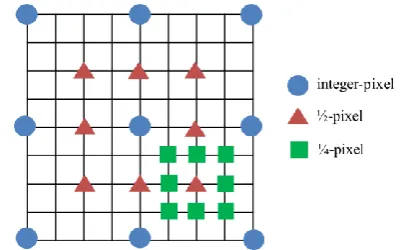
The H.264/AVC algorithm is one of the international standard of video coding technique [1, 2]. To improve the accuracy of motion estimation in the H.264/AVC video coding, a fractional-pixel motion estimation algorithm is almost mandatory [3, 4]. In addition, it is used the interpolation process to estimate the fractional pixel (1/2-pel and 1/4-pel) positions between the existing positions for the motion vector prediction in the reference image which is magnified in image resolution. In the typical hierarchical fractional-pixel search (HFPS) algorithm [2] shown in Fig.1, at least 8 positions are required for the 1/2-pel, and 16 positions are required for the 1/4-pel, respectively. The disadvantage of the 1/2-pel and 1/4-pel fractional pixel search algorithm is that the computations required are becoming very large. Furthermore, if the image resolution is increased, there are needed for additional motion estimation computations that involve considerably more fractional pixels.
Many fast fractional-pixel motion estimation algorithms to reduce the computational complexity of the motion estimation search process have been proposed [3, 4, 6-9] [12-16] such as Center Biased Fractional Pixel Search (CBFPS) [3], Fast Fractional Pixel Search (FFPS) [6], and Linear Prediction Search (LPS) [7]. The authors in [5] also developed a fast fractional-pixel search (FFS) algorithm to solve the calculation of the fractional-pixel motion estimation needed in the H.264/AVC algorithm. In this
* Corresponding author:
[email protected] (Lung-Jen Wang) Published online at http://journal.sapub.org/ajsp
Copyright © 2018 Scientific & Academic Publishing. All Rights Reserved
paper, the FFS algorithm based on linear-prediction motion estimation, called LFFS method, is proposed. That is, the more detailed description and derivation of LFFS method are presented in this paper. In addition, this LFFS method uses the linear prediction and small diamond search algorithm, as shown in Fig.2, [3, 6, 9]. It substantially reduces the fractional-pixel computations that are based on the sum of absolute difference error surface. Furthermore, computer simulations show that the proposed method speeds up the H.264/AVC standard and still achieves a very good quality of reconstructed image for motion vector prediction.
Figure 1. The hierarchical fractional-pixel search (HFPS) algorithm
↑2 Wiener
filter ↑2
Bilinear filter Image
I
Image
IB
W
I
Step 1 Step 2
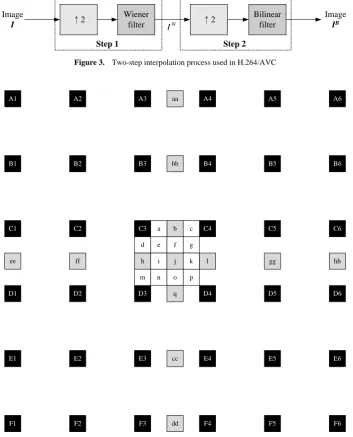
Figure 3. Two-step interpolation process used in H.264/AVC
A1 A2 A3 A4 A5 A6
B1 B2 B4 B5 B6
C1 C2 C4 C5 C6
D1 D2 D4 D5 D6
E1 E2 E4 E5 E6
F1 F2 F4 F5 F6
aa
B3
C3
D3
E3
F3
bb
cc
dd
ee ff gg hh
b
a c
d e f g
h i j k
m n o p
l
q
Figure 4. Example of interpolation relationship for filter size 6×6
2. Fractional-Pixel Motion Estimation
The fractional-pixel motion estimation of the H.264/AVC video coding can be used to improve the inter-frame prediction for video quality [8]. It requires very large computations, such as fractional-pixel (1/2-pel and 1/4-pel) search algorithm and interpolation process. Furthermore, the displacement vector with fractional-pixel resolution can be applied for the motion vector prediction in the H.264/AVC algorithm [10]. To estimate the fractional-pixel displacement, a two-step interpolation process is used as shown in Fig. 3. In the H.264/AVC algorithm, the Wiener filter with six coefficients: [1, -5, 20, 20, -5, 1]/32 is used to interpolate the 1/2-pel positions in first step and an image IW is generated after the first interpolation step. In addition, the bilinear interpolation filter is used to interpolate the 1/4-pel positions and an image IB is generated after the second
interpolation step. Fig. 4 shows the interpolation relationship between the integer-pel positions (black), the 1/2-pel positions (gray) and the 1/4-pel positions (white) [5].
(1)
where N is size of the macroblock, k and l are indices for pixels in the macroblock, i and j are horizontal and vertical displacements, C(x+k,y+l) is pixels in macroblock in target frame, R(x+u+k,y+v+l) is pixels in macroblock in reference frame and the motion vector MV=(u,v) such that SAD(i, j) is minimum. In addition, one observation is that if the minimum SAD obtained at fractional-pixel accuracy is larger than that at integer-pixel accuracy, the motion vector on the integer-pixel is selected as the final result and the fractional-pixel search for this block is regarded as ineffective. Otherwise, the fractional-pixel search is regarded as effective and the motion vector on the fractional-pixel is selected as the final result [8, 9].
Table 1 shows the effective fractional-pixel search ratio for some test video sequences. For the sequences with relatively lower motions, such as Paris with 38% and Akiyo with 48%, the majority of the fractional-pixel search is ineffective. The ineffective fractional-pixel search ratios are 62% and 52% for Paris and Akiyo, respectively. That is, the integer-pixel search is enough for the sequences with lower motions. Obviously, in Table 1, the most of fractional-pixel searches is ineffective. Therefore, if the integer-pixel motion vector is selected as the final motion vector, the fractional-pixel search computations can be skipped. In this paper, the LFFS method is proposed to determine whether the fractional-pixel search should be performed or not [8, 9].
Table 1. Effective Fractional-pixel Searsh Ratio Test video sequence Effective fractional-pixel search ratio
Akiyo 48%
Bus 70%
Coastguard 58%
Crew 70%
Foreman 70%
Paris 38%
3. The Proposed LFFS Algorithm
3.1. Linear Prediction
In this paper, a linear prediction based the fractional
-pixel motion estimation and the center-biased
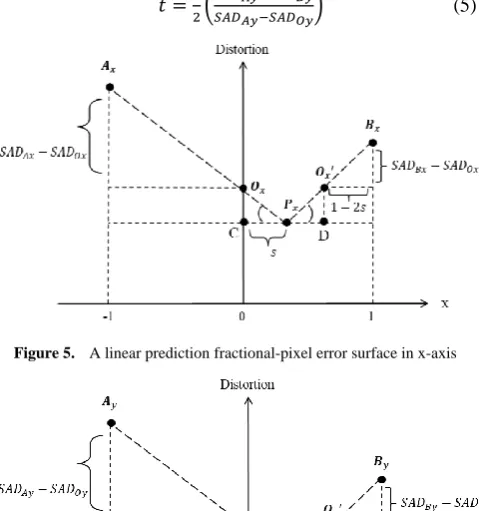
fractional-pixel search (CBFPS) [3] is developed, first estimates horizontal components and next vertical components for the fractional-pixel motion vector and its sum of absolute difference error surface. Figs. 5 and 6 show the linear prediction of fractional-pixel error surface in the horizontal and vertical directions, respectively.
In Fig. 5 for the x-axis (horizontal direction), let , , and be integer-pixel points, and , , and
are their corresponding SADs. is selected point
between and points such that the slopes of two lines and are equal as follows.
(2)
Let s be the distance between in a predicted minimum point and in a fractional-pixel point, and be a point in , , = , and
. The distance s can be obtained
by
(3)
and
(4)
Following [7], if , let , i.e., the integer-pixel motion vector is selected as the final motion vector.
Similarly, let t be selected distance between a predicted minimum point and a fractional-pixel point in the y-axis (vertical direction) for the fractional-pixel motion vector. As shown in Fig. 6, the distance t can be given by
(5)
Figure 5. A linear prediction fractional-pixel error surface in x-axis
Figure 6. A linear prediction fractional-pixel error surface in y-axis
3.2. LFFS with a Small Diamond Search
(6)
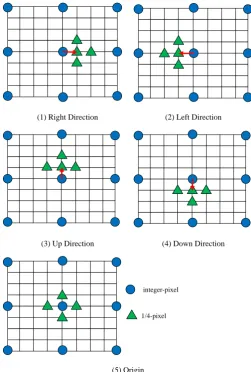
Using (6), we can calculate the s and t values at the best integer-pixel position and determinate the fractional-pixel search direction according to a small diamond search with their corresponding s and t values.
Furthermore, some directional selections based on the small diamond search algorithm are developed as shown in Fig. 7. The detailed flow chart of the proposed LFFS algorithm is mentioned in Fig. 8. In addition, Table 2 shows the directional selection of the fractional-pixel search.
(1) Right Direction (2) Left Direction
(3) Up Direction (4) Down Direction
integer-pixel
1/4-pixel
(5) Origin
Figure 7. Directional selections based small diamond search
Table 2. Directional Selections for Fractional-Pixel Search No. Condition Selected Direction
1 s > 0 and t > 0 Right
2 s < 0 and t < 0 Left
3 s > 0 and t < 0 Up
4 s < 0 and t > 0 Down
5 s = 0 and t = 0 Origin
mbSize = 16, p = 16
IntCost Ñ IntMV(j, i, imageP, imageI4, mbSize, p) u, v Ñ minSAD(intCost) LFFS_MotionEstimation(imageP, imageI4)
imageP: target image;
imageI4: reference image which is magnified by a factor of 4;
for j = 0 to r – mbSize + 1 by mbSize
Search motion vector for each MB
for i = 0 to c - mbSize + 1 by mbSize
Search integer-pixel motion vector
s Ñ linPred(IntCost(u, v - 1), IntCost(u, v), IntCost(u, v + 1)) t Ñ linPred(IntCost(u – 1, v), IntCost(u, v), IntCost(u + 1, v))
Linear prediction s and t
A B
C
(a) The front part of LFFS_MotionEstimaion
Select direction and search pixel motion vector with SDS (small diamond search)
displacement of one pixel to the right position A
s > 0 andt > 0 vectY Ñ (j + u)*4 vectX Ñ (i + v)*4 + 1
s > 0 andt < 0
displacement of one pixel to the up position
vectY Ñ (j + u)*4 – 1 vectX Ñ (i + v)*4
s < 0 andt < 0
displacement of one pixel to the left position
vectY Ñ (j + u)*4 vectX Ñ (i + v)*4 – 1
s < 0 andt > 0
displacement of one pixel to the down position
vectY Ñ (j + u)*4 + 1 vectX Ñ (i + v)*4
vectY Ñ (j + u)*4 vectX Ñ (i + v)*4
MVY, MVX Ñ SDS(j, i, vectY, vectX, imageP, imageI4, mbSize)
i B
j C
return MVY and MVX
Y
Y
Y
Y N
N
N
N
(b) The following part of LFFS_MotionEstimaion
4. Experimental Results
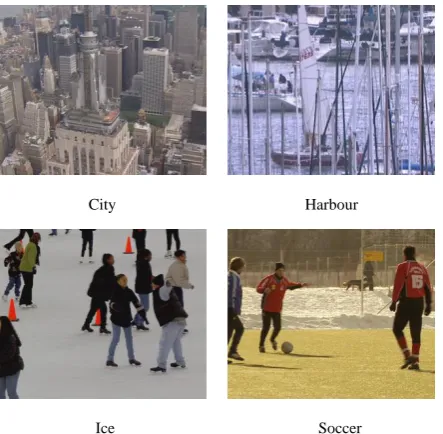
In this paper, the proposed LFFS method is compared with the Hierarchical Fractional Pixel Search (HFPS) [2], the Center Biased Fractional Pixel Search (CBFPS) [3], the Fast Fractional Pixel Search (FFPS) [6], and the Linear Prediction Search (LPS) [7]. Performance comparisons are carried out on some standard CIF (Akiyo, Bus, Coastguard, Crew, Foreman, Paris) and 4CIF (City, Harbour, Ice, Soccer) video sequences shown in Figs. 9 and 10, and based on the H.264/AVC JM 18.0 [11].
Experimental setups are IPPPP… frame structure, 1 reference frame, four different QP values (28, 32, 36, and 40), ±16 search range, and 100 frames. All the reported results (bit rates (kbps), number of search points (#SP), and PSNR (dB) performance) are computed from the reconstructed Y components.
Akiyo Bus Coastguard
Crew Foreman Paris
Figure 9. Some standard video test sequences (CIF)
City Harbour
Ice Soccer
Figure 10. Some standard video test sequences (4CIF)
Table 3 shows the performance comparisons for Akiyo (CIF) video sequences. In this table:
(1) At QP=28, for the PSNR which is compared to the
HFPS method, the proposed LFFS method is -0.01dB (least loss); for the average number of search points (#SP), the LPS method is 5.35 which is less than the other methods; and for bit-rates, the HFPS method is 443.47kbps and less than the other methods.
(2) At QP=32, for the PSNR, the LPS method is -0.01dB (least loss); for the average number of search points (#SP) and bit-rates, the LPS method is 5.49 and 313.26kbps, respectively, which is also less than the other methods.
(3) At QP=36, for the PSNR, the proposed LFFS method is 0dB (no loss); for the average number of search points (#SP), the LPS method is 5.64 which is less than the other methods; and for bit-rates, the CBFPS method is 245.37kbps and less than the other methods.
(4) At QP=40, for the PSNR, the proposed LFFS method is 0dB (no loss) and the CBFPS and LPS methods are +0.03dB which are better than HFPS method; for the average number of search points (#SP), the LPS method is 5.77 which is less than the other methods; and for bit-rates, the HFPS method is 216.38kbps and less than the other methods.
Table 3. Performance Comparisons for Akiyo (CIF) Method HFPS CBFPS FFPS LPS LFFS
QP28
△PSNR 41.13 -0.04 -0.20 -0.02 -0.01
#SP 16 6.16 9.34 5.35 6.37
Bit-rates 443.47 446.33 478.86 445.55 446.29
QP32
△PSNR 38.68 -0.02 -0.28 -0.01 -0.02
#SP 16 6.25 9.30 5.49 6.38
Bit-rates 313.27 314.31 337.47 313.26 314.28
QP36
△PSNR 36.57 -0.02 -0.26 -0.04 0
#SP 16 6.32 9.30 5.64 6.48
Bit-rates 246.04 245.37 255.30 245.66 246.10
QP40
△PSNR 34.37 +0.03 -0.16 +0.03 0
#SP 16 6.34 9.28 5.77 6.46
Bit-rates 216.38 216.41 220.24 216.54 216.71 Table 4. Performance Comparisons for Ice (4CIF) Method HFPS CBFPS FFPS LPS LFFS
QP28
△PSNR 40.91 0 -0.19 -0.02 0
#SP 16 8.83 9.20 9.99 7.65
Bit-rates 2755.36 2746.30 2966.51 2750.60 2737.14
QP32
△PSNR 38.92 +0.02 -0.25 0 +0.01
#SP 16 8.79 9.22 10.10 7.70
Bit-rates 1858.18 1834.02 1987.46 1839.66 1834.12
QP36
△PSNR 37.06 +0.01 -0.33 0 +0.02
#SP 16 8.66 9.21 10.01 7.65
Bit-rates 1348.50 1331.79 1421.08 1334.15 1329.52
QP40
△PSNR 35.14 0 -0.33 0 +0.01
#SP 16 8.52 9.21 9.90 7.56
In addition, Table 4 shows the performance comparisons for Ice (4CIF) video sequences. In this table:
(1) At QP=28, for the PSNR which is compared to the HFPS method, the proposed LFFS method and CBFPS method are 0dB (no loss); for the average number of search points (#SP) and bit-rates, the proposed LFFS method is 7.65 and 2737.14kbps, respectively, which is less than the other methods. (2) At QP=32, for the PSNR, the CBFPS method is
+0.02dB and the proposed LFFS method is +0.01dB which are better than HFPS method; for the average number of search points (#SP), the proposed LFFS method is 7.70 which is less than the other methods; and for bit-rates, the CBFPS method is 1834.02kbps and less than the other methods.
(3) At QP=36, for the PSNR, the proposed LFFS method is +0.02dB which is better than HFPS and other methods; for the average number of search points (#SP) and bit-rates, the proposed LFFS method is 7.65 and 1329.52kbps, respectively, which is also less than the other methods.
(4) At QP=40, for the PSNR, the proposed LFFS method is +0.01dB which is better than HFPS and other methods; for the average number of search points (#SP) and bit-rates, the proposed LFFS method is 7.56 and 1068.10kbps, respectively, which is also less than the other methods.
Finally, based on the above computer simulations, we can summarize the experimental results as follows:
(1) For the above standard CIF (Akiyo, Bus, Coastguard, Crew, Foreman, Paris) video sequences:
(a) The proposed LFFS method is compared with the HFPS method, the PSNR is -0.08dB (most loss), and however, for the average number of search points (#SP), the proposed LFFS method is less 60% than the HFPS method.
(b) The proposed LFFS method is compared with the CBFPS method, the PSNR is similar, and for the average number of search points (#SP), the proposed LFFS method is less 29% than the CBFPS method. (c) The proposed LFFS method is compared with the
FFPS method, the PSNR is more than 0.3dB, and for the average number of search points (#SP), the proposed LFFS method is less 31% than the FFPS method.
(d) The proposed LFFS method is compared with the LPS method, the PSNR is more than 0.01dB than the LPS method, and for the average number of search points (#SP), the proposed LFFS method is less 30% than the LPS method.
(2) For the above standard 4CIF (City, Harbour, Ice, Soccer) video sequences:
(a) The proposed LFFS method is compared with the
HFPS, CBFPS, and LPS methods, the PSNR is
similar, and for the average number of search points
(#SP), the proposed LFFS method is less 52% than these methods.
(b) The proposed LFFS method is compared with the
FFPS method, the PSNR is more than 0.37dB than
the FFPS method, and for the average number of search points (#SP), the proposed LFFS method is less 16% than the FFPS method.
5. Conclusions
In the H.264/AVC standard, the typical HFPS algorithm is used to improve the fractional-pixel motion estimation. This HFPS method requires at least 8 positions for the 1/2-pel, and 16 positions for the 1/4-pel, respectively, in the fractional-pixel motion estimation. However, if the image resolution is increased, the computations required for the fractional-pixel motion estimation are mandatory increased. In order to reduce the additional calculations of the fractional-pixel motion estimation needed in the H.264/AVC algorithm, the linear-prediction fast fractional-pixel search algorithm, called LFFS method, is developed in this paper. In this method, both linear prediction and small diamond search are proposed. Furthermore, the proposed LFFS method substantially reduces 60% and 52% computations for the fractional-pixel motion estimation in CIF and 4CIF video sequences, respectively, and still achieves a better quality of reconstructed image. That is, the proposed method for the fractional-pixel motion estimation in the H.264/AVC standard is that it substantially reduces the computation complexity and also increases the precision of motion vector prediction.
ACKNOWLEDGEMENTS
This work was supported by the Ministry of Science and
Technology, R.O.C., under Grant MOST
104-2221-E-153-010, 106-2622-E-153-001-CC2 and
106-2221-E-153-006.
REFERENCES
[1] T. Wiegand, G. J. Sullivan, G. Bjontegaard, and A. Luthra, “Overview of the H.264/AVC video coding standard,” IEEE Trans. on Circuits and Systems for Video Technology, vol. 13, no. 7, pp. 560-576, July 2003.
[2] T. Wiegand and G. J. Sullivan, “The H.264/AVC video coding standard [Standards in a Nutshell],” IEEE Signal Processing Magazine, vol.24, no.2, pp.148-153, March 2007. [3] Z. Chen, P. Zhou, and Y. He, “Fast integer pel and fractional pel motion estimation for JVT,” JVT-F017, Awaji Japan, Dec. 2002.
coding,” in Proc. 8th IEEE Conference on Industrial Electronics and Applications, pp. 891-895, 2013.
[5] L. J. Wang and W. M. Tai, “A fast linear-prediction fractional-pixel search algorithm,” in Proc. of the 30th IEEE International Conference on Advanced Information Networking and Applications (IEEE AINA-2016), Le Régent Congress Centre, Crans-Montana, Switzerland, March 23-25, 2016.
[6] H. Nisar and T. S. Choi, “Fast and efficient fractional pixel motion estimation for H.264/AVC video coding,” in Proc. 16th IEEE International Conference on Image Processing, pp. 1561-1564, 2009.
[7] K. H. Ng, L. M. Po, S. Y. Li, K. M. Wong and L. P. Wang, “A Linear prediction based fractional-pixel motion estimation algorithm,” in Proc. 4th International Conference on Multimedia and Ubiquitous Engineering, pp. 1-6, 2010. [8] J. S. Kim, K. W. Lee and M. H. Sunwoo, “Novel fractional
pixel motion estimation algorithm using motion prediction and fast search pattern,” in Proc. IEEE International Conference on Multimedia and Expo, pp.821-824, 2008. [9] L. Shen, Z. Zhang, Z. Liu and W. Zhang, “An adaptive
fractional pixel search algorithm,” in Proc. Fourth International Conference on Intelligent Sensing and Information Processing, pp. 153-156, 2006.
[10] L. J. Wang and C. T. Shu, “An efficient fractional-pixel motion compensation based on cubic convolution
interpolation,” Journal of Electrical and Electronic Engineering, vol. 2, no. 4, pp. 52-59, Sept. 2014.
[11] H.264/AVC Reference Software Version JM18.0, [Online]. Available:
http://iphome.hhi.de/suehring/tml/download/old_jm/. [12] J. F. Chang and J. J. Leou, “A quadratic prediction based
fractional-pixel motion estimation algorithm for H.264,” in Proc. Seventh IEEE International Symposium on Multimedia, 2005.
[13] J. Fang, W. Zheng, D. Zhang, and K. Wang, “A mode correlation-based fractional pixel motion estimation for H.264 video coding,” in Proc. 7th International Conference on ASIC, pp. 938- 941, 2007.
[14] S. G. Deshpande and J. N. Hwang, “A new fast motion estimation method based on total least squares for video encoding,” in Proc. IEEE International Conference on Acoustics, Speech and Signal Processing, pp. 2797-2800, 1998.
[15] R. Husemann, V. Roesler, R. Kintschner, H. Fröhlich, and A. A. Susin, “High performance H.264/AVC encoding motion prediction algorithm,” in Proc. 18th IEEE International Conference on Image Processing, pp. 957-960, 2011. [16] T. S. Kim, C. E. Rhee, H. J. Lee, and S. I. Chae, “Fast integer