Available Online at www.ijpret.com 147
INTERNATIONAL JOURNAL OF PURE AND
APPLIED RESEARCH IN ENGINEERING AND
TECHNOLOGY
A PATH FOR HORIZING YOUR INNOVATIVE WORK
STUDY THE JOINT IMPLEMENTATION OF JIT, TQM, TPM, SCM AND ERP
PARADIGMS FOR ENHANCING MANUFACTURING SYSTEMS PERFORMANCE
G. E. CHAUDHARI1, DR. S. G. PATIL2
1. Associate Professor, J. T. Mahajan College of Engineering, Faizpur(M.S.),India 2. Principal, IBSS College of Engineering, Amravati
Accepted Date: 05/03/2015; Published Date: 01/05/2015
\
Abstract: Past research on Just-in-Time (JIT), Total Quality Management (TQM), Total
Productive Maintenance (TPM), Supply Chain Management (SCM), and Enterprise Resource Planning (ERP) generally investigate the implementation and impact of these programs in isolation. They are not mutually exclusive and inconsistent. They complement each other by reinforcing mutually, inducing side-effects in favor of other paradigm’s, mutual stimulation and exploitation of shared values. The recent literature reports the discussion on joint implementation of JIT and TQM; TPM and TQM; SCM and ERP; JIT, SCM and TQM; JIT, TQM and TPM; JIT and SCM; TQM and ERP. The apparent linkages between JIT, TQM, TPM, SCM and ERP strategies and practices raise two questions that remain yet to be addressed, namely which specific elements of these strategies are consistent with each other, and how do they complement each other to improve firm’s performance.
Keywords: JIT, TQM, TPM, SCM, ERP, Integrated Manufacturing Program.
Corresponding Author: MR. G. E. CHAUDHARI
Access Online On:
www.ijpret.com
How to Cite This Article:
Available Online at www.ijpret.com 148 INTRODUCTION
Improving manufacturing performance for sustainable competitive advantage has been and continues to be an ongoing concern for modern manufacturing. Numerous operations paradigms, initiatives, and practices have emerged in recent years in response to this competitive pressures calling for improved product quality, increased responsiveness, and shorter lead times, but at lower cost. Just-in-Time (JIT), Total Quality Management (TQM), Total Productive Maintenance (TPM), Supply Chain Management (SCM), and Enterprise Resource Planning (ERP) are few among them which received particular attention in both academic and practitioner community. Each paradigm copes with the issue of improving the overall performance, based on a particular viewpoint and logic, which originated a rich set of practices and tools. Just-in-time (JIT) is a philosophy aimed at to produce and deliver finished goods just in time to be sold, subassemblies just in time to be assembled in to finished goods, fabricated parts just in time to go into assemblies, and purchased materials just in time to be transformed in to fabricated parts [1]. The TQM philosophy has a broader focus on improving the overall effectiveness of a company through a focus on continuously improving and sustaining quality products and processes by capitalizing on the involvement of management, workforce, suppliers, and customers, in order to meet or exceed customer expectations [3,4]. Total Productive Maintenance (TPM), which is built on the preventive maintenance concept, is a manufacturing program designed primarily to maximize equipment effectiveness throughout its entire life, which involves its entire human resources. When implemented fully, TPM dramatically improves productivity and quality, and reduces costs [2,6]. Supply Chain Management (SCM) is a process oriented, integrated approach to procuring, producing, and delivering products and services to customers, covering the management of material, information and financial flows [5]. Effective management of the supply chain is viewed as the driver of reductions in lead times and material costs, and improvements in product quality and responsiveness [5]. Enterprise Resource Planning (ERP) systems have emerged as the core of successful information management and the enterprise backbone of organizations. It is a software system that aims to provide an integrated application environment with a fast and seamless access to single uniformed information throughout the entire organization. Among the most important attributes of ERP are its abilities to automate and integrate an organization’s business process; share common data and practices across the enterprise; and produce and access information on a real-time environment.
2. RELATIOSHIP AMONG THE PARADIGMS
Available Online at www.ijpret.com 149
Although JIT and TQM function effectively in isolation, their combination yields synergies for further performance improvements. The overlapping practices of JIT and TQM are more than coincidental and they are mutually supportive. The unique JIT and TQM practices add predictive power to the JIT and TQM related performance. TQM practices support JIT to minimize variation by handling the causes of inconsistent quality leading to lessen its effect on work flow, production planning, and the plant capacity. TQM practices like product simplification using design for manufacturability helps in reducing the set-up time, allowing the use of smaller lots which reduces work-in-progress. As TQM helps in reducing number of reworks and decreases the cycle time, the deviation in the schedule is minimized so as to respond market demand quickly. Thus TQM practices helps to improve the performance of JIT system [1,2,3]. JIT facilitates the detection of the causes of quality problems by providing access to recent traces, exposes shortcomings in quality assurance, minimizes the production of non-quality items, clarifies the `client supplier’ relationships, minimizes damages, deterioration and losses of materials and products, provides the operators
Fig.1 Relationship of the practices on overlap of paradigms
Available Online at www.ijpret.com 150
toes and improves its performance. Firms that have implemented both JIT and TQM have achieved better performance than the firms which have implemented either JIT or TQM alone [4,6].
2.2 Relationship between TQM and TPM
A good brain and strong muscles are required to build strong enough manufacturing capability. TPM and TQM have a common and continuous goal of waste reduction. Some of the common themes of the two value systems include continuous improvement, employee empowerment, process focus, information gathering and analysis, and top management commitment. TQM facilitates the perception that problems found in a stage along equipment life cycle can be avoided by more proactive attitude in previous stages. It provides the means that can be applied for solving problems like equipment malfunction, breakdown maintenance and correction of design weaknesses. TQM makes to pay greater attention to the influence of equipment condition on the quality of conformance and relieves the need for extra production capacity. TPM contributes to ensure quality of conformance and helps to keep processes in controlled state. It reduces nonconforming items owing to improper set-up execution and human errors. TPM contributes in controlling the machine variation [2]. Total quality maintenance (TQMain) is a strategy which enables the user to maintain and improve continuously the technical and economic effectiveness of process elements. This approach has resulted in increase in employee involvement in decision making, team work, improved skills and training. The combination of both the approaches works as a contrivance to exploit their complementarities and thus attain enhanced overall performance. As many companies across the globe are striving to achieve the synergy of TQM and TPM [3].
2.3 Relationship between JIT and TPM
Available Online at www.ijpret.com 151
adopting cellular manufacturing, production smoothing and synchronization) and thus helps in reduction of buffers and safety stock.
2.4 Relationship between TQM and SCM
The integration of quality goals with supply chain goals may lead to cumulative capabilities which better prepare the organization to face dynamic, global competition. TQM and SCM appear to be rooted in very similar management principles[5]. Supplier management issues, like information sharing, establishment of long-term and trusting relationships with suppliers, mutual dependence and commitment are also advocated by the TQM philosophy. Also, internal integration, a prerequisite for SCM implementation is a key point in the TQM philosophy. Therefore it seems logical that TQM implementation may relate to supplier management aspects
in the SCM context. The SCM focuses on integrating the different parties together in order to meet the needs of the customers.
2.5 Relationship between JIT and SCM
JIT and SCM represent alternate approaches to improving the effectiveness and efficiency of an organization’s operations function. Both JIT and SCM seek improvements in quality, the former by way of improvements in production processes, the latter by integrating development and production processes throughout the supply chain. Successful JIT implementation depends on the coordination of production schedules with supplier deliveries, and on high levels of service from suppliers both in terms of product quality and delivery reliability.
2.6 Relationship among JIT, TQM, TPM and SCM
Available Online at www.ijpret.com 152 2.6 Relationship of ERP with JIT, TQM, TPM and SCM
Available Online at www.ijpret.com 153 3. MANAGERIAL CONCERNS
Manufacturing managers are being hit from all sides with the latest fads. Managers should analyze carefully their unique environment and based on this analysis they should adopt the latest management practices. Best practices must be selected and adopted relative to the situation the company faces. Rejecting new approaches out of hand is a risky business, just as is adopting every new approach that comes along. The main problem the managers are facing is how the new program should be implemented to link into the practices that already exist. Establishing and maintaining linkages across all of their new and old initiatives is one of the most challenging problems. They requires a clear understanding of how the practices provides the basis for tying new initiatives into what the plant is already doing. The understanding of the linkages and tracks of integration and which are the
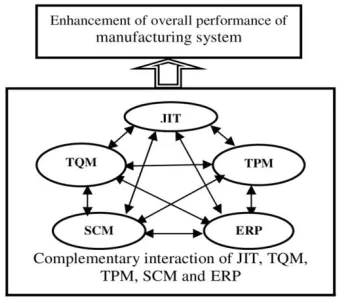
Fig. 2 Integrated Manufacturing Program
Shared practices and how the practices of one paradigm complement the other will surely help the managers in adopting new paradigm for enhancing manufacturing performance.
4. CONCLUSION
Available Online at www.ijpret.com 154
should be able to deliver the performance in terms of improved productivity, quality and delivery required in this irrepressible borderless competition.
REFERENCES
1. K. Vuppalapati, S. L. Ahire, and T. Gupta, “JIT and TQM: a case for joint implementation,” International Journal of Operations and Production Management, Vol.15, No. 5, pp. 84-94.
2. D. I. Miyake, T. Enkawa, and A. C. C. Fleury, “Improving manufacturing systems performance by complementary application of just-in-time, total quality control and total productive maintenance paradigms”, Total Quality Management, Vol. 6, No. 4, pp. 345-363.
3. K.O. Cua, K.E. McKone, and R. G. Schroeder, “Relationship between implementation of TQM, JIT, and TPM and manufacturing performance,” Journal of Operations Management, No.19, 2001, pp. 675-694.
4. D. Seth and D. Tripathi, “Relationship between TQM and TPM implementation factors and business performance of manufacturing industry in Indian context,” International Journal of Quality and Reliability Management, Vol.22, No.3, 2005, pp. 256-277.
5. Michael J. Tarn, D. C. Yen, and M. Beaumont, “Exploring the rationales for ERP and SCM integration”, Industrial Management and Data systems, 102/1, 2002, pp. 26-34.