Organized by C.O.E.T, Akola & IWWA, Amravati Center. Available Online at www.ijpret.com 422
INTERNATIONAL JOURNAL OF PURE AND
APPLIED RESEARCH IN ENGINEERING AND
TECHNOLOGY
A PATH FOR HORIZING YOUR INNOVATIVE WORK
SPECIAL ISSUE FOR
NATIONAL LEVEL CONFERENCE
"SUSTAINABLE TECHNOLOGIES IN
CIVIL ENGINEERING"
NON LINEAR DYNAMIC ANALYSIS OF G+10 CONCRETE BUILDING’’ WITH
SOFT STOREY AT DIFFERENT LEVEL
BHOLA M. SONTAKKE1, ASHISH S. MOON2
M. tech scholar: Structural Engineering Tulsiramji Gaikwad-Patil College of Engineering & Technology, Nagpur, India. Accepted Date: 13/03/2015; Published Date: 01/04/2015
Abstract: Many Urban multistoried building in India today have open storey as an unavoidable features. This is primarily being adopted to accommodate parking or lobbies in open storey, such features are highly undesirable in building built in seismically active areas, and this has been verified in numerous experience of strong shaking during past earthquake. Though multistoried building with open (soft) ground floor is inherently vulnerable to collapse due to earthquake load, their construction is still widespread developing nation like India. Social and functional need to provide parking space at the ground floor level and for office. Open storey at different levels of the structure for out-weighs the warning against such building from engineering community. In this paper we are concentrating on finding the best place for soft stories which is use for parking space and offices in high rise building.
Keywords- Non Linear, Soft Storey
. Corresponding Author: MR. BHOLA M. SONTAKKE
Co Author: MR. ASHISH S. MOON
Access Online On:
www.ijpret.com
How to Cite This Article:
Bhola M. Sontakke, IJPRET, 2015; Volume 3 (8): 422-431
Organized by C.O.E.T, Akola & IWWA, Amravati Center. Available Online at www.ijpret.com 423 INTRODUCTION
Due to increasing population since the past few years so that car parking for residential apartment in the populated cities is the matter of major problem. So that the construction of multistoried building with open storey (first) is common practice in all world. The upper stories have brick infilled walls panels. The draft Indian seismic code classifies a soft storey as one in which the lateral stiffness is less than 70% of that in the storey above or less than 80% of average. The building with the first soft storey, where seismic base shear as experienced by the building during an earthquake is dependent on its natural period , the seismic distribution of stiffness and the mass along the height . In the building with soft storey, the upper storey s being stiff undergoes smaller inter-storey drift. However the inter storey drift in the first storey is large. The strength demand on the column in the first storey is also large , as the upper storey force in the column maximum , for the upper storey force in the column are effectively reduced due to the presence of infill, infill increase the stiffness of the column . And this is the main reason, ground (first) soft storey has no infill, only column is there, there is infill masonry in between column only column is there . This has adverse effect on performance of the building during ground shaking, such buildings are required to be analyzed by dynamic analysis and designed carefully. [1]
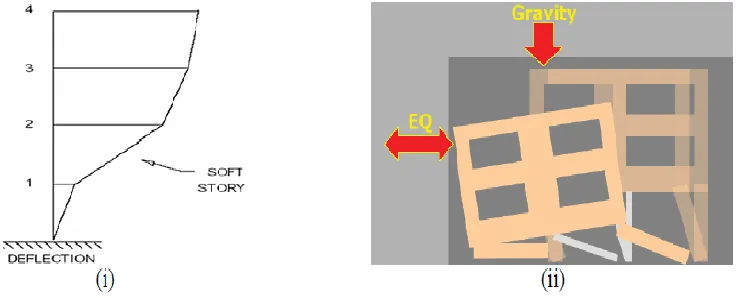
Organized by C.O.E.T, Akola & IWWA, Amravati Center. Available Online at www.ijpret.com 424 Fig (i) Lateral displacement diagram of building with soft storey under lateral loading (ii)
collapse mechanism of a building structure having soft storey
SOFT STOREY FAILURE
During the earthquake, the upper storey move almost together as a single block and most of the horizontal displacement of the building occurs in the soft ground storey itself. In other words this type of building sways back and forth like inverted pendulum.
Fig (iii) Behavior of OGS buildings like as inverted pendulum
Organized by C.O.E.T, Akola & IWWA, Amravati Center. Available Online at www.ijpret.com 425 NONLINEAR DYNAMIC ANALYSIS (TIME HISTORY ANALYSIS)
Nonlinear dynamic analysis or inelastic analysis known as Time history analysis. This is the only method to distribute the actual behavior of the structure during earthquake. This method is based on direct numerical integration of the motion differential equation by considering the elasto-plastic deformation of the structure element. This method capture the effect of amplification due to resonance , the variation of displacement at diverse level of a frame , an increase of motion duration and tendency of regularization of movement result as far as the level increase from bottom to top.
The time history analysis determines the response of a structure due to forces, displacements, velocities or accelerations that vary with time. There are two versions of this method, first is direct integration and the second, modal superposition [Ehsan, 2011]. Modal superposition is only suitable for linear analysis, whereas direct integration can be used also for nonlinear analysis. The direct integration utilizes a step-by-step solution of Equation of motion, which is generally described as:
Where, M, C, K are the mass, the damping, and the stiffness matrices, respectively
Organized by C.O.E.T, Akola & IWWA, Amravati Center. Available Online at www.ijpret.com 426 DISCRIPTION OF BUILDING
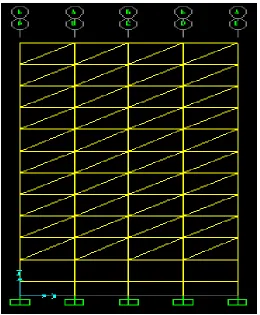
In the present study 3-Dimension G+10th storey R. C. C. frame building are considered. The plan
and elevation of the building model is a shown in fig.
1) Building = (G+10) Storey
2) Slab thickness = 150mm
3) Live Load = 2.5kN/m2 (No live load at terrace)
4) Live load at Terrace = 1.25 KN/m2
5) Floor finish = 1kN/m2
6) Wall Thickness (EXTERNAL) = 230mm
7) Wall Thickness (Internal ) = 115mm
8) Grade of concrete = M25
9) Grade of steel = Fe415
10) Software used = SAP2000
11) Method of analysis = Nonlinear time history analysis.
12) Earthquake use = Loma prieta earthquake – Oct 17, 19894
13) Preparing model in SAP 2000 with applying section properties of beam and column
COLUMN C1- 400 x 400, C2- 450 x 450 mm, BEAM B1-300X300mm
PROPERTY OF INFILL
Applying masonry infill having width = 0.87m, Thickness = 0.230m, modulus of elasticity = 700mpa
And passions Ratio=0.3
Organized by C.O.E.T, Akola & IWWA, Amravati Center. Available Online at www.ijpret.com 427 Model-2 Building has soft storey at first floor. Building has no infill at first floor storey as model as bare frame and infill are consider for all floors.
Model-3 Building has soft storey at second floor. Building has no infill at second floor storey as model as bare frame and infill are consider for all floors.
Model-4 Building has soft storey at fifth floor. Building has no infill at fifth floor storey as model as bare frame and infill are consider for all floors.
Model-5 Building has soft storey at seventh floor. Building has no infill at seventh floor storey as model as bare frame and infill are consider for all floors.
Model-6 Building has soft storey at tenth floor. Building has no infill at tenth floor storey as model as bare frame and infill are consider for all floors.
Organized by C.O.E.T, Akola & IWWA, Amravati Center. Available Online at www.ijpret.com 428 OBJECTIVE OF THIS PAPER
R. C. C. frame building which are known to perform poorly during strong earthquake shaking. The presence of infill wall influences the overall behavior of the structure when subjected to lateral force. When masonry infills are considered to interact with their surrounding frame the lateral stiffness and lateral load carrying capacity of structure largely increases. In this paper the seismic vulnerability of building is shown with an example of G+10. Earthquake analysis would be comes out of R. C. Frame of tall building without infill at soft storey with the help of SAP-200
RESULT AND DISSCUSSION
1) Building with soft storey at ground floor without infill compare Building with soft storey at first floor
Organized by C.O.E.T, Akola & IWWA, Amravati Center. Available Online at www.ijpret.com 429 3) Building with soft storey at ground floor without infill compare Building with soft storey
at Fifth floor
Organized by C.O.E.T, Akola & IWWA, Amravati Center. Available Online at www.ijpret.com 430 5) Building with soft storey at ground floor without infill compare Building with soft storey
at Tenth floor
6) Building with soft storey at ground floor without infill compare Building with soft storey at drift level
Inter-Storey Drift At Different Levels
CONCLUSION
1) The seismic performance of structure is very sensitive to stiffness ratio. The lower the
Organized by C.O.E.T, Akola & IWWA, Amravati Center. Available Online at www.ijpret.com 431
2) Soft storey at lower floor is more vulnerable to seismic force because it attracts more force
due to high seismic weight.
3) It is conclude that stiffness of structure should be maintained throughout the structure.
4) It is observed that location of soft storey at higher level displacement of structure goes on
increasing order.
5) It is also observed that inter- storey drift goes reducing as the location of soft storey.
REFERENCES
1. Rahiman G.Khan, Prof M. R. Vyawahare,” Push Over Analysis of Tall Building with Soft Stories at Different levels” International Journal of Engineering Research and Applications (IJERA) – Volume 3, Issue 4, July- August 2013.pp.176-185.
2. Praveen Rathod, Dr. S. S. Dyavanal,” Push Over Analysis of Seven Storeyed RC Buildings with Openings in Infill Walls” International Journal of Engineering Trends and Technology (IJETT) – Volume 14 Number 3 - August 2014.
3. Hiten L. Kheni,and Anuj K. Chandiwala(2014), “Seismic Response of RC Building with Soft Stories”, International Journal of Engineering Trends and Technology (IJETT) – Volume 10 Number 12 - Apr 2014.