DOI: 10.1002/ejic.200500845
Synthesis, Characterization, and Catalytic Properties of
ansa-Zirconocenes
[Zr{1-Me
2
Si(3-
η
5
-C
9
H
5
R)
2
}Cl
2
] (R = Me,
nPr,
nBu, and Bz)
Carlos Alonso-Moreno,
[a]Antonio Antiñolo,
[a]Fernando Carrillo-Hermosilla,
[a]Antonio Otero,*
[a]Ana M. Rodríguez,
[a]José Sancho,
[b]Victoria Volkis,
[c]and Moris Eisen
[c]Dedicated to Professor Victor Riera on the occasion of his 70th birthday
[‡]Keywords:
Metallocenes / Zirconium / Homogeneous catalysis / Polymerization / Ethylene
The ansa-indene ligands {1-Me2Si(3-C9H6R)2} [R = Me (1),
nPr (2),nBu (3), and Bz (4)] were prepared by alkylation of the unsubstituted ansa-indene. These ligands were con-verted, by reaction withnBuLi, to the di-lithium compounds [Li2{1-Me2Si(3-C9H5R)2}] [R = Me (5),nPr (6),nBu (7), and Bz
(8)]. ansa-Zirconocenes, [Zr{1-Me2Si(3-η5-C9H5R)2}Cl2] [R =
Me (9),nPr (10),nBu (11), and Bz (12)], have been prepared by the reaction of ZrCl4with5–8in diethyl ether/toluene at
–78 °C. The molecular structure of meso-[Zr{1-Me2Si[3-η5
-C9H5(CH3)]2}Cl2] (9) and rac-[Zr{1-Me2Si[3-η5-C9H5
-(CH2CH2CH3)]2}Cl2] (10) have been determined by
single-Introduction
A large number of new catalysts for olefin
polymeriza-tion, classified as metallocene catalysts, have been prepared
during the last decade.
[1]The majority of these catalysts
consist of a zirconium complex with the general formula
LL
⬘
ZrCl
2and these systems are activated by
methylalumin-oxane (MAO). The ligands L and L
⬘
are typically equal or
different dienyl ligands that may be linked together by a
bridge. A major evolution has been achieved in the field of
polypropylene, which can now be produced with different
types and degrees of stereoregularity.
[2]In fact, a new class
of catalysts based on
C
2-symmetric metallocenes, with
ansa
-bis(indenyl) ligands, produce almost isotactic
polypropyl-enes. The best-known example is Brintzinger’s
rac
-[Zr{1-(C
2H
4)(
η
5-C
9H
6)
2}Cl
2].
[3]Although the introduction of an
alkyl substituent in the cyclopentadienyl fragment of the
[a] Departamento de Química Inorgánica, Orgánica y Bioquímica, Facultad de Ciencias Químicas, Universidad de Castilla-La Mancha, Campus Universitario de Ciudad Real,
13071 Ciudad Real, Spain E-mail: [email protected]
[email protected] [b] Centro Tecnológico Repsol-YPF,
Carretera de Extremadura, Km. 18, 28931 Móstoles, Spain [c] Department of Chemistry and Institute of Catalysis Science and
Technology Technion, Israel Institute of Technology, Haifa 32000, Israel
[‡] In recognition of his important contribution to organometallic chemistry and as a mark of friendship.
crystal X-ray diffraction studies. Ethylene polymerization ca-talysis has been studied for complexes9–12as a mixture of
mesoandracisomers in the presence of methylaluminoxane (MAO) as cocatalyst. Complexes9–12exhibit high activities and give rise to polyethylene with low molecular weights without the introduction of molecular hydrogen. In addition, active species from these complexes were found to be very stable in comparison with unsubstituted analogues.
(© Wiley-VCH Verlag GmbH & Co. KGaA, 69451 Weinheim, Germany, 2006)
indenyl group has been studied,
[4]few examples of
ansa
-bis-indenyl complexes, bearing SiMe
2bridges, have been
de-scribed
[5–9]and, to the best of our knowledge, there is not
a complete structural characterization of these complexes.
The target for these catalysts was to study the influence of
the metallocene structure in the performance of propylene
polymerization. Less attention has been paid to the study
of the influence on the properties of the polyethylene
ob-tained with these catalysts, i.e., on the molecular weight of
the obtained polymer. Usually, this parameter can be
con-trolled during the polymerization by either adjusting the
temperature of the polymerization or by adding molecular
hydrogen, which acts as a chain transfer agent.
[10]With this in mind, and as part of our continued interest
in this field,
[11]we have developed new examples of
ansa
-zirconocene catalysts of the general formula [Zr{1-Me
2Si(3-η
5-C
9
H
5R)
2}Cl
2]. These catalysts have proved to be very
active and are able to produce polyethylene with low
mol-ecular weight without introducing molmol-ecular hydrogen to
control the process. It was of particular interest to compare
the results with the analogous unsubstituted complex
[Zr{1-Me
2Si(
η
5-C
9H
6)
2}Cl
2].
[12]Here we provide the details of the preparation and
poly-merization behavior of four members of this class of
cata-lysts [Zr{1-Me
2Si(3-
η
5-C
9H
5R)
2}Cl
2] [R = Me (
9
),
n
Pr (
10
),
of the resulting polymers are discussed. In addition, the
molecular structures of
rac
-
10
and
meso
-
9
have been
deter-mined by X-ray diffraction methods.
Results and Discussion
The preparation of the substituted
ansa
-indene
precur-sors {1-Me
2Si(3-C
9H
6R)
2} [R = Me (
1
),
n
Pr (
2
),
n
Bu (
3
)
and Bz (
4
)] was achieved by alkylation of the dilithium salt
of {1-Me
2Si(3-C
9H
7)
2}, generated with
n
BuLi in Et
2O, with
a large excess of RX (X = I and R = Me for
1
, X = Br and
R =
n
Pr for
2
, X = Br and R =
n
Bu for
3
, and X = Br and
R = Bz for
4
) (Scheme 1). Column chromatography was
used to purify the ligands
1
–
4
.
Scheme 1.
This is the preferred route because of the very simple
synthesis and purification of the intermediate {1-Me
2-Si(C
9H
7)
2} and because of its intrinsic versatility. In fact,
{1-Me
2Si(C
9H
7)
2} is a convenient starting material for the
synthesis of a series of different 3-alkyl- and 3-silyl-
ansa
-bisindenyl ligands.
[13]The
1H NMR spectra show the
meso
-isomer as the major -isomer for derivatives
1
–
4
, with two
singlets for the
ansa
-bridge methyl groups, a doublet for
H1, a doublet for H2, and four multiplets corresponding to
the protons of the C
6ring of the indenyl moiety. In
ad-dition, the corresponding signals were observed for the
pen-dant alkyl chain (see Exp. Sect.).
As shown in Scheme 2, the deprotonation of
1
–
4
with
n
BuLi gave the lithium salts [Li
2{1-Me
2Si(3-C
9H
5R)
2}] [R
= Me (
5
),
n
Pr (
6
),
n
Bu (
7
), and Bz (
8
)]. The subsequent
reaction of the lithium salts with ZrCl
4, in diethyl ether/
toluene, gave the corresponding zirconocene complexes
[Zr{1-Me
2Si(3-
η
5-C
9H
5R)
2}Cl
2] [R = Me (
9
),
n
Pr (
10
),
n
Bu
(
11
), and Bz (
12
)]. The orange solids obtained are sensitive
towards air and moisture and are soluble in polar solvents.
Scheme 2.
While the total yield of this last step is satisfactory, a
random
rac
/
meso
ratio is obtained. In general, the
rac
/
meso
ratio ranges from 0.6:1 (
10
) to 1.86:1 (
12
). For complex
9
,
samples of the pure
meso
diastereomer and a product
en-riched in the
rac
isomer (11.5:1) were obtained by careful
recrystallization from CH
2Cl
2/Et
2O.
The
1H NMR spectra for the
meso
isomers of the
com-plexes
9
–
12
show the following signals: two singlets for the
ansa
-bridge methyl groups, a singlet for the proton of the
indenyl C
5ring, and four multiplets corresponding to the
protons of the C
6ring of the indenyl moiety. In addition,
the appropriate signals were observed for the pendant alkyl
chain (see Exp. Sect.). Furthermore, the following signals
were observed for the
rac
isomers of the complexes
9
–
12
: a
singlet for the
ansa
-bridge methyl groups, a singlet for the
proton of the indenyl C
5ring, and four multiplets
corre-sponding to the protons of the C
6ring of the indenyl
moi-ety. In addition, several signals were observed for the
pen-dant alkyl chain (see Exp. Sect.).
1
H NMR nuclear Overhauser effect (NOE) difference
spectroscopy allowed unambiguous identification of each
isomer. Irradiation of the signal due to H2 in the
meso
iso-mer (which appears as a singlet in the NMR spectrum) led
to measurable enhancement of the protons of the C3-alkyl
substituent and the protons in one of the methyl groups of
the SiMe
2bridge. However, a similar irradiation in the
rac
aromatic proton H7 on the opposite indenyl ring (Figure 1).
In the
meso
isomer, these SiMe
2methyl groups are located
in very different chemical environments (one is sandwiched
between the two C
6aromatic rings, and the other is only
[image:3.593.301.545.89.300.2]flanked by the Cp rings), while in the
rac
isomer the two
methyl groups are equivalent.
Figure 1.1H NOE difference experiments provide information on the spatial proximity between protons.
The carbon signal assignments were made following a
procedure on the basis of
1H and
13C NMR correlated
spec-troscopy (HETCOR) (see Exp. Sect.). For the
meso
isomer
of these compounds
9
–
12
, the
13C analysis showed two
sig-nals for the
ansa
-bridge methyl groups, a signal for the
car-bon C2 of the indenyl C
5ring, and four signals
correspond-ing to the carbons (C4–C7) of the C
6ring of the indenyl
moiety. For the
rac
isomers, only one signal was found for
the ansa-bridge methyl groups. In addition, a signal of the
carbon C2 of the indenyl C
5ring was observed, and four
signals corresponding to the carbons (C4–C7) of the C
6ring of the indenyl moiety. The corresponding signals were
observed for the pendant alkyl chain for both isomers (see
Exp. Sect.).
X-ray Molecular Structures of Complexes
meso-9 and
rac-10
Single crystals of
meso
-
9
and
rac
-
10
that were suitable
for X-ray diffraction were obtained from CH
2Cl
2/ether and
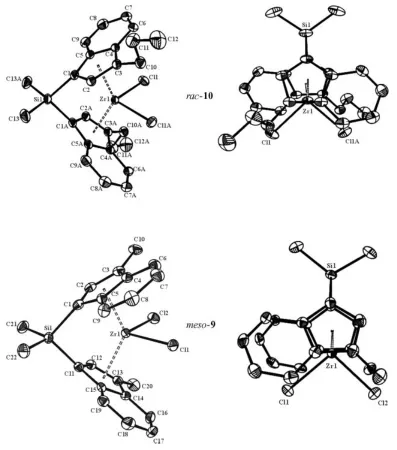
toluene. Their molecular structures, as determined by the
crystallographic analysis, are depicted in Figure 2.
The
meso
-
9
complex crystallizes in the triclinic space
group
P
1¯. The crystal structure reveals the existence of one
unique isomer. The
rac
-
10
complex crystallizes in the
mo-noclinic space group
P
2/
c
with a solvate toluene molecule.
The crystal structure reveals the existence of two racemic
enantiomers. The bonding parameters for
meso
-
9
and
rac
-10
are summarized in Table 1. The mutual arrangement of
the indenyl fragments corresponds to C
2symmetry for
rac
and C
sfor
meso
.
In both cases the zirconium atom is in a
pseudotetrahe-dral environment formed by the two chloride ligands and
two
η
5-coordinated indenyl ligands. The Zr–C bond lengths
of five-membered rings range between 2.448(6) and
2.662(6) Å. These values are close to that found in other
ansa
-bis(indenyl) zirconocene complexes (2.5 Å).
[14]The
Zr–Cl distances for these complexes are within the range
Table 1. Selected bond lengths [Å] and angles [°] for meso-9 and rac-10.
meso-9 rac-10
Bond lengths
Zr(1)–Cent(1)[a] 2.246(1) 2.243 Zr(1)–Cent(2)[b] 2.252(1)
av[c]Zr(1)–C[Cent(1)][a] 2.550(6) 2.548(3) av[c]Zr(1)–C[Cent(2)][b] 2.556(6)
Zr(1)–Cl(1) 2.409(2) 2.4130(11)
Zr(1)–Cl(2) 2.4375(19)
Zr(1)–C(1) 2.448(6) 2.451(3)
Zr(1)–C(2) 2.467(6) 2.483(3)
Zr(1)–C(3) 2.631(6) 2.619(3)
Zr(1)–C(4) 2.662(6) 2.656(3)
Zr(1)–C(5) 2.540(6) 2.529(3)
Bond angles
Cent(1)[a]–Zr–Cent(2)[b] 128.84 128.81 Si(1)–C(1)–Cent(1)[a] 163.6(4) 163.5 Si(1)–C(11)–Cent(2)[b] 163.5
Cl(1)–Zr–Cent(1)[a] 106.71 106.76(3) Cl(1)–Zr–Cent(2)[b] 106.65(5) 106.82(2) Cl(2)–Zr–Cent(1)[a] 106.40
Cl(2)–Zr–Cent(2)[b] 106.97
[a] Cent(1) is the centroid of C(1)–C(5) for both complexes. [b] Cent(2) is the centroid of C(11)–C(15) for the complexmeso-9. [c] Refers to the average bond length between Zr(1) and the carbon atoms of the C5ring of the cyclopentadienyl moiety.
observed previously for other bis(indenyl)-zirconium
di-chlorides [2.407(1)–2.465(2) Å].
[15–20]The angles between some relevant planes are collected in
Table 2 along with the geometrical parameters described in
Figure 3 for compounds
meso
-
9
,
rac
-
10
, and the
unsubsti-tuted parent
rac
-[Zr{1-Me
2Si(
η
5-C
9H
6)
2}Cl
2].
[12]As usual
for bent metallocenes, the overall coordination environment
is best described by the set of parameters depicted in
Fig-ure 3, which describes the metal accessibility. In particular,
the smaller the “bite angle”
β
and the larger the Cp–M–
Cp
⬘
α
angle, the more the metal is tucked into the ligand
envelope.
The main geometrical difference of
meso
-
9
and
rac
-
10
from
rac
-[Zr{1-Me
2Si(
η
5-C
9H
6)
2}Cl
2] is associated with the
angle
β
and the range of Zr–C
Cpbond lengths.
β
, in
meso
-9
(63.9°) and
rac
-
10
(62.9°), is increased compared to that
of
rac
-[Zr{1-Me
2Si(
η
5-C
9H
6)
2}Cl
2] (60.2°). The range of
Zr–C
Cpfor both complexes (0.21 Å for
meso
-
9
and 0.20 Å
for
rac
-
10
) is similar to that in
rac
-[Zr{1-Me
2Si(
η
5-C
9H
6)
2}Cl
2] (0.20 Å).
These differences are, likely, caused by the bulky R
sub-stituents at C(3) of both indenyl fragments. This conclusion
is supported by significant displacements of the C(3)–R
bonds from the planes of the parent cyclopentadienyl rings
opposite to Zr (4.1° and 4.5° for
meso
-
9
, and 4.2° for
rac
-10
).
It can be seen from Figure 2 that, for the structures of the
complexes
meso
-
9
and
rac
-
10
, both C
5rings are eclipsed,
including, in the case of
meso
-
9
, the methyl-substituent in
position 3. In
meso
-
9
, it can be observed that one of the
chloride ligands is very close to the C
6aromatic rings,
[image:3.593.75.262.145.250.2]Figure 2. Solid state structure ofrac-10andmeso-9(hydrogen atoms are omitted for clarity).
Table 2. Relevant geometrical parameters.[a]
meso-9 rac-10 rac-[Me2Si(Ind)2]ZrCl2
α 128.7 128.8 127.8
β 63.9 62.9 60.2
δ 83.6, 83.4 83.9 85.7
φ 95.3 95.3 94.4
γ 15.6, 15.8 16.1 17.8; 16.4 r(Zr–CCp), 2.45–2.66, 2.45–2.65, 2.46–2.66, 0.20
∆r 0.21 0.20
[a] All quantities in degrees, apart from∆(Å). The anglesα,β,γ, δ, and φ are defined in Figure 3. ∆is the distance between the perpendicular projection of the heavy atom on the ring least-squares plane and the ring centroid.
chloride ligand is between a ring and an alkyl substituent.
This situation could give rise to a great influence of the
rings and their alkyl substituents on the positions occupied
by the active sites of the catalysts. These features could be
Figure 3. Schematic representation of an ansa-metallocene detail-ing the angles listed in Table 2.
established to control the molecular weight of the polymers
obtained.
Polyethylene Polymerization using Complexes 9–12
Table 3. Homogeneous ethylene polymerization results for9–12and [Zr{1-Me2Si(η5-C9H6)2}Cl2] as reference. Conditions: 343 K, 1.5 bar monomer pressure, 6µmol Zr, MAO/Zr = 2000, 100 mL toluene,tpol= 30 min.
Complex Activity[a] Activity (after 12 h)[a][b] M
w Mn Mw/Mn M.p.
[kgPE/molZr× h] [kgPE/molZr× h] [g mol–1] [°C]
[Zr{1-Me2Si[3-(η5-C9H5)Me]2}Cl2] (9) 6333 1757 82000 21000 3.82 132
[Zr{1-Me2Si[3-(η5-C9H5)nPr]2}Cl2] (10) 3473 2333 87000 26000 3.40 134 [Zr{1-Me2Si[3-(η5-C9H5)nBu]2}Cl2] (11) 2946 1856 74000 17000 4.35 132 [Zr{1-Me2Si[3-(η5-C9H5)Bz]2}Cl2] (12) 1849 1843 70000 17000 4.06 134
[Zr{1-Me2Si(Ind)2}Cl2] 3573 No reaction 166000 53000 3.16 136
[a] Average value for three different runs. [b] Precatalyst/MAO solutions were aged for 12 h, at room temperature, before monomer introduction.
catalysts for the polymerization of ethylene. In the present
study, we used a 10 % solution of MAO in toluene, which
contains about 20–30 % of AlMe
3. In all polymerization
ex-periments, Al(
i
Bu)
3was used to scavenge possible
impuri-ties in the monomer. The polymerization results are
com-pared with those of one of the best zirconocene catalysts,
i.e., [Zr{1-Me
2Si(
η
5-C
9H
6)
2}Cl
2].
[12]The polymerization
re-sults and the available polymer characterization data are
shown in Table 3.
Complexes
9
–
12
show similar or higher activities than
the reference complex and, moreover, these new catalysts
produced lower molecular weight polyethylene than the
ref-erence catalyst. Although it is not possible to establish any
relation between the size of the substituent and the polymer
molecular weight, we suggest that this low molecular weight
arises due to the steric influence of the substituents. The
activities of complexes
9
–
12
decrease as the bulk of the
sub-stituent in position 3 increases.
In addition, the melting points of all the polymers were
determined (see Table 3). The catalysts
9
–
12
produced
crys-talline materials with relatively high melting points (near
130 °C).
The stability of metallocene complexes is one of the most
important variables for its future industrial use. The
activi-ties of activated forms of complexes
9
–
12
were tested after
12 h of contact between the complexes and MAO solution.
It is worth noting that these complexes maintained a
rea-sonable level of activity after this contact time. In contrast,
the reference complex ([Zr{1-Me
2Si(
η
5-C
9H
6)
2}Cl
2]) did
not give any reaction with ethylene after the same time of
contact with MAO. It therefore appears that an increase in
the volume of the substituent in the 3-position leads to an
increase in the stability of the catalyst.
Conclusions
We have carried out the synthesis of new examples of
ansa
-bis-indenylzirconocene complexes, bearing a SiMe
2bridge, with alkyl substituents in the 3 position. The
pres-ence of these groups allows stable and very active catalysts
to be obtained in ethylene polymerization, producing
poly-ethylenes of low molecular weight, in comparison with the
unsubstituted analogue. In addition, complexes
meso
-[Zr{1-Me
2Si[3-
η
5-C
9H
5(CH
3)]
2}Cl
2] and
rac
-[Zr{1-Me
2Si[3-
η
5-C
9H
5(CH
2CH
2CH
3)]
2}Cl
2] have been characterized by
X-ray diffraction methods.
Experimental Section
General Remarks: All reactions were carried out using standard Schlenk-tube and glove-box techniques in dry nitrogen. Solvents were distilled from appropriate drying agents and degassed before use. ZrCl4, indene, SiMe2Cl2, ICH3, BrCH2CH2CH3, BrCH2CH2CH2CH3, and BrCH2Ph were purchased from Aldrich and used directly.1H and13C spectra were recorded with Varian GEMINI FT-400 and Varian INNOVA FT-500 spectrometers and referenced to the residual deuterated solvent. Microanalyses were carried out with a Perkin–Elmer 2400 microanalyzer. Mass spec-trometry was performed with a Hewlett–Packard 5988A (m/z = 50–1000) (electron impact) spectrometer.
Preparation of {1-Me2Si[3-C9H6(CH3)]2} (1):nBuLi (1.60in hex-ane) (38.00 mL, 60.74 mmol) was added over 15 min to a cooled (–78 °C) solution of [Me2Si(C9H7)] (7.30 g, 25.31 mmol) in Et2O (100 mL) in a 250-mL Schlenk tube. At the end of the addition the solution was allowed to reach room temperature and stirred for 4 h, cooled again to –78 °C, and MeI (14.37 g, 101.24 mmol) was added. The reaction mixture was allowed to reach room tempera-ture and stirred for 16 h. The solvent was removed in vacuo and hexane (100 mL) was added. Water (200 mL) was added, the or-ganic product was extracted with hexane, the aqueous layer was washed with hexane (3 × 50 mL), the organic layers combined, dried with MgSO4, filtered and the solvent removed from the fil-trate under reduced pressure to yield the title compound as a yellow oil. Compound1was purified by column chromatography (Et2O/ hexane, 1:9) (yield 7.05 g, 88 %).1H NMR (400 MHz, CDCl3) (for the predominant isomer):δ= 0.10 and 0.14 (2 s, each 3 H, SiMe2), 0.82 (m, 6 H, CH3), 3.56 (d,J= 1.8 Hz, 2 H, 1-H), 6.82 (d,J = 1.8 Hz, 2 H, 2-H), 7.11–7.37 (m, 8 H, 4-H–7-H) ppm. MS electron impact: m/z (%) = 316 (3) [M, {1-Me2Si[3-C9H6(CH3)]2}]+, 187 (100) [M – (3-Me – C9H6)]+, 129 (56) [M – Me2Si]+.
Preparation of {1-Me2Si(3-C9H6(CH2CH2CH3))2} (2):The synthe-sis of2was carried out in an identical manner to1. [Me2Si(C9H7)] (7.30 g, 25.31 mmol), nBuLi (1.60 in hexane) (38.00 mL, 60.74 mmol), and BrCH2CH2CH3 (12.45 g, 101.24 mmol). Yield 8.48 g (89 %).1H NMR (400 MHz, CDCl3) (for the predominant isomer): δ= 0.19 and 0.32 (2 s, each 3 H, SiMe2), 0.95 (m, 6 H, CH2CH2CH3), 1.39–2.73 (m, 8 H, -CH2CH2CH3), 3.50 (d, J = 1.8 Hz, 2 H, 1-H), 6.98 (d,J= 1.8 Hz, 2 H, 2-H), 7.10–7.50 (m, 8 H, 4-H–7-H) ppm. MS electron impact:m/z(%) = 372 (3) [M, {1-Me2Si(3-C9H6(CH2CH2CH3))2}]+, 216 (100) [M – (3-Pr – C9H6)]+, 156 (23) [M – Me2Si]+.
Preparation of {1-Me2Si(3-C9H6(CH2CH2CH2CH3))2} (3): The synthesis of3was carried out in an identical manner to1. [Me2 -Si(C9H7)] (7.30 g, 25.31 mmol), nBuLi (1.60 in hexane) (38.00 mL, 60.74 mmol), and BrCH2CH2CH2CH3 (13.87 g, 101.24 mmol). Yield 9.13 g (90 %). 1H NMR (400 MHz, CDCl
SiMe2), 0.95–2.73 (m, 18 H, -CH2CH2CH2CH3), 3.80 (d, J = 1.8 Hz, 2 H, 1-H), 6.89 (d,J= 1.8 Hz, 2 H, 2-H), 7.10–7.50 (m, 8 H, 4-H–7-H) ppm. MS electron impact:m/z(%) = 400 (3) [M, {1-Me2Si(3-C9H6(CH2CH2CH3))2}]+, 228 (100) [M – (3-Bu-C9H6)]+, 59 (55) [M – Me2Si(C9H6)]+.
Preparation of {1-Me2Si(3-C9H6(CH2C6H5))2} (4):The synthesis of 4 was carried out in an identical manner to 1. [Me2Si(C9H7)] (7.30 g, 25.31 mmol), nBuLi (1.60 in hexane) (38.00 mL, 60.74 mmol), and BrCH2C6H5(8.66 g, 50.62 mmol). Yield 5.34 g (45 %).1H NMR (400 MHz, CDCl
3) (for the predominant isomer): δ = 0.16 and 0.13 (2 s, each 3 H, SiMe2), 2.72–3.00 (m, 4 H, -CH2C6H5), 3.54 (d,J= 1.8 Hz, 2 H, 1-H), 6.78 (d,J= 1.8 Hz, 2 H, 2-H), 7.14–7.39 (m, 18 H, 4-H–7-H, CH2C6H5) ppm. MS electron impact:m/z(%) = 468 (2) [M, {1-Me2Si(3-C9H6(CH2C6H5))2}]+, 264 (83) [M – (3-Bz-C9H6)]+, 91 (100) [M – Me2Si(C9H6)]+.
Preparation of Li2{1-Me2Si(3-C9H5(CH3))2} (5):nBuLi (1.60in hexane) (23.79 mL, 37.92 mmol) was added dropwise over 15 min to a cooled (–80 °C), stirred solution of {1-Me2Si(3-C9H6(CH3))2} (1) (5.00 g, 15.80 mmol) in Et2O (80 mL) in a 250-mL Schlenk tube. The solution was warmed up to room temperature and stirred for 4 h. An increasing turbidity developed and this finally led to the formation of a yellow-orange suspension. The solvent was removed in vacuo to give a yellow solid, which was washed with hexane (2 × 50 mL) and dried under vacuum to yield5 as a free flowing yellow solid (yield 3.94 g, 76 %). C22H22Li2Si (328.28): calcd. C 80.47, H 6.75; found C 80.53, H 6.80.
Preparation of Li2{1-Me2Si(3-C9H5(CH2CH2CH3))2} (6):The syn-thesis of6was carried out in an identical manner to5. {1-Me2Si(3-C9H6(CH2CH2CH3))2} (2) (5.00 g, 13.28 mmol),nBuLi (1.60in hexane), and (19.91 ml, 31.85 mmol). Yield 4.48 g (87 %). C26H30Li2Si (384.48): calcd. C 81.22, H 7.86; found C 81.43, H 7.93.
Preparation of Li2{1-Me2Si(3-C9H5(CH2CH2CH2CH3))2} (7):The synthesis of 7 was carried out in an identical manner to 5. {1-Me2Si(3-C9H6(CH2CH2CH2CH3))2} (3) (5.00 g, 12.48 mmol) and nBuLi (1.60in hexane) (18.72 mL, 29.95 mmol). Yield (4.37 g, 85 %). C28H34Li2Si (412.54): calcd. C 81.52, H 8.31; found C 81.43, H 8.40.
Preparation of Li2{1-Me2Si(3-C9H5(CH2C6H5))2} (8):The synthesis of 8 was carried out in an identical manner to 5. {1-Me2Si(3-C9H6(CH2C6H5))2} (4) (5.00 g, 10.67 mmol) andnBuLi (1.60in hexane) (16.00 mL, 26.21 mmol). Yield 4.10 g (80 %). C34H30Li2Si (480.57): calcd. C 84.97, H 6.29; found C 84.83, H 6.34.
Preparation of [Zr{1-Me2Si(3-η5-C9H5(CH3))2}Cl2] (9): A cooled (–78 °C) slurry of ZrCl4 (2.79 g, 12.00 mmol) in toluene (80 mL) was rapidly added to a cooled (–78 °C) solution of Li2{1-Me2Si(3-C9H5(CH3))2} (5) (3.94 g, 12.00 mmol) in Et2O (80 mL) in a 250-mL Schlenk tube. The reaction mixture was stirred for 30 min at –20 °C and then overnight at room temperature (16 h). The orange suspension was filtered through a G4 frit with Celite. The filtrate was evaporated to dryness under reduced pressure to yield a sticky dark-orange product. The product was washed with Et2O (30 mL) and the residue was dried to give an orange solid (0.86 g, 15 %). rac/meso= 55:45. For this complex, samples of the puremeso dia-stereomer and a product enriched in theracisomer (11.5:1) were obtained by careful recrystallization from CH2Cl2/Et2O.
meso Isomer: 1H NMR (500 MHz, CD
2Cl2): δ = 0.80 [s, 3 H, Si(CH3)exo], 1.27 [s, 3 H, Si(CH3)endo], 2.35 (s, 6 H, CH3), 5.50 (s, 2 H, 2-H), 6.83 and 7.09 (2 t,J= 8.8 Hz, each 2 H,5-H, 6-H), 7.32 and 7.44 (2 d,J= 8.8 Hz, each 2 H, 4-H, 7-H) ppm.13C{1H} NMR (125 MHz, CD2Cl2):δ= 13.03 [Si(CH3)exo], 13.62 [Si(CH3)
endo], 43.62 (CH3), 76.78, 86.00 (C1, C3), 118.40 (C2), 123.21 and 125.11 (C5, C6), 126.15, 126.48 (C4, C7) ppm.
rac Isomer: 1H NMR (500 MHz, CD2Cl2): δ = 1.09 [s, 6 H, Si(CH3)2], 2.22 (s, 6 H, CH3), 5.68 (s, 2 H, 2-H), 6.97 and 7.23 (2t, J = 8.8 Hz, each 2 H, 5-H, 6-H), 7.35 and 7.38 (2 d,J= 8.8 Hz, each 2 H, 4-H, 7-H) ppm. 13C NMR (125 MHz, CD2Cl2): δ = –1.44 ppm [Si(CH3)2], 13.34 (CH3), 78.04, 86.40 (C1, C3), 119.32 (C2), 124.25 and 125.06 (C5, C6), 126.55 and 126.85 (C4, C7) ppm.
Both Isomers:C22H22Cl2SiZr (476.6): calcd. C 55.44, H 4.65; found C 55.63, H 4.68.
Preparation of [Zr{1-Me2Si[3-η5-C9H5(CH2CH2CH3)]2}Cl2] (10): The synthesis of 10was carried out in an identical manner to9. Li2{1-Me2Si[3-C9H5(CH2CH2CH3)]2} (6) (4.48 g, 11.65 mmol) and ZrCl4(2.72 g, 11.65 mmol). Yield 1.61 g (26 %).rac/meso= 38:62.
meso Isomer: 1H NMR (500 MHz, CDCl3): δ = 1.04 [s, 3 H, Si(CH3)exo], 1.51 [s, 3 H, Si(CH3)endo], 1.07 (t, 6 H,J= 7.9 Hz, CH2CH2CH3), 1.74 (m, 4 H, CH2CH2CH3), 2.98 (m, 4 H, CH2CH2CH3), 5.73 (s, 2 H, 2-H), 7.07 and 7.32 (2 t,J= 8.8 Hz, each 2 H, 5-H, 6-H), 7.57 and 7.65 (2 d,J= 8.8 Hz, each 2 H, 4-H, 7-H) ppm. 13C{1H} NMR (125 MHz, CDCl3): δ = –2.45 [Si(CH3) exo], –0.71 [Si(CH3) endo], 14.46 (CH2CH2CH3), 23.62 (CH2CH2CH3), 30.78 (CH2CH2CH3), 77.30, 80.10 (C1, C3), 117.27 (C2), 124.36 and 126.04 (C5, C6), 126.30 and 126.47 (C4, C7) ppm.
rac Isomer: 1H NMR (500 MHz, CDCl
3): δ = 1.25 [s, 6 H, Si(CH3)2], 1.03 (t, 6 H,J = 7.9 Hz, CH2CH2CH3), 1.65 (m, 4 H, CH2CH2CH3), 2.84 (m, 4 H, CH2CH2CH3), 5.91 (s, 2 H, 2-H), 7.19 and 7.47 (2 t,J= 8.8 Hz, each 2 H, 5-H, 6-H), 7.57 and 7.65 (2 d, J = 8.8 Hz, each 2 H, 4-H, 7-H) ppm. 13C{1H} NMR (125 MHz, CDCl3): δ = –1.12 ppm [Si(CH3)2], 14.34 (CH2CH2CH3), 23.54 (CH2CH2CH3), 30.49 (CH2CH2CH3), 77.40, 85.31 (C1, C3), 117.27 (C2), 124.55 and 124.92 (C5, C6), 126.62 and 126.72 (C4, C7) ppm.
Both Isomers: C26H30Cl2SiZr (532.73): calcd. C 58.62, H 5.68; found C 58.71, H 5.69.
Preparation of [Zr{1-Me2Si[3-η5-C9H5(CH2CH2CH2CH3)]2}Cl2] (11):The synthesis of11was carried out in an identical manner to
9. Li2{1-Me2Si[3-C9H5(CH2CH2CH2CH3)]2} (7) (4.37 g, 10.59 mmol) and ZrCl4(2.47 g, 10.59 mmol). Yield 2.08 g (35 %). rac/meso= 59:41.
meso Isomer: 1H NMR (500 MHz, CDCl3): δ = 0.87 [s, 3 H, Si(CH3)exo], 1.36 [s, 3 H, Si(CH3)endo], 0.89 (t,J= 7.9 Hz, 6 H, CH2CH2CH2CH3), 1.34 (m, 4 H, CH2CH2CH2CH3), 1.51 (m, 4 H, CH2CH2CH2CH3), 2.72 (m, 4 H, CH2CH2CH2CH3), 5.58 (s, 2 H, 2-H), 6.91 and 7.16 (2 t,J= 8.8 Hz, each 2 H, 5-H, 6-H), 7.41 and 7.49 (2 d, J= 8.8 Hz, each 2 H, 4-H, 7-H) ppm. 13C{1H} NMR (125 MHz, CDCl3):δ= –2.69 [Si(CH3)exo], –0.96 [Si(CH3)endo], 13.95 (CH2CH2CH2CH3), 22.77 (CH2CH2CH2CH3), 28.24 (CH2CH2CH2CH3), 32.29 (CH2CH2CH2CH3), 77.10, 84.81 (C1, C3), 116.88 (C2), 123.98 and 125.77 (C5, C6), 126.03, 126.19 (C4, C7) ppm.
rac Isomer: 1H NMR (500 MHz, CDCl
3): δ = 1.11 [s, 6 H, Si(CH3)2], 0.90 (t, 6 H,J = 7.9 Hz CH2CH2CH2CH3), 1.34 (m, 4 H, CH2CH2CH2CH3), 1.51 (m, 4 H, CH2CH2CH2CH3), 2.82 (m, 4 H, CH2CH2CH2CH3), 5.77 (s, 2 H, 2-H), 7.06 and 7.32 (2 t,J= 8.8 Hz, each 2 H, 5-H, 6-H), 7.41 and 7.49 (2 d,J= 8.8 Hz, each 2 H,4-H, 7-H) ppm.13C{1H} NMR (125 MHz, CDCl
Both Isomers: C28H34Cl2SiZr (560.79): calcd. C 59.97, H 6.11; found C 60.21, H 6.19.
Preparation of [Zr{1-Me2Si[3-η5-C9H5(CH2C6H5)]2}Cl2] (12): The synthesis of12was carried out in an identical manner to9. Li2 {1-Me2Si[3-C9H5(CH2C6H5)]2} (8) (4.10 g, 8.53 mmol) and ZrCl4 (2.00 g, 8.53 mmol). Yield 2.15 g (40 %).rac/meso= 65:35.
meso Isomer: 1H NMR (500 MHz, CDCl3): δ = 1.01 [s, 3 H, Si(CH3)exo], 1.29 [s, 3 H, Si(CH3)endo],δA= 4.28,δB= 4.22 (AB, JAB= 21.6 Hz, 4 H, CH2C6H5), 5.77 (s, 2 H,2-H), 7.02–7.48 (m, 8 H, 4-H–7-H), 7.02–7.48 (m, 10 H, CH2C6H5) ppm.13C{1H} NMR (125 MHz, CDCl3):δ= –1.40 [Si(CH3)exo], –0.99 [Si(CH3)endo], 34.22 (CH2C6H5), 65.84, 85.90 (C1, C3), 118.12 (C2), 124.06 and 125.85 (C5, C6), 126.12 and 126.14 (C4, C7), 118.04–140.17 (CH2C6H5) ppm.
racIsomer:1H NMR (500 MHz, CDCl3):δ= 0.79 [s, 6 H, Si(CH3)], δA= 4.17, δB = 4.04 (AB, JAB = 19.6 Hz, 4 H, CH2C6H5), 5.59 (s, 2 H, 2-H), 7.02–7.48 (m, 8 H, 4-H–7-H), 7.02–7.48 (m, 10 H, CH2C6H5) ppm. 13C{1H} NMR (125 MHz, CDCl3): δ = –2.85 [Si(CH3)2], 34.58 (CH2C6H5), 65.94, 86.32 (C1, C3), 118.04 (C2), 124.25 and 124.74 (C5, C6), 126.57 and 126.78 (C4, C7), 118.04– 140.17 (CH2C6H5) ppm.
Both Isomers: C34H30Cl2SiZr (628.82): calcd. C 64.94, H 4.81; found C 65.02, H 4.86.
Polymerization Experiments:Polymerizations (three runs for cata-lyst) were carried out in a 250 mL glass reactor using toluene as a solvent (100 mL). Catalysts (6µmol) were treated with the appro-priate quantity (Al/Zr = 2000) of a commercial (CROPTOM) solu-tion of MAO in toluene (10 % Al) for 15 min. Toluene (80 mL), Al(iBu)3scavenger (2 mL), and activated catalyst were introduced, in this order, into the reactor and the temperature was maintained at 343 K. The nitrogen atmosphere was removed and a continuous flow of ethylene (1.5 bar) was introduced over 30 min. The reaction mixture was then quenched by the addition of acidified methanol. The polymer was collected by filtration, washed with methanol, and dried under vacuum at room temperature for 24 h.
Polymer Analysis Procedures: Mw, Mn, and Mw/Mn were mea-sured with an Alliance GPC-2000 high temperature GPG device from Waters Corp., Milford, MA, USA. The mobile phase was 2,4,5-trichlorobenzene (HPLC grade, J. T. Baker Ltd.) at 150 °C. Prior to use as a mobile phase, TCB was filtered through a 0.2-µ
fiberglass filter (PALL Corp.). The GPC device was completed with 3 Styragelcolumns (Waters Corp.) and an additional GARD col-umn. All columns were placed in an oven and heated to 150 °C. The RI detector at 150 °C was used for MW determination by the relative method. Data processing was performed using Millen-niumver. 4.2 Software (Waters Corp.). The sample (0.020 g) was dissolved in 2,4,5-trichlorobenzene (10.0 mL) (HPLC grade, J. T. Baker Ltd.) at 150 °C over 7 h. The solution was stirred four times during this period. The hot solution (7 mL) of each sample was placed into the metal vial equipped with a mechanism for auto-matic filtration through 0.2-µmetal filters prior to injection. The vials were immediately placed in an autosampler heated continually at 150 °C. The sample was stirred for 15 min in the autosampler prior to injection. 12 PS narrow standards in the range of MW from 2430 Dalton to 1.800.000 Dalton (Aldrich) were used for the calibration of the GPC device. The standards were prepared analo-gous to the sample preparation. The concentrations of standard solutions were calculated according the recommendations of Ald-rich. The calibration curve is linear in all range ofMWand indi-cates the good working order of the device and especially the col-umns.
X-ray Crystal Structure Determination ofmeso-9 andrac-10: Inten-sity data were collected with a Nonius-MACH3 diffractometer equipped with a graphite monochromator and a Mo-Kαradiation source (λ= 0.71073 Å) using aω/2θ-scan technique. The final unit cell parameters were determined from 25 well-centered reflections and refined by least-squares methods. Data were corrected for Lo-rentz and polarization effects and a semi-empirical absorption cor-rection (Psi-scans) was made.[21]
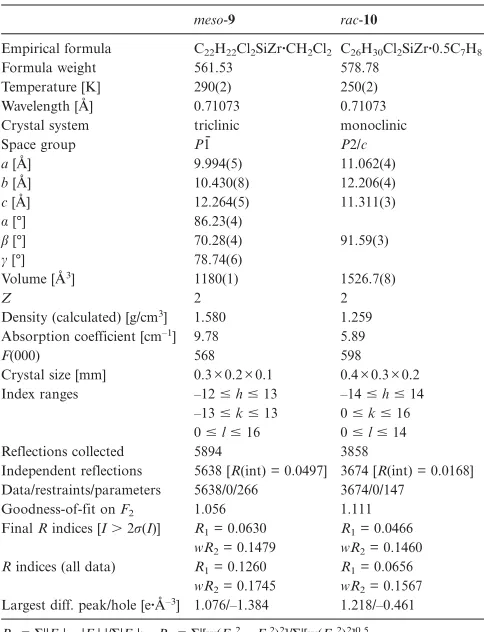
[image:7.593.301.543.270.586.2]The structures were solved using direct methods,[22]completed by subsequent difference Fourier syntheses, and refined by full-matrix least-squares procedures on F2.[23] All non-hydrogen atoms were refined with anisotropic thermal parameters. The hydrogen atoms were placed using a “riding model” and included in the refinement at calculated positions. Weights were optimized in the final cycles. Crystallographic data are given in Table 4.
Table 4. Crystal data and structure refinement formeso-9andrac
-10.
meso-9 rac-10
Empirical formula C22H22Cl2SiZr·CH2Cl2 C26H30Cl2SiZr·0.5C7H8
Formula weight 561.53 578.78
Temperature [K] 290(2) 250(2)
Wavelength [Å] 0.71073 0.71073
Crystal system triclinic monoclinic
Space group P1¯ P2/c
a[Å] 9.994(5) 11.062(4)
b[Å] 10.430(8) 12.206(4)
c[Å] 12.264(5) 11.311(3)
α[°] 86.23(4)
β[°] 70.28(4) 91.59(3)
γ[°] 78.74(6)
Volume [Å3] 1180(1) 1526.7(8)
Z 2 2
Density (calculated) [g/cm3] 1.580 1.259
Absorption coefficient [cm–1] 9.78 5.89
F(000) 568 598
Crystal size [mm] 0.3 × 0.2 × 0.1 0.4 × 0.3 × 0.2
Index ranges –12ⱕhⱕ13 –14ⱕhⱕ14
–13ⱕkⱕ13 0ⱕkⱕ16 0ⱕlⱕ16 0ⱕlⱕ14
Reflections collected 5894 3858
Independent reflections 5638 [R(int) = 0.0497] 3674 [R(int) = 0.0168] Data/restraints/parameters 5638/0/266 3674/0/147
Goodness-of-fit onF2 1.056 1.111
FinalRindices [I⬎2σ(I)] R1= 0.0630 R1= 0.0466
wR2= 0.1479 wR2= 0.1460
Rindices (all data) R1= 0.1260 R1= 0.0656
wR2= 0.1745 wR2= 0.1567
Largest diff. peak/hole [e·Å–3] 1.076/–1.384 1.218/–0.461
R1=Σ||Fo| – |Fc| |/Σ|Fo|;wR2=Σ|[w(Fo2–Fc2)2]/Σ|[w(Fo2)2]0.5
CCDC-283808 and -283809 contain the supplementary crystallo-graphic data for this paper. These data can be obtained free of charge from The Cambridge Crystallographic Data Centre via www.ccdc.cam.ac.uk/data_request/cif.
Acknowledgments
[1] See reviews by: a) P. C. Möring, N. J. Coville, J. Organomet. Chem. 1994, 479, 1; b) H.-H. Brintzinger, D. Fischer, R. Mülhaupt, B. Rieger, R. M. Waymouth,Angew. Chem.1995, 107, 1255;Angew. Chem. Int. Ed. Engl.1995,34, 1143; c) T. J. Marks, J. C. Stevens,Topics Catal.1999,7, 1; d) J. A. Gladysz, Chem. Rev.2000,100, 1167; e) M. Bochmann,J. Organomet. Chem.2004,689, 3982; f) W. Kaminsky,J. Polym. Sci., Part A: Polym. Chem.2004,42, 3911.
[2] J. A. Ewen, M. J. Elder, R. L. Jones, L. Haspeslagh, J. L. At-wood, S. G. Bott, K. Robinson,Makromol. Chem. Macromol. Symp.1991,48/49, 253.
[3] W. Kaminsky, K. Külper, H.-H. Brintzinger, F. Wild, Angew. Chem. Int. Ed. Engl.1985,24, 507.
[4] a) W. Spaleck, M. Antberg, J. Rohrmann, A. Winter, B. Bach-mann, P. Kiprof, J. Behm, W. HerrBach-mann,Angew. Chem. Int. Ed. Engl.1992,31, 1347; b) L. Resconi, F. Piemontesi, I. Ca-murati, O. Sudmeijer, I. E. Ninfant’ev, P. V. Ivchenko, L. G. Kuz’mina,J. Am. Chem. Soc.1998,120, 2308.
[5] T. H. Warren, G. Erker, R. Fröhlich, B. Wibbleing, Organome-tallics2000,19, 127.
[6] W. Spaleck, M. Antberg, L. Böhm, L. Rohrmann, J. Lüker, EP0399348,1990.
[7] J. A. Ewen,Macromol. Symp.1995,89, 181.
[8] S. C. Yoon, J.-W. Park, H. S. Jung, H. Song, J. T. Park, S. I. Woo,J. Organomet. Chem.1998,559, 149.
[9] D. Balboni, G. Moscardi, G. Baruzzi, V. Braga, I. Camurati, F. Piemontesi, L. Resconi, I. E. Nifant’ev, V. Venditto, S. Anti-nucci,Macromol. Chem. Phys.2001,202, 2010.
[10] R. Blom, I. M. Dahl,Macromol. Chem. Phys.1999,200, 442. [11] a) C. Alonso-Moreno, A. Antinolo, F. Carrillo-Hermosilla, P.
Carrión, I. López-Solera, A. Otero, S. Prashar, J. Sancho,Eur. J. Inorg. Chem.2005, 2924; b) A. Antinolo, R. Fernandez-Ga-lan, A. Otero, S. Prashar, I. Rivilla, A. M. Rodriguez, M. A. Maestro,Organometallics2004,23, 5108; c) A. Antinolo, I.
Lo-pez-Solera, A. Otero, S. Prashar, A. M. Rodriguez, E. Villa-señor,Organometallics2002,21, 2460.
[12] W. A. Herrmann, J. Rohrmann, E. Herdtweck, W. Spaleck, A. Winter,Angew. Chem. Int. Ed. Engl.1989,28, 1511.
[13] L. Resconi, L. Caballo, A. Fait, F. Piemontesi, Chem. Rev.
2000,100, 1253.
[14] a) M. Toto, L. Cavallo, P. Corradini, G. Moscardi, L. Resconi, G. Guerra,Macromolecules1998,31, 3431; b) L. Resconi, D. Balboni, G. Baruzzi, C. Fiori, S. Guidotti, P. Mercandelli, A. Sironi,Organometallics2000,19, 420.
[15] a) G. Erker, B. Temme,J. Am. Chem. Soc.1992,114, 4004; b) G. Erker, M. Aulbach, M. Knickmeier, D. Wingbermühle, C. Kruger, M. Nolte, S. Werner, J. Am. Chem. Soc. 1993, 115, 4590.
[16] C. Krüger, F. Lutz, M. Notle, G. Erker, M. Aulbach, J. Or-ganomet. Chem.1993,452, 79.
[17] N. E. Grimmer, N. J. Coville, C. B. de Koning, J. M. Smith, L. M. Cook,J. Organomet. Chem.1993,616, 112.
[18] G. Jany, M. Gustafsson, T. Repo, E. Aitola, J. A. Dobado, M. Klinga, M. Leskelä,J. Organomet. Chem.1998,558, 11. [19] R. L. Halterman, D. R. Fahey, E. F. Baillo, D. W. Docker, O.
Stenzel, J. L. Shipman, M. A. Khan, S. Dechert, H. Suman, Organometallics2000,19, 5464.
[20] S. Knüppel, J.-L. Fauré, G. Erker, G. Kehr, M. Nissinen, R. Fröhlich,Organometallics2000,19, 1262.
[21] A. C. T. North, D. C. Phillips, F. S. Mathews,Acta Crystallogr. Sect. A1968,24, 351–359.
[22]SIR92, A program for crystal structure solution: A. Altomare, G. Cascarano, C. Giacovazzo, A. Guagliardi, J. Appl. Crys-tallogr.1993,26, 343–350.
[23] G. W. Sheldrick,SHELXL-97, Program for the Refinement of Crystal Structures from Diffraction Data, University of Göttingen,1997.
![Table 1. Selected bond lengths [Å] and angles [°] for meso-9 andrac-10.](https://thumb-us.123doks.com/thumbv2/123dok_us/8138336.244027/3.593.301.545.89.300/table-selected-bond-lengths-a-angles-meso-andrac.webp)
![Table 3. Homogeneous ethylene polymerization results for 9monomer pressure, 6–12 and [Zr{1-Me2Si(η5-C9H6)2}Cl2] as reference](https://thumb-us.123doks.com/thumbv2/123dok_us/8138336.244027/5.593.47.545.89.165/table-homogeneous-ethylene-polymerization-results-monomer-pressure-reference.webp)