Kryzhna S. I., Kievskaya Yu. O., Kozar V. V., Tyupka T. I. Application of natural antioxidants in the composition of gel "Imbirol" for rhinitis of different genesis. Journal of Education, Health and Sport. 2018;8(5):277-283. eISNN 2391-8306. DOI
http://dx.doi.org/10.5281/zenodo.1291555
http://ojs.ukw.edu.pl/index.php/johs/article/view/5582
The journal has had 7 points in Ministry of Science and Higher Education parametric evaluation. Part b item 1223 (26/01/2017). 1223 Journal of Education, Health and Sport eISSN 2391-8306 7
© The Author(s) 2018;
This article is published with open access at Licensee Open Journal Systems of Kazimierz Wielki University in Bydgoszcz, Poland
Open Access. This article is distributed under the terms of the Creative Commons Attribution Noncommercial License which permits any noncommercial use, distribution, and reproduction in any medium, provided the original author (s) and source are credited. This is an open access article licensed under the terms of the Creative Commons Attribution Non commercial license
(http://creativecommons.org/licenses/by-nc/4.0/) which permits unrestricted, non commercial use, distribution and reproduction in any medium, provided the work is properly cited. This is an open access article licensed under the terms of the Creative Commons Attribution Non commercial License (http://creativecommons.org/licenses/by-nc/4.0/) which permits unrestricted, non commercial
use, distribution and reproduction in any medium, provided the work is properly cited. The authors declare that there is no conflict of interests regarding the publication of this paper.
Received: 02.04.2018. Revised: 12.04.2018. Accepted: 31.05.2018.
"
"
V
V
.
.
V
V
.
.
P
P
o
o
d
d
v
v
y
y
s
s
o
o
t
t
s
s
k
k
y
y
X
X
V
V
I
I
I
I
-
-
t
t
h
h
s
s
c
c
i
i
e
e
n
n
t
t
i
i
f
f
i
i
c
c
r
r
e
e
a
a
d
d
i
i
n
n
g
g
s
s
"
"
M
Ma
ay
y,
,
2
24
4-
-2
25
5
,
,
2
20
01
18
8,
,
O
Od
d
es
e
ss
sa
a
M
Ma
at
te
er
ri
ia
al
ls
s
o
of
f
c
co
on
n
fe
f
er
re
en
nc
ce
e
UDC 616.24-002-036.11-092: 612.015.11
APPLICATION OF NATURAL ANTIOXIDANTS IN THE COMPOSITION OF GEL
"IMBIROL" FOR RHINITIS OF DIFFERENT GENESIS
S. I. Kryzhna*, Yu. O. Kievskaya#, V. V. Kozar#, T. I. Tyupka**
*Kharkiv Academy of Postgraduate Education,
#Kharkiv National Pharmaceutical University,
**Kharkiv National Medical University, Kharkiv, Ukraine
Abstract
One of the stages of the pathophysiological study of the state of the
prooxidant-antioxidant system under the conditions of modeling different types of rhinitis in rats was
carried out. The experiment took 36 rats, with bacterial and chemical rhinitis, with treatment
and without it. Indicators of peroxidation of lipids and antioxidant system were determined in
catalase (Cat). The obtained research results confirmed the formation of oxidative stress in
experimental groups, both in chemical and bacterial rhinitis, according to DK and TBA data
at 168.3%, 216.1% (chemical) and 159.4%, 216.1% (at bacterial) compared to intact animals.
Imbirol shows pronounced therapeutic antioxidant properties in comparison with the
reference preparation Pinosol. The effectiveness of the new gel "Imbirol" has a more positive
dynamics of AOS restoration in blood serum when developing experimental rhinitis and does
not differ significantly from the parameters of the reference preparation "Pinosol".
In the pathogenesis of chemical and bacterial rhinitis, the violation of the
antioxidant-antioxidant system is installed at the system level. Application of powerful universal
treatment with gel "Imbirol" in both types of experimental rhinitis contributes to the
normalization of the indicators of the system "peroxidation-antioxidant protection". The
applying of the gel "Imbirol" in chemical and bacterial rhinitis reliably led to the restoration
of the excited AOS parameters at the systemic level by reducing the concentration of TBA
and DC and increasing the activity of the enzymes of catalase and RG. The obtained results
allow to continue the study of the influence of antioxidants in experimental rhinitis, and
mechanisms of restoration of the nasal mucosa under the pharmacological influence of the gel
"Imbirol".
Key words: rhinitis, prooxidant-antioxidant system, gel
Among the acute infectious diseases of the upper respiratory tract rhinitis occupies a
special leadership position. So, children in the preschool age are ill with viral infection of the
upper respiratory tract 6-12 times a year, and adults 2-3 times [4]. There are too much of
chronic rhinitis (10-20% of the population). The development of an inflammatory reaction, its
course has certain features, which depend both on the individual peculiarities of the human
body and on the etiologic factor. Indicators of lipid peroxidation (LPO) and the state of the
antioxidant system (AOS) reflect the acuity of the pathological process, its dynamics, the
degree of influence of the drugs and the effectiveness of their application. We note that
untimely and incorrect treatment of this pathology can cause complications: sinusitis, abscess
of the brain, purulent meningoencephalitis, sigmoid thrombophlebitis and cavernous sinus.
Therefore, the treatment of rhinitis at the initial stages of development is the optimal
condition for the prevention of severe infectious intracranial diseases [5]. Conducting a
well-documented pharmacotherapy of such conditions remains a topical issue of modern medicine.
Thus, the composition is based on the scientific basis and the technology of the local gel
(ginger, musk spaghetti, majorana and tea tree) is developed [6]. Such components have a
wide spectrum of action, especially anti-inflammatory, antibacterial, antiseptic,
wound-healing, etc [5, 7, 9]. The purpose of our study was to conduct one of the stages of
pathophysiological study of the flow of various types of rhinitis according to the parameters
of the LPO and AOS and the degree of pharmacological correction of pathological changes
with the gel "Imbirol" on the base Central Scientific Research Laboratory of NFaU [6]. The
work was performed in accordance with the plan of scientific research of the National
Pharmaceutical University ("Technology of obtaining original and combined medicines in
various forms", GDR No. 0108U009174. "Development of composition, technology and
biopharmaceutical research on drugs based on natural and synthetic raw materials" GDR No.
0114U000945, 2014-2019
Materials and methods. The studies were carried out on the model of acute
inflammation of the nasal cavity caused by caustic sodium (tampon rats were injected into
each nostril single-fold, the exposure time was 3 seconds). Within 14 days - chemical rhinitis
[2]. The experimental model of bacterial rhinitis was reproduced by intranasal single
administration of the Staphylococcus aureus museum strain (in each nasal passage). In the
experiment, 36 rats were used, which were divided into groups of bacterial and chemical
rhinitis, each of which was divided into three groups, separately isolated intact control group.
The first group - positive control (animals treated after the development of pathology),
animals were selected for the second and third groups, which were administered intranasally
with the study gel "Imbirol" and the reference preparation (Pinosol ointment), respectively.
With the help of biochemical methods of analysis in the blood serum, the parameters that
characterize the balance of prooxic and antioxidant systems responsible for the state of the
free radical oxidation process were determined [3, 7]. In the serum, the content of
thiobarbituric acid (TBA) and diene conjugates (DC) was determined according to standard
formulas. The state of AOS was assessed by the content of reduced glutathione (RG) and the
activity of the antioxidant protection enzyme catalase (Cat) by the method of Korolyuk et al.
[3, 8, 10]. Statistical analysis of the results was carried out using standard Exel software
packages (2007), and Statistica, v. 6.0 (StatSoft Inc., USA) on a personal computer Pentium
III. Determination of the type of distribution was carried out using the Shapiro-Wilkie
criterion. Differences between samples were considered statistically significant at (p <0.05)
[7].
Results and discussion. Previous studies of reproduction of such an experimental
inflammatory process according to morphological features, the state of development of
oxidative stress by the indices of free radical oxidation process of intranasal washes and the
degree of influence of the investigated gel "Imbirol" in comparison with the preparation of the
comparison "Pinosol". The next step in determining the state of the degree of activation of
free radical oxidation process on indicators of systemic influence of pathological factors due
to the development of various types of rhinitis will prove or refute the antioxidant properties
of the gel studied at the systemic level. It is well-known that the process of tissue damage by
any factor leads to the formation of active forms of oxygen, and, consequently, to the
development of free radical oxidation process. That is, the experimental models of rhinitis
used in this study reliably resulted in the first days of the experiment until the development of
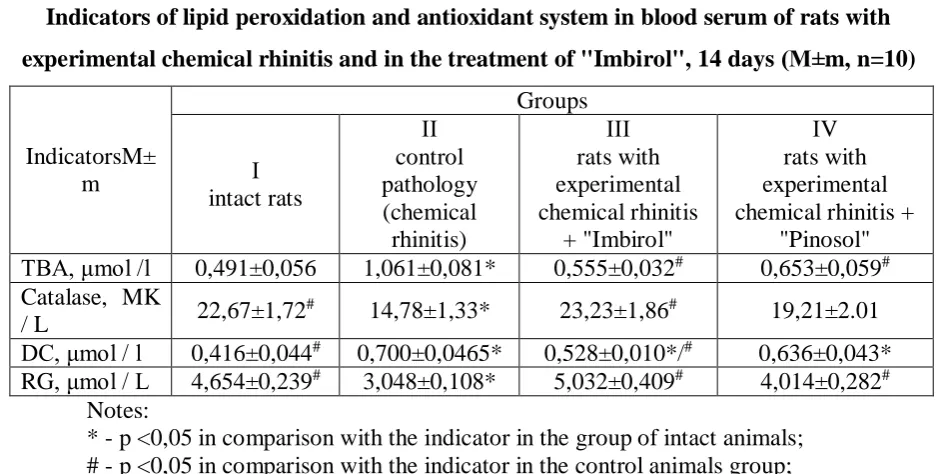
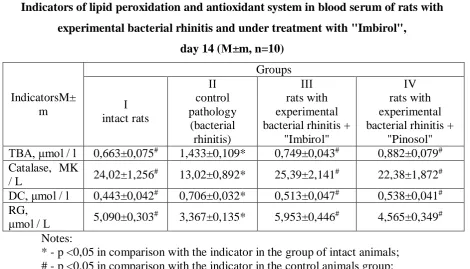
[image:4.595.63.534.318.555.2]oxidative stress at the system level [1, 5]. The results are shown in Table. 1, 2.
Table 1
Indicators of lipid peroxidation and antioxidant system in blood serum of rats with
experimental chemical rhinitis and in the treatment of "Imbirol", 14 days (М±m, n=10)
IndicatorsM± m
Groups
І intact rats
ІІ control pathology (chemical rhinitis)
ІІІ rats with experimental chemical rhinitis
+ "Imbirol"
ІV rats with experimental chemical rhinitis +
"Pinosol" TBА, μmol /l 0,491±0,056 1,061±0,081* 0,555±0,032# 0,653±0,059# Catalase, MK
/ L 22,67±1,72
# 14,78±1,33* 23,23±1,86# 19,21±2.01
DС, μmol / l 0,416±0,044# 0,700±0,0465* 0,528±0,010*/# 0,636±0,043*
RG, μmol / L 4,654±0,239# 3,048±0,108* 5,032±0,409# 4,014±0,282# Notes:
* - p <0,05 in comparison with the indicator in the group of intact animals; # - p <0,05 in comparison with the indicator in the control animals group; n - the number of animals in the group.
The obtained results of the research confirmed the development of oxidative stress in
experimental groups, both in chemical and bacterial rhinitis, according to the data of the LPO.
Thus, peroxide compounds formed under the influence of active forms of oxygen as a result
of oxidation of lipids (major oxidation substrates) in the form of DC and TBА were
significantly increased in serum throughout the experiment and remained at 168.3%, 216.1%
(at chemical), and 159.4%, 216.1% (with bacterial), respectively, in comparison with intact
animals. That is, such data testify to the development of the expressed oxidative stress at the
system level during 14 days of experimental pathology modeling and proves the necessity of
the activity of the AOS during the entire experiment, which did not return to normal even for
14 days. Thus, at the 14th day, in the group with experimental rhinitis, the KAT and RG
indices were -34.8% and -34.4% respectively (with chemical rhinitis), - 45.8% and -33.8%
(with bacterial) in comparable to intact animals. That is, the AOS activity was reliably
throughout the period in a depressed decompensated state and did not reach the indices of the
[image:5.595.65.536.209.478.2]intact group of rats.
Table 2
Indicators of lipid peroxidation and antioxidant system in blood serum of rats with
experimental bacterial rhinitis and under treatment with "Imbirol",
day 14 (М±m, n=10)
IndicatorsM± m
Groups
І intact rats
ІІ control pathology
(bacterial rhinitis)
ІІІ rats with experimental bacterial rhinitis +
"Imbirol"
ІV rats with experimental bacterial rhinitis +
"Pinosol" TBА, μmol / l 0,663±0,075# 1,433±0,109* 0,749±0,043# 0,882±0,079#
Catalase, MK
/ L 24,02±1,256
# 13,02±0,892* 25,39±2,141# 22,38±1,872#
DС, μmol / l 0,443±0,042# 0,706±0,032* 0,513±0,047# 0,538±0,041# RG,
μmol / L 5,090±0,303# 3,367±0,135* 5,953±0,446# 4,565±0,349# Notes:
* - p <0,05 in comparison with the indicator in the group of intact animals; # - p <0,05 in comparison with the indicator in the control animals group; n - the number of animals in the group.
Application of two therapeutic agents with a one-way mechanism of action: the
experimental gel "Imbirol" and "Pinosol" allowed to significantly improve the course of both
chemical and bacterial rhinitis and bring the indexes of LPO and AOS to a dynamic
equilibrium. Maintenance of such a state may be due to a certain organization of plasma and
cellular lipids, the restoration of a dynamic system of exchange of membrane phospholipids
and cholesterol, which determine the lipid level of oxidation of cell membranes. According to
the results of the study there was an improvement in all indicators of LPO for 14 days in the
groups treated. Thus, the TBA and DC values for chemical rhinitis decreased to 113%
(p≥0.05) and 127% (p≤0.05), as compared to the group of rats treated with gel "Imbirol". In
rats of control pathology, these indicators remained steadily high even for 14 days and
Indicators of AOS in the conditions of chemical rhinitis tended to increase activity, as
markers of the body's ability to compensate for pathological shifts in the active forms of
oxygen of a systemic nature. Thus, in the group using "Imbirol" gel, the restoration of
Catalase and RG activity to the level of intact animals was observed: 102.4% and 108.2%
(differences between the groups are statistically insignificant). In the group of animals treated
with "Pinosol" observed similar dynamics, but less expressed.
As can be seen from the results, a similar situation can be established as a result of
bacterial rhinitis. Thus, in the group with control pathology, TBA and DC remained elevated
at 2.61 and 1.6 times (p≤0.05) according to the intact group, Catalase and RG were below the
norm by 46% and 34%. Application of the experimental gel "Imbirol" and "Pinosol" resulted
in the expressed therapeutic effect: there was a partial restoration of the balance of a system of
prooxidant-antioxidant system. Indicators of AOS in groups using gel "Imbirol" and "Pinosol"
fully recovered and increased to normal (р≤0,05).
1. In the pathogenesis of chemical and bacterial rhinitis, the violation of the
antioxidant-antioxidant system is installed at the system level. Application of powerful
universal treatment with gel "Imbirol" in both types of experimental rhinitis contributes to the
normalization of the indicators of the system "peroxidation-antioxidant protection".
2. The applying of the gel "Imbirol" in chemical and bacterial rhinitis reliably led to
the restoration of the excited AOS parameters at the systemic level by reducing the
concentration of TBA and DC and increasing the activity of the enzymes of catalase and RG.
The obtained results allow to continue the study of the influence of antioxidants in
experimental rhinitis, and mechanisms of restoration of the nasal mucosa under the
pharmacological influence of the gel "Imbirol".
References
1. Belenіchev I.F., Kovalenko S.I, Dunaєv V.V., Antioksidanti: suchasne
uyavlennya, perspektivi stvorennya / І.F. Belenіchev, S.І. Kovalenko, V.V. Dunaєv // Lіki. –
2006. – № 1. – S. 35-40.
2. Vybor optimalnogo sredstva dlya mestnogo lecheniya faringita u detej. / Yu. L.
Soldatskij, E. K. Onufrieva, S. F. Gasparyan i dr. // Na dopomogu pedіatru. – 2014. – № 1
(52). – S. 105-108.
3. Korolyuk M.A., Ivanova L.I., Majorova I.G., tokarev V.E.. Metod opredeleniya
4. Levicka, S. A. Patofіzіologіchne znachennya xronіchnix zaxvoryuvan verxnіx і
nizhnіx dixalnix shlyaxіv v rozvitku chastix recidivіv respіratornix vіrusnix іnfekcіj u dіtej. / S. A. Levicka, A. І. Gozhenko, V. V. Buyalo // Aktualnye problemy transportnoj mediciny. –
2014. – № 1 (35). – S. 145-148.
5. Nosova, Ya. V. Razrabotka metoda ekspress-diagnostiki bakterialnoj mikroflory
polosti nosa / Ya. V. Nosova, X. Faruk, O. G. Avrunin // Problemi іnformacіjnix texnologіj. –
Xerson, 2013. – № 13. – S. 99-104.
6. Pul-Luzan, V. V. Razrabotka texnologii gelya dlya lecheniya zabolevanij
verxnix dyxatelnyx putej / V. V. Pul-Luzan, I. I. Baranova, S. A. Mamedova // Farmaciya
Kazaxstana. – 2014. – № 9. – S. 50-54.
7. Rukovodstvo po eksperimentalnomu (doklinicheskomu) izucheniyu novyx
farmakologicheskix veshhestv : metod. rek. / pod red. R.U. Xabrieva. – M. : Medicina, 2005.
– 832 s.
8. Stalnaya I.D., Garishvili T.G. Metod opredeleniya dienovyx konyugatov //
Sovremennye metody v bioximii. – M.: 1977. – S. 43-44.All-natural composite wound
dressing films of essential oils encapsulated in sodium alginate with antimicrobial
properties. / I. Liakos, L. Rizzello, D. J. Scurr et al. // Int. J. Pharm. – 2014. – Vol. 463, № 2.
– P. 137–145.
9. All-natural composite wound dressing films of essential oils
encapsulated in sodium alginate with antimicrobial properties. / I. Liakos, L. Rizzello, D. J.
Scurr et al. // Int. J. Pharm. – 2014. – Vol. 463, № 2. – P. 137– 145.
10. Beutler E,D., Duron O, Kelly BM. Improved method for the determination