Kubaj G. V., Iedinak G. A., Halamandzhuk L. L. The effectiveness of the experimental content of physical education in improving morphofunctional indexes of students of Medical College. Journal of Education, Health and Sport. 2016;6(9):797-804. eISSN 2391-8306. DOI
http://dx.doi.org/10.5281/zenodo.159347
http://ojs.ukw.edu.pl/index.php/johs/article/view/3903
The journal has had 7 points in Ministry of Science and Higher Education parametric evaluation. Part B item 755 (23.12.2015). 755 Journal of Education, Health and Sport eISSN 2391-8306 7
© The Author (s) 2016;
This article is published with open access at Licensee Open Journal Systems of Kazimierz Wielki University in Bydgoszcz, Poland
Open Access. This article is distributed under the terms of the Creative Commons Attribution Noncommercial License which permits any noncommercial use, distribution, and reproduction in any medium, provided the original author(s) and source are credited. This is an open access article licensed under the terms of the Creative Commons Attribution Non Commercial License (http://creativecommons.org/licenses/by-nc/4.0/) which permits unrestricted, non commercial use, distribution and reproduction in any medium, provided the work is properly cited. This is an open access article licensed under the terms of the Creative Commons Attribution Non Commercial License (http://creativecommons.org/licenses/by-nc/4.0/) which permits unrestricted, non commercial
use, distribution and reproduction in any medium, provided the work is properly cited. The authors declare that there is no conflict of interests regarding the publication of this paper.
Received: 02.09.2016. Revised 24.09.2016. Accepted: 24.09.2016.
THE EFFECTIVENESS OF THE EXPERIMENTAL CONTENT OF PHYSICAL EDUCATION IN IMPROVING MORPHOFUNCTIONAL INDEXES OF STUDENTS OF
MEDICAL COLLEGE
G.V. Kubaj, Prykarpattya National Vasyl Stefanyk University, Ukraine G.A. Iedinak, Lviv State University of Physical Culture, Ukraine
L.L. Halamandzhuk, Kamyanets-Podilsky Ivan Ohienko National University, Ukraine
Summary. The effectiveness of the content of physical education of students of medical college has been studied for one academic year through their involvement into systematic physical activity. One of the results of resolving this problem was students’ improvement in morphofunctional indexes. The developed organizational and methodological principles were the basis of the proposed content through the involvement of students of medical college for physical activity during physical education classes. Each position included a set of rules that were performed in a certain sequence during the formation of the content of physical education and its implementation in classes. Proposed development has provided 21 girls and 19 boys significantly better results in solving problems within a year than 58 girls and 35 boys who used the content of physical education that was formed and implemented without specified experimental factor.
Key words: motivation, physical activity, physical education, students of medical college.
Problem statement. The successful solution of the problem of physical education is not possible without formed a youth-type motivation for physical activity, the basis of which are physical exercises [1; 2; 17].The most recent data [3; 4] show that in solving this scientific problem the most promising areas are educational (the formation of knowledge in matters of physically active lifestyles) and realizable (satisfaction by means of physical activity of basic psychological needs of the individual).
of the author's programs that take into account the provisions of this concept [6]. If teacher does not use other means and methods of influence on appropriate motivation, the results of other studies indicate the lack of effectiveness of these programs in the formation of internal motivation of students for systematic implementation of physical activity [4; 9; 16]. The theory of self-determination is proposed to be considered during the classes of physical education due to the latter and indicated incoordination [11–13; 15]. Thus, the activity during these sessions is aimed at satisfaction of psychological needs of students such as independence, competence, integrity in team activities [8; 14].
At the same time the lack of research on the development content of physical education was established, the realization of which would facilitate the involvement of students of medical college for physical activity. Consequently, data on the dynamics of morphological and functional indicators of physical fitness and efficiency of these students by using the specified content in the physical education classes are important. These factors determined the choice of the research direction.
Objectives, structure and methods. The aim of the study was to determine the effectiveness of the experimental content of physical education in improving the morphological parameters of students of medical college. To achieve this goal a set of the following methods was used: general (analysis, summarizing the literature); teaching (molding experiment); biomedical (spirometry, tonometry, dynamometry, pulsometry); mathematical statistics. The experiment involved 79 girls and 54 boys, who were students of a medical College and were a part of the experimental group (EG) and control groups (CG) : there were 21girls and 19 boys in the EG, 58 girls and 35 boys in the CG. For the study of morphological indicators of students, length and weight, vital capacity of lungs (VC), heart rate (HR) at rest, blood pressure (BP systolic and diastolic) and also indexes of power (PI) Ruff'ye (RI) and Robinson (IR) were studied using appropriate methods at the beginning and at the end of the second year of college studying.
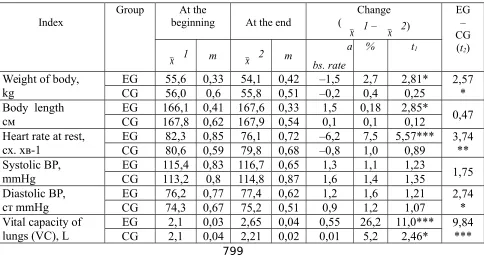
<0.001) improvement in most of the studied parameters of EG and was detected at the baseline in all parameters of CG except VC and LI (Table. 1).
In the EG there was a reduction in body mass on average by 2.7 % year (р <0.05), which was positive, considering the tendency to increase this index among the girls due to the lipid component. At the same time, they improved the heart rate at rest by 7.5 %, which together with the improvement of RI in 6.4 % certified the economization of activities in the rest of the cardiovascular system of the girls. Changing of VC to 26.2 % and LI to 29.6 % indicated the improvement of the respiratory system, namely the ability for once to breathe in more oxygen and to provide it the body.
In CG during the school year the change of values in these parameters was so small, that it allowed to speak about their expression on the output level.
Meanwhile the girls of EG showed a significant development in skeletal muscles: augmentation of PI testified opportunity to gain muscle to accumulate more than 19.2% of the structure redundant energy potential in comparison with that possibility at the beginning of the academic year (р <0.001). In CG the change of
value only proves the tendency to positive changes (р >0.05), which suggested the expression rate achieved in earlier levels.
[image:3.595.79.563.542.797.2]A similar result was obtained in the study of changes in physical health of the girls, except for this: in the EG, the value of RI decreased by 49 %, but this change
Table 1 - Changes in the morphological parameters of girls during the academic year
Index
Group At the
beginning At the end
Change (
¯x 1 – ¯x 2)
EG – CG (t2)
¯x 1 m ¯x 2 m
a bs. rate
% t1
Weight of body, kg
EG 55,6 0,33 54,1 0,42 –1,5 2,7 2,81* 2,57
*
CG 56,0 0,6 55,8 0,51 –0,2 0,4 0,25
Body length см
EG 166,1 0,41 167,6 0,33 1,5 0,18 2,85*
0,47
CG 167,8 0,62 167,9 0,54 0,1 0,1 0,12
Heart rate at rest, сх. хв-1
EG 82,3 0,85 76,1 0,72 –6,2 7,5 5,57*** 3,74
**
CG 80,6 0,59 79,8 0,68 –0,8 1,0 0,89
Systolic BP, mmHg
EG 115,4 0,83 116,7 0,65 1,3 1,1 1,23
1,75
CG 113,2 0,8 114,8 0,87 1,6 1,4 1,35
Diastolic BP,
стmmHg CGEG 76,274,3 0,770,67 77,475,2 0,510,62 1,20,9 1,61,2 1,071,21 2,74*
Vital capacity of
Life index (LI) ml∙kg-1
EG 37,8 0,78 49,0 0,92 11,2 29,6 9,29*** 7,42
***
CG 37,0 0,84 39,6 0,87 2,6 7,0 2,15*
Power index (PI), %
EG 33,8 0,89 40,3 1,03 6,5 19,2 4,78*** 4,18
***
CG 32,7 0,78 34,8 0,82 2,1 6,4 1,86
Ruff'ye (RI) , у. о. EG 9,8 0,12 5,0 0,11 –4,8 49,0 29,5*** 27,9
***
CG 10,0 0,14 10,2 0,15 0,2 –2,0 0,97
Robinson (ІR), у. о. EG 94,9 0,94 88,8 0,99 –6,1 6,4 4,47*** 2,08
*
CG 91,2 0,83 91,6 0,91 0,4 –0,4 0,32
Note. Hereinafter marked difference between the two averages at: «*» – р <0.05; «**» – р <0.01; «***» – р <0.001
was an indicative of a positive result (р <0.001); in CG, the values increased to 0.97 %, that reflected a negative trend in the change of physical health of the girls in that study group.
When comparing the values achieved by the girls at the end of the school year revealed the following: the EG certified a higher level of expression of studied parameters than in KG in all values except the body length and systolic blood pressure, body length and systolic blood pressure in these groups were almost identical. At the same time it noted that regardless of the presence or absence of differences in systolic and diastolic blood pressure the values obtained in the CG and the EG were within the age norm.
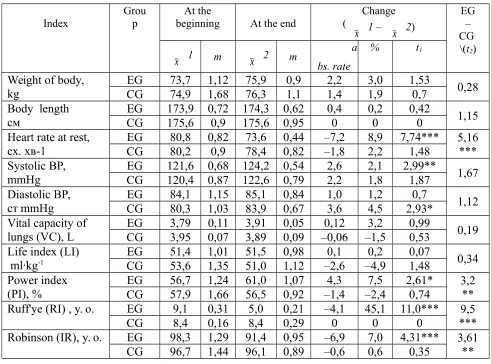
Boys. At the beginning of the academic year value of morphological parameters in experimental groups were almost identical (p> 0.05) at the end -essentially (at the level of p <0.05 to <0.001) different. The indicator values showed the latter, which boys reached at the end of the academic year, such as heart rate at rest, PI, RI and IR(tab. 2).
Table 2 - Changes in the morphological parameters of boys during the academic year
Index
Grou p
At the
beginning At the end
Change (
¯x 1 – ¯x 2)
EG – CG \(t2)
¯x 1 m ¯x 2 m
a bs. rate
% t1
Weight of body,
kg EGCG 73,774,9 1,121,68 75,976,3 0,91,1 2,21,4 1,93,0 1,530,7 0,28
Body length
см EGCG 173,9175,6 0,720,9 174,3175,6 0,620,95 0,40 0,20 0,420 1,15
Heart rate at rest, сх. хв-1
EG 80,8 0,82 73,6 0,44 –7,2 8,9 7,74*** 5,16
***
CG 80,2 0,9 78,4 0,82 –1,8 2,2 1,48
Systolic BP, mmHg
EG 121,6 0,68 124,2 0,54 2,6 2,1 2,99**
1,67
CG 120,4 0,87 122,6 0,79 2,2 1,8 1,87
Diastolic BP,
стmmHg
EG 84,1 1,15 85,1 0,84 1,0 1,2 0,7
1,12
CG 80,3 1,03 83,9 0,67 3,6 4,5 2,93*
Vital capacity of lungs (VC), L
EG 3,79 0,11 3,91 0,05 0,12 3,2 0,99
0,19
CG 3,95 0,07 3,89 0,09 –0,06 –1,5 0,53
Life index (LI)
ml∙kg-1 EGCG 51,453,6 1,011,35 51,551,0 0,981,12 –2,60,1 –4,90,2 0,071,48 0,34
Power index (PI), %
EG 56,7 1,24 61,0 1,07 4,3 7,5 2,61* 3,2
**
CG 57,9 1,66 56,5 0,92 –1,4 –2,4 0,74
Ruff'ye (RI) , у. о. EG 9,1 0,31 5,0 0,21 –4,1 45,1 11,0*** 9,5
***
CG 8,4 0,16 8,4 0,29 0 0 0
Robinson (ІR), у. о. EG 98,3 1,29 91,4 0,95 –6,9 7,0 4,31*** 3,61
**
CG 96,7 1,44 96,1 0,89 –0,6 0,6 0,35
display RI on the output level.
There was a similar change in physical health, except for: in the EG boys RI decreased to 45.1 %, but it was an indication of a positive result (р <0.001); in CG the value remained at the previously achieved level, because it was the same at the beginning and at the end of the academic year.
As can be seen from the above, the use of experimental content of physical education (takes into account the specific organizational and methodical bases) and the content that does not take into account such factors led to different results in the improvement of morphological parameters of students of medical college during the experimental year.
was associated with the obtained result, because only the systematic use of motor activity parameters can ensure the improvement of morphofunctional parameters of young girls and boys of 16-17 years, which were provided by our proposed methodological framework. Two classes per week of physical education under the current program [5] according to CG do not achieve the desired result. The information of other researchers also confirms this fact [6; 14; 16], including the necessity of additional classes per week. In the case of students, including a medical college, indicated is possible only if they use extracurricular time for physical activity. It is real only in case of involvement of students in this type of activity, as defined by psychologists - formed type of inner motivation for such activities.
Conclusions: 1. The use of girls and boys’ groups of experimental content of physical education helped to improve significantly larger number of morphofunctional indexes in them than in the control groups, in which the content did not take into account the experimental factor. 2. Students of experimental groups also achieved a higher level of expression of morphological parameters than control groups of students. The results demonstrate the effectiveness of the experimental content in solving its appointed task, and associated with the involvement of students of medical college for physical activity.
References
1. Dutchak M.V. Conceptual directions of improvement of physical education students and students for implementing a healthy lifestyle // M.V. Dutchak, T. Krutsevych, S.V. Trachuk // Sports Bulletin of Dnieper. - 2010. - № 2. - P. 116--119.
2. Iedinak G.A. Some theoretical and methodological aspects of strengthening students' motivation to systematic physical activity of wellness orientation // Bulletin of the Chernihiv National Pedagogical University. Series: PED. science. Phys. education and sport. – 2014. – Vol. 118(3). – P. 109-113.
sports: math. sci.-pract. conf. April 6-7, 2016, Chernivtsy. - Chernivtsi: Chernivtsi National University, 2016. - P. 24-29.
4. Mazur V.A. Technology to attract students of a special medical group to physical activity while learning at the primary school: Thesis. Dis. for obtaining sciences degree candidate of phys. ed. and sp. [Spec.] 24.00.02 "Physical culture, physical education of different population groups". - Ivano-Frankivsk, 2015. - 20 p.
5. Physical Education. The program for secondary schools. 10-11: Profile level. Level standard. - K. OJSC "Polihrafknyha", 2010. - 127 p.
6. Brehm B.A. Successful fitness motivation strategies. – Windsor: Human Kinetics, 2004. – 188 p.
7. Deci E.L. A motivational of approach to self: integration in personality / E.L. Deci, R.M. Ryan // Perspectives on motivation: Nebraska symposium on motivation. – Lincoln: University of Nebraska Press, 1991. – Vol. 38. – P. 237–288.
8. Llamas L.S. Satisfaction of the basic psychological needs and motivation in physical education : differences by gender and sport practice [in Spanish] / L.S. Llamas, D.Gonzales-Cutre, C.Martinez Galindo, N.Alonso & other / In : Proceedings of the seminar about research perspective in the field of physical education and its faculty / ed. C. Romero. – Granada, Spain, 2007. – 123 p.
9. Moreno J.A. Motivation and performance in physical education: an experimental test / J.A. Moreno, D. González-Cutre, J. Martín-Albo, E. Cervelló // J. of Sports Sci. and Medicine. – 2010. – Vol. 9.1. – P. 79–85.
10. Mowling C.M. Student motivation in physical education : breaking down barriers / C.M. Mowling, S.J. Brock, K.K. Eiler // The Journ. of Physical Education, Recreation & Dance. – 2004. – Vol. 75. – P. 40–45.
11. Ntoumanis N. Motivation in physical education classes : а self-determination theory perspective, M. HYPERLINK "http://tre.sagepub.com/search?
author1=Martyn+Standage&sortspec=date&submit=Submit"Standage // Theory and
Research in Education. – Lawrence, 2011. – Vol. 7. 2. – P. 194–202.
12. Sas-Nowosielski HYPERLINK
perspective of self-determination theory // Human Movement. – Warsaw: Versita,
2008. – P. 134–141.
13. Standage M. A model of contextual motivation in physical education : using construct from self-determination and achievement goal theories to predict physical activity intention / M. Standage, J. Duda, N. Ntoumanis // Jour. Educ. Psychol. – 2003. – № 95 (1). – P. 97–110.
14. Sun H. Middle school students learning and motivation in physical education : а self-determination perspective. – Maryland: University of Maryland, 2007. – 233 p.
15. Theobald M.A. Increasing student motivation : strategies for middle & high school teachers. – California: CorwinPress, 2005. – 145 p.
16. Yli-Piipari S. Relationships between physical education students motivational profiles, enjoyment, state anxiety, and self-reported physical activity / S. Yli-Piipari, A. Watt, T. Jaakkola, J. Liukkonen, J. E. Nurmi // Journ. of Sports Science and Medicine. – 2009. – № 8. – P. 327–336.