Ames Laboratory Publications
Ames Laboratory
8-2009
Systematic Fragmentation Method and the
Effective Fragment Potential: An Efficient Method
for Capturing Molecular Energies
Jonathan Michael Mullin
Iowa State UniversityLuke Roskop
Iowa State University, [email protected]
Spencer Pruitt
Iowa State UniversityMichael A. Collins
Australian National UniversityMark S. Gordon
Iowa State University, [email protected]
Follow this and additional works at:
http://lib.dr.iastate.edu/ameslab_pubs
Part of the
Chemistry Commons
The complete bibliographic information for this item can be found at
http://lib.dr.iastate.edu/
ameslab_pubs/342
. For information on how to cite this item, please visit
http://lib.dr.iastate.edu/
howtocite.html
.
Systematic Fragmentation Method and the Effective Fragment Potential:
An Efficient Method for Capturing Molecular Energies
Abstract
The systematic fragmentation method fragments a large molecular system into smaller pieces, in such a way as
to greatly reduce the computational cost while retaining nearly the accuracy of the parent ab initio electronic
structure method. In order to attain the desired (sub-kcal/mol) accuracy, one must properly account for the
nonbonded interactions between the separated fragments. Since, for a large molecular species, there can be a
great many fragments and therefore a great many nonbonded interactions, computations of the nonbonded
interactions can be very time-consuming. The present work explores the efficacy of employing the effective
fragment potential (EFP) method to obtain the nonbonded interactions since the EFP method has been
shown previously to capture nonbonded interactions with an accuracy that is often comparable to that of
second-order perturbation theory. It is demonstrated that for nonbonded interactions that are not high on the
repulsive wall (generally >2.7 Å), the EFP method appears to be a viable approach for evaluating the
nonbonded interactions. The efficacy of the EFP method for this purpose is illustrated by comparing the
method to ab initio methods for small water clusters, the ZOVGAS molecule, retinal, and the α-helix. Using
SFM with EFP for nonbonded interactions yields an error of 0.2 kcal/mol for the retinal cis−trans
isomerization and a mean error of 1.0 kcal/mol for the isomerization energies of five small (120−170 atoms)
α-helices.
Disciplines
Chemistry
Comments
Reprinted (adapted) with permission from
Journal of Physical Chemistry A
113 (2009): 10040, doi:
10.1021/
jp9036183
. Copyright 2009 American Chemical Society.
Systematic Fragmentation Method and the Effective Fragment Potential: An Efficient
Method for Capturing Molecular Energies
Jonathan M. Mullin,†Luke B. Roskop,†Spencer R. Pruitt,† Michael A. Collins,‡and
Mark S. Gordon*,†
Iowa State UniVersity, Ames Laboratory, Ames, Iowa, and Research School of Chemistry, Australian National UniVersity, Canberra, ACT, AU
ReceiVed: April 20, 2009; ReVised Manuscript ReceiVed: July 9, 2009
The systematic fragmentation method fragments a large molecular system into smaller pieces, in such a way as to greatly reduce the computational cost while retaining nearly the accuracy of the parent ab initio electronic structure method. In order to attain the desired (sub-kcal/mol) accuracy, one must properly account for the nonbonded interactions between the separated fragments. Since, for a large molecular species, there can be a great many fragments and therefore a great many nonbonded interactions, computations of the nonbonded interactions can be very time-consuming. The present work explores the efficacy of employing the effective fragment potential (EFP) method to obtain the nonbonded interactions since the EFP method has been shown previously to capture nonbonded interactions with an accuracy that is often comparable to that of second-order perturbation theory. It is demonstrated that for nonbonded interactions that are not high on the repulsive wall (generally >2.7 Å), the EFP method appears to be a viable approach for evaluating the nonbonded interactions. The efficacy of the EFP method for this purpose is illustrated by comparing the method to ab initio methods for small water clusters, the ZOVGAS molecule, retinal, and theR-helix. Using SFM with EFP for nonbonded interactions yields an error of 0.2 kcal/mol for the retinal cis-trans isomerization and a mean error of 1.0 kcal/mol for the isomerization energies of five small (120-170 atoms)R-helices.
1. Introduction
Electronic structure theory has progressed to the point that it is able to achieve “chemical accuracy” (within∼1 kcal/mol of the experimental values) for predicting the energetics related to chemical processes for small molecules (less than 10 atoms) and to approach chemical accuracy for molecules of moderate size (up to 20 atoms). Modern quantum mechanics (QM) methods can be used to predict structures, relative energies, and on-the-fly dynamics1 for chemical processes of interest. The most commonly used QM methods for these purposes include density functional theory (DFT),2 Hartree-Fock (HF),3 and second-order perturbation theory (MP2). HF is generally used as the starting point for more accurate approaches that include electron correlation, such as second-order perturbation theory (MP2)4 and coupled cluster theory with single, double, and perturbative triple excitations (CCSD(T)).5For systems requiring more than a single electronic configuration, multireference methods such as multiconfigurational self-consistent field (MCSCF),6multireference perturbation theory (MRPT),7 and multireference configuration interaction (MRCI)8are used. All of these correlated methods are computationally demanding, scaling as N5(MP2),N7(CCSD(T)), or exponentially (multi-reference methods), whereNis the number of basis functions. Because correlation corrections converge slowly with basis set improvements, large atomic basis sets9are required to achieve the desired accuracy. This exacerbates the computational demands due to the scaling of these methods. In order to extend the highly accurate methods to significantly larger chemical systems, one needs to develop methods that exhibit better
scaling. There have been many approaches to accomplishing this, including the use of localized molecular orbital (LMO) methods,9-13fast multipole methods (FMM),14-18and fragmen-tation methods in which a large molecular system is fragmented into smaller, more tractable pieces.
Several novel and very promising fragmentation methods have been proposed. Among these are the molecular fragmenta-tion with conjugated caps (MFCC),19the elongation method,20 the molecular tailoring approach (MTA),21generalized energy-based fragmentation (GEBF),22 the fast electron correlation method for molecular clusters developed by Hirata,23 the electrostatically embedded many-body (EE-MB) expansion approach developed by the Truhlar group,24multicentered QM/ QM methods,25the fragment molecular orbital (FMO) method developed by Kitaura, Fedorov, and co-workers,26 and the systematic fragmentation method (SFM).27Early fragmentation models28 built large molecules with a set of fragments from common chemical groups (carboxyl, amino, etc.). More recent fragmentation schemes begin with the full (not fragmented) system of interest and divide it into smaller parts (fragments). An advantage of most modern fragmentation schemes is that they tend to scale linearly with system size, since each fragment can be treated on a separate compute node.
Fragmentation schemes do need to account in some manner for the interactions between a given fragment and the remainder of the original (full) system, that is, the chemical environment. These fragment-environment interactions, which are typically nonbonded interactions between or among fragments that occur in the real system, can become a computational bottleneck. As the size of the system increases, the number of unique fragment -fragment interactions can increase rapidly. If one evaluates these nonbonded fragment-fragment interactions with the desired level of QM theory (e.g., MP2 or CCSD(T)), the computational * To whom correspondence should be addressed.
†Iowa State University. ‡Australian National University.
J. Phys. Chem. A2009,113,10040–10049
10040
demands can rapidly escalate. A common solution to this dilemma is to evaluate the fragment-fragment interactions using a simple electrostatic potential (see, for example, refs 24 and 25). However, simple electrostatics will not necessarily capture all of the contributions to nonbonded interactions, especially at short or intermediate distances, for which induction and disper-sion effects are still important. The present work explores an alternative approach in which the systematic fragmentation method (SFM) for intrafragment terms is combined with the effective fragment potential (EFP) for the nonbonded interac-tions. The EFP method, described briefly below, is a sophisti-cated model potential that has been shown to have the ability to capture intermolecular (i.e., nonbonded) interactions with high accuracy at a fraction of the cost of correlated QM methods. In this work, the SFM is used to fragment molecular systems, to evaluate the energies of the fragments, and to capture the short-range nonbonded interaction energies. The effective fragment potential model29is used to evaluate midrange and long-range nonbonded interaction energies.
Section 2 in this work summarizes the SFM and EFP methods. The computational details are presented in section 3. This is followed by several applications of the combined SFM-EFP method in section 4. Conclusions are drawn in section 5.
2. Systematic Fragmentation Method
In order to study large molecular systems, the systematic fragmentation method (SFM) considers several subsystems, or “groups”, independently. By treating each set of overlapping groups with an accurate level of theory, the total energy of the system, and other properties, may be obtained by addition and subtraction of the contributions from individual groups. This allows SFM to achieve a significant decrease in computational expense while retaining good accuracy when compared to full ab initio calculations. A complete description of the energy of the system is recovered via a perturbative many-body nonbonded term. In the original SFM formulation,25this nonbonded term was obtained using a classical electrostatic potential. In the present work, the EFP method is employed for this purpose, unless the two interacting fragments are too close and therefore the interaction energy is too high on the repulsive wall. The SFM is formally independent of the electronic structure method and the atomic basis set. Scaling approaches linearity as the system size is increased.
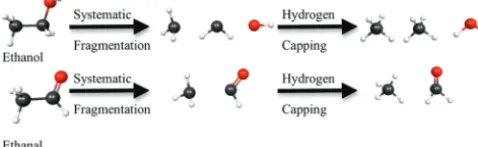
2.1. Background.In general, molecules can be considered to be composed of sets of functional groups that are bonded to each other. In this sense, the “groups” that are employed in the SFM can be thought of as functional groups. To illustrate the SFM, consider ethanol, which contains three functional groups (CH3, CH2, and OH). Figure 1 illustrates the fragmentation of ethanol into its component substituent functional groups by breaking two single bonds. In each case, the bonding pair of
electrons is split, each fragment being assigned one electron from the original bonded pair. A “cap” (hydrogen atom) is applied to the dangling bonds that are created by the fragmenta-tion to avoid the creafragmenta-tion of radical species. Double or triple bonds are not broken; the participating atoms are kept intact as a part of one functional group. A second example in Figure 1 is ethanal, which contains two functional groups (CH3 and CHO). The hydrogen capping yields three molecules, CH4, CH4, and H2O, for ethanol and two molecules, CH4and CH2O, for ethanal.
The SFM may be implemented at several levels of theory; these levels are defined as follows.25b
Consider the moleculeM
At SFM level 1, each broken bond is separated by one functional group Gi. The initial fragmentation would create the following pieces
G2is subtracted in order to conserve the number of atoms. The process of fragmentation is repeated on the G2G3G4G5G6G7G8 fragment until no fragment remains that is larger than two functional groups. The energy of M,E(M), can be approximated by a simple sum of fragment energies. For SFM level 1, this is
The superscript bonded means that nonbonded interactions are not included inE(M) at this point.
At SFM level 2, each broken bond is separated by two functional groups. The energy of M is approximated by the following expression
At SFM level 3, each broken bond is separated by three functional groups. The energy of M is approximated by the following expression
[image:4.598.44.283.47.120.2]The SFM has two formal limitations; the first is that if there is conjugation in delocalized molecular systems (e.g., butadiene), the entire delocalized moiety must remain intact (not frag-mented). The second limitation is that one cannot fragment six-member rings using level 3 because capping hydrogens approach each other too closely. This causes unphysical repulsive interactions. SFM level 2 cannot fragment five-member rings, while four- and three-member rings cannot be fragmented at
Figure 1. Pictorial examples of level 1 fragmentation for ethanol and ethanal. The first step breaks bonds, creating functional groups; hydrogens are capped at a chemically reasonable bond distance in the direction of the broken bond.
M )G1G2G3G4G5G6G7G8 (1)
M ≈G1G2+G2G3G4G5G6G7G8 -G2 (2)
Elevel 1 bonded
(M))E(G1G2)+E(G2G3)+E(G3G4) +
E(G4G5)+E(G5G6)+E(G6G7)+E(G7G8)-E(G2) -E(G3)-E(G4)-E(G5)-E(G6)-E(G7) (3)
Elevel 2 bonded
(M))E(G1G2G3)+E(G2G3G4) +E(G3G4G5)+ E(G4G5G6)+E(G5G6G7)+E(G6G7G8)-E(G2G3)
-E(G3G4)-E(G4G5)-E(G5G6)-E(G6G7) (4)
Elevel 3 bonded
(M))E(G1G2G3G4)+E(G2G3G4G5)+ E(G3G4G5G6)+E(G4G5G6G7) +E(G5G6G7G8)
all. A ring repair rule requires the ring to remain intact and to be considered a functional group itself.
2.2. Hydrogen Caps.When bonds are broken, the electrons are split between the two groups, and a hydrogen atom “cap” is added to both groups. In eq 2, the hydrogen atom (H) capping the G1G2fragment is added at the Cartesian position X[H] as follows
Therefore, the capping hydrogen is placed along the broken G2G3bond. Numerical tests for the optimal choices ofchave been reported previously.27a
2.3. Nonbonded Interactions. A simple sum of the indi-vidual hydrogen-capped fragment energies neglects interactions among the separated (nonbonded) fragments. In the full ab initio calculation, these nonbonded interactions are inherently part of the calculation. By assuming that bonded interactions are greater in strength than nonbonded interactions, a modified many-body expansion may be employed to model the nonbonded interactions. 2.3.1. Two-Body Interactions. Two arbitrary functional groups G1and G2are placed in their positions in the original full molecule M, and their interaction energy is given by
whereE(G1) andE(G2) are the one-body fragment energies and E(G1G2) is the supermolecular energy of the two separated functional groups. All possible pairs of functional groups (not considered in the bonded calculation) are considered in the total two-body nonbonded energy of the system. Therefore, all pairs of arbitrary functional groups (G1, G2) not contained in any one fragment are considered.
2.3.2. Three-Body Interactions.Mutual interactions among three arbitrary functional groups G1, G2, and G3are assumed to be negligible unless two of the groups are bonded to one another. Considering G3bonded to G2yields the three-body interaction energy
In eq 8, the three-body energy is the supermolecular energy,
E(G1G2G3), minus the one-body energies (E(G1), E(G2G3)), minus the two-body nonbonded energy terms containing any group (G1) with either of the bonded functional groups (G2or G3). This scheme can be extended to higher-order nonbonded interactions. Terms up tonth order form the modified many-body approximation. This work only considers two- and three-body interactions.
Addition of the bonded and nonbonded terms yields the total SFM energy
Previous work27b,c has shown that level 3 with nonbonded interactions is needed to achieve high accuracy (1 kcal/mol) compared to fully ab initio calculations.
2.4. Effective Fragment Potential Method.The generalized effective fragment potential (EFP2) method29is a
first-principles-based model potential for the evaluation of intermolecular forces. EFP2 is an extension of the EFP1 water model to general systems.28-31The EFP-EFP interaction consists of five terms for the EFP2 model potential
These terms correspond, respectively, to Coulombic (electro-static), induction (polarization), exchange repulsion, dispersion (van der Waals), and charge transfer. Damping functions are employed for the Coulomb, induction, and dispersion terms to account for short- or long-range behavior. Each of these terms may be thought of as a truncated expansion.
The EFP interactions decay either exponentially with respect to distance for short-range interactions or as (1/R)nfor long-range interactions. The Coulombic, induction, and dispersion are long-range interactions. The exchange repulsion and charge transfer are short-range interactions. A more complete descrip-tion of EFP has been detailed previously;29-33a short overview of the terms is outlined below.
The Coulomb interaction is obtained via the Stone distributed multipolar analysis.34This expansion is truncated at the octopole term. Atom centers and the bond midpoints are used as expansion points.
Induction (polarization) is the interaction of an induced dipole on one fragment with the permanent dipole on another fragment, expressed in terms of the dipole polarizability. Truncating at the first (dipole) term is viable since the molecular polarizability tensor is expressed as a (distributed) tensor sum of localized molecular orbital35 (LMO) polarizabilities. The number of polarizability points is equal to the number of bonds and lone pairs in the system.
An expansion in the intermolecular overlap integral, in a frozen LMO basis, is used to evaluate the exchange repulsion.36 The expansion in terms of frozen LMOs on each fragment allows truncation at the quadratic term. Since the basis set required to compute the exchange repulsion interaction is used only to calculate overlap integrals, the computation is very fast, and quite large basis sets are realistic.
Dispersion interactions are often expressed by an inverseR
expansion
The coefficients Cn may be derived from the (imaginary) frequency-dependent polarizabilities integrated over the entire frequency range.37 The first term in the expansion, n ) 6, corresponds to the induced dipole-induced dipole (van der Waals) interactions. In the EFP2 method, this term is derived from the time-dependent HF method. Additionally the contribu-tion of the n ) 8 term is estimated. The C6coefficients are derived in terms of interactions between pairs of LMOs on the two interacting fragments.
Charge-transfer interactions in the EFP2 method are derived using a second-order perturbative treatment of the intermolecular interactions for a pair of molecules at the Hartree-Fock level of theory.38The energy is evaluated by determining the energy due to the occupied valence molecular orbitals on one fragment interacting with the virtual orbitals on another fragment. Charge transfer can be important for polar or ionic species.
X[H])X[G2]+c{X[G3]-X[G2]} (6)
Enb (1,1)
[G1;G2])E(G1G2)-E(G1)-E(G2) (7)
Enb(1,2)[G1;G2, G3])E(G1G2G3)-E(G1) -E(G2G3)
-Enb (1,1)
[G1;G2]-Enb (1,1)
[G1;G3] (8)
ESFMtotal )Ebonded+Enonbonded (9)
E)Ecoul+Eind+Eexrep +Edisp+Ect (10)
Edisp)
∑
nCnR
-n
(11)
The use of classical approximations for the Coulomb and induction terms requires short-range interactions to be moderated by an additional damping function. A classical (point multipole) Coulombic interaction becomes too repulsive at short-range; this can be corrected by the damping term.39Induction, on the other hand, becomes too attractive at short distances; therefore, a damping term is employed here as well. The form of these damping functions is an exponential which augments the electrostatic multipole of the form
where the parameters R are determined at each multipole expansion point by fitting the damped multipole potential to the Hartree-Fock potential. Damping terms for the electrostatic and induction terms are derived explicitly from the damped potential and the charge density. Short-range dispersion interac-tions should decrease to zero. Therefore, each dispersion term is multiplied by a damping function as well. In the work described here, two damping methods are explored, one due to Tang and Toennies40 and a new approach based on the intermolecular overlap.41
The five EFP interaction terms have different relative costs. Considering small EFP clusters and considering the Coulomb term to be one time unit, the induction interaction would cost approximately one unit, dispersion would cost one unit, exchange repulsion would cost five units, and charge transfer would cost∼50 units. Thus, some trade off between computa-tion time and completeness of the potential may be considered. EFP calculations are basis-set-dependent. The smallest recom-mended basis set is 6-31++G(d,p).42The computational cost of an EFP calculation appears primarily in the initial generation of the EFP, not in EFP-EFP interactions. Therefore, one can employ much larger basis sets with minimal cost. In the tests presented below on the SFM method, the 6-311++G(3df,2p)43 basis is used. EFP contains no empirically fitted parameters, allowing automatic creation by a “makefp” run in the GAMESS44 suite of programs. It has been demonstrated that the EFP2-EFP2 intermolecular (e.g., nonbonded) interaction energies are frequently as accurate as MP2, at a small fraction of the MP2 cost. This suggests the efficacy of determining the SFM nonbonded interactions using this method.
3. Computational Details
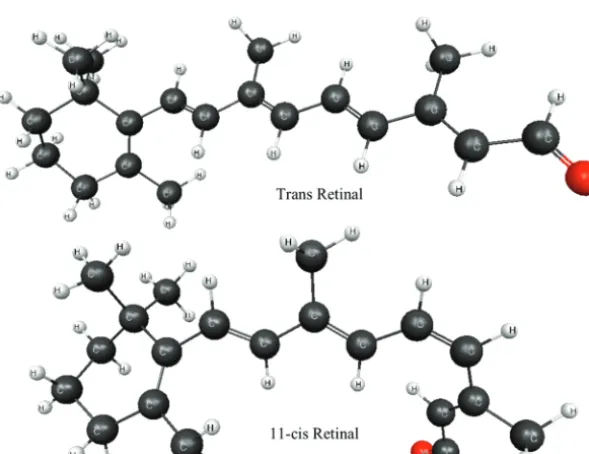
ZOVGAS (Figure 2) is a compound selected from the Cambridge Structural Database (CSD)45containing a combina-tion of several first- and second-row atoms. Therefore, it provides a nice test of the SFM. Comparisons of the performance in determining the SFM nonbonded contribution are demon-strated by calculating the nonbonded interactions via the CCSD(T)4and EFP methods, using the 6-311++G(3df,2p) basis set. Retinal structures (TRETAL02, CRETAL01) shown in Figure 3 are taken from the CSD.
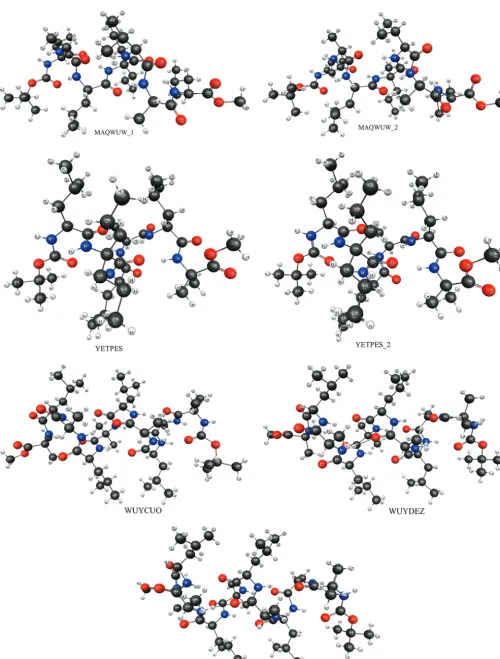
[image:6.598.90.241.45.187.2]The SFM bonded energy is treated at level 3 fragmentation using MP2/6-31++G(d,p) and EFP/6-311++G(3df,2p) for the nonbonded level 3 term. TheR-helix structures (MAQWUW, WUYCUO, WUYDAV, WUYDEZ, YETPES) shown in Figure 4 are taken from the CSD. MP2 calculations on the full system would have been prohibitively expensive, but employing this level of theory for the nonbonded interactions is feasible. The SFM bonded energies are determined at level 3 fragmentation,
[image:6.598.149.444.508.735.2]Figure 2. The ZOVGAS molecule used as a test for EFP nonbonded interactions. The structure is from the Cambridge Structural Database (CSD).
while the EFP/6-311++G(3df,2p) nonbonded interactions are determined with two-body and three-body interactions.
[image:7.598.45.545.36.694.2]The EFP dispersion term has been treated by overlap damping, unless otherwise noted. All EFP terms were used,
Figure 4. Depiction ofR-helix isomers used in Table 5. Structures are from the Cambridge Structural Database (CSD).
including charge transfer for all nonbonded interactions. All calculations were carried out with the GAMESS suite of programs.44
4. Results
4.1. Water Dimers.To evaluate the performance of EFP in capturing nonbonded interactions, consider water-water inter-actions. Shown in Table 1 is a systematic comparison of ab initio versus EFP water dimer nonbonded interactions. The three water dimers (referred to as D1, D2, and D3) that are compared in the table were derived from a water trimer structure whose coordinates are given in the Supporting Information. By comparing EFP interaction energies to energies at the complete basis set (CBS) limit, an accurate gauge of the error present in EFP can be obtained by eliminating any basis set superposition error (BSSE) that might be present in calculations that are performed with incomplete basis sets. The correlation-consistent basis sets were used for this purpose as they are very systematic and can reliably be used to extrapolate to the CBS limit.
Basis sets used in the ab initio calculations were systemati-cally increased (aug-cc-pVXZ9a,h(X)3, 4, 5)) and extrapolated to the CBS limit, while the water EFPs were generated using the 6-311++G(3df, 2p) basis set. EFP interaction energies were evaluated using either Tang-Toennies or overlap damping of the dispersion.
The water-water binding (interaction) energy,Eb(R), can be expressed as
whereERHF(R) andEcorr(R) represent the Hartree-Fock (HF) and correlation energies, respectively. The method used to determine the CBS interaction energies (accurate to∼1 mhar-tree48) extrapolates the HF and correlation energies separately. The HF energy is extrapolated exponentially46
while the correlation energy uses an inverse power expansion47
The HF/CBS energy, obtained with eq 14, used the aug-cc-pVXZ (X)3, 4, 5) energies. The MP2/CBS correlation energy was calculated with eq 15, using the aug-cc-pVXZ (X)4, 5) energies, while the CCSD(T)/CBS correlation energy was obtained using the aug-cc-pVXZ (X)3, 4) energies.48
As is expected, the aug-cc-pVXZ binding energies shown in Table 1 do demonstrate small BSSE. AsXincreases, for both MP2 and CCSD(T), the predicted binding energies decrease slightly as the BSSE diminishes to 0 at the CBS limit. Interestingly, this means that the MP2 and CCSD(T) binding
energies approach the EFP values as the basis set is improved. The EFP interaction energies are in good agreement with those predicted by MP2 and CCSD(T) at the CBS limit. EFP binding energies using Tang-Toennies dispersion damping underesti-mate the CCSD(T)/CBS binding energies by∼0.1-0.2 kcal/ mol. If overlap dispersion damping is used, the error increases slightly to∼0.2-0.3 kcal/mol.
The results in Table 1 also illustrate the effectiveness of EFP in capturing energies that are in agreement with ab initio nonbonded energies calculated with the 6-311++G(3df,2p) basis set. Comparing to energies at the CBS limit, the errors in the interaction energies from EFP are equivalent to those from ab initio results. The accuracy of EFP, as well as the compu-tational efficiency of the method, validates its use in conjunction with the SFM.
4.2. ZOVGAS.The nonbonded energy of ZOVGAS (Figure 2) consists of 129 separate interactions, including one-, two-, and three-body terms. The shortest nonbonded atom-atom distances range from 2.3 to 4.6 Å. Table 2 shows these nonbonded interaction energies calculated using MP2, CCSD(T), and EFP. The two EFP columns in this table differ only in the method that was used for dispersion damping, Tang-Toennies damping in column 3 of the table and the new overlap damping in column 4. The MP2 and CCSD(T) nonbonded interaction energies are in good agreement with each other, while the EFP method overestimates the nonbonded interaction energy. It is clear from the last two columns of the table that the overlap dispersion damping is more reliable, as suggested in ref 41. In Figure 5 the difference between the EFP and CCSD(T) interaction energies is plotted versus the nearest atom-atom distance for each nonbonded pair. As the nearest atom-atom distance decreases, the EFP error relative to CCSD(T) system-atically increases. In general, there is good agreement between EFP and CCSD(T) for nonbonded distances that are larger than 2.7 Å. For longer nonbonded atom-atom distances, the EFP error (Table 2) is small (∼(0.1 mh), and the two damping methods are in good agreement with each other. Therefore, in subsequent SFM calculations, the QM method of choice (e.g., CCSD(T)) is used for nonbonded distances that are 2.7 Å or shorter, while EFP is used for distances longer than 2.7 Å. This is monitored by using a distance cutoff dmin. The use of the overlap dispersion damping is recommended and used in the remainder of the study.
[image:8.598.45.557.53.118.2]Now, consider the possible contribution of BSSE to the CCSD(T)/6-311++G(3df,2p) nonbonded interactions. Since
TABLE 1: Comparsion of the Interaction Energies (kcal/mol) of Three Water Dimers
6-311++G(3df,2p) aug-cc-pVTZ aug-cc-pVQZ aug-cc-pV5Z CBS limit
MP2 CCSD(T) MP2 CCSD(T) MP2 CCSD(T) MP2 CCSD(T) MP2 CCSD(T) EFPa
EFPb
D1 -4.4 -4.4 -4.4 -4.4 -4.3 -4.3 -4.3 – -4.2 -4.2 -4.3 -4.0
D2 -4.9 -4.9 -4.8 -4.8 -4.7 -4.7 -4.7 – -4.6 -4.7 -4.6 -4.4
D3 -4.8 -4.8 -4.7 -4.8 -4.7 -4.7 -4.6 – -4.6 -4.6 -4.6 -4.3
a
Tang-Toennies damping of the dispersion term.b
Overlap damping of the dispersion term.
Eb(R))ERHF(R) +Ecorr(R) (13)
ERHF(R,X) )ERHF(R, CBS)+a(R) -b(R)X
(14)
Ecorr(R,X) )Ecorr(R, CBS)+A(R)X -3
(15)
TABLE 2: Total Nonbonded Energy for ZOVGASa
MP2 CCSD(T) EFPb EFPc
(a) nonbonded -3.38 -4.14 -11.95 -5.96
(b) nonbonded -3.30 -3.77
a
In (a), all nonbonded interactions (kcal/mol) are calculated using the indicated level of theory. In (b), CCSD(T) is used in the EFP column for all nonbonded interactions with separations e2.7
EFP is a model potential, it has no BSSE, while quantum methods using incomplete basis sets can, as noted in section 4.1, suffer from such errors. Ten of the ZOVGAS nonbonded interactions, with atom-atom distances ranging from 2.3 to 4.4 Å, were used to calculate the BSSE corrections. This was done using the standard counterpoise method,49although Truhlar has noted that such corrections can be unreliable.50For these 10 cases, the CCSD(T)/6-311++G(3df,2p) BSSE is of the same order of magnitude as the interaction energy itself. This suggests, as noted in section 4.1, that the differences between EFP and CCSD(T) nonbonded interaction energies might be somewhat ameliorated if one were able to use more complete basis sets for the CCSD(T) calculations.
The origin of the errors in the nonbonded interactions can be assessed by comparing the EFP-EFP interactions with those obtained from symmetry adapted perturbation theory (SAPT).51 For the same set of 10 test interactions noted in the previous paragraph, EFP and SAPT energy decompositions are in good agreement, except for the Tang-Toennies damped dispersion interactions when the atom-atom distances are less than 3 Å. The Tang-Toennies damping with a fixed parameter in the exponent41a may not be adequate to correctly capture the dispersion interactions at short-range. Nonetheless, the agree-ment between CCSD(T) and EFP used only for distances greater than 2.7 Å is excellent.
Table 3 compares the CPU times required to calculate the 129 nonbonded interactions. In this table,dmindetermines which nonbonded interactions are calculated using CCSD(T) and which ones are calculated using the EFP method. Ifdminis infinite, all nonbonded interactions are calculated with CCSD(T). This would be the most time-consuming approach. Ifdmin)0, all
nonbonded interactions are calculated using the EFP method. This would lead to errors at short distances, as noted above. If
dmin)2.7 Å, EFP is used to calculate nonbonded interactions only for pairs of fragments that are separated by greater than 2.7 Å. The calculations were preformed on Power3 II processors running at 375 MHz. As shown in Table 3, fordmin)∞, the calculation required more than 5000 CPU hours, whereas for
dmin )0, the entire nonbonded interaction energy calculation required only∼1 min. Creation of the EFP potentials themselves took just over 4 h for all 37 unique fragments. Therefore, for
dmin)0, the entire nonbonded interaction calculation required just over 4 h. This illustrates why it is attractive to employ the EFP method for the nonbonded interactions. However, as noted above, using the present EFP implementation at very short intermolecular distances can lead to significant errors. The compromise value ofdmin)2.7, which leads to a net interaction energy that is in excellent agreement with dmin)∞, requires ∼500 CPU hours. This is still an order of magnitude less time than that required for dmin ) ∞. As the system of interest increases in size, the efficacy of using the EFP method for most nonbonded interactions will increase since most of the interac-tion distances are likely to be larger than 2.7 Å.
4.3. Retinal.Retinal (See Figure 3) provides a well-known and important example of a cis-trans isomerization. This is a good test system for the combined SFM-EFP method since it can be used to assess the ability of the method to reproduce relative isomer energies. Shown in Table 4 are the (absolute) errors in the SFM cis-trans energy differences calculated with bothdmin)∞and 2.7 Å, relative to the full ab initio calculation. Recall that dmin ) ∞ means that all nonbonded interaction energies are calculated fully ab initio, in this case, MP2/6-311++G(3df,2p). Table 4 illustrates that using EFP for
non-Figure 5. A plot of the 129 nonbonded level 3 interactions of ZOVGAS. The nearest atom-atom distance (Å) is plotted versus the EFP interaction energy minus the CCSD(T) interaction energy. Both the Tang-Tonnies (]) dispersion damping scheme and the overlap (•) dispersion damping
scheme are shown.
TABLE 3: Timings (hours) for Calculating the 129 Interactions in ZOVGASa
dmin)∞b dmin)0c dmin)2.7 Å
hours 5038 4.1 ∼500
a
CCSD(T) was employed for all interactions with nearest atom -atom distances (angstroms) e dmin. bThe dmin ) ∞ represents all
nonbonded interactions treated by CCSD(T)/6-311++G(3df,2p). c
Thedmin)0 represents all nonbonded interactions treated by EFP.
TABLE 4: Absolute Relative Error (kcal/mol) for SFM Level 3 cis-trans Isomerization of Retinal, Compared to Full MP2/6-311++G(3df,2p)
dmin)2.7 Å dmin)∞a
trans-retinal-11-cis-retinal 0.2 0.3
a
Thedmin) ∞ represents all nonbonded interactions treated by
MP2/6-311++G(3df,2p).
[image:9.598.145.448.42.267.2]bonded interactions at fragment-fragment distances greater than 2.7 Å introduces an error of only 0.1 kcal/mol relative todmin ) ∞ and only 0.3 kcal/mol relative to the full MP2/6-311++G(3df,2p) calculation.
4.4. r-Helix.Seven different R-helices (Figure 4) ranging in size from 125 to 170 atoms are examined with the SFM to approximate their total isomer energy differences. Due to the large size of these systems, full MP2 single-point energies (without the SFM approximation) are not feasible. Instead, relative isomer energies are predicted by the SFM with the MP2/ 6-31++G(d,p) level of theory for bothdmin)∞(all nonbonded interactions calculated with MP2) and 2.7 Å. The bonded interaction energies are evaluated at level 3, and the nonbonded interactions either include up to two- or three-body terms (NB )2 or 3).
As shown in Table 5, there is good agreement (error ∼ 0.1-2.1 kcal/mol) betweendmin)∞and 2.7 Å; therefore, EFP and MP2 are in good agreement. There is little difference between the relative energies predicted with NB) 2 and 3. The relative energies shown in Table 5 further validate the use of the EFP method for nonbonded interactions.
5. Conclusions
The nonbonded interactions in the four systems considered here explore a broad range of interaction types that are encountered in organic molecular systems. It is apparent from the results presented here that the EFP method presents a viable way to determine nonbonded interactions in fragmentation methods like the SFM for nearest atom-atom distances larger than 2.7 Å. At shorter nonbonded distances, the EFP method is not as reliable, especially when fixed-parameter (Tang-Toennies) dispersion damping is used. However, it appears that the BSSE in the correlated ab initio calculations can be important if atomic basis sets of modest sizes are used, and this may ameliorate some of the apparent EFP error. The dispersion overlap approach to damping significantly improves the performance of the EFP approach, especially at short intermolecular distances. The prescription presented here, to use the ab initio method of choice for interactions with atom-atom distances e 2.7 Å, yields ∼kcal/mol accuracy with an order of magnitude improvement in the computational cost. Using the EFP method for all nonbonded terms achieves three orders of magnitude improve-ment in the computational cost but does not generally yield kcal/ mol accuracy due to larger errors at short intermolecular distances. Nonetheless, for larger molecular species, the time saved by using the EFP method for nonbonded interactions will increase since the relative number of large nonbonded distances will increase. The combined SFM and EFP approach is a linear scaling method that can be systematically improved by increas-ing the level of fragmentation and nonbonded interactions.
Acknowledgment.This work was supported in part by the Air Force Office of Scientific Research, by the National Science
Foundation, and by the Australian Research Council. Helpful discussions with Dr. Heather Netzloff and Professors Lyudmila Slipchenko and Theresa Windus are gratefully acknowledged. A portion of the research was performed using EMSL, a national scientific user facility sponsored by the Department of Energy’s Office of Biological and Environmental Research and located at Pacific Northwest National Laboratory.
Supporting Information Available: Coordinates of the three water cluster used for EFP basis set superposition error analysis. This material is available free of charge via the Internet at http:// pubs.acs.org.
References and Notes
(1) (a) Stewart, J. J. P.; Davis, L. P.; Burggraf, L. W.J. Comput. Chem. 1987,8, 1117. (b) Maluendes, S. A.; Dupuis, M.J. Chem. Phys.1990,93, 5902. (c) Helgaker, T.; Uggerud, E.; Jensen, H. J. A.Chem. Phys. Lett. 1990,173, 145. (d) Liu, Y.-P.; Lu, D.; Gonzalez-Lafont, A.; Truhlar, D. G.; Garret, B. C.J. Am. Chem. Soc.1993,115, 7806. (e) Taketsugu, T.; Gordon, M. S.J. Phys. Chem.1995,99, 8462. (f) Taketsugu, T.; Gordon, M. S.J. Phys. Chem.1995,99, 14597. (g) Taketsugu, T.; Gordon, M. S.J. Chem. Phys.1995,103, 10042. (h) Gordon, M. S.; Chaban, G.; Taketsugu, T.J. Phys. Chem.1996,100, 11512. (i) Takata, T.; Taketsugu, T.; Hirao, K.; Gordon, M. S.J. Chem. Phys.1998,109, 4281. (j) Wang, J. P.; Meroueh, S. O.; Wang, Y. F.; Hase, W. L.Int. J. Mass Spectrom.2003,230, 57. (k) Wang, Y. F.; Hase, W. L.J. Am. Soc. Mass Spectrom.2003,14, 1402. (l) Chen, W.; Hase, W. L.; Schlegel, H. B.Chem. Phys. Lett.1994,228, 436. (m) Matsubara, T.; Dupuis, M.; Aida, M.Chem. Phys. Lett.2007,437, 138. (n) Matsubara, T.; Dupuis, M.; Aida, M.J. Phys. Chem. B2007,111, 9965.
(2) Hohenberg, P.; Kohn, W.Phys. ReV. B1964,864, 136. (3) (a) Hartree, D. R.Proc. Cambridge Philos. Soc.1928,24, 426. (b) Hartree, D. R.Proc. Cambridge Philos. Soc.1928,24, 111. (c) Hartree, D. R.Proc. Cambridge Philos. Soc.1928,24, 89. (d) Fock, V.Physik. 1930,61, 126. (e) Roothan, C. C.J. ReV. Mod. Phys.1960,32, 179.
(4) Møller, C.; Plesset, S.Phys. ReV.1934,46, 618.
(5) (a) Paldus, J., Wilson, S., Eds. Handbook of Molecular Physics and Quantum Chemistry; Wiley: Chichester, U.K., 2000; Vol. 2, pp 272 -313. (b) Cı´zek, J.J. Chem. Phys.1966,45, 4256. (c) Cı´zek, J.AdV. Chem. Phys.1969,14, 35. (d) Cı´zek, J.; Paldus, J.Int. J. Quantum Chem.1971,
5, 359. (e) Crawford, T. D.; Schaefer, H. F.ReV. Comput. Chem.2000,14, 33.
(6) (a) Roos, B. O.; Taylor, P.; Siegbahn, P. E.Chem. Phys.1980,48, 157 (CASSCF). (b) Ruedenberg, K.; Schmidt, M. W.; Gilbert, M. M.; Elbert, S. T.Chem. Phys.1982,71, 41 (FORS).
(7) (a) Robb, M. Mol. Phys.1981, 44, 173. (b) Langhoff, S. R.; Davidson, E. R.Int. J. Quantum Chem.1974,8, 61.
(8) (a) Roos, B. O.; Andersson, K.; Fulscher, M. K.; Malmqvist, P.-A.; Serrano- Andres, L.; Pierloot, K.; Merchan, M.AdV. Chem. Phys.1996,
93, 219 (CASPT2). (b) Kozlowski, P. M.; Davidson, E. R.J. Chem. Phys. 1994,100, 3672 (MROPT). (c) Hirao, K.Chem. Phys. Lett.1992,190, 374. (d) Hirao, K.Chem. Phys. Lett.1992,196, 397. (e) Hirao, K.Int. J. Quantum Chem.1992,S26, 517. (f) Hirao, K.Chem. Phys. Lett.1993,201, 59 (MRMP2). (g) Nakano, H. J.Chem. Phys.1993,99, 7983. (h) Nakano, H.Chem. Phys. Lett.1993,207, 372 (MCQDPT2).
[image:10.598.46.547.54.126.2](9) (a) Dunning, T. H., Jr.J. Chem. Phys.1989,90, 1007. (b) Xantheas, S. S.; Dunning, T. H., Jr.J. Phys. Chem.1993,97, 18. (c) Dunning, T. H., Jr.; Peterson, K. A.; Wilson, A. K.J. Chem. Phys.2001,114, 9244. (d) Wilson, A. K.; Woon, D. E.; Peterson, K. A.; Dunning, T. H., Jr.J. Chem. Phys.1999,110, 7667. (e) Wilson, A. K.; Woon, D. E.; Peterson, K. A.; Dunning, T. H., Jr.J. Abstr. Pap. Am. Chem. Soc.1997,213, 60. (f) Kendall, R. A.; Dunning, T. H., Jr.; Harrison, R. J.J. Chem. Phys.1992,96, 6796. (g) Woon, D. E.; Dunning, T. H., Jr.J. Chem. Phys.1994,100, 2975. (h) Woon, D. E.; Dunning, T. H., Jr.J. Chem. Phys. 1995,103, 4572. (i)
TABLE 5: Isomerization Energies (kcal/mol) forr-Helices (see Figure 4) using SFM MP2/6-31++G(d,p)a
NB)2 NB)3
isomer dmin)2.7 Å [dmin)∞]b dmin)2.7 Å [dmin)∞]b
MAQWUW_1-MAQWUW_2 -32.5 [-32.9] -31.2 [-32.2]
WUYCUO-WUYDAV -280.6 [-279.2] -272.8 [-270.7]
WUYCUO-WUYDEX 73.4 [73.6] 74.5 [73.5]
YETPES_1-YETPES_2 -90.5 [-90.0] -86.1 [-84.9]
a
Fragmentation level 3 is used with nonbonded level 2 (NB)2) and nonbonded level 3 (NB)3). MP2/6-31++G(d,p) was employed for all nonbonded interactions with nearest atom-atom distances (angstroms)edmin.bThedmin)∞represents all nonbonded interactions treated
Peterson, K. A.; Dunning, T. H., Jr.J. Chem. Phys.2002,117, 10548. (j) G3 Basis: Curtiss, L. A.; Redfern, P. C.; Rassolov, V.; Kedziora, G.; Pople, J. A.J. Chem. Phys.2001,114, 9287. (k) Peterson, K. A.; Adler, T. B.; Werner, H.-J.J. Chem. Phys.2008,128, 084102.
(10) (a) Pulay, P.Chem. Phys. Lett.1983,100, 151. (b) Saebo, S.; Pulay, P.Chem. Phys. Lett.1985,113, 13. (c) Pulay, P.; Saebo, S.Theor. Chim. Acta1986,69, 357. (d) Saebo, S.; Pulay, P.J. Chem. Phys.1987,86, 914. (e) Saebo, S.; Pulay, P.Annu. ReV. Phys. Chem.1993,44, 213. (f) Saebo, S.; Baker, J.; Wolinski, K.; Pulay, P.J. Chem. Phys.2004,120, 11423. (g) Azhary, A. E.; Rauhut, G.; Pulay, P.; Werner, H. J.J. Chem. Phys.1998,108, 5185. (h) Saebo, S.; Pulay, P.Annu. ReV. Phys. Chem. 1993,44, 213.
(11) (a) Murphy, R. B.; Beachy, M. D.; Friesner, R. A.J. Chem. Phys. 1995,103, 1481. (b) Reynolds, G.; Martinez, T.; Carter, E.J. Chem. Phys. 1996,105, 6455. (c) Russ, N.; Crawford, T. D.J. Chem. Phys.2004,121, 691.
(12) (a) Schu¨tz, M.; Hetzer, G.; Werner, H. J.J. Chem. Phys.1999,111, 5691. (b) Werner, H. J.; Manby, F. R.; Knowles, P. J.J. Chem. Phys.2003,
118, 8149. (c) Schu¨tz, M.; Hetzer, G.; Werner, H. J.J. Chem. Phys.2001,
114, 661. (d) Schu¨tz, M.; Hetzer, G.; Werner, H. J.Chem. Phys. Lett.2000,
318, 370. (e) Schu¨tz, M.J. Chem. Phys.2000,113, 9986. (f) Schu¨tz, M.
J. Chem. Phys.2002,116, 8772. (g) Schu¨tz, M.; Rauhut, G.; Werner, H. J.J. Phys. Chem. A1998,102, 5997. (h) Rauhut, G.; Azhary, A. E.; Eckert, F.; Schumann, U.; Werner, H. J.Spectrochim. Acta, Part A1999,55, 647. (i) Schu¨tz, M.; Hetzer, G.; Werner, H. J.J. Chem. Phys.1999,111, 5691. (j) Rauhut, G.; Werner, H. J.Phys. Chem. Chem. Phys.2001,3, 4853. (k) Rauhut, G.; Werner, H. J.Phys. Chem. Chem. Phys.2003,5, 2001. (l) Schu¨tz, M.; Hetzer, G.; Werner, H. J.; Lindh, R.; Manby, F.J. Chem. Phys. 2004,121, 737. (m) Hrenar, T.; Rauhut, G.; Werner, H. J.J. Phys. Chem. A2006,110, 2060. (n) Hampel, C.; Werner, H. J.J. Chem. Phys.1996,
104, 6286.
(13) (a) Lee, M. S.; Maslen, P. E.; Head-Gordon, M.J. Chem. Phys. 2000,112, 3592. (b) Subotnik, J. E.; Head-Gordon, M.J. Chem. Phys.2005,
123, 064108. (c) Subotnik, J. E.; Dutoi, A. D.; Head-Gordon, M.J. Chem. Phys.2005,123, 114108. (d) Subotnik, J. E.; Sodt, A.; Head-Gordon, M.
J. Chem. Phys.2008,128, 034103. (e) Subotnik, J. E.; Dutoi, A. D.; Head-Gordon, M.Phys. Chem. Chem. Phys.2007,9, 5522. (f) Krylov, A. I.; Sherrill, C. D.; Head-Gordon, M.J. Chem. Phys.2000, 113, 6509. (g) DiStasio, R. A.; Jung, Y.; Head-Gordon, M.J. Chem. Theory Comput.2005,
1, 862. (h) Subotnik, J. E.; Head-Gordon, M.J. Chem. Phys.2006,125, 074116.
(14) (a) White, C. A.; Head-Gordon, M.J. Chem. Phys.1994,101, 6593. (b) White, C. A.; Johnson, B. G.; Gill, P. M. W.; Head-Gordon, M.Chem. Phys. Lett.1994,230, 8. (c) White, C. A.; Johnson, B. G.; Gill, P. M. W.; Head-Gordon, M.Chem. Phys. Lett. 1996,248, 482. (d) White, C. A.; Johnson, B. G.; Gill, P. M. W.; Head-Gordon, M.Chem. Phys. Lett.1996,
253, 268. (e) White, C. A.; Head-Gordon, M.Chem. Phys. Lett.1996,257, 647. (f) White, C. A.; Head-Gordon, M.J. Chem. Phys.1996,105, 5061. (g) Challacombe, M.; White, C. A.; Head-Gordon, M.J. Chem. Phys.1997,
107, 10131.
(15) (a) Strain, M. C.; Scuseria, G. E.; Frisch, M. J.Science1996,271, 51. (b) Burant, J. C.; Strain, M. C.; Scuseria, G. E.; Frisch, M. J.Chem. Phys. Lett.1996,248, 43. (c) Burant, J. C.; Strain, M. C.; Scuseria, G. E.; Frisch, M. J.Chem. Phys. Lett.1996,258, 45. (d) Kudin, K. N.; Scuseria, G. E.Chem. Phys. Lett.1998,283, 61. (e) Kudin, K. N.; Scuseria, G. E.
Chem. Phys. Lett.1998,289, 611. (f) Kudin, K. N.; Scuseria, G. E.J. Chem. Phys.1999,111, 2351. (g) Kudin, K. N.; Scuseria, G. E.Phys. ReV. B 2000,61, 5141. (h) Kudin, K. N.; Scuseria, G. E.Phys. ReV. B2000,61, 16440. (i) Kudin, K. N.; Scuseria, G. E.J. Chem. Phys.2004,121, 2886. (16) Choi, C. H.; Ruedenberg, K.; Gordon, M. S.J. Comput. Chem. 2001,22, 1484.
(17) Perez-Jorda, J. M.; Yang, W.J. Chem. Phys.1997,107, 1218. (18) Tobita, M.; Hirata, S.; Bartlett, R. J.J. Chem. Phys.2003,118, 5776.
(19) (a) Zhang, D. W.; Zhang, J. Z. H.J. Chem. Phys.2003,119, 3599. (b) Zhang, D. W.; Xiang, Y.; Zhang, J. Z. H.J. Phys. Chem. B2003,107, 12039. (c) Gao, A. M.; Zhang, D. W.; Zhang, J. Z. H.; Zhang, Y.Chem. Phys. Lett.2004,394, 293. (d) Chen, X. H.; Zhang, D. W.; Zhang, J. Z. H.
J. Chem. Phys.2004,120, 839. (e) Zhang, D. W.; Xiang, Y.; Gao, A. M.; Zhang, J. Z. H.J. Chem. Phys.2004,120, 1145. (f) Chen, X. H.; Zhang, J. Z. H.J. Chem. Phys.2004,120, 11386. (g) Chen, X. H.; Zhang, J. Z. H.
J. Chem. Phys.2006,125, 044903. (h) Xiang, Y.; Zhang, D. W.; Zhang, J. Z. H.J. Comput. Chem.2004,25, 1431. (i) Chen, X.; Zhang, Y.; Zhang, J. Z. H.J. Chem. Phys.2005,122, 184105. (j) Zhang, D. W.; Zhang, J. Z. H.
Int. J. Quantum Chem.2005,103, 246. (k) Mei, Y.; Zhang, D. W.; Zhang, J. Z. H.J. Phys. Chem. A2005,109, 2. (l) Li, S.; Li, W.; Fang, T.J. Am. Chem. Soc.2005,127, 7251. (m) Jiang, N.; Ma, J.; Jiang, Y.J. Chem. Phys.2006,124, 114112. (n) He, X.; Zhang, J. Z. H.J. Chem. Phys.2005,
122, 031103. (o) He, X.; Zhang, J. Z. H.J. Chem. Phys.2006,124, 184703. (p) Mei, Y.; Ji, C.; Zhang, J. Z. H.J. Chem. Phys.2006,125, 094906. (q) Mei, Y.; Wu, E. L.; Han, K. L.; Zhang, J. Z. H.Int. J. Quantum Chem. 2006,106, 1267. (r) Mei, Y.; He, X.; Xiang, Y.; Zhang, D. W.; Zhang, J. Z. H.Proteins: Struct., Funct., Bioinf.2005,59, 489. (s) He, X.; Mei,
Y.; Xiang, Y.; Zhang, D. W.; Zhang, J. Z. H.Proteins: Struct., Funct., Bioinf.2005,61, 423.
(20) (a) Imamura, A.; Aoki, Y.; Maekawa, K.J. Chem. Phys.1991,95, 5419. (b) Aoki, Y.; Suhai, S.; Imamura, A.Int. J. Quantum Chem.1994,
52, 267. (c) Aoki, Y.; Suhai, S.; Imamura, A.J. Chem. Phys.1994,101, 10808. (d) Mitani, M.; Aoki, Y.; Imamura, A.Int. J. Quantum Chem.1995,
54, 167. (e) Mitani, M.; Aoki, Y.; Imamura, A.Int. J. Quantum Chem. 1997,64, 301. (f) Rather, G.; Aoki, Y.; Imamura, A.Int. J. Quantum Chem. 1999,74, 35. (g) Gu, F. L.; Aoki, Y.; Imamura, A.; Bishop, D. M.; Kirtman, B.Mol. Phys.2003,101, 1487. (h) Gu, F. L.; Aoki, Y.; Korchowiec, J.; Imamura, A.; Kirtman, B.J. Chem. Phys.2004,121, 10385. (i) Korchowiec, J.; Gu, F. L.; Imamura, A.; Kirtman, B.; Aoki, Y.Int. J. Quantum Chem. 2005,102, 785. (j) Korchowiec, J.; Gu, F. L.; Aoki, Y.Int. J. Quantum Chem.2005,105, 875. (k) Makowski, M.; Korchowiec, J.; Gu, F. L.; Aoki, Y.J. Comput. Chem.2006,27, 1603. (l) Orimoto, Y.; Aoki, Y.J. Polym. Sci. B: Polym. Phys.2006,44, 119.
(21) (a) Gadre, S. R.; Shirsat, R. N.; Limaye, A. C. J. Phys. Chem. 1994,98, 9165. (b) Babu, K.; Gadre, S. R.J. Comput. Chem.2003,24, 484. (c) Babu, K.; Ganesh, V.; Gadre, S. R.; Ghermani, N. E.Theor. Chem. Acc.2004,111, 255. (d) Gadre, S. R.; Ganesh, V.J. Theor. Comput. Chem. 2006,5, 835.
(22) Li, W.; Li, S.; Jiang, Y.J. Phys. Chem. A2007,111, 2193. (23) (a) Hirata, S.; Valiev, M.; Dupuis, M.; Xantheas, S. S.; Sugiki, S.; Sekino, H.Mol. Phys.2005,103, 2255. (b) Kamiya, M.; Hirata, S.; Valiev, M.J. Chem. Phys.2008,128, 074103. (c) Windus, T. L.; Bylaska, E. J.; Dupuis, M.; Hirata, S.; Pollack, L.; Smith, D. M.; Straatsma, T. P.; Apra`, E. InLecture Notes in Computer Science; Sloot, P. M. A., Abramson, D., Bogdanov, A., Dongarra, J. J., Zomaya, A., GorbachevY., Eds.; Springer: Berlin, Germany, 2003; Vol. 2660. (d) Hirata, S.J. Phys. Chem. A2003,
107, 9887. (e) Hirata, S.J. Chem. Phys.2004,121, 51. (f) Hirata, S.; Zhan, C.-G.; Apra`, E.; Windus, T. L.; Dixon, D. A.J. Phys. Chem. A2003,107, 10154.
(24) (a) Dahlke, E. E.; Truhlar, D. G.J. Chem. Theory Comput.2007,3, 46. (b) Dahlke, E. E.; Truhlar, D. G.J. Chem. Theory Comput.2008,4, 1.
(25) (a) Tschumper, G. S.Chem. Phys. Lett.2006,427, 185. (b) Hopkins, B. W.; Tschumper, G. S.Mol. Phys.2005,103, 309. (c) Hopkins, B. W.; Tschumper, G. S.Chem. Phys. Lett.2005,407, 362.
(26) (a) Kitaura, K.; Sawai, T.; Asada, T.; Nakano, T.; Uebayasi, M.
Chem. Phys. Lett.1999,312, 319. (b) Kitaura, K.; Ikeo, E.; Asada, T.; Nakano, T.; Uebayasi, M.Chem. Phys. Lett.1999,313, 70. (c) Nakano, T.; Kaminuma, T.; Sato, T.; Akiyama, Y.; Uebayasi, M.; Kitaura, K.Chem. Phys. Lett. 2000,318, 614. (d) Kitaura, K.; Sugiki, S.-I.; Nakano, T.; Komeiji, Y.; Uebayasi, M.Chem. Phys. Lett.2001,336, 163. (e) Inadomi, Y.; Nakano, T.; Kitaura, K.; Nagashima, U.Chem. Phys. Lett.2002,364, 139. (f) Nakano, T.; Kaminuma, T.; Sato, T.; Fukuzawa, K.; Akiyama, Y.; Uebayasi, M.; Kitaura, K.Chem. Phys. Lett.2002,351, 475. (g) Fedorov, D. G.; Kitaura, K.J. Phys. Chem. A2007,111, 6904.
(27) (a) Deev, V.; Collins, M. A.J. Chem. Phys.2005,122, 154102. (b) Collins, M. A.; Deev, V.J. Chem. Phys.2006,125, 104104. (c) Netzloff, H. M.; Collins, M. A.J. Chem. Phys.2007,127, 134113.
(28) (a) Christoffersen, R.; Genson, D. W.; Maggiora, G. M.J. Chem. Phys.1971,54, 239. (b) Longuet-Higgins, H. C.; Murrel, J. N.Proc. Phys. Soc.1955,A68, 601.
(29) (a) Gordon, M. S.; Slipchenko, L.; Hui, L.; Jensen, J. H.Annu. Rep. Comput. Chem. 2007,3, 177. (b) Gordon, M. S.; Freitag, M. A.; Bandyopadhyay, P.; Kairys, V.; Jensen, J. H.; Stevens, W. J.J. Phys. Chem. 2001,105, 293.
(30) Day, P. N.; Jensen, J. H.; Gordon, M. S.; Webb, S. P.; Stevens, W. J.; Krauss, M.; Garmer, D.; Basch, H.; Cohen, D.J. Chem. Phys.1996,
105, 1968.
(31) Adamovic, I.; Gordon, M. S.J. Phys. Chem.2005,109, 1629. (32) Webb, S. P.; Gordon, M. S.J. Phys. Chem. A1999,103, 1265. (33) Yoo, S.; Gordon, M. S.J. Chem. Phys.2008,129, 14112. (34) (a) Stone, A. J.; Alderton, M.Mol. Phys.1985,56, 1047. (b) Stone, A. J.The Theory of Intermolecular Forces; Oxford Press: New York, 1996. (35) (a) Edmiston, C.; Ruedenberg, K.ReV. Mod. Phys.1963,35, 457. (b) Raffenetti, R. C.; Ruedenberg, K.; Janssen, C. L.; Schaefer, H. F., III.
Theor. Chim. Acta1993,86, 149.
(36) (a) Jensen, J. H.; Gordon, M. S.Mol. Phys.1996,89, 1313. (b) Murrell, J. N.Proc. R. Soc. London, Ser. A1965,284, 566. (c) Murrell, J. N.J. Chem. Phys.1967,47, 4916.
(37) (a) Adamovic, I.; Gordon, M. S.Mol. Phys.2005,103, 379. (b) Amos, R. D.; Handy, N. C.; Knowles, P. J.; Rice, J. E.; Stone, A. J.J. Phys. Chem.1985,89, 2186. (c) Piecuch, P.Mol. Phys.1986,59, 1085. (38) (a) Li, H.; Gordon, M. S.; Jensen, J. H.J. Chem. Phys.2006,124, 214107. (b) Li, H.; Gordon, M. S.Theor. Chem. Acc.2006,115, 385.
(39) (a) Slipchenko, L.; Gordon, M. S.J. Comput. Chem.2006,28, 276. (b) Freitag, M. A.; Gordon, M. S.; Jensen, J. H.; Stevens, W. J.J. Chem. Phys.2000,112, 7300.
(40) Tang, K. T.; Toennies, J. P.J. Chem. Phys.1984,80, 3726. (41) (a) Slipchenko, L.; Gordon, M. S.Mol Phys., in press. (b) Murrell, J. N.; Teixeira-Dias, J. J. C.Mol. Phys.1970,19, 521.
(42) (a) Hehre, W. J.; Ditchfield, R.; Pople, J. A.J. Chem. Phys.1972,
56, 2257. (b) Francl, M. M.; Pietro, W. J.; Hehre, W. J.; Binkley, J. S.; Gordon, M. S.; DeFrees, D. J.; Pople, J. A.J. Chem. Phys.1982,77, 3654. (c) Hariharan, P. C.; Pople, J. A.Theor. Chim. Acta1973,28, 213.
(43) (a) Hariharan, P. C.; Pople, J. A.Theor. Chim. Acta1973,28, 213. (b) Krishnan, R.; Binkley, J. S.; Seeger, R.; Pople, J. A.J. Chem. Phys. 1980,72, 650. (c) Clark, T.; Chandrasekhar, J.; Spitznagel, G. W.; Schleyer, P. v. R.J. Comput. Chem.1983,4, 294.
(44) (a) Schmidt, M. W.; Baldridge, K. K.; Boatz, J. A.; Elbert, S. T.; Gordon, M. S.; Jensen, J. H.; Koseki, S.; Matsunaga, N.; Nguyen, K. A.; Su, S.; Windus, T. L.; Dupuis, M.; Montgomery, J. A., Jr.J. Comput. Chem. 1993,14, 1347. (b) Gordon, M. S.; Schmidt, M. W.Theory and Applications of Computational Chemistry, the first forty years; Elsevier: Amsterdam, The Netherlands, 2005.
(45) Allen, F. H.Acta Crystallogr., Sect. B2002,58, 380.
(46) (a) Klopper, W.; Kutzelnigg, W.J. Mol. Struct.: THEOCHEM1986,
135, 339. (b) Kutzelnigg, W.Int. J. Quantum Chem.1994,51, 447. (47) (a) Wilson, A. K.; Dunning, T. H., Jr.J. Chem. Phys.1997,106, 8718. (b) Lee, J. S.; Park, S. Y. J. Chem. Phys.2000,112, 10746. (c)
Klopper, W.Mol. Phys.2001,99, 481. (d) Valeev, E. F.; Allen, W. D.; Hernandez, R.; Sherrill, C. D.; Schaefer, H. F., III.J. Chem. Phys.2003,
118, 8594. (e) Varandas, A. J. C.J. Chem. Phys.2007,126, 244105. (f) Varandas, A. J. C.Phys. Scr.2007,76, C28. (g) Varandas, A. J. C.J. Phys. Chem. A2008,112, 1841. (h) Varandas, A. J. C.Theor. Chem. Acc.2008,
119, 511.
(48) (a) Bytautas, L.; Ruedenberg, K.J. Chem. Phys.2005,122, 154110. (b) Kutzelnigg, W.; Morgan, J. D., III.J. Chem. Phys.1992,96, 4484. (c) Halkier, A.; Helgaker, T.; Jørgensen, P.; Klopper, W.; Koch, H.; Olsen, J.; Wilson, A. K.Chem. Phys. Lett.1998,286, 243. (d) Klopper, W.; Bak, K. L.; Jørgensen, P.; Olsen, J.; Helgaker, T.J. Phys. B1999,32, R103. (e) Bytautas, L.; Ruedenberg, K.J. Chem. Phys.2008,128, 214308.
(49) (a) Boys, S. F.; Bernardi, F.Mol. Phys.1970,19, 553. (b) Ostlund, N. S.; Merrifield, D. L.Chem. Phys. Lett.1976,39, 612.
(50) Schwenke, D. W.; Truhlar, D. G.J. Chem. Phys.1985,82, 2418. (51) Jeziorski, B.; Moszynski, R.; Szalewicz, K.Chem. ReV.1994,94, 1887.