The Journal of Teaching Language Skills (JTLS) Vol. 2, No. 3, Fall 2010, Ser. 61/4
(Previously Journal of Social Sciences & Humanities)
An Analysis of English and Persian Academic Written Discourses in Human Sciences: An Evolutionary Account
N. Rashidi ∗
Assistant professor Shiraz University, Shiraz email: [email protected]
H. Ghaffarpour
M.A. in TEFL Shiraz University, Shiraz email: [email protected]
Abstract
The present paper focused on the sociocultural explanations of rhetorical differences between English and Persian and was based on the contrastive genre analysis of Applied Linguistics research article abstracts in these two languages. The evolutionary nature of research article abstracts was also investigated from 1985 to 2005, in three stages, with a time interval of 10 years. Seventy eight research article abstracts were analyzed, forty two of which were taken from two English journals and the rest from two Persian journals.
The levels of generic structure contrasted included rhetorical moves, linguistic structure, and formal and textual layout. The rhetorical moves were investigated using move analysis with reference to Swales CARS (Create A Research Space) model and/ or IMRC (Introduction, Method, Results, Conclusion) Model. For investigating the linguistic features, the aspects of Tense and the use of I/We pronoun were taken into consideration and finally, with regard to the textual and formal layout, the relative length of the steps was probed. The results indicated differences between English and Persian research article abstracts, especially with regard to their evolution.
Keywords: 1. Contrastive Genre Analysis 2. Evolution 3. Move Analysis
–––––––––––––––––––––––––––––––––––––––– Received: 2/20/2010 Accepted: 9/29/2010
∗
1. Introduction
In contrastive rhetorical analysis, academic written discourses in English and other languages are compared. Shaw, Gillaerts, Jacobs, Palermo, Shinohara, and Verckens (2004) in their research have shown the genre validity across cultures in Sweden, Denmark, Belgium, England, Italy and Japan. Moreno (1997) believes that despite a uniformity of research articles imposed by requirements of the genre, there will be significant cultural variation of the rhetorical preferences of national cultures. This further confirms the genre validity across cultures. In fact, several contrastive bodies at research have been done on genres. For example, the Finnish and Spanish rhetoric of economic texts was probed and contrasted with English by Mauranen (1993), and Valero-Garces (1996), respectively; the academic writing of Polish was compared and contrasted with English by Duszak (1998); the genre of English and German astronomical texts was contrasted by Trauth (1990). Some researchers contrasted just specific parts of research articles. For instance, Fallah (2004) has done a contrastive genre analysis on English and Persian Result and Discussion sections of Applied Linguistics research articles and Habibi (2003) has done a descriptive genre analysis of research article Introductions across English and Persian.
Some researchers have focused on contrasting abstracts in two or more languages. Bonn and Swales (2007) have contrasted English and French language sciences journal abstracts. They have found some differences with respect to the linguistic features, formal and textual features and the way the research report is situated. Yakhontova (2006) investigated the cultural and disciplinary variation in academic discourse by using Applied Mathematics abstracts from conference papers in English and Slavic languages. Then the same researcher compared the results of this study with the previous findings of the studies conducted on the corresponding Applied Linguistics abstracts. The features compared included the rhetorical moves, using Swales' CARS Model, and their textual distribution, the paragraph organization of texts, the syntactic structures of titles and the use of the pronouns I / We. Significant differences were found between the two disciplines. Martin (2003) has conducted a study contrasting English and Spanish research paper abstracts in experimental social sciences, using move analysis and found some degree of convergence between the two languages. Leonor (2001) investigated intercultural, interdisciplinary differences in English and Spanish with attention to linguistic and textual features, following Swales’ CARS Model. A piece of research done by Busch-Lauer (1995) highlights the effect of culture on abstract genres; German medical abstracts written by native German speakers and native English speakers were contrasted considering their length, move structures and linguistic aspects. The results indicated some differences between the abstracts in the two languages.
All these studies found some degree of divergence between the two contrasted languages.
generic values within the more standardized genres. He also believes that genres might change because of promotional factors that cause mixing of generic values from a utilitarian view point of genre construction, interpretation and use. Swales (1990), while confirming the importance of this evolutionary pattern, states that like all living genres, the research article is continually evolving and future developments may find part of their explanation in the present or previous rhetorical practices. Bhatia (1997) investigated genre evolution in the Introduction sections and Ayers (2008) investigated the evolutionary nature of genre in abstracts of the research article in scientific journal of Nature. Ayers indicated an evident concern for the “general reader” and a “democratization” of science, after investigating this evolutionary pattern.
This paper investigates how abstracts with the same genre but in different languages, here English and Persian, are different in comparison. In other words, does language make any difference in the patterns these abstracts follow?
2. Method 2.1 Selection of the corpus
One hundred and fifty six research articles were chosen for the purpose of the present study. Out of these articles, 84 were from English journals on Language Teaching and Linguistics, namely, TESOL Quarterly and Language Learning Journal. From each journal 42 articles were chosen. They were selected from every ten years; that is 1985, 1995 and 2005; hence, 14 articles from each year. The Persian journals were Humanities and Social Science Journal of Shiraz University and Humanities and Social Science Journal of Tehran University from which articles related to Language Teaching and Linguistics were chosen. The selected years correspond to those of the selected English articles. Twelve article abstracts were taken from each year, which made a total of 72 Persian article abstracts.
and scholars in the field and also their availability. Additionally, the ten-year time interval might suffice for the probable changes to emerge.
2.2 Procedure
Three levels of generic structure in the texts contrasted were considered in the study. These levels were linguistic features, formal and textual layout, and rhetorical moves, with the focus on differences existing among them. According to Yakhontova (2006), these three levels of investigation correspond to the Bakhtininan version of genre based on which genre is the inseparable unity of thematic content, compositional structure and style that are equally determined by specific nature of the particular domain of communication.
With regard to the linguistic features, tense and the use of the pronouns I/ We were investigated. The main concern of the formal and contextual layout was with the relative length of the steps. For investigating rhetorical moves the move analysis was applied.
According to Cross and Oppenheim (2006) move is closely related to the concept of macrostructure. The moves represent the main themes of the text and aid the reader in selecting and understanding the different meaning units contained therein. Moreover, the individual move has its own communicative function to fulfill which in turn serves the major communicative purpose of the genre. Hence, each abstract is made of several moves with different functions. Once a move is determined, its communicative functions can be defined further and subcategorized into what is called steps (Swales, 1990).
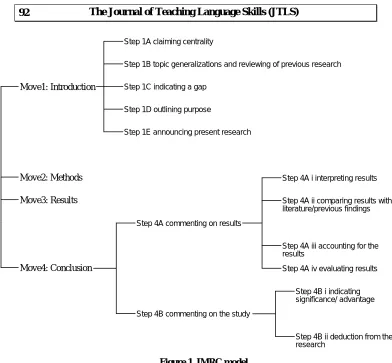
Figure 1. IMRC model
Move1: Introduction
Move2: Methods
Step 1A claiming centrality
Step 1B topic generalizations and reviewing of previous research
Step 1C indicating a gap
Step 1D outlining purpose
Step 1E announcing present research
Move3: Results
Move4: Conclusion
Step 4A commenting on results
Step 4B commenting on the study
Step 4A i interpreting results
Step 4A ii comparing results with literature/previous findings
Step 4A iii accounting for the results
Step 4A iv evaluating results
Step 4B i indicating significance/ advantage
The data were collected, codified, and analyzed by the researchers. In order to make certain if their codifications possessed rater reliability, the researchers asked two other researchers to do the codification. Then, the two codifications were compared to find the consistency over them. The comparison confirmed a high consistency as there was almost a complete overlap between the codifications. Meanwhile, the comparison of the codifications of the two researchers of the study indicated a high level of consistency. In other words, there was a nearly complete overlap between the codifications.
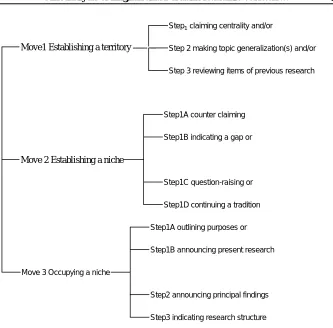
Move1 Establishing a territory
Step1 claiming centrality and/or
Step 2 making topic generalization(s) and/or
Step 3 reviewing items of previous research
Step1B indicating a gap or Step1A counter claiming
Step1C question-raising or
Step1D continuing a tradition
Move 3 Occupying a niche
Step1A outlining purposes or
Step1B announcing present research
Step2 announcing principal findings
Step3 indicating research structure
Move 2 Establishing a niche
3. Results and Discussion 3. 1 Deciding upon moves
First of all, the rhetorical moves in the texts under analysis were identified and appropriate statistical data was accumulated. It is worth mentioning that one may not find a well-defined borderline between the steps and moves and this makes it, at times, difficult, if not impossible, to differentiate between the two (Ayers, 2008). This is less surprising if we consider how these sections in full articles can overlap. For example, both the introduction and conclusion of an article can contain background information, and the study's hypothesis and objectives (Swales, 1990). Likewise, Ruiying and Allison (2003) note that the results and conclusion moves both present, summarize and comment on results. Therefore, as asserted by Ayers (2008) moves and steps might be regarded as
tendencies rather than clear-cut divisions.
As can be inferred from Table 1, both in English and Persian, there has been an increase in the tendency to adhere to IMRC Model of abstracts except for the second period. This tendency has grown more rapidly for the Persian writers. Nevertheless, as shown in the table, English abstracts showed more conformity with this model than the Persian ones, with the conformity level of 62.5%, 37.5%, and 75% for English abstracts and 30%, 30%, and 46.06% for the Persian ones in each period.
Table 1: The conformity levels of the English and Persian abstracts with IMRC Model in 1985, 1995 and 2005.
Years English Persian 1985 62.5% 30% 1995 37.5% 30%
2005 75% 46.06%
period, there were more variation in move structures. In addition to those present in the previous stage IR, IMIRC and a cyclic move of IMRMRC appeared. However, in the next stage, this expanding variation stopped transferring to the next stage, with only IRC, I, IMC move structures existing apart from the basic IMRC structure. However, in Persian, there was consistently a tendency towards the decrease in the number and variation of move structures, with the exception of the move structure No.1 which was always present. In the first stage, various structures were conceivable such as IMC, I, IM, IRC, IC, IMR; this range of variation decreased in the second stage with the disappearance of IMC structure. In the third stage, R became obligatory too. Among the 17 investigated abstracts of the third stage, there were 8 instances with IMR, and one instance of IR structure and the rest with IMRC structure.
On the whole, adherence to IMRC model in English was more frequent in all years studied. While Persian displayed a steady growth throughout all years conforming to this model, English abstracts did not show a specific evolutionary pattern of conformance to IMRC model.
3. 2 Signaling of steps and their tenses
One example of English abstract, along with one example of Persian abstract, is presented below to demonstrate how the steps were decided upon.
Conversational styles in language proficiency interviews (Taken
from Young 1995)
(Introduction: step 1E) This study compares the conversational
styles of intermediate and advanced learners of ESL in language proficiency interviews. (Method: participants and instrument) Eleven intermediate learners and 12 advanced learners participated in a regular administration of the Cambridge First Certificate in English oral
interview. (Method: technique)I analyzed interview discourse
and faster than intermediate learners), in the extent of context dependence (advanced learners elaborated more in answers to questions), and in the ability to construct and sustain narratives (advanced learners did so, intermediate learners did not). There were no differences between the two groups in the frequency of initiation of new topics, nor in the reactivity to topics introduced by the interviewers. Interviewers did not vary in their interviewing style with the two groups. (Conclusion: step
4Aii) Some of these findings contradict what designers of language
proficiency interviews claim to be proficiency-related differences between NNSs. (Conclusion: step 4Aiii) The discrepancies may be due to the format of the interview and/or to differing expectations of the interview by interviewers and NNSs from different cultures.
"xæta yabi" be ?onvan-e ?æbzari dær jæhæt-e tæhlil væ bærresi-ye zæban-e "beinabeini" ( Taken from Taj aldini, 2006)
(introduction, step 1E) tæhqiq ba ?in færziyye suræt gerefte ?æst ke dær suræti ke zæban ?amuz qader (Research with this hypothesis has
been done that in the case that language learner able ) be tæshxis-e
xætaha-ye mowjud dær yek ?azmun-e "tæshxis-e xætaha-ye dæasturi" næshævænd, in ?ehtemal ( to recognize error existing in a test of "
recognition of errors of grammatical" not be, this probability) vojud
daræd ke ?anha dær towlid niz be tekrar-e hæman xætaha pærdaxte væ be?ælave dær bær tæræf ( is that they in the production too repeat the
same errors and additionally in correcting) nemudæn-e ?anha niz ?æz
doshvari-ye bishtæri bærxordar bashænd. (method)103 daneshju-ye reshte-ye ( them too from difficulty more have. 103 learner field of )
zæban molzæm be vakonesh be yek ?azmun-e "tæshxis-e xætaha-ye zæbani" shodænd væ bæ?d ?æz ( language obliged to react to a test
of recognition errors linguistic were and after ) tæjziye væ tæhlil-e
pasoxha moshæxxæs shod ke (result) daneshjuyan dær shenasa?i-ye bærxi ?æz (analyzing the answers clear was made that students in
shenasai-ye bærxi digær natævan budænd. (conclusion), (the errors
successful were but in recognizing some other unable have been.)
(step 4A1) ba ?enayæt be mænbæ?-e ?in xætaha mohæqqeq be ?in
nætije ræsid ke xætaha?i ke mænbæ?-e ( with attention sources of
errors the researcher concluded thaterrors that source of ) ?anha do
zæbane mæhsub migærdæd, ?æz doshvari-ye bishtæri dær tæshxis bær xordar bude dær halike (them bilingual considered to be , from difficulty
more in recognizing have while) xætaha-ye mænsub be yek mænbæ?
dær meqyas-e væsi?tæri mowred-e tæshxis væ shenasa?i qærar (errors attributed to one source in scales larger recognized and noticed have)
gerefte?ænd. dær næhayæt, ?ertebati bein-e tæfavotha-ye saxtari-ye do zæban, mizan væ mafhum-e ( been .Finally, relation between
differences structural two languages, the rate and the meaning) doshvari
dær zæban ?amuzi, væ dær næhayæt ?ædæm-e sobat-e qævanin-e dæsturi-ye zæban-e mæqsæd ( of difficulty in language learning, and
finally lack of stability of rules grammatical language target) ?ijad
shode ? æst.(created has been.)
In the following sections the reflections of the moves and steps in the corpus are given.
3.2.1 The introduction move
The introduction move serves the reader with sufficient background information to grasp the topic or to establish the field. This is achieved through various steps introduced previously in the paper. The first step is Step 1_ Claiming Centrality. Claiming Centrality is defined by Swales (1990), as stating interest or importance by referring to the classic or central character of the issue or claiming that there are many investigators active in the field.
Step 3 is Indicating a Gap. For this step in English just Present Perfect is used while in Persian both Present Perfect and Present tenses are applied. In the introduction of full papers, the information in steps 1, 2 and, 3 also serves to help establish a niche for the about-to-be-presented research.
Step 4, Outlining the Purpose, helps the reader to focus on the primary objective of the research and is generally signaled by the infinitive, or by past tense in the majority of cases, in English; but in Persian, first, there had been a tendency to use present perfect to indicate the purpose but later, the past and the present tense were used more frequently.
Step 5, Announcing Present Research, on the other hand serves to front a paper’s main achievement. In this step, in English, Present tense is mostly used with some instances of Past tense; however the tendency to use the Present tense augments gradually. Nonetheless in Persian, Present Perfect, Present, and Past tense have been used, with Past tense being the most dominant in all three stages but with no evolutionary implications. This is the most frequently used step of the Introduction move both in English and Persian, with 85.42 percent of occurrence in English and 60.53 percent in Persian.
3.2.2 The method move
This move illustrates how information is provided about the method as an integral part of a paper. Usually the Method move in this field consists of Participants, Instruments, and Techniques with respect to the requirements of the specific research. In English, the Past tense has been the most prevalent tense being used with some instances of Present tense. In Persian, a mixture of Present, Present Perfect, and Past tense is used, but an increase from 25% to 75% in the tendency toward using Past tense more frequently has emerged.
3.2.3 The result move
time. In Persian, in addition to Past and Present tenses, Present Perfect has been used; however, there has been a growing tendency in using Past tense recently with 70.59 percent of cases using Past tense in the third stage. What is more noticeable in Persian is that this move has emerged as an obligatory move more recently, while previously, there were some instances where no Result was present, and some times the Results were incorporated in the Discussion section or Introduction section, which are the steps of Announcing Present Research. Nevertheless, in English, nearly all cases (91.67 % of cases) have had this move included in abstracts, with no observable evolutionary pattern.
3.2.4 The conclusion move
In some instances the distinction between Result and Conclusion moves was difficult; the move with more interpretations was identified as the Conclusion move. The Conclusion move consists of two main steps: Commenting on Results and Commenting on the Study.
For commenting on results the researcher might interpret results, compare results with literature/ previous findings, account for results or evaluate the results.
Both in English and Persian, the tendency toward interpreting the results has increased in the third stage, compared to the first and the second stage, using both Present and Past tense in English and Present, Past and Present, and Perfect tense in Persian.
For comparing the results with literature in English both Present and Past tenses have been used. But in Persian there has been just one instance of comparing the results with literature and Present tense has been employed.
Accounting for results is less common in Persian than English. The major tense used has been the Present tense.
Evaluating results is more frequent in Persian than in English and the only tense used both in English and Persian has been Present
3.3 CARS model
A noteworthy point to mention is that both in English and Persian in earlier abstracts the Swales’ CARS Model of Introduction was followed in many abstracts, but later in the third stage, in most cases, the only suitable model seemed to be the IMRC Model.
3.4 Length of the steps
The length of the steps does not convey a significant difference between English and Persian or an evolutionary pattern. That seems to conform to the need of the research article. However, one can observe an increase in the length of the Method move both in English and Persian. This increase occurs perhaps because the writers feel that more information on how the results are going to be obtained is needed to be conveyed.
3.5 Use of the pronoun I/ we
In Persian no instance of the usage of I/ We has been observed, while in English there has been 10 instances of ‘I’, in 6 abstracts and 11 instances of ‘we’, in 4 abstracts. An increase in the usage of these pronouns was observed with no instance in the first stage, 4 ‘I’s in the second stage and 6 ‘I’s and 11 ‘we’s in the third stage.
4. Conclusion
the first stage while at the same stage in English 62.5 percent of cases adhere to this pattern.
None of the moves were obligatory in the first and second stage whereas in the third stage the Introduction appears consistently in all abstracts. In the research done by Ayers (2008), the Results has been the obligatory move in the period considered. This difference might be due to the disciplinary differences as Ayers research dealt with Science and in Science the results are of the noticeable importance though they may be incorporated into Conclusion move and make no independent move; however, in Humanities a presentation of what has been done and what is going to be done in the present research is important. In some cases, the study is not experimental but it is just a review with the researcher's comments. In Persian, in addition to Introduction, Results became established in the third or the final stage perhaps on demand of the kinds of research related. This occurs to experimental types of research not to the ones that are of review- like types.
Steps: in the Introduction move, the tendency to outline the purpose occurs more in Persian with 52 percent than in English with 33 percent of the cases of the Introduction move containing the related step. This might indicate that the Persian writers tend to justify what they want to do more than the English writers.
The most prevalent step of the Conclusion is Deduction from the Research, both in English and Persian. It is important for the researcher to state the use of the research by implications and the gaps that are sometimes left to be filled by suggestions for further research. Additionally, the Result has become an obligatory move recently in Persian. That might further confirm the move of abstracts toward the standard.
Tense: tense variation is generally more observable in Persian than in English. It seems that the Persian writers act in a freer framework of tenses. The tenses they usually use are Present, Past and Present Perfect. The reason for the Persian writers' application of these tenses might be that they think this way the information and their intentions can be best presented. This seems to be a subjective choice.
Use of the Pronoun I/ We: this is where the differences between English and Persian are the most conspicuous. English abstracts, increasingly, tended to put emphasis on the writer while in Persian there is a total lack of ‘self-promotion’, to use the term by Yakhontova (2006). This might find explanations in the cultural differences. Noticing this increasing tendency to use these personal pronouns in English one can ask if English moves toward a new standard.
Although with various insights, contrastive rhetorical research has raised several questions, the most significant of them is how to interpret the differences found and explain them on the basis of the possible influencing factors. Three major perspectives are taken with this regard which can roughly be grouped into academic discourse community factors, influences of sociohistorical and sociopolitical circumstances, of national intellectual styles, and finally, of the possible correlation between language structure and grammatical norms.
interpretations varying from sociopolitical factors to merely intralinguistic peculiarities, which according to Yakhontova (2006) are assumed to interplay and leave their joint imprints upon the texts created within different linguistic and cultural environments. Another explanation of the differences or similarities is in the light of possible correlation between language and structures or the styles; however, this explanation is less prevalent.
Whichever perspective is taken it is manifest that the role of the potential factors influencing the writing differences remains one of the most contested issues in contrastive rhetoric.
One can conclude that the complexities of a genre and the evolutionary changes which can occur need to be taken into consideration when teaching genre conventions to apprentices and when applying generalized models in research, especially if the models are taken from the literature.
Finally, the results of the study can contribute to the developments of English for Specific Purposes (ESP). In writing courses, EFL teachers can benefit from the results of the study in the way that the learners are made aware of both the discipline and language discrepancy in regards of rhetorical structures.
References
Ayers, G. (2008). The evolutionary nature of genre: An investigation of the short texts accompanying research articles in scientific journal nature. English for Specific Purposes.27(1), 22-41.
Bhatia, V. (1997). Genre-mixing in academic introduction. English
for Specific Purposes, 16(3), 181-195.
Bonn, S. & Swales, J. (2007). English and French journal abstracts in the language science: Three exploratory studies. Journal of English for
Academic Purposes, 6(2), 93-108.
Busch-Lauer, I. A. (1995). Abstracts in German medical journals: A linguistic analysis. Information Processing and Management: An
Cross, C., & Oppenheim, C. (2006). A genre analysis of scientific
abstracts. Journal of Documentation, 62(4), 428-446.
Duszak, A. (1998). Academic writing in English and Polish: comparing and subverting genres. International Journal of Applied Linguistics, 8(2), 191-213.
Fallah, S. (2004). A contrastive genre analysis of result and discussion sections of applied linguistic research articles written by English and Persian native speakers' respect to evaluated entities and
ascribed values. Unpublished master's thesis, Tarbiat Moa'lem
University, Tehran, Iran.
Habibi, P. (2003). Descriptive genre analysis of research article introductions across sociolinguistics, psycholinguistics ,and ESP.
Unpublished master's thesis, Tarbiat Moa'lem University, Tehran, Iran. Leonor, P. R. (2001). Linguistic and rhetorical contrastive analysis of medical and linguistic journal abstracts: contrasting abstracts written
in English and Spanish. Doctoral dissertation, Universidad de Valladolid,
Spain. Publication number AAT 3044857. (retrieved from ProQuest, Document ID 726344461).
Lores, R. (2004). On RA abstracts: From rhetorical structures to thematic organization. English for Specific Purposes, 23, 280-302.
Martin, P. M. (2003). A genre analysis of English and Spanish research paper abstracts in experimental social sciences. English for
Specific Purposes, 22, 25- 43.
Mauranen, A. (1993). Contrastive ESP rhetoric: Metatext in Finnish-English economic texts. English for Specific Purposes, 12(1), 3-22.
Moreno, A. I. (1997). Genre constraints across languages: Causal metatext in Spanish and English RAs. English for Specific Purposes, 16(3), 161-179.
Ruiying, Y., & Allison, R. (2003). Research articles in applied linguistics: Moving from results to conclusions. English for Specific
Shaw, P., Gillaerts, P., Jacobs, E., Palermo, O., Shinohara, M., & Verckens, J. P. (2004). Genre across cultures: Types of accessibility variation. World Englishes, 23(3), 385-401.
Swales, J. (1990). Genre analysis. English in academic and
research settings. Cambridge: Cambridge University Press.
Taj aldini, M. (2006). "Error analysis" as a tool of investigation and study of "interlanguage". The Journal of Social Science and Humanities
of Shiraz University 23(1), 91-106.
Trauth, G. P. (1990). German and English academic genre: A contrastive study of astronomical sublanguage and discourse.
Dissertation, University of California, Berkeley, United States. Publication number AAT 9103900. (Retrieved from Pro Quest, document ID 744612011).
Valero-Garces, G. (1996). Contrastive ESP rhetoric: Metatexts in Spanish and English economic texts. English for Specific Purposes, 15(4), 279-294.
Yakhontova, T. (2006). Cultural and disciplinary variation in academic discourse: The issue of the influencing factors. Journal of
English for Academic Purposes, 5(2), 153-167.