RESEARCH
Production of the versatile cellulase
for cellulose bioconversion and cellulase
inducer synthesis by genetic improvement
of
Trichoderma reesei
Jia Gao
†, Yuanchao Qian
†, Yifan Wang, Yinbo Qu and Yaohua Zhong
*Abstract
Background: The enzymes for efficient hydrolysis of lignocellulosic biomass are a major factor in the development of an economically feasible cellulose bioconversion process. Up to now, low hydrolysis efficiency and high production cost of cellulases remain the significant hurdles in this process. The aim of the present study was to develop a versatile cellulase system with the enhanced hydrolytic efficiency and the ability to synthesize powerful inducers by geneti-cally engineering Trichoderma reesei.
Results: In our study, we employed a systematic genetic strategy to construct the carbon catabolite-derepressed strain T. reesei SCB18 to produce the cellulase complex that exhibited a strong cellulolytic capacity for biomass sac-charification and an extraordinary high β-glucosidase (BGL) activity for cellulase-inducing disaccharides synthesis. We first identified the hypercellulolytic and uracil auxotrophic strain T. reesei SP4 as carbon catabolite repressed, and then deleted the carbon catabolite repressor gene cre1 in the genome. We found that the deletion of cre1 with the selecta-ble marker pyrG led to a 72.6% increase in total cellulase activity, but a slight reduction in saccharification efficiency. To facilitate the following genetic modification, the marker pyrG was successfully removed by homologous recombina-tion based on resistance to 5-FOA. Furthermore, the Aspergillus niger BGLA-encoding gene bglA was overexpressed, and the generated strain T. reesei SCB18 exhibited a 29.8% increase in total cellulase activity and a 51.3-fold enhance-ment in BGL activity (up to 103.9 IU/mL). We observed that the cellulase system of SCB18 showed significantly higher saccharification efficiency toward differently pretreated corncob residues than the control strains SDC11 and SP4. Moreover, the crude enzyme preparation from SCB18 with high BGL activity possessed strong transglycosylation ability to synthesize β-disaccharides from glucose. The transglycosylation product was finally utilized as the inducer for cellulase production, which provided a 63.0% increase in total cellulase activity compared to the frequently used soluble inducer, lactose.
Conclusions: In summary, we constructed a versatile cellulase system in T. reesei for efficient biomass saccharifica-tion and powerful cellulase inducer synthesis by combinasaccharifica-tional genetic manipulasaccharifica-tion of three distinct types of genes to achieve the customized cellulase production, thus providing a viable strategy for further strain improvement to reduce the cost of biomass-based biofuel production.
Keywords: Trichoderma reesei, Cellulase, cre1, β-Glucosidase, Transglycosylation, β-Disaccharides
© The Author(s) 2017. This article is distributed under the terms of the Creative Commons Attribution 4.0 International License (http://creativecommons.org/licenses/by/4.0/), which permits unrestricted use, distribution, and reproduction in any medium, provided you give appropriate credit to the original author(s) and the source, provide a link to the Creative Commons license, and indicate if changes were made. The Creative Commons Public Domain Dedication waiver (http://creativecommons.org/ publicdomain/zero/1.0/) applies to the data made available in this article, unless otherwise stated.
Open Access
*Correspondence: [email protected]
†Jia Gao and Yuanchao Qian contributed equally to this work
Page 2 of 16 Gao et al. Biotechnol Biofuels (2017) 10:272
Background
Lignocellulosic biomass, especially from crop and forest residues, is among the most abundant, but under-utilized resources on Earth [1, 2]. It is now gaining wide atten-tion as a sustainable source for producatten-tion of environ-ment-friendly biofuels such as cellulosic ethanol [3, 4]. Cellulolytic enzymes produced by microorganisms play a key role in the bioconversion process, but the cost of enzymes remains one of the major hurdles to the devel-opment of an economically viable cellulosic ethanol on an industrial scale [5]. The filamentous fungus Tricho-derma reesei has the ability to secrete large amounts of cellulolytic enzymes, and thus is the main industrial source for cellulase production. The cellulolytic system of T. reesei, which can efficiently degrade insoluble cel-lulose into glucose, comprises three classes of enzymes: cellobiohydrolases (CBHs), endoglucanases (EGs), and β-glucosidases (BGLs) [6]. In addition, lytic polysaccha-ride monooxygenases (LPMOs) are a recently discov-ered class of enzymes capable of oxidizing recalcitrant cellulose substrates and boosting the activity of classical cellulolytic enzymes [7, 8]. However, these enzymes are conditionally expressed, and one of the master regulators is the Cys-2/His-2 (C2H2) zinc finger transcription factor Cre1, which mediates the carbon catabolite repression (CCR) [9]. It downregulates the expression of enzymes involved in the catabolism of carbon sources other than the preferred ones such as glucose, and most of these enzymes are belonging to the cellulolytic enzymes [10]. In fact, the hypercellulolytic mutant RUT-C30 derived from the wild-type strain QM6a has a truncated version of Cre1, which is one of the main causes for the improved cellulase production [11]. Further deletion of the cre1
gene could significantly elevate expression of the cel-lulolytic enzymes under both inducing and noninducing conditions [12]. Therefore, Cre1 represents a valid engi-neering target to improve cellulase production in T. reesei
[10].
In the T. reesei cellulolytic system, BGL could hydrolyze cellobiose to glucose in the final step of cellulose degra-dation and relieve the feedback inhibition of cellobiose on CBHs and EGs [13, 14]. It is generally recognized that the insufficiency of BGL in this cellulase complex is one of the bottlenecks in efficient cellulose hydrolysis [15, 16]. Therefore, a major challenge in the biomass conversion is obtaining the optimal amount of BGL to complete the cellulose hydrolysis [17, 18]. Supplementation of the T. reesei cellulase preparation with external BGL has been shown to improve glucose production from cellulose degradation, but additional complexity is also introduced due to the in vitro preparation of BGL [19, 20]. Recently, construction of engineered strains by overexpressing homologous and heterogenous bgl genes has been the
preferred strategy to address this problem [21–23]. The endogenous bgl1 gene under the control of different strong promoters was transformed into T. reesei, and the transformants displayed BGL activities ranging from 0.48 to 8.30 IU/mL [15, 18, 23]. Particularly, the BGL enzymes from several Aspergillus and Penicillium species were reported to exhibit relatively higher specific activities, and studies have shown that heterogenous expression of these genes in T. reesei could significantly increase BGL activity (up to 34.31 IU/mL), resulting in the enhanced efficiency of cellulose hydrolysis [20, 24].
In addition, majority of cellulases in T. reesei are adap-tive enzymes, and their full expression requires the pres-ence of an inducer. Although cellulose can be used as the cellulase-inducing carbon source, cellulose itself is practically unable to trigger the induction because of its insolubility [25]. Currently, one acceptable model for cellulase induction is that the extracellular cellulose is hydrolyzed by the constitutive cellulases to release small amounts of cello-oligosaccharides such as cellobiose, acting as inducers for the further large-scale synthesis of cellulases [26]. However, high cost of pure celluloses such as Avicel and low mycelial growth with cellulose as carbon source make cellulase production cost very high [27, 28]. Soluble β-disaccharides, including sophorose and lactose, are found to be not only the suitable carbon sources but powerful inducers for cellulase production in
T. reesei [29–31]. Nevertheless, sophorose rarely exists in nature, and is extremely expensive to manufacture and purify, thus limiting its industrial application for cellu-lase production [30, 31]. Lactose is easily available but less effective in cellulase induction than sophorose [28, 30, 32]. A growing number of studies have shown that BGLs possess the transglycosylation property, besides the hydrolytic activity, to synthesize sophorose [25, 33, 34]. For example, the purified β-glucosidase Td2F2 and the commercial β-glucosidase from A. niger (NS50010) were reported to catalyze transglycosylation to produce sophorose, cellobiose, and gentiobiose at high concentra-tion of glucose [28, 35]. Specifically, Li et al. confirmed that the cellulase activity of T. reesei RUT-C30 could be remarkably enhanced by using the transglycosylation product as inducer [28]. However, this type of inducer is obtained from purified or commercial enzymes, which would increase the production cost [36]. Therefore, con-struction of the T. reesei-engineered strains with high β-glucosidase activity would contribute to synthesizing the soluble cellulase-inducing oligosaccharides for low-cost production of cellulases.
for strain improvement [18]. In this study, multiple gene manipulations, including deletion of cre1, elimination of the marker gene pyrG, and overexpression of the A. niger
BGLA-encoding gene bglA in T. reesei SP4, were adopted. The cellulase complex produced by the engineered strain SCB18 exhibited remarkably high BGL activity (103.9 IU/ mL), which was 51.3-fold higher than that of its parental strain. Subsequently, it was not only used for efficient sac-charification of cellulosic substrates, but also applied to synthesize β-disaccharides directly from glucose through the transglycosylation reaction, which were further uti-lized as inducers for cellulase production.
Results and discussion
Deletion of the carbon catabolite repressor gene cre1 in T. reesei SP4
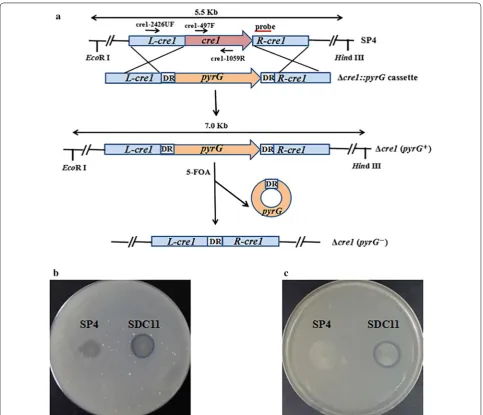
Cre1 and its homologs are known to be the master regu-lators of carbon assimilation in filamentous fungi, allow-ing the cell to prefer the assimilation of carbon sources of high nutritional value over others [9, 37]. In the cel-lulolytic fungi, Cre1 has been shown to be a key repres-sor involved in cellulase gene expression [12, 38, 39]. Based on previous studies, most of the hypercellulolytic mutant strains are carbon catabolite derepressed, such as T. reesei RUT-C30 and PC-3-7 [11, 40]. In this study, the hypercellulolytic T. reesei strain SP4 was found to be carbon catabolite repressed and contained the full-length Cre1-encoding gene cre1 (Additional file 1: Figure S1). To relieve the genes encoding the cellulolytic enzymes from CCR in T. reesei SP4, the Δcre1::pyrG cassette was constructed and transformed into SP4 to delete cre1 via replacing it with the A. niger pyrG marker gene (Fig. 1a). The generated Δcre1 (pyrG+) strain SCP11 was
ana-lyzed through amplification of the full-length and inter-nal fragments of the cre1 gene (Additional file 2: Figure S2a), and the absence of cre1 was further confirmed by its growth phenotype on the media containing 0.5% Avi-cel and 1.0% glucose (data not shown). The EcoR I/Hind III-digested genomic DNA was hybridized with the cre1
probe for further Southern blot assay, which yielded a 7.0-kb fragment for the strain SCP11 and a 5.5-kb frag-ment for the parental strain SP4 (Additional file 2: Fig-ure S2b). These results suggested that the cre1 gene was successfully knocked out in SCP11. To facilitate further strain improvement via genetic manipulation, the marker gene pyrG was required to be removed, which could be done by homologous recombination between two direct repeats in the Δcre1::pyrG cassette. Here, SCP11 was grown on resistance to 5-FOA to excise the pyrG
marker gene (Fig. 1a). Finally, the Δcre1 (pyrG−) strain
SDC11 was achieved, which was found to have lost the
pyrG gene in the genome via PCR analysis with the prime pair, pyrG-F/pyrG-R (Additional file 1: Figure S1a). To
confirm that SDC11 is a uracil auxotrophic strain, SDC11 was grown on minimal media (MM) plates with or with-out uracil (Additional file 1: Figure S1b, c). It was found that SDC11 and the control strain SP4 could grow well on MM plates with uracil, but no colonies were formed without uracil, while its parental strain SCP11 could grow well on MM plates with or without uracil. These results indicated that the pyrG marker gene was success-fully excised in the SDC11 genome, and the SDC11 strain regained the uracil auxotrophy. To further test whether T. reesei SDC11 is also carbon catabolite derepressed, it was grown on the MM plates containing Avicel and glucose or only Avicel as the carbon sources (Fig. 1b, c). In both plates, clear cellulolytic halos were observed around the colonies of SDC11, but the control strain SP4 could not exhibit any cellulolytic halo, indicating that SDC11 was carbon catabolite derepressed. In addition, deletion of
cre1 led to relatively lower radial growth rate, fewer aerial hyphae, and less production of spores in T. reesei SDC11 compared with SP4 (data not shown). It was reported that the absence of cre1 could significantly affect the colony morphology of T. reesei QM6a whether in the glucose-containing medium causing catabolite repres-sion or in the medium inducing cellulase expresrepres-sion [12]. Besides, decreased growth rate and reduced sporulation were also exhibited in the A. niger ΔcreA mutant, where the CreA-encoding gene creA, the homolog of T. reesei cre1, was disrupted [41]. Collectively, these results illus-trated that the carbon catabolite repressor gene cre1 in T. reesei was successfully deleted in the strain SDC11.
Cellulase production and its cellulolytic potential in biomass saccharification by T. reesei SDC11
Page 4 of 16 Gao et al. Biotechnol Biofuels (2017) 10:272
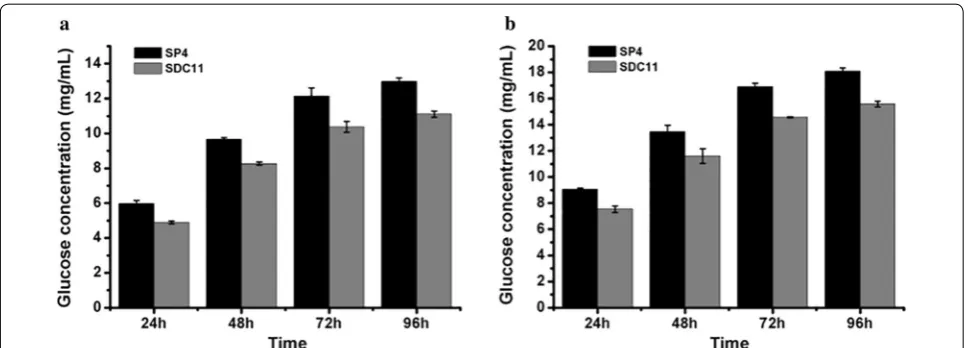
this improvement was not related to the fungal growth rate. Then, the saccharification potential of the SDC11 enzyme for converting cellulosic materials was examined. Two types of pretreated corncob materials, the acid-pretreated corncob residue and the delignified corncob residue, were adopted for enzymatic hydrolysis at 50 °C and pH 4.8 for 96 h. The amounts of glucose released from these two materials by SDC11 and SP4 observably increased with time increasing from 24 to 96 h. How-ever, with equal FPA loading, the released glucose by the SDC11 enzyme was lower than that for SP4. Specifi-cally, in the saccharification of acid-pretreated corncob residue, the released glucose by SDC11 at the end of
substrate, the delignified corncob residue, contained little lignin (3.2%) after pretreatment [43]. Thus, the amount of released glucose via enzymatic hydrolysis of the acid-pretreated material was significantly lower than that of
Page 6 of 16 Gao et al. Biotechnol Biofuels (2017) 10:272
that of SP4. The main reason for the discrepancy between the cellulase activity and the saccharification efficiency was probably due to the relatively reduced amount of extracellular BGL in the cellulase complex, as the ratio of BGL activity to FPA in SDC11 was 0.57, which was lower than that in SP4 (0.68). The lower BGL ratio in SDC11 was further confirmed by renaturing SDS-PAGE analysis with equal FPA loading (Additional file 3: Figure S3).
In filamentous fungi T. reesei and N. crassa, Cre1/ CRE-1 functions as a global transcription factor and affects gene expression directly or indirectly [44, 45]. The functions of enzymes encoded by the Cre1/CRE-1-reg-ulated genes include lignocellulosic biomass-degrading, nitrogen-uptaking, developmental processes, chromatin remodeling, and so on [46]. In this study, the CBH activ-ity of the control strain SP4 was remarkably reduced compared to that of SDC11 (Fig. 2c). The reason might be that Cre1 could bind to two closely spaced 5′ -CCC-CAC-3′ motifs in the cbh1 promoter region and then directly represses cbh1 transcription in the cre1+ strain
but not in the Δcre1 strain [46, 47]. Moreover, cbh2 is found to be not Cre1 regulation dependent as some evi-dences indicate that CCR is only conferred by double Cre1-binding sites and only a single putative Cre1-bind-ing site exists in the cbh2 promoter region in T. reesei [39, 48–50]. However, Cre1 could indirectly suppress cbh2
expression via regulating Xyr1, the major activator of the cellulase-encoding genes [50]. Thus, the CBH activity in SDC11 could be speculated to be enhanced due to the absence of Cre1. The transcriptional regulation of egl1
is shown to be strictly dependent on Xyr1 and repressed by Cre1 indirectly, like cbh2 [39, 49]. Therefore, deletion of cre1 also caused the significant enhancement of EG
activity in SDC11 (Fig. 2b). Besides, studies have indi-cated that bgl1 encoding the extracellular β-glucosidase BGL1 is also suppressed by Cre1 indirectly [48, 49, 51]. Furthermore, the absence of cre1 in the hypercellulolytic strain QM9414 resulted in a significant increase in the amount of BGL [51]. In this study, the BGL activity in the Δcre1 strain SDC11 constructed was also improved (Fig. 2d), which was in accordance with the above-men-tioned reports. In our previous study, BGL activity was positively correlated with the cellulose conversion and had a dramatic influence on the enzymatic hydrolysis of corncob residues [15, 18]. Therefore, the relatively reduced ratio of BGL activity to FPA in the cellulase com-plex produced by SDC11 caused the decreased sacchari-fication efficiency toward the cellulosic materials (Fig. 3).
Construction of the A. niger BGLA‑overexpressing strain SCB18 and characterization of its cellulase production Although T. reesei is one of the best fungal cellulase producers, the amount of BGL secreted by this fun-gus is insufficient for effective hydrolysis of cellobiose, thus resulting in the inhibition of the production in the
T. reesei enzyme system [52]. Due to this restriction on saccharification imposed by deficiency of BGL, the effi-ciency of enzymatic hydrolysis cannot be improved much by increasing enzyme loading. In general, enzymatic saccharification of biomass with considerable efficiency can be acquired by supplementation of the commercial
A. niger BGL, such as Novozym 188 preparation [19]. Sukumaran et al. evaluated the applications of T. reesei
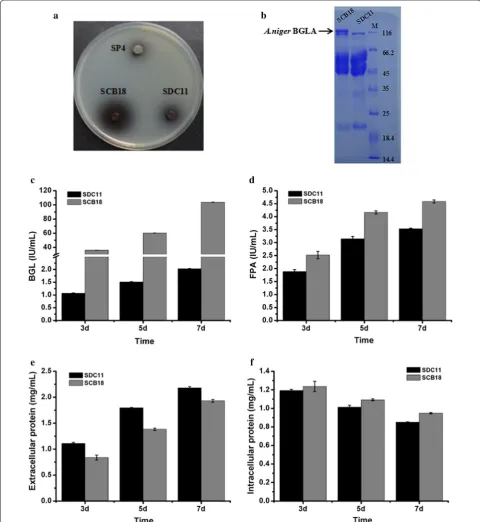
It is found that A. niger BGL has a tadpole-like structure consisting of catalytic domain (CD) and fibronectin III-like domain (FnIII) connected by a long linker and exhib-its less adsorption onto lignin than T. reesei BGL, which indirectly facilitates enzymatic hydrolysis of cellulose due to increased hydrolysis of cellobiose that in turn accu-mulates and inhibits CBHs/EGs [54, 55]. Here, to over-come the lack of BGL in the SDC11 enzyme system, an overexpressing cassette containing the A. niger bglA gene under the control of the T. reesei cbh1 promoter was con-structed and co-transformed with the pyrG+DR frag-ment into T. reesei SDC11 (Additional file 4: Figure S4a). The ability of the candidate transformants to secrete BGL was first detected by screening on CMC-esculin plates (data not shown). And one transformant, SCB18, which showed much larger black zone around the colony than its parental strain SDC11, was selected (Fig. 4a). Then it was verified through PCR amplification of the chimeric fragment spanning the cbh1 promoter and the bglA gene with primer pair cbh1-1138UF/bg-R as well as the inter-nal fragment of the bglA gene with primer pair bg-F/bg-R (Additional file 4: Figure S4b). To investigate the capacity to secrete cellulase, SCB18 was grown on the MM plates containing Avicel and glucose or only Avicel as the car-bon sources (Additional file 4: Figure S4c, d). In both the plates, clear cellulolytic halos were observed around the colony of SCB18 and its parental strain SDC11, but the control strain SP4 (glucose repression-sensitive) could not exhibit any cellulolytic halo. To further analyze its cellulase production ability, SCB18 was fermented in CPM for 7d, and the fermentation broth was used for cellulase activity assay. First, SDS-PAGE analysis was applied to detect the secreted proteins from the fun-gal strains. A clear band of approximately 120 kDa (the expected molecular weight of A. niger BGLA), which was not present in SDC11, was observed in the secreted proteins of SCB18 (Fig. 4b). This result indicated that the
A. niger bglA gene was successfully expressed in SCB18. In accordance with the above result, the BGL activ-ity of SCB18 was significantly improved and reached up to 103.9 IU/mL at the end of fermentation, which was 51.3-fold higher than that of its parental strain SDC11 (Fig. 4c). In this study, A. niger BGLA was overexpressed under the control of T. reesei cbh1 promoter that is a strong promoter for endogenous/heterogeneous pro-teins production [56]. In addition, it was known that A. niger BGL had much higher specific activity (198.5 IU/ mg) toward pNPG than that of T. reesei (88.5 IU/mg) [57, 58]. These may be the reasons behind the improve-ment of BGL activity in SCB18. In our previous study, the native bgl1 gene was overexpressed using a modi-fied cbh1 promoter in T. reesei SP4, and a BGL activity
of 8.3 IU/mL was obtained in the recombinant strain [18]. Ma et al. reported that the P. decumbens bgl1 gene was successfully expressed under the control of the cbh1
promoter in T. reesei RUT-C30, and the recombinant strain exhibited a BGL activity of 34.3 IU/mL [20]. To our knowledge, the BGL activity (103.9 IU/mL) produced by SCB18 is the highest BGL activity reported for T. reesei. Furthermore, T. reesei SCB18 provided a 29.8% higher FPA activity (4.6 IU/mL) than that of the parental strain SDC11 (3.5 IU/mL) (Fig. 4d). This result is consistent with the recent reports that high BGL activity could pro-mote hydrolysis of the filter paper substrate [59–61]. The comparison of BGL activity and cellulase titer achieved in this study to those produced by other T. reesei BGL-overexpressing strains is highlighted in Additional file 5: Table S1. While the amount of total secreted protein was detected, SCB18 produced 11.4% decrease compared with SDC11 (Fig. 4e). In addition, the growth rate of SCB18, which was measured by detecting the total intra-cellular protein, was slightly higher than SDC11 (Fig. 4f). Consequently, the cellulase preparation of SCB18 exhib-ited extremely high specific BGL activity and also pos-sessed demonstrable cellulolytic ability.
Saccharification of corncob substrates by the cellulase preparation from T. reesei SCB18
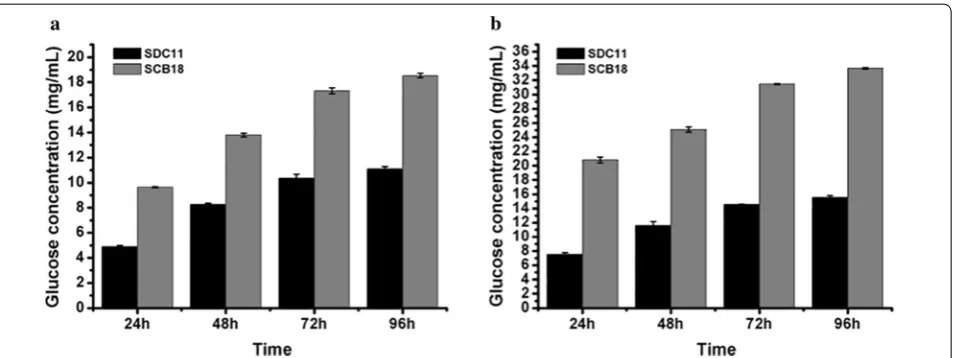
Page 8 of 16 Gao et al. Biotechnol Biofuels (2017) 10:272
produced by T. reesei SCB18, which was obtained through a two-step gene-manipulation process contain-ing deletion of cre1 and overexpression of A. niger BGLA,
exhibited superior performance on saccharification of differently pretreated corncob substrates, indicating its potential applications in cellulose bioconversion.
β‑Disaccharides synthesis by the crude enzyme
preparation from T. reesei SCB18 using glucose as substrate Many researches have proven that BGLs from different sources, in addition to possessing the property of hydro-lyzing cellobiose, could catalyze the formation of more complex β-oligosaccharides in vitro through transglyco-sylation reaction using a wide range of substrates such as glucose, cellobiose, and gentiobiose [63–65]. However, these BGLs present transglycosylation activity only when the concentration of the substrates is relatively high [66– 68]. In order to investigate the transglycosylation capacity of the fermentation broth produced by T. reesei SCB18, which held an extraordinary BGL activity (103 IU/mL), the transglycosylation assay was performed with different concentrations of glucose [10, 20, 40, 60, and 80% (w/v)] as substrates. The transglycosylation reaction was con-ducted at 65 °C and pH 4.8 for 3d. As shown in Fig. 6a, the glucose conversion rate was significantly improved with the concentration of glucose increasing from 10 to 60%, while the conversion rate of 80% glucose was lower than that of 60% glucose. Notably, the glucose conversion rate reached the highest value (17.6%) when transglyco-sylation reaction was performed with 60% glucose for 2d. Then, TLC assay was applied to further analyze the trans-glycosylation product after 2-d reaction. As shown in Fig. 6b, two β-disaccharides, sophorose and gentiobiose, were the main products regardless of the concentration of glucose, and their amounts increased with the increased concentration of glucose from 10 to 60%. Cellobiose could also be observed when the concentration of glu-cose was more than 40%. In accordance with the gluglu-cose conversion rate, the amount of the transglycosylation product with 60% glucose as substrate was the highest
among the product detected. It is known that BGLs are economically enticing for β-oligosaccharide synthesis compared with glycosyltransferases, but their transgly-cosylation products are altered depending on the initial substrates [63, 69]. For instance, cellotriose and gentio-biose could be detected after the incubation of A. niger
BGL with high concentration of cellobiose. While using the same substrate, cellotetraose and cellotriose were synthesized after being catalyzed by a Trichosporon asa-hii BGL [63, 69, 70]. Gentiobiose could be synthesized by BGL from Thermus caldophilus GK24 via transglycosyla-tion reactransglycosyla-tion with high concentratransglycosyla-tion of glucose as sub-strate [71], while cellobiose, cellotriose, and cellotetraose were obtained after the incubation of a Trichosporon asa-hii BGL with high concentration of glucose [63]. More recently, cellobiose, sophorose, and gentiobiose were syn-thesized by commercial BGL via transglycosylation reac-tion with 60% glucose after 3d of cultivareac-tion [28]. In this study, cellobiose, sophorose, and gentiobiose were also detected, and their contents reached the peak values after incubation of a crude enzyme preparation with 60% glu-cose at 2d, indicating that the cellulase preparation with high BGL activity produced by T. reesei SCB18 could be used for β-disaccharides synthesis.
The β‑disaccharides synthesized by the crude enzyme preparation from T. reesei SCB18 as efficient inducers for cellulase production
Page 10 of 16 Gao et al. Biotechnol Biofuels (2017) 10:272
found to induce 50 times more cellulase in P. purpuroge-num in the presence of BGL inhibitor [25, 72]. Here, to analyze the ability of the sugar mixture synthesized by the transglycosylation reaction to induce cellulase pro-duction, the carbon catabolite-derepressed strain T. ree-sei SDC11 was fermented using different carbon sources for 3d. When the transglycosylation product was used as the inducer, the FPA activity was 63.0% higher than that with lactose, but 20.8% lower than that with cellulose (Fig. 7). That is, the transglycosylation product showed stronger cellulase-inducing effect than lactose, but lower than that with cellulose. When glucose was used as the carbon source, a small amount of FPA activity could also be measured, which was probably due to the alleviation of carbon catabolite repression caused by deletion of cre1
gene in SDC11. It is known that the utilization of soluble carbon sources such as lactose, compared with the insolu-ble cellulose, could allow greater control of fermentation since fungal growth and enzyme generation did not rely on cellulose hydrolysis [27]. However, the cellulase yield with lactose as soluble carbon source is lower than that with cellulose [73]. Here, the soluble β-disaccharides in
the transglycosylation product synthesized from glucose by the crude enzyme of SCB18 exhibited stronger cellu-lase-inducing ability than lactose, thus representing an Fig. 6 Transglycosylation capability of the fermentation broth produced by T. reesei SCB18 under different glucose concentrations. a Glucose conversion rate (%) by determining glucose residual content at 1d, 2d, and 3d of transglycosylation reaction. b Analysis of the transglycosylation products containing glucose and β-disaccharides by thin-layer chromatography (TLC) at 2d. Data are the means of three independent experiments; error bars show standard deviations
alternative and prospective candidate as carbon source for larger production of economically attractive and competi-tive cellulase.
Conclusions
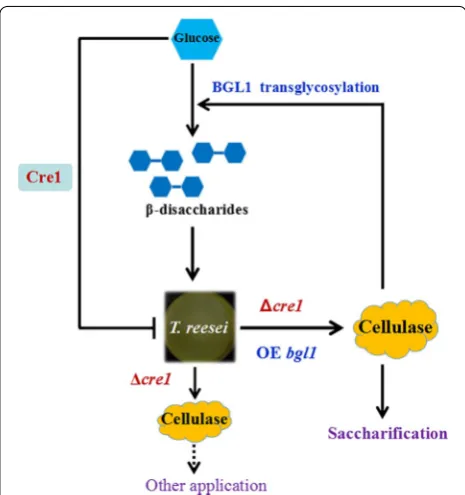
In this study, we used multiple genetic manipulations to construct a versatile cellulase system for enhancing cellu-lose saccharification and synthesizing cellulase inducers based on a hypercellulolytic T. reesei strain (Fig. 8). The
cre1 gene was first deleted to relieve carbon catabolite repression in T. reesei SP4 and further construct an engi-neered strain T. reesei SCB18 with extremely high BGL activity. The cellulase system exhibited remarkably strong cellulolytic ability toward differently pretreated corncob residues and high capacity to synthesize β-disaccharides from glucose through transglycoslation reaction, which showed superior cellulase-inducing ability relative to lac-tose. Consequently, this study develops a BGL-overex-pressing cellulase system with pleiotropic functions for
application in cellulose bioconversion and suggests a new prospective strategy for strain improvement of industrial fungi.
Methods
Strains, plasmids, and culture conditions
Trichoderma reesei SP4, a uracil auxotrophic strain derived from the hypercellulolytic variant T. reesei SN1 [18], was used as the initial host for strain improve-ment. The well-known glucose repression-sensitive strain T. reesei QM9414 (ATCC 26921) and another cel-lulase high-producing strain RUT-C30 (ATCC 56765) that is less sensitive to glucose repression were selected as the control strains. The plasmid pAB4-1 was used as the template to amplify the Aspergillus niger pyrG gene, a selection marker to encode orotidine-5′-phosphate decarboxylase [74]. For conidia production, all strains were grown and maintained on potato dextrose agar (PDA) plates containing peeled potato extract 200 g/L, glucose (2%, w/v), and agar (2%, Dingguo Corp., Beijing, China; GA010-500 g) for 7 days at 30 °C. The conidia were harvested by washing PDA plates with distilled H2O containing 0.8% NaCl and 0.02% Tween 80. For prepa-ration of protoplasts, 106 conidia were inoculated in a 500-mL flask containing 200-mL liquid minimal medium (MM; [75]) and incubated at 30 °C overnight. The MM agar plate supplemented with 300 μg/mL hygromycin B and 1.5 mg/mL 5-FOA (Sigma, USA) was applied as the selective medium for the screening of the uracil auxo-trophic transformants. Also, the MM agar plates con-taining Avicel (0.5%) or Avicel (0.5%) plus glucose (1.0%) as carbon resources were used to investigate the capac-ity of T. reesei strains to secrete cellulases. The CMC-esculin plate was used to screen the strains showing β-glucosidase (BGL) activity, and the medium compo-sition was as follows: 3 g/L esculin, 10 g/L sodium car-boxymethyl cellulose (CMC–Na), 0.5 g/L ferric citrate, and 20 g/L agar. To prepare the seed culture for cellulase production, the fungal spores (106/mL) were inoculated in the liquid MM and incubated at 180 rpm and 30 °C for 36 h. Then, 10 mL of the inoculum was transferred to 100 mL of the cellulase production medium (CPM, [18]) in a 500-mL flask. The culture medium was supple-mented with 0.1% uracil (Sigma, USA) when needed in the entire research process.
Construction of the cre1 deletion strain
Deletion of cre1 with the pyrG+DR fragment in T. reesei
was performed according to the method described pre-viously [74]. To be specific, first, the pyrG+DR fragment containing the 2.8-kb A. niger pyrG gene and the 458-bp direct repeat (DR) sequence was constructed as follows: the pyrG gene was amplified by the primer pair pyrG-F/ Fig. 8 Schematic model illustrating the principle for constructing the
BGLA-overexpressing cellulase system with pleiotropic functions. The cellulase expression in T. reesei (SP4) is repressed through the carbon catabolite repressor Cre1 when glucose is present. Deletion of the
cre1 gene results in glucose derepression and enhanced cellulase expression. Further overexpression of the A. niger bglA gene produces the T. reesei (SCB18) cellulase with high efficiency for saccharifica-tion of different cellulosic substrates. Meanwhile, the cellulase in
T. reesei could also be induced by β-disaccharides (cellobiose and sophorose). The BGLA-overexpressing cellulase system produced by
Page 12 of 16 Gao et al. Biotechnol Biofuels (2017) 10:272
pyrG-R; then, the DR fragment was produced from the 3′ end of pyrG gene through PCR using the primer pair DR-F/DR-R and fused into the 5′ end of the pyrG gene through double-joint PCR [76]. The final pyrG + DR frag-ment was amplified by the nested primer pair, pyrG-UF1/ pyrG-2425DR. Second, the upstream and downstream fragments of cre1 were amplified using T. reesei genome as template by primer pairs UF/UR and cre1-DF/cre1-DR, respectively, and then fused together with the pyrG+DR fragment to construct the Δcre1::pyrG
cassette through Double-joint PCR. Finally, the primer pair cre1-F1/cre1-R1 was utilized as nested primers to amplify the entire Δcre1::pyrG cassette (Fig. 1a).
The Δcre1::pyrG cassette was transformed into SP4 protoplasts, and the fungal genomic DNA was isolated according to the methods described by Penttilä et al. [76]. The target transformants containing the A. niger pyrG gene were screened on MM containing 300 μg/mL hygromycin B, and the purified candidate transformants were identified through PCR by primer pairs, pyrG-UF1/ pyrG-2425DR, cre1-2426UF/cre1-1059R, and cre1-497F/
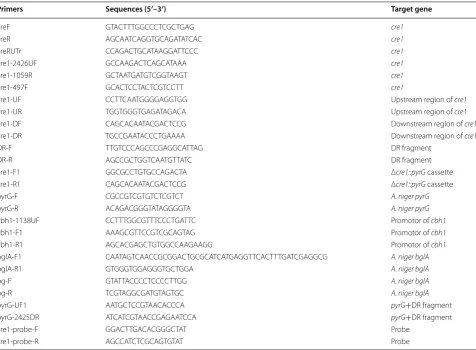
cre1-1059R. Afterward, 104–106 spores of three 5-FOA resistant transformants were spread onto MM plate con-taining 1 mg/mL uracil and 1.5 mg/mL 5-FOA to select the pyrG gene excision transformants by spontaneous mutation. Then, the purified candidate transformants were identified through PCR by primer pair, pyrG-UF1/ pyrG-2425DR. Phanta® Super-Fidelity DNA Polymerase (Vazyme Biotech Co., Ltd., Nanjing, China) was utilized for PCR amplification. The PCR primers were designed using the primer premier 5.0 software. The DNA frag-ments were recovered using Gel Extraction Kit (Omega, USA). Primers used for PCR analysis are listed in Table 1.
Construction of the A. niger bglA‑overexpressing strain The A. niger bglA gene-overexpressing cassette was constructed through double-joint PCR. Chromosomal DNA of A. niger was used as the template to clone the β-glucosidase-encoding gene bglA (GenBank Accession No. AM270402) and its terminator region by primer pair bglA-F1/bglA-R1. Chromosomal DNA of T. reesei was used as the template to amplify the promotor of cbh1
Table 1 Primers used in this study
Primers Sequences (5′–3′) Target gene
creF GTACTTTGGCCCTCGCTGAG cre1
creR AGCAATCAGGTGCAGATATCAC cre1
creRUTr CCAGACTGCATAAGGATTCCC cre1
cre1-2426UF GCCAAGACTCAGCATAAA cre1
cre1-1059R GCTAATGATGTCGGTAAGT cre1
cre1-497F GCACTCCTACTCGTCCTT cre1
cre1-UF CCTTCAATGGGGAGGTGG Upstream region of cre1
cre1-UR TGGTGGGTGAGATAGACA Upstream region of cre1
cre1-DF CAGCACAATACGACTCCG Downstream region of cre1
cre1-DR TGCCGAATACCCTGAAAA Downstream region of cre1
DR-F TTGTCCCAGCCCGAGGCATTAG DR fragment
DR-R AGCCGCTGGTCAATGTTATC DR fragment
cre1-F1 GGCGCCTGTGCCAGACTA Δcre1::pyrG cassette
cre1-R1 CAGCACAATACGACTCCG Δcre1::pyrG cassette
pyrG-F CGCCGTCGTGTCTCGTCT A. niger pyrG
pyrG-R ACAGACGGGTATAGGGGTA A. niger pyrG
cbh1-1138UF CCTTTGGCGTTTCCCTGATTC Promotor of cbh1
cbh1-F1 AAAGCGTTCCGTCGCAGTAG Promotor of cbh1
cbh1-R1 AGCACGAGCTGTGGCCAAGAAGG Promotor of cbh1
bglA-F1 CAATAGTCAACCGCGGACTGCGCATCATGAGGTTCACTTTGATCGAGGCG A. niger bglA
bglA-R1 GTGGGTGGAGGGTGCTGGA A. niger bglA
bg-F GTATTACCCCTCCCCTTGG A. niger bglA
bg-R TCGTAGGCGATGTAGTGC A. niger bglA
pyrG-UF1 AATGCTCCGTAACACCCA pyrG+DR fragment
pyrG-2425DR ATCATCGTAACCGAGAATCCA pyrG+DR fragment
cre1-probe-F GGACTTGACACGGGCTAT Probe
and its signal sequence by primer pair cbh1-F1/cbh1-R1. Then these two fragments were fused together through Double-joint PCR, and the final A. niger bglA gene-over-expressing cassette was amplified by primer pair cbh1-1138UF/bglA-R. The overexpressing cassette and the
pyrG+DR fragment were co-transformed into the pro-toplasts of the Δcre1 strain SDC11 through the method mentioned above. The transformants were screened on MM containing 300 μg/mL hygromycin B, and the puri-fied candidate transformants were identipuri-fied through PCR by primer pairs cbh1-1138UF/bg-R and bg-F/bg-R.
Enzyme activity and SDS‑PAGE assay
Whatman no. 1 paper (Whatman, UK), CMC–Na (Sigma, USA), p-nitrophenyl-β-d-cellobioside (pNPC; Sigma, USA), and p-nitrophenyl-β-d-glucopyranoside (pNPG; Sigma, USA) were utilized to measure the filter paper (FP), endoglucanases (EGs), cellobiohydrolases (CBHs), and BGL activities, respectively, as described previously by Ghose [77]. One enzyme activity was defined as the amount of enzymes required to liberate one µmol glucose (FPA, EG) or p-nitrophenol (CBH, BGL) per minute under the assay conditions. The equal volume of culture super-natants were supplemented with loading buffer, boiled for 10 min for degeneration, and loaded onto a 12% SDS– polyacrylamide separating gel. Renaturing SDS-PAGE electrophoresis was performed in 12% SDS–polyacryla-mide-separating gel using 0.3% CMC–Na as the substrate. Since it is difficult to separate the mycelial biomass from the insoluble cellulose substrate in the cellulase production medium, growth rates of T. reesei strains were measured by detecting the total intracellular protein amount. Spe-cifically, the insoluble portion of the fungal culture was washed once with 0.7 NaCl and twice with distilled water and then extracted by 1 M NaOH. The NaOH extraction method and the correlation between the intracellular pro-tein with the fungal growth were described previously [78, 79]. Analysis of protein concentration was performed using the Bio-Rad Protein Assay kit (Bio-Rad, USA).
Southern blot analysis
The probe of cre1 was a fragment amplified through PCR using the primer pair, cre1-probe-F/cre1-probe-R (Table 1) to detect the cre1 gene. The EcoR I/Hind III-digested genomic DNA was separated in 0.8% agarose gel and transferred to a Hybond-N+ nylon membrane
(Amersham, USA). DNA labeling and detection were performed using a DIG-High prime DNA labeling and detection starter kit (Roche, Germany) according to the manufacturer’s protocol.
Transglycosylation reaction
The transglycosylation reaction was conducted according to the method described previously with some modifica-tions [28]. Different concentrations of glucose (10, 20, 40, 60, and 80% (w/v)), dissolved in 0.05 M pH 4.8 citric acid buffer, were used as substrates in the transglycosylation reaction with the cellulase preparation from the T. reesei
BGLA-overexpressing strain SCB18. The reaction was implemented at 65 °C in a 100-mL flask for 1d, 2d, and 3d in a total volume of 30 mL.
TLC assay and glucose residual content detection
The silica gel 60 F254 plate (Millipore, Germany) was used for TCL assay [80]. In detail, all of the reaction solu-tions were diluted to 5% (w/v), and aliquots of the dilu-ents (1 μL) were spotted 1.0 cm from the bottom of the plate. Then the plate was run using the developing agent containing butanol, isopropanol, acetic acid, and water, with their proportions in volume being fixed to 7:5:2:4, respectively. The plate was dried after completion of the assay, and the sugars were visualized after the plate was sprayed with the diphenylamine–aniline–phosphoric acid (DPA) reagent and reacted in the drying oven at 110 °C for 10 min. The glucose residual contents of the reaction solutions were further examined using the SBA-40C bio-logical sensor analyzer (BISAS, Shandong, China).
Cellulase production using the transglycosylation product To determine the effect of the transglycosylation product on the induction of cellulase production, the liquid MM containing 2% glucose, 2% lactose, 2% Avicel, or 2% sugar-mixture (the transglycosylation product) was used as the carbon source to cultivate the carbon catabolite-dere-pressed strain T. reesei SDC11. The spores (106/mL) were inoculated in a 500-mL flask containing 100 mL culture and incubated at 180 rpm, 30 °C for cellulase production.
Saccharification of the pretreated corncob residues
Acid-pretreated and delignified corncob residues were applied as substrates for saccharification. The former residue contained 62.6% cellulose, 2.4% hemicellulose, 17.7% lignin, and 6.8% ash, while the latter one included 65.7% cellulose, 1.8% hemicellulose, 3.2% lignin, and 5.9% ash [43]. The sac-charification reaction was implemented at 150 rpm and 50 °C in a 100-mL flask containing 5% (w/v) substrate. The fermentation broths with the equal FPA activity (10 FPU/g substrate) were loaded by adding pH 4.8 citric acid buffer to make up the total volume to 30 mL. The glucose release was detected using the SBA-40C biological sensor analyzer every 24 h. Cellulose conversion was calculated as follows:
Cellulose conversion=
Glucose yield from enzyme hydrolysis(mg)
Page 14 of 16 Gao et al. Biotechnol Biofuels (2017) 10:272
Abbreviations
BGLs: β-glucosidases; CBHs: cellobiohydrolases; EGs: endoglucanases; LPMOs: lytic polysaccharide monooxygenases; CCR: carbon catabolite repression; pNPG: 4-nitrophenyl-β-dglucopyranoside; pNPC: p -nitrophenyl-β-d-cellobioside; CMC–Na: sodium carboxymethyl cellulose; CPM: cellulase pro-duction medium; FPA: filter paper activity; SDS-PAGE: sodium dodecyl sulfate polyacrylamide gel electrophoresis; DPA: diphenylamine–aniline–phosphoric acid; TLC: thin-layer chromatography.
Authors’ contributions
JG and YZ conceived the study and drafted the manuscript. JG and YCQ per-formed the experiments and analyzed the data. YW participated in the experi-ment and collected the data. YBQ and YZ designed the study and revised the manuscript. All authors read and approved the final manuscript.
Acknowledgements
This study was supported by the grants from the National Natural Science Foundation of China (No. 31370135), the Fundamental Research Funds of Additional files
Additional file 1: Figure S1.T. reesei SP4 is carbon catabolite-repressed. a Growth of T. reesei SP4, QM9414 and RUT-C30 on the medium plate containing both glucose (1.0%) and Avicel (0.5%) as carbon sources. A clear cellulolytic halo was observed around the colony of RUT-C30, but not SP4 and QM9414. b Graphical representation of the cre1 gene locus in the chromosomes of T. reesei QM9414 and RUT-C30. c PCR analysis of the internal fragment of the cre1 gene in T. reesei SP4, QM9414 and RUT-C30 using the primer pair creF/creR. A 2.9-kb length fragment was amplified from QM9414 and SP4 but not from RUT-C30. d PCR analysis of the full-length cre1 gene in T. reesei SP4, QM9414 and RUT-C30 using the primer pair creF/creRUTr. The primers provided a 1.9-kb fragment corresponding to the truncated cre1 gene from RUT-C30, but yielded a larger fragment (4.4 kb) from QM9414 and SP4.
Additional file 2: Figure S2. PCR and phenotypic analysis of the Δcre1 strain T. reesei SDC11. a PCR analysis of T. reesei SDC11 with SP4 as control. 1 and 2 represent the fragment (upstream region and open reading frame of gene cre1) amplificated by the prime pair cre1-2426UF/cre1-1069R in T. reesei SDC11 and SP4, respectively; 3 and 4 represent the internal frag-ment of gene cre1 amplificated by the prime pair cre1-497F/cre1-1069R in T. reesei SDC11 and SP4, respectively. 5 and 6 represent the fragment of gene pyrG amplificated by the prime pair pyrG-UF1/pyrG-2426DR in T. reesei SDC11 and SCP11, respectively. b Southern blot analysis of the genomic DNA isolated from SP4 and SCP11, which were digested with EcoRI/HindIII. A 5.5-kb fragment is present in the parental strain SP4, and a 7.0-kb band is shown in Δcre1+pyrG strain SCP11. c Growth of T. reesei SN1, Δcre1+pyrG strain SCP11 and Δcre1 strain SDC11 on MM plate. d Growth of T. reesei SP4, Δcre1+pyrG strain SCP11 and Δcre1 strain SDC11 on the MM plate containing uracil (0.1%).
Additional file 3: Figure S3. Renaturing SDS-PAGE assay of BGL activities from the fermentation broths of T. reesei SDC11 and SP4 with equal FPA loading (0.04 FPA).
Additional file 4: Figure S4. PCR and phenotypic analysis of the bglA overexpression strain T. reesei SCB18. a Graphical representation of the bglA overexpression cassette. b PCR analysis of the T. reesei SCB18 and SDC11 strains. 1 and 3 represent the chimeric fragments spanning the cbh1 promoter and the bglA gene, which were amplificated by the primer pair cbh1-1138UF/bg-R using the chromosomes of SCB18 and SDC11, respectively; 2 and 4 represent the internal fragments of the bgl1 gene, which were amplificated by the primer pair bg-F/bg-R using the chromo-somes of SCB18 and SDC11, respectively. c Growth of T. reesei SP4, SDC11 and SCB18 on the medium plate containing Avicel (0.5%) as sole carbon source. d Growth of T. reesei SP4, SDC11 and SCB18 on the medium plate containing both glucose (1.0%) and Avicel (0.5%) as carbon sources.
Additional file 5: Table S1. Comparisons of BGL activity and cellulase titer in the T. reesei BGL-overexpressing strains.
Shandong University (No. 2015CJ005), and the Agricultural Science and Tech-nology Achievement Transformation Fund of Shandong Province (2014No. 45).
Competing interests
The authors declare that they have no competing interests.
Publisher’s Note
Springer Nature remains neutral with regard to jurisdictional claims in pub-lished maps and institutional affiliations.
Received: 13 June 2017 Accepted: 7 November 2017
References
1. Dashtban M, Schraft H, Qin W. Fungal bioconversion of lignocellulosic residues; opportunities & perspectives. Int J Biol Sci. 2009;5(6):578–95. 2. Sánchez C. Lignocellulosic residues: biodegradation and bioconversion
by fungi. Biotechnol Adv. 2009;27(2):185–94.
3. Sun Y, Cheng J. Hydrolysis of lignocellulosic materials for ethanol produc-tion: a review. Bioresour Technol. 2002;83(1):1–11.
4. Lin Y, Tanaka S. Ethanol fermentation from biomass resources: current state and prospects. Appl Microbiol Biotechnol. 2006;69(6):627–42. 5. Balan V. Current challenges in commercially producing biofuels from
lignocellulosic biomass. ISRN Biotechnol. 2014;2014:463074.
6. Sipos B, Benko Z, Dienes D, Réczey K, Viikari L, Siika-aho M. Characterisa-tion of specific activities and hydrolytic properties of cell-wall-degrading enzymes produced by Trichoderma reesei Rut C30 on different carbon sources. Appl Biochem Biotechnol. 2010;161(1–8):347–64.
7. Hemsworth GR, Henrissat B, Davies GJ, Walton PH. Discovery and charac-terization of a new family of lytic polysaccharide monooxygenases. Nat Chem Biol. 2014;10(2):122–6.
8. Hemsworth GR, Johnston EM, Davies GJ, Walton PH. Lytic polysac-charide monooxygenases in biomass conversion. Trends Biotechnol. 2015;33(12):747–61.
9. Portnoy T, Margeot A, Linke R, Atanasova L, Fekete E, Sándor E, Hartl L, Karaffa L, Druzhinina IS, Seiboth B, Le Crom S, Kubicek CP. The CRE1 carbon catabolite repressor of the fungus Trichoderma reesei: a master regulator of carbon assimilation. BMC Genom. 2011;12:269. 10. Bischof RH, Ramoni J, Seiboth B. Cellulases and beyond: the first
70 years of the enzyme producer Trichoderma reesei. Microb Cell Fact. 2016;15(1):106.
11. Peterson R, Nevalainen H. Trichoderma reesei RUT-C30—thirty years of strain improvement. Microbiology. 2012;158(Pt 1):58–68.
12. Nakari-Setälä T, Paloheimo M, Kallio J, Vehmaanperä J, Penttilä M, Salo-heimo M. Genetic modification of carbon catabolite repression in Tricho-derma reesei for improved protein production. Appl Environ Microbiol. 2009;75(14):4853–60.
13. Baba Y, Sumitani JI, Tani S, Kawaguchi T. Characterization of Aspergillus aculeatus β-glucosidase 1 accelerating cellulose hydrolysis with Tricho-derma ellulase system. AMB Express. 2015;5(1):3.
14. Du F, Wolger E, Wallace L, Liu A, Kaper T, Kelemen B. Determination of product inhibition of CBH1, CBH2, and EG1 using a novel cellulase activ-ity assay. Appl Biochem Biotechnol. 2010;161:313–7.
15. Zhang J, Zhong Y, Zhao X, Wang T. Development of the cellulolytic fungus Trichoderma reesei strain with enhanced beta-glucosidase and filter paper activity using strong artificial cellobiohydrolase 1 promoter. Bioresour Technol. 2010;101(24):9815–8.
16. Dashtban M, Qin W. Overexpression of an exotic thermotolerant β-glucosidase in trichoderma reesei and its significant increase in cel-lulolytic activity and saccharification of barley straw. Microb Cell Fact. 2012;11:63.
17. Singhania RR, Patel AK, Sukumaran RK, Larroche C, Pandey A. Role and significance of beta-glucosidases in the hydrolysis of cellulose for bioethanol production. Bioresour Technol. 2013;127:500–7.
genetic engineering for optimized cellulase production in biomass conversion improvement. Front Microbiol. 2016;7:1349.
19. Chen M, Zhao J, Xia L. Enzymatic hydrolysis of maize straw polysac-charides for the production of reducing sugars. Carbohyd Polym. 2008;71(3):411–5.
20. Ma L, Zhang J, Zou G, Wang C, Zhou Z. Improvement of cellulase activity in Trichoderma reesei by heterologous expression of a beta-glucosidase gene from Penicillium decumbens. Enzyme Microb Technol. 2011;49:366–71.
21. Chauve M, Mathis H, Huc D, Casanave D, Monot F, Lopes Ferreira N. Comparative kinetic analysis of two fungal beta-glucosidases. Biotechnol Biofuels. 2010;3(1):3.
22. Murray P, Aro N, Collins C, Grassick A, Penttila M, Saloheimo M, et al. Expression in Trichoderma reesei and characterisation of a thermostable family 3 beta-glucosidase from the moderately thermophilic fungus Talaromyces emersonii. Protein Expr Purif. 2004;38:248–57.
23. Rahman Z, Shida Y, Furukawa T, Suzuki Y, Okada H, Ogasawara W. Applica-tion of Trichoderma reesei cellulase and xylanase promoters through homologous recombination for enhanced production of extracellular beta-glucosidase I. Biosci Biotechnol Biochem. 2009;73:1083–9. 24. Wang B, Xia L. High efficient expression of cellobiase gene from
Aspergillus niger in the cells of Trichoderma reesei. Bioresour Technol. 2011;102(6):4568–72.
25. Suto M, Tomita F. Induction and catabolite repression mechanisms of cellulase in fungi. J Biosci Bioeng. 2001;92(4):305–11.
26. Kubicek CP, Mikus M, Schuster A, Schmoll M, Seiboth B. Metabolic engineering strategies for the improvement of cellulase production by Hypocrea jecorina. Biotechnol Biofuels. 2009;2:19.
27. Allen AL, Mortensen RE. Production of cellulase from Trichoderma reesei in fed-batch fermentation from soluble carbon sources. Biotechnol Bioeng. 1981;23(11):2641–5.
28. Li Y, Liu C, Bai F, Zhao X. Overproduction of cellulase by Trichoderma reesei RUT C30 through batch-feeding of synthesized low-cost sugar mixture. Bioresour Technol. 2016;216:503–10.
29. Morikawa Y, Ohashi T, Mantani O, Okada H. Cellulase induction by lactose in Trichoderma reesei PC-3-7. Appl Microbiol Biotechnol. 1995;44:106. 30. Mandels M, Parrish FW, Reese ET. Sophorose as an inducer of cellulase in
Trichoderma viride. J Bacteriol. 1962;83:400–8.
31. Sternberg D, Mandels GR. Induction of cellulolytic enzymes in Tricho-derma reesei by sophorose. J Bacteriol. 1979;139(3):761–9.
32. Huang TT, Wages JM. New-to-nature sophorose analog: a potent inducer for gene expression in Trichoderma reesei. Enzyme Microb Technol. 2016;85:44–50.
33. Fowler T, Brown RD Jr. The bgl1 gene encoding extracellular beta-glucosidase from Trichoderma reesei is required for rapid induction of the cellulase complex. Mol Microbiol. 1992;6(21):3225–35.
34. Zhou Q, Xu J, Kou Y, Lv X, Zhang X, Zhao G, Zhang W, Chen G, Liu W. Dif-ferential involvement of β-glucosidases from Hypocrea jecorina in rapid induction of cellulase genes by cellulose and cellobiose. Eukaryot Cell. 2012;11(11):1371–81.
35. Uchiyama T, Miyazaki K, Yaoi K. Characterization of a novel β-glucosidase from a compost microbial metagenome with strong transglycosylation activity. J Biol Chem. 2013;288(25):18325–34.
36. Stephanopoulos G. Challenges in engineering microbes for biofuels production. Science. 2007;315(5813):801–4.
37. Cziferszky A, Mach RL, Kubicek CP. Phosphorylation positively regulates DNA binding of the carbon catabolite repressor Cre1 of Hypocrea jecorina (Trichoderma reesei). J Biol Chem. 2002;277(17):14688–94.
38. Antoniêto AC, de Paula RG, Castro Ldos S, Silva-Rocha R, Persinoti GF, Silva RN. Trichoderma reesei CRE1-mediated carbon catabolite repression in response to sophorose through RNA sequencing analysis. Curr Genom. 2016;17(2):119–31.
39. Imén M, Thrane C, Penttilä M. The glucose repressor gene cre1 of Tricho-derma: isolation and expression of a full-length and a truncated mutant form. Mol Gen Genet. 1996;251(4):451–60.
40. Nogawa M, Takahashi H, Kashiwagi A, Ohshima K, Okada H, Morikawa Y. Purification and characterization of Exo-β-d-glucosaminidase from a cellulolytic fungus, Trichoderma reesei PC-3-7. Appl Environ Microbiol. 1998;64(3):890–5.
41. Ruijter GJ, Vanhanen SA, Gielkens MM, van de Vondervoort PJ, Visser J. Isolation of Aspergillus niger creA mutants and effects of the mutations on
expression of arabinases and l-arabinose catabolic enzymes. Microbiol-ogy. 1997;143(Pt9):2991–8.
42. Mooney CA, Mansfield SD, Saddler JN. The effect of initial pore volume and lignin content on the enzymatic hydrolysis of softwoods. Bioresour Technol. 1999;64:113–9.
43. Liu K, Lin X, Yue J, Li X, Fang X, Zhu M, Lin J, Qu Y, Xiao L. High concentra-tion ethanol producconcentra-tion from corncob residues by fed-batch strategy. Bioresour Technol. 2010;101(13):4952–8.
44. Sun J, Glass NL. Identification of the CRE-1 cellulolytic regulon in Neuros-pora crassa. PLoS ONE. 2011;6(9):e25654.
45. Aro N, Pakula T, Penttilä M. Transcriptional regulation of plant cell wall degradation by filamentous fungi. FEMS Microbiol Rev. 2005;29(4):719–39.
46. Ries L, Belshaw NJ, Ilmén M, Penttilä ME, Alapuranen M, Archer DB. The role of CRE1 in nucleosome positioning within the cbh1 promoter and coding regions of Trichoderma reesei. Appl Microbiol Biotechnol. 2014;98(2):749–62.
47. Mach-Aigner AR, Pucher ME, Steiger MG, Bauer GE, Preis SJ, Mach RL. Transcriptional regulation of xyr1, encoding the main regulator of the xylanolytic and cellulolytic enzyme system in Hypocrea jecorina. Appl Environ Microbiol. 2008;74(21):6554–62.
48. Zeilinger S, Schmoll M, Pail M, Mach RL, Kubicek CP. Nucleosome transactions on the Hypocrea jecorina (Trichoderma reesei) cellulase promoter cbh2 associated with cellulase induction. Mol Genet Genomics. 2003;270(1):46–55.
49. Stricker AR, Grosstessner-Hain K, Würleitner E, Mach RL. Xyr1 (xylanase regulator 1) regulates both the hydrolytic enzyme system and d-xylose metabolism in Hypocrea jecorina. Eukaryot Cell. 2006;5(12):2128–37. 50. Mach RL, Strauss J, Zeilinger S, Schindler M, Kubicek CP. Carbon catabolite
repression of xylanase I (xyn1) gene expression in Trichoderma reesei. Mol Microbiol. 1996;21(6):1273–81.
51. Castro Ldos S, Antoniêto AC, Pedersoli WR, Silva-Rocha R, Persinoti GF, Silva RN. Expression pattern of cellulolytic and xylanolytic genes regu-lated by transcriptional factors XYR1 and CRE1 are affected by carbon source in Trichoderma reesei. Gene Expr Patterns. 2014;14(2):88–95. 52. Saloheimo M, Kuja-Panula J, Ylösmäki E, Ward M, Penttilä M.
Enzy-matic properties and intracellular localization of the novel Tricho-derma reesei beta-glucosidase BGLII (cel1A). Appl Environ Microbiol. 2002;68(9):4546–53.
53. Sukumaran RK, Singhania RR, Mathew GM, Pandey A. Cellulase produc-tion using biomass feed stock and its applicaproduc-tion in lignocellulose sac-charification for bio-ethanol production. Renew Energ. 2009;34(2):421–4. 54. Ko JK, Ximenes E, Kim Y, Ladisch MR. Adsorption of enzyme onto
lignins of liquid hot water pretreated hardwoods. Biotechnol Bioeng. 2015;112(3):447–56.
55. Lima MA, Oliveira-Neto M, Kadowaki MA, Rosseto FR, Prates ET, Squina FM, Leme AF, Skaf MS, Polikarpov I. Aspergillus niger β-glucosidase has a cellulase-like tadpole molecular shape: insights into glycoside hydrolase family 3 (GH3) β-glucosidase structure and function. J Biol Chem. 2013;288(46):32991–3005.
56. Keränen S, Penttilä M. Production of recombinant proteins in the filamen-tous fungus Trichoderma reesei. Curr Opin Biotechnol. 1995;6(5):534–7. 57. Yan TR, Lin CL. Purification and characterization of a glucose-tolerant
beta-glucosidase from Aspergillus niger CCRC 31494. Biochim Biophys Acta. 1992;1121(1–2):54–60.
58. Chen H, Hayn M, Esterbauer H. Purification and characterization of two extracellular beta-glucosidases from Trichoderma reesei. Biosci Biotechnol Biochem. 1997;61(6):965–70.
59. Yao G, Wu R, Kan Q, Gao L, Liu M, Yang P, Du J, Li Z, Qu Y. Production of a high-efficiency cellulase complex via β-glucosidase engineering in Penicillium oxalicum. Biotechnol Biofuels. 2016;9:78.
60. Nakazawa H, Kawai T, Ida N, Shida Y, Kobayashi Y, Okada H, Tani S, Sumitani J, Kawaguchi T, Morikawa Y, Ogasawara W. Construction of a recombinant Trichoderma reesei strain expressing Aspergillus aculeatus β-glucosidase 1 for efficient biomass conversion. Biotechnol Bioeng. 2012;109(1):92–9.
Page 16 of 16 Gao et al. Biotechnol Biofuels (2017) 10:272
• We accept pre-submission inquiries
• Our selector tool helps you to find the most relevant journal
• We provide round the clock customer support
• Convenient online submission
• Thorough peer review
• Inclusion in PubMed and all major indexing services
• Maximum visibility for your research
Submit your manuscript at www.biomedcentral.com/submit
Submit your next manuscript to BioMed Central
and we will help you at every step:
62. Chen M, Qin Y, Liu Z, Liu K, Wang F, Qu Y. Isolation and characterization of a β-glucosidase from Penicillium decumbens and improving hydrolysis of corncob residue by using it as cellulase supplementation. Enzyme Microb Technol. 2010;46(6):444–9.
63. Wang Y, Li J, Xu Y. Characterization of novel β-glucosidases with trans-glycosylation properties from Trichosporon asahii. J Agric Food Chem. 2011;59(20):11219–27.
64. Bohlin C, Praestgaard E, Baumann MJ, Borch K, Praestgaard J, Monrad RN, Westh P. A comparative study of hydrolysis and transglycosyla-tion activities of fungal β-glucosidases. Appl Microbiol Biotechnol. 2013;97(1):159–69.
65. Guo Y, Yan Q, Yang Y, Yang S, Liu Y, Jiang Z. Expression and charac-terization of a novel β-glucosidase, with transglycosylation and exo-β-1,3-glucanase activities, from Rhizomucor miehei. Food Chem. 2015;175:431–8.
66. Fujimoto Y, Hattori T, Uno S, Murata T, Usui T. Enzymatic synthesis of gen-tiooligosaccharides by transglycosylation with beta-glycosidases from Penicillium multicolor. Carbohydr Res. 2009;344(8):972–8.
67. He H, Qin Y, Chen G, Li N, Liang Z. Two-step purification of a novel β-glucosidase with high transglycosylation activity and another hypothetical β-glucosidase in Aspergillus oryzae HML366 and enzymatic characterization. Appl Biochem Biotechnol. 2013;169(3):870–84. 68. Du L, Wang Z, Zhao Y, Huang J, Pang H, Wei Y, Lin L, Huang R. A
β-glucosidase from Novosphingobium sp. GX9 with high catalytic efficiency toward isoflavonoid glycoside hydrolysis and (+)-catechin transglycosylation. Appl Microbiol Biotechnol. 2014;98(16):7069–79. 69. Seidle HF, Huber RE. Transglucosidic reactions of the Aspergillus niger
family 3 beta-glucosidase: qualitative and quantitative analyses and evi-dence that the transglucosidic rate is independent of pH. Arch Biochem Biophys. 2005;436(2):254–64.
70. Yan TR, Liau JC. Synthesis of alkyl beta-glucosides from cellobiose with Aspergillus niger beta-glucosidase II. Biotechnol Lett. 1998;20(7):653–7. 71. Kim TY, Lee DS, Shin HJ. Gentiobiose synthesis from glucose using
recombinant β-glucosidase from Thermus caldophilus GK24. Biotechnol Bioprocess Eng. 2003;8:210.
72. Kurasawa T, Yachi M, Suto M, Kamagata Y, Takao S, Tomita F. Induction of cellulase by gentiobiose and its sulfur-containing analog in Penicillium purpurogenum. Appl Environ Microbiol. 1992;58(1):106–10.
73. Ivanova C, Bååth JA, Seiboth B, Kubicek CP. Systems analysis of lactose metabolism in Trichoderma reesei identifies a lactose permease that is essential for cellulase induction. PLoS ONE. 2013;8(5):e62631.
74. Hartl L, Seiboth B. Sequential gene deletions in Hypocrea jecorina using a single blaster cassette. Curr Genet. 2005;48(3):204–11.
75. Penttilä M, Nevalainen H, Rättö M, Salminen E, Knowles J. A versatile transformation system for the cellulolytic filamentous fungus Tricho-derma reesei. Gene. 1987;61(2):155–64.
76. Yu JH, Hamari Z, Han KH, Seo JA, Reyes-Domínguez Y, Scazzocchio C. Double-joint PCR: a PCR-based molecular tool for gene manipulations in filamentous fungi. Fungal Genet Biol. 2004;41(11):973–81.
77. Ghose TK. Measurement of cellulase activities. Pure Appl Chem. 1987;59:257–68.
78. Aro N, Ilmén M, Saloheimo A, Penttilä M. ACEI of Trichoderma reesei is a repressor of cellulase and xylanase expression. Appl Environ Microbiol. 2003;69(1):56–65.
79. Jayaraman J, Cotman C, Mahler HR, Sharp CW. Biochemical correlates of respiratory deficiency. VII. Glucose repression. Arch Biochem Biophys. 1966;116(1):224–51.