R E V I E W
Open Access
A critical study on efficiency of different materials
for fluoride removal from aqueous media
Vaishali Tomar
*and Dinesh Kumar
*Abstract
Fluoride is a persistent and non-biodegradable pollutant that accumulates in soil, plants, wildlife and in human beings. Therefore, knowledge of its removal, using best technique with optimum efficiency is needed. The present survey highlights on efficacy of different materials for the removal of fluoride from water. The most important results of extensive studies on various key factors (pH, agitation time, initial fluoride concentration, temperature, particle size, surface area, presence and nature of counter ions and solvent dose) fluctuate fluoride removal capacity of materials are reviewed.
Keywords:Adsorbents, Adsorption, Fluoride, Removal
Introduction
The chemical nature of water is one of the most impera-tive criteria that determine its usefulness for a precise need and as such not all the waters are fit for drinking and potable purposes. Apart from fluoride, arsenic and nitrate are few of major water pollutants which cause large scale health issues, but in cutting-edge the most serious pollutant is fluoride [1]. According to the World Health Organization the maximum acceptable concen-tration of fluoride ions in drinking water lies below 1.5 ppm. Fluoride if taken in small amount is usually beneficial, but the beneficial fluoride concentration range for human health is very small. Depending on the concentrations and the duration of fluoride intake, it could have positive effect on dental caries [2]. On the contrary, long term consumption of water containing ex-cessive amounts of fluoride can lead to fluorosis of the teeth and bones [3]. The excessive intake of fluoride may cause dental [4] and skeletal disorders [5]. Fluoride ion is attracted by positively charged calcium ion in teeth and bones due to its strong electronegativity which re-sults in dental, skeletal and no skeletal forms of fluorosis i.e. high fluoride ingestion, in children as well as adults. Fluorosis in mild version can be evidenced by mottling of teeth and in high version by embrittlement of bones and neurological damage [6], in some of the cases it may even interfere with carbohydrates, proteins, vitamins and
mineral metabolism and to DNA creation as well if in-take excessively [7]. Studies have shown that major of the Kidney diseases have a great inclination of toxicity of fluoride. On high doses and short term exposure fluoride can exterminate the kidney function. Several research groups have also shows that fluoride can interfere with the function of pineal gland as well as of brain. Pineal gland is one of the major fluoride accrued site in body with concentration more than that of teeth and bones. Workers exposed to high fluoride concentration areas are diagnosed with bladder cancer [8]. Various diseases such as osteoporosis, arthritis, brittle bones, cancer, in-fertility, brain damage, Alzheimer syndrome, and thyroid disorder can attack human body on excessive intake of fluoride [9]. Fluoride contamination in ground water is a world-wide issue, and some cost effective technologies are required to eliminate excess fluoride in water. The occurrence of high fluoride concentrations in ground-water and risk of fluorosis associated with using such water for human consumption is a problem faced by many countries, notably India, Sri Lanka, and China, the Rift Valley countries in East Africa, Turkey, and parts of South Africa. Conventionally, the fluoride was removed from contaminated water is by liming and accompanying precipitation of fluoride [10]. Various other methods used for the defluoridation of water are ion-exchange [11], precipitation with iron (III) [12], activated alumina [13], alum sludge [14], calcium [15] is widely examined. In addition reverse osmosis [16,17] and electro coagulation
* Correspondence:[email protected];[email protected] Department of Chemistry, Banasthali Vidyapith, Rajasthan 304022, India
[18]. Many of these methods didn’t get used on large scale because various unfavourable factors such as high oper-ational and maintenance cost, generation of toxic by-products (pollution) and due to complex treatment. Authors discussed pros and cons of different techniques for defluoridation and it was concluded that the effective method is coagulation but it does not help in bringing down the fluoride concentration at desired level. On the other hand membrane process is expensive in terms of installation and operation cost, there are also more chances of fouling, scaling or membrane degradation. The electro-chemical techniques are not popular due to high cost during installation and maintenance.
One of the most popular techniques for defluoridation that is used in countries like India, Kenya, Senegal and Tanzania is Nalgonda technique. In this technique, cal-culated quantities of alum, lime and bleaching powder are mixed with water, after mixing the water is processed with flocculation, sedimentation, filtration and disinfec-tion. The entire operation takes about 2–3 hours for around 200 people in batches. Disadvantages of this technique is reported that treated water has high re-sidual aluminium concentration (2–7 mg/L) then the WHO standard of 0.2 mg/L [19-21]. Among these methods, adsorption is the most suitable and widely used technique due to its simple operation, and the availability of a wide range of adsorbents [22].
In this review, an extensive list of adsorbents literature has been compiled. It is evident from a literature survey of about 140 recent papers that low-cost sorbents have demonstrated outstanding removal capabilities for fluor-ide. In particular, nanomaterial based adsorbents might be a promising adsorbents for environmental and purifi-cation purposes.
Review
Remediation materials
Alumina and aluminium
Among the adsorbents, activated alumina has been an effective adsorbent for defluoridation of water. Different studies have been focus on this. For the fluoride removal from water Acidic alumina [23], amorphous Al(OH)3,
gibbsite or alumina (Al2O3) [24] have been used. It was
found that this adsorbent react fluoride at pH range 3–8 with fluoride concentration 1.9 -19 mg/L. At pH 5.5-6.5, maximum fluoride uptake was observed 9 mol/kg. At lower pH, fluoride uptake decreased due to the preferen-tial formation of AlFx soluble species but at higher pH,
OH−displaced F−from the solid Al(OH)3so the amount
of fluoride adsorbed to complexes declined towards zero between pH 6–8. At lower rate, same reaction was followed with gibbsite. At pH 5–7, maximum fluoride removal was found 16.3 mg/g. Due to the electrostatic repulsion in acidic solutions, adsorption of fluoride was
retarded. At higher pH, fluoride adsorption on alum oc-curred due to electrostatic repulsion of fluoride ion to the negatively charged surface of alumina; competition for active sites by excusive amount of hydroxide ion [25]. The Langmuir and Freundlich isotherm models have been described the equilibrium behaviours of the adsorption process. So it was conclude that defluo-ridation by alumina occurred by nonspecific adsorption. The value of zeta potential forα- Al2O3was also
investi-gated. At 25°C and pH 5–6, maximum fluoride removal
was occurred. From the zeta potential measurement, it was achieved that fluoride adsorbed onto α- Al2O3 by
replacing hydroxyl ions from positively charged surfaces and through hydrogen bond [26]. Adsorption capacity of activated alumina (AA) (grad OA−25) was also studied for defluoridation of aqueous solution. At pH 7, adsorp-tion capacity was obtained 1450 mg/kg [27]. Defluo-ridation increased at pH 4–7 but decreased thereafter. At pH >7, silicates and hydroxyl ions were considered to compete with F− ions for alumina exchange sites but at pH < 7, alumina fluoro complexes were formed in the presence of aluminium ions in the treated water. The potential of metallurgical grade alumina (MGA) for defluoridation was investigated at different condition [28]. The effect of temperature on zeta potential and fluoride adsorption was observed at α- Al2O3/aqueous
solution interface [29]. Comparison between the adsorp-tion capacities of the untreated hydrated alumina (UHA) and thermally treated hydrated alumina (THA) were obtained from the hydrolysis of locally manufactured aluminium sulphate for defluoridation [30]. The capacity was found 23.7 mg F−/g and 7.0 mg F−/g for THA and UHA, respectively at pH 4–9. The potential of alumina for fluoride removal from aqueous solution was ex-plained by several other researchers [31-34].
In the recent study, the application of the new HPLC– UVVIS method used in speciation analysis of aluminum form Al(III) ion, aluminum complexes with fluorides and iron in groundwater samples. Based on the obtained results of groundwater samples analysis, the separation of iron in the retention time≈3.7, was obtained. The proposed method is selective for aluminum fluoride complexes and Al(III) in the pH conditions of their oc-currence. The paper presents the possible types of trans-formation of aluminum hydroxyl forms and aluminum sulfate complexes by the reaction of the sample with mobile phase. An indirect method for the determination of aluminum in the form of aluminum sulfate was pro-posed [35]. See Table 1 for details.
Modified activated alumina
witnessed between La(III) and Y(III) impregnated alu-mina and original alualu-mina for the adsorption of fluoride. Lanthanum hydroxide supported on alumina has also been investigated foe defluoridation [37]. The adsorption capacity of alumina impregnated lanthanum hydroxide was 48 mg/g, which was higher than original alumina 23–25 mg/g. Defluoridation by impregnated alumina was explained by ion exchange process between anion and hydroxide group on surface material. Adsorption was found to increase with decreasing of fluoride con-centration from 130 mg/L to 0.57 mg/L at pH 5.7-8.0. The sorbed fluoride ions were eluted from the adsorbent with 10 mL of 0.1 M NaOH and column could be reused after being conditioned with 10 mL of 1 × 10⁻³M HCl. The surface of alumina was also impregnated with alum for defluoridation [38]. At pH 6.5, the adsorption of fluoride was found 92.6% and then decreased with fur-ther increased in pH. To improve the efficiency of alu-mina for defluoridation of aqueous solution, it modified by coating of copper oxide. The adsorption capacity of copper oxide coated alumina was mentioned in Table 2, which was higher than unmodified activated alumina [39]. Magnesia amended activated alumina [40,41] and calcium oxide modified activated alumina [42] was also used for fluoride removal from water. See Table 2 for details.
Iron-based adsorbents
Iron-based materials have been investigated for fluoride removal from water. Polypyrrole (PPy)/Fe3O4 magnetic
nanocomposites is novel adsorbent in fluoride removal [43]. It was found that presence of chloride and nitrate ions had negligible effect on fluoride adsorption while sulphate and phosphate ions reduced fluoride adsorption because of competitive interaction. It was found that fluoride, sulphate, phosphate ions form inner sphere complexes and they competed for the same active sites
of adsorption. Fluoride removal found to be increased with increase in polypyrrole/magnetite (adsorbent) dose. Fluoride uptake increased with increase in solution pH from 2 to 6. Up to 97% of the adsorbed fluoride on the PPy/Fe3O4nanocomposites was desorbed at pH 12. The
adsorption process was endothermic in nature and proceeded by ion-exchange mechanism. To understand the mechanism of fluoride removal, electro coagulation is a method of applying direct current to sacrificial elec-trodes that [44] are submerged in an aqueous solution and in the acidic condition dissolving aluminum Al(III) is predominant and aluminum hydroxide has tendency soluble. And electro coagulation is pH dependent and pH ranging from 6 to 8, the defluoridation process was found to be efficient. The fluoride removal mechanisms were investigated based on the solution speciation (Al and Al–Fe complexes) and dried sludge characteris-tics in the electro coagulator. Fluoride removal by amorphous Fe/Al mixed hydroxides was evaluated [45]. At pH 7.5, mixed Fe/Al samples were prepared by the increase of Al content in Fe(OH)3 matrix increase the
surface area. The fluoride adsorption followed first order kinetics and intraparticle diffusion model. The sorption process followed both Langmuir and Freundlich iso-therm models. The iso-thermodynamic studies showed fluoride sorption to be spontaneous and exothermic in nature. Adsorption and desorption studies were also conducted to gain an insight into the adsorption mech-anism on Fe/Al hydroxide surface. The formation of new complexes on the fluoride adsorbed on adsorbent surface was confirmed through spectral analyses. The other anions like phosphate, sulphate and arsenate con-centration have adverse effect on fluoride removal effi-ciency of adsorbent. The adsorbent regenerated with 0.5 M NaOH, maximum regeneration of 80.5% was obtained.
Table 1 Adsorption capacities (AC) and other parameters for the removal of fluoride by Alumina and aluminium
Adsorbent AC (mg/g) CR (mg/L) pH Ref.
Acidic alumina 8.4 5-15 3.6-11.6 [23]
Activated alumina (α- Al2O3) 88 15-100 5-6 [26]
Activated alumina (Grade OA-25) 2 2.5-14 7 [27]
Metallurgical grade alumina 13 - 5-6 [28]
Al(OH)3(Al2O3.xH2O) (THA and UHA) 24 and 7 5-30 7 ± 0.3 [30]
Table 2 Adsorption capacities (AC) and other parameters for the removal of fluoride by modified activated alumina
Adsorbent AC (mg/g) CR (mg/L) pH Ref.
La(III) impregnated on alumina 48.0 276 -300 5.7-8.0 [37]
Alum-impregnated activated alumina 40.7 1-35 6.5 [38]
Copper oxide coated alumina 7.8 10- 15 - [39]
Magnesia-amended activated alumina 10.1 5-150 6.5-7.0 [40]
Granulated mixture of Fe-Al-Ce nano adsorbent for fluoride removal by spraying Fe-Al-Ce nano-adsorbent suspension onto glass beads in a fluidized bed was devel-oped [46]. It was found that fluoride adsorption capacity was 2.22 mg/g at pH 7 and initial fluoride concentration of 1 × 10⁻³ M using the coated granules as adsorbent. The active site for fluoride adsorption was the hydroxyl groups on the Fe-Al-Ce surface. With the increasing coating amount the adsorption capacity increased while the stability of the granule decreased. The natural stilbite zeolite modified with Fe(III) used as adsorbent for the removal of excess fluoride from the drinking water [47]. It was studied from the batch adsorption studies that fluoride concentration can be reduced down to the very low level of 1 mg/L under the optimum conditions. From the study of XPS and EDX, it was concluded that Fe(III) is impregnated on the natural stilbite zeolite and the fluoride is adsorbed on the Fe(III)-stilbite zeolite. And the result of desorption and regeneration showed that the exhausted Fe(III)-stilbite zeolite can be regenerated using 1 M HCl as eluent and the regenerated samples still remain the good adsorptive performance. The fluoride ad-sorption on Fe(III)-STI is well described by the Langmuir adsorption model, and the maximum adsorption capacity is 2.31 mg/g. The natural STI zeolite is an environment-friendly adsorbent with lower chemical consumption and waste release and operating costs.
For the effectiveness of iron-impregnated granules cer-amics in defluoridation of water, it was prepared by sim-ple granulation procedure at room temperature. Both granular ceramics FeSO4.7H2O and granular ceramic
(Fe2O3) adsorbents was used for defluoridation of
aque-ous solution [48]. It was found granular ceramics FeSO4.7H2O is more effective than granular ceramic
(Fe2O3) for fluoride removal. The adsorption
experi-ments by batch and mini column scale to test the poten-tial of granular ferric hydroxide for removal of various ions including fluoride was studied [49]. The fluoride ad-sorption onto granular ferric hydroxide was again found pH dependent. The fluoride capacity decreased with in-creasing value of pH. The fluoride has the highest
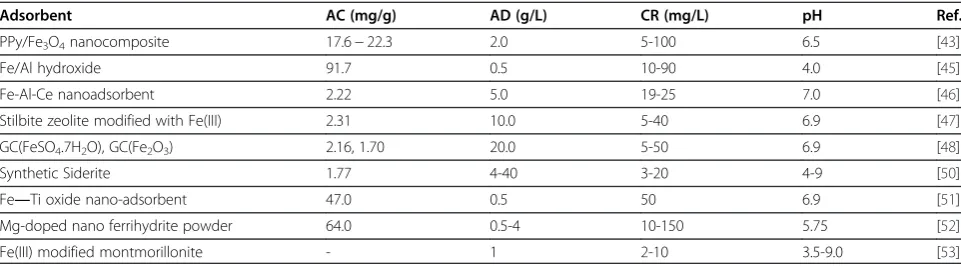
adsorption capacity (1.8 mmol/g) and it followed by ar-senate (0.9−1.0 mmol/g) and phosphate (0.65−0.75 mmol/g). The decreases were sharp at above pH 8, as the surface charge of the sample became more negative. The fluoride did not affect arsenate uptake by the ad-sorbent as fluoride is not a triprotic acid and does not compete for the same sites as arsenate. The synthetic siderite used as a sorbent for fluoride removal [50]. In experiments with an adsorbent dosage of 5 g/L, which was up to 1.775 mg/g and an initial F− concentration was 20 mg/L at 25°C. The presence of chloride and ni-trate has less effect on fluoride adsorption, while phos-phate ion has affected F−removal capacity from aqueous solution. Co-precipitation of ferric hydroxide with fluoride was caused by dissolution of pristine syn-thetic siderite and subsequent oxidization of Fe(II) ions. A novel bimetallic oxide adsorbent was synthesized by the co-precipitation of Fe(II) and Ti(IV) sulphate solu-tion using ammonia titrasolu-tion at room temperature for fluoride removal from water [51]. Mg-doped nano ferrihydrite powder [52], Fe(III) modified montmorillon-ite [53], iron rich latermontmorillon-ite [54], as an adsorbents for F− removal from aqueous solutions. See Table 3 for details.
Calcium-based adsorbents
Calcium has a good affinity for fluoride anion and it has been used for fluoride removal [55]. Crushed limestone (99% pure calcite) used as an adsorbent for fluoride re-moval by batch studies and surface-sensitive techniques from solutions with high fluoride concentration ranging from 3 to ~2100 mg/L. With different techniques, such as atomic force microscopy (AFM) and X-ray photoelectron spectroscopy (XPS) as well as ζpotential measurements, the authors were able to confirm that a combination of surface adsorption and precipitation reactions removed fluoride from aqueous systems. The removal capacity of fluoride was dependent on calcite surface area. Activated and ordinary quick lime as adsorbents used for fluor-ide removal from water [56]. When initial concentra-tion was 50 mg/L, the removal of fluoride was 80.6%
Table 3 Adsorption capacities (AC) and other parameters for the removal of fluoride by Iron-based adsorbents
Adsorbent AC (mg/g) AD (g/L) CR (mg/L) pH Ref.
PPy/Fe3O4nanocomposite 17.6−22.3 2.0 5-100 6.5 [43]
Fe/Al hydroxide 91.7 0.5 10-90 4.0 [45]
Fe-Al-Ce nanoadsorbent 2.22 5.0 19-25 7.0 [46]
Stilbite zeolite modified with Fe(III) 2.31 10.0 5-40 6.9 [47]
GC(FeSO4.7H2O), GC(Fe2O3) 2.16, 1.70 20.0 5-50 6.9 [48]
Synthetic Siderite 1.77 4-40 3-20 4-9 [50]
Fe―Ti oxide nano-adsorbent 47.0 0.5 50 6.9 [51]
Mg-doped nano ferrihydrite powder 64.0 0.5-4 10-150 5.75 [52]
at optimum conditions from synthetic solution. Lang-muir maximum sorption capacity of activated quick lime for fluoride was found 16.67 mg/g. The removal of fluoride was found due to chemisorption and pre-cipitation which was confirmed through scanning electron microscopy (SEM) micrographs and X-ray diffraction (XRD). Aluminium hydroxide impregnated limestone as a adsorbent used for fluoride removal from water [57]. At pH 2, the adsorption in case of modified lime stone was decreased. The maximum sorption capacities of the limestone and aluminium hy-droxide impregnated limestone were found 43.10 mg/g and 84.03 mg/g, respectively. The adsorption method was used for fluoride removal from aqueous solution by Apatitic tricalcium phosphate [58]. The fluoride uptake by various calcium phosphate minerals [59], calcium alumi-nate (CA) [60] was reported. See Table 4 for details.
Other metal oxides/hydroxides/oxyhydroxides, mixed metal oxides, metal- impregnated oxides as adsorbents
An inorganic cerium based adsorbent used for fluoride removal [61] and showed sorption capacity for fluoride. Fluoride removal results at low pH were very fruitful. In the fluoride removal, hydroxyl group of cerium based adsorbent played vital role. To facilitate the adsorption of different cations and anions, the metal oxyhydroxide have surface oxygen which differs in the number of co-ordinating metal ions and the property of oxide minerals was found as advantages for fluoride removal from water [62]. Refractory grade bauxite feed bauxite, manganese ore and hydrated oxides of manganese ores used as ad-sorbents for fluoride removal from water. Experiments showed that refractory grade bauxite had high fluoride removal efficiency in comparison to other three adsor-bents. With pH up to 5.5, the percentage of fluoride ad-sorption onto refractory grade bauxite was found to increase but decreased with increase in pH. The adsorp-tion process was found to be exothermic hence the adsorption efficiencies decreased with increase of temperature. To obtain CeO2-TiO2/SiO2surface, sol–gel
method was employed and used to determine its poten-tial for fluoride removal [63]. The adsorption capacity for fluoride was found 21.4 mg/g. Magnesia-amended silicon dioxide granules for fluoride removal were inves-tigated [64]. With magnesium chloride solution, the modification of silicon dioxide by wet impregnation was
also performed. The adsorption of fluoride depends upon the porous structure and high surface area of the modified granules. At pH range 3 to 4, maximum fluor-ide adsorption was found and further decreased as pH increased above 10 and the decreased in defluoridation was found due to the change in surface charge of the ad-sorbent. At pH 3, maximum defluoridation capacity was found 12.6 mg/g. The order of the reduction of fluoride adsorption is bicarbonate > sulphate > phosphate.
The reduction of fluoride adsorption was found due to the competition for active sites between these ions or due to the change in pH. Nano-sized superparamagnetic zirconia material (ZrO2/SiO2/Fe3O4, SPMZ) was applied
for the sorption of fluoride from water and simulated in-dustrial wastewater [65]. Fluoride removal from water by a mechanochemically synthesized anion clay (meixnerite) and its calcinations product was studied at initial fluoride: meixnerite molar ratios (FI:meix) of 0.1 to 2.0 the theoret-ical fluoride uptake limit for meixnerite [66].
Al-Ce hybrid adsorbent by co-precipitation method was prepared and used for fluoride removal [67]. The hybrid adsorbent was of amorphous structure with some aggregated nanoparticles which was revealed by SEM and XRD results. For fluoride, the adsorbent capacity of Al-Ce adsorbent was 91.4 mg/g at 25°C. At pH 6, max-imum adsorption capacity was achieved. Due to high zero point potential, the adsorbent was effective in fluor-ide removal from aqueous solution. FTIR analysis and zeta potential measurement confirmed that the hydroxyl and pronated hydroxyl groups on the adsorbent surface were involved in fluoride adsorption at high and low pH solutions, respectively. Gel like titanium hydroxide de-rived adsorbent from titanium oxysulfate TiO(SO4) used
for fluoride removal [68]. At low fluoride concentration the adsorbent exhibited high adsorption potential for fluoride and had selectivity for fluoride ions with coexisting chloride, nitrate and sulphate ions. At pH 3, maximum fluoride adsorption occurred. In case of low fluoride concentration < 0.8 mg/L, the adsorbent was also able to remove fluoride in real waste water. Alumin-ium titanate (AT) and bismuth aluminate (BA) as a ad-sorbent [69] used by authors due to high refractivity, low thermal conductivity, low thermal expansion coefficient of aluminium titanate and bismuth aluminate is antacid, nontoxic, water insoluble material which make them suitable for fluoride removal from water. The amounts
Table 4 Adsorption capacities (AC) and other parameters for the removal of fluoride by Calcium-based adsorbents
Adsorbent AC (mg/g) CR (mg/L) pH Ref.
Quick Lime 16.67 10-50 - [56]
Lime stone & Al(OH)3impregnated lime stone 43.10 & 84.03 0-100 8 [57]
Apatitic tricalcium phosphate 15.15 30-60 6.8-6.9 [58]
of fluoride adsorbed by AT and BA were 0.85 and 1.55 mg/g, respectively at 30°C from 4 mg/L initial concentration.
The removal of fluoride from aqueous solution with magnesia (MgO) and magnesia/chitosan (MgOC) com-posite were used batch equilibrium experiments [70]. It was observed that defluoridation capacity of MgOC composite (4440 mg/F−/kg) was appreciably higher than MgO (2175 mg/F−/kg). The influence of different pa-rameters such as contact time, co-existing anions and initial fluoride concentration were studied. It was found that MgO composite reached saturation after 30 min while MgO attained equilibrium after 60 min. In the presence of Cl−, SO24− and NO−3 ions the defluoridation capacity of MgOC composite was slightly increased while it decreased in presence of HCO−3 ions. Defluoridation capacity of both MgO and MgOC com-posites were found to increase with increase in initial fluoride concentration. The sorption process followed Freundlich isotherm and pseudo-second order kinetics. The mechanism of fluoride removal was mainly governed by adsorption. Thermodynamics parameters (ΔGº, ΔHº and ΔSº) were calculate and values indicate that fluoride adsorption to be feasible, spontaneous and endothermic reaction.
The removal of fluoride by novel adsorbent calcined magnesia with pullulan (cMgOP) composite, an extracel-lular water soluble microbial polysaccharide was studied [71]. It was found that the surface area and adsorption micropore of the cMgOP composite were increased from 7.6 m2/g and 14 nm for pure MgO to 33 m2/g and 30 nm, respectively. The presence of Cl−, SO24−and NO−3 ions has negligible effect in defluoridation capacity be-cause Cl−, SO24− and NO−3 ions interfered in fluorine re-agent spectrophotometry and showed a small positive effect as to be negligible while significant decrease in presence of HCO−3 due to the competition of bicarbon-ate ions with fluoride ions in the sorption process. Effect of contact time revealed that the adsorption of three
adsorbents- cMgOP, MgO and pullulan increased with increasing contact time. The defluoridation capability of cMgOP (4537 mg/F−/kg) was 10 times than that of MgO (457 mg/F−/kg). At pH 5, maximum defluoridation cap-acity of 97.6% was obtained. From the thermodynamic parameters, sorption process was found to be spontan-eous and endothermic. Particle diffusion model was the best to describe the adsorption of fluoride on cMgOP.
Hybrid process was applied that combined the adsorp-tion on convenadsorp-tional solid adsorbents such as alumin-ium and zirconalumin-ium oxide along with specific donnan dialysis for defluoridation of ground water [72]. It was found that adsorption was not dependent on pH and ionic strength of water to be treated. Donnan dialysis pilot was equipped with specific anion exchange mem-branes to reduce electrolyte leakage and thus increased in mineralization of treated water. By this treatment cat-ion compositcat-ion of treated water was not modified but all the anion except chloride was partially eliminated and substituted chloride ions.
The use of magnesium titanate as an adsorbent for fluoride removal was examined [73]. The amount of fluoride adsorbed from 4 mgL-1of fluoride solution was found to be 0.029 mg/g. The influence of different pa-rameters such as initial concentration of adsorbent, ad-sorbent dose, agitation time, co-ions and temperature on defluoridation was studied. The percentage of fluoride removal increased with increase in initial concentration of fluoride, temperature, and adsorbent dose and agita-tion time up to 40 min. Wide range of pH and high temperature ranges were found as the optimum conditions for fluoride adsorption. The experimental data fitted satis-factorily (r > 0.97) to Langmuir isotherm. Thermodynamic parameters such asΔHº,ΔSº and ΔGº concluded the ad-sorption was endothermic. Moreover the mechanism of adsorption was found to be physisorption from the magni-tude of enthalpy change 20–45 KJ/mol. Defluoridation of water using bauxite adsorbent was studied [74]. The optimum adsorbent dose was found to be 5 g/100 mL, the
Table 5 Adsorption capacities (AC) and other parameters for the removal of fluoride by metal oxides/hydroxides/ oxyhydroxides, mixed metal oxides, metal- impregnated oxides as adsorbents
Adsorbent AC (mg/g) CR (mg/L) pH Ref.
Magnesia-amended silicon dioxide 12.6 - 3.0 [64]
Superparamagnetic sorbent(ZrO2/SiO2/Fe3O4) 14.7 10-105 4 [65]
Calcined meixnerite 16.0 12.4-248 6.5 [66]
Al-Ce hybrid adsorbent 91.4 2-15 6.0 [67]
Aluminium titanate, Bismuth aluminate 3.01, 7.09 2-10 7.0 [69]
Magnesia, Magnesia/chitosan composite 2.2, 4.4 10-23 10-10 [70]
Magnesium Titanate 0.03 2-10 3-11 [73]
Bauxite 5.16 4-26 6 [74]
Mn-Ce oxide adsorbent powdered & granular 79.5 & 45.5 10-100 6-8 [76]
equilibrium contact time was found to be 75 min and max-imum adsorption obtained at pH 6. Maxmax-imum fluoride re-moval was found to be 94.2% at optimum conditions. Langmuir isotherm fitted well for defluoridation of water using bauxite.
In very recent study, bauxite as an adsorbent for the removal of fluoride from contaminated ground water was used. Adsorption experiments with respect to vari-ation in time, pH, adsorbate and concentrvari-ations of other anions namely nitrate, sulfate, carbonate, and phosphate were carried out. To get a better insight into the mech-anism of adsorption they were characterized bauxite be-fore and after fluoride adsorption by XRD, FTIR and SEM–EDX. An adsorption rate was rapid and followed first order kinetics with intraparticle diffusion as the rate determining step. They were also estimated thermo-dynamic parameters (ΔH°, ΔS° and ΔG°) which are indicating that the adsorption was spontaneous and exothermic in nature [75]. Mn-Ce oxide adsorbent by co-precipitation method was prepared [76] and studied the role of prepared adsorbent in fluoride removal from the sorption isotherms. It has been shown that the maximum sorption capacities of fluoride on the powdered and granular Mn-Ce adsorbent were 137.5 and 103.1 mg/g.
In our lab, we are also synthesizing Mn-Zr, Mn-Ce-Zr, Mn-Ti-Ce etc. as nano adsorbent with high sorption capacity for fluoride removal from potable water. In this study, the sorption isotherms showed that the maximum adsorption capacities of fluoride on the powdered and granular Mn-Zr adsorbent. The sorption experiment was carried out in 250 mL polypropylene flask containing 200 mL of fluoride solution and 0.02 g adsorbent, and flask were shaken at 150 rpm in a shaker at 25°C for
24 h. The adsorption experiment was carried out at the initial fluoride concentration of 10 mg/L while after treatment water has fluoride concentration in range of 5–7 mg/L. The concentration of fluoride in treated water was varied with contact time, concentration of adsorbent, pH, and concentration of fluoride in non-treated water. The individual particle size, as determined by TEM and XRD and the specific surface area of each sample. There is two size ranges as determined by the TEM images given for the samples. This is due to the fact that the Mn-Zr samples possess a very wide size dis-tribution. In real, there is no discreet break between the large and small particles in these samples. The large and small particles are separated here because important information about the exposed surface planes can be determined by examining the large particles while the small particles are too small to view anything of value.
The paper presents a detailed study of the effect of manganese dioxide on the defluoridation potential of disposed earthenware (DEW) of the particle size less than 300 μm. Manganese dioxide was added to DEW with weight content from 0.01 to 0.025%. The defluo-ridation was investigated in static experiments, at pH 5–11 and with contact time of 35 min. The fluoride re-moval increased with the increasing content of manga-nese dioxide. In static sorption, the defluoridation with DEW dispersed with 0.025% of manganese dioxide creased from 1198 to 1888 mg/kg when the pH in-creased from 5 to 7 [77]. In the simulating equilibrium data, simple kinetic models namely, pseudo I and II order, particle and pore diffusion, Elovich and isothermal models of Langmuir and Freundlich were used. The fluoride removal was investigated in the presence of
Table 6 Adsorption capacities (AC) and other parameters for the removal of fluoride by Bio adsorbents
Adsorbent AC (mg/g) CR (mg/L) pH Ref.
Neodymium-modified chitosan 22.4 10-100 7.0 [81]
PANi/Ch, PPy/Ch 5.9, 6.7 2-10 7.0 [82]
Lanthanum incorporated chitosan beads 4.7 5.34 5.0 [83]
Chitin 3.4 1-100 4.8 [85]
Rice husk ash (RHA) by coating Al(OH)3 9-10 10-60 5 [86]
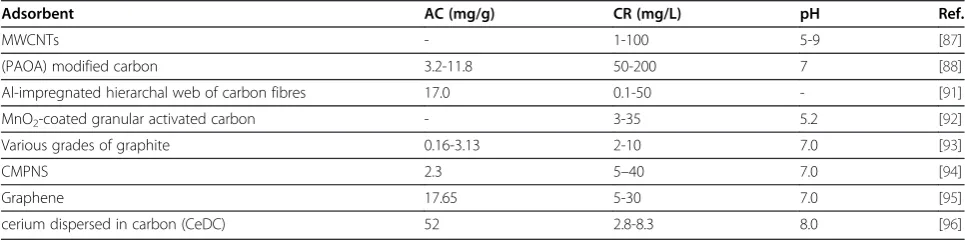
Table 7 Adsorption capacities (AC) and other parameters for the removal of fluoride by Carbon based sorbents
Adsorbent AC (mg/g) CR (mg/L) pH Ref.
MWCNTs - 1-100 5-9 [87]
(PAOA) modified carbon 3.2-11.8 50-200 7 [88]
Al-impregnated hierarchal web of carbon fibres 17.0 0.1-50 - [91]
MnO2-coated granular activated carbon - 3-35 5.2 [92]
Various grades of graphite 0.16-3.13 2-10 7.0 [93]
CMPNS 2.3 5–40 7.0 [94]
Graphene 17.65 5-30 7.0 [95]
coexisting ions. It was found that the reduction in fluor-ide sorption was greater in the presence of SO24− ion than in the presence of HCO3, Cl−and NO3. DEW with dispersed manganese dioxide, showed an ability to lower the fluoride concentration to acceptable levels and improved the defluoridation efficiency of unmodified DEW. The spent sorbent was easily regenerated by NaOH solution. See Table 5 for details.
Bio adsorbents
The defluoridation capability of brushite-calcite with two local biosorbents material (grind neem and pipal leaves) was compared [78]. Fluoride concentration was found to be reduced from 5 mg/L to 1.2 mg/L in 90 min and decreased to 1 mg/L in 18 h by brushite calcite while local biosorbents materials reduced the fluoride concentration to 4 mg/L in 90 min and to 3.22 mg/L after 18 h thus indicating the superiority of brushite-calcite to biosorbents (neem and papal leaves). The Cynodon dactylon was prepared from the activated car-bon for fluoride removal [79]. The fluoride concentra-tion of 3 mg/L with 1.25 g of adsorbent at neutral pH was found to be removed to 83.77%. Adsorbent was regenerated by 67.4% using 2% NaOH. Fluoride removal was hindered by bicarbonate ions. The sorption of fluor-ide was found to be spontaneous and endothermic fol-lowing pseudo-second order kinetics.
The applicability of neodymium-modified chitosan as adsorbents for the removal of excess fluoride from water was investigated [80]. The modified chitosan showed defluoridation capacity at pH 7. The defluoridation cap-acity increased with increasing temperature which indi-cated the strong tendency of monolayer formation process to occur. The chloride, sulphate and nitrate showed no significant effect within the concentration range tested. The Langmuir maximum equilibrium sorp-tion was found to be 11.411 - 22.38 mg/g at different temperatures. The defluoridation capacity of chitosan beads was found negligible and it was chemically modi-fied by introducing the multifunctional groups, such as ammonium and carboxylic groups by mean of proton-ation and carboxylproton-ation in order to utilize both amine and hydroxyl groups for fluoride removal. That modified bioadsorbent showed maximum defluoridation capacity at pH 7. The defluoridation capacity of protonated cum
carboxylated chitosan beads was found (1800 mg/F−/kg), which was higher than raw chitosan beads (52 mg/F−/kg). The protonated cum carboxylated chitosan beads re-moved fluoride by hydrogen bonding [81]. To remove fluoride ions from aqueous solutions eco-friendly conducting polymer/bio-polymer composites viz. polya-niline/chitosan (PANi/Ch) and polypyrrole/chitosan (PPy/ Ch) as adsorbents were investigated. Chitosan is one of the promising natural polymers with characteristics such as biodegradability, chemical inertness, good film forming properties and low cost. The system variables studied in-clude initial concentration of the sorbate, agitation time, adsorbent dose, pH, co-ions and temperature. At low pH and high temperature, fluoride removal occurred. The amount of fluoride ion removal increased with a decrease in adsorbent dose due to the availability of higher number of fluoride ions per unit mass of polymer composites, i.e., higher fluoride/composite ratio. According to Langmuir and Freundlich isotherms, the experimental data fitted well. The amounts of fluoride ions adsorbed per unit mass of the adsorbents were found to be 5.9 mg/g for PANi/Ch and 6.7 for PPy/Ch, at 50°C from 10 mg/L fluoride solu-tion. The removal of fluoride ions is an endothermic process was indicated through thermodynamic parame-ters. The PPy/Ch composite exhibited relatively higher defluoridation capacity than the PANi/Ch composite due to the fact that polypyrrole itself exhibited higher fluoride ions removal capacity than that of polyaniline [82]. Therefore, the corresponding polymer/Ch com-posites also exhibited the same trend. It is well established that these polymers, in the chloride ion doped form, remove fluoride ions from water via dopant-exchange mechanism. The conducting poly-mer/Ch composites remove fluoride ions from water through the ion-exchange mechanism using the N-atoms present in both the constituent polymers and this ion- exchange leading to an enhanced fluo-ride removal. The defluoridation occurred through dopant-exchange mechanism on the N-atoms present in these constituent polymers.
To enhance the fluoride removal capacity from water, Lanthanum incorporated chitosan beads were prepared using precipitation method. At pH 5, maximum adsorp-tion capacity was observed 4.7 mg/g [83]. Waste fungal biomass [84] (Pleuratus astreatus 1804) derived from the laccare fermentation process was used for fluoride
Table 8 Adsorption capacities (AC) and other parameters for the removal of fluoride by Natural materials
Adsorbent AC (mg/g) CR (mg/L) pH Ref.
Lignite, Fine coke and Bituminous coal 6.9-7.4 3-90 5-10 [99]
Fired clay chips 7.2-9.0 5-20 5-7 [101]
Tamarindus indica Fruit Shells (TIFSs) 22.3 2-8 7 [105]
removal from water. Batch absorption studies were performed for this experiment and the results revealed that bioadsorbent demonstrated the ability to absorb fluoride from water. The sorption obeyed the pseudo-first-order rate equation and the fluoride sorption was found to be dependent on the aqueous phase pH. At lower pH, the fluoride uptake was observed to be greater. A detailed fluoride adsorption study in packed columns with chitin or a chitin-based biocomposite is reported [85]. A novel cost effective defluoridation method that is based on surface modification of rice husk ash (RHA) by coating aluminum hydroxide [86]. See Table 6 for details.
Carbon based sorbents
Some researchers used carbon as an adsorbent for fluor-ide removal. The potential sorption capacity of multi-walled carbon nanotubes (MWCNTs) was investigated as a means of removing fluoride from the drinking water of a number of regions in Iran and from experimental solutions [87]. A novel poly(aniline-co-o-aminophenol) (PAOA) modified carbon felt electrode reactor was designed and investigated for fluoride removal from aqueous solutions [88]. Fishbone charcoal is a moving media adsorption system used for fluoride adsorption [89]. The ratio of attained of attained equilibrium sor-bate concentration to the initial sorsor-bate concentration and the fluoride removal capacity of the sorbent were found to vary inversely with the sorbent mass input rate and varied directly with the sorbate flow rate and initial sorbate concentration. The ratio of attained equilibrium sorbate concentration to the initial sorbate concentra-tion found to be a funcconcentra-tion of the sorbent – sorbent mass input rate ratio. Zirconium impregnated activated charcoals as an adsorbent used for defluoridation [90]. In comparison of plain activated charcoal, the fluoride adsorption capacity of impregnated activated charcoals was 3–5 times higher. Maximum fluoride uptake showed by zirconium impregnated coconut fibre charcoal and followed by groundnut shell and coconut shell charcoals due to its large surface area. Micro/nano-hierarchal web consisting of activated carbon fibres [91] and carbon nano fibres impregnated with Al used as an adsorbent for fluoride removal from wastewater. At pH 5–8, Al-carbon nano fibres was used for treating the wastewater. Granular activated carbon was coated with manganese oxides and used for fluoride removal from water and showed maximum adsorption capacity [92]. The adsorp-tion capacity was three times higher than uncoated granular activated carbon. At pH 3, the fluoride adsorp-tion was observed maximum. Different grades of graph-ite were used as adsorbents for fluoride removal from water [93]. At appreciable extent, competing anions did not affect fluoride removal. Carbons loaded with specific
chemical moieties were prepared from pecan nut shells employing a natural modifier agent obtained from egg shell (CMPNS), which is rich in calcium, for the select-ive adsorption of fluoride from water [94]. A batch ad-sorption system was applied to investigate the adad-sorption of fluoride from aqueous solution by graphene [95]. To the removal of excess fluoride in drinking water using cer-ium dispersed in carbon (CeDC), a hybrid sorbent which was prepared by carbonization of ammonium cerium sulphate impregnated starch [96].
The importance of Acacia Arabicafruit carbon as an alternative to activated carbon as defluoridation method was investigated [97]. It was concluded that, for the se-lected domain, the chosen variables agitation time (T), granulometry (G) and adsorbent’s concentration (A) had very significant influence on the process, with increasing importance as followed: G < T < A. The role of three acti-vated carbon adsorbents, BKC, BOC and RSC which were prepared from biomaterials of bergera koenigh (curry leaf seeds), batavia orange and raphanus sativus (garden radish) respectively was investigated [98]. It has been found that upto 4 mg/L fluoride contents can be reduced to permissible level. Maximum contact time was found to be 30 min and optimum dose of adsorbent was 1 g/L. Moreover, at pH 6 maximum defluoridation was observed. Adsorbent was found to be regenerated by passing 0.1 M NaOH solutions. See Table 7 for details.
Natural materials
fluoride adsorption efficiency. The defluoridation of water using tamarind seed by domestic water filter was studied [104]. The influence of pH, agitation time, initial fluoride concentration, temperature, particle size and solvent dose were studied for defluoridation. Maximum defluoridation capacity was achieved at pH 7. Tamarindus indica fruit shells (TIFSs) were activated by ammonium carbonate and then carbonized leading to carbon abbreviated as ACA–TIFSC [105]. The defluoridation capacity decreased with increase in initial fluoride concentration, temperature and particle size. Defluoridation followed first order kinetics and Langmuir adsorption isotherm. The hydro-methanolic extract of tamarind fruit pulp in removing of body fluoride burden has been undertaken for study [106]. For this experiment thirty rats were divided into five groups. Low dose, middle dose, high dose of sodium fluoride was received by these groups through orally at the rate of 200 mg/kg body weight daily for four weeks. Rats of low dose, middle dose and high dose group simultaneously received tamarind fruit pulp ex-tract at three doses 25 (low), 50 (medium) and 100 mg (high) per kg body weight orally, respectively. The concentration of fluoride in blood, urine and long bone of experimental rats was monitored to as-sess the efficacy of the extract. The mean serum fluoride concentration in fluoride exposed rats was 0.145 ± 0.009 and0.783 ± 0.042 g/mL on days 0 and 98. In comparison, fluoride concentrations in tama-rind treated rats were 0.179 ± 0.021 and 0.633 ± 0.015; 0.179 ± 0.021 and 0.502 ± 0.025 and 0.176 ± 0.021 and 0.498 ± 0.030 g/mL in low, medium and high dose groups, respectively on day 0 and day 98 of the experiment. There was a significant increase in uri-nary fluoride excretion from day 28 onwards. The mean fluoride concentration in long bones of treated rats was significantly lower than the values recorded from fluoride exposed rats. Adsorption was carried out by pumice stone [107] as an adsorbent for fluo-ride removal. See Table 8 for details.
Nano-sorbents
The potential of nano alumina for fluoride removal and was found to be 140 mg/g [108]. Defluoridation studies were conducted under various experimental conditions such as pH, contact time, initial fluoride concentration, temperature and the presence of counter ions. It was no-ticed that maximum fluoride removal occurred at
pH 6.15 and increased with increase in time and initial fluoride concentration. Fluoride adsorption was not sig-nificantly affected by temperature variation but was influenced by PO34 , SO24 and CO23 ions. The sorption isotherm was fitted with Langmuir model and followed pseudo-second order kinetics. Carbon nanotubes (CNTs) as support to deposit Al2O3and explored the possibility
of Al2O3/CNTs for fluoride removal from drinking water
[109]. The fluoride removal was occurred on Al2O3/CNTs
at pH 5.9-9.0. The adsorption capacity for Al2O3/CNTs
was 13.5 times higher than AC-300 carbon and four times higher than that of γ-Al2O3at equilibrium fluoride
con-centration of 12 mg/L. The mass of fluoride adsorption for Al2O3/CNTs at pH 6 reached 28.7 mg/g at equilibrium
concentration of 50 mg/L. See Table 9 for details.
Building materials
The potential of building materials towards fluoride re-moval was observed. The low weight concrete (building material) [110] as an adsorbent for the removal of fluor-ide from water was used and check their efficacy by vary various parameters. The maximum adsorption of fluor-ide took place at pH 6.9 but in the acidic medium, less adsorption took place due to the formation of weakly ionised hydrofluoric acid. Another adsorbent i.e. hy-drated cement [111] and hardened alumina cement granules [112] for fluoride removal from aqueous solu-tion was observed. See Table 10 for details.
Apatite and hydroxyapatite
Apatite in different forms has been used for fluoride re-moval as it showed good prospective for defluoridation. Synthetic nano-hydroxyapatite (n-Hap), biogenic apatite, treated biogenic apatite, geogenic apatite were engaged to evaluate their effectiveness for fluoride removal [113]. The removal of fluoride using synthetic hydroxyapatites (HAps) was investigated. It was found that small sized (HAps) were more efficient than the largest particle size. It was also concluded that the defluoridation efficiency
Table 9 Adsorption capacities (AC) and other parameters for the removal of fluoride by Nano-sorbents
Adsorbent AC (mg/g) CR (mg/L) pH Ref.
Nano–alumina 14.0 1-100 6.15 [108]
Al2O3/CNTs 28.7 50 6.0 [109]
Table 10 Adsorption capacities (AC) and other parameters for the removal of fluoride by Building materials
Adsorbent AC (mg/g) AD (mg/g) CR (mg/L) pH Ref.
LWC (building material) 5.15 0.10 - 6.9 [110]
Hydrated cement 2.7 1000 - 6.7 [111]
increased with increase in the dose of HAps and contact time but decreased with increase in initial fluoride con-centration and pH. The nanostructure of hydroxyapatite from combined ultrasonic and microwave technique and examined its role in defluoridation [114,115]. The effects of low molecular weight organic acids (LMWOAs) on the defluoridation capacity of nanosized hydrpxyapatite (nHAP) from aqueous solution were investigated [116]. Cellulose@hydroxyapatite (HA) nanocomposites were prepared in NaOH/thiourea/urea/H2O solution via situ
hybridization [117]. Aluminum-modified hydroxyapatite (Al-HAP) was also used for defluoridation [118]. Phosphogypsum (PG) was utilized to prepare hydroxy-apatite nanoparticles with high purity. nHAP derived from PG exhibits excellent adsorption capacity for fluor-ide [119]. See Table 11 for details.
Industrial waste adsorbent
Extensive industrial actions generates enormous amount of solid waste materials as by–products. One of the ad-vantageous uses of these wastes is to convert them as economical sorbents for detoxification of water. For the fluoride removal from aqueous solution, the industrial waste like spent bleaching earth (SBE) is used as a ad-sorbent [120]. The waste SBE was obtained from the oil industry, and acid and alkaline were used to recover it. In addition, the optimum conditions obtained in this study were tested on Kuhbonan (one of the regions of Iran whose fluoride level has been reported between 2.28 and 5.4 mg/L) water. At pH 7, the maximum fluoride adsorption was obtained and an equivalent time of 180 min. When the fluoride initial concentration in water increased, fluoride removal efficiency decreased. The maximum adsorption capacity of RSBE was 0.6 mg/g
fluoride (2.5–8 mg/F−/L, 10 g RSBE/L and pH 7). Adsorp-tion of fluoride on waste carbon slurry (a fertilizer indus-try waste) was investigated [121]. Activated titanium rich bauxite was also another adsorbent which was used for defluoridation of water [122]. See Table 12 for details.
Zirconium based adsorbents
The defluoridation performance and adsorption mech-anism of a high capacity hydrous zirconium oxide [123], meso-structured zirconium phosphate (MZrP) [124] ad-sorbents were investigated. The need of treatment of large volume water samples could be met by the super paramagnetic properties of the nanoparticles through application of an external magnetic field. Zr(IV) metallo-porphyrins possess high selective affinity toward fluor-ide. The synthesis of a new sorbent consisting of 3-aminopropyl triethoxysilane (APTES) coated magnetic nanoparticles functionalized with a zirconium(IV) por-phyrin complex Zr(TCPP)Cl2 [TCPP: tetrakis(4-carboxy phenyl) porphyrin] [125] were used for defluoridation. A novel zirconium(IV)-ethylenediamine (ZrEDA) hybrid material was prepared by mixing aqueous solution of zir-conium oxychloride (0.1 M) and aqueous solution of ethylenediamine (0.1 M) following an environmental friendly sol–gel method [126]. zirconium-modified-Na-attapulgite (Zr-A) adsorbent was used for defluoridation [127]. See Table 13 for details.
Miscellaneous adsorbents for defluoridation of water
Bleaching powder as adsorbent for fluoride removal from water was used. It could be used as disinfectant and defluoridation agent. It was found that defluo-ridation from water occurred due to adsorption by bleaching powder and slightly due to precipitation in the
Table 11 Adsorption capacities (AC) and other parameters for the removal of fluoride by Apatite and hydroxyapatite
Adsorbent AC (mg/g) AD (g/L) CR (mg/L) pH Ref.
Synthetic nano hydroxyapatite 4.575 4 3-80 5-6 [113]
Biogenic apatite 4.99
Treated biogenic apatite 6.849
Geogenic apatite 0.014
Hydroxyapatite 1.432 20 3-80 5 [114]
Nano sized hydroxyapatite 3.44 0.2 50 5 [116]
Cellulose@hydroxyapatite nanocomposites 4.2 4 10 6.5 [117]
Al-modified hydroxyapatite (Al-HAP) 32.57 0.5 5-50 7 [118]
nHAp derived from PG 19.74-40.81 1 10-50 2-11 [119]
Table 12 Adsorption capacities (AC) and other parameters for the removal of fluoride by Industrial waste adsorbent
Adsorbent AC (mg/g) AD (g/L) CR (mg/L) pH Ref.
Regenerated spent bleaching earth 0.6 10 2.5–8 7.0 [120]
Waste carbon slurry 4.3 1 1-11 7.6 [121]
form of calcium fluoride. At pH 6–10, defluoridation from water was occurred by adsorbent dose of 50 g/L [128]. Ti-Ce (9.6 mg/g) and Ti-La (15.1 mg/g) hybrid ad-sorbents had higher sorption capacities for fluoride than TiO2 (1.7 mg/g) adsorbent [129]. The sorption capacity
decreased with increasing pH from 3 to 9.5. The conducting polypyrrole as adsorbent for the fluoride re-moval from aqueous solution was studied [130]. The amount of fluoride ion removed per unit mass of the adsorbent at 30°C from 10 mg/L fluoride ion solution was estimated to be 6.37 mg/g. For defluoridation from aqueous solution, Magnesia-loaded fly ash cenospheres was prepared by wet impregnation of fly ash cenos-pheres with magnesium chloride solution. At pH 3, defluoridation from aqueous solution was observed with adsorbent dose 2.5 mg/L [131]. Aerobic granules (AG) were carboxylated and Ce(III) was incorporated to ob-tain modified granules (Ce(III)–MAG) for removal of fluoride from aqueous solutions [132]. Besides the above mentioned adsorbents, various other authors also exam-ined the potential of different types of sorbents such as KMnO4 modified activated carbon derived from steam
pyrolysis of rice straw [133], hybrid thorium phosphate composite [134], granular acid-treated bentonite [135], Nickel and magnesium hydrotalcite-like compounds (NiAlHT, MgAlHT) [136], etc. for fluoride removal. See Table 14 for details.
Conclusions
Studies for the removal of fluoride, using several adsor-bents have been summarized briefly in this review. The efficacy of each adsorbent has been examined and discussed. The following conclusions have been made on the basis of literature review:
Although activated alumina adsorption technology shows higher uptake of fluoride, but it is expensive
and its performance is affected by the presence of co-ions in water.
Rare earth oxide-based materials have shown high fluoride removal efficiency in batch mode but these materials have been found very expensive.
Carbon based adsorbents have its application in small scale and lack in terms of column operation and/or pilot scale.
Various natural adsorbents have potential for defluoridation of water but their difficulties in regeneration and low efficiency have also been reported.
Biosorption is an environmentally friendly technique for fluoride removal utilizing various biomaterials of low cost. However, there are some disadvantages also, which limited its use for removal of low fluoride concentration.
Nano- adsorbents have been attracted considerable attention in the recent years in fluoride removal and these materials have shown higher fluoride uptake capacity.
The influence of pH, agitation time, initial fluoride concentration, temperature, particle size, surface area, presence and nature of counter ions and solvent dose were studied for defluoridation with various adsorbents.
The sorption kinetics was pseudo-second order or pseudo-first order and the equilibrium data fitted well to the adsorption isotherms like Langmuir and Freundlich.
So, the future research should be concentrated in evaluating the efficacy of adsorbents in terms of cost and feasibility for removal of fluoride. It would be worthwhile to study the suitability of different chemicals to regenerates the spent adsorbents.
Table 13 Adsorption capacities (AC) and other parameters for the removal of fluoride by Zirconium based adsorbents
Adsorbent AC (mg/g) CR (mg/L) pH Ref.
Hydrous zirconium oxide adsorbent 124 -68 2-120 4-7 [123]
Meso-structured zirconium phosphate (MZrP) - 1-10 6 [124]
Zr(IV)metalloporphyrin grafted Fe3O4NPs - 1-10 5.5 [125]
Zr(IV)–ethylenediamine 37.03 2-50 7 [126]
Zr-modified-Na-attapulgite(Zr-A) 24.55 10-50 3.7–7.5 [127]
Table 14 Adsorption capacities (AC) and other parameters for the removal of fluoride by miscellaneous adsorbents
Adsorbent AC (mg/g) CR (mg/L) pH Ref.
Bleaching powder 0.2 5 6.7 [128]
Magnesia loaded fly ash cenospheres 6.0 100 3.0 [131]
Modified granules (Ce(III)–MAG) 4.80 4-20 3-5 [132]
Abbreviations
AA: Activated Alumina; MGA: Metallurgical grade alumina; UHA: Untreated hydrated alumina; THA: Thermally treated hydrated alumina; PPy: Polypyrrole; Fe(III)-STI: Fe(III)-stilbite zeolite; AFM: Atomic force microscopy; XPS: X-ray photoelectron spectroscopy; SEM: Scanning electron microscopy; FTIR: Foutier infrared spectroscopy; XRD: X-ray diffraction; CA: Calcium aluminate; SO4: Titanium oxysulfate TiO(SO4); AT: Aluminium titanate; BA: Bismuth aluminate; MgOC composite: Magnesia (MgO) and magnesia/ chitosan; enthalpyΔH0and entropyΔS0: Gibbs free energyΔG0;
cMgOP: Calcined magnesia with pullulan; DEW: Disposed earthenware; PPy/ Ch: Polyaniline/chitosan (PANi/Ch) and polypyrrole/chitosan; RHA: Rice husk ash; MWCNTs: Multi-walled carbon nanotubes; PAOA: Poly(aniline-co-o-aminophenol); CMPNS: Carbons loaded with specific chemical moieties pecan nut shells; CeDC: Cerium dispersed in carbon; T: Agitation time; G: Granulometry; A: Adsorbent’s concentration; BKC: Bergera koenigh (curry leaf seeds); BOC: Batavia orange; RSC: Raphanus sativus (garden radish); (PriTS: Tamarind seed, pristine; PurTS: Purified; Pani: Polyaniline; TIFSs: Tamarindus indica Fruit Shells; ACA–TIFSC: Ammonium carbonate Tamarindus indica Fruit Shells carbon; CNTs: Carbon nanotubes; LWC: Low weight concrete; n-Hap: Synthetic nano-hydroxyapatite; LMWOAs: Low molecular weight organic acids; Al-HAP: Aluminum-modified hydroxyapatite; PG: Phosphogypsum; SBE: Spent bleaching earth; RSBE: Regenerated spent bleaching earth; MZrP: Meso-structured zirconium phosphate; APTES: 3-aminopropyl triethoxysilane; TCPP: Tetrakis(4-carboxyphenyl) porphyrin; ZrEDA: Zirconium(IV)-ethylenediamine; Zr-A: Zirconium-modified-Na-attapulgite; AG: Aerobic granules; NiAlHT: MgAlHT, Nickel and magnesium hydrotalcite-like compounds; Ce(III)–MAG: Ce(III) modified granules; AC: Adsorption capacity; CR: Concentration range; AD: Adsorbent dose.
Competing interests
Both the authors declared that there is no competing interest.
Authors’contributions
VT and DK both authors made equally efforts in this paper and have created many of the chemistry related stuffs in this review. Both authors read and approved the final manuscript.
Acknowledgement
The authors are thankful to University Grant Commission (UGC), New Delhi for its financial assistance.
Received: 4 September 2012 Accepted: 4 March 2013 Published: 13 March 2013
References
1. Amini M, Mueller K, Abbaspour KC, Rosenberg T, Afyuni M, Møller KN, Sarr M, Johnson CA:Statistical modeling of global geogenic fluoride contamination in groundwaters.Environ Sci Technol2008,42:3662–3668. 2. Mahramanlioglu M, Kizilcikli I, Bicer IO:Adsorption of fluoride from
aqueous solution by acid treated spent bleaching earth.J Fluorine Chem
2002,115:41–47.
3. Jamodei AV, Sapkal VS, Jamode VS:Defluoridation of water using inexpensive adsorbents.J Ind Inst Sci2004,84:163–171. 4. Gonzales C, Hotokezaka H, Karadeniz EI, Miyazaki T, Kobayashi E,
Darendeliler MA, Yoshida N:Effects of fluoride intake on orthodontic tooth movement and orthodontically induced root respiration. Am. J Ortho Dentofacial Orthop2004,139:196–205.
5. Solangi IB, Memon S, Bhanger MI:Removal of fluoride from aqueous environment by modified amberlite resin.J Hazard Mater2009, 171:815–819.
6. Fan X, Parker DJ, Smith MD:Adsorption kinetics of fluoride on low cost materials.Water Res2003,37:4929–4937.
7. Zhou Y, Yu C, Shan Y:Adsorption of fluoride from aqueous solution on La3+ impregnated crosslinked gelatin.Sep Purif Technol2004,36:89–94. 8. Islam M, Patel RK:Thermal activation of basic oxygen furnace slag and evaluation of its fluoride removal efficiency.Chem Eng J2011,169:68–77. 9. Health Effects. http://www.fluoridealert.org/health/.
10. Harrison PTC:Fluoride in water: a UK perspective.J Fluorine Chem2005, 126:1448–1456.
11. Apambire WB, Boyle DR, Michel FA:Geochemistry, genesis, and health implications of fluoriferous groundwaters in the upper regions of Ghana. Environ Geochem1997,33:13–24.
12. Tressaud A:Fluorine and the Environment: Agrochemicals, Archaeology, Green Chemistry & Water. Amsterdam; Boston: Elsevier; 2006. (series editor): Advances in Fluorine Science, vol. 2.
13. Ghorai S, Pant KK:Equilibrium, kinetics and breakthrough studies for adsorption of fluoride on activated alumina.Sep Purif Technol2005, 42:265–271.
14. Sujana MG, Thakur RS, Rao SB:Removal of fluoride from aqueous solution by using alum sludge.J Colloid Interface Sci1998,206:94–101.
15. Huang CJ, Liu JC:Precipitate flotation of fluoride-containing wastewater from a semiconductor manufacturer.Water Res1999,33:3403–3412. 16. Simons R:Trace element removal from ash dam waters by nanofiltration
and diffusion dialysis.Desalination1993,89:325–341.
17. Sehn P:Fluoride removal with extra low energy reverse osmosis membranes: three years of large scale field experience in Finland. Desalination2008,223:73–84.
18. Hu CY, Lo SL, Kuan WH:Effect of co-exiting anions on fluoride removal in electrocoagulation process using aluminium electrodes.Water Res2003, 37:4513–4523.
19. Ayoob S, Gupta AK, Bhat VT:A conceptual overview on sustainable technologies for defluoridation of drinking water and removal mechanisms.Crit Rev Environ Sci Technol2008,38:401–470.
20. WHO:Guidelines for drinking-water quality.3rd edition. Geneva: World Health Organisation; 2004:375–378. 301–303.
21. Meenakshi MRC:Fluoride in drinking water and its removal.J Hazard Mater2006,137:456–463.
22. Mohapatra M, Anand S, Mishra BK, Giles DE, Singh P:Review of fluoride removal from drinking water.J Environ Manage2009,91:67–77. 23. Goswami A, Purkait MK:The defluoridation of water by acidic alumina.
Chem Eng Res and Des2012,90:2316–2324.
24. Farrah H, Slavek J, Pickering WF:Fluoride interactions with hydrous aluminum oxides and alumina.Aust J Soil Res1987,25:55–69.
25. Ku Y, Chiou HM:The adsorption of fluoride ion from aqueous solution by activated alumina.Water Air Soil Pollut2002,133:349–361.
26. Bahena JLR, Cabrera AR, Valdivieso AL, Urbina RH:Fluoride adsorption onto α-Al2O3and its effect on the zeta potential at the alumina–aqueous electrolyte interface.Sep Sci Technol2002,37:1973–1987.
27. Ghorai S, Pant KK:Investigations on the column performance of fluoride adsorption by activated alumina in a fixed-bed.Chem Eng J2004, 98:165–173.
28. Pietrelli L:Fluoride wastewater treatment by adsorption onto metallurgical grade alumina.Anal Chim2005,95:303–312.
29. Valdivieso AL, Bahena JLR, Song S, Urbina H:Temperature effect on the zeta potential and fluoride adsorption at theα-Al2O3/aqueous solution interface.J Colloid Interface Sci2006,298:1–5.
30. Shimelis B, Zewge F, Chandravanshi BS:Removal of excess fluoride from water by aluminum hydroxide.Bull Chem Soc Ethiopia2006,20:17–34. 31. Bishop PL, Sansoucy G:Fluoride removal from drinking water by fluidized
activated alumina adsorption.J Am Water Works Assoc1978,70:554–559. 32. Choi WW, Cen KY:Removal of fluoride from waters by adsorption.J Am
Water Works Assoc1979,71:562–570.
33. Hao OJ, Huang CP:Adsorption characteristics of fluoride onto hydrous alumina.J Environ Eng1986,112:1054–1069.
34. Fletcher HR, Smith DW, Pivonka P:Modeling the sorption of fluoride onto alumina.J Environ Eng2006,132:229–246.
35. Frankowski M:Simultaneous determination of aluminum, aluminum fluoride complexes and iron in groundwater samples by new HPLC– UVVIS method.Microchem J2012,101:80–86.
36. Wasay SA, Tokunaga S, Park SW:Removal of hazardous anions from aqueous solutions by La(III)- and Y(lll)-impregnated alumina.Sep Sci Technol1996,31:1501–1514.
37. Puri BK, Balani S:Trace determination of fluoride using lanthanum hydroxide supported on alumina.J Environ Sci Health2000,35:109–121. 38. Tripathy SS, Bersillon JJ, Gopal K:Removal of fluoride from drinking water
by adsorption onto alum-impregnated activated alumina.Sep Purif Technol2006,50:310–317.
40. Shihabudheen MM, Sharma AK, Philip L:Manganese-oxide-coated alumina: A promising sorbent for defluoridation of water.Water Res2006, 40:3497–3506.
41. Teng SX, Wang SG:Removal of fluoride by hydrous manganese oxide-coated alumina: Performance and mechanism.J Hazard Mater2009, 168:1004–1011.
42. Camacho LM, Torres A, Saha D, Deng S:Adsorption equilibrium and kinetics of fluoride on sol–gel- derived activated alumina adsorbents.
J Colloid Interface Sci2010,349:307–313.
43. Bhaumika M, Leswifia TY, Maity A, Srinivasu VV, Onyango MS:Removal of fluoride from aqueous solution by polypyrrole/Fe3O4 magnetic nanocomposite.J Hazard Mater2011,186:150–159.
44. Emamjomeh MM, Sivakumar M, Varyani AS:Analysis and the understanding of fluoride removal mechanisms by an electrocoagulation/flotation (ECF) process.Desalination2011,275:102–106.
45. Sujana MG, Soma G, Vasumathi N, Anans S:Studies on fluoride adsorption capacities of amorphous Fe/Al mixed hydroxides from aqueous solutions.J Fluorine Chem2009,130:749–754.
46. Chen L, Wu HX, Wang TJ, Jin Y, Zhang Y, Dou XM:Granulation of Fe–Al–Ce nano-adsorbent for fluoride removal from drinking water by spray coating on sand in a fluidized bed.Powder Technol2009,193:59–64. 47. Sun Y, Fang Q, Dong J, Cheng X, Xu J:Removal of Fluoride form drinking
water by natural Stilbite Zeolite modified with Fe (III).Desalination2011, 277:121–127.
48. Chen N, Zhang Z, Feng C, Li M, Zhu D, Sugiura N:Studies on fluoride adsorption of iron-impregnated granular ceramics from aqueous solution.Mater Chem Phys2011,125:293–298.
49. Streat M, Hellgardt K, Newton NLR:Hydrous ferric oxide as an adsorbent in water treatment: Part 3: Batch and mini-column adsorption of arsenic, phosphorus, fluorine and cadmium ions.Process Saf. Environ2008, 86:21–30.
50. Liu Q, Guo H, Shan Y:Adsorption of fluoride on synthetic siderite from aqueous solution.J Fluorine Chem2010,131:635–641.
51. Chen L, He BY, He S, Wang TJ, Su CL, Jin Y:Fe-Ti oxide nano-adsorbent synthesized by co-precipitation for fluoride removal from drinking water and its adsorption mechanism.Powder Technol2012,227:3–8.
52. Mohapatra M, Hariprasad D, Mohapatra L, Anand S, Mishra BK:Mg-doped nano ferrihydrite - A new adsorbent for fluoride removal from aqueous solutions.Appl Surf Sci2012,258:4228–4236.
53. Bia G, Pauli CPD, Borgnino L:The role of Fe(III) modified montmorillonite on fluoride mobility: Adsorption experiments and competition with phosphate.J Environ Manage2012,100:1–9.
54. Vithanagea M, Jayarathnaa L, Rajapakshaa AU, Dissanayakea CB, Bootharajub MS, Pradeep T:Modeling sorption of fluoride on to iron rich laterite Colloids and Surfaces A.Physicochem Eng Aspects2012,398:69–75. 55. Turner BD, Binning P, Stipp SLS:Fluoride removal by calcite: evidence for
fluorite precipitation and surface adsorption.Environ Sci Technol2005, 39:9561–9568.
56. Islam M, Patel RK:Evaluation of removal efficiency of fluoride from aqueous solution using quick lime.J Hazard Mater2007,143:303–310. 57. Jain S, Jayaram RV:Removal of fluoride from contaminated drinking
water using unmodified and aluminium hydroxide impregnated blue lime stone waste.Sep Sci Technol2009,44:1436–1451.
58. Mourabet M, Rhilassi AE, Boujaady HE, Ziatni MB, Hamri RE, Taitai A: Removal of fluoride from aqueous solution by adsorption on Apatitic tricalcium phosphate using Box–Behnken design and desirability function.Appl Surf Sci2012,258:4402–4410.
59. Yang T, Kim C, Jho J, Kim IW:Regulating fluoride uptake by calcium phosphate minerals with polymeric additives. Colloids and Surfaces A. Physicochem. Eng. Aspects2012,401:126–136.
60. Sakhare N, Lunge S, Rayalu R, Bakardjiva S, Subrt J, Devotta S, Labhsetwar N: Defluoridation of water using calcium aluminate material.Chem Eng J
2012,203:406–414.
61. Zhongzhi J, Zhonglin C, Min Y, Yu Z, Guibai L:Adsorption of fluoride ion by inorganic cerium based adsorbent.High Technol Lett2004,10:83–86. 62. Mohapatra D, Mishra D, Mishra SP, Chaudhury GR, Das RP:Use of oxide
minerals to abate fluoride from water.J Colloid Interface Sci2004, 275:355–359.
63. Xiuru Y, Kuanxiu S, Jianping W, Liuchang H, Zhaohui Z:Preparation of CeO2-TiO2/SiO2and its removal properties for fluoride ions.J Rare Earth 1998,16:279–280.
64. Zhu P, Wang H, Sun B, Deng P, Hou S, Yu Y:Adsorption of fluoride from aqueous solution by magnesia–amended silicon dioxide granules. J Chem Technol Biotech2009,84:1449–1455.
65. Chang CF, Chang CY, Chang TLHF, Chang CY, Hsu TL:Removal of fluoride from aqueous solution with the superparamagnetic zirconia material. Desalination2011,279:375–382.
66. Guo Q, Reardon EJ:Fluoride removal from water by meixnerite and its calcination product.Appl Clay Sci2012,56:7–15.
67. Liu H, Deng S, Li Z, Yu G, Huang J:Preparation of Al-Ce hybrid adsorbent and its application for defluoridation of drinking water.J Hazard Mater
2010,179:424–430.
68. Wajima T, Umeta Y, Narita S, Sugawara K:Adsorption behaviour of fluoride ions using a titanium hydroxide- derived adsorbent.Desalination2009, 249:323–330.
69. Karthikeyan M, Elango KP:Removal of fluoride from water using aluminium containing compounds.J Environ Sci2009,21:1513–1518. 70. Sundaram CS, Viswanathan N, Meenakshi S:Defluoridation of water using
magnesia/chitosan composite.J Hazard Mater2009,163:618–624. 71. Kang J, Li B, Song J, Li D, Yang J, Zhan W, Liu D:Defluoridation of water using
calcined magnesia/pullulan composite.Chem Eng J2011,166:765–771. 72. Garmes H, Persin F, Sandeaux J, Pourcelly G, Mountadar M:Defluoridation
of groundwater by a hybrid process combining adsorption and Donnan dialysis.Desalination2002,145:287–291.
73. Gopal V, Elango KP:Studies on defluoridation of water using magnesium titanate.Ind J Chem Tech2010,17:28–33.
74. Sujana MG, Anand S:Fluoride removal studies from contaminated ground water by using bauxite.Desalination2011,267:222–227. 75. Jamasbian F, Attar SJ, Saini DR:Defluoridation Of Water Using Bauxite
Adsorbent.Int J of Engg Res & Indu Appls2009,2:247–257. 76. Denq S, Liu H, Zhou W, Huang J, Yu G:Mn–Ce oxide as a high-capacity
adsorbent for fluoride removal from water.J Hazard Mater2011,186:1360–1366. 77. Sivasankar V, Ramachandramoorthy T, Darchen A:Manganese dioxide
improves the efficiency of earthenware in fluoride removal from drinking water.Desalination2011,272:179–186.
78. Lakshminarayan N, Davangere AG:Evaluation of the water defluoridating potential of Brushite-Calcite and two indigenous bioadsorbent materials. Fluoride2011,44:27–29.
79. Alagumuthu G, Veeraputhiran V, Venkataraman R:Fluoride sorption using
cynodon dactylon-based activated carbon.Hem. Ind2011,65(1):23–35. 80. Yao R, Meng F, Zhang L, Ma D, Wang M:Defluoridation of water using
neodymium-modified chitosan.J Hazard Mater2009,165:454–460. 81. Viswanathan N, Sundaram C, Meenakshi S:Development of multifunctional
chitosan beads for fluoride removal.J Hazard Mater2009,167:325–331. 82. Karthikeyan M, Kumar KKS, Elango KP:Batch sorption studies on the
removal of fluoride ions from water using eco-friendly conducting polymer/bio-polymer composites.Desalination2011,267:49–56. 83. Jagtap S, Yenkie MK, Das S, Rayalu S:Synthesis and characterization of
lanthanum impregnated chitosan flakes fopr fluoride removal in water. Desalination2011,273:267–275.
84. Ramanaiah SV, Mohan SV, Sarma PN:Adsorptive removal of fluoride from aqueous phase using waste fungus (Pleurotus ostreatus 1804) biosobent: Kinetics evalution.Ecol Eng2007,31:47–56.
85. Rodriguez JLD, Vladimir A, Barrios E, Mendez JRR:Removal of fluoride from drinking water by a chitin-based biocomposite in fixed-bed columns. J Fluorine Chem2012,140:99–103.
86. Ganvir V, Das K:Removal of fluoride from drinking water using aluminum hydroxide coated rice husk ash.J Hazard Mater2011,185:1287–1294. 87. Ansari M, Kazemipour M, Dehghani M, Kazemipour M:The defluoridation
of drinking water using multi-walled carbon nanotubes.J Fluorine Chem
2011,132:516–520.
88. Cui H, Qian Y, An H, Sun C, Zhai J, Li Q:Electrochemical removal of fluoride from water by PAOA modified carbon felt electrodes in a continuous flow reactor.Water Res2012,46:3943–3950.
89. Bhargava DS, Killedar DJ:Fluoride adsorption on fishbone charcoal through a moving media adsorber.Water Res1992,26:781–788. 90. Janardhana C, Rao GN, Sathish RS, Kumar PS, Kumar VA, Madhav MV:Study
on defluoridation of drinking water using zirconium ion impregnated activated charcoals.Indian J Chem Technol2007,14:350–354.