Hastings Women’s Law Journal
Volume 22
Number 1
Winter 2011
Article 6
1-1-2011
Polarized Circuits: Party Affiliation of Appointing
Presidents, Ideology, and Circuit Court Voting in
Race and Gender Civil Rights Cases
Christopher Smith
Follow this and additional works at:
https://repository.uchastings.edu/hwlj
Part of the
Law and Gender Commons
This Article is brought to you for free and open access by the Law Journals at UC Hastings Scholarship Repository. It has been accepted for inclusion in Hastings Women’s Law Journal by an authorized editor of UC Hastings Scholarship Repository. For more information, please contact
Recommended Citation
Christopher Smith,Polarized Circuits: Party Affiliation of Appointing Presidents, Ideology, and Circuit Court Voting in Race and Gender Civil Rights Cases, 22 Hastings Women's L.J. 157 (2011).
Polarized Circuits: Party Affiliation of Appointing
Presidents, Ideology, and Circuit Court Voting in
Race and Gender Civil Rights Cases
Christopher Smith*
I. INTRODUCTION
Empty federal judicial benches,' long Senate confirmation delays,2 highly partisan Senate judiciary confirmation hearings,3 and Kabuki theater4 characterize the polarizing environment that is the federal judiciary branch. Such an atmosphere raises the question of whether the partisanship and politicization within the confirmation process affects how appointed federal judges cast their votes. Assuming the political ideology of federal judges is measurable, does that ideology correlate to judicial decision making in a liberal versus a conservative direction, in case outcomes that can be categorized as either liberal or conservative?
It is important to examine judicial political ideology and how it correlates with judicial decision making because Americans want to believe that federal judges make their decisions based on the merits of the law as
* J.D. 2001, Vanderbilt University Law School; B.A. 1998, University of Richmond.
Christopher Smith is a Law and Government LL.M. candidate at American University's Washington College of Law. The author wishes to thank Professor Jeffrey Lubbers of American University's Washington College of Law for his guidance and suggestions.
1. Judges and Judgeships, Judicial Vacancies, UNITED STATES COURTS, http://www.uscourts.gov/JudgesAndudgeships/JudicialVacancies.aspx (last visited Oct. 13, 2010) (demonstrating that approximately one out of every eight federal judgeships is vacant).
2. Eric H. Holder, Jr., Op-Ed., A Crisis in Our Courts, WASH. POST, Sept. 28, 2010, at
A25 (noting that twenty-three judicial nominees, as of September 28, 2010, "are enduring
long delays while awaiting up-or-down [confirmation] votes").
3. Karl A. Schweitzer, Litigating the Appointments Clause: The Most Effective Solution for Senate Obstruction of the Judicial Confirmation Process, 12 U. PA. J. CONST. L.
909, 909-10 (2010) ("[T]he increased partisanship and obstruction at the hands of both
Democrats and Republicans involved in the Senate confirmation process for federal judges has been the subject of much scholarly discussion and criticism.").
4. David R. Stras, Understanding the New Politics ofJudicial Appointments, 86 TEX. L. REv. 1033, 1066 (2008) (citing Editorial, How Conservative is Judge Roberts?, N.Y. TIMES, Sept. 15, 2005, at A30) (quoting then-Senator Joe Biden, who described recent Supreme Court confirmation hearings "as more of a 'Kabuki dance' than an opportunity to find out substantive information about a nominee").
HASTINGS WOMEN'S LAW JOURNAL
applied to a given set of facts, and not based on partisan political ideology.' It may be impossible to causally connect judicial decisions with political ideology because it is impossible to know why a judge makes a particular decision without questioning that judge's subjective reasoning. However, it is possible to examine correlations between ideologically categorized case outcomes and a measure of judicial ideology. At a minimum, such examination should shed light on whether the ideal of an independent, non partisan judiciary branch holds true.
The research and analysis on the role of political ideology in judicial decision making is wide-ranging and extensive.6 However, this Article has a narrow focus: the influence of judicial political ideology on judicial voting patterns within the United States Circuit Courts of Appeals ("circuit courts"), within the context of civil rights cases, particularly race and gender cases. The Article focuses on circuit court judges instead of district court judges because the latter conduct jury trials where it is difficult to measure judicial ideology and its impact, given that the jury is usually the ultimate arbiter of the case.' Moreover, district court cases are often routine on matters of law, while circuit court cases are more difficult and more likely to be contested on ideological grounds.
This Article also focuses on the circuit courts, as opposed to the Supreme Court, because the circuit courts are where the bulk of federal
5. See CASS R. SUNSTEIN ET AL., ARE JUDGES POLITICAL? AN EMPIRICAL ANALYSIS OF THE FEDERAL JUDICIARY 4 (2006) ("Many people believe that, as a general rule, political ideology should not and does not affect legal judgments."); Harry T. Edwards, Collegiality and Decision Making on the D.C. Circuit, 84 VA. L. REV. 1335, 1336-37 (1998)
(expressing a view that if people believe that judicial decision making is ideologically driven, then they will be skeptical of the courts, view judges as lawless in their decision making, and will lose trust in the court system).
6. Some of the studies of political ideology and judicial decision making include:
Richard L. Revesz, Environmental Regulation, Ideology, and the D.C. Circuit, 83 VA. L. REV. 1717 (1997); Frank B. Cross & Emerson H. Tiller, Judicial Partisanship and Obedience to Legal Doctrine: Whistleblowing on the Federal Courts ofAppeals, 107 YALE
L.J. 2155 (1998); Gregory C. Sisk et al., Charting the Influences on the Judicial Mind: An
Empirical Study ofJudicial Reasoning, 73 N.Y.U. L. REV. 1377 (1998); Cass R. Sunstein et al., Ideological Voting on Federal Courts ofAppeals: A Preliminary Investigation, 90 VA. L. REV. 301 (2004); Thomas J. Miles & Cass R. Sunstein, Do Judges Make Regulatory Policy? An Empirical Investigation of Chevron, 73 U. CHI. L. REV. 823 (2006); Richard J. Pierce, Jr., Is Standing Law or Politics?, 77 N.C. L. REV. 1741 (1999); Tracey E. George, Developing a Positive Theory of Decisionmaking on U.S. Courts of Appeals, 58 OHIO ST.
L.J. 1635 (1998); Frank B. Cross, Decisionmaking in the U.S. Circuit Courts ofAppeals, 91 CAL. L. REV. 1457 (2003); Theodore W. Ruger et al., The Supreme Court Forecasting
Project: Legal and Political Science Approaches to Predicting Supreme Court Decision-making, 104 COLUM. L. REv. 1150 (2004); Jennifer L. Peresie, Note, Female Judges Matter: Gender and Collegial Decisionmaking in the Federal Appellate Courts, 114 YALE L.J. 1759
(2005).
7. See SUNSTEIN ET AL., supra note 5, at 3. 8. Id. at 4.
[Vol. 22:1
case-law decisions are made.' The circuit courts are required to accept all final decisions or orders on appeal from district courts,'o whereas the Supreme Court hears only those cases for which it either accepts a certified question of law from the circuit court or grants a writ of certiorari." In
2008, the Supreme Court granted review of only eighty-seven cases, yet 8966 cases were on the Supreme Court's docket.12 Given the judicial "law
of the land" is overwhelmingly set at the circuit court level, it is very important to examine correlations between circuit court judicial voting patterns and judicial ideology, at least as important as at the Supreme Court level.
This Article proceeds from the Introduction in four additional parts. Part II outlines the two hypotheses regarding the judicial voting patterns and behavior this Article examines. Part III discusses the empirical study against which the two hypotheses are tested, and assesses and analyzes the study and its findings in terms of the two hypotheses. Part IV of this Article outlines some deficiencies in the methodology of the study against which the two hypotheses are tested and proposes suggestions for future studies. This Article concludes by discussing possible implications for the Obama administration regarding the issues discussed herein.
II. THE IDEOLOGY GAP AND THE RACE/GENDER GAP
HYPOTHESES
To study ideology and judicial voting patterns, this Article explores the data, analysis, and findings of a recent study by Cass R. Sunstein, David Schkade, Lisa M. Ellman, and Andres Sawicki (collectively "Sunstein"), which examined the effect of political ideology on circuit court judge voting across various case categories.13 The Sunstein study serves as the
source of this Article because it is a fairly recent study, focuses on circuit court political ideology and decision making, separately examines circuit court voting in race-based and gender-based civil rights cases, and presents its statistics and findings clearly and a in manner that allows use of the data to test the hypotheses outlined below.
Two hypotheses form the foundation for this Article. Focusing on civil rights cases from the 1970s through the 2000s, the first hypothesis
9. SUNSTEIN ET AL., supra note 5, at 3 (noting that the Supreme Court rarely reviews lower court decisions and oftentimes the decisions of the circuit courts are effectively final).
10. Bray v. United States, 370 F.2d 44, 46 (5th Cir. 1966) (holding that an appeal from a
judgment of a district court is a matter of right).
11. 28 U.S.C. § 1254 (2008); SUP. CT. R. 10 (stating that "review on a writ of certiorari is not a matter of right, but of judicial discretion").
12. Supreme Court ofthe United States-Cases on Docket, Disposed of and Remaining
on Docket at Conclusion of December Terms, 2004 Through 2008, Tbl.A-1., UNITED
STATES COURTS, http://www.uscourts.gov/Statistics/JudicialBusiness/JudicialBusiness.aspx? doc=/uscourts/Statistics/JudicialBusiness/2009/appendices/AO 1 Sep09.pdf.
13. SUNSTEIN ET AL., supra note 5, at 17-18.
HASTINGS WOMEN'S LAW JOURNAL
("Ideology Gap Hypothesis") posits that the ideological voting gap has widened over time between circuit court judges appointed by Republican Presidents (hereinafter "Republican judges") and circuit court judges appointed by Democratic Presidents (hereinafter "Democratic judges") in terms of the percentage likelihood that they will vote in a liberal direction ("liberal voting percentage"), meaning in favor of a race or gender civil rights claim. In other words, for civil rights cases, the data should show that the ideological voting gap between the earlier-appointed Democratic judges and earlier-appointed Republican judges is narrower than the ideological voting gap between more recently appointed Democratic judges and more recently appointed Republican judges. Moreover, more recently appointed Democratic judges should be voting in higher liberal voting percentages than those appointed by earlier Democratic Presidents, while more recently appointed Republican judges should be voting in lower liberal voting percentages than those appointed by earlier Republican Presidents.
The Sunstein data can only prove or disprove the existence of changes in circuit court judicial voting patterns in civil rights using presidential appointing party affiliation as a proxy for judicial ideology. Nevertheless, it is worth noting the theory underlying this hypothesis, which is that the Democratic and Republican parties have become more ideologically extreme over the past forty or fifty years, and that this increased partisanship extends to the federal judiciary as well.14 More precisely, this
Article theorizes that more recently appointed judges reflect the increased partisanship within the two parties, and therefore should exhibit a higher percentage of stereotypical ideological voting in civil rights cases than their respective predecessors.
This theory operates under the following assumptions: (1) that circuit court judges vote, at least in part, based on ideology; (2) that appointing presidential party affiliation does in fact serve as a proxy for judicial ideology; and (3) that appointing presidential party affiliation is a proxy for a given conservative ideology (in the case of the Republican Party), or liberal ideology (in the case of the Democratic Party). While some of these assumptions may be large assumptions subject to critique, proving or disproving the Ideology Gap Hypothesis at least provides some evidence to support or reject the underlying theory. Should the hypothesis prove true, the underlying theory is merely one among many possible explanations for the observed judicial voting behavior. Future scholarly endeavors may want to further explore or test the assumptions identified above and/or alternative theories to the one posited herein.
14. William A. Galston, Political Polarization and the U.S. Judiciary, 77 UMKC L. REv. 307, 308 (2008) (arguing that Congress has become increasingly politically polarized).
[Vol. 22:1
The second hypothesis ("Race/Gender Gap Hypothesis") posits that the Democratic judges and Republican judges will vote more similarly to each other in gender civil rights cases than in racial civil rights cases. The Race/Gender Gap Hypothesis is focused solely on the present gap between Democratic and Republican judges in terms of voting on women's and African American's civil rights issues rather than any changes to that gap over time.
For the Ideology Gap Hypothesis, the Sunstein data will, at best, demonstrate whether the hypothesized race/gender voting gap exists and whether assigned judicial political ideology is predictive of differing voting patterns between Democratic and Republican judges in racial civil rights cases versus gender civil rights cases. Nonetheless, the underlying theory is that Republican judges are more sensitive to gender civil rights issues than racial civil rights issues and that Democratic judges are probably equally sensitive to both issues, or maybe more sensitive to racial civil rights issues than gender civil rights issues.
A number of assumptions inform the theory underlying the
Race/Gender Gap Hypothesis. First, this Article posits that women appear to play a more prominent leadership role in the Republican Party than African Americans, whereas both women and African Americans play prominent roles in the Democratic Party. Although party leadership could be measured in a number of ways, this Article looks at political party leadership as evidenced by the President, Vice-President, political parties' nominees for those offices, representation in Congress, and representation as Governors. This Article looks to these factors as evidence of women's leadership role compared to African Americans' leadership role within each party. As of the writing of this Article, there are only two Republican African-American congressmen," and no Republican African-American Senators or Governors.16 By contrast, there are four female Republican Senators, seventeen Republican Congresswomen in the 111th Congress, and three female Republican Governors. Furthermore, former Alaskan Governor Sarah Palin was the Republican nominee for Vice-President in
2008.17 On the Democratic side of the equation, there are two
African-15. Jennifer Steinhauer, Black and Republican and Back in Congress, N.Y. TIMES, Nov.
6, 2010, https://www.nytimes.com/ 2010/11/06/us/politics/06house.html.
16. Governors of the American States, Commonwealths and Territories: 2010,
NATIONAL GOVERNORS ASSOCIATION (June 9, 2010), http://www.nga.org/Files/pdf/BIO BOOK; Jennifer E. Manning, Membership of the 111th Congress: A Profile,
CONGRESSIONAL RESEARCH SERVICE, 5 (July 19, 2010), http://www.senate.gov/CRSReports/
crs-publish.cfm?pid=%260BL)PL%3B%3D%0A (identifying all African-American Senators in the 111th Congress to be Democrats). Although he is not an elected official, this Article would be remiss in not mentioning that Michael Steele, the Chairman of the Republican National Committee, is African-American. See Leadership: Chairman Michael Steele, GOP, http://www.gop.com/index.php/learn/leadership (last visited Oct. 22, 2010).
17. Governors of the American States, supra note 16; Manning, supra note 16, at 5
(identifying four female Republican Senators and seventeen Republican Congresswomen in
HASTINGS WOMEN'S LAW JOURNAL
American Democratic Governors, forty-one African-American congressmen, one African-American Senator, and President Obama, who is of mixed African/Caucasian descent.1 8 There are three female Democratic
Governors, fifty-nine Democratic congresswomen, and thirteen female Democratic Senators.19 The political offices outlined above suggest that women have a much stronger leadership role within the Republican Party than African-Americans, while both African Americans and women have substantial leadership roles in the Democratic Party and are on a somewhat equal footing.
This Article starts with the two assumptions that women play more of a leadership role within the Republican Party than African Americans and that women and African Americans play somewhat equal leadership roles in the Democratic Party. This Article makes further assumptions as part of the theory underlying the Race/Gender Gap Hypothesis: (1) that the difference in gender and race leadership within the Republican Party is evidence that the Republican Party is more sensitive to gender issues than race issues, and the similar leadership roles for women and African Americans in the Democratic Party is evidence that the Democratic Party is equally sensitive to both gender and race issues; (2) that the President, as a member and, arguably, the leader of his/her political party embodies those same sensitivities as part of the party ideology; (3) that appointing presidential party affiliation is a proxy for judicial ideology along those same ideological lines; and (4) that circuit judges vote, at least in part, based on that ideology.
In sum, the theory underlying the Race/Gender Gap Hypothesis is that Republican judges reflect the ideological sensitivities of the Republican Party on race and gender civil rights issues as embodied within the appointing Republican President, and therefore Republican judges should be more sensitive to gender civil rights issues than racial civil rights issues and cast more liberal votes on the former over the latter. On the Democratic side, the theory follows the same assumptions with the hypothesis that Democratic judges should be equally sensitive to gender civil rights and racial civil rights issues and should cast a somewhat equal number of liberal votes in both sets of cases. In the end, the theory underlying the Race/Gender Gap Hypothesis posits that the ideological
voting gap between Democratic and Republican judges should be smaller with regard to gender civil rights cases than racial civil rights cases because
the 111th Congress); Leland Ware & David C. Wilson, Jim Crow on the 'Down Low': Subtle Racial Appeals in Presidential Campaigns, 24 ST. JOHN'S J. LEGAL COMMENT 299,
333-34 (2009) (identifying Sarah Palin as the Republican Party's first female
vice-presidential nominee).
18. Governors of the American States, supra note 16; Manning supra note 16, at 5
(identifying the African-American Democratic members of the 111th Congress).
19. Id.
Republican judges are less sensitive to racial civil rights issues than gender civil rights issues, while Democratic judges are equally sensitive to both.
As with the Ideology Gap Hypothesis, should the data support the Race/Gender Gap Hypothesis, the theory stated herein to explain the Race/Gender Gap Hypothesis is but one of a number of possible explanations. Moreover, some of the assumptions may be subject to critique. However, exploring the Race/Gender Gap Hypothesis provides at least a starting point for whether or not the underlying theory is valid at all. Future studies may want to explore in more depth the assumptions outlined above as well as alternative theories to the one posited herein.
III. TESTING THE HYPOTHESES: USING THE SUNSTEIN
STUDY ON CIRCUIT COURT IDEOLOGICAL VOTING TRENDS
Although there are a number of recent studies on circuit court ideological voting in civil rights cases, none of the studies directly address the two hypotheses raised by this Article.2 0 However, the most recent and
comprehensive study that touches on these issues is the Sunstein study. Outlined below is a brief description of the Sunstein study, its methodology and findings, and an assessment of the study in terms of the two hypotheses raised in this Article.
A. DATA FROM THE SUNSTEIN STUDY ON CIRCUIT COURT JUDICIAL VOTING PATTERNS IN RACE AND GENDER CIVIL RIGHTS CASES
The Sunstein study examined the effect of political ideology on the ideological direction of circuit court judges' votes in 6408 published three-judge panel decisions including 19,224 judicial votes.21 Sunstein's study is
limited to published opinions.22 Sunstein examined various categories of
20. Pauline T. Kim, Deliberation and Strategy on the United States Courts of Appeals: An Empirical Exploration of Panel Effects, 157 U. PA. L. REv. 1319, 1327 (2009) (examining ideological panel effects on judicial voting in Title VII sex discrimination cases in the circuit courts); William M. Landes & Richard A. Posner, Rational Judicial Behavior:
A Statistical Study 22 (Apr. 14, 2008), (unpublished manuscript), available at http://
epstein.law.northwestern.edu/research/supctLawPosner.pdf (examining ideological driven votes in civil, criminal, constitutional, economic, and labor circuit court cases decided from
1925 through 2002); Michael J. Songer, Decline of Title VII Disparate Impact: The Role of
the 1991 Civil Rights Act and the Ideologies of Federal Judges, 11 MiCH. J. RACE & L. 247, 248, 254 (2005) (examining the role of circuit court judicial ideology on the outcomes of disparate impact Title VII cases by African-American plaintiffs); Peresie, supra note 6, at
1761 (studying the effect of gender, in terms of panel effects, for Title VII sex
discrimination and sexual harassment cases); Charles M. Cameroon & Craig P. Cummings, Diversity and Judicial Decision-Making: Evidence from Affirmative Action Cases in the Federal Courts of Appeals, 1971-1999 (Mar. 30, 2003) (unpublished manuscript) available at http://www.yale.edu/coic/CameronCummings.pdf (examining the effect of race, gender, and ideology on affirmative action cases in the circuit courts).
21. SUNSTEINETAL., supra note 5, at 17-18.
22. Id. at 18.
163
cases, focusing on cases that Sunstein deemed to be most controversial and most likely to reveal different voting patterns for Republican versus Democratic judges.23 Of particular importance for this Article is Sunstein's
analysis of affirmative action, Title VII race discrimination, sex
24
discrimination, and sexual harassment cases.
To obtain data, Sunstein conducted Lexis searches on each case type or category of circuit court decision and filtered the resulting cases to limit the data set to relevant cases; for example, those cases that actually resolve a sex discrimination dispute and not those that only refer to sex discrimination as a side issue or in dicta.25 For affirmative action cases,
Sunstein searched Lexis for "affirmative action and constitution and constitutional," as well as cases citing United Steelworkers of America,
AFL-CIO-CLC v. Weber, 443 U.S.
193
(1979) and Regents of University ofCalifornia v. Bakke, 438 U.S. 265 (1978).26 If a judge voted to hold any
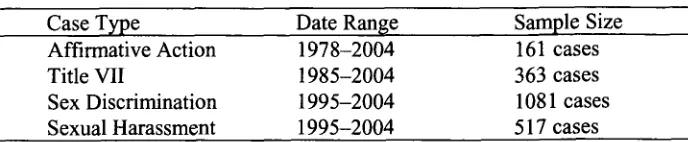
part of an affirmative action plan unconstitutional, then Sunstein treated the vote as a vote against the plan.27 The affirmative action case sample included cases from June 28, 1978, through June 30, 2004,28 and the sample size was 161 cases.2 9 For Title VII cases, Sunstein searched Lexis
for "Title VII and African-American or black."30 Sunstein examined Title
VII cases from January 1, 1985, through June 30, 2004, and the total sample size was 363 cases.3 1 For sex discrimination cases, Sunstein searched Lexis for "sex! discrimination or sex! harassment."32 Sunstein examined sex discrimination cases from January 1, 1995, through January
30, 2004, and the total sample size was 1081 cases. For sexual harassment cases, treated as a subset of sex discrimination cases, Sunstein searched Lexis for "sex! harassment."34 Sunstein examined sexual
harassment cases from January 1, 1995, through June 30, 2004, and the total sample size was 517 cases. For the Title VII, sex discrimination,
23. SUNSTEIN ET AL., supra note 5, at 8, 17-18 (outlining all of the case types that Sunstein examined and discussing the reasons for those choices).
24. Id. at 20-21, 31-32. Sunstein also examined desegregation cases as a category. However, this paper does not examine the desegregation cases because the cases are basically nonexistent in the last twenty years. See id. at 36-37.
25. Id. at 17, n.1. 26. Id. at 17, n.8. 27. Id.
28. For each category of case, Sunstein generally used a date range of judicial votes from 1995 to 2004 in order to keep the inquiry manageable. However, Sunstein occasionally
used a longer date range in order to produce a sufficient sample size of judicial votes for a particular category. Id. at 18.
29. Id. at 17, n.8. 30. Id. at 17, n.9. 31. Id.
32. Id. at 17, n.10. 33. Id.
34. Id. at 17, n.12.
35. Id.
[Vol. 22:1
and sexual harassment cases, Sunstein treated any vote to afford the plaintiff any sort of relief as a pro-plaintiff vote.36 The raw data table is
illustrated below. Table 1
Case Type Date Range Sample Size Affirmative Action 1978-2004 161 cases
Title VII 1985-2004 363 cases
Sex Discrimination 1995-2004 1081 cases
Sexual Harassment 1995-2004 517 cases
To measure judicial ideology, Sunstein identified each judge as a Democratic appointee or Republican appointee based on the party of that judge's appointing President. Sunstein used the party of affiliation of the appointing President as a proxy for the ideology of the appointed judge, with the view that a judge appointed by a Democratic President would vote in a more liberal direction and a judge appointed by a Republican President would vote in a more conservative direction.3 8 Generally, Sunstein treated a vote in favor of a discrimination plaintiff to be a liberal vote and a vote upholding an affirmative action plan as a liberal vote.
It is important to emphasize, as Sunstein did, that the appointing presidential party affiliation is only a proxy for judicial ideology with recognized weaknesses. First, undoubtedly some Democratic Presidents have appointed conservative judges and vice versa for Republican Presidents.40 Second, Senators of the appointing President's party and the
judge's home state play a substantial role in the choice of judge through the practice of "senatorial courtesy."4 1 Despite these weaknesses, measuring judicial voting patterns according to the appointing President's party will demonstrate whether Republican and Democratic Presidents select judges with different views, the extent to which those views differ, and whether Republican and Democratic judges cast systematically different votes from each other in specific case categories.42
Sunstein's study explored three issues: (1) the impact of the appointing President's party affiliation on the ideological direction of a judge's vote; (2) whether a judge's tendency to vote along predicted ideological lines is dampened when he or she sits on a panel with two judges of a different political party affiliation than his or her own; and (3) whether a judge's
36. SUNSTEIN ET AL., supra note 5, at 17, nn.9-10, n. 12. 37. Id. at 6.
38. Id. 39. Id. at 19. 40. Id. 41. See id. at 6. 42. See id. at 5.
HASTINGS WOMEN'S LAW JOURNAL
tendency to vote along predicted ideological lines is amplified when he or she sits on a panel with two judges of the same political party affiliation as his or her own.43 This discussion will focus primarily on the first issue.
1. Sunstein's Racial Civil Rights Cases Findings
Sunstein examined affirmative action cases from 1978 through 2004, revealing that Democratic judges voted in favor of affirmative action plans
75% of the time, while Republican judges voted in favor of them 47% of
the time.4 Despite the large voting gap for affirmative action cases, the voting gap was much smaller for Title VII race discrimination cases, where Democratic judges voted in favor of the plaintiffs 43% of the time and Republican judges voted in favor of the plaintiffs 34% of the time.4 5 The
46
voting gaps for both sets of data are statistically significant voting gaps. These statistics are illustrated below.
Table 2
Democratic Republican
Case Type Judges' Liberal Judges' Liberal Votg Vote Percentage Vote Percentage
Affirmative 75% 47% 28%
Action
Title VII 43% 34% 9%
Sunstein never discusses possible explanations for why the data illustrates starkly different voting gaps between the two sets of judges, even though affirmative action cases and Title VII race cases both involve race and remedying racial discrimination. One plausible explanation for the two different voting gaps may be that affirmative action is a more partisan issue than Title VII race discrimination. In other words, many Republicans are fundamentally opposed to the concept of affirmative action,47 whereas they are not fundamentally opposed to Title VII, but merely favor a narrower interpretation of Title VII, or believe that Title VII is overly enforced.4 8 If
Republican judges reflect the Republican Party, then expectedly Republican judges would display more extreme ideological voting in affirmative action cases than in Title VII race discrimination cases,
43. SUNSTEIN ET AL., supra note 5, at 8-9. 44. Id. at 20-21, 24.
45. Id. at 20-21.
46. Id. at 24, nn.31, 36, 48.
47. Adam Winkler, Fatal in Theory and Strict in Fact: An Empirical Analysis of Strict Scrutiny in the Federal Courts, 59 VAND. L. REv. 793, 843 (2006) (arguing that the
Repub-lican Party opposes affirmative action).
48. Lee Reeves, Pragmatism Over Politics: Recent Trends in Lower Court Employment Discrimination Jurisprudence, 73 Mo. L. REV. 481, 486 (2008) (arguing that conservatives
favor a narrow interpretation of employment discrimination laws).
[Vol. 22:1
resulting in a larger gap between Republican and Democratic judges in affirmative action cases than in Title VII race discrimination cases.
Although the partisanship rationale is a possible explanation for the different voting gaps for affirmative action cases and Title VII race cases, that rationale is undercut to some extent by the statistical showing that Republican judges voted more often in favor of affirmative action plaintiffs (47%) than they voted in favor of Title VII plaintiffs (34%).49 Assuming the correctness of the partisanship rationale identified above, (that Republican judges should be more ideologically opposed to affirmative action than Title VII), one would not expect to find Republican judges voting liberally at higher percentages in affirmative action cases compared to Title VII race discrimination cases. However, the data in Table 2 demonstrates such a voting pattern.
The most likely explanation that the partisanship rationale is correct despite Republican judges voting in higher percentages in a liberal direction in affirmative action cases versus Title VII cases is that the Title VII cases were simply weaker than the affirmative action cases. This explanation is especially plausible given that even Democratic judges voted for plaintiffs at much lower percentage rates in Title VII cases (43%)
compared with affirmative action cases (75%) . It is also possible that too
many attorneys accept frivolous Title VII race cases.1 It may seem odd that frivolous Title VII cases make it to the appellate level, but at least one scholar has conjectured that "after slogging through the district court, the losing party must see the additional cost and effort of appeal as insignificant when compared to the big return of reversal. Nearly a fifth of losing parties decide that they might as well stagger to the finish line, seemingly regardless of their chances on appeal."5 2 Alternatively, the cases
may be weaker, not because they are frivolous, but because over time the courts have interpreted the Title VII standards in such a manner as to be extremely difficult for plaintiffs to prevail, even if the deciding judges favor plaintiffs on Title VII issues.
49. SUNSTEIN ET AL., supra note 5, at 20-21.
50. Id.
51. Nichole B. Porter, The Perfect Compromise: Bridging the Gap Between At-Will
Employment and Just Cause, 87 NEB. L. REv. 62, 76-77 (2008) (arguing that "many terminated employees bring discrimination claims regardless of whether there is any indication that discrimination was the motivation behind the termination decision"); Reeves, supra note 48, at 556 (arguing that "a considerable number of employment discrimination claims are meritless, if not frivolous").
52. Kevin M. Clermont & Stewart J. Schwab, Employment Discrimination Plaintifs in
Federal Court: From Bad to Worse?, 3 HARv. L. & POL'Y REV. 103, 108 (2009).
53. Porter, supra note 51, at 76 (arguing that the burden of proof under current
discrim-ination case law is too difficult for plaintiffs); Michael Selmi, Why are Employment Dis-crimination Cases So Hard to Win?, 61 LA. L. REv. 555, 555 (2001) (discussing how the "courts continually impose roadblocks for employment discrimination plaintiffs that do not exist for other civil plaintiffs").
168 HASTINGS WOMEN'S LAW JOURNAL rvol. 22:1 2. Sunstein's Gender Civil Rights Cases Findings
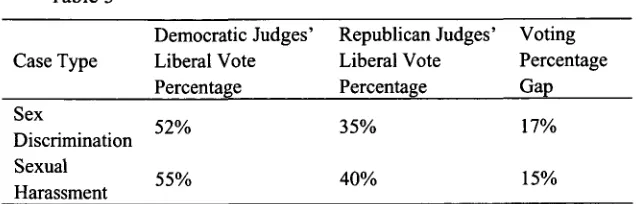
Sunstein examined sex discrimination cases decided from 1995 through 2004. Sunstein revealed that Democratic judges voted in favor of plaintiffs
52% of the time, while Republican judges voted in favor of plaintiffs only 35% of the time.S4 A similar gap was present in sexual harassment cases,
where Democratic judges voted in favor of the plaintiff 55% of the time and Republican judges voted in favor of the plaintiff 40% of the time.ss In both sets of cases, the percentage gap is highly significant.56 Table 3 illustrates these judicial voting percentages.
Table 3
Democratic Judges' Republican Judges' Voting Case Type Liberal Vote Liberal Vote Percentage
Percentage Percentage Gap Sex
Discrimination 52% 35% 17%
SexualSeul55% 40%
15%
Harassment
B. TESTING THE RACE/GENDER GAP HYPOTHESIS USING THE SUNSTEIN
DATA
Comparing the gender civil rights case statistics in Table 3 to the racial civil rights case statistics in Table 2, Sunstein's study does not support the Race/Gender Gap Hypothesis that Republican judges and Democratic judges are more closely aligned in gender civil rights cases than in racial civil rights cases. The liberal voting percentage gap between Republican and Democratic judges is surprisingly larger in gender cases than in race cases, with the exception of affirmative action cases.57 The liberal voting percentage gap between the two sets of judges for Title VII race cases is
9%, while the liberal voting percentage gap between the two sets of judges
for sex discrimination cases is 17%. The explanation for the larger liberal voting percentage gap in sex discrimination cases is the fact that the liberal voting percentages of Republican judges is practically the same for Title VII race cases, 34%, as it is for sex discrimination cases, 35%, while
54. SUNSTEIN ET AL., supra note 5, at 30. 55. Id. at 32.
56. Id. at 30, n.37.
57. The extreme gap in voting percentages for the affirmative action cases may be
exp-lained by the extreme partisanship surrounding the issue of affirmative action, as discussed supra at II.
POLARIZED CIRCUITS
Democratic judges are 9% more likely to vote for the plaintiff in a sex discrimination case than in a Title VII racial discrimination case.s8
One explanation for the consistency of Republican judges is that Republican judges simply hold fast to their core belief in a narrow or strict construction of civil rights statutes, regardless of whether the subject of the discrimination case is gender or race.59 Regardless of the reason for the consistency, the Republican judicial consistency in conservative ideology tends to disprove an underlying assumption of the Race/Gender Gap Hypothesis that more extensive female Republican leadership compared with African-American Republican leadership is predictive of greater Republican judicial sensitivities to plaintiffs in gender civil rights cases over plaintiffs in racial civil rights cases.
Democratic judges are 9% more likely to vote in favor of sex discrimination plaintiffs than Title VII African-American plaintiffs, which tends to refute that Democratic judges are equally sensitive to both types of civil rights cases or that they are more sensitive Title VII racial civil rights cases than sex discrimination cases. Assuming that circuit court judges reflect the ideology of their appointing President and his party, this result is surprising as there is evidence of a closer alignment between the Democratic Party and African Americans than the Democratic Party and women. 60
58. Factoring in the liberal voting percentages of Democratic judges on affirmative
action cases by averaging the liberal voting percentage of Democratic judges in affirmative action cases (75%) with the liberal voting percentage of Democratic judges in Title VII race cases (43%), Democratic judges are 7% more likely to vote in a liberal direction on race cases than on sex discrimination cases, as would be expected (59%, averaging the voting on affirmative action and Title VII race cases, versus 52% for sex discrimination cases). However, it is questionable whether one can simply average the liberal voting percentages for affirmative action cases with the liberal voting percentages in Title VII race cases and use the average to predict how a judge will vote in a given race-based case, regardless of the type of case or statute at issue. Most, if not all, of the sex discrimination cases will be Title VII sex discrimination cases, so it is more of an "apples to apples" comparison to compare the voting percentages for Title VII race discrimination cases and sex discrimination cases than to factor in affirmative action cases, which are not analyzed under Title VII.
59. Thomas W. Merrill, The Making of the Second Rehnquist Court: A Preliminary
Analysis, 47 ST. Louis L.J. 569, 591 (2003) (arguing that conservative Supreme Court Justices fundamentally believe in a narrow interpretation of civil rights statutes).
60. Compare Gregory S. Parks & Quinetta M. Roberson, Michelle Obama: A
Contem-porary Analysis of Race and Gender Discrimination Through the Lens of Title VII, 20
HASTINGS WOMEN'S L.J. 3, 13-14 (2009) (arguing that race as opposed to gender provided
more predictive power of voter choices in the 2008 Democratic Presidential primary) and Michael K. Brown, The Death Penalty and the Politics of Racial Resentment in the Post Civil Rights Era, 58 DEPAUL L. REv. 645, 658 (2009) (citing that African-American voters cast an average of 87% of their ballots for Democrats over the last ten elections) with The Gender Gap: Voting Choices in Presidential Elections, CTR. FOR AM. WOMAN & POLITICS (Dec. 2008), http://www.cawp.rutgers.edu/fast-facts/voters/documents/GGPresVote .pdf
(demonstrating that, at most, Democratic presidential candidates have received 56% of the women's vote since 1980).
There are no obvious explanations for the difference in liberal voting percentages for Democratic judges between Title VII racial civil rights cases and sex discrimination cases. One possible explanation is that Democratic judges have viewed gender discrimination claims as stronger claims than racial discrimination claims. Alternatively, although these are Democratic judges, and this Article assumes that they are ideologically prone to be equally pro-plaintiff in both racial civil rights and sex discrimination cases, perhaps they are willing to lower their decision making standards for prevailing in a sex discrimination case than in a Title VII racial civil rights case. Assuming the latter explanation is true, it is difficult to figure out why there would be such a double standard, particularly among Democratic judges, which this Article assumes are more sympathetic, ideologically speaking, to both racial and gender civil rights cases than Republican judges. Future empirical studies may shed further light on this issue, but it will always remain difficult to determine how circuit court judges subjectively make their decisions.
C. THE SUNSTEIN STUDY DATA ON CIVIL RIGHTS VOTING TRENDS BY TIME PERIOD OF APPOINTMENT AND APPOINTING PRESIDENT
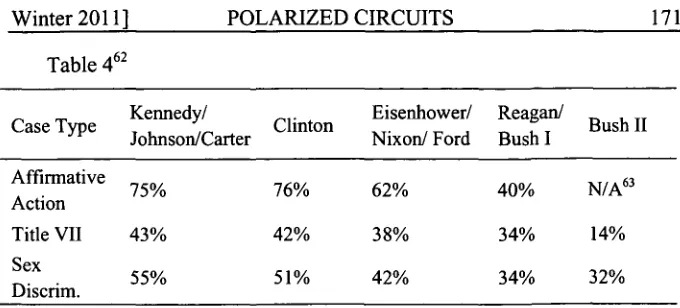
Before testing the Ideology Gap Hypothesis using Sunstein's data on circuit court judicial voting patterns among more recently appointed judges versus earlier appointed judges, it is important to examine Sunstein's two data sets relevant to this hypothesis and what those data sets reveal. In the first data set, Sunstein categorized circuit court judicial votes by case category, ideology and appointing President.6' His findings revealed the liberal voting percentages categorized by case type and appointing President as illustrated in Table 4 below.
The data set in Table 4 measures whether Republican judges appointed
by earlier Republican Presidents have voted, over the periods measured, in
a more conservative manner on civil rights cases than those appointed by more recent Republican Presidents in more recent years. Similarly, the data measures whether Democratic judges appointed by earlier Democratic Presidents have voted, over the time periods measured, in a less liberal manner on civil rights cases than those appointed by more recent Democratic Presidents in more recent years. Alternatively, the data also demonstrates over the periods measured whether there is a narrower liberal voting percentage gap between Republican and Democratic judges appointed by earlier Presidents than between Republican and Democratic judges appointed by more recent Presidents.
61. SUNSTEIN ET AL., supra note 5, at 113-22. Sunstein also examined the percentage of liberal judicial votes categorized by case category and individual appointing President, and not groupings of Presidents. Id. at 114-15.
Winter 2011] POLARIZED CIRCUITS 171
Table 462
Case Type Kennedy/ Clinton Eisenhower/ Reagan/ Bush 11 Johnson/Carter Nixon/ Ford Bush I
Affirmative
4
Afti v 75% 76% 62% 40% N/A6 1
Action
Title VII 43% 42% 38% 34% 14%
Sex
S55% 51% 42% 34% 32%
In interpreting Table 4, note that Sunstein's data does not reveal whether all judges or each individual judge appointed by a certain President or grouping of Presidents voted over time at a consistent liberal voting percentage or whether those percentages changed over time. To make such a determination would require extensive empirical research beyond the scope of this Article. However, if the liberal voting percentages for a given judge or group of judges did change over the course of their career, then the data is more of a measure of whether all Democratic judges, as a group, and all Republican judges, as a group, have moved in a particular ideological direction over time, regardless of when or by whom each judge or group of judges was appointed. Conversely, if all of the judges' liberal voting percentages remained consistent over the course of their careers, then the data is more predictive of differences in the liberal voting percentages of more recently appointed judges versus earlier appointed judges.
Given that the Ideology Gap Hypothesis aims to measure changes in voting patterns between more recently appointed judges and earlier appointed judges, this Article assumes consistent liberal voting percentages
by a given judge or group of judges throughout their careers. This assumption allows the statistics to be used as a proxy for determining whether more recently appointed judges of both parties are more partisan in terms of their civil rights voting patterns than their predecessors. There is support for such an assumption.64 Several scholars, in the context of
62. SUNSTEIN ET AL., supra note 5, at 118-19. The statistical significance of some of these statistics may be weak, given that the sample size of judicial votes for some appointing Presidents is small for some categories of cases. Id. at 116.
63. Sunstein did not include data on President GeorgeW. Bush appointees and their votes on affirmative action cases, presumably because those appointees had not yet had the opportunity to rule on any affirmative action cases at the time of the study. See id. at 118.
64. Keith Whittington, Taking What They Give Us: Explaining the Court's Federalism Offensive, 51 DUKE L.J. 477, 483 (2001). In discussing Supreme Court Justice voting
behavior, Whittington notes:
HASTINGS WOMEN'S LAW JOURNAL
Supreme Court Justices, have noted that this assumption is reasonable, given that "Supreme Court justices [sic] serve with life tenure and are typically appointed after serving in other political or judicial roles."65 Nonetheless, others have critiqued the assumption as tenuous and some scholars believe that a given judge's ideological voting patterns change
66
over time.
D. RESULTS OF THE SUNSTEIN DATA ON CIVIL RIGHTS VOTING TRENDS
BY TIME PERIOD OF APPOINTMENT AND APPOINTING PRESIDENT,
AND THE IDEOLOGY GAP HYPOTHESIS
Table 5, which incorporates data from Table 4, demonstrates that Democratic judges appointed in the 1960s and 1970s have almost the same liberal voting percentage in racial civil rights cases as Clinton-appointed judges. Moreover, those same Democratic judges appointed in the 1960s and 1970s have a slightly higher liberal voting percentage (4% higher) in sex discrimination cases than their counterparts appointed by President Clinton. This finding goes against the hypothesis that as the Democratic Party has become more liberally partisan over time, so have Democratic judges in terms of their votes on civil rights cases, such that Clinton appointees would tend to vote in a liberal direction in higher percentages than Kennedy, Johnson, and Carter appointees.
Turning to the analysis of Republican judges, Table 5 illustrates that judges appointed by Republican Presidents in the 1950s to 1970s voted in a much more liberal manner in affirmative action cases (62% pro-affirmative action plan) than judges appointed by Republican Presidents in the 1980s and 1990s (40% pro-affirmative action plan). However, Table 5 also demonstrates that the liberal voting percentage did not drop as much when comparing earlier appointed Republican judges' liberal voting percentages in Title VII race cases with the percentages for Reagan and George Bush judges (a 4% drop). Compared with Title VII race cases, there is a
past voting behavior of the Justices or even their ideological profile at the time of their nomination is sufficient to predict accurately their votes in fu-ture cases.
Id.; JEFFREY A. SEGAL & HAROLD J. SPAETH, THE SUPREME COURT AND THE ATTITUDINAL MODEL 214-55, 363 (1993) (arguing that Supreme Court Justices vote in an ideologically
consistent fashion over time).
65. Ruger et al., supra note 6, at 365.
66. Lawrence Baum & Neal Devins, Why the Supreme Court Cares About Elites, Not the
American People, 98 GEO. L.J. 1515, 1575-76 (2010) (finding that some Republican appointed Supreme Court Justices voted in an increasingly liberal ideological direction in civil liberties cases over the course of their tenure); Landes & Posner, supra note 20, at 36 (finding that some Supreme Court Justices' political voting behavior became more liberal during their tenure, while other Justices' political voting behavior became more conserva-tive); Lori A. Ringhand, In Defense of Ideology: A Principled Approach to the Supreme Court Confirmation Process, 18 WM. & MARY BILL RTS. J. 131, 157 (2009) (arguing that
"the ideological direction of most [Supreme Court] Justices' jurisprudence changes (or 'drifts') over time").
[Vol. 22:1
somewhat larger drop in liberal voting percentages when comparing earlier-appointed Republican judges with Reagan and George Bush judges and George W. Bush judges in sex discrimination cases (an 8% and 10%67 drop, respectively), but still not as much as the percentage drop for affirmative action cases. That said, Table 5 illustrates a much more significant liberal voting percentage drop when comparing earlier appointed Republican judges with judges appointed by President George W. Bush in terms of Title VII race cases (a 24% drop).8 Assuming the statistical significance of these percentages, these statistics support the Ideology Gap Hypothesis insofar as they demonstrate a conservative ideological voting shift in civil rights cases for more recently appointed Republican judges, albeit one of varying degrees depending on which subset of civil rights cases one examines.
Table 561
Case Type Kennedy/ Eisenhower/ Eisenhower/ Reagan/ Bush I Johnson/Carter Nixon/Ford Nixon/Ford Liberal
Liberal Voting Liberal Voting Liberal Voting Voting Percentage Percentage vs. Percentage vs. Percentage vs. vs. Clinton Reagan/Bush I Bush II Bush II Affirmative 1% 22% N/A7 0 N/A
Action less liberal more liberal
Title VII 1% 4% 24% 20%
more liberal more liberal more liberal more liberal
Sex 4% 8% 10% 2%
Discrim. more liberal more liberal more liberal more liberal
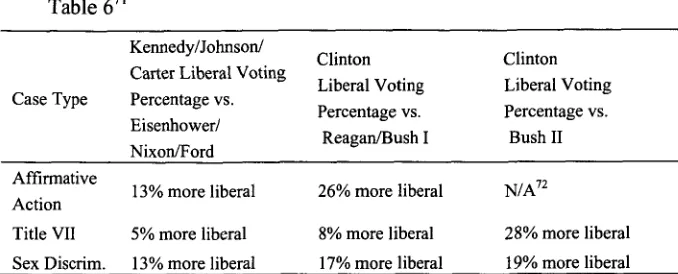
Looking at another aspect of the Ideology Gap Hypothesis, the statistics in Table 4 yield mixed conclusions regarding the prediction that the liberal voting percentage gap between earlier appointed Republican and Democratic judges should be narrower than the gap between more recently appointed Republican and Democratic judges, as illustrated in Table 6, below.
For affirmative action cases, Table 6 illustrates that the liberal voting percentage gap between Kennedy/Johnson/Carter judges and Eisenhower/Nixon/Ford judges was 13%, while the gap was 26% between
67. The statistical significance for President George W. Bush judges voting in sex
discrimination cases may be weak given that only 37 votes were measured. SUNSTEIN ET AL., supra note 5, at 118-19.
68. The statistical significance for President George W. Bush judges voting in Title VII
race dis-crimination cases may be weak, given that the sample included only 14 votes. Id.
69. Id.
70. There was no data for President George W. Bush judges voting in affirmative action
cases. Id.
Clinton judges and Reagan/George Bush judges. This demonstrates a clear increase in polarization, which supports the Ideology Gap Hypothesis.
Table 6 7
Kennedy/Johnson/ Clinton Clinton Carter Liberal Voting Liberal Voting Liberal Voting Case Type Percentage vs.
Es entowe Percentage vs. Percentage vs. ixn oerd Reagan/Bush I Bush II Nixon/Ford
Affirmative 7
13% more liberal 26% more liberal N/A72
Action
Title VII 5% more liberal 8% more liberal 28% more liberal
Sex Discrim. 13% more liberal 17% more liberal 19% more liberal
For sex discrimination cases, Table 6 illustrates that the liberal voting percentage gap between Kennedy/Johnson/Carter judges and Eisenhower/Nixon/Ford judges was 13%, while the gap between Clinton and Regan/George Bush judges was 17% and the gap between Clinton and George W. Bush judges was 19%.73 This demonstrates an increase in polarization, but a very small one compared to the change in polarized voting seen in the affirmative action cases.
For Title VII cases, Table 6 demonstrates that the liberal voting percentage gap between Kennedy/Johnson/Carter judges and Eisenhower/Nixon/Ford judges was 5%, while the gap between Clinton and Regan/George Bush judges was 8% and the gap between Clinton and George W. Bush judges was 28%. As with the sex discrimination cases, this demonstrates a small increase in polarization compared to the change in polarized voting in the affirmative action cases. Moreover, the 28% gap between the Clinton and George W. Bush judges may not be statistically significant due to the small sample size of judicial votes for George W. Bush judges.74
E. ANALYSIS OF THE IDEOLOGY GAP HYPOTHESIS IN LIGHT OF THE
SUNSTEIN DATA
To summarize the findings in Tables 4 and 5 in terms of the Ideology Gap Hypothesis, the statistics support the hypothesis that more recently appointed Republican judges vote in a more conservative fashion on civil
71. SUNSTEINETAL., supra note 5, at 118-19.
72. There was no data for President George W. Bush judges voting in affirmative action
cases. Id.
73. The 19% statistic may not be statistically significant, as only 37 President George W. Bush judicial votes were measured in terms of sex discrimination cases. Id. at 118.
74. Id. at 119 (noting that only 14 President George W. Bush votes were measured).
POLARIZED CIRCUITS
rights cases than their predecessors, but does not support the hypothesis that more recently appointed Democratic judges vote in a more liberal fashion than their predecessors. Moreover, with the exception of affirmative action cases and the cases involving George W. Bush judges with limited sample sizes, the Tables 4 and 6 statistics demonstrate that the liberal voting percentage gap between earlier appointed Republican and Democratic judges was only slightly smaller than the gap between more recently appointed Republican and Democratic judges. Of course, with affirmative action cases, the gap literally doubled, and the gap increased by almost 600% in the case of Title VII cases involving George W. Bush judges. Accordingly, the statistics in Tables 4 and 6 provide either somewhat low-or moderate-support for the hypothesis that the liberal voting percentage gap between more recently appointed Democratic and Republican judges should be wider than the gap between earlier appointed Democratic and Republican judges, depending on what weight one gives to the statistics regarding affirmative action cases and the votes of the George W. Bush judges.
Before discussing the implications of these findings and possible explanations, it is worth noting that Sunstein finds that both Democratic judges, as a group, and Republican judges, as a group, voted in an increasingly conservative manner over time when measuring all case types together. Sunstein finds that this increasingly conservative voting trend is statistically significant for the entire period for Republican judges and for the period since 1993 for Democratic judges.76 Admittedly, this finding considers all cases, not only civil rights cases. If it reflects a similar pattern regarding civil rights cases, however, then the finding also tends to disprove the part of the Ideology Gap Hypothesis that more recently appointed Democratic judges vote at a higher liberal voting percentage than their predecessors. Moreover, this finding tends to prove the part of the Ideology Gap Hypothesis that more recently appointed Republican judges vote at a lower liberal voting percentage than their predecessors.
There are at least two possible explanations for why, according to Tables 4 and 5, Clinton-appointed Democratic judges have not demonstrated a liberal ideological shift from judges appointed by Presidents Kennedy, Johnson, and Carter, and why recently appointed Republican judges have demonstrated a small to substantial conservative ideological shift from Republican judges appointed in the 1950s through 1970s. First, using various empirical scales for measuring presidential ideology, there is support for the conclusion that President Clinton was more ideologically conservative than Presidents Kennedy, Johnson, and
75. SUNSTEIN ET AL., supra note 5, at 121. 76. Id.
HASTINGS WOMEN'S LAW JOURNAL
Carter. As such, and given the fact that this Article uses presidential ideology as a proxy for judicial ideology, President Clinton would not be expected to have appointed circuit court judges who vote in a more liberal fashion on civil rights cases than those appointed by Kennedy, Johnson, or Carter. Likewise, using the same empirical measurements, there is also support for the conclusion that Presidents George W. Bush, George Bush, and Reagan were more ideologically conservative than their Republican predecessors.78 Therefore, it is not surprising to find that Republican
judges appointed in the last 30 years vote in a more conservative manner in civil rights cases than Republican judges appointed before that time.
The second possible explanation for the Table 4 and 5 findings is that President Clinton had to navigate his judicial appointments through six years of a Republican controlled Senate, unlike Presidents Kennedy, Johnson and Carter, who faced Democratic Senate majorities.79
Accordingly, President Clinton may have been able to appoint only moderate circuit court judges in order to achieve confirmation through a Republican Senate, even though he may have desired to appoint more ideologically liberal circuit court judges.o
On the other side of the ledger, for Republican Presidents, the history of party control of the Senate is somewhat complex. Presidents
77. Compare Clay Calvert & Robert D. Richards, Defending the First in the Ninth:
Judge Alex Kozinski and the Freedoms ofSpeech and Press, 23 Lov. L.A. ENT. L. REv. 259,
293 (2003) (quoting Judge Alex Kozinski as arguing that President Carter was more liberal
than President Clinton) with Michael Bailey & Kelly H. Chang, Comparing Presidents, Senators, and Justices: Interinstitutional Preference Estimation, 17 J.L. ECON & ORG. 477, 491 (2001) (using random effects ideal point estimates to argue that President Carter was more conservative than President Clinton and that President Clinton was more conservative than Presidents Kennedy and Johnson) and Madeline Fleisher, Judicial Decision Making Under the Microscope: Moving Beyond Politics Versus Precedent, 60 RUTGERS L. REv.
919, 944-45, 969 (2008) (using Common Space NOMINATE Scores to demonstrate that
President Clinton was more liberal than President Johnson, but not Presidents Kennedy and Carter).
78. Bailey & Chang, supra note 77, at 491 (using random effects ideal point estimates to
argue that President Reagan was the most conservative Republican President followed by Presidents George Bush, Ford, Nixon, and Eisenhower); Lee Epstein et al., The Bush Imprint on the Supreme Court: Why Conservatives Should Continue to Yearn and Liberals Should Not Fear, 43 TULSA L. REv. 651, 652 n.10 (2008) (citing David Alistair Yalof,
Conservative Supreme Court Will Be Bush Legacy, 8 U. CONN. (2007) at 34-35, available
at http://alumnimagazine.uconn.edu/fwin2007/ feature54.html) (arguing that "George W. Bush may have done more to transform the constitutional landscape in a conservative direction than any President in the past century, including Ronald Reagan and Richard Nixon"); Fleisher, supra note 77, at 944-45, 969 (using Common Space NOMINATE Scores to demonstrate that Presidents Reagan, George Bush, and George W. Bush were more conservative than their predecessors, but Presidents Reagan and George Bush were more conservative than President George W. Bush).
79. Party Division in the Senate, 1789-Present, U.S. SENATE, http://www.senate.gov/ pagelayout/history/one itemandteasers/partydiv.htm (last visited Sept. 2, 2010) (outlining the history of party control in the Senate).
80. SUNSTEIN ET AL., supra note 5, at 113.
Eisenhower, Nixon and Ford faced Democrat-controlled Senates for their entire terms, with the exception of two years of a Republican-controlled
Senate for President Eisenhower.8 1 President Reagan faced a
Republican-controlled Senate for his entire two terms in office, except for the last two years, and President George Bush faced Democratic Senate majorities during his one-term presidency. From 2001 through 2004, President George W. Bush navigated his judicial nominees through an almost evenly split Senate, with control of the Senate flipping between the parties until November 2002 when Republicans gained control.83
Unlike the Senates faced by the Democratic Presidents, there is less of a clear trend in which political party controlled the Senate during the terms of Republican Presidents, at least after 1987. Nonetheless, Sunstein's grouping of the circuit court appointments of Presidents Eisenhower, Nixon and Ford together, the appointments of Presidents Reagan and George Bush together, and the appointments of President George W. Bush separately, makes it not surprising to see a more conservative trend in circuit court judicial civil rights votes for Republican judges appointed in approximately the last twenty-five years. First, given the history of Senate party control under Republican Presidents, predictably, Presidents Reagan and George W. Bush should have succeeded in appointing more conservative circuit court judges in terms of civil rights voting when compared with their Republican predecessors. Second, by grouping President Reagan's appointments with President George Bush's appointments, President Reagan's appointments may have tempered any effect a Democratic Senate majority had on President George Bush's ability to obtain confirmation of judges who would vote in a conservative manner on civil rights cases.
There are at least three possible explanations for the findings illustrated in Tables 4 and 6, that is, why the liberal voting percentage gap between earlier appointed Republican and Democratic judges on civil rights cases is only slightly narrower than the gap between more recently appointed Republican and Democratic judges (except affirmative action cases and cases involving George W. Bush judicial-appointee votes). First, the increasingly conservative Supreme Court, with increasingly conservative civil rights decisions, may be pushing lower courts in a more conservative direction, regardless of whether the judges on those courts are Republican or Democratic judges.84 Second, as discussed supra, it is possible that the
nature of the underlying civil rights cases may have become weaker for plaintiffs over time, accounting for a consistently conservative voting trend across both Republican and Democratic judges.8 5
81. Party Division in the Senate, 1789-Present, supra note 79. 82. Id.
83. Id.
84. SUNSTEIN ET AL., supra note 5, at 113.
85. Id. at 117.