Material Modification for Flexible Pavement Using Polyamide
Granules
Sai Krishna K
1, Rohith C H
2, Syed Hussain Pasha
3, Vani C E
4,
Dr Sridhar R
5*(Graduated BE in Civil Engineering, Nagarjuna college of Engineering and Technology, INDIA) ** (Graduated BE in Civil Engineering, Nagarjuna college of Engineering and Technology, INDIA) *** (Graduated BE in Civil Engineering, Nagarjuna college of Engineering and Technology, INDIA) **** (Graduated BE in Civil Engineering, Nagarjuna college of Engineering and Technology, INDIA)
***** (Associate professor, department of Civil Engineering, Nagarjuna college of Engineering and Technology, INDIA)
1. INTRODUCTION
In recent scenario, a world without roads, cars, motorcycles and bicycles is almost unimaginable. India is having second largest road network of over 5.4 lakh KM in the world. Due to extreme climatic conditions, growth of traffic and increasing maintenance expenditure on roads in India there is a necessity to develop sustainable technologies and economical road construction. The entire road infrastructure with its diversity of transport concepts now has a prominent − almost dominant – position in our society. The question is therefore not so much whether there will still be a road infrastructure in the future, but rather how will society view these mobility facilities in, say, thirty or forty years’ time. Comparing the road infrastructure and means of transport of today with those of forty years ago, it becomes clear that in the next forty years’ time everything will again look a lot different to how it looks today. Societies are constantly developing and, consequently so are people’s requirements regarding the use, structure and design of the road infrastructure − not just roads in urban areas (urban roads), but also the motorways (interurban roads) between the major European cities. It is also quite conceivable that the future construction and design of infrastructure constructions such as bridges and tunnels will be subject to different requirements. In view of the lengthy time span of 10 to 15 years between planning infrastructure facilities and its actual completion, followed by an operational period of at least 25 years, more clarity of these future needs, demands and requirements becomes essential in order to make the right choices for today. Making the future more identifiable and tangible reveals the gaps of knowledge and indicates which new technologies will have to be developed to meet the future demands and requirements. Besides generic developments like shortage of clean environment, space and energy, spotting and extrapolating the social and economic trends and technical advances offer starting-points for forming a more realistic image of the future and the associated needs and demands related to road transport.
Abstract: Polyamides are à group, related to thermoplastic or thermosetting plastic substances derived from Amide groups. In India, flexible pavements with bituminous surfaces are widely used. Due to increased traffic intensity of roads, overloading of commercial vehicles and temperature variation of pavements due to climatic changes leads to formation of various distresses like rutting, shoving, bleeding, cracking and potholing of bituminous surfacing. Due to high temperature, bitumen becomes very soft in summer and brittle in winter. Also, in a developing country like India, roadway construction is taking place at a very high pace which require large demand of construction material that too eco-friendly and economical. Several Studies have revealed that properties of bitumen and bituminous mixes can be modified with addition of certain additives and the bitumen premixed with these additives/modifiers is known as “modified bitumen”. The present paper aims for use of modified bitumen by using polyamides for road construction. The polyamide mix shows better binding property, stability, density, more resistant to water and eco-friendly.
2. LITERATUREVIEW
2.1 Review 1
Use of Waste Plastic in Flexible Pavements-Green Roads, Open Journal of Civil Engineering. Yash Menaria, Rupal Sankhla
Wrappers of betel nuts, chocolates, chips, hand bags, cold drink bottles and all other forms of plastic create significant environmental and economic problem. They consume massive energy and other natural resources, depleting the environment in various ways. The plastics are made up of Polyethylene, Polyamide, Polystyrene and Polypropylene. Temperature varying between 120˚C - 160˚C gives the softening point of these plastics. They do not produce any toxic gases during heating but the softened plastics have tendency to form a lamination or coating over the aggregate, when it is sprayed over the hot aggregate at 160˚C. The main objective of this paper is to discuss the significance of plastic in terms of cost reduction, increase in strength and durability when these plastics are heated and coated upon the aggregates (160˚C) to compensate the air voids with plastic and binds with aggregate to provide stability. Utilization of the plastic improves the binding property of mix. The optimum result of waste plastic came out to be 8% from the experiments conducted. Plastic roads can also be constructed in the areas having high temperatures (50˚C). Plastic in roads increases the stability value and durability to a great extent.
2.2 Review 2
USE of Plastic Waste in Flexible Pavements Miss Apurva J Chavan, April 2013
Plastic coating on aggregates is used for the better performance of roads. This helps to have a better binding of bitumen with plastic wasted coated aggregate due to increased bonding and increased area of contact between polymers and bitumen. The polymer coating also reduces the voids. This prevents the moisture absorption and oxidation of bitumen by entrapped air. In short we can conclude that, using plastic waste in mix will help reduction in need of bitumen by around 10%, increase the strength and performance of road, avoid use of anti-stripping agent, avoid disposal of plastic waste by incineration and land filling and ultimately develop a technology, which is eco-friendly. Increased traffic conditions will and are reducing the life span of roads. Plastic roads are means of prevention and ultimately will be the cure. It will save millions of dollars in future and reduce the amount of resources used for construction
By considering above reviews……
Since all reviews shows the binding capacity of Polymer modified bitumen or plastic waste helps in changing bitumen properties, and it is a type of polyamide granules. Hence it is mixed with bitumen to check its binding capacity. Polyamides are is also having the property that it can with stand high temperatures in summer season and it also environmental eco-friendly in nature.
3. PROBLEM STATEMENT
The failures and distresses in flexible pavement surface leads to uncomforted travel of vehicles. Due to these uncomforted movement of traffic leads to traffic jam, accidents etc. By considering above statements.
Polyamide Granules are a group, related to thermoplastic or crystalline plastic substances derived from amide bonds. Its properties says that it is a good binding material and also widely used in clothing and carpet production. Hence it is used as a catalyst to bituminous mix to check its strength
4. MATERIALS USED
4.1 Bitumen
Bitumen is a petroleum product obtained by fractional distillation of crude petroleum. It is used for road surfacing in flexible pavements. The grade of bitumen used is VG-30 grade or 60/70 grade for BC course.
4.2 Aggregates
The coarse aggregates, fine aggregates, and filler material are enough to provide the sufficient strength, durability, crushing, toughness etc.…..
4.3 Polyamides
Polyamides are obtained from the amide group. The polyamides have good binding nature and also flexible in nature. These polyamides can with stand high temperature.
5. METHODOLOGY AND TESTING
The coarse aggregates passing 12.5mm and retained on 10mm is used. For every 100grams of aggregates 11% of bitumen is used i.e. for the specimen of 75x75x75mm 700gms of bitumen is used. Polyamide granules-5%, 10%, 15%, 20%, 25% of weight of bitumen.The mix is casted in 3 layers, and well compacted. The specimens of varying percentage of polyamide granules is done and tested under UTM.
5.1 Specimen Combinations
Specimen1: Aggregates+bitumen+0%polyamides
Specimen1: Aggregates+bitumen+5%polyamides
Specimen1: Aggregates+bitumen+10%polyamides
Specimen1: Aggregates+bitumen+15%polyamides
Specimen1: Aggregates+bitumen+20%polyamides
Specimen1: Aggregates+bitumen+25%polyamides
6. EXPERIMENTAL OBSERVATIONS
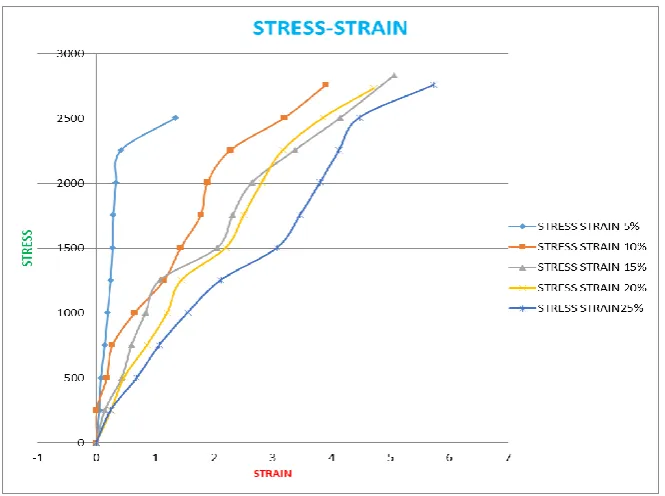
The specimens of varying percentage of polyamide granules is done and tested under UTM.The graph showing stress vs strain is plotted.
Figure 1: stress vs strain
6.1 Calculations for Stress and Strain
Deflection is calculated by formulae:
Def = (
Where M = main scale reading
Stress = Where P = load A = area
Strain is calculated by formulae:
Strain =
Where = deflection L=Length
7. RESULTS AND DISCUSSIONS
Based on the test results, the graph corresponding to Stress vs Strain shows the variation of strength of
test specimens with varying percentage of POLYAMIDE GRANULES.
Hence it is concluded that 10%, 15%, 20% shows the good strength compared to other percentages of POLYAMIDE GRANULES.
For the above percent of polyamide granules the Marshal Stability moulds are casted.
8. BASIC TEST RESULTS OF BITUMEN AND AGGREGATES
Properties of VG-30 grade Bitumen
Properties of Aggregates
9. METHODOLOGY AND MARSHALL STABILITY
Evaluating of stability value, flow value, density value and % of air voids of different composition in relation to fatigue performance by using Marshall Stability.
Mix Design
Desired grading of mix is selected from the recommended gradation for the particular type of pavement layer. Sieve analysis is carried out on the samples of aggregate collected and the proportion in which they should be mixed to obtained desire gradation(by any one of method such as graphical method or trail method).The maximum permissible size of coarse aggregates for the preparation of Marshall Stability test specimen is 25 mm. The present project is carried for the top most layer of BC course.
The following table shows the specified grading of aggregates and binder for BC course as per IRC.
SL.NO PROPERTY TEST RESULTS IS CODES
1 Specific gravity test 1.015 1202-1978
2 Penetration 60mm 1203-1978
3 Softening point 41ºC 1205-1978
4 Viscosity 72sec 1206-1978
SL.NO PROPERTY TEST RESULTS IS CODES
1 Specific gravity test 2.631 2386 (Part 3) -1963
2 Water absorption 0.99% 2386 (Part 3) -1963
3 Crushing test 23.626% 2386 (Part IV)-1963
10. PROPOSED COMBINED GRADATION OF BITUMINOUS CONCRETE
11. MARSHAL STABILITY
Marshal stability test is conducted on compacted cylindrical specimen of bituminous mix of dia 101.6mm thickness 63.5 mm.The load is applied perpendicular to the axis of the cylindrical specimen through a testing head consisting of a pair of cylindrical segments, at a constant rate deformation of 51 mm per min at the standard test temperature of 60. The Marshall stability of the bituminous mix specimen is defined as a maximum load carried in kg at the standard test temperature of 60 when load applied is applied under specified test conditions. The flow value is the total deformation of Marshall Test specimen at the maximum load expressed in mm units. .
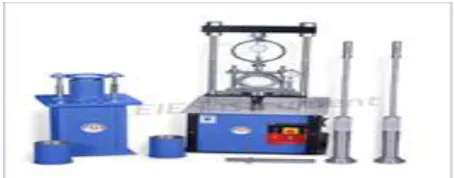
Figure 2: Marshall Stability apparatus
% OF POLYAMIDE % OF BITUMEN TOTAL AGGREGATES (gms)
0 7
1200gms as per IRC
10 6.75
15 6.38
20 6
Nominal aggregate size 13mm % Passing obtained Sieve size, mm Percentage passing, By weight
Grade2 Grade 2
26.5 - -
19 100 100
13.2 79-100 95.1
9.5 70-88 80.865
4.75 53-71 63.85
2.36 42-58 51.585
1.18 34-48 43.26
0.6 26-38 33.805
0.3 18-28 24.85
0.15 12-20 17.26
0.075 4-10 8.26
Bitumen content,% by weight of total mix
12. METHOD OF PREPARATION OF SPECIMEN USING MARSHALL STABILITY
The aggregates are heated to 160-170 ⁰C and correspondingly the bitumen is heated to 150 ⁰ C and polyamide granules of required percent is added. The aggregate and polyamides are mixed well to a temperature
of160 ⁰C.The mixed material is poured into marshal stability mould and compacted by giving 75 blows on each
side, using rammer. The mould is kept for air curing for an hour and it is demoulded by using mould extractor. For every percentage of adding polyamide granules the same content of bitumen should be reduced.
12.1Specimen combinations
Specimen 1: Aggregates+ 7% Bitumen+0%polyamides
Specimen 1: Aggregates+6.75%Bitumen+10%polyamides
Specimen 1: Aggregates+6.38%Bitumen+15%polyamides
Specimen 1: Aggregates+ 6% Bitumen+20%polyamide
13. TEST RESULT OF BITUMINOUS CONCRETE MIX DESIGN
BITUMEN POLYAMIDES STABILITY FLOW DENSITY AIRVOIDS
6% 20% 3828 8.833 2.17 16.05
6.38% 15% 4764.76 4 2.24 13.34
6.75% 10% 4313.733 5.733 2.23 13.73
7% 0% 2967.16 10.5 2.2 14.89
14. RESULTS
Stability v/s Bitumen content Flow value v/s Bitumen content Density v/s Bitumen content % of voids v/s Bitumen content
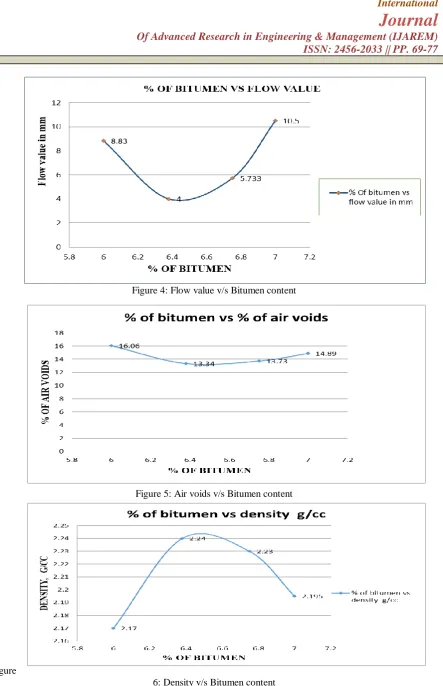
Figure 4: Flow value v/s Bitumen content
Figure 5: Air voids v/s Bitumen content
Figure
15. RESULTS AND DISCUSSION
It is observed from graphs that with increase in bitumen concentration the Marshall stability value increases up to certain bitumen content and there after it decreases. Thus, the maximum stability was obtained at 6.38% from % bitumen v/s stability graph. Bitumen content corresponding to maximum density is 6.38% .The bitumen content corresponding to 6.38% air voids was obtained as 13.34%. Flow value corresponding to 6.38% is 4 which is also satisfactory as per standards.
From the graphs it can be observed that with addition of all polyamide granules stability value also increases up to certain limits and further addition decreases the stability. This may be due to excess amount of polyamide granules which is not able to mix in asphalt properly.
CONCLUSION
Polyamides are type of plastics will increase the melting point of the bitumen. With the increase in bitumen concentration the Marshall stability value increases up to certain bitumen content and there after it decreases. The use of the innovative technology not only strengthened the road construction but also increased the road life as well as will help to improve the environment and also creating a source of income. Plastic roads would be a boon for India’s hot and extremely humid climate, where temperatures frequently cross 50°C and torrential rains create havoc, leaving most of the roads with big potholes. It is hoped that in near future we will have strong, durable and eco-friendly roads which will relieve the earth from all type of plastic-waste from the above project the optimum content of polyamide granules should be used for the flexible pavement is 15%.
ACKNOWLEDGEMENT
I am very thankful to the beloved principle for guiding us in a suitable directions. Iam also thankful to our guide Associate Professor Dr Sridhar R who guided in all situations and made our project successful. At last I am very thankful to our friends, family members and our civil engineering department for lot of support and help.
REFERENCES
[1]. ASTM, 2015. ASTM D 5710 - Standard Specification for Trinidad Lake Modified Asphalt. American
Society of the International Association for Testing and Materials (ASTM). Designation: D5710/D5710M – 15
[2]. ASTM, 2015. ASTM D 6927 - Standard Test Method for Marshall Stability and Flow of Asphalt
Mixtures. American Society of the International Association for Testing and Materials (ASTM). Designation: D6927 – 15
[3]. Carreira, D.J., and K.H. Chu. 1985. Stress-Strain Relationship for Plain Concrete in Compression. Journal of the American Concrete Institute 82(6), 797-804.
[4]. Government of the Republic of Trinidad and Tobago (GORTT), 2000. Hot Asphalt Mixtures for Use in
Road Paving – Schedule 20. Central Tenders Board Standard Specifications. No. CTB: HAM-R 2000
[5]. Hsu, L.S., C. Hsu. 1994. Complete Stress-Strain Behavior of High-Strength Concrete under
Compression. Magazine of Concrete Research 46(169), 301-312.
[6]. Starodubsky, S., Blechman, I., Livneh, M. 1994. Stress-strain relationship for asphalt concrete in
compression. Materials and Structures 27 (8), 474-482.
BIOGRAPHIES
ROHITH C H
SAI KRISHNA K
Graduated BE in Civil Engineering Nagarjuna college of Engineering and Technology
SYEDHUSSAIN PASHA Graduated BE in Civil Engineering Nagarjuna college of Engineering and Technology
VANI C E
Graduated BE in Civil Engineering Nagarjuna college of Engineering and Technology
Dr.SRIDHAR R