Examining the effectiveness of organisations matching their
pro-active workforce with Introvert leadership and its influence on
the overall team performance
Dr. Lalitha Balakrishnan
Principal
M.O.P. Vaishnav College for Women (Autonomous
Ms. Ramya Raman
Assistant Professor
M.O.P. Vaishnav College for Women(Autonomous)
Introduction
:
Introverts are persons who are generally directed inwards towards his/ her feelings and thoughts, in contrast to an extravert. whose attention is directed towards other people and world outside.
According to Harvard Business School Professor Francesca Gino, Introverts can be better leaders especially when their employees are naturally pro-active.
"Scientific research now shows that behaving in an introverted manner is the key to success as a leader. Like Mahatma Gandhi, Abraham Lincoln, and Socrates, great leaders are introverted: their behaviour is quiet, shy, reserved, and unadventurous. This enables them to empower their people to deliver results.
Statement of Problem
:
In today’s competitive scenario, there exist a persistent itch to find if leadership positions can be offered to introverts who are often supposed to be self-confined in their silent world. If given such positions, what would be the possible outcome if they are matched with pro-active employees.
Scope of the study
:
The study helps to reveal the effectiveness of Chennai based organisations matching introvert leaders with proactive employees.
Objectives of the study
:
To find if introvert persons deserve leadership positions To analyse the effectiveness of group performance if proactive employees are led by introvert leaders.
Abstract:
There are enormous leaders exhibitingdiverse styles of leadership across organisations worldwide for sustaining employee co-operation and commitment towards the common vision.Each individual is exclusive and distinct from the other, so do their styles. Personality of a person may influence his/her employees. The purpose of this research paper is to shed light on the leadership styles demonstrated by introverted leaders and its stimulus to their naturally pro-active employees.A detailed questionnaire has been designed to construe the inspiration level of introverted leaders to their pro-active employees and whether the former will be accepted in organisations by the latter. It has also been endeavoured to reveal if silent bosses inspire their robust and passionate counterparts. The study also aims to find out under what circumstance does an introvert leader exhibit greater team performance.Literature Review:
Certain myths about introvert personality:
Introverts find it difficult to connect and associate with people while the extraverts swiftly accumulates the list of contacts to build long-lasting relationship; But in reality introverts silently absorb the great deal of information from the atmosphere which is even more valuable. Introverts usually discover the hidden talents from all sources which will pave greatly towards organisational effectiveness.
Second misconception is that introverts are less-likeable than their extravert counterparts as they are reserved and confined to themselves but actually mere quietness of these silent leaders attract onlookers. Thirdly,introverts are often construed to be poor in public speaking while extraverts as confident and loud; nevertheless, the fact is introverts, even though quiet, do comprehend the claim of the status quo and rise up to the occasion which is well appreciated and commended by the target listeners.
Introverts are considered to be choosier and avoid social gatherings and business meetings as they are often drained by these get-togethers which in contrast is an energiser for the extraverted people. But then again it was interestingly noted that this choosiness was favourable to organisations as extraverts most of the time end up with un-productive meetings and idle time in social networking which in contrast is well utilised by these silent folks of the organisation.
There also subsists a collectivefallacy that a virtuous(extravert)leader has to hold a right blend of over-confidence, authoritarian and be a great orator, who wears the crowd like a well fitted suit. But in reality, louder voices may not be often wiser and appropriate.
Working with silent Leaders:
1. Introvert leaders do not expect a day to day feedback with their immediate employees. They are quiet and silent at most of the times which actually enables the employee’s thinking and analytical skills in solving problems by their own with less interference with their leadership. Though, initially this might be disturbing, gradually it becomes a practice and paves way for employee empowerment and decision making skills.
2. Introvert leaders are good listeners and pay their complete attention when an opinion is voiced by their employees which improves team cohesiveness.
3. Introvert leaders utter once and do not frequently repeat their opinion and expect employee to attentive with open eye approach when the situation demand rather than repeated reminders.
4. Sometimes, silence is construed to be the best gift a leader can gift to his employees. Less noise can increase work productivity and efficiency in operations.
5. Working with these leaders improves the confidence of employees as they have had an opportunity to work at their own pace with minimal interference, improve their listening and analytical skillset and above all grooming themselves as great leaders in the course of time.
6. Introvert leaders own the moment by speaking calmly and deliberately, which translates as a positive perception to their followers.
7. Introverts can address to a problematic situation even with given limited information. They are formatted to work alone most of the time which gives them more opportunity to focus and leverage upon their personality strengths.
Who actually are pro-active employees:
Proactive employees are most valuable for any organisation as they control the factors which cause situations to occur rather than waiting to respond after situations happen. They do not require someone to provide them with an instruction manual nor step by step instruction. They are formatted naturally to look beyond, march forward and make things happen. They are active engagers and not on passive observers. There are five mantras(P’s) followed by pro-active employees:
Predict – they do not always consider past as an accurate predictor, rather they prefer creativity and
logic.
Prevent – Foreseeing potential obstacles and addressing ahead helps to attend problems in advance. Plan- looking ahead and think of long term consequences by visualising the future in the present. Participate – active participation and contribution.
Research Methodology
:
Descriptive research study was used Questionnaire was designed and collected with 50 respondents from Chennai based organisations to infer the individual characteristics and leadership style, its impact on team management and overall team performance. Simple random sampling technique was used for the purpose of sample collection.
Tools for Data Collection
:
The questionnaire is basically divided into two parts.Part A aims to collect the basic details of the respondent such as name, gender, age, qualification, designation and experience.
In Part 2, the questions are categorised based on three parameters such as individual characteristics, team management and team performance.
Statistical Tool for Analysis
:
Descriptive and inferential statistics are computed with SPSS Package Version 23.The different tools used for the study includes percentage analysis, correlation and regression.
Results of the Study
:
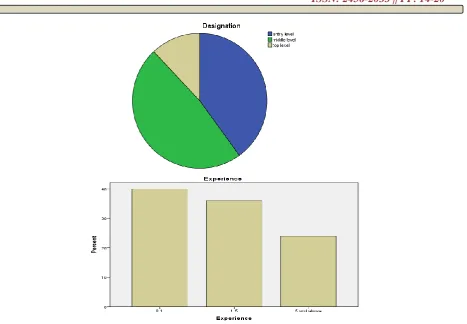
Percentage Analysis:Responses were received from 29 male employees and 21 female employees with various age groups across organisations designated at multiple levels
Age in Years
Valid Percent Cumulative Percent
below 25 14.0 14.05
25-45 46.0 60.0
45 and above 40.0 100.0
Total 100.0
From the above table, it was observed that 14% of the respondents were below the age group of 25, 46% between the age group of 25-45 and 40% of the respondents were in the age group of 45 years and above.
Qualification
Valid Percent Cumulative Percent
Undergraduate 6.0 6.0
Graduate 44.0 50.0
Post graduate 28.0 78.0
Others 22.0 100.0
Total 100.0
From the table, we infer that 6% of the respondents were not graduates, 44% were graduates and 28% were post graduates.
Gender of the Respondent
Frequency Cumulative Percent
Male 29 58.0
Female 21 100.0
. Table 1: DESCRIPTIVE STATISTICS ON INDIVIDUAL CHARACTERSTICS
Table 2: DESCRIPTIVE STATISTICS ON TEAM MANAGEMENT
Team Management Mean Std. Deviation
Frequent Interference with Team 2.16 .997
Team acceptance 2.24 1.041
Exceeds Organisation's target 2.26 .899
Timely inputs to teams 1.88 .773
Independence and freedom to team 2.50 .886
Individual Characteristics Mean Std. Deviation
Energetic and Cheerful 2.24 1.041
One-on-one conversation 2.68 1.039
Prefers writing 2.08 .922
Soft spoken 2.16 .997
Spontaneous 2.14 .833
Closed and Composed 2.26 .899
One task at a time 2.68 1.039
Table 3: DESCRIPTIVE STATISTICS ON TEAM PERFORMANCE
Table 4: ASSOCIATION BETWEEN CLOSED AND COMPOSED AND MEETING AND EXCEEDING ORGANISATIONAL EXPECTATIONS.
**. Correlation is significant at the 0.01 level (2-tailed).
There is no significant difference between closed and composed character and exceeding organisation’s target.
Table 5: ASSOCIATION BETWEEN NETWROK AVOIDANCE AND PROVIDING TIMELY INPUTS TO TEAM
. Avoids
Networking
Timely inputs to teams Avoids Networking Pearson Correlation 1 -.065
Sig. (2-tailed) .654
N 50 50
Timely inputs to teams Pearson Correlation -.065 1
Sig. (2-tailed) .654
N 50 50
Since the table is negatively correlated, there is significant relationship between network avoidance and giving timely inputs to teams.
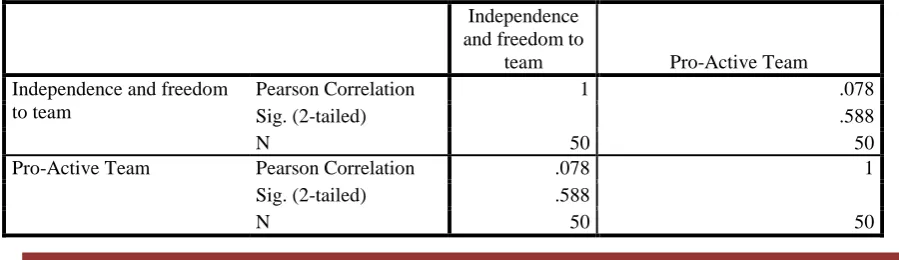
Table 6: ASSOCIATION BETWEEN INDEPENDENCE AND FREEDOM GIVEN TO TEAM MEMBERS AND PERFORMANCE BY PRO-ACTIVE TEAM.
Independence and freedom to
team Pro-Active Team Independence and freedom
to team
Pearson Correlation 1 .078
Sig. (2-tailed) .588
N 50 50
Pro-Active Team Pearson Correlation .078 1
Sig. (2-tailed) .588
N 50 50
Descriptive Statistics
Team Performance Mean Std. Deviation
Well appreciated by Management 2.60 1.030
Pro-Active Team 2.38 1.028
Concentrates on Long Range
Planning 2.40 1.010
Closed and Composed Exceeds Organisation's target Closed and
Composed
Pearson
Correlation 1 1.000
**
Sig.
(2-tailed) .000
N 50 50
Exceeds Organisation's target
Pearson
Correlation 1.000
**
1
Sig.
(2-tailed) .000
Since there exists a positive correlation in the above table, there is direct relationship between giving independence and freedom to team and innovative and joint solution provided by team.
Findings
:
Correlation test reveals that the introvert character of being closed and composed is not an obstacle for reaching and exceeding organisation’s expectations, similarly it as also revealed that such introvert leaders who give complete freedom to their team in discharging their performance are greatly accepted by their proactive employees and that boost their energy levels.
In contrary to this avoidance of networking is negatively correlated to providing timely inputs to team members which means introverts though silent and composed do not lack knowledge in discharging organisational commitments.
Suggestions:
Organisational Benefit of Matching Introvert leaders with pro-active employees:
Introvert leaders are silent yet talented listeners and hence can go in-depth to the problem area jointly with the alternatives suggested by their pro-active team members and process the same into action with their focussed vision. These passionate leaders are highly receptive with zilch deviation which enriches and nourishes the vision and ultimate goal of the organisation with the help of their energetic team. Introverts are proven to be trustworthy and reliable and hence make up an excellent and long-lasting client relationship for the organisation which is vital in the current scenario. Introverts are not mere business card collectors in social gatherings but do maintain strong and deep relationship with the meaningful few.
Taking care of your Introvert Leaders:
Quiet Rooms- Quiet, but interconnected work station would be the first preference for these intellectual leaders. Modular Workspaces- Moveable workspaces can attract introverts to move to quieter part of the office to retain and be boisterous with getting distracted with the external environment.
Reliable Trouble shooters- Introverts can be made to address at critical situations to close a deal or solve conflicting situation if the extraverted team is not able to march forward. In that way the organisation can minimise its chances of losing its prospective customers.
Conclusion:
Confident introverts make great leaders by nurturing other people’s talent and by using recognition rather than blame.
Three professors conducted research surveying unit managers and their employees about their personality traits and their co-worker’s behaviour.
The research compared the survey result against each unit’s overall profitability over a period of seven-week period and the following were observed:
High profits in units were the employees were relatively passive but led by extraverted managers When the employees were pro-active, the units led by introverted employees earned high profits Profits were lower in units where the extraverted managers led proactive employees and introverted
managers led passive employees.
Effective leadership is not about making speeches or being liked but defined by the results which are essential for the attainment of the group goals of the organisation.
Hence, introvert leaders are blessings of maturity and valuable asset for any organisation as they think and listen before taking action and well known conflict managers at crisis situations.
References:
[1]. Adam M. Grant, “Rethinking the Extraverted Sales Ideal”: The Ambivert Advantage, Psychological
Science 2013 24: 1024 originally published online 8 April 2013.
[2]. Carmen Nobel,” Introverts- The Best Leaders for Pro-Active Employees”, Harvard Business School,
October 2010 Issue.
[3]. Adam M Grant, “Reversing the Extraverted Leadership Advantage: The Role of Employee
[4]. Abhishek Srivastava,” Empowering Leadership in Management Teams- Effects on Knowledge sharing,
efficacy and performance”, Academy of Management Journal, 2006, Vol49, No.6,1238-1251.
[5]. Fernando Jaramill,” Servant leadership and ethics: a dyadic examination of supervisor behaviours and
salesperson perceptions”, Journal of Personal Selling & Sales Management, 2015 Vol. 35, No. 2, 108– 124.