RESEARCH
De novo assembly, functional
annotation, and analysis of the giant reed
(
Arundo donax
L.) leaf transcriptome provide
tools for the development of a biofuel feedstock
Chiara Evangelistella
1, Alessio Valentini
1, Riccardo Ludovisi
1, Andrea Firrincieli
1, Francesco Fabbrini
1,2,
Simone Scalabrin
3, Federica Cattonaro
3, Michele Morgante
4,5, Giuseppe Scarascia Mugnozza
1,
Joost J. B. Keurentjes
6and Antoine Harfouche
1*Abstract
Background: Arundo donax has attracted renewed interest as a potential candidate energy crop for use in biomass-to-liquid fuel conversion processes and biorefineries. This is due to its high productivity, adaptability to marginal land conditions, and suitability for biofuel and biomaterial production. Despite its importance, the genomic resources cur-rently available for supporting the improvement of this species are still limited.
Results: We used RNA sequencing (RNA-Seq) to de novo assemble and characterize the A. donax leaf transcrip-tome. The sequencing generated 1249 million clean reads that were assembled using single-k-mer and multi-k-mer
approaches into 62,596 unique sequences (unitranscripts) with an N50 of 1134 bp. TransDecoder and Trinotate soft-ware suites were used to obtain putative coding sequences and annotate them by mapping to UniProtKB/Swiss-Prot and UniRef90 databases, searching for known transcripts, proteins, protein domains, and signal peptides. Furthermore, the unitranscripts were annotated by mapping them to the NCBI non-redundant, GO and KEGG pathway databases using Blast2GO. The transcriptome was also characterized by BLAST searches to investigate homologous transcripts of key genes involved in important metabolic pathways, such as lignin, cellulose, purine, and thiamine biosynthesis and carbon fixation. Moreover, a set of homologous transcripts of key genes involved in stomatal development and of genes coding for stress-associated proteins (SAPs) were identified. Additionally, 8364 simple sequence repeat (SSR) markers were identified and surveyed. SSRs appeared more abundant in non-coding regions (63.18%) than in coding regions (36.82%). This SSR dataset represents the first marker catalogue of A. donax. 53 SSRs (PolySSRs) were then predicted to be polymorphic between ecotype-specific assemblies, suggesting genetic variability in the studied ecotypes.
Conclusions: This study provides the first publicly available leaf transcriptome for the A. donax bioenergy crop. The functional annotation and characterization of the transcriptome will be highly useful for providing insight into the molecular mechanisms underlying its extreme adaptability. The identification of homologous transcripts involved in key metabolic pathways offers a platform for directing future efforts in genetic improvement of this species. Finally, the identified SSRs will facilitate the harnessing of untapped genetic diversity. This transcriptome should be of value to ongoing functional genomics and genetic studies in this crop of paramount economic importance.
© The Author(s) 2017. This article is distributed under the terms of the Creative Commons Attribution 4.0 International License (http://creativecommons.org/licenses/by/4.0/), which permits unrestricted use, distribution, and reproduction in any medium, provided you give appropriate credit to the original author(s) and the source, provide a link to the Creative Commons license, and indicate if changes were made. The Creative Commons Public Domain Dedication waiver (http://creativecommons.org/ publicdomain/zero/1.0/) applies to the data made available in this article, unless otherwise stated.
Open Access
*Correspondence: [email protected]
Background
Giant reed (Arundo donax L.) is a polyploid perennial rhizomatous grass, belonging to the Poaceae family. Although the debate about its origin is still outstand-ing, recently a Middle-East provenance of A. donax has been suggested [1]. A. donax is recognized as one of the most promising lignocellulosic crops for the Mediterra-nean area, due to its high biomass yield, low irrigation and nitrogen input requirements, and excellent drought tolerance. Moreover, A. donax biomass feedstock can be readily converted to heat and/or electricity and can also be processed to produce biofuels and biomaterials [2]. Because of these advantages, A. donax is expected to play a major role in the provision of lignocellulosic biomass across much of Europe.
Even though A. donax can produce panicle-like flow-ers, no viable seed production for Mediterranean ecotypes has been ever reported [3]. Consequently, there has been little agronomic improvement in this species. The rapid development of next-generation sequencing (NGS) technology provides us an opportunity to develop novel genomic tools and enable rapid improvement of A. donax. RNA sequencing (RNA-Seq) has been success-fully and increasingly used to define the transcriptome in plants [4–8]. Transcriptome sequencing by RNA-Seq also holds great potential as a platform for molecular breed-ing and the generation of molecular markers [9]. De novo RNA-Seq assembly facilitates the study of transcriptomes for non-model plant species without sequenced genomes by enabling an almost exhaustive survey of their tran-scriptomes and allowing the discovery of virtually all expressed genes in a plant tissue. It also helps reconstruct transcript sequences from RNA-Seq reads without the aid of genome sequence information.
Despite its economic importance, genomic sequence resources available for A. donax are limited. Currently, a Blast web server was implemented to search for homologs of known genes in a transcriptome of bud, leaf, culm, and root tissues of one ecotype [10]. This database was fur-ther enriched with transcripts from shoot and root tis-sues of young plants grown in a growth chamber under polyethylene glycol (PEG)-induced osmotic/water stress [11]. Moreover, a shoot transcriptome of an invasive ecotype representing high and low confidence transcripts is accessible at the Transcriptome Shotgun Assembly (TSA) sequence database [12]. Genotype- and develop-mental stage-specific transcriptomes [13–15], generated from multiple individuals within a species, from different
geographical origins, at different growth stages and sub-jected to environmental stresses under natural field con-dition, will ultimately lead to a comprehensive catalogue of gene expression. Therefore, using different ecotypes of A. donax, treatments, and time points/developmen-tal stages is urgently needed to provide a more complete gene expression catalogue and allow a comprehensive comparison among various assemblies. Here we describe the genomic resources that we have generated using three ecotypes originating from distant geographical locations. We provide information on transcriptomic data with (a) improved coverage across ecotypes and drought stress conditions, (b) in-depth transcriptome assembly quality assessments, and (c) improved annotations, which will enrich the available data for A. donax and make these datasets directly valuable to other researchers.
To date, there are no genetic markers reported for A. donax. Simple sequence repeats (SSRs) or microsatellites are an ideal choice for developing markers for A. donax because of their abundance, high polymorphism, codom-inance, reproducibility, and cross-species transferability. Exploiting transcriptome data for the development and characterization of gene-based SSR markers is of para-mount importance. In contrast to genomic SSRs, genic-SSRs are located in the coding region of the genome, developed in a relatively easy and inexpensive way, and are highly transferable to related taxa [16]. Therefore, they can directly influence phenotype and also be in close proximity to genetic variation in coding or regulatory regions corresponding to traits of interest. SSRs located in coding and untranslated regions can be efficient func-tional markers [17]. Despite their advantages, no SSR markers for A. donax are currently available.
Here we report the sequencing, de novo assembly, and annotation of the leaf transcriptome of A. donax, as well as the development of polymorphic and func-tional genic-SSR markers. RNA was extracted from leaf tissues of three ecotypes of A. donax grown under two water regimes in field conditions. Illumina sequencing produced 1252 million RNA-Seq reads and 1249 mil-lion clean reads were used for the de novo transcriptome assembly. The leaf transcriptome assembly consists of 62,596 unitranscripts with a mean length of 842 bp and a total nucleotide count of about 52.7 megabase pair (Mbp). The high-quality unitranscripts selected through the EvidentialGene pipeline were further analyzed for Benchmarking Sets of Universal Single-Copy Ortho-logues (BUSCOs) to assess the completeness of the
transcriptome assembly and gene prediction. A global comparison of homology between the transcriptomes of A. donax and four other species of the Poaceae family revealed a high level of global sequence similarity within this family. The assembly was functionally annotated using several public databases: the Swiss-Prot section of the UniProt KnowledgeBase (UniProtKB/Swiss-Prot), UniProt reference clusters (UniRef90), NCBI (National Center for Biotechnology Information) non-redundant (NR) database, Gene Ontology (GO), and Kyoto Encyclo-pedia of Genes and Genomes (KEGG). In addition, com-parative analyses with several phylogenetically related species with more complete genomic information were performed, allowing the identification of putative genes controlling important agronomic or domestication traits. Particularly, genes encoding for stress-associated pro-teins (SAPs), for lignin and cellulose biosynthesis, purine and thiamine metabolism, and stomatal development and distribution were analyzed in the leaf transcriptome. The identification of homologs of these genes leads to sup-portable hypotheses of their conserved functions and to reasonable strategies for their use in A. donax genetic improvement. Additionally, simple sequence repeats (SSRs) were identified in the leaf transcriptome, thereby obtaining the first genetic marker catalogue for A. donax, which could be used for population genetics studies. This new transcript dataset provides the most comprehensive resource currently publicly available for gene expression
and gene discovery in A. donax, and the SSR markers
developed in this study will facilitate further genetic and genomic research in A. donax and related plant species. The leaf transcriptome developed in this study is made available in LabArchives at doi:10.6070/H4W37TC2. All the Illumina sequencing reads generated in this study are deposited in the NCBI SRA (PRJNA360076). The SSR markers developed based on de novo transcriptome assembly are also included in Additional files 1, 2, 3, 4, 5, 6, 7, 8, 9, and 10.
Methods
Plant material, experimental design, and RNA isolation Three ecotypes of A. donax named EcoA, EcoB, and EcoC were selected from a panel of 81 ecotypes collected along the Mediterranean basin for this study because of their great biomass yield potential and contrasting responses to drought stress. EcoA originates from a coastal habitat of Greece that is characterized by hot and dry climatic conditions, whereas EcoB from a coastal habitat of Cro-atia that is considered a transitional zone between sub-tropical and semiarid climates, and EcoC from an hilly habitat in northern Portugal that is characterized by a transitional zone between Mediterranean subtropical and European oceanic climates.
In 2014, six replicate plots of each selected ecotype were planted in Savigliano (SAV, 44°35′N, 07°37′E, 349 m above sea level), northern Italy, in a plot-scale experimen-tal design using homogeneous rhizome cuttings. Each plot measured 10 m2 (2.5 m × 4.0 m) and contained 30 rhizomes planted at a distance of 0.5 m × 1.0 m. Dur-ing this first year of growth, no serious insect infestation or diseases were observed, and no pesticide or fungi-cide was used. Plants were irrigated until field capacity and then grown under two watering regimes during the dry season: well-watered (WW) and natural moderate drought stress (mDr). The mDr was gradually imposed by decreasing the water availability from 80% to approxi-mately 40% of field capacity, whereas WW plants, used as control, were maintained to approximately 80% of field capacity with drip irrigation to replenish evapotranspira-tion losses. Soil volumetric water content was continu-ously checked in the two treatments and was maintained near the field capacity in WW. Additionally, daily water deficit was calculated as the difference between the water availability (i.e., rainfall) and the crop water demand (i.e., specific crop evapotranspiration). A detailed description of drought treatments, soil water status, and meteorolog-ical conditions is shown in Additional files 1 and 2: Figure S1. The whole experiment lasted 73 days, during which three samplings, designated as T1 (DOY 198), T2 (DOY 218), and T3 (DOY 248), corresponding to 23, 43, and 73 days after water stress imposition, were performed for leaves.
Fully expanded, non-senescing leaves (the 5th from the top) were harvested at the three time points (T1, T2, and T3), immediately frozen in liquid nitrogen, and stored at −80 °C until further processing. A total of fifty-four leaf samples (3 ecotypes × 2 treatments × 3 biologi-cal replicates × 3 time points) were then ground in liq-uid nitrogen with precooled mortars and pestles. These samples are envisaged to represent a large proportion of the total leaf transcriptome in A. donax during the expo-nential growth phase in different environmental condi-tions. Total RNA was extracted from 50 mg of ground
tissue using a Spectrum™ Plant Total RNA Extraction
Imaging Analysis Software (Eastman Kodak Company, Rochester, NY). The quantity of total RNA was deter-mined with a Qubit® 2.0 Fluorometer using the Qubit® RNA BR assay kit (Invitrogen™).
cDNA library construction and Illumina sequencing The fifty-four total RNA samples from the three A. donax ecotypes were used for the construction of cDNA librar-ies and for Illumina sequencing reactions. Total RNA integrity was further checked using a Caliper GX (Perki-nElmer, Waltham, MA). 1.5 µg of good-quality RNA was used as input of the ‘TruSeq Stranded mRNA Sample Prep kit’ (Illumina, San Diego, CA) for library prepara-tion following the manufacturer’s instrucprepara-tions. Briefly, the poly-A containing mRNA in each of the samples was purified and enriched using magnetic oligo(dT)-rich beads, and then fragmented using divalent cations at high temperature. Next, cDNA was synthesized by reverse transcription and standard blunt-ending plus add ‘A.’ Illu-mina TruSeq adapters with indexes were ligated to the ends of the cDNA fragments. After ligation reaction and separation of non-ligated adapters, samples were ampli-fied by PCR to selectively enrich the cDNA fragments in the library that have adapters at both ends. To ensure that the quality of the libraries was appropriate for sequenc-ing, the concentration and insert size of final libraries were determined using a Qubit 2.0 Fluorometer (Invitro-gen, Carlsbad, CA) and an Agilent 2100 Bioanalyzer High Sensitivity and DNA 1000 assay (Agilent Technologies, Santa Clara, CA). Finally, cDNA libraries were processed with Illumina cBot for cluster generation on the flow cell following the manufacturer’s instructions and sequenced in single-end mode using a HiSeq2500 sequencing plat-form (Illumina, San Diego, CA). The CASAVA v1.8.2 of the Illumina pipeline was used to process raw data for format conversion and de-multiplexing. On average, 23 million 50-bp reads were produced for each sample.
Quality control and filtering of read dataset
Reads were processed for quality assessment and removal of low-quality bases before de novo assembly of a leaf tran-script catalogue. Subsequently, quality control of raw reads was performed using FastQC v0.11.3 (available at http:// www.bioinformatics.babraham.ac.uk/projects/fastqc/) [18] and a quality score above Q30 was maintained in all fastq files for downstream analysis. We further excluded reads containing at least one undefined (N) base using an inhouse-built script in Python v2.7. Finally, we used FASTX-Collapser (downloaded from http://hannonlab. cshl.edu/fastx_toolkit/index.html) [19] to collapse identi-cal sequences from fastq files of each biologiidenti-cal replicate in the two conditions and in each time point into a single file, while maintaining read counts. Hence, a comprehensive
dataset, representing a large proportion of A. donax leaf transcriptome, was generated into a single fasta file, which was used for the subsequent assembly step.
De novo assembly strategy for leaf transcriptome reconstruction
In our assembly pipeline, the de novo leaf transcriptome reconstruction was performed using a two-step proce-dure. The first step (hereafter termed pre-assembly step) was carried out using two different approaches in order to capture a maximum number of transcripts. These two approaches employed different sequences of a fixed length of k nucleotides (k-mers) and were defined as sin-gle-k-mer (SK) and multi-k-mer (MK). In the SK method, the pre-assembly was generated using a de Bruijn graph based on the de novo transcriptome Trinity Assembler v2.0.4 [20], with a default k-mer parameter (K = 25). In parallel, a MK approach using Trans-ABySS v1.5.1 [21] and rnaSPAdes v0.1.1 (available at http://bioinf.spbau.ru/ en/rnaspades) [22] was carried out. In the pre-assembly step with Trans-ABySS, we used k-mer values of K = 17, 21, and 25. The three raw transcriptomes assembled with different k-mers were then merged using the ‘transabyss-merge’ option. Whereas the pre-assembly step performed with rnaSPAdes used two k-mer values (k = 21 and 33). For both SK and MK methods, the minimum transcript length was set to 200 bp. The different assemblies were performed using a 16-core Intel® Xeon(R) CPU E5-2650 v2 workstation with 64 GB of RAM.
as dropped did not pass the internal filters and were rejected. The primary and alternate transcripts were used for further assessments.
Reads mapping back to transcriptome (RMBT)
Two aligners were used for the mapping of reads back to the leaf transcriptome catalogue: Bowtie2 v2.1.0 [25] and Burrows–Wheeler Alignment (BWA) tool v0.7.12 [26]. The ‘end-to-end’ and the ‘sensitive’ options were used for the alignment using Bowtie2, in which the max number of mismatches (-N = 1) was allowed in the seed alignment. For BWA, the ‘bwtsw’ algorithm was used to index the leaf transcriptome database, and the ‘aln’ (with -n = 0.01; i.e., for 51-bp reads and max_diff 4) and ‘samse’ options to align reads. SAMtools v0.1.19-96b5f2294a [27] was used to calculate mapping statistics from BAM files.
Full‑length transcript analysis
The de novo leaf transcriptome assembly was com-pared to five databases from the Ensembl Plants FTP server (release-29, ftp://ftp.ensemblgenomes.org/pub/ plants/release-29/) [28]: barley (Hordeum vulgare) coding sequence v1.29 (August 2014), rice (Oryza sativa) coding sequence IRGSPv1.0.29, sorghum (Sorghum bicolor)
cod-ing sequence v1.29, common wheat (Triticum aestivum)
coding sequence IWGSC1.0 + popseq.29, and foxtail mil-let (Setaria italica) coding sequence JGIv2.0.29, using
NCBI-BLAST v2.2.28+. BLASTn searches were performed
with the following parameters: -task dc-megablst, -evalue 1e−20, -max_target_seqs 1, and -outfmt 6. In addition, the ‘analyze_blastPlus_topHit_coverage’ script from the Trinity software package (available at https://github.com/trinityr-naseq/trinityrnaseq/wiki) [29] was used to calculate the tar-get database alignment coverage and to assess the number of queries that were assembled to full-length and specific length thresholds, respectively, in the de novo assembly.
Assessment of the completeness of A. donax leaf transcripts
The quality and completeness of the de novo assembly were further evaluated using BUSCO software v2.0 [30]. This quality assessment tool provides high-resolution quantifications for genomes, gene sets, and transcrip-tomes and checks whether each of the BUSCO group is complete, duplicated, fragmented, or missing in the genome or transcriptome assembly. The leaf unitran-scripts were compared to the set of Embryophyta genes, which contains 1440 BUSCO groups from a total of 31 species in order to obtain a quantitative measure of the transcriptome completeness, based on evolutionarily informed expectations of gene content from near-univer-sal single-copy orthologs [30].
Functional annotation of the leaf transcriptome catalogue TransDecoder v2.0.1 (available at http://transdecoder. github.io) [31] was used to identify open reading frames (ORFs) and to predict potential coding sequences using the assembled unitranscripts as input. After ORFs were extracted from the assembly, the Trinotate v2.0.2 (avail-able at http://trinotate.github.io) [32] pipeline was used to annotate the leaf transcript ORF dataset. Both nucle-otide transcripts and protein sequences were used to search against the UniProtKB/Swiss-Prot (uniprot_sprot. trinotate_v2.0.pep.gz) and UniRef90 (uniprot_uniref90. trinotate_v2.0.pep.gz) databases (downloaded at https://data.broadinstitute.org/Trinity/Trinotate_v2.0_ RESOURCES/) [33], using NCBI-BLASTx and BLASTp v2.2.28+ (-evalue 1e−10 -max_target_seqs 1 -outfmt 6), respectively. The UniProtKB is a collection of functional information on proteins, with accurate, consistent, and rich annotation; the section Swiss-Prot contains manu-ally annotated records. The UniRef databases provide NR clustered sets of sequences from the UniProtKB (includ-ing isoforms) and the UniProt Archive (UniParc) records (a comprehensive and NR database that contains most of the publicly available protein sequences). Functional domains were identified using the Pfam domain database (Pfam-A.hmm.gz, available at https://data.broadinstitute. org/Trinity/Trinotate_v2.0_RESOURCES/) [33] using HMMER v3.1b2 [34]. Potential signal peptides were identified using SignalP v4.1 [35]. All the leaf transcrip-tome annotations were loaded into the SQLite database (Trinotate.sprot_uniref90.20150131.boilerplate.sqlite. gz, downloaded at https://data.broadinstitute.org/Trin-ity/Trinotate_v2.0_RESOURCES/) [33]. The maximum e-value for reporting the best hit and associated annota-tion was 1e−5.
Blast2GO v3.1 [36] was used to retrieve the leaf uni-transcripts related to GO and to reveal biological path-ways. Briefly, the assembled transcripts were aligned using the CloudBlast [37] service targeted against the NCBI NR protein database with default parameters. The matching transcripts were further processed to detect associated GO terms, describing biological processes (BPs), molecular functions (MFs), and cellular compo-nents (CCs). UniProtKB, Gramene Proteins Database
(GR_protein), Protein Data Bank (PDB), and The
We further created custom databases of A. thaliana and S. italica genes involved in the biosynthesis of par-ticular cell wall components (lignin and cellulose), which should aid in the optimization of biofuel production from lignocellulosic biomass, the development of bioenergy crops, and in improving drought tolerance through sto-matal development and distribution. We also created a database for SAP genes, which are potential candidates for biotechnological approaches aiming to improve abi-otic stress tolerance in plants. BLASTn searches were performed against the custom databases with an e-value cut-off of 1e−5.
Identification and distribution of functional genic‑SSRs and development of polymorphic SSR markers
The A. donax leaf unitranscripts were scanned for single sequence repeat (SSR) markers using the MISA (MIcro-SAtellite identification tool) program downloaded from the Leibniz Institute of Plant Genetics and Crop Plant Research website (http://pgrc.ipk-gatersleben.de/misa/) [38]. Only perfect SSRs including mono-, di-, tri-, tetra-, penta-, and hexa-nucleotide motifs with numbers of uninterrupted repeat units more than 10, 6, 5, 5, and 5, respectively, were targeted. The maximum interruption distance between two SSRs in a compound microsatel-lite was set to 100 bases. Furthermore, the distribution of the SSR classes within A. donax leaf unitranscripts with respect to the untranslated (5′-UTR and 3′-UTR) and the coding sequence (CDS) regions in the identified ORFs was investigated. First, TransDecoder v3.0.0 (available at http://transdecoder.github.io) [TransDecoder] with the ‘single best orf’ option was used to retrieve the best 5′-UTR, CDS, and 3′-UTR regions. Then, the positions of the transcript domains were combined with the SSRs’ positions to assign microsatellite location within the dif-ferent ORF regions.
In order to retrieve candidate polymorphic SSRs (PolySSRs) among EcoA, EcoB, and EcoC, the leaf tran-scriptome of each ecotype was de novo assembled using Trinity software v2.0.4 [20] with the default parameters (K = 25 and a minimum transcript length of 200 bp). Clustering of redundant transcripts was performed with 95% identity and a word size of 10 using CD-HIT v4.6.4 [23]. The CandiSSR pipeline (available at http://www. plantkingdomgdb.com/CandiSSR/index.html) [39] was used to identify microsatellite polymorphisms between A. donax unitranscripts and the ecotype-specific leaf transcriptome assemblies. This procedure (i) employs MISA software to identify repeat sequences in the refer-ence transcriptome (using the criteria for SSR identifica-tion described above); (ii) retrieves the flanking regions (100 bp both upstream and downstream) of the identified SSRs in the reference sequences; (iii) aligns them using
BLAST to the non-reference transcriptome (e.g., among different individuals); (iv) filters out the low-quality hits; (v) extracts the non-reference sequences with the flank-ing regions; (vi) searches for the specific reference SSRs within them; (vii) removes the invalid search items; (viii) filters out the low-quality PolySSRs; (ix) calculates the sequence similarity of the flanking regions of the iden-tified PolySSRs; and finally (x) designs primer pairs for each PolySSR using Primer3 (http://primer3.sourceforge. net/) [40, 41], assessing also the global similarity of the primer binding regions. Parameters for the primer design were as follows: minimum, maximum, and optimal sizes were 18, 24, and 20 nt; minimum and maximum GC
con-tents were 40 and 60%; and minimum and maximum Tm
values were 52 and 63 °C, respectively.
Blast2GO v3.1 [36] was used to functionally annotate the transcripts containing the PolySSRs, with the aim to analyze the GO categories and KEGG metabolic path-ways of these unitranscripts.
Validation of PolySSR markers by PCR and Sanger sequencing
In order to validate microsatellites identified in the A. donax leaf transcriptome, a total of five primer pairs were randomly selected from those obtained from the CandiSSR pipeline (i.e., forward and reverse primer pairs n.1 of CPSSR_1|AAG, CPSSR_3|AGA, CPSSR_4|AGC, CPSSR_5|AGC, and CPSSR_9|CAG; see Additional file 9: Table S9) to be synthesized (Eurofins Genomics, Milan, Italy) and used for screening polymorphisms among the three ecotypes. Genomic DNA was extracted using the ‘DNeasy Plant Mini kit’ (Qiagen, Hilden, Germany) according to the manufacturer’s instructions. Polymerase chain reactions (PCRs) were conducted in a total volume of 25 μl containing 5 μl of 5× colorless GoTaq® reac-tion buffer, 0.80 μl of 25 mM MgCl2, 0.50 μl of 10 mM dNTP mix, 0.10 μl of 5 μ μl−1 GoTaq® DNA polymerase
(Promega™, Madison, USA), 0.65 μl of 10 μM (0.25 μM)
sense and antisense primers, and 20 ng of template DNA. The PCR mixture was subjected to 94 °C for 3 min, fol-lowed by 35 cycles of 45 s at 94 °C, annealing for 30 s at 55–60 °C (based on the melting temperature of prim-ers), 25 s at 72 °C, and a final step at 72 °C for 2 min. PCR products were visualized via 3% MetaPhor gel and
eth-idium bromide staining and purified using ExoSAP-IT®
treatment (Amersham Biosciences, Buckinghamshire, UK), according to the manufacturer’s instructions. Puri-fied PCR products were sequenced on an ABI 3730XL at Eurofins Genomics (Milan, Italy). Finally, the presence
of the polymorphic SSR fragment between the three A.
Results
Sequencing of the A. donax leaf transcriptome
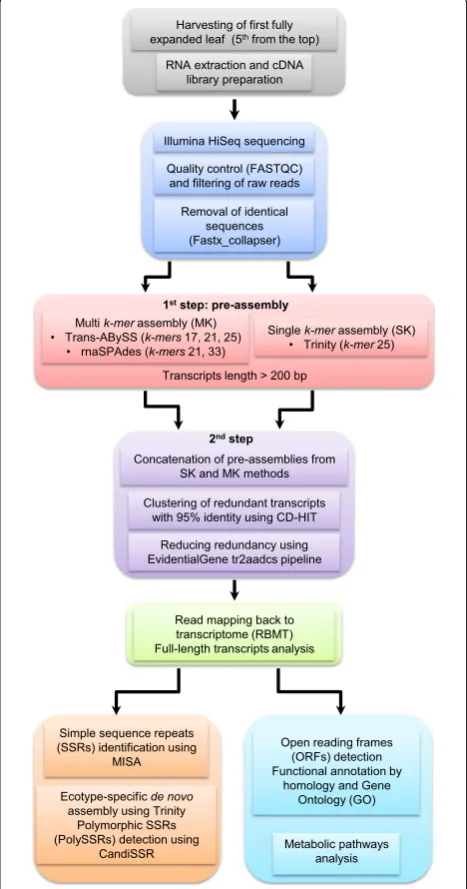
A flowchart overview of the steps followed in the assem-bly process is outlined in Fig. 1. To obtain a broad sample and accurate estimate of the A. donax leaf transcriptome, 54 independent cDNA libraries were constructed from leaves sampled from three biological replicates of three ecotypes at three time points, and under two water stress treatments. All 54 samples were subjected to Illumina RNA-Seq. A total number of 1252 million 50-bp single-end (SE) reads from the 54 fastq files accounting for 187.1 Gb of raw data were generated from the Illumina sequencing with a GC content ranging from approxi-mately 47 to 50%. Prior to the de novo assembly step, raw reads were analyzed to assess quality metrics using the FASTQC software. All files contained high-quality reads with Phred scores ranging from 33 to 37 (Phred quality score, Q, is a measure of base-calling quality and is inversely related to the probability that the correspond-ing base call is incorrect; a Q30 threshold is considered of high quality). We excluded 2.85 million reads contain-ing uncalled bases (N) uscontain-ing inhouse-developed scripts in Python. We further collapsed identical sequences into a single sequence using Fastx_collapser and then concat-enated the resulting files into a unique file that we used for the subsequent assembly step (Fig. 1). This provided a dataset of 1249 million of high-quality unique reads rep-resenting the leaf transcriptome at three different devel-opmental stages of three different ecotypes grown in two contrasting conditions and as such encompasses a large proportion of the leaf transcriptome in the species A. donax.
Leaf transcriptome de novo assembly of A. donax
Since no genome-wide DNA sequence is available for A.
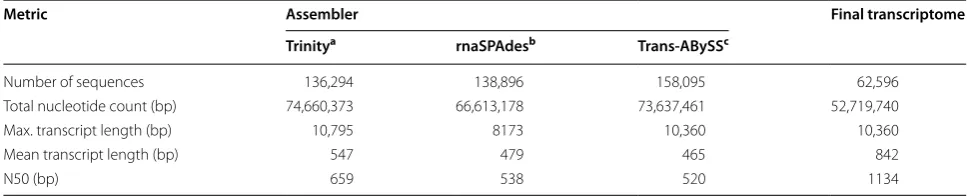
donax for alignment purposes, we developed a special-ized bioinformatics workflow for de novo transcriptome assembly (Fig. 1). Accurate reconstruction and distinc-tion between highly similar transcripts of homologous and paralogous genes as well as transcript isoforms in polyploid species present substantial challenges for de novo transcriptome assembly. For this reason, to opti-mize transcriptome assembly and obtain a high-quality transcriptome, it is useful to combine the output of dif-ferent de novo assemblers using a range of k-mer sizes, while minimizing sequence redundancy [43]. Hence, the pre-assembly step was performed using two paral-lel approaches: a SK method using Trinity software and a MK method using Trans-ABySS and rnaSPAdes. The Trinity pre-assembly generated 136,294 transcripts with a total length of 74,660,373 bp. The median length of these transcripts (N50 value) was 659 bp and the mean and maximum transcript lengths were 547 and 10,795 bp,
Multi k-mer assembly (MK) • Trans-ABySS (k-mers 17, 21, 25)
• rnaSPAdes (k-mers 21, 33)
Single k-mer assembly (SK) • Trinity (k-mer 25)
1st step: pre-assembly
Transcripts length > 200 bp
Clustering of redundant transcripts with 95% identity using CD-HIT
Reducing redundancy using
EvidentialGene tr2aadcs pipeline
2nd step
Concatenation of pre-assemblies from SK and MK methods
Read mapping back to transcriptome (RBMT) Full-length transcripts analysis
Quality control (FASTQC) and filtering of raw reads
Removal of identical sequences (Fastx_collapser) Illumina HiSeq sequencing RNA extraction and cDNA
library preparation Harvesting of first fully expanded leaf (5th from the top)
Open reading frames (ORFs) detection Functional annotation by
homology and Gene Ontology (GO)
Metabolic pathways analysis Simple sequence repeats
(SSRs) identification using MISA
Ecotype-specific de novo assembly using Trinity
Polymorphic SSRs (PolySSRs) detection using
CandiSSR
Fig. 1 Flowchart of the pipeline for the A. donax leaf transcriptome sequencing, de novo assembly, annotation, and analysis. The pipe-line performs multiple operations from sampling and preparation to sequencing and de novo assembly to functional annotation and analy-sis. First, mRNA extraction from the first fully expanded leaf (5th from the
respectively (Table 1). N50 is defined as the length N for which 50% of all bases in the assembly are in a contig of length smaller than N [44]. The MK approach using rnaSPAdes resulted in 138,896 raw transcripts with a total length of 66,613,178 bp, a mean and a maximum transcript length of 479 bp and 8173 bp, respectively.
The N50 value was 538 bp (Table 1). Finally, the MK
approach using Trans-ABySS produced 158,095 tran-script sequences with a total length of 66,613,178 bp, a mean and a maximum transcript length of 465 bp and 10,360 bp, respectively. The N50 value was 520 bp (Table 1).
To reduce redundancy and possible artifacts due to the ploidy level of A. donax, the pre-assemblies from the SK and MK methods were subsequently merged and clustered using the CD-HIT program. The processed sequences were further subjected to the EvidentialGene tr2aacds pipeline in order to select the best biological dataset of primary and alternative transcripts. The result-ing final leaf unitranscript catalogue consisted of 62,596 NR unique sequences with a considerably increased N50 value of 1134 bp and a mean transcript length of 842 bp, covering a total nucleotide count of 52,719,740 bp with an average GC content of 49% (Table 1).
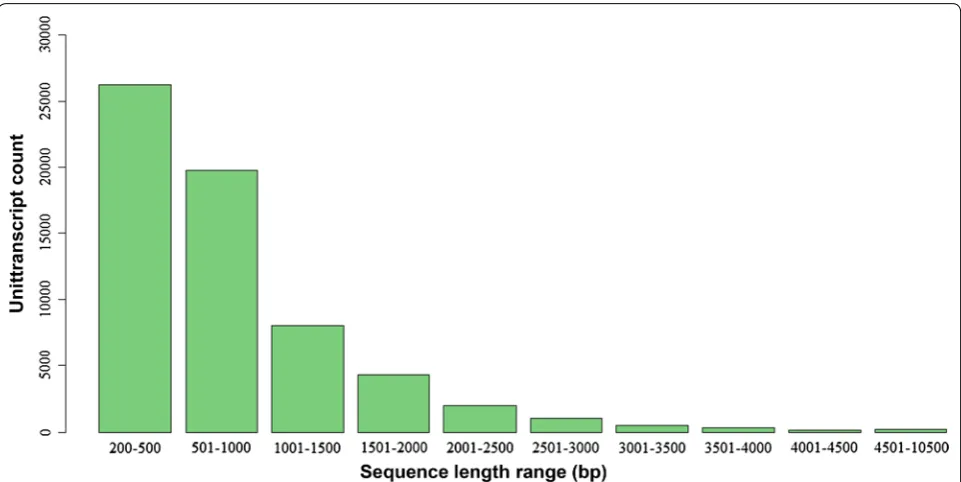
The assembled sequence lengths ranged from the 200 bp cut-off value to a maximum transcript length of 10,360 bp. The majority of the assembled sequences were in the ranges of 200–500 and 501–1000 bp, while the frequency of longer transcripts gradually decreased and only a minor proportion reached lengths above 3000 bp (Fig. 2).
Quality assessment of the leaf transcriptome assembly To evaluate the assembly consistency, the filtered unique reads were mapped back to the final assembled leaf transcriptome, taking into account the number of mismatches when mapping reads to the assembled
transcripts to tolerate the average differences due to the potential genome divergences, as previously reported in wheat [45, 46]. The overall alignment rates using the alignment software Bowtie2 and BWA were 74.27 and 68.35%, respectively. About 40% of the reads uniquely mapped to a single assembled transcript using either aligner, whereas 34.18 and 25.82% of the reads aligned to more than one transcript (Table 2).
We further assessed the level of homology between our leaf transcriptome dataset and those from related spe-cies of the Poaceae family in order to evaluate how many transcripts were reconstructed at full length and those partially reconstructed. A considerable proportion of the A. donax sequences aligned completely (100% of cover-age) or virtually (70% of covercover-age) to the transcripts of related species. The highest number of hits was retrieved when A. donax sequences were aligned to the H. vulgare and T. aestivum transcriptomes. However, only a slightly smaller number of hits were detected for alignment against the S. bicolor, O. sativa, and S. italica transcrip-tomes (Table 3).
We also checked the quality of our assembled unitran-scripts by comparing them to the set of Embryophyta genes using BUSCO quality assessment tool [30]. Out of the 1440 BUSCO groups searched, 70.07% (1009 BUS-COs) were ‘complete’ (i.e., 813 single-copy and 196 dupli-cated), 13.19% (190 BUSCOs) were ‘fragmented,’ and the remaining 16.74% (241 BUSCOs) were ‘missing.’
Functional annotation of the leaf transcriptome by homology and GO
To determine putative functions of the identified A.
donax unitranscripts, we adopted the Trinotate pipe-line to detect homology between the predicted A. donax ORFs/potential proteins and sequences deposited in uni-versal databases. ORFs and potential coding sequences were first predicted using the TransDecoder software.
Table 1 Statistics of the leaf transcriptome pre-assemblies and the final de novo assembly of A. donax
Summary statistics of the A. donax pre-assemblies using Trinity, rnaSPAdes, and Trans-AbySS, and of the final A. donax leaf transcriptome after clustering and redundancy removal
a Trinity: K-mer 25 b rnaSPAdes: K-mer 21, 33
c Trans-ABySS: K-mer 17, 21, 25; the minimum transcript length was set to 200 bp
Metric Assembler Final transcriptome
Trinitya rnaSPAdesb Trans‑ABySSc
Number of sequences 136,294 138,896 158,095 62,596
Total nucleotide count (bp) 74,660,373 66,613,178 73,637,461 52,719,740
Max. transcript length (bp) 10,795 8173 10,360 10,360
Mean transcript length (bp) 547 479 465 842
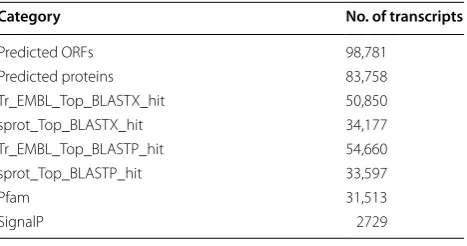
From the initial leaf unitranscript catalogue of 62,596 NR unique sequences, 98,781 ORFs and 83,758 poten-tial proteins could be predicted. The retrieved nucleo-tide sequences and putative protein sequences were then functionally annotated using the Trinotate pipe-line, searching for nucleotide (BLASTx) and protein (BLASTp) homology (e-value <1e−10) against the
Uni-ProtKB/Swiss-Prot and UniRef90 databases. In addition, the presence of known functional protein domains and potential signal peptides was analyzed using the Pfam protein domain database and SignalP, respectively. In total, 34,177 nucleotide sequences (54.59%) and 33,597 protein sequences (34.01%) displayed significant homol-ogy when aligned against the UniProtKB/Swiss-Prot database using BLASTx and BLASTp searches, respec-tively. When aligned against the UniRef90 database, the number of homologous nucleotide and protein sequences increased to 50,850 (81.23%) and 54,660 (55.33%),
respectively. Furthermore, 31,513 (31.90%) unique Pfam protein motifs could be assigned and 2729 (2.76%) pro-tein sequences were predicted to have signal peptides (Table 4). Among the Pfam domains, the most abundant classes were leucine-rich repeat (LRR), pentatricopeptide repeat (PPR), and AAA domains. These protein domains can be found in proteins involved in various functions such as protein–protein interactions, transcription reg-ulation, signal transduction, and protein degradation. The functional annotation by homology is available in LabArchives at doi:10.6070/H40V89V1).
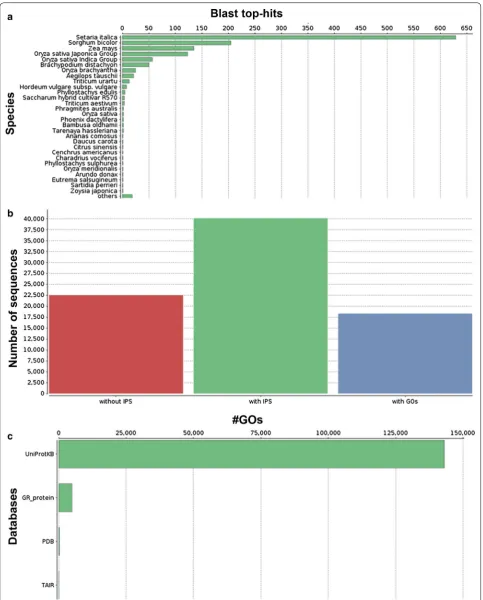
In addition, to further functionally characterize the A. donax leaf transcriptome we related the detected transcripts to GO and biological pathways using the Blast2GO software. First, we assessed the blast hit dis-tribution of the 62,596 unitranscripts blasted against the NCBI NR protein database. Our transcript dataset dis-played 26,323 (42.05%) hits with the NR database and the highest sequence similarity (the lowest e-value) to S. italica (629 top-hits), followed by S. bicolor (205 top-hits), Zea mays (135 top-hits), and O. sativa ssp. japonica (123 top-hits) (Fig. 3a). We further assessed the number of transcripts with InterPro (IP) sequence motifs and
associated GO terms. About 64% (40,116) of A. donax
unitranscripts contained IP motifs, of which about 46%
(18,293) were associated to GOs terms (Fig. 3b). The
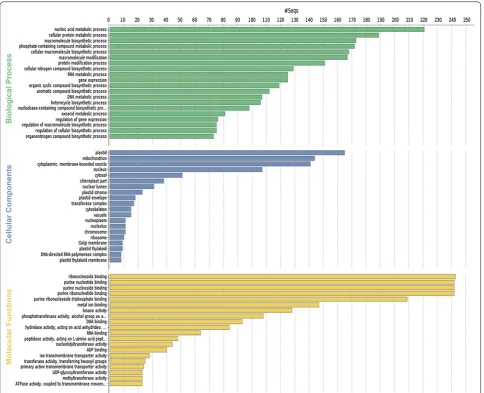
mapping databases used in the Blast2GO suite were Uni-ProtKB, GR_protein, PDB, and TAIR (Fig. 3c). GO analy-sis revealed 9778 sequences associated to 820 GO terms.
Fig. 2 Sequencing and de novo assembly of A. donax leaf transcriptome. Sequence length distribution of A. donax non-redundant (NR) unique unitranscript sequences. The X-axis represents the length range bins in bp. The Y-axis represents the frequency of transcripts in each bin
Table 2 Percentage of reads mapped back to A. donax leaf transcriptome
Percentage of reads uniquely mapped, aligned more than one time to the unitranscripts, and overall alignment rate using Bowtie2 and BWA aligners
Aligner
Bowtie2 BWA
Reads aligned 1 time (%) 40.09 42.53.38
Reads aligned >1 times (%) 34.18 25.82
Among the three main categories, BP category was the most abundant (6299 sequences, 520 GOs), followed by MF (2441 sequences, 151 GOs) and CC (1038 sequences, 104 GOs) categories (Additional file 3: Table S1). Within the BP category, metabolic processes (28.75%), biosyn-thetic processes (25.37%), and cellular processes (17.38%) were most represented. Likewise, genes encoding binding proteins (24.66%) and genes encoding proteins related to catalytic activities (22.45%) were most abundant in the MF category. In the CC category, cell (63.20%), cell part (63%), organelle (54.14%), and membrane (37.18%) were the most abundantly represented GO terms (Fig. 4). These numbers indicate the importance of essential met-abolic and biosynthetic processes in A. donax. However, a large proportion of transcripts showed no similarity to any known putative protein in the public databases, par-ticularly in NCBI NR protein and UniProtKB/Swiss-Prot BLAST searches.
Biological pathway analyses in A. donax
In order to investigate functional biological
path-ways in A. donax, we exploited the Blast2GO function
that assigns EC numbers to transcripts with a blast hit e-value ≤1e−5. The largest proportion of such retrieved transcripts encoded for proteins with EC numbers related to transferase activity (33.53%), followed by hydrolases (29.48%) and oxidoreductases (13.30%). Next, tran-scripts with assigned EC numbers were mapped against the KEGG database to identify the putative presence of
curated pathway components in A. donax. Among the
128 KEGG pathways analyzed (Additional file 4: Table
S2), nucleotide metabolism, specifically purine metabo-lism (929 sequences), was the most represented pathway in terms of the number of homologous leaf transcripts. Furthermore, thiamine metabolism (749 sequences), metabolism of terpenoids and polyketides and other secondary metabolites (370 sequences), aminobenzo-ate degradation (252 sequences), and starch and sucrose metabolism (240 sequences) were highly represented.
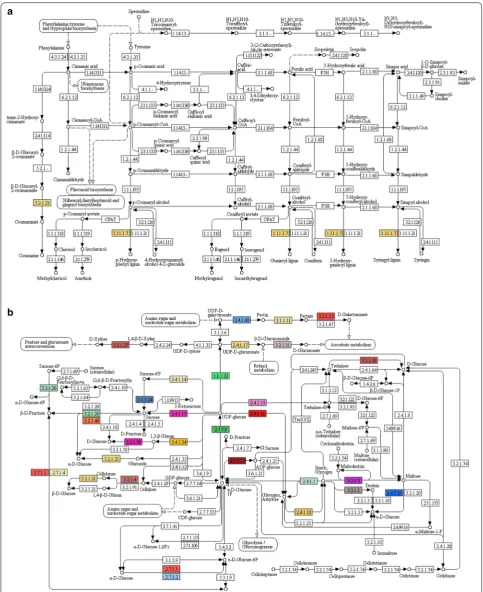
Because of its high representation and the putative role of adenine in triggering abiotic stress tolerance, lead-ing to increased plant biomass [47], we further analyzed purine metabolism. In the A. donax leaf transcriptome, 926 homologs to 36 purine metabolism genes were detected, suggesting high numbers of paralogs, possibly due to the high level of polyploidization into A. donax. Particularly, proteins with nucleosidase activity involved in adenine, hypoxanthine, xanthine, and guanine biosyn-thesis (EC 3.2.2.1), proteins with xanthine dehydrogenase activity (EC 1.17.1.4), and the enzyme involved in the first stage of conversion of 5-hydroxyisourate to S-allantoin (EC 3.5.2.17) were highly abundant in the transcripts catalogue. The A. donax leaf transcriptome dataset fur-ther included several additional enzymes involved in the biosynthesis of various compounds of purine metabo-lism, allowing the reconstructing of large segments of the pathway (Fig. 5a).
The second most represented pathway encompassed the metabolism of thiamine, a universal cofactor involved in common metabolic pathways, including biotic and abiotic stress responses in plants. In the A. donax leaf transcript dataset, 749 sequences homologous to 5 thia-mine metabolism genes were identified, highlighting the importance of this pathway in A. donax. Particularly, enzymes involved in the production of thiamine phos-phates, such as thiamine diphosphokinase (EC 2.7.6.2) converting thiamine in thiamine diphosphate, and thia-mine phosphatase (EC 3.6.1.15) converting thiathia-mine diphosphate in thiamine phosphate, were retrieved (Fig. 5b).
Considering the substantial economic relevance of lignin metabolism in bioenergy crops, the A. donax leaf unitranscripts were also analyzed for coding sequences of the phenylpropanoid biosynthesis pathway. Although this pathway was not among the most represented ones, 44 A. Table 3 Full-length transcripts’ analysis
Percentage A. donax leaf transcripts aligned completely (100%), virtually (>70%), or partially (>20%) to the transcripts of related species
Template tran‑
script dataset 100% coverage >70% coverage >20% coverage
H. vulgare 6526 11,443 17,430
T. aestivum 6503 12,385 21,661
S. bicolor 6281 10,851 16,521
O. sativa 6176 11,283 16,631
S. italica 6066 11,039 17,378
Table 4 Overview of functional annotation by homology
Summary of the functional annotation by homology
ORFs, open reading frames; Tr_EMBL_Top_BLASTX_hit, top blastx hits against UniRef90 database; sprot_Top_BLASTX_hit, top blastx hits against UniProtKB/ Swiss-Prot database; Tr_EMBL_Top_BLASTP_hit, top blastp hits against UniRef90 database; sprot_Top_BLASTP_hit, top blastp hits against UniProtKB/Swiss-Prot database; Gene_ontology_blast, gene ontology using Blast; Gene_ontology_ pfam, gene ontology using Pfam
Category No. of transcripts
Predicted ORFs 98,781
Predicted proteins 83,758
Tr_EMBL_Top_BLASTX_hit 50,850
sprot_Top_BLASTX_hit 34,177
Tr_EMBL_Top_BLASTP_hit 54,660
sprot_Top_BLASTP_hit 33,597
Pfam 31,513
donax transcripts mapped to a peroxidase (EC 1.11.1.7), which is involved in the last step of guaiacyl, hydroxyl-guaiacyl, syringyl, and hydroxyl-phenyl lignin biosynthe-sis, and also to a beta-glucosidase (EC 3.2.1.21), which is involved in the synthesis of coumarinate (Fig. 6a). This indicates that A. donax is capable of synthesizing vari-ous types of lignin, provided that precursors are pro-duced as well. However, despite its importance, lignin is not considered as the only target for improving the yield and quality of lignocellulosic biomass in bioenergy crops. A pivotal role toward this goal is assigned to poly-saccharides. Therefore, the presence of transcripts cod-ing for starch and sucrose metabolism was also verified in the A. donax leaf transcripts catalogue, identifying 30 different enzymes involved in this pathway (Fig. 6b). Among others, cellulose synthase (EC 2.4.1.12) involved
in the synthesis of cellulose from UDP glucose and cel-lulase (EC 3.2.1.4) involved in cellulose catabolism were identified. In addition, sucrose-phosphate synthase (EC 2.4.1.14) responsible for the phosphorylation of sucrose into sucrose-6-phosphate, could also be retrieved. More-over, the A. donax leaf transcriptome contained several enzymes involved in the biosynthesis of amylopectin and glycogen, such as the branching enzyme (EC 2.4.1.18) (Fig. 6b). The identification of these crucial genes in bio-mass production might provide important targets for bioengineering approaches.
To complete the analysis of carbohydrate metabolism in A. donax, the occurrence of components of the carbon fix-ation pathway in the leaf transcriptome was also explored and 15 different enzymes could be retrieved (Additional file 5: Figure S2). A large proportion of the carbon fixation
pathway could thus be reconstructed, including, among others, phosphoglycerate kinase (EC 2.7.2.3) involved in the synthesis of 1,3-bisphopsho-glycerate, and aldolase (EC 4.1.2.13) required for the conversion of glyceralde-hyde-3-phosphate into fructose-1,6-diphosphate and of erythrose-4-phosphate into sedoheptulose-1,7- bisphos-phate. Furthermore, the phosphoenolpyruvate carboxy-lase enzyme (EC 4.1.1.31) could be identified in the leaf transcripts. Finally, the malate dehydrogenase enzyme (EC 1.1.1.37) involved in malate biosynthesis and pyruvic-malic carboxylase (EC 1.1.1.39) involved in the conversion
of malate into pyruvate were detected in the A. donax
transcriptome (Additional file 5: Figure S2).
Interspecies comparisons of A. donax pathways
Since the KEGG pathways accumulate enzymes and possible conversions of many species, it is difficult to estimate how this complexity relates to the presence of pathway components in single species. We, there-fore, analyzed sequence similarity of the A. donax tran-scripts to its most related species S. italica, O. sativa, S. bicolor, and the plant model species A. thaliana. Tran-scripts involved in the biosynthesis of certain cell wall compounds (cellulose and lignin), in stomatal develop-ment, and transcripts encoding for SAPs homologous to those species were identified in the A. donax leaf transcriptome.
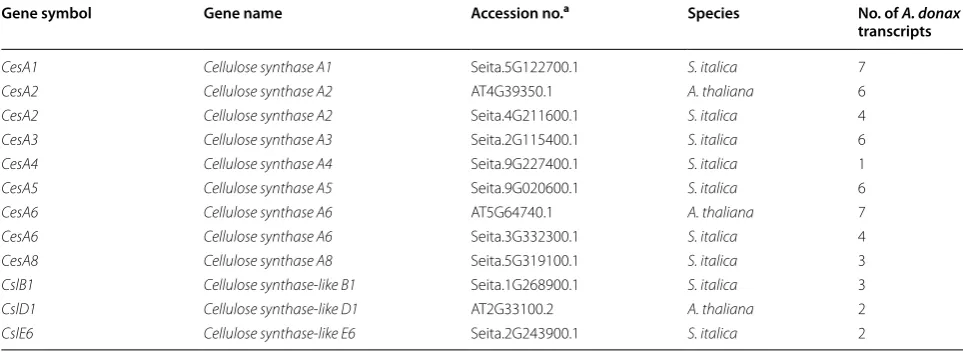
The cellulose synthase superfamily encompasses thir-teen cellulose synthase A (CesA) genes and thirty-six cellulose synthase-like (Csl) genes in S. italica [48]. In A. thaliana, the cellulose synthase superfamily includes ten CesA genes and thirty Csl genes [49]. Among these genes involved in the biosynthesis of cellulose, we detected A. donax transcripts homologous to nine out of thirteen
CesA genes and two to Csl genes of S. italica, as well as three genes of the A. thaliana Ces superfamily (Table 5), confirming the high homology of A. donax to S. italica.
For most genes, of both S. italica and A. thaliana, multiple homologous leaf transcripts of A. donax were
retrieved, with a maximum of seven copies for CesA1,
homologous to S. italica, and CesA6, homologous to A. thaliana. In line with the high homology of A. donax to the S. italica cellulose biosynthesis pathway, all ten lignin biosynthesis genes known for S. italica were also detected in the A. donax transcriptome (Table 6). Again, high copy numbers were detected for key genes in the lignin biosynthesis pathway, such as for phenylalanine ammonia-lyase (PAL) (13 copies) and trans-cinnamate 4-hydroxylase (C4H) (8 copies). These high copy num-bers further stress the importance of key genes in bio-mass composition in A. donax.
We further assessed the presence of A. donax leaf
transcripts homologous to S. italica and A. thaliana genes involved in stomatal development and distribution (Table 7), key genes in the response to drought stress. Five of the seven genes [erecta (ER), epidermal patterning factor-like protein 9 (EPLF9/STOMAGEN), erecta-like1 (ERL1), GT2-like1 (GTL1), FMA/bHLH097 (FAMA)]
known to be involved in stomatal development in S.
italica showed sequence similarity with A. donax leaf transcripts, whereas no sequence similarity was detected between A. donax transcripts and A. thaliana genes.
SAPs are fast emerging as potential gene family can-didates for systems and synthetic biology approaches to improve multiple abiotic stress tolerance in plants [50]. Thus, they would be invaluable in the improvement of bioenergy crops such as A. donax. So far, however, until relatively recently, such genes had only been identified
Table 5 Comparison between A. donax transcriptome and S. italica and A. thaliana transcripts for cellulose biosynthesis
A total of nine S. italica transcripts and three A. thaliana transcripts involved in cellulose biosynthesis showed homology with A. donax transcripts
a Phytozome (v11.0) accession numbers
Gene symbol Gene name Accession no.a Species No. of A. donax
transcripts
CesA1 Cellulose synthase A1 Seita.5G122700.1 S. italica 7
CesA2 Cellulose synthase A2 AT4G39350.1 A. thaliana 6
CesA2 Cellulose synthase A2 Seita.4G211600.1 S. italica 4
CesA3 Cellulose synthase A3 Seita.2G115400.1 S. italica 6
CesA4 Cellulose synthase A4 Seita.9G227400.1 S. italica 1
CesA5 Cellulose synthase A5 Seita.9G020600.1 S. italica 6
CesA6 Cellulose synthase A6 AT5G64740.1 A. thaliana 7
CesA6 Cellulose synthase A6 Seita.3G332300.1 S. italica 4
CesA8 Cellulose synthase A8 Seita.5G319100.1 S. italica 3
CslB1 Cellulose synthase-like B1 Seita.1G268900.1 S. italica 3
CslD1 Cellulose synthase-like D1 AT2G33100.2 A. thaliana 2
in few plant species (for example, in rice and sorghum). Therefore, we investigated the homology of A. donax leaf
transcripts to genes encoding SAPs not only in the A.
thaliana and S. italica, but also in O. sativa and S. bicolor transcript catalogs (Table 8).
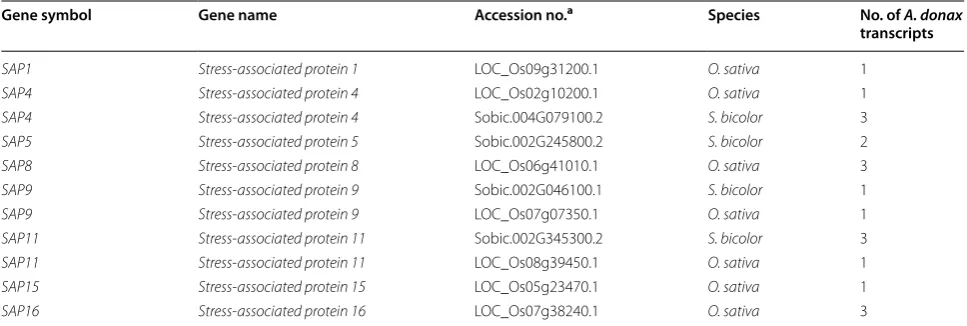
We identified A. donax transcripts homologous to
seven of the 18 genes encoding for O. sativa SAPs, and to four of the S. bicolor SAPs. In addition, no sequence similarity was detected between A. donax transcripts and those of S. italica and A. thaliana.
Table 6 Comparison between A. donax transcriptome and S. italica transcripts for lignin biosynthesis
A total of ten S. italica transcripts involved in lignin biosynthesis showed homology with A. donax transcripts
a Phytozome (v11.0) accession numbers
Gene symbol Gene name Accession no.a Species No. of A. donax
transcripts
PAL Phenylalanine ammonia-lyase Seita.1G240400.1 S. italica 13
CCoAOMT Caffeoyl-CoA 3-O-methyl-transferase Seita.6G197700.1 S. italica 1
CCR Cinnamoyl-CoA reductase Seita.2G256200.1 S. italica 1
CAD Hydroxycinnamyl alcohol dehydrogenase Seita.1G057300.1 S. italica 1
COMT Caffeate O-methyltransferase Seita.6G059400.1 S. italica 3
F5H Ferulate 5-hydroxylase Seita.9G193900.1 S. italica 5
HCT Hydroxycinnamoyl transferase Seita.7G155700.1 S. italica 7
C3H Trans-cinnamate 3-hydroxylase Seita.3G194300.1 S. italica 6
C4H Trans-cinnamate 4-hydroxylase Seita.5G361200.1 S. italica 8
4CL 4 coumarate CoA-ligase Seita.6G093400.1 S. italica 3
Table 7 Comparison between A. donax transcriptome and S. italica transcripts for stomatal development and distribution
A total of six S. italica transcripts involved in stomatal development and distribution showed homology with A. donax transcripts
a Phytozome (v11.0) and NCBI accession numbers
Gene symbol Gene name Accession no.a Species No. of A. donax
transcripts
ER Erecta Seita.4G086700.1 S. italica 5
EPLF9/STOMAGEN Epidermal patterning factor-like protein 9 Seita.5G425700.1 S. italica 1
GTL1 GT2-like1 Seita.7G184400.1 S. italica 1
ERL1 Erecta-like1 Seita.4G019700.1 S. italica 2
FAMA FMA/bHLH097 XM_004961002.3 S. italica 5
Table 8 Comparison between A. donax transcriptome and O. sativa and S. bicolor transcripts for SAPs
A total of seven O. sativa transcripts and four S. bicolor transcripts encoding for SAPs showed homology with A. donax transcripts
a Phytozome (v11.0) accession numbers
Gene symbol Gene name Accession no.a Species No. of A. donax
transcripts
SAP1 Stress-associated protein 1 LOC_Os09g31200.1 O. sativa 1
SAP4 Stress-associated protein 4 LOC_Os02g10200.1 O. sativa 1
SAP4 Stress-associated protein 4 Sobic.004G079100.2 S. bicolor 3
SAP5 Stress-associated protein 5 Sobic.002G245800.2 S. bicolor 2
SAP8 Stress-associated protein 8 LOC_Os06g41010.1 O. sativa 3
SAP9 Stress-associated protein 9 Sobic.002G046100.1 S. bicolor 1
SAP9 Stress-associated protein 9 LOC_Os07g07350.1 O. sativa 1
SAP11 Stress-associated protein 11 Sobic.002G345300.2 S. bicolor 3
SAP11 Stress-associated protein 11 LOC_Os08g39450.1 O. sativa 1
SAP15 Stress-associated protein 15 LOC_Os05g23470.1 O. sativa 1
Genic‑SSR marker mining, distribution, and polymorphism prediction
Many of the sequenced mRNA transcripts contained untranslated regions (UTRs) and occasional remaining introns. Such non-coding regions are prone to sequence diversity, which might be a source for potential poly-morphic markers. Currently, no genetic markers are available for A. donax. Hence, we mined the retrieved transcripts for SSR markers, which are commonly used as a tool for assessing genetic diversity, the development of genetic maps, marker-assisted selection (MAS) breeding, and comparative genomics. The 62,596 unitranscripts, accounting for 52.7 Mbp, were screened for repeat motifs to explore the SSR profile in the A. donax leaf transcrip-tome. A total of 8364 SSRs were obtained from 7491 unitranscript sequences (11.97%) so 775 sequences con-tained more than one SSR. In addition, 294 sequences
revealed compound SSR formation (Additional file 6:
Table S3). A strong enrichment of mono- and tri-nucle-otide repeat motifs was further detected among each of the SSR classes, while longer repeat motifs were clearly underrepresented (Additional file 6: Table S4). The com-plete list of unitranscripts with the description of the identified SSR motifs is reported in Additional file 7: Table S5, whereas the frequencies of each of the different SSR repeats as compared to the total identified SSRs are reported in Additional file 7: Table S6. We further investi-gated the distribution of SSR classes in the unitranscripts (CDS, 5′ UTR, and 3′ UTR). Out of the total 8364 SSRs, 5592 were located in the UTR and CDS regions, of which 611 (10.93%), 2059 (36.82%), and 2922 (52.25%) SSRs were located in the 5′ UTR, CDS, and 3′ UTR, respec-tively. The remaining SSRs (2772 SSRs; 33.14%) were not ascertained a position because it was not possible to delimit the UTR and CDS regions for the transcripts con-taining them. For the SSRs located in the CDS, 75.52% (1555 SSRs) were tri-nucleotides, followed by di-nucle-otides (200 SSRs; 9.71%). Conversely, the proportion of tri-nucleotides within the UTR regions was lower com-pared to the CDS. Mono- (2609 SSRs; 82.48%) and tri- (303 SSRs; 9.58%) nucleotides were the most abundant in the 3′-UTR region, while in the 5′-UTR 457 (40.23%) and 420 (36.97%) SSRs were mono- and tri-nucleotides, respectively. With respect to tri-nucleotides within the CDS region, the CGC repeats (114 SSRs; 7.33%) were most represented within the 1555 tri-nucleotide motifs, followed by GGC (109 SSRs; 7.01%) and CGG (107 SSRs; 6.88%) repeats. Within the mono- and tri- nucleotides in the 5′-UTR region, T (246 SSRs; 53.83%), A (139 SSRs; 30.42%), CCG (30 SSRs; 7.14%), and GGC (30 SSRs; 7.14%) repeats were the most common. Similarly, among the mono- and tri-nucleotide SSR classes in the 3′-UTR, the highest frequencies were observed for T (1650 SSRs;
63.24%), A (848 SSRs; 32.50%), GGC (17 SSRs; 5.61%), and AGC (16 SSRs; 5.28%) repeats.
Finally, in order to detect PolySSRs, ecotype-specific assemblies were reconstructed using the Trinity software. The assembly statistics of the transcript dataset of each ecotype is reported in Additional file 8: Table S7. Using CandiSSR pipeline, a total of 53 PolySSRs were identified between A. donax unitranscripts (hereafter referred to as reference transcriptome) and the three ecotype-specific transcriptomes (Additional file 9: Table S8), suggest-ing the existence of a certain degree of genetic diversity among the three ecotypes analyzed in this study. The specific primer pairs for the 53 PolySSRs were designed using Primer3, which is implemented in the CandiSSR Perl script (Additional file 9: Table S9). The polymor-phism encompassed di-nucleotide motifs with a mini-mum of six repeats and tri-nucleotide motifs with a minimum of five repeats in the reference transcriptome. The total number of PolySSR motifs ranged from 1 to 4 and the minimum and maximum number of repeats was 2 for AGC, GTT, and TCC motifs, and 11 for AG, respec-tively (Additional file 9: Table S10).
Gene functions of the unitranscript sequences containing PolySSRs
To date, no gene-related markers have been identified in A. donax. We therefore conducted functional categoriza-tion of unitranscripts containing SSRs in order to reveal homology with known proteins and determine the pos-sible functions of the 53 polymorphic genic-SSRs by BLAST2GO analysis with the NR database of protein sequences. A total of 31 GO terms were allocated to the transcripts containing the PolySSRs. They were assigned to the BP (157 sequences, 20 GOs), CC (132 sequences, 8 GOs), and MF (49 sequences, 3 GOs) categories. In addi-tion, nineteen KEGG metabolic pathways were repre-sented by at least one transcript with the corresponding EC numbers. Particularly, the phenylpropanoid biosyn-thesis, starch and sucrose metabolism, and purine and thiamine metabolisms were overrepresented.
Agrobacterium tumefaciens-mediated genetic transfor-mation, such as VirE2 interacting protein2 (i.e., VIP2) [56]. Furthermore, homologous sequences to glutathione S-transferase (GST) genes, whose detoxification and anti-oxidant activities can be considered important factors in drought tolerance in plants, such as in H. vulgare [57] and in transgenic A. thaliana [58] were also found among the unitranscripts containing PolySSRs. These findings make these functional PolySSRs particularly useful for research into accelerated genetic studies and enhanced breeding programmes in A. donax.
Experimental validation of PolySSR markers
To test whether the potential SSR loci that were mined were true-to-type ones for use in genetic diversity stud-ies, a total of five primer pairs were randomly selected from those obtained from the CandiSSR pipeline (i.e., forward and reverse primer pairs n.1 of CPSSR_1|AAG, CPSSR_3|AGA, CPSSR_4|AGC, CPSSR_5|AGC, and CPSSR_9|CAG; see Additional file 9: Table S9) and syn-thesized. The results showed that all tested primer pairs amplified successfully. Out of the five pairs of primer, four produced amplicons with expected sizes, while one primer pair gave an amplicon larger than the expected size (i.e., CPSSR_1|AAG). Consequently, the former pairs of primer were then used to assess the genetic
diversity among the three A. donax ecotypes. Out of
the four primer pairs, one (i.e., CPSSR_4|AGC) success-fully amplified polymorphic SSR fragment; particularly,
(AGC/GCT)5 repeats were detected in EcoA, whereas
(AGC/GCT)4 repeats were identified in EcoB and EcoC
(Additional file 10: Figure S3).
Discussion
Although A. donax is one of the most promising and
emerging non-food bioenergy crops in regions with Mediterranean climates, until very recently available genomics resources were scarce. The knowledge about
the molecular mechanisms of A. donax, underlying its
adaptability in marginal lands with low input require-ments, its high biomass yield and tolerance to abiotic stresses, is still in its infancy due to the little information in public databases about Arundo transcriptome profiles. Therefore, the transcriptomic data generated in this study provide invaluable resources to understand the biology of A. donax, offering new tools and methodologies to help develop agriculturally productive and economically sound genotypes.
It is worth mentioning that genomes at species level are dynamic and are composed by genes which are pre-sent in each individual of a species (core genes) and genes in a set of individuals (dispensable genes); collectively, these genes constitute the so-called pan-genome. For
example, transposable elements are largely responsible for the variation in both intergenic and genic regions, not only in closely related species but also between individu-als within a species. These suggest that a single genome sequence might not reflect the entire genomic informa-tion of a species [59]. The presence of pan-genome and pan-transcriptome was observed also in many plant spe-cies. For instance, a study of the pan-genome was con-ducted by resequencing of six elite Z. mais inbred lines for commercial relevance in China and several hundreds of complete dispensable genes with presence/absence variation among these lines were identified [60]. More recently, a transcriptome sequencing of 503 maize inbred lines revealed the dynamic nature of the maize pan-genome and identified representative transcript assem-blies (RTAs) with 16.4% expressed in all lines and 82.7% expressed in subsets of the lines, demonstrating that a considerable portion of variation may be outside the sin-gle reference genome for a species [61]. Also DNA and
RNA sequencing of seven accessions of Glycine soya
(wild soybean) revealed that approximately 80% of the pan-genome was present in all the accessions, represent-ing the core genome, and the remainrepresent-ing were dispensable genes that exhibited greater variation reflecting a puta-tive role in adaptation to different environments [62]. This reflects the importance of sequencing and
assem-bling numerous A. donax transcriptomes in order to
capture all the possible variable dispensable genes/tran-scripts and decipher their role in adaptation to different environments. Further analysis of the pan-transcriptome rather than a single reference circumvents single sam-ple bias and ensures that the majority of genetic diver-sity within A. donax is fully captured. Furthermore, de novo construction of A. donax pan-transcriptome is also necessary to unravel variation in gene regulation and expression and provide additional candidate genes for the development of elite genotypes.
De novo RNA-Seq assembly facilitates the study of transcriptomes for plant species without sequenced genomes, but it is challenging to select the most accurate assembly in this context. Here, we developed a special-ized bioinformatics workflow for de novo transcriptome assembly. Illumina next-generation mRNA-Seq was suc-cessfully used to assemble and analyze the leaf transcrip-tome profile of three A. donax ecotypes representing a vast array of geographical adaptation across the species and possessing traits of agronomic importance grown under two different field conditions in order to increase the understanding of biological processes and shed new light on the molecular mechanisms underlying the out-standing adaptability of this relatively unknown species.