schools in rural India, AACE Journal, 15(1), 57-72.
The ICT Laboratory: An Analysis of Computers in
Public High Schools in Rural India
PAYAL ARORA
Teachers College, Columbia University New York, USA
India as the IT Hub
At the international level, the United Nations has generated the “Global e-school and Communities Initiative” (Gesci), a special campaign to promote the use of technology in education (UNESCO, 2005). India’s “Silicon Valley,” Bangalore, has been chosen as the headquarters for this United Nations campaign. The Gesci initiative was established by the UN ICT Task Force in 2003. The Gesci initiative has drawn attention to the fact that ICT in schools has impact that goes beyond the classroom, yielding enormous benefits to local communities in the form of employment, adult education, health, business services, communication, and e-governance. The Gesci initiative therefore seeks to build partnerships between the ICT, media, and entertainment industries in order to find ways to put existing technology to educational uses.
Hence, in recent years, there has been policy development in computer-enabled education instruction, particularly in secondary schools across the nation. In the last few years, several private and public partnerships (PPP) have been set up with the intention of scaling these initiatives nationwide. Unfortunately, according to recent World Development indicators (World Bank, 1997), less than 2% of the Indian population currently has access to the Internet, the majority being in the urban area. Accounting for determin-ing factors includdetermin-ing the availability of connectivity, maintenance techni-cians, trained users, end-user hardware, relevant and applicable content and the like, India falls short of these expectations (Press, Foster, & Goodman, 1999). This has posed a serious stumbling block in the ambitious scaling of e-literacy through computers across states. It has propelled governments, international think-tanks, and the private sector alike to seek for innovative solutions in computer distribution and utilization to best capitalize on these cost intensive resources.
The Vidya Vahini Scheme
950 teachers will be trained. In each of the districts, 20 government/ government-aided schools have been selected in consultation with the state government. Under this scheme, each of the schools will have one computer lab consisting of a breadth of hardware and software. In terms of hardware, each of these schools are meant to have a server, a hard disk, network printer, 10 multimedia personal computers with a web camera, 29" flat screen color TV, with 15 minutes power back-up, uninterrupted power supply (UPS) and a constant voltage transformer. As for software, a multiplicity of tools are meant to have been supplied: MS-Office (full suite) with multi-lingual support, Visual studio, Encarta reference suite and online deluxe, and web hosting software.
A technology room is to be set up where a color TV and personal computer are connected to the Internet through the computer lab. The purpose of the technology classroom is to enable the teachers to access the education related material in the classroom and impart computer-aided instructions through the large screen color TV. Also, part of the Vidya Vahini scheme is the teacher’s training lab. The purpose of setting up this lab is to bring the teachers from the same district and train them in computer applications, course development, and other technology related aspects. An arrangement has been made with Intel, Microsoft, and other corporate ICT providers to train the teachers in the use of computers, development of course curriculum material, internet access, and other related applications. Last, in addressing the issue of connectivity, given that most of the schools are in the semi-urban and rural areas, the terrestrial infrastructure at present is weak. Hence, the broadband facility has been used to provide intra and internet connectiv-ity at all the 140 schools and 7 training labs covered in the pilot project. All the schools will have peer-to-peer connectivity. Therefore, the Vidya Vahini pilot project has been recorded as aiming to provide:
1. better quality of education at the school level; 2. good foundation at the school level;
3. IT training to the students;
6. exchange of skills, knowledge and sharing of resources among schools; and
7. linkages with schools all over the world.
In the following section, I will analyze how this initiative has translated at the ground level within Kuppam high schools based on my six months of ethnographic research.
ETHNOGRAPHIC FIELDWORK
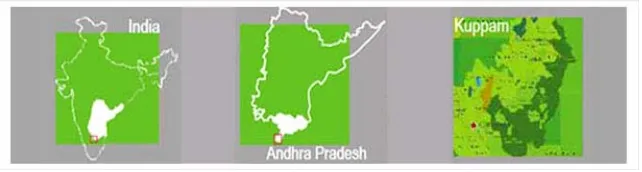
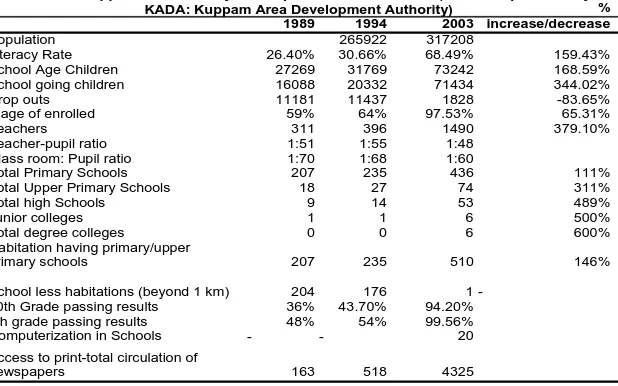
Located at the confluence of Karnataka, Tamil Nadu, and Andhra Pradesh, Kuppam is strategically if not symbolically stationed amidst the three states. Ten years ago, Kuppam was reputed to be the prison encampment area of Andhra Pradesh. Today, Kuppam, due to the “progressive nature of its people1” has been chosen to be a “model” by Hewlett Packard for new technologies to be tried and tested within its vicinity. It is a rural Indian village, 105 kilometers from Bangalore city on the Bangalore-Chennai railway (Figure 1). Telugu is the official and most widely spoken language in the state. Other spoken languages in this area include Hindi, Urdu, English, Kannada, and Tamil. With a population of around 300,000 people across five districts or mandals, the area has experienced a transformation in health, education, agriculture and employment sectors. In the education setting, according to local government statistics (Kuppam Area Develop-ment Authority [KADA], 2003), impressive strides have been made in enrolments, retention, school facilities and passing rates (Table 1).
Literacy rates jumped from 26% in 1989 to 68% in 2003. Within those years, dropout rates decreased by almost 84%. The statistics on access to schooling rivals the statistics in learning achievement. Passing rates amongst 7th and 10th grades have swung from a low of 36%-48% respec-tively in 1989 to 94%-99% in 2003. Through theVidhya Vahini Scheme, the government pledged to provide computers to all local high schools by the end of 2005. Further reforms included the establishment of a model residential school with the support of World Bank in 2003, targeting girls from the most marginalized scheduled castes and tribes (see Table 1).
Basics Are Not Sexy, Computers Are
A good portion of government schools persist in not having access to the basic facilities for children (Table 2)
1989 1994 2003
% increase/decrease
Population 265922 317208
Literacy Rate 26.40% 30.66% 68.49% 159.43%
School Age Children 27269 31769 73242 168.59%
School going children 16088 20332 71434 344.02%
Drop outs 11181 11437 1828 -83.65%
%age of enrolled 59% 64% 97.53% 65.31%
Teachers 311 396 1490 379.10%
Teacher-pupil ratio 1:51 1:55 1:48
Class room: Pupil ratio 1:70 1:68 1:60
Total Primary Schools 207 235 436 111%
Total Upper Primary Schools 18 27 74 311%
Total high Schools 9 14 53 489%
Junior colleges 1 1 6 500%
Total degree colleges 0 0 6 600%
Habitation having primary/upper
primary schools 207 235 510 146%
School less habitations (beyond 1 km) 204 176 1
-10th Grade passing results 36% 43.70% 94.20%
7th grade passing results 48% 54% 99.56%
Computerization in Schools - - 20
Access to print-total circulation of
newspapers 163 518 4325
“We just need teachers,” said the headmistress at a government high school in Gonugur. This had been a common plea professed by a majority of the public high school teachers and principals. Access to drinking water, infrastructure, curriculum change, science laboratories, and sports facilities were stated as the most urgent reforms needed within the education system (Table 2). Furthermore, the relentless poverty in this “model” community is illustrated by the “uniform” policy of the local schools. Several public high schools had instituted the “no-uniform” rule on Wednesdays and Thursdays. When asked the reason for this, we were informed that this rule gave the parents an opportunity to wash their child’s uniform for that week. Safety is another key concern, especially in the education of girls. During our stay, a local school teacher had run away with a 13 year old girl student from his class. “That is why we don’t want to send our older girls to schools. This is what happens,” lamented a father of two girls. Also, there were several
Table2: Education System in Kuppam: Government High School District Statistics
2003 + Fieldwork %
High Schools founded within last 5 years 70% On students
Female students in high schools 43%
Co-educational schools (M+F) 85%
Students from Backward Castes, Scheduled and Tribal Castes 90% On Teachers
Female teachers in schools 26%
Language in Schools
Schools with Telugu as prime medium of instruction 100% English as prime medium of instruction 0% Teachers graduated from Telugu medium school 91% Technology in Schools
Schools with Computers 40%
Televisions in Schools 38%
Cable access 0%
Teachers claim computers main function to be that of a teaching aid 78% Teachers claim that computers main function is to provide technical skills to students 17% Students claim playing computer games to be their favorite usage of computers 47% Students claim graphics & GK to be their favorite usage of computers 30% Students claim internet to be their favorite usage of the computers 17% Facilities
Schools with access to drinking water 50%
Schools with libraries 15%
Schools with girls toilets 32%
Schools with Cultural activities/ Functions 57% School perception on education
Principals that claims instilling moral values to be the most important aspect of schooling 75% Principals that claim schools main role is to prepare children with skills for jobs 17% Principals that claim hiring more teachers to be their most urgent need 43% Principals that claim their need for more facilities as most urgent 30% Access to drinking water being the most predominant facility need 60% Principals that claim reforming state mandated curriculum as their most urgent need 9%
complaints of corruption pertaining to the government education depart-ment. A well respected local teacher pleaded with us to come with him to see the open corruption in the education offices. “They ask you to sign for 20 textbooks and give you only 10. That is why you see clerks in “two lakh houses.” In spite of this sobering state of affairs, in speaking with parents, we learned that many strongly believed that English and computers were the most critical to their child’s education. As one of the mothers put it, she believed that it was the only way her children could succeed and do well. This is reflected in the fact that within the last 10 years, there has been a burgeoning of many private schools in Kuppam, all promising instruction in the English language medium as opposed to Telugu, the regional language medium taught in public schools (KADA, 2003). This parallels a national trend where poor parents in both rural and urban settings are opting for private schooling over the public, causing a national crisis in public educa-tion (Waldman, 2003).
Old and New ICT Within Kuppam Classrooms
The former government had pledged to provide computers to all government high schools by 2005. However, only 40% of the schools currently have computer facilities (see Table 2). Televisions had also been promised in addition to the computers for satellite TV education and other innovations in content access. Again, less than 40% of the schools have televisions (see Table 2). This is meant to enable children to watch educational programmes shown on TV and function as a temporary remedy to the shortage of competent teachers in rural settings. Also, schools can link computers to televisions for better viewing. This is an interesting phenomenon for it brings together the “old” ICT medium, the television, with the “new” ICT medium, the computer in a marriage that is conducive to large classes. With an average ratio of 10 pupils to 1 computer, more focus was given to group based activities. However, this put the onus on the teachers to facilitate participation among marginalized groups to maximize engagement.
Sitting Ducks
from the government. The word “recently” alluded to a two year period. In spite of this time lag, the government had not set up a power line for the television in her school. Meantime, the television had been locked away for the last two years. Power is perhaps the most critical factor in ICT access. A shift-policy system was in place where there was a planned power outage from 10 in the morning to 5 in the evening every alternate week. In terms of private-public partnerships, Hewlett Packard (HP) had provided Linux based PCs for a few schools. They applied the 4-for-1 strategy where four monitors are connected to one computer processing unit (CPU). According to The Financial Express HP has claimed that the schools could benefit from this novel facility where the cost of the system would be 40-60% cheaper compared to the regular PCs.1 However, with no formal follow up and maintenance, much of this equipment could stay unused in these schools. If there is a problem with the computers, the principal would have to go to the district office, which is a good six hours away. “We have the equipment but with no power and no maintenance, there is no use. The children do not come here much,” lamented a headmaster in Kangundi. In fact, in one of the schools, we noticed six computers sitting idly due to a fuse problem. Apparently a simple fix but due to the lack of support, these computers had been unused for months. “We are willing to pay from our own pockets, just tell us where to go,” exclaimed the computer teacher at this school. Several other incidents pointed out the urgency of an ongoing support system in equipment maintenance and training, crucial for maximiz-ing these cost-intensive resources.
The Language Barrier
When we watched the students in these schools demonstrate their knowledge of the computers, we noticed that they were comfortable handling the computers. They showed us their favorite programs on the computers: biology centered programs, programs on the Agra fort, and the solar system. Yet, in gauging their comprehension, we realized that they had not grasped the meaning of the content. They were still dependant on the teachers to translate this information to them. Also, a good percentage of students reported video games as their favorite usage of the computer with graphics software a close second (see Table 2). Yet, even when accounting for language accessibility, issues of content engagement, relevance and contex-tuality still persevere. As observed by the Educational Development Center (EDC), children centered educational content designed for ICT is unfortu-nately not readily available (EDC, 2004).
Changing Pedagogy, Changing Mindsets
Much of computer usage can be understood in light of the current pedagogi-cal practices and beliefs within an existent system. According to the World Bank education sector report in 2001, a large number of teachers do not use the teaching kits provided. However, if teachers are involved in the process of creating the kits and if quality training is provided, the likelihood of usage is much higher. Interestingly though, teachers rely heavily on textbooks, often the only reading material in the schools in their day to day instruction (World Bank, 2001). In our interviews and observations of teachers using computers, similar patterns were observed. The majority of teachers, when asked about the main functionality of computers, stated computers to be teaching aids (see Table 2). The other most predominant usage of computers was in providing children with computer skills (see Table 2).
classroom behavior, either the teachers abdicated responsibility to the “computer instructor” in charge who taught basic computer skills or would treat the computer medium as an e-textbook, making children copy down material being taught.
There were some teachers who were able to effectively use the medium to maximize learning. For example, in the Urdu school, the principal was able to combine various subjects within the same class and present it through multi-media facilities provided by the Urdu Foundation. In the government high school in Kothaindlu, the teachers had cultured a query-based learning within their classrooms which translated effectively in the usage of technolo-gies for learning. This was evident through the high interactivity and sharing of the students in problem solving using computers. In Kangundi, the science teacher managed to design multi-media programs on physics and astronomy. He claimed he was self-taught. Yet for the most part, teachers did not display such a penchant to alternate pedagogical techniques. Another aspect, which is important to consider is the overall vision of education as espoused by the principals. Their leadership often determines to what extent computers get integrated within the classroom. Interestingly, most principals privileged the vision of schools as portals of values (see Table 2). While 75% stated moral education as their main goal to schooling, only 17% claimed their main aim was to impart skills to their students (see Table 2). Yet, most content for computers is designed as subject based, with little sensitivity towards value based instruction that can simultaneously be engaging and meaningful to children.
between literacy and ICT access where both literacy and ICT access are closely connected to “human communication and the means of knowledge production” (Warschauer, 2003b, p. 38). Other parallels are where both tools function as prerequisites to full participation in the information stage of capitalism; they both necessitate a connection to a physical artifact ( a book or a computer) and serve as a two way street in receiving and produc-ing information. Lastly, he stated that both literacy and ICT access have spiraled the notion of societal divides, one being the literacy divide while the other is the digital divide. Attewell (2001) chose to see the latter as two waves, the first and second digital divides, where the first has been preoccu-pied with access issues while the second wave is concerned with usage and actual implementation of technology in learning. However, it needs to be noted that they cannot be looked upon as separate entities but rather as a webbed duality in the pursuit of enhanced learning.
Overall, the use of ethnographic grounded observations is critical to helps us illuminate the nature and worth of what students are learning about comput-ers. Jungck, (1999) stated that, “What we know is linked to the way we come to know it” (p. 283). Hence, as students’ interaction with computers shape what they know about them, researchers through conducting observa-tions of technology access and use in schools will shape the understanding of teachers and students’ experiences, their values and their needs in this teaching/ learning process. Thereby, voices from the ground level are endemic to shaping the effectiveness in policy and practice in technology in education.
CONCLUSION
private sector. In my interview with Mr. Naidu, the former chief minister of Andhra Pradesh, I asked about his computer-education schemes and its potential to be sustainable. He stated that Kuppam was a state laboratory, which housed smaller models of innovation. His main belief in sustainability was rooted in private-public partnerships (PPP) as a means for generating efficiency. Efficiency in turn was to produce wealth. “You need to create wealth in order to distribute it,” he remarked. I shared my concern on projects like the Vidya Vahini scheme where due to its maintenance offices being closed, there was little continued support of the schools’ computer facilities. He replied that governments could only jump start a project through initial subsidies. However, to really be an autonomous unit, certain corporate strategies were necessary for sustaining these projects. In the case of Vidya Vahini, the mobilization of local resources through user charges he stated was stringent to enable true sustainability. However, with Mr. Naidu not in power, HP transferring all responsibility to local non govermental organizations (NGOs) in 2005 and other computer training think-tanks potentially losing their funding, the idea of continuity is a looming concern. I also met with the current secretary of education, Dr.Chellappa to help gauge the mindset of the current government towards ICT initiatives in education. Overall, he seemed supportive of the efforts. However, he explained that the department had been bombarded with educational content from several local and international sources, many targeting rural issues. I saw some samples, which were primarily documentaries on agriculture, environment, and other rural domains. He went on to explain that due to the high volume of ICT content, the department was in the midst of creating an ICT committee within the education department to screen through the material. He also expressed his personal frustration in dealing with the same topics over these years. “It’s like to grind an already grounded floor,” he said, quoting a Telugu saying. “In the 60s, we spoke of dowry, health, women’s issues, agriculture and today we speak again of the same issues.” He expressed the need for something fresh, something new, and less preachy to the public.
Sustaining Current Momentum
appropriate computer instruction among other quality based schooling factors for their children to keep privatization at bay. However, this can be done in parallel to maintaining the regional language and culture within schools through investing in culturally appropriate educational software and adopting engaging multiple-language content software. Also, to prevent computers from becoming modern day artifacts in the classrooms, ongoing technical support and pedagogical e-training for teachers is key. Govern-ments and nonprofits involved in training should harness the strengths of gifted teachers with a natural affinity towards creative applications of technology in the classroom. These teachers should be at the table when shaping computer content and e-curriculum. To make a genuine impact on learning outcomes, strong partnerships need to be developed between non-profits, the private sector and the government to create meaningful and engaging content for the children. This can be achieved by broadening the parameters of PPP to encompass the teachers, students, and popular socio-cultural bodies to help shape content. By engaging locals in their own learning process and development, it creates buy in, with a higher chance of the content being utilized. Overall, sustainability for computerization within the educational forum requires the long term investment of human, fiscal and institutional resources with a special emphasis on community participation.
References
Attewell, P. (2001). The first and second digital divides. Sociology of Edu-cation, 74(3), 252-259.
Dudley, B. (2005, April 22). India parlays education, timing into tech boom. Retrieved November 13, 2006, from The Seattle Times, Busi-ness and Technology Web site: http://seattletimes.nwsource.com/html/ businesstechnology/2002000235_india09.html
Education Development Center Report. (2004). Digital libraries in India: A baseline survey. Washington, DC: Author.
Girdner, J.E. (1987). Economic liberalization in India: The new electronics policy. Asian Survey, 27(11), 1188-1204.
Gujral, K. I. (2005, June 27). Digital democracy. Retrieved November 13, 2006 from http://www.dqindia.com/content/egovernance/2005/ 105062701.asp
Kuppam Area Development Authority. (2003). Notes on developmental ac-tivities in Kuppam constituency, Andhra Pradesh, India: State Govern-ment docuGovern-ment.
National Task Force on Information and Technology Development. (1999).
Information technology action plan part III: Long term national IT pol-icy. Retrieved November 13, 2006, from http://it-taskforce.nic.in/ actplan3/index.html
Pink, H. D. (2005, May 13). Why the world is flat. Retrieved November 13, 2006, from http://www.wired.com/wired/archive/13.05/friedman.html Press, L., Foster, A. W., & Goodman, E. S. (1999). The Internet in India
and China.Proceedings of INET 1999, Stockholm, Sweeden. Retrieved November 13, 2006, from http://www.isoc.org/inet99/proceedings/3a/ 3a_3.htm#s3
Selfe, C. (1988). Computers in the classroom: The humanization of com-puters: Forget technology, remember literacy. The English Journal, 77(6), 69-71.
Shrikanth, G. (2004, April 7). From literacy to e-literacy. Retrieved No-vember 13, 2006, from http://www.dqindia.com/content/egovernance/ 104040701.asp
United Nations Educational Scientific and Cultural Organization (UNESCO, 2005). Bangalore chosen as India headquarters for UN technology in education initiative. Retrieved November 13, 2006, from h t t p : / / p o r t a l . u n e s c o . o r g / c i / e n / e v . p h p -URL_ID=19610&URL_DO=DO_TOPIC&URL_SECTION=201.html Waldman, A. (2003, November 15). India’s poor bet precious sums on
pri-vate schools. Retrieved November 13, 2006, from the New York Times Foreign Desk web site: http://www.cs.princeton.edu/~rywang/05s598/ docs/031115-000938.india_school/
Warschauer, M. (2003a). Demystifying the digital divide. Scientific Ameri-can,289(2), 42-47.
Warschauer, M. (2003b). Technology and social inclusion: Rethinking the digital divide. Cambridge, MA: MIT Press.
World Bank (1997). World development indicators. Washington, DC: Au-thor.
World Bank (2001). India expanding and improving upper primary educa-tion in India (Report No.20347-IN). Washington, DC: Author.
Acknowledgement
local field coordinator, who allowed for this investigation to proceed at a deeper level due to her local knowledge and networks.
Notes
1. Hewlett Packard website on the Kuppam i-community. Retrieved on November 13, 2006, from http://www.kupnet.org/
2. Hewlett Packard Press Site. Retrieved on November 13, 2006, from http://www.hp.com/hpinfo/newsroom/feature_stories/2005/