evaluation tips and internet resources for secondary educators. AACE Journal, 16(3), 275-291.
Educating the Web-Savvy Urban Teacher: Website
Evaluation Tips and Internet Resources for Secondary
Educators
IMMACULÉE HARUSHIMANA Lehman College, City University of New York
New York, NY USA
This article, The Web-Savvy Urban Teacher, addresses the question of what educational technology educators and scholars can do to close the pedagogical mismatch, which exists today between “digital native” secondary students and their predigital educators. The infrequent use of the Internet as a resource in urban schools is detrimental for today’s generation of students, the majority of whom consider the World Wide Web as the source of all knowledge. The purpose of his article is to: (a) introduce and establish the rationale that the Internet is an appropriate medium by means of which differentiated instruction and multiple intelligences can help foster content literacy among struggling and reluctant adolescent learners, (b) provide secondary educa-tors with teacher-specific website criteria that will facilitate the website selection process, and (c) supply a sampling of timeless websites for students and teachers interested in working in a self-regulated environment.
On November 15, 2006, “Good Morning America” on ABC News, in consultation with a group of experts, named the Internet the fifth new wonder of the world (Hennessey, 2006). Everybody would agree with Reporter Hennessy’s observation that “the Internet has revolutionized everything from commerce to education to dating.” Today’s generation of “digital natives” (Prensky, 2001; Hertzog & Klein, 2005) has grown up so accustomed to the Internet that it is becoming increasingly difficult for teachers who are unfamiliar with technology to reach these students through a traditional print textbook approach. An adequate education for today’s net generation of learners (Oblinger & Oblinger, 2005) requires that the Internet play a significant part in the educational process, especially if we want to engage the less motivated learners. On the other hand, as Leblanc (1994) sadly reported, true integration of technology in the curriculum remains a luxury, not to say impractical, in many secondary schools.
help foster content literacy among struggling and reluctant adolescent learners. Additionally, this document provides middle and secondary educators with a sampling of carefully reviewed, timeless websites for use in a self-monitored environment.
INTERNET AND DIFFERENTIATED INSTRUCTION
In poor urban school settings, where technological innovations are absent and teachers have to deal with large class sizes comprised of a highly intellectually and culturally diverse student population, addressing the individual needs of low performing students becomes a serious challenge (Levin, 2002). As the Illinois Planning Commission for Educational Technology argued, the use of technology allows students at all levels “to develop skills in problem solving, decision making, data collection, self spaced instruction, research, and communications” (Barker, Hall, & Wood, 1994, p. 2). In the absence of funding to fully integrate technology across the curriculum, educational websites can serve as an intermediate solution to help individual learners develop the skills they need according to their cognitive level and their learning style. In this respect, the Internet has a lot to offer the proponents of inclusion and differentiated instruction.
Additionally, because they are enhanced by web devices, educational websites allow for the integration of the theories of multiple intelligences and individual learning styles (Gardner, 1999; Veneema & Gardner, 1996). Some activities include traditional multiple choice and sentence completion tasks appropriate for the linguistic and logical-mathematical mind; others offer graphic-enhanced, three dimensional, and concentration activities for the visual-spatial learner. Kinesthetic and auditory learners connect with colorful and vibrant simulation activities that incorporate music, sound and/ or action. Finally, web-based practice offers digital learners the opportunity to draw from their digital intelligence (Adams, 2004) to develop academic abilities. With adequate guidance in using educationally-oriented Internet activities, teachers can achieve success with learners for whom the tradition-al approach has not proved effective.
A SAMPLING OF WEB SITES FOR MIDDLE AND SECONDARY EDUCATORS
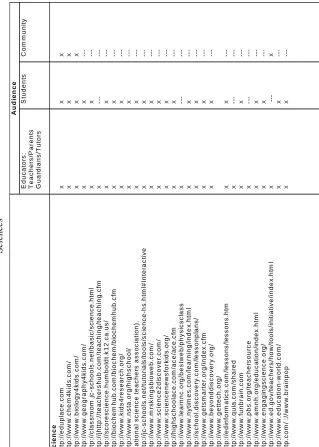
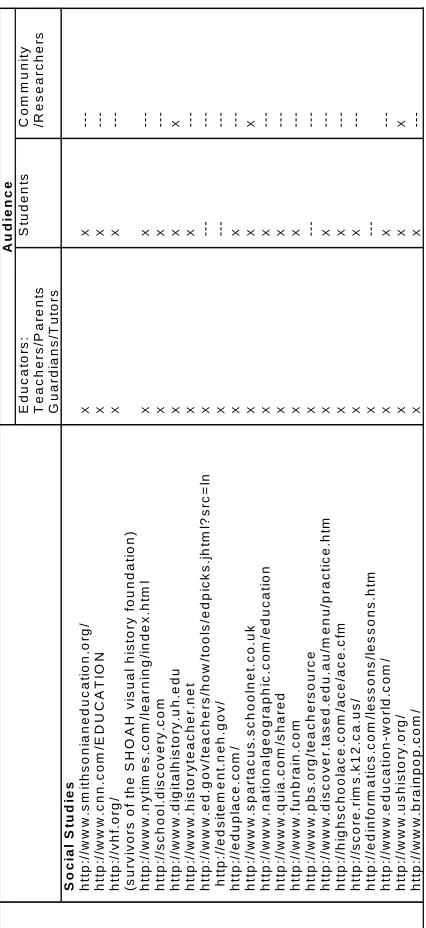
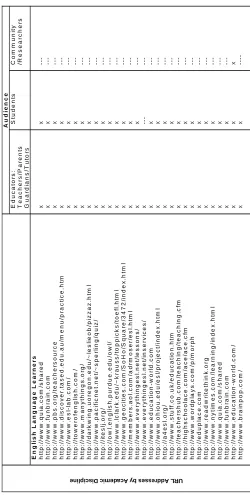
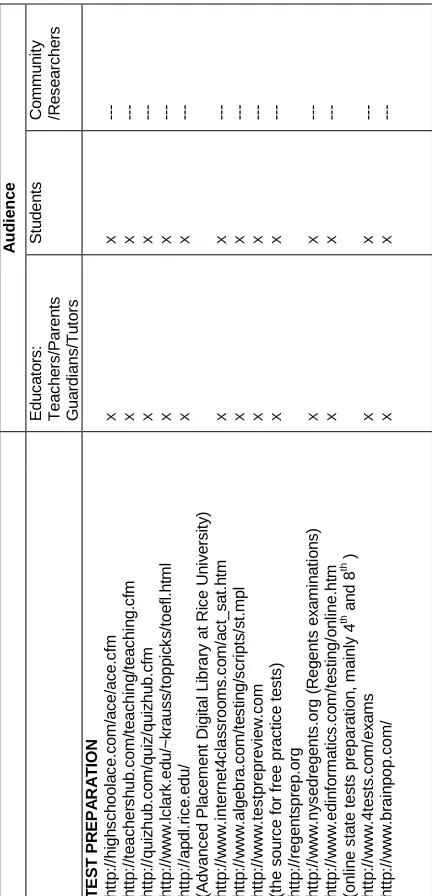
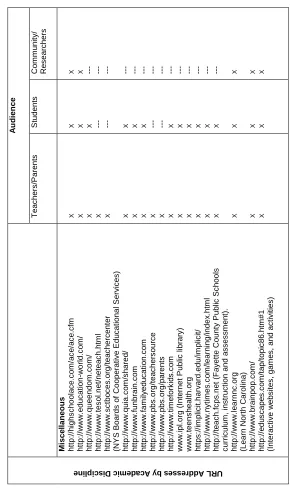
Tables 3-9 (later) provide samples of educational websites, most of which have been recognized as exemplary websites in the 101 best websites for secondary educators (Lerman, 2005), an ISTE publication, or other accredit-ed agencies, such as: PC Magazine, the Eisenhower National Clearinghouse for Mathematics and Science Education, and the Educational Source. Website selection criteria. Authors of educational websites come from diverse backgrounds, academic experiences, and different professions. However, their intention may not necessarily be educational. Therefore, the websites included in this project had to demonstrate a direct connection with either students or the teachers, and sometimes both.
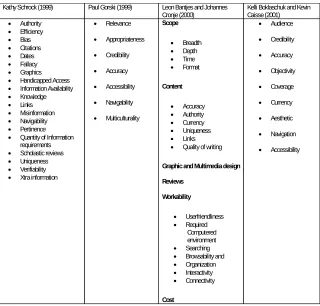
Table 1
Four Models of Educational Website Evaluation
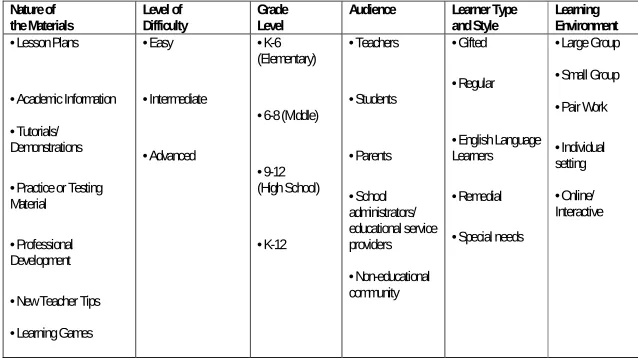
The users of educational websites also need to know the general content area a given site focuses on, what grade level the content is suited for, the material’s level of difficulty, the nature of the information it provides, and the learning environment it requires. These additional criteria were summa-rized in Table 2.
Kathy Schrock (1999) Paul Gorski (1999) Leon Bantjes and Johannes Cronje (2000)
Kelli Boklaschuk and Kevin Caisse (2001) • Authority
• Efficiency • Bias • Citations • Dates • Fallacy • Graphics • Handicapped Access • Information Availability • Knowledge • Links • Misinformation • Navigability • Pertinence • Quantity of Information
requirements • Scholastic reviews • Uniqueness • Verifiability • Xtra information
• Relevance
• Appropriateness
• Credibility
• Accuracy
• Accessibility
• Navigability
• Multiculturality
Scope
• Breadth • Depth • Time • Format
Content
• Accuracy • Authority • Currency • Uniqueness • Links • Quality of writing
Graphic and Multimedia design
Reviews
Workability
• Userfriendliness • Required
Computered environment • Searching • Browsability and • Organization • Interactivity • Connectivity
Cost
• Audience
• Credibility
• Accuracy
• Objectivity
• Coverage
• Currency
• Aesthetic
• Navigation
Table 2
Teaching-Specific Website Evaluation Criteria
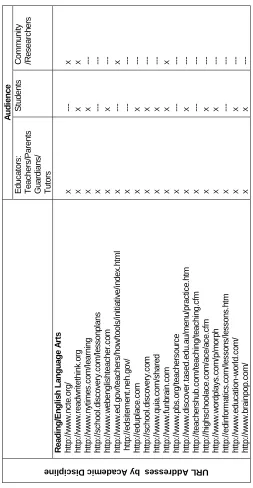
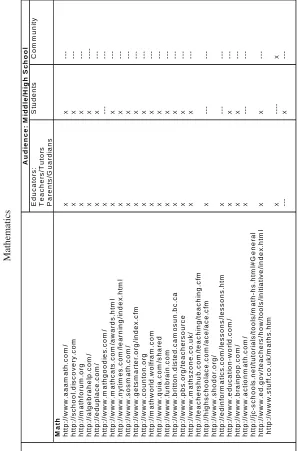
To enhance the manageability of the tabled information, the tables highlight only URL’s, the audience, and academic disciplines.
In the process of selecting websites of relevance, teachers, students, and parents received the most attention as the target audience. On the whole, like most educational websites, the websites discussed here provide teachers with teaching tips, lesson plans, supplementary content, strategies, quizzes, student activities, and links to related sites. The selection process gave precedence to the major academic disciplines, including math, science, English language arts, social studies, and English as a second language. Additionally, these samples include interactive review and test preparation websites which provide teachers with a means to ensure that both digitally inclined and paper and pencil learners have equal opportuni-ties to enhance learning. Student links feature interactive practice activiopportuni-ties, such as online quizzes, learning games, and simulations. Parents’ links mainly advertise information related to homework help, learning software, learning games, and home schooling resources.
At first glance, some websites included in this article might not seem directly relevant to education. However, after a closer look the reader will discover that, while intended for the general public, these sites contain
Nature of the Materials
Level of Difficulty
Grade Level
Audience Learner Type and Style
Learning Environment
• Lesson Plans
• Academic Information
• Tutorials/ Demonstrations
• Practice or Testing Material
• Professional Development
• New Teacher Tips
• Learning Games
• Easy
• Intermediate
• Advanced
• K-6 (Elementary)
• 6-8 (Middle)
• 9-12 (High School)
• K-12
• Teachers
• Students
• Parents
• School administrators/ educational service providers
• Non-educational community
• Gifted
• Regular
• English Language Learners
• Remedial
• Special needs
• Large Group
• Small Group
• Pair Work
• Individual setting
sublinks to useful information for children and educators. Usually, public programs, such as: www.pbs.org, www.nytimes.org, and www.ipl.org, fall under this category. In a comparable fashion, there are websites which, while being of high interest for students and educators, contain useful information for other services outside of the field of education. This is the case with http://www.queendom.com and https://implicit.harvard.edu/ implicit, among others. The heading “miscellaneous” category designates this type of website, stressing the fact that the readership extends to other disciplines beyond education.
The no-fee-required criterion. The cost factor received serious consider-ation during the selection and compilconsider-ation of these the websites included in this work. Plainly commercial websites scarcely appear in the listings for two main reasons. In addition to being expensive, business websites tend to prioritize advertisers’ pop-ups and promotional links over educational content; this interference may discourage educational web surfers from using the Internet. A minimal number of commercial websites were included in the provided website list after an in-depth examination of the educational value of the information made available to nonsubscribers.
A u di ence E duc at ors : Te ac her s/ Par ent s G uar di ans / Tu to rs St udent s C o m m uni ty /R es ear c h ers URL Addr esses by Acade mic D iscip line R eadi ng/ En gl is h La nguage A rt s h ttp ://w w w .n c te .o rg / ht tp :/ /w w w .r eadw ri te th in k. or g h ttp ://w w w .n yt im e s .c o m /le a rn in g ht tp :/ /s c hool .d is c o ver y. c o m /le ss o n p lans ht tp :/ /w w w .w eb engl is ht eac her. c o m ht tp :/ /w w w .ed. g o v/ teac her s /ho w /t o ol s /i n it ia ti ve /i ndex .h tm l ht tp :/ /eds ite m e n t. neh. gov/ ht tp :/ /edupl a c e .c o m ht tp :/ /s c hool .d is c o ver y. c o m ht tp :/ /w w w .qui a .c o m/ s har ed h ttp ://w w w .fu n b ra in .c o m h ttp ://w w w .p b s.o rg /te a c h e rs o u rc e ht tp :/ /w w w .d is cover .t a s ed. edu .au/ menu /p ra c tic e .ht m ht tp :/ /t eac hers h ub. c o m /t eac hi ng /t e ac hi ng. c fm h tt p :/ /h ig h sch o o la ce .co m /a ce /a ce .cfm ht tp :/ /w w w .w ordpl a ys .c o m /p/ m o rp h h ttp ://e d in fo rm a tic s .c o m /le s s o n s /le s s o n s .h tm h ttp ://w w w .e d u c a tio n -w o rl d .c o m / ht tp :/ /w w w .b ra inpop. c o m /
X X X X X X X X X X X X X X X X X X X
--- X X --- X --- --- X X X X --- X --- X X --- X X
X X --- --- --- X --- --- --- --- X --- --- --- --- --- --- --- ---
Table 3
A u d ie n c e : M id d le /H ig h S c h o o l E ducat or s: T eacher s /T u to rs P a rent s /G u ar di ans S tudent s C o m m uni ty w w w .a a a m a th .c o m / /s c hool .d iscov e ry .c o m a th fo ru m .o rg /al gebr ahel p. co m / /edu pl a c e. co m / /w w w .m a thgoodi es .c o m / w w w .m a th c a ts .c o m /a w a rd s .h tm l /w w w .ny ti m e s. co m /l e a rni ng/ inde x .ht m l /ww w. s o s m a th .c o m / /w w w .get s m ar te r. or g/ index .c fm /w w w .co unt on .o rg a th w o rl d .w o lf ra m .c o m /w w w .qui a. co m /sh ar ed /w w w .f unbr ai n. co m /w w w .br it ton. di s ted. ca m o sun. bc. c a /w w w .pbs .o rg /t eache rs our ce /w w w .m a th sz one. co .u k / a c h e rs hub. co m /t eachi ng /t e a c hi n g .c fm /hi gh sc hool a c e. c o m /a c e/ a c e. cf m /w w w .sh odor .o rg / /edi n for m a ti c s .co m /l e s s on s/ le s s on s. h tm /w w w .edu cat ion-w o rl d. c o m / /w w w .br ai npop. com / w w w .a c ti o n m a th .c o m / /j c -school s. ne t/ tu to ri al s/ to o ls /m a th -h s .ht m l# G en er al /w w w .ed. gov /t eacher s/ how /t o o ls /i n it ia ti v e/ in d e x .h tm l ://w w w .s tu ff.c o .u k /m a th s .h tm
X X X X X X X X X X X X X X X X X X X X X X X X ---
X X X X X --- X X X X X X X X X X X --- --- X X --- X
---- X --- --- --- ---- --- --- --- --- --- --- --- --- --- --- --- --- --- --- --- --- --- --- ---
X ---
Table 4
Table 5 Sciences A u d ien ce E ducat or s: Teacher s /P a rent s G uar di ans/ T u tor s S tudent s C o m m uni ty URL Ad dresses by Acade mic Dis cipli ne Sc ie n c e ht tp :/ /edupl a c e. co m h ttp ://w w w .c h e m 4 k id s .c o m / h ttp ://w w w .b io lo g y 4 k id s .c o m / ht tp :/ /w w w .geogr ap hy 4ki d s. com / ht tp :/ /c la s s ro o m .j c-s c hool s .net /bas ic /sci ence .ht m l ht tp :/ /j h tt p :/ /t e a c her shub. co m /t e a c hi ng/ teach ing .c fm ht tp :/ /s cor e s c ience .hu m bol dt .k 12 .c a. u s / ht tp :/ /b io che m hub. co m /bi o c h e m /b ioche m hub. cf m h ttp ://w w w .k id s 4 re s e a rc h .o rg / ht tp :/ /w w w .n st a. or g/ hi ghs chool / (nat ional s c ie n c e teacher s as so ci a ti o n) . ht tp :/ /j c-school s. ne t/ tu to ri al s/ tool s /sci ence-hs .h tm l# In te ra c ti v e h ttp ://w w w .m rs k in g s b io w e b .c o m / ht tp :/ /w w w .sci ence2di s c ov er .c o m / ht tp :/ /w w w .sci encenewsf or k ids .o rg / ht tp :/ /h ig h school a c e. co m /a c e/ a c e. cf m ht tp :/ /w w w .l ear nnc. o rg /best w eb/ phy si c s c la ss ht tp :/ /w w w .n y ti m e s .c o m /l ear n ing/ inde x .ht m l ht tp :/ /s chool .d iscov e ry .c o m /l es s o n p lans/ ht tp :/ /w w w .get s m ar te r. or g/ index .c fm ht tp :/ /w w w .bey ond di sc ov er y .or g/ h ttp ://w w w .g e tte c h .o rg / h ttp ://e d in fo rm a ti c s .c o m /le s s o n s /l e s s o n s .h tm ht tp :/ /w w w .qui a. co m /shar ed ht tp :/ /w w w .f unbr ai n. co m ht tp :/ /w w w .pbs. o rg /t eacher sour ce ht tp :/ /w w w .a m nh. or g/ educa ti on/ in dex .h tm l ht tp :/ /w w w .engagi ngsci ence. or g/ ht tp :/ /w w w .ed. gov /t eacher s/ how/ to ol s/ in it ia ti ve/ index .h tm l ht tp :/ /w w w .educat ion-w o rl d. com / ht tp .c o m / : // w w w .b ra inpop
X X X X X X X X X X X X X X X X X X X X X X X X X X X X X X X X X X X --- X X X X X X X X X X --- X X X X X --- X
-A u di ence E duc at o rs: T eac her s /P a re nt s G uar di a n s/ T u to rs S tu den ts C o m m u n it y /R es ear che rs S tu d ies w w .s m it h so ni a ned uc at io n. o rg/ w w .c n n .c o m /E D U C A T IO N h f.o rg / v o rs o f t h e S H O A H v is ual hi s tor y fo u n d a ti o n ) w w .n y ti m e s .c o m /le a rn in g /i n d e x .h tm l ch oo l. di s c over y. com w w .d ig it a lh is to ry .u h .e d u w w .h is to ry te a c h e r.n e t w w .e d .g o v /te a c h e rs /h o w /to o ls /e d p ic k s .j h tm l? s rc = ln /e d s it e m e n t.n e h .g o v / pl ace. co m / w w .s par ta c u s .s c h ool net .c o .uk w w .n at io na lg e ogr aph ic .c o m /e d u cat ion w w .q ui a .com /s har ed w w .f u n b ra in .c o m w w .p b s .o rg /te a c h e rs o u rc e w w .d is c o v e r.ta s e d .e d u .a u /m e n u /p ra c ti c e .h tm ig h s c h o o la c e .c o m /a c e /a c e .c fm co re .r im s. k1 2. c a .u s/ d in fo rm a ti c s .c o m /le s s o n s /l e s s o n s .h tm w w .e du cat ion-w o rl d. c o m / w w .u s h is to ry .o rg / w w .b ra inpo p. c o m /
X X X X X X X X X X X X X X X X X X X X X X X X X X X X X --- --- X X X X X --- X X X --- X X X
--- --- --- --- ---
X --- --- --- --- X --- --- --- --- --- --- --- --- X ---
Table 6
Table 7
English Language Learners
A u d ien ce E d u c at or s: T e a c her s /P a rent s G u a rdi ans/ T u tor s S tudent s C o m m uni ty /R esear cher s UR L A dd res ses b y A ca dem ic Disc ip line E n g li s h La ng ua ge Le a r n e r s ht tp :/ /w w w .qui a. co m /shar e d ht tp :/ /w w w .f unbr ai n. co m ht tp :/ /w w w .pbs. o rg /t eache rs our ce ht tp :/ /w w w .d isco v e r. ta sed .edu. au/ m enu /p ra ct ic e .ht m h ttp ://w w w .e s l-l a b .c o m / ht tp :/ /t o w e ro feng li s h. co m / h ttp ://w w w .m a n y th in g s .o rg / ht tp :/ /d ar kw ing. u o regon. ed u/ ~ lesl ieo b/ pi z z a z .ht m l ht tp :/ /w w w .paci fi c ne t. net /~ sper li ng/ q u iz / h ttp ://i te s lj .o rg / ht tp :/ /o w l. engl is h .pur due. e du/ ow l/ ht tp :/ /w w w .l cl ar k .edu/ ~ k ra us s /t opp ic ks /t oef l. h tm l ht tp :/ /w w w .geoc it ie s .co m /S o H o /S q u a re /3472/ index .h tm l h tt p :/ /m em b e rs. a o l. c om /a dr m o s e r/ es l. ht m l ht tp :/ /w w w .e v e ry th ingesl .n e t/ le s s o n s / ht tp :/ /w w w .e v e ry th ingesl .n e t/ in ser v ic es / ht tp :/ /w w w .educ at ion-w o rl d. co m ht tp :/ /w w w .ohi ou .edu/ esl /p roj ec t/ in d e x .ht m l h ttp ://a 4 e s l.o rg / h ttp ://w w w .s tu ff .c o .u k /e d u c a ti o n .h tm ht tp :/ /t eacher shu b .c o m /t ea chi n g /t e a c hi ng. cf m h ttp ://h ig h s c h o o la c e .c o m /a c e /a c e .c fm h ttp ://w w w .w o rd p la y s .c o m /p /m o rp h ht tp :/ /e dupl a c e. c o m ht tp :/ /w w w .r ead w ri tet hi nk .o rg h ttp ://w w w .n y ti m e s .c o m /l e a rn in g /i n d e x .h tm l ht tp :/ /w w w .qui a. co m /shar e d ht tp :/ /w w w .f unbr ai n. co m ht tp :/ /w w w .educ at ion-w o rl d. co m / ht tp :/ /w w w .b ra in pop. com /
X X X X X X X X X X X X X X X X X X X X X X X X X X X X X X X X X X X X X X X X X X X X X --- X X X X X X X X X X X X X X
--- --- --- --- --- --- --- --- --- --- --- --- --- --- --- --- --- --- --- --- --- --- --- --- --- --- --- --- X
Table 8 Test Preparation A u d ien ce d uc at ors : T e ac her s /P a re nt s Gu ar di an s /T u to rs S tude nt s Com m uni ty /R es ear c h ers EP A R A T IO N h s c ho ol a c e. c o m /ac e /ac e. c fm ch e rs h u b .c o m /t e a ch in g /te a c h in g .c fm iz h ub. c o m /qui z /q u iz h ub. cf m w .l c la rk .e d u /~ kra u s s /t o p p ic k s /t o e fl .h tm l .r ic e .edu / ed P lac em en t Di gi ta l Li b ra ry at R ic e Uni v er s it y ) w .i n te rn e t4 c la s s ro o m s.c o m/ a c t_ sa t. h tm w .a lgeb ra .c om /t e s ti n g /s c ri pt s/ st .m pl w .t e s tpr epr ev ie w .c o m rc e fo r fr e e p ra c ti ce te s ts) ent s p re p. or g w .n y s e d re gen ts .o rg (Re g e n ts exam inat ions ) w .e d in fo rm a ti c s. c o m /te st in g /o n lin e .h tm tat e t e st s pr ep ar at ion, m a in ly 4
th and
8
th )
w .4 te s ts .c o m /e x a m s w .b ra inpo p. c o m /
X X X X X X X X X X X X X
X X X X X X X X X X X X X
Table 9 Miscellaneous Topics A u d ien ce T eac hers/ P a rent s S tudent s Com m u nit y / Res earchers UR L A dd res ses by Ac ad emic Dis cip lin e M isce ll an eo u s ht tp :/ /h igh s c hoola c e. c o m /a c e/ a c e .c fm ht tp :/ /w ww .educ at ion-w o rld. c o m / ht tp :/ /w ww .queendom .c o m / h ttp ://w ww .te s o l.n e t/n e te a c h .h tm l ht tp :/ /w ww .s c tbo c e s. org/ te a c herce nt er (NY S B oards o f Cooperat ive E d u c at ional S e rvic es ) ht tp :/ /w ww .quia. c o m /s hared/ ht tp :/ /w ww .f unbrain. c o m h ttp ://w ww .fa m ily e d u c a tio n .c o m ht tp :/ /w ww .pbs .o rg/ teac her s ourc e h ttp ://w ww .p b s .o rg /p a re n ts h ttp ://w ww .tim e fo rk id s .c o m www .i pl. o rg (I nt ernet P ubli c librar y ) www .t eens healt h .o rg ht tp s: // im p licit .harvard. edu/ im pli c it / ht tp :/ /w ww .n yt im e s .c o m /l earning/ inde x .ht m l ht tp :/ /t eac h .f c ps. net (F ayet te Cou n ty P ubli c Sc hools c u rric u lu m , inst ruct
ion and a
s s e ss m e n t). h ttp ://w ww .le a rn n c .o rg (Learn Nort h Carolina) ht tp :/ /w ww .b rainpop. c o m / ht tp :/ /e du s c ape s .c o m /t a p /t opi c 8 6 .ht m #1 (I nt era c ti ve w ebs it es, ga m e s, and ac ti vi ti es )
X X X X X X X X X X X X X X X X X X X
X X X --- --- X X X --- --- X X X X X X X X X
PEDAGOGICAL IMPLICATIONS FOR ENHANCING INTERNET-ASSISTED INSTRUCTION
In an era when technology, especially hypermedia, pervades young people's daily lives, the education field must join the digital bandwagon and make a paradigm shift (Rogers, 2000) from print based to hypertext instruction. If it is true that successful learning must build on the learner's prior knowledge and experiences, hypermedia needs to be placed at the center of today's educational system. With the World Wide Web's endless expandability as a showcase for all sorts of digital actions and inventions, internet technology needs to be an integral part of teaching and learning in the 21st century classroom. Therefore, politicians and policy makers must find successful means to address the widening digital divide between the rich and the poor; the young and the old. Access to technology is the “civil rights” issue of the new millennium. Further, given the fact that technology is only as good as the person using it, teachers with no previous training in using technolo-gy should receive substantial support and inservice training at the school site to acquire the skills they need to effectively implement internet-assisted instruction. Finally, it should be the primary role of instructional technology professionals, including scholars, teacher educators, and staff developers, through well planned forums and workshops, to connect teachers to techno-logical tools that “focus on developing curriculum, evaluating learning materials, and thinking about how to provide better learning opportunities for their students” (Sandholtz & Reilly, 2004, p. 487). Teachers need to be continually updated about web resources that are relevant to their instruc-tional agenda. Ongoing training should insure that teachers can select:
websites that are educationally relevant;
websites that target a specific discipline, grade level, and audience;
CONCLUSION
Internet resources are essential in the education of reluctant and struggling adolescent learners. While most of these adolescents have not been condi-tioned to respond positively to print information, as part of today's genera-tion of “digital natives,” they have acquired the ability to read and make sense out of hypermedia through the World Wide Web. Integrating web resources in the curriculum should be viewed as a natural way to scaffold the learning process for digital natives. Schools that cannot afford commer-cial educational software should invest in training their teachers to make effective use of the wealth of educational information available on the World Wide Web, the most trusted source of information and knowledge in the 21st century.
References
Adams, N. (2004, Spring). Digital intelligence fostered by technology. The
Journal of Technology Studies, 30, 93-97.
Bantjes, L., & Cronje, J. (2000). An analysis of criteria for the evaluation
of websites. South African Journal of Higher Education, 14, 121-129.
Barker, B., Hall, R., & Wood, S. (1994, Winter). Rural schools and the In-ternet: Providing an on/off ramp to the information superhighway of
the 21st century. Rural Research Report, 6, 3-10.
Boklaschuk, K., & Caisse, K., (2001). Evaluation of educational websites.
Retrieved October 15, 2005, from http://www.usask.ca/education/ coursework/802papers/bokcaisse/bokcaisse.htm
Higgins, K., & Hartley, K. (2001, March/April). Teachers and technology
equity. Teaching Exceptional Children, 33, 32-39.
Gardner, H. (1999). Intelligence reframed. Multiple intelligences for the
21st century. New York: Basic Books.
Gartin, B., Murdick, N., Imbeau, M., & Perner, D. (2002). How to use
dif-ferentiated instruction with students with developmental disabilities in the general education classroom. DDD Prism series. Arlington, VA: Council for Exceptional Children.
Gorski, P. (1999, December). The multiculturality of the world wide web.
Multicultural Perspectives, 1, 44-46.
Hennessy, J. (2006). New wonder no. five: The internet. ABCNews.
Hertzog, N., & Klein, M. (2005, June). Beyond gaming: A technology explosion
in early childhood. Gifted Child Today Magazine, 28, 24-31.
Jordanov, W. (2001, November). An examination of the relationship
be-tween learning style and technology use. Paper presented at the Annual Meeting of the Mid-South Educational Research Association, Little Rock, AR. (ERIC Document Reproduction Service No ED460150) Leblanc, P. (1994). The politics of literacy in secondary school classrooms.
In C. Selfe & S. Hilligoss (Eds.), Literacy and computers in technology
(pp. 22-36). New York: Modern language Association of America.
Lerman, J. (2005). 101 best websites for secondary teachers. Eugene, OR:
International Society for Technology in Education. Retrieved October 25, 2005 from ISTE Store Website: http://www.iste.org/source/Orders/ isteProductDetail.cfm?product_code=101sec
Levin, D., & Arafeh, S. (2002). The digital disconnect: The widening gap
between internet-savvy students and their schools. Washington, DC: Pew and American Life Project.
Levin, M. (2002). A mind at a time. New York: Simon & Schuster.
Madden, A., Ford, N., Miller, D., & Levy, P. (2005, March). Using the
in-ternet in teaching:The views of practitioners. British Journal of
Educa-tional Technology, 36, 255-280.
Oblinger, D., & Oblinger, J. (2005). Is it age or IT: First steps toward un-derstanding the net generation. In D.G. Oblinger & J.L. Oblinger
(Eds.), Educating the net generation (pp. 2.1-2.20). Boulder, CO:
Edu-cause. Retrieved December 2, 2006, from http://www.eduEdu-cause.edu/ed- http://www.educause.edu/ed-ucatingthenetgen
Prensky, M. (2001). Digital natives, digital immigrants. On the Horizon, 9(5). Retrieved
August 25, 2006, from http://www.marcprensky.com/writing/Prensky%20-%20Digital%20Natives,%20Digital%20Immigrants%20-%20Part1.pdf
Rogers, D. (2000). A paradigm shift: Technology integration for higher education in the new
millennium. AACE Journal, 1(13), 19-33. Retrieved January 7, 2007, from http://
www.editlib.org/INDEX.CFM?fuseaction=Reader.ViewAbstract&paper_id=8058 Sandholtz, J., & Reilly, B. (2004). Teachers, not technicians: Rethinking technical
ex-pectations for teachers. Teachers College Record, 106, 487-512. Retrieved
No-vember 25, 2005, from http://www.tcrecord.org/Content.asp?ContentId=11525
Schrock, K. (1999, January). Teaching media literacy in the age of the internet.
Class-room Connect, 4-6. Retrieved November 6, 2005, from http:// school.discovery.com/schrockguide/pdf/weval.pdf
Veneema, S., & Gardner, H. (1996, November-December). Multimedia and multiple
in-telligences. The American Prospect, 7(29). Retrieved March 25, 2007, from http://