R E S E A R C H
Open Access
Goodness-of-fit testing for the inverse Gaussian
distribution based on new entropy estimation
using ranked set sampling and double ranked
set sampling
Amer Ibrahim Al-Omari
1*and Abdul Haq
2Abstract
Background:
Entropy is a measure of uncertainty and dispersion associated with a random variable. Several
goodness-of-fit tests based on entropy are available in literature and the entropy been widely used in many applications.
Results:
Goodness-of-fit test for the inverse Gaussian distribution is studied based on new entropy estimation using
simple random sampling (SRS), ranked set sampling (RSS) and double ranked set sampling (DRSS) methods. The critical
values of the new tests are obtained using Monte Carlo simulations. The power values of the suggested tests based on
several alternative hypotheses using SRS, RSS, and DRSS are also presented. It is observed that the proposed tests are
more powerful as compared to the test under SRS. Also, it turns out that the test based on DRSS is superior to the RSS
test for all of the cases considered in this study.
Conclusion:
Since the suggested goodness-of-fit tests for the inverse Gaussian distribution using DRSS are more
efficient than that based on RSS, one may consider them using multistage RSS.
Keywords:
Entropy, Goodness-of-fit test, Inverse Gaussian, Root mean square error, Simple random sampling, Ranked set
sampling, Double ranked set sampling
Background
Entropy is a measure of uncertainty and dispersion
asso-ciated with a random variable. It is not uniquely defined,
there exist axiom systems that justify the particular
en-tropies. Shannon (1948) defined the entropy
H
(
f
) of the
random variable
X
as
H f
ð Þ ¼
Z
11
f x
ð Þ
log
f x
ð Þ
dx;
ð
1
Þ
where
X
is a continuous random variable with
prob-ability density function (pdf )
f
(
x
) and cumulative
distribution
function
(cdf )
F
(
x
).
Vasicek
(1976)
defined
H
(
f
) as
H f
ð Þ ¼
Z
10
log
d
d
p
F
1
p
ð Þ
dp:
ð
2
Þ
Let
X1;
X2;
. . .
;
X
nbe a simple random sample of size
n
from
F
(
x
) and let
X
ð Þ1≤
X
ð Þ2≤ ⋯ ≤
X
ð Þnbe the order
statistics of the sample. Vasicek (1976) estimator of
H
(
f
)
is given by
VE
ðm;nÞ¼
1
n
X
ni¼1
log
n
2
m
X
ðiþmÞX
ðimÞn
o
;
ð
3
Þ
where
m
is a positive integer, known as a window size,
m
<
n
/2. Here
X
(i)=
X
(1)if
i
< 1 and
X
(i)=
X
(1)if
i
>
n
. It is of
interest to note that
VE
ðm;nÞ!
PH f
ð Þ
as
n
!
∞
,
m
!
∞
and
m
/
n
!
0.
* Correspondence:[email protected]
1
Department of Mathematics, Faculty of Science, Al al-Bayt University, Mafraq 25113, Jordan
Full list of author information is available at the end of the article
Van Es (1992) suggested another entropy estimator
based on spacing's, given by
VE
ðm;nÞ¼
1
n
m
X
nmi¼1
log
n
þ
1
m
X
ðiþmÞX
ð Þiþ
X
nk¼m1
k
þ
log
m
n
þ
1
:
ð
4
Þ
They proved the consistency and asymptotic normality
of this estimator under some conditions.
Ebrahimi et al. (1994) suggested a new estimator by
assigning different weights in Vasicek (1976) entropy
es-timator, and proposed the following estimator
EE
ðm;nÞ¼
1
n
X
ni¼1
log
n
c
im
X
ðiþmÞX
ðimÞ;
ð
5
Þ
where
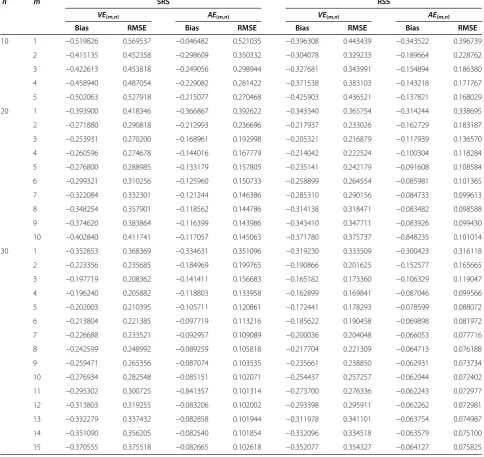
Table 1 Monte Carlo RMSEs and bias values of the entropy estimators
VE
(m,n)and
AE
(m,n)for the uniform distribution
,
H
(
f
) = 0
n m SRS RSS
VE(m,n) AE(m,n) VE(m,n) AE(m,n)
Bias RMSE Bias RMSE Bias RMSE Bias RMSE
10 1 −0.519826 0.569537 −0.046482 0.521035 −0.396308 0.443439 −0.343522 0.396739
2 −0.415135 0.452358 −0.298609 0.350332 −0.304078 0.329233 −0.189664 0.228762
3 −0.422613 0.453818 −0.249056 0.298944 −0.327681 0.343991 −0.154894 0.186380
4 −0.458940 0.487054 −0.229082 0.281422 −0.371538 0.383103 −0.143218 0.171767
5 −0.502063 0.527918 −0.215077 0.270468 −0.425903 0.436521 −0.137821 0.168029
20 1 −0.393900 0.418346 −0.366867 0.392622 −0.343340 0.365754 −0.314244 0.338695
2 −0.271880 0.290818 −0.212993 0.236696 −0.217937 0.233026 −0.162729 0.183187
3 −0.253931 0.270200 −0.168961 0.192998 −0.205321 0.216879 −0.117939 0.136570
4 −0.260596 0.274678 −0.144016 0.167779 −0.214042 0.222524 −0.100304 0.118284
5 −0.276800 0.288985 −0.133179 0.157805 −0.235141 0.242179 −0.091608 0.108584
6 −0.299321 0.310256 −0.125960 0.150733 −0.258899 0.264554 −0.085981 0.101365
7 −0.322084 0.332301 −0.121244 0.146386 −0.285310 0.290156 −0.084733 0.099613
8 −0.348254 0.357901 −0.118562 0.144786 −0.314138 0.318471 −0.083482 0.098588
9 −0.374620 0.383864 −0.116399 0.143986 −0.343410 0.347711 −0.083926 0.099430
10 −0.402840 0.411741 −0.117057 0.145063 −0.371780 0.375737 −0.848235 0.101014
30 1 −0.352853 0.368369 −0.334631 0.351096 −0.319230 0.333509 −0.300423 0.316118
2 −0.223356 0.235685 −0.184969 0.199765 −0.190866 0.201625 −0.152577 0.165665
3 −0.197719 0.208362 −0.141411 0.156683 −0.165182 0.173360 −0.106329 0.119047
4 −0.196240 0.205882 −0.118803 0.133958 −0.162899 0.169841 −0.087046 0.099566
5 −0.202003 0.210395 −0.105711 0.120861 −0.172441 0.178293 −0.078599 0.088072
6 −0.213804 0.221385 −0.097719 0.113216 −0.185622 0.190458 −0.069898 0.081972
7 −0.226688 0.233521 −0.092957 0.109089 −0.200036 0.204048 −0.066053 0.077716
8 −0.242599 0.248992 −0.089259 0.105818 −0.217704 0.221309 −0.064713 0.076188
9 −0.259471 0.265356 −0.087074 0.103535 −0.235661 0.238850 −0.062931 0.073734
10 −0.276934 0.282548 −0.085151 0.102071 −0.254437 0.257257 −0.062044 0.072402
11 −0.295302 0.300725 −0.841357 0.101314 −0.273700 0.276336 −0.062243 0.072977
12 −0.313803 0.319255 −0.083206 0.102002 −0.293398 0.295911 −0.062262 0.072981
13 −0.332279 0.337432 −0.082858 0.101944 −0.311978 0.341101 −0.063754 0.074987
14 −0.351090 0.356205 −0.082540 0.101854 −0.332096 0.334518 −0.063579 0.075100
c
i¼
1
þ
i
1
m
;
1
≤
i
≤
m;
2
;
m
þ
1
≤
i
≤
n
m;
1
þ
n
i
m
;
n
m
þ
1
≤
i
≤
n:
8
>
>
>
>
<
>
>
>
>
:
Based on the simulation study, it is shown that this
estimator has smaller bias and mean square error
as compared to the Vasicek (1976) entropy estimator.
They proved that
EE
(m,n)converges in probability to
H
(
f
)
as
n
!
∞
,
m
!
∞
and
m/n
!
0.
(Al-Omari AI (2012): Modified entropy estimators
using simple random sampling, ranked set sampling and
double ranked set sampling, Submitted) suggested a
modified estimator of entropy of an unknown
continu-ous pdf
f
(
x
) as
AE
ðm;nÞ¼
1
n
X
ni¼1
log
n
c
im
X
ðiþmÞX
ðimÞ;
ð
6
Þ
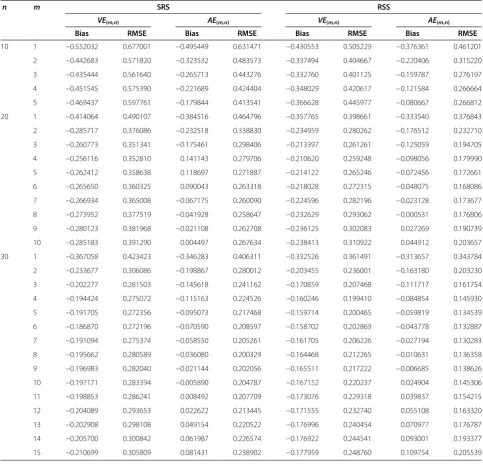
Table 2 Monte Carlo RMSEs and bias values of the entropy estimators
VE
(m,n)and
AE
(m,n)for the exponential
distribution,
H
(
f
) = 1
n m SRS RSS
VE(m,n) AE(m,n) VE(m,n) AE(m,n)
Bias RMSE Bias RMSE Bias RMSE Bias RMSE
10 1 −0.552032 0.677001 −0.495449 0.631471 −0.430553 0.505229 −0.376361 0.461201
2 −0.442683 0.571820 −0.323532 0.483573 −0.337494 0.404667 −0.220406 0.315220
3 −0.435444 0.561640 −0.265713 0.443276 −0.332760 0.401125 −0.159787 0.276197
4 −0.451545 0.575390 −0.221689 0.424404 −0.348029 0.420617 −0.121584 0.266664
5 −0.469437 0.597761 −0.179844 0.413541 −0.366628 0.445977 −0.080667 0.266812
20 1 −0.414064 0.490107 −0.384516 0.464796 −0.357765 0.398661 −0.333540 0.376843
2 −0.285717 0.376086 −0.232518 0.338830 −0.234959 0.280262 −0.176512 0.232710
3 −0.260773 0.351341 −0.175461 0.298406 −0.213397 0.261261 −0.125059 0.194705
4 −0.256116 0.352810 0.141143 0.279706 −0.210620 0.259248 −0.098056 0.179990
5 −0.262412 0.358638 0.118697 0.271887 −0.214122 0.265246 −0.072456 0.172661
6 −0.265650 0.360325 0.090043 0.263318 −0.218028 0.272315 −0.048075 0.168086
7 −0.266934 0.365008 −0.067175 0.260090 −0.224596 0.282196 −0.023128 0.173677
8 −0.273952 0.377519 −0.041928 0.258647 −0.232629 0.293062 −0.000531 0.176806
9 −0.280123 0.381968 −0.021108 0.262708 −0.236125 0.302083 0.027269 0.190739
10 −0.285183 0.391290 0.004497 0.267634 −0.238413 0.310922 0.044912 0.203657
30 1 −0.367058 0.423423 −0.346283 0.406311 −0.332526 0.361491 −0.313657 0.343784
2 −0.233677 0.306086 −0.198867 0.280012 −0.203455 0.236001 −0.163180 0.203230
3 −0.202277 0.281503 −0.145618 0.241162 −0.170859 0.207468 −0.111717 0.161754
4 −0.194424 0.275072 −0.115163 0.224526 −0.160246 0.199410 −0.084854 0.145930
5 −0.191705 0.272356 −0.095073 0.217468 −0.159714 0.200465 −0.059819 0.134539
6 −0.186870 0.272196 −0.070590 0.208597 −0.158702 0.202869 −0.043778 0.132887
7 −0.191094 0.275374 −0.058550 0.205261 −0.161705 0.206226 −0.027194 0.130283
8 −0.195662 0.280589 −0.036080 0.200329 −0.164468 0.212265 −0.010631 0.136358
9 −0.196983 0.282040 −0.021144 0.202056 −0.165511 0.217222 −0.006685 0.138626
10 −0.197171 0.283394 −0.005890 0.204787 −0.167152 0.220237 0.024904 0.145306
11 −0.198853 0.286241 0.008492 0.207709 −0.173076 0.229318 0.039837 0.154215
12 −0.204089 0.293653 0.022622 0.213445 −0.171555 0.232740 0.055108 0.163320
13 −0.202908 0.298108 0.049154 0.220522 −0.176996 0.240454 0.070977 0.176787
14 −0.205700 0.300842 0.061987 0.226574 −0.176922 0.244541 0.093001 0.193377
where
c
i¼
1
þ
1
2
;
1
≤
i
≤
m;
2
;
m
þ
1
≤
i
≤
n
m;
1
þ
1
2
;
n
m
þ
1
≤
i
≤
n:
8
>
>
>
>
<
>
>
>
>
:
Alizadeh (2010) proposed a new estimator of entropy
and studied its application in testing normality. Park and
Park (2003) considered correcting moments for
goodness-of-fit tests for two entropy estimates.
Inverse Gaussian distribution
A random variable
X
is said to have an inverse Gaussian
distribution function
IG
(
x
;
μ
,
β
), if its pdf is of the
fol-lowing form
f x
ð Þ ¼
ffiffiffiffiffiffiffiffiffiffi
β
2
π
x
3r
exp
β
2
μ
2x
ð
x
μ
Þ
2;
for
x
>
0
;
ð
7
Þ
where
μ
>
0 is the mean and
β
>
0 is the shape parameter.
The variance of
X
is
μ
3β
. Its characteristic function is
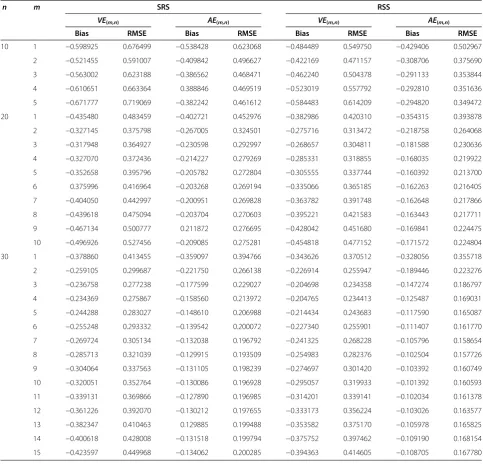
VE
(m,n)AE
(m,n)distribution,
H
(
f
) = 1.419
n m SRS RSS
VE(m,n) AE(m,n) VE(m,n) AE(m,n)
Bias RMSE Bias RMSE Bias RMSE Bias RMSE
10 1 −0.598925 0.676499 −0.538428 0.623068 −0.484489 0.549750 −0.429406 0.502967
2 −0.521455 0.591007 −0.409842 0.496627 −0.422169 0.471157 −0.308706 0.375690
3 −0.563002 0.623188 −0.386562 0.468471 −0.462240 0.504378 −0.291133 0.353844
4 −0.610651 0.663364 0.388846 0.469519 −0.523019 0.557792 −0.292810 0.351636
5 −0.671777 0.719069 −0.382242 0.461612 −0.584483 0.614209 −0.294820 0.349472
20 1 −0.435480 0.483459 −0.402721 0.452976 −0.382986 0.420310 −0.354315 0.393878
2 −0.327145 0.375798 −0.267005 0.324501 −0.275716 0.313472 −0.218758 0.264068
3 −0.317948 0.364927 −0.230598 0.292997 −0.268657 0.304811 −0.181588 0.230636
4 −0.327070 0.372436 −0.214227 0.279269 −0.285331 0.318855 −0.168035 0.219922
5 −0.352658 0.395796 −0.205782 0.272804 −0.305555 0.337744 −0.160392 0.213700
6 0.375996 0.416964 −0.203268 0.269194 −0.335066 0.365185 −0.162263 0.216405
7 −0.404050 0.442997 −0.200951 0.269828 −0.363782 0.391748 −0.162648 0.217866
8 −0.439618 0.475094 −0.203704 0.270603 −0.395221 0.421583 −0.163443 0.217711
9 −0.467134 0.500777 0.211872 0.276695 −0.428042 0.451680 −0.169841 0.224475
10 −0.496926 0.527456 −0.209085 0.275281 −0.454818 0.477152 −0.171572 0.224804
30 1 −0.378860 0.413455 −0.359097 0.394766 −0.343626 0.370512 −0.328056 0.355718
2 −0.259105 0.299687 −0.221750 0.266138 −0.226914 0.255947 −0.189446 0.223276
3 −0.236758 0.277238 −0.177599 0.229027 −0.204698 0.234358 −0.147274 0.186797
4 −0.234369 0.275867 −0.158560 0.213972 −0.204765 0.234413 −0.125487 0.169031
5 −0.244288 0.283027 −0.148610 0.206988 −0.214434 0.243683 −0.117590 0.165087
6 −0.255248 0.293332 −0.139542 0.200072 −0.227340 0.255901 −0.111407 0.161770
7 −0.269724 0.305134 −0.132038 0.196792 −0.241325 0.268228 −0.105796 0.158654
8 −0.285713 0.321039 −0.129915 0.193509 −0.254983 0.282376 −0.102504 0.157726
9 −0.304064 0.337563 −0.131105 0.198239 −0.274697 0.301420 −0.103392 0.160749
10 −0.320051 0.352764 −0.130086 0.196928 −0.295057 0.319933 −0.101392 0.160593
11 −0.339131 0.369866 −0.127890 0.196985 −0.314201 0.339141 −0.102034 0.161378
12 −0.361226 0.392070 −0.130212 0.197655 −0.333173 0.356224 −0.103026 0.163577
13 −0.382347 0.410463 0.129885 0.199488 −0.353582 0.375170 −0.105978 0.165825
14 −0.400618 0.428008 −0.131518 0.199794 −0.375752 0.397462 −0.109190 0.168154
given by
ϕ
xð Þ ¼
t
exp
β
μ
p
ffiffiffi
β
ffiffiffiffiffiffiffiffiffiffiffiffiffiffiffiffi
β
μ
22
it
s
!
:
The
IG
(
x
;
μ
,
β
) has many applications in the field,
for example see Seshadri (1999), and Folks and
Chhikara (1998).
Method
The test procedure
Let
X1;
X2;
. . .
;
X
nbe a random sample of size
n
drawn
from the pdf
f
(
x
) and let
X
ð Þ1≤
X
ð Þ2≤ ⋯ ≤
X
ð Þnbe the
order statistics of this sample. Our interest is to test that
this random sample is coming from an inverse Gaussian
population or not. Thus, the composite null hypothesis
is
H
0:
X
~
IG
(
x
;
μ
,
β
).
The following corollary is due to Mahdizaheh and
Arghami (2010).
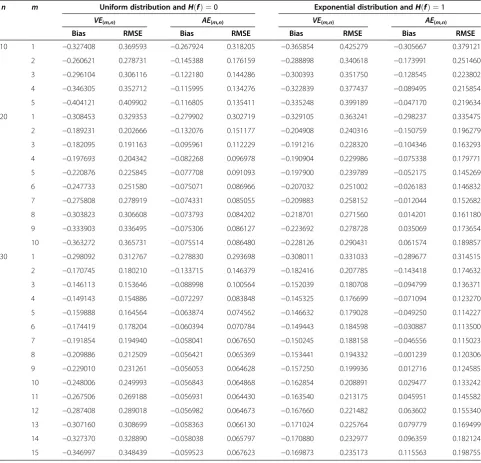
Table 4 Monte Carlo RMSEs and bias values of the entropy estimators
VE
(m,n)and
AE
(m,n)for the uniform distribution
with
H
(
f
) = 0 and exponential distribution with
H
(
f
) = 1 using DRSS
n m Uniform distribution andH fð Þ ¼0 Exponential distribution andH fð Þ ¼1
VE(m,n) AE(m,n) VE(m,n) AE(m,n)
Bias RMSE Bias RMSE Bias RMSE Bias RMSE
10 1 −0.327408 0.369593 −0.267924 0.318205 −0.365854 0.425279 −0.305667 0.379121
2 −0.260621 0.278731 −0.145388 0.176159 −0.288898 0.340618 −0.173991 0.251460
3 −0.296104 0.306116 −0.122180 0.144286 −0.300393 0.351750 −0.128545 0.223802
4 −0.346305 0.352712 −0.115995 0.134276 −0.322839 0.377437 −0.089495 0.215854
5 −0.404121 0.409902 −0.116805 0.135411 −0.335248 0.399189 −0.047170 0.219634
20 1 −0.308453 0.329353 −0.279902 0.302719 −0.329105 0.363241 −0.298237 0.335475
2 −0.189231 0.202666 −0.132076 0.151177 −0.204908 0.240316 −0.150759 0.196279
3 −0.182095 0.191163 −0.095961 0.112229 −0.191216 0.228320 −0.104346 0.163293
4 −0.197693 0.204342 −0.082268 0.096978 −0.190904 0.229986 −0.075338 0.179771
5 −0.220876 0.225845 −0.077708 0.091093 −0.197900 0.239789 −0.052175 0.145269
6 −0.247733 0.251580 −0.075071 0.086966 −0.207032 0.251002 −0.026183 0.146832
7 −0.275808 0.278919 −0.074331 0.085055 −0.209883 0.258152 −0.012044 0.152682
8 −0.303823 0.306608 −0.073793 0.084202 −0.218701 0.271560 0.014201 0.161180
9 −0.333903 0.336495 −0.075306 0.086127 −0.223692 0.278728 0.035069 0.173654
10 −0.363272 0.365731 −0.075514 0.086480 −0.228126 0.290431 0.061574 0.189857
30 1 −0.298092 0.312767 −0.278830 0.293698 −0.308011 0.331033 −0.289677 0.314515
2 −0.170745 0.180210 −0.133715 0.146379 −0.182416 0.207785 −0.143418 0.174632
3 −0.146113 0.153646 −0.088998 0.100564 −0.152039 0.180708 −0.094799 0.136371
4 −0.149143 0.154886 −0.072297 0.083848 −0.145325 0.176699 −0.071094 0.123270
5 −0.159888 0.164564 −0.063874 0.074562 −0.146632 0.179028 −0.049250 0.114227
6 −0.174419 0.178204 −0.060394 0.070784 −0.149443 0.184598 −0.030887 0.113500
7 −0.191854 0.194940 −0.058041 0.067650 −0.150245 0.188158 −0.046556 0.115023
8 −0.209886 0.212509 −0.056421 0.065369 −0.153441 0.194332 −0.001239 0.120306
9 −0.229010 0.231261 −0.056053 0.064628 −0.157250 0.199936 0.012716 0.124585
10 −0.248006 0.249993 −0.056843 0.064868 −0.162854 0.208891 0.029477 0.133242
11 −0.267506 0.269188 −0.056931 0.064430 −0.163540 0.213175 0.045951 0.145582
12 −0.287408 0.289018 −0.056982 0.064673 −0.167660 0.221482 0.063602 0.155340
13 −0.307160 0.308699 −0.058363 0.066130 −0.171024 0.225764 0.079779 0.169499
14 −0.327370 0.328890 −0.058038 0.065797 −0.170880 0.232977 0.096359 0.182124
Corollary 1
: Assume that
X
is a random variable has
an inverse Gaussian distribution
IG
(
x
;
μ
,
β
) and let
Y
¼
1
=
p
ffiffiffiffi
X
Then the entropy of
Y
is given by
H f y
ð
ð Þ
Þ ¼
log 0
:
5
ϕ
p
ffiffiffiffiffiffiffiffi
2
π
e
, where
ϕ
2¼
1
=
β
¼
E Y
ð Þ
21
=E Y
ð
2Þ
:
The following corollary is due to Mudholkar and Tian
(2002).
Corollary 2
: The random variable
X
with inverse
Gaussian distribution
IG
(
x
;
μ
,
β
) is characterized by the
property that
1
=
p
ffiffiffiffi
X
attains the maximum entropy
among all nonnegative, absolutely continuous random
variables
Y
with a given value at
E Y
ð Þ
21
=E Y
ð
2Þ
:
Let
VE
ðm;nÞf
ybe the sample estimate of
VE f
yfor
the distribution of
Y
¼
1
=
p
ffiffiffiffi
X
defined as
VE
ðm;nÞf
y¼
1
n
X
ni¼1
Log
n
2
m
y
ðiþmÞy
ðimÞ;
ð
8
Þ
where
y
ð Þi¼
x
ðniþ1Þ 1=2i
¼
1
;
2
;
. . .
;
n
ð
Þ
:
Mahdizaheh and Arghami (2010) followed Vasicek
(1976) and proposed rejecting the null hypothesis
H
0:
X
~
IG
(
x
;
μ
,
β
) if
K
ðm;nÞf
y¼
2
exp VE
ðm;nÞf
yψ
≤
K
ðm;n;αÞf
y;
ð
9
Þ
where
ψ
2is a uniform minimum variance unbiased
(UMVU) estimate of
Ø
2defined as
ψ
2¼
1
n
1
X
1
=x
i1
=
x
ð
Þ
¼
1
n
¼
1
X
ni¼1
y
2i
n
2X
ni¼1
yi
2
1:
ð
10
Þ
Suggested test
Let
X
i(i)denote the
i
th order statistic from the
i
th
sam-ple
ð
i
¼
1
;
2
;
. . .
;
n
Þ
. Then, the measured RSS units are
denoted by
X
1(1),
X
2(2),
. . .,
X
n(n). The cumulative
distri-bution function of
X
i(i)is given by
F
ð Þið Þ ¼
x
X
nj¼i
n
j
F
j
ð Þ
x
ð
1
F x
ð Þ
Þ
nj;
1
<
x
<
1
;
with probability density function defined as
f
ð Þið Þ ¼
x
n
n
i
1
1
F
i1ð Þ
x
ð
1
F x
ð Þ
Þ
nif x
ð Þ
;
1
<
x
<
1
:
The mean and the variance of the
i
th order statistic,
X
i(i)can be written respectively as
μ
ð Þ ¼
i
Z
11
xf
ð Þið Þ
x
d
x;
and
σ
2
i ð Þ
¼
Z
11
x
μ
ð Þi 2f
ð Þið Þ
x
d
x:
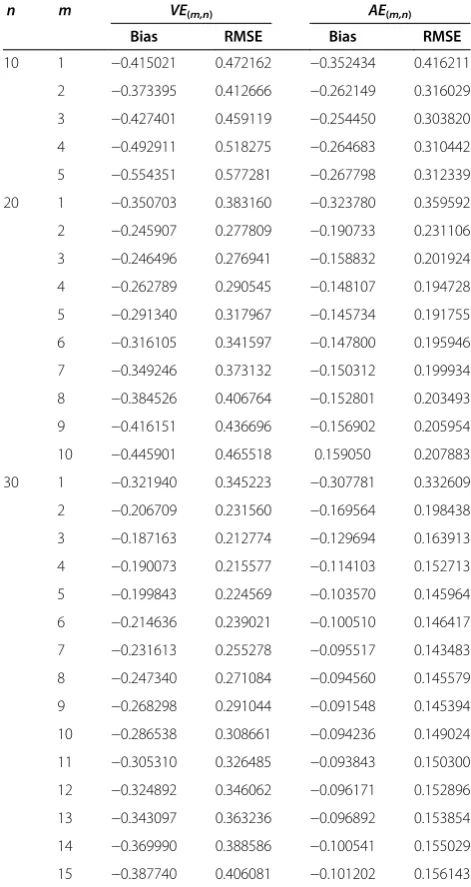
entropy estimators
VE
(m,n)and
AE
(m,n)for the standard
normal distribution and
H
(
f
) = 1.419 using DRSS
n m VE(m,n) AE(m,n)
Bias RMSE Bias RMSE
10 1 −0.415021 0.472162 −0.352434 0.416211
2 −0.373395 0.412666 −0.262149 0.316029
3 −0.427401 0.459119 −0.254450 0.303820
4 −0.492911 0.518275 −0.264683 0.310442
5 −0.554351 0.577281 −0.267798 0.312339
20 1 −0.350703 0.383160 −0.323780 0.359592
2 −0.245907 0.277809 −0.190733 0.231106
3 −0.246496 0.276941 −0.158832 0.201924
4 −0.262789 0.290545 −0.148107 0.194728
5 −0.291340 0.317967 −0.145734 0.191755
6 −0.316105 0.341597 −0.147800 0.195946
7 −0.349246 0.373132 −0.150312 0.199934
8 −0.384526 0.406764 −0.152801 0.203493
9 −0.416151 0.436696 −0.156902 0.205954
10 −0.445901 0.465518 0.159050 0.207883
30 1 −0.321940 0.345223 −0.307781 0.332609
2 −0.206709 0.231560 −0.169564 0.198438
3 −0.187163 0.212774 −0.129694 0.163913
4 −0.190073 0.215577 −0.114103 0.152713
5 −0.199843 0.224569 −0.103570 0.145964
6 −0.214636 0.239021 −0.100510 0.146417
7 −0.231613 0.255278 −0.095517 0.143483
8 −0.247340 0.271084 −0.094560 0.145579
9 −0.268298 0.291044 −0.091548 0.145394
10 −0.286538 0.308661 −0.094236 0.149024
11 −0.305310 0.326485 −0.093843 0.150300
12 −0.324892 0.346062 −0.096171 0.152896
13 −0.343097 0.363236 −0.096892 0.153854
14 −0.369990 0.388586 −0.100541 0.155029
15 −0.387740 0.406081 −0.101202 0.156143
The ranked set sampling method was suggested by
McIntyre (1952) for estimating the mean of pasture and
forage yields. The RSS can be described as follows:
Step 1: Select
n
simple random samples each of size
n
from the target population.
Step 2: Without cost, visually rank the units within
each sample with respect to the variable of interest.
Step 3: For actual measurement, from the
i
th
i
¼
1
;
2
;
. . .
;
n
ð
Þ
sample of
n
units, select the
i
th smallest
ranked unit. The method is repeated
h
times if needed
to increase the sample size to
hn
units.
Al-Saleh and Al-Kadiri (2000) suggested double ranked
set sampling (DRSS) method for estimating the population
mean. The DRSS can be described as in the following steps:
Step 1 Randomly select
n
2samples each of size
n
from
the target population.
Step 2 Apply the RSS method on the
n
2samples obtained
in Step 1. This step yields
n
samples each of size
n
.
Step 3 Reapply the RSS method again on the
n
sam-ples obtained on Step 2 to obtain a sample of size
n
from the DRSS data. The cycle can be repeated
h
times
if needed to obtain a sample of size
hn
units.
The SRS estimator of the population mean is given by
^
μ
SRS¼
X
ni¼1X
i=n;
with variance
Var
ð
^
μ
SRSÞ ¼
σ
2=n
. The
RSS estimator of the population mean is defined as
^
μ
RSS¼
X
ni¼1X
i ið Þ=n
, with variance given by
Var
ð
^
μ
RSSÞ ¼
σ2n
n12X
ni¼1
μ
ð Þiμ
2. The relative precision (RP) of
RSS relative to SRS for estimating the population mean
is
RP
¼
Var
μ
SRSVar
μ
RSS¼
1
i
¼
1
n
μ
i
μ
2
n
σ
2:
Takahasi and Wakimoto (1968) showed that the parent
f
(
x
) and the population mean can be expressed as
f x
ð Þ ¼
1n
X
ni¼1
f
ð Þið Þ
x
;
and
μ
¼
1n
X
ni¼1
μ
ð Þi, respectively.
Also, they showed that 1
≤
RP
≤
mþ12
, where the lower
bound is attained if and only if the underlying
distribu-tion is degenerate, while the upper bound is attained if
and only if the underlying distribution of the data is
rectangular.
Al-Saleh and Al-Omari (2002) extended the DRSS for
multistage RSS method to increase the efficiency of the
estimators for fixed value of the sample size, Al-Omari
and Raqab (2012) suggested truncation RSS method for
estimating the population mean and median, Al-Omari
(2011) suggested double robust extreme RSS for
estimat-ing the population mean, Haq and Shabbir (2010)
pro-posed a family of ratio estimators of the population
mean using extreme RSS based on two auxiliary
variables.
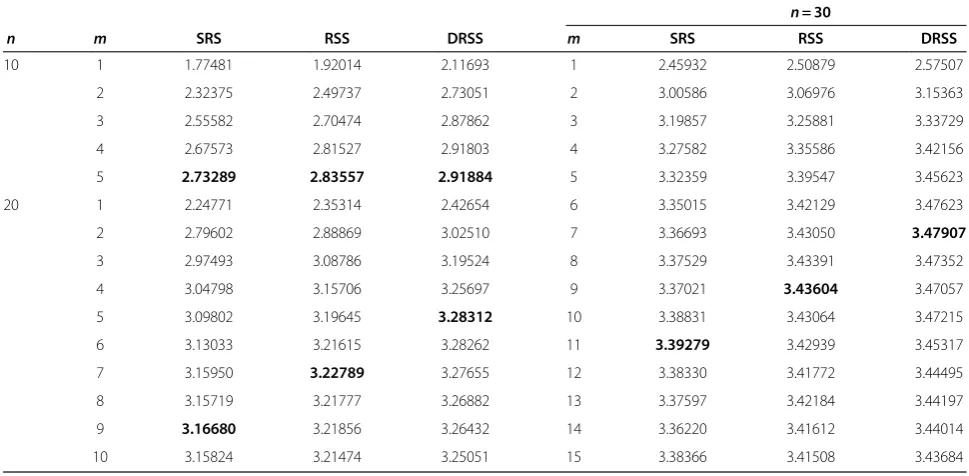
Table 6 Critical values of the test statistics at significance level
α
= 0.05 using SRS, RSS and DRSS
n= 30n m SRS RSS DRSS m SRS RSS DRSS
10 1 1.77481 1.92014 2.11693 1 2.45932 2.50879 2.57507
2 2.32375 2.49737 2.73051 2 3.00586 3.06976 3.15363
3 2.55582 2.70474 2.87862 3 3.19857 3.25881 3.33729
4 2.67573 2.81527 2.91803 4 3.27582 3.35586 3.42156
5 2.73289 2.83557 2.91884 5 3.32359 3.39547 3.45623
20 1 2.24771 2.35314 2.42654 6 3.35015 3.42129 3.47623
2 2.79602 2.88869 3.02510 7 3.36693 3.43050 3.47907
3 2.97493 3.08786 3.19524 8 3.37529 3.43391 3.47352
4 3.04798 3.15706 3.25697 9 3.37021 3.43604 3.47057
5 3.09802 3.19645 3.28312 10 3.38831 3.43064 3.47215
6 3.13033 3.21615 3.28262 11 3.39279 3.42939 3.45317
7 3.15950 3.22789 3.27655 12 3.38330 3.41772 3.44495
8 3.15719 3.21777 3.26882 13 3.37597 3.42184 3.44197
9 3.16680 3.21856 3.26432 14 3.36220 3.41612 3.44014
10 3.15824 3.21474 3.25051 15 3.38366 3.41508 3.43684
Table 7 Optimal window sizes
n SRS RSS DRSS
10 5 5 5
20 9 7 5
Goodness-of-fit test for the
IG
(
x
;
μ
,
β
) distribution is
considered using SRS, RSS and DRSS methods. Our
composite null hypothesis is
H
0:
X
~
IG
(
x
;
μ
,
β
).
Follow-ing Mudholkar and Tian (2002), we reject
H
0if
K
ðm;nÞf
y¼
2 exp
AE
ðm;nÞf
yψ
≤
K
ðm;n;αÞf
y;
ð
11
Þ
where
AE
ðm;nÞ¼
n1X
ni¼1
Log
n
c
im
X
ðiþmÞX
ðimÞand
c
i¼
1
þ
1
2
;
1
≤
i
≤
m;
2
;
m
þ
1
≤
i
≤
n
m;
1
þ
1
2
;
n
m
þ
1
≤
i
≤
n:
8
>
>
>
>
<
>
>
>
>
:
Note that,
AE
ðm;nÞf
yis the sample estimate of
AE f
y.
Since the entropy estimators are functions of order
sta-tistics, then the entropy estimation using RSS and DRSS
involves ordering the RSS units.
Results and discussion
In this section, a Monte Carlo experiment is presented to
investigate the performance of the entropy estimators i.e.
AE
(m,n)as well as
VE
(m,n)and as well as to study the
α
n m Exponential (1) Uniform (0,1) Weibull (2,1)
SRS RSS DRSS SRS RSS DRSS SRS RSS DRSS
10 1 0.1869 0.2330 0.2559 0.4089 0.5078 0.5921 0.1059 0.1238 0.1346
2 0.2167 0.2776 0.3610 0.4874 0.6422 0.8381 0.1269 0.1640 0.2240
3 0.1960 0.2562 0.3242 0.4796 0.6398 0.8455 0.1261 0.1659 0.2230
4 0.1366 0.1875 0.1981 0.3735 0.5284 0.6825 0.0961 0.1391 0.1593
5 0.0629 0.0750 0.0780 0.1897 0.2481 0.3011 0.0460 0.0574 0.0622
20 1 0.3805 0.4530 0.4682 0.7665 0.8704 0.9186 0.1874 0.2311 0.2351
2 0.4584 0.5375 0.6152 0.8661 0.9528 0.9930 0.2566 0.3062 0.3597
3 0.4713 0.5680 0.6360 0.8873 0.9716 0.9970 0.2625 0.3341 0.3890
4 0.4179 0.5201 0.6027 0.8711 0.9680 0.9968 0.2299 0.2964 0.3552
5 0.3829 0.4685 0.5284 0.8346 0.9484 0.9944 0.2095 0.2648 0.3106
6 0.3094 0.3855 0.4221 0.8024 0.9211 0.9802 0.1682 0.2106 0.2364
7 0.2377 0.2899 0.3074 0.7229 0.8564 0.9312 0.1368 0.1611 0.1635
8 0.1660 0.1827 0.1942 0.5806 0.7019 0.7954 0.0877 0.0955 0.0963
9 0.1022 0.1131 0.1132 0.4095 0.4875 0.5456 0.0600 0.0581 0.0633
10 0.0538 0.0615 0.0638 0.2145 0.2585 0.2627 0.0297 0.0328 0.0346
30 1 0.5400 0.5913 0.6094 0.9188 0.9660 0.9851 0.2729 0.3091 0.3125
2 0.6402 0.7097 0.7585 0.9724 0.9960 0.9997 0.3776 0.4276 0.4669
3 0.6734 0.7431 0.7941 0.9832 0.9982 0.9999 0.4116 0.4605 0.5075
4 0.6510 0.7374 0.7959 0.9804 0.9989 1.0000 0.3941 0.4650 0.5156
5 0.6252 0.7048 0.7711 0.9800 0.9979 0.9999 0.3636 0.4324 0.4829
6 0.5763 0.6583 0.7229 0.9690 0.9978 0.9998 0.3109 0.3757 0.4322
7 0.5170 0.6015 0.6531 0.9558 0.9940 0.9995 0.2795 0.3274 0.3575
8 0.4526 0.5237 0.5565 0.9392 0.9875 0.9982 0.2166 0.2672 0.2778
9 0.3843 0.4356 0.4609 0.8973 0.9730 0.9949 0.1768 0.2066 0.2134
10 0.3102 0.3424 0.3547 0.8673 0.9445 0.9823 0.1421 0.1438 0.1592
11 0.2440 0.2528 0.2585 0.7882 0.8763 0.9285 0.1066 0.1070 0.1020
12 0.1772 0.1788 0.1785 0.6678 0.7474 0.8160 0.0713 0.0697 0.0660
13 0.1117 0.1218 0.1141 0.5201 0.6034 0.6372 0.0447 0.0501 0.0502
14 0.0697 0.0774 0.0800 0.3516 0.4083 0.4327 0.0269 0.0363 0.0288
powers of the suggested tests under different alternatives
hypotheses. The root mean square errors (RMSEs) and
the bias values are obtained for the estimators based on
10,000 samples of sizes
n
= 10, 20, 30 with window sizes
1
≤
m
≤
5, 1
≤
m
≤
10 and 1
≤
m
≤
15, respectively.
Comparison between
VE(
m,n)and
AE(
m,n)The samples are selected from the uniform, exponential
and the standard normal distributions using SRS, RSS and
DRSS methods. From Tables 1, 2, 3, 4, 5, 6, and 7 we can
see that
AE
ðm;nÞis more efficient than
VE
ðm;nÞfor all cases
considered in this study. Also, the DRSS is superior to
SRS and RSS. For more details about this comparison
see (Al-Omari AI (2012): Modified entropy estimators
using simple random sampling, ranked set sampling
and double ranked set sampling, Submitted).
We can see that these optimal values are different from
Mahdizaheh and Arghami (2010) values where their
sug-gested test is based on Vasicek (1976) entropy estimator.
Here, we can conclude that the optimal window size
depends on the entropy estimator used for the
goodness-of-fit test.
Power of the tests
The power of the suggested goodness-of-fit tests using SRS,
RSS and DRSS is considered here relative to the same
alter-natives considered by Mahdizaheh and Arghami (2010) for
the distributions, exponential(1), uniform(0,1), Weibull(2,1),
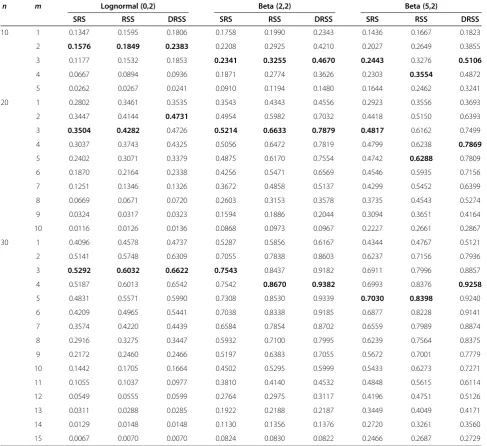
Table 9 Power comparison for the entropy tests at the significance level
α
= 0.05
n m Lognormal (0,2) Beta (2,2) Beta (5,2)
SRS RSS DRSS SRS RSS DRSS SRS RSS DRSS
10 1 0.1347 0.1595 0.1806 0.1758 0.1990 0.2343 0.1436 0.1667 0.1823
2 0.1576 0.1849 0.2383 0.2208 0.2925 0.4210 0.2027 0.2649 0.3855
3 0.1177 0.1532 0.1853 0.2341 0.3255 0.4670 0.2443 0.3276 0.5106
4 0.0667 0.0894 0.0936 0.1871 0.2774 0.3626 0.2303 0.3554 0.4872
5 0.0262 0.0267 0.0241 0.0910 0.1194 0.1480 0.1644 0.2462 0.3241
20 1 0.2802 0.3461 0.3535 0.3543 0.4343 0.4556 0.2923 0.3556 0.3693
2 0.3447 0.4144 0.4731 0.4954 0.5982 0.7032 0.4418 0.5150 0.6393
3 0.3504 0.4282 0.4726 0.5214 0.6633 0.7879 0.4817 0.6162 0.7499
4 0.3037 0.3743 0.4325 0.5056 0.6472 0.7819 0.4799 0.6238 0.7869
5 0.2402 0.3071 0.3379 0.4875 0.6170 0.7554 0.4742 0.6288 0.7809
6 0.1870 0.2164 0.2338 0.4256 0.5471 0.6569 0.4546 0.5935 0.7156
7 0.1251 0.1346 0.1326 0.3672 0.4858 0.5137 0.4299 0.5452 0.6399
8 0.0669 0.0671 0.0720 0.2603 0.3153 0.3578 0.3735 0.4543 0.5274
9 0.0324 0.0317 0.0323 0.1594 0.1886 0.2044 0.3094 0.3651 0.4164
10 0.0116 0.0126 0.0136 0.0868 0.0973 0.0967 0.2227 0.2661 0.2867
30 1 0.4096 0.4578 0.4737 0.5287 0.5856 0.6167 0.4344 0.4767 0.5121
2 0.5141 0.5748 0.6309 0.7055 0.7838 0.8603 0.6237 0.7156 0.7936
3 0.5292 0.6032 0.6622 0.7543 0.8437 0.9182 0.6911 0.7996 0.8857
4 0.5187 0.6013 0.6542 0.7542 0.8670 0.9382 0.6993 0.8376 0.9258
5 0.4831 0.5571 0.5990 0.7308 0.8530 0.9339 0.7030 0.8398 0.9240
6 0.4209 0.4965 0.5441 0.7038 0.8338 0.9185 0.6877 0.8228 0.9141
7 0.3574 0.4220 0.4439 0.6584 0.7854 0.8702 0.6559 0.7989 0.8874
8 0.2916 0.3275 0.3447 0.5932 0.7100 0.7995 0.6239 0.7564 0.8375
9 0.2172 0.2460 0.2466 0.5197 0.6383 0.7055 0.5672 0.7001 0.7779
10 0.1442 0.1705 0.1664 0.4502 0.5295 0.5999 0.5433 0.6273 0.7271
11 0.1055 0.1037 0.0977 0.3810 0.4140 0.4532 0.4848 0.5615 0.6114
12 0.0549 0.0555 0.0599 0.2764 0.2975 0.3117 0.4196 0.4751 0.5126
13 0.0311 0.0288 0.0285 0.1922 0.2188 0.2187 0.3449 0.4049 0.4171
14 0.0129 0.0148 0.0148 0.1130 0.1356 0.1376 0.2720 0.3261 0.3560
lognormal(0,2), beta(2,2), and beta(5,2). 10000 samples of
sizes
n
= 30, 20, 30 are generated for each method at the
significance level 0.05.
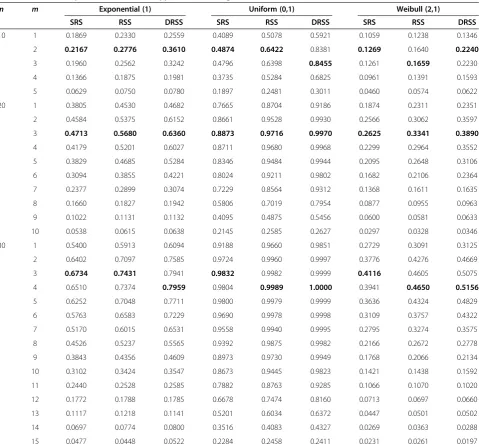
Based on Tables 8 and 9, we can conclude that gain in
the performance of the new suggested tests using
differ-ent methods considered in this paper is obtained.
How-ever, we found that the DRSS is superior to both RSS
and SRS methods based on the sample size. Also, the
RSS performs better than SRS for all cases considered
here. The bold fonts in Tables 8 and 9 are the optimal
power values for each design with the same sample size.
These optimal power values are
<
n=
2. However, the
op-timal values of the window size are 2, 3, 4, 5. For fixed
n
,
the power values decreases as
m
increases, while it
increases in
n.
Conclusion
In this paper, new goodness-of-fit tests for the inverse
Gaussian distribution are suggested using SRS, RSS and
DRSS based on the maximum entropy characterization.
It is found that the new tests are more powerful under
RSS and DRSS, and the test under DRSS is superior to
the tests under RSS and SRS methods. We recommend
using the suggested goodness-of-fit tests for the inverse
Gaussian distribution. As the DRSS is better than RSS,
the current work can be extended to multistage RSS
de-sign and for some other probability distributions.
Competing interests
Both authors declared that they have no competing.
Authors’contribution
The work presented here was carried out in collaboration between authors. AA carried out the theoretical and discussion of this paper. AH carried out the Monte Carlo simulations. All authors read and approved the final manuscript.
Acknowledgment
The authors are grateful to the editors and the anonymous reviewers for their valuable comments and suggestions.
Author details
1Department of Mathematics, Faculty of Science, Al al-Bayt University, Mafraq 25113, Jordan.2Department of Statistics, Quaid-i-Azam University, Islamabad 45320, Pakistan.
Received: 26 July 2012 Accepted: 29 August 2012 Published: 15 September 2012
References
Alizadeh HN (2010) A new estimator of entropy and its application in testing normality. J Stat Comput Simul 80:1151–1162
Al-Omari AI (2011) Estimation of mean based on modified robust extreme ranked set sampling. J Stat Comput Simul 81(8):1055–1066
Al-Omari AI, Raqab MZ (2012) Estimation of the population mean and median using truncation-based ranked set samples. Accepted in J Stat Comput Simul. doi:10.1080/00949655.2012.662684
Al-Saleh MF, Al-Kadiri MA (2000) Double ranked set sampling. Stat probability lett 48(2):205–212
Al-Saleh MF, Al-Omari AI (2002) Multistage ranked set sampling. J Stat Planning and Inference 102(2):273–286
Ebrahimi N, Pflughoeft K, Soofi E (1994) Two measures of sample entropy. Stat Probability Lett 20:225–234
application-a review. J R Soc, Series B 40:263–289
Haq A, Shabbir J (2010) A family of ratio estimators for population mean in extreme ranked set sampling using two auxiliary variables. SORT 34(1):45–64 Mahdizaheh M, Arghami NR (2010) Efficiency of ranked set sampling in entropy
estimation and goodness-of-fit testing for the inverse Gaussian law. J Stat Comput Simul 80(7):761–774
McIntyre GA (1952) A method for unbiased selective sampling using ranked sets. Australian J Agricultural Res 3:385–390
Mudholkar GS, Tian L (2002) An entropy characterization of the inverse Gaussian distribution and related goodness-of-fit test. J Stat Planning and Inference 102:211–221
Park S, Park D (2003) Correcting moments for goodness of fit tests based on two entropy estimates. J Stat Comput Simul 73(9):685–694
Seshadri V (1999) The inverse Gaussian distribution: Statistical theory and applications. Springer, New York
Shannon CE (1948) A mathematical theory of communications. Bell System Technical J 27(379–423):623–656
Takahasi K, Wakimoto K (1968) On the unbiased estimates of the population mean based on the sample stratified by means of ordering. Annals of the Institute of Statistical Mathematics 20:1–31
Van Es B (1992) Estimating functionals related to a density by class of statistics based on spacing's. Scand J Stat 19:61–72
Vasicek O (1976) A test for normality based on sample entropy. J Royal Stat Soc B 38:54–59
doi:10.1186/2193-2697-1-8
Cite this article as:Al-Omari and Haq:Goodness-of-fit testing for the inverse Gaussian distribution based on new entropy estimation using ranked set sampling and double ranked set sampling.Environmental
Systems Research20121:8.
Submit your manuscript to a
journal and benefi t from:
7Convenient online submission 7Rigorous peer review
7Immediate publication on acceptance 7Open access: articles freely available online 7High visibility within the fi eld
7Retaining the copyright to your article