R E S E A R C H
Open Access
Nutritional potentials and in vitro estimation
of composite cocoa pod husk-based diets
for ruminants
Oluwatosin Bode Omotoso
Abstract
Background:The use of cocoa pod husk in livestock nutrition is being limited because of its fibrous nature and anti-nutrients, which have detrimental effect(s) on the animals. This study was conducted to evaluate the nutritive value and effects of replacing urea-treated ensiled cocoa pod husk meal (urea-treated CPHM) with cassava peel in a complete concentrate diet (CCD) on in vitro digestibility and methane (CH4) production.
Methods:Urea-treated CPHM was prepared by soaking the raw milled pod in 5% urea solution under anaerobic condition for 7 days, and decanted and the filtrates were further ensiled for 28 days, dried, and were replaced with cassava peel meal in CCD at 0, 5, 7.5, 10, 12.5, and 15% on part basis. Feed samples (n= 3) were analyzed for chemical composition, and data generated from in vitro study were subjected to statistical analysis in a completely randomized design experiment.
Results:Results revealed that the treatment significantly reduced the crude fiber, fiber fraction contents, and anti-nutrients and improved the crude protein content of the pod by 71.84%. Dry matter and crude protein of the diets ranged from 89.34–89.71% and 10.52–12.84%, respectively. The in vitro dry matter digestibility (IVDMD) increased with increasing levels of urea-treated CPHM in the diets. With increasing levels of urea-treated CPHM, CH4production relatively reduced as compared to diet E. Metabolizable energy (5.66 Kcal/g) of diet F was the
highest. Therefore, the inclusion of urea-treated CPHM at 15% in CCDs has the potential for improving digestibility and reducing CH4production in ruminants.
Keywords:Cocoa pod husk, Methane, Ruminant, Urea treatment
Introduction
Livestock production is undertaken in a multitude of ways across the planet, providing a large variety of goods and services, using different animal species and different sets of resources, in a wide spectrum of agro-ecological and socio-economic conditions (Steinfeld et al., 2006). In re-cent years, emphases have been shifted to the use of by-products of agro-industrial origin as low-cost alternative carbohydrate sources for livestock nutrition. Sucharita et al. (1998) concluded that effective utilization of non-conventional feeds should be the major areas of research in the less developed countries due to shortage of conven-tional feedstuffs, ever-increasing human population and to
ensure their food security, which is dependent on the bet-ter utilization of albet-ternative feed resources. Though ru-minant animals can thrive very well on fibrous feeds to keep their rumen healthy, but higher quantities of cellu-lose, hemicellulose in the cell wall and presence of anti-nutritional factors usually limit efficient nutrients utilization by the ruminants (Makkar,1993).
Consequently, cocoa pod husk which is an abundant residue generated on cocoa farmlands has been regarded as a“waste” in Nigeria, except for the negligible amount used in the manufacture of local soap. It has however been reported to contain about 80.00–88.96% DM, 6.00–9.14% CP, 24.93–35.74% CF, and 14.10–21.16% lig-nin (Aregheore, 2002; Ozung et al., 2016). To nutrition-ally upgrade the crop residue for efficient utilization by ruminant animals, urea, a non-protein nitrogen, which
© The Author(s). 2019Open AccessThis article is distributed under the terms of the Creative Commons Attribution 4.0 International License (http://creativecommons.org/licenses/by/4.0/), which permits unrestricted use, distribution, and reproduction in any medium, provided you give appropriate credit to the original author(s) and the source, provide a link to the Creative Commons license, and indicate if changes were made.
can be easily converted to ammonia in the rumen, could be effective.
Thus, an in vitro study was conducted to evaluate the nutritive value and effects of incorporating graded levels of urea-treated ensiled cocoa pod husk meal in total mixed rations on digestibility and methane production.
Materials and methods
Experimental site
The study was carried out at the Nutrition Laboratory of the Animal Production and Health, Federal University of Technology, Akure (FUTA), located on latitude 7° 15′′ N and longitude 5°15′′E (Ajibade et al.,2014).
Sourcing and processing of feed materials
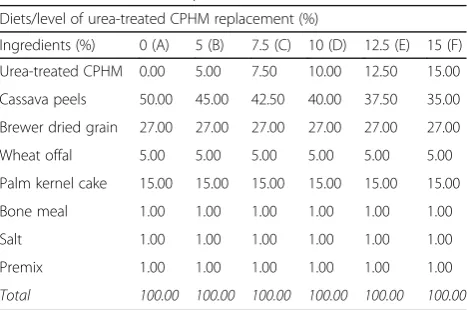
Cocoa pod husk was collected at various cocoa farm-lands in Ilara-Mokin, Ondo State, sun-dried for 8–12 days, crushed at the FUTA feed mill to 1-mm particle size, and then soaked in the 5% urea solution under an anaerobic condition for 7 days. Thereafter, decanted and the filtrates were further ensiled for 28 days, dried, and were replaced with cassava peel meals at 0, 5, 7.5, 10, 12.5, and 15% in a complete concentrate diet (Table1). The feed samples (n= 3) were analyzed for the chemical composition according to AOAC (2002) method.
In vitro degradability trial
Two adult male WAD goats of the same age and uniform conformation were selected as donors of rumen inoculum for in vitro studies. The animals were fed for 2 weeks with 40% concentrate feed and 60%Panicum maximumat 5% body weight. Rumen liquor was collected in the morning before feeding through a stomach tube against negative pressure created by a suction pump into the thermo-flask that had been pre-warmed to a temperature of 39 °C. Buf-fer solution prepared was the McDougall’s solution which consist solution (gram/liter) of 9.8 NaHCO3 + 2.77 Na2HPO4+ 0.57 KCl + 0.47 NaCl + 2.16 MgSO3.7H2O +
16 CaCl2.2H2O and mixed with rumen liquor at 1: 4 (v/v) under continuous flushing with CO2to minimize changes in microbial populations and to avoid O2 contamination for the incubation. Incubation procedure was carried out using 120-ml calibrated transparent plastic syringes with a fitted silicon tube.
The sample weighing 200 mg (n = 3) was carefully dropped into syringes and thereafter 30 ml each of the in-oculum containing cheesecloth strained rumen liquor and buffer solution. The syringe was tapped and pushed up-ward by the piston in order to completely eliminate air in the inoculum. The silicon tube fitted to the syringe was then tightened by a metal clip so as to prevent the escape of gas. Incubation was carried out at 39 ± 1 °C and the vol-ume of gas production was measured at 3, 6, 9, 12, 15, 18, 21, and 24 h. At the end of the termination hour, 4 ml of NaOH (10M) was introduced to estimate the methane pro-duction according to Fievez et al., (2005), metabolizable en-ergy (ME), organic matter digestibility (OMD), and short-chain fatty acids (SCFA) were estimated according to the methods of Menke and Steingass (1988). The average of the volume of gas produced from the blanks was deducted from the volume of gas produced per sample. The following were calculated as ME (MJ/KgDM) = 2.20 + 0.136GV + 0.057CP + 0.0029 CF; OMD (%) = 14.88 + 889GV + 0.45CP + 0.651XA; SCFA = 0.0239 V–0.0601. Where GV, CP, CF, and XA are total gas volume, crude protein, crude fiber, and ash, respectively.
Experimental design and statistical analysis
The experimental layout was completely randomized de-sign and all data obtained were subjected to analysis of variance using SAS (2008), and the significant means were separated using Duncan Multiple Range Test of the same package (Duncan,1955).
Results
Chemical composition (%) of raw CPHM, urea-treated CPHM, and formulated diets
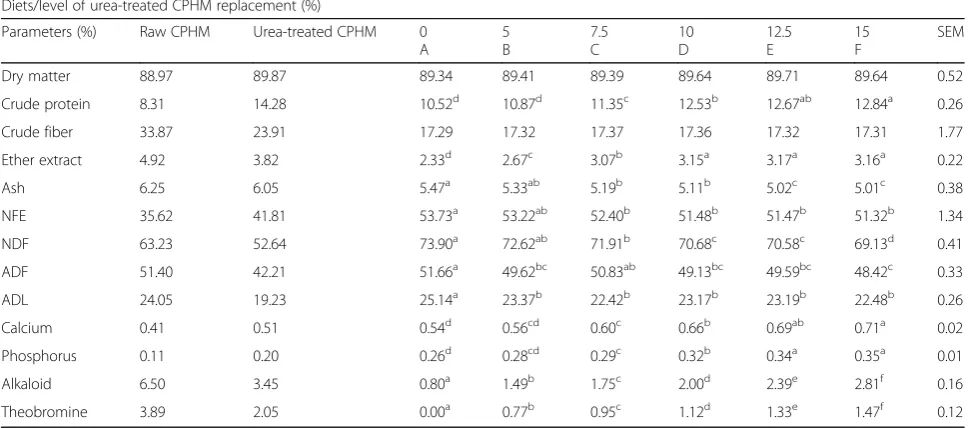
Table 2 presents the chemical composition of raw CPHM, urea-treated CPHM, and replacement levels of urea-treated CPHM in the total mixed ration. The value of dry matter did not follow a particular trend. However, the values were not significantly (p > 0.05) varied. The highest DM (88.97%) was recorded for raw CPHM and least (89.34%) in treatment A (0% urea-treated CPHM). The crude protein (CP) value of the urea-treated CPHM increased by 71.84% over the raw CPHM, and this sig-nificantly (p < 0.05) influenced the CP contents of the diets. Consequently, the protein contents progressively increased with increased replacement levels of urea-treated CPHM in the complete concentrate diets. The highest CP (12.84%) was recorded for treatment F (15% urea-treated CPHM replacement level). The treatment Table 1Gross composition of graded inclusion levels of
urea-treated CPHM in complete concentrate diets
Diets/level of urea-treated CPHM replacement (%)
Ingredients (%) 0 (A) 5 (B) 7.5 (C) 10 (D) 12.5 (E) 15 (F)
Urea-treated CPHM 0.00 5.00 7.50 10.00 12.50 15.00
Cassava peels 50.00 45.00 42.50 40.00 37.50 35.00
Brewer dried grain 27.00 27.00 27.00 27.00 27.00 27.00
Wheat offal 5.00 5.00 5.00 5.00 5.00 5.00
Palm kernel cake 15.00 15.00 15.00 15.00 15.00 15.00
Bone meal 1.00 1.00 1.00 1.00 1.00 1.00
Salt 1.00 1.00 1.00 1.00 1.00 1.00
Premix 1.00 1.00 1.00 1.00 1.00 1.00
effect caused the significant reduction in the crude fiber level, as 33.87% CF (raw CPHM) was reduced to 23.91% (urea-treated CPHM). Though, no significant reduction was noticed in the CF contents of the diets. The ether extract content values gradually increased across the treatment. Though, values recorded for treatment E and F were statistically (p > 0.05) similar. The highest EE (4.92%) and ash content (6.25%) values were obtained in raw CPHM, respectively. The value of nitrogen-free ex-tract increased numerically from 35.62% (raw CPHM) to 41.81% (urea-treated CPHM).
The neutral detergent fiber and acid detergent fiber con-tents of raw cocoa pod husk were 63.23% and 51.40%, re-spectively, and higher compared to NDF (52.64%) and ADF (42.21%) of urea-treated CPHM. Similarly, the value of acid detergent lignin (24.05%) content of raw CPHM was the highest. The CPHM calcium and phosphorus con-centrations varied positively with the treatment effect and significantly improved the Ca and P contents of the diets. The alkaloid and theobromine concentration of the pod drastically reduced, though the concentration increased with increased levels of urea-treated CPHM in the diets.
Table3presents the in vitro gas production of raw and replacement levels of cassava peels with urea-treated cocoa pod husk meal diets. The result showed that gas volume produced at different incubation time differed sig-nificantly (p < 0.05). The volume of gas produced in-creased with increasing incubation time (Fig. 1). The study revealed that raw CPHM produced the least gas vol-ume (1.67 ml) at 3 h and highest (3.01 ml) at 18 h. How-ever, gas production declined after 18th hour. Diet A (0%
replacement level of urea-treated CPHM with cassava peels in the diet) produced the least volume of gas (3.33 ml) at 3 h of incubation time, while diet F produced the highest volume of gas (9.69 ml) under the same period of incubation. Gas volume production at 3 h was least in diet A (3.33 ml) and highest in diet F (9.69 ml). Similarly, at 24 h, the highest gas volume (20.19 ml) was obtained in diet F and least (10.67 ml) in diet A at 21 and 24 h.
Means on the same row with different superscript let-ters are statistically (p< 0.05) different
CPHM cocoa pod husk meal,A0% replacement levels of urea-treated CPHM,B5% replacement levels of urea-treated CPHM, C 7.5% replacement levels of urea--treated CPHM, D 10% replacement levels of urea-treated CPHM, E 12.5% replacement levels of Table 2Chemical composition of raw, urea-treated ensiled cocoa pod husk and formulated diets
Diets/level of urea-treated CPHM replacement (%)
Parameters (%) Raw CPHM Urea-treated CPHM 0 A
5 B
7.5 C
10 D
12.5 E
15 F
SEM
Dry matter 88.97 89.87 89.34 89.41 89.39 89.64 89.71 89.64 0.52
Crude protein 8.31 14.28 10.52d 10.87d 11.35c 12.53b 12.67ab 12.84a 0.26
Crude fiber 33.87 23.91 17.29 17.32 17.37 17.36 17.32 17.31 1.77
Ether extract 4.92 3.82 2.33d 2.67c 3.07b 3.15a 3.17a 3.16a 0.22
Ash 6.25 6.05 5.47a 5.33ab 5.19b 5.11b 5.02c 5.01c 0.38
NFE 35.62 41.81 53.73a 53.22ab 52.40b 51.48b 51.47b 51.32b 1.34
NDF 63.23 52.64 73.90a 72.62ab 71.91b 70.68c 70.58c 69.13d 0.41
ADF 51.40 42.21 51.66a 49.62bc 50.83ab 49.13bc 49.59bc 48.42c 0.33
ADL 24.05 19.23 25.14a 23.37b 22.42b 23.17b 23.19b 22.48b 0.26
Calcium 0.41 0.51 0.54d 0.56cd 0.60c 0.66b 0.69ab 0.71a 0.02
Phosphorus 0.11 0.20 0.26d 0.28cd 0.29c 0.32b 0.34a 0.35a 0.01
Alkaloid 6.50 3.45 0.80a 1.49b 1.75c 2.00d 2.39e 2.81f 0.16
Theobromine 3.89 2.05 0.00a 0.77b 0.95c 1.12d 1.33e 1.47f 0.12
Means on the same row with different superscript letters are statistically (p< 0.05) different
A0% replacement levels of urea-treated CPHM,B5% replacement levels of urea-treated CPHM,C7.5% replacement levels of urea-treated CPHM,D10% replacement levels of urea-treated CPHM,E12.5% replacement levels of urea-treated CPHM,F15% replacement levels of urea-treated CPHM, NFEnitrogen-free extract,NDFneutral detergent fiber,ADFacid detergent fiber,ADLacid detergent lignin (n= 3)
Table 3In vitro gas production of raw and replacement levels of urea-treated CPHM diets
Gas volume (ml)
Diets 3 h 6 h 9 h 12 h 15 h 18 h 21 h 24 h
Raw CPHM
1.67f 1.82e 1.99e 2.13e 2.47e 3.01f 2.89f 2.89f
A 3.33e 4.33d 6.33d 6.33d 8.33d 10.33e 10.67e 10.67e
B 4.67d 5.67c 6.67d 7.33d 9.67c 11.67d 11.93d 12.33d
C 6.00c 6.00c 8.00c 9.00c 11.00b 13.00c 14.00c 14.07c
D 8.33b 9.00b 11.00b 13.00b 16.33a 14.00b 17.67b 17.67b
E 9.67a 11.67a 14.33a 14.33a 16.33a 17.67a 20.00a 20.03a
F 9.69a 11.64a 14.29a 14.32a 16.34a 17.62a 20.01a 20.19a
urea-treated CPHM, F 15% replacement levels of urea-treated CPHM
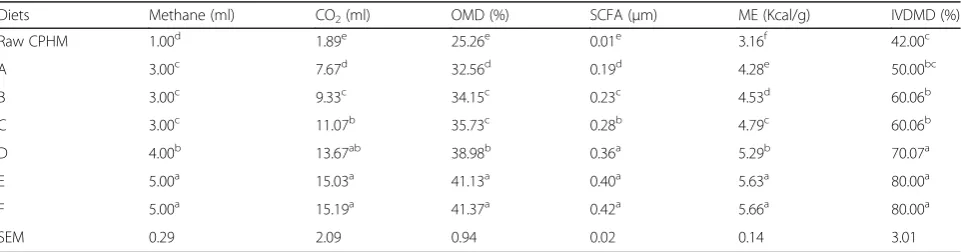
Presented in Table4 are the in vitro characteristics of raw and replacement levels of urea-treated CPHM for cassava peels. The result showed a significant (p< 0.05) difference for all the parameters assessed with respect to the treatments. It was noted that the least values ob-tained in all the parameters assessed were for raw CPHM. However, the highest volume of methane gas (5.00 ml) produced was obtained in diets E and F, while the least was observed in diets A, B, and C (3.00 ml) which were numerically and statistically (p
> 0.05) similar. The carbon dioxide (CO2) gas pro-duced from the insoluble fraction increased with in-creased replacement levels of urea-treated CPHM for cassava peels in the diet. Diet F produced the highest volume of CO2 gas (15.19 ml), while diet A produced the least (7.67 ml). The organic matter digestibility (OMD) obtained ranged from 32.56% (diet A) to 41.37% (diet E). The short-chain fatty acid (SCFA)
also increased with increased replacement of urea-treated cocoa pod husk meal for cassava peels in the diets; with the highest (0.42 μm) value obtained in diet F and least (0.19 μm) obtained in diet A. The metabolizable energy of the diets increased with in-creased replacement of urea-treated cocoa pod husk meal for cassava peels in the diets. Diets E and F had statistical (p > 0.05) similar values but differed nu-merically. The values of ME obtained ranged from 4.28 Kcal/g (diet A) to 5.66 Kcal/g (diet E). In vitro dry matter disappearance was highest (80.00%) in di-ets E and F and least (50.00%) in diet A.
Discussion
The 88.97% DM, 8.31% CP, and 33.87% CF contents obtained for the raw CPHM in this study (Table 2) agreed with the reported values of about 80.00– 88.96% DM, 6.00–9.14% CP, and 24.93–35.74% CF by Aregheore (2002) and Ozung et al., (2016). The dry matter of the pod before and after treatment (soaking Fig. 1Graphical representation of in vitro gas production of raw and replacement levels of urea-treated cocoa pod husk meal diets
Table 4In vitro characteristics of raw and replacement levels of urea-treated CPHM diets
Diets Methane (ml) CO2(ml) OMD (%) SCFA (μm) ME (Kcal/g) IVDMD (%)
Raw CPHM 1.00d 1.89e 25.26e 0.01e 3.16f 42.00c
A 3.00c 7.67d 32.56d 0.19d 4.28e 50.00bc
B 3.00c 9.33c 34.15c 0.23c 4.53d 60.06b
C 3.00c 11.07b 35.73c 0.28b 4.79c 60.06b
D 4.00b 13.67ab 38.98b 0.36a 5.29b 70.07a
E 5.00a 15.03a 41.13a 0.40a 5.63a 80.00a
F 5.00a 15.19a 41.37a 0.42a 5.66a 80.00a
SEM 0.29 2.09 0.94 0.02 0.14 3.01
Means on the same row with different superscript letters are significantly (p< 0.05) different
OMDorganic matter digestibility,CO2(carbon dioxide)gas production from insoluble fraction,SCFAshort-chain fatty acid,MEmetabolizable energy,IVDMDin vitro
in 5% urea solution for 7 days and ensiled for 28 days) and the formulated diets were high; this could be attributed to the dried nature of the pod and cas-sava peels, culminating in its high lignification. The CP content of the pod and invariably that of the di-ets was improved. The CP contents (10.52–12.84%) of the diets could adequately meet the protein re-quirement by ruminant animals for growth (NRC, 2007). The reduction in fiber contents could be as a result of the fermentation process during ensiling. The reduction in the alkaloid and theobromine might be traced to decanting after been soaked in urea so-lution and thus would make the feed more palatable to the animals. The amount of gas produced during fermentation is dependent on the nature, level of fiber, and potency of the rumen liquor used for the incubation. The result showed that gas volume pro-duced at different incubation time differed signifi-cantly at p < 0.05.
The observed increase in the cumulative gas volume from 3 to 21 h (Table 3), and the gradual decline after 21 h of incubation from diets A to F could be associated to the replacement levels of urea-treated CPHM and thus predicted digestibility, fermentation end-product, and microbial protein synthesis of the diets by rumen microbes in the in vitro system. This also implied that digestion would take place within the normal rumen retention time at 21 to 24 h and could be an indirect measure of dry matter degrad-ability. This trend agreed with the report of Babayemi and Bamikole (2006) when a similar method was used to evaluate the nutritive value of Tephrosia candida
DC leaf and its mixtures with Guinea grass for ru-minant feeding. From Table 4, methane gas produced was in line with the values reported by Okoruwa and Agbonlahor (2016) when they investigated the gas production characteristics of cocoa pod husk with soursop pulp meals used in replacement for Napier grass in the diet of WAD sheep. Thus, the methane gas volume produced in this study could be traced to the gradual increment in the protein quality of the diets.
The apparently low methane gas volume produced in this study is an indication of the effective utilization of the diets. The gradual increase in the value of OMD and ME reported implied a mutual re-lationship exists between total methane production and ME with OMD (Babayemi and Bamikole, 2006). The low SCFA reported in this study were due to the lower methane gas production which was evident within the 24-h incubation period. The increased value of IVDMD of urea-treated CPHM-based diets over the raw CPHM could be traced to the effect of soaking in urea solution because great quantities of
cell contents were dissolved in the water. Thus, the formulated diets are rich in nutrients, highly digest-ible, and could meet the nutrient requirements for growth/maintenance by ruminant animals.
Conclusions
The study established that cocoa pod husk has nutri-tional potentials in ruminant nutrition and could be nu-tritionally upgraded by soaking in 5% urea solution for 7 days, ensiled for 28 days, and incorporated up to 15% re-placement level in the ruminants’diets. However, in vivo study should be carried out to substantiate the in vitro study.
Acknowledgements
Sincere appreciation goes to my PhD supervisors—Prof. J. A. Alokan and Dr. A. N. Fajemisin for their mentorship role.
Availability of data materials
The data that support the findings of this study are available from Omotoso, O. B., but restriction applies to the availability of the data, which were used under license for the current study, and so are not publicly available. Data are however available from the author upon reasonable request and with permission of Omotoso, O. B.
Author’s contributions
This manuscript is a subset of my doctoral research work. I was responsible to manage all the activities of the experiment and worked in the execution of the trial and involved in the data collection and interpretation to make this manuscript. The author read and approved the
final manuscript.
Author information
ORCID 0000-0002-6181-0467
Funding
Not applicable
Ethics approval and consent to participate
Not applicable
Consent for publication
Not applicable
Competing interests
The authors declare that they have no competing interests.
Received: 10 June 2019 Accepted: 9 September 2019
References
Ajibade FO, Adewumi JR, Oguntuase AM (2014) Design of improved storm water management system for the Federal University of Technology, Akure.Niger J Technol33(4):470–481
AOAC (2002) Association of Official Analytical Chemists. Official methods of analysis, 17th edn. Published by Association of Official Analytical Chemists, Washington, D.C
Aregheore EM (2002) Chemical evaluation and digestibility of cocoa (Theobroma cacao) by products fed to goats.Trop Anim Health Prod34:339–348 Babayemi OJ, Bamikole MA (2006) Effect ofTephrosia candidaDC leaf and its
mixtures with Guinea grass on in vitro fermentation changes as feed for ruminants in Nigeria.Pak J Nutr5(1):14–18
Duncan DB (1955) Multi rang and multiple F test. Biometrics 11:1–2 Fievez V, Babayemi OJ, Demeyer D (2005) Estimation of direct and indirect gas
Makkar HPS (1993) Anti-nutritional factors in food for livestock.Br Soc Anim Prod 16:69–85
Menke KH, Steingass H (1988) Estimation of the energetic fed value from chemical analysis and in vitro gas production using rumen fluid.Anim Res Devt28:7–55
NRC (2007). Nutrient requirements of small ruminants: sheep, goats, cervids, and new world camelids. National Academy Press, 384 p.
Okoruwa MI, Agbonlahor I (2016) Replacement value of cocoa pod husk with soursop pulp meals for Napier grass in the practical diet of West African Dwarf sheep.Eur J Agric For Res4(5):1–11
Ozung PO, Kennedy OO, Agiang EA (2016) Chemical composition of differently treated forms of cocoa pod husk meal.Asian J Agric Sci8:5–9
SAS (2008) Statistical Analysis System Institute Inc. SAS/STAT Programme, Carry, NC Steinfeld, H., T. Wassenaar, T. and Jutzi, S. (2006). Livestock production systems in
developing countries: status, drivers, trends. Rev Sci Tech 25 (2): 505-516. Sucharita S, Makkar HPS, Becker K (1998) Alfalfa saponins and their implications in
animal nutrition.J Agric Food Chem46:131–140
Publisher’s Note