The Thirty-Third AAAI Conference on Artificial Intelligence (AAAI-19)
Data Augmentation Based on Adversarial Autoencoder
Handling Imbalance for Learning to Rank
∗Qian Yu, Wai Lam
Department of Systems Engineering and Engineering Management The Chinese University of Hong Kong
{yuqian, wlam}@se.cuhk.edu.hk
Abstract
Data imbalance is a key limiting factor for Learning to Rank (LTR) models in information retrieval. Resampling methods and ensemble methods cannot handle the imbalance problem well since none of them incorporate more informative data into the training procedure of LTR models. We propose a data generation model based on Adversarial Autoencoder (AAE) for tackling the data imbalance in LTR via informative data augmentation. This model can be utilized for handling two types of data imbalance, namely, imbalance regarding rele-vance levels for a particular query and imbalance regarding the amount of relevance judgements in different queries. In the proposed model, relevance information is disentangled from the latent representations in this AAE-based model in order to reconstruct data with specific relevance levels. The semantic information of queries, derived from word embed-dings, is incorporated in the adversarial training stage for reg-ularizing the distribution of the latent representation. Two in-formative data augmentation strategies suitable for LTR are designed utilizing the proposed data generation model. Ex-periments on benchmark LTR datasets demonstrate that our proposed framework can significantly improve the perfor-mance of LTR models.
Introduction
In information retrieval, the task of Learning to Rank (LTR) (Liu and others 2009) refers to a category of methods where machine learning models are trained to rank documents based on the degree of relevance to the query. One challenge for LTR is that the available training data is usually imbal-anced (Verberne et al. 2011; Macdonald, Santos, and Ounis 2013; Agarwal et al. 2012). The imbalance problem for LTR comes from two sources:
1. Imbalance regarding Relevance (R-imbalance) Given a query, the documents judged with high relevance level are much fewer than judged irrelevant documents. The reason is that the relevant documents are typically
∗
The work described in this paper is substantially supported by grants from the Research Grant Council of the Hong Kong Special Administrative Region, China (Project Codes: 14203414) and the Direct Grant of the Faculty of Engineering, CUHK (Project Code: 4055093).
Copyright c⃝2019, Association for the Advancement of Artificial Intelligence (www.aaai.org). All rights reserved.
scarce in the whole collection and it is hard for an explicit or implicit relevance judgement annotation procedure to pick out all the documents with high relevance level.
2. Imbalance regarding Query (Q-imbalance)
Different queries typically have different amounts of rel-evance judgements. Since relrel-evance is always query-based, the imbalance of available information associated with different queries also influences the model training in LTR. Specifically, if some queries have much larger amount of judged documents than other queries, then these queries tend to dominate the learning of LTR mod-els.
The performances of LTR models are restricted by imbal-anced training data, especially the pointwise LTR models. The pairwise LTR models regard pairs of document with different relevance levels as training samples, and pairwise learning objectives are designed according to the relative relevance level for eliminating R-imbalance problem. How-ever, the pairwise objective function and training samples still suffer from the scarcity of documents with high rele-vance level. The pairwise training set lacks of diversity since the ”highly relevance” part of the pairwise training samples is still derived from the same small set of documents with high relevance level. Therefore, if we can address the issue of imbalanced data in LTR, the overall performance of pair-wise methods can be improved.
to train a data generator and a discriminator to distinguish the generated data and real data. However, GAN-based mod-els capture the input data distribution, and will intrinsically inherit the imbalance in the training set. GAN-based meth-ods cannot address data imbalance since they cannot comply with the two data generation criteria mentioned before.
We propose a data generation model based on Adversarial Autoencoder (AAE) (Makhzani et al. 2015) to facilitate in-formative data augmentation for LTR. Basically, we attempt to generate latent representations which can be decoded to informative synthetic data. The proposed data augmentation has several characteristics for handling R-imbalance and Q-imbalance. First, relevance information is disentangled from the latent representation. Thus, the data reconstruction stage facilitates the data generation for a given target relevance levels for handling R-imbalance. We refer this data gener-ation as informative since the generated data contains new information via combining the target relevance level and the relevance-independent latent representation. Second, with the aid of word embeddings, query types containing queries that are semantically close are discovered and incorporated in the adversarial training stage for regularizing the distri-bution of latent representations. For each query, sufficient training data derived from the same query type can be ob-tained via manipulating the generation of latent represen-tation. This can eliminate the dominance of queries with large amount of relevance judgements, therefore handling Q-imbalance. Two informative data augmentation strategies for LTR are designed exploiting the above mentioned model. To the best of our knowledge, this is the first work for han-dling both types of imbalance in LTR setting.
Related Work
A basic task for information retrieval is to rank a set of documents given a query, based on the relevance between a document and a query (Cao et al. 2006). Learning to rank (LTR) methods (Liu and others 2009) solve this problem via training a ranking model with samples labeled with rank-ing information. There are three categories of LTR methods, namely pointwise, pairwise, and listwise methods (Cao et al. 2007). For pointwise methods, the inputs are feature vectors derived from the corresponding query and document. A in-put vector contains features associated with the document, such as document length, IDF of terms, etc., and features associated with both query and document, such as TF*IDF, BM25 score, etc. Each of the vector is labeled with the rele-vance score of the document to the query. The learned model is capable for relevance score prediction. In pairwise meth-ods, each training sample is constructed by two feature vec-tors. The two feature vectors in one pairwise sample is asso-ciated with the same query and the relative relevance is the label for the training sample. Listwise methods use docu-ment lists as training samples. However, it is difficult to pre-pare the training set for listwise methods and the algorithm complexity tends to be high. Recently, features extracted from texts via deep learning models are also utilized in LTR methods (Wan et al. 2016; Severyn and Moschitti 2015; Pang et al. 2017), but we only consider the traditional fea-tures in LTR datasets in this paper.
Resampling (Good 2006) is an important technique for handling data imbalance (He and Garcia 2009) in machine learning. There are mainly two types of sampling meth-ods, namely oversampling (Fern´andez-Navarro, Herv´as-Mart´ınez, and Guti´errez 2011) and undersampling (Chawla 2003). In oversampling (Chawla 2003), data are sampled from the existing data set of minor classes and added into the training set. In this way, the sizes of minor classes are enlarged and the imbalance between major and mi-nor classes is alleviated. However, the training data is aug-mented with duplicated data without new information, and these sampling methods make the learned machine learn-ing model suffer from high risk of overfittlearn-ing. One of the well-known oversampling methods is SMOTE (Chawla et al. 2002) and there are several variants (Han, Wang, and Mao 2005) of SMOTE for specific settings. One the other hand, undersampling methods (Liu, Wu, and Zhou 2009; Yen and Lee 2009) reduce the number of data in major classes to obtain similar amount of training data in dif-ferent classes. The undersampling will result in informa-tion loss during the reducinforma-tion of training data via sampling. Undersampling technique is usually utilized with ensem-ble methods (Galar et al. 2013; Liu, An, and Huang 2006; Wang, Minku, and Yao 2015), but the scarcity of data in mi-nor classes is not directly handled in these methods. As we mentioned before, informative data generation is more help-ful than resampling technique.
Informative Data Generation Model
Each training sample vq,d for LTR is a feature vectorde-rived from a pair of query q and document d. Features invq,d are assigned with nonnegative values. Also, a
rele-vance judgement indicating the relerele-vance degree is associ-ated with a query-document pair. Let the relevance degree be denoted asrq,dwhich is an integer value typically in the
range[0, nr−1], wherenris the number of relevance
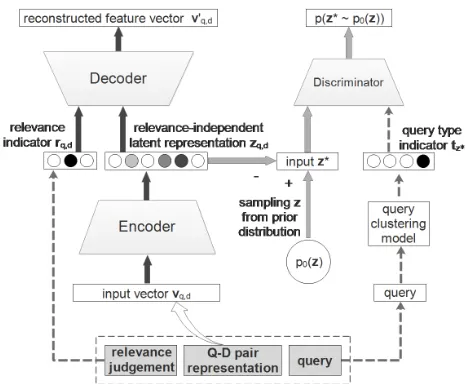
lev-els. The aim of the informative data generation model is to generate pseudo feature vector v∗ given a target relevance degreer∗. Fig. 1 depicts our proposed informative data gen-eration model. The decoder is equipped with a relevance level indicator in the reconstruction procedure to disentangle relevance information from the latent representation. Each data instance is reconstructed based on the target relevance level and relevance-independent latent representation. This method can incorporate new information into the training set via combining the desired relevance level and the relevance-independent latent representation. Query clusters containing queries that are semantically close are discovered with the aid of word embeddings. Each cluster can be regarded as a query type labeled with a type ID. The query type informa-tion is incorporated in the adversarial training stage for reg-ularizing the distribution of latent representations. Thus, the prior distribution of the latent representation can be utilized for generating data via pseudo queries for a particular query type. Such strategy can tackle the Q-imbalance problem.
Background of Adversarial Autoencoder
compo-Figure 1: Informative Data Generation Model.
nent. The adversarial learning is employed for imposing a prior distributionp0(z)to the latent representationz.
Sam-pling fromp0(z)will result in latent representations that can
be reconstructed to generate reasonable synthetic data. Com-pared with Variational Autoencoder (VAE) (Kingma and Welling 2013), AAE performs better when imposing com-plicated prior distribution
There are three basic components in AAE:
Encoder. A feed forward neural network consists of sev-eral layers with ReLU nonlinear activation function. The in-put is the real data, namely the normalized feature vectorv and the output of encoder is the latent representationz.
Decoder. A neural network consists of similar structure as the encoder but the input is the latent representationz. A latent representation can run through the decoder resulting in a reconstructed feature vectorv′with the same size as the input for encoder.
Discriminator. A discriminative network makes use of a sigmoid output layer. The inputz∗for the discriminator can be a latent vector sampled from the prior distributionp0(z)
or a latent representation encoded from a real feature vector. The output of the discriminator is the probability that the inputz∗is generated fromp0(z).
The learning of AAE is guided by two objective func-tions, namely reconstruction loss function and adversarial loss function, as shown in Eqn 1 and Eqn 2 respectively given below.
min Encode,Decode
∑
v∼pv
||v−Decode(Encode(v))||2 (1)
min
EncodemaxD Ez∼p0(z)logD(z)−Ev∼pvlogD(Encode(v))
(2)
where Encode(·) and Decode(·) stand for the data pro-cess function of the Encoder and Decoder respectively,D(·)
stands for the discriminator, andpvis the distribution of real data. The adversarial training (Lowd and Meek 2005) facil-itates the AAE to embed the input in a space that is defined
by the prior distributionp0(z). Thus, latent representations
sampled fromp0(z)can be reconstructed to reasonable
syn-thetic data. Note that different from general GAN model, the latent representations generated from the prior distribution in AAE are regarded as positive samples for the discrimina-tor, while the outputs of the encoder are regarded as negative samples. After the AAE is trained with a given prior distribu-tionp0(z), we can sample the latent representationz∗from
p0(z)and reconstruct the feature vector via the decoder.
Disentangling Relevance Information from Latent
Representation
To facilitate the support of generating feature vector with a target relevance degree, the relevance information needs to be captured. A relevance indicator vector is added as the in-put for the decoder for disentangling the relevance informa-tion. This disentanglement enforces the encoder to generate relevance-independent latent representation. Then the recon-struction procedure can be controlled via assigning a specific target relevance degree to the latent representation for data reconstruction. In adversarial learning, the prior distribution is only imposed for the relevance-independent latent repre-sentation.
Given a real datavq,dwhich passes through the encoder,
the latent representation obtained is written as:
zq,d=Encode(vq,d) (3)
whereEncode is the data embedding process in Encoder. We make use of a relevance degree indicatorrq,das shown
in Figure 1.rq,dis a one-hot vector denoting the relevance
degree of the current input vector. It participates in the re-construction procedure together with the latent representa-tion. Thus, the decoding process takes the concatenation of rq,dandzq,das input for obtaining the reconstructionv′q,d:
v′q,d=Decode([rq,d,zq,d]) (4)
whereDecodeis the data reconstruction process in Decoder. The learned latent representation is relevance-independent. In this way, the learned decoder becomes relevance-aware and the relevance degree of the generated data can be controlled.
Regularizing Latent Representation Distribution
based on Query Type
Now if we sample a latent representation from the prior dis-tributionp0(z), we can provide a target relevance degree to
the decoder and reconstruct a feature vector. But the sam-pling may be influenced by dominant queries in the training data, namely queries with large amounts of document rele-vance judgements. To solve this Q-imbalance issue, we fur-ther regularize the latent representation with query content information and multi-mode prior distribution.
discovery model will be presented below. Denoting the num-ber of query types asntwhich is an assigned parameter, we
design a prior distribution that is a mixture ofntGaussian
distributions.p0(z) = ∑nt
k=1pk0(z), wherepk0(z)is a normal
distribution for latent representation. Differentpk0(z)is
as-signed with different means but sharing the same variance. In our implementation, we random select nt points as the
means and variance is set to 1.
Each normal distributionpk0(z)is responsible for generat-ing queries from one query type. This is achieved by feedgenerat-ing a query type indicator into the discriminator together with the original input, namely the latent representation. When sampling a latent representationzfrom the prior distribution, we use only one normal distribution and record the query type with an indicator vectortz. If the latent representation zq,dis encoded from a real datavq,d, then the query type for
the corresponding query will be denoted with the indicator vector tzq,d. The discriminative process takes the
concate-nation of latent representation and the query type indicator vector as shown below:
p(z∗ ∼p0(z)) =D([z∗,tz∗]) (5)
wherep(z ∼p0(z))is the predicted probability that the
in-putzis generated fromp0(z), andz∗ can be a latent
repre-sentation coming from the encoder or a latent reprerepre-sentation sampled fromp0(z). This query type indicator will influence
the discriminator for using different decision boundaries for different query types. Positive samples for each query type are generated from the corresponding Gaussian distribution. In this way, the latent representation will be guided for fit-ting in the mixture prior distribution according to the query type.
One advantage of our design is that we can generate the latent representation for a particular query type and recon-struct synthetic data with a specific target relevance degree.
Query Type Discovery Given the query set, we discover the query types in an unsupervised manner. Since word em-bedding methods can capture semantic information for ev-ery individual term, we adopt word embedding and con-duct query clustering. Specifically, we embed each query with the average of its term embeddings from GloVe (Pen-nington, Socher, and Manning 2014), and then the K-Means method with Euclidean distance is applied for discovering query types. The parameterkin the K-Means method is set tonc. After such discovery process, given a query, we can
determine the query type it belongs.
Training Procedure
The learning procedure for the proposed model consists of three stages described below. These training stages will be conducted iteratively until a stable model is obtained. The learned model is capable of reconstructing data with disen-tanglement of relevance information. The query type-based prior distribution will be used for regularizing the distribu-tion of latent representadistribu-tion.
Update Encoder and Decoder for Reconstruction First of all, the encoder and decode should have the basic ability
for data reconstruction. In this stage, the reconstruction loss is used for training. We assume that the values in input fea-ture vector are normalized to be in the range[0,1]. Then we adopt the cross-entropy loss for reconstruction:
Lrecon(v,v′) =−vklog(vk′)−(1−vk) log(1−v′k) (6)
wherev′is the reconstructed vector based on the real datav, and both of them are associated with a pair of queryqand documentd:
v′q,d=Decode(Encode(vq,d),rq,d) (7)
For training data without normalization, the reconstruction loss can be replaced by other suitable functions, such as the squared error between input and output.
Update Discriminator Next, a good discriminator is needed for distinguishing the latent representations encoded from the real data and the latent representations sampled from the prior distribution. Recall that both kinds of latent representation are associated with a query type. The input for the discriminator are latent representationzand its cor-responding query type indicatortz. The discriminator output
D(z)is the probability that the input is generated from the prior distribution, namelyp(z∗∼p0(z)). Then the learning
objective function for the discriminator is formulated as:
LD=−logD(z∗,tz∗) + log(1−D(zq,d,tz
q,d)) (8)
wherez∗is the latent representation sampled from the prior distributionp0(z), andzq,d is the latent representation
en-coded from the real data. This loss function will guide the model to assign 1 to the latent representation that generated from the prior distribution, whereas 0 for latent representa-tion encoded from the real data. The learned discriminator is used for distinguishing these two kinds of latent vectors.
Update Encoder for Generation After the discriminator is updated, it will perform better in distinguishing two kinds of latent representations. The next step is to further adjust the encoder to generate latent representations that can con-fuse the discriminator. The target is to train the encoder to output latent representations that can be predicted to be gen-erated from the prior distribution by the discriminator. Thus, the prediction probability of discriminator is used as the loss function for training the encoder as a generator.
LG=−logD(zq,d,tzq,d) (9)
wherezq,d is the latent representation generated from
en-coder based on real data.
Data Augmentation for Learning to Rank
Basic Data Generation
Typically, there are much more irrelevant documents for a query than relevant ones. Our proposed model can gener-ate feature vectors associgener-ated with high relevance degree. In general, a generated data instance with a specific tar-get relevance degree can be regarded as representation for a pseudo-pair of query and document. Given a real datavand its latent representation zencoded by Encoder. According to the disentanglement ability of our model,zis relevance-independent and it can be used for generating data given a particular target relevance degree. First the target relevance degree is represented by the relevance indicator vectorr∗, the data generation is formulated as:
v∗=Decode([z,r∗]) (10) Different queries have different amounts of relevance judgements. Some queries with large amounts of judge-ments tend to dominate the learned ranking model, while some queries have just a few available judgements. Since our model can generate latent representation for each query type, we can enlarge the training set for those query types with small amount of judgements. The prior distribution of latent representation is a mixture of normal distributions, and each of them is responsible for one query type. Thus, we select the specific normal distribution to sample latent representation for data generation, and the output will possess the query characteristic of the corresponding query type. Assume that a latent representationz∗ is sampled from the normal dis-tribution associated with the query typetz∗, thenz∗can be
decoded to generate.
Data Augmentation Strategy I: Augment(R)
The first data augmentation strategy intends to generate pair-wise training data with different relevance levels but sharing the same relevance-independent latent representation. This kind of pairwise training data will help the LTR model to focus only on the relevance-related features.
Let us consider a training datavwith relevance degreer
as an example. We obtain its latent representationzand use it to reconstruct the data with relevance degreer−1 and
r+ 1, denoted asvr−1andvr+1respectively. Two pairwise
training samples are constructed:(v,vr−1)and(vr+1,v).
Since the data, vr−1, v and vr+1 are all reconstructed
from the same relevance-independent latent representation z, the main information that can be obtained from the rank-ing difference is the relevance information, without interfer-ence from the content information. In this way, this strategy Augment(R) utilizes the disentanglement ability of the data generation model to directly embed the relative relevance in-formation in the training pairs. Since the training pairs share the same latent representation, it reduces the burden of the ranking model to distinguish relevance information and con-tent information. Note that only R-imbalance is handled in this strategy. The augmented pairwise data set is added to the original pairwise training set.
Data Augmentation Strategy II: Augment(R+Q)
This data augmentation strategy aims at alleviating the two types of data imbalance. Given a training data, we generate
new data associated with the next higher relevance level to incorporate more data with high relevance. For example, as-suming that the range of the relevance degree is[0,2]. For a queryq, we sample training data from the training subset with relevance degree 1, denoted asV1q. Then a new data set with target relevance degree 2 is generated based onV1q via the above proposed data generation model, denoted asV′q2. Similarly, based on the training subset with relevance degree 0, denoted asV0q, we can generate a data set with relevance degree 1, denoted asV′q1. A ratiorR ∈(0,1)is introduced
to provide the stopping threshold for the generation proce-dure:
rR< S q 2/S
q
1, rR< S q 1/S
q
0 (11)
whereSnq =|Vnq|+|V′ q
n|is the number of original data and
generated data with relevance degreen.
Then we use the data generation to generate data for query types with small amount of relevance judgement via sam-pling from the prior distribution based on specific query types. We sum all the available training data for each query type to find out the query types with small amount of judge-ments. More training data is generated for these query types via a ratiorQused similar asrR:
rQ < Sqmin/S q
i (12)
where Sminq is the number of the training data associated with the query type with fewest judgements, andSqi is the number of the training data for any other query type. We repeatedly find the query type with the minimum training set for data generation, until the stopping threshold expressed in Eqn 12 is reached.
Experiments
Datasets
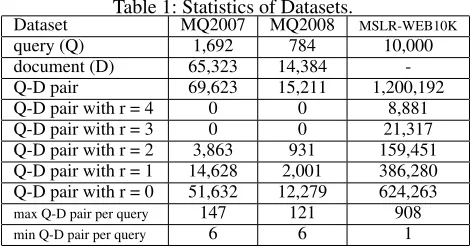
Three benchmark LTR datasets are used in our experi-ments to test the proposed data augmentation methods. The datasets are MQ2007 and MQ2008 from the LETOR 4.0 package, and MSLR-WEB10K. The queries for MQ2007
Table 1: Statistics of Datasets.
Dataset MQ2007 MQ2008 MSLR-WEB10K
query (Q) 1,692 784 10,000
document (D) 65,323 14,384
-Q-D pair 69,623 15,211 1,200,192
Q-D pair with r = 4 0 0 8,881
Q-D pair with r = 3 0 0 21,317
Q-D pair with r = 2 3,863 931 159,451 Q-D pair with r = 1 14,628 2,001 386,280 Q-D pair with r = 0 51,632 12,279 624,263 max Q-D pair per query 147 121 908 min Q-D pair per query 6 6 1
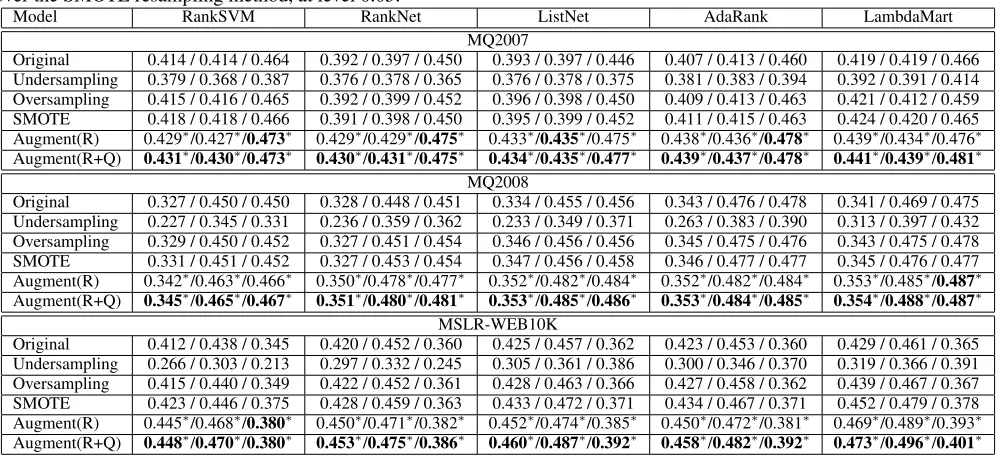
Table 2: Performance (P@5/NDCG@5/MAP) of Learning to Rank Models. * indicates a statistically significant improvement over the SMOTE resampling method, at level 0.05.
Model RankSVM RankNet ListNet AdaRank LambdaMart
MQ2007
Original 0.414 / 0.414 / 0.464 0.392 / 0.397 / 0.450 0.393 / 0.397 / 0.446 0.407 / 0.413 / 0.460 0.419 / 0.419 / 0.466 Undersampling 0.379 / 0.368 / 0.387 0.376 / 0.378 / 0.365 0.376 / 0.378 / 0.375 0.381 / 0.383 / 0.394 0.392 / 0.391 / 0.414 Oversampling 0.415 / 0.416 / 0.465 0.392 / 0.399 / 0.452 0.396 / 0.398 / 0.450 0.409 / 0.413 / 0.463 0.421 / 0.412 / 0.459
SMOTE 0.418 / 0.418 / 0.466 0.391 / 0.398 / 0.450 0.395 / 0.399 / 0.452 0.411 / 0.415 / 0.463 0.424 / 0.420 / 0.465
Augment(R) 0.429∗/0.427∗/0.473∗ 0.429∗/0.429∗/0.475∗ 0.433∗/0.435∗/0.475∗ 0.438∗/0.436∗/0.478∗ 0.439∗/0.434∗/0.476∗ Augment(R+Q) 0.431∗/0.430∗/0.473∗ 0.430∗/0.431∗/0.475∗ 0.434∗/0.435∗/0.477∗ 0.439∗/0.437∗/0.478∗ 0.441∗/0.439∗/0.481∗
MQ2008
Original 0.327 / 0.450 / 0.450 0.328 / 0.448 / 0.451 0.334 / 0.455 / 0.456 0.343 / 0.476 / 0.478 0.341 / 0.469 / 0.475 Undersampling 0.227 / 0.345 / 0.331 0.236 / 0.359 / 0.362 0.233 / 0.349 / 0.371 0.263 / 0.383 / 0.390 0.313 / 0.397 / 0.432 Oversampling 0.329 / 0.450 / 0.452 0.327 / 0.451 / 0.454 0.346 / 0.456 / 0.456 0.345 / 0.475 / 0.476 0.343 / 0.475 / 0.478
SMOTE 0.331 / 0.451 / 0.452 0.327 / 0.453 / 0.454 0.347 / 0.456 / 0.458 0.346 / 0.477 / 0.477 0.345 / 0.476 / 0.477
Augment(R) 0.342∗/0.463∗/0.466∗ 0.350∗/0.478∗/0.477∗ 0.352∗/0.482∗/0.484∗ 0.352∗/0.482∗/0.484∗ 0.353∗/0.485∗/0.487∗ Augment(R+Q) 0.345∗/0.465∗/0.467∗ 0.351∗/0.480∗/0.481∗ 0.353∗/0.485∗/0.486∗ 0.353∗/0.484∗/0.485∗ 0.354∗/0.488∗/0.487∗
MSLR-WEB10K
Original 0.412 / 0.438 / 0.345 0.420 / 0.452 / 0.360 0.425 / 0.457 / 0.362 0.423 / 0.453 / 0.360 0.429 / 0.461 / 0.365 Undersampling 0.266 / 0.303 / 0.213 0.297 / 0.332 / 0.245 0.305 / 0.361 / 0.386 0.300 / 0.346 / 0.370 0.319 / 0.366 / 0.391 Oversampling 0.415 / 0.440 / 0.349 0.422 / 0.452 / 0.361 0.428 / 0.463 / 0.366 0.427 / 0.458 / 0.362 0.439 / 0.467 / 0.367
SMOTE 0.423 / 0.446 / 0.375 0.428 / 0.459 / 0.363 0.433 / 0.472 / 0.371 0.434 / 0.467 / 0.371 0.452 / 0.479 / 0.378
Augment(R) 0.445∗/0.468∗/0.380∗ 0.450∗/0.471∗/0.382∗ 0.452∗/0.474∗/0.385∗ 0.450∗/0.472∗/0.381∗ 0.469∗/0.489∗/0.393∗ Augment(R+Q) 0.448∗/0.470∗/0.380∗ 0.453∗/0.475∗/0.386∗ 0.460∗/0.487∗/0.392∗ 0.458∗/0.482∗/0.392∗ 0.473∗/0.496∗/0.401∗
For each query-document pair, a 46-dimentional feature vec-tor is prepared in the datasets. A query level normalization is conducted on the feature vectors. The description for each feature and normalization can be found in (Qin and Liu 2013). For the dataset MSLR-WEB10K, 10000 queries are collected from a commercial search engine, and documents for each query are annotated with 5 different relevance level, namely from 0 for irrelevance to 4 for high relevance level. There are 136 features extracted for each pair of query and document.
The statistics of the three datasets are presented in Table 1. We can observe that relevant query-document pairs are rela-tively scarce in the training set, especially the ones with high relevance degree. In addition, the large range of the number of query-document pairs for a query indicates the data im-balance regarding queries.
Experiment Settings
We apply our proposed two data augmentation strategies to several state-of-the-art LTR models. Given a set of training data and corresponding query set, we first conduct unsuper-vised learning via the query type discovery model described above for labeling each query with a particular query type. As a result, each training data is associated with a query type ID and a relevance degree. Then the informative data gener-ation model as described above can be trained. After that, the two data generation strategies are applied for augment-ing the trainaugment-ing set. Then the LTR models are learned based on the augmented training set. We apply the data augmenta-tion methods on the following state-of-the-art LTR models. RankSVM(Joachims 2002) is a variant of SVM model for LTR task. RankNet(Burges et al. 2005) is a classic pair-wise ranking algorithm making use of a neural network with a natural probabilistic loss function on pairs of training data.
ListNet (Cao et al. 2007) uses lists of document as train-ing instances employtrain-ing listwise loss function. AdaRank (Xu and Li 2007) trains one ranking model at each itera-tion followed with re-weighting document pairs, and com-bines these weak rankers for the final ranking output. Lamb-daMART(Burges, Ragno, and Le 2007) incorporates tree-based boosting methods into LambdaRank for LTR, and di-rectly optimizes the evaluation metric such as NDCG.
To demonstrate the effectiveness of the proposed data augmentation methods for improving LTR performance, we compare with the different resampling methods including random oversampling, random undersampling, and one of the state-of-the-art oversampling method calledSMOTE (Chawla et al. 2002). We denote our proposed two data aug-mentation methods as Augment(R) and Augment(R+Q). Each dataset is partitioned to five subsets with roughly equal size, and 5-fold cross validation is adopted for all the LTR models. Specifically, in each fold, there are 3 subsets utilized as training set, one subset as validation set and one as test set. Data augmentation will be conducted on each training set and the improved model will be evaluated on the corre-sponding test set. The average performance on test sets of 5 folds is recorded for each method. We use the Wilcoxon significance test to examine the statistical significance of the improvements over the SMOTE resampling method.
datasets MQ2007 and MQ2008 contain only three levels of relevance degree, i.e., 0, 1, and 2, the relevance indicator vector in the model is 3-dimension. This dimension is 5 for MSLR-WEB10K. The query cluster number is set to 10 for MQ2007, 5 for MQ2008, and 10 for MSLR-WEB10K. The analysis for this hyper-parameter can be found in Section .
rRandrQis set to 1. The framework is implemented via
Py-torch 0.4.0 and Python 3.6, and all AAE based models are run with a single NVIDIA Tesla K80 GPU.
Performance Improvement on LTR Models
The performance of LTR models with different data aug-mentation methods on MQ2007, MQ2008 and MSLR-WEB10k are presented in Table 2. We can observe that our proposed two data augmentation strategies can significantly improve the LTR performance of all the LTR models. Lamb-daMART method with Augment(R+Q) achieves the best performance regarding all evaluation metrics. Specifically, Augment(R+Q) can improve the NDCG@5 performance of LambdaMART by more than 3% on both MQ2007 and MQ2008.Augment(R+Q)generally improves LTR perfor-mance a little more thanAugment(R), which indicates that handling data imbalance regarding queries (Q-imbalance) can also help LTR models as well as imbalance regard-ing relevance levels (R-imbalance). Accordregard-ing to the re-sults, all the other tested resampling methods cannot in-fluence the performance of LTR models significantly. Un-dersampling achieves worse performance than the base-line methods, which reveals that irrelevant query-document pairs are also valuable. The randomoversamplingand the SMOTEmethod obtain similar performance as the original LTR model since these resampling methods cannot add in-formative data into the training set for LTR. Our framework achieves significant improvement due to the ability of in-formative data generation considering both relevance degree and query characteristics.
Table 3: Number of queries with improved/reduced MAP via data augmentation on LambdaMART.
augment method MQ2007 MQ2008 MSLR-WEB10k
Undersampling 327 / 842 143 / 467 1474 / 8035
Oversampling 641 / 684 329 / 352 4902 / 4864
SMOTE 653 / 674 346 / 331 4964 / 4795
Augment(R) 956 / 504 475 / 240 5625 / 3792
Augment(R+Q) 1035 / 495 493 / 213 5871 / 3675
Apart from the overall performance, we further look into the effect of data augmentation for individual queries. In Ta-ble 3, the number of queries whose MAP can be improved or reduced via a specific data augmentation method is recorded. The base model is LambdaMART and similar trends are observed for other LTR models. We can observe that our proposed two augmentation methods can improve the per-formance of most queries. Specifically, the MAP perfor-mance of 1035 out of 1692 queries can be improved by Aug-ment(R+Q). As for other resampling methods, such dom-inance of queries with improved MAP performance can-not be observed. This demonstrate the proposed informative data augmentation can benefit most individual queries.
Investigation of Hyper-parameters
We present some analysis on some important hyper-parameters in our framework. The P@1 evaluation metric is used for comparison of different parameter settings. Lamb-daMART is adopted as the base model for this analysis.
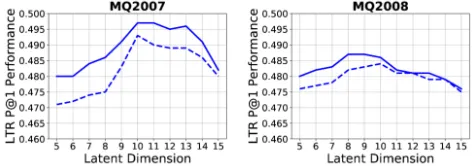
Figure 2: Investigation of Latent Representation Dimension. Solid lines represent the performance of Augment(R+Q) and dash lines forAugment(R).
Figure 2 shows the investigation of the dimension of the relevance-independent latent representationz, with regard to the LTR performance ofAugment(R)andAugment(R+Q) on MQ2007 and MQ2008. We can observe that the perfor-mances are stable as long as the dimension of latent repre-sentation is set in a specific range. Too small or too large dimension reversely affect the performance.
Figure 3: Investigation of Number of Query Types.
Figure 3 shows the investigation of the number of clus-ters in the query type discovery component of the frame-work, with regard to the performance ofAugment(R+Q)on MQ2007 and MQ2008. It can be observed that a larger num-ber of query clusters generally yield better performance. The performance improvement is negligible when the number of query clusters exceeds a certain value.
Conclusions
References
Agarwal, A.; Raghavan, H.; Subbian, K.; Melville, P.; Lawrence, R. D.; Gondek, D. C.; and Fan, J. 2012. Learning to rank for robust question answering. InCIKM, 833–842.
Batuwita, R., and Palade, V. 2010. Efficient resampling methods for training support vector machines with imbal-anced datasets. InIJCNN, 1–8. IEEE.
Burges, C.; Shaked, T.; Renshaw, E.; Lazier, A.; Deeds, M.; Hamilton, N.; and Hullender, G. 2005. Learning to rank using gradient descent. InICML, 89–96. ACM.
Burges, C. J.; Ragno, R.; and Le, Q. V. 2007. Learning to rank with nonsmooth cost functions. InNIPS, 193–200.
Cao, Y.; Xu, J.; Liu, T.-Y.; Li, H.; Huang, Y.; and Hon, H.-W. 2006. Adapting ranking svm to document retrieval. In SIGIR, 186–193. ACM.
Cao, Z.; Qin, T.; Liu, T.-Y.; Tsai, M.-F.; and Li, H. 2007. Learning to rank: from pairwise approach to listwise ap-proach. InICML, 129–136. ACM.
Chawla, N. V.; Bowyer, K. W.; Hall, L. O.; and Kegelmeyer, W. P. 2002. Smote: synthetic minority over-sampling tech-nique. Journal of Artificial Intelligence Research16:321– 357.
Chawla, N. V. 2003. C4. 5 and imbalanced data sets: investi-gating the effect of sampling method, probabilistic estimate, and decision tree structure. InICML, volume 3, 66.
Dietterich, T. G. 2000. Ensemble methods in machine learn-ing. InInternational Workshop on Multiple Classifier Sys-tems, 1–15. Springer.
Fern´andez-Navarro, F.; Herv´as-Mart´ınez, C.; and Guti´errez, P. A. 2011. A dynamic over-sampling procedure based on sensitivity for multi-class problems.Pattern Recognition 44(8):1821–1833.
Galar, M.; Fern´andez, A.; Barrenechea, E.; and Herrera, F. 2013. Eusboost: Enhancing ensembles for highly im-balanced data-sets by evolutionary undersampling. Pattern Recognition46(12):3460–3471.
Good, P. I. 2006.Resampling methods. Springer.
Goodfellow, I.; Pouget-Abadie, J.; Mirza, M.; Xu, B.; Warde-Farley, D.; Ozair, S.; Courville, A.; and Bengio, Y. 2014. Generative adversarial nets. InNIPS, 2672–2680.
Han, H.; Wang, W.-Y.; and Mao, B.-H. 2005. Borderline-smote: a new over-sampling method in imbalanced data sets learning. InInternational Conference on Intelligent Com-puting (ICIC), 878–887. Springer.
He, H., and Garcia, E. A. 2009. Learning from imbalanced data.TKDE21(9):1263–1284.
Joachims, T. 2002. Optimizing search engines using click-through data. InSIGKDD, 133–142. ACM.
Kingma, D. P., and Welling, M. 2013. Auto-encoding vari-ational bayes. arXiv preprint arXiv:1312.6114.
Liu, Y.; An, A.; and Huang, X. 2006. Boosting prediction accuracy on imbalanced datasets with svm ensembles. In PAKDD, 107–118. Springer.
Liu, T.-Y., et al. 2009. Learning to rank for information re-trieval. Foundations and Trends⃝R in Information Retrieval 3(3):225–331.
Liu, X.-Y.; Wu, J.; and Zhou, Z.-H. 2009. Exploratory un-dersampling for class-imbalance learning. IEEE Transac-tions on Systems, Man, and Cybernetics, Part B (Cybernet-ics)39(2):539–550.
Lowd, D., and Meek, C. 2005. Adversarial learning. In SIGKDD, 641–647. ACM.
Macdonald, C.; Santos, R. L.; and Ounis, I. 2013. The whens and hows of learning to rank for web search. Information Retrieval16(5):584–628.
Makhzani, A.; Shlens, J.; Jaitly, N.; Goodfellow, I.; and Frey, B. 2015. Adversarial autoencoders. arXiv preprint arXiv:1511.05644.
Mariani, G.; Scheidegger, F.; Istrate, R.; Bekas, C.; and Mal-ossi, C. 2018. Bagan: Data augmentation with balancing gan. arXiv preprint arXiv:1803.09655.
Pang, L.; Lan, Y.; Guo, J.; Xu, J.; Xu, J.; and Cheng, X. 2017. Deeprank: A new deep architecture for relevance ranking in information retrieval. InCIKM, 257–266. ACM. Pennington, J.; Socher, R.; and Manning, C. 2014. Glove: Global vectors for word representation. InEMNLP, 1532– 1543.
Qin, T., and Liu, T.-Y. 2013. Introducing letor 4.0 datasets. arXiv preprint arXiv:1306.2597.
Severyn, A., and Moschitti, A. 2015. Learning to rank short text pairs with convolutional deep neural networks. In SI-GIR, 373–382. ACM.
Shrivastava, A.; Pfister, T.; Tuzel, O.; Susskind, J.; Wang, W.; and Webb, R. 2017. Learning from simulated and un-supervised images through adversarial training. In CVPR, 2107–2116.
Verberne, S.; van Halteren, H.; Theijssen, D.; Raaijmakers, S.; and Boves, L. 2011. Learning to rank for why-question answering. Information Retrieval14(2):107–132.
Wan, S.; Lan, Y.; Xu, J.; Guo, J.; Pang, L.; and Cheng, X. 2016. Match-srnn: modeling the recursive matching struc-ture with spatial rnn. InIJCAI, 2922–2928.
Wang, S.; Minku, L. L.; and Yao, X. 2015. Resampling-based ensemble methods for online class imbalance learn-ing.TKDE27(5):1356–1368.
Xu, J., and Li, H. 2007. Adarank: a boosting algorithm for information retrieval. InSIGIR, 391–398. ACM.
Yen, S.-J., and Lee, Y.-S. 2009. Cluster-based under-sampling approaches for imbalanced data distributions. Ex-pert Systems with Applications36(3):5718–5727.