EU PROJECTS
Received: 30 March 2010 / Accepted: 1 April 2010 / Published online: 27 April 2010
MODELKEY
Key findings and recommendations for reaching the EU Water Framework Directive’s
quality objectives
Michaela Hein · Eric de Deckere · Dick de Zwart · Edwin M. Foekema · Antonio Marcomini · Isabel Muñoz · Leo Posthuma · Stefanie Rotter · Sergi Sabater · Claudia Schmitt · Mechthild Schmitt-Jansen · Helmut Segner · Elena Semenzin · Jos van Gils · Bert van Hattum · L. Alexander van Vliet · Peter C. von der Ohe · Werner Brack
© Springer-Verlag 2010
Preamble A first paper on MODELKEY was published in Environ Sci Pollut Res (Brack et al. 2005, see online Ap-pendix) and introduced the project. This article summarises the outcome of the project.
Abstract The EU Water Framework Directive (WFD) re-quires the achievement of good ecological and chemical status in European river basins. However, evidence is in-creasing that a majority of European water bodies will not achieve this goal. Nutrient emissions and related eutrophi-cation together with hydromorphological alterations have been suggested as the major driving forces of this insuffi -cient ecological status. MODELKEY (511237 GOCE, FP6)
provides strong evidence that toxic chemicals also affect the ecological status of European rivers. This was demonstrated in the case study rivers Elbe, Scheldt and Llobregat on dif -ferent scales.
This paper summarises key findings of MODELKEY in -cluding recommendations for WFD implementation. We • provide evidence of toxic stress in aquatic ecosystems, • provide evidence that impairment of ecological status re
-sults from impact of multiple stressors,
• suggest a tiered approach to assess impact of chemicals on ecological status,
• suggest a new approach for deriving candidate com -pounds for monitoring and prioritisation,
• call for consideration of bioavailability and bioaccumu -lation in chemical status assessments,
• suggest improvements for WFD water quality monitor -ing programmes,
S. Sabater
University of Girona, Department of Environmental Sciences, Campus Montilivi, 17071 Girona, Spain
H. Segner
University of Berne, Centre for Fish and Wildlife Health,
PO Box 8466, 3001 Bern, Switzerland E. Semenzin · A. Marcomini
Consorzio Venezia Ricerche,
Via della Libertà 5–12, 30175 Marghera, Venice, Italy J. van Gils
Deltares,
PO Box 177, 2600 MH Delft, The Netherlands
B. van Hattum
Vrije Universiteit, Institute for Environmental Studies, De Boelelaan 1087, 1081 HV Amsterdam, The Netherlands
L. A. van Vliet
RWS Centre for Water management,
PO Box 17, 8200 AA Lelystad, The Netherlands Electronic supplementary material The online version of this article
(doi: 10.1007/s12302-010-0137-2) contains supplementary material which is opened up to interested users (doi: http://dx.doi.org/10.1065/ espr2005.08.286).
M. Hein · S. Rotter · M. Schmitt-Jansen · P. C. von der Ohe ·
W. Brack ()
Helmholtz-Zentrum für Umweltforschung GmbH – UFZ, Permoserstraße 15, 04318 Leipzig, Germany
E-Mail: [email protected] E. de Deckere · C. Schmitt
University of Antwerp, Department of Biology,
Universiteitsplein 1, 2610 Antwerp, Belgium D. de Zwart · L. Posthuma
National Institute for Public Health and the Environment,
Laboratory for Ecological Risk Assessment,
PO Box 1, 3720 BA Bilthoven, The Netherlands E. M. Foekema
Wageningen IMARES, Environment Department, PO Box 57, 1780 AB Den Helder, The Netherlands
I. Muñoz
University of Barcelona, Department of Ecology,
• provide new integrated tools for basin-scale risk assess -ment and decision making,
• developed a Decision Support System to support river basin management.
These key results will be presented in a series of ten in-tegrated sections; for the scientific details please refer to publications listed on the MODELKEY website (http:// www.modelkey.org/). This article also looks beyond MOD-ELKEY and proposes a combination of MODELKEY diag -nostic tools with recent ecological methods to further im-prove effectiveness of river basin management.
Keywords Aquatic ecosystems · Basin management · Basin-scale risk assessment · Chemical status assessments · Decision-making · Decision Support System · Ecological status · European river basins · Multiple stressors · Toxic stress · Water quality monitoring programmes
1 New evidences of toxic stress in aquatic ecosystems
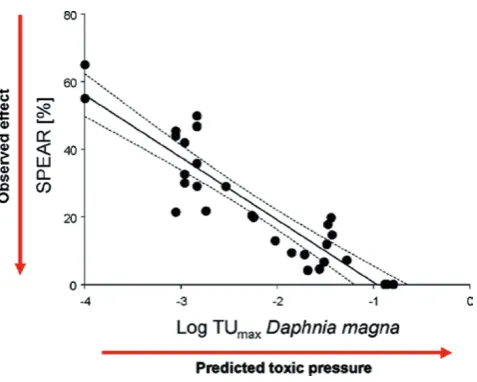
Water managers who are concerned about the ecological status of European rivers often primarily think about the most obvious stressors: insufficient habitats due to hydro -morphological alterations and excess eutrophication. How-ever, research in MODELKEY provided strong evidence that contamination with toxic chemicals has a clear impact on aquatic communities and thus on the ecological status of a water body. This may be illustrated by the example of benthic invertebrates: In all of the three case study rivers (Elbe, Scheldt and Llobregat) those invertebrate species that are sensitive to chemicals and represented by the SPecies At Risk index (SPEAR), disappeared with increasing contami-nation, which is expressed as toxic units (TU) based on tox-icity to water flea Daphnia magna (Fig. 1 for the Llobregat as an example) (von der Ohe et al. 2009).
This toxic stress could be confirmed for local communities in aquatic systems. We found evidence that benthic commu-nities in the Llobregat were impacted by bioactive substanc -es like pharmaceuticals. Multi-variate statistics revealed that the abundance and biomass of macroinvertebrates were correlated with concentrations of selected pharmaceuticals (e. g. Chironomus sp. with ibuprofen) (Munoz et al. 2009). Changes in physiological parameters of microalgal commu-nities in the same field investigation were mainly correlated with the presence of pesticides (Ricart et al. 2009).
For the Scheldt basin, a tremendous alteration of the com-position of macroinvertebrate communities has been detect-ed downstream of the discharge of industrial and domestic waste water effluent at the river Schijn. This was especial -ly the case for molluscs, where some species (e. g. Pota mopyrgus antipodarum) were completely absent in parts of the river. In situ experiments with caged snails (P. antipo
darum) revealed an unusual high reproduction potential at the downstream site, obviously resulting in a reduced com-petitiveness and thus disappearance of this species. Because of the fact that those snails are known to be very sensitive to endocrine-disrupting chemicals and that their reproduc-tion is enhanced by xeno-estrogenic compounds (Duft et al. 2007), it was assumed that endocrine-disrupting compounds play an important role concerning the loss of species at this particular site. Additional experiments detected a high es-trogenic equivalence concentration (using yeast estrogen screen [YES]) and a high concentration of the xeno-estrogen nonylphenol (0.91 ng/g sediment dw) at that site ( Schmitt et al. 2010).
To be able to direct remediation efforts to improve the quality of European waters, a causal link is needed bridg-ing contamination to impairment of aquatic communities. Thus, in situ experiments have been developed and applied during the project, as illustrated in the examples above. Moreover, MODELKEY demonstrated that communities (defined as assemblages of interacting species) are more sensitive towards toxicants than indicated by single species investigations. The concept of pollution-induced commu-nity tolerance (PICT) was applied to discriminate effects of key toxicants on a community level in the Elbe river basin, Germany. Algal communities from a contaminated site ex -hibited significantly higher tolerance to the herbicide prom -etryn, compared to the reference, indicating a loss of sensi-tive species caused by prometryn (McClellan et al. 2008).
These examples demonstrate that there is strong evi-dence of toxic stress impairing biological quality elements (BQEs). However, this can be seen only if appropriate diag-nostic tools are applied that show stressor-specific responses rather than general degradation only.
Fig. 1 Relation between observed effects from toxic stress, expressed by the SPEAR indicator, and the predicted toxic stress, expressed by
2 Impairment of ecological status results from the impact of multiple stressors
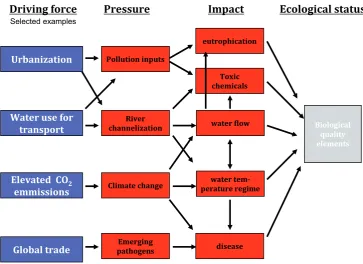
The WFD requires the identification of significant anthropo -genic pressures and the assessment of their impact on water bodies (Annex II, WFD). Relevant stressors include, among others, toxic chemicals arising from point source discharges or diffuse pollution, altered habitat properties due to hydro-morphological changes, altered species interaction due to the invasion of alien species or disease and increased mor-talities due to the presence of emerging pathogens (Fig. 2).
The risk imposed by multiple stressors to aquatic re-sources cannot be understood from assessing each indi-vidual stressor alone, but requires consideration of possible interactions and combination effects (Segner 2007). The ec-ological status integrates the impact of all stressors, regard-less of whether they are present simultaneously or whether they are spatially and temporally separated. Importantly, the consequences of the combined impact are not only a func-tion of stressor magnitude, frequency or durafunc-tion, but also of the traits and characteristics of the biological receptors. This includes, for instance, the resilience of an ecosystem, the species composition of communities, or the genetically and physiologically determined resistance of resident spe-cies (see also Sect. 10).
Given such a complex situation, the challenge is to iden -tify the hierarchy amongst the multiple stressors in order to prioritise remedial actions.
The MODELKEY project has taken different approaches to understand and assess the role of chemical stressors in
relation to the impact of other stressors. These approaches included the development and application of
• diagnostic experimental techniques such as the use of bio assays, biomarkers, pollution-induced community tol-erance (PICT) or toxicogenomics and -metabolomics to disentangle the role of toxic chemicals versus the impact of non-chemical stressors on aquatic species,
• mechanistic experimental studies to understand inter -actions between stressors and how they translate into trait- or density-mediated indirect effects on species and populations,
• mechanistically based models to predict interactions between stressors and how they translate into altered population growth and ecosystem structure (species composition) and functioning (processes such as primary production rate, etc.),
• multi-variate methodologies to identify those stressors that are major drivers of biological variability in an aquatic ecosystem,
• eco-epidemiological methodologies to quantify the in -tensity of stressors and to relate this to the biodiversity of river sites or river basins and
• stressor-specific indices to signify impairment of BQEs.
Research needs
Currently, assessing the role of multiple stressors in eco-system impairment and inferring causative agents is largely done on an empirical, case-by-case approach. What is need-ed, however, are more conceptual approaches providing
Fig. 2 DP(S)IR (Driving force – Pressure – State – Impact – Response) concept graph on multiple stress; in this schematised presentation, the S component was merged into P
Biological quality elements Urbanization
eutrophication
Driving force Pressure Impact Ecological status
Water use for transport
Elevated CO2 emmissions
Global trade
Pollution inputs
River channelization
Climate change
Emerging pathogens
Toxic chemicals
Selected examples
water low
water tem-perature regime
a framework for an integrative – instead of solely chemi-cal – risk assessment, i. e. the analysis, characterisation and possibly quantification of the combined risks to the environ -ment from multiple stressors. MODELKEY has provided examples of how to tackle the problem of multiple stressor assessment. Future research should build on that and devel-op tools that enable water managers to
• set hierarchies on the relative importance of stressors, • find evidence of cause–effect relationships,
• extrapolate multiple stressor effects across biological, spatial and temporal scales.
In developing these tools, it is important to keep in mind that multiple stressor assessment asks both for more under-standing of the processes underlying stressor interactions and for more “ecological topping up” (see Sect. 10) of ex-isting approaches.
3 “What to do if … ?” – A tiered approach to assess the impact of chemicals
The WFD forces water managers to invest in reaching a so-called “good” chemical and ecological status of its water bodies by the end of the year 2015. However, the list of pri-ority substances used to define the chemical status, contains only a small fraction of the chemicals that can be present in the environment and as a consequence the qualification “good chemical status” can never guarantee that the BQEs are not affected by toxic compounds. In the case where the chemical status is good in terms of the WFD, but (some) BQEs are poor, it may be difficult to identify the real causes.
This yields a potential problem for water managers since expensive measures, such as the improvement of hydromor-phological characteristics of a water body, may be hardly effective if the BQEs are negatively affected by the presence of unknown toxic compounds. Actually, such site- or river basin specific toxic compounds should also be monitored in the frame of assessing the ecological status.
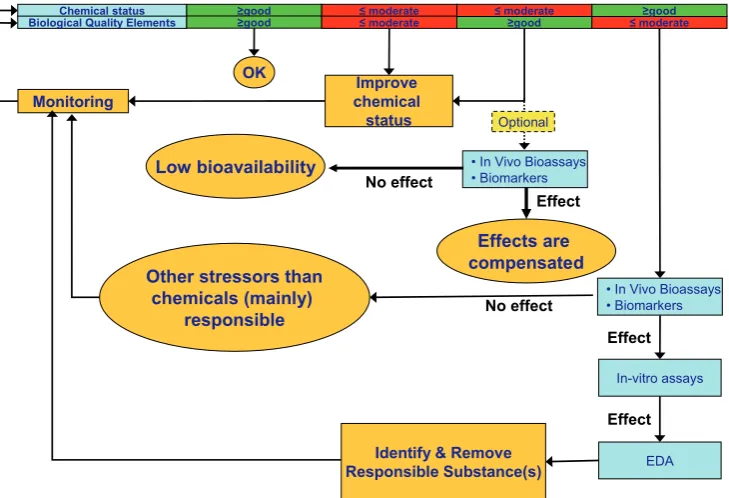
To deal with this problem, the approach developed within MODELKEY was converted into a practical flow chart that can be used as a guideline to assess whether toxic compounds affect the ecological status of a water body (Fig. 3). This flow chart can help water managers in terms of decision-making in regard to the most effective measure to improve the ecological status of a water body. For example, in the case of a “good” chemical status but insufficient ecological status (top, right), this approach suggests the application of available toxicological (and ecological) tools (e. g. various in vivo and in vitro assays) to verify chemicals as causa-tive factors for the deterioration. Subsequently, with Effect-Directed Analysis studies (EDA), the responsible (group of) basin or site-specific toxic compounds can be determined (Brack et al. 2008), to be considered in future monitoring plans and programmes of measures.
4 MODELKEY suggests a field-evidence-based approach to derive candidates for monitoring and prioritisation
MODELKEY demonstrated that toxic compounds affect aquatic communities, by replacement of sensitive species (see Sect. 1). Significant effects were observed already at
Fig. 3 Schematic overview of
the tiered assessment approach Biological Quality ElementsChemical status ≥good≥good ≤ moderate≤ moderate ≤ moderate≥good ≤ moderate≥good
Improve chemical
status Monitoring
No effect
Effect
In-vitro assays
Effect
EDA Identify & Remove
Responsible Substance(s)Identify & Remove
Responsible Substance(s)
• In Vivo Bioassays
• Biomarkers
• In Vivo Bioassays
• Biomarkers
No effect
Optional
Effects are compensated
Effect Low bioavailability
Other stressors than chemicals (mainly)
responsible
concentrations a thousand times lower than acute lethal concentrations (LC50 values) to Daphnia magna. And these are concentrations that frequently occur in our rivers. Thus, taking toxic contamination into account is crucial for suc-cessful management of rivers and the achievement of a good ecological status. However, the assessment of toxic effects on the BQEs is hampered by the enormous complexity of contamination. While only 41 priority and other hazardous chemicals together with some river-basin specific com -pounds are monitored in European river basins, screening analyses in environmental samples detect many thousands of compounds in each individual sample. These compounds are a subset of the 50 million chemicals we know today to-gether with the even greater number of compounds we do not know yet. Thus, defining candidate compounds for mon -itoring and prioritisation is a challenging task.
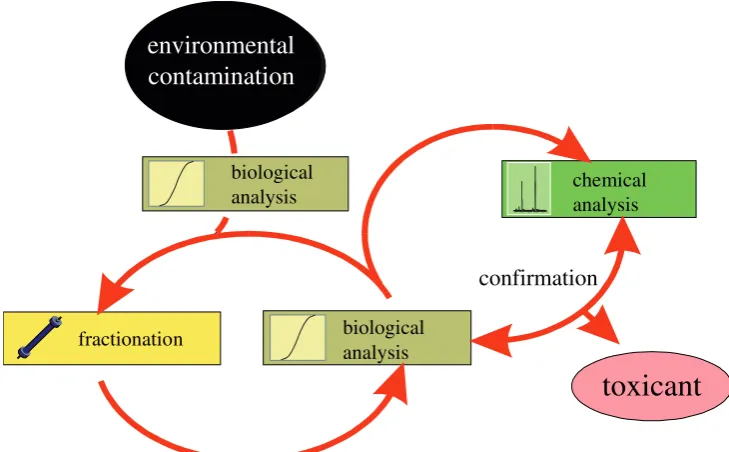
The European Commission meets this challenge by ap-plying two approaches. One approach applies PEC/PNEC ratios (ratio of Predicted Environmental Concentrations to Predicted No Effect Concentration) based on chemical monitoring data from the member states, while the other ap-proach is based on modelled exposure data applying pro-duction volumes and usage patterns for the candidate com-pounds. Both approaches are complementary and powerful for compounds with a sufficient data basis. However, for many compounds present in the environment, neither moni-toring nor reliable production data are available. Therefore, MODELKEY suggests involvement of a third approach based on field relevance applying effect-directed analysis (EDA, Fig. 4; Brack 2003). This approach is complemen-tary to the others. It does not require any a priori knowledge on the chemicals we are looking for. It is based on
measur-able effects and thus specific for selected toxicological end -points. Accordingly, it would combine ideally with effect monitoring based on biotests and biomarkers.
The EDA approach is site specific. Thus, the selection of sites representative and relevant for the river basin is important. We suggest that performing EDA downstream of major sources of pollution (intensive agriculture, indus-trial agglomerations, big cities …) but also in integrative sinks such as reservoirs, harbours or estuaries, particularly for sediment-associated compounds, would derive valuable candidates for prioritisation, monitoring and reduction.
EDA is based on selected toxicological endpoints and combines biotesting with fractionation to sequentially re-duce complexity down to those compounds (or compound groups) causing observable effects. Finally, the components of the toxic fractions are analytically identified, quantified and confirmed as the cause of the effect. MODELKEY de -veloped an extensive integrated toolbox for EDA including tools for exhaustive and bioaccessibility-directed extraction (Schwab and Brack 2007), clean-up and fractionation tools (Lübcke-von Varel et al. 2008; Meinert et al. 2010), biotests and bioavailability-directed dosing techniques (Bandow et al. 2009), and analytical and computer tools for struc-ture elucidation (Schymanski et al. 2008). We applied this toolbox to sediments and waters at several sites in the three river basins mentioned above. The identified fractions and compounds bore little correspondence to what had been ex-pected and to what are included in priority pollutant and river basin specific monitoring lists. This is illustrated using sediments as an example. Current assessment of sediment contaminants has a clear focus on nonpolar and highly hy-drophobic compounds like for example polycyclic aromatic
Fig. 4 EDA scheme (modified
after Brack 2003)
environmental
contamination
biological analysis
biological analysis
chemical analysis
fractionation
confirmation
hydrocarbons (PAHs), polychlorinated biphenyls (PCBs), polychlorinated dioxins and furans (PCDD/Fs) and chlo-rinated pesticides such as DDT, HCH, HCB, aldrin and dieldrin. EDA focusing on algal growth inhibition, muta-genicity, tumour promotion and endocrine disruption (es-trogenic, androgenic, arylhydrocarbon-receptor mediated, thyroid hormone disturbing) as endpoints suggested a clear dominance of polar fractions causing these effects. These are thus likely relevant for different BQEs but possibly also for human health. This tendency towards attributing impacts to more polar compounds was further enhanced if bioavailability was considered in the EDA studies. Typical compounds identified as major toxicants in sediments were polar PAH-derivatives including nitro and keto-PAHs and PAH-quinones, the biocide triclosan used in personal care products, musk compounds such as galaxolide and tonal-ide or the flame retardant tri(2-chloroisopropyl)phosphate. None of these compounds is a priority pollutant or regularly monitored.
5 EQS values may be not protective for sensitive species
According to the EU Water Framework Directive, chemi-cal contamination is assessed on the basis of environmen-tal quality standards (EQS). Applying the SPecies At Risk (SPEAR) index MODELKEY clearly showed that sensitive invertebrate species are affected already at concentrations that are by a factor of 1,000 below the acute LC50 value for Daphnia magna, which is the most frequently used in-vertebrate test organism. This indicates that EQS closer to the acute lethal concentrations than a factor of 1,000 are not protective for invertebrate communities. These EQS have been derived from chronic or mesocosm experiments using a lower assessment factor on the observed effect concentra-tions. The priority pollutant chlorfenvinphos with an EQS of 0.1 µg/L and an LC50 of 0.3 µg/L may serve as an example. This compound is considered as less important and is rarely monitored because fortunately exceedances of the EQS are almost never observed when measured. However, already at concentrations far below the EQS an extensive disappear-ance of sensitive species will occur. On the basis of TU, chlorfenvinphos is among the most problematic compounds in the river basins investigated by MODELKEY.
6 Considering bioavailability and bioaccumulation improves the assessment of chemical stress
Traditional approaches in compliance monitoring and risk assessment of chemicals in the aquatic environment are based on the measurement and evaluation of total concen-trations in water and sediment. Although it is well known
that only a limited part of the contaminants bound to sedi-ments, soils, suspended particulate matter, and colloids may be available for uptake by organisms, to date no standard-ised approaches exist that properly address bioavailability in monitoring and risk assessment.
A multitude of factors may determine the bioavailability of organic chemicals in sediments, including: (1) sediment characteristics, such as the type and quantity of organic matter (e. g. black carbon), grain size, ageing, (2) compound properties, such as lipophilicity, chemical structure (e. g. planarity), (3) organism-related factors, such as lipid con-tent, body size, age, feeding habits, reproduction, habitat use, migration, biotransformation, and trophic position, and (4) environmental factors such as temperature and seasonal effects.
In MODELKEY much effort was dedicated to the assess -ment of bioavailability and bioaccumulation in integrated field, laboratory and modelling studies. The laboratory de -sorption and bioaccumulation studies with spiked contami-nants demonstrated that, although our understanding of the factors involved is far from complete, the freely dissolved water concentrations, sediment characteristics, and – to a lesser extent – the rapidly exchanging fraction appeared to be the most predictive parameters for most of the com-pounds (Sormunen et al. 2009).
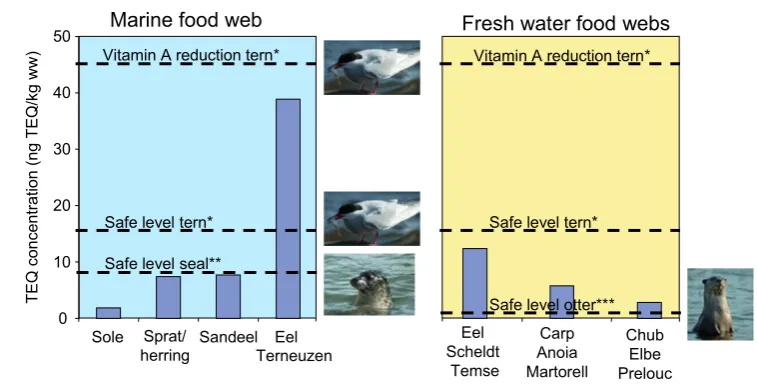
Bioaccumulation and trophic transfer were addressed in field studies, where in situ levels of a broad range of compounds were determined in sediments, suspended mat-ter, water, biofilms, invertebrates and fish, sampled in the MODELKEY case study rivers Scheldt (estuary and fresh -water tributaries), Elbe and Llobregat. The (more than 150) contaminants included: traditional PAHs, PCBs, dioxins, chlorinated pesticides to PCNs, brominated flame retard -ants, PFOS (Perfluorooctanesulfonic acid), alkyl phenols and ethoxylates, cationic surfactants, estrogens, pharma-ceutical compounds, and polar pesticides. The results ex-hibited a large variation in biota-sediment accumulation factors (BSAF) between compounds, organisms and rivers, reflecting differences in uptake mechanisms, bioavailability and biotransformation. However, the results for dioxin-like compounds for example indicated that the assessment of bio-accumulation and trophic transfer is essential for assessing risks of secondary poisoning in predatory species (Fig. 5). These risks may be present even at concentrations in water that are orders of magnitude below what usually is measur-able in current monitoring programmes for total water con-centrations. Assessment and prediction of bioaccumulation and possible food web magnification may help to reveal un -expected properties of emerging compounds, and may be a useful tool to identify possible priority pollutants.
model-ling, lab- and field investigations revealed that a combina -tion of modelling parti-tioning to different organic carbon phases and applying assessment methods to estimate freely dissolved (pore) water concentrations or exchangeable sedi-ment concentrations seems to be the most cost-effective ap-proach for underpinning management decisions. Despite the still considerable uncertainties in current methods to assess bioavailability, MODELKEY investigations clearly showed that retrospective risk assessment (of supposedly contami-nated water bodies) shall be based on extractable concentra-tions and freely dissolved concentraconcentra-tions rather than on total water or total sediment concentrations. These methods can also be useful for investigative monitoring studies.
7 MODELKEY suggests improvements for surveillance and investigative monitoring
One of the goals of the WFD was to harmonise the moni-toring strategies all over Europe, which differed among countries or even regions with respect to for example pa-rameters recorded or metrics applied for the same endpoint. The WFD distinguishes three different types, in a tiered and cost-effective basic design: surveillance, operational and investigative monitoring. The surveillance monitoring shall be carried out at a sufficient number of sites to provide an assessment of the overall surface water status and aims to monitor the actual status and to assess long-term changes resulting from widespread anthropogenic activity. The op-erational monitoring should establish the status of those wa-ter bodies identified as being at risk of failing to meet the environmental objectives, and to assess any changes in the status of such water bodies that result from the programmes of measures. Investigative monitoring again shall be carried out where the causes of a water body failing to achieve the environmental objectives are unknown. MODELKEY de
-veloped innovative environmental assessment tools to sup-port all three monitoring programmes to unravel unknown chemicals that might be responsible for the observed deg-radation.
Current monitoring programmes are less comprehensive than previous national or regional monitoring programmes with respect to frequency, number of stations, matrices and parameters, as a result of the Common Implementation Strat-egy. That favours the success of intercalibration of assessment tools, but reduces the overall ambition. Within MODELKEY, new assessment tools were tested and applied on exist-ing monitorexist-ing data from the case study river basins (Elbe, Llobregat and Scheldt) and from Danube basin (Fig. 6). The experiences gained during the project resulted in suggestions to improve the monitoring programmes applied in function of the WFD. The main strengths of the existing programmes have been the long-time series of standardised methods and the occasional high frequencies, providing a high tempo-ral and spatial resolution of water quality changes. In some monitoring programmes, chemical and biological assessment in all environmental compartments (water (suspended) and sediment biota) supplemented with eco-toxicological assess-ments provided extra tools for early warning. This is certainly not the case in the WFD monitoring strategy applying three different types, where warning only starts when ecosystem effects already occur. Moreover, the example of persistent, lipophilic contaminants (e. g. PCBs, DDT, BFRs, PFOS) highlights that it is not sufficient to monitor these substances in the water phase alone, as required by the WFD.
A weak point of the historic monitoring programmes was often a lack of harmonisation of methods, which resulted in the phenomenon that water quality earmarks could change when water simply crossed a border. Moreover, water qual-ity monitoring often focused on compliance with environ-mental criteria of a limited number of chemical parameters as well as on the macroinvertebrate community and was not Fig. 5 Dioxin-like compounds
(PCDDs, PCDFs, PCBs) in
fish from a marine (Western
Scheldt) and fresh water food webs (Scheldt, Anoia, Elbe) in relation to safe and critical body burden concentrations for tern, harbour seal and otter
0 10 20 30 40 50 Sole Sprat/
herring Sandeel EelTerneuzen
Eel Scheldt Temse Carp Anoia Martorell Chub Elbe Prelouc TE Q c on ce nt ra tio n (n g TE Q /k g w w
) Vitamin A reduction tern* Vitamin A reduction tern*
* n r e t l e v e l e f a S * n r e t l e v e l e f a S
Safe level otter*** Safe level seal**
designed to establish cause–effect relationships. Minimis-ing monitorMinimis-ing effort was even rewarded by facMinimis-ing fewer problems under the WFD.
The WFD investigative monitoring offers opportunities to determine the causal link between pressures, stressors and the impact causing an insufficient ecological status. The main aim of MODELKEY was to address just these cause–effect links. By combining tools working at differ-ent eco-system levels (e. g. from chemical toxicity, via food web bioaccumulation to biological reproduction), possible causes of impaired ecological status could be detected. The major finding from these case study assessments is that minimising the monitoring ambition in any of the three WFD monitoring types creates the risk of leaving the real ecosystem problems to the next generation. This is not the basis for sustainable development, as also recognised by the European community.
Suggestions for improving the monitoring strategy under the WFD include:
• the use of bioassays as early warning indicators in surveil -lance monitoring. Bioassays cover a wide range of known and unknown chemicals (> hazardous substances), • to measure biological communities and chemical stres
-sors at the same site and at the same time to allow for cause–effect relationships,
• to harmonise biological and chemical codes on a Euro -pean level to facilitate the application of Euro-pean as-sessment tools,
• to discriminate between the optimal matrices for hazard -ous substances analysis: water for hydrophilic and sus-pended matter, sediment, biotic tissues for hydrophobic compounds,
• to explore the use of biomimetic monitoring techniques which are concentrating and time-integrating, and can be used both for chemical and bioassay analysis,
• to discriminate the ecological targets (organisms), e. g. by food web studies (birds and fish have completely differ -ent stressors).
8 MODELKEY provides new integrated tools for risk assessment and decision-making on a basin scale
European water managers find the ecological status of the water bodies in their river basins threatened by different pressures (“multiple stresses”; among them the possible toxic effects of a wide range of chemicals.
MODELKEY investigated and applied different meth -ods to predict toxic stress on the basis of measured concen-trations in the field. The TU method offers the possibility to differentiate the predicted toxic stress between phyto-plankton, macroinvertebrates and fish (von der Ohe et al. 2009). The “multi-species potentially affected fraction of species” (msPAF) directly quantifies the expected loss of species, taking into account mixture toxicity. Both meth-ods use estimated bioavailable concentrations (de Zwart et al. 2009).
Despite the fact that these methods quantify only “known” toxicity connected to chemicals which are measured, and do not account for unmonitored emerging pollutants, the predicted effects can indeed be observed in the field. The SPEAR (SPecies At Risk) indicator expresses the share of invertebrate species sensitive to toxic stress within the total spectrum of species (Liess and von der Ohe 2005). Any sig -nificant reduction of this indicator, compared to a reference value of 50 %, indicates possible effects from toxic stress.
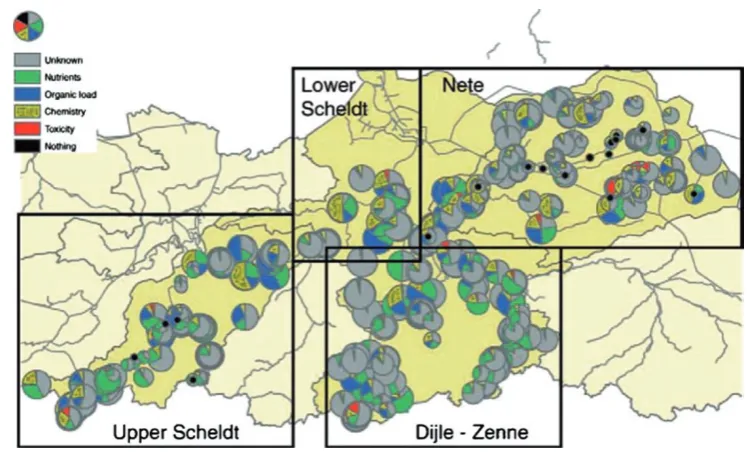
By state-of-the-art effect modelling, MODELKEY re -search demonstrated in different case studies (Scheldt River, Danube River) that the msPAF predicted loss of species is significantly related to the actually observed loss of species, even in complex multi-stress conditions (Fig. 7). Further-more, the msPAF predicted loss of species correlated well with the results from bioassays.
The tools mentioned above have been implemented in the MODELKEY DSS (see Sect. 9) which supports the analysis of field data for evidence of various stressors on the ecosys -tem and the prioritisation between different polluted sites, in support of cost-effective programmes of measures.
Fig. 6 Time series of number of measured chemicals in the four investigated case studies
0 10 20 30 40 50 60 70
1996 1997 1998 1999 2000 2001 2002 2003 2004 2005 2006 2007 2008
Average number of measured chemicals
per sampling site
With respect to prioritisation between different polluted sites, MODELKEY research also resulted in the EXPOBA -SIN model (van Gils et al. 2009). This model establishes spatial relations between causes (pollution sources) and downstream impacts (ecological risk, expressed as TU) to allow a spatial, quantitative and objective ranking of chemi-cals and/or pollution sources. The model can easily be ap-plied to all European river basins. Within MODELKEY it has been applied to the Rhine, Elbe, Scheldt, Llobregat and Danube Rivers. Figure 8 demonstrates a comparative assessment of two pollution sources in the Czech part of the Elbe Basin. The EXPOBASIN model includes the lat -est insights in bioavailability modelling and also addresses
bioaccumulation, so that the impacts up to the level of top predators (secondary poisoning) can be included in the as-sessment (Fig. 9).
MODELKEY research resulted in clear insights into fu -ture research needs. To further facilitate the drafting of cost-effective programmes of measures in Europe, the MOD-ELKEY effect-oriented approach should be connected to a source-oriented approach (as e. g. applied in the project SOCOPSE), including the compilation of suitable invento-ries of diffuse sources of pollution. For some chemicals this may necessitate the integration of the environmental com-partments water, air, ground water and soils in a spatially distributed fashion.
Fig. 7 Observed loss of
spe-cies (pie size) and identified
causes (stressors), among them the msPAF predicted loss of species (“toxicity” pie slices).
From de Zwart et al. 2009, with
permission
Fig. 8 Sample results from EXPOBASIN: the colours indicate the maximum relative risk to the phytoplankton community (expressed as TU) as
9 The MODELKEY Decision Support System supports river basin managers
Within MODELKEY, a decision support system (DSS) sup -porting the overall assessment process of river basins ac-cording to WFD requirements is implemented (Gottardo et al. 2009).
The MODELKEY DSS is an innovative software sys -tem that combines several risk-based assessment tools
sup-porting river basin management. It allows classifying the ecological and chemical status of individual water bodies or (monitoring) locations. It prioritises hot spots by integrating environmental and socio-economic information. By identi-fying relevant causes of impairment (key stressors and key toxicants) and the most impaired biological communities (key ecological endpoints at risk) the DSS supports the set up of additional (investigative) monitoring and consecutive measures.
Fig. 9 Simplified generic food web included in EXPOBASIN
model
All these features are available in a simple-to-use, geo-graphically resolved, GIS-based software system structured in three modules: environmental, socio-economic and pri-oritisation. It offers adaptability to various rivers and local conditions, perfect coherence with the language and the re-porting requirements of the WFD, technical simplicity and preferential flexibility, transparency and traceability of re -sults, enhanced by strong graphical interface visualisation.
In Fig. 10, an example of the results provided by the DSS is reported.
The MODELKEY DSS is user friendly and freely down -loadable from the MODELKEY project website (www. modelkey.org) after registration.
After the end of the MODELKEY project the main ob -jective of the DSS developers team is to promote the ap-plication of the software system both within Europe (e. g. to support the preparation of the future River Basin Manage-ment Plans according to WFD cycles) and outside Europe through training courses and presentations at international conferences.
The present DSS offers the possibility to develop further modules and/or adapt existing ones to support new applica-tions, for instance to address groundwater, or water quantity issues due to climate change impacts. Also a management module supporting the selection of more appropriate inter-ventions for identified hot spots may be developed.
10 Do projected management measures improve the ecological status? Combining MODELKEY diagnostic tools with recent ecological methods opens up new opportunities for success prognosis
MODELKEY has clearly shown that toxic compound mix -tures may cause deviations from the good ecological status (GES). These effects often remained hidden because of a Europe-wide tendency to focus on a limited set of chemi-cals and because of the intrinsic complexity of the problem: At any specific site many compounds and mixtures play a role within a complex multi-stress context. Thus, a suite of approaches and techniques was developed and applied in MODELKEY locally and on large geographical scales to diagnose and unveil those GES-relevant mixture impacts hidden so far. This will help to design River Basin Man-agement Plans to counteract mixture impacts and to limit the risk that management successfully acts on one or two
apparently major drivers for poor ecological conditions, but fails to reach GES because of chemical mixtures being the next “weakest link”.
MODELKEY but also the Integrated Project NoMira -cle, confirmed by recent US (National Research Council US 2008) or EU (Council of the European Union 2010) concerns on joint impacts, suggest an increasing focus on
the net impact on the protection endpoints rather than on separate causes. Supporting this, the EU recently stated in a flyer on Ecosystem Services that “policy makers are chang ing their perspective and are integrating ecosystem health into some sectoral policies” (European Commission 2009). Thus, we suggest taking a receptor in its surface water or sediment setting, and studying the complex stresses oper-ating on the receptor via a stepwise “peeling-off probable causes” approach, to result in the identification of major stressors. With a focus on chemical stressors MODELKEY demonstrated the strength of this approach in EDA. Like -wise, given major (bio)monitoring databases (as collected under the WFD), MODELKEY has proposed various meth -odologies for site-specific diagnosis of impact magnitudes and probable causes.
While MODELKEY results provide a crucial step to -wards a holistic, receptor-based approach, we argue that these findings can be further expanded and deepened by combining them with recently developed, other promis-ing eco(toxico)logical approaches and data. This will help to further improve site-specific diagnosis and prognosis of management effectiveness. We could show that ecological methods, adding data on species traits (functional proxies for their ecological “opportunities”; and data on “who eats whom?” (mathematical proxies for species‘ positions in food webs), are potentially of great help in the diagnosis of local ecosystem impairments and quantification of stability and resilience. Additional costs are quite limited, since the (bio)monitoring data are already available.
The same approach may provide the basis for prognoses, whether “Good Ecological Status” will be reached when Riv -er Basin Management Plans (potentially designed for GES) are implemented further. Even without being fully able yet to predict the consequences of human impacts on structures and functions of aquatic systems, we have to develop prog-nostic tools to provide informed guesses on the dimensions of change and improvements expected from management and to alert on the most relevant remaining threats.
Within MODELKEY the proof of the pudding for our argument has already been given. Considering ecotoxico-logical methods, combination of existing (bio)monitoring data with species sensitivity data for toxicants and mixture modelling approaches yielded a novel proxy parameter (the multi-substance potentially affected fraction, msPAF), which is a measure for a net local toxic pressure (de Zwart et al. 2009). This novel proxy helped to unravel local multi-stress impacts, including the unravelling of the role of mix-tures and separate compounds therein.
techniques (based on monitoring data) with the site-specific tools results in a versatile toolbox for effective river basin management.
References
Bandow et al. (2009) Partitioning based dosing – an approach to in-clude bioavailability in the effect directed analysis of
contami-nated sediment samples. Environ Sci Technol 43:3891–3896
Brack W (2003) Effect-directed analysis: a promising tool for the
iden-tification of organic toxicants in complex mixtures. Anal Bioanal
Chem 377:397–407
Brack W et al. (2005) MODELKEY – Models for assessing and fore -casting the impact of environmental key pollutants on freshwater and marine ecosystems and biodiversity. Environ Sci Pollut Res
12(5):252–256
Brack W, Schmitt-Jansen M, Machala M, Brix R, Barceló D,
Schy-manski E, Streck G, Schulze T (2008) How to confirm identi
-fied toxicants in effect-directed analysis. Anal Bioanal Chem
390(8):1959–1973
Council of the European Union (2010) Combination effects of chemi-cals. Draft Council conclusions. Dec. 10, 2009
Duft M, Schmitt C, Bachmann J, Brandelik C, Schulte-Oehlmann U, Oehlmann J (2007) Prosobranch snails as test organisms for the assessment of endocrine active chemicals – an overview and a guideline proposal for a reproduction test with the freshwater mudsnail Potamopyrgus antipodarum. Ecotoxicol 16:169–182 European Commission (2009) Ecosystem Goods and Services (4-page
flyer), September
van Gils J et al. (2009) Exposure modeling on a river basin scale in
support of risk assessment for chemicals in European river basins. Integr Environ Assess Manag 5(1):80–85
Gottardo S et al. (2009) MODELKEY: a decision support system for
the assessment and evaluation of impacts on aquatic ecosystems.
In: Marcomini A, Suter GW II, Critto A (eds) Decision sup -port systems for risk based management of contaminated sites.
Springer, Heidelberg New York, pp 331–351
Liess M, von der Ohe PC (2005) Analyzing effects of pesticides on
invertebrate communities in streams. Environ Toxicol Chem
24(4):954–965
Lübcke-von Varel U et al. (2008) Automated fractionation procedure
for polycyclic aromatic compounds in sediment extracts on three
coupled normal phase HPLC columns. J Chrom A 1185:31–42
McClellan K et al. (2008) Pollution-induced community tolerance as a
measure of species interaction in toxicity assessment. J Appl Ecol 45:1514–1522
Meinert C et al. (2010) Optimisation of trapping parameters in prepar-ative capillary gas chromatography for the application in
effect-directed analysis. Chemosphere 78:416–422
Munoz I et al. (2009) Bridging levels of pharmaceuticals in river water with biological community structure in the Llobregat River basin (Northeast Spain). Environ Toxicol Chem 28(12):2706–2714
National Research Council US (2008) Committee on the health risks of phthalates. Phthalates and Cumulative Risk Assessment – The Task Ahead. ISBN: 978-0-309-12841-4, 208 pp
von der Ohe PC et al. (2009) Towards an Integrated and Integra-tive European Risk Assessment. Integr Environ Assess Manag
5(1):50–61
Ricart M, Guasch H, Barceló D, Brix R, Conceiçao MH, Geszinger A, López de Alda M, López-Doval JC, Muñoz I, Postigo C, Romaní
AM, Villagrasa M, Sabater S (2009) Primary and complex stres-sors in polluted Mediterranean rivers: pesticide effects on
biolog-ical communities. J Hydrol, DOI: 10.1016/j.jhydrol.2009.08.014 Schmitt C, Balaam J, Leonards P, Brix R, Streck G, Tuikka A, Ber
-voets L, Brack W, Van Hattum B, Meire P, de Deckere E (2010) Characterizing field sediments from three European river basins
with special emphasis on endocrine effects – a recommendation for Potamopyrgus antipodarum as test organism. Chemosphere,
DOI: 10.1016/j.chemosphere.2010.03.050
Schwab K, Brack W (2007) Large volume TENAX extraction of the
bioaccessible fraction of sediment-associated organic compounds for a subsequent effect-directed analysis. J Soils Sediments
7(3)178–186
Schymanski E et al. (2008) The use of MS classifiers and structure generation to assist in the identification of unknowns in effect-directed analysis. Anal Chim Acta 615:136–147
Segner H (2007) Ecotoxicology – how to assess the impact of toxi-cants in a multi-factorial environment? In: Mothersill et al. (eds) Multiple stressors: A challenge for the future. Springer,
Heidel-berg New York, pp 39–56
Sormunen AJ et al. (2009) Desorption and bioavailability of spiked
pentabromo diphenyl ether and tetrachlorodibenzo(p)dioxin in contaminated sediments. Arch Environ Contam Toxicol 56:670– 679
de Zwart D et al. (2009) Diagnosis of ecosystem impairment in a